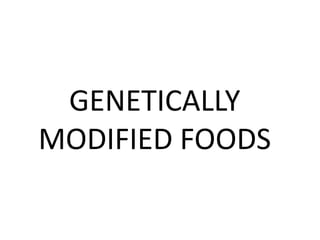
Green revolution
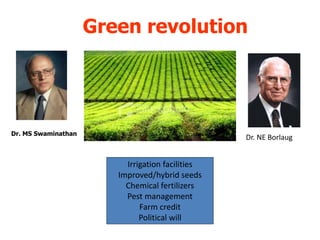
Dr. MS Swaminathan
Irrigation facilities
Improved/hybrid seeds
Chemical fertilizers
Pest management
Farm credit
Political will
Dr. NE Borlaug
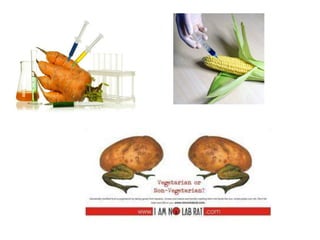
GENETICALLY
MODIFIED FOODS
What are GM’s?
are a result of technology that has altered the
DNA of living organisms (animals, plants or
bacteria)
Other terms that mean the same thing:
Genetically engineered
Transgenic
Recombinant DNA (rDNA) technology
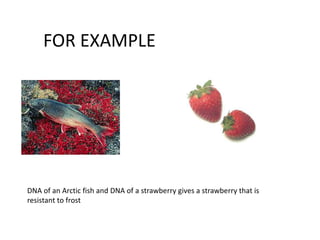
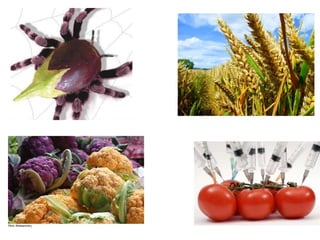
+DNA of an Arctic fish and DNA of a strawberry gives a strawberry that is
resistant to frost
FOR EXAMPLE
Why do it ?
• Initially started in the U.S,
objective was to improve crop
protection i.e to translate food
into a product with lower price
and greater benefit.
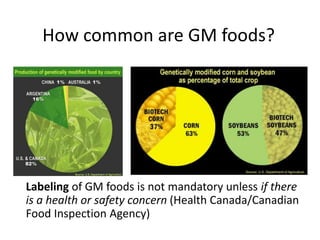
How common are GM foods?
Labeling of GM foods is not mandatory unless if there
is a health or safety concern (Health Canada/Canadian
Food Inspection Agency)
Benefits of Genetic Engineering
and Modifying
1. Higher yielding crops, more efficient use of land
2. Can save money and promote higher profits
3. Longer shelf life, less waste
Example// Tomatoes from genetically
modified seeds stay fresh
longer.
4. Enhanced taste and quality
5. Reduced maturation time
6. Increased and improved nutrients and stress tolerance
- A single gene genetically engineered into cauliflower can increase
production of beta-carotene 100 times.
- A gene can be implanted into a soybean upgrading the soy protein
to a quality equal to that of milk.
- Corn can be modified to contain its two limiting amino acids,
lysine or tryptophan
7. Improved resistance to disease or illness
- Foods can be enhanced with phytochemicals that help maintain
health and reduce the risks of chronic disease.
8. Improved crop resistance to disease, pests, weeds and herbicides
9. New products and growing techniques
- “Individuals allergic to milk may be able to buy milk that has been
treated with the lactase enzyme” (Whiney, 2002).
- Creating decaffeinated coffee beans are in a process of research.
What are people’s concerns
• Is this food safe?
• Should food be labeled?
• Are there adverse
environmental effects?
• Patenting of seeds
• Discrimination against the
poor
• Who benefits?

abstract

  • 1.
    Green revolution Dr. MSSwaminathan Irrigation facilities Improved/hybrid seeds Chemical fertilizers Pest management Farm credit Political will Dr. NE Borlaug
  • 2.
  • 3.
    What are GM’s? area result of technology that has altered the DNA of living organisms (animals, plants or bacteria) Other terms that mean the same thing: Genetically engineered Transgenic Recombinant DNA (rDNA) technology
  • 4.
    +DNA of anArctic fish and DNA of a strawberry gives a strawberry that is resistant to frost FOR EXAMPLE
  • 5.
    Why do it? • Initially started in the U.S, objective was to improve crop protection i.e to translate food into a product with lower price and greater benefit.
  • 6.
    How common areGM foods? Labeling of GM foods is not mandatory unless if there is a health or safety concern (Health Canada/Canadian Food Inspection Agency)
  • 10.
    Benefits of GeneticEngineering and Modifying 1. Higher yielding crops, more efficient use of land 2. Can save money and promote higher profits 3. Longer shelf life, less waste Example// Tomatoes from genetically modified seeds stay fresh longer. 4. Enhanced taste and quality 5. Reduced maturation time
  • 11.
    6. Increased andimproved nutrients and stress tolerance - A single gene genetically engineered into cauliflower can increase production of beta-carotene 100 times. - A gene can be implanted into a soybean upgrading the soy protein to a quality equal to that of milk. - Corn can be modified to contain its two limiting amino acids, lysine or tryptophan 7. Improved resistance to disease or illness - Foods can be enhanced with phytochemicals that help maintain health and reduce the risks of chronic disease. 8. Improved crop resistance to disease, pests, weeds and herbicides 9. New products and growing techniques - “Individuals allergic to milk may be able to buy milk that has been treated with the lactase enzyme” (Whiney, 2002). - Creating decaffeinated coffee beans are in a process of research.
  • 12.
    What are people’sconcerns • Is this food safe? • Should food be labeled? • Are there adverse environmental effects? • Patenting of seeds • Discrimination against the poor • Who benefits?