. Submitted To : DR.
WAJID ALI
. Submitted By :
ANOUSHA AJAZ
. REG # 9181
ASSIGNMENT:1
(BS)-BIOTECHNOLOGY
1ST SEMESTER
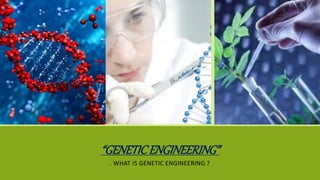
“GENETICENGINEERING”
. WHAT IS GENETIC ENGINEERING ?
.WHAT IS GENETIC ENGINEERING ?
▪ INTRODUCTION TO GENETICS.
▪ BACKGROUND OF GENETIC ENGINEERING.
▪ PROCESS INVOLVED IN GENETIC ENGINEERING.
▪ APPLICATIONS/USES OF GENETIC ENGINEERING.
.“INTRODUCTION TO GENETIC ENGININEERING”:-
▪ Genetic engineering (GE) is the modification of an organism’s genetic composition
by artificial means, often involving the transfer of specific traits, or genes, from one
organism into a plant or animal of an entirely different species. When gene transfer
occurs, the resulting organism is called transgenic or a GMO (genetically modified
organism).
▪ Genetic engineering is different from traditional cross breeding, where genes can
only be exchanged between closely related species. With genetic engineering, genes
from completely different species can be inserted into one another. For example,
scientists in Taiwan have successfully inserted jellyfish genes into pigs in order to
make them glow in the dark
.WHAT ARE GENES ?
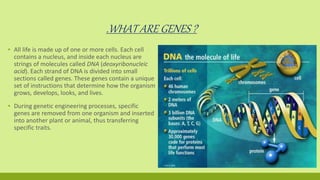
▪ All life is made up of one or more cells. Each cell
contains a nucleus, and inside each nucleus are
strings of molecules called DNA (deoxyribonucleic
acid). Each strand of DNA is divided into small
sections called genes. These genes contain a unique
set of instructions that determine how the organism
grows, develops, looks, and lives.
▪ During genetic engineering processes, specific
genes are removed from one organism and inserted
into another plant or animal, thus transferring
specific traits.
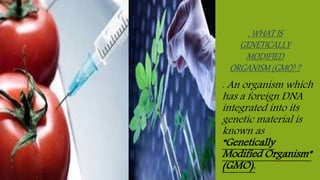
. An organism which
has a foreign DNA
integrated into its
genetic material is
known as
“Genetically
Modified Organism”
(GMO).
. WHAT IS
GENETICALLY
MODIFIED
ORGANISM (GMO) ?
. BACKGROUND OF GENETIC ENGINEERING:-
▪ Genetic engineering is normally taken to mean recombinant DNA technology -- the
artificial addition, deletion or rearrangement of sequences of bases in DNA in order
to alter the observable form and function of an organism.
▪ However, genetic engineering is sometimes referred to as biotechnology and
biotechnologists have been quick to point out that mankind has been doing
biotechnology ever since the first farmers some 10,000 years ago started to
domesticate wild species by selecting seeds of wild plants for cultivation or
selectively breeding wild animals.
▪ In this history, therefore, we include any artificial intervention in the reproductive
process as well as some landmarks in the development of genetics which has made
genetic engineering possible.
▪ This will include selection procedures old and new which could influence the
genetic outcome of a reproductive event, gene therapy and diagnosis as well as
cloning, vegetative reproduction and in vitro (test-tube) reproduction procedures.
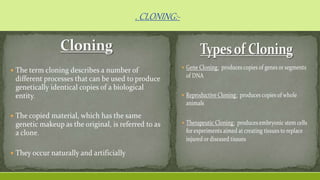
. CLONING:-
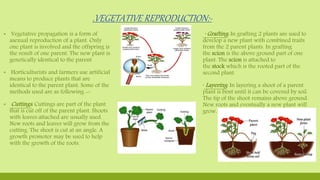
.VEGETATIVE REPRODUCTION:-
· Grafting: In grafting 2 plants are used to
develop a new plant with combined traits
from the 2 parent plants. In grafting
the scion is the above ground part of one
plant. The scion is attached to
the stock which is the rooted part of the
second plant.
· Layering: In layering a shoot of a parent
plant is bent until it can be covered by soil.
The tip of the shoot remains above ground.
New roots and eventually a new plant will
grow. These plants can then be separated.
▪ Vegetative propagation is a form of
asexual reproduction of a plant. Only
one plant is involved and the offspring is
the result of one parent. The new plant is
genetically identical to the parent
▪ Horticulturists and farmers use artificial
means to produce plants that are
identical to the parent plant. Some of the
methods used are as following :-·
▪ Cuttings: Cuttings are part of the plant
that is cut off of the parent plant. Shoots
with leaves attached are usually used.
New roots and leaves will grow from the
cutting. The shoot is cut at an angle. A
growth promoter may be used to help
with the growth of the roots.
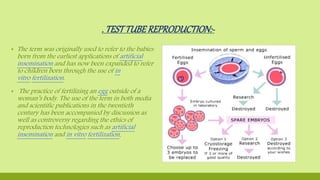
. TESTTUBE REPRODUCTION:-
▪ The term was originally used to refer to the babies
born from the earliest applications of artificial
insemination and has now been expanded to refer
to children born through the use of in
vitro fertilization.
▪ The practice of fertilizing an egg outside of a
woman’s body. The use of the term in both media
and scientific publications in the twentieth
century has been accompanied by discussion as
well as controversy regarding the ethics of
reproduction technologies such as artificial
insemination and in vitro fertilization.
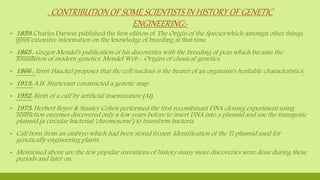
. CONTRIBUTION OF SOME SCIENTISTS IN HISTORY OF GENETIC
ENGINEERING:-
▪ 1859: Charles Darwin published the first edition of The Origin of the Species which amongst other things
gives extensive information on the knowledge of breeding at that time
▪ 1865 : Gregor Mendel's publication of his discoveries with the breeding of peas which became the
foundation of modern genetics. Mendel Web - Origins of classical genetics.
▪ 1866 : Ernst Haeckel proposes that the cell nucleus is the bearer of an organism's heritable characteristics.
▪ 1913: A.H. Sturtevant constructed a genetic map.
▪ 1952: Birth of a calf by artificial insemination (AI).
▪ 1973: Herbert Boyer & Stanley Cohen performed the first recombinant DNA cloning experiment using
restriction enzymes discovered only a few years before to insert DNA into a plasmid and use the transgenic
plasmid (a circular bacterial 'chromosome') to transform bacteria.
▪ Calf born from an embryo which had been stored frozen. Identification of the Ti plasmid used for
genetically engineering plants.
▪ Mentioned above are the few popular inventions of history many more discoveries were done during those
periods and later on.
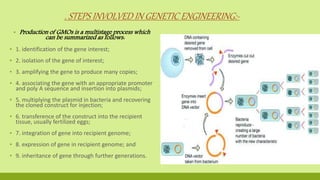
. STEPS INVOLVED IN GENETIC ENGINEERING:-
▪ Production of GMOs is a multistage process which
can be summarized as follows:
▪ 1. identification of the gene interest;
▪ 2. isolation of the gene of interest;
▪ 3. amplifying the gene to produce many copies;
▪ 4. associating the gene with an appropriate promoter
and poly A sequence and insertion into plasmids;
▪ 5. multiplying the plasmid in bacteria and recovering
the cloned construct for injection;
▪ 6. transference of the construct into the recipient
tissue, usually fertilized eggs;
▪ 7. integration of gene into recipient genome;
▪ 8. expression of gene in recipient genome; and
▪ 9. inheritance of gene through further generations.
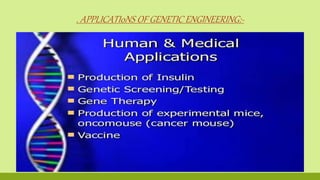
. APPLICATI0NS OF GENETIC ENGINEERING:-
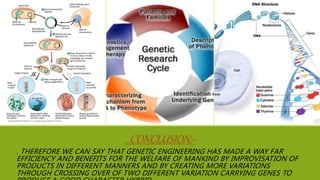
.CONCLUSION:-
. THEREFORE WE CAN SAY THAT GENETIC ENGINEERING HAS MADE A WAY FAR
EFFICIENCY AND BENEFITS FOR THE WELFARE OF MANKIND BY IMPROVISATION OF
PRODUCTS IN DIFFERENT MANNERS AND BY CREATING MORE VARIATIONS
THROUGH CROSSING OVER OF TWO DIFFERENT VARIATION CARRYING GENES TO

Genetic engineering

  • 1.
    . Submitted To: DR. WAJID ALI . Submitted By : ANOUSHA AJAZ . REG # 9181 ASSIGNMENT:1 (BS)-BIOTECHNOLOGY 1ST SEMESTER
  • 2.
  • 3.
    .WHAT IS GENETICENGINEERING ? ▪ INTRODUCTION TO GENETICS. ▪ BACKGROUND OF GENETIC ENGINEERING. ▪ PROCESS INVOLVED IN GENETIC ENGINEERING. ▪ APPLICATIONS/USES OF GENETIC ENGINEERING.
  • 4.
    .“INTRODUCTION TO GENETICENGININEERING”:- ▪ Genetic engineering (GE) is the modification of an organism’s genetic composition by artificial means, often involving the transfer of specific traits, or genes, from one organism into a plant or animal of an entirely different species. When gene transfer occurs, the resulting organism is called transgenic or a GMO (genetically modified organism). ▪ Genetic engineering is different from traditional cross breeding, where genes can only be exchanged between closely related species. With genetic engineering, genes from completely different species can be inserted into one another. For example, scientists in Taiwan have successfully inserted jellyfish genes into pigs in order to make them glow in the dark
  • 5.
    .WHAT ARE GENES? ▪ All life is made up of one or more cells. Each cell contains a nucleus, and inside each nucleus are strings of molecules called DNA (deoxyribonucleic acid). Each strand of DNA is divided into small sections called genes. These genes contain a unique set of instructions that determine how the organism grows, develops, looks, and lives. ▪ During genetic engineering processes, specific genes are removed from one organism and inserted into another plant or animal, thus transferring specific traits.
  • 6.
    . An organismwhich has a foreign DNA integrated into its genetic material is known as “Genetically Modified Organism” (GMO). . WHAT IS GENETICALLY MODIFIED ORGANISM (GMO) ?
  • 7.
    . BACKGROUND OFGENETIC ENGINEERING:- ▪ Genetic engineering is normally taken to mean recombinant DNA technology -- the artificial addition, deletion or rearrangement of sequences of bases in DNA in order to alter the observable form and function of an organism. ▪ However, genetic engineering is sometimes referred to as biotechnology and biotechnologists have been quick to point out that mankind has been doing biotechnology ever since the first farmers some 10,000 years ago started to domesticate wild species by selecting seeds of wild plants for cultivation or selectively breeding wild animals. ▪ In this history, therefore, we include any artificial intervention in the reproductive process as well as some landmarks in the development of genetics which has made genetic engineering possible. ▪ This will include selection procedures old and new which could influence the genetic outcome of a reproductive event, gene therapy and diagnosis as well as cloning, vegetative reproduction and in vitro (test-tube) reproduction procedures.
  • 8.
  • 9.
    .VEGETATIVE REPRODUCTION:- · Grafting:In grafting 2 plants are used to develop a new plant with combined traits from the 2 parent plants. In grafting the scion is the above ground part of one plant. The scion is attached to the stock which is the rooted part of the second plant. · Layering: In layering a shoot of a parent plant is bent until it can be covered by soil. The tip of the shoot remains above ground. New roots and eventually a new plant will grow. These plants can then be separated. ▪ Vegetative propagation is a form of asexual reproduction of a plant. Only one plant is involved and the offspring is the result of one parent. The new plant is genetically identical to the parent ▪ Horticulturists and farmers use artificial means to produce plants that are identical to the parent plant. Some of the methods used are as following :-· ▪ Cuttings: Cuttings are part of the plant that is cut off of the parent plant. Shoots with leaves attached are usually used. New roots and leaves will grow from the cutting. The shoot is cut at an angle. A growth promoter may be used to help with the growth of the roots.
  • 10.
    . TESTTUBE REPRODUCTION:- ▪The term was originally used to refer to the babies born from the earliest applications of artificial insemination and has now been expanded to refer to children born through the use of in vitro fertilization. ▪ The practice of fertilizing an egg outside of a woman’s body. The use of the term in both media and scientific publications in the twentieth century has been accompanied by discussion as well as controversy regarding the ethics of reproduction technologies such as artificial insemination and in vitro fertilization.
  • 11.
    . CONTRIBUTION OFSOME SCIENTISTS IN HISTORY OF GENETIC ENGINEERING:- ▪ 1859: Charles Darwin published the first edition of The Origin of the Species which amongst other things gives extensive information on the knowledge of breeding at that time ▪ 1865 : Gregor Mendel's publication of his discoveries with the breeding of peas which became the foundation of modern genetics. Mendel Web - Origins of classical genetics. ▪ 1866 : Ernst Haeckel proposes that the cell nucleus is the bearer of an organism's heritable characteristics. ▪ 1913: A.H. Sturtevant constructed a genetic map. ▪ 1952: Birth of a calf by artificial insemination (AI). ▪ 1973: Herbert Boyer & Stanley Cohen performed the first recombinant DNA cloning experiment using restriction enzymes discovered only a few years before to insert DNA into a plasmid and use the transgenic plasmid (a circular bacterial 'chromosome') to transform bacteria. ▪ Calf born from an embryo which had been stored frozen. Identification of the Ti plasmid used for genetically engineering plants. ▪ Mentioned above are the few popular inventions of history many more discoveries were done during those periods and later on.
  • 12.
    . STEPS INVOLVEDIN GENETIC ENGINEERING:- ▪ Production of GMOs is a multistage process which can be summarized as follows: ▪ 1. identification of the gene interest; ▪ 2. isolation of the gene of interest; ▪ 3. amplifying the gene to produce many copies; ▪ 4. associating the gene with an appropriate promoter and poly A sequence and insertion into plasmids; ▪ 5. multiplying the plasmid in bacteria and recovering the cloned construct for injection; ▪ 6. transference of the construct into the recipient tissue, usually fertilized eggs; ▪ 7. integration of gene into recipient genome; ▪ 8. expression of gene in recipient genome; and ▪ 9. inheritance of gene through further generations.
  • 13.
    . APPLICATI0NS OFGENETIC ENGINEERING:-
  • 14.
    .CONCLUSION:- . THEREFORE WECAN SAY THAT GENETIC ENGINEERING HAS MADE A WAY FAR EFFICIENCY AND BENEFITS FOR THE WELFARE OF MANKIND BY IMPROVISATION OF PRODUCTS IN DIFFERENT MANNERS AND BY CREATING MORE VARIATIONS THROUGH CROSSING OVER OF TWO DIFFERENT VARIATION CARRYING GENES TO