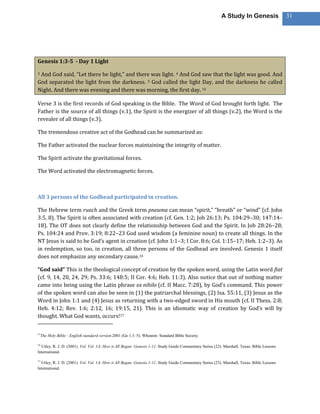
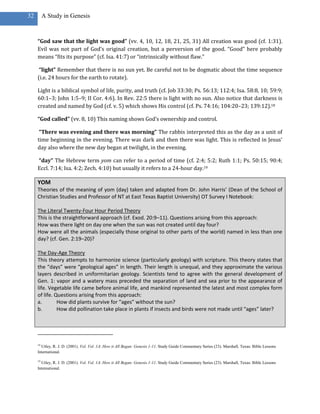
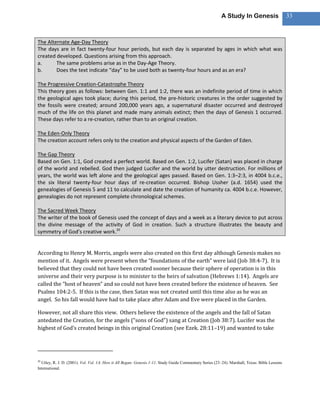
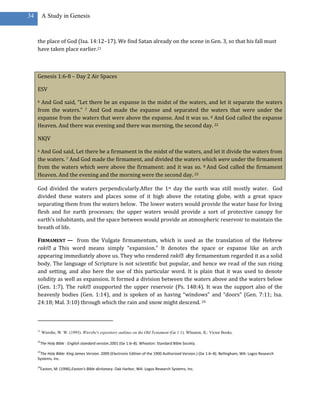
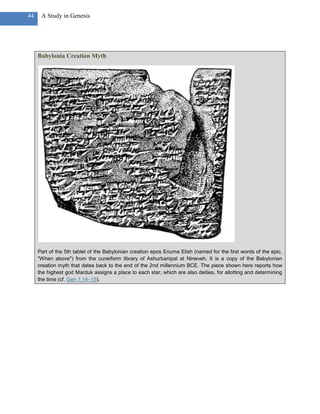
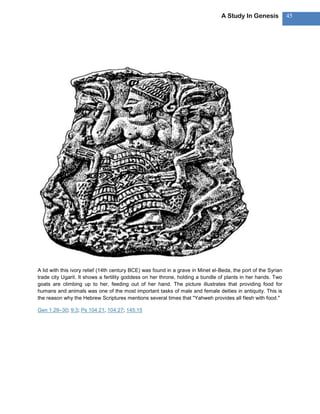
A Study In Genesis           1


Genesis – Part 1

Overview
NOTE: A large majority of the documentation contained here came from Henry Morrison’s The
Genesis Record, written sometime in the 1970’s. Although he spent a lifetime studying Genesis, in
particular Creation and the Flood, his sources were limited to those available up to that time. Since
then, scientific advancements have been made which may conflict with some of his observations,
others have proven him correct.

The remainder of the documentation was gleaned from a variety of different sources and Bible
commentaries, many of which have conflicting opinions regarding Creation, the Flood, the Gap
theory, and others, each point of view substantiating their interpretation with additional Bible
scriptures. I have included all of these conflicting different opinions. One can make up one’s own
mind how they interpret the scriptures with the guidance of the Holy Spirit.

Keep in mind, the Bible was not meant to be a scientific journal on the beginnings of man, but it is a
guide as to how man is to interact with God and his purpose and role for being created in the first
place. So, whatever one’s opinion is on the many various interpretations of scripture, it is
important not to lose sight of the real theme of Genesis and the Bible as a whole.


Genesis is the book of beginnings; it provides a dramatic account of the origins of mankind and his
universe, the intrusion of sin into the world, the catastrophic effects of its curse on the race, and the
beginnings of God’s plan to bless the nations through His seed.1

The Hebrew title of the book is the initial word berē’šîṯ , translated “in the beginning.” The English
title “Genesis” was derived from the Greek translation of ṯ ôleḏ ôṯ , the key word of the book. In
Genesis 2:4a, the Septuagint translation is, “This is the book of the geneseōs of heaven and earth.”2

Genesis 1–11 affirms that you and I live in a personal universe. The material and moral world were
designed by a Person, who made mankind distinct from the rest of Creation. There is no hint here of
the pagan notion that objects (like the sun or moon) are “gods.” There is no hint of the modern
fiction that life was generated spontaneously from nonliving matter, to gradually evolve from single


1Walvoord,  J. F., Zuck, R. B., & Dallas Theological Seminary. (1983-). Vol. 1: The Bible knowledge commentary : An exposition of the
scriptures (15). Wheaton, IL: Victor Books.

2Walvoord,  J. F., Zuck, R. B., & Dallas Theological Seminary. (1983-). Vol. 1: The Bible knowledge commentary : An exposition of the
scriptures (15). Wheaton, IL: Victor Books.
2        A Study in Genesis


    cells into the complex forms we know today. Genesis sets forth a personal God as the ultimate
    reality. He is the root and source of all that exists.

    Genesis 12–50 emphasizes another message. We live in a purposive universe. These chapters tell the
    story of God’s call of Abraham, and God’s unveiling in the Abrahamic Covenant of a divine plan and
    purpose to history. We can outline Genesis by these two themes:

    I.            A Personal Universe (Gen. 1–11)
    II.           A Purposive Universe (Gen. 12–50)

    Create. The Hebrew word bara˒is used only of God’s activity in initiating a thing or project. The
    Bible teaches that God initiated (created) the universe, humanity, forgiveness, and new life for
    sinners.3

    Genesis gives the only true and reliable account of the origin of all the basic entities of the universe
    and of life.

    1. Origin of the Universe
       An account of the ultimate origin of matter, space, and time.

    2. Origin of order and complexity
       Order and complexity never arise spontaneously, they are always generated by a prior cause
       programmed to produce such order.

    3. Origin of the solar system
       Brought into existence by the Creator; scientist have been unable to satisfactorily come up with
       an answer.

    4. Origin of the atmosphere and hydrosphere
       Our atmosphere is uniquely equipped to support life, this has never developed on any other
       planet.

    5. Origin of life
       Infinite complexity programmed into the genetic systems of plants and animals are inexplicable
       except by special creation.

            NOTE: Read “The Case for Creation” by Lee Strobel for recent scientific proof and support of
            creation.


    6. Origin of man


    3
        Richards, L., & Richards, L. O. (1987).The teacher's commentary (19). Wheaton, Ill.: Victor Books.
A Study In Genesis           3


    Evolution cannot account for man’s ability to contemplate the abstract entities of beauty and
    love and worship, as well as the ability to philosophize about our own meaning of existence.

7. Origin of marriage
   Genesis brought into being the institution of marriage, a monogamous, patriarchal social
   culture.

8. Origin of evil
   The origin of physical and moral evils in the universe is explained in Genesis as a temporary
   intrusion into God’s perfect world, allowed by Him as a concession to the prinicple of human
   freedom and responsibility, and also to manifest Himself as Redeemer as well as Creator.

9. Origin of language
   The difference between man’s ability to speak and animals chattering cannot be accounted for
   by evolution. Genesis accounts for man’s ability of language as well as multiple languages.

10. Origin of government
    Development of organized systems of human government is described in Genesis.

11. Origin of culture
    Describes the beginning of urbanization, metallurgy, music, agriculture, animal husbandry,
    writing, education, navigation, textiles, and ceramics.

12. Origin of nations
    Describes how nations came to be.

13. Origin of religion
    The origin of man’s pursuit for spirituality

14. Origin of the chosen people
    The enigma of the Israelites


The Authorship of Genesis.
So, who wrote Genesis? According to the New Testament, it was written under the inspiration of
the Holy Spirit:

        II Peter 1:21
        II Timothy 3:16

Both Scripture and tradition attribute the Pentateuch to Moses. There was no one would have been
better qualified to write the book. Since “Moses was educated in all the wisdom of the Egyptians”
(Acts 7:22), his literary skills would have enabled him to collect Israel’s traditions and records and
4    A Study in Genesis


    to compose the work. His communion with God at Horeb and throughout his life would have given
    him direction for this task. Genesis provided the theological and historical foundation for the
    Exodus and the covenant at Sinai. Even Jesus seemed to share this view. Luke 24:27, 44.

    It is significant that the book of Genesis is quoted from or alluded to at least 200 times in the New
    Testament. None of these references ever state that Moses is the actual author, however, Moses is
    mentioned by name at least 85 times in the New Testament, approximately 35 of which refer to
    specific passages attributed to Moses in the other books of the Pentateuch.

    Critical scholars, however, deny the Mosaic authorship of both Genesis and the rest of the
    Pentateuch. This is not a recent view; early in the Christian era theologians vacillated between
    Moses and Ezra as the author of the Pentateuch. But the modern view that the Pentateuch was
    compiled from various sources seems to be the product of rationalistic skepticism. Benedict
    Spinoza (a.d. 1632-1677) believed that the Pentateuch was written by Ezra, who utilized a mass of
    traditions (including some by Moses).

    There are several more popular criticisms against Moses being the author of the Bible. Some of the
    main ones include the following:

    1. Documentary Hypothesis
       This hypothesis says the Genesis was written and compiled by different scholars over a long
       period of time based on myths and legends passed down orally from generation to generation.

       This is also known as the J.E. D.P. Hypothesis. The letters stand for the supposed writers of the
       respective portions:
       J -         Jehovist Document              850 B.C.
       E -         Elohist Document               750 B.C.
       D -         Deuteronomist Document         620 B.C.
       P -         Priestly Document              500 B.C.

       This theory is based on peculiarities of language and style, references to custom and culture,
       etc. Convinced that man did not evolve to the state of culture described in Genesis until much
       later than Moses, and that there was no writing at the time.

       The first attempt at a documentary theory of Pentateuchal origins was made in 1753 by Jean
       Astruc (1684-1766). He promoted the idea that Genesis was composed from two major and
       several minor documents. Over the next 124 years scholars debated and developed that idea
       until finally Julius Wellhausen (1844-1918) restated the documentary approach forcefully and
       meticulously in 1877.

       Wellhausen divided the Pentateuch into four literary sources, represented by the letters, J, E, D,
       and P. The “J” material (named because of its preference for the name Yahweh [Jehovah]) was
       supposedly written in the Southern Kingdom about 850 b.c. It was personal, biographical, and
       anthropomorphic. It included prophetic-like ethics and theological reflection. “E” (named
       because of its preference for Elohim [God]) was written in the Northern Kingdom about 750 b.c.
A Study In Genesis           5


It was more objective, less concerned with ethical and theological reflection, and given more to
concrete particulars.

According to this view as elaborated by subsequent scholars these two documents were
combined around 650 b.c. by an unknown redactor or editor. The result was “JE.”

The composition was completed by “D” and “P” material. “D” was composed under Hilkiah
around 621 b.c. as part of Josiah’s reforms. This Deuteronomic school was also responsible for
reworking the Books of Joshua through Kings. The “P” source (Ezra and the Holiness Code
known as H), dated anywhere from 570 to 445 b.c., is said to be concerned with the origins and
institutions of the theocracy, genealogies, rituals, and sacrifices.

What brought about this approach was an analytical study of the text that observed apparently
irreconcilable difficulties. The critical scholars observed changes in the divine names (Yahweh
vs. Elohim). They could not reconcile parallel stories (e.g., the endangering of Sarah told in Gen.
12:10-20 and chap. 20). Furthermore, linguistic differences showed up that seemed to coincide
with other peculiarities of different sources (e.g., J might use Sinai, and E Horeb). Finally,
diverse theological ideas seemed to harmonize with the various emerging sources.

This documentary theory, has deceptively captured the scholarly world for decades. For further
information, see R.K. Harrison, Introduction to the Old Testament. Grand Rapids: Wm. B.
Eerdmans Publishing Co., 1966; Umberto Cassuto, The Documentary Hypothesis; and H. Wouk,
This Is My God. Garden City, N.Y.: Doubleday & Co., 1959. pp. 312-20. J. Skinner’s book, Genesis
(International Critical Commentary. Edinburgh: T. & T. Clark, 1910), is an example of how this
theory wrongly influences the exegesis of Genesis.

Criticism of the documentary theory must certainly begin with its antisupernaturalist base.
Proponents of the view subjected the Bible to criticism as if it were merely a human book and
therefore unreliable. The approach of the theory was anthropomorphic and evolutionary (i.e.,
the monotheism seen in Gen. was of human origin and gradually evolved from primitive states).
Hegelian dialecticism was employed to show how teaching evolved till it reached its final form
of “truth.”

Apart from its fundamental presuppositions that undermine revelation, the approach is fraught
with problems. One is the lack of unanimity concerning the four sources (J, E, P, D) and which
passages belong to each of them. Another problem is the subjectivity involved. Too often
circular reasoning appears. For example, a passage would be assigned to J because it frequently
used the Hebrew word yālaḏ (“to bear, to generate”); therefore, it was argued, yālaḏ is peculiar
to J. Though the approach claimed to be analytical it too often evaded, emended, or deleted a
text when it contradicted the system.

Archeological discoveries have contributed material that not only calls into question the criteria
of the documentary hypothesis, but also lends coloring to the Pentateuchal literature in its early
setting. In the land of Canaan, Ugaritic literature (ca. 1400 b.c.) shows widespread use of cultic
terms (attributed to P), poetic clichés, rare words originally considered late “Aramaisms,” a
variety of divine names and compound names, as well as repetition in style. The recent
6    A Study in Genesis


       discovery of the Ebla tablets in Syria also provides very early documentation of names, places,
       and ideas presented in the Pentateuch (cf. Giovanni Pettinato, The Archives of Ebla. Garden City,
       N.Y.: Doubleday & Co., 1981).

       Farther east the Nuzi tablets discovered in 1925 and the Mari tablets brought to light in 1933
       record many customs and laws that are comparable to those reflected in the patriarchal
       narratives in Genesis.

       Though these and many other contributions from archeology do not “prove” the existence of the
       patriarchs or the early date of the narratives, they do fit rather well with the Pentateuchal
       material and the manner in which the narratives are presented in Genesis. With the ever-
       increasing archeological finds there is less and less reason for a later date for the material.

    2. Form Criticism
       Form criticism, pioneered in Old Testament studies by Hermann Gunkel, recognized the
       antiquity of the traditions (e.g., that Genesis 1-11 must be compared with the Sumerian-
       Akkadian literature of the third and second millennia b.c. and that the patriarchs would be
       strangely out of place against an Assyrian background of the first half of the first millennium).
       Form criticism sought to determine the genre, structure, setting, and intention of each literary
       unit behind the extant material in order to reconstruct the original unit and to relate the texts to
       the people in ancient Israel.

       This method isolates the literary units, often following the arrangement of the JEDP sources. It
       then identifies the form (or genre) of the unit (e.g., blessings, oaths, hymns, legends, etc.) and
       compares common motifs, common vocabulary, and common structure. It then seeks to state
       the setting for the unit in the life of ancient Israel in order to determine its original intent. In
       order to do this the form critic must often seek to determine how the unit was transmitted.

       Gunkel listed six kinds of narratives in Genesis which reflected an early poetic, oral stage of the
       material (Hermann Gunkel, Genesis. Göettingen: Vandenhoeck und Ruprecht, 1922). They are:
       (a) etiological (e.g., a narrative explains why man is sinful), (b) ethnological (e.g., a narrative
       explains why Canaan was enslaved), (c) etymological (e.g., a narrative explains a well-known
       name such as Babel), (d) ceremonial (e.g., a narrative explains the Sabbath), (e) geological (e.g.,
       a narrative explains salt near Sodom), and (f) a group of unclassified types.

       Form criticism has produced much that is valuable in Old Testament studies. In general, it takes
       a more cautious view of the text, often being concerned with the final, fixed form of the text as a
       part of the study. Its emphasis on literary types and ancient oral tradition point out Israel’s
       ancient literary development.

       However, form-critical scholarship is often plagued with the same weaknesses as the
       documentary approach. The presupposition that the literature developed naturally rather than
       supernaturally leads to false conclusions: that Israel’s monotheism developed out of
       polytheism, that miracles were later explanations of early events, and that the records may not
       tell the real history.
A Study In Genesis           7


   The idea that sagas existed as distinct oral literary units before they were collected may be
   correct in some cases, but it would be difficult to prove. The idea that these oral traditions were
   edited and embellished as they reached their final form is problematic. Too often the critical
   interpretation considers this embellishing to be an extensive reshaping and reinterpreting of
   the tradition. Consequently much of form-critical exegesis is concerned with reconstructing the
   original tradition—a procedure that is often quite subjective and probably impossible.

   However, the emphasis in form criticism on the literary units, the types of literature, the
   structure, and the setting in the life of ancient Israel are important for exegesis. Exegesis is
   concerned with the final form of the biblical text, not with possibly preliterary stages of the
   traditions. (For further information, see Gene Tucker, Form Criticism of the Old Testament.
   Philadelphia: Fortress Press, 1971.)

3. Traditio-historical Criticism
   Out of form criticism a number of emphases in the study of the Pentateuch developed. Most
   notable has been traditio-historical criticism. Several scholars criticized the old literary
   analytical approach (JEDP) from various perspectives. They believed that a complete analytical
   approach was needed—one that took into account oral tradition, comparative mythology, and
   Hebrew psychology—for the purposes of discovering the formation and transmission of
   Israelite tradition in its preliminary stage.

   Though the subjectivity prompted by such an approach has led to a great diversity among the
   critics, the essential elements in the theory are as follows: The story was transmitted from
   memory at the preliterary stage; it was accompanied by an interpretation; it was reformulated
   in accordance with various forces (perhaps, e.g., a Canaanite etiology, or a redemptive motif in
   the period of the monarchy). The cycles of stories were next redacted into a literary unit by a
   creative editor. The collections of stories then became normative for faith in the postexilic
   period.

   The two long-developing, contemporaneous tradition collections that traditio-historical
   criticism posits are the P and the D collections. The former is largely Genesis through Numbers;
   it centers on the Passover in which the Feast is historicized. The D work is Deuteronomy
   through 2 Kings. So even though literary sources of the old documentary approach are rejected,
   a similar source analysis is maintained. Too often the history of the tradition is considered more
   important than the tradition itself.

   Traditio-historical criticism places too much emphasis on oral tradition. No doubt there was
   oral tradition, but it was usually accompanied by written documents (Kenneth A. Kitchen,
   Ancient Orient and Old Testament, p. 136). Archeological evidence relevant to Palestine (E.
   Nielsen, e.g., draws also on Hindu and Old Icelandic materials [Oral Tradition. London: SCM
   Press, 1954]) emphasizes the great care taken in copying documents in the ancient world (see
   W.F. Albright, From the Stone Age to Christianity. Garden City, N.Y.: Doubleday & Co., 1957).

   The emphasis on comparative mythology presupposes that Israel’s religion was comparable to
   the pagan religions. Similarities exist, but essentially Yahwism (Israel’s worship of the true God,
8       A Study in Genesis


          Yahweh) is distinct. Following this approach, one is left without an explanation of the origin of
          the Hebrew faith.

          Finally, concentration on the supposed reformation of traditions lacks scientific control, a fact
          evidenced by the lack of agreement over the reconstructions. Reconstructions indeed are often
          the products of critics’ predispositions.

    4. Modified Structuralism or Rhetorical Criticism.
       Though many contributions to the study of the Old Testament have been made by these
       approaches, they all fail to place a proper emphasis on the final form of the text, the canonical
       shape of the biblical material. If one could trace these levels of development with certainty—
       which he cannot—and if one used sources to explain difficulties, he would still be left with the
       question as to why the material was recorded in the form in which it now exists.

          Consequently more emphasis is now being placed on the present shape of the text. Repetition,
          diversity of style, variation of vocabulary, and the like, are often considered proof of the unity of
          the text by scholars following a modified structuralism or rhetorical criticism.

          The traditional view that Genesis (and the Pentateuch) possesses unity and is the work of
          Moses has not been destroyed. On the contrary, the evidence points more and more to the
          antiquity and unity of the work. This is not to say that the present form of the book has not been
          edited by subsequent writers whose work was guided by the Holy Spirit’s inspiration; it does
          affirm that widespread reshaping of the accounts is unfounded and unnecessary. Any reshaping
          of the traditions of Genesis would have been done by Moses under divine inspiration, with the
          result that the book reports actual events and gives correct theological interpretations of them.4

    But in spite of these criticisms, most Biblical scholars believe that Moses compiled and edited
    earlier written records handed down through Adam, Noah, Shem, Terah and others. Guided by the
    Holy Spirit, he put these together, added commentary guided by the Holy Spirit and current events
    of his time, into what Genesis is now.


    4
     Walvoord, J. F., Zuck, R. B., & Dallas Theological Seminary. (1983-). Vol. 1: The Bible knowledge commentary : An exposition of the scriptures
    (15–18). Wheaton, IL: Victor Books.
A Study In Genesis                 9


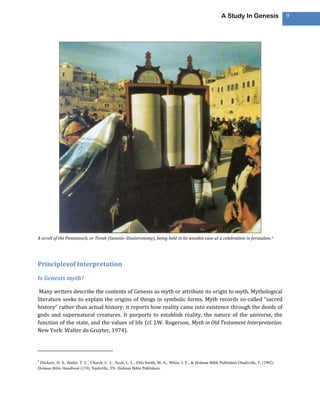
A scroll of the Pentateuch, or Torah (Genesis–Deuteronomy), being held in its wooden case at a celebration in Jerusalem. 5


Principlesof Interpretation

Is Genesis myth?

 Many writers describe the contents of Genesis as myth or attribute its origin to myth. Mythological
literature seeks to explain the origins of things in symbolic forms. Myth records so-called “sacred
history” rather than actual history; it reports how reality came into existence through the deeds of
gods and supernatural creatures. It purports to establish reality, the nature of the universe, the
function of the state, and the values of life (cf. J.W. Rogerson, Myth in Old Testament Interpretation.
New York: Walter de Gruyter, 1974).


5
 Dockery, D. S., Butler, T. C., Church, C. L., Scott, L. L., Ellis Smith, M. A., White, J. E., & Holman Bible Publishers (Nashville, T. (1992).
Holman Bible Handbook (119). Nashville, TN: Holman Bible Publishers.
10    A Study in Genesis


     Pagan literature that records supernatural activities such as Creation, the Flood, and other divine
     interventions in man’s world are often compared with Genesis. Some scholars envision a wholesale
     borrowing of such mythologies by Israel, with a subsequent demythologizing (removal of pagan
     elements) to make them satisfactory for Yahwism. But when Semitic mythology is correctly
     understood, it is clear that this was not possible.

     Myths were not merely symbolic language or reflections of primitive mentality. They were ancient
     man’s expression of his view of reality. At the center of a myth is its doctrine of correspondence
     (e.g., the god dies; therefore vegetation dies). Consequently ritual based on sympathetic magic was
     enacted to ensure the vital forces of life and fertility.

     The Old Testament makes a radical break with this philosophy of the ancient world. One does not
     do justice to the Old Testament by saying that Israel borrowed myth, or used mythological language
     to describe its faith. To the Hebrew, an absolutely sovereign God brought them into existence as a
     nation. Their concept of time was not cyclical but eschatological; their ritual at the temple was not
     cosmic and magical but an enactment of their redemption; and their concept of space was not
     limited to the primeval world but was actualized in history. In a word, reality to Israel was within
     her concept of history (Brevard S. Childs, Myth and Reality in the Old Testament. Naperville, Ill.: Alec
     R. Allenson, 1960, p. 13).

     Therefore Genesis is not myth. The Hebrew faith was a radical departure from the characteristic
     mythical thought of the pagans. James Barr says, “The main battle of the Hebrew faith is fought
     against the confusion of human and divine, of God and nature” so prevalent in pagan myth (“The
     Meaning of ­Mythology‘ in Relation to the Old Testament,” Vetus Testamentum 9. 1959:3). If the Old
     Testament preserves any vestiges of myth, it is to show that such were done away with in Yahwism.
     Gerhard Hasel says that Genesis employs certain terms and motifs, partly taken from theologically
     incompatible predecessors and partly chosen in deliberate contrast with comparable ancient Near
     Eastern concepts, and uses them with a meaning that is consonant with and expressive of faith in
     Yahweh. It represents a parting of the spiritual ways brought about by a deliberate antimythical
     polemic which undermined the prevailing mythological views (“The Polemic Nature of the Genesis
     Cosmology,” Evangelical Quarterly 46. 1974: 81-102). Thus the Old Testament in general and
     Genesis in particular are a cemetery for lifeless myths and gods.

     Is Genesis etiology?

     The narratives of Genesis have also been classified as etiologies, stories that explain some given
     phenomenon, a topographical, ethnological, cultic, or customary reality (see S. Mowinckel,
     Tetrateuch-Pentateuch-Hexateuch. Berlin: Verlag Alfred Töppelmann, 1964, p. 81; and Brevard S.
     Childs, “The Etiological Tale Re-examined,” Vetus Testamentum 24. 1974:387-97).

     If the etiological narrative is the tradition and not simply a motif, that is, if it is a primary etiology,
     then doubt is cast over the historicity of the event. John Bright correctly observes that it is
     impossible to prove that an etiology is the creative force of the tradition (Early Israel in Recent
     History Writing. London: SCM Press, 1956, p. 90). The narratives no doubt record actual events. If
     there is an etiological element added in the use made of the tradition, it is usually responsible for a
A Study In Genesis           11


single detail or application of the story. To say a story explains why something exists is one thing;
but to say a story employs some mythical episode to form the tradition is quite another.

Etiological motifs do occur in general in the Bible, especially in Genesis which explains the
beginnings of many things. But these narratives cannot be referred to as etiological tales that came
into being to answer certain questions.

Is Genesis history?

All this raises the question of the historicity of the accounts. Scholars have been unwilling to use the
term “history” unless it is adequately qualified as distinct from modern philosophies of history.
Norman Porteous explains, “The fact that Israel’s religious traditions made frequent reference to
supernatural interventions is usually enough to make the historian look askance at them and
assume that the actual course of events must have been very different” (“The Old Testament and
History,” Annual of the Swedish Theological Institute 8. 1972:22).

For many, the evidence of events from Genesis is not reliable as history. Without outside sources to
verify the events, historians must depend on the biblical records themselves. Even the many
findings of archeology, though confirming the cultural setting of the events, do not actually prove
the existence of an Abraham or a Joseph. So critical scholars hesitate to designate Genesis as factual
history.

However, one must remember that the Bible is a unique Book. Genesis was not intended to be a
mere chronicle of events, a history for history’s sake, or even a complete biography of the nation. It
is a theological interpretation of selected records of the ancestors of Israel. As with all histories,
Genesis explains the causes behind the events—but its causes are divine as well as human. Because
it is part of the revealed Word of God, and not merely human history comparable to ancient pagan
mythologies, both the events and the explanations are true.

For the Israelites some of the basic questions about life were answered within this theological
interpretation of the events of their history. These events were recognized as integral parts of the
God-planned and God-directed course of history, extending from Creation to the last days. In
between this starting point and finishing point is biblical history. Thus faith was an essential part of
understanding national and international events.

At the heart of this biblical history was God’s covenant. It began with election—God chose Israel
through Abram. God’s people could look back and see what God had done, and on the basis of that
they could look forward to the fulfillment of the promises. Even though promise and fulfillment
were predominant motifs of the biblical history, obedience to the covenant was uppermost in the
minds of the narrators. So the events of the past were recounted for apologetic, polemic, and
didactic reasons.

The fact that Genesis is a theological interpretation of ancient events does not destroy its
historicity. As Porteous says, “It would seem reasonable to suppose that interpretation is a
response to something that demands interpretation” (“The Old Testament and History,” p. 107).
E.A. Speiser says that while the material may not be history in the conventional sense of the term,
12       A Study in Genesis


     “it cannot be set down as fancy. The author retells the events in his own inimitable way; he does not
     invent them. What is thus committed to writing is tradition, in the reverent care of literary genius.
     Where the tradition can be independently checked, it proves to be authentic. This much has been
     evident for some time in respect to a number of incidental details. It now turns out that the main
     framework of the patriarchal account has been accurately presented” (“The Biblical Idea of History
     in the Common Near Eastern Setting,” Israel Exploration Journal 7. 1957:202). For evangelicals, of
     course, it comes as no surprise that the biblical narratives prove to be authentic.

     Is Genesis tradition?

     Many biblical scholars prefer to describe the Genesis narratives as “traditions” or “sagas” (which
     should have been used instead of “legends” in translating Gunkel’s book The Legends of Genesis). By
     these terms they mean the people’s recollections of historical events. In this view historicity is not
     endangered; it is just not assured. Gerhard von Rad says that saga is more than history because God,
     not man, is the subject (Genesis. Philadelphia: Westminster Press, 1961, p. 31).

     Conservative scholars do not share this hesitancy to regard the narratives as true. Certainly the
     primeval accounts and genealogies could have been brought from Mesopotamia by the ancestors.
     To these would have been added the family records of the patriarchs. All the traditions—oral and
     written—could have been preserved in Egypt by Joseph along with his own records. Moses could
     then have compiled the work in essentially the form in which it exists today, being preserved from
     error and guided in truth by the divine inspiration of the Holy Spirit (Kenneth A. Kitchen, “The Old
     Testament in Its Context: 1,” Theological Students Fellowship Bulletin 59. 1971:1-9). So whether the
     narratives are called traditions or history, they record God’s true revelation and therefore
     correspond with what actually happened.

     Genesis is the first book of the Torah, the five Books of the Law. It may be best to classify the work
     as “Torah literature.” It may not be legal literature specifically, that is, laws and commandments, but
     it lays the foundation for the Law. It is a theological interpretation of the historical traditions
     behind the formation of the covenant with Israel at Sinai. Throughout Genesis one may discern that
     Moses was preparing his readers for the revelation of the Law. It is in this that Genesis conveys its
     didactic nature.

     But the material in Genesis is closely related to wisdom literature as well, especially in the Joseph
     narratives. The emphasis in the book on God’s blessing for those who walk in faithful obedience
     suggests many parallels with the Books of Wisdom, as will be observed. Genesis, then, is a unique
     book but it is also a book that is like the rest of the Bible in many ways. It is here that theology and
     history begin.6

     One must realize that Moses did not write Genesis with the intention of giving a scientific
     account. In II Timothy 3:16-17, Paul tells us that “All scripture is given by inspiration of God,


     6
      Walvoord, J. F., Zuck, R. B., & Dallas Theological Seminary. (1983-). Vol. 1: The Bible knowledge commentary : An exposition of the scriptures
     (18–20). Wheaton, IL: Victor Books.
A Study In Genesis          13


and is profitable for doctrine, for reproof, for correction, for instruction in righteousness...”
It was not written to teach us geology or biology, it is written to show man’s relationship to
God and God’s requirements for man and what man must do to be saved.
14       A Study in Genesis


     Outline of Genesis


     OUTLINE

     I.         The Primeval Events (1:1-11:26)
     A.         The Creation (1:1-2:3)
     B.         The succession from the creation of the heavens and earth (2:4-4:26)
     1.         The creation of the man and the woman (2:4-25)
     2.         The temptation and the Fall (chap. 3)
     3.         The advance of sin in Cain’s murder of Abel (4:1-16)
     4.         The spread of godless civilization (4:17-26)
     C.         The succession from Adam (5:1-6:8)
     1.         The genealogy from Adam to Noah (chap. 5)
     2.         The corruption of the race (6:1-8)
     D.         The succession from Noah (6:9-9:29)
     1.         The judgment by the Flood (6:9-8:22)
     2.         The covenant with Noah (9:1-17)
     3.         The curse of Canaan (9:18-29)
     E.         The succession from the sons of Noah (10:1-11:9)
     1.         The table of nations (chap. 10)
     2.         The dispersion at Babel (11:1-9)
     F.         The succession from Shem (11:10-26)
     II.        The Patriarchal Narratives (11:27-50:26)
     A.         The succession from Terah (11:27-25:11)
     1.         The making of the covenant with Abram (11:27-15:21)
     2.         The provision of the promised seed for Abraham whose faith was developed by testing (16:1-
                22:19)
     3.         The transition of the promises to Isaac by faithful Abraham (22:20-25:11)
     B.         The succession from Ishmael (25:12-18)
     C.         The succession from Isaac (25:19-35:29)
     1.         The transfer of the promised blessing to Jacob instead of to Esau (25:19-28:22)
     2.         The blessing of Jacob in his sojourn (chaps. 29-32)
     3.         The return of Jacob and the danger of corruption in the land (chaps. 33-35)
     D.         The succession from Esau (36:1-8)
     E.         The succession from Esau, father of the Edomites (36:9-37:1)
     F.         The succession from Jacob (37:2-50:26)
     1.         The selling of Joseph into Egypt (37:2-36)
     2.         The corruption of Judah’s family and confirmation of God’s choice (chap. 38)
     3.         The rise of Joseph to power in Egypt (chaps. 39-41)
     4.         The move to Egypt (42:1-47:27)
     5.         The provision for the continuation of the promised blessing (47:28-50:26)7


     7
      Walvoord, J. F., Zuck, R. B., & Dallas Theological Seminary. (1983-). Vol. 1: The Bible knowledge commentary : An exposition of the scriptures
     (27). Wheaton, IL: Victor Books.
A Study In Genesis   15


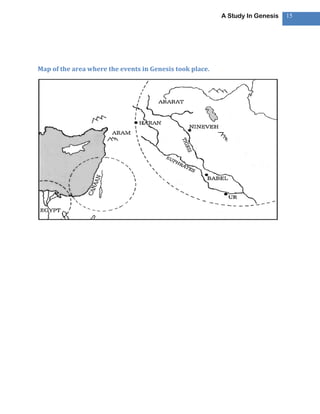
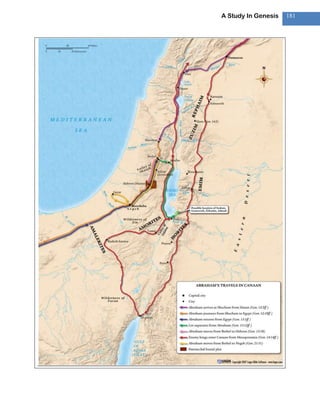
Map of the area where the events in Genesis took place.
16        A Study in Genesis


     Genesis 1 – In The Beginning…


     Genesis 1:1-2

     1 In the beginning, God created the heavens and the earth. 2 The earth was without form and void,
     and darkness was over the face of the deep. And the Spirit of God was hovering over the face of the
     waters. 8

     The first verse of the Bible is the foundational verse. The first 11 chapters deal with the whole
     world and all of its nations, the rest of Genesis deals with the beginnings of the nation Israel.

     The book of Genesis makes no attempt to prove that God exists. It simply takes for granted that He
     does as though it was so obvious that only a fool could say, “There is no God”.

     1:1 “In the beginning”Bereshith is the Hebrew title of the book. We get Genesis from the Septuagint
     translation. This is the beginning of history but not of God’s activity (cf. Matt. 25:34; John 17:5, 25;
     Eph. 1:4; Titus 1:2; II Tim. 1:9; I Pet. 1:19–20; Rev. 13:8). R. K. Harrison says it should be translated
     “by way of beginning” (Introduction to the Old Testament, p. 542 footnote 3).“In the beginning” –
     speaks of the creation of space and matter, and also notes the beginning of time. The universe is a
     continuum of space, matter, and time – all three must exist for the other 2 to exist.

     Verse 1 contains the first occurrence of the name God – ĕlôhîym. Here it is the Hebrew word
     Elohim, which stresses His majesty and omnipotence. This is the name used throughout the first
     chapter of Genesis. “im” is plural meaning gods, however, in this case it is used in the singular. It is
     a plural name with a singular meaning – the Trinity When referring to the God of Israel the verb is
     usually (6 exceptions) SINGULAR. Iit speaks of God as creator, provider and sustainer of all life on
     planet earth (cf. Ps. 19:1–6; 104). Notice how often this word is used in chapter 1.9

     “Created” or bara˒ /baw·raw/ in Hebrew, used only in reference to God, means to call into
     existence that which had no existence. It is used only for God’s creative activity. God willed into
     being everything but Himself. Psalm 33:6, 9; Heb. 11:3 and II Pet. 3:5 reflect creation (cosmology)


     8
         The Holy Bible : English standard version.2001 (Ge 1:1–2). Wheaton: Standard Bible Society.

     9
       Utley, R. J. D. (2001). Vol. Vol. 1A: How it All Began: Genesis 1-11. Study Guide Commentary Series (20–21). Marshall, Texas: Bible Lessons
     International.
A Study In Genesis                 17


by God’s spoken word (fiat) from nothing (ex nihilo). Greek (gnostic) and Mesopotamian
philosophies emphasize an eternal dualism between “spirit” and “matter.”10

Although it is impossible for us to comprehend fully this concept of an eternal, transcendent God,
the only alternative is the concept of an eternal, self-existing universe, and this concept is also
incomprehensible. Eternal God or Eternal matter – that is the choice. The latter is an impossibility
if the present scientific law of cause and effect is valid since random particles of matter could not,
by themselves, generate a complex, orderly, intelligle universe, not to mention living persons
capable of applying intelligence to the understanding of the complex order of the universe. A
personal God is the only adqueate cause to produce such effects.

“theHeavens”, the Hebrew word shamayin [shamayim, shameh /shaw·mah·yim/], refers to the
component of space in the basic space-mass-time-universe.It may be used in several senses: (1) it
refers to the atmosphere of the earth as in vv. 8 and 20; (2) it may refer to the entire cosmos (i.e. all
material existence); or (3) it may refer to the creation of all things visible (material) and invisible
(angels, heaven as God’s throne). If option three is true then a parallel would be Col. 1:16. If not,
then Genesis 1 focuses only on the creation of earth. The Bible emphasizes a geocentric perspective
(i.e. creation seen as a spectator on this planet would have observed it). Some would assert that
Gen. 1 is addressing the creation of the universe (i.e. sun, moon, stars, and galaxies, while Gen. 2–3
focuses on this planet and the creation of mankind. This is surely possible because chapters 2–4
form a literary unit. In both (i.e. Gen. 1 and 2–4) creation is geocentristic (i.e. earth focused).

“Earth”, component of matter in the universe. Since planets, stars, and other material bodies were
not created until the 4th day, it is believed that this verse speaks essentially of the creation of the
basic elements of matter, which were then to be structured into earth and other material bodies.
Genesis 1 is geocentric (cf. v. 15). This fits the theological purpose of the chapter, not science.
Remember that the Bible is written in the language of description for theological purposes. It is not
anti-scientific, but pre-scientific.

 “darkness” This does not represent evil, but chaos. God names the darkness in v. 5 as He does the
light. These two terms, though often used to denote spiritual realities, are representing physical
realities here.11

“the deep” The Hebrew term is Tehom. A similar, but different, Hebrew root is personified as
Tiamat in the Sumerian and Babylonian creation myths as the monster of chaos and the mother of
the gods, wife of Apsu. She tried to kill all lesser gods that came forth from her. Marduk killed her.
Out of her body Marduk fashioned heaven and earth in the Babylonian Genesis called Enuma Elish.
The Hebrews believed that water was the beginning element of creation (cf. Ps. 24:1; 104:6; II Pet.


10
  Utley, R. J. D. (2001). Vol. Vol. 1A: How it All Began: Genesis 1-11. Study Guide Commentary Series (21). Marshall, Texas: Bible Lessons
International.

11
  Utley, R. J. D. (2001). Vol. Vol. 1A: How it All Began: Genesis 1-11. Study Guide Commentary Series (22). Marshall, Texas: Bible Lessons
International.
18        A Study in Genesis


     3:5). It is never said to have been created. However, the Hebrew term is masculine, not feminine
     and it is unrelated etymologically to Tiamat.

     There are passages in the NT which describe YHWH in conflict with personified watery chaos (cf.
     Ps. 74:13–14; 89:9–10; 104:6–7; Isa. 51:9–10). However, these are always in poetical, metaphorical
     passages. Water is a crucial aspect of creation (cf. 1:2b, 6–7).12

     Genesis 1:1 can be paraphrased as follows: The transcendent, omnipotent Godhead called into
     existence the space-mass-time universe.


     The Date of Creation

     1:1-2.These verses have traditionally been understood as referring to the actual beginning of
     matter, a Creation out of nothing and therefore part of day one. But the vocabulary and grammar of
     this section require a closer look. The motifs and the structure of the Creation account are
     introduced in the first two verses. That the universe is God’s creative work is perfectly expressed by
     the statement God created the heavens and the earth. The word bārā’ (“created”) may express
     creation out of nothing, but it certainly cannot be limited to that (cf. 2:7). Rather, it stresses that
     what was formed was new and perfect. The word is used throughout the Bible only with God as its
     subject.

     But 1:2 describes a chaos: there was waste and void, and darkness was over the surface of the
     deep. The clauses in verse 2 are apparently circumstantial to verse 3, telling the world’s condition
     when God began to renovate it. It was a chaos of waste, emptiness, and darkness. Such conditions
     would not result from God’s creative work (bārā’); rather, in the Bible they are symptomatic of sin
     and are coordinate with judgment. Moreover, God’s Creation by decree begins in verse 3, and the
     elements found in verse 2 are corrected in Creation, beginning with light to dispel the darkness. The
     expression formless and empty (ṯ ōhû wāḇ ōhû) seems also to provide an outline for chapter 1,
     which describes God’s bringing shape and then fullness to the formless and empty earth.

     Some have seen a middle stage of Creation here, that is, an unfinished work of Creation (v. 2) that
     was later developed (vv. 3-25) into the present form. But this cannot be sustained by the syntax or
     the vocabulary.

     Others have seen a “gap” between the first two verses (see additional notes on Gap theory),
     allowing for the fall of Satan and entrance of sin into the world that caused the chaos. It is more
     likely that verse 1 refers to a relative beginning rather than the absolute beginning (Merrill F.
     Unger, Unger’s Commentary on the Old Testament. 2 vols. Chicago: Moody Press, 1981, 1:5). The
     chapter would then be accounting for the Creation of the universe as man knows it, not


     12
       Utley, R. J. D. (2001). Vol. Vol. 1A: How it All Began: Genesis 1-11. Study Guide Commentary Series (22). Marshall, Texas: Bible Lessons
     International.
A Study In Genesis                  19


thebeginning of everything, and verses 1-2 would provide the introduction to it. The fall of Satan
and entrance of sin into God’s original Creation would precede this.

It was by the Spirit that the Lord God sovereignly created everything that exists (v. 2b). In the
darkness of the chaos the Spirit of God moved to prepare for the effectual creative word of God.13

So what would be the exact date of creation? Based on technology and written records, it is not
possible to come up with an exact date, although many have tried.

There are some serious hindrances which prevent the pinpointing of an exact date:

     Uncertainty of accurate copying and transmission of the numbers originally recorded: the
     Masoretic, Septuagint, and Samarian texts all disagree.
     Uncertainty of whether the ancient calendar year was the same length as it is now.
     Possibility of missing generations.
     Lists of durations of the administrations of various judges and kings don’t always agree.
     Secular chronologies of Egypt and Babylonia.
     Radio carbon and other methods of dating are inconsistent.

Based on Biblical framework, the best-known chronological system is that of Archbishop James
Ussher (1581 – 1650) who computed the date of creation as 4004 BC. This was before any
scientific advancements were made and was based on all available records from various cultures.
The oldest known written list of Egyptian Kings goes back a little over 3000 BC.


Evolution and the Bible

Having made mention of the truthfulness of this account, let us say a brief word about evolution.
Note that the evolutionary hypothesis is simply that—a hypothesis, not scientific fact. Because of the
time that has elapsed between the beginning of time and today, no hypothesis of the origins of the
world can ever be properly tested, much less proven. So, though many around us are enamored of
the evolutionary hypothesis, let us not get carried away by accusations claiming the Bible
contradicts proven science. For not only can the evolutionary hypothesis not be scientifically tested
or proven, it also cannot, by any reasonable means, be partnered with the biblical creation account.
Notice three reasons why:

•         First, we are given no reason to believe that the six days of creation were not six literal days.
          Yes, “with the Lord one day is like a thousand years, and a thousand years like one day” (2
          Peter 3:8). But Genesis 1 says again and again that on each day “there was evening and
          there was morning.” That doesn’t describe a millennium, but the normal sequence of one
          twenty-four-hour day!


13
 Walvoord, J. F., Zuck, R. B., & Dallas Theological Seminary. (1983-). The Bible knowledge commentary : An exposition of the scriptures (Ge
1:1). Wheaton, IL: Victor Books.
20        A Study in Genesis


     •            Second, notice that the Bible makes it clear that the plants (1:11–12), the sea creatures
                  (1:21), the birds (1:21), the mammals (1:24), and the reptiles (1:24) were all created “after
                  their kind.” So what we are being told is this: God did not create an amoeba that turned into
                  a fish. Nor did he create a monkey that evolved into a modern man. Each creature was
                  created as a distinct “kind”!
     •            Third, notice that man was created in the image of God. Anyone, then, who says that we
                  came from the apes must also be prepared to say that God, in whose image we are made,
                  must be like an ape—or, at least, that God must have been ape-like when he created Adam
                  (maybe he’s evolving too?)! Do you see? Evolution is, at best, silliness; and, at worst,
                  blasphemy! From the very beginning we see the first man, Adam, with God-like
                  characteristics such as speech, reason, creativity, and moral consciousness. Man was made,
                  from the beginning, in the image of God!14


     The Gap Theory

     There is great debate about the Gap theory. It basically states that between Genesis 1:1 and 1:2,
     there was a large gap in time. There was a great cataclysm which left the earth in darkness and
     covered with water. It is thought that it was caused by a judgments against Satan in rebelling
     against God.

     Those who don’t agree with this theory believe it undermines the creation by God and supports
     evolutionism.

     For more information on the Gap theory, see article insert below. There are also a lot of additional
     information on this and other theories on the internet.

     There are verses inthe Bible that seem to support both views. Either way, God did not include this
     in the Bible because that is not the purpose of the Bible: it is not a lesson in geology or
     biology, but rather to show man’s relationship to God and reveals the plan of salvation for us.

     In Genesis 1:2, the physical universe had come into existence, but everything was still and dark – no
     form, no motion, no light.

     “The face of the waters” (or the face of the deep). “Face” means presence. The formless waters, like
     the formless earth were essentially a presence rather than a cohesive body. The universe had not
     yet been imbued with energy and set in motion. It was awaiting the energizing action of the Spirit
     of God and the activating power of the Word of God.

     “The Spirit of God moved”. Moved in Hebrew is recap, this roughly translates to vibrate or shake.
     The Holy Spirit provided the energy to activate heat waves, light waves, sound waves, gravitational
     pull, etc.


     14
          Strassner, K. (2009). Opening up Genesis (21–23). Leominster: Day One Publications.
A Study In Genesis          21


As God’s spirit began to flow outward and to permeate the cosmos, gravitational forces were
activated and water and earth particles come together to form a great sphere moving through
space. Other particles would soon be brought together to form the sun, moon, and stars. There was
now a “compass” on the face of the deep, and the formless earth was now ready for light, heat, and
other forms of enlivening energy.
22    A Study in Genesis


     The Gap Theory
     http://www.apologeticspress.org/articles/442 - it was originally published in Reason &
     Revelation, 14[7]:49-56

     AP Content :: Reason & Revelation

     Popular Compromises of Creation—The Gap Theory
      by Bert Thompson, Ph.D.


     It is rare in the creation/evolution controversy to find issues on which both creationists and
     evolutionists agree. Generally speaking, the two world views are light-years apart. But there is one
     thing on which both sides agree: evolution is impossible if the Earth/Universe-system is young—
     with an age measured in thousands, not billions, of years. R.L. Wysong has commented:

     Both evolutionists and creationists believe evolution is impossibility if the universe is only a few
     thousand years old. There probably is no statement that could be made on the topic of origins
     which would meet with so much agreement from both sides. Setting aside the question of whether
     vast time is competent to propel evolution, we must query if vast time is indeed available (1976, p.
     144).

     It is interesting to observe how something on which both sides agree has caused so much
     disagreement. Aside from the basic issue of whether creation or evolution is correct, the most
     serious area of conflict between the biblical and the evolutionary scenarios is the chronological
     framework of history—in other words, the age of the Earth. This matter is of importance not only to
     evolutionists, but to theistic evolutionists, progressive creationists, and other “old-Earth
     creationists.” While a young Earth presents no problem whatsoever for a creationist, it is the death
     knell to each and every variety of the evolutionary scenario.

     A simple, straightforward reading of the biblical record indicates that the Cosmos was created in six
     days only a few thousand years ago. Opposed to that view is the idea of evolutionists that the
     Universe is 15-20 billion years old, and that the Earth is 4.6 billion years old. Further complicating
     matters is the fact that the biblical record indicates living things were placed on the newly created
     Earth even before the end of the six-day creative process (e.g., plant life came on day three). The
     evolutionary scenario, however, postulates that primitive life evolved from nonliving chemicals
     roughly 3.5-4.0 billion years ago, and that all other life forms developed during the so-called
     geologic ages, with man arriving on the scene in one form or another 1-2 million years ago.

     Even to a casual observer, it is apparent that this is no small problem. Much of the controversy
     today centers on the age of the Earth. The magnitude of the controversy is multiplied by two
     factors. First, theistic evolution and progressive creation are impossible if the Earth is young. Thus,
     if the proponents of these views wish to retain their belief systems, it is imperative that they find a
     way to place the time for an ancient Earth in the biblical record. Second, there is no middle ground
A Study In Genesis            23


that will permit the old-Earth/young-Earth scenarios to coexist; the gulf separating the biblical and
evolutionary views on the topic of the age of the Earth is just too large. As Henry Morris has
observed:

Thus the Biblical chronology is about a million times shorter than the evolutionary chronology. A
million-fold mistake is no small matter, and Biblical scholars surely need to give primary attention
to resolving this tremendous discrepancy right at the very foundation of our entire Biblical
cosmology. This is not a peripheral issue that can be dismissed with some exegetical twist, but is
central to the very integrity of scriptural theology (1984, p. 115).

If the Earth is ancient, where in the Bible can the time be inserted to ensure that antiquity? The time
needed to guarantee an old Earth might be placed: (a) before the creation week; (b) during the
creation week; or (c) after the creation week.

The attempt to insert geological time into the biblical text during the creation week is known as the
Day-Age Theory—a concept that has fallen on hard times in recent years because it is completely
without lexical or exegetical support from the biblical record (see Thompson, 1982, 1994). As a
result, it has been rejected by numerous old-Earth creationists, theistic evolutionists, and
progressive creationists.

Rarely do those desiring to insert geologic time into the biblical record attempt to place the time
after the creation week, for two reasons. First, placing time after the creation has occurred does not
help the case of the theistic evolutionist or progressive creationist. Time “after the fact” is a moot
issue. Second, the biblical genealogies (e.g., Genesis 5, Genesis 11, Luke 3, etc.) have the text so well
protected that it is manifestly impossible to insert the billions of years of time needed to allow for
an ancient Earth (see Thompson, 1989).

Thus, the Bible believer intent on accommodating his theology to the uniformitarian dogma of an
ancient Earth must find another way to force vast time spans into Genesis 1. The only option
remaining is to insert the time before the creation week—a concept known as the Gap Theory.


THE GAP THEORY

Popularity of the Gap Theory (also referred to by such synonyms as the Ruin-and-Reconstruction
Theory, the Pre-Adamic Cataclysm Theory, and the Restitution Theory) is generally attributed to
the writings of Thomas Chalmers, a nineteenth century Scottish theologian. In recent years, the Gap
Theory has undergone an “evolution” of its own, and for that reason is not easily defined. There are
several variations, and its defenders do not agree among themselves on strict interpretations.
However, a brief summation of its main tenets might be as follows.

The widely held view among gap theorists today is that the original creation of the world by God, as
recorded in Genesis 1:1, took place billions of years ago. The creation was despoiled because of
Satan’s rebellion against God, resulting in his being cast from heaven with his followers. A
cataclysm occurred at the time of Satan’s overthrow, and is said to have left the Earth in darkness
24    A Study in Genesis


     (the “waste and void” of Genesis 1:2). [NOTE: It is alleged by some Gap theorists that the cataclysm
     occurring at Satan’s overthrow terminated the geologic ages, after which God “re-created.” It is
     alleged by others that the cataclysm occurred first, and then was followed by the geologic ages,
     after which God “re-created.”] The world as God had created it, with all its inhabitants, was
     destroyed, which, it is claimed, accounts for the myriad fossils present in the Earth. Many holding to
     this theory place the fossils of dinosaurs, so-called “ape-men,” and other extinct forms of life in this
     gap. Then, God “re-created” the Earth in six literal days. By way of summary, then, the “gap”
     between Genesis 1:1 and Genesis 1:2 contains the story of an original creation, a judgment, and
     ruination, while the verses in Genesis 1:3 through the remainder of the chapter record the story of
     the Earth’s re-creation.

     Is the Gap Theory Popular?

     The Gap Theory has had, and continues to have, numerous supporters. George H. Pember, in Earth’s
     Earliest Ages (1876), advocated the Gap Theory. Harry Rimmer, in Modern Science and the Genesis
     Record (1937), helped popularize the theory. The renowned Canadian anthropologist, Arthur C.
     Custance, produced Without Form and Void (1970), which many consider the ablest defense of the
     Gap Theory ever put into print. George DeHoff advocated the theory in Why We Believe the Bible
     (1944).

     J.D. Thomas, former chairman of the Bible Department at Abilene Christian University, has stated
     that “no man can prove that it is not true, at least in part” (1961, p. 54). The popular Scofield
     Reference Bible was first published in 1909; by 1917, it contained a reference to the Gap Theory in
     the footnotes accompanying Genesis 1. In more recent editions, references to the theory may be
     found as a footnote to Isaiah 45. John Clayton has accepted major portions of the Gap Theory, but
     has added to and deleted from the theory to produce what has come to be known as the Modified
     Gap Theory (see Clayton, 1976, pp. 147-148; Thompson, 1977, pp. 192-194; McIver, 1988, 8[3]:1-
     23; Jackson and Thompson, 1992, pp. 114-130).


     Arguments Presented in Support of the Gap Theory

     Advocates of the Gap Theory base their beliefs on several arguments, a summary of which is given
     here; comments and refutation follow.

     Gap theorists suggest that the word bara (used in Genesis 1:1, 21, 27) must mean “to create” (i.e.:
     ex nihilo creation), while the word asah cannot mean “to create,” but rather means “to make.”
     Therefore, the original creation was “created”; the creation of the six days was “made” (i.e., “made
     over”).

     Gap theorists suggest that the Hebrew verb hayetha (translated “was” in Genesis 1:2) should be
     rendered “became” or “had become”—a translation required in order to suggest a change of state
     from the original perfect creation to the chaotic conditions implied in verse 2.
A Study In Genesis           25


Gap theorists believe that the “without form and void” of Genesis 1:2 (tohu wabohu) can refer only
to something once in a state of repair, but now ruined. Pember accepted these words as expressing
“an outpouring of the wrath of God.” Gap theorists believe that the cataclysm that occurred was on
the Earth, and was the direct result of Satan’s rebellion against God. The cataclysm, of course, is
absolutely essential to the Gap Theory. Isaiah 14:12-15 and Ezekiel 28:11-17 are used as proof-
texts to bolster the theory.

Gap theorists believe that Isaiah 45:18 (“God created the earth not in vain”—tohu; same word
translated “without form” in Genesis 1:2) indicates that the Earth was not tohu at the initial
creation. Therefore, they suggest, Genesis 1:2 can refer only to a judgment brought upon the Earth
by God.

Gap theorists generally believe that there was a pre-Adamic creation of both non-human and
human forms—a position adopted to account for the fossils present in the geologic strata.


The Gap Theory—A Refutation

I would like to suggest the following reasons why the Gap Theory should be rejected.

1. The Gap Theory is false because of the mental gymnastics necessary to force its strained
argumentation to agree with the actual biblical text.

Bernard Ramm, a progressive creationist, has admitted as much:

It gives one of the grandest passages in the Bible a most peculiar interpretation. From the earliest
Bible interpretation this passage has been interpreted by Jews, Catholics, and Protestants as the
original creation of the universe. In six majestic days the universe and all of life is brought into
being. But according to Rimmer’s view the great first chapter of Genesis, save for the first verse, is
not about original creation at all, but about reconstruction. The primary origin of the universe is
stated in but one verse. This is not the most telling blow against the theory but it certainly indicates
that something has been lost to make the six days of creation anti-climactic. So entrenched has this
theory become in hyper-orthodox circles that they feel as if the foundations are removed if this
theory is criticized, whereas the majority of commentators feel that the entire theory has a
peculiarity to it in that it makes the great creation chapter the second time round! (1954, p. 138,
emp. in orig.).

2. The Gap Theory is false because it is based on an incorrect distinction between God’s
creating (bara) and making (asah).

According to the standard rendition of the Gap Theory, the word baramust refer to “creating” (i.e.,
an “original” creation), while asah can refer only to “making” (i.e., not an original creation, but
something either “made over” or made from preexisting materials). A survey of these two words in
the Old Testament, however, clearly indicates that they are used interchangeably. Morris has
observed:
26    A Study in Genesis


     The Hebrew words for “create” (bara) and for “make” (asah) are very often used quite
     interchangeably in Scripture, at least when God is the one referred to as creating or making.
     Therefore, the fact that bara is used only three times in Genesis 1 (vv. 1, 21, and 27) certainly does
     not imply that the other creative acts, in which “made” or some similar expression is used, were
     really only acts of restoration. For example, in Genesis 1:21, God “created” the fishes and birds; in
     1:25, He “made” the animals and creeping things. In verse 26, God speaks of “making” man in His
     own image. The next verse states that God “created” man in His own image. No scientific or
     exegetical ground exists for distinction between the two processes, except perhaps a matter of
     grammatical emphasis... (1966, p. 32).

     The insistence by Gap theorists, and those sympathetic with them, that the word baraalways must
     mean “to create something from nothing,” simply is incorrect. In his commentary, The Pentateuch,
     Old Testament scholar C.F. Keil concluded that when bara appears in its basic form, as it does in
     Genesis 1,

     ...it always means to create, and is only applied to a divine creation, the production of that which
     had no existence before. It is never joined with an accusative of the material, although it does not
     exclude a pre-existent material unconditionally, but is used for the creation of man (ver. 27, ch.
     v. 1,2), and of everything new that God creates, whether in the kingdom of nature (Num. xvi.30) or
     of that of grace (Ex. xxxiv.10; Ps. li.10, etc.) (1980, 1:47, first emp. in orig.; last emp. added).

     There are numerous examples where bara and asah are used interchangeably. In Psalm 148:1-5,
     the writer spoke of the “creation” (bara) of the angels. Yet when Nehemiah addressed the creation
     of angels (9:6), he employed the word asah to describe it. In Genesis 1:1, the text speaks of God
     “creating” (bara) the Earth. But when Nehemiah spoke of that same event (9:6), he employed the
     word asah. When Moses wrote of man’s “creation,” he used bara (Genesis 1:27). But one verse
     before that (1:26), he spoke of the “making” (asah) of man. Moses also employed the two words in
     the same verse when he said: “These are the generations of the heavens and of the earth when they
     were created [bara], in the day that Jehovah made [asah] earth and heaven” (Genesis 2:4).

     Gap theorists teach that the Earth was created (bara) from nothing in Genesis 1:1. However, Moses
     stated in Genesis 2:4 that the Earth was made (asah). Gap theorists are on record as advocating the
     view that asah can refer only to that which is made from something already in existence. Do they
     believe that when Moses spoke of the Earth being “made,” it was formed from something already in
     existence?

     One verse with which proponents of the Gap Theory have never dealt adequately is Nehemiah 9:6.

     Thou art Jehovah, even thou alone; thou hast made [asah] heaven, the heaven of heavens, with all
     their host, the earth and all things that are thereon, the seas, and all that is in them, and thou
     preservest them all; and the host of heaven worshippeth thee.

     The following quotation from Fields explains why this verse is so extremely critical in a refutation
     of the Gap Theory.
A Study In Genesis           27


While the passages in Genesis cited by one of the lexicons...mention only the making of the
firmament, sun, moon, stars, and animals, it must be carefully marked by the reader that in
Nehemiah 9:6 the objects of God’s making (asa) include the heavens, the host of heavens, and the
earth, and everything contained in and on it, and the seas and everything they contain, as well
as the hosts of heaven (probably angels).

Now this is a very singular circumstance, for those who argue for the distinctive usage of asa
throughout Scripture must, in order to maintain any semblance of consistency, never admit that the
same creative acts can be referred to by both the verb bara and the verb asa. Thus, since Genesis
1:1 says that God created (bara) the heavens and the earth, and Exodus 20:11 and Nehemiah 9:6
contend that he made (asa) them, there must be two distinct events in view here....

So that, while asa is quite happily applied to the firmament, sun, moon, stars, and the beasts, its
further application to everything else contained in the universe, and, indeed, the universe itself
(which the language in both Exodus 20:11 and Nehemiah 9:6 is intended to convey) creates a
monstrosity of interpretation which should serve as a reminder to those who try to fit Hebrew
words into English molds, that to strait-jacket these words is to destroy the possibility of coherent
interpretation completely! (1976, pp. 61-62, emp. in orig.).

3. The Gap Theory is false because, in the context of Genesis 1:2, there is no justification for
translating the verb “was” (hayetha) as “became.”

Gap theorists insist that the Earth became “waste and void” after Satan’s rebellion. Yet usage of the
verb hayah argues against the translation, “The earth became waste and void” (Genesis 1:2). Ramm
has noted:

The effort to make was mean became is just as abortive. The Hebrews did not have a word for
became but the verb to be did service for to be and become. The form of the verb was in Genesis
1:2 is the Qal, perfect, third person singular, feminine. A Hebrew concordance will give all the
occurrences of that form of the verb. A check in the concordance with reference to the usage of this
form of the verb in Genesis reveals that in almost every case the meaning of the verb is simply was.
Granted in a case or two was means became but if in the preponderance of instances the word is
translated was, any effort to make one instance mean became, especially if that instance is highly
debatable, is very insecure exegesis (1954, p. 139, emp. in orig.).

The verb hayetha of Genesis 1:2 is translated “was” in all the standard translations because that is
its meaning. Surely it is significant that none of the Old Testament linguists felt compelled to
translate hayetha to suggest that the Earth became waste and void, as gap theorists propose.

4. We reject the Gap Theory because tohu wabohudoes not mean only “something once in a
state of repair, but now ruined.”

Gap theorists believe that God’s “initial” creation was perfect, but became “waste and void” as a
result of Satan’s rebellion. Whitcomb has responded:
28    A Study in Genesis


     “Without form and void” translate the Hebrew expression tohu wabohu, which literally means
     “empty and formless.” In other words, the Earth was not chaotic, not under a curse of judgment. It
     was simply empty of living things and without the features that it later possessed, such as oceans
     and continents, hills and valleys—features that would be essential for man’s well-being. In other
     words, it was not an appropriate home for man.... [W]hen God created the Earth, this was only the
     first state of a series of stages leading to its completion (1973, 2:69-70).

     5. The Gap Theory is erroneous because there is no evidence for the claim that Satan’s
     rebellion was on the Earth, or responsible for any great “cataclysm.”

     The idea of a cataclysm that destroyed the initial perfect Earth is not supported by an appeal to
     Scripture, as Morris has explained.

     There is, in fact, not a word in Scripture to connect Satan with the earth prior to his rebellion. On
     the other hand, when he sinned, he was expelled from heaven to the earth.... There is, therefore, no
     scriptural reason to connect Satan’s fall in heaven with a cataclysm on earth.... That Satan was not
     on earth, at least not as a wicked rebel against God, prior to Adam’s creation, is quite definite from
     Genesis 1:31. “And God saw everything that He had made, and...it was very good.” ...Therefore,
     Satan’s sin must have occurred after man’s creation (1974, pp. 233-234, emp. in orig.).

     6. We reject the Gap Theory because its proof-text (Isaiah 45:18) is premised on a removal of
     the verse from its proper context.

     Isaiah 45:18 reads:

     For thus saith the Lord that created the heavens; God Himself that formed the earth and made it; He
     hath established it, He created it not in vain [the phrase “in vain” is tohu, the same as “without form”
     in Genesis 1:2—BT], He formed it to be inhabited.

     Gap theorists suggest since Isaiah stated that God did not create the Earth tohu, and since the Earth
     of Genesis 1:2 wastohu, therefore the latter could not have been the Earth as it was created in
     Genesis 1:1. The implication is that the Earth becametohu as a result of the cataclysm precipitated
     by Satan’s rebellion.

     The immediate context, however, has to do with Israel and God’s promises to His people. Isaiah
     reminded his listeners that just as God had a purpose in creating the Earth, so He had a purpose for
     Israel. Isaiah spoke of God’s immense power and special purpose in creation, noting that God
     created the Earth “to be inhabited”—something accomplished when the Lord created people in His
     image. In Isaiah 45, the prophet’s message is that God, through His power, likewise will accomplish
     His purpose for His chosen people, Israel. Morris has remarked:

     There is no conflict between Isaiah 45:18 and the statement of an initial formless aspect to the
     created earth in Genesis 1:2. The former can properly be understood as follows: “God created it not
     (to be forever) without form; He formed it to be inhabited.” As described in Genesis 1, He
     proceeded to bring beauty and structure to the formless elements and then inhabitants to the
A Study In Genesis                29


waiting lands. It should be remembered that Isaiah 45:18 was written many hundreds of years after
Genesis 1:2 and that its context deals with Israel, not a pre-Adamic cataclysm (1974, p. 241).

7. The Gap Theory is false because it implies death of humankind on the Earth prior to Adam.

Pember believed that the fossils (which he felt the Gap Theory explained) revealed death, disease,
and ferocity—all tokens of sin. He suggested:

Since, then, the fossil remains are those of creatures anterior to Adam, and yet show evident token
of disease, death, and mutual destruction, they must have belonged to another world, and have a
sin-stained history of their own (1876, p. 35, emp. added).

The idea that the death of humankind occurred prior to Adam’s sin contradicts New Testament
teaching which indicates that the death of humankind entered this world as a result of Adam’s sin
(1 Corinthians 15:21; Romans 8:20-22; Romans 5:12). Paul stated in 1 Corinthians 15:45 that Adam
was “the first man.” Yet long before Adam—if the Gap Theory is correct—there existed a pre-
Adamic race of men with (to quote Pember) “a sin-stained history of their own.” The Gap Theory
and Paul cannot both be correct.

CONCLUSION

In 1948, M. Henkel, a graduate student at the Winona Lake School of Theology, wrote a master’s
thesis on “Fundamental Christianity and Evolution.” During the course of his research, he polled 20
leading Hebrew scholars in the United States, and asked each of them if there were any exegetical
evidence that would allow for a gap between Genesis 1:1 and Genesis 1:2. They unanimously
replied—No! (Henkel, 1950, p. 49, n. 30). We are unable to see that anything in this regard has
changed in over four-and-a-half decades.

REFERENCES
Clayton, John N. (1976), The Source (South Bend, IN: privately published by author).

Custance, Arthur (1970), Without Form and Void (Brockville, Canada: Doorway Papers).

DeHoff, George W. (1944), Why We Believe the Bible (Murfreesboro, TN: DeHoff).

Fields, Weston W. (1976), Unformed and Unfilled (Grand Rapids, MI: Baker).

Henkel, M. (1950), “Fundamental Christianity and Evolution,” Modern Science and the Christian Faith, ed. F. Alton Everest (Wheaton, IL:
Van Kampen Press).

Jackson, Wayne and Bert Thompson (1992), In the Shadow of Darwin: A Review of the Teachings of John N. Clayton (Montgomery, AL:
Apologetics Press).

Keil, C.F. and Franz Delitzsch (1980), Biblical Commentaries on the Old Testament (Grand Rapids, MI: Eerdmans).

McIver, Tom (1988), “Formless and Void: Gap Theory Creationism,” Creation/Evolution, 8[3]:1-24, Fall.

Morris, Henry M. (1966) Studies in the Bble and Science (Grand Rapids, MI: Baker).

Morris, Henry M. (1974), Scientific Creationism (San Diego, CA: Creation-Life Publishers).

Morris, Henry M. (1984), The Biblical Basis for Modern Science (Grand Rapids, MI: Baker).
30     A Study in Genesis


     Pember, George H. (1876), Earth’s Earliest Ages (New York: Revell).

     Ramm, Bernard (1954), The Christian View of Science and Scripture (Grand Rapids, MI: Eerdmans).

     Rimmer, Harry (1937), Modern Science and the Genesis Record (Grand Rapids, MI: Eerdmans).

     Thomas, J.D. (1961), Evolution and Antiquity (Abilene, TX: Biblical Research Press).

     Thompson, Bert (1977), Theistic Evolution (Shreveport, LA: Lambert).

     Thompson, Bert (1982), “The Day-Age Theory: Another False Compromise of the Genesis Account of Creation,” Reason & Revelation, 2:29-
     32, July.

     Thompson, Bert (1989), “Questions and Answers,” Reason & Revelation, 9:17-18, May.

     Thompson, Bert (1994), “Popular Compromises of Creation—The Day-Age Theory,” Reason & Revelation, 14:41-44,46-47, June.

     Whitcomb, John C. (1973), “The Gap Theory,” And God Created, ed. Kelly L. Segraves (San Diego, CA: Creation-Science Research Center),
     2:67-71.

     Wysong, R.L. (1976), The Creation-Evolution Controversy (East Lansing, MI: Inquiry Press).

     Copyright © 1994 Apologetics Press, Inc. All rights reserved.
A Study In Genesis                 31


Genesis 1:3-5 - Day 1 Light

3And God said, “Let there be light,” and there was light. 4 And God saw that the light was good. And
God separated the light from the darkness. 5 God called the light Day, and the darkness he called
Night. And there was evening and there was morning, the first day. 15

Verse 3 is the first records of God speaking in the Bible. The Word of God brought forth light. The
Father is the source of all things (v.1), the Spirit is the energizer of all things (v.2), the Word is the
revealer of all things (v.3).

The tremendous creative act of the Godhead can be summarized as:

The Father activated the nuclear forces maintaining the integrity of matter.

The Spirit activate the gravitational forces.

The Word activated the electromagnetic forces.


All 3 persons of the Godhead participated in creation.

The Hebrew term ruach and the Greek term pneuma can mean “spirit,” “breath” or “wind” (cf. John
3:5, 8). The Spirit is often associated with creation (cf. Gen. 1:2; Job 26:13; Ps. 104:29–30; 147:14–
18). The OT does not clearly define the relationship between God and the Spirit. In Job 28:26–28;
Ps. 104:24 and Prov. 3:19; 8:22–23 God used wisdom (a feminine noun) to create all things. In the
NT Jesus is said to be God’s agent in creation (cf. John 1:1–3; I Cor. 8:6; Col. 1:15–17; Heb. 1:2–3). As
in redemption, so too, in creation, all three persons of the Godhead are involved. Genesis 1 itself
does not emphasize any secondary cause.16

“God said” This is the theological concept of creation by the spoken word, using the Latin word fiat
(cf. 9, 14, 20, 24, 29; Ps. 33:6; 148:5; II Cor. 4:6; Heb. 11:3). Also notice that out of nothing matter
came into being using the Latin phrase ex nihilo (cf. II Macc. 7:28), by God’s command. This power
of the spoken word can also be seen in (1) the patriarchal blessings, (2) Isa. 55:11, (3) Jesus as the
Word in John 1:1 and (4) Jesus as returning with a two-edged sword in His mouth (cf. II Thess. 2:8;
Heb. 4:12; Rev. 1:6; 2:12, 16; 19:15, 21). This is an idiomatic way of creation by God’s will by
thought. What God wants, occurs!17

15
     The Holy Bible : English standard version.2001 (Ge 1:3–5). Wheaton: Standard Bible Society.

16
  Utley, R. J. D. (2001). Vol. Vol. 1A: How it All Began: Genesis 1-11. Study Guide Commentary Series (22). Marshall, Texas: Bible Lessons
International.

17
  Utley, R. J. D. (2001). Vol. Vol. 1A: How it All Began: Genesis 1-11. Study Guide Commentary Series (23). Marshall, Texas: Bible Lessons
International.
32        A Study in Genesis


     “God saw that the light was good” (vv. 4, 10, 12, 18, 21, 25, 31) All creation was good (cf. 1:31).
     Evil was not part of God’s original creation, but a perversion of the good. “Good” here probably
     means “fits its purpose” (cf. Isa. 41:7) or “intrinsically without flaw.”

      “light” Remember that there is no sun yet. Be careful not to be dogmatic about the time sequence
     (i.e. 24 hours for the earth to rotate).

     Light is a biblical symbol of life, purity, and truth (cf. Job 33:30; Ps. 56:13; 112:4; Isa. 58:8, 10; 59:9;
     60:1–3; John 1:5–9; II Cor. 4:6). In Rev. 22:5 there is light with no sun. Also notice that darkness is
     created and named by God (cf. v. 5) which shows His control (cf. Ps. 74:16; 104:20–23; 139:12).18

     “God called” (vv. 8, 10) This naming shows God’s ownership and control.

      “There was evening and there was morning” The rabbis interpreted this as the day as a unit of
     time beginning in the evening. There was dark and then there was light. This is reflected in Jesus’
     day also where the new day began at twilight, in the evening.

     “day” The Hebrew term yom can refer to a period of time (cf. 2:4; 5:2; Ruth 1:1; Ps. 50:15; 90:4;
     Eccl. 7:14; Isa. 4:2; Zech. 4:10) but usually it refers to a 24-hour day.19

     YOM
     Theories of the meaning of yom (day) taken and adapted from Dr. John Harris’ (Dean of the School of
     Christian Studies and Professor of NT at East Texas Baptist University) OT Survey I Notebook:

     The Literal Twenty-Four Hour Period Theory
     This is the straightforward approach (cf. Exod. 20:9–11). Questions arising from this approach:
     How was there light on day one when the sun was not created until day four?
     How were all the animals (especially those original to other parts of the world) named in less than one
     day? (cf. Gen. 2:19–20)?

     The Day-Age Theory
     This theory attempts to harmonize science (particularly geology) with scripture. This theory states that
     the “days” were “geological ages” in length. Their length is unequal, and they approximate the various
     layers described in uniformitarian geology. Scientists tend to agree with the general development of
     Gen. 1: vapor and a watery mass preceded the separation of land and sea prior to the appearance of
     life. Vegetable life came before animal life, and mankind represented the latest and most complex form
     of life. Questions arising from this approach:
     a.        How did plants survive for “ages” without the sun?
     b.        How did pollination take place in plants if insects and birds were not made until “ages” later?


     18
       Utley, R. J. D. (2001). Vol. Vol. 1A: How it All Began: Genesis 1-11. Study Guide Commentary Series (23). Marshall, Texas: Bible Lessons
     International.

     19
       Utley, R. J. D. (2001). Vol. Vol. 1A: How it All Began: Genesis 1-11. Study Guide Commentary Series (23). Marshall, Texas: Bible Lessons
     International.
A Study In Genesis                    33


The Alternate Age-Day Theory
The days are in fact twenty-four hour periods, but each day is separated by ages in which what was
created developed. Questions arising from this approach.
a.      The same problems arise as in the Day-Age Theory.
b.      Does the text indicate “day” to be used both as twenty-four hours and as an era?

The Progressive Creation-Catastrophe Theory
This theory goes as follows: between Gen. 1:1 and 1:2, there was an indefinite period of time in which
the geological ages took place; during this period, the pre-historic creatures in the order suggested by
the fossils were created; around 200,000 years ago, a supernatural disaster occurred and destroyed
much of the life on this planet and made many animals extinct; then the days of Genesis 1 occurred.
These days refer to a re-creation, rather than to an original creation.

The Eden-Only Theory
The creation account refers only to the creation and physical aspects of the Garden of Eden.

The Gap Theory
Based on Gen. 1:1, God created a perfect world. Based on Gen. 1:2, Lucifer (Satan) was placed in charge
of the world and rebelled. God then judged Lucifer and the world by utter destruction. For millions of
years, the world was left alone and the geological ages passed. Based on Gen. 1:3–2:3, in 4004 b.c.e.,
the six literal twenty-four hour days of re-creation occurred. Bishop Ussher (a.d. 1654) used the
genealogies of Genesis 5 and 11 to calculate and date the creation of humanity ca. 4004 b.c.e. However,
genealogies do not represent complete chronological schemes.

The Sacred Week Theory
The writer of the book of Genesis used the concept of days and a week as a literary device to put across
the divine message of the activity of God in creation. Such a structure illustrates the beauty and
symmetry of God’s creative work.20


According to Henry M. Morris, angels were also created on this first day although Genesis makes no
mention of it. Angels were present when the “foundations of the earth” were laid (Job 38:4-7). It is
believed that they could not have been created sooner because their sphere of operation is in this
universe and their very purpose is to minister to the heirs of salvation (Hebrews 1:14). Angels are
called the “host of heaven” and so could not have been created before the existence of heaven. See
Psalms 104:2-5. If this is the case, then Satan was not created until this time also as he was an
angel. So his fall would have had to take place after Adam and Eve were placed in the Garden.

However, not all share this view. Others believe the existence of the angels and the fall of Satan
antedated the Creation, for the angels (“sons of God”) sang at Creation (Job 38:7). Lucifer was the
highest of God’s created beings in this original Creation (see Ezek. 28:11–19) and wanted to take


20
  Utley, R. J. D. (2001). Vol. Vol. 1A: How it All Began: Genesis 1-11. Study Guide Commentary Series (23–24). Marshall, Texas: Bible Lessons
International.
34        A Study in Genesis


     the place of God (Isa. 14:12–17). We find Satan already on the scene in Gen. 3, so that his fall must
     have taken place earlier.21


     Genesis 1:6-8 – Day 2 Air Spaces

     ESV

     6 And God said, “Let there be an expanse in the midst of the waters, and let it separate the waters
     from the waters.” 7 And God made the expanse and separated the waters that were under the
     expanse from the waters that were above the expanse. And it was so. 8 And God called the expanse
     Heaven. And there was evening and there was morning, the second day. 22

     NKJV

     6 And God said, Let there be a firmament in the midst of the waters, and let it divide the waters from
     the waters. 7 And God made the firmament, and divided the waters which were under the firmament
     from the waters which were above the firmament: and it was so. 8 And God called the firmament
     Heaven. And the evening and the morning were the second day. 23

     God divided the waters perpendicularly.After the 1st day the earth was still mostly water. God
     divided these waters and places some of it high above the rotating globe, with a great space
     separating them from the waters below. The lower waters would provide the water base for living
     flesh and for earth processes; the upper waters would provide a sort of protective canopy for
     earth’s inhabitants, and the space between would provide an atmospheric reservoir to maintain the
     breath of life.

     FIRMAMENT — from the Vulgate firmamentum, which is used as the translation of the Hebrew
     raki˒a This word means simply “expansion.” It denotes the space or expanse like an arch
            .
     appearing immediately above us. They who rendered raki˒aby firmamentum regarded it as a solid
     body. The language of Scripture is not scientific but popular, and hence we read of the sun rising
     and setting, and also here the use of this particular word. It is plain that it was used to denote
     solidity as well as expansion. It formed a division between the waters above and the waters below
     (Gen. 1:7). The raki˒asupported the upper reservoir (Ps. 148:4). It was the support also of the
     heavenly bodies (Gen. 1:14), and is spoken of as having “windows” and “doors” (Gen. 7:11; Isa.
     24:18; Mal. 3:10) through which the rain and snow might descend. 24


     21
          Wiersbe, W. W. (1993). Wiersbe's expository outlines on the Old Testament (Ge 1:1). Wheaton, IL: Victor Books.

     22
          The Holy Bible : English standard version.2001 (Ge 1:6–8). Wheaton: Standard Bible Society.
     23
      The Holy Bible: King James Version. 2009 (Electronic Edition of the 1900 Authorized Version.) (Ge 1:6–8). Bellingham, WA: Logos Research
     Systems, Inc.
     24
          Easton, M. (1996).Easton's Bible dictionary. Oak Harbor, WA: Logos Research Systems, Inc.
A Study In Genesis                 35


an expanse” This could mean “to hammer out.” This refers to the earth’s atmosphere depicted
metaphorically as an air vault or inverted bowl above the surface of the earth (cf. Isa. 40:22). It
could also mean “to stretch out,” as in Isa. 42:5.25

“waters” Fresh water and salt water are important elements in extra-biblical creation accounts, but
in the Bible they are controlled by God. There is no distinction in Gen. 1 made between salt water
and fresh water. The water in the atmosphere is divided from the water on the earth. Analysis of
Gen. 1 shows that God separates several things as a process to an inhabited earth (light from dark,
water above from water below, water below from dry land, sun time from moon time).26

“separated the waters” God is in control of watery chaos. He sets their boundaries (cf. Job 38:8–
11; Ps. 33:6–7; Isa. 40:12).27

and it was so” Whatever God willed occurred and occurs (cf. 1:9, 11, 15, 24, 30).28

There are 3 heavens mentioned in scripture:
1. The atmospheric heaven (Jeremiah 4:25)
2. The stars of heaven, or 2nd heaven (Isaiah 13:10)
3. The heaven where God dwells (Hebrews 9:24)


There are many theories regarding what shape and form this canopy was, but the most likely
scenario is that it was a vapor canapoy. A vapor canopy would have the following functionality:

     Serve as a global greenhouse, maintaining an essentially uniformly pleasant warm temperature
     all over the world.
     It would inhibit great air movements, no windstorms.
     No rain
     Stable and not precipitate itself
     Uniform humidity
     Conclusive to worldwide lush vegetation
     Filter out ultraviolet radiations, etc. This would contribute to health and lengevity.
     Atmospheric pressure – also promotes health and longevity (hyperbaric)
     Upper waters would provide water for the flood.


25
   Utley, R. J. D. (2001). Vol. Vol. 1A: How it All Began: Genesis 1-11. Study Guide Commentary Series (24). Marshall, Texas: Bible Lessons
International.
26
   Utley, R. J. D. (2001). Vol. Vol. 1A: How it All Began: Genesis 1-11. Study Guide Commentary Series (24). Marshall, Texas: Bible Lessons
International.
27
   Utley, R. J. D. (2001). Vol. Vol. 1A: How it All Began: Genesis 1-11. Study Guide Commentary Series (25). Marshall, Texas: Bible Lessons
International.

28
  Utley, R. J. D. (2001). Vol. Vol. 1A: How it All Began: Genesis 1-11. Study Guide Commentary Series (25). Marshall, Texas: Bible Lessons
International.
36        A Study in Genesis


     This atmospheric canopy will be restored in the millenial earth and the new earth which God will
     create. Psalms 148: 4,6 says the waters that be above the heavens will be established “forever and
     ever”.

     Genesis 1:9-13 Day 3, Dry Land and Plant Life

     9 And God said, “Let the waters under the heavens be gathered together into one place, and let the
     dry land appear.” And it was so. 10 God called the dry land Earth, and the waters that were gathered
     together he called Seas. And God saw that it was good.

     11 And God said, “Let the earth sprout vegetation, plants yielding seed, and fruit trees bearing fruit
     in which is their seed, each according to its kind, on the earth.” And it was so. 12 The earth brought
     forth vegetation, plants yielding seed according to their own kinds, and trees bearing fruit in which
     is their seed, each according to its kind. And God saw that it was good. 13 And there was evening and
     there was morning, the third day. 29


     let the waters under the heaven be gathered together unto one place— Does this imply one
     continent (i.e. Pangaea)? The earth is changing form (i.e. tectonic plates) continually. The question
     again is the age of the earth.30This was brought about by a volcanic convulsion on its surface, the
     up-heaving of some parts, the sinking of others, and the formation of vast hollows, into which the
     waters impetuously rushed, as is graphically described (Ps 104:6–9). Thus a large part of the earth
     was left “dry land,” and thus were formed oceans, seas, lakes, and rivers which, though each having
     its own bed, or channel, are all connected with the sea (Job 38:10; Ec 1:7).31 These are not the same
     as our present seas, since the antediluvian arrangement of continental and marine areas was
     completely changed at the time of the Flood.

     let the earth bring forth—The bare soil was clothed with verdure, and it is noticeable that the
     trees, plants, and grasses—the three great divisions of the vegetable kingdom here mentioned—
     were not called into existence in the same way as the light and the air; they were made to grow, and
     they grew as they do still out of the ground—not, however, by the slow process of vegetation, but
     through the divine power, without rain, dew, or any process of labor—sprouting up and flourishing
     in a single day.32


     29
          The Holy Bible : English standard version.2001 (Ge 1:9–13). Wheaton: Standard Bible Society.

     30
       Utley, R. J. D. (2001). Vol. Vol. 1A: How it All Began: Genesis 1-11. Study Guide Commentary Series (25). Marshall, Texas: Bible Lessons
     International.

     31
      Jamieson, R., Fausset, A. R., Fausset, A. R., Brown, D., & Brown, D. (1997).A commentary, critical and explanatory, on the Old and New
     Testaments (Ge 1:9). Oak Harbor, WA: Logos Research Systems, Inc.

     32
      Jamieson, R., Fausset, A. R., Fausset, A. R., Brown, D., & Brown, D. (1997).A commentary, critical and explanatory, on the Old and New
     Testaments (Ge 1:11). Oak Harbor, WA: Logos Research Systems, Inc.
A Study In Genesis                 37


This was not meant to be a technical description for the origin of all plant life. It seems to refer to
three types of plants: grasses, grains, and fruit. The animals will eat the first and second; humans
will eat the second and third. God is preparing the earth step by step as a stage or platform on
which to fellowship with and sustain His highest creation, mankind.

There have been several modern scientific theories as to the order of the development of plant life.
Some scientists would assert this very order. But we must be careful because scientific theories
change. Christians do not believe the Bible because science and archaeology confirm a matter. We
believe it because of the peace we have found in Christ and the Bible’s own statements of
inspiration.33

“after their kind”.The evolutionary dogma that all living things areinterrelated by common
ancestry and descent is refuted by the Bible, as well as by all established scientific observations
made to date. Each type of organism has its own unique structure of DNA and can only specify the
reproduction of the same kind. A large amount of horizontal variation is possible, but no vertical
changes.

Creation is structured so that once created, plants, animals and humans can reproduce and adapt in
and of themselves. God created life to adapt. At this level, evolution to varying conditions surely
occurred through time (micro-evolution).

There is a growing trend in theology toward the concept of progressive creation which implies that
God may have created mankind (1) in stages or (2) Adam and Eve were created at a later stage, fully
developed (cf. writings of Bernard Ramm and Hugh Ross).

In contrast to the ancient Near East where fertility was worshiped as twin gods, this shows the
source of life as God, not a sexual act. In many ways this creation account diminishes the gods of the
ancient Near East (water monster as gods; light/dark; heavenly bodies; fertility gods) as the
plagues of the Exodus depreciated the gods of Egypt.34

The formation of plants occurred before the creation of any form of animal life. This contradicts the
accepted evolutionary system, which has marine animals evolving hundreds of millions of years
before the evolution of trees and plants.


33
  Utley, R. J. D. (2001). Vol. Vol. 1A: How it All Began: Genesis 1-11. Study Guide Commentary Series (25). Marshall, Texas: Bible Lessons
International.

34
  Utley, R. J. D. (2001). Vol. Vol. 1A: How it All Began: Genesis 1-11. Study Guide Commentary Series (25). Marshall, Texas: Bible Lessons
International.
38        A Study in Genesis


     Genesis 1:14-19 – Day 4, Sun, Moon, Stars

     14 And God said, “Let there be lights in the expanse of the heavens to separate the day from the
     night. And let them be for signs and for seasons, and for days and years, 15 and let them be lights in
     the expanse of the heavens to give light upon the earth.” And it was so. 16 And God made the two
     great lights—the greater light to rule the day and the lesser light to rule the night—and the stars. 17
     And God set them in the expanse of the heavens to give light on the earth, 18 to rule over the day and
     over the night, and to separate the light from the darkness. And God saw that it was good. 19 And
     there was evening and there was morning, the fourth day. 35

     “let there be lights in the expanse of the heavens (firmament)”—The atmosphere was now
     completed and was pure. The sun, moon, and stars are now made in all their glory in the cloudless
     sky; and they are described as “in the firmament” which to the eye they appear to be, though we
     know they are really at vast distances from it.

     “for signs” The heavenly lights were to mark feast days (cf. 18:14; Lev. 23; Deut. 31:10) and cycles
     of rest, work, and worship (cf. Ps. 104:19–23). The sun was created to divide the calendar and each
     day into segments of time to help humans fulfill all their responsibilities (i.e. physical and spiritual).
     This could also refer to the various star groupings which serve for visual recognition of advancing
     days and years, and also as guides for navigation.

     the two great lights … He madethe stars also” God is creator of the heavenly bodies (cf. Isa.
     40:26). They are not deities to be worshiped (Mesopotamian astral worship, cf. Deut. 4:19; Ezek.
     8:16) but physical servants (cf. Ps. 19:1–6). The moon, which would be seen first in the horizon,
     would appear “a great light” in comparison with the stars; while its pale radiance would be eclipsed
     by the splendor of the sun. When the sun rose in the morning and attained it’s full radiance at
     midday, it would appear as ‘the greater light” that ruled the day. Both these lights are stated as
     having been “made”, not created; it is a different word that is used here. The sun and moon were to
     serve as luminaries to the world, regulating the motions of mankind and influence the progress and
     divisions of time.36

     The theory that stars are millions of “light years” away and therefore have existed for millions of
     years, is just that, a theroy. The methods used to measure light years are only accurate up to 330
     light-years. The rest is guess work based on certain unproved assumptions. As far as stellar and
     galactic evolution goes, no one has ever seen a star or galaxy evolve, nor is there any scientific
     evidence of this. It is all just theoretical.


     35
          The Holy Bible : English standard version.2001 (Ge 1:14–19). Wheaton: Standard Bible Society.

     36
      Jamieson, R., Fausset, A. R., Fausset, A. R., Brown, D., & Brown, D. (1997).A commentary, critical and explanatory, on the Old and New
     Testaments (Ge 1:14–16). Oak Harbor, WA: Logos Research Systems, Inc.
A Study In Genesis                 39


In verses 17–18, we are given the three parallel purposes for the Hebrews in addition to v.14.37
This was no doubt added in as a commentary by Moses.

Genesis 1:20-23, Day 5 – Animal Life, Living Creatures

20And God said, “Let the waters swarm with swarms of living creatures, and let birds fly above the
earth across the expanse of the heavens.” 21 So God created the great sea creatures and every living
creature that moves, with which the waters swarm, according to their kinds, and every winged bird
according to its kind. And God saw that it was good. 22 And God blessed them, saying, “Be fruitful
and multiply and fill the waters in the seas, and let birds multiply on the earth.” 23 And there was
evening and there was morning, the fifth day. 38

The waters “brought forth abundantly...after their kind”. The word “kind” does not mean species,
the word is phylum. If you look up that word you will see that it means a direct line of descent
within a group.

Henry M. Morris claims that the words “bring forth” are mistranslated in the Authorized Version
but does not provide any other meaning.

The first animals specifically mentioned are “great whales”. This is the Hebrew word tannin.Which
is also used as “dragon”. It would appear the term refers to all large sea creatures. The word
rendered “whales,” includes also sharks, crocodiles, &c.; so that from the countless shoals of small
fish to the great sea monsters, from the tiny insect to the king of birds, the waters and the air were
suddenly made to swarm with creatures formed to live and sport in their respective elements.39

8577      [tanniyn, tanniym /tan·neen/] n m. Intensive from the same as 8565; TWOT 2528b; GK
9490; 28 occurrences; AV translates as “dragon” 21 times, “serpent” three times, “whale” three
times, and “sea monster” once. 1 dragon, serpent, sea monster.1A dragon or dinosaur.1B sea or river
monster.1C serpent, venomous snake.40


37
  Utley, R. J. D. (2001). Vol. Vol. 1A: How it All Began: Genesis 1-11. Study Guide Commentary Series (26). Marshall, Texas: Bible Lessons
International.

38
     The Holy Bible : English standard version.2001 (Ge 1:20–23). Wheaton: Standard Bible Society.

39
 Jamieson, R., Fausset, A. R., Fausset, A. R., Brown, D., & Brown, D. (1997).A commentary, critical and explanatory, on the Old and New
Testaments (Ge 1:20). Oak Harbor, WA: Logos Research Systems, Inc.

40
  Strong, J. (1996). The exhaustive concordance of the Bible : Showing every word of the text of the common English version of the canonical
books, and every occurrence of each word in regular order. (electronic ed.). Ontario: Woodside Bible Fellowship.
40        A Study in Genesis


     Thus in four days earth was fully shaped. On the fifth and sixth days God created animal life. The fifth saw the
     creation of fishes and birds, first the creatures of the water, then those of the upper waters, the firmament, the air.
     ―Abundantly‖ the first were brought forth, even as to-day a single fish will produce many thousand little fish every
     year. ―And God created great whales.‖


     Then upon the sixth day He created the land animals, the more finished forms; but the Bible makes no mention here
     of abundance; for among the higher animals life has never been so fertile.


     Then last of all His work, as the culmination of the sixth day of effort, God created man. ―Male and female created
     he them.‖ Thus Brueghel‘s picture shows them in the background as though just created, and as yet in no way
     distinguished above the other animals.


     Genesis 1:24-26 – Day 6 Land Animals, Man

     And God said, “Let the earth bring forth living creatures according to their kinds—livestock and
     creeping things and beasts of the earth according to their kinds.” And it was so. 25 And God made
     the beasts of the earth according to their kinds and the livestock according to their kinds, and
     everything that creeps on the ground according to its kind. And God saw that it was good. 4128 And
     God blessed them. And God said to them, “Be fruitful and multiply and fill the earth and subdue it
     and have dominion over the fish of the sea and over the birds of the heavens and over every living


     41
          The Holy Bible : English standard version.2001 (Ge 1:24–25). Wheaton: Standard Bible Society.
A Study In Genesis                  41


thing that moves on the earth.” 29 And God said, “Behold, I have given you every plant yielding seed
that is on the face of all the earth, and every tree with seed in its fruit. You shall have them for food.
30 And to every beast of the earth and to every bird of the heavens and to everything that creeps on

the earth, everything that has the breath of life, I have given every green plant for food.” And it was
so. 31 And God saw everything that he had made, and behold, it was very good. And there was
evening and there was morning, the sixth day. 42

Sea creatures and air creatures came first, now it’s time for land creatures.

All three categories of land animals were made simultaneously. There was no evolutionary struggle
for existence among these animals, neither could one kind evolve into a different kind, because God
made each “after i’ts kind”.

The land animals were “brought forth” from the earth.

The world is now fully prepared for human inhabitants, who would be given dominion over it.

Man’s body would be formed in the same way as the bodies of the animals had been formed, man
would have the “breath of life” like animals, and even a “living soul” like animals. So what makes
man special?

Man was to be in the image and likeness of God. Therefore, he was both made and created in the
image of God. It is not enough to say that man had a spirit (“breath of life”) because the animals did
also. When man was made in God’s image, it means he is an eternal spirit, possessed of esthetic,
moral, spiritual attributes. Man is a free moral agent. Being in God’s image means that humans
share, though imperfectly and finitely, in God’s nature, that is, in His communicable attributes (life,
personality, truth, wisdom, love, holiness, justice), and so have the capacity for spiritual fellowship
with Him.

God’s purpose in creating human life in His image was functional: man is to rule or have dominion
(1:26, 28). God’s dominion was presented by a “representative.” (Egyptian kings later, in idolatry,
did a similar kind of thing: they represented their rule or dominion by making representative
statues of themselves.) However, because of sin all things are not under man’s dominion (Heb. 2:8).
But Jesus Christ will establish dominion over all the earth (Heb. 2:5-8) at His second coming.43

Although God Himself may have no physical body, He designed and formed man’s body to enable it
to function physically in ways in which He Himself could function even without a body. God can see
(Genesis 16:13), hear (Psalm 94:9), smell (Genesis 8:21), touch (Genesis 32:32), and speak (II Peter
1:18). Also, whenever He has appeared visibly to man, He has done so in the form of a human body
(Genesis 18:1-2); and the same is true of angels.


42
     The Holy Bible : English standard version.2001 (Ge 1:28–31). Wheaton: Standard Bible Society.

43
 Walvoord, J. F., Zuck, R. B., & Dallas Theological Seminary. (1983-). The Bible knowledge commentary : An exposition of the scriptures (Ge
1:24–31). Wheaton, IL: Victor Books.
42        A Study in Genesis


     There is something about the human body which is uniquely appropriate to God’s manifestation of
     Himself. He must have designed man’s body with an erect posture, an upward gazing countenance,
     capable of facial expressions corresponding to emotional feelings, and with a brain and tongue
     capable of articulate, symbolic speech.

     The word “man” is actuallyadam, and is related to earth (Hebrew “adamah”, since man’s body was
     formed from the elements of earth. “Man” is also a generic term, including both male and female.

     Man is the crown of Creation. There is a “divine conference” among the members of the Godhead
     before man is created, something not seen at any other step of the Creation. Some of the angels had
     already rebelled against God, and He certainly knew what man would do. Yet, in His love and grace,
     He molded the first man “in His image,” referring to man’s personality—mind, will, emotions,
     freedom—rather than his physical appearance. (See Eph. 4:24; Col. 3:10.) Man was given the place
     of dominion over the earth, the highest position in Creation. This explains the attack of Satan; for
     Satan (Lucifer) had once held this position and had wanted an even higher one! If Lucifer could not
     have the place of God in the universe, then he would try to take the place of God in human’s lives.
     And he succeeded! Man lost his dominion through sin (Ps. 8 and Heb. 2:5–18), but this dominion
     has been regained for us by Christ, the Last Adam (see Rom. 5). 44


     Genesis 1:28-30 – God Blesses Man and Woman
     28
        And God blessed them. And God said to them, ―Be fruitful and multiply and fill the earth and
     subdue it and have dominion over the fish of the sea and over the birds of the heavens and over
     every living thing that moves on the earth.‖ 29 And God said, ―Behold, I have given you every
     plant yielding seed that is on the face of all the earth, and every tree with seed in its fruit. You
     shall have them for food. 30 And to every beast of the earth and to every bird of the heavens and
     to everything that creeps on the earth, everything that has the breath of life, I have given every
     green plant for food.‖ And it was so. 45

     To some, the word “replenish” here is another indication that the earth had been inhabited before
     by other creatures. Whatever these creatures were, they were gone before man was created.
     Others disagree, saying the word means “fill, fulfill, be filled”. Of the more than 300 times the word
     is used in the Bible, only 7 times is it translated as “replenish”. However, if the translators were
     inspired by the Spirit, then they could have been lead to use the word “replenish” here.


     44
          Wiersbe, W. W. (1993). Wiersbe's expository outlines on the Old Testament (Ge 1:1). Wheaton, IL: Victor Books.

     45
          The Holy Bible : English standard version.2001 (Ge 1:28–30). Wheaton: Standard Bible Society.
A Study In Genesis   43


Genesis 1:31
31
  And God saw everything that he had made, and behold, it was very good. And there was
evening and there was morning, the sixth day. 46

God has completed his work and declared it “good”. On each previous day, the account was
concluded by saying literally “the evening and the morning were a fifth day (and so on); but in this
verse it says literally, “the evening and the morning were the sixth day”.

This is the conclusion of the work of creation. As for God, his work is perfect; and if he began he will
also make an end, in providence and grace, as well as here in creation.

God reviewed His work. He saw every thing that he had made. So he does still; all the works of his
hands are under his eye. He that made all sees all; he that made us sees us, Ps. 139:1–16.
Omniscience cannot be separated from omnipotence. Known unto God are all his works, Acts 15:18.
All that God made was well-made, and there was no flaw nor defect in it.


46
     The Holy Bible : English standard version.2001 (Ge 1:31). Wheaton: Standard Bible Society.
44    A Study in Genesis


     Babylonia Creation Myth


     Part of the 5th tablet of the Babylonian creation epos Enuma Elish (named for the first words of the epic,
     "When above") from the cuneiform library of Ashurbanipal at Nineveh. It is a copy of the Babylonian
     creation myth that dates back to the end of the 2nd millennium BCE. The piece shown here reports how
     the highest god Marduk assigns a place to each star, which are also deities, for allotting and determining
     the time (cf. Gen 1:14–15).
A Study In Genesis             45


A lid with this ivory relief (14th century BCE) was found in a grave in Minet el-Beda, the port of the Syrian
trade city Ugarit. It shows a fertility goddess on her throne, holding a bundle of plants in her hands. Two
goats are climbing up to her, feeding out of her hand. The picture illustrates that providing food for
humans and animals was one of the most important tasks of male and female deities in antiquity. This is
the reason why the Hebrew Scriptures mentions several times that "Yahweh provides all flesh with food."

Gen 1:29–30; 9:3; Ps 104:21, 104:27; 145:15
46     A Study in Genesis


     Genesis 2 – The Condition Placed On Man


     Theme
     Genesis 2 answers a basic question. What is the origin and nature of human beings? The answer is
     that we human beings are the special creation of God, made in His image and likeness. Our special
     creation gives each human being individual worth and value. Because God made us, and made us
     like Himself, you and I are precious beings.

     Genesis 2, then, lays the foundation for our understanding of ourselves and for our view of others. If
     human beings are special to God, we must learn to love others, and can love ourselves as well.

     The rest of the Bible demonstrates how important human beings truly are to God. Despite man’s fall
     into sin, God continues to love us. The Bible is the history of redemption, of God reaching out to
     humankind to rescue and to save.47

     The Lord God forms human beings from the dust of the ground — the same material he has used for
     the plants and animals. But to humanity he gives the special dimension of relationship. From the
     beginning humankind is ‘a living being’ — a seamless body — soul. A person, wanted and loved.

     God sets man in the Garden of Eden. Eden means ‘delight’, and ‘Garden’ has a sense of spaciousness,
     pleasure and peace. Rivers flow from Eden to water the world around. This lovely place is
     somewhere north of today’s Persian Gulf, in an area known as the ‘Fertile Crescent’.

     At the centre of the Garden are two trees — one the tree of life and the other the tree of the
     knowledge of good and evil. God gives the human beings the fruit of all the trees, except these two.
     If they take fruit from the forbidden trees, they will forfeit the life-sustaining love of God. They will
     die.

     Why does God forbid human beings the fruit of the trees of life, and the knowledge of good and evil?
     Is he afraid that they will get above themselves and start to experiment with test-tube babies and
     deep-frozen corpses? Is he worried that they will see through God, call his bluff and hijack his
     world?

     Although human beings have conquered the world, split the atom and landed on the moon, we have
     only the merest glimmer of God’s creativity and wisdom. The ‘trees’ in this story are a test of
     whether we will accept God’s authority. Will we accept that God’s limits are for our good?48


     Richards, L., & Richards, L. O. (1987).The teacher's commentary (26). Wheaton, Ill.: Victor Books.

     Knowles, A. (2001). The Bible guide (1st Augsburg books ed.) (24). Minneapolis, MN: Augsburg.
A Study In Genesis                 47


Genesis 2:1-3 – The First Sabbath

Thus the heavens and the earth were finished, and all the host of them. 2 And on the seventh day
God finished his work that he had done, and he rested on the seventh day from all his work that he
had done. 3 So God blessed the seventh day and made it holy, because on it God rested from all his
work that he had done in creation. 49

“the heavens” This refers to the atmosphere above the earth and the starry heavens beyond the
atmosphere.

“and the earth were completed, and all their hosts” God’s physical creation had reached
maturity. It was now ready for human habitation. Each level of creation has its proper inhabitants.
This does not specifically refer to the creation of angels (unless 1:1 includes it). This text is dealing
with physical creation.

The Hebrew term “hosts,” in some contexts, refers to (1) Mesopotamian idolatry connected to the
heavenly lights (i.e. sun, moon, planets, comets, constellations (cf. Deut. 4:19) or (2) YHWH’s angelic
army (cf. Josh. 5:14).

“By the seventh day God completed His work” This is very anthropomorphic but does not imply
that God was tired or that He ceased permanently from His active involvement with creation and
mankind. This is a basic pattern set for mankind who needs regular rest and worship. The
structure of verses 2 and 3 in the Hebrew is well ordered in its clauses with parallel emphases on
the adjective seventh. The number “seven” often represents the covenant (the verb “swear” is
related etymologically); thus it is no surprise that the Sabbath became the sign of God’s covenant at
Sinai (Ex. 31:13, 17).

“Then God blessed the seventh day and sanctified it” The term “sanctified” means “made holy.”
This term is used in the sense of setting something apart for God’s particular use. Very early God
established a special day for Himself and humanity to commune. This does not mean that all days
do not belong to God, but one is uniquely set aside for worship, praise, and rest.

The origin of the seven day week is shrouded in antiquity and mystery. One can see how the month
is related to the phases of the moon and how the year is related to seasonal changes, but a week has
no obvious source. However, every ancient culture that we know of seems to have known about it
when their written history began.50


49
     The Holy Bible : English standard version.2001 (Ge 2:1–3). Wheaton: Standard Bible Society.

50
  Utley, R. J. D. (2001). Vol. Vol. 1A: How it All Began: Genesis 1-11. Study Guide Commentary Series (32). Marshall, Texas: Bible Lessons
International.
48        A Study in Genesis


     The institution of the Sabbath serves a dual purpose. It allows man (physically) and the animals
     employed in his service rest of a physical nature. It also sets aside an appointed time for religious
     worship.51


     Genesis 2:4-7

     4Theseare the generations of the heavens and the earth when they were created, in the day that the
     LORD God made the earth and the heavens.

     5 When no bush of the field was yet in the land and no small plant of the field had yet sprung up—
     for the LORD God had not caused it to rain on the land, and there was no man to work the ground, 6
     and a mist was going up from the land and was watering the whole face of the ground—527 then the
     LORD God formed the man of dust from the ground and breathed into his nostrils the breath of life,
     and the man became a living creature.

     This passage presents creation from a different perspective than Genesis chapter 1. However, these
     chapters do not contradict each other, rather they are complementary. Genesis 1:1 to 2:4a pictures
     God as transcendent, creating by speaking. Genesis 2:4b–25 describes His shaping man as a potter
     would shape his clay and speaks of his walking in the garden in the cool of the day. God is both holy
     and accessible, speaking from afar yet dwelling close to man.

     In Genesis 1:1 to 2:4a God moves in creation from lower to higher forms. In 2:4b–25, man makes his
     appearance before the animals. Again, there is no contradiction. The first account clearly presents
     creation in chronological order, whereas the second mentions each form of life as the need arises in
     the story.

     In the first account the name for deity is “God” (Hebrew, Elohim), while the divine name in the
     second account is “the Lord God” (Hebrew, Yahweh Elohim). Elohim is the general name for deity;
     Yahweh is the personal and covenant name of Israel’s God. Placed together the two passages say
     “Yahweh is Elohim. It is the God of Israel who brought the world into existence.”

     The thrust of Genesis 1:1 to 2:4a is comprehensive. It stresses how God brought the universe into
     being. This universe is the home for man who was made like God and commissioned to attain
     mastery over the world his Lord had created. However, Genesis 2:4b–25 is more detailed. Where
     the first passage speaks in generalities, the second becomes more specific. One section has a more
     commanding overview; the other has more intriguing insights along the way. However, they serve


     51
      Jamieson, R., Fausset, A. R., Fausset, A. R., Brown, D., & Brown, D. (1997).A commentary, critical and explanatory, on the Old and New
     Testaments (Ge 2:2–3). Oak Harbor, WA: Logos Research Systems, Inc.

     52
          The Holy Bible : English standard version.2001 (Ge 2:4–6). Wheaton: Standard Bible Society.
A Study In Genesis                 49


the same purposes of God for man. In one instance man is to serve him in a garden, in the other the
whole earth. Clearly man has been created to realize the purposes of God.53

2:4b-7. In the creation of Adam the contrast is striking: against the background of a time when
there was no life, no growth, no rain, no one to till the ground, God took great care in forming man.
The arrangement in these verses includes a title (v. 4), three circumstantial clauses beginning in the
Hebrew with “when” (“when” no shrub … had yet appeared, “when” there was no man to work the
ground, “when” streams … watered the … ground), and the verb beginning the narrative (and [He]
formed). This mirrors chapter 1 of Genesis.

The work of the Lord in creating human life involved both fashioning from the dust and
inbreathing. The word formed (from yāṣ ar, 2:7) describes the work of an artist. Like a potter
shaping an earthen vessel from clay, so God formed man from clay. Man was made by divine plan;
also he was made from the earth. He is “earthy” in spite of subsequent dreams of being like God
(3:5). The Hebrew for man (’āḏ ām, whence “Adam,” 2:20) is related to the word for ground
(’ăḏ āmâh; cf. 3:17).

God’s breathing the breath of life into man transformed his form into a living being (lit., “a living
soul”). This made man a spiritual being, with a capacity for serving and fellowshipping with God.
With this special Creation in mind, the reader can see the significance of the Fall. Since the Fall,
regeneration by the “inbreathing” of the Holy Spirit is essential in order for people to enjoy
fellowship with God.54

Genesis 2:8-15 Man’s Creation

8 And the LORD God planted a garden in Eden, in the east, and there he put the man whom he had
formed. 9 And out of the ground the LORD God made to spring up every tree that is pleasant to the
sight and good for food. The tree of life was in the midst of the garden, and the tree of the
knowledge of good and evil.

10A river flowed out of Eden to water the garden, and there it divided and became four rivers. 11
The name of the first is the Pishon. It is the one that flowed around the whole land of Havilah, where
there is gold. 12 And the gold of that land is good; bdellium and onyx stone are there. 13 The name of
the second river is the Gihon. It is the one that flowed around the whole land of Cush. 14 And the
name of the third river is the Tigris, which flows east of Assyria. And the fourth river is the
Euphrates.

15    The LORD God took the man and put him in the garden of Eden to work it and keep it. 55


53
 Paschall, F. H., & Hobbs, H. H. (1972).The teacher's Bible commentary: A concise, thorough interpretation of the entire Bible designed
especially for Sunday School teachers (13–14). Nashville: Broadman and Holman Publishers.

54
 Walvoord, J. F., Zuck, R. B., & Dallas Theological Seminary. (1983-). The Bible knowledge commentary : An exposition of the scriptures (Ge
2:4). Wheaton, IL: Victor Books.

55
     The Holy Bible : English standard version.2001 (Ge 2:8–15). Wheaton: Standard Bible Society.
50    A Study in Genesis


     Man was made from the “dust of the ground”. God “breathed life” into man. The “breath of life” is
     shared in common with animals (Gen 7:22), but God directly breathed life into man, rather than at a
     distance with His spoken word.

     At this point, man became a living soul, also shared with the animals (Gen. 1:24), but man’s soul was
     of much higher order than the animal soul, requiring God’s direct energizing for its activation.

     The whole world was man’s dominion, but God made a special garden for man’s home – Eden. God
     personally planted this garden.

     It is believed that man was created somewhere in the world outside of Eden, but was able to
     observe God preparing the garden. Then Adam was placed in the garden.

     Verse 8 gives a summary of all of these events. Then verses 9=15 go back and fill in some of the
     details.

     Eden—was probably a very extensive region in Mesopotamia, distinguished for its natural beauty
     and the richness and variety of its produce. God planted a garden eastward, a paradise, in which
     man was put to be taught to worship and to be a steward of the garden.

     In the garden were planted two special trees – the Tree of Life and the Tree of Knowledge of Good
     and Evil. The Tree of Life would have enabled man to live forever (Genesis 3:22). According to
     Henry Morris, this tree will be growing in profusion in the New Jerusalem (Rev. 22:2) for the
     “health” of the nations.

     Next, we are given information on a river which split into four and some geographical landmarks.
     The names of the four rivers are Pishon, Gihon, Hiddekel, Euphrates. Hiddekel is also known as the
     Tigris. Some think the Gihon was the Nile and Pishon either the Ganges or Indus. However, other
     geographical features described don’t support this. In all likelihood, the geography described in
     these verses no longer existed after the flood. The earth’s topography changed when “the world
     that then was, being overflowed with water, perished.” II Peter 3:6.


                               Map of the four rivers surrounding the Garden of Eden
A Study In Genesis               51


The names which are familiar with post flood names (Ethiopia, Assyria, Tigris, Euphrates) were
originally pre-flood names. These names were remembered by Noah and his family and then given
to landmarks after the flood.

The Garden of Eden was des-troyed in the flood.

Man was put into the garden to take care of it. It was also, as the title of this garden, the garden of
the Lord (Ge 13:10; Ez 28:13), in-dicates, was in fact a temple in which he worshipped God, and was
daily employed in offering the sacrifices of thanksgiving and praise.56

Genesis 2:16-17

16And the LORD God commanded the man, saying, “You may surely eat of every tree of the garden, 17
but of the tree of the knowledge of good and evil you shall not eat, for in the day that you eat of it
you shall surely die.” 57

Man was given a free will, and privilege always creates responsibility. Adam was given a world to
live in which was perfect in every way. “…unto whomsoever much is given, of him shall be much
required…” (Luke 12:48).

Why did God make man? Without divine revelation we cannot fully understand this, but there can
be no doubt that God’s nature of love was central to His purpose in creating men and women.
There seems to have been a desire for other spiritual personalities (other than the Godhead itself)
on whom He could bestow His love.

But love is a reciprocal relationship. Therefore, if God created people with the purpose of
bestowing love on them, His purpose must have included a mutual and reciprocated love on their
parts.


56
 Jamieson, R., Fausset, A. R., Fausset, A. R., Brown, D., & Brown, D. (1997).A commentary, critical and explanatory, on the Old and New
Testaments (Ge 2:8–15). Oak Harbor, WA: Logos Research Systems, Inc.

The Holy Bible : English standard version.2001 (Ge 2:16–17). Wheaton: Standard Bible Society.
52     A Study in Genesis


     But love, by its very nature, must be voluntary. If Adam was free to love God on his own initiative,
     he was also free not to love God. God’s creation of morally free

     spiritual beings “in His own image”, clearly must run the risk of having them reject Him and His
     love. There must be a probationary period to allow man a free decision.

     Before explaining to man the terms of his probation, God first assigned him a specific duty of caring
     for the garden. It wasn’t until after Eve was created that man was commissioned to exercise
     dominion over the entire creation. Even though there were no weeds, the ground was so fertile and
     the plant cover so luxuriant that its growth needed to be channeled and controlled. Even in the
     perfect world as God made it, work was necessary for man’s good.

     Adam could eat of any tree or herb including the “tree of life”, except for one. This constraint would
     be to test man’s love for God, giving him an opportunity to rejects God’s Word if he wished.

     Verse 16 includes the first use in the Old Testament of ṣ āwâh, the major verb for “command.”God’s
     first command to man concerned life and death, good and evil. As with all God’s subsequent
     commandments, there were positive blessings and negative prohibitions. All earthly goods and
     pleasures were at man’s disposal, except this one tree which was forbidden. The Hebrew wording
     in verses 16-17 states the command in strong terms: man could eat freely from all the other fruit,
     but if he ate from the forbidden tree he would surely die.58

     After everything God had done for Adam, you would think that this one thing would be easy for him.

     The tree itself was not poison, and there was no indication that it had special powers; however, the
     simple act of disobedience is what would cause “death”. This “death” would be a spiritual death as
     well as a physical death. Spiritual death is separation from God who is also the giver of physical life.

     The forbidden fruit is the fruit of the tree of knowledge of good and evil in the Garden of Eden, often
     pictured as an apple, that God commanded Adam—and through Adam, Eve—not to eat. Their
     disobedience brought on the Fall. Today, the expression “forbidden fruit” is used commonly to refer
     to anything that is tempting but potentially dangerous. It’s often associated with sexual matters.

     Somewhere in history, a story was started that when Adam took the first bite of the “apple” and
     tried to swallow it, the piece of forbidden fruit stuck in his throat because he felt so guilty. So ever
     since then the slight projection at the front of the throat formed by the largest cartilage of the
     larynx, which is usually more prominent in men than in women, has been called the “Adam’s
     apple.”59


     Walvoord, J. F., Zuck, R. B., & Dallas Theological Seminary. (1983-). The Bible knowledge commentary : An exposition of the scriptures (Ge
     2:15–17). Wheaton, IL: Victor Books.

     Freeman, J. M., & Chadwick, H. J. (1998).Manners & customs of the Bible (Rev. ed.].) (2). North Brunswick, NJ: Bridge-Logos Publishers.
A Study In Genesis                 53


Genesis 2:18-19 Man and the Animals

18Then the LORD God said, “It is not good that the man should be alone; I will make him a helper fit
for him.” 19 Now out of the ground the LORD God had formed every beast of the field and every bird
of the heavens and brought them to the man to see what he would call them. And whatever the man
called every living creature, that was its name. 20 The man gave names to all livestock and to the
birds of the heavens and to every beast of the field. But for Adam there was not found a helper fit
for him.60

 “God formed every beast” Some have taken this to assert that God created the animals after Adam
in what they call the second creation account (cf. Gen. 2:4–25). But in reality the VERB form should
be translated “had formed” (cf. NIV). Often the interpreter’s pre - suppositions drive the
interpretation more than the text.61

However, given the previous chapter and the context of the verse, it is merely calling attention to
the fact that God was the one who formed the animals and that their bodies had been formed out of
the ground like Adam’s. The purpose of the verse is to tell us that certain of the animals who were
candidates for companionship to man were actually brought to him.

But in all the animal kingdom, there could not be found a “helper” like him. All the creatures were
made male/female, but not Adam. Before God could declare the creation “very good” or “finished”,
He needed to remedy this. God would provide a “helper” and companion for Adam, one like him,
and yet different, perfectly complementing him and completing God’s work.

Adam was alone and that was not good; all else in Creation was good (cf. 1:4, 10, 12, 18, 21, 25). As
man began to function as God’s representative (naming the animals [2:19-20] represented his
dominion over them; cf. 1:28), he became aware of his solitude (2:20). God therefore put him to
sleep (v. 21) and created Eve from his flesh and bone (vv. 21-23).62


Genesis 2:21-25- Woman’s Creation

21So the LORD God caused a deep sleep to fall upon the man, and while he slept took one of his ribs
and closed up its place with flesh. 22 And the rib that the LORD God had taken from the man he made
into a woman and brought her to the man. 23 Then the man said,

“This at last is bone of my bones and flesh of my flesh; she shall be called Woman, because she was
taken out of Man.”


The Holy Bible : English standard version.2001 (Ge 2:19–20). Wheaton: Standard Bible Society.

Utley, R. J. D. (2001). Vol. Vol. 1A: How it All Began: Genesis 1-11. Study Guide Commentary Series (38). Marshall, Texas: Bible Lessons
International.

Walvoord, J. F., Zuck, R. B., & Dallas Theological Seminary. (1983-). The Bible knowledge commentary : An exposition of the scriptures (Ge
2:18–25). Wheaton, IL: Victor Books.
54     A Study in Genesis


     24Therefore a man shall leave his father and his mother and hold fast to his wife, and they shall
     become one flesh. 25 And the man and his wife were both naked and were not ashamed. 63

     So God put Adam asleep and opened him up and took a “rib” and formed Eve. It’s interesting to
     note that Eve was not “formed” from the ground like Adam and the animals, but rather from Adam
     himself.

     Also, the word “rib” is not a good translation. This Hebrew word isela appears 35 times in the Old
     Testament and this is the only time it’s translated as “rib” rather than “side”.

     Woman was not made from Adams head (suggesting superiority), nor from his feet (suggesting
     inferiority) but from his side, indicating equality and companionship. God decided to make a helper
     suitable (lit., “a helper corresponding to him,” or “a corresponding helper”) for the man (v. 18).
     “Helper” is not a demeaning term; it is often used in Scripture to describe God Almighty (e.g., Pss.
     33:20; 70:5; 115:9, where it is trans. “help” in the NIV). The description of her as “corresponding to
     him” means basically that what was said about him in Genesis 2:7 was also true of her. They both
     had the same nature. But what man lacked (his aloneness was not good) she supplied, and what she
     lacked he supplied. The culmination was one flesh (v. 24)—the complete unity of man and woman
     in marriage. Since Adam and Eve were a spiritual unity, living in integrity without sin, there was no
     need for instruction here on headship. Paul later discussed that in relationship to the order of
     Creation (1 Cor. 11:3; 1 Tim. 2:13).64

     Then God brought Eve to Adam and established the nature of marriage.

     God made it plain from the beginning that marriage was intended to be permanent until death.
     Ethnologists and anthropologists have found evidence that monogamous, permanent marriage has
     been considered as the ideal and preferred form of family life throughout all ages.

     God intended husband and wife to be a spiritual, functional unity, walking in integrity, serving God,
     and keeping His commandments together. When this harmony is operative, society prospers under
     God’s hand. The words ‘al-kēn (for this reason, Gen. 2:24) are used frequently in Genesis. If the
     words in verse 24 were spoken directly by God to Adam, then the verb “leave” must be translated as
     the future will leave (as in the NIV). But if God said those words through Moses, they should be
     translated in the present tense: “that is why a man leaves… .” The implication is that marriage
     involves one male and one female becoming “one flesh.” Their nakedness (v. 25) suggests that they
     were at ease with one another without any fear of exploitation or potential for evil. Such fellowship
     was shattered later at the Fall and is retained only in a measure in marriage when a couple begins
     to feel at ease with each other. Here the nakedness, though literal, also suggests innocence or
     without sin.


     The Holy Bible : English standard version.2001 (Ge 2:20–25). Wheaton: Standard Bible Society.

     Walvoord, J. F., Zuck, R. B., & Dallas Theological Seminary. (1983-). The Bible knowledge commentary : An exposition of the scriptures (Ge
     2:18–25). Wheaton, IL: Victor Books.
A Study In Genesis           55


Because of sin, it has not always been expedient for God to rigidly enforce this ideal. He has allowed
polygamy at times (Abraham, Jacob, David); and even commanded divorce (Ezra 10:11). But it was
not his original plan.

Furthermore, God chose the marriage relationship as the pattern of the relationship of Christ to the
Church. Ephesians 5:22-23 - Husbands are to love their wives with a sacrificial, protecting,
providing, perfect love, even as Christ loved the Church, and gave Himself for it. Wives are to
reverence and be submissive to their husbands in return, even as the Church is to revere and obey
Christ in all things.

In Chapter 2 we have seen the creation of man, where he was placed, his occupation, the condition
upon which he Is there with a responsibility, his need for companionship, and God’s creation of
woman; and the first marriage and the responsibility of man to his wife, and a wife to her husband.

There is also man’s kinship with God, man’s worship of God, man’s fellowship with God, man’s
service to God, man’s loyalty to God, man’s authority from God, and man’s social life from and for
God.
56     A Study in Genesis


     Genesis 3 – The Fall of Man


     Theme
     The serpent denies the Word of God; man and woman disobey the Word of God; the design of God
     for the future; the doctrine of redemption introduced.

     Genesis 1–2 was about paradise, Genesis 3 and what follows is a description of paradise lost.
     Through one foolish and rebellious act—eating the fruit God had forbidden—Adam and Eve lost
     their innocence, their dignity, their home, and their perfect relationship with God. And so, says
     Romans 5:12, did you and I: “through one man sin entered into the world, and death through sin,
     and so death spread to all men, because all sinned.” The reason we are the way we are—diseased,
     discontent, disobedient, disappointed, and disenfranchised from God—is because each one of us
     has inherited a sin sickness and a death sentence from Adam, our first father.

     Man was created innocent, but man was not created righteous. Character must be developed and it
     can only be developed in the presence of temptation. Man was created a responsible being, and he
     was responsible to glorify, to obey, to serve, and to be subject to divine government.

     In order to give man freedom to be a responsible moral being, God placed a certain tree in the
     center of the Garden and commanded man not to eat. With the command came a warning of the
     consequences: “When you eat of it you will surely die” (v. 17).

     This opportunity to eat was no trap, or even a test. Given the intention of God that man should be in
     His own image, that tree was a necessity! There is no moral dimension to the existence of a robot; it
     can only respond to the program imposed by its maker. Robots have no capacity to value, no ability
     to choose between good and bad, or good and better. To be truly like God, man must have the
     freedom to make moral choices and the opportunity to choose, however great the risk such
     freedom may involve.

     Daily Adam and Eve may have passed that tree, gladly obeying a God they knew and trusted. Until
     finally a third being stepped in.65

     The talking snake – the creature itself was taken over by Satan. We don’t get the history of Satan
     here in Genesis but other scriptures give us a clue as to his origins.


     Richards, L., & Richards, L. O. (1987).The teacher's commentary (32). Wheaton, Ill.: Victor Books.
A Study In Genesis           57


Satan

Scripture portrays a host of living, intelligent beings with individuality and personality called
angels: “messengers.” Some of these rebelled against God, and it is from this rebellion that evil has
its origin, and from this source that the demons we read of in both Testaments have come.


At the top of the hierarchy of the rebellious angels is Satan. One interpretation equates Satan with
the Lucifer of Isaiah 14:12 (KJV), whose rebellion is so graphically portrayed:

   I will ascend to heaven; I will raise my throne above the stars of God; I will sit enthroned on
   the mount of assembly.… I will make myself like the Most High.

   Isaiah 14:13–14

In Isaiah 14:12-15, the prophetic warning to the wicked “King of Babylon” goes beyond his
denunciation of the earthly monarch to the malevolent spirit who had possessed and utilized the
king’s body and powers. This same spirit is addressed in Ezekial 28:11-19 (this time directed at the
king of Tyra). He is referred to as “the anointed Cherub that covereth” the very throne of God, the
highest being in all of God’s creation.

This rebellion against established order brought judgment. Lucifer, along with those angels who
followed him, was judged. Lucifer’s name was changed to Satan, and from his arrogance was born
an unending hatred of God. Because God found sin in him, he was cast out of heaven (Luke 10:18 –
as lightning from heaven”). He was cast to the ground (Ez. 28:17) and will ultimately be cast into
hell (Is. 14:15, Matt. 25:41).

The Bible does not tell us why Lucifer, who was the most beautiful angel, decided to rebel. It is
hinted at that his beauty made him vain. It is also possible that Satan was jealous of God’s plan for
mankind. People were made in the image and likeness of God and who would be able to reproduce
their own kind. It would seem that by capturing man’s dominion and affection along with his own
angels, he might be able to ascend back to heaven and dethrone God.

Whatever the reason, he entered into the body of this “most clever” of all the “beasts of the field” in
order to approach Eve. Why he chose this particular animal is not revealed. The Hebrew word
nachash meant “shining, upright creature”, so maybe it was chosen because of its beauty. So the
serpent (or dragon) was originally created to walk upright.

There is also much debate as to whether some of the Edenic animals may have originally had the
ability to converse with man. God opened the vocal chords of Balaam’s ass to speak (Numbers
22:28), so it could be possible. The vocal chords of these animals were shut after the fall of man to
58    A Study in Genesis


     put a greater barrier between man and beast and to prevent further use of their bodies by demonic
     spirits to deceive man again in this fashion.

     The approach of Satan through the serpent was a masterpiece of effective subtlety. Satan’s
     approach was to cast doubt on God’s Word. He also questioned the love of God and the goodness of
     God. The serpent implies that God is not righteous (“you will not die”) and questions the holiness of
     God (“you will be like God”). He very subtly contradicts God, and he substitutes his word for God’s
     Word. This has been Satan’s template for deceit since the beginning of time until even the present
     day.

     Doubt leads to disobedience.

     Satan’s appeal was aimed at:

     1. Appeal to the flesh
     2. Appeal to the psychological part of man
     3. Appeal to the religious side of man

     This was the same temptation that caused Satan’s downfall and the same temptation that Satan
     used to tempt Jesus:

     1. turn the stones into bread (appeal to the flesh)
     2. Offered the kingdom of the world (appeal to the mind)
     3. “cast yourself down” from the temple (appeal to the religious side)

     Jesus, of course, repudiated Satan by using the Word of God to remind Satan of the promises in the
     Word.

     We are still subject to this same temptation. I John 2:16 says “….the lust of the flesh, and the lust of
     the eyes, and the pride of life, is not of the Father, but is of the world.”

     Satan is the father of Lies

     Paradise lost began with the lies of “the serpent”—“the serpent of old who is called the devil and
     Satan, who deceives the whole world” (Rev. 12:9). Jesus called him “the father of lies” and said that
     lying is his native language (John 8:44)! So it is no surprise that, in his very first speaking part, we
     find the devil uttering deceit. And, since he is “crafty” (3:1)—since his expertise is crafting lies that
     sound almost true—we find Eve falling for his schemes. God had said, quite plainly, not to eat of the
     one tree in the middle of the garden (3:3). But the devil was able, with a clever twisting of God’s
     Word and lies, to convince her that she should indeed eat.

     Satan tries to confuse us

     “Indeed, has God said …?” was his introductory question for Eve (3:1). Modern paraphrase: “Are
     you sure that’s what God said? Are you certain that is what he meant?” Eve had a perfectly clear
     commandment from God. But the serpent planted seeds of doubt in her mind. He does the same in
     our minds: “Maybe that verse doesn’t really mean what it looks as if it means. Maybe God doesn’t
A Study In Genesis            59


mean for us to take that literally. Maybe … Maybe … Maybe …” Satan’s strategy is to make us doubt
the reliability and applicability of the clear teachings of Scripture.

Satan makes a caricature God

Notice 3:1 : “has God said, ‘You shall not eat from any tree of the garden’?” Of course God hadn’t said
that! In fact, he said that Adam and Eve could eat from any tree of the garden—except the one
(2:16–17)! Satan twists what God has said. And he takes one small restriction, placed upon us for
our good, and makes God out to be a spoilsport. He says things like: “God is always trying to spoil
your fun. What’s the matter with looking at a little soft porn? After all, you’re not hurting anyone.”
Or, “Why does God care what you do with your money? Doesn’t he want you to enjoy life?” In the
face of such lies, we must remember that our God is good, no matter how the devil paints him!

Satan then salves our consciences

“You surely will not die!” the devil said to Eve in 3:4. Sin isn’t that big a deal, the devil tells us. “OK,
God said don’t eat from the tree. But come now, do you really think he’s going to kill you over this?
Go ahead. You know he will forgive you.” Have you ever heard him talk like that? Don’t believe it.
The devil is a liar; God hates sin, and “the wages of sin is death” (Rom. 6:23).

Satan then attempts to beautify sin

“God knows that in the day you eat from it your eyes will be opened, and you will be like God,
knowing good and evil,” Satan said of the forbidden fruit (3:5). There was some element of truth to
that statement. Adam and Eve, who had never before known evil, would surely know it now! But do
you see what Satan was doing? He was convincing Eve that sin would actually enable liberation and
self-actualization! And he is still telling the same lies: “Go ahead and separate from your wife. You’ll
finally be free.’ “Go ahead and take out your frustration. You’ll feel much better.” “Go ahead and vent
your anger towards God. It’s cathartic.” Sin will never make you free. Adam and Eve were promised
liberation, but instead (3:7) they received shame. They were promised that they would become like
God, but instead they found themselves (3:8–10) hiding from God.


Sin’s seductive promises always turn out to be a mirage! Those relationships we enter against the
will of God leave scars that may never fully fade. Those extra trips to the buffet leave us miserable
for the rest of the day and place some of us on operating tables. And what about the nicer car, the
bigger TV, the latest gadgetry, and the younger wife or more successful husband?All those things
grow old and outdated—leaving us just as empty as we were before. Selfishness and sin never keep
their promises.

Excuses, excuses

Worse than broken promises and broken dreams, however, is the broken relationship with God
that sin causes. Adam and Eve knew they had rebelled. And they knew there must be
consequences. But instead of repentance, observe their response in 3:11–13:
60     A Study in Genesis


     ―Have you eaten from the tree of which I commanded you not to eat?‖

     The man said, ―The woman whom You gave to be with me, she gave me from the tree, and I
     ate.‖

     Then the LORD God said to the woman, ―What is this you have done?‖

     And the woman said, ―The serpent deceived me, and I ate.‖

      Adam points his finger at God: “The woman whom you gave me made me do it.” At the same time, he
     also shifts the blame onto his wife: “The woman whom you gave me made me do it.” And when God
     looks to Eve for an explanation, she points to the serpent—“The devil made me do it”!


     Blame-shifting is a universal human disease. Ever since Adam and Eve, it has been part of our sinful
     human nature: “I know I sometimes lose my temper. But that is just the way God made me.” “I know
     I shouldn’t talk to my wife that way, but I’m under a lot of stress at work.” “I know I shouldn’t read
     these racy romance novels, but my husband isn’t exactly a knight in shining armor anymore.” But
     anytime we begin a sentence with “I know I shouldn’t … but,” we are on dangerous ground. We
     ought simply to stop with: “I know I shouldn’t.” God has made himself clearly seen in creation, in
     the human conscience, and, most of all, in his Word, so that we are “without excuse” (Rom. 1:20)
     when we sin against him.

     The curse

     Whether they wanted to admit their sin or not, Adam and Eve’s rebellion came with great
     consequences. They lost their capacity to rightly enjoy God’s good gifts. Perfection was replaced
     with pain (3:16a). A joyful marriage became an unequal partnership (3:16b). Happy cultivation
     became sweaty toil (3:17). The beautiful garden became a briar patch (3:18). Once-imperishable
     bodies began slowly to decay and die (3:19). And they were thrust out of their garden home forever
     (3:22–24). Everything that was once so good was turned on its head. As we read on in the book of
     Genesis we find that murder, rape, disease, drunkenness, and death were further results of the sin
     of Adam and Eve. And the world in which we live today is mixed-up and messy because of their
     original sin.

     The curse on Adam and Eve affected everything about them—including their natures. All that God
     made—including Adam and Eve—was good. But now these two humans became enslaved to sinful
     cravings. And, like the other effects of the curse, this sinful nature has been inherited by us all:
     “through the one man’s disobedience the many were made sinners” (Rom. 5:19).66


     Strassner, K. (2009). Opening up Genesis (31–36). Leominster: Day One Publications.
A Study In Genesis                 61


Genesis 3:1-7

Now the serpent was more crafty than any other beast of the field that the LORD God had made.

    He said to the woman, ―Did God actually say, ‗You shall not eat of any tree in the garden‘?‖
2
  And the woman said to the serpent, ―We may eat of the fruit of the trees in the garden, 3 but
God said, ‗You shall not eat of the fruit of the tree that is in the midst of the garden, neither shall
you touch it, lest you die.‘ ‖ 4 But the serpent said to the woman, ―You will not surely die. 5 For
God knows that when you eat of it your eyes will be opened, and you will be like God, knowing
good and evil.‖6 So when the woman saw that the tree was good for food, and that it was a
delight to the eyes, and that the tree was to be desired to make one wise, she took of its fruit and
ate, and she also gave some to her husband who was with her, and he ate. 7 Then the eyes of both
were opened, and they knew that they were naked. And they sewed fig leaves together and made
themselves loincloths. 67


Genesis 1-2 recorded what God said; now the serpent (the devil, Rev. 20:2) spoke. The word of the
Lord brought life and order; the word of the serpent brought chaos and death. Truth is older than
falsehood; God’s word came before Satan’s lies.68

Genesis 3:1 is connected with 2:25 by a Hebrew wordplay: Adam and Eve were “naked”
(‘ărûmmîm); and the serpent was more crafty (‘ārûm, “shrewd”) than all. Their nakedness
represented the fact that they were oblivious to evil, not knowing where the traps lay, whereas
Satan did and would use his craftiness to take advantage of their integrity. That quality of
shrewdness or subtleness is not evil in itself (indeed, one of the purposes of the Bible is to make
believers so, according to Prov. 1:4, where ‘ārmâh, shrewdness, is trans. “prudence”). But it was
used here for an evil purpose.69

the serpent—The fall of man was effected by the seductions of a serpent (or dragon). That it was a
real serpent is evident from the many allusions made to it in the New Testament. But the material
serpent was just the instrument of Satan who is referred to as“the dragon, that old serpent” [Rev
20:2]. Though Moses makes no mention of this wicked spirit—giving only the history of the visible
world—it is distinctly intimated throughout scripture that Satan was the author of the plot (Jn 8:44;
2Co 11:3; 1Jn 3:8; 1Ti 2:14; Rev 20:2).


The Holy Bible : English standard version.2001 (Ge 3:6–7). Wheaton: Standard Bible Society.

Walvoord, J. F., Zuck, R. B., & Dallas Theological Seminary. (1983-). The Bible knowledge commentary : An exposition of the scriptures (Ge
3:1–7). Wheaton, IL: Victor Books.

Walvoord, J. F., Zuck, R. B., & Dallas Theological Seminary. (1983-). The Bible knowledge commentary : An exposition of the scriptures (Ge
3:1–7). Wheaton, IL: Victor Books.
62     A Study in Genesis


     Satan could not assume the human form, since there was only Adam and Eve in the world, so he had
     to use an inferior creature. The dragon-serpent [BOCHART] seemed the fittest for his purpose; (being
     more crafty than the other beasts of the field) and Satan was allowed by God who permitted the
     trial, to bring articulate sounds from its mouth.

     yea, hath God said?—Is it true that He has restricted you in using the fruits of this delightful place?
     This is not like one so good and kind. Surely there is some mistake. He insinuated a doubt as to her
     sense of the divine will and appeared as an angel of light (2Co 11:14), offering to lead her to the
     true interpretation. It was evidently from her regarding him as specially sent on that errand, that,
     instead of being startled by the reptile’s speaking, she received him as a heavenly messenger.

     the woman said, We may eat of the fruit of the trees of the garden—In her answer, Eve extolled
     the large extent of liberty they enjoyed in ranging at will amongst all the trees—with one exception.
     To this tree she declared there was no doubt, either of the prohibition or the penalty. But there is
     reason to think that she had already received an incorrect impression; for in using the words “lest
     ye die,” instead of “ye shall surely die” [Ge 2:17], she spoke as if the tree had been forbidden
     because of some poisonous quality of its fruit. This may have been due to the way that Adam
     presented to her the rules of the garden. Satan, perceiving this, became bolder in his assertions.

     Ye shall not surely die—He proceeded, not only to assure her of perfect impunity, but to promise
     great benefits from partaking of it.

     your eyes shall be opened—His words meant more than met the ear. In one sense her eyes were
     opened; for she acquired a knowledge of “good and evil”. Eve, who had a desire for knowledge,
     thought only of rising to the rank and privileges of her angelic visitants.70

     Once Adam and Eve ate of the tree, the work of Satan was finished. The woman was then left to her
     natural desires and physical appetites. The word for desirable (neḥ māḏ , v. 6) is related to a word
     that appears later in the command, “You shall not covet” (ṯ aḥ mōḏ , Ex. 20:17). Physical practicality
     (good for food), aesthetic beauty (pleasing to the eye), and the potential for gaining wisdom—to be
     “in the know”—these draw a person over the brink once the barrier of punishment is supposedly
     removed.

     The results, of course, were anticlimactic. The promise of divine enlightenment did not come about.
     They both ate and saw, but they were spoiled by so doing. They were ill at ease with one another
     (mistrust and alienation) and they were ill at ease with God (fearful and hiding from Him). Satan’s
     promises never come true. Wisdom is never attained by disobeying God’s Word. Instead the fear of
     the Lord is the beginning of wisdom (Prov. 1:7).71


     Jamieson, R., Fausset, A. R., Fausset, A. R., Brown, D., & Brown, D. (1997).A commentary, critical and explanatory, on the Old and New
     Testaments (Ge 3:2–5). Oak Harbor, WA: Logos Research Systems, Inc.

     Walvoord, J. F., Zuck, R. B., & Dallas Theological Seminary. (1983-). The Bible knowledge commentary : An exposition of the scriptures (Ge
     3:1–7). Wheaton, IL: Victor Books.
A Study In Genesis   63


Genesis 3:8-10
8 And they heard the sound of the LORD God walking in the garden in the cool of the day, and the
man and his wife hid themselves from the presence of the LORD God among the trees of the garden.
9 But the LORD God called to the man and said to him, “Where are you?” 10 And he said, “I heard the

sound of you in the garden, and I was afraid, because I was naked, and I hid myself.”72

God has to seek out Adam, not the other way around. Instead of encountering Adam waiting
expectantly for the daily time of fellowship, Adam was hiding. But when God called to him, Adam
realized he must respond.

The remainder of this chapter falls into three sections:

1. the confrontation with the LORD in which the two sinners, hearing Him, feared and hid …
   among the trees (vv. 8-13)
2. the oracles of the Lord in which new measures were given to the serpent, the woman, and the
   man (vv. 14-19)
3. the clothing by the Lord as a provision for the new order (vv. 20-24).

“They heard the sound of the LORDGod walking in the garden” King James has “the voice of the
LORD God” but the Hebrew word implies the sound of Him walking. The structure of the Hebrew
and the context seem to imply that this was a regular activity where God and the first couple met
for fellowship. This is a very anthropomorphic phrase for God who is a spiritual being and does not
have a body. Some have postulated that God clothed Himself in human form for fellowship with the
original couple. This may be true but the only part of the Triune God that has a corporeal existence
is the Son. Some have speculated that since the NT asserts creation to the agency of the Son (cf. John
1:3, 10; I Cor. 8:6; Col. 1:16; Heb. 1:2), the physical manifestations of God (i.e. Angel of the LORD)
may refer to the pre-incarnate Christ.

“in the cool of the day” The Hebrew phrase is related to the term for the wind. It speaks of the
cool breeze either of the morning or the evening.

 “the man and his wife hid themselves from the presence of the LORDGod” The tragedy of sin
can already be seen in the emotional as well as physical separation between God and His creation
(cf. Ps. 139; Rev. 6:16).

3:9 “Where are you?” Obviously this is not God looking for information, but asking a question so
that they could realize what they had done (cf. v. 11).

3:10 “I was afraid because I was naked” What a tragedy! Adam is afraid of the loving God who
created him and wanted to know him. The intensity of evil can be clearly seen here as man still
continues to hide from God, from himself, from his family and from the natural order. The fact that


The Holy Bible : English standard version.2001 (Ge 3:8–10). Wheaton: Standard Bible Society.
64     A Study in Genesis


     he was naked was simply a cover up of the real problem which was open-eyed rebellion to the will
     of God.73

     Genesis 3:11-13
     11He said, “Who told you that you were naked? Have you eaten of the tree of which I commanded
     you not to eat?” 12 The man said, “The woman whom you gave to be with me, she gave me fruit of
     the tree, and I ate.” 13 Then the LORD God said to the woman, “What is this that you have done?” The
     woman said, “The serpent deceived me, and I ate.”

     God confronts Adam about his knowledge of being naked and Adam blames God for giving him Eve
     and then blames Eve for giving him the fruit. She in turn, blames the serpent. Adam did not confess
     his own sin, but tried to blame others.

     Had Adam confessed his sin and asked for forgiveness, it’s possible that God may not have been so
     harsh, but Adam acted like none of it was his fault and did not show true repentance.

     This sin of Adam and Eve was not simply eating the fruit that was forbidden to them, but a love of
     self, dishonor to God, ingratitude to a benefactor, and disobedience to God. 74

     Genesis 3:14-15

     14   The LORD God said to the serpent,

     “Because you have done this, cursed are you above all livestock and above all beasts of the field; on
     your belly you shall go, and dust you shall eat all the days of your life.

     15Iwill put enmity between you and the woman, and between your offspring and her offspring; he
     shall bruise your head, and you shall bruise his heel.”

     This and the following passages are often referred to as “the curse”. There are actually several
     curses:

     1.    On the animal kingdom
     2.    On the serpent
     3.    Adam and his descendents
     4.    On Eve
     5.    On the earth itself

     The serpent was cursed above all cattle and every beast of the field. It was no longer beautiful and
     upright, but was to crawl on its belly.


     Utley, R. J. D. (2001). Vol. Vol. 1A: How it All Began: Genesis 1-11. Study Guide Commentary Series (48–49). Marshall, Texas: Bible Lessons
     International.

     Jamieson, R., Fausset, A. R., Fausset, A. R., Brown, D., & Brown, D. (1997).A commentary, critical and explanatory, on the Old and New
     Testaments (Ge 3:13). Oak Harbor, WA: Logos Research Systems, Inc.
A Study In Genesis                   65


The curse upon the serpent was not just on the physical animal, but also on the spirit that
possessed it – Satan.

The Lord God said unto the serpent—God first addresses the material serpent, which is cursed
above all creatures. From being a model of grace and elegance in form, it has become the type of all
that is odious, disgusting, and low. It is now branded with infamy and avoided with horror. Next,
God addresses the spiritual serpent, Lucifer. Already fallen, he was to be still more degraded and his
power wholly destroyed by the offspring of those he had deceived. God’s words to the serpent
included (a) the announcement that the snake, crawling and eating dust, would be a perpetual
reminder to mankind of temptation and the Fall.

thy seed—The “offspring” of the serpent includes demons and anyone serving his kingdom of
darkness, those whose “father” is the devil (John 8:44) There would be a perpetual struggle
between satanic forces and mankind.

I will put enmity between you and the woman—It would be between Satan and the woman,
and their respective offspring or “seeds.” The “offspring” of the woman was Cain, then all humanity
at large, and then Christ and those collectively in Him.

thou shalt bruise his heel—The serpent wounds the heel that crushes him; and so Satan would be
permitted to afflict the humanity of Christ and bring suffering and persecution on His people.

it shall bruise thy head—The serpent’s poison is lodged in its head; and a bruise on that part is
fatal. Thus, fatal shall be the stroke which Satan shall receive from Christ, though it is probable he
did not at first understand the nature and extent of his doom.75


Genesis 16 – Eve’s Curse

16   To the woman he said,

“I will surely multiply your pain in childbearing; in pain you shall bring forth children. Your desire
shall be for your husband, and he shall rule over you.” 76

The next two verses reveal the fact that there will be a long struggle between good and evil.

The full force of the curse fell on Adam, but it also included Eve, Adam’s entire dominion, and all of
creation.


Jamieson, R., Fausset, A. R., Fausset, A. R., Brown, D., & Brown, D. (1997).A commentary, critical and explanatory, on the Old and New
Testaments (Ge 3:14–15). Oak Harbor, WA: Logos Research Systems, Inc.

The Holy Bible : English standard version.2001 (Ge 3:16). Wheaton: Standard Bible Society.
66     A Study in Genesis


     Because of her sin, Eve is condemned to a state of sorrow and a state of subjection, which correlates
     with her sin in which she had gratified her pleasure and her pride.

     Her state of sorrow was to include bearing children. Along with bearing children her sorrow and
     pain was to include the worry, stress, and heartbreak of raising children.

     She was now to be mastered by Adam, she was no longer his equal because she had overstepped
     her boundaries and rejected the Word of God.

     Genesis 17-19

     17   And to Adam he said,

     “Because you have listened to the voice of your wife and have eaten of the tree of which I
     commanded you, ‘You shall not eat of it,’cursed is the ground because of you;

     in pain you shall eat of it all the days of your life; 18 thorns and thistles it shall bring forth for you;
     and you shall eat the plants of the field. 19By the sweat of your face you shall eat bread, till you
     return to the ground, for out of it you were taken; for you are dust, and to dust you shall return.”

     The curse on Adam and Eve affected everything about them—including their natures. All that God
     made—including Adam and Eve—was good. But now these two humans became enslaved to sinful
     cravings. And, like the other effects of the curse, this sinful nature has been inherited by us all:
     “through the one man’s disobedience the many were made sinners” (Rom. 5:19).77

     First God recited Adam’s crime. Eve could only tempt Adam, but it was his fault for obeying her.
     Then God curses the earth, Adam will no longer dwell in a paradise, but would be removed to a
     place where the land was cursed and it would produce thorns and thistles. God had given the earth
     to the children of men, designing it to be a comfortable dwelling place for them, but sin altered the
     property of it. It is now cursed for man’s sin. Whatever man now needed to yield from the earth, it
     would only come with hard work and toil. But even in this curse, God shows mercy. Adam, himself,
     is not cursed as the serpent was, but only the ground. Adam’s “job” in the garden had been to take
     care of it and it had been a joy for him to do so, but now, having to work the ground to bring forth
     his food, it was no longer a joy but a necessity and wearisome. God had always intended for man to
     “work”, but now the work was a punishment for sin. Everyone must labor/work; it is part of
     mankind’s sentence. We are not to be idle, that is not what God originally wanted and especially
     not since sin was introduced into the world.

     Adam’s life was now also to be cut short. He would die and his soul would leave his body which
     would return to dust.

     The curse made Adam fully aware of the seriousness of his sin, as well as his inability to save
     himself and his dominion from eventual destruction. The necessity of laboring to keep alive would


     Strassner, K. (2009). Opening up Genesis (36). Leominster: Day One Publications.
A Study In Genesis   67


help inhibit further rebellion and would make him realize that Satan’s promises meant nothing but
lies. Thus he would be encouraged to a state of repentance toward God, and a desire for God to
provide deliverance from the sinful state.

It is thought that when God removed His hand from His creation, plants and animals began to
mutate. First very rapidly and then slower after the initial wave. There now grew thorns, weeds,
animals developed more canine like teeth, and more.

The curse was fourfold:

1.   Sorrow
2.   Pain and suffering
3.   Sweat or tears
4.   Physical death

Jesus, by dying on the cross, took the curse upon himself. Revelations 21:4 – “there shall be no
more death, neither sorrow, nor crying, neither shall there by any more pain for the former things
are passed away.”

Genesis 3:20-21

 The man called his wife’s name Eve, because she was the mother of all living. 21 And the LORD God
20

made for Adam and for his wife garments of skins and clothed them. 78

At the same time God pronounced the curse, He also gave the promise of the coming Redeemer.

Adam called his wife Eve (meaning “life”) because she was the “mother of all living”. By doing so, he
showed his faith in God’s promises. It would appear that at this point Adam and Eve felt
repentance.Adam bears the name of the dying body, Eve that of the living soul. Some think that it
was Moses, the historian, that gave Eve the name, others by Adam himself. Previously, Adam had
called her Ishah—woman, as a wife; here he calls her Evah—life, as a mother.

If this was done by divine direction, it was an instance of God’s favor, and, like the new naming of
Abraham and Sarah, it was a seal of the covenant, an assurance to them that, notwithstanding their
sin and His displeasure against them, God had not reversed that blessing - Be fruitful and multiply. It
was also a confirmation of the promise made that the seed of this woman, should break the
serpent’s head.

If Adam did it of himself, it was an instance of his faith in the word of God. It was not donein
contempt or defiance of the curse, but rather in a humble confidence and dependence upon the
blessing. Rather than destroying mankind for their sin, God spared them and made them


The Holy Bible : English standard version.2001 (Ge 3:20–21). Wheaton: Standard Bible Society.
68     A Study in Genesis


     theparents of all living persons to come. God also promised a Redeemer, who would come from
     Eve, his wife, who would bring eternal life. 79

     In response to their faith, God provided covering for their nakedness, “coats of skin”. They learned
     that an atonement (or “covering”) could only be provided by God and through the shedding of blood
     on the alter.

     Genesis 3:22-24
     22
        Then the LORD God said, ―Behold, the man has become like one of us in knowing good and
     evil. Now, lest he reach out his hand and take also of the tree of life and eat, and live forever—‖
     23
        therefore the LORD God sent him out from the garden of Eden to work the ground from which
     he was taken. 24 He drove out the man, and at the east of the garden of Eden he placed the
     cherubim and a flaming sword that turned every way to guard the way to the tree of life. 80

     The Garden of Eden continued to exist for an unknown length of time. The Tree of Life still grew
     there, and man was driven from the garden to prevent them from eating it’s fruit anymore.

     The “Tree of Life” will once again be planted along the Edenic river in the coming age when the
     earth is made new again. (Revelation 2:7; 21:1,5; 22:1-2).

     Notice that God had to drive them out of the garden. It is mentioned twice that God sent them from
     the Garden, first in v. 23 (“He sent him forth), and then in v. 24, He drove him out. Apparently, even
     after all that had happened they were reluctant to leave. It would have been calamitous had they
     continued in a perfect environment as sinful people, especially eating of the life-tree fruit and living
     on indefinitely in such a condition. They and their descendents were to be taught the true nature
     and effects of sin, and living out of fellowship with God, so that they could eventually come to know
     and understand and love Him fully, as Savior, as well as Maker and Provider.

     Man was driven out of the Garden as he was no longer worthy of the honor of living there, nor
     capable of the service he provided there. He lost communion with God. But considering everything,
     mankind got off easy. He could have removed him from the earth, or cast him down to hell like He
     did the angels that sinned. Man was sent to a place of toil, not to a pace of torment. The need to toil
     in order to raise food to eat was part of his punishment; he would also have to always strive to
     improve his circumstances; the purpose here to was to keep man humble and focused on God. This
     was man’s new state of probation with new terms.

     God placed two cherubim at the east of the garden to guard the Tree of Life. Cherubim are
     apparently the highest in the angel hierarchy. They are described more fully in Ezekial 1:4-28,
     10:1-22; and Revelations 4:6-8. Satan himself had once been the “anointed cherub” (Ezekial 28:14)
     on God’s holy mountain.


     Henry, M. (1996).Matthew Henry's commentary on the whole Bible : Complete and unabridged in one volume (Ge 3:20). Peabody: Hendrickson.

     The Holy Bible : English standard version.2001 (Ge 3:22–24). Wheaton: Standard Bible Society.
A Study In Genesis          69


The cherubim are always closely associated with the Throne of God (Psalm 18:10, 80:1, 99:1) and it
was thus intimated that God’s presence was particularly manifest there at the Tree of Life. Later,
the mercy seat of the Holy of Holies was overshadowed by two golden representations of the
cherubim.
70    A Study in Genesis


     According to legend, Cherubs or Cherubim are mixed creatures with a human head and a winged body of
     a lion. In the iconography of the Near East, they are often found as guardians of important cultic objects
     (e.g. the World Tree). The orthostat depicted here comes from northern Syria (9th century BCE).

     Gen 3:24; Exod 25:18–22; 1 Sam 2:2; 2 Sam 6:2; Sam 22:11; 1 Kings 6:23–35; Ezek 10:1–20


     The Expulsion from Eden

     Accompanying the curse upon man came the divine promise of redemption. The woman was told that she
     should stand forever in opposition to the serpent, the symbol of evil, and that at length a child born of her
     race should conquer evil.

     Then as the first visible sign to man of the change in the conditions of his life came his expulsion from
     Eden. Many Bible students take such passages metaphorically. As for instance, this one may mean not
     that man was actually ordered out of a garden, but that the beauty and freshness of earth’s youth
     withered around him. Heaven and earth had been as one in those first fair days. And even now the man
     who dwells in perfect purity may walk with angel thoughts, and commune with God as with a father. But
     when sin came, the flaming sword of shame divided heaven and earth. A stern-faced judgment stood to
     bar man out from paradise; and the cherubim gazed in pity and in mourning while the man and the
     woman fled from before the face of God.


     The privilege of Adam’s dominion in the Garden also carried responsibility and limitation. Being
     placed in the garden to “work it and watch over it” represented human responsibility (2:15). The
A Study In Genesis                   71


tree in the midst of the garden from which humans should not eat represented those areas of
dominion reserved to Yahweh alone. The man and woman, however, disobeyed God and ate of the
tree. They “died” with respect to their covenant privileges (2:17) and suffered the indictment and
judgment of their Sovereign. This entailed suffering and sorrow and eventual physical death. God
had created man and woman to enjoy fellowship with Himself and with each other. Their
disobedience alienated them from God and each other.

The pattern of sin and its consequences set in the garden is replayed throughout Genesis in the
accounts of Cain, the generation of the flood, and the men of Sodom. The fall means that we humans
are predisposed to sin. Though God punishes sin, sin does not thwart God’s ultimate, gracious
purpose for His human creation. Embedded in the curse was the gleam of a promise that the
offspring of the woman would someday lead the human race to triumph.

The consequences of sin became clear in the second generation when Cain, the oldest son, killed
Abel his brother. Just as his parents had been expelled from the presence of God in the garden, so
now Cain was expelled from human society to undertake a nomadic life in the east. Embedded in
the curse was the gleam of grace, the “mark on Cain,” symbolizing God’s protection.81


Merrill, E. H. (1998). The Pentateuch. In D. S. Dockery (Ed.), Holman concise Bible commentary: Simple, straightforward commentary on every
book of the Bible (D. S. Dockery, Ed.) (8–9). Nashville, TN: Broadman & Holman Publishers.
72     A Study in Genesis


     Genesis 4 – Cain and Abel


     Theme
     The birth of Cain and Abel; God gives Cain a second chance; Cain murders Abel; the children of Cain;
     a godless civilization; the birth of Seth.

     Cain’s genealogy illustrates the tension between God’s blessing and spreading sin. Through the
     achievements of Cain’s descendants, humanity began to experience the blessing of dominion over
     creation. Progress in the arts and technology was, however, matched by progress in sin as
     illustrated in Lamech’s boastful song of murder. Meanwhile, God’s redemptive, creation mandate
     continued through another son of Adam and Eve—Seth. His genealogy led straight to Noah, to
     whom the original creation promises were reaffirmed 82

     The first part of Chapter 4 is the story of Cain and Abel. The remainder of Chapter 4 gives a picture
     of life before the Flood and talks about cities and technology.

     Genesis 4:1-2

     Now Adam knew Eve his wife, and she conceived and bore Cain, saying, “I have gotten a man with
     the help of the LORD.” 2 And again, she bore his brother Abel. Now Abel was a keeper of sheep, and
     Cain a worker of the ground.83

     This is the first use of the familiar Biblical euphemism for marital intercourse, “Adam knew his
     wife”. This expression emphasizes both the full harmony and understanding of man and wife (one
     flesh) and also an ideal awareness of God’s primeval purpose as implemented through the human
     capacity for sexual love and reproduction.

     The name Cain means “gotten”,that is, “a possession,” as if valued above everything elseCain “was of
     the wicked one” (I John 3:12) and thus, was the first in the long line of the serpent’s seed.

     Abel - the arrival of another son reminded Eve of the misery she had entailed on her offspring, so
     she called him Abel which means either weakness, vanity (Ps 39:5), or grief, lamentation. 84 He is


     Merrill, E. H. (1998). The Pentateuch. In D. S. Dockery (Ed.), Holman concise Bible commentary: Simple, straightforward commentary on every
     book of the Bible (D. S. Dockery, Ed.) (9). Nashville, TN: Broadman & Holman Publishers.

     The Holy Bible : English standard version.2001 (Ge 4:1–2). Wheaton: Standard Bible Society.

     Jamieson, R., Fausset, A. R., Fausset, A. R., Brown, D., & Brown, D. (1997).A commentary, critical and explanatory, on the Old and New
     Testaments (Ge 4:1). Oak Harbor, WA: Logos Research Systems, Inc.
A Study In Genesis             73


the very first mentioned in the long line of men of faith recorded in Hebrews 11 (v. 4). He is called
“righteous” and a prophet (Matthew 23:35, Luke 11:50-51).

There is some debate over whether or not Cain and Abel were twins, because there is not a separate
record of their conceptions. It is thought that, at this early period, children were born in pairs
(Genesis 5:4)85It would seem that if this was the case it would have been part of the record. Also,
she bare “again”, which indicates a separate event.

Cain became a farmer, Abel a shepherd.Their employments were different, that they might trade
and exchange with one another, as there was occasion. This way they would have need of one
another, and mutual love is helped by mutual commerce. It should seem, by the order of the story,
that Abel, though the younger brother, entered first into his calling, and probably his example drew
in Cain. Abel chose that employment which most befriended contemplation and devotion, at this
time a pastoral life was looked upon as being peculiarly favorable. 86

It seems probably that Adam and Eve showed love to both of their sons and had instructed them
alike; so it is difficult to understand what caused Cain and Abel to assume different attitudes and
characters.

Adam and Eve had other sons and daughters (Genesis 5:4) so Cain and Abel had many brothers and
sisters. At the time of this event, they were both grown men, so they must have made many
sacrifices in the past which were acceptable to God.

Genesis 4:3-5

3 In the course of time Cain brought to the LORD an offering of the fruit of the ground, 4 and Abel also
brought of the firstborn of his flock and of their fat portions. And the LORD had regard for Abel and
his offering, 5 but for Cain and his offering he had no regard. So Cain was very angry, and his face
fell. 87

God had given Adam and Eve a specific means by which they could still commune with Him at
certain times, on the basis of a similar sacrifice, which they in turn taught their children. It is
thought that the children of Adam and Eve brought their sacrifices to Adam (acting as the high
priest) to be presented to God.


Jamieson, R., Fausset, A. R., Fausset, A. R., Brown, D., & Brown, D. (1997).A commentary, critical and explanatory, on the Old and New
Testaments (Ge 4:1). Oak Harbor, WA: Logos Research Systems, Inc.

Henry, M. (1996).Matthew Henry's commentary on the whole Bible : Complete and unabridged in one volume (Ge 4:1–2). Peabody:
Hendrickson.

The Holy Bible : English standard version.2001 (Ge 4:3–5). Wheaton: Standard Bible Society.
74     A Study in Genesis


     Abel brings select portions of the first young animals from his flocks — and finds joy in doing so.
     Cain brings some grain, but his heart is hostile. He is the first person in the Bible to pretend religion
     — but it gives him no pleasure.88

     So what was wrong with Cain’s offering?

     1. He did not come by faith, he came on his own
     2. His offering denied that man was separated from God
     3. His offering denied that man cannot offer works to God. Scripture says “not by works of
        righteousness…but according to His mercy He saved us….” Titus 3:5

     The righteousness of Cain was his own righteousness, the righteousness of Abel was faith in a
     sacrifice that looked forward to Christ’s sacrifice. Cain and Abel came together to worship God –
     one was accepted because of the sacrifice which he brought by faith; the other brought his sacrifice
     without any recognition at all.

     And the Lord had regard for Abel and his offering—The words, “had regard for,” signify in
     Hebrew,—“to look at any thing with a keen earnest glance,” which has been translated, “kindle into
     a fire,” so that the divine approval of Abel’s offering was shown in its being consumed by fire (see
     Ge 15:17; Jdg 13:20).89

     Cain became very angry. It’s possible that up to this point Cain appeared to everyone as a pious
     person, but God’s rejection of his sacrifice brought out his true nature. It would seem that not only
     was he resentful towards God, but also towards Abel.

                                                                         It would seem, since both Cain and Abel are adults
                                                                         at this point, that Cain’s previous sacrifices had
                                                                         been acceptable to God. Something had changed in
                                                                         Cain’s heart, so that when this particular sacrifice
                                                                         was presented to God, his heart was no longer
                                                                         acceptable. It’s possible that he already had a
                                                                         resentment against Abel for some reason, as his
                                                                         action of murder is extreme for just one incident to
                                                                         have driven him to kill his brother.

     It would also seem, if indeed, they brought their sacrifices to Adam to be presented to God, that Cain
     is now publicly humiliated, as everyone can see that Abel’s sacrifice was accepted and his was not.
     So now, not only does he have a resentful attitude towards his brother Abel, but he has been shown
     to all those around him, that he does not have a heart that pleases God.


     Knowles, A. (2001). The Bible guide (1st Augsburg books ed.) (26). Minneapolis, MN: Augsburg.

     Jamieson, R., Fausset, A. R., Fausset, A. R., Brown, D., & Brown, D. (1997).A commentary, critical and explanatory, on the Old and New
     Testaments (Ge 4:4). Oak Harbor, WA: Logos Research Systems, Inc.
A Study In Genesis               75


Genesis 4:6-8

6The LORD said to Cain, “Why are you angry, and why has your face fallen? 7 If you do well, will you
not be accepted? And if you do not do well, sin is crouching at the door. Its desire is for you, but you
must rule over it.”

8Cain spoke to Abel his brother. And when they were in the field, Cain rose up against his brother
Abel and killed him.90

In spite of Cain’s attitude, God gives him a second chance. If Cain would just do what was right, God
would accept his sacrifice. But Cain refuses. It is not really clear from the translation whether the
murder of Abel was pre-meditated or not. Some translations indicate that it might be. Either way,
Cain and Abel had harsh words and Cain became so angry that he killed Abel.

God is reasoning with Cain, to convince him of the sin and folly of his anger and discontent. It is an
instance of God’s patience and condescending goodness that he would deal tenderly with so bad a
man, in so bad an affair. 91God is asking several questions, not for information, but to help Cain to
understand his own feelings and motives.

God advises Cain to resist the evil in his heart. This shows that we are not a puppet in the hand of
evil, but we have the ability, with God’s help, to resist evil (cf. Eph. 6:13; James. 4:7; I Pet. 5:9), and
to repent. Cain was not bound by Adam’s sin (cf. Ezek. 18:2–4). We are affected by Adam and Eve’s
rebellion, but we are responsible for our own choices.

But Cain was so angry he would not be talked out of his sin—even by God. It is as if he could not
wait to destroy his brother—a natural man’s solution to his own failure.

Cain spoke to Abel his brother” There has been much discussion about this phrase. Some assert
that Cain told Abel about what God had said in vv. 6 and 7. Others assert, along with the Samaritan
Pentateuch, Septuagint, Syriac, Vulgate, and RSV translations, that Cain told Abel a lie in order to
lure him into the field so that he could kill him which would refer to premeditated murder.92


The Holy Bible : English standard version.2001 (Ge 4:5–8). Wheaton: Standard Bible Society.

Henry, M. (1996).Matthew Henry's commentary on the whole Bible : Complete and unabridged in one volume (Ge 4:6–7). Peabody:
Hendrickson.

Utley, R. J. D. (2001). Vol. Vol. 1A: How it All Began: Genesis 1-11. Study Guide Commentary Series (60). Marshall, Texas: Bible Lessons
International.
76     A Study in Genesis


     The First People? Controversial Point of View

     Adam and Eve are presented as the first man and woman to be conscious of God and responsive
     to him. They are the crown of God‘s creation, and their fall into sin is a tragedy.

     But clearly there are other humans around, as the wider world is already populated. Cain in his
     wanderings finds a wife and founds a city. Soon we read of generations that have the skills to
     make music and work with bronze and iron.

     Putting these clues together, we can date the people of these stories as living between the
     Neolithic and Bronze Ages — from 6000 to 2500 BC.

     It may seem an anticlimax to think of Adam and Eve in a world in which there are already other
     people. But this doesn‘t prevent us taking the main point — that God made human beings with
     individual personalities and sensitive consciences. These people are ‗new‘ in their awareness of
     themselves, in their responsibility for their actions and in their relationship with God.93

     This point of view is not particularly supported by the Bible nor eschewed. It does not give any
     other details. However, pure Creationists believe that by the time the events of this story take
     place, that there were many more people in the world because Adam and Eve had many more
     children who in turn had more children and so forth. Since mankind lived to be quite old at this
     time, several hundred years could have taken place before the events in Chapter 4 occurred. The
     fact that Cain took a wife after he was cast out of the area does not mean he had not yet taken a
     wife previously. It is possible that the family he had while living in the area with Abel did not
     go with him. Since this is not the purpose of the telling of this story, the Bible does not elaborate
     on how other people had come to be.


     Knowles, A. (2001). The Bible guide (1st Augsburg books ed.) (26). Minneapolis, MN: Augsburg.
A Study In Genesis   77


Genesis 4:9-15

9 Then the LORD said to Cain, “Where is Abel your brother?” He said, “I do not know; am I my
brother’s keeper?” 10 And the LORD said, “What have you done? The voice of your brother’s blood is
crying to me from the ground. 11 And now you are cursed from the ground, which has opened its
mouth to receive your brother’s blood from your hand. 12 When you work the ground, it shall no
longer yield to you its strength. You shall be a fugitive and a wanderer on the earth.” 13 Cain said to
the LORD, “My punishment is greater than I can bear. 14 Behold, you have driven me today away
from the ground, and from your face I shall be hidden. I shall be a fugitive and a wanderer on the
earth, and whoever finds me will kill me.” 15 Then the LORD said to him, “Not so! If anyone kills Cain,
vengeance shall be taken on him sevenfold.” And the LORD put a mark on Cain, lest any who found
him should attack him. 94

As soon as Cain killed Abel, God called Cain to account. When asked where Abel was (of course God
already knew), Cain boldly questioned God’s right to ask such a question. “Am I my brother’s
keeper?”

Note: Abel, like all others who died in faith, not having received the promises, was the first human
inhabitant of Sheol – that place in the heart of the earth where resided the spirits of those who were
to await the coming of the Savior.

When God sought out Adam after his sin, Adam responded in confession and repentance, but not
Cain. He compounded his wickedness by blatantly lying to God and even challenging God’s right to
question him.

Cain’s punishment was to be forever “driven out from the presence of the Lord”. He would no
longer be able to farm, but would be a wanderer.Cain did not repent of his sin; instead, he showed
remorse and despair for his own situation. Like his parents, he blamed God. “You have driven me
away from the ground!” He was rejected by Heaven and refused by earth. He was condemned to a
restlessness that could only be cured by faith.

Cain does not say that his punishment is undeserved, but rather it was too much to bear. So he
acknowledges that he has sinned. Cain feels fear and hopelessness. “…and whoever finds me will
kill me.” God spared Cain’s life (capital punishment would not be required until later – Genesis
9:6). God, partly in mercy and partly to ensure Cain would be a continuing testimony to his
generation of God’s warnings against sin, promised Cain that he would protect him against
execution. He gave Cain a “sign” of some kind to assure him of this protection.Whatever this “sign”
was, it served to protect him in his wanderings. He survived to found a city and become the
ancestor of a large number of descendents.

The remaining part of Chapter 4 gives a picture of life in the antediluvian world. This world was
much different than the one in which we now live. The earth’s population was at least several


The Holy Bible : English standard version.2001 (Ge 4:12–15). Wheaton: Standard Bible Society.
78     A Study in Genesis


     hundred thousand if you take into account that people lived an average of 800 years, they had many
     children who in turn also had many children. There are some mathematical formulas which
     support this. (See the book, “The Case for Creation”).

     Of course, Adam’s sons had to marry Adam’s daughters, at least during this first generation. But at
     this time, there were no mutant genes so that no genetic harm could have resulted from these
     marriages. Once you get to Moses time, this was no longer the case and incest became forbidden.

     During this period of time, technology also increased. Metal tools and implements of all kinds were
     available. Musical instruments were in existence.

     Genesis 4:16-17

     16Then Cain went away from the presence of the LORD and settled in the land of Nod, east of Eden.
     17Cain knew his wife, and she conceived and bore Enoch. When he built a city, he called the name of
     the city after the name of his son, Enoch. 95

     He tamely submitted to that part of his sentence by which he was hidden from God’s face; for (v. 16)
     he went out from the presence of the Lord, that is, he willingly renounced God and religion, and was
     content to forego its privileges, so that he might not be under its precepts. He forsook Adam’s family
     and altar, and cast off all pretensions to the fear of God, and never came among good people, nor
     attended on God’s ordinances, any more. 96

     He chose his land. He went and dwelt on the east of Eden, somewhere distant from the place where
     Adam and his religious family resided, distinguishing himself and his accursed generation from the
     holy seed, his camp from the camp of the saints and the beloved city, Rev. 20:9. On the east of Eden,
     the cherubim were, with the flaming sword, ch.3:24. There he chose his lot, as if to defy the terrors
     of the Lord. But his attempt to settle was in vain; for the land he dwelt in was to him the land of Nod
     (that is, of shaking or trembling), because of the continual restlessness and uneasiness of his own
     spirit. Note, Those that depart from God cannot find rest anywhere else. After Cain went out from
     the presence of the Lord, he never rested. “Was building” is a more correct translation. Since Cain
     was cursed to wander, it seems likely that he left his son Enoch behind to finish. It has been in cities
     that the human race has ever made the greatest social progress; and several of Cain’s descendants
     distinguished themselves by their inventive genius in the arts.97

     Cain defies the divine sentence that God had ordained. God said he should be a fugitive and a
     wanderer. But Cain decides to build a city. Even after everything that has happened, Cain is still
     rebelling against God.


     The Holy Bible : English standard version.2001 (Ge 4:16–17). Wheaton: Standard Bible Society.

     Henry, M. (1996).Matthew Henry's commentary on the whole Bible : Complete and unabridged in one volume (Ge 4:16–18). Peabody:
     Hendrickson.

     Jamieson, R., Fausset, A. R., Fausset, A. R., Brown, D., & Brown, D. (1997).A commentary, critical and explanatory, on the Old and New
     Testaments (Ge 4:17). Oak Harbor, WA: Logos Research Systems, Inc.
A Study In Genesis             79


One of the marks that anthropologists use to denote the emergence of the “stone age”, culture into a
civilized society is the development of urbanization. According to the Bible, Cain built the first city,
the first generation after Adam, not millions of years ago. This circles back to the controversy as to
whether or not there was some form of humanity on earth already when God made Adam in his
image.

Genesis 4:18-22

18 To Enoch was born Irad, and Irad fathered Mehujael, and Mehujael fathered Methushael, and
Methushael fathered Lamech. 19 And Lamech took two wives. The name of the one was Adah, and
the name of the other Zillah. 20 Adah bore Jabal; he was the father of those who dwell in tents and
have livestock. 21 His brother’s name was Jubal; he was the father of all those who play the lyre and
pipe. 22 Zillah also bore Tubal-cain; he was the forger of all instruments of bronze and iron. The
sister of Tubal-cain was Naamah. 98

This is a list of the main descendants of Cain. Lamech led the Cainites into open rebellion against
God. He defied God’s ordained principle of monogamy by taking two wives. This is the first
transgression of the law of marriage on record, and the practice of polygamy, like all other breaches
of God’s institutions, has been a fruitful source of corruption and misery.99

3 sons are mentioned:

1. Jabal – “wanderer” invented the tent; developed formal systems for domesticating and
   commercially producing other animals besides sheep.
2. Jubal – “sound” had an ear for music, invented string and wind instruments
3. Tubal-cain – invented metallurgy, both in bronze and iron. Tubal-cain’s sister Naamah
   (“pleasant”) is also mentioned.

More and more archaeological discoveries are verifying the high degree of technology possessed by
the earliest men. The word “book” is intimated in Genesis 5:1 showing there was written language
also.

Genesis 4:23-24

23Lamech said to his wives: “Adah and Zillah, hear my voice; you wives of Lamech, listen to what I
say: I have killed a man for wounding me, a young man for striking me. 24   If Cain’s revenge is
sevenfold, then Lamech’s is seventy-sevenfold.” 100


The Holy Bible : English standard version.2001 (Ge 4:18–22). Wheaton: Standard Bible Society.

Jamieson, R., Fausset, A. R., Fausset, A. R., Brown, D., & Brown, D. (1997).A commentary, critical and explanatory, on the Old and New
Testaments (Ge 4:19). Oak Harbor, WA: Logos Research Systems, Inc.

The Holy Bible : English standard version.2001 (Ge 4:23–24). Wheaton: Standard Bible Society.
80     A Study in Genesis


     This speech is in a poetical form, probably the fragment of an old poem, transmitted to the time of
     Moses. It seems to indicate that Lamech had slain a man in self-defense, and its drift is to assure his
     wives, by the preservation of Cain, that an unintentional homicide, as his was, could be in no
     danger.101

     Lamech’s poem to his two wives is considered by some to be a blasphemous outburst against God.
     He is basically saying that if God promised a seven-fold retribution on anyone for killing Cain, he
     guarantees a seventy-seven-fold retribution on anyone who even hurts him. If Cain got away with
     it, so can he.

     From all appearances, Lamech is portrayed as an evil man. He flaunts the laws of marriage and
     thinks highly of himself. This is obvious in the haughty way that he addresses his wives and the
     context of his speech.

     From the Fall to the Flood, there seems to have been no organized system of law enforcement. Each
     man and each clan did what they wanted to do. This demonstrates man’s inability to control
     himself without laws and governments. Consequently, after the Flood, God formally instituted
     systems of human government among men (Genesis 9:6).

     Genesis 4:25-26

     25And Adam knew his wife again, and she bore a son and called his name Seth, for she said, “God
     has appointed for me another offspring instead of Abel, for Cain killed him.” 26 To Seth also a son
     was born, and he called his name Enosh. At that time people began to call upon the name of the
     LORD. 102

     Lists the descendents of Adam through Seth. These descendants are not marked by their
     accomplishments but rather that they were men who “called upon the name of the Lord”.

     Seth means appointed or substituted and indicates that Eve had faith that it was through this son
     that God’s promises would eventually be fulfilled.

     In strong contrast with this godless society were the righteous. In the line from Seth there was
     faith. Seth himself was a provision from God, according to Eve’s statement of faith. In the days of
     Enosh, Seth’s son, men began to call on (better, “proclaim”) the name of the LORD (Yahweh).103

     “called upon the name of the Lord” – indicates that this was when man began regular public
     worship of God. They no longer met with God individually like Cain and Abel. It may also have
     been the beginning of prayer.


     Jamieson, R., Fausset, A. R., Fausset, A. R., Brown, D., & Brown, D. (1997).A commentary, critical and explanatory, on the Old and New
     Testaments (Ge 4:23–24). Oak Harbor, WA: Logos Research Systems, Inc.

     The Holy Bible : English standard version.2001 (Ge 4:25–26). Wheaton: Standard Bible Society.

     Walvoord, J. F., Zuck, R. B., & Dallas Theological Seminary. (1983-). The Bible knowledge commentary : An exposition of the scriptures (Ge
     4:25–26). Wheaton, IL: Victor Books.
A Study In Genesis       81


Genesis 5 – Adam, Enoch, and Genealogy to Noah


This is the final chapter of Adam’s biography; the story of Enoch; the genealogy of Enoch to Noah.

Genesis 5:1-2

This is the book of the generations of Adam. When God created man, he made him in the likeness of
God. 2 Male and female he created them, and he blessed them and named them Man when they were
created. 104

This is the “book” of the generations of Adam. This would indicate that there is a written language
and that quite possibly Chapters 1-5a were recorded by Adam himself or someone close to him. It
is the book of the generations of Adam; it is the list or catalogue of the posterity of Adam, not of all,
105 but the names, ages, and deaths, of those that were the successors of the first Adam in the

custody of the promise (those that followed God), and who were the ancestors of the second Adam.
The genealogy begins with Adam himself. 106

This brief summary in v.1-2 completes the story of Adam and is a complete record of the ante-
diluvian patriarchs, from the date of Creation down to the birth of Shem, Ham, and Japheth. It
provides the chronological framework of history from Creation to the Flood.

Genesis 5:3-5

3When Adam had lived 130 years, he fathered a son in his own likeness, after his image, and named
him Seth. 4 The days of Adam after he fathered Seth were 800 years; and he had other sons and
daughters. 5 Thus all the days that Adam lived were 930 years, and he died. 107

There is some debate as to whether or not Eve had other children between Cain and Abel and Seth.
There is no clear indication one way or the other. However, Seth was the one through whose
descendents would come the Savior. Common sense would indicate that they had many children,
whether or not any were born between Cain and Abel, it would seem there had to be some born
between Abel and Seth or there would not have been women with whom the men could marry and


The Holy Bible : English standard version.2001 (Ge 5:1–2). Wheaton: Standard Bible Society.

Henry, M. (1996).Matthew Henry's commentary on the whole Bible : Complete and unabridged in one volume (Ge 5:1–5). Peabody:
Hendrickson.

Henry, M. (1996).Matthew Henry's commentary on the whole Bible : Complete and unabridged in one volume (Ge 5:1–5). Peabody:
Hendrickson.

The Holy Bible : English standard version.2001 (Ge 5:2–5). Wheaton: Standard Bible Society.
82       A Study in Genesis


     other people whom Cain met with, got married, and built a city. Again, this goes back to the debate
     of whether Cain and Abel were twins and whether or not other people existed who were not
     created in the image of God.

     Genesis 5:6-20

     6 When Seth had lived 105 years, he fathered Enosh. 7 Seth lived after he fathered Enosh 807 years
     and had other sons and daughters. 8 Thus all the days of Seth were 912 years, and he died. 9 When
     Enosh had lived 90 years, he fathered Kenan. 10 Enosh lived after he fathered Kenan 815 years and
     had other sons and daughters. 11 Thus all the days of Enosh were 905 years, and he died. 12 When
     Kenan had lived 70 years, he fathered Mahalalel. 13 Kenan lived after he fathered Mahalalel 840
     years and had other sons and daughters. 14 Thus all the days of Kenan were 910 years, and he died.
     15 When Mahalalel had lived 65 years, he fathered Jared. 16 Mahalalel lived after he fathered Jared

     830 years and had other sons and daughters. 17 Thus all the days of Mahalalel were 895 years, and
     he died. 18 When Jared had lived 162 years he fathered Enoch. 19 Jared lived after he fathered Enoch
     800 years and had other sons and daughters. 20 Thus all the days of Jared were 962 years, and he
     died. 108

     There is no reason to believe that there are any gaps in this record, or that the years are anything
     other than normal years (except they may have been 360 days instead of 365). However, it cannot
     be completely ruled out either – there is no evidence one way or the other.

     Provided there were no gaps, there was a total of 1656 years from Creation to the Flood. This is
     based on the Massoretic text; it is believed that the Septuagint text artificially elongated the ages.


     The Holy Bible : English standard version.2001 (Ge 5:6–20). Wheaton: Standard Bible Society.
A Study In Genesis                 83


We have here all that the Holy Ghost thought fit to leave upon record concerning five of the
patriarchs before the flood, Seth, Enos, Cainan, Mahalaleel, and Jared. There is nothing observable
concerning any of these particularly, though we have reason to think they were men of eminence.109

Besides providing the link between Adam and his times and Noah and his, this chapter has a motif
that cannot be missed—and then he died (vv. 5, 8, 11, 14, 17, 20, 27, 31). If one were in doubt
whether the wages of sin is death (Rom. 6:23), he need only look at human history.

In Enoch’s case, the statement was not made—as it was with the other males in this genealogy—
that he lived so many years and then died. Instead he walked with God (Gen. 5:22, 24). “Walk” is the
biblical expression for fellowship and obedience that results in divine favor. Enoch’s walk lasted
300 years. No doubt his walk would have continued, but God took him away (v. 24)—he did not die.
Such a walk was commanded of Israel (Lev. 26:3, 12) and of the church.110

Some natural causes may be assigned for their long life in those first ages of the world. It is very
probable that the earth was more fruitful, that the productions of it were more strengthening, that
the air was more healthful, and that the influences of the heavenly bodies were more benign, before
the flood, than afterwards. Though man was driven out of paradise, yet the earth itself was then
paradisiacal—a garden in comparison with its present wilderness-state: and some think that their
great knowledge of the creatures, and of their usefulness both for food and medicine, together with


Henry, M. (1996).Matthew Henry's commentary on the whole Bible : Complete and unabridged in one volume (Ge 5:6–20). Peabody:
Hendrickson.

Walvoord, J. F., Zuck, R. B., & Dallas Theological Seminary. (1983-). The Bible knowledge commentary : An exposition of the scriptures (Ge
5:3–32). Wheaton, IL: Victor Books.
84     A Study in Genesis


     their sobriety and temperance, contributed much to it. It is also believed that before the Flood, the
     earth had more air pressure and other features which contributed to this. When the flood occurred,
     many things about the earth were changed.

     It also could be contributed to the providence of God. He prolonged their lives, both for the purpose
     of replenishing the earth and for the more effectual preservation of the knowledge of God and
     religion, then, when there was no formal written word (although many believe there was at this
     time, it still was probably not that common), but tradition was the channel of its conveyance. All the
     patriarchs here, except Noah, were born before Adam died; so that from him they might receive a
     full and satisfactory account of the creation, paradise, the fall, the promise, and those divine
     precepts which concerned religious worship and a religious life: and, if any mistake arose, they
     might have recourse to him while he lived, as to an oracle, for the rectifying of it, and after his death
     to Methuselah, and others, that had conversed with him: so great was the care of Almighty God to
     preserve in his church the knowledge of his will and the purity of his worship.111

     Genesis 5:21-24

     21 When Enoch had lived 65 years, he fathered Methuselah. 22 Enoch walked with God after he
     fathered Methuselah 300 years and had other sons and daughters. 23 Thus all the days of Enoch
     were 365 years. 24 Enoch walked with God, and he was not, for God took him. 112

     Enoch … fathered Methuselah—This name signifies, “He dieth, and the sending forth,” so that Enoch
     gave it as prophetical of the flood. It is computed that Methuselah died in the year of that
     catastrophe.113

     Enoch “walked with God” and was a prophet. In Jude 14-15, he tells of Enoch’s prophecy, which
     foretells of Christ’s second coming. In Heb 11:5, we are informed that he was translated to
     heaven114

     Enoch’s walk with God consisted of faith, prayer, and obedience to God’s Word. He maintained
     close fellowship and communion with God.

     Only Enoch and Elijah were “translated” as recorded in the Old Testament. See Hebrews 11:5.

     “Where” God took him is not specified, but it must have been to wherever God’s presence was.
     According to John `14:3, Jesus is preparing a place for us and someday the new Jerusalem will come


     Henry, M. (1996).Matthew Henry's commentary on the whole Bible : Complete and unabridged in one volume (Ge 5:6–20). Peabody:
     Hendrickson.

     The Holy Bible : English standard version.2001 (Ge 5:21–24). Wheaton: Standard Bible Society.

     Jamieson, R., Fausset, A. R., Fausset, A. R., Brown, D., & Brown, D. (1997).A commentary, critical and explanatory, on the Old and New
     Testaments (Ge 5:21). Oak Harbor, WA: Logos Research Systems, Inc.

     Jamieson, R., Fausset, A. R., Fausset, A. R., Brown, D., & Brown, D. (1997).A commentary, critical and explanatory, on the Old and New
     Testaments (Ge 5:24). Oak Harbor, WA: Logos Research Systems, Inc.
A Study In Genesis   85


down out of heaven (Revelation 21:2) to the earth. So evidently there is a real physical place
somewhere out in the heavens where God’s temple and personal presence are centered.

As to why both Enoch and Elijah were taken into heaven without dying, it is thought that they have
further ministry to do in the future – namely that of serving as God’s two witnesses during the
coming Tribulation Period. In Zechariah 4:14, these witnesses are identified as the “two anointed
ones, that stand by the Lord of the whole earth”. These are real men, not angels, because they are to
be slain when they have finished their testimony and then resurrected (Revelation 11:7-12) and
translated. Since these two witnesses were “standing by” the Lord in the days of Zechariah, they
must have been born in the world sometime before Zechariah’s day. So far as can be deduced from
Scripture, only Enoch and Elijah meet this criteria.

Some believe that Moses and Elijah will be the two witnesses since they were together with Christ
on the Mount of Transfiguration (Matthew 17:1-4). However, since Moses died once and “it is
appointed unto men once to die” (Hebrews 9:27), it seems more likely that it is Enoch and Elijah.
That one of the witnesses is Elijah, there is no doubt.

Genesis 5:25-27

25When Methuselah had lived 187 years, he fathered Lamech. 26 Methuselah lived after he fathered
Lamech 782 years and had other sons and daughters. 27 Thus all the days of Methuselah were 969
years, and he died. 115

It is believed that Methusela meant “when he is dead, it shall be sent” – referring to the Flood. As
long as Methuselah lived, the Flood could not come. Enoch, the prophet of coming judgment may
have received a special revelation concerning the Flood and God promised him that it would not
come as long as Methuselah lived. The Flood came the same year that Methuselah died.

Methuselah’s son Lamech, like his grandfather Enoch, was a prophet of God, at least concerning his
son Noah. Methuselah outlived Lamech by 5 years, he lived longer than Adam. Between Adam and
Methuselah they bridged the gap between creation and the Flood. Methuselah could have told
Noah everything from the creation of the world to Noah’s own time.


The Holy Bible : English standard version.2001 (Ge 5:25–27). Wheaton: Standard Bible Society.
86     A Study in Genesis


     Genesis 6 –The Flood


     The cause of the Flood; God’s deliverance from the judgment of the Flood, instructions to Noah for
     building the ark; passengers in the ark.

     The corruption of human civilization became so great that God resolved on cataclysmic judgment.
     The Flood, which wiped out all human life except for righteous Noah and his family, serves as a
     powerful biblical statement of God’s commitment to judge sin at history’s end. The preservation of
     Noah and his family is an equally powerful statement of God’s commitment to save those who
     respond to Him in obedient faith. These chapters (Chapters 6 and 7) explain God’s determination to
     act (6:1–8); relate Noah’s 120-year struggle to build a great barge (vv. 9–22); and describe Flood
     results (7:1–24).

     Genesis 6:1-2

     When man began to multiply on the face of the land and daughters were born to them, 2 the sons of
     God saw that the daughters of man were attractive. And they took as their wives any they chose. 116

     In these verses we have an account of two things which were the cause of wickedness in the pre-
     Flood era. First, not unlike today, the increase of mankind: Men began to multiply upon the face of
     the earth. This was the effect of the blessing (ch.1:28), and yet man’s corruption so abused and
     perverted this blessing that it was turned into a curse. 117. And secondly, not only were men
     themselves becoming Godless, but something else very terrible was also occurring. The “Sons of
     God” saw the “daughters of man” and took them as wives, the children of these unions were giants
     in the earth and were evil.

     The phrase “sons of God” is a much debated issue, depending on how the original verses are
     interpreted. Some believe that the “Sons of God” were Sethite and the “daughters of men” as
     Cainites and this merely represents the co-mingling of the two lines (See note below). Others
     believe that “Sons of God” refer to kings and nobles who were marrying commoners. But neither of
     these fit with the text or context. Nor do they explain why “giants” came from these unions. Some
     argue that the giants came first, then the sons of God married the daughters of man. But this still
     doesn’t explain why this would lead to universal corruption and violence.


     The Holy Bible : English standard version.2001 (Ge 6:1–2). Wheaton: Standard Bible Society.

     Henry, M. (1996).Matthew Henry's commentary on the whole Bible : Complete and unabridged in one volume (Ge 6:1–2). Peabody:
     Hendrickson.
A Study In Genesis                 87


View 1
The sons of God saw the daughters of men—By the former is meant the family of Seth, who were professedly
religious; by the latter, the descendants of apostate Cain. Mixed marriages between parties of opposite principles and
practice were necessarily sources of extensive corruption. The women, religious themselves, would as wives and
mothers exert an influence fatal to the existence of religion in their household, and consequently the people of that
later age sank to the lowest depravity. 118

View 2
Many have suggested that the sons of God were the godly line of Seth and the daughters of men were the Cainites.
But this does not do justice to the terminology or the context. Others view the ―sons of God‖ as angels (as in Job
1:6), who cohabited with women on earth. This, however, conflicts with Matthew 22:30.

The incident is one of hubris, the proud overstepping of bounds. Here it applies to ―the sons of God,‖ a lusty,
powerful lot striving for fame and fertility. They were probably powerful rulers who were controlled (indwelt) by
fallen angels. It may be that fallen angels left their habitation and inhabited bodies of human despots and warriors,
the mighty ones of the earth.

It is known from Ezekiel 28:11-19 and Daniel 10:13 that great kings of the earth have ―princes‖ ruling behind
them—their power is demonic. It is no surprise that in Ugaritic literature (as well as other nations‘ literature), kings
are described as divine, half-divine, or demigods. Pagans revered these great leaders. Many mythological traditions
describe them as being the offspring of the gods themselves. In fact bn‘lm (―sons of the gods‖) in Ugaritic is used of
members of the pantheon as well as great kings of the earth. In the Ugaritic legend of the Dawn, the chief god of the
pantheon, El, seduced two human women. This union of a god with human women produced Šḥ r (―Dawn‖) and Šlm
(―Dusk‖) who seem to have become goddesses representing Venus. Thus for the pagans, gods had their origin in
copulation between gods and humans. Any superhuman individual in a myth or any mythological or actual giant
would suggest a divine origin to the pagans.

Genesis 6:1-4, then, describes how corrupt the world got when this violation was rampant. It is also a polemic
against the pagan belief that giants (Nephilim; cf. Num. 13:32-33) and men of renown (Gen. 6:4) were of divine
origin, and that immortality was achieved by immorality. The Canaanite cult (and most cults in the ancient Near
East) included fertility rites involving sympathetic magic, based on the assumption that people are supernaturally
affected through an object which represents them.

The passage, then, refutes pagan beliefs by declaring the truth. The sons of God were not divine; they were demon-
controlled. Their marrying as many women as they wished was to satisfy their baser instincts. They were just
another low order of creatures, though powerful and demon-influenced. Children of these marriages, despite pagan
ideas, were not god-kings. Though heroes and ―men of renown,‖ they were flesh; and they died, in due course, like
all members of the human race. When God judges the world—as He was about to—no giant, no deity, no human has
any power against Him. God simply allots one‘s days and brings his end. 119


Jamieson, R., Fausset, A. R., Fausset, A. R., Brown, D., & Brown, D. (1997).A commentary, critical and explanatory, on the Old and New
Testaments (Ge 6:2). Oak Harbor, WA: Logos Research Systems, Inc.

Walvoord, J. F., Zuck, R. B., & Dallas Theological Seminary. (1983-). The Bible knowledge commentary : An exposition of the scriptures (Ge
6:1–4). Wheaton, IL: Victor Books.
88    A Study in Genesis


     The phrase “sons of God” (bene elohim) is NOT the same phrase used later to reference those who
     were born again and have a relationship with God. Neither the descendents of Seth, nor true
     believers of any sort have been previously referred to in Genesis as sons of God except for Adam
     himself. Just like Adam, these “sons of God” were created. The only beings created directly by God
     were Adam, Eve and the angels.

     The actual phrase “bene elohim” is used only three other times, all in the ancient book of Job (1:6,
     2:1, 37:7). In these passages, the phrase refers to angels. A similar form of the phrase, “bar elohim”
     is used in Daniel 3:25 and refers to either an angel or a theophany. The term “bene elim”, which
     means “sons of the mighty” is used in Psalms 29:1 and 90:6 and again refers to angels.

     These are believed to be the fallen angels since they were evil. This was the meaning placed on the
     passage by the Greek translators of the Septuagint, by Josephus, by the writer of the ancient
     apocryphal book of Enoch, and by all the other ancient Jewish interpreters and early Christian
     writers.

     The main reason for questioning this idea, besides the supernaturalistic overtones, is the opinion
     that angels cannot have sexual relations with human women and to father children with them. But
     where does it say this in the Bible? The Bible does not give us much details about angels and their
     physical structures. Whenever they have appeared to man, they have had the physical bodies of
     men, they have eaten with men (Abraham), when they appeared in Sodom they were mistaken for
     men, one fought with Jacob. In Hebrews 13:2 it suggests, that on occasions, some have “entertained
     angels unaware”.

     In Matthew 22:30, Jesus says “in the resurrection they (man) neither marry, nor are given in
     marriage, but are as the angels of God in heaven”. But this is not equivalent of angels being sexless,
     since people who share in the resurrection will retain their own personal identity, whether male or
     female. Furthermore, angels are always described as “he”. They have been given the capacity of
     materializing themselves in masculine form when occasion warrants, even though their bodies are
     not under the control of the gravitational and electromagnetic forces which we are.

     The angels “in heaven” do not marry, but that does not mean the angels cast out of heaven were
     incapable of doing so. This is not God’s will, but these angels were wicked and did not care what
     God’s will was. Satan was trying to corrupt as much as possible before the promised seed could
     accomplish Satan’s defeat, this was a good way to accomplish this quickly.

     “took them wives” is also commonly used for women in general, married and unmarried. The word
     “take” (lagach) is a very common verb and can be used with any noun as its object. Shechem “took”
     Dinah and lay with her, though he was not married to her (Genesis 34:2).

     The naturalistic interruption (see side not above) says that the sons of God were merely the sons of
     Seth who married the unbelievers –daughters of men- Cainites. But then why mention it at all? And
A Study In Genesis           89


what about the giants and the universal violence? This theory doesn’t fit with the rest of the
Scripture.

The rationalistic exegetes accepts the plain meaning and agree that it speaks of angels cohabitating
with human women. But this sort of thing is impossible, so the writer of Genesis was simply
drawing on the myths and legends of demigods in various religious traditions or had been
exaggerated over time.

But the New Testament itself supports the Septuagint version. It rendered the phrase “sons of God”
as “angels of God”. This was the version that would have been read by Jesus and his apostles. The
apocryphal book of Enoch was extant then, as well, and was known to the New Testament writers
(June 14). This interpretation is strongly implied and supported by these New Testament verses:
June 6;, II Peter 2:4-6; I Peter 3:19-20.

It’s possible that these angels simply possessed human men, but then there is still the question of
giants being the offspring. These particular Satanic angels compounded their original sin in
following Satan in his rebellion against God by now leaving “their own habitation” and keeping not
their “first estate”, “going after strange flesh” (Jude 6,7). Therefore God no longer allows them to
roam about the earth like other demons, but has confined them “in everlasting chains under
darkness unto the judgment of the great day”, casting them down to a special “hell” (literally
Tartarus, not the ordinary place of departed spirits) where they are to be reserved unto judgment.
II Peter 2:4.j

Demon possession has occurred throughout the ages, but never on a scale that existed before the
Flood. That is, until recently. It has been on the uprise – Satan worship, occult, astronomy, UFO’s,
aliens. Scientists usually debunk these phenomena, but there remains a stubborn residuum of
scientifically inexplicable, yet apparently well-verified, phenomena attached to these unusual types
of data.

Ephesians 6:12 states that there exists principalities and powers, rulers of the darkness of this
world, spiritual wickedness in the heavenly places and that Satan is “the prince of the power of the
air” (Ephesians 2:2). Jesus warned that, in the last days, “fearful sights and great signs shall there
be from heaven” (Luke 21:11).
90    A Study in Genesis


     SPECIAL TOPIC: “the sons of God” in Genesis 6
     There is great controversy over the identification of the phrase “the sons of God.” There have been
     three major interpretations

     1.      the phrase refers to the godly line of Seth (cf. Gen 5, see note at 4:14)
     2.      the phrase refers to a group of angelic beings
     3.      the phrase refers to the kings or tyrants or Cain’s line (cf. Gen. 4)


     Evidence for the phrase referring to Seth’s line

     1.      The immediate literary context of Gen. 4 and 5 shows the development of the rebellious line of
             Cain and the chosen line of Seth. Therefore, contextual evidence seems to favor the godly line of
             Seth
     2.      The rabbis have been divided over their understanding of this passage. Some assert that it refers
             to Seth (but most to angels).
     3.      The plural phrase “the sons of God,” though most often used for angelic beings, rarely refers to
             human beings
     4.      Deut. 14:1; 32:5
     5.      Psalm 73:15; 82:1–4
     6.      Hosea 1:10


     Evidence for the phrase referring to angelic beings

     This has been the most common traditional understanding of the passage. The larger context of Genesis
     could support this view as another example of supernatural evil trying to thwart God’s will for mankind
     (the rabbis say out of jealousy)

     1.      the plural phrase is used overwhelmingly for angels
             a.      Job 1:6
             b.      1.Job 2:1
             c.      Job 38:7
             d.      1.Daniel 3:25
             e.      2.Psalm 29:1
             f.      3.Psalm 89:6, 7
     2.      the inter-testamental book of I Enoch (cf. I Enoch 6:1–8:4; 12:4–6; 19:1–3; 21:1–10) and Jubilees
             5:1, which was very popular among believers in the NT period, along with the Genesis
             Apocrypha from the Dead Sea Scrolls, and Jubilees 5:1 interprets these as rebellious angels
     3.      the immediate context of chapter 6 seems to imply that “the mighty men who were of old, men
             of renown” came from this improper mixing of the orders of creation
     4.      the Septuagint translates the phrase “sons of God” as “angels of God”
A Study In Genesis           91


5.      I Enoch even asserts that Noah’s Flood came to destroy this angelic/human union which was
        hostile towards YHWH and His plan for creation (cf. I Enoch 7:1ff; 15:1ff; 86:1ff)
6.      in Ugaritic literature “sons of God” refers to members of the pantheon (i.e. lesser spiritual
        beings)


Evidence for the phrase referring to kings or tyrants

There are several ancient translations that support this view

1.      1.Targum of Onkelos (second century a.d .) translates “sons of God” as “Sons of nobles”
2.      2.Symmachus (second century a.d .) Greek translation of the OT, translated “sons of God” as
        “the sons of the kings”
3.      the term “elohim” used of Israelite leaders (cf. Ex. 21:6; 22:8; Ps. 82:1, 6)
4.      Nephilim linked to Gibborim in Gen 6:4, Gibborim is from Gibbor meaning “ a mighty man of
        valor; strength; wealth or power
5.      this interpretation and its evidence is taken from Hard Sayings of the Bible pp. 106–108.


Historical evidence of the advocates of both usages

1.      the phrase refers to Sethites
        a.      Cyril of Alexander
        b.      Theodoret
        c.      Augustine
        d.      Jerome
        e.      Calvin
        f.      Kyle
        g.      Gleason Archer

2.      the phrase refers to angelic beings
        a.      writers of the Septuagint
        b.      Philo
        c.      Josephus (Antiquities 1:3:1)
        d.      Justin Martyr
        e.      Irenaeus
        f.      Clement of Alexandria
        g.      Tertullian
        h.      Origen
        i.      Luther
        j.      Ewald
        k.      Delitzsch
92    A Study in Genesis


             l.      Hengstenberg
             m.      Olford
             n.      Westermann
             o.      Wenham


     How are the “Nephilim” of Gen. 6:4 related to the “sons of God” and “the daughters of men” of Gen.
     6:1–2?

     1.      They are the resultant giants (cf. Num. 13:33) of the union between angels and human women.
     2.      They do not relate at all. They are simply mentioned as being on the earth in the days of the
             events of Gen. 6:1–2 and also afterwards.
     3.      R. K. Harrison in Introduction to the Old Testament, p. 557, has the following cryptic quote, “to
             miss entirely the invaluable anthropological insights into the interrelation of homo sapiens and
             pre-Adamic species which the passage contains, and which are amenable to those scholars who
             are equipped to pursue them.”

             This implies to me that he sees these two groups as representing differing groups of humanoids.
             This would ply a later special creation of Adam and Eve, but also an evolutionary development
             of Homo erectus .


     Often the text in Genesis is brief and ambiguous. Moses’ first hearers must have had additional
     historical insight or Moses used oral or written tradition from the Patriarchal period that he himself did
     not fully understand. This issue is not a crucial theological subject. We are often curious about things the
     Scriptures only hint at but are ambiguous. It would be very unfortunate to build an elaborate theology
     out of this and similar fragments of biblical information. If we needed this information God would have
     provided it in a more clear and complete form. The following supports the theory that this was angels:

     1.      the consistent, although not exclusive, use of the phrase “sons of God” for angels in the OT
     2.      the Septuagint (Alexandrian) translates (late first century B.C.) “sons of God” as “angels of God”
     3.      the pseudepigraphal apocalyptic book of I Enoch (possibly written about 200 B.C.) is very
             specific that it refers to angels (cf. chapters 6–7)
     4.      the theological link to II Pet. 2 and Jude of angels who sinned and did not keep their proper
             abode
     1.      I know that to some this seems to contradict Matt. 22:30, but these specific angels are neither in
             heaven nor earth but in a special prison (Tartarus ).
     5.      I think that one reason many of the events of Gen. 1–11 are found in other cultures (i.e. similar
             creation accounts, similar flood accounts, similar accounts of angels taking women) is because
             all humans were together and had some knowledge of YHWH during this period, but after the
             tower of Babel’s dispersion this knowledge became corrupted and adapted to a polytheistic
             model.
A Study In Genesis            93


A good example of this is Greek mythology where the half human/half superhuman giants called Titans
are imprisoned in Tartarus, this very name used only once in the Bible (cf. II Pet. 2) for the holding place
of the angels that did not keep their proper abode. In rabbinical theology Hades was divided into a
section for the righteous (paradise) and a section for the wicked (Tartarus).
94       A Study in Genesis


     Genesis 6:3

     . 3 Then the LORD said, “My Spirit shall not abide in man forever, for he is flesh: his days shall be 120
     years.”120

     This verse also has been interpreted to mean many different things. The generally accepted
     meaning is that God is referring to the Holy Spirit. The world had become so corrupted and demon
     possessed, that it was futile for the Spirit to strive with man. God also emphasized that man was
     also flesh, referring to the fact that man had a physical body as well as spiritual. Since the witness
     of God’s Spirit to man’s spirit had been rejected, there was no purpose to be served any longer in
     maintaining his physical life and continued multiplication.

     Because God is long suffering, even with the amount of evil in the world, He still granted 120 years
     to mankind that some might repent.

     Genesis 6:4

     4 The Nephilim were on the earth in those days, and also afterward, when the sons of God came in
     to the daughters of man and they bore children to them. These were the mighty men who were of
     old, the men of renown. 121

     The children of the unions of the demonically controlled men and women are the ones who were
     said to have become the “giants”, the mighty men of old. The Hebrew word is “nephilim” and comes
     from the verb “naphal” (fall).

     As to why these children should grow into giants, we can only make a reasonable supposition. It is
     believed that mutations produce “giantism”. The fallen angels knew enough about the human body
     to cause these mutations.

     All of these giants, their parents, and all the other evil inhabitants perished in the Flood. These
     waters are now the waters of the seas. In Revelation 20:13, it says the “sea gave up the dead which
     were in it”. The evil spirits who indwelt their bodies have been imprisoned in Tartarus (II Peter
     2:4) and are probably “the spirits in prison which were once disobedient when the long suffering of
     God waited in the days of Noah” (I Peter 3:19,20), to whom Christ went in the Spirit after His death
     to proclaim His ultimate victory over their evil purposes.

     There were giants “also after that”, in the days of the Canaanites, and these were also known as the
     Nephilim (Numbers 13:33). They were descended from Anak, and were also known as Anakim.
     These people were known to Moses and it is thought that it was he who added the phrase “and also
     after that” into Noah’s original record, as well as adding that these men, whose exploits of strength


     The Holy Bible : English standard version.2001 (Ge 6:2–3). Wheaton: Standard Bible Society.

     The Holy Bible : English standard version. 2001 (Ge 6:4). Wheaton: Standard Bible Society.
A Study In Genesis                 95


and violence had made them famous in song and fable in all the nations following the Flood. To
rebellious men of later times, they were revered as heroes; but in God’s sight they were evil.

Genesis 6:5-6

5 The LORD saw that the wickedness of man was great in the earth, and that every intention of the
thoughts of his heart was only evil continually. 6 And the LORD was sorry that he had made man on
the earth, and it grieved him to his heart.122

God’s words concerning the human race are filled with pathos. People’s wickedness was great, and
every inclination (better, “plan,” yēṣ er) of their hearts was only evil continually (cf. 8:21, “every
indication of his heart is evil from childhood”). God had made man by design (yāṣ ar, “to form by
design”; 2:7), but man had taken that capacity given to him and produced evil alone. There is hardly
a stronger statement in the Bible about the sin of mankind. 123

Although God had made a perfect world for man and had been patient and forgiving, there finally
came a time when, in justice to His own holiness, He had to terminate man’s boundless wickedness.

Any further delay would have completely prevented the accomplishment of God’s purpose in and
for mankind. Man’s outward wickedness had become “great on the earth”, because his inward
imaginations had become completely evil.

Before demonic wickedness could gain control of every man, woman, and child throughout the
entire world, thus destroying God’s redemptive promises, God must intervene in catastrophic
judgment – the Flood.

Genesis 6:7-8

7So the LORD said, “I will blot out man whom I have created from the face of the land, man and
animals and creeping things and birds of the heavens, for I am sorry that I have made them.” 8 But
Noah found favor in the eyes of the LORD. 124

These verses close out the “generations of Noah” section.

Even though swift judgment would fall because God’s Spirit would not always shield (dûn; “shield”
is better than NIV‘s “contend with,” Gen. 6:3) mankind, the judgment would be delayed 120 years (v.
3). During this time Noah was “a preacher of righteousness” (2 Peter 2:5).125


The Holy Bible : English standard version.2001 (Ge 6:5–6). Wheaton: Standard Bible Society.

Walvoord, J. F., Zuck, R. B., & Dallas Theological Seminary. (1983-). The Bible knowledge commentary : An exposition of the scriptures (Ge
6:5–8). Wheaton, IL: Victor Books.

The Holy Bible : English standard version.2001 (Ge 6:6–8). Wheaton: Standard Bible Society.

Walvoord, J. F., Zuck, R. B., & Dallas Theological Seminary. (1983-). The Bible knowledge commentary : An exposition of the scriptures (Ge
6:5–8). Wheaton, IL: Victor Books.
96     A Study in Genesis


     “I will blot out man whom I have created” The term “blot out” means “to wash away” (i.e. the
     flood). The animals suffer because of the sin of mankind (cf. Rom. 8:19–22). The fish are not
     included in this judgment. This judgment is not based on the capricious actions of the gods as in the
     Mesopotamian accounts but the moral evil of humanity. This evil remains even within the family of
     righteous Noah (cf. 8:21–22) but God’s grace chooses to cover continuing human evil until the
     coming of Christ (cf. Gal. 3).

     NOAH — rest, (Heb. Noah the grandson of Methuselah (Gen. 5:25–29), who was for two hundred and fifty years
     contemporary with Adam, and the son of Lamech, who was about fifty years old at the time of Adam‘s death. This
     patriarch is rightly regarded as the connecting link between the old and the new world. He is the second great
     progenitor of the human family.

     The words of his father Lamech at his birth (Gen. 5:29) have been regarded as in a sense prophetical, designating
     Noah as a type of Him who is the true ―rest and comfort‖ of men under the burden of life (Matt 11:28).

     He lived five hundred years, and then there were born unto him three sons, Shem, Ham, and Japheth (Gen. 5:32). He
     was a ―just man and perfect in his generation,‖ and ―walked with God‖ (comp. Ezek. 14:14,20). But now the
     descendants of Cain and of Seth began to intermarry, and then there sprang up a race distinguished for their
     ungodliness. Men became more and more corrupt, and God determined to sweep the earth of its wicked population
     (Gen. 6:7). But with Noah God entered into a covenant, with a promise of deliverance from the threatened deluge
     (18). He was accordingly commanded to build an ark (6:14–16) for the saving of himself and his house. An interval
     of one hundred and twenty years elapsed while the ark was being built (6:3), during which Noah bore constant
     testimony against the unbelief and wickedness of that generation (1 Pet. 3:18–20; 2 Pet. 2:5).

     When the ark of ―gopher-wood‖ (mentioned only here) was at length completed according to the command of the
     Lord, the living creatures that were to be preserved entered into it; and then Noah and his wife and sons and
     daughters-in-law entered it, and the ―Lord shut him in‖ (Gen 7:16). The judgment-threatened now fell on the guilty
     world, ―the world that then was, being overflowed with water, perished‖ (2 Pet. 3:6). The ark floated on the waters
     for one hundred and fifty days, and then rested on the mountains of Ararat (Gen. 8:3,4); but not for a considerable
     time after this was divine permission given him to leave the ark, so that he and his family were a whole year shut up
     within it (Gen. 6–14).

     On leaving the ark Noah‘s first act was to erect an altar, the first of which there is any mention, and offer the
     sacrifices of adoring thanks and praise to God, who entered into a covenant with him, the first covenant between
     God and man, granting him possession of the earth by a new and special charter, which remains in force to the
     present time (Gen. 8:21-9:17). As a sign and witness of this covenant, the rainbow was adopted and set apart by
     God, as a sure pledge that never again would the earth be destroyed by a flood.

     Noah after this fell into grievous sin (Gen. 9:21); and the conduct of Ham on this sad occasion led to the memorable
     prediction regarding his three sons and their descendants. Noah ―lived after the flood three hundred and fifty years,
     and he died‖ (28, 29). (See DELUGE ). 126


     Easton, M. (1996).Easton's Bible dictionary. Oak Harbor, WA: Logos Research Systems, Inc.
A Study In Genesis                   97


6:8 “in the eyes of the LORD” This is another example of anthropomorphic phrases to describe
God. He does not have eyes, He is a Spirit. This is metaphorical for God’s all-knowingness (i.e.
omniscience).127

Noah was a man of great faith and found grace in the eyes of the Lord. What an awful state of things
when only one man or one family of piety and virtue was now existing among the professed sons of
God!128

Many people consider Noah’s Ark and the Flood a fable, but it is mentioned in the New Testament
on numerous occasions, even by Jesus Himself.

The story of Noah and the ark testifies to the Bible’s reliable memory of this catastrophic event.
Other ancient cultures had similar stories, including the Sumerian account of Atrahasis and the
Babylonian epic of Gilgamesh. The Bible’s resemblance to these accounts can be attributed to a
shared memory, rather than to borrowing. Although some remarkable parallels exist (such as the
kind and purpose of the released birds, 8:7–12), the differences in detail and purpose are
substantive. For example, in the Gilgamesh story the ark is a perfect cube of about 197 feet; such a
vessel would capsize and sink in turbulent water. Noah’s ark possessed a seaworthy shape of a long
rectangular barge (450 ft. by 75 ft.). More importantly, the pagan accounts are typically polytheistic.
The purpose of the flood is to rid the earth of the pesky and noisy humans whose explosive
population disturbs the sleep of the gods, and the survivor receives immortality from the gods. By
contrast, the biblical account presents a high moral motivation for the flood, through which God
judges sin and also purifies the earth. Moreover, Noah is decidedly mortal, and God preserves the
human family out of His grace. The lessons of the flood account are Noah’s obedience to God’s word
and the perpetuation of God’s blessing for humanity and the world.129

Genesis 6:9-10

These are the generations of Noah. Noah was a righteous man, blameless in his generation. Noah
walked with God. 10 And Noah had three sons, Shem, Ham, and Japheth. 130

“Noah was a righteous man, blameless in his time” These two descriptive words are very
significant. The first one implies that Noah conformed to the standard of his understanding about
the will of God. The second implies that he has a complete heart toward the LORD. The second term
is later used for unblemished sacrifices.


Utley, R. J. D. (2001). Vol. Vol. 1A: How it All Began: Genesis 1-11. Study Guide Commentary Series (76). Marshall, Texas: Bible Lessons
International.

Jamieson, R., Fausset, A. R., Fausset, A. R., Brown, D., & Brown, D. (1997).A commentary, critical and explanatory, on the Old and New
Testaments (Ge 6:8). Oak Harbor, WA: Logos Research Systems, Inc.

Cabal, T., Brand, C. O., Clendenen, E. R., Copan, P., Moreland, J., & Powell, D. (2007). The Apologetics Study Bible: Real Questions, Straight
Answers, Stronger Faith (16). Nashville, TN: Holman Bible Publishers.

The Holy Bible : English standard version.2001 (Ge 6:9–10). Wheaton: Standard Bible Society.
98     A Study in Genesis


     “Noah walked with God” This is a very similar phrase to 5:21–24 where the phrase is used of
     Enoch. But here, the form is slightly intensified.131

     These verses begin the section of the “sons of Noah””. It starts by giving testimony to Noah and
     stating he “walked with God”. Then the sons are introduced by name as Noah’s sons. Did Noah
     have more sons than these? It seems likely but it is not stated. It’s possible there were more sons
     and daughters, but these are the only ones who survived the Flood. If there were other sons, they
     were not righteous like Noah, Shem, Ham, and Japheth.

     In contrast with the reason for the Flood in the Babylonian account (the caprice of the gods because
     of man’s noise), the biblical record presents the Flood as a distinctly moral judgment. The human
     race had become so corrupt (vv. 11-12) and full of violence (vv. 11, 13) that God’s wrath would
     destroy all flesh, except Noah, who walked with God (v. 9), and his family (v. 18).132

     Genesis 6:11-13

     Now the earth was corrupt in God’s sight, and the earth was filled with violence. 12 And God saw the
     earth, and behold, it was corrupt, for all flesh had corrupted their way on the earth. 13 And God said
     to Noah, “I have determined to make an end of all flesh, for the earth is filled with violence through
     them. Behold, I will destroy them with the earth. 133

     The earth was corrupt, filled with violence; all flesh was corrupted. Shem, Ham, and Japheth had all
     been born within the last century before the Flood and had lived in the midst of this corrupt society
     all of their lives. How they managed to not become corrupt also is a wonder. Possibly because of
     the teachings of their father, grandfather, and great-grandfather, Enoch (who was still alive). Also,
     Noah kept them busy building the ark.

     God told Noah that He would destroy man “with” the earth (not “from” the earth). The Flood was a
     world-destroying cataclysm. II Peter 3:6 says “The world that was then, being overflowed with
     water, perished.”


     Utley, R. J. D. (2001). Vol. Vol. 1A: How it All Began: Genesis 1-11. Study Guide Commentary Series (77). Marshall, Texas: Bible Lessons
     International.

     Walvoord, J. F., Zuck, R. B., & Dallas Theological Seminary. (1983-). The Bible knowledge commentary : An exposition of the scriptures (Ge
     6:9). Wheaton, IL: Victor Books.

     The Holy Bible : English standard version.2001 (Ge 6:11–13). Wheaton: Standard Bible Society.
A Study In Genesis               99


Genesis 6:14-16

Make yourself an ark of gopher wood. Make rooms in the ark, and cover it inside and out with pitch.
15 This is how you are to make it: the length of the ark 300 cubits, its breadth 50 cubits, and its

height 30 cubits. 16 Make a roof for the ark, and finish it to a cubit above, and set the door of the ark
in its side. Make it with lower, second, and third decks. 134

God instructed Noah to build a huge bargelike structure called an ark. The word ark may be an
Egyptian loan word for “chest” or “box.” The only other use of this term is for the basket in which
Moses was placed (cf. Exod. 2:3, 4).135

The ark was to be 300 cubits long, 50 cubits wide, 30 cubits high. According to the description, the
ark was not a ship, but an immense house in form and structure like the houses in the East,
designed not to sail, but only to float. Assuming the cubit to be 21.888inches (see paragraph below,
the cubit could have been a slightly different size than this), the ark would be five hundred forty-
seven feet long, ninety-one feet two inches wide, and forty-seven feet two inches high.136 Of course,
there were many different versions of a cubit according to culture and/or nation, so it is not known
the exact measurements.

A cubit is thought to have been 18 inches in Noah’s day. There are a lot of different cubits, for
instance, the long cubit was 20.4 inches (Ezekial 40:5) and a common cubit was about 17.5 inches.
The Egyptians had a long and short cubit of 20.65 and 17.6 inches, the Babylonians had a royal cubit
of about 19.8 inches.

If you take even the shortest of these, the ark would be 438 feet long, 72.9 feet wide, 43.8 feet high.
The volume would be 1,400,000 cubic feet. This is equivalent to 522 livestock cars which would
hold approximately 125,000 sheep.

It has been proved hydro dynamically that a gigantic box of these dimensions would be almost
impossible to capsize. It would tend to align itself with the direction of major wave advance and
would have minimum pitching.

Other details given are: it was 3 stories high with rooms (literally “nests”). It was made with
gopher wood (unknown to us today), and would be lined with pitch. There was to be a window
(Hebrew isohar which means “opening for light”), it was 1 cubit tall extending around the ark’s
circumference near the roof (providing light and ventilation). There was a door in its side (only 1
door), the roof would be 1 cubit above, making a slightly sloping roof.


The Holy Bible : English standard version.2001 (Ge 6:14–16). Wheaton: Standard Bible Society.

Utley, R. J. D. (2001). Vol. Vol. 1A: How it All Began: Genesis 1-11. Study Guide Commentary Series (77). Marshall, Texas: Bible Lessons
International.

Jamieson, R., Fausset, A. R., Fausset, A. R., Brown, D., & Brown, D. (1997).A commentary, critical and explanatory, on the Old and New
Testaments (Ge 6:15). Oak Harbor, WA: Logos Research Systems, Inc.
100     A Study in Genesis


      gopher wood - We have no certainty about the etymology of this word. Some of the various
      interpretations are: (1) the Septuagint has “squared wood”; (2) the Vulgate has “smooth wood”; (3)
      most commentators believe that it refers to some type of tree, most likely a cypress because most
      ships in the ancient Near East were made from this wood and covered with resin.137

      Genesis 6:17

      For behold, I will bring a flood of waters upon the earth to destroy all flesh in which is the breath of
      life under heaven. Everything that is on the earth shall die.138

      The words “flood of waters” are mǎ b∙bûl mah´-yim. The word flood (mǎ b∙bûl) applies only to the
      Noah’s Flood, other floods are denoted by various other words. Mǎ b∙bûl is related to an Assyrian
      word meaning “destructioin”. Since mǎb∙bûl is used only in Psalm 29:10 (outside of Genesis 6-9),
      the cataclysmic activity described in this Psalm must refer to the Noachien Deluge.

      In the New Testament, the Greek term katakiusmos is used for the Flood. Other floods are
      described with the usual Greek word for flood.

      The Flood would not only destroy mankind but “all flesh”, so animals as well as men would die. The
      term “under heaven” qualifies the destruction as applying to land animals only; the marine species
      would not be destroyed.


      Utley, R. J. D. (2001). Vol. Vol. 1A: How it All Began: Genesis 1-11. Study Guide Commentary Series (77). Marshall, Texas: Bible Lessons
      International.

      The Holy Bible : English standard version.2001 (Ge 6:17). Wheaton: Standard Bible Society.
A Study In Genesis               101


Local vs. Word wide Flood

Another highly controversial top surrounding the Flood is the question, ―Was the flood of
Noah‘s day world-wide or only in the ancient Near East?‖ The term ―earth‖ (eres) is often
translated ―land‖ in a local sense (cf. Gen. 41:57). If humans had not spread out to all parts of the
earth which is surely implied in the tower of Babel experience of chapters 10–11, then a local
flood would have done the job. For information on the rational evidence for a local flood is
Bernard Ramm‘s The Christian View of Science and Scripture.139However, most scholars believe
that the flood was world wide. At the site ―Answers In Genesis‖, there are several articles in
their magazine supporting this belief scientifically.


Utley, R. J. D. (2001). Vol. Vol. 1A: How it All Began: Genesis 1-11. Study Guide Commentary Series (78). Marshall, Texas: Bible Lessons
International.
102   A Study in Genesis
A Study In Genesis   103
104       A Study in Genesis


      Genesis 6:18

      But nI will establish my covenant with you, and you shall come into the ark, you, your sons, your
      wife, and your sons’ wives with you. 140

      I establish my covenant with you—a special promise of deliverance, called a covenant, to
      convince him of the confidence to be reposed in it. The substance and terms of this covenant are
      related at Ge 6:19–21.141

      This is the first use of this term berith. (covenants) used in the Bible. It is explained and amplified
      in Gen. 9:8–17. It forms a central motif for both the OT and NT understanding of the relationship
      between God and humanity. There are mutual responsibilities, obligations, and promises on both
      sides. This sets the stage for our understanding the dialectical tension between the unconditional
      covenant on God’s part, yet its conditional aspect on human response in each generation. See
      Special Topic below.142

      There would be only 8 people saved from the Flood – Noah, his wife, 3 of his sons and their wives.
      Apparently none of Noah’s 3 sons mentioned here have any children, or at least the Bible does not
      talk about them. If they did have children, then they were of an age of accountability and were
      ungodly as they were not included to go on the ark.


      n
          ch. 9:9, 11

      The Holy Bible : English standard version.2001 (Ge 6:18). Wheaton: Standard Bible Society.

      Jamieson, R., Fausset, A. R., Fausset, A. R., Brown, D., & Brown, D. (1997).A commentary, critical and explanatory, on the Old and New
      Testaments (Ge 6:18). Oak Harbor, WA: Logos Research Systems, Inc.

      OT Old Testament

      NT New Testament

      Utley, R. J. D. (2001). Vol. Vol. 1A: How it All Began: Genesis 1-11. Study Guide Commentary Series (78). Marshall, Texas: Bible Lessons
      International.
A Study In Genesis           105


SPECIAL TOPIC: COVENANT


The NT term berith, covenant, is not easy to define. There is no matching VERB in Hebrew. All
attempts to derive an etymological definition have proved unconvincing. However, the obvious
centrality of the concept has forced scholars to examine the word usage to attempt to determine
its functional meaning.

Covenant is the means by which the one true God deals with His human creation. The concept of
covenant, treaty, or agreement is crucial in understanding the biblical revelation. The tension
between God‘s sovereignty and human free-will are clearly seen in the concept of covenant.
Some covenants are based exclusively on God‘s character and actions

    creation itself (cf. Gen. 1–2)
    the call of Abraham (cf. Gen. 12)
    the covenant with Abraham (cf. Gen. 15)
    the preservation and promise to Noah (cf. Gen. 6–9)


However, the very nature of covenant demands a response

    by faith Adam must obey God and not eat of the tree in the midst of Eden
    by faith Abraham must leave his family, follow God, and believe in future descendants
    by faith Noah must build a huge boat far from water and gather the animals
    by faith Moses brought the Israelites out of Egypt to Mt. Sinai and received specific guidelines or
    religious and social life with promises of blessings and cursings (cf. Deut. 27–28)


This same tension involving God‘s relationship to humanity is addressed in the ―new covenant.‖
The tension can be clearly seen in comparing Ezek. 18 with Ezek. 36:27–37 (YHWH‘s action).
Is the covenant based on God‘s gracious actions or mandated human response? This is the
burning issue of the Old Covenant and the New. The goals of both are the same: (1) the
restoration of fellowship with YHWH lost in Gen. 3 and (2) the establishment of a righteous
people who reflect God‘s character.

The new covenant of Jer. 31:31–34 solves the tension by removing human performance as the
means of attaining acceptance. God‘s law becomes an internal desire instead of an external law
code. The goal of a godly, righteous people remains the same, but the methodology changes.
Fallen mankind proved themselves inadequate to be God‘s reflected image. The problem was not
God‘s covenant, but human sinfulness and weakness (cf. Rom. 7; Gal. 3).


NT Old Testament
106       A Study in Genesis


      The same tension between NT unconditional and conditional covenants remains in the NT.
      Salvation is absolutely free in the finished work of Jesus Christ, but it requires repentance and
      faith (both initially and continually). It is both a legal pronouncement and a call to
      Christlikeness, an indicative statement of acceptance and an imperative to holiness! Believers are
      not saved by their performance, but unto obedience (cf. Eph. 2:8–10). Godly living becomes the
      evidence of salvation, not the means of salvation. However, eternal life has observable
      characteristics! This tension is clearly seen in Hebrews.143


      Genesis 6:19-22

      19 And of every living thing of all flesh, you shall bring two of every sort into the ark to keep them
      alive with you. They shall be male and female. 20 Of the birds according to their kinds, and of the
      animals according to their kinds, of every creeping thing of the ground, according to its kind, two of
      every sort shall come in to you to keep them alive. 21 Also take with you every sort of food that is
      eaten, and store it up. It shall serve as food for you and for them.” 22oNoah did this; he did all that
      God commanded him. 144

      As well as “two of every sort”, 7 animals of each “clean” king (for use as domestic and sacrificial
      animals) were also to be taken on board.

      Authorities on biological taxonomy estimate that there are less than 18,000 species of mammals,
      birds, reptiles, and amphibians. Even if this number was doubled to allow for extinct animals, only
      about 60% of the arks capacity would have been used for animals. This is based on the ark having
      the capacity to hold 125,000 sheep and most land animals are small than sheep (see previous
      section for how this was estimated). There were a few large animals (elephants, giraffes, dinosaurs,
      etc.), but many more small ones (mice, robins, lizards, frogs, etc). It is very possible that even the
      larger ones were represented by young (and smaller) ones, since they had to spend a year on the
      ark without reproductive activity and then go out to populate the earth.

      God told Noah that the animals would “come unto thee” at the proper time. This was probably the
      first migration. Also, since weather was uniform throughout the world, animals were not


      NT Old Testament

      NT New Testament

      Utley, R. J. D. (2001). Vol. Vol. 1A: How it All Began: Genesis 1-11. Study Guide Commentary Series (78–79). Marshall, Texas: Bible Lessons
      International.

      o
          Heb. 11:7; [Ex. 40:16]

      The Holy Bible : English standard version.2001 (Ge 6:19–22). Wheaton: Standard Bible Society.
A Study In Genesis          107


ecologically isolated into different parts of the world, like today, but were more uniformly
distributed. So no continent division was an issue. Also, they had 120 years to migrate to where
Noah was. God somehow urged and impelled them toward the ark.

Another remarkable thing happened also – or so it is believed – the animals began the cycle of
hibernation while on the ark. This would of course have helped to cut down on food supplied
needed as well as maintenance needed.

Noah not only had faith, but he was obedient to God. There are 7 recorded instances in which it is
said that God spoke to Noah, each time in fellowship and blessing to Noah and his family.
108        A Study in Genesis


      Genesis 7 – Noah Enters the Ark


      Noah and his family enter the ark, destruction of all flesh and the salvation of those in the ark.

      Genesis 7:1

      Then the LORD said to Noah, p“Go into the ark, you and all your household, for I have seen that qyou
      are righteous before me in this generation. 145

      “theLORDsaid to Noah” It is the covenant name for God, YHWH, here but in verse 16 He is called
      Elohim. The rabbinical understanding of these terms referring to God as savior (YHWH) and as
      Creator (Elohim) seems to fit the usages of the Pentateuch.

       “for I have seen that you are righteous before me in this generation” The term “righteous”
      here is used in the same sense as referring to Job as “blameless.” This does not imply a sinlessness
      but one who has conformed to and performed all that they understand or is culturally expressed in
      relation to God. Notice that Noah’s righteousness affects his family. This is a biblical truth. This does
      not mean that someone can be right with God based on another person’s merit, but it does imply
      that spiritual blessings flow from those who know God to those with whom they are acquainted and
      with whom they are intimately involved (compare Deut. 5:9–10; 7:9 and I Cor. 7:14).


      Genesis 7:2-3

      2Take with you seven pairs of all rclean animals,1 the male and his mate, and a pair of the animals
      that are not clean, the male and his mate, 3 and seven pairs2 of the birds of the heavens also, male
      and female, to keep their offspring alive on the face of all the earth. 146


      p
          Matt. 24:38, 39; Luke 17:26, 27; Heb. 11:7; 1 Pet. 3:20; 2 Pet. 2:5

      q
          ch. 6:9

      The Holy Bible : English standard version. 2001 (Ge 7:1). Wheaton: Standard Bible Society.

      r
          ch. 8:20; [Lev. 11]

      1
          Or seven of each kind of clean animal

      2
          Or seven of each kind

      The Holy Bible : English standard version.2001 (Ge 7:2–3). Wheaton: Standard Bible Society.
A Study In Genesis               109


Detailed instructions were given regarding the animals which were to be taken on board the ark. Of
the clean animals he was to take literally “seven seven.” This has been taken to mean (1) seven plus
seven, or fourteen; (2) seven times seven, or forty-nine; (3) seven pairs; and (4) seven even seven,
i.e., six pairs and a spare.147

The exact basis upon which the distinction between the clean and unclean was made in this early
period is not clear. Apparently the distinction was well known to Noah and he needed no further
instruction on the subject. In any case, the reason for the larger number of clean animals is clear.
The extra number would provide animals for sacrifice after the Flood, some food (e.g., milk) during
the Flood, and would facilitate rapid reproduction of the clean animals after the Flood.148


Genesis 7:4-5

4 For in seven days sI will send rain on the earth forty days and forty nights, tand every living thing3
that I have made I will blot out from the face of the ground.” 5uAnd Noah did all that the LORD had
commanded him. 149

7:4 “seven more days, I will send rain on the earth”Many Jewish scholars believe that this was
the period of mourning for the righteous Methuselah who had just died. God had promised not to
send the Flood until Methuselah had passed away.

The seven day week is so ancient that its origin has never been traced. Both the month and the year
can be deduced from the phases of the moon and change of seasons, but not the week. For believers
Gen. 1 sets the pattern.

 “forty days and forty nights” The term “forty” is used quite often in the Bible (see a concordance).
At times it is meant to be taken literally but at other times it simply means a long period of
indefinite time (longer than a lunar cycle which is twenty-eight and one-half days, but shorter than
a seasonal change). In several Mesopotamian accounts the time frame of the Flood is seven days.150


Smith, J. E. (1993). The Pentateuch (2nd ed.) (Ge 7:1–10). Joplin, Mo.: College Press Pub. Co.

Smith, J. E. (1993). The Pentateuch (2nd ed.) (Ge 7:1–10). Joplin, Mo.: College Press Pub. Co.

s
    ver. 12, 17; [Job 37:11–13]

t
    ch. 6:17

3
    Hebrew all existence; also verse 23

u
    ch. 6:22

The Holy Bible : English standard version.2001 (Ge 7:4–5). Wheaton: Standard Bible Society.

Utley, R. J. D. (2001). Vol. Vol. 1A: How it All Began: Genesis 1-11. Study Guide Commentary Series (82). Marshall, Texas: Bible Lessons
International.
110       A Study in Genesis


      A worldwide rain lasting 40 days would be impossible in present atmospheric conditions; but in
      pre-Flood days, there was an invisible water vapor around the world. God made this water vapor
      condense and fall on the earth.

      “andevery living thing” – kal ha yeqûwm - Means literally “all existence” or “all that grows up”.

      Genesis 7:6-12

      6Noah was six hundred years old when the flood of waters came upon the earth. 7 And Noah and his
      sons and his wife and his sons’ wives with him went into the ark to escape the waters of the flood. 8
      Of clean animals, and of animals that are not clean, and of birds, and of everything that creeps on
      the ground, 9 two and two, male and female, went into the ark with Noah, as God had commanded
      Noah. 15110 And after seven days the waters of the flood came upon the earth.

       In the six hundredth year of Noah’s life, in the second month, on the seventeenth day of the
      11

      month, on that day all the vfountains of the great deep burst forth, and wthe windows of the heavens
      were opened. 12 And rain fell upon the earth forty days and forty nights. 152


      The authors (thought to be Noah’s sons), marked the solemnity of the occasion, denoting it in terms
      of Noah’s age at the time. This terminates the antediluvian age and initiated the postdiluvian age.

      The exact date of the beginning of the Flood is recorded. Noah was 600 years, 2 months, the 17 th
      day of the month. The dating is very specific in this verse (which implies a historical event) as well
      as the terms to describe the physical catastrophe that occurred on the earth. Which calendar was
      this based on? No one can be sure. If you go by the early chapters of Genesis then it would be 1655
      years after creation.

      “all the fountains of the great deep burst open, and the floodgates of the sky were opened”
      We can see the scale of destruction in vv. 18 and 19 in the Hebrew text. Many of the earth’s physical
      features may have been changed especially in the near east. There are two sources of the water: (1)
      fountains of the deep and (2) floodgates (i.e. windows, cf. Ps. 78:23ff; Mal. 3:10) of the sky. This is
      an obvious reversal of what God did in Gen. 1. Watery chaos returns.153

      The breaking up of the fountains of the great deep was probably the initial action which triggered
      the rest. Remembering that God had created this wonderful continuous water system where rivers


      The Holy Bible : English standard version.2001 (Ge 7:6–9). Wheaton: Standard Bible Society.

      v
          ch. 8:2; Prov. 8:28; [Amos 9:6]

      w
          ch. 8:2; 2 Kgs. 7:19; Isa. 24:18; Mal. 3:10; [Ps. 78:23]

      The Holy Bible : English standard version.2001 (Ge 7:9–12). Wheaton: Standard Bible Society.

      Utley, R. J. D. (2001). Vol. Vol. 1A: How it All Began: Genesis 1-11. Study Guide Commentary Series (82–83). Marshall, Texas: Bible Lessons
      International.
A Study In Genesis                   111


were fed by underground fountains and then in turn flowed back out to sea, it would seem
reasonable to assume then, that somehow pressure was made to build up within the earth itself
which caused these fountains to burst open. This would cause a chain reaction so that all the
fountains of the great deep would break open.


The chronology of the flood may seem confusing but it is consistent. Noah waited on the ark seven
days before the 40 days of rain began. The waters “surged” for 150 days (five months) of
destruction (v. 24). This includes 40 days of rain followed by 110 days, during which the waters
began to recede until the ark settled somewhere on the mountains of Ararat. In 40 more days land
became visible (8:5–6). For about three weeks Noah sent out birds until the dove failed to return
(8:12). But Noah had to wait another three months before he saw that the “ground was drying”
(8:13), and another month before he and his shipmates could disembark, 377 days after climbing
aboard.154


Cabal, T., Brand, C. O., Clendenen, E. R., Copan, P., Moreland, J., & Powell, D. (2007). The Apologetics Study Bible: Real Questions, Straight
Answers, Stronger Faith (17). Nashville, TN: Holman Bible Publishers.
112        A Study in Genesis


      The volcanic explosions and eruptions which would have accompanies these fractures would have
      poured great quantities of magma up from the earth’s mantle along with the waters.

      FOR MORE RECENT SCIENTIFIC PROOF OF CREATION, READ “THE CASE FOR
      CREATION” BY LEE STROBEL.

      The immense quantities of volcanic dust would in turn have been blown skyward, along with
      gigantic sprays of water and turbulent surges of the atmosphere. This would penetrate the upper
      canopy of water vapor and trigger another chain reaction there, causing it’s waters to begin to
      condense and coalesce and soon to start moving earthward as a torrential global downpour of rain.

      Genesis 7:13-16

      13 On the very same day Noah and his sons, Shem and Ham and Japheth, and Noah’s wife and the
      three wives of his sons with them entered the ark, 14 they and every beast, according to its kind, and
      all the livestock according to their kinds, and every creeping thing that creeps on the earth,
      according to its kind, and every bird, according to its kind, every winged creature. 15 They xwent
      into the ark with Noah, two and two of all flesh in which there was the breath of life. 16 And those
      that entered, male and female of all flesh, went in yas God had commanded him. And the LORD shut
      him in. 155

      The author reiterates the great number of animals on the Ark. After the 7 days of final preparation
      and loading of animals, Noah and his family then entered the Ark last.

      Once everyone was inside, God shut and sealed the door. The old world was forever dead to them
      from that moment on.

      Genesis 7:17-20

      17 The flood zcontinued forty days on the earth. The waters increased and bore up the ark, and it
      rose high above the earth. 18 The waters prevailed and increased greatly on the earth, and the ark
      floated on the face of the waters.19 And the waters prevailed so mightily on the earth that all the
      high mountains under the whole heaven were covered. 20 The waters prevailed above the
      mountains, covering them fifteen cubits4 deep. 156


      x
          ch. 6:20

      y
          ver. 2, 3

      The Holy Bible : English standard version.2001 (Ge 7:13–16). Wheaton: Standard Bible Society.

      z
          ver. 4, 12

      4
          A cubit was about 18 inches or 45 centimeters

      The Holy Bible : English standard version.2001 (Ge 7:19–20). Wheaton: Standard Bible Society.
A Study In Genesis               113


These scriptures support that this was a world-wide flood, not a localized flood. In Genesis 6-9,
expressions involving universality of the Flood and its effects occur more than 30 times. If this
were only a local flood, there was no point in the Ark. Noah, and the animals could have just
migrated. In Job 12:15, it says that the waters “overturned the earth”.

7:19 The language of this verse certainly implies a world-wide flood (cf. 8:21; II Pet. 3:6). But does
it? The term “earth” (eres) can mean “land” (cf. 41:57). It may be an idiom similar to Luke 2:1 and
Col. 1:23 (cf. Hard Sayings of the Bible, IVP pp. 112–114). As for the theology of the flood, its extent
is irrelevant. There is not a consistent flood deposit even in Mesopotamia much less the whole
world! Floods were common in Mesopotamia because of the two large river systems that combine
at their mouths.157

The record of the Flood gives every indication of being written by an eyewitness – either Noah or
his sons.

It says that all the mountains under the whole heaven were inundated under at least fifteen cubits
of water which would allow the Ark to float freely. Ararat, the highest peak, is 17,000 ft. A 17,000
foot flood is not a local flood.

“all the high mountains under all the heavens” – indicates a worldwide flood.

Genesis 7:21-23

21And aall flesh died that moved on the earth, birds, livestock, beasts, all swarming creatures that
swarm on the earth, and all mankind. 22 Everything on the dry land bin whose nostrils was the
breath of life died. 23 He blotted out every living thing that was on the face of the ground, man and
animals and creeping things and birds of the heavens. They were blotted out from the earth. Only
cNoah was left, and those who were with him in the ark.


Not only did everything with the breath of life die (this including man and animals which confirms
that animals possess the ruach or “spirit of life”), but so was every living substance destroyed. So
vegetation also was destroyed. God told Noah in Genesis 6:13 – “I will destroy man with the earth”

Genesis 7:24

24    And the waters prevailed on the earth 150 days. 158


Utley, R. J. D. (2001). Vol. Vol. 1A: How it All Began: Genesis 1-11. Study Guide Commentary Series (83). Marshall, Texas: Bible Lessons
International.

a
    ver. 4; ch. 6:13, 17; 2 Pet. 3:6

b
    ch. 2:7

c
    2 Pet. 2:5

The Holy Bible : English standard version.2001 (Ge 7:24). Wheaton: Standard Bible Society.
114    A Study in Genesis


      A period of five months. No local flood continues to rise for 150 days. It was over a year before
      enough land had been exposed to permit the occupants to leave the Ark.

      Again, some of the reasons for believing this was a worldwide flood and not just a local flood:

         God’s promise never to send such a flood again would have been broken repeatedly if this was
         just a local flood.
         The New Testament uses a unique term for the Flood – kataklusmos (or cataclysm) instead of
         the usual Greek word.
         New cosmological conditions came into being after the flood – sharply defined seasons,
         rainbows, enmity between man and beasts, mans longevity began declining.
         Later Biblical writers accepted the Flood.
         Jesus accepted the historicity and universality of the Flood (Matthew 24:37-29; Luke 17:26-27).
         There is strong geological evidence for a universal flood.


      See “Answers In Genesis” publication for scientific proof of a world-wide flood.
A Study In Genesis                   115


Genesis 8 –The Flood Ends, Noah Leaves the Ark


The rains cease; earth dries and Noah leaves the Ark; Noah builds an alter and offers a sacrifice.

The consequence of sin was the great flood, a catastrophe so enormous that all life and institutions
perished from the earth. God’s grace was still active in preserving a remnant on the ark. In response
to the worship of His people, God promised never again to destroy the earth so long as history ran
its course. God’s pledge to Noah reaffirmed the creation promises of blessing and dominion.159

The early chapters of Genesis are about the people of Mesopotamia — a fertile area where early
humans settle and build communities. Mesopotamia means ‘between rivers’. It is the fertile land
which lies between the great rivers, the Tigris and the Euphrates. To the south is Babylonia, to
be known in the future for its power, wealth and pagan pride. Both regions have folk memories
of great floods, and stories of the heroes who built vessels and survived. Traces of these floods
have been found in the ruins of some of the ancient cities, but nothing as vast and totally
devastating as Noah’s flood.

In one famous flood story from Babylonia, the hero is a man called Atrahasis. He is at the mercy
of a multitude of petty and quarrelsome gods. The gods regard humans as unpleasant and noisy
neighbours, and resolve to wipe them out. But then they miss the delicious smell of burnt
offerings!

This and other pagan stories, dating from around 3000 BC, show a very different understanding
of ‘god’ and the reasons for flooding. There is nothing about awesome judgment, life-saving
faith or the merciful promise that it won’t happen again.

The Genesis story tells of one creator-God, who is holy and just. He is determined to save the
righteous and punish the wicked. There are various simple details (such as the actual date of the
downpour) which a family could have remembered and handed down. It is possible that Noah’s
story is told to put the record straight about the flood and why it happened. 160


Merrill, E. H. (1998). The Pentateuch. In D. S. Dockery (Ed.), Holman concise Bible commentary: Simple, straightforward commentary on every
book of the Bible (D. S. Dockery, Ed.) (9). Nashville, TN: Broadman & Holman Publishers.

Knowles, A. (2001). The Bible guide (1st Augsburg books ed.) (27). Minneapolis, MN: Augsburg.
116        A Study in Genesis


      Genesis 8:1-2

      But God dremembered Noah and all the beasts and all the livestock that were with him in the ark.
      And eGod made a wind blow over the earth, and the waters subsided. 2fThe fountains of the deep
      and fthe windows of the heavens were closed, the rain from the heavens was restrained, 161

      “remembered” is a Hebraism for “began again to act on their behalf”. This term is used in the
      sense of God taking appropriate and personal action towards someone (cf. 8:1; 9:15; 16; 19:29;
      30:22). The covenant God is about to act again because of who He is. Noah will be the source of a
      new humanity.162

      Three specific actions were taken by God – He caused the wind to pass over the earth, He stopped
      the fountains of the deep from further eruptions, He closed the windows of heaven from further
      downpour.

      The uniform temperatures of the antediluvian world would have precluded strong winds. With the
      vapor canopy gone, sharp temperature differentials would have been established between equinox
      and poles, and great air movements begun. Add in the earth’s rotation, atmospheric circulation and
      the early phases of air movement would have been quite violent. With nothing but a shore less
      ocean, these winds would generate tremendous saves and currents, and vast quantities of water
      would have evaporated, especially in the equatorial regions.

      But wind, waves, and evaporation would not have been enough. There was also a drastic
      rearrangement of terrestrial topography, with continental land masses rising from the waters and
      ocean basins deepening and widening to receive the waters draining off the lands. According to
      Psalm 104:6-9, this is exactly what happened.

      Genesis 8:3-4

      3and the waters receded from the earth continually. At the end gof 150 days the waters had abated,
      4and in the seventh month, on the seventeenth day of the month, the ark came to rest on the
      mountains of hArarat. 163


      d
          ch. 19:29; 30:22; Ex. 2:24; 1 Sam. 1:19

      e
          Ex. 14:21

      f
          ch. 7:11

      f
          ch. 7:11

      The Holy Bible : English standard version.2001 (Ge 8:1–2). Wheaton: Standard Bible Society.

      Utley, R. J. D. (2001). Vol. Vol. 1A: How it All Began: Genesis 1-11. Study Guide Commentary Series (86). Marshall, Texas: Bible Lessons
      International.

      g
          ch. 7:24

      h
          2 Kgs. 19:37; Isa. 37:38; Jer. 51:27
A Study In Genesis                 117


The ark rested in the mountains of Ararat 150 days after the rains began. Assyrian records may
identify such a name in Armenia of eastern Turkey, but the precise location remains unknown. After
it was clear that the earth was suitable for habitation, the eight people and all the animals left the
ark. This was 377 days after they had entered it (cf. 7:11 with 8:13-14). The theme of “rest” seems
to be quite strong throughout the story. The ark rested (v. 4); at first the dove could find no place to
set its feet (v. 9; lit., “could not find a resting place for its feet”). When the ark came to rest on
Ararat, this was more than a physical landing on dry ground. It was a new beginning; the world was
clean and at rest.164

The narrator distinguishes eight stages in the abatement:

1. At the end of 150 days the waters had regressed enough to cause the ark to be grounded on
   Ararat (8:4).
2. Seventy-three days after the grounding, the tops of the mountains were visible from the ark
   (8:5).
3. To assure himself that the Deluge would not return, Noah waited forty days before taking
   action. He then opened a window of the ark and dispatched a raven (8:6–7). This window is
   mentioned here for the first time. The raven no doubt was selected because, as a bird of prey, it
   could feed upon the carrion which must have been scattered about on the ground. From the
   movements of this bird, however, Noah could not ascertain the condition of the ground.
4. Seven days later Noah sent forth a dove (8:8–9). The ground was apparently still too wet and
   muddy for the fastidious dove. The bird flew back and forth and then returned to the safety of
   the ark.
5. Noah anxiously waited (yachel) seven more days. He dispatched a dove which returned to him
   that evening with an olive leaf (8:10–11). Noah knew that the waters had receded to the lower
   elevations where olive trees commonly grow.
6. A third dove sent forth seven days later did not return to the ark (8:12). The gentle creature
   now found a clean, dry place to make her nest.
7. The covering of the ark was removed 163 days after the grounding of the vessel. The face of the
   ground was now charabh, i.e., dry (8:13).
8. Fifty-seven days later the earth was dry (yabheshah). After some 370 days on board, the eight
   humans and their animal cargo departed from the ark (8:14–19). The departure was divinely
   directed, obediently executed and orderly conducted. Noah emerged into a world cleansed from
   sin by judgment. God was giving the human race a second chance.165


The Holy Bible : English standard version.2001 (Ge 8:2–4). Wheaton: Standard Bible Society.

cf. confer, compare

v. verse

v. verse

lit. literal, literally

Walvoord, J. F., Zuck, R. B., & Dallas Theological Seminary. (1983-). The Bible knowledge commentary : An exposition of the scriptures (Ge
8:4–19). Wheaton, IL: Victor Books.

Smith, J. E. (1993). The Pentateuch (2nd ed.) (Ge 8:1–19). Joplin, Mo.: College Press Pub. Co.
118       A Study in Genesis


      Genesis 8:5-12

      5 And the waters continued to abate until the tenth month; in the tenth month, on the first day of
      the month, the tops of the mountains were seen.

            At the end of forty days Noah opened the window of the ark that he had made 7 and sent forth
            6

      a raven. It went to and fro until the waters were dried up from the earth. 8 Then he sent forth a dove
      from him, to see if the waters had subsided from the face of the ground. 9 But the dove found no
      place to set her foot, and she returned to him to the ark, for the waters were still on the face of the
      whole earth. So he put out his hand and took her and brought her into the ark with him. 10 He
      waited another seven days, and again he sent forth the dove out of the ark. 11 And the dove came
      back to him in the evening, and behold, in her mouth was a freshly plucked olive leaf. So Noah knew
      that the waters had subsided from the earth. 12 Then he waited another seven days and sent forth
      the dove, and she did not return to him anymore. 166

      Noah sends out the raven and then the dove, waiting for enough dry land to disembark. The fact
      that the dove returned with an olive branch shows that the vegetation was already starting to grow.

      “forty days” This phrase usually means “a long, indefinite period of time.” In this context, the dates
      are so specific it might mean forty exactly.167

      “the window” This is a different term from 6:16. Its size and location are uncertain but probably in
      the roof itself.168

      Genesis 8:13-14

      13 In the six hundred and first year, in the first month, the first day of the month, the waters were
      dried from off the earth. And Noah removed the covering of the ark and looked, and behold, the face
      of the ground was dry. 14 In the second month, on the twenty-seventh day of the month, the earth
      had dried out. 169

      Based on 30 day months, it is believed that Noah was in the ark a total of 371 days (53 weeks).


      The Holy Bible : English standard version.2001 (Ge 8:5–12). Wheaton: Standard Bible Society.

      Utley, R. J. D. (2001). Vol. Vol. 1A: How it All Began: Genesis 1-11. Study Guide Commentary Series (87). Marshall, Texas: Bible Lessons
      International.

      Utley, R. J. D. (2001). Vol. Vol. 1A: How it All Began: Genesis 1-11. Study Guide Commentary Series (87). Marshall, Texas: Bible Lessons
      International.

      The Holy Bible : English standard version.2001 (Ge 8:13–14). Wheaton: Standard Bible Society.
A Study In Genesis             119


The New World After The Flood

After the Flood, the world was drastically changed. II Peter 3:6 says “The world that then was,
being overflowed with water, perished”.

1. Land was now desolate, it was no longer filled with lush vegetation.
2. The air was no longer warm and gentle, it moved in stiff and sometimes violent winds; there
    now was a chill. Extreme weather patterns now existed.
3. Oceans were more extensive, they now contained all the waters which were formerly “above
    the firmament”.
4. Land area was less extensive, greater areas were uninhabitable.
5. Since the thermal blanket was gone, it began to form on the polar latitudes.
6. Mountain ranges had been lifter up.
7. Environment more hostile because of radiation which was no longer filtered out by the vapor
    cavity.
8. Because of the tremendous physiographic and isostatic movements generated by the collapse of
    the subterranean canvas and post-Flood uplifts, the crust of the earth was in a state of general
    instability, reflected in recurrent volcanic and seismic activity all over the world.
9. Lands were barren of vegetation right after the Flood
10. Earth’s rotation sped up (??? – this is conjecture, but the year went from 360 days to 365 days).

The bodies of the dead were for the most part buried in the sediments which were upheaved and
swept along by the waters, ergo fossils. Marine and lower creatures would be buried deepest,
animals and men in the more upper areas.

Genesis 8:15-19

15 Then God said to Noah, 16 “Go out from the ark, iyou and your wife, and your sons and your sons’
wives with you. 17 Bring out with you every living thing that is with you of all flesh—birds and
animals and every creeping thing that creeps on the earth—that they may swarm on the earth, and
jbe fruitful and multiply on the earth.” 18 So Noah went out, and his sons and his wife and his sons’

wives with him. 19 Every beast, every creeping thing, and every bird, everything that moves on the
earth, went out by families from the ark. 170

Then God said … Go out from the ark — They went forth in the most orderly manner—the
human occupants first, then each species “after their kinds” [Ge 8:19], literally, “according to their
families,” implying that there had been an increase in the ark.171 The departure from the ark was


i
    ch. 7:13

j
    ch. 1:22, 28; 9:1

The Holy Bible : English standard version.2001 (Ge 8:15–19). Wheaton: Standard Bible Society.

Jamieson, R., Fausset, A. R., Fausset, A. R., Brown, D., & Brown, D. (1997).A commentary, critical and explanatory, on the Old and New
Testaments (Ge 8:15–16). Oak Harbor, WA: Logos Research Systems, Inc.
120        A Study in Genesis


      divinely directed, obediently executed and orderly conducted. Noah emerged into a world cleansed
      from sin by judgment. God was giving the human race a second chance.172

      Noah’s family was to repopulate the earth along with the animals they had brought into the ark
      with them. Lack of competition permitted animal populations to flourish. However, since the
      environment had changed so drastically after the Flood, many of the animals that were highly
      specialized or unusually large would find it difficult to adjust. They would eventually become
      extinct.

      Many extinctions probably took place during the Ice Age. The sharp change in temperature plus
      precipitation led to the buildup of great thicknesses of snow and ice near the polar regions. This
      would eventually radiate out to form a tremendous ice sheet, covering Northern Europe and
      reaching down into the northern third of the United States. The “Ice Age” probably lasted several
      hundred or maybe even a thousand years (not several billion) and would have had a profound
      effect on the earth’s animal species.

      In addition there were land bridges across the Bering Straits into the Americas, from Malaysian
      Straits to New Guinea and Australia. These have been scientifically proven to exist during the Ice
      Age. Modern computer studies have shown that the geographical center of the earth’s land areas is
      located within a short distance of Mount Ararat. So animals and people were able to migrate to the
      various different large land masses without having to traverse the seas.

      Genesis 8:20-22

      20 Then Noah built an altar to the LORD and took some of every clean animal and some of every
      clean bird and offered burnt offerings on the altar. 21 And when the LORD smelled kthe pleasing
      aroma, the LORD said in his heart, “I will never again lcurse1 the ground because of man, for mthe
      intention of man’s heart is evil from his youth. nNeither will I ever again strike down every living
      creature as I have done. 22oWhile the earth remains, seedtime and harvest, cold and heat, summer
      and winter, pday and night, shall not cease.” 173


      Smith, J. E. (1993). The Pentateuch (2nd ed.) (Ge 8:1–19). Joplin, Mo.: College Press Pub. Co.

      k
          Ex. 29:18, 25, 41; Lev. 1:9, 13, 17; See Ezek. 16:19; 20:41; 2 Cor. 2:15; Eph. 5:2; Phil. 4:18

      l
          ch. 3:17; 6:17

      1
          Or dishonor

      m
          ch. 6:5; Ps. 58:3; Rom. 1:21; [Matt. 15:19]

      n
          ch. 9:11, 15; Isa. 54:9

      o
          Jer. 5:24

      p
          Jer. 33:20, 25

      The Holy Bible : English standard version.2001 (Ge 8:20–22). Wheaton: Standard Bible Society.
A Study In Genesis   121


Worship was Noah’s first concern after exiting the ark. He built an altar, the first altar mentioned in
the Bible. Noah, functioning as a priest to his family, offered on his new altar burnt offerings of
every clean animal (8:20). The burnt offering was the symbol of complete consecration and
gratitude.174

God accepted Noah’s sacrifice. He promised never again to destroy all life on earth. God would
neither curse the ground again with an additional curse to the one pronounced in Eden, nor again
destroy everything living, as He had done with the Flood.

The duration of God’s promise to Noah would be “as long as the earth remaineth”. He assured Noah
that a regular order of nature, with a fixed sequence of seasons and a fixed cycle of day and night,
would prevail from that time on.

The marvelous grace of God was revealed anew in the promise which he made concerning earth’s
seasons: “Until all the days of earth, seed time and harvest, cold and heat, summer and winter and
day and night shall not cease” (8:22). The language does suggest, however, that the present order is
not eternal.175


Smith, J. E. (1993). The Pentateuch (2nd ed.) (Ge 8:20–22). Joplin, Mo.: College Press Pub. Co.

Smith, J. E. (1993). The Pentateuch (2nd ed.) (Ge 8:20–22). Joplin, Mo.: College Press Pub. Co.
122        A Study in Genesis


      Genesis 9 – The New World


      New instructions and arrangements; the sin of Noah and his sons.

      In the first part of chapter 9, God gives new rules for mankind:

      1.      Man was to protect and have rulership over the animal world
      2.      Man can now eat meat
      3.      Man cannot drink blood
      4.      Principle of government – capital punishment

      God gives his word that all natural disasters will now be local and limited (9:1–17). He will never
      again destroy the whole world. It is a promise to every creature on earth in every place and for all
      time. This is God’s free and generous assurance, which he signs as only he can — with a rainbow176

      Genesis 9:1-2

      And God blessed Noah and his sons and said to them, q“Be fruitful and multiply and fill the earth.
      2rThe fear of you and the dread of you shall be upon every beast of the earth and upon every bird of

      the heavens, upon everything that creeps on the ground and all the fish of the sea. Into your hand
      they are delivered. 177

      These verses are a renewal with a slight modification, of the original mandate in Genesis 1:26-28.
      There was new fear between man and animals, rather than obedience and understanding.

      In the list of the animals, cattle are not mentioned. The domesticated animals, would not shun
      man’s presence and company, but all others, would seek to flee at the approach of man.

      Genesis 9:3-4

      3sEverymoving thing that lives shall be food for you. And tas I gave you the green plants, I give you
      everything. 4 But you shall not eat flesh with its ulife, that is, its blood. 178


      Knowles, A. (2001). The Bible guide (1st Augsburg books ed.) (28). Minneapolis, MN: Augsburg.

      q
          ch. 1:22, 28; 8:17

      r
          [Ps. 8:6–8; James 3:7]

      The Holy Bible : English standard version.2001 (Ge 9:1–2). Wheaton: Standard Bible Society.

      s
          Deut. 12:15; 1 Tim. 4:3, 4
A Study In Genesis                 123


“Every moving thing that is alive shall be food for you”In the original Creation man and animals
were given green plants for food (cf. 1:29–30). Only now, after the Flood, are living creatures given
for food, with the single condition that the blood not be eaten with the flesh. This is consistent with
the small number of animals taken into the ark. Before this all animals lived on vegetation rather
than meat. Since the fall and since no crops could be produced for a while, meat was made available.
Also notice that there was no distinction between clean and unclean animals as far as consumption
was concerned (very different from Lev. 11), but there was a distinction in sacrifice (cf. 7:2ff).

“you shall not eat flesh with its life, that is, its blood”This is the theological foundation for the
sacrificial system (cf. Lev. 17:10–16; Deut. 12:16, 23; Acts 15:29) and the significance of the death of
Christ.Sin costs a life. God mercifully substituted an animal life.179

Genesis 9:5-6

5And for your lifeblood I will require a reckoning: vfrom every beast I will require it and wfrom man.
From his fellow man I will require a reckoning for the life of man. 6x“Whoever sheds the blood of
man, by man shall his blood be shed, yfor God made man in his own image.180

With Noah’s new beginning came a covenant. It was necessary now to have a covenant with
obligations for mankind and a promise from God. Because of the Flood’s destruction of life people
might begin to think that God holds life cheap and assume that taking life is a small matter. This
covenant shows that life is sacred and that man is not to destroy man, who is made in the image of
God.

In essence, then, this covenant was established to ensure the stability of nature. It helped guarantee
the order of the world. People would also learn that human law was necessary for the stability of
life and that wickedness should not go unchecked as it had before. So human government was
brought in.181


t
    ch. 1:29

u
    Lev. 17:10, 11, 14; Deut. 12:16, 23; 1 Sam. 14:33; Acts 15:20, 29

The Holy Bible : English standard version.2001 (Ge 9:3–4). Wheaton: Standard Bible Society.

Utley, R. J. D. (2001). Vol. Vol. 1A: How it All Began: Genesis 1-11. Study Guide Commentary Series (90). Marshall, Texas: Bible Lessons
International.

v
    Ex. 21:28

w
    ch. 4:10, 11

x
    Ex. 21:12, 14; Lev. 24:17; Num. 35:31, 33; [Matt. 26:52; Rev. 13:10]

y
    ch. 1:27; 5:1; James 3:9

The Holy Bible : English standard version.2001 (Ge 9:5–6). Wheaton: Standard Bible Society.

Walvoord, J. F., Zuck, R. B., & Dallas Theological Seminary. (1983-). The Bible knowledge commentary : An exposition of the scriptures (Ge
9:5–7). Wheaton, IL: Victor Books.
124       A Study in Genesis


      Capital punishment. The text quotes God as commanding capital punishment for murder. The
      reason given is that God made man in His own image. It is important to understand that the death
      sentence is neither retribution, nor simply preventative. Because we bear God’s image, each human
      being is irreplaceable. Every human life is so significant that no penalty less than death provides an
      adequate measure of its value. Only by decreeing capital punishment as a penalty for murder can
      society affirm the ultimate worth and value of each individual citizen. See Numbers 35-36. Most
      scholars see the responsibility to impose the death penalty for murder as the institution of human
      government, for it implies that society is obligated to restrain individuals from sin.

      Genesis 9:7

      7   And you,1 be fruitful and multiply, teem on the earth and multiply in it.”

       “Be fruitful and multiply” This is parallel to 1:22, 24, 28. Chapters 8–9 form a re-initiation of
      God’s expressed will and actions in Gen. 1. The Jews believe that because of the context of murder
      (vv. 5–6) those who refuse to have children also violate this command.182 But at the time that God
      told Noah to be fruitful, it was a necessary thing in order for mankind to survive. With the current
      over population of the world, this is no longer necessary, and in fact, many believe that having many
      children is contributing to the destruction of the world.

      Genesis 9:8-10

      8Then God said to Noah and to his sons with him, 9 “Behold, I establish my covenant with you and
      your offspring after you, 10 and with every living creature that is with you, the birds, the livestock,
      and every beast of the earth with you, as many as came out of the ark; it is for every beast of the
      earth.

      9:9 “I establish” This covenant is unconditional and totally from God’s grace. (cf. 9, 11, 12, 17).
      Other covenants including Adamic and Abrahamic had conditions.

      Genesis 9:11-12

      11aIestablish my covenant with you, that never again shall all flesh be cut off by the waters of the
      flood, and never again shall there be a flood to destroy the earth.” 12 And God said, “This is the sign
      of the covenant that I make between me and you and every living creature that is with you, for all
      future generations: 183


      1
          In Hebrew you is plural

      Utley, R. J. D. (2001). Vol. Vol. 1A: How it All Began: Genesis 1-11. Study Guide Commentary Series (90). Marshall, Texas: Bible Lessons
      International.

      a
          Isa. 54:9, 10

      The Holy Bible : English standard version.2001 (Ge 9:11–12). Wheaton: Standard Bible Society.
A Study In Genesis                 125


God reiterates his promise to Noah and the animals, and all their descendants.

Genesis 9:13-17

13 I have set cmy bow in the cloud, and it shall be a sign of the covenant between me and the earth. 14
When I bring clouds over the earth and the bow is seen in the clouds, 15dI will remember my
covenant that is between me and you and every living creature of all flesh. And the waters shall
never again become a flood to destroy all flesh. 16 When the bow is in the clouds, I will see it and
remember ethe everlasting covenant between God and every living creature of all flesh that is on the
earth.” 17 God said to Noah, “This is the sign of the covenant that I have established between me and
all flesh that is on the earth.”

Rainbow. The rainbow is described as a “sign” of God’s covenant with Noah. In the O.T. a covenant
is a promise stated in a legally binding form: a binding promise made openly before witnesses.
Today the rainbow makes us witnesses with all the rest of mankind to God’s firm commitment
never again to destroy all life on earth by a flood. Let the next rainbow you see remind you that God
has kept His promise for millenniums. He will keep every promise He makes to you and me.184

The Heb. word for rainbow, qešeṯ , is also the word for a battle bow. Elsewhere in the Old
Testament God referred to judgment storms by using terms for bows and arrows. The bow is now
“put away,” hung in place by the clouds, suggesting that the “battle,” the storm, is over. Thus the
rainbow speaks of peace. 185

In these verses, God seems to be repeating Himself. This could be to stress to those in the Ark that
His promise was true and eternal.

Genesis 9:18-19 – Noah’s Descendants

18 The sons of Noah who went forth from the ark were fShem, Ham, and Japheth. (Ham was the
father of Canaan.) 19 These three were the sons of Noah, and gfrom these the people of the whole
earth were dispersed.2


c
    Ezek. 1:28; [Rev. 4:3; 10:1]

d
    [Lev. 26:42, 45; 1 Kgs. 8:23; Ezek. 16:60]

e
    ch. 17:7, 13, 19

Richards, L. O. (1991). The Bible readers companion (electronic ed.) (30). Wheaton: Victor Books.

Heb. Hebrew

Walvoord, J. F., Zuck, R. B., & Dallas Theological Seminary. (1983-). The Bible knowledge commentary : An exposition of the scriptures (Ge
9:8–17). Wheaton, IL: Victor Books.

f
    ch. 5:32; 10:1
126       A Study in Genesis


      The names of Noah’s sons are again mentioned (v. 18, 19) as those from whom the whole earth was
      overspread. It appears that Noah, after the flood, had no more children: all the world came from
      these three. 186

      Ham is identified particularly as the one of Noah’s sons who was the father of Canaan. The
      descendants of Shem were the Shemites from whom Abraham descended 187

      “Shem” The etymology of this name can be “renoun” or “name.”

      “Ham” This name can mean “dark” or “burnt.”

      “Japheth” The etymology of this name can be “extender” or “enlarged” (See Hebrew word play in v.
      22).

       “Canaan” He is mentioned for possibly two reasons: (1) Noah’s drunkenness and resulting curse
      will affect Canaan or (2) the Canaanites became Israel’s major theological problem in later years
      (i.e. Moses’ lifetime).

      9:19 This was the repeatedly stated purpose of God (i.e. fill the earth). The tower of Babel was in
      direct deviance to this.

      It is interesting that modern mitochondrial DNA studies have concluded that the original humans
      came from north Africa while modern philology has determined that all human languages started in
      northern India. Notice how geographically near this is to the biblical account.Apparently all the
      different races of humans are direct descendants of these three brothers. Modern DNA research has
      shown that humans of all races are genetically the same!188

      Genesis 9:20-21

      20Noah began to be a man of the soil, and he planted a vineyard.321 He drank of the wine and
      became drunk and lay uncovered in his tent. 189


      g
          ch. 10:32

      2
          Or from these the whole earth was populated

      Henry, M. (1996).Matthew Henry's commentary on the whole Bible : Complete and unabridged in one volume (Ge 9:18–23). Peabody:
      Hendrickson.

      Walvoord, J. F., Zuck, R. B., & Dallas Theological Seminary. (1983-). The Bible knowledge commentary : An exposition of the scriptures (Ge
      9:18–23). Wheaton, IL: Victor Books.

      Utley, R. J. D. (2001). Vol. Vol. 1A: How it All Began: Genesis 1-11. Study Guide Commentary Series (91–92). Marshall, Texas: Bible Lessons
      International.

      3
          Or Noah, a man of the soil, was the first to plant a vineyard

      The Holy Bible : English standard version.2001 (Ge 9:20–21). Wheaton: Standard Bible Society.
A Study In Genesis                 127


The first time wine is mentioned in the Bible occurs here in connection with the drunkenness and
shame of Noah.

Noah, “the man of the earth” (as the rabbis translated the words a man of the soil), began to plant
a vineyard. Though wine is said to cheer the heart (Jud. 9:13; Ps. 104:15) and alleviate the pain of
the curse (Prov. 31:6), it is also clear that it has disturbing effects. Here Noah lay drunk and naked
in his tent.190

And he drank of the wine, and was drunken—perhaps at the festivities of the vintage season.
This solitary stain on the character of so eminently pious a man must, it is believed, have been the
result of age or inadvertency.191


SPECIAL TOPIC: WINE AND STRONG DRINK

I. Biblical Terms

A.    Old Testament

1.    Yayin - This is the general term for “wine,” which is used 141 times. The etymology is uncertain because
      it is not from a Hebrew root. It always means fermented fruit juice, usually grape. Some typical passages
      are Gen. 9:21; Exod. 29:40; Num. 15:5, 10.
2.    Tirosh - This is “new wine.” However, because of climatic conditions of the near east, fermentation began
      as soon as 6 hours after extracting the juice. This term refers to wine in the process of fermenting. For
      some typical passages see: Deut. 12:17; 18:4; Isa. 62:8–9; Hos. 4:11.
3.    Asis - Joel 1:5 and Isa. 49:26 show that it is obviously alcoholic.
4.    Sekar - This is the term “strong drink.” It has something added to it to make it more intoxicating. The
      same Hebrew root is used in the term “drunk” or “drunkard.”

B.    New Testament

1.    Oinos - This is the Greek term parallel to yayin (cf. Prov. 20:1; 31:6; Isa. 28:7).
2.    Gleukos - The unfermented juice of grapes (cf. Acts 2:13).


II. Fermentation

A. Fermentation begins very soon, often the first day (6 hrs. after juice is extracted).
B. When a slight foam appears on the surface, Jewish tradition says that it is liable to the wine-tithe (Ma
   aseroth 1:7).
C. The primary fermentation is over in one week.


Walvoord, J. F., Zuck, R. B., & Dallas Theological Seminary. (1983-). The Bible knowledge commentary : An exposition of the scriptures (Ge
9:18–23). Wheaton, IL: Victor Books.

Jamieson, R., Fausset, A. R., Fausset, A. R., Brown, D., & Brown, D. (1997).A commentary, critical and explanatory, on the Old and New
Testaments (Ge 9:21). Oak Harbor, WA: Logos Research Systems, Inc.
128    A Study in Genesis


      D. The secondary fermentation takes about 40 days. At this stage it is considered aged wine and can be
         offered on the altar (Edhuyyoth 6:1).
      E. Wine that is resting on its “lees” (aging sediment) is considered good, but wine must be strained well
         before use.
      F. Three years is the longest period of time that wine can be stored. It is called “old wine.” It is considered
         the best usually after one year of fermentation.
      G. Only in the last 100 years, with sterile conditions and chemical additives, has it become possible to
         postpone the fermentation process.

      III. Biblical Usage

      A.   Old Testament

      1.   Wine is a gift of God (cf. Gen. 27:28; Ps. 104:14–15; Eccl. 9:7; Hos. 2:8–9; Joel 2:19, 24; Amos 9:13; Zech.
           10:7).
      2.   Wine is part of a sacrificial offering (cf. Exod. 29:40; Lev. 23:13; Num. 15:7, 10; 28:14; Jdg. 9:13).
      3.   Wine was used at Israel’s feasts (cf. Deut. 14:26).
      4.   Wine is used as medicine (cf. II Sam. 16:2; Prov. 31:6–7).
      5.   Wine can be a real problem (Noah: Gen. 9:21; Lot: Gen. 19:33, 35; Samson: Jdg. 16:19; Nabal: I Sam.
           25:36; Uriah: II Sam. 11:13; Ammon: II Sam. 13:28; Elah: I Kgs. 20:12; Rulers: Amos 6:6; Ladies: Amos 4).
      6.   Wine has its accompanying warning against abuse (cf. Prov. 20:1; 23:20–21, 29–35; 31:4–5; Isa. 5:11,
           22; 19:14; 28:7–8; Hos. 4:11).
      7.   Wine was prohibited to certain groups (Priests on duty, Lev. 10:9; Ezek. 44:21; Nazirites, Num. 6; rulers,
           Prov. 31:4–5; Isa. 56:11–12; Hos. 7:5).
      8.   Wine is used in an eschatological setting (cf. Amos 9:13; Joel 3:18; Zech. 9:17).

      B.   Inter-biblical

      1.   Wine in moderation is very helpful (Ecclesiasticus 31:27–30).
      2.   The rabbis say “Wine is the greatest of all medicine, where wine is lacking, then drugs are needed” (BB
           58b).
      3.   Mixed wine and water is not harmful, but delicious, and enhances one’s enjoyment (II Macc. 15:39).

      C.   New Testament

      1.   Jesus turned water into wine (cf. John 2:1–11).
      2.   Jesus used wine (cf. Matt. 11:16, 18–19; Luke 7:33–34; 22:17ff)
      3.   Peter accused of drunkenness on “new wine” at Pentecost (cf. Acts 2:13).
      4.   Wine used as medicine (cf. Mark 15:23; Luke 10:34; I Tim. 5:23).
      5.   Leaders are not to be abusers. This does not mean total abstainers (cf. I Tim. 3:3, 8; Titus 1:7; 2:3; I Pet.
           4:3).
      6.   Wine used in eschatological settings (cf. Matt. 22:1ff; Rev. 19:9).
      7.   Drunkenness is deplored (cf. Matt. 24:49; Luke 11:45; 21:34 I Cor. 5:11–13; 6:10; Gal. 5:21; I Pet. 4:3;
           Rom. 13:1–14)

      IV. Theological Insight

      A.   Dialectical Tension

      1.   Wine is the gift of God.
A Study In Genesis             129


2.    Drunkenness is a major problem
3.    Our example is Christ (cf. Matt. 15:1–20; Mark 7:1–23; Rom. 14; I Cor. 8:7–13).

B.    Tendency to go beyond God-given bounds

1.    God is the sources of all good things.
2.    Man has abused all of God’s gifts by taking them beyond bounds.

C.    Abuse is in us, not in things. There is nothing evil in the physical creation (cf. Rom. 14:14, 20).


Genesis 9:22-23

22 And Ham, the father of Canaan, saw the nakedness of his father and told his two brothers outside.
23 Then Shem and Japheth took a garment, laid it on both their shoulders, and walked backward and
covered the nakedness of their father. Their faces were turned backward, and they did not see their
father’s nakedness. 192

This incident could scarcely have happened till twenty years after the flood; for Canaan, whose
conduct was more offensive than that even of his father, was not born till after that event. It is
probable that there is a long interval included between these verses and that this prophecy, like
that of Jacob on his sons, was not uttered till near the close of Noah’s life when the prophetic spirit
came upon him; this presumption is strengthened by the mention of his death immediately after.193

The basic question concerns what Ham, Noah’s youngest son, did (9:22, 24) and why Noah cursed
Ham’s “son” Canaan (vv. 25-27). Many fanciful ideas have been proposed . The rabbis said Ham
castrated Noah, thus explaining why Noah had no other sons. Others claim that Ham slept with his
mother, thus uncovering his father’s nakedness, and that Canaan was the offspring of that union.
Others have said that Ham was involved in a homosexual attack on his father. But the Hebrew
expression here means what it says: Ham … saw his father’s nakedness (v. 22). He was not
involved with Noah sexually, for in that case the Hebrew would be translated “he uncovered
(causative form of gālâh) his father’s nakedness.” Instead Noah had already uncovered himself
(wayyiṯ gal, reflexive form, v. 21), and Ham saw him that way.

To the ancients, however, even seeing one’s father naked was a breach of family ethic. The sanctity
of the family was destroyed and the strength of the father was made a mockery. Ham apparently


The Holy Bible : English standard version.2001 (Ge 9:22–23). Wheaton: Standard Bible Society.

Jamieson, R., Fausset, A. R., Fausset, A. R., Brown, D., & Brown, D. (1997).A commentary, critical and explanatory, on the Old and New
Testaments (Ge 9:24). Oak Harbor, WA: Logos Research Systems, Inc.

vv. verses

v. verse

v. verse
130        A Study in Genesis


      stumbled on this accidentally, but went out and exultingly told his two brothers, as if he had
      triumphed over his father.

      So what seems to be a trivial incident turned out to be a major event.Noah’s oracle (vv. 25-27)
      showed that the natures of his three sons would be perpetuated in their descendants.

      In all but one of the verses in Leviticus 18:6-19, Moses used the causative form of the verb gālâh to
      refer to the Canaanites’ (Ham’s descendants) “uncovering” another’s nakedness (rendered in the
      NIV, “have sexual relations”). This euphemism reports the actual licentious and repulsively immoral
      behavior of the descendants of Ham (cf. Lev. 18:3). Ham’s disposition toward moral abandon thus
      bore fruit in the immoral acts of his descendants, the Canaanites.194Ham’s sin was one of rebellion
      and disrespect for Noah and his authority; against the entire moral standard enforced by his father.

      Genesis 9:24-27

      24When Noah awoke from his wine hand knew what his youngest son had done to him, 25 he said,
      i“Cursed  be Canaan; ja servant of servants shall he be to his brothers.” 26 He also said, “Blessed be
      the LORD, the God of Shem; and let Canaan be his servant. 27May God enlarge Japheth,4 and let him
      dwell in the tents of Shem, and let Canaan be his servant.” 195

      Noah woke from his wine induced sleep, and found out what had happened. The Bible does not
      explain how he knew, possibly he had a vague recollection or because of the covering his two other
      sons put on him.

      Noah’s curse and prophecy. His first words were directed toward Ham (Canaan), the Shem, then
      Japheth; youngest to oldest.

      Noah cursed Canaan, Ham’s youngest son, which included his older brothers Cush, Mizraim, and
      Phut, because they had inherited the carnal and materialistic nature of their father Ham.

      Some argue that the curse was only on Canaan, but that doesn’t really fit.


      vv. verses

      cf. confer, compare

      Walvoord, J. F., Zuck, R. B., & Dallas Theological Seminary. (1983-). The Bible knowledge commentary : An exposition of the scriptures (Ge
      9:18–23). Wheaton, IL: Victor Books.

      h
          [Hab. 2:15]

      i
          Deut. 27:16

      j
          Josh. 9:23; Judg. 1:28; 1 Kgs. 9:20, 21

      4
          Japheth sounds like the Hebrew for enlarge

      The Holy Bible : English standard version.2001 (Ge 9:24–27). Wheaton: Standard Bible Society.
A Study In Genesis           131


1. Prophecy was symmetrical and worldwide
2. If it was only Canaan, then the prophecy was only fulfilled sporadically and imperfectly.
3. It was the sin of Ham, not Canaan, that brought on the curse and it would have been
   inappropriate for Noah to single out only one of Ham’s four sons.

Some interpreters have applied the Hamitic curse specifically to black people, but this is very
wrong. Ham’s descendants included Sumerians, Egyptians, Ethiopians, and possibly some Asiatic
nations.

What does “servants of servants” mean? Ham’s descendants would be both servants to Shem and
also servants to Japheth. This does not mean “slave”, rather “steward”.

God made man a steward of the earth. Man has three fundamental types of duties to perform as
God’s steward over the world.

1. Spiritual – receiving, preserving, and teaching the knowledge of the Word of God.
2. Intellectual – expanding and teaching the knowledge of the world of God.
3. Physical – providing the material means for man’s bodily needs and comforts.

These three duties correspond to Spirit, Soul, and Body. Every person has all three, but usually one
dominates. The same applies to nations – some have historically been primarily motivated by
religious considerations, some by philosophical and scientific thinking, others by materialistic
(practical) pursuits.

Shem’s descendants were spiritual, Japheths’s intellectual, Ham’s physical. Ham, responsible for
physical service, was thus a “servant of servants”, serving both Shem and Japheth, who were also
servants. He would provide the physical means (food, clothing, shelter, weapons, machinery,
transportation, technological inventions, and equipment) which would enable his brothers to carry
out their spiritual and mental responsibilities towards mankind and toward God.

If you trace far enough back, you will find that practically every other basic device or system
needed for man’s physical sustenance or convenience originated with one of the Hamitic peoples.
The downside of the prophecy is that the Hamite’s have usually been able to only go so far, the
Japhethites and Semites, have sooner or later, taken over their territories and their inventions, and
then developed and used them to their own advantage. Possessed of a genetic character concerned
mainly with mundane, practical matters, they have often eventually been displaced by the
intellectual acumen of the Japhethites and the religious zeal of the Semites. There are of course
exceptions to this one an individual basis.

Next Noah prophesied regarding Shem. It is indicated by Noah’s blessing that Shem was a man of
God. It was through Shem’s line that Jesus would come.

Japheth would be “enlarged”. The normal word for enlarged is not used here, but rather “Pathah”,
which is translated to mean mental enlargement, rather than physical or geographical.

“dwell in the tents of Shem” – common figure of speech meaning “have fellowship with him”.
132       A Study in Genesis


      There has been much intermingling of these three and of course there are also exceptions in each
      group on an individual basis but it is possible to discern those general trends, and they do follow
      the prophetic pattern outlined by Noah. The Semites (Jews, Moslems, Zoroastrians, etc) have been
      predominant in theology; the Japhethites (Greeks, Romans, Europeans, Americans) in science and
      philosophy; the Hamites (Egyptians, Phoenicians, Sumerians, Orientals, Africans, etc.) in technology.

      NOTE: These three streams of nations are not “races”. Some try to categorize these as dusky, white,
      and black, or – Mongoloid, Caucasian, and Negroid. This is NOT what the Bible teaches, nor is it
      what modern anthropology and human genetics teach. All three – dusky, white, black – are found in
      all three nations. The Bible does not use the word race nor does it acknowledge such a concept.
      The modern concept of “race” is based on evolutionary thinking.

      Genesis 9:28-29

      8   After the flood Noah lived 350 years. 29 All the days of Noah were 950 years, and he died. 196

      These verses conclude the story of Noah. He lived longer than any of his ancestors except Jared
      (962) and Methuselah (969). However, his descendants did not.

      If there are no gaps in the genealogies of Genesis 11, then Noah continued living until Abraham was
      about 58 years old. There is no way to be certain. If nothing else, Noah lived until after the
      dispersion of the nations at Babel.


      The Holy Bible : English standard version.2001 (Ge 9:28–29). Wheaton: Standard Bible Society.
A Study In Genesis   133


The Table of Nations
134     A Study in Genesis


      Genesis 10 – Noah’s Descendants


      Shem seems to have been the one to keep the genealogy. His signature is attached in the subscript
      of Genesis 11:10 after he had written of the events of Babel. As he only records three generations of
      his brothers, it is possible they lost contact after the event at Babel.

      What is the theological purpose of the detailed nature of chapter 10?

      1. It shows that God is concerned with all nations. Chapter 11 is chronologically out of order.
         This seems to show that 10 is not only a judgment (cf. 11:1–9), but primarily the fulfillment
         of 1:28 and 9:1, 7 (i.e. be fruitful and fill the earth).

      2. These same nations are often referred to in the prophets (cf. Isa. 7–23; Jer. 46–51; Ezek. 27–
         30; 38–39) as groups that God judges.

      3. It sets the stage for the call of Abraham and his seed as a kingdom of priests to bring all of
         the world to YHWH (cf. 12:3; Exod. 19:5–6).

      4. It follows the pattern of Genesis of the narrowing focus of the Messianic line (cf. 9:26).

      5. There seems to be about 70 groups mentioned. The rabbis say that there are 70 languages
         of the world, possibly from Deut. 32:5. Many link Luke 10:1 with this to assert the
         worldwide missionary thrust of the Gospel.197

      How and why does it disagree with modern ethnological research?

      1. Modern research is based on linguistic principles while the biblical account focuses on
         geographical data. This geographical information is affected by (1) date and (2) people
         movements both from migration and war (cf. Ezek. 16:3; Hosea 12:7).
      2. One must take into account the theological nature of this account
         a. Selective coverage
         b. Unity of mankind (Adam and Noah)
         c. Those nations farthest from contact with Israel are dealt with least (or not at all)
      3. This chapter contains many plural names. This shows that often an ancestor stands for a group.
         Often, groups occupy more than one geographical location.
      4. This is not a western, detailed, scientific account. We often forget that this is the first attempt at
         a list of this type. Its accuracy is assured by our pre-suppositional commitment to Scripture.


      Utley, R. J. D. (2001). Vol. Vol. 1A: How it All Began: Genesis 1-11. Study Guide Commentary Series (98). Marshall, Texas: Bible Lessons
      International.
A Study In Genesis               135


   However, this does not mean it was meant to inform us exhaustively in all areas or conform to
   our western mind-set. For its day it is shockingly accurate!
5. This list, as all of the Torah, was subject to scribal revisions and updating. Several of the names
   in this list (i.e. Cimmerians, Scythians, Philistines, and Medes) are not found in other ancient
   Near Eastern literature until 1500–1000 b.c.
6. It is possible because the peoples of Asia and Polynesia (and thereby the Americas) and many of
   the peoples of Africa are not dealt with, that this list may only include parts of the racial
   diversity observable today. If this is true then it is a theological overstatement to say the races
   came directly from Noah’s three children.

This is not meant to diminish the oneness of humans (which DNA studies have confirmed) which is
clearly asserted in the original human pair in Gen. 1 and 2.198

Its structure

1.           Japheth, vv. 2–5, occupies the region north of Mesopotamia from Spain to the Caspian Sea.
2.           Ham, vv. 6–20, occupies the region south of Mesopotamia from Africa to India
3.           Shem, vv. 21ff, deals with the Semites’ occupation of Mesopotamia from the Mediterranean
             Sea to India.199
4.

Genesis 10:1-4

These are the generations of the sons of Noah, Shem, Ham, and Japheth. Sons were born to them
after the flood. 2002kThe sons of Japheth: Gomer, Magog, Madai, Javan, Tubal, Meshech, and Tiras. 3
The sons of Gomer: Ashkenaz, Riphath, and Togarmah. 4 The sons of Javan: Elishah, lTarshish,
mKittim, and Dodanim. 5 From these nthe coastland peoples spread in their lands, each with his own

language, by their clans, in their nations. 201

All of the descendents and nations can be linked to our modern nations.


Utley, R. J. D. (2001). Vol. Vol. 1A: How it All Began: Genesis 1-11. Study Guide Commentary Series (98). Marshall, Texas: Bible Lessons
International.

Utley, R. J. D. (2001). Vol. Vol. 1A: How it All Began: Genesis 1-11. Study Guide Commentary Series (98). Marshall, Texas: Bible Lessons
International.

The Holy Bible : English standard version. 2001 (Ge 10:1). Wheaton: Standard Bible Society.

k
    For ver. 1–5, see 1 Chr. 1:5–7; Ezek. 38:1–6

l
    Ps. 72:10; Ezek. 38:13

m
    Num. 24:24; Isa. 23:1, 12; Dan. 11:30

n
    Isa. 11:11; Jer. 2:10; 25:22; Ezek. 27:6; Zeph. 2:11

The Holy Bible : English standard version.2001 (Ge 10:2–5). Wheaton: Standard Bible Society.
136     A Study in Genesis


      Moses begins with Japheth’s family, either because he was the eldest, or because his family lay
      remotest from Israel and had least concern with them at the time when Moses wrote, and therefore
      he mentions that race very briefly, hastening to give an account of the posterity of Ham, who were
      Israel’s enemies and of Shem, who were Israel’s ancestors; for it is the church that the scripture is
      designed to be the history of, and of the nations of the world only as they were some way or other
      related to Israel and interested in the affairs of Israel.202

      The descendants of Japheth, numbering 14, were given first. These were northern people, remote
      from Israel.

      The sons of Japheth are:

      1. “Gomer” This seems to refer to the Cimmerians, thought to be of the same stock as the
         Scythians. They are mentioned in Homer’s Iliad, chapter 11:13–19. They inhabited northern
         Asia Minor. They possibly migrated north and became European tribal groups. This can be seen
         through a similar term for them in north Germany, “Cimbi” and in Wales, “Cymri.”203
      2. Magog -was the land of Gog, between Armenia and Cappadocia (Ezek. 38:2; 39:6). There has
         been much discussion about this name because of its connection to Ezek. 38–39 and end-time
         events. However, it must be asserted that Magog, along with Meshech and Tubal, also
         mentioned in v. 2, are primarily tribes connected with Asia Minor and the coast of the Black Sea.
         It is quite possible that they migrated north and became the tribal groups of modern Russia.
         But, in ancient times, they were much closer to the Promised Land. Most assert that Magog is
         connected with the Scythians, southeast of the Black Sea. This information comes from
         Josephus.204
      3. Madai represented the Medes east of Assyria and southwest of the Caspian Sea. They become
         so important to Israel in their joining with Persia to overthrow the Neo-Babylon Empire
         (Nebuchadnezzar).
      4. Javan was the general word for the Hellenic race, the Ionians of western Asia Minor. This seems
         to refer to the Ionian (southern) Greeks (cf. Dan. 8:21; 10:20; 11:2). This group is spelled
         “Javana” in Sanskrit; “Juna” in old Persian and “Jounan” on the Rosetta stone. They later became,
         not only the kingdom of Greece, but possibly a part of the sea peoples in the Aegean area (i.e.
         Phoenicians and Philistines).
      5. Tubal - many assert that this refers to the Tiberenians of central Asia Minor. Both Tubal and
         Meshech occur in Ezek 38–39 as residing in Asia Minor.
      6. Meshech were northern military states. They might have been located in Pontus and the
         Armenian mountains; many assert that this is a tribal group who lived south and southwest of
         the Black Sea (cf. Ezek. 27:13; 32:26; 38:2; 39:1). This information comes from Herodotus.
      7. Tiras - There have been several possible identifications for this group, as is so common among
         commentators. Many of these names and locales are simply uncertain. The possibilities include


      Henry, M. (1996).Matthew Henry's commentary on the whole Bible : Complete and unabridged in one volume (Ge 10:1–5). Peabody:
      Hendrickson.

      Utley, R. J. D. (2001). Vol. Vol. 1A: How it All Began: Genesis 1-11. Study Guide Commentary Series (99). Marshall, Texas: Bible Lessons
      International.

      Utley, R. J. D. (2001). Vol. Vol. 1A: How it All Began: Genesis 1-11. Study Guide Commentary Series (99). Marshall, Texas: Bible Lessons
      International.
A Study In Genesis                    137


     (1) the Etruscans; (2) an Aegean pirate nation called Pelasgians; (3) Josephus says the
     Thracians; or (4) Rashi says that it refers to Persia.

From these seven, seven more were derived.

Three northern tribes came from Gomer:

1. Ashkenaz (related to the Scythians),
2. Riphath- This has been alleged to be a tribal group near the river Rhebas or a tribal group near
   the Bosphorus.
3. Togarmah (distant northern tribes). - “Togarmah” These are (1) a tribal group in the area of
   Cappadocia in Asia Minor; (2) near the ancient city of Carchemish; or (3) a tribal group in
   Phrygia. All three of these possibilities are in modern Turkey.

The sons of Javan, two geographical names and two tribal names, were all kin to the Greeks:

1. Elishah was Alashiyah or Cyprus. - Most assert that this refers to the native population of
   Cyprus. They are mentioned in Ezek. 27:7.
2. Tarshish was a distant coast in Asia Minor. - Although Albright located this at Sardinia, most
   modern researchers locate it in southern Spain (i.e. Tartessos). It is mentioned in II Chr. 9:21;
   Ps. 48:7; 72:10; Jonah 1:3; 4:2).
3. The Kittim also dwelt on Cyprus. - There is a consistent opinion that this refers to the settlers
   on the east coast of Cyprus.
4. The “Dodanim” (NIV marg.) may have lived in Dodona, Greece (unless “Dodanim” is a textual
   variant for Rodanim [Rhodes]; cf. 1 Chron. 1:7). Many assert that the similarity between the
   Hebrew letters, D ( ) and R ( ), has been confused and that this refers to the tribal inhabitants of
   the Island of Rhodes (cf. NIV translation). However, others assert that it is northern Greece and
   still others say it is southern Italy. It is obvious that this is simply unknown.

10:5 “From these coastlands of the nations” This phrase is used metaphorically for far away
peoples, but here it seems to refer to the inhabitants along the coast of the Mediterranean and Black
Seas which follows the migration of the children of Japheth.

“their lands … his language … their families … their nations” This seems to be a fourfold
division of how this chapter is divided: (1) geographically; (2) linguistically; (3) ethnically; and (4)
politically.205


marg. margin, marginal reading

cf. confer, compare

NIV New International Version

Utley, R. J. D. (2001). Vol. Vol. 1A: How it All Began: Genesis 1-11. Study Guide Commentary Series (99–100). Marshall, Texas: Bible Lessons
International.
138       A Study in Genesis


      These northern tribes did not figure predominantly in Israel’s history, but occur frequently in
      prophetic writings (Ezek. 27; 37-39).206

      Genesis 10:6-7

      6oThesons of Ham: Cush, Egypt, Put, and Canaan. 2077 The sons of Cush: Seba, Havilah, Sabtah,
      Raamah, and Sabteca. The sons of Raamah: Sheba and Dedan. 208


      The descendants of Ham (vv. 6-20) formed the eastern and southern peoples of Mesopotamia.

      “Cush and Mizraim and Put and Canaan” These sons of Ham are discussed further in the
      following verses: Cush in vv. 7–12; Mizraim in vv. 13–14; and Canaan in vv. 15–19. Put, although not
      discussed, seems to refer either to East Africa (Somalia), southern Arabia, Libya or Cyrene. It is
      obvious from this many possible locations that we are uncertain.209

      These are the descendents of Ham:

      1.           Cush (Kish) – The Cushites (descendants of Cush) settled in south Arabia, and in present-
                   day southern Egypt, Sudan, and northern Ethiopia. They became mingled with Semitic
                   tribes dwelling in the same region; hence there is repetition of some of the names in other
                   lines.
      2.           Mizraim – Egyptians
      3.           Phut – Libya
      4.           Canaan – Canaan

      Five of the sons of Cush are listed:

      1.           Seba – was in Upper Egypt. This is the area of the upper Nile as far as we can tell from the
                   information that is now available. It is mentioned in Isa. 43:3.210


      Walvoord, J. F., Zuck, R. B., & Dallas Theological Seminary. (1983-). The Bible knowledge commentary : An exposition of the scriptures (Ge
      10:2–5). Wheaton, IL: Victor Books.

      o
          For ver. 6–8, see 1 Chr. 1:8–10

      The Holy Bible : English standard version. 2001 (Ge 10:6). Wheaton: Standard Bible Society.

      The Holy Bible : English standard version. 2001 (Ge 10:7). Wheaton: Standard Bible Society.

      vv. verses

      Utley, R. J. D. (2001). Vol. Vol. 1A: How it All Began: Genesis 1-11. Study Guide Commentary Series (101). Marshall, Texas: Bible Lessons
      International.

      Utley, R. J. D. (2001). Vol. Vol. 1A: How it All Began: Genesis 1-11. Study Guide Commentary Series (101). Marshall, Texas: Bible Lessons
      International.
A Study In Genesis                 139


2.           Havilah - Havilah (“sand-land”) could refer to northern and eastern Arabia on the Persian
             Gulf or the Ethiopian coast.
3.           Sabtah - ancient Hadhramaut, was on the western shore of the Persian Gulf. This can either
             be in the area of modern Ethiopia, which would be east Africa, or a city in Arabia.211
4.           Sabtechah – migrated to Arabia
5.           Raamah – also settled in Arabia but he is the only one who’s sons are mentioned – Sheba
             and Dedan. It is believed they were both someone of note because two of Abraham’s
             grandsons were named after them.

The two sons of Raamah –

Sheba - was in southwest Arabia (cf. the queen of Sheba, 1 Kings 10:1-13)

Dedan - was in northern Arabia.

Some of the people in these ancient kingdoms traced their lineage to Joktan from Shem (Gen.
10:29). So there was a mixing in the settlement.212

Genesis 10:8-9

8Cush fathered Nimrod; he was the first on earth to be a mighty man.19 He was a mighty hunter
before the LORD. Therefore it is said, “Like Nimrod a mighty hunter before the LORD.” 213

Inserted in this table of nations is the story of Nimrod. This is the first “begot” ( NIV, was the father
of) section (cf. comments on v. 1) and forms a major stylistic break from the tribal names preceding
it.

Nimrod was the youngest son of Cush. His name means “Let us rebel”. The inference is that Cush
trained Nimrod to be a leader in a planned and organized rebellion against God’s purpose for
mankind.

Nimrod is particularly named because he was a founder of the first major civilization. This would
mean that descendants of Ham developed Babylon. He is linked with the sons of Cush because of


Utley, R. J. D. (2001). Vol. Vol. 1A: How it All Began: Genesis 1-11. Study Guide Commentary Series (101). Marshall, Texas: Bible Lessons
International.

cf. confer, compare

Walvoord, J. F., Zuck, R. B., & Dallas Theological Seminary. (1983-). The Bible knowledge commentary : An exposition of the scriptures (Ge
10:6–7). Wheaton, IL: Victor Books.

1
    Or he began to be a mighty man on the earth

The Holy Bible : English standard version.2001 (Ge 10:8–9). Wheaton: Standard Bible Society.

cf. confer, compare

v. verse
140       A Study in Genesis


      the linguistic similarities to the name Kassites. There are two groups from Cush, one in v. 7 on the
      eastern side of the Red Sea and this one in v. 8 on the western side of the Red Sea.

      Attempts to identify or date Nimrod have proven unsuccessful. Because his name seems to be
      connected with the verb “to rebel” (māraḏ ), tradition has identified him with tyrannical power. He
      was the founder of the earliest imperial world powers in Babylon and Assyria.

      According to Wiersbe’s Expository Outlines in the Old Testament, Nimrod was the founder of the
      Babylonian empire and the organizer of the enterprise which led to the construction of the tower of
      Babel. History tells us that Nimrod and his wife devised a new religion built around “the mother
      and child” (For details, see Alexander Hislop’s book, “The Two Bablyons”).

      The phrases, “mighty one” and “mighty hunter,” are interpreted negatively as “tyrant” or
      “conqueror” or “killer of men.” However, it is uncertain if this is the connotation, but it seems to fit
      the context. This man is going to build some of the major cities of Mesopotamia and he will
      apparently start the first world power. Many have asserted that this refers to Tukuli-ninurta I, but
      he did not live until the thirteenth century B.C. when he controlled Assyria and Babylon. He was
      called Ninus, but his time is much too late to fit that of Nimrod. Others assert that this refers to
      Sargon I, ruler of the city of Akkad.214

      Genesis 10:10-12

      10The beginning of his kingdom was pBabel, Erech, Accad, and Calneh, in qthe land of Shinar. 11
      From that land he went into Assyria and built Nineveh, Rehoboth-Ir, Calah, and 12 Resen between
      Nineveh and Calah; that is the great city. 215

      All of the cities listed in this verse were major cities in Shinar at one time or another.

      Erech (Uruk) is 100 miles southeast of Babylon; was the legendary home of Gilgamesh, hero of the
      Babylonian flood story. No doubt, in rebellion against God, the story was changed to remove God
      from the equation.It’s excavation yielded examples of ancient writing.

      Babel -The Babylonians say that this term (bab-ili) means “the gate of the gods.” However, in
      Genesis 11, the Jews interpreted it as meaning (balil ), “he confused.”

      Calneh-Some say that this refers to a city of Nippur while others re-verbalize this to mean “all of
      them.” Calneh has not been found.


      Utley, R. J. D. (2001). Vol. Vol. 1A: How it All Began: Genesis 1-11. Study Guide Commentary Series (101). Marshall, Texas: Bible Lessons
      International.

      p
          ch. 11:9

      q
          ch. 11:2

      The Holy Bible : English standard version.2001 (Ge 10:10–12). Wheaton: Standard Bible Society.
A Study In Genesis            141


the land of Shinar - This is linguistically related to the term “Sumer” or “Sumeria.” It refers to an
area of southern Mesopotamia.

“he went forth into Assyria” Some say that this refers to Nimrod and that seems to fit the context
best (cf. Mic. 5:6). However, others, including the Septuagint, the Vulgate, the Syriac, Martin Luther,
and John Calvin, say it refers to Asshur.

Nineveh-This is the major capital of the Assyrian Empire located on the Tigris River, 200 miles
north of Babylon. (cf. II Kgs. 19:36; Isa. 37:37; Jonah 1:2; 3:2–7; 4:11; Nah. 1:1; 2:8; 3:7; Zeph.
2:13)..

Rehoboth-Ir This literally means “wide street city” or “wide places of the city” and probably is a
description of Nineveh. It has not been found.

Resen – this is unknown and has not been found.

Calah This is a major Assyrian city. Its modern name is Nimrud which is obviously connected to the
name, Nimrod.216 It is 20 miles south of Nineva.


Genesis 10:13-14

Egypt fathered Ludim, Anamim, Lehabim, Naphtuhim,                               14   Pathrusim, Casluhim (from whom2 the
Philistines came), and sCaphtorim. 217

Mizraim - Many assert this refers to upper and lower Egypt.

The sons of Mizraim (founder of Egypt). These have not been positively identified but were
apparently important tribes at the time of this writing.

1. Ludim- may refer to Lydians in Asia Minor.
2. Anamim - may be a tribal group occupying the oasis west of Egypt.
3. Lehabim - This seems to refer to the desert tribes of the northern African coast.
4. Naphtuhim - This seems to be the tribal group near the city of Memphis. All of those mentioned
   in v. 13 are obviously connected with Egypt and the surrounding area.
5. Pathrusim - This means southland and probably refers to upper Egypt.


Utley, R. J. D. (2001). Vol. Vol. 1A: How it All Began: Genesis 1-11. Study Guide Commentary Series (101–102). Marshall, Texas: Bible
Lessons International.

2
    Or from where

s
    Deut. 2:23; Jer. 47:4; Amos 9:7

The Holy Bible : English standard version.2001 (Ge 10:13–14). Wheaton: Standard Bible Society.
142        A Study in Genesis


      6. Casluhim (from which came the Philistines) - There has been much discussion about this
         phrase because from Amos 9:7 it seems to imply that the Philistines came from Crete. This is
         one of those places where this reference may be geographical. The continuing wave of invasions
         and migrations of the sea peoples of the Aegean affected most of the coastlands of the
         Mediterranean world, including Egypt and Palestine.
      7. Caphtorim - may refer to the inhabitants of the island of Crete known as Caphtor.218

      Genesis 10:15-20

      15tCanaan fathered Sidon his firstborn and Heth, 16 and the Jebusites, the Amorites, the Girgashites,
      17 the Hivites, the Arkites, the Sinites, 18 the Arvadites, the Zemarites, and the Hamathites.

      Afterward the clans of the Canaanites dispersed. 19 And the territory of the Canaanites extended
      from Sidon in the direction of Gerar as far as Gaza, and in the direction of Sodom, Gomorrah,
      Admah, and Zeboiim, as far as Lasha. 20 These are the sons of Ham, by their clans, their languages,
      their lands, and their nations. 219

      The account of the posterity of Canaan, of the families and nations that descended from him, and of
      the land they possessed, is more particular than of any other in this chapter, because these were the
      nations that were to be subdued before Israel, and their land was to become the holy land220

      Canaan has 11 sons and an unknown number of daughters.

      Sidon, the eldest, was the progenitor of the Phoenicians.

      Heth is the ancestor of the Hittites. Hittites were present in the land of Canaan during the time of
      Abraham. They were still a great power at the time of Solomon, a thousand years later.It is believed
      that when the Hittite empire finally crumpled, a remnant of them fled east and formed Cathay.
      Archaeologists have noted a number of similarities between the Hittites and the Mongoloids.

      The Jebusiteswere the occupants of the city of Salem or Jebus, later Jerusalem.221

      The Amoriteswas a general reference to western Semites, but here points to a smaller ethnic group
      in the mixed population of Canaan.


      Utley, R. J. D. (2001). Vol. Vol. 1A: How it All Began: Genesis 1-11. Study Guide Commentary Series (102). Marshall, Texas: Bible Lessons
      International.

      t
          [ch. 15:18–21]

      The Holy Bible : English standard version.2001 (Ge 10:15–20). Wheaton: Standard Bible Society.

      220
        Henry, M. (1996).Matthew Henry's commentary on the whole Bible : Complete and unabridged in one volume (Ge 10:15–20). Peabody:
      Hendrickson.

      221
         Utley, R. J. D. (2001). Vol. Vol. 1A: How it All Began: Genesis 1-11. Study Guide Commentary Series (103). Marshall, Texas: Bible Lessons
      International.
A Study In Genesis                   143


 The Girgasiteswere a Canaanite tribe often named in the various lists of the tribes of Canaan (cf.
Gen. 10:16; 15:21; Deut. 7:11; Josh. 3:10; 24:11; Neh. 9:8; I Chr. 1:14), but no locality is ever
identified.222The other seven were tribes that settled in Lebanon,

Hamath on the Orontes River, and all through the land. Their listing is significant after the passage
pronouncing the curse on Canaan (9:25-27).223

The Hivite - They seem to be the inhabitants of central Palestine. Some identify them with
Hurrians. Numbers 13:29 is a good geographical summary of the division of these tribes in
Palestine.

Arkite This seems to be the inhabitants of a coastal city and island north of Sidon.

Sinite - This seems to be the inhabitants of a city close to Arke.224

Arvadite - This seems to refer to the inhabitants of an island off the coast north of Palestine. Like
the two previous ones it is north of Tripolis.

Hamathite - This refers to the inhabitants of a city on the Orontes River.

Sodom and Gomorrah and Admah and Zeboiim - These are cities of the plains that God later
destroys. They are located in the southern end of the Dead Sea.

Lasha - Jerome says that this was east of the Dead Sea.

Verse 20 is a summary of the divisions much like v. 5.225

Of all the names in the Table of Nations, it seems that Heth and Sin are the most likely candidates to
have become the ancestors of the Oriental peoples. The Mongoloid peoples (this includes the
American Indians) have come mostly from the Hamitic line.


222
   Utley, R. J. D. (2001). Vol. Vol. 1A: How it All Began: Genesis 1-11. Study Guide Commentary Series (103). Marshall, Texas: Bible Lessons
International.

223
  Walvoord, J. F., Zuck, R. B., & Dallas Theological Seminary. (1983-). The Bible knowledge commentary : An exposition of the scriptures (Ge
10:15–20). Wheaton, IL: Victor Books.

224
   Utley, R. J. D. (2001). Vol. Vol. 1A: How it All Began: Genesis 1-11. Study Guide Commentary Series (103). Marshall, Texas: Bible Lessons
International.

225
   Utley, R. J. D. (2001). Vol. Vol. 1A: How it All Began: Genesis 1-11. Study Guide Commentary Series (103). Marshall, Texas: Bible Lessons
International.
144        A Study in Genesis


      The descendents of Ham are summarized; they were grouped by families, tongues, countries, and
      nations. Since there was only one “tongue” before Babel, it would appear the Tree of Nations was
      written after Babel.

      Genesis 10:21-31

      To Shem also, the father of all the children of Eber, the elder brother of Japheth, children were born.
      22 The usons of Shem: Elam, Asshur, Arpachshad, Lud, and Aram. 23 The sons of Aram: Uz, Hul,

      Gether, and Mash. 24 Arpachshad fathered vShelah; and Shelah fathered Eber. 25wTo Eber were born
      two sons: the name of the one was Peleg,3 for in his days the earth was divided, and his brother’s
      name was Joktan. 26 Joktan fathered Almodad, Sheleph, Hazarmaveth, Jerah, 27 Hadoram, Uzal,
      Diklah, 28 Obal, Abimael, Sheba, 29xOphir, Havilah, and Jobab; all these were the sons of Joktan. 30
      The territory in which they lived extended from Mesha in the direction of Sephar to the hill country
      of the east. 31 These are the sons of Shem, by their clans, their languages, their lands, and their
      nations. 226

      The descendants from Shem are recorded last. It is believed that Shem was the keeper of the
      records and that he wrote the Table of Nations.

      Shem is identified as the “father of all the children of Eber” and the “brother of Japheth, the elder”.
      The etymology of this name is very similar to the term “Hebrew,” which refers to a much wider
      group than simply the Jews. There has been much speculation about the connection between Eber
      and the phrase found on many documents and stele(s) in Egypt called “Habiur” (cf. Gen. 14:13). A
      possible etymology of the name Eber is “to pass over and through,” which seems to imply a nomadic
      group.227

      Some later versions try to interpret part of the scripture to mean “Shem, the elder brother”, as the
      ESV version used above, but this doesn’t fit. Shem was born 97 years before the Flood, whereas
      Noah begat the first of three sons 100 years before the Flood.

      5 children of Shem are identified:


      u
          For ver. 22–29, see 1 Chr. 1:17–25

      v
          ch. 11:12; Luke 3:35, 36

      w
          1 Chr. 1:19

      3
          Peleg means division

      x
          1 Kgs. 9:28; 10:11

      226
            The Holy Bible : English standard version.2001 (Ge 10:21–31). Wheaton: Standard Bible Society.

      227
         Utley, R. J. D. (2001). Vol. Vol. 1A: How it All Began: Genesis 1-11. Study Guide Commentary Series (104). Marshall, Texas: Bible Lessons
      International.
A Study In Genesis                   145


1. Elam - Elamites, descendants of Shem’s first son Elam,was a major kingdom that dwelt in the
   highlands east of Babylonia and the Tigris River. It’s capital was Shushan. This is probably the
   most eastern of the groups mentioned in this chapter. They later merged with others, especially
   the Medes, to form the Persian empire.
2. Asshur- the name of the region and people of Assyria, they were invaded by Nimrod, a Hamite,
   had founded Ninevah here.
3. Arphaxad –(Arpachshad)resided northeast of Nineveh. Not much is known about him, but he
   was in the direct line leading to Abram.
4. Lud -was the Ludbu of the Assyrians. Perhaps Lud was a shortened form of Ludda, possibly
   another name for Lydia (in what is now western Turkey) according to Josephus. Herodotus
   asserts that they claimed origin from Nineveh, a Semite city.228
5. Aram- area of modern Syria,was an ancestor of the Aramean tribes in the steppes of
   Mesopotamia. The Aramaic language was adopted as a nationwide language for the leading
   nations of the ancient world, including Assyria and Babylonia. Some of the Old Testament
   (portions of Daniel and Ezra) were originally written in Aramaic, and it was a common spoken
   language among the Jews at the time of Christ. The descendants of Aram are not well known.


4 sons of Aram are listed but little is known of them.

1.    Uz – this name was given to a region in Arabia, which later was Job’s homeland.
2.    Hul
3.    Gether
4.    Mash

The most important son of Shem is Arphaxad. Only one of his sons, Salah, is mentioned. And of
Salah’s sons, only Eber is listed. Though not much is known of them in the modern world, they
were the direct line to Abram.

Eber had 2 sons:

1. Peleg - he was in the direct line to Abram. The note that in his time the earth was divided—
   seems to pinpoint the Babel experience (11:1-9). The verb pālaḡ is used in the Old Testament to
   describe division into languages. This would indicate that the Babel event occurred five
   generations after the Flood.
2. Joktan - (10:26-29), most of his descendants lived in the Arabian peninsula. Israel would find
   ancient blood ties with these 13 tribes of Joktanites in the desert.


228
   Utley, R. J. D. (2001). Vol. Vol. 1A: How it All Began: Genesis 1-11. Study Guide Commentary Series (104). Marshall, Texas: Bible Lessons
International.
146       A Study in Genesis


      Genesis 10:32

      These are the clans of the sons of Noah, according to their genealogies, in their nations, yand from
      these the nations spread abroad on the earth after the flood. 229

      Here is a colophon-type ending, reminding the readers that all families came from Noah, but some
      were of special interest for the nation Israel.230

      There may have been other nations not mentioned. This could be due to a lot of reasons, but 70
      were specifically mentioned. The number “seventy” seems to be a significant number throughout
      Israel’s history.

      1.       70 weeks was determined upon they people (Daniel 9:24)
      2.       Israel was led by 70 elders (Numbers 11:16, 25)
      3.       70 members of the Jewish Sanhedrin
      4.       70 scholars translated the Old Testament into Greek
      5.       70 children of Israel that came into Egypt from Canaan
      6.       Babylonian captivity lasted 70 years.


      These are just a few examples in the Bible, there are more.


      y
          ver. 1; ch. 9:19

      229
            The Holy Bible : English standard version.2001 (Ge 10:32). Wheaton: Standard Bible Society.

      230
        Walvoord, J. F., Zuck, R. B., & Dallas Theological Seminary. (1983-). The Bible knowledge commentary : An exposition of the scriptures (Ge
      10:21–32). Wheaton, IL: Victor Books.
A Study In Genesis           147


Chapter 11 – The Tower of Babel


It is believed that Chapters 10–11 are in reversed chronological order. Chapter 10 specifically
mentions nations and language. Everyone spoke one language prior to Babel. The proper names of
men and places in pre-Babel period appear to be Hebrew-like. It’s possible that Hebrew (or some
form of it) was the original universal language. Shem, who did not participate in Babel would not
have been affected by the resulting confusion of tongues. Consequently, his family would have
continued to speak the same language as before.

To properly understand the account of Babel, we must remember the circumstances in which
Moses presented it to the Hebrew people. They had just been freed from slavery in Egypt around
1491 BC. They were about to enter the Promised Land and annihilate the wicked nations of Canaan.
They needed to understand where nations came from and why God had the authority to judge them
for their sin.

Moses knew about the history, geography, languages, and cultures of his world. He had been trained
in the court of pharaoh. Yet he did not rely on his education because God spoke to Him directly.
God’s words—whether spoken to Moses or recorded in the Bible for us today—are the highest
authority we could or should ever want.

God’s claims do not have to be “proven,” yet the evidence lines up with God’s statements about the
past. Genesis 11:1–9 describes a unique revolution in human history. At first, all people on earth
were literally of “one lip” and “one words.” They had the same grammar and vocabulary. But as a
result of God’s judgment, their language was divided into several languages, according to “families.”
This is what we find today.

Tower of Babel

Satan was still active after the Flood. He played on Ham’s weakness in character and infiltrated the
Hamites in general. Nimrod was Satan’s pawn.

Romans 1:18, 32 describes the resulting moral and spiritual deterioration of Nimrod and his
followers. They willfully left the knowledge and worship of the true God and Creator. They began
to worship the creation, rather than the Creator. This led to pantheism and polytheism and
idolatry. There is abundant evidence that all forms of paganism have come originally from the
ancient Babylonian religion. Nimrod himself was deified as the chief god “Merodach” (aka Marduk)
of Babylon.

The pagan deities were identified with stars and planets, with sun-worshipping occupying the
central place. The system was formalized in the zodiac. Behind the façade of images of “men and
birds and four footed beasts and creeping things” lurked a real “host of heavens”, the angelic and
demonic hosts of Lucifer, the “day-star”.
148    A Study in Genesis


      Many of the rebel angels had already been cast down to Tartarus because of their participation in
      the attempt to corrupt man in Noah’s day by demon possession and joining with women; but there
      was still a great host at liberty. The main thrust of Satan has always been deception. He is the one
      who “deceiveth the whole world” (Rev. 12:9) into worshipping something or someone other than
      God. Astrology is a gross corruption of the original evangelical significance of the heavenly bodies,
      created originally to serve in part for “signs and seasons”. Nimrod and his followers corrupted the
      original purpose with astrology which led to spiritism, paganism, and idolatry.

      The development of this system of idolatry and Satan worship was an attempt to unify all mankind
      under one government. This government was to be a dictatorship under Nimrod. The original
      Babylonian religious system has served as the source for all non-Christian religions (Rev. 17:5,
      Babylon was the “mother of harlots and abominations of the earth”). It has also infiltrated and
      corrupted Christendom to an alarming degree – ritualism, idolatry, philosophy of evolutionary
      pantheistic humanism.

      The episode of Babel is more significant than it’s length suggests. It presents a unified humanity
      using all its resources to establish a city that is the antithesis of what God intended when He created
      the world. The tower is a symbol of human autonomy and the city builders see themselves as
      determining and establishing their own destiny without any reference to God.
A Study In Genesis                   149


Search for the Tower of Babel

From the April-June 2008 Issue of ―Answers in Genesis‖.

Babel comes from two words: ―gate‖ (bab) and ―god‖ (el), which means ―gate to heaven‖ or ―gate of god.‖ It came to mean
confusion or ―babble‖ because of what Genesis 11:1–9 says happened there.

1
  And the whole earth was of one language, and of one speech. 2And it came to pass, as they journeyed from the east, that they
found a plain in the land of Shinar; and they dwelt there. 3And they said one to another, Go to, let us make brick, and burn them
thoroughly. And they had brick for stone, and slime had they for morter. 4And they said, Go to, let us build us a city and a tower,
whose top may reach unto heaven; and let us make us a name, lest we be scattered abroad upon the face of the whole earth. 5And
the LORD came down to see the city and the tower, which the children of men builded. 6And the LORD said, Behold, the people
is one, and they have all one language; and this they begin to do: and now nothing will be restrained from them, which they have
imagined to do. 7Go to, let us go down, and there confound their language, that they may not understand one another's speech.
8
  So the LORD scattered them abroad from thence upon the face of all the earth: and they left off to build the city. 9Therefore is
the name of it called Babel; because the LORD did there confound the language of all the earth: and from thence did the LORD
scatter them abroad upon the face of all the earth.

What was the significance and purpose of Noah‘s descendents building the tower?

In our view, the tower of Babel was almost certainly an early ziggurat or temple tower. It is difficult to imagine ziggurats being
anything other than what is described as the Tower of Babel. Almost every city in the region had one in it. Temples owned the
land around the city, theoretically at least. Sumerian society built up around temples, economically and geographically. What was
true of the first society after the Flood was true of all to follow—except Israel, whose God was Jehovah.

The City

The religio-political systems that developed in early cities would later expand into empires. Babel was just the first. Fifty-four
miles south of Baghdad, it was a huge city in its heyday, with walls 14 miles (23 km) long and 135 feet (41 m) thick. The famous
Hanging Gardens were a part of the temple tower. Among many archaeological treasures discovered in the city were the clay
tablets with the Enuma Elish Creation Epic, which some scholars mistakenly say inspired the biblical creation story. However,
even a cursory reading of the Enuma Elish shows that it is a later corruption of the true account in Scripture.

The tower had a small temple on top for the patron god. It would not be Jehovah, the Creator, but a god of their own choosing. At
Babylon the god was, no doubt, Marduk. The tower on top was to reach up to heaven. Why? In defiance of Jehovah and to
establish their own power and might. As they said, ―Let us make us a name lest we be scattered.‖ Then they devised a religio-
political system that bound men in slavery.

Each city had its own gods, and the king of the city had to be accepted by its gods. In it the ruler was like a ―divine‖ king. (For a
complete exposé of the system, see Fustel de Coulange‘s The Ancient City, and Henri Frankfort‘s Kingship and the Gods.)

Abraham rejected these city systems. If he was to serve God, he had to leave the city because of what took place there. All
citizens were expected to take part in special calendar days, including the first day of the new year when the king supposedly
cohabited with a goddess in the temple on top of the ziggurat to assure a good harvest. In light of this, God‘s warning in
Revelation 18:4 gains new meaning: ―Come out of her [Babylon, a symbolic term for Rome] my people, that ye be not partakers
of her sins, and that ye receive not her plagues.‖ Thus we can see the dilemma Abraham would have been in if he had stayed
there.

Jacob’s Ladder

The biblical account of ―Jacob‘s ladder‖ in Genesis 28:17 is yet another hint that the tower at Bab-el was built as a gate to
heaven, similar to ziggurats. Jacob fell asleep and dreamed that angels were going up and down a ―ladder,‖ while the Lord was
above in heaven, promising to give Jacob the land He had promised Abraham. Jacob was afraid that he had stumbled into a
sacred place and said, ―How dreadful is this place. This is none other but the house of God, and this is the gate of heaven.‖
150        A Study in Genesis


      What does this place, this ―ladder,‖ actually look like? When we used the Bible to find the location of Bethel north of Jerusalem,
      where this incident took place, we discovered a mountain between Bethel and Ai. The west side of this mountain had huge
      natural terraces, which from a distance looked like the wide steps (Hebrew: sulam used only here in the Bible) of monumental
      buildings.1 Comparing this passage with the passage in Genesis 11:1–9, we can see the contrast between God in heaven and
      mankind‘s puny efforts to rebel at Babel.

      Even today, the mountains are a reminder of our insignificance in the face of God‘s judgment.

      Dr. David Livingston founded and directed Associates for Biblical Research for 25 years. Searching for the actual location of
      biblical cities, Dr. Livingston has made excavations in Jerusalem, Jericho, Jezreel, Gezer, and biblical Ai (at Khirbet Nisya).


      Genesis 11:1-2

      Now the whole earth had one language and the same words. 2 And as people migrated from the
      east, they found a plain in zthe land of Shinar and settled there. 231


                  Babel was most likely located in Mesopotamia. The Bible tells us that the nations were divided from this location.

      After the Flood (about 2348 BC, according to Ussher) God had commanded Noah’s descendants to
      “be fruitful, and multiply, and replenish the earth” (Genesis 9:1), but instead they took up
      permanent residence, with no apparent intention to spread out.

      This rebellion, which took place a century or two after Noah’s Flood, was no surprise to God. While
      promising not to send another Flood, God told Noah that human sinfulness was still a problem: “The


      z
          ch. 10:10; 14:1, 9; Isa. 11:11; Dan. 1:2; Zech. 5:11

      231
            The Holy Bible : English standard version.2001 (Ge 11:1–2). Wheaton: Standard Bible Society.

      255
            Answers in Genesis, June – August 2008 Issue.
A Study In Genesis      151


imagination of man’s heart is evil from his youth” (Genesis 8:21). Rebellion has been a pattern ever
since Adam disobeyed God.255

Genesis 11:3

3And they said to one another, “Come, let us make bricks, and burn them thoroughly.” And they had
brick for stone, aand bitumen for mortar. 232

Nimrod was present at the Tigris-Euphrates.                               He wanted to be able to build more durable
structures, so they starting making bricks.

Where did these early humans learn to build a city and tower? Long before Noah’s Flood, Cain was a
city-builder, and his descendant Tubal-cain was gifted in brass and iron (Genesis 4:17–22). It is
clear from the genealogies in Genesis that Noah lived among these people for six hundred years
before the Flood came, acquiring their technology and possibly their books. His sons had plenty of
time to develop their construction skills, too, while building the Ark.

At this time most construction was done with stone and clay mortar. The bricks that the Egyptians
and Assyrians used were only sun-dried. The Babylonian construction was stronger and lasted
much longer, enough so that the write of these scriptures made note of it.

Genesis 11:4

4Then they said, “Come, let us build ourselves a city and a tower bwith its top in the heavens, and let
us make a name for ourselves, lest we be dispersed over the face of the whole earth.” 233

The settlers at Babel went out of their way to ensure that they would not be scattered, contrary to
what God had commanded. They put down roots in one place, including a tower that they could
rally around.

                                                               Contrary to God’s command, the settlers at Babel planned
                                                               to stay together. Illustrations by Jon Taylor.

                                                               With the ability to make bricks, man decided to build a
                                                               city and tower.       Most communities and towns
                                                               haphazardly formed as the population grew. This was to
                                                               be a planned out urban city. The tower would dominate
                                                               the city – both architecturally and culturally. It would
                                                               serve as the focal point and of the political and religious


a
    ch. 14:10; Ex. 2:3

232
      The Holy Bible : English standard version.2001 (Ge 11:2–3). Wheaton: Standard Bible Society.

b
    Deut. 1:28

233
      The Holy Bible : English standard version.2001 (Ge 11:3–4). Wheaton: Standard Bible Society.
152    A Study in Genesis


      life of the population, and be a symbol of their unity and strength. One recent suggestion is that,
      like ziggurats built in later cities of the region, the tower was a symbolic bridge between heaven
      and earth, a place where the gods could come down to earth or rest (David S. DeWitt, Journal of the
      Evangelical Theological Society 22:1, p. 19).

      Notice the words us, ourselves, and we. Moses makes it clear that pride was the real problem at
      Babel. Building cities and towers is not evil, but proud motives can turn even the most worthwhile
      activities into sin. Any human activity, done for the wrong reason, is wicked, as Proverbs 21:4
      warns (“The plowing of the wicked is sin”).

      The rebels wanted to build their tower “whose top is in the heavens.” This figure of speech, a
      hyperbole, is similar to the description of the cities in Canaan as “walled up to heaven”
      (Deuteronomy 1:28).

      ―…..let us make a name for ourselves‖

      This sentence reveals the arrogance of the people at Babel. They sought a name for themselves
      rather than to honor the name of their Creator, who is above all and whose name is worthy of all
      praise.

                                                                               The settlers at Babel
                                                                               sought       to      glorify
                                                                               themselves rather than
                                                                               to honor the name of
                                                                               their Creator. Illustra-
                                                                               tions by Jon Taylor.

                                                                              Throughout       history,
                                                                              humans have longed to
                                                                              share God’s glory. The
                                                                              serpent tempted Eve
                                                                              with the promise that
      she and Adam could “be as gods.” All man-made religions try to “honor” God by the works of our
      own hands. God, in contrast, is not impressed by our works. He desires obedience and humility (1
      Samuel 15:22–23). Moses’s account reminds us how we are all naturally stubborn and rebellious.

      Ironically, if we are humble and obedient, God will honor our name. Moses shows this by
      contrasting the events at Babel with the later faithfulness of Abraham. God promised to make
      Abraham’s name great, and all he needed was humble faith (Genesis 12:2).
A Study In Genesis   153


Genesis 11:5-6

5And cthe LORD came down to see the city and the tower, which the children of man had built. 6 And
the LORD said, “Behold, they are one people, and they have all one language, and this is only the
beginning of what they will do. And nothing that they propose to do will now be impossible for
them. 234

This verse marks the dramatic turning point in Moses’s account of the events at Babel. God takes
note of man’s plans. Then He steps in to reverse them.

Repeatedly, we learn that God observes our actions (Adam, the wicked generation of Noah’s day,
Babel, Sodom and Gomorrah, etc.), and He judges us accordingly. Nothing escapes God’s attention.
No individual sin, no sin of a nation. That is the lesson of Babel.

―…the Lord came down to see the city and the tower‖

This does not indicate that God was not fully aware of what was going on but rather, He decided it
was time to take action and intervene. Normally, God allows man to pursue their own ways without
intervening. But, as with the necessity of the Flood, God’s very purpose for the world became so
endangered that it required divine intervention.

With the unity of the world and Nimrod’s presumed knowledge of the Satanic mysteries and his
access to demonic powers, nothing was beyond his reach.

―…now nothing that they propose to do will be withheld from them.‖ (v. 6)

This is one of the most amazing claims in the Bible. God has truly given mankind incredible gifts. He
can fly to the moon, land probes on comets, and peer into the deepest recesses of the universe.

God gave us these talents for the purpose of glorifying His name, but our incredible gifts, if used for
the wrong purpose, can destroy us. So God “restrains” humans. Unlike the judgment during Noah’s
day, when God wiped out the entire world, here He intervened before the rebellion had gone too
far.


c
    ch. 18:21

234
      The Holy Bible : English standard version.2001 (Ge 11:4–6). Wheaton: Standard Bible Society.
154        A Study in Genesis


      Genesis 11:7

      Come, let us go down and there confuse their language, so that they may not understand one
      another’s speech.235

                                                                                    We can see God’s mercy in His judgment at
                                                                                    Babel.

                                                                                    God’s gentleness in judging the rebels at Babel
                                                                                    is a lesson for us today. God did not let man’s
                                                                                    rebellion run its full course, as He had before
                                                                                    Noah’s Flood. He nipped the rebellion in its
                                                                                    early stages so that humans would not hurt
                                                                                    themselves too much.

      By changing one language into many, He separated nations more effectively than any Wall of China.
      God stepped in to prevent the human race from falling under the sway of a single, absolute tyrant
      over all the earth. Only in His time would Christ gather together God’s family from every nation and
      tongue (Revelation 7:9).

      Note God’s ironic words. Just as the rebels said, “Let us build a tower,” God said, “Let us confound
      their language.” Man’s counsels can’t stand in the face of God’s counsel. As the original creator of
      human speech, God could easily rewire speech so that the evil speakers could no longer speak to
      one another.

      Genesis 11:8-9
      8 So ethe LORD dispersed them from there over the face of all the earth, and they left off building the
      city. 9 Therefore its name was called fBabel, because there the LORD confused1 the language of all the
      earth. And from there the LORD dispersed them over the face of all the earth. 236

      Moses closes this account with a reminder that God will always accomplish His will. We may think
      we have found a way to circumvent His will, but that is just an appearance. As King Solomon later
      wrote, “The king’s heart is in the hand of the Lord, like the rivers of water; He turns it wherever He
      wishes” (Proverbs 21:1).


      235
            The Holy Bible : English standard version. 2001 (Ge 11:7). Wheaton: Standard Bible Society.

      e
          ch. 10:25, 32; Luke 1:51

      f
          ch. 10:10

      1
          Babel sounds like the Hebrew for confused

      236
            The Holy Bible : English standard version.2001 (Ge 11:8–9). Wheaton: Standard Bible Society.
A Study In Genesis            155


                                            The end result of God’s judgment was the scattering of
                                            the settlers.By this simple act, God forced humanity to
                                            proceed down His chosen path—to resettle the earth by
                                            families. When only small groups of people could
                                            understand each other, the building of the city was
                                            disrupted. People moved away and migrated to other
                                            lands, just as God has originally intended.

                                          God’s first judgment after the Flood proved that He
                                          would continue to superintend the events of human
                                          history. God wants us to turn to Him, rather than relying
on ourselves. One day, whether they like it or not, all people will bow their knee before the name of
Jesus Christ, the true bridge between heaven and earth (Philippians 2:9–11).

―Therefore its name is called Babel.‖ (v. 9)

Mankind’s rebellion came full circle. The people earned a name for their city, but not a name of their
own choosing. Their city’s name became Babel, from a related word meaning “confusion.”

But the story does not end there. The next verse opens a new chapter in the history of mankind:
“This is the genealogy of Shem” (Genesis 11:10). The history of this family becomes the focus of the
rest of the Old Testament.

Through Abraham, a descendant of Shem, all the nations on earth would be blessed. God had
promised Abraham that He would make of him a great nation and make his name great (Genesis
12:2). God planned that the nations would one day learn about a Savior, Jesus Christ, who would
descend from Abraham. All along, God had planned eventually to build a city, united under the rule
of Christ. Unlike impatient man, however, God would patiently build this city on His own timetable.

With the eyes of faith, Abraham looked for this city, “whose builder and maker is God” (Hebrews
11:10). In contrast to the tiny cities built by human hands, God’s city will be everlasting, built on a
grand scale, approximately 1,500 miles (2,225 km) square and 1,500 miles high, with streets of gold
and walls of precious jewels (Revelation 21:16).

God’s plans included an incredible way for repentant sinners to join Him in this city—by faith in
Jesus Christ. With His dramatic miracle at Pentecost when people from nations all over the earth
first heard the gospel in their own tongue, God let the world know that He had begun overcoming
the effects of Babel. Since then, He has been patiently fulfilling His plan to call people to His eternal
city “out of every tribe and tongue and people and nation” (Revelation 5:9).
156       A Study in Genesis


      Genesis 11:10-11

      10gThese are the generations of Shem. When Shem was 100 years old, he fathered Arpachshad two
      years after the flood. 11 And Shem lived after he fathered Arpachshad 500 years and had other sons
      and daughters. 237

      Here ends the generations of Shem. Shem had apparently kept the record from Genesis 10:1
      through Genesis 11:9. The account was then taken up by Terah, who was in the 9 th generation after
      the Flood, assuming no gaps in the geneological records.

      Arphaxad was born 2 years after the Flood, so Elam and Asshur were born between the Flood and
      when Arphaxad was born. Only Arphaxad is mentioned here as he was the direct line to Abram.

      Genesis 11:12-17
      12When Arpachshad had lived 35 years, he fathered Shelah. 13 And Arpachshad lived after he
      fathered Shelah 403 years and had other sons and daughters. 14 When Shelah had lived 30 years, he
      fathered Eber. 15 And Shelah lived after he fathered Eber 403 years and had other sons and
      daughters. 16 When Eber had lived 34 years, he fathered Peleg. 17 And Eber lived after he fathered
      Peleg 430 years and had other sons and daughters. 238

      These verses give the genealogy from Arphaxad to Peleg.

      The Masoretic Text excludes Kainan in v. 13 but the Septuagint includes him as does Luke 3:36.239

      In comparing Genesis 5 and 11, you can see that longevity began to decline right after the Flood.

      The genealogy of Shem is a “vertical” genealogy designed to show legitimate ancestry. This type
      was often used in the ancient world to establish the authenticity of a king or a dynasty. The list in
      verses 10-26 shows the straight line of Shem, who was blessed, to Abram, thus authenticating God’s
      handing down the blessing to Abram.

      Some have argued that the names in the genealogical lists in chapters 5 and 11 are contrived, with
      the names selected (from among others not listed) to show symmetry (e.g., each list ends with
      reference to three sons, 5:32; 11:26), but this view cannot be substantiated by consistent exegesis.
      To show “gaps” in the genealogy, one must posit ellipses: “X lived so many years and begot [the line
      that culminated in] Y.” Such ellipses are hard to prove. Moreover, gaps are not possible in two


      g
          [ch. 10:22]; For ver. 10–26, see 1 Chr. 1:17–27

      237
            The Holy Bible : English standard version.2001 (Ge 11:10–11). Wheaton: Standard Bible Society.

      238
            The Holy Bible : English standard version.2001 (Ge 11:12–17). Wheaton: Standard Bible Society.

      239
         Utley, R. J. D. (2001). Vol. Vol. 1A: How it All Began: Genesis 1-11. Study Guide Commentary Series (109). Marshall, Texas: Bible Lessons
      International.

      e.g. exempli gratia, for example
A Study In Genesis                   157


places in the list (Shem was the son of Noah, and Abram was the son of Terah). Thus verses 10-26
seem to present a tight chronology.

The main contribution of this passage is the linking of Abram with the line from Shem. The ancestry
of Israel lies here. Interesting archeological material shows that many of these names are preserved
in place names around Haran.

Unlike the genealogy in chapter 5, the list in 11:10-26 does not tally the total number of years of
each person and does not close each section with the words “and he died.” Genesis 5:1-6:8 stresses
death before the Flood; 11:10-26 stresses life and expansion even though longevity was declining.
The mood of chapter 11 is different, then, from the earlier genealogy. This is because verses 10-26
trace the lineage of Abram—who was to be blessed by God—back to Shem, the son of Noah who
was blessed by God (9:26).240

Genesis 11:18-25
18
  When Peleg had lived 30 years, he fathered Reu. 19 And Peleg lived after he fathered Reu 209
years and had other sons and daughters. 20 When Reu had lived 32 years, he fathered Serug. 21
And Reu lived after he fathered Serug 207 years and had other sons and daughters. 22 When
Serug had lived 30 years, he fathered Nahor. 23 And Serug lived after he fathered Nahor 200
years and had other sons and daughters. 24 When hNahor had lived 29 years, he fathered Terah. 25
And Nahor lived after he fathered Terah 119 years and had other sons and daughters. 241


Genealogy from Peleg to Terah.

“Terah” “Terah” possibly means “tarrying,” “delaying,” or “migrating.” From Josh. 24:2 it is obvious
that he and his family were polytheists. The names of his family suggest primarily that they
worshiped the moon goddess Zin. She was worshiped in Ur, Tema, and Haran. However, Gen. 31:53
implies that he knew of YHWH.242

There is much debate over whether there are gaps in these geneologies. (See note above under
Genesis 11:12-17 section). According to Henry M. Morris, there was no reason why the writer
should be so careful to give precise chronological data for each of the links in the chain unless the


240
  Walvoord, J. F., Zuck, R. B., & Dallas Theological Seminary. (1983-). The Bible knowledge commentary : An exposition of the scriptures (Ge
11:10–26). Wheaton, IL: Victor Books.

h
    Josh. 24:2

241
      The Holy Bible : English standard version.2001 (Ge 11:18–25). Wheaton: Standard Bible Society.

242
   Utley, R. J. D. (2001). Vol. Vol. 1A: How it All Began: Genesis 1-11. Study Guide Commentary Series (111). Marshall, Texas: Bible Lessons
International.
158       A Study in Genesis


      chain itself is intact and complete. Furthermore, the writers of I Chronicles 1:25 and Luke 3:35 give
      no hint of a gap.


      The main reason for wanting to stretch the chronology is to deal with the opinion of archaeologists
      that early civilization must be dated earlier than the Ussher chronology which is based on the
      assumption of complete geneological lists in Genesis 5 and 11.There is no concrete proof one way
      or the other.

      The story of Abraham, which begins here, is under the heading of the name Terah. What follows
      after ṯ ôleḏ ôṯ are the “particulars” about the family from Terah—this is what became of Terah in
      his son Abram.It began with Terah’s move to Haran and continued with the move on to Canaan by
      Abram, the recipient of the promise. Terah’s story is completed when Abram finally had a son, who
      would carry forward the line and the blessing.243

      Genesis 11:26-28

      18 When Peleg had lived 30 years, he fathered Reu. 19 And Peleg lived after he fathered Reu 209
      years and had other sons and daughters. 20 When Reu had lived 32 years, he fathered Serug. 21 And
      Reu lived after he fathered Serug 207 years and had other sons and daughters. 22 When Serug had
      lived 30 years, he fathered Nahor. 23 And Serug lived after he fathered Nahor 200 years and had
      other sons and daughters. 24 When hNahor had lived 29 years, he fathered Terah. 25 And Nahor lived
      after he fathered Terah 119 years and had other sons and daughters. 244


      243
        Walvoord, J. F., Zuck, R. B., & Dallas Theological Seminary. (1983-). The Bible knowledge commentary : An exposition of the scriptures (Ge
      11:10–26). Wheaton, IL: Victor Books.

      h
          Josh. 24:2

      244
            The Holy Bible : English standard version.2001 (Ge 11:18–25). Wheaton: Standard Bible Society.
A Study In Genesis                   159


Terah closes his geneologies with these verses. The next writer is believed to have been Isaac. He
picked up the narative in vs. 27b, by tying his record back to that of Terah, giving the name of his
three sons again.

This brief section accounts for the three sons of Terah, and their marriages. (See the chart “Terah’s
Family.”) It also accounts for Lot, Abram’s nephew, who figures prominently in the narratives about
Abram.

Terah was an idolater, worshiping other gods (Josh. 24:2). Perhaps the home of Terah was
originally in Haran because many of Terah’s ancestors’ names are similar to place names in the land
of Aram where the city of Haran was located. If so, then the family had migrated southeast
approximately 600 miles to Ur, capital of Sumer, where Terah’s youngest son Haran was born and
(Gen. 11:28) died. God’s call to Abram (12:1) initially came in Ur, and the family then moved back
to Haran and settled there (11:31), where Terah died (v. 32). Because that was not the Promised
Land, Abram moved on to Canaan, where God appeared and confirmed the location.245

“Abram, Nabor and Haran” This might be the order of importance and not age. The name Abram
can mean (1) “exalted father”; (2) “exalter of father”; or (3) “the Exalted One is my father.” The
name Nahor means “panting” or an Assyrian place named, while Haran means “mountaineer.”246

It’s possible that Terah passed the records of genealogy directly to Isaac as Isaac was 35 years old
when Terah died. Or Abram himself took them when he left his father in Haran (Genesis 12:40),
especially in view of the fact that Terah seems to have become an idolater in his later years (Joshua
24:2-3).

“Haran died in the presence of his father Terah” This is a Hebrew idiom for Haran dying before
his father.

“the Ur of the Chaldeans” The Chaldean culture developed (i.e. built on the strengths of the
Sumerian culture) and thrived after Abram’s day.247


v. verse

245
  Walvoord, J. F., Zuck, R. B., & Dallas Theological Seminary. (1983-). The Bible knowledge commentary : An exposition of the scriptures (Ge
11:27–32). Wheaton, IL: Victor Books.

246
   Utley, R. J. D. (2001). Vol. Vol. 1A: How it All Began: Genesis 1-11. Study Guide Commentary Series (111). Marshall, Texas: Bible Lessons
International.

247
   Utley, R. J. D. (2001). Vol. Vol. 1A: How it All Began: Genesis 1-11. Study Guide Commentary Series (111). Marshall, Texas: Bible Lessons
International.
160        A Study in Genesis


      Genesis 11:29-30

      29And Abram and Nahor took wives. The name of Abram’s wife was iSarai, and the name of Nahor’s
      wife, jMilcah, the daughter of Haran the father of Milcah and Iscah. 30 Now Sarai was barren; she had
      no child. 248

      and Iscah= This person and the reason for her presence in this verse is unknown. The rabbis (also
      Josephus, Jerome, and Augustine) say it is Sarai, but the text asserts that they have different fathers.
      There is still much debate about this and many scholars still interpret this to be Sarai.

      Ur—now Orfa; that is, “light, or “fire.” Its name probably derived from its being devoted to the rites
      of fire-worship. Terah and his family were equally infected with that idolatry as the rest of the
      inhabitants (Jos 24:15).

      they came unto Haran—two days’ journey south-southeast from Ur, on the direct road to the ford
      of the Euphrates at Rakka, the nearest and most convenient route to Palestine.249

      Sarai was barrenThe inability of Sarai, Rachel, and Rebecca to have children was one of the ways
      God used to exhibit His power and control of human history and genealogy. Human sexual
      generation is not the key aspect to the lineage of the Messiah.

      This same style of theological aspect to Israel’s history is also seen in the fact that the firstborn is
      not in the Messianic line. Culturally the firstborn was the head of the clan, but not so among
      YHWH’s people. It was always God’s choice.250

      Genesis 11:31-32

      31Terah took Abram his son and Lot the son of Haran, his grandson, and Sarai his daughter-in-law,
      his son Abram’s wife, and they went forth together from Ur of the Chaldeans to go into the land of
      Canaan, but when they came to Haran, they settled there. 32 The days of Terah were 205 years, and
      Terah died in Haran. 251

      According to Stephen, “The God of glory appeared to our father Abraham when he was in
      Mesopotamia, before he lived in Haran, and said to him, Depart from your country and


      i
          ch. 17:15

      j
          ch. 22:20

      248
            The Holy Bible : English standard version.2001 (Ge 11:29–30). Wheaton: Standard Bible Society.

      249
        Jamieson, R., Fausset, A. R., Fausset, A. R., Brown, D., & Brown, D. (1997).A commentary, critical and explanatory, on the Old and New
      Testaments (Ge 11:28–31). Oak Harbor, WA: Logos Research Systems, Inc.

      250
         Utley, R. J. D. (2001). Vol. Vol. 1A: How it All Began: Genesis 1-11. Study Guide Commentary Series (111). Marshall, Texas: Bible Lessons
      International.

      251
            The Holy Bible : English standard version.2001 (Ge 11:31–32). Wheaton: Standard Bible Society.
A Study In Genesis                   161


yourrelatives, and come into the land that I will show you” (Acts 7:2–3). Even though Abram had
seen this theophany, Terah is credited in Genesis with organizing the expedition. There is much
discussion as to whether Terah took his family or if Abram took them. Some postulate God calling
Terah but he lapsed back into idolatry. It seems to be that Abraham is the focus of the entire
section, not Terah. By leaving Ur Abram was leaving not only his extended family, but also their
national deities. He left a comfortable, settled life to follow a new God who had spoken to him in
rather cryptic fashion.

Terah “took” three members of his family: Abram, Lot his grandson, and Sarai his daughter-in-law.
Terah was leading a larger group northward and he invited the three above mentioned family
members to travel with him. This is why the text says, “They went forth with them” (11:31). In the
course of time Nahor and his wife Milcah also left Ur to settle in Haran.

The group was bound for Canaan. That was the divine intention at least. Abram did not know his
ultimate destination for the apostle declares that he went forth “not knowing whither he went”
(Heb 11:8). He left Ur in faith that God would providentially lead him to that place which he would
receive as an inheritance. As to what precise time Abram was told that Canaan would be his final
destination the text is silent.

The journey halted in Haran about six hundred miles north of Ur. The people who lived in Haran
were essentially the same racially, religiously, and linguistically as those who lived in Ur. Why
Terah’s company should stop there cannot be determined. Perhaps Terah’s health was a factor.
What is clear here is that Abram, for whatever reason, stopped short of the Promised Land! His
initial response to the command of God to leave Ur and family had only been half-hearted. Because
of this, Abram lost precious time he could have spent walking with God in Canaan land.

Terah died in Haran at the age of 205 (11:32). Abram was thought to be seventy-five at the time
(12:4). How long the group had been in Haran before the death of Terah cannot be determined.252

When one adds 11:26 with 12:4 which equals 145 years and subtracts this from 205, it becomes
obvious that Terah lived 60 years after Abraham left Haran. However, this seems to conflict with
Stephen’s sermon in Acts 7:4. Several aspects of Stephen’s historical review conflicts with our
understanding of Old Testament history. Possibly he was using rabbinical interpretation. Others
assert that Abram, though listed first in 11:26, was born much later and that Stephen was
accurate.253 See the note under the section for verse 26. It is believed by many that the sons were
listed in order of importance, not age. If Isaac is indeed the writer of this section, then it’s very
possible that he listed his father first.


252
      Smith, J. E. (1993). The Pentateuch (2nd ed.) (Ge 11:31–32). Joplin, Mo.: College Press Pub. Co.

253
   Utley, R. J. D. (2001). Vol. Vol. 1A: How it All Began: Genesis 1-11. Study Guide Commentary Series (112). Marshall, Texas: Bible Lessons
International.
162   A Study in Genesis


                           ABRAM’S JOURNEY
A Study In Genesis              163


BABEL
Written by Johnny Cisneros

From the November and December 2010 Bible Study Magazine
Pgs. 26, 27

Genesis 11:1-9 is a leterary masterpiece, but unless you are familiar with ancient
compositional techniques, you might not know why.

The chiasmus – named after the Greek letter chi, which looks like the English X – is just one of
the techniques at work in this passage. It is formed by parallel lines that make half an X
pattern. Genesis 11:1-9 makes a chiasmus.

On the surface, the Tower of Bable story seems like a power struggle between God and humanity. Did God
intervene because He was envious of their technological advancements? Is God the cosmic killjoy? You might take
it that way, but only if you read the story apart from its literary and cultural context.

The details about migration and settlement (11:2) are no small matter. Earlier in Genesis, God judged humanity by
expelling them eastward from the land. He expelled Adam and Eve in that direction (3:24), and Cain, too (4:16).
But here the people are moving back west (from the east), reversing the judgement (11:2). Their settlement in the
valley also reverses another divine action: God’s command to fill the earth, which He gave to Adam and Eve (1:28),
and to Noah (9:1). But this is only the beginning.

The structure they were building was more than just a tower. Scholars believe it was a ziggurat, a construction
that was “used for worship” and was “similar in profile to the step pyramid of Egypt” (Baker Encyclopedia of the
Bible, pg. 2198). Ancients believed that deities dwell on high places, and so worship should take place on hills and
mountains where they could be closer to the gods. Since these people were in a valley or plain, they built the
ziggurat as a substitute for a mountain. So either the people wanted to manipulate God to come down for
worship, or they wanted to ascend the structure to become like God. (Remember, they wanted to make a name
for themselves.) Ironically, God does come down (11:5). But He comes down to mix up their language because
they mixed up His created order (11:7-9).

Putting this story in context shows that God is not a cosmic killjoy-jealous of the accomplishments of humanity.
Rather, He is a loving Creator-King who commands love and loyalty from His subjects. Yes, He judges. But He also
redeems.

The next chapter in Genesis and the book of Revelation testify to the divine redemption that began at Babel. The
very things humanity tried to take by force God gave to Abram as a gift: a great name, nationhood and land
(Genesis 12:1-3). In doing so, God did not abandon the other nations. Instead, He called Abram from the east to
the land of Canaan so that He could bless the nations. Looking forward, God invites all tribes, nations and
languages to come and worship Him (Revelation 5:9, 14:6). He leads them not into a garden, but into His city-the
New Jerusalem-where He Himself is the temple (Revelations 21:9-27).
164    A Study in Genesis


      Is My Bible Right?

      Written by Michael S. Heiser
      Bible Study Magazine November/December 2010

      After the great flood, eveyone had one language. Humanity congregated in the region of Babylonia
      (“the land of Shinar”) and started building a tower that would reach into the heavens (Genesis 11:1-9).
      God stopped the project by transforming the single language into many-dispersing humanity over the
      earth and creating the nations and regions listed in Genesis 10. Most people think it eands there, but
      there’s more. The story picks up again in Deut 32:8-9. And the story changes, depending on what Bible
      version you use.

      When the Most High apportioned the nations as an inheritance, when he divided up humankind, he
      established the borders of the peoples according to the number of the sons of God. But the Lord’s
      portion is his people, Jacob his allotted heritage.

      Some Bibles may read “sons of Israel” instead of “sons of God”. The difference is due to an ancient
      manuscript disagreement with major theological ramifications.


      Is it Accurate?
      Most English Bibles have “sons of Israel” or something similar because the translation is based on the
      traditional Hebrew text of the Old Testament, known to us as the Masoretic Text. But how does God
      dividing humankind and fixing the boundaries of the peoples “according to the number of the sons of
      Israel” make any sense? Deuteronomy 32:8 hearkens back to what happened at Babel-and Israel did not
      exist at that time! If you read through the “Table of Nations” in Gen 10, Israel does not even appear.

      “Sons of God” is the reading in two other older manuscripts: the Septuagint, an ancient Greek
      translation of the Old Testament, and the Dead Sea Scrolls, a set of manuscripts discovered in the desert
      not too far form Jerusalem. Bible translators agree that “sons of God” is the more original reading, but
      they usually place it in a footnote at Deuteronomy 32:8, not in the actual text. The Engllish Standard
      Version (ESV), though, and others, place “sons of God”into their translation.


      Why is There a Difference?
      Deuteronomy 32:8 is a textbook example of how later scribes sometimes changed the biblical text in a
      misguided attempt to “protect” God’s reputation. Other parts of Deuteronomy (32:43) were also
      changed by scribes. When you line up the Dead Sea Scroll reading with the Masoretic Text-the
      traditional Hebrew text most English transactions are based upon-you can see that the original was
      altered.
A Study In Genesis         165


Does Your Bible Have the Reading from the Dead See Scrolls?


7       Include “Sons of God”
        ESV, RSV, NRSV, NLT, NET, MESSAGE,
        GOOD NEWS


13      Include “Sons of Israel”
        NIV, TNIV, ASB, NASB, HCSB, KIV, NKIV,
        NCV, TANAKH, 1890 DARBY, YOUNG’S
        LITERAL, GOD’S WORD TRANSLATION,
        AV (1873)


        Deuteronomy 32:8

        Masoretic Text                                       Dead Sea Scrolls
        When the Most high gave the nations their            When the Most High gave the nations their
        Inheritance                                          inheritance
        When he divided humanity                             When he divided humanity
        He fixed the borders of the peoples                  He fixed the borders of the peoples
        According to the number of the sons of Israel        according to the number of the sons of God


        Deuteronomy 32:43

        Masoretic Text                                       Dead Sea Scrolls
        [1a] O nations acclaim His people!                   [1a] Rejoice, O heavenly ones with Him!
        [1b] --Missing--                                     [1b] Bow down, all you gods, before Him!

        [2a] For he will avenge the blood of his servants;   [2a] For he will avenge the blood of his sons;
        [2b] He will exact vengeance on his adversaries,     [2b] He will exact vengeance on his adversaries.

        [3a] --Missing--                                     [3a] He will repay those who hate him,
        [3b] And make atonement for his land [and]           [3b] And make atonement for his
             his people.                                              people’s land.

Notice that Deut 32:43 in the Dead Sea Scrolls has three poetic pairings. Since it’s a poectic section, the
symmetry is not only important, it’s expected. The Masoretic Text reading has removed or altered parts of
two of the pairings. The first, as in Deut 32:8 eliminates references to other diving beings (32:8, “sons of
God”; 32:43 “heavenly ones” and “gods”). At some point, a scribe thought this reference to other gods was
theologically offensive. The first liine of the final pairing was removed because someone hating God was also
offensive.3

God, of course, doesn’t need to be protected by a zealous scribe or anyone else, Israel’s doctrine was that
Yahweh was unique and above all other divine beings (Psa 29:1, 89:5-7). In a severe judgement, the nations
of Babel were disinherited by Yahweh and given over to the administration of other gods (Deut 4:19-20;
32:8), whose actions would be judged by the God of Israel (Psa 82:1,6). This paved the way for God to create
a new people, Israel, in the very next chapter of Genesis. And ironically, it was through Abraham’s seed that
the disinherited nations would be reclaimed (Gen 12:1-3).
166       A Study in Genesis


      QuickBits
      Masorectic Text                             Septuagint                              Dead Sea Scrolls
      The Hebrew Scriptures as traditionally      A Greek translation of the Hebrew       Over 100,000 fragments of text,
      received. The two oldest copies of it are   Scriptures. The oldest copies are in    comprising more than 800 biblical and
      the Aleppo Codex and the Leningrad          Codex Vaticanus and Codex Sinaiticus-   non-biblical manuscripts-ca.250 BC-70
      Codex-ca.10th century A.D.                  ca.4th cnetury A.D.                     AD.


      All Biblical references were translated by Michael S. Heiser.
      3
       See Michael S. Heiser, “Deuteronomy 32:8 and the Sons of God’ published by Dallas Theological Seminary in
      Bibliotheca Sacra 158 (Jan-Mar 2001). Read it at TheDivineCouncil.com/Deut3:28pdf. See Appendix A for a link to
      the document.

      This scribal practice of “protecting” God through textual changes is known as tiqquine sopherim (“emendations of
      the scribes”). See Emanuel Tov, Textual Criticism of the Hebrew Bible (Minneapolis: Fortress Press, 1992), pgs.
      264-269.
A Study In Genesis   167


Chapter 12 - Abram


After the Flood, man became corrupt again, so God took drastic measures and caused the
Dispersion. This, however, did not bring people back to God, they continued in their wicked ways.

There were some who retained some knowledge of God – Job, Melchizedek, and a few others. But
there was danger that soon, God would be completely forgotten by the peoples of the earth. So God
decided to prepare a new nation, one which would be responsible for carrying God’s revelation to
other men and through whom the Redeemer could finally come into the world.

In the first eleven chapters there have been four great events:

1.      Creation
2.      Fall of Man
3.      The Flood
4.      Tower of Babel

In these events, God has been dealing with the entire human race as a whole.

In Chapter 12, God begins to deal with individuals. God will no longer be dealing with events, but
man, one in particular, from which He will make a nation.

The four main characters of Chapters 24-50 are:

1.      Abram (Abraham) – the man of faith (Genesis 12-23)
2.      Isaac – the beloved son (Genesis 24-26)
3.      Jacob – the chosen and chastened son (Genesis 27-36)
4.      Joseph – his suffering and glory (Genesis 37-50)

With the call of Abram about 2092 B.C. a new era of Bible history began. The importance of this
patriarch can be seen in the amount of space allocated to him in the sacred narrative. The entire
history of the world from creation to the Flood—a time of no less than 1656 years—is recorded in
six chapters. Some nineteen chapters are devoted to Abram even though his life span was but 175
years. 254


254
      Smith, J. E. (1993). The Pentateuch (2nd ed.) (Ge 12:1–13:4). Joplin, Mo.: College Press Pub. Co.
168       A Study in Genesis


      Genesis 12:1-3

      Now mthe LORD said1 to Abram, “Go from your country and your kindred and your father’s house to
      the land that I will show you.2nAnd I will make of you a great nation, and I will bless you and make
      your name great, so that you will be a blessing. 3oI will bless those who bless you, and him who
      dishonors you I will curse, and pin you all the families of the earth shall be blessed.”2255

      Verses 1-3 record God’s call to Abram, and verses 4-9 record Abram’s obedience.

      In Haran God called Abram a second time (cf. Gn 15:5; Acts 7:2–4). With regard to the manner of
      this call only this can be said: According to Stephen, the “God of glory” appeared to Abram in Ur
      (Acts 7:2). This language suggests some visible manifestation. Perhaps a similar manifestation
      occurred in Haran.

      Abram’s call, which came after the death of Terah, contained the same directives which had earlier
      been given in Ur:

      1. The first imperative was to get out (Leave your country … go to the land, v. 1)
      2. The second imperative was to be a blessing. (The second imperative, in v. 2, is imprecisely
         rendered in many versions, including the NIV, as a prediction, you will be a blessing. But lit., it is,
         “Be a blessing.”)


      His leaving started a chain of reactions. If Abram would get out of Ur, God would do three things for
      him, so that he could then be a blessing in the land (the second imperative); and he had to be that
      blessing so that God would do three more things for him. This symmetry should not be missed, for it
      strengthens the meaning. Abram’s calling had a purpose: his obedience would bring great blessing.


      m
          Acts 7:3; Heb. 11:8

      1
          Or had said

      n
          ch. 17:6; 18:18; [Gal. 3:14]

      o
          ch. 27:29; Num. 24:9

      p
          ch. 18:18; 22:18; 26:4; 28:14; Jer. 4:2; Acts 3:25; Gal. 3:16; Cited Gal. 3:8

      2
          Or by you all the families of the earth shall bless themselves

      255
            The Holy Bible : English standard version.2001 (Ge 12:1–3). Wheaton: Standard Bible Society.

      v. verse

      v. verse

      lit. literal, literally
A Study In Genesis                   169


Three promises were based on God’s call for Abram to leave his land:

1. a great nation,
2. a blessing for Abram, and
3. a great name (v. 2).


These promises would enable him to “be a blessing” (the second imperative, v. 2). Based on this
obedience were God’s three promises to:

1. bless those who blessed him,
2. curse anyone who would treat him lightly, and
3. bless the families of the earth through him (v. 3).


To bless or curse Abram was to bless or curse Abram’s God. Unfortunately God often had to use
other nations to discipline His people because, far from being a blessing to the world, they were
usually disobedient. The third promise takes on its greatest fulfillment in the fact that Jesus Christ
became the means of blessing to the world (Gal. 3:8, 16; cf. Rom. 9:5).

The idea of faith is stressed in these passages. Abram was told to leave several things—his
“country,” his people, and his father’s household (Gen. 12:1). But he was told nothing about the land
to which he must go. His departure required an unparalleled act of faith.

The themes of blessing and cursing are heightened here. In fact this is the central passage of the
Book of Genesis. Here begins the program that was so desperately needed in chapters 1-11 (a
purpose of which was to show that this blessing was needed). This was the call; Abram responded
to it by faith. The ensuing promises were formulated later, under covenant conditions (15:8-21).256

Genesis 12:4-9

So Abram went, as the LORD had told him, and Lot went with him. Abram was seventy-five years old
when he departed from qHaran. 5 And Abram took Sarai his wife, and Lot his brother’s son, and all
their possessions that they had gathered, and the people that they had acquired in Haran, and they
set out to go to the land of Canaan. When they came to the land of Canaan, 6 Abram rpassed through


v. verse

v. verse

v. verse

cf. confer, compare

256
  Walvoord, J. F., Zuck, R. B., & Dallas Theological Seminary. (1983-). The Bible knowledge commentary : An exposition of the scriptures (Ge
12:1–3). Wheaton, IL: Victor Books.

q
    ch. 11:31

r
    [Heb. 11:9]
170        A Study in Genesis


      the land to the place at Shechem, to sthe oak3 of tMoreh. At that time uthe Canaanites were in the
      land. 7 Then the LORD appeared to Abram and said, v“To your offspring I will give this land.” So he
      built there an altar to the LORD, who had appeared to him. 8 From there he moved to the hill country
      on the east of wBethel and pitched his tent, with Bethel on the west and Ai on the east. And there he
      built an altar to the LORD and called upon the name of the LORD. 9 And Abram journeyed on, still
      going toward the Negeb. 257

      Abraham’s response to God’s calling.

      Abram obeyed the directive of the Lord, and Lot chose to travel with him. Abram took his wife Sarai,
      all the servants and all the possessions which he had acquired in Haran and set out for Canaan. He
      was now seventy-five years of age, Sarai was ten years younger. The narrator emphasizes the fact
      that this time he reached his destination (12:4–5).

      “the people that they had acquired” – this could refer to other believers or household staff, servants.
      Genesis 14:14 mentions 318 trained men born in his household, and Genesis 17:12 refers to males
      Abram has bought with money from a foreigner.

      Abram obeyed God without delaying any further. Hebrew 11:8 says “for he went out, not knowing
      whither he went”.

      At Sichem (Shechem), Abram stopped to build an altar. Shechem is at the crossroads of Palestine.
      At Shechem the main roads meet — between north and south, east and west. Here stands the great
      tree of Moreh — perhaps the site of a pagan shrine. And here Abram builds an altar to the
      Lord.258Shechem is the first of a number of locations in Canaan mentioned in association with
      Abram. The site of Shechem is modern day Tel Balatah, which has been extensively excavated. A
      major settlement here begins around 1900 B.C.

      “the Lord appeared to Abram” – This is the first time in scripture where we read an actual
      “appearance”. God had “walked” and spoken with Adam, Enoch, and Noah. But God did not
      reappear to Abram until he left Haran and obeyed God.


      s
          ch. 13:18

      3
          Or terebinth

      t
          Deut. 11:30; Judg. 7:1

      u
          ch. 13:7

      v
          ch. 13:15; 17:8; Ex. 33:1; Ps. 105:9–12; [Num. 32:11]; Gal. 3:16

      w
          ch. 28:19

      257
            The Holy Bible : English standard version.2001 (Ge 12:4–9). Wheaton: Standard Bible Society.

      258
            Knowles, A. (2001). The Bible guide (1st Augsburg books ed.) (29). Minneapolis, MN: Augsburg.
A Study In Genesis   171


Wherever Abram went he built an altar. Abram made an open profession of his religion,
established the worship of the one true God, and declared his faith in the promise.

Genesis 12:10-20

10 Now xthere was a famine in the land. So Abram went down to Egypt to sojourn there, for the
famine was severe in the land. 11 When he was about to enter Egypt, he said to Sarai his wife, “I
know that you are a woman beautiful in appearance, 12 and when the Egyptians see you, they will
say, ‘This is his wife.’ Then they ywill kill me, but they will let you live. 13 Say you are my sister, that
it may go well with me because of you, and that my life may be spared for your sake.” 14 When
Abram entered Egypt, the Egyptians saw that the woman was very beautiful. 15 And when the
princes of Pharaoh saw her, they praised her to Pharaoh. And the woman was taken into Pharaoh’s
house. 16 And for her sake he dealt well with Abram; and he had sheep, oxen, male donkeys, male
servants, female servants, female donkeys, and camels.

17But the LORDzafflicted Pharaoh and his house with great plagues because of Sarai, Abram’s wife. 18
So Pharaoh called Abram and said, “What is this you have done to me? Why did you not tell me that
she was your wife? 19 Why did you say, ‘She is my sister,’ so that I took her for my wife? Now then,
here is your wife; take her, and go.” 20 And Pharaoh gave men orders concerning him, and they sent
him away with his wife and all that he had. 259

A famine broke out in the land, so Abram went to Egypt. This wa a lack of faith on Abrams part and
led to more problems. It is possible that Abram was pressured to go by Sarai and Lot, as their faith
was not as strong as Abram’s and they had grown up in a life with privilege.


x
    ch. 26:1; 43:1

y
    See ch. 20:1–18; 26:6–11

z
    1 Chr. 16:21; Ps. 105:14

259
      The Holy Bible : English standard version.2001 (Ge 12:10–20). Wheaton: Standard Bible Society.
172     A Study in Genesis


      It was 500 miles on foot from Ur to Canaan. We know the road; rainfall patterns of the era show only
      one route could have been followed. In Canaan Abram still lived as a nomad, in tents.260


      The Bedouin scheme he concocted was to speak a half truth about his sister-wife. This was a subtle
      way to salve his own conscience. She was indeed his sister (actually a half-sister; so he conveyed to
      the Egyptians only what he wanted them to know. His motive was undoubtedly based on
      fratriarchical society laws. In enemy territory a husband could be killed for his wife. But if Abram
      were known as her brother, someone wanting her would have to make marriage arrangements
      with him, which would possibly give him time to react in his own interest.261

      Some biblical scholars have maintained that the mention of camels in Genesis is anachronistic, on
      the assumption that they were not domesticated until about 1100 BC. Archaeological finds of camel
      bones, however, suggests that some camels were in use by humans as early as the third millennium.
      The scarcity of camels in the period of the patriarchs made them a luxury of great wealth, and thus
      their listing here must server to emphasize Abram’s wealth.

      The ironic twist to the story came that Sarai came to the attention of Pharaoh’s princes. Rather than
      taking her for themselves, they praised her to Pharaoh. Egyptians were dark skinned, Sarai was
      fair, so she would have stood out. The very words of Abram (“so that I will be treated well,” v. 13)
      came back on him for Pharaoh treated Abram well because of beautiful Sarai, and Abram got very


      260
            Richards, L. O. (1991). The Bible readers companion (electronic ed.) (32). Wheaton: Victor Books.

      261
        Walvoord, J. F., Zuck, R. B., & Dallas Theological Seminary. (1983-). The Bible knowledge commentary : An exposition of the scriptures (Ge
      12:10–13). Wheaton, IL: Victor Books.

      v. verse
A Study In Genesis                 173


wealthy. But this bound Abram to an obligation from which he was not able to deliver himself. His
scheme nearly lost him his wife, and without Sarai his promised blessing would be doomed.262

A tomb painting of Khnumhotep III at Beni Hasan from 870 B.C. depicts a trading donkey caravan of
“Asiatics” visiting Egypt. Their beards, multicolored robes, weapons, and goods would have been
typical of visitors from Canaan during the time of the patriarchs. During the first half of the second
millennium B.C. Egyptian kings had a northern palace in the eastern Delta region near Avaris.
Egyptologist Kenneth Kitchen points out that “the pharaohs were commonly partial to attractive
foreign ladies, as finds and texts for the Middle and New Kingdoms attest.”263

But God was still watching out for Abram and Pharaoh decided to make Sarai his wife instead of a
concubine, therefore he did not touch her as she had to be “prepared” for marriage. A period of
purification that might last for months was typical when a bride entered a ruler’s harem (see Es.
2:12 for the practice in the later Persian era). God protected Sarai from Abram’s lack of faith.264

Abram’s deception brought disaster on Pharaoh’s house. Pharaoh rebuked Abram as well he
should. Pharaoh feared to harm Sarai or Abram but he did sharply rebuke them. He lost all respect
and affection for them and ergo their God. He ordered them to leave. Their fearfulness and
compromise had caused the house of Pharaoh to suffer greatly and the Egyptians came to despise
them.

In spite of Abram’s deception and sin, he was still blessed. He left Egypt with greater wealth than
when he had arrived Yet while he was in Egypt, Abram lost time of fellowship with God. He also
lost his testimony to Pharaoh.


262
  Walvoord, J. F., Zuck, R. B., & Dallas Theological Seminary. (1983-). The Bible knowledge commentary : An exposition of the scriptures (Ge
12:14–16). Wheaton, IL: Victor Books.

263
   Cabal, T., Brand, C. O., Clendenen, E. R., Copan, P., Moreland, J., & Powell, D. (2007). The Apologetics Study Bible: Real Questions,
Straight Answers, Stronger Faith (23). Nashville, TN: Holman Bible Publishers.

264
      Richards, L. O. (1991). The Bible readers companion (electronic ed.) (32). Wheaton: Victor Books.
174     A Study in Genesis


      Abraham
      Abram, whose name God later changed to Abraham, was born in one of the fabled cities of the ancient world, Ur. In
      Abram‘s day, 4,100 years ago, Ur was center of a rich Sumerian culture; a city lying along the Euphrates that
      boasted monumental architecture, vast wealth, comfortable homes, music, and art. There Abram ―worshiped other
      gods‖ (Josh. 24:2). But when God spoke to him, Abram left his civilization, traveled to Canaan, and there lived a
      nomadic life in tents for nearly a hundred years!

      Abram exchanged the fading glory of this world for a personal relationship with God—and won undying fame.
      Today Abram is revered by adherents of three great world religions: Judaism, Islam, and Christianity. The Old
      Testament recognizes him as father of God‘s chosen people, the Jews. And the New Testament honors him as the
      spiritual ancester of all ―who … walk in the footsteps of the faith that our father Abraham had‖ (Rom. 4:12).

      What is the importance of Abraham to us today? First, we cannot begin to understand the Old Testament until we
      see it as the outworking in history of the promises that God gave this towering figure. Second, as we meditate on
      stories of Abraham‘s life, we find many principles we can apply today to enrich our personal relationship with the
      Lord.


      Abraham’s clothing reflects the patterns and style of garments worn in Ur in the third millennium B.C.265


      265
            Richards, L. O. (1991). The Bible readers companion (electronic ed.) (33). Wheaton: Victor Books.
A Study In Genesis   175
176       A Study in Genesis


      Chapter 13 – Abram in Egypt


      Abram had been accompanied by Lot in all his wanderings. But a separation needed to take place
      between them. Abram and his seed were to be kept quite distinct from all other races as this was
      the line that the Messiah was to come from. Like so many of God’s interpositions, this separation
      was brought about by what seemed like a series of natural circumstances.266

      In spite of Lot choosing the best land, Abram continued to believe in God’s promise. And, in fact,
      God reaffirms his promise in the later half of this chapter.

      Genesis 13:1-13

      So Abram went up from Egypt, he and his wife and all that he had, and Lot with him, ainto the
      Negeb.

            2bNow Abram was very rich in livestock, in silver, and in gold. 3 And he journeyed on from the
      Negeb as far as Bethel to the place where his tent had been at the beginning, between Bethel and Ai,
      4 to cthe place where he had made an altar at the first. And there Abram called upon the name of the

      LORD. 5 And Lot, who went with Abram, also had flocks and herds and tents, 6 so that dthe land could
      not support both of them dwelling together; for their possessions were so great that they could not
      dwell together, 7 and there was strife between the herdsmen of Abram’s livestock and the
      herdsmen of Lot’s livestock. At that time fthe Canaanites and the Perizzites were dwelling in the
      land.

           Then Abram said to Lot, g“Let there be no strife between you and me, and between your
            8

      herdsmen and my herdsmen, for we are kinsmen.19 Is not the whole land before you? Separate
      yourself from me. If you take the left hand, then I will go to the right, or if you take the right hand,
      then I will go to the left.” 10 And Lot lifted up his eyes and saw that the Jordan Valley was well
      watered everywhere like kthe garden of the LORD, like the land of Egypt, in the direction of lZoar.
      (This was before the LORD destroyed Sodom and Gomorrah.) 11 So Lot chose for himself all the
      Jordan Valley, and Lot journeyed east. Thus they separated from each other. 12 Abram settled in the
      land of Canaan, while Lot settled among the cities of the valley and moved his tent as far as Sodom.
      13 Now the men of Sodom nwere wicked, great sinners against the LORD.


      266
          Edersheim, A. (1997). Bible History: Old Testament (Ge 13–14). Oak Harbor: Logos Bible Software.
      a
        ch. 12:9
      b
        ch. 24:35; [Ps. 112:1–3; Prov. 10:22]
      c
        ch. 12:7, 8
      d
        ch. 36:6, 7
      f
        ch. 12:6
      g
        [1 Cor. 6:1–8]
      1
        Hebrew we are men, brothers
      k
        ch. 2:8; Isa. 51:3; Ezek. 28:13; Joel 2:3
      l
        ch. 14:2, 8; 19:22
      n
        ch. 18:20; Ezek. 16:49; 2 Pet. 2:7, 8
A Study In Genesis                 177


Verses 1-4 provide the setting for the story, but that setting is a story in itself. It is one of conflict in
the midst of God’s blessings. The first few verses stress the return of Abram to the place where he
had been at the beginning. Here one cannot help but see the emphasis placed on earlier and first
(“formerly”) in describing his return to the land (vv 3-4). Back in the land, Abram renewed his
worship and proclamation of the LORD (Yahweh) at an altar (cf 12:8).

Rather significant to this section is the stress on the wealth of Abram (13:2, very wealthy in
livestock and in silver and gold) and on that of Lot who traveled with him (v 5, flocks and herds and
tents). They had both greatly prospered. Lot specifically is singled out as having tents, a fact to be
developed later.267

But in the midst of the land, with Canaanites and Perizzites around them, quarreling broke out (v
7). (The Perizzites were one of several tribes living in Palestine, usually listed with the Canaanites;
cf 34:30; Deut. 7:1; Jud. 1:4; 3:5.) The land could not sustain Abram and Lot dwelling together,
because the Canaanites held the best parts, so these two men’s servants had to scrap for water and
food in the rest. When faced with this dilemma, a strife (rîḇ ) broke out. (This Heb word was later
used to describe legal controversy in Israel.)268

 Abram’s solution to the strife was magnanimously to give Lot the first choice. One might expect
Abram to cling to what was promised to him and tell Lot to go find his own place, but he did not.
They were brothers, that is, relatives (v 8). Their common bond shared over such a long period of
time was to Abram something worth saving. To keep that intact, separation seemed the only
possibility.

Abram offered Lot the choice of the whole land that rightfully belonged to him. Lot looked up (lit
“lifted up [nāśā’] his eyes”) and saw (rā’âh); cfv 14) the whole plain (circle) of the Jordan Valley.
This valley was lush and fruitful, well watered, like the garden of the LORD. (Zoar was a small town
in the plain to which Lot and his family would flee, 19:18-22. Before that it was called Bela, 14:2, 8.)
Without a concern for Abram, Lot made the choice, the greatest mistake of his life.

Lot pitched his tents next to Sodom, where the men were wicked … sinning greatly before the LORD.
Later chapter 19 clarifies their wickedness.269

Lot walked by flesh, Abram walked in the Spirit. The outward cause was wealth, the real cause was
Lot’s unbelief. Lot was:


267
  Walvoord, J. F., Zuck, R. B., & Dallas Theological Seminary. (1983-). The Bible knowledge commentary : An exposition of the scriptures (Ge
13:1–7). Wheaton, IL: Victor Books.

268
  Walvoord, J. F., Zuck, R. B., & Dallas Theological Seminary. (1983-). The Bible knowledge commentary : An exposition of the scriptures (Ge
13:1–7). Wheaton, IL: Victor Books.

269
  Walvoord, J. F., Zuck, R. B., & Dallas Theological Seminary. (1983-). The Bible knowledge commentary : An exposition of the scriptures (Ge
13:8–13). Wheaton, IL: Victor Books.
178       A Study in Genesis


      1. Prideful – he put himself ahead of Abram, when he should have deferred to Abram as his elder
         and benefactor.
      2. Unbelief – he “lifted his eyes”, he lived by sight, not by faith. Had he consulted God, he would
         have discovered that Sodom was to be destroyed.
      3. Worldliness – he saw that the land was “like the land of Egypt”; that’s all Lot cared about.
      4. Selfishness – his success was mainly due to Abram’s kindness.
      5. Heedlessness – he first looked toward Sodom, then he moved toward Sodom. Instead of
         walking with the light, he went toward the darkness.

      Genesis 13:14-18

             The LORD said to Abram, after Lot had separated from him, “Lift up your eyes and look from
            14

      the place where you are, onorthward and southward and eastward and westward, 15 for all the land
      that you see I will give pto you and qto your offspring forever. 16rI will make your offspring as the
      dust of the earth, so that if one can count the dust of the earth, your offspring also can be counted. 17
      Arise, walk through the length and the breadth of the land, for I will give it to you.” 18 So Abram
      moved his tent and came and ssettled by the toaks2 of Mamre, which uare at Hebron, and there he
      built an altar to the LORD.

      God confirms His covenant with Abram. Abram himself never actually owned the land during his
      lifetime. Even his descendants, Israel, have only for short periods been able to hold on to the land.
      Israel now occupies a majority of it and in the coming millennial age will inherit all that was
      promised to them by God.

      In verses 14-17 Abram is contrasted with Lot. Lot had been active in taking what he thought was
      best. Now Yahweh reworded the ideas, instructing Abram with several commands. Abram was told
      to lift up (nāśā’) his eyes … and look(rā’âh, v 14; cf v 10), which Lot did on his own. Abram was
      waiting for God to give him the land; Lot just took it. God restated that He would give the land to
      Abram as a possession. Better that God give it than that someone take it. God also told Abram his
      descendants would be as numerous as the dust of the earth (cf 22:17; 28:14). He then was invited
      by God to walk through the land and see his possession.

      Chapter 13 closes the way it began, with Abram settling down (this time near the great trees of
      Mamre; cf 14:13, at Hebron (aka Kiriatharba),, 22 miles south of Jerusalem) and making an altar to
      Yahweh.270


      o
        ch. 28:14
      p
        ch. 17:8; 28:13; 35:12; Acts 7:5
      q
        ch. 12:7; 15:18; 24:7; 26:4; Deut. 34:4; 2 Chr. 20:7
      r
        ch. 22:17; 28:14; 32:12; Num. 23:10; [1 Kgs. 3:8]; See ch. 15:5
      s
        ch. 14:13
      t
        ch. 12:6
      2
        Or terebinths
      u
        ch. 35:27
      270
          Walvoord, J. F., Zuck, R. B., & Dallas Theological Seminary. (1983-). The Bible knowledge commentary : An exposition of the scriptures (Ge
      13:14–18). Wheaton, IL: Victor Books.
A Study In Genesis           179


Mamre the Amorite became one of Abram’s allies. During the Middle Bronze Age (2000-1500 BC)
when the patriarchs lived, Hebron was, for it’s day, a major settlement in the Judean hills. It
covered between 6-7 acres, was heavily fortified and contained some large public buildings. A
cuneiform tablet discovered there from this time period indicates that Hebron was a capital city of a
Canaanite kingdom. Hebron was not known as Hebron at the time of Abram. It is believed that
Moses inserted this to identify the location to future readers. This happens with other localities
mentioned in Genesis as well.

It was believed by many a hundred years ago, that Abram was just a Jewish myth and never existed.
However, due to more recent excavations, the cities of Shechem, Bethel, Sodom, Haran, Ur, and
others have been unearthed. Even archaeologists who don’t believe in the divine purpose of
Abram, agree that the Genesis descriptions of the world of his day are accurate.

These excavations do not show primitive cultures, but a high civilization, exactly as suggested in
Genesis.

It can be said that nothing in these chapters has been proved wrong through archaeological
investigation and a great many of their implications have been substantiated. You can read the
Book of Genesis in full confidence (especially from Chapter 12 and onward) that it is giving us a true
and accurate picture of the world of those days. It could only have been written by men who
actually lived in those days – Abram, Isaac, or their contemporaries.

Chronology is still uncertain. It you go by the Ussher chronology (which does not allow for any
generation gaps in the genealogies), then Abram was born only 292 years after the Flood, he would
have died 35 years before Shem and would have been 58 years old when Noah died. Not that this is
impossible, but it does seem strange based on the fact that Ur was already an old city and Egypt
already had many dynasties come and go.

The term “begot” does not necessarily denote a direct father-son relationship. For example, in II
Chronicles 21:26, it says that Joram begot Ahaziah, who begat Joash, who begat Amaziah, who begat
Uzziah, while in Matthew 1:8 it simply states that “Joram begat Ahaziah”. Begat refers to ancestry.

Although chronological questions are still unsettled, there is no reason to question the accuracy of
the names and events in the Bible. New archeological discoveries continue to support names,
events and places in the Bible.
180     A Study in Genesis


      Justification by faith

      Abram is the first to trust God‘s promises against all the odds. From now on, faith means
      believing what God says. This simple trust in God‘s word counts as ‗righteousness‘ — being
      right with God.

      The apostle Paul looks back to Abram as the father of all who have faith. Abram wasn‘t at peace
      with God because he was circumcised or had kept God‘s law. These developments came later.
      Abram was right with God because he believed God‘s promises. He was old and his wife was
      past childbearing, but he believed God would give him an heir. He was homeless and a nomad,
      but he believed God would give him a land:

      He did not waver through unbelief regarding the promise of God, but was strengthened in his
      faith and gave glory to God, being fully persuaded that God had power to do what he had
      promised (Romans 4:20–21).In the time of the Reformation, this important truth of ‗justification
      by faith‘ was rediscovered by Martin Luther and others.

      It became a crucial weapon in the fight against fanciful traditions and superstitious practices in
      the church.We are justified (made right with God) by faith alone — not by good deeds, religious
      devotion or the prayers of others. Such actions may be important ways of expressing our faith;
      but faith itself is trusting only in what God has done for us, not what we have done for him.271


      271
            Knowles, A. (2001). The Bible guide (1st Augsburg books ed.) (30). Minneapolis, MN: Augsburg.
A Study In Genesis   181
182       A Study in Genesis


      Chapter 14 – Abram Rescues Lot


      Chapter 14 covers Abrams rescue of Lot. Lot is taken captive by an alliance of four kings. When
      Abram finds out, he puts together a small force, pursues Lot’s captors, and rescues Lot.

      Verses 1-12 cover the events leading up to Lot’s abduction. Verses 13-16 cover his rescue, verses
      17-24 cover Abram’s meeting with the kings of Sodom and Salem.

      NOTE: Alternative names are given in verses 1-12 for several locations. This suggests that an older
      account has been reworded for inclusion here in Genesis.

      Genesis 14:1-4

      In the days of Amraphel king of vShinar, Arioch king of Ellasar, Chedorlaomer king of wElam, and
      Tidal king of Goiim, 2 these kings made war with xBera king of Sodom, Birsha king of Gomorrah,
      Shinab king of yAdmah, Shemeber king of yZeboiim, and the king of Bela (that is, Zoar). 3 And all
      these joined forces in the Valley of Siddim (zthat is, the Salt Sea). 4 Twelve years they had served
      Chedorlaomer, but in the thirteenth year they rebelled. 272

      Abram seems to have lived in comparative quiet and security in Mamre for several years after Lot
      departed. Archaeology has confirmed that, during the early years of Abram in Canaan, all the lands
      from Syria through Sinai, were peaceful and fruitful. Then a great northeastern confereation of
      kings swept through the land, devastating it.

      The invading confereacy consisted of:

      1.       Amraphel – king of Shinar (Babylon)
      2.       Arioch – king of Ellasar (leading tribe in Southern Babylon)
      3.       Chedorlaomer – king of Elam (original kingdom of Persia)
      4.       Tidal – king of Goiim (possibly a tribe of northeastern Babylon)

      At this time, kingdoms were still city-states. They were fierce and cruel. Archaeology has revealed
      that such invasions were common through the Middle East.


      v
          ch. 10:10; 11:2

      w
          ch. 10:22; Isa. 11:11; Acts 2:9

      x
          ver. 8; ch. 13:10; 19:22

      y
          Deut. 29:23

      y
          Deut. 29:23

      z
          Num. 34:12; Deut. 3:17; Josh. 3:16

      272
            The Holy Bible : English standard version.2001 (Ge 14:1–4). Wheaton: Standard Bible Society.
A Study In Genesis                   183


Archeology is most helpful in understanding the background of this chapter. The kings have not
been identified, but their names fit the types from the ancient Near East of this period, especially
the Mesopotamian kings. (The name Arriyuk, similar to Arioch, was found at Mari; Kedorlaomer
fits the name Kudur; and Tudhalia, mindful of Tidal, is attested in early Hittite literature.)
Moreover, the gathering of city-states (“nations”) in military service was common.

The locations of many of the areas and cities are also now known. Shinar (cf. 10:10) is another
name for what later became known as Babylonia. Elam (cf. 10:22) was east of Shinar. But the
locations of Ellasar and Goiim remain unknown. Sodom … Gomorrah … Admah … Zeboiim and
Bela (that is, Zoar; cf. 19:22)—the cities of the five kings who rebelled against Kedor-laomer—
were near the Salt (Dead) Sea. Ashteroth and Karnaim (14:5) were in Hauran, ancient Bashan, east
of the Sea of Kinnereth. Ham was in eastern Gilead, south of Bashan. Shaveh Kiriathaim was east
of the Dead Sea, and the hill country of Seir was southeast of the Dead Sea, in the area later known
as Edom. El Paran was modern Elat, on the Gulf of Aqaba. Kadesh and Tamar were southwest of
the Dead Sea. The route of the conquerors was well known in antiquity, being designated as “the
king’s highway” (Num. 20:17; 21:22). Those four kings—Kedorlaomer … Tidal … Amraphel, and
Arioch (Gen. 14:9)—went down the eastern side of the Jordan, turned around in the Arabah (the
rift valley south of the Dead Sea), went up to Kadesh, over to Tamar, and then to the region of
Sodom and Gomorrah in the Valley of Siddim (vv. 8, 10). The five cities of the plain apparently
were close together at the southern end of the valley (Unger, Archaeology and the Old Testament,
pp. 114-8). The four kings looted Sodom and Gomorrah and captured Lot.273

This confederacy of kings had come earlier and placed the local kings under tribute. But in the
thirteenth year, the local kings decided to rebel.


273
  Walvoord, J. F., Zuck, R. B., & Dallas Theological Seminary. (1983-). The Bible knowledge commentary : An exposition of the scriptures (Ge
14:1–12). Wheaton, IL: Victor Books.
184        A Study in Genesis


      The rebelling city-states were:

      1.       Sodom
      2.       Gomorrah
      3.       Admah
      4.       Zeboim
      5.       Zoar

      This area was called the “vale of Siddim” and was later called the Salt Sea by Moses. The Salt Sea
      later became known as the Dead Sea or Asphalt Sea. The Dead Sea was not originally salty.
      Centuries of sale laden tributary inflows, combined with heavy evaporation and not outlet,
      gradually made it salty.

      Genesis 14:5-12

      In the fourteenth year Chedorlaomer and the kings who were with him came and defeated the
      aRephaim in bAshteroth-karnaim, the Zuzim in Ham, the Emim in Shaveh-kiriathaim, 6 and the

      Horites in their hill country of Seir as far as fEl-paran on the border of the wilderness. 7 Then they
      turned back and came to En-mishpat (that is, gKadesh) and defeated all the country of the
      Amalekites, and also the Amorites who were dwelling in Hazazon-tamar.

           Then the king of Sodom, the king of Gomorrah, the king of Admah, the king of Zeboiim, and the
               8

      king of Bela (that is, Zoar) went out, and they joined battle in the Valley of Siddim 9 with
      Chedorlaomer king of Elam, Tidal king of Goiim, Amraphel king of Shinar, and Arioch king of Ellasar,
      four kings against five. 10 Now the Valley of Siddim was full of ibitumen pits, and as the kings of
      Sodom and Gomorrah fled, some fell into them, and the rest fled to the hill country. 11 So the enemy
      took kall the possessions of Sodom and Gomorrah, and all their provisions, and went their way. 12
      They also took Lot,lthe son of Abram’s brother, mwho was dwelling in Sodom, and his possessions,
      and went their way. 274


      a
          ch. 15:20; Deut. 2:11; 3:11

      b
          Deut. 1:4

      f
          [ch. 21:21; Num. 12:16; 13:3]

      g
          ch. 16:14; 20:1; Num. 13:26

      i
          ch. 11:3; Ex. 2:3

      k
          ver. 16, 21

      l
          ch. 12:5

      m
          ch. 13:12

      274
            The Holy Bible : English standard version.2001 (Ge 14:5–12). Wheaton: Standard Bible Society.
A Study In Genesis   185


The result of the rebellion is that Chedorlaomer and his allies swept through the land ravaging it.
As part of this rampage, Lot and his family and possessions were taken.

Genesis 14:13-16

13 Then one who had escaped came and told Abram the Hebrew, nwho was living by the ooaks1 of
Mamre the Amorite, brother of Eshcol and of Aner. These were allies of Abram. 14 When Abram
heard that his kinsman had been taken captive, he led forth his trained men, pborn in his house, 318
of them, and went in pursuit as far as qDan. 15 And he divided his forces against them by night, he
and his servants, and defeated them and pursued them to Hobah, north of Damascus. 16 Then he
brought back all the possessions, and also brought back his kinsman Lot rwith his possessions, and
the women and the people. 275

One of the escapee’s came and told Abram about the capture.

God was with Abram and against all odds he was able to defeat the invading armies and not only
recover Lot, but also his family and possessions.

Hearing of the invasion and of the capture of Lot, Abram mustered his 318 trained men and
together with his allies (v. 13) pursued and defeated the invaders in a night attack. He pursued
them all the way to Dan, the future northern border of the Promised Land (140 miles from Abram’s
home in Hebron). Dan was then named Leshem (Josh. 19:47) or Laish (Jud. 18:29). During the night
Abram pursued them on to Hobah, another 100 miles north of Dan, and brought back … Lot and his
possessions and family and other captives. This was a striking victory for the patriarch over four
leading kings who had previously conquered such an extensive portion of Transjordania and the
area south of the Dead Sea.

Abram the Hebrew (‘iḇ rî, Gen. 14:13 - Verse 13 contains the first mention of the name “Hebrew”
applying it to Abram) was now recognized as a clan leader. Though the term “Hebrew” is not to be
equated with the later group of marauding soldiers known as the “Habiru,” it may be etymologically
related. In fact Abram’s military activity in this chapter shows that this meaningful designation fits.
He was thus a force to be reckoned with among the nations.


n
    ch. 13:18

o
    ch. 12:6

1
    Or terebinths

p
    ch. 15:3; 17:12, 13, 23, 27; Eccles. 2:7

q
    Judg. 18:29

r
    ver. 11, 12

275
      The Holy Bible : English standard version.2001 (Ge 14:13–16). Wheaton: Standard Bible Society.

v. verse
186        A Study in Genesis


      Lot’s dwelling in Sodom was the means of Abram’s being drawn into the conflict. Abram was
      dwelling in Hebron (13:18), but had a covenant with Mamre the Amorite and his brothers Eshcol
      and Aner (14:13; cf. v. 24). Here this covenant worked in favor of Abram, for these Amorites, who
      allowed him to dwell with them, had to fight with him. When the term “Amorite” is used alone, it
      refers to western Semitic peoples living in Transjordanian kingdoms and the hill country of
      Palestine. These Amorites were a small ethnic group, not the large wave of Amorites who poured
      into both ancient Sumer and the West.

      Abram was the general, and the victory was attributed to him (v. 17). But this does not fully explain
      the triumph. Later Melchizedek attributed the victory to God as part of God’s blessing on the
      patriarch (v. 20). God was working through the life of Abram in accord with His promise. When
      invaders plundered the land and stole his troublesome relative, Abram instinctively sprang into
      action.276

      Genesis 14:17-24

            After his return from the defeat of Chedorlaomer and the kings who were with him, the king
               17

      of Sodom went out to meet him at the Valley of Shaveh (that is, the sKing’s Valley). 18 And
      tMelchizedek king of Salem brought out bread and wine. (He was upriest of vGod Most High.) 19 And

      he blessed him and said,

               w“Blessed      be Abram by God Most High, xPossessor2 of heaven and earth;

          20   and blessed be God Most High, who has delivered your enemies into your hand!”


      cf. confer, compare

      v. verse

      v. verse

      v. verse

      276
        Walvoord, J. F., Zuck, R. B., & Dallas Theological Seminary. (1983-). The Bible knowledge commentary : An exposition of the scriptures (Ge
      14:13–16). Wheaton, IL: Victor Books.

      s
          2 Sam. 18:18

      t
          Heb. 7:1

      u
          Ps. 110:4; Heb. 5:6, 10; 7:1, 11, 17

      v
          Ps. 57:2; Acts 16:17

      w
          Heb. 7:6, 7

      x
          Matt. 11:25

      2
          Or Creator; also verse 22
A Study In Genesis   187


And Abram gave him ya tenth of everything. 21 And the king of Sodom said to Abram, “Give me the
persons, but take the goods for yourself.” 22 But Abram said to the king of Sodom, z“I have lifted my
hand3 to the LORD, God Most High, Possessor of heaven and earth, 23 that aI would not take a thread
or a sandal strap or anything that is yours, lest you should say, ‘I have made Abram rich.’ 24 I will
take nothing but what the young men have eaten, and the share of the men who went with me. Let
bAner, Eshcol, and Mamre take their share.” 277


Melchizedek, king of Salem, was a priest of the “most high God”. This individual is referred to 900
years later by King David (Psalm 110:4) and even later in the Epistle of Hebrews.

His name means “King of Righteiousness” (Hebrew 7:2) and the title “King of Salem” also means
“king of Peace”.

Abram recognized him as a man of God and he gave him tithes of all the booty.

Melchizedek is an interesting figure and there is much speculation about who he really was. He was
the first priest mentioned in the Bible. Some think that he was a form of pre incarnate Christ,
because how else would he come to be recognized as the priest of the one true God in the midst of
sinful and immoral Canaan? He was the King of Salem. Salem is thought to be a shortened version
of Jerusalem (Psalms 76:2). Salem means “peace”. The commentary in Hebrews says that
Melchizedek was “without father, without mother, without descents, having neither beginning of
days, nor end of life, but made like unto the Son of God, abideth a priest continually (Hebrews 7:3).

Other scholars believe Melchizedek was Shem. If you follow Usshers genealogy, allowing for no
gaps in the geneologies, then this would be possible as Shem did not die until 35 years after Abram.
Therefore, Melchizedek was a title rather than an actual name. It’s possible that after the
Dispersion of Babel, that Shem, under divine guidance, mvoed to the place where God would one
day establish His temple. As the custodian of the patriarchal records, he could then have
transmitted them to Isaac after Abraham’s death. Isaac would have been 45 when Shem died
(again, assuming no gaps). However, Shem had a father and a mother.

There are a few other theories out there, but there is no substantial proof one way or the other and
so the question cannot be settled completely based on Bible scriptures.


y
    Heb. 7:4; [ch. 28:22]

z
    Ex. 6:8; Num. 14:30; Deut. 32:40; Ezek. 20:5, 6, 15, 23, 28; Dan. 12:7; Rev. 10:5, 6

3
    Or I have taken a solemn oath

a
    [Esth. 9:15, 16]

b
    ver. 13

277
      The Holy Bible : English standard version.2001 (Ge 14:17–24). Wheaton: Standard Bible Society.
188       A Study in Genesis


      Chapter 15 – God’s Covenant With Abraham


      God’s covenant with Abraham. Verses 1-6 address Abram’s concern that he is still childless, verses
      7-21 focus on Abram’s desire to have a divine pledge that the land of Canaan will belong to his
      descendents. Both elements are essential components of nationhood. God’s conditional promise in
      12:2 that Abram will become a great nation is now guaranteed by a covenant, although the
      fulfillment will not take place until several centuries after Abram’s death.

      Genesis 15:1

      After these things the word of the LORD came to Abram in a vision: c“Fear not, Abram, I am dyour
      shield; your reward shall be very great.”278

      After the battle with the kings, the Lord came to Abram in a vision. In attacking superior forces
      Abram had acted impulsively. Abram was encouraged not to be afraid. Two incentives for courage
      were offered. God affirmed that he was Abram’s “shield,” and his exceeding great reward (Abram
      rejected the offer from the king of Sodom; in response, God now states that Abrams reward shall be
      very great.) . Thus for the believer, God is both protector and provider.279The verse introduces the
      first use in the Bible of “word”, “vision”, “shield”, and “reward”.


      c
          ch. 26:24; Dan. 10:12; Luke 1:13, 30

      d
          Ps. 3:3; 18:2; 84:11; 119:114

      278
            The Holy Bible : English standard version. 2001 (Ge 15:1). Wheaton: Standard Bible Society.

      279
            Smith, J. E. (1993). The Pentateuch (2nd ed.) (Ge 15:1). Joplin, Mo.: College Press Pub. Co.
A Study In Genesis   189


Genesis 15:2-7

2 But Abram said, “O Lord GOD, what will you give me, for I continue childless, and the heir of my
house is Eliezer of Damascus?” 3 And Abram said, “Behold, you have given me no offspring, and a
member of my household will be my heir.” 4 And behold, the word of the LORD came to him: “This
man shall not be your heir; your very own son shall be your heir.” 5 And he brought him outside and
said, “Look toward heaven, and number the stars, if you are able to number them.” Then he said to
him, “So shall your offspring be.” 6 And ihe believed the LORD, and he counted it to him as
righteousness.

      And he said to him, “I am the LORD who kbrought you out from Ur of the Chaldeans to give you
         7

this land to possess.”280

Documents found by archeologists from the ancient Near East (e.g., discoveries at Nuzi and Larsa)
reveal that in Abram’s day a childless couple might adopt a servant, who would care for them in
their old age, and inherit their estate. But if a son was born to the family, this right of the adopted
servant was set aside 281

Responding to Abram’s discouragement, God confirmed two of the promises made to his servant a
decade earlier. Abram would indeed have a son, not an adopted son, but a son of his own loins.
Using the night sky as a pledge, God even promised that the seed of Abram would become as
numerous as the starry host. In confirming the land promise, God reminded Abram of his name. He
was Yahweh, God of redemption. He had brought Abram out of Ur in order to give him possession of
the land in which he now was a sojourner.282

The Lord renews His promist to Abram. And Abram believed and he counted it to him as
righteiousness. This is the great principle of true salvation, set forth for the first time in the Bible.
Not by works do men attain or manifest righteousness, but by faith. Because they believe in the
Word of God, He credits them with perfect righteousness and therefore enables sinful men to be
made fit for fellowship with God.

This key verse is quoted four times in the New Testament:

1. Romans 4:3, 22
2. Galations 3:6


i
    Rom. 4:9, 22; Gal. 3:6; James 2:23

k
    ch. 11:31; 12:1; Neh. 9:7, 8; Acts 7:2–4

280
      The Holy Bible : English standard version.2001 (Ge 15:2–7). Wheaton: Standard Bible Society.

281
      Richards, L. O. (1991). The Bible readers companion (electronic ed.) (35). Wheaton: Victor Books.

282
      Smith, J. E. (1993). The Pentateuch (2nd ed.) (Ge 15:4–5). Joplin, Mo.: College Press Pub. Co.
190       A Study in Genesis


      3. James 2:23

      The writer of this part of Genesis stresses the significance of faith – before Abram has proved
      himself rightous by his deeds, he is regarded as rightous because of his faith.

      Genesis 15:8-11

      8But he said, “O Lord GOD, mhow am I to know that I shall possess it?” 9 He said to him, “Bring me a
      heifer three years old, a female goat three years old, a ram three years old, a turtledove, and a young
      pigeon.” 10 And he brought him all these, ncut them in half, and laid each half over against the other.
      But ohe did not cut the birds in half. 11 And when birds of prey came down on the carcasses, Abram
      drove them away. 283

      Abram believed God’s promises, but his faith was in need of encouragement. He asked for a sign
      from God. God, in grace, granted his request by a remarkable ceremony. Abram knew full well the
      legal implications of the action he was required to perform.

      The ceremony confirmed God’s promise as well as being instructive. Each of the five acceptable
      sacrificial animals – cows, sheep, goat, pidgeon, dove – was to be slain. They were placed in two
      rows, one bird in each, along with a half portion of each animal. This arrrangement was intended to
      conform to the custom of the day – when a covenant was made between two parties, each would
      pass between the two rows, as a sign that he was bound by the terms of the contract. The
      intimation was that if he broke it, the substitutionary death of the animals would no longer be
      efficacious and he himself would be subject to death.

      Abrams sacrifice was not consumed right away. This delay symbolized the fact that, althoough
      God’s covenant would be sure, it’s accomplishment would take a long time.

      During the wait, Abram had to drive off the birds of prey, symbolizing the attacks from Satan to
      thwart the plans of God. The believer needed to be alert in order for the enemy not to succeed.

      As the sun was setting, Abram fell into a deep sleep (tardemah). Terror fell upon him, and deep
      darkness, symbolizing the ominous character of the revelation about to be presented. A smoking
      fire pot with a blazing torch appeared and passed between the animal carcasses. A fire pot was a
      portable clay oven a couple of feet high. It resembled an inverted bowl with a hole in the upper side
      for draft. The explanation of this theophany is clearly stated in verse 18: “On that day Yahweh made
      a covenant with Abram.”284


      m
          [Judg. 6:17; 2 Kgs. 20:8; Ps. 86:17; Isa. 7:11–13; Luke 1:18]

      n
          Jer. 34:18, 19

      o
          Lev. 1:17

      283
            The Holy Bible : English standard version.2001 (Ge 15:8–11). Wheaton: Standard Bible Society.

      284
            Smith, J. E. (1993). The Pentateuch (2nd ed.) (Ge 15:8–12). Joplin, Mo.: College Press Pub. Co.
A Study In Genesis   191


Genesis 15:12-21

As the sun was going down, a deep sleep fell on Abram. And behold, dreadful and great darkness fell
upon him. 13 Then the Lord said to Abram, “Know for certain that your offspring will be sojourners
in a land that is not theirs and will be servants there, and they will be afflicted for four hundred
years. 14 But tI will bring judgment on the nation that they serve, and afterward they shall come out
with great possessions. 15 As for yourself, you shall go to your fathers in peace; you shall be buried
in a good old age. 16 And they shall come back here in the fourth generation, for wthe iniquity of the
Amorites xis not yet complete.”

17 When the sun had gone down and it was dark, behold, a smoking fire pot and a flaming torch
passed between these pieces. 18 On that day the Lord made a covenant with Abram, saying,“To your
offspring I give this land, from the river of Egypt to the great river, the river Euphrates, 19 the land
of the Kenites, the Kenizzites, the Kadmonites, 20 the Hittites, the Perizzites, the Rephaim, 21 the
Amorites, the Canaanites, the Girgashites and the Jebusites.” 285

See Appendix B for further study on this section of verse.

Abram fell into a deep sleep and a great darkness fell on him. The darkness symbolized the log
tribulation in Eypt. God reveals Himself in connection with the image of an oven (smoking fire pot)
and a torch. These two elements were connected with sacrificial ritual.

The Israelites would be in captivity for 400 years (approximately). Exodus 12:40 indicates 430
years exactly. However, Galations 3:17 suggests that the 430 year period was from the time of the
covenant with Abram until the giving of the Law on Mount Sinai. If this is the case, then the actual
time in Egypt was only about 215 years.

The land of Canaan would belong to Abrams descendents after five conditions were met:

1.       His descendents would spend 400 years in a strange land where they would become slaves
2.       The land that enslaved them would be judged
3.       His descedents would come out of the land with great substance
4.       Abram would die peacefully at an old age
5.       The sin of the Amorites would have reached full measure

God specified the geographical boundaries of Israel’s land – “from the rive of Egypt” (Wadi el-Arish)
to the great river, the Euphrates. Israel has as yet not possessed this land in it’s entirety, although


t
    Ex. 6:6

w
    1 Kgs. 21:26; Amos 2:9

x
    [Dan. 8:23; Matt. 23:32; 1 Thess. 2:16]

285
      The Holy Bible : English standard version.2001 (Ge 15:12–21). Wheaton: Standard Bible Society.
192    A Study in Genesis


      during Solomon’s reign they came close. However, when Christ returns to reign as Messiah, they
      will.

      Since God was the only one who passed between the sacrifice, He swore by Himself. This covenant
      is unconditional and not dependent on Abram himself.
A Study In Genesis           193


Genesis 16 - Faith


Abram and Sarai still had to wait many years before Isaac would be born. Realizing how old they
were getting, they decided to “help God out”. This is a common experience for believers. Failing to
see God work as soon as we thing He should, we begin to feel that He is waiting for us to “do our
part” before He will do His. This usually gets us in trouble as it did Abram and Sarai.

Abraham was now eighty-five years old. He had been walking with the Lord for ten years and had
learned some valuable lessons about faith. God had promised Abraham and Sarah a child but had
not told them when the child would be born. It was a period of waiting, and most people don’t like
to wait. But it is through “faith and patience [that we] inherit the promises” (Heb. 6:12).

God has a perfect timetable for all that He wants to do. After all, this event was not the birth of just
another baby: It was part of God’s great plan of salvation for the whole world. However, as Sarah
waited for something to happen, she became impatient.

Why did God wait so long? He wanted Abraham and Sarah to be physically “as good as dead” (Heb.
11:12) so that God alone would get the glory. At age eighty-five, Abraham was still virile enough to
father a child by Hagar; so the time for the miracle baby had not yet arrived. Whatever is truly done
by faith is done for the glory of God (Rom. 4:20) and not for the praise of man.

A willingness to wait on the Lord is another evidence that you are walking by faith. “He that
believeth shall not make haste” (Isa. 28:16). Paul quoted this verse in Romans 10:11 and amplified
its meaning: “Whosoever believeth on Him shall not be ashamed.” (The same Holy Spirit inspired
both Isaiah and Paul, and He has the right to make these changes.) Whenever we stop trusting God,
we start to “make haste” in the wrong direction and we end up being ashamed.

A third evidence of faith is that you are acting on the author-ity of God’s Word.“So, then, faith cometh
by hearing, and hearing by the Word of God” (Rom. 10:17). You can act by faith, and know that God
will bless, if you are obeying what He says in His Word. Hebrews 11 records the mighty acts of
ordinary men and women who dared to believe God’s promises and obey His commandments.

Finally, whenever you act by faith, God will give joy and peace in your life. “Now the God of hope fill
you with all joy and peace in believing” (Rom. 15:13). Conflict may surround you, but you will have
God’s peace and joy within you.

These, then, are the evidences of true biblical faith: (1) you are willing to wait; (2) you are
concerned only for the glory of God; (3) you are obeying God’s Word; and (4) you have God’s joy
and peace within. While Abraham and Sarah were waiting, God was increasing their faith and
194     A Study in Genesis


      patience and building character (James 1:1–4). Then something happened that put Abraham and
      Sarah on a painful detour.286

      Genesis 16:1-6

      Now Sarai, Abram’s wife, had borne him no children. She had a female Egyptian servant whose
      name was Hagar. 2 And Sarai said to Abram, “Behold now, the LORD has prevented me from bearing
      children. Go in to my servant; it may be that I shall obtain children by her.” And Abram listened to
      the voice of Sarai. 3 So, after Abram had lived ten years in the land of Canaan, Sarai, Abram’s wife,
      took Hagar the Egyptian, her servant, and gave her to Abram her husband as a wife. 4 And he went
      in to Hagar, and she conceived. And when she saw that she had conceived, she looked with
      contempt on her mistress. 5 And Sarai said to Abram, “May the wrong done to me be on you! I gave
      my servant to your embrace, and when she saw that she had conceived, she looked on me with
      contempt. May the LORD judge between you and me!” 6 But Abram said to Sarai, “Behold, your
      servant is in your power; do to her as you please.” Then Sarai dealt harshly with her, and she fled
      from her.

      Sarai was barren so by all human calculations the heir of the promise could not come through her at
      all. This set in motion some dubious activities by Abram and Sarai. Abram learned, however, that
      God’s promise was not to be fulfilled in this way.

      Sarah knew that she was incapable of bearing a child but that her husband was still capable of
      having a child. God had specifically named Abraham as the father of the promised heir, but He had
      not yet identified the mother. Logically, it would be Abraham’s wife; but perhaps God had other
      plans. Sarai was “second-guessing” God. True faith is based on the Word of God (Rom. 10:17) and
      not on the wisdom of man (Prov. 3:5–6), because “faith is living without scheming.” Sarai said, “It
      may be”; she did not say, “Thus saith the Lord!” God had told Abram, “Know of a surety” (Gen.
      15:13); but Sarai had no such assurance on which to base her actions.287

      In the legal custom of that day a barren woman could give her maid to her husband as a wife, and
      the child born of that union was regarded as the first wife’s child. If the husband said to the slave-
      wife’s son, “You are my son,” then he was the adopted son and heir. So Sarai’s suggestion was
      unobjectionable according to the customs of that time. But God often repudiates social customs.

      Hagar was apparently a slave that was obtained while Abram and Sarai were in Egypt. In v. 3,
      “Wife” is used to describe an inferior, though not degrading, relation, in countries where polygamy
      prevails These female slaves are the personal property of the woman and were either purchased
      before her marriage or given as a special present to her. No one can become the husband’s
      secondary wife without the first wife’s consent or permission. This usage seems to have prevailed
      in patriarchal times; and Hagar, Sarai’s slave, of whom she had the entire right of disposing, was
      given by her mistress’ spontaneous offer, to be the secondary wife of Abram, in the hope of

      286
            Wiersbe, W. W. (1996). Be obedient (53–54). Wheaton, Ill.: Victor Books.

      287
            Wiersbe, W. W. (1996). Be obedient (54). Wheaton, Ill.: Victor Books.
A Study In Genesis                   195


obtaining the long-looked-for heir. It was a wrong step—indicating a want of simple reliance on
God—and Sarai was the first to reap the bitter fruits of her device.288

Sarah was not concerned about the glory of God; her only goal was “that I may obtain children by
her” (16:2). Perhaps there is a hint of disappointment with God and even blaming God when she
says, “The Lord hath restrained me from bearing” (16:2). It has often been said that God’s delays are
not God’s denials, but Satan whispers to us, “God is holding out on you! If He loved you, things
would be different! Blame Him!” (See 3:1–6.)289

But not everything that is legal or that appears to be successful is approved by the will of God. God
never accepted Hagar as Abraham’s wife; the Angel of the Lord called her “Sarah’s maid” (16:8).
Later she was called “this bondwoman and her son” (21:10), not “Abraham’s wife and son.” Why?
Because “whatever is not of faith is sin” (Rom. 14:23). God rejected the whole enterprise because
He had something far better in mind for Abraham and Sarah.290

Sarai’s plan, with Abram’s approval, turned sour. After Hagar became pregnant, she became proud,
and this irritated her mistress291, Hagar began to resent Sarai. Both women may have wondered
what would become of Abram’s seed. Would Hagar have it? Because of the conflict between the
women, Sarai turned her anger towards Abram who simply washed his hands of the whole
situation and did not want to deal with it. He gave in to his wife and abdicate spiritual headship in
the home. He should have had pity for a helpless servant who was pregnant, but he allowed Sarah
to mistreat her. He should have summoned them all to the altar, but he did not.292

Sarai then mistreated (‘ānâh; see comment on this word in 15:13) Hagar so that she fled
(16:6).293The Bible does not tell us exactly what transpired between Sarai and Hagar, but whatever
happened, it was bad enough that Hagar ran away.


288
  Jamieson, R., Fausset, A. R., Fausset, A. R., Brown, D., & Brown, D. (1997).A commentary, critical and explanatory, on the Old and New
Testaments (Ge 16:3). Oak Harbor, WA: Logos Research Systems, Inc.

289
      Wiersbe, W. W. (1996). Be obedient (54–55). Wheaton, Ill.: Victor Books.

290
      Wiersbe, W. W. (1996). Be obedient (55). Wheaton, Ill.: Victor Books.

291
      Wiersbe, W. W. (1996). Be obedient (56). Wheaton, Ill.: Victor Books.

292
      Wiersbe, W. W. (1996). Be obedient (56). Wheaton, Ill.: Victor Books.

293
  Walvoord, J. F., Zuck, R. B., & Dallas Theological Seminary. (1983-). The Bible knowledge commentary : An exposition of the scriptures (Ge
16:1–6). Wheaton, IL: Victor Books.
196        A Study in Genesis


      Genesis 16:7-16

           The angel of the LORD found her by a spring of water in the wilderness, the spring on the way
               7

      to Shur. 8 And he said, “Hagar, servant of Sarai, where have you come from and where are you
      going?” She said, “I am fleeing from my mistress Sarai.” 9 The angel of the LORD said to her, “Return
      to your mistress and submit to her.” 10 The angel of the LORD also said to her, “I will surely multiply
      your offspring so that they cannot be numbered for multitude.” 11 And the angel of the LORD said to
      her,

         “Behold, you are pregnant and shall bear a son.                             You shall call his name Ishmael, because the
      LORD has listened to your affliction.

             He shall be a wild donkey of a man, his hand against everyone and everyone’s hand against
               12

      him, and he shall dwell jover against all his kinsmen.”

             So she called the name of the LORD who spoke to her, “You are a God of seeing,”4 for she said,
               13

      “Truly here I have seen him who looks after me.” 14 Therefore the well was called lBeer-lahai-roi; it
      lies between mKadesh and Bered.

           And Hagar bore Abram a son, and Abram called the name of his son, whom Hagar bore,
               15

      Ishmael. 16 Abram was eighty-six years old when Hagar bore Ishmael to Abram. 294

      It seems that God held Hagar less blameworthy than the others as indicated by His treatment and
      promise to her. Hagar was headed home to Egypt but the desert crossing was too much for a
      pregnant woman. She probably did not have adequate supplies or water with her as her decision to
      run was probably a split second decision when she could no longer bear Sarai’s mistreatment.

      This is the first appearance in Scripture of the Angel of the Lord, who is generally identified as our
      Lord Jesus Christ. In Genesis 16:10, the angel promised to do what only God can do; and in 16:13,
      Hagar called the angel “God.” These pre-Incarnation visits of Jesus Christ to the earth were to meet
      special needs and to accomplish special tasks. The fact that the Son of God took on a temporary
      body, left heaven, and came down to help a rejected servant-girl surely reveals His grace and love.
      His servants Abram and Sarai had sinned against the Lord and against Hagar, but the Lord did not
      desert them.295


      j
          ch. 25:18

      4
          Or You are a God who sees me

      l
          ch. 24:62; 25:11

      m
          ch. 14:7; 20:1; Num. 13:26

      294
            The Holy Bible : English standard version.2001 (Ge 16:1–16). Wheaton: Standard Bible Society.

      295
            Wiersbe, W. W. (1996). Be obedient (57). Wheaton, Ill.: Victor Books.
A Study In Genesis                   197


After asking Hagar two questions (Where have you come from, and where are you going?) God
commanded her to return and submit (Gen. 16:9), and then He told her she would give birth to a
boy (vv. 10-12). She called God the One who sees me (v. 13), and to commemorate the event she
named the well at that (unknown) location Beer Lahai Roi (“well of the living One who sees me”; cf.
24:62; 25:11).296

It was not God’s will that the union between Abram and Hagar take place, but now that it had, He
made a gracious promise to her descendents.God Himself named the boy Ishmael, which He then
explained: for the LORD has heard of your misery (16:11). Clearly He meant this primarily for Hagar,
but it was also meant for Abram and Sarai.297

Hagar returned to Sarai and Abram as instructed. She no doubt told them of her experience and
what the angel of the Lord had told her. The Bible does not tell us how Sarai felt about her return,
but apparently she accepted Hagar back and took her at her word regarding her experience in the
dessert. Sarai did not mistreat her further, as God was watching over Hagar.

In this entire episode, Abraham played a rather passive role. He let Sarah talk him into marrying
Hagar, and he allowed Sarah to mistreat Hagar and drive her from the camp. Apparently, Abraham
did not offer to help Hagar in any way. However, When the child was born, Abram, in obedience to
the revelation received by Hagar, name him Ishmael and raised him as his son. This was the right
and necessary thing for him to do at this point. By naming Ishmael, Abram publicly acknowledged
him as his son and heir.

Both Abraham and Sarah had to learn to live with their mistakes. Certainly Abraham enjoyed
watching the boy grow up, and the old man’s heart was full of love for him (17:18). But Abraham
knew that Ishmael would not be a permanent part of the covenant family. God’s solution to the
“Ishmael problem” was not to blame Abraham, Sarah, or Hagar, but to send another baby into the
home—Isaac. Ishmael did not give Abraham and Sarah any trouble until Isaac came along; then he
started to create problems (21:1–11).298


vv. verses

v. verse

cf. confer, compare

296
  Walvoord, J. F., Zuck, R. B., & Dallas Theological Seminary. (1983-). The Bible knowledge commentary : An exposition of the scriptures (Ge
16:7–16). Wheaton, IL: Victor Books.

297
  Walvoord, J. F., Zuck, R. B., & Dallas Theological Seminary. (1983-). The Bible knowledge commentary : An exposition of the scriptures (Ge
16:7–16). Wheaton, IL: Victor Books.

298
      Wiersbe, W. W. (1996). Be obedient (58–59). Wheaton, Ill.: Victor Books.
198        A Study in Genesis


      Genesis 17 – The Covenant of Circumcision


      13 years after the birth of Ishmael, the Lord appears to Abram. In a series of speeches, God
      announces that He will establish an eternal covenant with Abram and his offspring. This covenant
      involves Abram as the father of many nations. The sign of the covenant is circumcision.

      Genesis 17:1-8

      When Abram was ninety-nine years old the LORD appeared to Abram and said to him, “I am God
      Almighty; walk before me, and be nblameless, 2 that I may make my covenant between me and you,
      and may multiply you greatly.” 3 Then Abram fellon his face. And God said to him, 4 “Behold, my
      covenant is with you, and you shall be qthe father of a multitude of nations. 5 No longer shall your
      name be called Abram,2 but ryour name shall be Abraham,3sfor I have made you the father of a
      multitude of nations. 6 I will make you exceedingly fruitful, and I will make tyou into nations, and
      ukings shall come from you. 7 And I will vestablish my covenant between me and you and your

      offspring after you throughout their generations for an everlasting covenant, to be God to you and
      to your offspring after you. 8 And I will give to you and to your offspring after you the land of your
      sojournings, all the land of Canaan, for an everlasting possession, and yI will be their God.” 299

      There are thirteen years of silence between Ishmael’s birth and the events of this chapter. God had
      to wait for Abraham and Sarah to die to self so that His resurrection power might be displayed in
      their lives. God revealed Himself as “God Almighty”—El Shaddai,** “the all-sufficient One.” Note the


      n
          ch. 6:9; Deut. 18:13; Job 1:1; Ps. 119:1; Matt. 5:48

      q
          Rom. 4:11, 12, 16

      2
          Abram means exalted father

      r
          Neh. 9:7

      3
          Abraham means father of a multitude

      s
          Cited Rom. 4:17

      t
          ch. 35:11

      u
          ver. 16

      v
          Gal. 3:17

      y
          Ex. 6:7; Lev. 26:12

      299
            The Holy Bible : English standard version.2001 (Ge 17:1–8). Wheaton: Standard Bible Society.
A Study In Genesis                 199


repetition of “my covenant” in this chapter. Its fulfillment rests upon God, not upon man. Note also
the repeated “I will” statements.300

** This is the first OT occurrence of the title “God Almighty” [’ēl šadday], which is used several times
in Gen. [17:1; 28:3; 35:11; 43:14; 48:3; cf 49:25]. Some scholars suggest that šadday is related to the
Akk. wordšadû that means breast or mountain or both. [Some words describing parts of the body
were also used for geographical descriptions; e.g., “mouth” of a river, “foot” of a mountain.] So
šadday, when used of God, refers either to His ability to supply abundantly [“the Abundant One”] or
to His majestic strength [“the Almighty One”].301

Abram was 99 years old when God appeared to him once again. He admonished Abram to walk in
fellowship with Him and to be completely dedicated to performing the will of God. These were not
conditions of the covenant, but simply commands.

God told Abram once again that he would be a father of many nations. God then change Abram’s
and Sarai’s names to be more fitting with his covenant. “Abram” means “high father”; “Abraham”
means “father of a multitude.” “Sarai” is said to mean “contentious”; but “Sarah” means “a princess.”
Their new names were preparation for the new blessing about to enter their home.302“

Genesis 17:9-14

9 And God said to Abraham, “As for you, you shall keep my covenant, you and your offspring after
you throughout their generations. 10 This is my covenant, which you shall keep, between me and
you and your offspring after you: Every male among you shall be circumcised. 11 You shall be
circumcised in the flesh of your foreskins, and it shall be a sign of the covenant between me and
you. 12 He who is eight days old among you shall be circumcised. Every male throughout your
generations, whether born in your house or bought with your money from any foreigner who is not
of your offspring, 13 both he who is born in your house and he who is bought with your money, shall
surely be circumcised. So shall my covenant be in your flesh an everlasting covenant. 14 Any
uncircumcised male who is not circumcised in the flesh of his foreskin shall be cut off from his
people; he has broken my covenant.”

See Appendix B for additional information on Circumcision from Bible Study Magazine.

Circumcision was practiced in other areas in the ancient Near East, but here it achieved a new
meaning. It too would remind Abraham and his descendants of the everlasting covenant (v. 13; cf
vv. 7, 19). By this symbol God impressed them with the impurity of nature and with dependence on


300
      Wiersbe, W. W. (1993). Wiersbe's expository outlines on the Old Testament (Ge 17). Wheaton, IL: Victor Books.

e.g. exempli gratia, for example

301
  Walvoord, J. F., Zuck, R. B., & Dallas Theological Seminary. (1983-). The Bible knowledge commentary : An exposition of the scriptures (Ge
17:1–8). Wheaton, IL: Victor Books.

302
      Wiersbe, W. W. (1993). Wiersbe's expository outlines on the Old Testament (Ge 17). Wheaton, IL: Victor Books.
200        A Study in Genesis


      God for the production of all life. They would recognize and remember: (a) that native impurity
      must be laid aside, especially in marriage, and (b) that human nature is unable to generate the
      promised seed. They must be loyal to the family. Any Israelite who refused to be cut physically in
      this way would be cut off (separated) from his people (v 14) because of his disobedience to God’s
      command.

      Elsewhere Scripture refers to circumcision as a symbol of separation, purity, and loyalty to the
      covenant. Moses said that God would circumcise the hearts of His people so that they might be
      devoted to Him (Deut. 30:6). And Paul wrote that “circumcision of the heart” (being inwardly set
      apart by the Spirit) evidences salvation and fellowship with God (Rom. 2:28-29; cf. Rom. 4:11).
      Unbelief is described as having an uncircumcised heart (Jer. 9:26; Ezek. 44:7-9).303

      Genesis 17:15-22

      And God said to Abraham, “As for Sarai your wife, you shall not call her name Sarai, but Sarah shall
      be her name. 16 I will bless her, and moreover, I will give you a son by her. I will bless her, and she
      shall become nations; kings of peoples shall come from her.” 17 Then Abraham fell on his face and
      laughed and said to himself, “Shall a child be born to a man who is a hundred years old? Shall Sarah,
      who is ninety years old, bear a child?” 18 And Abraham said to God, “Oh that Ishmael might live
      before you!” 19 God said, “No, but Sarah your wife shall bear you a son, and you shall call his name
      Isaac. I will establish my covenant with him as an everlasting covenant for his offspring after him. 20
      As for Ishmael, I have heard you; behold, I have blessed him and will make him fruitful and multiply
      him greatly. He shall father twelve princes, and I will make him into a great nation. 21 But I will
      establish my covenant with Isaac, whom Sarah shall bear to you at this time next year.”

      And God said to Abraham, “As for Sarai your wife, you shall not call her name Sarai, but Sarah shall
      be her name. 16 I will bless her, and moreover, I will give you a son by her. I will bless her, and she
      shall become nations; kings of peoples shall come from her.” 17 Then Abraham fell on his face and
      laughed and said to himself, “Shall a child be born to a man who is a hundred years old? Shall Sarah,
      who is ninety years old, bear a child?” 18 And Abraham said to God, “Oh that Ishmael might live
      before you!” 19 God said, “No, but Sarah your wife shall bear you a son, and you shall call his name
      Isaac.6 I will establish my covenant with him as an everlasting covenant for his offspring after him.
      20 As for Ishmael, I have heard you; behold, I have blessed him and will make him fruitful and

      imultiply him greatly. He jshall father twelve princes, and I will make him into a great nation. 21 But

      lI will establish my covenant with Isaac, mwhom Sarah shall bear to you at this time next year.”


      303
        Walvoord, J. F., Zuck, R. B., & Dallas Theological Seminary. (1983-). The Bible knowledge commentary : An exposition of the scriptures (Ge
      17:9–14). Wheaton, IL: Victor Books.

      6
          Isaac means he laughs

      i
          ch. 16:10

      j
          See ch. 25:12–16

      l
          ch. 26:2–5
A Study In Genesis   201


For the first time God specifically announced that Sarai was yet to become a mother. To symbolize
her change of fortune Abraham was to change her name to Sarah (17:15). Both names mean
“heroine;” but Sarah was a newer form of the feminine ending and it was employed here to give
renewed emphasis to the meaning of her name. (Note: Other references interpret Sarah as
“princess”.)

Even though Sarah would bear only one son, yet she would become the mother of nations. This
promise embraced her spiritual posterity (Rom 4:11), Gentiles of every nationality who have faith
in Christ. Among the descendants of Sarah would be kings (17:16).

Abraham fell on his face and laughed with joy. Abraham’s joy was mitigated a bit, however, by his
concern about Ishmael. If Sarah was to have a child, what would become of Ishmael? How would he
fit into God’s plan? Because of his love for the boy, Abraham presented his petition that Ishmael
might live forever before the Lord (17:18).

Before answering his petition regarding Ishmael, God focused the attention of Abraham of the child
yet to be born. This son of Sarah was named by God. The name Isaac means “laugh” and it
commemorated Abraham’s joyous response to the news of his birth. God’s everlasting covenant
would be established through Isaac and his descendants after him.

Then God promised to bless Ishmael with fruitfulness, and cause him to multiply exceedingly.
Twelve princes would come from his loins and his descendants would become a great nation. The
covenant, however, would be with Isaac. Then came the greatest news of all. The miraculous birth
would take place the very next year (17:20–21).304

Genesis 17:22-27

22 When he had finished talking with him, nGod went up from Abraham. 23 Then Abraham took
Ishmael his son and all those born in his house or bought with his money, every male among the
men of Abraham’s house, and he circumcised the flesh of their foreskins that very day, as God had
said to him. 24 Abraham was ninety-nine years old when he was circumcised in the flesh of his
foreskin. 25 And Ishmael his son was thirteen years old when he was circumcised in the flesh of his
foreskin. 26 That very day Abraham and his son Ishmael were circumcised. 27 And all the men of his
house, those born in the house and those bought with money from a foreigner, were circumcised
with him. 305


m
    ch. 21:2

304
      Smith, J. E. (1993). The Pentateuch (2nd ed.) (Ge 17:15–22). Joplin, Mo.: College Press Pub. Co.

n
    ch. 35:13

305
      The Holy Bible : English standard version.2001 (Ge 17:22–27). Wheaton: Standard Bible Society.
202     A Study in Genesis


      The verbal revelation to Abraham ended when “God went up from him” (17:22). This expression
      indicates that the “appearance” of God involved something that was externally visible, i.e., a
      theophany.

      Abraham believed the Lord and acted that very day to carry out his instructions. He circumcised
      himself, his thirteen year old son Ishmael, and all the males born in his house as servants or
      acquired through purchase. Faith responds with immediacy and precision to the direct commands
      of the Lord.306

      The Jews’ ownership of the land depends solely on God’s gracious covenant with Abraham: God gave
      them the land. But their possession and enjoyment of the land depends on their faithfulness to obey
      the Lord. This was the theme of Moses’ messages in Deuteronomy. More than sixty times in that
      book, Moses told the people they would inherit or possess the land; and at least twenty-five times,
      Moses reminded them that the land was a gift from the Lord. God’s name was there (Deut. 12:5, 11,
      21), and He would watch over the land to bless it, if His people walked in His ways.307


      306
            Smith, J. E. (1993). The Pentateuch (2nd ed.) (Ge 17:22–27). Joplin, Mo.: College Press Pub. Co.

      307
            Wiersbe, W. W. (1996). Be obedient (66). Wheaton, Ill.: Victor Books.
A Study In Genesis                   203


Circumcision
“This is my covenant with you and your descendants after you, the covenant you are to keep: Every
male among you shall be circumcised. You are to undergo circumcision, and it will be the sign of the
covenant between me and you.”
Circumcise means cutting around. Circumcision was appointed by God to be the special mark of His chosen
people, an abiding sign of their consecration to Him, and His covenant with them. He established it as a
national ordinance. In compliance with the divine command, Abraham, although ninety-nine years of age, was
circumcised on the same day with Ishmael, who was thirteen years old (Genesis 17:24–27). Slaves, whether
born in the household or purchased, were circumcised (Genesis 17:12, 13). It was later decreed that all
foreigners must have their males circumcised before they could enjoy the privileges of Jewish citizenship
(Exodus 12:48). During the journey through the wilderness, the practice of circumcision fell into disuse,
probably because the Israelites were under God’s judgment during that time, but was resumed by Joshua’s
command before they entered the Promised Land (Joshua 5:2–9). It was observed always afterwards among
the tribes of Israel, although it’s not expressly mentioned from the time of the settlement in Canaan until the
time of Christ, about 1,450 years later. The Jews prided themselves in the possession of this covenant
distinction (see Judges 14:3, 15:18; 1 Samuel 14:6, 17:26; 2 Samuel 1:20; and Ezekiel 31:18).

As a rite of the Church, circumcision ceased when the New Testament times began; ceased so completely, in
fact, that Paul told the Galatians that if they were circumcised in belief that it was a requirement of their
salvation they would fall from grace and Christ would be of no use to them. (See Galatians 5). Paul resolutely
resisted the Jewish Christians who sought to impose circumcision on his Gentile converts (Acts 15:1–2). Our
Lord would have been circumcised, for He was a Jew and it became him to “fulfill all righteousness” (Matthew
3:15), as of the seed of Abraham, according to the flesh; and Paul “took and circumcised” Timothy (Acts 16:3)
to avoid giving offense to the Jews. Being circumcised would render Timothy’s labors more acceptable to the
Jews. But Paul would by no means consent to the demand that Titus should be circumcised (Galatians 2:3–5).
The great point for which he contended was the free admission of uncircumcised Gentiles into the Church. He
contended successfully in behalf of Titus, even in Jerusalem.

In the Old Testament a spiritual idea is attached to circumcision. It was the symbol of purity (Isaiah 52:1). We
read of uncircumcised lips (Exodus 6:12, 30), ears (Jeremiah 6:10), hearts (Leviticus 26:41). The fruit of a tree
that is unclean is spoken of as uncircumcised (Leviticus 19:23). Circumcision was a sign and seal of the
covenant of grace as well as of the national covenant between God and the Hebrews. It sealed the promises
made to Abraham, which related to the commonwealth of Israel, national promises. But the promises made to
Abraham included the promise of redemption (Galatians 3:14), a promise that has come upon us. The
covenant with Abraham was a dispensation or a specific form of the covenant of grace, and circumcision was
a sign and seal of that covenant. It had a spiritual meaning. It signified purification of the heart, inward
circumcision effected by the Holy Spirit (Deuteronomy 10:16, 30:6; Ezekiel 44:7; Acts 7:51; Romans 2:28;
Colossians 2:11).

Under the Jewish dispensation, Church and state were identical. No one could be a member of the one without
also being a member of the other. Circumcision was a sign and seal of membership in both. Every circumcised
person bore thereby evidence that he was one of the chosen people, a member of the Church of God as it then
existed, and consequently also a member of the Jewish commonwealth.308


308
  Freeman, J. M., & Chadwick, H. J. (1998).Manners & customs of the Bible (Rev. ed.].) (22–24). North Brunswick, NJ: Bridge-Logos Publishers.
204        A Study in Genesis


      Genesis 18 – Destruction of Sodom and Gomorrah


      Genesis 18-19 form a unified narrative that divides into a number of distinct episodes, coalescesing
      around the rescue of Lot. There are three main sections:

      18:1-15                             The Lord appears to Abraham at Mamre

      18:16-33                            Abraham intercedes on behalf of Lot

      19:1-29                             Lot is rescued from Sodom.


      Genesis 18:1-8

      And the LORD appeared to him by the ooaks1 of Mamre, as he sat at the door of his tent in the heat of
      the day. 2 He lifted up his eyes and looked, and behold, three men were standing in front of him.
      pWhen he saw them, he ran from the tent door to meet them and bowed himself to the earth 3 and

      said, “O Lord,2 if I have found favor in your sight, do not pass by your servant. 4 Let a qlittle water be
      brought, and wash your feet, and rest yourselves under the tree, 5 while I bring a morsel of bread,
      that ryou may refresh yourselves, and after that you may pass on—ssince you have come to your
      servant.” So they said, “Do as you have said.” 6 And Abraham went quickly into the tent to Sarah and
      said, “Quick! Three seahs3 of fine flour! Knead it, and make cakes.” 7 And Abraham ran to the herd
      and took a calf, tender and good, and gave it to a young man, who prepared it quickly. 8 Then he
      took curds and milk and the calf that he had prepared, and set it before them. And he stood by them
      under the tree while they ate. 309


      o
          ch. 13:18; 14:13

      1
          Or terebinths

      p
          ch. 19:1; [Heb. 13:2]

      2
          Or My lord

      q
          ch. 19:2; 24:32; 43:24; [Luke 7:44; John 13:14]

      r
          Judg. 19:5; [Ps. 104:15]

      s
          ch. 19:8; 33:10

      3
          A seah was about 7 quarts or 7.3 liters

      309
            The Holy Bible : English standard version.2001 (Ge 18). Wheaton: Standard Bible Society.
A Study In Genesis                   205


The Lord appears to Abraham in the form of a man and two friends traveling through Hebron in the
heat of the day. The context of chapters 18-19 make it clear that the other two men were angels,
who later were sent to Sodom and Gomorrah to bring God’s judgement.

Abram was sitting “in the tent door in the heat of the day,” when Jehovah once more appeared in
visible form to him. This time it was, as it seemed, three wayfarers, whom Abraham hastened to
welcome. Abraham’s guests were the Lord Himself3 and two angels, who were to be the ministers of
God’s judgment. There can be no doubt that Abraham recognized the character of his heavenly
visitors, though, with the delicacy and modesty so peculiarly his, he received and entertained them
according to the manner in which they presented themselves to him.

NOTE: In lands without motels or hotels travelers were dependent on hospitality. It was considered a good
deed in biblical times to feed and house strangers. The lengths to which a host would go to serve and protect
such guests is shown in Gen. 24:15–31 and 19:1–8. Rom. 12:13 says, “Share with God’s people who are in
need. Practice hospitality.”310

Abraham’s visitors meant to convey intimate fellowship. To eat together was important for fellowship, peace
offerings, and treaties. When the Lord was ready to specify the fulfillment of the covenantal promise, He came
in person and ate in Abraham’s tent. Nothing could more significantly communicate their close
relationship.311

NOTE: Meals

Normal meals consisted of a vegetable or lentil stew made in a large cooking pot and seasoned with herbs and
salt. Only on special occaisions such as a sacrifice or getival, or special guests, was meat added to the stew.
Rarely was the meat roasted or game or fish eaten. When it was time to eat, the pot was placed on the floor,
usually on a rug with all those eating sitting around the pot. A blessing or thanksgiving was always given, and
each person used a piece of bread as a scoop to take up some of the stew from the common pot, because there
were no eating utensils. For this reason, it was essential that everyone’s hands be washed before the meal. At
some point in history, a table and benches replace the rug on the floor, but everyone still dipped into the
common eating pot in the center. This common pot is referred to in John 13:26: Jesus answered, “It is the one
to whom I wil give this piece of bread when I have dipped it in the dish.”

After Abraham killed the calf to feed the Lord and his servants, he would have immediately roasted it because
it would have taken too long to boil it. To serve such a rare delicacy to unexpected guests in the middle of the
day showed that Abraham well knew who had come to visit him, for meals were not usually eaten in the heat
of the day. His knowledge of the nature of his visitors is shown also by the fact that he did not consider
himself worthy to eat with them, and stood by and watched while they ate.


3
    See Gen. xviii. 13.

310
      Richards, L. O. (1991). The Bible readers companion (electronic ed.) (37). Wheaton: Victor Books.

311Walvoord,J. F., Zuck, R. B., & Dallas Theological Seminary. (1983-). The Bible knowledge commentary : An exposition of the scriptures (Ge
18:1–8). Wheaton, IL: Victor Books.
206        A Study in Genesis


      Angels

      It seems strange that angels would partake of food as they don’t need it for sustenance. But evidently it is
      possible for them to do so. In order to communicate with man, they frequently appear in scripture as men.
      Angels are spirits (Hebrews 1:14) but God allows them to be “clothed” in human form when the occasion
      arises. Jesus, when resurrected, ate with the disciples (Luke 24:43). In the resurrection, we shall be “as the
      angels of God I heaven” (Matthew 22:30), and there is indication that the activities in the New Jerusalem
      include eating (Revelations 22:2, 14).


      Genesis 18:9-15

      9 They said to him, “Where is Sarah your wife?” And he said, “She is tin the tent.” 10 The LORD said, “I
      will surely return to you uabout this time next year, and vSarah your wife shall have a son.” And
      Sarah was listening at the tent door behind him. 11 Now wAbraham and Sarah were old, advanced in
      years. The way of women had ceased to be with Sarah. 12xSo Sarah laughed to herself, saying, y“After
      I am worn out, and zmy lord is old, shall I have pleasure?” 13 The LORD said to Abraham, “Why did
      Sarah laugh and say, ‘Shall I indeed bear a child, now that I am old?’ 14aIs anything too hard4 for the
      LORD?bAt the appointed time I will return to you, about this time next year, and Sarah shall have a
      son.” 15 But Sarah denied it,5 saying, “I did not laugh,” for she was afraid. He said, “No, but you did
      laugh.” 312


      t
          ch. 24:67

      u
          ver. 14; 2 Kgs. 4:16

      v
          ch. 17:19, 21; 21:2; Cited Rom. 9:9

      w
          ch. 17:17; Rom. 4:19; Heb. 11:11, 12

      x
          [ch. 17:17]

      y
          [Luke 1:18]

      z
          1 Pet. 3:6

      a
          Job 42:2; Jer. 32:17, 27; Zech. 8:6; Matt. 19:26; Luke 1:37

      4
          Or wonderful

      b
          ver. 10

      5
          Or acted falsely

      312
            The Holy Bible : English standard version.2001 (Ge 18:9–15). Wheaton: Standard Bible Society.
A Study In Genesis   207


The object of their visit was twofold—the one bearing reference to Sarah, the other to Abraham. If
Sarah was to become the mother of the promised seed, she also must learn to believe. 4Probably she
had not received quite in faith the account which Abraham had given of his last vision of Jehovah. At
any rate, the first inquiry of the three was after Sarah. The message of the birth of a son was now
addressed directly to her; and as her non-belief appeared in her laughter, it was first reproved and
then removed.313

Genesis 18:16-21

16 Then the men set out from there, and they looked down toward Sodom. And Abraham went with
them to set them on their way. 17 The LORD said, c“Shall I hide from Abraham what I am about to do,
18 seeing that Abraham shall surely become a great and mighty nation, and all the nations of the

earth shall be dblessed in him? 19 For I have echosen6 him, that he may command his children and
his household after him to keep the way of the LORD by doing righteousness and justice, so that the
LORD may bring to Abraham what he has promised him.” 20 Then the LORD said, “Because fthe outcry
against Sodom and Gomorrah is great and their sin is very grave, 21gI will go down to see whether
they have done altogether7 according to the outcry that has come to me. And if not, hI will know.” 314

The first object of their visit accomplished, the three visitors turntowards Sodom, accompanied by
Abraham. The Lord lingered with Abraham to tell him what was about to happen. It was to tell him
the impending doom of the cities of the plain. There were two reasons the Lord told Abraham of
what was about to happen: because Abraham was the heir to the promises, and because he would
“command his children and his household after him, and they shall keep the way of Jehovah, to do
justice and judgment.” The doom of Sodom was communicated to Abraham that it might serve as a
warning to the children of Israel. It was not to be regarded as an isolated judgment. Abraham could
explain to his descendents that God is gracious and merciful and long-suffering, but also a God of
wrath (Jude 7) and that He will not spare when the time of His judgment comes. The other reason


4
    Heb. xi. 11.

313
      Edersheim, A. (1997). Bible History: Old Testament (Ge 15–21:34). Oak Harbor: Logos Bible Software.

c
    [Ps. 25:14; Amos 3:7; John 15:15]

d
    ch. 12:3; 22:18; 26:4; Acts 3:25; Gal. 3:8

e
    [Amos 3:2]

6
    Hebrew known

f
    ch. 4:10; 19:13; [Isa. 3:9; Ezek. 16:49, 50; James 5:4]

g
    ch. 11:5, 7; Ex. 3:8

7
    Or they deserve destruction; Hebrew they have made a complete end

h
    Josh. 22:22

314
      The Holy Bible : English standard version.2001 (Ge 18:16–21). Wheaton: Standard Bible Society.
208        A Study in Genesis


      was because of the covenant between God and Abraham, where God had made gift of the land to
      Abraham and to his seed, it seemed fitting that he should know of the terrible desolation which was
      so soon to spread over part of it; and that in his character as the medium of blessing to all, he should
      be allowed to intercede for their preservation, as formerly he had been called to fight for their
      deliverance. It was therefore neither on account of the intimate converse between God and
      Abraham, nor yet because Lot, the nephew of Abraham, was involved in the catastrophe, but strictly
      in accordance with God’s covenant-promise, that God communicated to Abraham the coming
      judgment, and that Abraham was allowed to plead for the saving of the city.315

      Although the iniquity of the Amorites was not yet full, the sin of Sodom and Gomorrah had become
      very grievous. Their sin was particularly inexcusable in that they had seen the power of the Lord
      and had been delivered from a horrible fate at the hand of the Kings of the East through Abraham’s
      divinely empowered rescue, and had heard the testimony of Melchizedek.

      Genesis 18:22-33

            So the men turned from there and went toward Sodom, but Abraham jstill stood before the
               22

      LORD. Then Abraham drew near and said, “Will you indeed sweep away the righteous with the
                    23

      wicked? 24 Suppose there are fifty righteous within the city. Will you then sweep away the place and
      not spare it for the fifty righteous who are in it? 25 Far be it from you to do such a thing, to put the
      righteous to death with the wicked, so that the righteous fare as the wicked! Far be that from you!
      mShall not the Judge of all the earth do what is just?” 26 And the LORD said, n“If I find at Sodom fifty

      righteous in the city, I will spare the whole place for their sake.”

             Abraham answered and said, “Behold, I have undertaken to speak to the Lord, I who am but
               27

      dust and ashes. 28 Suppose five of the fifty righteous are lacking. Will you destroy the whole city for
      lack of five?” And he said, “I will not destroy it if I find forty-five there.” 29 Again he spoke to him and
      said, “Suppose forty are found there.” He answered, “For the sake of forty I will not do it.” 30 Then he
      said, “Oh let not the Lord be angry, and I will speak. Suppose thirty are found there.” He answered,
      “I will not do it, if I find thirty there.” 31 He said, “Behold, I have undertaken to speak to the Lord.
      Suppose twenty are found there.” He answered, “For the sake of twenty I will not destroy it.” 32
      Then he said, p“Oh let not the Lord be angry, and I will speak again but this once. Suppose ten are
      found there.” He answered, “For the sake of ten I will not destroy it.” 33 And the LORD went his way,
      when he had finished speaking to Abraham, and Abraham returned to his place. 316


      315
            Edersheim, A. (1997). Bible History: Old Testament (Ge 15–21:34). Oak Harbor: Logos Bible Software.

      j
          ver. 1; [Ps. 106:23; Jer. 18:20]

      m
          Deut. 32:4; Job 8:3; 34:10; Rom. 3:5, 6

      n
          Jer. 5:1; Ezek. 22:30; [Isa. 65:8]

      p
          Judg. 6:39

      316
            The Holy Bible : English standard version.2001 (Ge 18:22–33). Wheaton: Standard Bible Society.
A Study In Genesis            209


This section is a remarkable example of intercessory prayer. It is the first solemn prayer we have
upon record in the Bible; and it is a prayer for the sparing of Sodom.317 First Abraham asks if there
were at least 50 righteous people, would God spare the city. Would God sweep away the righteous
along with the unrighteous? Eventually he gets down to 10. Abraham was convinced that there
were some righteous people in Sodom, he was not just thinking of Lot. God agrees that for 10 He
won’t destroy the city.

This section of scripture reveals:

      God does not want to bring judgement on any city or person.
      He responds to the prayer of those who intercede if there is any basis at all within the
      framework of His hoiness and justice to enable Him to do so
      Abraham’s prayer was highly reverent, yet persistent and definite. His prayer continually
      recognized and appealed to, the rightous character and the loving kindness of God as a basis for
      making the request.

Abraham was not trying to “bargain” with God, rather he pleaded for the cities with the same
boldness, perseverance, and generosity with which he had previously fought for them.

Although Sodom is the specific city referred to in the dialogue, and no doubt was the chief city of the
five, all five cities of the plain were intended to be the subjects of the imminent destruction. Later,
in response to Lot’s request, the small city of Zoar was spared, but otherwise (God destroyed the
cities of the plain” (Gen. 19:29, Deut. 29:23).


317
  Henry, M. (1996).Matthew Henry's commentary on the whole Bible : Complete and unabridged in one volume (Ge 18:23–33). Peabody:
Hendrickson.
210        A Study in Genesis


      Genesis 19 – Destruction of Sodom and Gomorrah - continued


      Lot participated in the marvelous revelations and deliverances from God, but chose to live in one of
      the most wicked cities that ever disgraced the earth. There is no indication that Los was witnessing
      to those around him, rather, it seems like he tried to blend in.

      Genesis 19:1-3

      The qtwo angels came to Sodom in the evening, and Lot was sitting in the gate of Sodom. When Lot
      saw them, he rose to meet them and bowed himself with his face to the earth 2 and said, “My lords,
      rplease turn aside to your servant’s house and spend the night sand wash your feet. Then you may

      rise up early and go on your way.” They said, t“No; we will spend the night in the town square.” 3
      But he pressed them strongly; so they turned aside to him and entered his house. And he made
      them a feast and baked unleavened bread, and they ate. 318

      “The two angels” – From the context, these are the two men who accompanied the Lord in Chapter
      18, but subsequently separated from Him.

      “Lot was sitting in the gate of Sodom” – Like Abraham, Lot greets the two men by bowing before
      them and offering them hospitality. He invites them to spend the night and provides a meal for
      them. Lot’s actions paralleled Abraham’s, demonstrating that he is a righteous man, unlike the men
      of Sodom.


      q
          ch. 18:22

      r
          Heb. 13:2; [Judg. 4:18]

      s
          See ch. 18:4

      t
          [Luke 24:28]

      318
            The Holy Bible : English standard version.2001 (Ge 19:1–3). Wheaton: Standard Bible Society.
A Study In Genesis           211


The gateways of walled cities, as well as the open spaces near them, were popular places for
meeting or gathering, and often the elders of the city met there to judge the affairs of the city.


                                               City Gate

Some gates had arched structures that provided shade, and often open tents for shade were placed
around the outside area. Seats were also provided to sit upon, most especially for the elders and
judges. Eli the prophet was sitting at the gate to Shiloh when he learned that his sons Hophni and
Phinehas had been killed by the Philistines and the ark of God taken. “When he mentioned the ark
of God, Eli fell backward off his chair by the side of the gate. His neck was broken and he died, for he
was an old man and heavy. He had led Israel forty years” (1 Samuel 4:18).


By command of God, courts of justice were established at the gates of every city: “Appoint judges
and officials for each of your tribes in every town the LORD your God is giving you, and they shall
judge the people fairly” (Deuteronomy 16:18). The courts were usually presided over by elders of
the city, as shown in Deuteronomy 21:18–19: “If a man has a stubborn and rebellious son who does
not obey his father and mother and will not listen to them when they discipline him, his father and
mother shall take hold of him and bring him to the elders at the gate of his town,” and in
Deuteronomy 25:6–7: “The first son she bears shall carry on the name of the dead brother so that
his name will not be blotted out from Israel. However, if a man does not want to marry his brother’s
wife, she shall go to the elders at the town gate and say, ‘My husband’s brother refuses to carry on
212       A Study in Genesis


      his brother’s name in Israel. He will not fulfill the duty of a brother-in-law to me.’ ” Lot sitting at the
      gate may have meant that he was an elder or judge in the city.319


      Genesis 19:4-11

      4 But before they lay down, the men of the city, the men of Sodom, both young and old, all the
      people to the last man, surrounded the house. 5uAnd they called to Lot, “Where are the men who
      came to you tonight? vBring them out to us, that we wmay know them.” 6 Lot went out to the men at
      the entrance, shut the door after him, 7 and said, “I beg you, my brothers, do not act so wickedly.
      8xBehold, I have two daughters who have not known any man. Let me bring them out to you, and do

      to them as you please. Only do nothing to these men, for they have come under the shelter of my
      roof.” 9 But they said, “Stand back!” And they said, “This fellow ycame to sojourn, and zhe has
      become the judge! Now we will deal worse with you than with them.” Then they pressed hard
      against the man Lot, and drew near to break the door down. 10 But the men reached out their hands
      and brought Lot into the house with them and shut the door. 11 And they struck with ablindness the
      men who were at the entrance of the house, both small and great, so that they wore themselves out
      groping for the door. 320

      These verses show how corrupt and evil Sodom had become. Both young and old, and from every
      quarter, surrounded Lot’s house.

      Lot was no doubt in a confused state of mind in this emergency situation. He did not lack courage
      as his willingness to shield the men with his own body attested. The very fact that he had two
      virgin daughters in such a place, is itself testimony to the fact that he still had some influence over
      his own family and the men of the city.


      319
        Freeman, J. M., & Chadwick, H. J. (1998).Manners & customs of the Bible (Rev. ed.].) (27–29). North Brunswick, NJ: Bridge-Logos
      Publishers.

      u
          Isa. 3:9; [ch. 13:13]

      v
          Judg. 19:22

      w
          Rom. 1:24, 27; Jude 7

      x
          [Judg. 19:24]

      y
          ch. 13:12

      z
          Ex. 2:14

      a
          [2 Kgs. 6:18; Acts 13:11]

      320
            The Holy Bible : English standard version.2001 (Ge 19:4–11). Wheaton: Standard Bible Society.
A Study In Genesis   213


It’s possible that Lot at least suspected, if not knew for sure, the real identity of his guests. If he did
suspect, this might explain why he felt the need to go to such lengths as to offer his daughters up to
protect the men.

The situation was so bad that the angels themselves had to take matters into their own hands. They
pulled Lot back inside and struck the crowd with “blindness”. This is the same “blindness” used
only in II Kings 6:18, when God did the same thing to the Syrian army in order to save Elisha.
Evidently, this blindness did not leave its victims sightless, but rather was a blindness of confusion.
Somehow they were unable to find the door to break it in.

Genesis 19:12-14

Then the men said to Lot, “Have you anyone else here? Sons-in-law, sons, daughters, or anyone you
have in the city, bbring them out of the place. 13 For we are about to destroy this place, cbecause the
outcry against its people has become great before the LORD, and the LORD has sent us to destroy it.”
14 So Lot went out and said to his sons-in-law, who were to marry his daughters, d“Up! Get out of

this place, for the LORD is about to destroy the city.” But he seemed to his sons-in-law to be jesting.
321


The angels gave Lot a chance to save his future sons-in-law and the rest of his sons and daughters.
It does not record anything about Lot going to talk to his sons, only the future son-in-laws of his two
daughters. But they did not believe him. It’s possible that Lot already knew his sons would not
believe him.

Genesis 19:15-22

15 As morning dawned, the angels urged Lot, saying, “Up! Take your wife and your two daughters
who are here, lest you be swept away in the punishment of the city.” 16 But he lingered. So the men
seized him and his wife and his two daughters by the hand, ethe LORD being merciful to him, and
they brought him out and set him outside the city. 17 And as they brought them out, one said,
“Escape for your life. fDo not look back or stop anywhere in the gvalley. Escape to the hills, lest you
be swept away.” 18 And Lot said to them, “Oh, no, my lords. 19 Behold, your servant has found favor
in your sight, and you have shown me great kindness in saving my life. But I cannot escape to the


b
    2 Pet. 2:7, 9; [Rev. 18:4, 5]

c
    ch. 18:20

d
    Num. 16:21, 26, 45; Jer. 51:6

321
      The Holy Bible : English standard version.2001 (Ge 19:12–14). Wheaton: Standard Bible Society.

e
    [Ps. 34:22]

f
    ver. 26; [Matt. 24:16–18]

g
    ch. 13:10
214        A Study in Genesis


      hills, lest the disaster overtake me and I die. 20 Behold, this city is near enough to flee to, and it is a
      little one. Let me escape there—is it not a little one?—and my life will be saved!” 21 He said to him,
      “Behold, I grant you this favor also, that I will not overthrow the city of which you have spoken. 22
      Escape there quickly, for I can do nothing till you arrive there.” Therefore the name of the city was
      called hZoar.1322

      In the morning, the angels urged Lot and his family to leave Sodom. But apparently Lot still didn’t
      see the urgency of the situation. The angels had to lead him outside the city gates. Lot was told to
      escape to the mountains and not look back.

      Lot asked the angels to let him flee to Zoar, which was the smallest and least corrupt of the cities of
      the plain. He felt he could reach it sooner than if he escaped to the mountains. The Lord was again
      merciful to Lot and granted his request. The request may have been made more for the sake of his
      wife and two daughters, than himself. So Zoar was spared.

      Genesis 19:23-29

            The sun had risen on the earth when Lot came to Zoar. 24 Then ithe LORD rained on Sodom
               23

      and Gomorrah sulfur and fire from the LORD out of heaven. 25 And he overthrew those cities, and all
      the valley, and all the inhabitants of the cities, and what grew on the ground. 26 But Lot’s wife,
      behind him, looked back, and she became ja pillar of salt.

           And Abraham went early in the morning to the place where he had kstood before the LORD. 28
               27

      And he looked down toward Sodom and Gomorrah and toward all the land of the valley, and he
      looked and, behold, the smoke of the land went up like the smoke of a furnace.

            So it was that, when God destroyed the cities of the valley, God lremembered Abraham and
               29

      sent Lot out of the midst of the overthrow when he overthrew the cities in which Lot had lived. 323


      The Lord rained upon Sodom and Gomorrah brimstone and fire from out of heaven. Some think
      that the “brimstone” was actually a volcano erruption, as there is evidence of volcanic activity in


      h
          ch. 14:2

      1
          Zoar means little

      322
            The Holy Bible : English standard version.2001 (Ge 19:15–22). Wheaton: Standard Bible Society.

      i
          Deut. 29:23; Jer. 20:16; 50:40; Lam. 4:6; Amos 4:11; Zeph. 2:9; Luke 17:29; 2 Pet. 2:6

      j
          Luke 17:32

      k
          ch. 18:22

      l
          See ch. 8:1

      323
            The Holy Bible : English standard version.2001 (Ge 19:23–29). Wheaton: Standard Bible Society.
A Study In Genesis           215


this area. Another theory is that it was a combination of a great earthquake and lightning storm,
the lightning igniting the sulpher that was released during the earthquake. The cities of the plain all
lay along a fault line that still exists today. Or, it could simply have been supernatural fire from
heaven, no more, no less.

Lot’s wife “looked back” and she became a pillar of salt. There are many pillars of salt in the region
and a number of these have been called “Lot’s wife” by the Arabs. Though it is possible that this
transmutation may have been sudden and miraculous, such an even would seem out of character in
the Bible. When God intervenes in nature miraculously, there is always an appropriate reason and
the phenomena of the miracle corresponds in an appropriate way to that reason. Based o this, this
statement simply records a natural calamity that overtook this woman as she very reluctantly
followed her husband and daughters out of Sodom.

In Luke 17:32-33, Jesus says, “Remember Lot’s wife. Whosoever shall seek to save his life shall lose
it; and whosoever shall loose his life shall preserve it”. The implication here is that Lot’s wife was
seeking to hang on to her life in Sodom, and that, consequently, she lost her life in its destruction.
The word “look back” has the connotation of “looking intently” or “lagged back”. In any case, she
was not with her husband or daughters, so that only she perished. She may have been buried in
volcanic ash or other materials and her body became petrified.

Genesis 19:30-38

       Now Lot went up out of Zoar and mlived in the hills with his two daughters, for he was afraid
        30

to live in Zoar. So he lived in a cave with his two daughters. 31 And the firstborn said to the younger,
“Our father is old, and there is not a man on earth to come in to us after the manner of all the earth.
32 Come, let us make our father drink wine, and we will lie with him, that we may preserve offspring

from our father.” 33 So they made their father drink wine that night. And the firstborn went in and
lay with her father. He did not know when she lay down or when she arose.

      The next day, the firstborn said to the younger, “Behold, I lay last night with my father. Let us
        34

make him drink wine tonight also. Then you go in and lie with him, that we may preserve offspring
from our father.” 35 So they made their father drink wine that night also. And the younger arose and
lay with him, and he did not know when she lay down or when she arose. 36 Thus both the
daughters of Lot became pregnant by their father. 37 The firstborn bore a son and called his name
Moab.2nHe is the father of the Moabites to this day. 38 The younger also bore a son and called his
name Ben-ammi.3oHe is the father of the Ammonites to this day. 324


m
    ver. 17, 19

2
    Moab sounds like the Hebrew for from father

n
    Deut. 2:9

3
    Ben-ammi means son of my people

o
    Deut. 2:19
216     A Study in Genesis


      Lot and his daughters did not stay long in Zoar. They left for the mountains which is where the
      angels told them to go in the first place. With all their possessions gone, they lived in a cave. It
      must have been a miserable existence after years of living in luxury in Sodom. It is not known why
      Lot did not return to Abraham, that would have seemed the logical thing to do. The Dead Sea region
      abounds with caves in the nearby mountains, which have served many people as residences. The
      Dead Sea scrolls were found in one of these caves.

      Lot’s daughters did not act out of lust, but rather desperation. They had remained virgins in spite of
      living in Sodom. But now it seemed as if their prospects of getting husbands were slim to none.
      Since they were the only surviving memers of Lot’s family, if they did not have children, there
      would be no descendents. Instead of trusting in God, they took matters into their own hands. They
      knew Lot would not go along with it, so they got him drunk.

      We are not told how Lot felt about this when he found out, but he apparently did act as a father to
      these two sons, since they grew to maturity and became the ancestors of two nations.


      324
            The Holy Bible : English standard version.2001 (Ge 19:30–38). Wheaton: Standard Bible Society.
A Study In Genesis   217

Genesis Part 1

  • 1.
    A Study InGenesis 1 Genesis – Part 1 Overview NOTE: A large majority of the documentation contained here came from Henry Morrison’s The Genesis Record, written sometime in the 1970’s. Although he spent a lifetime studying Genesis, in particular Creation and the Flood, his sources were limited to those available up to that time. Since then, scientific advancements have been made which may conflict with some of his observations, others have proven him correct. The remainder of the documentation was gleaned from a variety of different sources and Bible commentaries, many of which have conflicting opinions regarding Creation, the Flood, the Gap theory, and others, each point of view substantiating their interpretation with additional Bible scriptures. I have included all of these conflicting different opinions. One can make up one’s own mind how they interpret the scriptures with the guidance of the Holy Spirit. Keep in mind, the Bible was not meant to be a scientific journal on the beginnings of man, but it is a guide as to how man is to interact with God and his purpose and role for being created in the first place. So, whatever one’s opinion is on the many various interpretations of scripture, it is important not to lose sight of the real theme of Genesis and the Bible as a whole. Genesis is the book of beginnings; it provides a dramatic account of the origins of mankind and his universe, the intrusion of sin into the world, the catastrophic effects of its curse on the race, and the beginnings of God’s plan to bless the nations through His seed.1 The Hebrew title of the book is the initial word berē’šîṯ , translated “in the beginning.” The English title “Genesis” was derived from the Greek translation of ṯ ôleḏ ôṯ , the key word of the book. In Genesis 2:4a, the Septuagint translation is, “This is the book of the geneseōs of heaven and earth.”2 Genesis 1–11 affirms that you and I live in a personal universe. The material and moral world were designed by a Person, who made mankind distinct from the rest of Creation. There is no hint here of the pagan notion that objects (like the sun or moon) are “gods.” There is no hint of the modern fiction that life was generated spontaneously from nonliving matter, to gradually evolve from single 1Walvoord, J. F., Zuck, R. B., & Dallas Theological Seminary. (1983-). Vol. 1: The Bible knowledge commentary : An exposition of the scriptures (15). Wheaton, IL: Victor Books. 2Walvoord, J. F., Zuck, R. B., & Dallas Theological Seminary. (1983-). Vol. 1: The Bible knowledge commentary : An exposition of the scriptures (15). Wheaton, IL: Victor Books.
  • 2.
    2 A Study in Genesis cells into the complex forms we know today. Genesis sets forth a personal God as the ultimate reality. He is the root and source of all that exists. Genesis 12–50 emphasizes another message. We live in a purposive universe. These chapters tell the story of God’s call of Abraham, and God’s unveiling in the Abrahamic Covenant of a divine plan and purpose to history. We can outline Genesis by these two themes: I. A Personal Universe (Gen. 1–11) II. A Purposive Universe (Gen. 12–50) Create. The Hebrew word bara˒is used only of God’s activity in initiating a thing or project. The Bible teaches that God initiated (created) the universe, humanity, forgiveness, and new life for sinners.3 Genesis gives the only true and reliable account of the origin of all the basic entities of the universe and of life. 1. Origin of the Universe An account of the ultimate origin of matter, space, and time. 2. Origin of order and complexity Order and complexity never arise spontaneously, they are always generated by a prior cause programmed to produce such order. 3. Origin of the solar system Brought into existence by the Creator; scientist have been unable to satisfactorily come up with an answer. 4. Origin of the atmosphere and hydrosphere Our atmosphere is uniquely equipped to support life, this has never developed on any other planet. 5. Origin of life Infinite complexity programmed into the genetic systems of plants and animals are inexplicable except by special creation. NOTE: Read “The Case for Creation” by Lee Strobel for recent scientific proof and support of creation. 6. Origin of man 3 Richards, L., & Richards, L. O. (1987).The teacher's commentary (19). Wheaton, Ill.: Victor Books.
  • 3.
    A Study InGenesis 3 Evolution cannot account for man’s ability to contemplate the abstract entities of beauty and love and worship, as well as the ability to philosophize about our own meaning of existence. 7. Origin of marriage Genesis brought into being the institution of marriage, a monogamous, patriarchal social culture. 8. Origin of evil The origin of physical and moral evils in the universe is explained in Genesis as a temporary intrusion into God’s perfect world, allowed by Him as a concession to the prinicple of human freedom and responsibility, and also to manifest Himself as Redeemer as well as Creator. 9. Origin of language The difference between man’s ability to speak and animals chattering cannot be accounted for by evolution. Genesis accounts for man’s ability of language as well as multiple languages. 10. Origin of government Development of organized systems of human government is described in Genesis. 11. Origin of culture Describes the beginning of urbanization, metallurgy, music, agriculture, animal husbandry, writing, education, navigation, textiles, and ceramics. 12. Origin of nations Describes how nations came to be. 13. Origin of religion The origin of man’s pursuit for spirituality 14. Origin of the chosen people The enigma of the Israelites The Authorship of Genesis. So, who wrote Genesis? According to the New Testament, it was written under the inspiration of the Holy Spirit: II Peter 1:21 II Timothy 3:16 Both Scripture and tradition attribute the Pentateuch to Moses. There was no one would have been better qualified to write the book. Since “Moses was educated in all the wisdom of the Egyptians” (Acts 7:22), his literary skills would have enabled him to collect Israel’s traditions and records and
  • 4.
    4 A Study in Genesis to compose the work. His communion with God at Horeb and throughout his life would have given him direction for this task. Genesis provided the theological and historical foundation for the Exodus and the covenant at Sinai. Even Jesus seemed to share this view. Luke 24:27, 44. It is significant that the book of Genesis is quoted from or alluded to at least 200 times in the New Testament. None of these references ever state that Moses is the actual author, however, Moses is mentioned by name at least 85 times in the New Testament, approximately 35 of which refer to specific passages attributed to Moses in the other books of the Pentateuch. Critical scholars, however, deny the Mosaic authorship of both Genesis and the rest of the Pentateuch. This is not a recent view; early in the Christian era theologians vacillated between Moses and Ezra as the author of the Pentateuch. But the modern view that the Pentateuch was compiled from various sources seems to be the product of rationalistic skepticism. Benedict Spinoza (a.d. 1632-1677) believed that the Pentateuch was written by Ezra, who utilized a mass of traditions (including some by Moses). There are several more popular criticisms against Moses being the author of the Bible. Some of the main ones include the following: 1. Documentary Hypothesis This hypothesis says the Genesis was written and compiled by different scholars over a long period of time based on myths and legends passed down orally from generation to generation. This is also known as the J.E. D.P. Hypothesis. The letters stand for the supposed writers of the respective portions: J - Jehovist Document 850 B.C. E - Elohist Document 750 B.C. D - Deuteronomist Document 620 B.C. P - Priestly Document 500 B.C. This theory is based on peculiarities of language and style, references to custom and culture, etc. Convinced that man did not evolve to the state of culture described in Genesis until much later than Moses, and that there was no writing at the time. The first attempt at a documentary theory of Pentateuchal origins was made in 1753 by Jean Astruc (1684-1766). He promoted the idea that Genesis was composed from two major and several minor documents. Over the next 124 years scholars debated and developed that idea until finally Julius Wellhausen (1844-1918) restated the documentary approach forcefully and meticulously in 1877. Wellhausen divided the Pentateuch into four literary sources, represented by the letters, J, E, D, and P. The “J” material (named because of its preference for the name Yahweh [Jehovah]) was supposedly written in the Southern Kingdom about 850 b.c. It was personal, biographical, and anthropomorphic. It included prophetic-like ethics and theological reflection. “E” (named because of its preference for Elohim [God]) was written in the Northern Kingdom about 750 b.c.
  • 5.
    A Study InGenesis 5 It was more objective, less concerned with ethical and theological reflection, and given more to concrete particulars. According to this view as elaborated by subsequent scholars these two documents were combined around 650 b.c. by an unknown redactor or editor. The result was “JE.” The composition was completed by “D” and “P” material. “D” was composed under Hilkiah around 621 b.c. as part of Josiah’s reforms. This Deuteronomic school was also responsible for reworking the Books of Joshua through Kings. The “P” source (Ezra and the Holiness Code known as H), dated anywhere from 570 to 445 b.c., is said to be concerned with the origins and institutions of the theocracy, genealogies, rituals, and sacrifices. What brought about this approach was an analytical study of the text that observed apparently irreconcilable difficulties. The critical scholars observed changes in the divine names (Yahweh vs. Elohim). They could not reconcile parallel stories (e.g., the endangering of Sarah told in Gen. 12:10-20 and chap. 20). Furthermore, linguistic differences showed up that seemed to coincide with other peculiarities of different sources (e.g., J might use Sinai, and E Horeb). Finally, diverse theological ideas seemed to harmonize with the various emerging sources. This documentary theory, has deceptively captured the scholarly world for decades. For further information, see R.K. Harrison, Introduction to the Old Testament. Grand Rapids: Wm. B. Eerdmans Publishing Co., 1966; Umberto Cassuto, The Documentary Hypothesis; and H. Wouk, This Is My God. Garden City, N.Y.: Doubleday & Co., 1959. pp. 312-20. J. Skinner’s book, Genesis (International Critical Commentary. Edinburgh: T. & T. Clark, 1910), is an example of how this theory wrongly influences the exegesis of Genesis. Criticism of the documentary theory must certainly begin with its antisupernaturalist base. Proponents of the view subjected the Bible to criticism as if it were merely a human book and therefore unreliable. The approach of the theory was anthropomorphic and evolutionary (i.e., the monotheism seen in Gen. was of human origin and gradually evolved from primitive states). Hegelian dialecticism was employed to show how teaching evolved till it reached its final form of “truth.” Apart from its fundamental presuppositions that undermine revelation, the approach is fraught with problems. One is the lack of unanimity concerning the four sources (J, E, P, D) and which passages belong to each of them. Another problem is the subjectivity involved. Too often circular reasoning appears. For example, a passage would be assigned to J because it frequently used the Hebrew word yālaḏ (“to bear, to generate”); therefore, it was argued, yālaḏ is peculiar to J. Though the approach claimed to be analytical it too often evaded, emended, or deleted a text when it contradicted the system. Archeological discoveries have contributed material that not only calls into question the criteria of the documentary hypothesis, but also lends coloring to the Pentateuchal literature in its early setting. In the land of Canaan, Ugaritic literature (ca. 1400 b.c.) shows widespread use of cultic terms (attributed to P), poetic clichés, rare words originally considered late “Aramaisms,” a variety of divine names and compound names, as well as repetition in style. The recent
  • 6.
    6 A Study in Genesis discovery of the Ebla tablets in Syria also provides very early documentation of names, places, and ideas presented in the Pentateuch (cf. Giovanni Pettinato, The Archives of Ebla. Garden City, N.Y.: Doubleday & Co., 1981). Farther east the Nuzi tablets discovered in 1925 and the Mari tablets brought to light in 1933 record many customs and laws that are comparable to those reflected in the patriarchal narratives in Genesis. Though these and many other contributions from archeology do not “prove” the existence of the patriarchs or the early date of the narratives, they do fit rather well with the Pentateuchal material and the manner in which the narratives are presented in Genesis. With the ever- increasing archeological finds there is less and less reason for a later date for the material. 2. Form Criticism Form criticism, pioneered in Old Testament studies by Hermann Gunkel, recognized the antiquity of the traditions (e.g., that Genesis 1-11 must be compared with the Sumerian- Akkadian literature of the third and second millennia b.c. and that the patriarchs would be strangely out of place against an Assyrian background of the first half of the first millennium). Form criticism sought to determine the genre, structure, setting, and intention of each literary unit behind the extant material in order to reconstruct the original unit and to relate the texts to the people in ancient Israel. This method isolates the literary units, often following the arrangement of the JEDP sources. It then identifies the form (or genre) of the unit (e.g., blessings, oaths, hymns, legends, etc.) and compares common motifs, common vocabulary, and common structure. It then seeks to state the setting for the unit in the life of ancient Israel in order to determine its original intent. In order to do this the form critic must often seek to determine how the unit was transmitted. Gunkel listed six kinds of narratives in Genesis which reflected an early poetic, oral stage of the material (Hermann Gunkel, Genesis. Göettingen: Vandenhoeck und Ruprecht, 1922). They are: (a) etiological (e.g., a narrative explains why man is sinful), (b) ethnological (e.g., a narrative explains why Canaan was enslaved), (c) etymological (e.g., a narrative explains a well-known name such as Babel), (d) ceremonial (e.g., a narrative explains the Sabbath), (e) geological (e.g., a narrative explains salt near Sodom), and (f) a group of unclassified types. Form criticism has produced much that is valuable in Old Testament studies. In general, it takes a more cautious view of the text, often being concerned with the final, fixed form of the text as a part of the study. Its emphasis on literary types and ancient oral tradition point out Israel’s ancient literary development. However, form-critical scholarship is often plagued with the same weaknesses as the documentary approach. The presupposition that the literature developed naturally rather than supernaturally leads to false conclusions: that Israel’s monotheism developed out of polytheism, that miracles were later explanations of early events, and that the records may not tell the real history.
  • 7.
    A Study InGenesis 7 The idea that sagas existed as distinct oral literary units before they were collected may be correct in some cases, but it would be difficult to prove. The idea that these oral traditions were edited and embellished as they reached their final form is problematic. Too often the critical interpretation considers this embellishing to be an extensive reshaping and reinterpreting of the tradition. Consequently much of form-critical exegesis is concerned with reconstructing the original tradition—a procedure that is often quite subjective and probably impossible. However, the emphasis in form criticism on the literary units, the types of literature, the structure, and the setting in the life of ancient Israel are important for exegesis. Exegesis is concerned with the final form of the biblical text, not with possibly preliterary stages of the traditions. (For further information, see Gene Tucker, Form Criticism of the Old Testament. Philadelphia: Fortress Press, 1971.) 3. Traditio-historical Criticism Out of form criticism a number of emphases in the study of the Pentateuch developed. Most notable has been traditio-historical criticism. Several scholars criticized the old literary analytical approach (JEDP) from various perspectives. They believed that a complete analytical approach was needed—one that took into account oral tradition, comparative mythology, and Hebrew psychology—for the purposes of discovering the formation and transmission of Israelite tradition in its preliminary stage. Though the subjectivity prompted by such an approach has led to a great diversity among the critics, the essential elements in the theory are as follows: The story was transmitted from memory at the preliterary stage; it was accompanied by an interpretation; it was reformulated in accordance with various forces (perhaps, e.g., a Canaanite etiology, or a redemptive motif in the period of the monarchy). The cycles of stories were next redacted into a literary unit by a creative editor. The collections of stories then became normative for faith in the postexilic period. The two long-developing, contemporaneous tradition collections that traditio-historical criticism posits are the P and the D collections. The former is largely Genesis through Numbers; it centers on the Passover in which the Feast is historicized. The D work is Deuteronomy through 2 Kings. So even though literary sources of the old documentary approach are rejected, a similar source analysis is maintained. Too often the history of the tradition is considered more important than the tradition itself. Traditio-historical criticism places too much emphasis on oral tradition. No doubt there was oral tradition, but it was usually accompanied by written documents (Kenneth A. Kitchen, Ancient Orient and Old Testament, p. 136). Archeological evidence relevant to Palestine (E. Nielsen, e.g., draws also on Hindu and Old Icelandic materials [Oral Tradition. London: SCM Press, 1954]) emphasizes the great care taken in copying documents in the ancient world (see W.F. Albright, From the Stone Age to Christianity. Garden City, N.Y.: Doubleday & Co., 1957). The emphasis on comparative mythology presupposes that Israel’s religion was comparable to the pagan religions. Similarities exist, but essentially Yahwism (Israel’s worship of the true God,
  • 8.
    8 A Study in Genesis Yahweh) is distinct. Following this approach, one is left without an explanation of the origin of the Hebrew faith. Finally, concentration on the supposed reformation of traditions lacks scientific control, a fact evidenced by the lack of agreement over the reconstructions. Reconstructions indeed are often the products of critics’ predispositions. 4. Modified Structuralism or Rhetorical Criticism. Though many contributions to the study of the Old Testament have been made by these approaches, they all fail to place a proper emphasis on the final form of the text, the canonical shape of the biblical material. If one could trace these levels of development with certainty— which he cannot—and if one used sources to explain difficulties, he would still be left with the question as to why the material was recorded in the form in which it now exists. Consequently more emphasis is now being placed on the present shape of the text. Repetition, diversity of style, variation of vocabulary, and the like, are often considered proof of the unity of the text by scholars following a modified structuralism or rhetorical criticism. The traditional view that Genesis (and the Pentateuch) possesses unity and is the work of Moses has not been destroyed. On the contrary, the evidence points more and more to the antiquity and unity of the work. This is not to say that the present form of the book has not been edited by subsequent writers whose work was guided by the Holy Spirit’s inspiration; it does affirm that widespread reshaping of the accounts is unfounded and unnecessary. Any reshaping of the traditions of Genesis would have been done by Moses under divine inspiration, with the result that the book reports actual events and gives correct theological interpretations of them.4 But in spite of these criticisms, most Biblical scholars believe that Moses compiled and edited earlier written records handed down through Adam, Noah, Shem, Terah and others. Guided by the Holy Spirit, he put these together, added commentary guided by the Holy Spirit and current events of his time, into what Genesis is now. 4 Walvoord, J. F., Zuck, R. B., & Dallas Theological Seminary. (1983-). Vol. 1: The Bible knowledge commentary : An exposition of the scriptures (15–18). Wheaton, IL: Victor Books.
  • 9.
    A Study InGenesis 9 A scroll of the Pentateuch, or Torah (Genesis–Deuteronomy), being held in its wooden case at a celebration in Jerusalem. 5 Principlesof Interpretation Is Genesis myth? Many writers describe the contents of Genesis as myth or attribute its origin to myth. Mythological literature seeks to explain the origins of things in symbolic forms. Myth records so-called “sacred history” rather than actual history; it reports how reality came into existence through the deeds of gods and supernatural creatures. It purports to establish reality, the nature of the universe, the function of the state, and the values of life (cf. J.W. Rogerson, Myth in Old Testament Interpretation. New York: Walter de Gruyter, 1974). 5 Dockery, D. S., Butler, T. C., Church, C. L., Scott, L. L., Ellis Smith, M. A., White, J. E., & Holman Bible Publishers (Nashville, T. (1992). Holman Bible Handbook (119). Nashville, TN: Holman Bible Publishers.
  • 10.
    10 A Study in Genesis Pagan literature that records supernatural activities such as Creation, the Flood, and other divine interventions in man’s world are often compared with Genesis. Some scholars envision a wholesale borrowing of such mythologies by Israel, with a subsequent demythologizing (removal of pagan elements) to make them satisfactory for Yahwism. But when Semitic mythology is correctly understood, it is clear that this was not possible. Myths were not merely symbolic language or reflections of primitive mentality. They were ancient man’s expression of his view of reality. At the center of a myth is its doctrine of correspondence (e.g., the god dies; therefore vegetation dies). Consequently ritual based on sympathetic magic was enacted to ensure the vital forces of life and fertility. The Old Testament makes a radical break with this philosophy of the ancient world. One does not do justice to the Old Testament by saying that Israel borrowed myth, or used mythological language to describe its faith. To the Hebrew, an absolutely sovereign God brought them into existence as a nation. Their concept of time was not cyclical but eschatological; their ritual at the temple was not cosmic and magical but an enactment of their redemption; and their concept of space was not limited to the primeval world but was actualized in history. In a word, reality to Israel was within her concept of history (Brevard S. Childs, Myth and Reality in the Old Testament. Naperville, Ill.: Alec R. Allenson, 1960, p. 13). Therefore Genesis is not myth. The Hebrew faith was a radical departure from the characteristic mythical thought of the pagans. James Barr says, “The main battle of the Hebrew faith is fought against the confusion of human and divine, of God and nature” so prevalent in pagan myth (“The Meaning of ­Mythology‘ in Relation to the Old Testament,” Vetus Testamentum 9. 1959:3). If the Old Testament preserves any vestiges of myth, it is to show that such were done away with in Yahwism. Gerhard Hasel says that Genesis employs certain terms and motifs, partly taken from theologically incompatible predecessors and partly chosen in deliberate contrast with comparable ancient Near Eastern concepts, and uses them with a meaning that is consonant with and expressive of faith in Yahweh. It represents a parting of the spiritual ways brought about by a deliberate antimythical polemic which undermined the prevailing mythological views (“The Polemic Nature of the Genesis Cosmology,” Evangelical Quarterly 46. 1974: 81-102). Thus the Old Testament in general and Genesis in particular are a cemetery for lifeless myths and gods. Is Genesis etiology? The narratives of Genesis have also been classified as etiologies, stories that explain some given phenomenon, a topographical, ethnological, cultic, or customary reality (see S. Mowinckel, Tetrateuch-Pentateuch-Hexateuch. Berlin: Verlag Alfred Töppelmann, 1964, p. 81; and Brevard S. Childs, “The Etiological Tale Re-examined,” Vetus Testamentum 24. 1974:387-97). If the etiological narrative is the tradition and not simply a motif, that is, if it is a primary etiology, then doubt is cast over the historicity of the event. John Bright correctly observes that it is impossible to prove that an etiology is the creative force of the tradition (Early Israel in Recent History Writing. London: SCM Press, 1956, p. 90). The narratives no doubt record actual events. If there is an etiological element added in the use made of the tradition, it is usually responsible for a
  • 11.
    A Study InGenesis 11 single detail or application of the story. To say a story explains why something exists is one thing; but to say a story employs some mythical episode to form the tradition is quite another. Etiological motifs do occur in general in the Bible, especially in Genesis which explains the beginnings of many things. But these narratives cannot be referred to as etiological tales that came into being to answer certain questions. Is Genesis history? All this raises the question of the historicity of the accounts. Scholars have been unwilling to use the term “history” unless it is adequately qualified as distinct from modern philosophies of history. Norman Porteous explains, “The fact that Israel’s religious traditions made frequent reference to supernatural interventions is usually enough to make the historian look askance at them and assume that the actual course of events must have been very different” (“The Old Testament and History,” Annual of the Swedish Theological Institute 8. 1972:22). For many, the evidence of events from Genesis is not reliable as history. Without outside sources to verify the events, historians must depend on the biblical records themselves. Even the many findings of archeology, though confirming the cultural setting of the events, do not actually prove the existence of an Abraham or a Joseph. So critical scholars hesitate to designate Genesis as factual history. However, one must remember that the Bible is a unique Book. Genesis was not intended to be a mere chronicle of events, a history for history’s sake, or even a complete biography of the nation. It is a theological interpretation of selected records of the ancestors of Israel. As with all histories, Genesis explains the causes behind the events—but its causes are divine as well as human. Because it is part of the revealed Word of God, and not merely human history comparable to ancient pagan mythologies, both the events and the explanations are true. For the Israelites some of the basic questions about life were answered within this theological interpretation of the events of their history. These events were recognized as integral parts of the God-planned and God-directed course of history, extending from Creation to the last days. In between this starting point and finishing point is biblical history. Thus faith was an essential part of understanding national and international events. At the heart of this biblical history was God’s covenant. It began with election—God chose Israel through Abram. God’s people could look back and see what God had done, and on the basis of that they could look forward to the fulfillment of the promises. Even though promise and fulfillment were predominant motifs of the biblical history, obedience to the covenant was uppermost in the minds of the narrators. So the events of the past were recounted for apologetic, polemic, and didactic reasons. The fact that Genesis is a theological interpretation of ancient events does not destroy its historicity. As Porteous says, “It would seem reasonable to suppose that interpretation is a response to something that demands interpretation” (“The Old Testament and History,” p. 107). E.A. Speiser says that while the material may not be history in the conventional sense of the term,
  • 12.
    12 A Study in Genesis “it cannot be set down as fancy. The author retells the events in his own inimitable way; he does not invent them. What is thus committed to writing is tradition, in the reverent care of literary genius. Where the tradition can be independently checked, it proves to be authentic. This much has been evident for some time in respect to a number of incidental details. It now turns out that the main framework of the patriarchal account has been accurately presented” (“The Biblical Idea of History in the Common Near Eastern Setting,” Israel Exploration Journal 7. 1957:202). For evangelicals, of course, it comes as no surprise that the biblical narratives prove to be authentic. Is Genesis tradition? Many biblical scholars prefer to describe the Genesis narratives as “traditions” or “sagas” (which should have been used instead of “legends” in translating Gunkel’s book The Legends of Genesis). By these terms they mean the people’s recollections of historical events. In this view historicity is not endangered; it is just not assured. Gerhard von Rad says that saga is more than history because God, not man, is the subject (Genesis. Philadelphia: Westminster Press, 1961, p. 31). Conservative scholars do not share this hesitancy to regard the narratives as true. Certainly the primeval accounts and genealogies could have been brought from Mesopotamia by the ancestors. To these would have been added the family records of the patriarchs. All the traditions—oral and written—could have been preserved in Egypt by Joseph along with his own records. Moses could then have compiled the work in essentially the form in which it exists today, being preserved from error and guided in truth by the divine inspiration of the Holy Spirit (Kenneth A. Kitchen, “The Old Testament in Its Context: 1,” Theological Students Fellowship Bulletin 59. 1971:1-9). So whether the narratives are called traditions or history, they record God’s true revelation and therefore correspond with what actually happened. Genesis is the first book of the Torah, the five Books of the Law. It may be best to classify the work as “Torah literature.” It may not be legal literature specifically, that is, laws and commandments, but it lays the foundation for the Law. It is a theological interpretation of the historical traditions behind the formation of the covenant with Israel at Sinai. Throughout Genesis one may discern that Moses was preparing his readers for the revelation of the Law. It is in this that Genesis conveys its didactic nature. But the material in Genesis is closely related to wisdom literature as well, especially in the Joseph narratives. The emphasis in the book on God’s blessing for those who walk in faithful obedience suggests many parallels with the Books of Wisdom, as will be observed. Genesis, then, is a unique book but it is also a book that is like the rest of the Bible in many ways. It is here that theology and history begin.6 One must realize that Moses did not write Genesis with the intention of giving a scientific account. In II Timothy 3:16-17, Paul tells us that “All scripture is given by inspiration of God, 6 Walvoord, J. F., Zuck, R. B., & Dallas Theological Seminary. (1983-). Vol. 1: The Bible knowledge commentary : An exposition of the scriptures (18–20). Wheaton, IL: Victor Books.
  • 13.
    A Study InGenesis 13 and is profitable for doctrine, for reproof, for correction, for instruction in righteousness...” It was not written to teach us geology or biology, it is written to show man’s relationship to God and God’s requirements for man and what man must do to be saved.
  • 14.
    14 A Study in Genesis Outline of Genesis OUTLINE I. The Primeval Events (1:1-11:26) A. The Creation (1:1-2:3) B. The succession from the creation of the heavens and earth (2:4-4:26) 1. The creation of the man and the woman (2:4-25) 2. The temptation and the Fall (chap. 3) 3. The advance of sin in Cain’s murder of Abel (4:1-16) 4. The spread of godless civilization (4:17-26) C. The succession from Adam (5:1-6:8) 1. The genealogy from Adam to Noah (chap. 5) 2. The corruption of the race (6:1-8) D. The succession from Noah (6:9-9:29) 1. The judgment by the Flood (6:9-8:22) 2. The covenant with Noah (9:1-17) 3. The curse of Canaan (9:18-29) E. The succession from the sons of Noah (10:1-11:9) 1. The table of nations (chap. 10) 2. The dispersion at Babel (11:1-9) F. The succession from Shem (11:10-26) II. The Patriarchal Narratives (11:27-50:26) A. The succession from Terah (11:27-25:11) 1. The making of the covenant with Abram (11:27-15:21) 2. The provision of the promised seed for Abraham whose faith was developed by testing (16:1- 22:19) 3. The transition of the promises to Isaac by faithful Abraham (22:20-25:11) B. The succession from Ishmael (25:12-18) C. The succession from Isaac (25:19-35:29) 1. The transfer of the promised blessing to Jacob instead of to Esau (25:19-28:22) 2. The blessing of Jacob in his sojourn (chaps. 29-32) 3. The return of Jacob and the danger of corruption in the land (chaps. 33-35) D. The succession from Esau (36:1-8) E. The succession from Esau, father of the Edomites (36:9-37:1) F. The succession from Jacob (37:2-50:26) 1. The selling of Joseph into Egypt (37:2-36) 2. The corruption of Judah’s family and confirmation of God’s choice (chap. 38) 3. The rise of Joseph to power in Egypt (chaps. 39-41) 4. The move to Egypt (42:1-47:27) 5. The provision for the continuation of the promised blessing (47:28-50:26)7 7 Walvoord, J. F., Zuck, R. B., & Dallas Theological Seminary. (1983-). Vol. 1: The Bible knowledge commentary : An exposition of the scriptures (27). Wheaton, IL: Victor Books.
  • 15.
    A Study InGenesis 15 Map of the area where the events in Genesis took place.
  • 16.
    16 A Study in Genesis Genesis 1 – In The Beginning… Genesis 1:1-2 1 In the beginning, God created the heavens and the earth. 2 The earth was without form and void, and darkness was over the face of the deep. And the Spirit of God was hovering over the face of the waters. 8 The first verse of the Bible is the foundational verse. The first 11 chapters deal with the whole world and all of its nations, the rest of Genesis deals with the beginnings of the nation Israel. The book of Genesis makes no attempt to prove that God exists. It simply takes for granted that He does as though it was so obvious that only a fool could say, “There is no God”. 1:1 “In the beginning”Bereshith is the Hebrew title of the book. We get Genesis from the Septuagint translation. This is the beginning of history but not of God’s activity (cf. Matt. 25:34; John 17:5, 25; Eph. 1:4; Titus 1:2; II Tim. 1:9; I Pet. 1:19–20; Rev. 13:8). R. K. Harrison says it should be translated “by way of beginning” (Introduction to the Old Testament, p. 542 footnote 3).“In the beginning” – speaks of the creation of space and matter, and also notes the beginning of time. The universe is a continuum of space, matter, and time – all three must exist for the other 2 to exist. Verse 1 contains the first occurrence of the name God – ĕlôhîym. Here it is the Hebrew word Elohim, which stresses His majesty and omnipotence. This is the name used throughout the first chapter of Genesis. “im” is plural meaning gods, however, in this case it is used in the singular. It is a plural name with a singular meaning – the Trinity When referring to the God of Israel the verb is usually (6 exceptions) SINGULAR. Iit speaks of God as creator, provider and sustainer of all life on planet earth (cf. Ps. 19:1–6; 104). Notice how often this word is used in chapter 1.9 “Created” or bara˒ /baw·raw/ in Hebrew, used only in reference to God, means to call into existence that which had no existence. It is used only for God’s creative activity. God willed into being everything but Himself. Psalm 33:6, 9; Heb. 11:3 and II Pet. 3:5 reflect creation (cosmology) 8 The Holy Bible : English standard version.2001 (Ge 1:1–2). Wheaton: Standard Bible Society. 9 Utley, R. J. D. (2001). Vol. Vol. 1A: How it All Began: Genesis 1-11. Study Guide Commentary Series (20–21). Marshall, Texas: Bible Lessons International.
  • 17.
    A Study InGenesis 17 by God’s spoken word (fiat) from nothing (ex nihilo). Greek (gnostic) and Mesopotamian philosophies emphasize an eternal dualism between “spirit” and “matter.”10 Although it is impossible for us to comprehend fully this concept of an eternal, transcendent God, the only alternative is the concept of an eternal, self-existing universe, and this concept is also incomprehensible. Eternal God or Eternal matter – that is the choice. The latter is an impossibility if the present scientific law of cause and effect is valid since random particles of matter could not, by themselves, generate a complex, orderly, intelligle universe, not to mention living persons capable of applying intelligence to the understanding of the complex order of the universe. A personal God is the only adqueate cause to produce such effects. “theHeavens”, the Hebrew word shamayin [shamayim, shameh /shaw·mah·yim/], refers to the component of space in the basic space-mass-time-universe.It may be used in several senses: (1) it refers to the atmosphere of the earth as in vv. 8 and 20; (2) it may refer to the entire cosmos (i.e. all material existence); or (3) it may refer to the creation of all things visible (material) and invisible (angels, heaven as God’s throne). If option three is true then a parallel would be Col. 1:16. If not, then Genesis 1 focuses only on the creation of earth. The Bible emphasizes a geocentric perspective (i.e. creation seen as a spectator on this planet would have observed it). Some would assert that Gen. 1 is addressing the creation of the universe (i.e. sun, moon, stars, and galaxies, while Gen. 2–3 focuses on this planet and the creation of mankind. This is surely possible because chapters 2–4 form a literary unit. In both (i.e. Gen. 1 and 2–4) creation is geocentristic (i.e. earth focused). “Earth”, component of matter in the universe. Since planets, stars, and other material bodies were not created until the 4th day, it is believed that this verse speaks essentially of the creation of the basic elements of matter, which were then to be structured into earth and other material bodies. Genesis 1 is geocentric (cf. v. 15). This fits the theological purpose of the chapter, not science. Remember that the Bible is written in the language of description for theological purposes. It is not anti-scientific, but pre-scientific. “darkness” This does not represent evil, but chaos. God names the darkness in v. 5 as He does the light. These two terms, though often used to denote spiritual realities, are representing physical realities here.11 “the deep” The Hebrew term is Tehom. A similar, but different, Hebrew root is personified as Tiamat in the Sumerian and Babylonian creation myths as the monster of chaos and the mother of the gods, wife of Apsu. She tried to kill all lesser gods that came forth from her. Marduk killed her. Out of her body Marduk fashioned heaven and earth in the Babylonian Genesis called Enuma Elish. The Hebrews believed that water was the beginning element of creation (cf. Ps. 24:1; 104:6; II Pet. 10 Utley, R. J. D. (2001). Vol. Vol. 1A: How it All Began: Genesis 1-11. Study Guide Commentary Series (21). Marshall, Texas: Bible Lessons International. 11 Utley, R. J. D. (2001). Vol. Vol. 1A: How it All Began: Genesis 1-11. Study Guide Commentary Series (22). Marshall, Texas: Bible Lessons International.
  • 18.
    18 A Study in Genesis 3:5). It is never said to have been created. However, the Hebrew term is masculine, not feminine and it is unrelated etymologically to Tiamat. There are passages in the NT which describe YHWH in conflict with personified watery chaos (cf. Ps. 74:13–14; 89:9–10; 104:6–7; Isa. 51:9–10). However, these are always in poetical, metaphorical passages. Water is a crucial aspect of creation (cf. 1:2b, 6–7).12 Genesis 1:1 can be paraphrased as follows: The transcendent, omnipotent Godhead called into existence the space-mass-time universe. The Date of Creation 1:1-2.These verses have traditionally been understood as referring to the actual beginning of matter, a Creation out of nothing and therefore part of day one. But the vocabulary and grammar of this section require a closer look. The motifs and the structure of the Creation account are introduced in the first two verses. That the universe is God’s creative work is perfectly expressed by the statement God created the heavens and the earth. The word bārā’ (“created”) may express creation out of nothing, but it certainly cannot be limited to that (cf. 2:7). Rather, it stresses that what was formed was new and perfect. The word is used throughout the Bible only with God as its subject. But 1:2 describes a chaos: there was waste and void, and darkness was over the surface of the deep. The clauses in verse 2 are apparently circumstantial to verse 3, telling the world’s condition when God began to renovate it. It was a chaos of waste, emptiness, and darkness. Such conditions would not result from God’s creative work (bārā’); rather, in the Bible they are symptomatic of sin and are coordinate with judgment. Moreover, God’s Creation by decree begins in verse 3, and the elements found in verse 2 are corrected in Creation, beginning with light to dispel the darkness. The expression formless and empty (ṯ ōhû wāḇ ōhû) seems also to provide an outline for chapter 1, which describes God’s bringing shape and then fullness to the formless and empty earth. Some have seen a middle stage of Creation here, that is, an unfinished work of Creation (v. 2) that was later developed (vv. 3-25) into the present form. But this cannot be sustained by the syntax or the vocabulary. Others have seen a “gap” between the first two verses (see additional notes on Gap theory), allowing for the fall of Satan and entrance of sin into the world that caused the chaos. It is more likely that verse 1 refers to a relative beginning rather than the absolute beginning (Merrill F. Unger, Unger’s Commentary on the Old Testament. 2 vols. Chicago: Moody Press, 1981, 1:5). The chapter would then be accounting for the Creation of the universe as man knows it, not 12 Utley, R. J. D. (2001). Vol. Vol. 1A: How it All Began: Genesis 1-11. Study Guide Commentary Series (22). Marshall, Texas: Bible Lessons International.
  • 19.
    A Study InGenesis 19 thebeginning of everything, and verses 1-2 would provide the introduction to it. The fall of Satan and entrance of sin into God’s original Creation would precede this. It was by the Spirit that the Lord God sovereignly created everything that exists (v. 2b). In the darkness of the chaos the Spirit of God moved to prepare for the effectual creative word of God.13 So what would be the exact date of creation? Based on technology and written records, it is not possible to come up with an exact date, although many have tried. There are some serious hindrances which prevent the pinpointing of an exact date: Uncertainty of accurate copying and transmission of the numbers originally recorded: the Masoretic, Septuagint, and Samarian texts all disagree. Uncertainty of whether the ancient calendar year was the same length as it is now. Possibility of missing generations. Lists of durations of the administrations of various judges and kings don’t always agree. Secular chronologies of Egypt and Babylonia. Radio carbon and other methods of dating are inconsistent. Based on Biblical framework, the best-known chronological system is that of Archbishop James Ussher (1581 – 1650) who computed the date of creation as 4004 BC. This was before any scientific advancements were made and was based on all available records from various cultures. The oldest known written list of Egyptian Kings goes back a little over 3000 BC. Evolution and the Bible Having made mention of the truthfulness of this account, let us say a brief word about evolution. Note that the evolutionary hypothesis is simply that—a hypothesis, not scientific fact. Because of the time that has elapsed between the beginning of time and today, no hypothesis of the origins of the world can ever be properly tested, much less proven. So, though many around us are enamored of the evolutionary hypothesis, let us not get carried away by accusations claiming the Bible contradicts proven science. For not only can the evolutionary hypothesis not be scientifically tested or proven, it also cannot, by any reasonable means, be partnered with the biblical creation account. Notice three reasons why: • First, we are given no reason to believe that the six days of creation were not six literal days. Yes, “with the Lord one day is like a thousand years, and a thousand years like one day” (2 Peter 3:8). But Genesis 1 says again and again that on each day “there was evening and there was morning.” That doesn’t describe a millennium, but the normal sequence of one twenty-four-hour day! 13 Walvoord, J. F., Zuck, R. B., & Dallas Theological Seminary. (1983-). The Bible knowledge commentary : An exposition of the scriptures (Ge 1:1). Wheaton, IL: Victor Books.
  • 20.
    20 A Study in Genesis • Second, notice that the Bible makes it clear that the plants (1:11–12), the sea creatures (1:21), the birds (1:21), the mammals (1:24), and the reptiles (1:24) were all created “after their kind.” So what we are being told is this: God did not create an amoeba that turned into a fish. Nor did he create a monkey that evolved into a modern man. Each creature was created as a distinct “kind”! • Third, notice that man was created in the image of God. Anyone, then, who says that we came from the apes must also be prepared to say that God, in whose image we are made, must be like an ape—or, at least, that God must have been ape-like when he created Adam (maybe he’s evolving too?)! Do you see? Evolution is, at best, silliness; and, at worst, blasphemy! From the very beginning we see the first man, Adam, with God-like characteristics such as speech, reason, creativity, and moral consciousness. Man was made, from the beginning, in the image of God!14 The Gap Theory There is great debate about the Gap theory. It basically states that between Genesis 1:1 and 1:2, there was a large gap in time. There was a great cataclysm which left the earth in darkness and covered with water. It is thought that it was caused by a judgments against Satan in rebelling against God. Those who don’t agree with this theory believe it undermines the creation by God and supports evolutionism. For more information on the Gap theory, see article insert below. There are also a lot of additional information on this and other theories on the internet. There are verses inthe Bible that seem to support both views. Either way, God did not include this in the Bible because that is not the purpose of the Bible: it is not a lesson in geology or biology, but rather to show man’s relationship to God and reveals the plan of salvation for us. In Genesis 1:2, the physical universe had come into existence, but everything was still and dark – no form, no motion, no light. “The face of the waters” (or the face of the deep). “Face” means presence. The formless waters, like the formless earth were essentially a presence rather than a cohesive body. The universe had not yet been imbued with energy and set in motion. It was awaiting the energizing action of the Spirit of God and the activating power of the Word of God. “The Spirit of God moved”. Moved in Hebrew is recap, this roughly translates to vibrate or shake. The Holy Spirit provided the energy to activate heat waves, light waves, sound waves, gravitational pull, etc. 14 Strassner, K. (2009). Opening up Genesis (21–23). Leominster: Day One Publications.
  • 21.
    A Study InGenesis 21 As God’s spirit began to flow outward and to permeate the cosmos, gravitational forces were activated and water and earth particles come together to form a great sphere moving through space. Other particles would soon be brought together to form the sun, moon, and stars. There was now a “compass” on the face of the deep, and the formless earth was now ready for light, heat, and other forms of enlivening energy.
  • 22.
    22 A Study in Genesis The Gap Theory http://www.apologeticspress.org/articles/442 - it was originally published in Reason & Revelation, 14[7]:49-56 AP Content :: Reason & Revelation Popular Compromises of Creation—The Gap Theory by Bert Thompson, Ph.D. It is rare in the creation/evolution controversy to find issues on which both creationists and evolutionists agree. Generally speaking, the two world views are light-years apart. But there is one thing on which both sides agree: evolution is impossible if the Earth/Universe-system is young— with an age measured in thousands, not billions, of years. R.L. Wysong has commented: Both evolutionists and creationists believe evolution is impossibility if the universe is only a few thousand years old. There probably is no statement that could be made on the topic of origins which would meet with so much agreement from both sides. Setting aside the question of whether vast time is competent to propel evolution, we must query if vast time is indeed available (1976, p. 144). It is interesting to observe how something on which both sides agree has caused so much disagreement. Aside from the basic issue of whether creation or evolution is correct, the most serious area of conflict between the biblical and the evolutionary scenarios is the chronological framework of history—in other words, the age of the Earth. This matter is of importance not only to evolutionists, but to theistic evolutionists, progressive creationists, and other “old-Earth creationists.” While a young Earth presents no problem whatsoever for a creationist, it is the death knell to each and every variety of the evolutionary scenario. A simple, straightforward reading of the biblical record indicates that the Cosmos was created in six days only a few thousand years ago. Opposed to that view is the idea of evolutionists that the Universe is 15-20 billion years old, and that the Earth is 4.6 billion years old. Further complicating matters is the fact that the biblical record indicates living things were placed on the newly created Earth even before the end of the six-day creative process (e.g., plant life came on day three). The evolutionary scenario, however, postulates that primitive life evolved from nonliving chemicals roughly 3.5-4.0 billion years ago, and that all other life forms developed during the so-called geologic ages, with man arriving on the scene in one form or another 1-2 million years ago. Even to a casual observer, it is apparent that this is no small problem. Much of the controversy today centers on the age of the Earth. The magnitude of the controversy is multiplied by two factors. First, theistic evolution and progressive creation are impossible if the Earth is young. Thus, if the proponents of these views wish to retain their belief systems, it is imperative that they find a way to place the time for an ancient Earth in the biblical record. Second, there is no middle ground
  • 23.
    A Study InGenesis 23 that will permit the old-Earth/young-Earth scenarios to coexist; the gulf separating the biblical and evolutionary views on the topic of the age of the Earth is just too large. As Henry Morris has observed: Thus the Biblical chronology is about a million times shorter than the evolutionary chronology. A million-fold mistake is no small matter, and Biblical scholars surely need to give primary attention to resolving this tremendous discrepancy right at the very foundation of our entire Biblical cosmology. This is not a peripheral issue that can be dismissed with some exegetical twist, but is central to the very integrity of scriptural theology (1984, p. 115). If the Earth is ancient, where in the Bible can the time be inserted to ensure that antiquity? The time needed to guarantee an old Earth might be placed: (a) before the creation week; (b) during the creation week; or (c) after the creation week. The attempt to insert geological time into the biblical text during the creation week is known as the Day-Age Theory—a concept that has fallen on hard times in recent years because it is completely without lexical or exegetical support from the biblical record (see Thompson, 1982, 1994). As a result, it has been rejected by numerous old-Earth creationists, theistic evolutionists, and progressive creationists. Rarely do those desiring to insert geologic time into the biblical record attempt to place the time after the creation week, for two reasons. First, placing time after the creation has occurred does not help the case of the theistic evolutionist or progressive creationist. Time “after the fact” is a moot issue. Second, the biblical genealogies (e.g., Genesis 5, Genesis 11, Luke 3, etc.) have the text so well protected that it is manifestly impossible to insert the billions of years of time needed to allow for an ancient Earth (see Thompson, 1989). Thus, the Bible believer intent on accommodating his theology to the uniformitarian dogma of an ancient Earth must find another way to force vast time spans into Genesis 1. The only option remaining is to insert the time before the creation week—a concept known as the Gap Theory. THE GAP THEORY Popularity of the Gap Theory (also referred to by such synonyms as the Ruin-and-Reconstruction Theory, the Pre-Adamic Cataclysm Theory, and the Restitution Theory) is generally attributed to the writings of Thomas Chalmers, a nineteenth century Scottish theologian. In recent years, the Gap Theory has undergone an “evolution” of its own, and for that reason is not easily defined. There are several variations, and its defenders do not agree among themselves on strict interpretations. However, a brief summation of its main tenets might be as follows. The widely held view among gap theorists today is that the original creation of the world by God, as recorded in Genesis 1:1, took place billions of years ago. The creation was despoiled because of Satan’s rebellion against God, resulting in his being cast from heaven with his followers. A cataclysm occurred at the time of Satan’s overthrow, and is said to have left the Earth in darkness
  • 24.
    24 A Study in Genesis (the “waste and void” of Genesis 1:2). [NOTE: It is alleged by some Gap theorists that the cataclysm occurring at Satan’s overthrow terminated the geologic ages, after which God “re-created.” It is alleged by others that the cataclysm occurred first, and then was followed by the geologic ages, after which God “re-created.”] The world as God had created it, with all its inhabitants, was destroyed, which, it is claimed, accounts for the myriad fossils present in the Earth. Many holding to this theory place the fossils of dinosaurs, so-called “ape-men,” and other extinct forms of life in this gap. Then, God “re-created” the Earth in six literal days. By way of summary, then, the “gap” between Genesis 1:1 and Genesis 1:2 contains the story of an original creation, a judgment, and ruination, while the verses in Genesis 1:3 through the remainder of the chapter record the story of the Earth’s re-creation. Is the Gap Theory Popular? The Gap Theory has had, and continues to have, numerous supporters. George H. Pember, in Earth’s Earliest Ages (1876), advocated the Gap Theory. Harry Rimmer, in Modern Science and the Genesis Record (1937), helped popularize the theory. The renowned Canadian anthropologist, Arthur C. Custance, produced Without Form and Void (1970), which many consider the ablest defense of the Gap Theory ever put into print. George DeHoff advocated the theory in Why We Believe the Bible (1944). J.D. Thomas, former chairman of the Bible Department at Abilene Christian University, has stated that “no man can prove that it is not true, at least in part” (1961, p. 54). The popular Scofield Reference Bible was first published in 1909; by 1917, it contained a reference to the Gap Theory in the footnotes accompanying Genesis 1. In more recent editions, references to the theory may be found as a footnote to Isaiah 45. John Clayton has accepted major portions of the Gap Theory, but has added to and deleted from the theory to produce what has come to be known as the Modified Gap Theory (see Clayton, 1976, pp. 147-148; Thompson, 1977, pp. 192-194; McIver, 1988, 8[3]:1- 23; Jackson and Thompson, 1992, pp. 114-130). Arguments Presented in Support of the Gap Theory Advocates of the Gap Theory base their beliefs on several arguments, a summary of which is given here; comments and refutation follow. Gap theorists suggest that the word bara (used in Genesis 1:1, 21, 27) must mean “to create” (i.e.: ex nihilo creation), while the word asah cannot mean “to create,” but rather means “to make.” Therefore, the original creation was “created”; the creation of the six days was “made” (i.e., “made over”). Gap theorists suggest that the Hebrew verb hayetha (translated “was” in Genesis 1:2) should be rendered “became” or “had become”—a translation required in order to suggest a change of state from the original perfect creation to the chaotic conditions implied in verse 2.
  • 25.
    A Study InGenesis 25 Gap theorists believe that the “without form and void” of Genesis 1:2 (tohu wabohu) can refer only to something once in a state of repair, but now ruined. Pember accepted these words as expressing “an outpouring of the wrath of God.” Gap theorists believe that the cataclysm that occurred was on the Earth, and was the direct result of Satan’s rebellion against God. The cataclysm, of course, is absolutely essential to the Gap Theory. Isaiah 14:12-15 and Ezekiel 28:11-17 are used as proof- texts to bolster the theory. Gap theorists believe that Isaiah 45:18 (“God created the earth not in vain”—tohu; same word translated “without form” in Genesis 1:2) indicates that the Earth was not tohu at the initial creation. Therefore, they suggest, Genesis 1:2 can refer only to a judgment brought upon the Earth by God. Gap theorists generally believe that there was a pre-Adamic creation of both non-human and human forms—a position adopted to account for the fossils present in the geologic strata. The Gap Theory—A Refutation I would like to suggest the following reasons why the Gap Theory should be rejected. 1. The Gap Theory is false because of the mental gymnastics necessary to force its strained argumentation to agree with the actual biblical text. Bernard Ramm, a progressive creationist, has admitted as much: It gives one of the grandest passages in the Bible a most peculiar interpretation. From the earliest Bible interpretation this passage has been interpreted by Jews, Catholics, and Protestants as the original creation of the universe. In six majestic days the universe and all of life is brought into being. But according to Rimmer’s view the great first chapter of Genesis, save for the first verse, is not about original creation at all, but about reconstruction. The primary origin of the universe is stated in but one verse. This is not the most telling blow against the theory but it certainly indicates that something has been lost to make the six days of creation anti-climactic. So entrenched has this theory become in hyper-orthodox circles that they feel as if the foundations are removed if this theory is criticized, whereas the majority of commentators feel that the entire theory has a peculiarity to it in that it makes the great creation chapter the second time round! (1954, p. 138, emp. in orig.). 2. The Gap Theory is false because it is based on an incorrect distinction between God’s creating (bara) and making (asah). According to the standard rendition of the Gap Theory, the word baramust refer to “creating” (i.e., an “original” creation), while asah can refer only to “making” (i.e., not an original creation, but something either “made over” or made from preexisting materials). A survey of these two words in the Old Testament, however, clearly indicates that they are used interchangeably. Morris has observed:
  • 26.
    26 A Study in Genesis The Hebrew words for “create” (bara) and for “make” (asah) are very often used quite interchangeably in Scripture, at least when God is the one referred to as creating or making. Therefore, the fact that bara is used only three times in Genesis 1 (vv. 1, 21, and 27) certainly does not imply that the other creative acts, in which “made” or some similar expression is used, were really only acts of restoration. For example, in Genesis 1:21, God “created” the fishes and birds; in 1:25, He “made” the animals and creeping things. In verse 26, God speaks of “making” man in His own image. The next verse states that God “created” man in His own image. No scientific or exegetical ground exists for distinction between the two processes, except perhaps a matter of grammatical emphasis... (1966, p. 32). The insistence by Gap theorists, and those sympathetic with them, that the word baraalways must mean “to create something from nothing,” simply is incorrect. In his commentary, The Pentateuch, Old Testament scholar C.F. Keil concluded that when bara appears in its basic form, as it does in Genesis 1, ...it always means to create, and is only applied to a divine creation, the production of that which had no existence before. It is never joined with an accusative of the material, although it does not exclude a pre-existent material unconditionally, but is used for the creation of man (ver. 27, ch. v. 1,2), and of everything new that God creates, whether in the kingdom of nature (Num. xvi.30) or of that of grace (Ex. xxxiv.10; Ps. li.10, etc.) (1980, 1:47, first emp. in orig.; last emp. added). There are numerous examples where bara and asah are used interchangeably. In Psalm 148:1-5, the writer spoke of the “creation” (bara) of the angels. Yet when Nehemiah addressed the creation of angels (9:6), he employed the word asah to describe it. In Genesis 1:1, the text speaks of God “creating” (bara) the Earth. But when Nehemiah spoke of that same event (9:6), he employed the word asah. When Moses wrote of man’s “creation,” he used bara (Genesis 1:27). But one verse before that (1:26), he spoke of the “making” (asah) of man. Moses also employed the two words in the same verse when he said: “These are the generations of the heavens and of the earth when they were created [bara], in the day that Jehovah made [asah] earth and heaven” (Genesis 2:4). Gap theorists teach that the Earth was created (bara) from nothing in Genesis 1:1. However, Moses stated in Genesis 2:4 that the Earth was made (asah). Gap theorists are on record as advocating the view that asah can refer only to that which is made from something already in existence. Do they believe that when Moses spoke of the Earth being “made,” it was formed from something already in existence? One verse with which proponents of the Gap Theory have never dealt adequately is Nehemiah 9:6. Thou art Jehovah, even thou alone; thou hast made [asah] heaven, the heaven of heavens, with all their host, the earth and all things that are thereon, the seas, and all that is in them, and thou preservest them all; and the host of heaven worshippeth thee. The following quotation from Fields explains why this verse is so extremely critical in a refutation of the Gap Theory.
  • 27.
    A Study InGenesis 27 While the passages in Genesis cited by one of the lexicons...mention only the making of the firmament, sun, moon, stars, and animals, it must be carefully marked by the reader that in Nehemiah 9:6 the objects of God’s making (asa) include the heavens, the host of heavens, and the earth, and everything contained in and on it, and the seas and everything they contain, as well as the hosts of heaven (probably angels). Now this is a very singular circumstance, for those who argue for the distinctive usage of asa throughout Scripture must, in order to maintain any semblance of consistency, never admit that the same creative acts can be referred to by both the verb bara and the verb asa. Thus, since Genesis 1:1 says that God created (bara) the heavens and the earth, and Exodus 20:11 and Nehemiah 9:6 contend that he made (asa) them, there must be two distinct events in view here.... So that, while asa is quite happily applied to the firmament, sun, moon, stars, and the beasts, its further application to everything else contained in the universe, and, indeed, the universe itself (which the language in both Exodus 20:11 and Nehemiah 9:6 is intended to convey) creates a monstrosity of interpretation which should serve as a reminder to those who try to fit Hebrew words into English molds, that to strait-jacket these words is to destroy the possibility of coherent interpretation completely! (1976, pp. 61-62, emp. in orig.). 3. The Gap Theory is false because, in the context of Genesis 1:2, there is no justification for translating the verb “was” (hayetha) as “became.” Gap theorists insist that the Earth became “waste and void” after Satan’s rebellion. Yet usage of the verb hayah argues against the translation, “The earth became waste and void” (Genesis 1:2). Ramm has noted: The effort to make was mean became is just as abortive. The Hebrews did not have a word for became but the verb to be did service for to be and become. The form of the verb was in Genesis 1:2 is the Qal, perfect, third person singular, feminine. A Hebrew concordance will give all the occurrences of that form of the verb. A check in the concordance with reference to the usage of this form of the verb in Genesis reveals that in almost every case the meaning of the verb is simply was. Granted in a case or two was means became but if in the preponderance of instances the word is translated was, any effort to make one instance mean became, especially if that instance is highly debatable, is very insecure exegesis (1954, p. 139, emp. in orig.). The verb hayetha of Genesis 1:2 is translated “was” in all the standard translations because that is its meaning. Surely it is significant that none of the Old Testament linguists felt compelled to translate hayetha to suggest that the Earth became waste and void, as gap theorists propose. 4. We reject the Gap Theory because tohu wabohudoes not mean only “something once in a state of repair, but now ruined.” Gap theorists believe that God’s “initial” creation was perfect, but became “waste and void” as a result of Satan’s rebellion. Whitcomb has responded:
  • 28.
    28 A Study in Genesis “Without form and void” translate the Hebrew expression tohu wabohu, which literally means “empty and formless.” In other words, the Earth was not chaotic, not under a curse of judgment. It was simply empty of living things and without the features that it later possessed, such as oceans and continents, hills and valleys—features that would be essential for man’s well-being. In other words, it was not an appropriate home for man.... [W]hen God created the Earth, this was only the first state of a series of stages leading to its completion (1973, 2:69-70). 5. The Gap Theory is erroneous because there is no evidence for the claim that Satan’s rebellion was on the Earth, or responsible for any great “cataclysm.” The idea of a cataclysm that destroyed the initial perfect Earth is not supported by an appeal to Scripture, as Morris has explained. There is, in fact, not a word in Scripture to connect Satan with the earth prior to his rebellion. On the other hand, when he sinned, he was expelled from heaven to the earth.... There is, therefore, no scriptural reason to connect Satan’s fall in heaven with a cataclysm on earth.... That Satan was not on earth, at least not as a wicked rebel against God, prior to Adam’s creation, is quite definite from Genesis 1:31. “And God saw everything that He had made, and...it was very good.” ...Therefore, Satan’s sin must have occurred after man’s creation (1974, pp. 233-234, emp. in orig.). 6. We reject the Gap Theory because its proof-text (Isaiah 45:18) is premised on a removal of the verse from its proper context. Isaiah 45:18 reads: For thus saith the Lord that created the heavens; God Himself that formed the earth and made it; He hath established it, He created it not in vain [the phrase “in vain” is tohu, the same as “without form” in Genesis 1:2—BT], He formed it to be inhabited. Gap theorists suggest since Isaiah stated that God did not create the Earth tohu, and since the Earth of Genesis 1:2 wastohu, therefore the latter could not have been the Earth as it was created in Genesis 1:1. The implication is that the Earth becametohu as a result of the cataclysm precipitated by Satan’s rebellion. The immediate context, however, has to do with Israel and God’s promises to His people. Isaiah reminded his listeners that just as God had a purpose in creating the Earth, so He had a purpose for Israel. Isaiah spoke of God’s immense power and special purpose in creation, noting that God created the Earth “to be inhabited”—something accomplished when the Lord created people in His image. In Isaiah 45, the prophet’s message is that God, through His power, likewise will accomplish His purpose for His chosen people, Israel. Morris has remarked: There is no conflict between Isaiah 45:18 and the statement of an initial formless aspect to the created earth in Genesis 1:2. The former can properly be understood as follows: “God created it not (to be forever) without form; He formed it to be inhabited.” As described in Genesis 1, He proceeded to bring beauty and structure to the formless elements and then inhabitants to the
  • 29.
    A Study InGenesis 29 waiting lands. It should be remembered that Isaiah 45:18 was written many hundreds of years after Genesis 1:2 and that its context deals with Israel, not a pre-Adamic cataclysm (1974, p. 241). 7. The Gap Theory is false because it implies death of humankind on the Earth prior to Adam. Pember believed that the fossils (which he felt the Gap Theory explained) revealed death, disease, and ferocity—all tokens of sin. He suggested: Since, then, the fossil remains are those of creatures anterior to Adam, and yet show evident token of disease, death, and mutual destruction, they must have belonged to another world, and have a sin-stained history of their own (1876, p. 35, emp. added). The idea that the death of humankind occurred prior to Adam’s sin contradicts New Testament teaching which indicates that the death of humankind entered this world as a result of Adam’s sin (1 Corinthians 15:21; Romans 8:20-22; Romans 5:12). Paul stated in 1 Corinthians 15:45 that Adam was “the first man.” Yet long before Adam—if the Gap Theory is correct—there existed a pre- Adamic race of men with (to quote Pember) “a sin-stained history of their own.” The Gap Theory and Paul cannot both be correct. CONCLUSION In 1948, M. Henkel, a graduate student at the Winona Lake School of Theology, wrote a master’s thesis on “Fundamental Christianity and Evolution.” During the course of his research, he polled 20 leading Hebrew scholars in the United States, and asked each of them if there were any exegetical evidence that would allow for a gap between Genesis 1:1 and Genesis 1:2. They unanimously replied—No! (Henkel, 1950, p. 49, n. 30). We are unable to see that anything in this regard has changed in over four-and-a-half decades. REFERENCES Clayton, John N. (1976), The Source (South Bend, IN: privately published by author). Custance, Arthur (1970), Without Form and Void (Brockville, Canada: Doorway Papers). DeHoff, George W. (1944), Why We Believe the Bible (Murfreesboro, TN: DeHoff). Fields, Weston W. (1976), Unformed and Unfilled (Grand Rapids, MI: Baker). Henkel, M. (1950), “Fundamental Christianity and Evolution,” Modern Science and the Christian Faith, ed. F. Alton Everest (Wheaton, IL: Van Kampen Press). Jackson, Wayne and Bert Thompson (1992), In the Shadow of Darwin: A Review of the Teachings of John N. Clayton (Montgomery, AL: Apologetics Press). Keil, C.F. and Franz Delitzsch (1980), Biblical Commentaries on the Old Testament (Grand Rapids, MI: Eerdmans). McIver, Tom (1988), “Formless and Void: Gap Theory Creationism,” Creation/Evolution, 8[3]:1-24, Fall. Morris, Henry M. (1966) Studies in the Bble and Science (Grand Rapids, MI: Baker). Morris, Henry M. (1974), Scientific Creationism (San Diego, CA: Creation-Life Publishers). Morris, Henry M. (1984), The Biblical Basis for Modern Science (Grand Rapids, MI: Baker).
  • 30.
    30 A Study in Genesis Pember, George H. (1876), Earth’s Earliest Ages (New York: Revell). Ramm, Bernard (1954), The Christian View of Science and Scripture (Grand Rapids, MI: Eerdmans). Rimmer, Harry (1937), Modern Science and the Genesis Record (Grand Rapids, MI: Eerdmans). Thomas, J.D. (1961), Evolution and Antiquity (Abilene, TX: Biblical Research Press). Thompson, Bert (1977), Theistic Evolution (Shreveport, LA: Lambert). Thompson, Bert (1982), “The Day-Age Theory: Another False Compromise of the Genesis Account of Creation,” Reason & Revelation, 2:29- 32, July. Thompson, Bert (1989), “Questions and Answers,” Reason & Revelation, 9:17-18, May. Thompson, Bert (1994), “Popular Compromises of Creation—The Day-Age Theory,” Reason & Revelation, 14:41-44,46-47, June. Whitcomb, John C. (1973), “The Gap Theory,” And God Created, ed. Kelly L. Segraves (San Diego, CA: Creation-Science Research Center), 2:67-71. Wysong, R.L. (1976), The Creation-Evolution Controversy (East Lansing, MI: Inquiry Press). Copyright © 1994 Apologetics Press, Inc. All rights reserved.
  • 31.
    A Study InGenesis 31 Genesis 1:3-5 - Day 1 Light 3And God said, “Let there be light,” and there was light. 4 And God saw that the light was good. And God separated the light from the darkness. 5 God called the light Day, and the darkness he called Night. And there was evening and there was morning, the first day. 15 Verse 3 is the first records of God speaking in the Bible. The Word of God brought forth light. The Father is the source of all things (v.1), the Spirit is the energizer of all things (v.2), the Word is the revealer of all things (v.3). The tremendous creative act of the Godhead can be summarized as: The Father activated the nuclear forces maintaining the integrity of matter. The Spirit activate the gravitational forces. The Word activated the electromagnetic forces. All 3 persons of the Godhead participated in creation. The Hebrew term ruach and the Greek term pneuma can mean “spirit,” “breath” or “wind” (cf. John 3:5, 8). The Spirit is often associated with creation (cf. Gen. 1:2; Job 26:13; Ps. 104:29–30; 147:14– 18). The OT does not clearly define the relationship between God and the Spirit. In Job 28:26–28; Ps. 104:24 and Prov. 3:19; 8:22–23 God used wisdom (a feminine noun) to create all things. In the NT Jesus is said to be God’s agent in creation (cf. John 1:1–3; I Cor. 8:6; Col. 1:15–17; Heb. 1:2–3). As in redemption, so too, in creation, all three persons of the Godhead are involved. Genesis 1 itself does not emphasize any secondary cause.16 “God said” This is the theological concept of creation by the spoken word, using the Latin word fiat (cf. 9, 14, 20, 24, 29; Ps. 33:6; 148:5; II Cor. 4:6; Heb. 11:3). Also notice that out of nothing matter came into being using the Latin phrase ex nihilo (cf. II Macc. 7:28), by God’s command. This power of the spoken word can also be seen in (1) the patriarchal blessings, (2) Isa. 55:11, (3) Jesus as the Word in John 1:1 and (4) Jesus as returning with a two-edged sword in His mouth (cf. II Thess. 2:8; Heb. 4:12; Rev. 1:6; 2:12, 16; 19:15, 21). This is an idiomatic way of creation by God’s will by thought. What God wants, occurs!17 15 The Holy Bible : English standard version.2001 (Ge 1:3–5). Wheaton: Standard Bible Society. 16 Utley, R. J. D. (2001). Vol. Vol. 1A: How it All Began: Genesis 1-11. Study Guide Commentary Series (22). Marshall, Texas: Bible Lessons International. 17 Utley, R. J. D. (2001). Vol. Vol. 1A: How it All Began: Genesis 1-11. Study Guide Commentary Series (23). Marshall, Texas: Bible Lessons International.
  • 32.
    32 A Study in Genesis “God saw that the light was good” (vv. 4, 10, 12, 18, 21, 25, 31) All creation was good (cf. 1:31). Evil was not part of God’s original creation, but a perversion of the good. “Good” here probably means “fits its purpose” (cf. Isa. 41:7) or “intrinsically without flaw.” “light” Remember that there is no sun yet. Be careful not to be dogmatic about the time sequence (i.e. 24 hours for the earth to rotate). Light is a biblical symbol of life, purity, and truth (cf. Job 33:30; Ps. 56:13; 112:4; Isa. 58:8, 10; 59:9; 60:1–3; John 1:5–9; II Cor. 4:6). In Rev. 22:5 there is light with no sun. Also notice that darkness is created and named by God (cf. v. 5) which shows His control (cf. Ps. 74:16; 104:20–23; 139:12).18 “God called” (vv. 8, 10) This naming shows God’s ownership and control. “There was evening and there was morning” The rabbis interpreted this as the day as a unit of time beginning in the evening. There was dark and then there was light. This is reflected in Jesus’ day also where the new day began at twilight, in the evening. “day” The Hebrew term yom can refer to a period of time (cf. 2:4; 5:2; Ruth 1:1; Ps. 50:15; 90:4; Eccl. 7:14; Isa. 4:2; Zech. 4:10) but usually it refers to a 24-hour day.19 YOM Theories of the meaning of yom (day) taken and adapted from Dr. John Harris’ (Dean of the School of Christian Studies and Professor of NT at East Texas Baptist University) OT Survey I Notebook: The Literal Twenty-Four Hour Period Theory This is the straightforward approach (cf. Exod. 20:9–11). Questions arising from this approach: How was there light on day one when the sun was not created until day four? How were all the animals (especially those original to other parts of the world) named in less than one day? (cf. Gen. 2:19–20)? The Day-Age Theory This theory attempts to harmonize science (particularly geology) with scripture. This theory states that the “days” were “geological ages” in length. Their length is unequal, and they approximate the various layers described in uniformitarian geology. Scientists tend to agree with the general development of Gen. 1: vapor and a watery mass preceded the separation of land and sea prior to the appearance of life. Vegetable life came before animal life, and mankind represented the latest and most complex form of life. Questions arising from this approach: a. How did plants survive for “ages” without the sun? b. How did pollination take place in plants if insects and birds were not made until “ages” later? 18 Utley, R. J. D. (2001). Vol. Vol. 1A: How it All Began: Genesis 1-11. Study Guide Commentary Series (23). Marshall, Texas: Bible Lessons International. 19 Utley, R. J. D. (2001). Vol. Vol. 1A: How it All Began: Genesis 1-11. Study Guide Commentary Series (23). Marshall, Texas: Bible Lessons International.
  • 33.
    A Study InGenesis 33 The Alternate Age-Day Theory The days are in fact twenty-four hour periods, but each day is separated by ages in which what was created developed. Questions arising from this approach. a. The same problems arise as in the Day-Age Theory. b. Does the text indicate “day” to be used both as twenty-four hours and as an era? The Progressive Creation-Catastrophe Theory This theory goes as follows: between Gen. 1:1 and 1:2, there was an indefinite period of time in which the geological ages took place; during this period, the pre-historic creatures in the order suggested by the fossils were created; around 200,000 years ago, a supernatural disaster occurred and destroyed much of the life on this planet and made many animals extinct; then the days of Genesis 1 occurred. These days refer to a re-creation, rather than to an original creation. The Eden-Only Theory The creation account refers only to the creation and physical aspects of the Garden of Eden. The Gap Theory Based on Gen. 1:1, God created a perfect world. Based on Gen. 1:2, Lucifer (Satan) was placed in charge of the world and rebelled. God then judged Lucifer and the world by utter destruction. For millions of years, the world was left alone and the geological ages passed. Based on Gen. 1:3–2:3, in 4004 b.c.e., the six literal twenty-four hour days of re-creation occurred. Bishop Ussher (a.d. 1654) used the genealogies of Genesis 5 and 11 to calculate and date the creation of humanity ca. 4004 b.c.e. However, genealogies do not represent complete chronological schemes. The Sacred Week Theory The writer of the book of Genesis used the concept of days and a week as a literary device to put across the divine message of the activity of God in creation. Such a structure illustrates the beauty and symmetry of God’s creative work.20 According to Henry M. Morris, angels were also created on this first day although Genesis makes no mention of it. Angels were present when the “foundations of the earth” were laid (Job 38:4-7). It is believed that they could not have been created sooner because their sphere of operation is in this universe and their very purpose is to minister to the heirs of salvation (Hebrews 1:14). Angels are called the “host of heaven” and so could not have been created before the existence of heaven. See Psalms 104:2-5. If this is the case, then Satan was not created until this time also as he was an angel. So his fall would have had to take place after Adam and Eve were placed in the Garden. However, not all share this view. Others believe the existence of the angels and the fall of Satan antedated the Creation, for the angels (“sons of God”) sang at Creation (Job 38:7). Lucifer was the highest of God’s created beings in this original Creation (see Ezek. 28:11–19) and wanted to take 20 Utley, R. J. D. (2001). Vol. Vol. 1A: How it All Began: Genesis 1-11. Study Guide Commentary Series (23–24). Marshall, Texas: Bible Lessons International.
  • 34.
    34 A Study in Genesis the place of God (Isa. 14:12–17). We find Satan already on the scene in Gen. 3, so that his fall must have taken place earlier.21 Genesis 1:6-8 – Day 2 Air Spaces ESV 6 And God said, “Let there be an expanse in the midst of the waters, and let it separate the waters from the waters.” 7 And God made the expanse and separated the waters that were under the expanse from the waters that were above the expanse. And it was so. 8 And God called the expanse Heaven. And there was evening and there was morning, the second day. 22 NKJV 6 And God said, Let there be a firmament in the midst of the waters, and let it divide the waters from the waters. 7 And God made the firmament, and divided the waters which were under the firmament from the waters which were above the firmament: and it was so. 8 And God called the firmament Heaven. And the evening and the morning were the second day. 23 God divided the waters perpendicularly.After the 1st day the earth was still mostly water. God divided these waters and places some of it high above the rotating globe, with a great space separating them from the waters below. The lower waters would provide the water base for living flesh and for earth processes; the upper waters would provide a sort of protective canopy for earth’s inhabitants, and the space between would provide an atmospheric reservoir to maintain the breath of life. FIRMAMENT — from the Vulgate firmamentum, which is used as the translation of the Hebrew raki˒a This word means simply “expansion.” It denotes the space or expanse like an arch . appearing immediately above us. They who rendered raki˒aby firmamentum regarded it as a solid body. The language of Scripture is not scientific but popular, and hence we read of the sun rising and setting, and also here the use of this particular word. It is plain that it was used to denote solidity as well as expansion. It formed a division between the waters above and the waters below (Gen. 1:7). The raki˒asupported the upper reservoir (Ps. 148:4). It was the support also of the heavenly bodies (Gen. 1:14), and is spoken of as having “windows” and “doors” (Gen. 7:11; Isa. 24:18; Mal. 3:10) through which the rain and snow might descend. 24 21 Wiersbe, W. W. (1993). Wiersbe's expository outlines on the Old Testament (Ge 1:1). Wheaton, IL: Victor Books. 22 The Holy Bible : English standard version.2001 (Ge 1:6–8). Wheaton: Standard Bible Society. 23 The Holy Bible: King James Version. 2009 (Electronic Edition of the 1900 Authorized Version.) (Ge 1:6–8). Bellingham, WA: Logos Research Systems, Inc. 24 Easton, M. (1996).Easton's Bible dictionary. Oak Harbor, WA: Logos Research Systems, Inc.
  • 35.
    A Study InGenesis 35 an expanse” This could mean “to hammer out.” This refers to the earth’s atmosphere depicted metaphorically as an air vault or inverted bowl above the surface of the earth (cf. Isa. 40:22). It could also mean “to stretch out,” as in Isa. 42:5.25 “waters” Fresh water and salt water are important elements in extra-biblical creation accounts, but in the Bible they are controlled by God. There is no distinction in Gen. 1 made between salt water and fresh water. The water in the atmosphere is divided from the water on the earth. Analysis of Gen. 1 shows that God separates several things as a process to an inhabited earth (light from dark, water above from water below, water below from dry land, sun time from moon time).26 “separated the waters” God is in control of watery chaos. He sets their boundaries (cf. Job 38:8– 11; Ps. 33:6–7; Isa. 40:12).27 and it was so” Whatever God willed occurred and occurs (cf. 1:9, 11, 15, 24, 30).28 There are 3 heavens mentioned in scripture: 1. The atmospheric heaven (Jeremiah 4:25) 2. The stars of heaven, or 2nd heaven (Isaiah 13:10) 3. The heaven where God dwells (Hebrews 9:24) There are many theories regarding what shape and form this canopy was, but the most likely scenario is that it was a vapor canapoy. A vapor canopy would have the following functionality: Serve as a global greenhouse, maintaining an essentially uniformly pleasant warm temperature all over the world. It would inhibit great air movements, no windstorms. No rain Stable and not precipitate itself Uniform humidity Conclusive to worldwide lush vegetation Filter out ultraviolet radiations, etc. This would contribute to health and lengevity. Atmospheric pressure – also promotes health and longevity (hyperbaric) Upper waters would provide water for the flood. 25 Utley, R. J. D. (2001). Vol. Vol. 1A: How it All Began: Genesis 1-11. Study Guide Commentary Series (24). Marshall, Texas: Bible Lessons International. 26 Utley, R. J. D. (2001). Vol. Vol. 1A: How it All Began: Genesis 1-11. Study Guide Commentary Series (24). Marshall, Texas: Bible Lessons International. 27 Utley, R. J. D. (2001). Vol. Vol. 1A: How it All Began: Genesis 1-11. Study Guide Commentary Series (25). Marshall, Texas: Bible Lessons International. 28 Utley, R. J. D. (2001). Vol. Vol. 1A: How it All Began: Genesis 1-11. Study Guide Commentary Series (25). Marshall, Texas: Bible Lessons International.
  • 36.
    36 A Study in Genesis This atmospheric canopy will be restored in the millenial earth and the new earth which God will create. Psalms 148: 4,6 says the waters that be above the heavens will be established “forever and ever”. Genesis 1:9-13 Day 3, Dry Land and Plant Life 9 And God said, “Let the waters under the heavens be gathered together into one place, and let the dry land appear.” And it was so. 10 God called the dry land Earth, and the waters that were gathered together he called Seas. And God saw that it was good. 11 And God said, “Let the earth sprout vegetation, plants yielding seed, and fruit trees bearing fruit in which is their seed, each according to its kind, on the earth.” And it was so. 12 The earth brought forth vegetation, plants yielding seed according to their own kinds, and trees bearing fruit in which is their seed, each according to its kind. And God saw that it was good. 13 And there was evening and there was morning, the third day. 29 let the waters under the heaven be gathered together unto one place— Does this imply one continent (i.e. Pangaea)? The earth is changing form (i.e. tectonic plates) continually. The question again is the age of the earth.30This was brought about by a volcanic convulsion on its surface, the up-heaving of some parts, the sinking of others, and the formation of vast hollows, into which the waters impetuously rushed, as is graphically described (Ps 104:6–9). Thus a large part of the earth was left “dry land,” and thus were formed oceans, seas, lakes, and rivers which, though each having its own bed, or channel, are all connected with the sea (Job 38:10; Ec 1:7).31 These are not the same as our present seas, since the antediluvian arrangement of continental and marine areas was completely changed at the time of the Flood. let the earth bring forth—The bare soil was clothed with verdure, and it is noticeable that the trees, plants, and grasses—the three great divisions of the vegetable kingdom here mentioned— were not called into existence in the same way as the light and the air; they were made to grow, and they grew as they do still out of the ground—not, however, by the slow process of vegetation, but through the divine power, without rain, dew, or any process of labor—sprouting up and flourishing in a single day.32 29 The Holy Bible : English standard version.2001 (Ge 1:9–13). Wheaton: Standard Bible Society. 30 Utley, R. J. D. (2001). Vol. Vol. 1A: How it All Began: Genesis 1-11. Study Guide Commentary Series (25). Marshall, Texas: Bible Lessons International. 31 Jamieson, R., Fausset, A. R., Fausset, A. R., Brown, D., & Brown, D. (1997).A commentary, critical and explanatory, on the Old and New Testaments (Ge 1:9). Oak Harbor, WA: Logos Research Systems, Inc. 32 Jamieson, R., Fausset, A. R., Fausset, A. R., Brown, D., & Brown, D. (1997).A commentary, critical and explanatory, on the Old and New Testaments (Ge 1:11). Oak Harbor, WA: Logos Research Systems, Inc.
  • 37.
    A Study InGenesis 37 This was not meant to be a technical description for the origin of all plant life. It seems to refer to three types of plants: grasses, grains, and fruit. The animals will eat the first and second; humans will eat the second and third. God is preparing the earth step by step as a stage or platform on which to fellowship with and sustain His highest creation, mankind. There have been several modern scientific theories as to the order of the development of plant life. Some scientists would assert this very order. But we must be careful because scientific theories change. Christians do not believe the Bible because science and archaeology confirm a matter. We believe it because of the peace we have found in Christ and the Bible’s own statements of inspiration.33 “after their kind”.The evolutionary dogma that all living things areinterrelated by common ancestry and descent is refuted by the Bible, as well as by all established scientific observations made to date. Each type of organism has its own unique structure of DNA and can only specify the reproduction of the same kind. A large amount of horizontal variation is possible, but no vertical changes. Creation is structured so that once created, plants, animals and humans can reproduce and adapt in and of themselves. God created life to adapt. At this level, evolution to varying conditions surely occurred through time (micro-evolution). There is a growing trend in theology toward the concept of progressive creation which implies that God may have created mankind (1) in stages or (2) Adam and Eve were created at a later stage, fully developed (cf. writings of Bernard Ramm and Hugh Ross). In contrast to the ancient Near East where fertility was worshiped as twin gods, this shows the source of life as God, not a sexual act. In many ways this creation account diminishes the gods of the ancient Near East (water monster as gods; light/dark; heavenly bodies; fertility gods) as the plagues of the Exodus depreciated the gods of Egypt.34 The formation of plants occurred before the creation of any form of animal life. This contradicts the accepted evolutionary system, which has marine animals evolving hundreds of millions of years before the evolution of trees and plants. 33 Utley, R. J. D. (2001). Vol. Vol. 1A: How it All Began: Genesis 1-11. Study Guide Commentary Series (25). Marshall, Texas: Bible Lessons International. 34 Utley, R. J. D. (2001). Vol. Vol. 1A: How it All Began: Genesis 1-11. Study Guide Commentary Series (25). Marshall, Texas: Bible Lessons International.
  • 38.
    38 A Study in Genesis Genesis 1:14-19 – Day 4, Sun, Moon, Stars 14 And God said, “Let there be lights in the expanse of the heavens to separate the day from the night. And let them be for signs and for seasons, and for days and years, 15 and let them be lights in the expanse of the heavens to give light upon the earth.” And it was so. 16 And God made the two great lights—the greater light to rule the day and the lesser light to rule the night—and the stars. 17 And God set them in the expanse of the heavens to give light on the earth, 18 to rule over the day and over the night, and to separate the light from the darkness. And God saw that it was good. 19 And there was evening and there was morning, the fourth day. 35 “let there be lights in the expanse of the heavens (firmament)”—The atmosphere was now completed and was pure. The sun, moon, and stars are now made in all their glory in the cloudless sky; and they are described as “in the firmament” which to the eye they appear to be, though we know they are really at vast distances from it. “for signs” The heavenly lights were to mark feast days (cf. 18:14; Lev. 23; Deut. 31:10) and cycles of rest, work, and worship (cf. Ps. 104:19–23). The sun was created to divide the calendar and each day into segments of time to help humans fulfill all their responsibilities (i.e. physical and spiritual). This could also refer to the various star groupings which serve for visual recognition of advancing days and years, and also as guides for navigation. the two great lights … He madethe stars also” God is creator of the heavenly bodies (cf. Isa. 40:26). They are not deities to be worshiped (Mesopotamian astral worship, cf. Deut. 4:19; Ezek. 8:16) but physical servants (cf. Ps. 19:1–6). The moon, which would be seen first in the horizon, would appear “a great light” in comparison with the stars; while its pale radiance would be eclipsed by the splendor of the sun. When the sun rose in the morning and attained it’s full radiance at midday, it would appear as ‘the greater light” that ruled the day. Both these lights are stated as having been “made”, not created; it is a different word that is used here. The sun and moon were to serve as luminaries to the world, regulating the motions of mankind and influence the progress and divisions of time.36 The theory that stars are millions of “light years” away and therefore have existed for millions of years, is just that, a theroy. The methods used to measure light years are only accurate up to 330 light-years. The rest is guess work based on certain unproved assumptions. As far as stellar and galactic evolution goes, no one has ever seen a star or galaxy evolve, nor is there any scientific evidence of this. It is all just theoretical. 35 The Holy Bible : English standard version.2001 (Ge 1:14–19). Wheaton: Standard Bible Society. 36 Jamieson, R., Fausset, A. R., Fausset, A. R., Brown, D., & Brown, D. (1997).A commentary, critical and explanatory, on the Old and New Testaments (Ge 1:14–16). Oak Harbor, WA: Logos Research Systems, Inc.
  • 39.
    A Study InGenesis 39 In verses 17–18, we are given the three parallel purposes for the Hebrews in addition to v.14.37 This was no doubt added in as a commentary by Moses. Genesis 1:20-23, Day 5 – Animal Life, Living Creatures 20And God said, “Let the waters swarm with swarms of living creatures, and let birds fly above the earth across the expanse of the heavens.” 21 So God created the great sea creatures and every living creature that moves, with which the waters swarm, according to their kinds, and every winged bird according to its kind. And God saw that it was good. 22 And God blessed them, saying, “Be fruitful and multiply and fill the waters in the seas, and let birds multiply on the earth.” 23 And there was evening and there was morning, the fifth day. 38 The waters “brought forth abundantly...after their kind”. The word “kind” does not mean species, the word is phylum. If you look up that word you will see that it means a direct line of descent within a group. Henry M. Morris claims that the words “bring forth” are mistranslated in the Authorized Version but does not provide any other meaning. The first animals specifically mentioned are “great whales”. This is the Hebrew word tannin.Which is also used as “dragon”. It would appear the term refers to all large sea creatures. The word rendered “whales,” includes also sharks, crocodiles, &c.; so that from the countless shoals of small fish to the great sea monsters, from the tiny insect to the king of birds, the waters and the air were suddenly made to swarm with creatures formed to live and sport in their respective elements.39 8577 [tanniyn, tanniym /tan·neen/] n m. Intensive from the same as 8565; TWOT 2528b; GK 9490; 28 occurrences; AV translates as “dragon” 21 times, “serpent” three times, “whale” three times, and “sea monster” once. 1 dragon, serpent, sea monster.1A dragon or dinosaur.1B sea or river monster.1C serpent, venomous snake.40 37 Utley, R. J. D. (2001). Vol. Vol. 1A: How it All Began: Genesis 1-11. Study Guide Commentary Series (26). Marshall, Texas: Bible Lessons International. 38 The Holy Bible : English standard version.2001 (Ge 1:20–23). Wheaton: Standard Bible Society. 39 Jamieson, R., Fausset, A. R., Fausset, A. R., Brown, D., & Brown, D. (1997).A commentary, critical and explanatory, on the Old and New Testaments (Ge 1:20). Oak Harbor, WA: Logos Research Systems, Inc. 40 Strong, J. (1996). The exhaustive concordance of the Bible : Showing every word of the text of the common English version of the canonical books, and every occurrence of each word in regular order. (electronic ed.). Ontario: Woodside Bible Fellowship.
  • 40.
    40 A Study in Genesis Thus in four days earth was fully shaped. On the fifth and sixth days God created animal life. The fifth saw the creation of fishes and birds, first the creatures of the water, then those of the upper waters, the firmament, the air. ―Abundantly‖ the first were brought forth, even as to-day a single fish will produce many thousand little fish every year. ―And God created great whales.‖ Then upon the sixth day He created the land animals, the more finished forms; but the Bible makes no mention here of abundance; for among the higher animals life has never been so fertile. Then last of all His work, as the culmination of the sixth day of effort, God created man. ―Male and female created he them.‖ Thus Brueghel‘s picture shows them in the background as though just created, and as yet in no way distinguished above the other animals. Genesis 1:24-26 – Day 6 Land Animals, Man And God said, “Let the earth bring forth living creatures according to their kinds—livestock and creeping things and beasts of the earth according to their kinds.” And it was so. 25 And God made the beasts of the earth according to their kinds and the livestock according to their kinds, and everything that creeps on the ground according to its kind. And God saw that it was good. 4128 And God blessed them. And God said to them, “Be fruitful and multiply and fill the earth and subdue it and have dominion over the fish of the sea and over the birds of the heavens and over every living 41 The Holy Bible : English standard version.2001 (Ge 1:24–25). Wheaton: Standard Bible Society.
  • 41.
    A Study InGenesis 41 thing that moves on the earth.” 29 And God said, “Behold, I have given you every plant yielding seed that is on the face of all the earth, and every tree with seed in its fruit. You shall have them for food. 30 And to every beast of the earth and to every bird of the heavens and to everything that creeps on the earth, everything that has the breath of life, I have given every green plant for food.” And it was so. 31 And God saw everything that he had made, and behold, it was very good. And there was evening and there was morning, the sixth day. 42 Sea creatures and air creatures came first, now it’s time for land creatures. All three categories of land animals were made simultaneously. There was no evolutionary struggle for existence among these animals, neither could one kind evolve into a different kind, because God made each “after i’ts kind”. The land animals were “brought forth” from the earth. The world is now fully prepared for human inhabitants, who would be given dominion over it. Man’s body would be formed in the same way as the bodies of the animals had been formed, man would have the “breath of life” like animals, and even a “living soul” like animals. So what makes man special? Man was to be in the image and likeness of God. Therefore, he was both made and created in the image of God. It is not enough to say that man had a spirit (“breath of life”) because the animals did also. When man was made in God’s image, it means he is an eternal spirit, possessed of esthetic, moral, spiritual attributes. Man is a free moral agent. Being in God’s image means that humans share, though imperfectly and finitely, in God’s nature, that is, in His communicable attributes (life, personality, truth, wisdom, love, holiness, justice), and so have the capacity for spiritual fellowship with Him. God’s purpose in creating human life in His image was functional: man is to rule or have dominion (1:26, 28). God’s dominion was presented by a “representative.” (Egyptian kings later, in idolatry, did a similar kind of thing: they represented their rule or dominion by making representative statues of themselves.) However, because of sin all things are not under man’s dominion (Heb. 2:8). But Jesus Christ will establish dominion over all the earth (Heb. 2:5-8) at His second coming.43 Although God Himself may have no physical body, He designed and formed man’s body to enable it to function physically in ways in which He Himself could function even without a body. God can see (Genesis 16:13), hear (Psalm 94:9), smell (Genesis 8:21), touch (Genesis 32:32), and speak (II Peter 1:18). Also, whenever He has appeared visibly to man, He has done so in the form of a human body (Genesis 18:1-2); and the same is true of angels. 42 The Holy Bible : English standard version.2001 (Ge 1:28–31). Wheaton: Standard Bible Society. 43 Walvoord, J. F., Zuck, R. B., & Dallas Theological Seminary. (1983-). The Bible knowledge commentary : An exposition of the scriptures (Ge 1:24–31). Wheaton, IL: Victor Books.
  • 42.
    42 A Study in Genesis There is something about the human body which is uniquely appropriate to God’s manifestation of Himself. He must have designed man’s body with an erect posture, an upward gazing countenance, capable of facial expressions corresponding to emotional feelings, and with a brain and tongue capable of articulate, symbolic speech. The word “man” is actuallyadam, and is related to earth (Hebrew “adamah”, since man’s body was formed from the elements of earth. “Man” is also a generic term, including both male and female. Man is the crown of Creation. There is a “divine conference” among the members of the Godhead before man is created, something not seen at any other step of the Creation. Some of the angels had already rebelled against God, and He certainly knew what man would do. Yet, in His love and grace, He molded the first man “in His image,” referring to man’s personality—mind, will, emotions, freedom—rather than his physical appearance. (See Eph. 4:24; Col. 3:10.) Man was given the place of dominion over the earth, the highest position in Creation. This explains the attack of Satan; for Satan (Lucifer) had once held this position and had wanted an even higher one! If Lucifer could not have the place of God in the universe, then he would try to take the place of God in human’s lives. And he succeeded! Man lost his dominion through sin (Ps. 8 and Heb. 2:5–18), but this dominion has been regained for us by Christ, the Last Adam (see Rom. 5). 44 Genesis 1:28-30 – God Blesses Man and Woman 28 And God blessed them. And God said to them, ―Be fruitful and multiply and fill the earth and subdue it and have dominion over the fish of the sea and over the birds of the heavens and over every living thing that moves on the earth.‖ 29 And God said, ―Behold, I have given you every plant yielding seed that is on the face of all the earth, and every tree with seed in its fruit. You shall have them for food. 30 And to every beast of the earth and to every bird of the heavens and to everything that creeps on the earth, everything that has the breath of life, I have given every green plant for food.‖ And it was so. 45 To some, the word “replenish” here is another indication that the earth had been inhabited before by other creatures. Whatever these creatures were, they were gone before man was created. Others disagree, saying the word means “fill, fulfill, be filled”. Of the more than 300 times the word is used in the Bible, only 7 times is it translated as “replenish”. However, if the translators were inspired by the Spirit, then they could have been lead to use the word “replenish” here. 44 Wiersbe, W. W. (1993). Wiersbe's expository outlines on the Old Testament (Ge 1:1). Wheaton, IL: Victor Books. 45 The Holy Bible : English standard version.2001 (Ge 1:28–30). Wheaton: Standard Bible Society.
  • 43.
    A Study InGenesis 43 Genesis 1:31 31 And God saw everything that he had made, and behold, it was very good. And there was evening and there was morning, the sixth day. 46 God has completed his work and declared it “good”. On each previous day, the account was concluded by saying literally “the evening and the morning were a fifth day (and so on); but in this verse it says literally, “the evening and the morning were the sixth day”. This is the conclusion of the work of creation. As for God, his work is perfect; and if he began he will also make an end, in providence and grace, as well as here in creation. God reviewed His work. He saw every thing that he had made. So he does still; all the works of his hands are under his eye. He that made all sees all; he that made us sees us, Ps. 139:1–16. Omniscience cannot be separated from omnipotence. Known unto God are all his works, Acts 15:18. All that God made was well-made, and there was no flaw nor defect in it. 46 The Holy Bible : English standard version.2001 (Ge 1:31). Wheaton: Standard Bible Society.
  • 44.
    44 A Study in Genesis Babylonia Creation Myth Part of the 5th tablet of the Babylonian creation epos Enuma Elish (named for the first words of the epic, "When above") from the cuneiform library of Ashurbanipal at Nineveh. It is a copy of the Babylonian creation myth that dates back to the end of the 2nd millennium BCE. The piece shown here reports how the highest god Marduk assigns a place to each star, which are also deities, for allotting and determining the time (cf. Gen 1:14–15).
  • 45.
    A Study InGenesis 45 A lid with this ivory relief (14th century BCE) was found in a grave in Minet el-Beda, the port of the Syrian trade city Ugarit. It shows a fertility goddess on her throne, holding a bundle of plants in her hands. Two goats are climbing up to her, feeding out of her hand. The picture illustrates that providing food for humans and animals was one of the most important tasks of male and female deities in antiquity. This is the reason why the Hebrew Scriptures mentions several times that "Yahweh provides all flesh with food." Gen 1:29–30; 9:3; Ps 104:21, 104:27; 145:15
  • 46.
    46 A Study in Genesis Genesis 2 – The Condition Placed On Man Theme Genesis 2 answers a basic question. What is the origin and nature of human beings? The answer is that we human beings are the special creation of God, made in His image and likeness. Our special creation gives each human being individual worth and value. Because God made us, and made us like Himself, you and I are precious beings. Genesis 2, then, lays the foundation for our understanding of ourselves and for our view of others. If human beings are special to God, we must learn to love others, and can love ourselves as well. The rest of the Bible demonstrates how important human beings truly are to God. Despite man’s fall into sin, God continues to love us. The Bible is the history of redemption, of God reaching out to humankind to rescue and to save.47 The Lord God forms human beings from the dust of the ground — the same material he has used for the plants and animals. But to humanity he gives the special dimension of relationship. From the beginning humankind is ‘a living being’ — a seamless body — soul. A person, wanted and loved. God sets man in the Garden of Eden. Eden means ‘delight’, and ‘Garden’ has a sense of spaciousness, pleasure and peace. Rivers flow from Eden to water the world around. This lovely place is somewhere north of today’s Persian Gulf, in an area known as the ‘Fertile Crescent’. At the centre of the Garden are two trees — one the tree of life and the other the tree of the knowledge of good and evil. God gives the human beings the fruit of all the trees, except these two. If they take fruit from the forbidden trees, they will forfeit the life-sustaining love of God. They will die. Why does God forbid human beings the fruit of the trees of life, and the knowledge of good and evil? Is he afraid that they will get above themselves and start to experiment with test-tube babies and deep-frozen corpses? Is he worried that they will see through God, call his bluff and hijack his world? Although human beings have conquered the world, split the atom and landed on the moon, we have only the merest glimmer of God’s creativity and wisdom. The ‘trees’ in this story are a test of whether we will accept God’s authority. Will we accept that God’s limits are for our good?48 Richards, L., & Richards, L. O. (1987).The teacher's commentary (26). Wheaton, Ill.: Victor Books. Knowles, A. (2001). The Bible guide (1st Augsburg books ed.) (24). Minneapolis, MN: Augsburg.
  • 47.
    A Study InGenesis 47 Genesis 2:1-3 – The First Sabbath Thus the heavens and the earth were finished, and all the host of them. 2 And on the seventh day God finished his work that he had done, and he rested on the seventh day from all his work that he had done. 3 So God blessed the seventh day and made it holy, because on it God rested from all his work that he had done in creation. 49 “the heavens” This refers to the atmosphere above the earth and the starry heavens beyond the atmosphere. “and the earth were completed, and all their hosts” God’s physical creation had reached maturity. It was now ready for human habitation. Each level of creation has its proper inhabitants. This does not specifically refer to the creation of angels (unless 1:1 includes it). This text is dealing with physical creation. The Hebrew term “hosts,” in some contexts, refers to (1) Mesopotamian idolatry connected to the heavenly lights (i.e. sun, moon, planets, comets, constellations (cf. Deut. 4:19) or (2) YHWH’s angelic army (cf. Josh. 5:14). “By the seventh day God completed His work” This is very anthropomorphic but does not imply that God was tired or that He ceased permanently from His active involvement with creation and mankind. This is a basic pattern set for mankind who needs regular rest and worship. The structure of verses 2 and 3 in the Hebrew is well ordered in its clauses with parallel emphases on the adjective seventh. The number “seven” often represents the covenant (the verb “swear” is related etymologically); thus it is no surprise that the Sabbath became the sign of God’s covenant at Sinai (Ex. 31:13, 17). “Then God blessed the seventh day and sanctified it” The term “sanctified” means “made holy.” This term is used in the sense of setting something apart for God’s particular use. Very early God established a special day for Himself and humanity to commune. This does not mean that all days do not belong to God, but one is uniquely set aside for worship, praise, and rest. The origin of the seven day week is shrouded in antiquity and mystery. One can see how the month is related to the phases of the moon and how the year is related to seasonal changes, but a week has no obvious source. However, every ancient culture that we know of seems to have known about it when their written history began.50 49 The Holy Bible : English standard version.2001 (Ge 2:1–3). Wheaton: Standard Bible Society. 50 Utley, R. J. D. (2001). Vol. Vol. 1A: How it All Began: Genesis 1-11. Study Guide Commentary Series (32). Marshall, Texas: Bible Lessons International.
  • 48.
    48 A Study in Genesis The institution of the Sabbath serves a dual purpose. It allows man (physically) and the animals employed in his service rest of a physical nature. It also sets aside an appointed time for religious worship.51 Genesis 2:4-7 4Theseare the generations of the heavens and the earth when they were created, in the day that the LORD God made the earth and the heavens. 5 When no bush of the field was yet in the land and no small plant of the field had yet sprung up— for the LORD God had not caused it to rain on the land, and there was no man to work the ground, 6 and a mist was going up from the land and was watering the whole face of the ground—527 then the LORD God formed the man of dust from the ground and breathed into his nostrils the breath of life, and the man became a living creature. This passage presents creation from a different perspective than Genesis chapter 1. However, these chapters do not contradict each other, rather they are complementary. Genesis 1:1 to 2:4a pictures God as transcendent, creating by speaking. Genesis 2:4b–25 describes His shaping man as a potter would shape his clay and speaks of his walking in the garden in the cool of the day. God is both holy and accessible, speaking from afar yet dwelling close to man. In Genesis 1:1 to 2:4a God moves in creation from lower to higher forms. In 2:4b–25, man makes his appearance before the animals. Again, there is no contradiction. The first account clearly presents creation in chronological order, whereas the second mentions each form of life as the need arises in the story. In the first account the name for deity is “God” (Hebrew, Elohim), while the divine name in the second account is “the Lord God” (Hebrew, Yahweh Elohim). Elohim is the general name for deity; Yahweh is the personal and covenant name of Israel’s God. Placed together the two passages say “Yahweh is Elohim. It is the God of Israel who brought the world into existence.” The thrust of Genesis 1:1 to 2:4a is comprehensive. It stresses how God brought the universe into being. This universe is the home for man who was made like God and commissioned to attain mastery over the world his Lord had created. However, Genesis 2:4b–25 is more detailed. Where the first passage speaks in generalities, the second becomes more specific. One section has a more commanding overview; the other has more intriguing insights along the way. However, they serve 51 Jamieson, R., Fausset, A. R., Fausset, A. R., Brown, D., & Brown, D. (1997).A commentary, critical and explanatory, on the Old and New Testaments (Ge 2:2–3). Oak Harbor, WA: Logos Research Systems, Inc. 52 The Holy Bible : English standard version.2001 (Ge 2:4–6). Wheaton: Standard Bible Society.
  • 49.
    A Study InGenesis 49 the same purposes of God for man. In one instance man is to serve him in a garden, in the other the whole earth. Clearly man has been created to realize the purposes of God.53 2:4b-7. In the creation of Adam the contrast is striking: against the background of a time when there was no life, no growth, no rain, no one to till the ground, God took great care in forming man. The arrangement in these verses includes a title (v. 4), three circumstantial clauses beginning in the Hebrew with “when” (“when” no shrub … had yet appeared, “when” there was no man to work the ground, “when” streams … watered the … ground), and the verb beginning the narrative (and [He] formed). This mirrors chapter 1 of Genesis. The work of the Lord in creating human life involved both fashioning from the dust and inbreathing. The word formed (from yāṣ ar, 2:7) describes the work of an artist. Like a potter shaping an earthen vessel from clay, so God formed man from clay. Man was made by divine plan; also he was made from the earth. He is “earthy” in spite of subsequent dreams of being like God (3:5). The Hebrew for man (’āḏ ām, whence “Adam,” 2:20) is related to the word for ground (’ăḏ āmâh; cf. 3:17). God’s breathing the breath of life into man transformed his form into a living being (lit., “a living soul”). This made man a spiritual being, with a capacity for serving and fellowshipping with God. With this special Creation in mind, the reader can see the significance of the Fall. Since the Fall, regeneration by the “inbreathing” of the Holy Spirit is essential in order for people to enjoy fellowship with God.54 Genesis 2:8-15 Man’s Creation 8 And the LORD God planted a garden in Eden, in the east, and there he put the man whom he had formed. 9 And out of the ground the LORD God made to spring up every tree that is pleasant to the sight and good for food. The tree of life was in the midst of the garden, and the tree of the knowledge of good and evil. 10A river flowed out of Eden to water the garden, and there it divided and became four rivers. 11 The name of the first is the Pishon. It is the one that flowed around the whole land of Havilah, where there is gold. 12 And the gold of that land is good; bdellium and onyx stone are there. 13 The name of the second river is the Gihon. It is the one that flowed around the whole land of Cush. 14 And the name of the third river is the Tigris, which flows east of Assyria. And the fourth river is the Euphrates. 15 The LORD God took the man and put him in the garden of Eden to work it and keep it. 55 53 Paschall, F. H., & Hobbs, H. H. (1972).The teacher's Bible commentary: A concise, thorough interpretation of the entire Bible designed especially for Sunday School teachers (13–14). Nashville: Broadman and Holman Publishers. 54 Walvoord, J. F., Zuck, R. B., & Dallas Theological Seminary. (1983-). The Bible knowledge commentary : An exposition of the scriptures (Ge 2:4). Wheaton, IL: Victor Books. 55 The Holy Bible : English standard version.2001 (Ge 2:8–15). Wheaton: Standard Bible Society.
  • 50.
    50 A Study in Genesis Man was made from the “dust of the ground”. God “breathed life” into man. The “breath of life” is shared in common with animals (Gen 7:22), but God directly breathed life into man, rather than at a distance with His spoken word. At this point, man became a living soul, also shared with the animals (Gen. 1:24), but man’s soul was of much higher order than the animal soul, requiring God’s direct energizing for its activation. The whole world was man’s dominion, but God made a special garden for man’s home – Eden. God personally planted this garden. It is believed that man was created somewhere in the world outside of Eden, but was able to observe God preparing the garden. Then Adam was placed in the garden. Verse 8 gives a summary of all of these events. Then verses 9=15 go back and fill in some of the details. Eden—was probably a very extensive region in Mesopotamia, distinguished for its natural beauty and the richness and variety of its produce. God planted a garden eastward, a paradise, in which man was put to be taught to worship and to be a steward of the garden. In the garden were planted two special trees – the Tree of Life and the Tree of Knowledge of Good and Evil. The Tree of Life would have enabled man to live forever (Genesis 3:22). According to Henry Morris, this tree will be growing in profusion in the New Jerusalem (Rev. 22:2) for the “health” of the nations. Next, we are given information on a river which split into four and some geographical landmarks. The names of the four rivers are Pishon, Gihon, Hiddekel, Euphrates. Hiddekel is also known as the Tigris. Some think the Gihon was the Nile and Pishon either the Ganges or Indus. However, other geographical features described don’t support this. In all likelihood, the geography described in these verses no longer existed after the flood. The earth’s topography changed when “the world that then was, being overflowed with water, perished.” II Peter 3:6. Map of the four rivers surrounding the Garden of Eden
  • 51.
    A Study InGenesis 51 The names which are familiar with post flood names (Ethiopia, Assyria, Tigris, Euphrates) were originally pre-flood names. These names were remembered by Noah and his family and then given to landmarks after the flood. The Garden of Eden was des-troyed in the flood. Man was put into the garden to take care of it. It was also, as the title of this garden, the garden of the Lord (Ge 13:10; Ez 28:13), in-dicates, was in fact a temple in which he worshipped God, and was daily employed in offering the sacrifices of thanksgiving and praise.56 Genesis 2:16-17 16And the LORD God commanded the man, saying, “You may surely eat of every tree of the garden, 17 but of the tree of the knowledge of good and evil you shall not eat, for in the day that you eat of it you shall surely die.” 57 Man was given a free will, and privilege always creates responsibility. Adam was given a world to live in which was perfect in every way. “…unto whomsoever much is given, of him shall be much required…” (Luke 12:48). Why did God make man? Without divine revelation we cannot fully understand this, but there can be no doubt that God’s nature of love was central to His purpose in creating men and women. There seems to have been a desire for other spiritual personalities (other than the Godhead itself) on whom He could bestow His love. But love is a reciprocal relationship. Therefore, if God created people with the purpose of bestowing love on them, His purpose must have included a mutual and reciprocated love on their parts. 56 Jamieson, R., Fausset, A. R., Fausset, A. R., Brown, D., & Brown, D. (1997).A commentary, critical and explanatory, on the Old and New Testaments (Ge 2:8–15). Oak Harbor, WA: Logos Research Systems, Inc. The Holy Bible : English standard version.2001 (Ge 2:16–17). Wheaton: Standard Bible Society.
  • 52.
    52 A Study in Genesis But love, by its very nature, must be voluntary. If Adam was free to love God on his own initiative, he was also free not to love God. God’s creation of morally free spiritual beings “in His own image”, clearly must run the risk of having them reject Him and His love. There must be a probationary period to allow man a free decision. Before explaining to man the terms of his probation, God first assigned him a specific duty of caring for the garden. It wasn’t until after Eve was created that man was commissioned to exercise dominion over the entire creation. Even though there were no weeds, the ground was so fertile and the plant cover so luxuriant that its growth needed to be channeled and controlled. Even in the perfect world as God made it, work was necessary for man’s good. Adam could eat of any tree or herb including the “tree of life”, except for one. This constraint would be to test man’s love for God, giving him an opportunity to rejects God’s Word if he wished. Verse 16 includes the first use in the Old Testament of ṣ āwâh, the major verb for “command.”God’s first command to man concerned life and death, good and evil. As with all God’s subsequent commandments, there were positive blessings and negative prohibitions. All earthly goods and pleasures were at man’s disposal, except this one tree which was forbidden. The Hebrew wording in verses 16-17 states the command in strong terms: man could eat freely from all the other fruit, but if he ate from the forbidden tree he would surely die.58 After everything God had done for Adam, you would think that this one thing would be easy for him. The tree itself was not poison, and there was no indication that it had special powers; however, the simple act of disobedience is what would cause “death”. This “death” would be a spiritual death as well as a physical death. Spiritual death is separation from God who is also the giver of physical life. The forbidden fruit is the fruit of the tree of knowledge of good and evil in the Garden of Eden, often pictured as an apple, that God commanded Adam—and through Adam, Eve—not to eat. Their disobedience brought on the Fall. Today, the expression “forbidden fruit” is used commonly to refer to anything that is tempting but potentially dangerous. It’s often associated with sexual matters. Somewhere in history, a story was started that when Adam took the first bite of the “apple” and tried to swallow it, the piece of forbidden fruit stuck in his throat because he felt so guilty. So ever since then the slight projection at the front of the throat formed by the largest cartilage of the larynx, which is usually more prominent in men than in women, has been called the “Adam’s apple.”59 Walvoord, J. F., Zuck, R. B., & Dallas Theological Seminary. (1983-). The Bible knowledge commentary : An exposition of the scriptures (Ge 2:15–17). Wheaton, IL: Victor Books. Freeman, J. M., & Chadwick, H. J. (1998).Manners & customs of the Bible (Rev. ed.].) (2). North Brunswick, NJ: Bridge-Logos Publishers.
  • 53.
    A Study InGenesis 53 Genesis 2:18-19 Man and the Animals 18Then the LORD God said, “It is not good that the man should be alone; I will make him a helper fit for him.” 19 Now out of the ground the LORD God had formed every beast of the field and every bird of the heavens and brought them to the man to see what he would call them. And whatever the man called every living creature, that was its name. 20 The man gave names to all livestock and to the birds of the heavens and to every beast of the field. But for Adam there was not found a helper fit for him.60 “God formed every beast” Some have taken this to assert that God created the animals after Adam in what they call the second creation account (cf. Gen. 2:4–25). But in reality the VERB form should be translated “had formed” (cf. NIV). Often the interpreter’s pre - suppositions drive the interpretation more than the text.61 However, given the previous chapter and the context of the verse, it is merely calling attention to the fact that God was the one who formed the animals and that their bodies had been formed out of the ground like Adam’s. The purpose of the verse is to tell us that certain of the animals who were candidates for companionship to man were actually brought to him. But in all the animal kingdom, there could not be found a “helper” like him. All the creatures were made male/female, but not Adam. Before God could declare the creation “very good” or “finished”, He needed to remedy this. God would provide a “helper” and companion for Adam, one like him, and yet different, perfectly complementing him and completing God’s work. Adam was alone and that was not good; all else in Creation was good (cf. 1:4, 10, 12, 18, 21, 25). As man began to function as God’s representative (naming the animals [2:19-20] represented his dominion over them; cf. 1:28), he became aware of his solitude (2:20). God therefore put him to sleep (v. 21) and created Eve from his flesh and bone (vv. 21-23).62 Genesis 2:21-25- Woman’s Creation 21So the LORD God caused a deep sleep to fall upon the man, and while he slept took one of his ribs and closed up its place with flesh. 22 And the rib that the LORD God had taken from the man he made into a woman and brought her to the man. 23 Then the man said, “This at last is bone of my bones and flesh of my flesh; she shall be called Woman, because she was taken out of Man.” The Holy Bible : English standard version.2001 (Ge 2:19–20). Wheaton: Standard Bible Society. Utley, R. J. D. (2001). Vol. Vol. 1A: How it All Began: Genesis 1-11. Study Guide Commentary Series (38). Marshall, Texas: Bible Lessons International. Walvoord, J. F., Zuck, R. B., & Dallas Theological Seminary. (1983-). The Bible knowledge commentary : An exposition of the scriptures (Ge 2:18–25). Wheaton, IL: Victor Books.
  • 54.
    54 A Study in Genesis 24Therefore a man shall leave his father and his mother and hold fast to his wife, and they shall become one flesh. 25 And the man and his wife were both naked and were not ashamed. 63 So God put Adam asleep and opened him up and took a “rib” and formed Eve. It’s interesting to note that Eve was not “formed” from the ground like Adam and the animals, but rather from Adam himself. Also, the word “rib” is not a good translation. This Hebrew word isela appears 35 times in the Old Testament and this is the only time it’s translated as “rib” rather than “side”. Woman was not made from Adams head (suggesting superiority), nor from his feet (suggesting inferiority) but from his side, indicating equality and companionship. God decided to make a helper suitable (lit., “a helper corresponding to him,” or “a corresponding helper”) for the man (v. 18). “Helper” is not a demeaning term; it is often used in Scripture to describe God Almighty (e.g., Pss. 33:20; 70:5; 115:9, where it is trans. “help” in the NIV). The description of her as “corresponding to him” means basically that what was said about him in Genesis 2:7 was also true of her. They both had the same nature. But what man lacked (his aloneness was not good) she supplied, and what she lacked he supplied. The culmination was one flesh (v. 24)—the complete unity of man and woman in marriage. Since Adam and Eve were a spiritual unity, living in integrity without sin, there was no need for instruction here on headship. Paul later discussed that in relationship to the order of Creation (1 Cor. 11:3; 1 Tim. 2:13).64 Then God brought Eve to Adam and established the nature of marriage. God made it plain from the beginning that marriage was intended to be permanent until death. Ethnologists and anthropologists have found evidence that monogamous, permanent marriage has been considered as the ideal and preferred form of family life throughout all ages. God intended husband and wife to be a spiritual, functional unity, walking in integrity, serving God, and keeping His commandments together. When this harmony is operative, society prospers under God’s hand. The words ‘al-kēn (for this reason, Gen. 2:24) are used frequently in Genesis. If the words in verse 24 were spoken directly by God to Adam, then the verb “leave” must be translated as the future will leave (as in the NIV). But if God said those words through Moses, they should be translated in the present tense: “that is why a man leaves… .” The implication is that marriage involves one male and one female becoming “one flesh.” Their nakedness (v. 25) suggests that they were at ease with one another without any fear of exploitation or potential for evil. Such fellowship was shattered later at the Fall and is retained only in a measure in marriage when a couple begins to feel at ease with each other. Here the nakedness, though literal, also suggests innocence or without sin. The Holy Bible : English standard version.2001 (Ge 2:20–25). Wheaton: Standard Bible Society. Walvoord, J. F., Zuck, R. B., & Dallas Theological Seminary. (1983-). The Bible knowledge commentary : An exposition of the scriptures (Ge 2:18–25). Wheaton, IL: Victor Books.
  • 55.
    A Study InGenesis 55 Because of sin, it has not always been expedient for God to rigidly enforce this ideal. He has allowed polygamy at times (Abraham, Jacob, David); and even commanded divorce (Ezra 10:11). But it was not his original plan. Furthermore, God chose the marriage relationship as the pattern of the relationship of Christ to the Church. Ephesians 5:22-23 - Husbands are to love their wives with a sacrificial, protecting, providing, perfect love, even as Christ loved the Church, and gave Himself for it. Wives are to reverence and be submissive to their husbands in return, even as the Church is to revere and obey Christ in all things. In Chapter 2 we have seen the creation of man, where he was placed, his occupation, the condition upon which he Is there with a responsibility, his need for companionship, and God’s creation of woman; and the first marriage and the responsibility of man to his wife, and a wife to her husband. There is also man’s kinship with God, man’s worship of God, man’s fellowship with God, man’s service to God, man’s loyalty to God, man’s authority from God, and man’s social life from and for God.
  • 56.
    56 A Study in Genesis Genesis 3 – The Fall of Man Theme The serpent denies the Word of God; man and woman disobey the Word of God; the design of God for the future; the doctrine of redemption introduced. Genesis 1–2 was about paradise, Genesis 3 and what follows is a description of paradise lost. Through one foolish and rebellious act—eating the fruit God had forbidden—Adam and Eve lost their innocence, their dignity, their home, and their perfect relationship with God. And so, says Romans 5:12, did you and I: “through one man sin entered into the world, and death through sin, and so death spread to all men, because all sinned.” The reason we are the way we are—diseased, discontent, disobedient, disappointed, and disenfranchised from God—is because each one of us has inherited a sin sickness and a death sentence from Adam, our first father. Man was created innocent, but man was not created righteous. Character must be developed and it can only be developed in the presence of temptation. Man was created a responsible being, and he was responsible to glorify, to obey, to serve, and to be subject to divine government. In order to give man freedom to be a responsible moral being, God placed a certain tree in the center of the Garden and commanded man not to eat. With the command came a warning of the consequences: “When you eat of it you will surely die” (v. 17). This opportunity to eat was no trap, or even a test. Given the intention of God that man should be in His own image, that tree was a necessity! There is no moral dimension to the existence of a robot; it can only respond to the program imposed by its maker. Robots have no capacity to value, no ability to choose between good and bad, or good and better. To be truly like God, man must have the freedom to make moral choices and the opportunity to choose, however great the risk such freedom may involve. Daily Adam and Eve may have passed that tree, gladly obeying a God they knew and trusted. Until finally a third being stepped in.65 The talking snake – the creature itself was taken over by Satan. We don’t get the history of Satan here in Genesis but other scriptures give us a clue as to his origins. Richards, L., & Richards, L. O. (1987).The teacher's commentary (32). Wheaton, Ill.: Victor Books.
  • 57.
    A Study InGenesis 57 Satan Scripture portrays a host of living, intelligent beings with individuality and personality called angels: “messengers.” Some of these rebelled against God, and it is from this rebellion that evil has its origin, and from this source that the demons we read of in both Testaments have come. At the top of the hierarchy of the rebellious angels is Satan. One interpretation equates Satan with the Lucifer of Isaiah 14:12 (KJV), whose rebellion is so graphically portrayed: I will ascend to heaven; I will raise my throne above the stars of God; I will sit enthroned on the mount of assembly.… I will make myself like the Most High. Isaiah 14:13–14 In Isaiah 14:12-15, the prophetic warning to the wicked “King of Babylon” goes beyond his denunciation of the earthly monarch to the malevolent spirit who had possessed and utilized the king’s body and powers. This same spirit is addressed in Ezekial 28:11-19 (this time directed at the king of Tyra). He is referred to as “the anointed Cherub that covereth” the very throne of God, the highest being in all of God’s creation. This rebellion against established order brought judgment. Lucifer, along with those angels who followed him, was judged. Lucifer’s name was changed to Satan, and from his arrogance was born an unending hatred of God. Because God found sin in him, he was cast out of heaven (Luke 10:18 – as lightning from heaven”). He was cast to the ground (Ez. 28:17) and will ultimately be cast into hell (Is. 14:15, Matt. 25:41). The Bible does not tell us why Lucifer, who was the most beautiful angel, decided to rebel. It is hinted at that his beauty made him vain. It is also possible that Satan was jealous of God’s plan for mankind. People were made in the image and likeness of God and who would be able to reproduce their own kind. It would seem that by capturing man’s dominion and affection along with his own angels, he might be able to ascend back to heaven and dethrone God. Whatever the reason, he entered into the body of this “most clever” of all the “beasts of the field” in order to approach Eve. Why he chose this particular animal is not revealed. The Hebrew word nachash meant “shining, upright creature”, so maybe it was chosen because of its beauty. So the serpent (or dragon) was originally created to walk upright. There is also much debate as to whether some of the Edenic animals may have originally had the ability to converse with man. God opened the vocal chords of Balaam’s ass to speak (Numbers 22:28), so it could be possible. The vocal chords of these animals were shut after the fall of man to
  • 58.
    58 A Study in Genesis put a greater barrier between man and beast and to prevent further use of their bodies by demonic spirits to deceive man again in this fashion. The approach of Satan through the serpent was a masterpiece of effective subtlety. Satan’s approach was to cast doubt on God’s Word. He also questioned the love of God and the goodness of God. The serpent implies that God is not righteous (“you will not die”) and questions the holiness of God (“you will be like God”). He very subtly contradicts God, and he substitutes his word for God’s Word. This has been Satan’s template for deceit since the beginning of time until even the present day. Doubt leads to disobedience. Satan’s appeal was aimed at: 1. Appeal to the flesh 2. Appeal to the psychological part of man 3. Appeal to the religious side of man This was the same temptation that caused Satan’s downfall and the same temptation that Satan used to tempt Jesus: 1. turn the stones into bread (appeal to the flesh) 2. Offered the kingdom of the world (appeal to the mind) 3. “cast yourself down” from the temple (appeal to the religious side) Jesus, of course, repudiated Satan by using the Word of God to remind Satan of the promises in the Word. We are still subject to this same temptation. I John 2:16 says “….the lust of the flesh, and the lust of the eyes, and the pride of life, is not of the Father, but is of the world.” Satan is the father of Lies Paradise lost began with the lies of “the serpent”—“the serpent of old who is called the devil and Satan, who deceives the whole world” (Rev. 12:9). Jesus called him “the father of lies” and said that lying is his native language (John 8:44)! So it is no surprise that, in his very first speaking part, we find the devil uttering deceit. And, since he is “crafty” (3:1)—since his expertise is crafting lies that sound almost true—we find Eve falling for his schemes. God had said, quite plainly, not to eat of the one tree in the middle of the garden (3:3). But the devil was able, with a clever twisting of God’s Word and lies, to convince her that she should indeed eat. Satan tries to confuse us “Indeed, has God said …?” was his introductory question for Eve (3:1). Modern paraphrase: “Are you sure that’s what God said? Are you certain that is what he meant?” Eve had a perfectly clear commandment from God. But the serpent planted seeds of doubt in her mind. He does the same in our minds: “Maybe that verse doesn’t really mean what it looks as if it means. Maybe God doesn’t
  • 59.
    A Study InGenesis 59 mean for us to take that literally. Maybe … Maybe … Maybe …” Satan’s strategy is to make us doubt the reliability and applicability of the clear teachings of Scripture. Satan makes a caricature God Notice 3:1 : “has God said, ‘You shall not eat from any tree of the garden’?” Of course God hadn’t said that! In fact, he said that Adam and Eve could eat from any tree of the garden—except the one (2:16–17)! Satan twists what God has said. And he takes one small restriction, placed upon us for our good, and makes God out to be a spoilsport. He says things like: “God is always trying to spoil your fun. What’s the matter with looking at a little soft porn? After all, you’re not hurting anyone.” Or, “Why does God care what you do with your money? Doesn’t he want you to enjoy life?” In the face of such lies, we must remember that our God is good, no matter how the devil paints him! Satan then salves our consciences “You surely will not die!” the devil said to Eve in 3:4. Sin isn’t that big a deal, the devil tells us. “OK, God said don’t eat from the tree. But come now, do you really think he’s going to kill you over this? Go ahead. You know he will forgive you.” Have you ever heard him talk like that? Don’t believe it. The devil is a liar; God hates sin, and “the wages of sin is death” (Rom. 6:23). Satan then attempts to beautify sin “God knows that in the day you eat from it your eyes will be opened, and you will be like God, knowing good and evil,” Satan said of the forbidden fruit (3:5). There was some element of truth to that statement. Adam and Eve, who had never before known evil, would surely know it now! But do you see what Satan was doing? He was convincing Eve that sin would actually enable liberation and self-actualization! And he is still telling the same lies: “Go ahead and separate from your wife. You’ll finally be free.’ “Go ahead and take out your frustration. You’ll feel much better.” “Go ahead and vent your anger towards God. It’s cathartic.” Sin will never make you free. Adam and Eve were promised liberation, but instead (3:7) they received shame. They were promised that they would become like God, but instead they found themselves (3:8–10) hiding from God. Sin’s seductive promises always turn out to be a mirage! Those relationships we enter against the will of God leave scars that may never fully fade. Those extra trips to the buffet leave us miserable for the rest of the day and place some of us on operating tables. And what about the nicer car, the bigger TV, the latest gadgetry, and the younger wife or more successful husband?All those things grow old and outdated—leaving us just as empty as we were before. Selfishness and sin never keep their promises. Excuses, excuses Worse than broken promises and broken dreams, however, is the broken relationship with God that sin causes. Adam and Eve knew they had rebelled. And they knew there must be consequences. But instead of repentance, observe their response in 3:11–13:
  • 60.
    60 A Study in Genesis ―Have you eaten from the tree of which I commanded you not to eat?‖ The man said, ―The woman whom You gave to be with me, she gave me from the tree, and I ate.‖ Then the LORD God said to the woman, ―What is this you have done?‖ And the woman said, ―The serpent deceived me, and I ate.‖ Adam points his finger at God: “The woman whom you gave me made me do it.” At the same time, he also shifts the blame onto his wife: “The woman whom you gave me made me do it.” And when God looks to Eve for an explanation, she points to the serpent—“The devil made me do it”! Blame-shifting is a universal human disease. Ever since Adam and Eve, it has been part of our sinful human nature: “I know I sometimes lose my temper. But that is just the way God made me.” “I know I shouldn’t talk to my wife that way, but I’m under a lot of stress at work.” “I know I shouldn’t read these racy romance novels, but my husband isn’t exactly a knight in shining armor anymore.” But anytime we begin a sentence with “I know I shouldn’t … but,” we are on dangerous ground. We ought simply to stop with: “I know I shouldn’t.” God has made himself clearly seen in creation, in the human conscience, and, most of all, in his Word, so that we are “without excuse” (Rom. 1:20) when we sin against him. The curse Whether they wanted to admit their sin or not, Adam and Eve’s rebellion came with great consequences. They lost their capacity to rightly enjoy God’s good gifts. Perfection was replaced with pain (3:16a). A joyful marriage became an unequal partnership (3:16b). Happy cultivation became sweaty toil (3:17). The beautiful garden became a briar patch (3:18). Once-imperishable bodies began slowly to decay and die (3:19). And they were thrust out of their garden home forever (3:22–24). Everything that was once so good was turned on its head. As we read on in the book of Genesis we find that murder, rape, disease, drunkenness, and death were further results of the sin of Adam and Eve. And the world in which we live today is mixed-up and messy because of their original sin. The curse on Adam and Eve affected everything about them—including their natures. All that God made—including Adam and Eve—was good. But now these two humans became enslaved to sinful cravings. And, like the other effects of the curse, this sinful nature has been inherited by us all: “through the one man’s disobedience the many were made sinners” (Rom. 5:19).66 Strassner, K. (2009). Opening up Genesis (31–36). Leominster: Day One Publications.
  • 61.
    A Study InGenesis 61 Genesis 3:1-7 Now the serpent was more crafty than any other beast of the field that the LORD God had made. He said to the woman, ―Did God actually say, ‗You shall not eat of any tree in the garden‘?‖ 2 And the woman said to the serpent, ―We may eat of the fruit of the trees in the garden, 3 but God said, ‗You shall not eat of the fruit of the tree that is in the midst of the garden, neither shall you touch it, lest you die.‘ ‖ 4 But the serpent said to the woman, ―You will not surely die. 5 For God knows that when you eat of it your eyes will be opened, and you will be like God, knowing good and evil.‖6 So when the woman saw that the tree was good for food, and that it was a delight to the eyes, and that the tree was to be desired to make one wise, she took of its fruit and ate, and she also gave some to her husband who was with her, and he ate. 7 Then the eyes of both were opened, and they knew that they were naked. And they sewed fig leaves together and made themselves loincloths. 67 Genesis 1-2 recorded what God said; now the serpent (the devil, Rev. 20:2) spoke. The word of the Lord brought life and order; the word of the serpent brought chaos and death. Truth is older than falsehood; God’s word came before Satan’s lies.68 Genesis 3:1 is connected with 2:25 by a Hebrew wordplay: Adam and Eve were “naked” (‘ărûmmîm); and the serpent was more crafty (‘ārûm, “shrewd”) than all. Their nakedness represented the fact that they were oblivious to evil, not knowing where the traps lay, whereas Satan did and would use his craftiness to take advantage of their integrity. That quality of shrewdness or subtleness is not evil in itself (indeed, one of the purposes of the Bible is to make believers so, according to Prov. 1:4, where ‘ārmâh, shrewdness, is trans. “prudence”). But it was used here for an evil purpose.69 the serpent—The fall of man was effected by the seductions of a serpent (or dragon). That it was a real serpent is evident from the many allusions made to it in the New Testament. But the material serpent was just the instrument of Satan who is referred to as“the dragon, that old serpent” [Rev 20:2]. Though Moses makes no mention of this wicked spirit—giving only the history of the visible world—it is distinctly intimated throughout scripture that Satan was the author of the plot (Jn 8:44; 2Co 11:3; 1Jn 3:8; 1Ti 2:14; Rev 20:2). The Holy Bible : English standard version.2001 (Ge 3:6–7). Wheaton: Standard Bible Society. Walvoord, J. F., Zuck, R. B., & Dallas Theological Seminary. (1983-). The Bible knowledge commentary : An exposition of the scriptures (Ge 3:1–7). Wheaton, IL: Victor Books. Walvoord, J. F., Zuck, R. B., & Dallas Theological Seminary. (1983-). The Bible knowledge commentary : An exposition of the scriptures (Ge 3:1–7). Wheaton, IL: Victor Books.
  • 62.
    62 A Study in Genesis Satan could not assume the human form, since there was only Adam and Eve in the world, so he had to use an inferior creature. The dragon-serpent [BOCHART] seemed the fittest for his purpose; (being more crafty than the other beasts of the field) and Satan was allowed by God who permitted the trial, to bring articulate sounds from its mouth. yea, hath God said?—Is it true that He has restricted you in using the fruits of this delightful place? This is not like one so good and kind. Surely there is some mistake. He insinuated a doubt as to her sense of the divine will and appeared as an angel of light (2Co 11:14), offering to lead her to the true interpretation. It was evidently from her regarding him as specially sent on that errand, that, instead of being startled by the reptile’s speaking, she received him as a heavenly messenger. the woman said, We may eat of the fruit of the trees of the garden—In her answer, Eve extolled the large extent of liberty they enjoyed in ranging at will amongst all the trees—with one exception. To this tree she declared there was no doubt, either of the prohibition or the penalty. But there is reason to think that she had already received an incorrect impression; for in using the words “lest ye die,” instead of “ye shall surely die” [Ge 2:17], she spoke as if the tree had been forbidden because of some poisonous quality of its fruit. This may have been due to the way that Adam presented to her the rules of the garden. Satan, perceiving this, became bolder in his assertions. Ye shall not surely die—He proceeded, not only to assure her of perfect impunity, but to promise great benefits from partaking of it. your eyes shall be opened—His words meant more than met the ear. In one sense her eyes were opened; for she acquired a knowledge of “good and evil”. Eve, who had a desire for knowledge, thought only of rising to the rank and privileges of her angelic visitants.70 Once Adam and Eve ate of the tree, the work of Satan was finished. The woman was then left to her natural desires and physical appetites. The word for desirable (neḥ māḏ , v. 6) is related to a word that appears later in the command, “You shall not covet” (ṯ aḥ mōḏ , Ex. 20:17). Physical practicality (good for food), aesthetic beauty (pleasing to the eye), and the potential for gaining wisdom—to be “in the know”—these draw a person over the brink once the barrier of punishment is supposedly removed. The results, of course, were anticlimactic. The promise of divine enlightenment did not come about. They both ate and saw, but they were spoiled by so doing. They were ill at ease with one another (mistrust and alienation) and they were ill at ease with God (fearful and hiding from Him). Satan’s promises never come true. Wisdom is never attained by disobeying God’s Word. Instead the fear of the Lord is the beginning of wisdom (Prov. 1:7).71 Jamieson, R., Fausset, A. R., Fausset, A. R., Brown, D., & Brown, D. (1997).A commentary, critical and explanatory, on the Old and New Testaments (Ge 3:2–5). Oak Harbor, WA: Logos Research Systems, Inc. Walvoord, J. F., Zuck, R. B., & Dallas Theological Seminary. (1983-). The Bible knowledge commentary : An exposition of the scriptures (Ge 3:1–7). Wheaton, IL: Victor Books.
  • 63.
    A Study InGenesis 63 Genesis 3:8-10 8 And they heard the sound of the LORD God walking in the garden in the cool of the day, and the man and his wife hid themselves from the presence of the LORD God among the trees of the garden. 9 But the LORD God called to the man and said to him, “Where are you?” 10 And he said, “I heard the sound of you in the garden, and I was afraid, because I was naked, and I hid myself.”72 God has to seek out Adam, not the other way around. Instead of encountering Adam waiting expectantly for the daily time of fellowship, Adam was hiding. But when God called to him, Adam realized he must respond. The remainder of this chapter falls into three sections: 1. the confrontation with the LORD in which the two sinners, hearing Him, feared and hid … among the trees (vv. 8-13) 2. the oracles of the Lord in which new measures were given to the serpent, the woman, and the man (vv. 14-19) 3. the clothing by the Lord as a provision for the new order (vv. 20-24). “They heard the sound of the LORDGod walking in the garden” King James has “the voice of the LORD God” but the Hebrew word implies the sound of Him walking. The structure of the Hebrew and the context seem to imply that this was a regular activity where God and the first couple met for fellowship. This is a very anthropomorphic phrase for God who is a spiritual being and does not have a body. Some have postulated that God clothed Himself in human form for fellowship with the original couple. This may be true but the only part of the Triune God that has a corporeal existence is the Son. Some have speculated that since the NT asserts creation to the agency of the Son (cf. John 1:3, 10; I Cor. 8:6; Col. 1:16; Heb. 1:2), the physical manifestations of God (i.e. Angel of the LORD) may refer to the pre-incarnate Christ. “in the cool of the day” The Hebrew phrase is related to the term for the wind. It speaks of the cool breeze either of the morning or the evening. “the man and his wife hid themselves from the presence of the LORDGod” The tragedy of sin can already be seen in the emotional as well as physical separation between God and His creation (cf. Ps. 139; Rev. 6:16). 3:9 “Where are you?” Obviously this is not God looking for information, but asking a question so that they could realize what they had done (cf. v. 11). 3:10 “I was afraid because I was naked” What a tragedy! Adam is afraid of the loving God who created him and wanted to know him. The intensity of evil can be clearly seen here as man still continues to hide from God, from himself, from his family and from the natural order. The fact that The Holy Bible : English standard version.2001 (Ge 3:8–10). Wheaton: Standard Bible Society.
  • 64.
    64 A Study in Genesis he was naked was simply a cover up of the real problem which was open-eyed rebellion to the will of God.73 Genesis 3:11-13 11He said, “Who told you that you were naked? Have you eaten of the tree of which I commanded you not to eat?” 12 The man said, “The woman whom you gave to be with me, she gave me fruit of the tree, and I ate.” 13 Then the LORD God said to the woman, “What is this that you have done?” The woman said, “The serpent deceived me, and I ate.” God confronts Adam about his knowledge of being naked and Adam blames God for giving him Eve and then blames Eve for giving him the fruit. She in turn, blames the serpent. Adam did not confess his own sin, but tried to blame others. Had Adam confessed his sin and asked for forgiveness, it’s possible that God may not have been so harsh, but Adam acted like none of it was his fault and did not show true repentance. This sin of Adam and Eve was not simply eating the fruit that was forbidden to them, but a love of self, dishonor to God, ingratitude to a benefactor, and disobedience to God. 74 Genesis 3:14-15 14 The LORD God said to the serpent, “Because you have done this, cursed are you above all livestock and above all beasts of the field; on your belly you shall go, and dust you shall eat all the days of your life. 15Iwill put enmity between you and the woman, and between your offspring and her offspring; he shall bruise your head, and you shall bruise his heel.” This and the following passages are often referred to as “the curse”. There are actually several curses: 1. On the animal kingdom 2. On the serpent 3. Adam and his descendents 4. On Eve 5. On the earth itself The serpent was cursed above all cattle and every beast of the field. It was no longer beautiful and upright, but was to crawl on its belly. Utley, R. J. D. (2001). Vol. Vol. 1A: How it All Began: Genesis 1-11. Study Guide Commentary Series (48–49). Marshall, Texas: Bible Lessons International. Jamieson, R., Fausset, A. R., Fausset, A. R., Brown, D., & Brown, D. (1997).A commentary, critical and explanatory, on the Old and New Testaments (Ge 3:13). Oak Harbor, WA: Logos Research Systems, Inc.
  • 65.
    A Study InGenesis 65 The curse upon the serpent was not just on the physical animal, but also on the spirit that possessed it – Satan. The Lord God said unto the serpent—God first addresses the material serpent, which is cursed above all creatures. From being a model of grace and elegance in form, it has become the type of all that is odious, disgusting, and low. It is now branded with infamy and avoided with horror. Next, God addresses the spiritual serpent, Lucifer. Already fallen, he was to be still more degraded and his power wholly destroyed by the offspring of those he had deceived. God’s words to the serpent included (a) the announcement that the snake, crawling and eating dust, would be a perpetual reminder to mankind of temptation and the Fall. thy seed—The “offspring” of the serpent includes demons and anyone serving his kingdom of darkness, those whose “father” is the devil (John 8:44) There would be a perpetual struggle between satanic forces and mankind. I will put enmity between you and the woman—It would be between Satan and the woman, and their respective offspring or “seeds.” The “offspring” of the woman was Cain, then all humanity at large, and then Christ and those collectively in Him. thou shalt bruise his heel—The serpent wounds the heel that crushes him; and so Satan would be permitted to afflict the humanity of Christ and bring suffering and persecution on His people. it shall bruise thy head—The serpent’s poison is lodged in its head; and a bruise on that part is fatal. Thus, fatal shall be the stroke which Satan shall receive from Christ, though it is probable he did not at first understand the nature and extent of his doom.75 Genesis 16 – Eve’s Curse 16 To the woman he said, “I will surely multiply your pain in childbearing; in pain you shall bring forth children. Your desire shall be for your husband, and he shall rule over you.” 76 The next two verses reveal the fact that there will be a long struggle between good and evil. The full force of the curse fell on Adam, but it also included Eve, Adam’s entire dominion, and all of creation. Jamieson, R., Fausset, A. R., Fausset, A. R., Brown, D., & Brown, D. (1997).A commentary, critical and explanatory, on the Old and New Testaments (Ge 3:14–15). Oak Harbor, WA: Logos Research Systems, Inc. The Holy Bible : English standard version.2001 (Ge 3:16). Wheaton: Standard Bible Society.
  • 66.
    66 A Study in Genesis Because of her sin, Eve is condemned to a state of sorrow and a state of subjection, which correlates with her sin in which she had gratified her pleasure and her pride. Her state of sorrow was to include bearing children. Along with bearing children her sorrow and pain was to include the worry, stress, and heartbreak of raising children. She was now to be mastered by Adam, she was no longer his equal because she had overstepped her boundaries and rejected the Word of God. Genesis 17-19 17 And to Adam he said, “Because you have listened to the voice of your wife and have eaten of the tree of which I commanded you, ‘You shall not eat of it,’cursed is the ground because of you; in pain you shall eat of it all the days of your life; 18 thorns and thistles it shall bring forth for you; and you shall eat the plants of the field. 19By the sweat of your face you shall eat bread, till you return to the ground, for out of it you were taken; for you are dust, and to dust you shall return.” The curse on Adam and Eve affected everything about them—including their natures. All that God made—including Adam and Eve—was good. But now these two humans became enslaved to sinful cravings. And, like the other effects of the curse, this sinful nature has been inherited by us all: “through the one man’s disobedience the many were made sinners” (Rom. 5:19).77 First God recited Adam’s crime. Eve could only tempt Adam, but it was his fault for obeying her. Then God curses the earth, Adam will no longer dwell in a paradise, but would be removed to a place where the land was cursed and it would produce thorns and thistles. God had given the earth to the children of men, designing it to be a comfortable dwelling place for them, but sin altered the property of it. It is now cursed for man’s sin. Whatever man now needed to yield from the earth, it would only come with hard work and toil. But even in this curse, God shows mercy. Adam, himself, is not cursed as the serpent was, but only the ground. Adam’s “job” in the garden had been to take care of it and it had been a joy for him to do so, but now, having to work the ground to bring forth his food, it was no longer a joy but a necessity and wearisome. God had always intended for man to “work”, but now the work was a punishment for sin. Everyone must labor/work; it is part of mankind’s sentence. We are not to be idle, that is not what God originally wanted and especially not since sin was introduced into the world. Adam’s life was now also to be cut short. He would die and his soul would leave his body which would return to dust. The curse made Adam fully aware of the seriousness of his sin, as well as his inability to save himself and his dominion from eventual destruction. The necessity of laboring to keep alive would Strassner, K. (2009). Opening up Genesis (36). Leominster: Day One Publications.
  • 67.
    A Study InGenesis 67 help inhibit further rebellion and would make him realize that Satan’s promises meant nothing but lies. Thus he would be encouraged to a state of repentance toward God, and a desire for God to provide deliverance from the sinful state. It is thought that when God removed His hand from His creation, plants and animals began to mutate. First very rapidly and then slower after the initial wave. There now grew thorns, weeds, animals developed more canine like teeth, and more. The curse was fourfold: 1. Sorrow 2. Pain and suffering 3. Sweat or tears 4. Physical death Jesus, by dying on the cross, took the curse upon himself. Revelations 21:4 – “there shall be no more death, neither sorrow, nor crying, neither shall there by any more pain for the former things are passed away.” Genesis 3:20-21 The man called his wife’s name Eve, because she was the mother of all living. 21 And the LORD God 20 made for Adam and for his wife garments of skins and clothed them. 78 At the same time God pronounced the curse, He also gave the promise of the coming Redeemer. Adam called his wife Eve (meaning “life”) because she was the “mother of all living”. By doing so, he showed his faith in God’s promises. It would appear that at this point Adam and Eve felt repentance.Adam bears the name of the dying body, Eve that of the living soul. Some think that it was Moses, the historian, that gave Eve the name, others by Adam himself. Previously, Adam had called her Ishah—woman, as a wife; here he calls her Evah—life, as a mother. If this was done by divine direction, it was an instance of God’s favor, and, like the new naming of Abraham and Sarah, it was a seal of the covenant, an assurance to them that, notwithstanding their sin and His displeasure against them, God had not reversed that blessing - Be fruitful and multiply. It was also a confirmation of the promise made that the seed of this woman, should break the serpent’s head. If Adam did it of himself, it was an instance of his faith in the word of God. It was not donein contempt or defiance of the curse, but rather in a humble confidence and dependence upon the blessing. Rather than destroying mankind for their sin, God spared them and made them The Holy Bible : English standard version.2001 (Ge 3:20–21). Wheaton: Standard Bible Society.
  • 68.
    68 A Study in Genesis theparents of all living persons to come. God also promised a Redeemer, who would come from Eve, his wife, who would bring eternal life. 79 In response to their faith, God provided covering for their nakedness, “coats of skin”. They learned that an atonement (or “covering”) could only be provided by God and through the shedding of blood on the alter. Genesis 3:22-24 22 Then the LORD God said, ―Behold, the man has become like one of us in knowing good and evil. Now, lest he reach out his hand and take also of the tree of life and eat, and live forever—‖ 23 therefore the LORD God sent him out from the garden of Eden to work the ground from which he was taken. 24 He drove out the man, and at the east of the garden of Eden he placed the cherubim and a flaming sword that turned every way to guard the way to the tree of life. 80 The Garden of Eden continued to exist for an unknown length of time. The Tree of Life still grew there, and man was driven from the garden to prevent them from eating it’s fruit anymore. The “Tree of Life” will once again be planted along the Edenic river in the coming age when the earth is made new again. (Revelation 2:7; 21:1,5; 22:1-2). Notice that God had to drive them out of the garden. It is mentioned twice that God sent them from the Garden, first in v. 23 (“He sent him forth), and then in v. 24, He drove him out. Apparently, even after all that had happened they were reluctant to leave. It would have been calamitous had they continued in a perfect environment as sinful people, especially eating of the life-tree fruit and living on indefinitely in such a condition. They and their descendents were to be taught the true nature and effects of sin, and living out of fellowship with God, so that they could eventually come to know and understand and love Him fully, as Savior, as well as Maker and Provider. Man was driven out of the Garden as he was no longer worthy of the honor of living there, nor capable of the service he provided there. He lost communion with God. But considering everything, mankind got off easy. He could have removed him from the earth, or cast him down to hell like He did the angels that sinned. Man was sent to a place of toil, not to a pace of torment. The need to toil in order to raise food to eat was part of his punishment; he would also have to always strive to improve his circumstances; the purpose here to was to keep man humble and focused on God. This was man’s new state of probation with new terms. God placed two cherubim at the east of the garden to guard the Tree of Life. Cherubim are apparently the highest in the angel hierarchy. They are described more fully in Ezekial 1:4-28, 10:1-22; and Revelations 4:6-8. Satan himself had once been the “anointed cherub” (Ezekial 28:14) on God’s holy mountain. Henry, M. (1996).Matthew Henry's commentary on the whole Bible : Complete and unabridged in one volume (Ge 3:20). Peabody: Hendrickson. The Holy Bible : English standard version.2001 (Ge 3:22–24). Wheaton: Standard Bible Society.
  • 69.
    A Study InGenesis 69 The cherubim are always closely associated with the Throne of God (Psalm 18:10, 80:1, 99:1) and it was thus intimated that God’s presence was particularly manifest there at the Tree of Life. Later, the mercy seat of the Holy of Holies was overshadowed by two golden representations of the cherubim.
  • 70.
    70 A Study in Genesis According to legend, Cherubs or Cherubim are mixed creatures with a human head and a winged body of a lion. In the iconography of the Near East, they are often found as guardians of important cultic objects (e.g. the World Tree). The orthostat depicted here comes from northern Syria (9th century BCE). Gen 3:24; Exod 25:18–22; 1 Sam 2:2; 2 Sam 6:2; Sam 22:11; 1 Kings 6:23–35; Ezek 10:1–20 The Expulsion from Eden Accompanying the curse upon man came the divine promise of redemption. The woman was told that she should stand forever in opposition to the serpent, the symbol of evil, and that at length a child born of her race should conquer evil. Then as the first visible sign to man of the change in the conditions of his life came his expulsion from Eden. Many Bible students take such passages metaphorically. As for instance, this one may mean not that man was actually ordered out of a garden, but that the beauty and freshness of earth’s youth withered around him. Heaven and earth had been as one in those first fair days. And even now the man who dwells in perfect purity may walk with angel thoughts, and commune with God as with a father. But when sin came, the flaming sword of shame divided heaven and earth. A stern-faced judgment stood to bar man out from paradise; and the cherubim gazed in pity and in mourning while the man and the woman fled from before the face of God. The privilege of Adam’s dominion in the Garden also carried responsibility and limitation. Being placed in the garden to “work it and watch over it” represented human responsibility (2:15). The
  • 71.
    A Study InGenesis 71 tree in the midst of the garden from which humans should not eat represented those areas of dominion reserved to Yahweh alone. The man and woman, however, disobeyed God and ate of the tree. They “died” with respect to their covenant privileges (2:17) and suffered the indictment and judgment of their Sovereign. This entailed suffering and sorrow and eventual physical death. God had created man and woman to enjoy fellowship with Himself and with each other. Their disobedience alienated them from God and each other. The pattern of sin and its consequences set in the garden is replayed throughout Genesis in the accounts of Cain, the generation of the flood, and the men of Sodom. The fall means that we humans are predisposed to sin. Though God punishes sin, sin does not thwart God’s ultimate, gracious purpose for His human creation. Embedded in the curse was the gleam of a promise that the offspring of the woman would someday lead the human race to triumph. The consequences of sin became clear in the second generation when Cain, the oldest son, killed Abel his brother. Just as his parents had been expelled from the presence of God in the garden, so now Cain was expelled from human society to undertake a nomadic life in the east. Embedded in the curse was the gleam of grace, the “mark on Cain,” symbolizing God’s protection.81 Merrill, E. H. (1998). The Pentateuch. In D. S. Dockery (Ed.), Holman concise Bible commentary: Simple, straightforward commentary on every book of the Bible (D. S. Dockery, Ed.) (8–9). Nashville, TN: Broadman & Holman Publishers.
  • 72.
    72 A Study in Genesis Genesis 4 – Cain and Abel Theme The birth of Cain and Abel; God gives Cain a second chance; Cain murders Abel; the children of Cain; a godless civilization; the birth of Seth. Cain’s genealogy illustrates the tension between God’s blessing and spreading sin. Through the achievements of Cain’s descendants, humanity began to experience the blessing of dominion over creation. Progress in the arts and technology was, however, matched by progress in sin as illustrated in Lamech’s boastful song of murder. Meanwhile, God’s redemptive, creation mandate continued through another son of Adam and Eve—Seth. His genealogy led straight to Noah, to whom the original creation promises were reaffirmed 82 The first part of Chapter 4 is the story of Cain and Abel. The remainder of Chapter 4 gives a picture of life before the Flood and talks about cities and technology. Genesis 4:1-2 Now Adam knew Eve his wife, and she conceived and bore Cain, saying, “I have gotten a man with the help of the LORD.” 2 And again, she bore his brother Abel. Now Abel was a keeper of sheep, and Cain a worker of the ground.83 This is the first use of the familiar Biblical euphemism for marital intercourse, “Adam knew his wife”. This expression emphasizes both the full harmony and understanding of man and wife (one flesh) and also an ideal awareness of God’s primeval purpose as implemented through the human capacity for sexual love and reproduction. The name Cain means “gotten”,that is, “a possession,” as if valued above everything elseCain “was of the wicked one” (I John 3:12) and thus, was the first in the long line of the serpent’s seed. Abel - the arrival of another son reminded Eve of the misery she had entailed on her offspring, so she called him Abel which means either weakness, vanity (Ps 39:5), or grief, lamentation. 84 He is Merrill, E. H. (1998). The Pentateuch. In D. S. Dockery (Ed.), Holman concise Bible commentary: Simple, straightforward commentary on every book of the Bible (D. S. Dockery, Ed.) (9). Nashville, TN: Broadman & Holman Publishers. The Holy Bible : English standard version.2001 (Ge 4:1–2). Wheaton: Standard Bible Society. Jamieson, R., Fausset, A. R., Fausset, A. R., Brown, D., & Brown, D. (1997).A commentary, critical and explanatory, on the Old and New Testaments (Ge 4:1). Oak Harbor, WA: Logos Research Systems, Inc.
  • 73.
    A Study InGenesis 73 the very first mentioned in the long line of men of faith recorded in Hebrews 11 (v. 4). He is called “righteous” and a prophet (Matthew 23:35, Luke 11:50-51). There is some debate over whether or not Cain and Abel were twins, because there is not a separate record of their conceptions. It is thought that, at this early period, children were born in pairs (Genesis 5:4)85It would seem that if this was the case it would have been part of the record. Also, she bare “again”, which indicates a separate event. Cain became a farmer, Abel a shepherd.Their employments were different, that they might trade and exchange with one another, as there was occasion. This way they would have need of one another, and mutual love is helped by mutual commerce. It should seem, by the order of the story, that Abel, though the younger brother, entered first into his calling, and probably his example drew in Cain. Abel chose that employment which most befriended contemplation and devotion, at this time a pastoral life was looked upon as being peculiarly favorable. 86 It seems probably that Adam and Eve showed love to both of their sons and had instructed them alike; so it is difficult to understand what caused Cain and Abel to assume different attitudes and characters. Adam and Eve had other sons and daughters (Genesis 5:4) so Cain and Abel had many brothers and sisters. At the time of this event, they were both grown men, so they must have made many sacrifices in the past which were acceptable to God. Genesis 4:3-5 3 In the course of time Cain brought to the LORD an offering of the fruit of the ground, 4 and Abel also brought of the firstborn of his flock and of their fat portions. And the LORD had regard for Abel and his offering, 5 but for Cain and his offering he had no regard. So Cain was very angry, and his face fell. 87 God had given Adam and Eve a specific means by which they could still commune with Him at certain times, on the basis of a similar sacrifice, which they in turn taught their children. It is thought that the children of Adam and Eve brought their sacrifices to Adam (acting as the high priest) to be presented to God. Jamieson, R., Fausset, A. R., Fausset, A. R., Brown, D., & Brown, D. (1997).A commentary, critical and explanatory, on the Old and New Testaments (Ge 4:1). Oak Harbor, WA: Logos Research Systems, Inc. Henry, M. (1996).Matthew Henry's commentary on the whole Bible : Complete and unabridged in one volume (Ge 4:1–2). Peabody: Hendrickson. The Holy Bible : English standard version.2001 (Ge 4:3–5). Wheaton: Standard Bible Society.
  • 74.
    74 A Study in Genesis Abel brings select portions of the first young animals from his flocks — and finds joy in doing so. Cain brings some grain, but his heart is hostile. He is the first person in the Bible to pretend religion — but it gives him no pleasure.88 So what was wrong with Cain’s offering? 1. He did not come by faith, he came on his own 2. His offering denied that man was separated from God 3. His offering denied that man cannot offer works to God. Scripture says “not by works of righteousness…but according to His mercy He saved us….” Titus 3:5 The righteousness of Cain was his own righteousness, the righteousness of Abel was faith in a sacrifice that looked forward to Christ’s sacrifice. Cain and Abel came together to worship God – one was accepted because of the sacrifice which he brought by faith; the other brought his sacrifice without any recognition at all. And the Lord had regard for Abel and his offering—The words, “had regard for,” signify in Hebrew,—“to look at any thing with a keen earnest glance,” which has been translated, “kindle into a fire,” so that the divine approval of Abel’s offering was shown in its being consumed by fire (see Ge 15:17; Jdg 13:20).89 Cain became very angry. It’s possible that up to this point Cain appeared to everyone as a pious person, but God’s rejection of his sacrifice brought out his true nature. It would seem that not only was he resentful towards God, but also towards Abel. It would seem, since both Cain and Abel are adults at this point, that Cain’s previous sacrifices had been acceptable to God. Something had changed in Cain’s heart, so that when this particular sacrifice was presented to God, his heart was no longer acceptable. It’s possible that he already had a resentment against Abel for some reason, as his action of murder is extreme for just one incident to have driven him to kill his brother. It would also seem, if indeed, they brought their sacrifices to Adam to be presented to God, that Cain is now publicly humiliated, as everyone can see that Abel’s sacrifice was accepted and his was not. So now, not only does he have a resentful attitude towards his brother Abel, but he has been shown to all those around him, that he does not have a heart that pleases God. Knowles, A. (2001). The Bible guide (1st Augsburg books ed.) (26). Minneapolis, MN: Augsburg. Jamieson, R., Fausset, A. R., Fausset, A. R., Brown, D., & Brown, D. (1997).A commentary, critical and explanatory, on the Old and New Testaments (Ge 4:4). Oak Harbor, WA: Logos Research Systems, Inc.
  • 75.
    A Study InGenesis 75 Genesis 4:6-8 6The LORD said to Cain, “Why are you angry, and why has your face fallen? 7 If you do well, will you not be accepted? And if you do not do well, sin is crouching at the door. Its desire is for you, but you must rule over it.” 8Cain spoke to Abel his brother. And when they were in the field, Cain rose up against his brother Abel and killed him.90 In spite of Cain’s attitude, God gives him a second chance. If Cain would just do what was right, God would accept his sacrifice. But Cain refuses. It is not really clear from the translation whether the murder of Abel was pre-meditated or not. Some translations indicate that it might be. Either way, Cain and Abel had harsh words and Cain became so angry that he killed Abel. God is reasoning with Cain, to convince him of the sin and folly of his anger and discontent. It is an instance of God’s patience and condescending goodness that he would deal tenderly with so bad a man, in so bad an affair. 91God is asking several questions, not for information, but to help Cain to understand his own feelings and motives. God advises Cain to resist the evil in his heart. This shows that we are not a puppet in the hand of evil, but we have the ability, with God’s help, to resist evil (cf. Eph. 6:13; James. 4:7; I Pet. 5:9), and to repent. Cain was not bound by Adam’s sin (cf. Ezek. 18:2–4). We are affected by Adam and Eve’s rebellion, but we are responsible for our own choices. But Cain was so angry he would not be talked out of his sin—even by God. It is as if he could not wait to destroy his brother—a natural man’s solution to his own failure. Cain spoke to Abel his brother” There has been much discussion about this phrase. Some assert that Cain told Abel about what God had said in vv. 6 and 7. Others assert, along with the Samaritan Pentateuch, Septuagint, Syriac, Vulgate, and RSV translations, that Cain told Abel a lie in order to lure him into the field so that he could kill him which would refer to premeditated murder.92 The Holy Bible : English standard version.2001 (Ge 4:5–8). Wheaton: Standard Bible Society. Henry, M. (1996).Matthew Henry's commentary on the whole Bible : Complete and unabridged in one volume (Ge 4:6–7). Peabody: Hendrickson. Utley, R. J. D. (2001). Vol. Vol. 1A: How it All Began: Genesis 1-11. Study Guide Commentary Series (60). Marshall, Texas: Bible Lessons International.
  • 76.
    76 A Study in Genesis The First People? Controversial Point of View Adam and Eve are presented as the first man and woman to be conscious of God and responsive to him. They are the crown of God‘s creation, and their fall into sin is a tragedy. But clearly there are other humans around, as the wider world is already populated. Cain in his wanderings finds a wife and founds a city. Soon we read of generations that have the skills to make music and work with bronze and iron. Putting these clues together, we can date the people of these stories as living between the Neolithic and Bronze Ages — from 6000 to 2500 BC. It may seem an anticlimax to think of Adam and Eve in a world in which there are already other people. But this doesn‘t prevent us taking the main point — that God made human beings with individual personalities and sensitive consciences. These people are ‗new‘ in their awareness of themselves, in their responsibility for their actions and in their relationship with God.93 This point of view is not particularly supported by the Bible nor eschewed. It does not give any other details. However, pure Creationists believe that by the time the events of this story take place, that there were many more people in the world because Adam and Eve had many more children who in turn had more children and so forth. Since mankind lived to be quite old at this time, several hundred years could have taken place before the events in Chapter 4 occurred. The fact that Cain took a wife after he was cast out of the area does not mean he had not yet taken a wife previously. It is possible that the family he had while living in the area with Abel did not go with him. Since this is not the purpose of the telling of this story, the Bible does not elaborate on how other people had come to be. Knowles, A. (2001). The Bible guide (1st Augsburg books ed.) (26). Minneapolis, MN: Augsburg.
  • 77.
    A Study InGenesis 77 Genesis 4:9-15 9 Then the LORD said to Cain, “Where is Abel your brother?” He said, “I do not know; am I my brother’s keeper?” 10 And the LORD said, “What have you done? The voice of your brother’s blood is crying to me from the ground. 11 And now you are cursed from the ground, which has opened its mouth to receive your brother’s blood from your hand. 12 When you work the ground, it shall no longer yield to you its strength. You shall be a fugitive and a wanderer on the earth.” 13 Cain said to the LORD, “My punishment is greater than I can bear. 14 Behold, you have driven me today away from the ground, and from your face I shall be hidden. I shall be a fugitive and a wanderer on the earth, and whoever finds me will kill me.” 15 Then the LORD said to him, “Not so! If anyone kills Cain, vengeance shall be taken on him sevenfold.” And the LORD put a mark on Cain, lest any who found him should attack him. 94 As soon as Cain killed Abel, God called Cain to account. When asked where Abel was (of course God already knew), Cain boldly questioned God’s right to ask such a question. “Am I my brother’s keeper?” Note: Abel, like all others who died in faith, not having received the promises, was the first human inhabitant of Sheol – that place in the heart of the earth where resided the spirits of those who were to await the coming of the Savior. When God sought out Adam after his sin, Adam responded in confession and repentance, but not Cain. He compounded his wickedness by blatantly lying to God and even challenging God’s right to question him. Cain’s punishment was to be forever “driven out from the presence of the Lord”. He would no longer be able to farm, but would be a wanderer.Cain did not repent of his sin; instead, he showed remorse and despair for his own situation. Like his parents, he blamed God. “You have driven me away from the ground!” He was rejected by Heaven and refused by earth. He was condemned to a restlessness that could only be cured by faith. Cain does not say that his punishment is undeserved, but rather it was too much to bear. So he acknowledges that he has sinned. Cain feels fear and hopelessness. “…and whoever finds me will kill me.” God spared Cain’s life (capital punishment would not be required until later – Genesis 9:6). God, partly in mercy and partly to ensure Cain would be a continuing testimony to his generation of God’s warnings against sin, promised Cain that he would protect him against execution. He gave Cain a “sign” of some kind to assure him of this protection.Whatever this “sign” was, it served to protect him in his wanderings. He survived to found a city and become the ancestor of a large number of descendents. The remaining part of Chapter 4 gives a picture of life in the antediluvian world. This world was much different than the one in which we now live. The earth’s population was at least several The Holy Bible : English standard version.2001 (Ge 4:12–15). Wheaton: Standard Bible Society.
  • 78.
    78 A Study in Genesis hundred thousand if you take into account that people lived an average of 800 years, they had many children who in turn also had many children. There are some mathematical formulas which support this. (See the book, “The Case for Creation”). Of course, Adam’s sons had to marry Adam’s daughters, at least during this first generation. But at this time, there were no mutant genes so that no genetic harm could have resulted from these marriages. Once you get to Moses time, this was no longer the case and incest became forbidden. During this period of time, technology also increased. Metal tools and implements of all kinds were available. Musical instruments were in existence. Genesis 4:16-17 16Then Cain went away from the presence of the LORD and settled in the land of Nod, east of Eden. 17Cain knew his wife, and she conceived and bore Enoch. When he built a city, he called the name of the city after the name of his son, Enoch. 95 He tamely submitted to that part of his sentence by which he was hidden from God’s face; for (v. 16) he went out from the presence of the Lord, that is, he willingly renounced God and religion, and was content to forego its privileges, so that he might not be under its precepts. He forsook Adam’s family and altar, and cast off all pretensions to the fear of God, and never came among good people, nor attended on God’s ordinances, any more. 96 He chose his land. He went and dwelt on the east of Eden, somewhere distant from the place where Adam and his religious family resided, distinguishing himself and his accursed generation from the holy seed, his camp from the camp of the saints and the beloved city, Rev. 20:9. On the east of Eden, the cherubim were, with the flaming sword, ch.3:24. There he chose his lot, as if to defy the terrors of the Lord. But his attempt to settle was in vain; for the land he dwelt in was to him the land of Nod (that is, of shaking or trembling), because of the continual restlessness and uneasiness of his own spirit. Note, Those that depart from God cannot find rest anywhere else. After Cain went out from the presence of the Lord, he never rested. “Was building” is a more correct translation. Since Cain was cursed to wander, it seems likely that he left his son Enoch behind to finish. It has been in cities that the human race has ever made the greatest social progress; and several of Cain’s descendants distinguished themselves by their inventive genius in the arts.97 Cain defies the divine sentence that God had ordained. God said he should be a fugitive and a wanderer. But Cain decides to build a city. Even after everything that has happened, Cain is still rebelling against God. The Holy Bible : English standard version.2001 (Ge 4:16–17). Wheaton: Standard Bible Society. Henry, M. (1996).Matthew Henry's commentary on the whole Bible : Complete and unabridged in one volume (Ge 4:16–18). Peabody: Hendrickson. Jamieson, R., Fausset, A. R., Fausset, A. R., Brown, D., & Brown, D. (1997).A commentary, critical and explanatory, on the Old and New Testaments (Ge 4:17). Oak Harbor, WA: Logos Research Systems, Inc.
  • 79.
    A Study InGenesis 79 One of the marks that anthropologists use to denote the emergence of the “stone age”, culture into a civilized society is the development of urbanization. According to the Bible, Cain built the first city, the first generation after Adam, not millions of years ago. This circles back to the controversy as to whether or not there was some form of humanity on earth already when God made Adam in his image. Genesis 4:18-22 18 To Enoch was born Irad, and Irad fathered Mehujael, and Mehujael fathered Methushael, and Methushael fathered Lamech. 19 And Lamech took two wives. The name of the one was Adah, and the name of the other Zillah. 20 Adah bore Jabal; he was the father of those who dwell in tents and have livestock. 21 His brother’s name was Jubal; he was the father of all those who play the lyre and pipe. 22 Zillah also bore Tubal-cain; he was the forger of all instruments of bronze and iron. The sister of Tubal-cain was Naamah. 98 This is a list of the main descendants of Cain. Lamech led the Cainites into open rebellion against God. He defied God’s ordained principle of monogamy by taking two wives. This is the first transgression of the law of marriage on record, and the practice of polygamy, like all other breaches of God’s institutions, has been a fruitful source of corruption and misery.99 3 sons are mentioned: 1. Jabal – “wanderer” invented the tent; developed formal systems for domesticating and commercially producing other animals besides sheep. 2. Jubal – “sound” had an ear for music, invented string and wind instruments 3. Tubal-cain – invented metallurgy, both in bronze and iron. Tubal-cain’s sister Naamah (“pleasant”) is also mentioned. More and more archaeological discoveries are verifying the high degree of technology possessed by the earliest men. The word “book” is intimated in Genesis 5:1 showing there was written language also. Genesis 4:23-24 23Lamech said to his wives: “Adah and Zillah, hear my voice; you wives of Lamech, listen to what I say: I have killed a man for wounding me, a young man for striking me. 24 If Cain’s revenge is sevenfold, then Lamech’s is seventy-sevenfold.” 100 The Holy Bible : English standard version.2001 (Ge 4:18–22). Wheaton: Standard Bible Society. Jamieson, R., Fausset, A. R., Fausset, A. R., Brown, D., & Brown, D. (1997).A commentary, critical and explanatory, on the Old and New Testaments (Ge 4:19). Oak Harbor, WA: Logos Research Systems, Inc. The Holy Bible : English standard version.2001 (Ge 4:23–24). Wheaton: Standard Bible Society.
  • 80.
    80 A Study in Genesis This speech is in a poetical form, probably the fragment of an old poem, transmitted to the time of Moses. It seems to indicate that Lamech had slain a man in self-defense, and its drift is to assure his wives, by the preservation of Cain, that an unintentional homicide, as his was, could be in no danger.101 Lamech’s poem to his two wives is considered by some to be a blasphemous outburst against God. He is basically saying that if God promised a seven-fold retribution on anyone for killing Cain, he guarantees a seventy-seven-fold retribution on anyone who even hurts him. If Cain got away with it, so can he. From all appearances, Lamech is portrayed as an evil man. He flaunts the laws of marriage and thinks highly of himself. This is obvious in the haughty way that he addresses his wives and the context of his speech. From the Fall to the Flood, there seems to have been no organized system of law enforcement. Each man and each clan did what they wanted to do. This demonstrates man’s inability to control himself without laws and governments. Consequently, after the Flood, God formally instituted systems of human government among men (Genesis 9:6). Genesis 4:25-26 25And Adam knew his wife again, and she bore a son and called his name Seth, for she said, “God has appointed for me another offspring instead of Abel, for Cain killed him.” 26 To Seth also a son was born, and he called his name Enosh. At that time people began to call upon the name of the LORD. 102 Lists the descendents of Adam through Seth. These descendants are not marked by their accomplishments but rather that they were men who “called upon the name of the Lord”. Seth means appointed or substituted and indicates that Eve had faith that it was through this son that God’s promises would eventually be fulfilled. In strong contrast with this godless society were the righteous. In the line from Seth there was faith. Seth himself was a provision from God, according to Eve’s statement of faith. In the days of Enosh, Seth’s son, men began to call on (better, “proclaim”) the name of the LORD (Yahweh).103 “called upon the name of the Lord” – indicates that this was when man began regular public worship of God. They no longer met with God individually like Cain and Abel. It may also have been the beginning of prayer. Jamieson, R., Fausset, A. R., Fausset, A. R., Brown, D., & Brown, D. (1997).A commentary, critical and explanatory, on the Old and New Testaments (Ge 4:23–24). Oak Harbor, WA: Logos Research Systems, Inc. The Holy Bible : English standard version.2001 (Ge 4:25–26). Wheaton: Standard Bible Society. Walvoord, J. F., Zuck, R. B., & Dallas Theological Seminary. (1983-). The Bible knowledge commentary : An exposition of the scriptures (Ge 4:25–26). Wheaton, IL: Victor Books.
  • 81.
    A Study InGenesis 81 Genesis 5 – Adam, Enoch, and Genealogy to Noah This is the final chapter of Adam’s biography; the story of Enoch; the genealogy of Enoch to Noah. Genesis 5:1-2 This is the book of the generations of Adam. When God created man, he made him in the likeness of God. 2 Male and female he created them, and he blessed them and named them Man when they were created. 104 This is the “book” of the generations of Adam. This would indicate that there is a written language and that quite possibly Chapters 1-5a were recorded by Adam himself or someone close to him. It is the book of the generations of Adam; it is the list or catalogue of the posterity of Adam, not of all, 105 but the names, ages, and deaths, of those that were the successors of the first Adam in the custody of the promise (those that followed God), and who were the ancestors of the second Adam. The genealogy begins with Adam himself. 106 This brief summary in v.1-2 completes the story of Adam and is a complete record of the ante- diluvian patriarchs, from the date of Creation down to the birth of Shem, Ham, and Japheth. It provides the chronological framework of history from Creation to the Flood. Genesis 5:3-5 3When Adam had lived 130 years, he fathered a son in his own likeness, after his image, and named him Seth. 4 The days of Adam after he fathered Seth were 800 years; and he had other sons and daughters. 5 Thus all the days that Adam lived were 930 years, and he died. 107 There is some debate as to whether or not Eve had other children between Cain and Abel and Seth. There is no clear indication one way or the other. However, Seth was the one through whose descendents would come the Savior. Common sense would indicate that they had many children, whether or not any were born between Cain and Abel, it would seem there had to be some born between Abel and Seth or there would not have been women with whom the men could marry and The Holy Bible : English standard version.2001 (Ge 5:1–2). Wheaton: Standard Bible Society. Henry, M. (1996).Matthew Henry's commentary on the whole Bible : Complete and unabridged in one volume (Ge 5:1–5). Peabody: Hendrickson. Henry, M. (1996).Matthew Henry's commentary on the whole Bible : Complete and unabridged in one volume (Ge 5:1–5). Peabody: Hendrickson. The Holy Bible : English standard version.2001 (Ge 5:2–5). Wheaton: Standard Bible Society.
  • 82.
    82 A Study in Genesis other people whom Cain met with, got married, and built a city. Again, this goes back to the debate of whether Cain and Abel were twins and whether or not other people existed who were not created in the image of God. Genesis 5:6-20 6 When Seth had lived 105 years, he fathered Enosh. 7 Seth lived after he fathered Enosh 807 years and had other sons and daughters. 8 Thus all the days of Seth were 912 years, and he died. 9 When Enosh had lived 90 years, he fathered Kenan. 10 Enosh lived after he fathered Kenan 815 years and had other sons and daughters. 11 Thus all the days of Enosh were 905 years, and he died. 12 When Kenan had lived 70 years, he fathered Mahalalel. 13 Kenan lived after he fathered Mahalalel 840 years and had other sons and daughters. 14 Thus all the days of Kenan were 910 years, and he died. 15 When Mahalalel had lived 65 years, he fathered Jared. 16 Mahalalel lived after he fathered Jared 830 years and had other sons and daughters. 17 Thus all the days of Mahalalel were 895 years, and he died. 18 When Jared had lived 162 years he fathered Enoch. 19 Jared lived after he fathered Enoch 800 years and had other sons and daughters. 20 Thus all the days of Jared were 962 years, and he died. 108 There is no reason to believe that there are any gaps in this record, or that the years are anything other than normal years (except they may have been 360 days instead of 365). However, it cannot be completely ruled out either – there is no evidence one way or the other. Provided there were no gaps, there was a total of 1656 years from Creation to the Flood. This is based on the Massoretic text; it is believed that the Septuagint text artificially elongated the ages. The Holy Bible : English standard version.2001 (Ge 5:6–20). Wheaton: Standard Bible Society.
  • 83.
    A Study InGenesis 83 We have here all that the Holy Ghost thought fit to leave upon record concerning five of the patriarchs before the flood, Seth, Enos, Cainan, Mahalaleel, and Jared. There is nothing observable concerning any of these particularly, though we have reason to think they were men of eminence.109 Besides providing the link between Adam and his times and Noah and his, this chapter has a motif that cannot be missed—and then he died (vv. 5, 8, 11, 14, 17, 20, 27, 31). If one were in doubt whether the wages of sin is death (Rom. 6:23), he need only look at human history. In Enoch’s case, the statement was not made—as it was with the other males in this genealogy— that he lived so many years and then died. Instead he walked with God (Gen. 5:22, 24). “Walk” is the biblical expression for fellowship and obedience that results in divine favor. Enoch’s walk lasted 300 years. No doubt his walk would have continued, but God took him away (v. 24)—he did not die. Such a walk was commanded of Israel (Lev. 26:3, 12) and of the church.110 Some natural causes may be assigned for their long life in those first ages of the world. It is very probable that the earth was more fruitful, that the productions of it were more strengthening, that the air was more healthful, and that the influences of the heavenly bodies were more benign, before the flood, than afterwards. Though man was driven out of paradise, yet the earth itself was then paradisiacal—a garden in comparison with its present wilderness-state: and some think that their great knowledge of the creatures, and of their usefulness both for food and medicine, together with Henry, M. (1996).Matthew Henry's commentary on the whole Bible : Complete and unabridged in one volume (Ge 5:6–20). Peabody: Hendrickson. Walvoord, J. F., Zuck, R. B., & Dallas Theological Seminary. (1983-). The Bible knowledge commentary : An exposition of the scriptures (Ge 5:3–32). Wheaton, IL: Victor Books.
  • 84.
    84 A Study in Genesis their sobriety and temperance, contributed much to it. It is also believed that before the Flood, the earth had more air pressure and other features which contributed to this. When the flood occurred, many things about the earth were changed. It also could be contributed to the providence of God. He prolonged their lives, both for the purpose of replenishing the earth and for the more effectual preservation of the knowledge of God and religion, then, when there was no formal written word (although many believe there was at this time, it still was probably not that common), but tradition was the channel of its conveyance. All the patriarchs here, except Noah, were born before Adam died; so that from him they might receive a full and satisfactory account of the creation, paradise, the fall, the promise, and those divine precepts which concerned religious worship and a religious life: and, if any mistake arose, they might have recourse to him while he lived, as to an oracle, for the rectifying of it, and after his death to Methuselah, and others, that had conversed with him: so great was the care of Almighty God to preserve in his church the knowledge of his will and the purity of his worship.111 Genesis 5:21-24 21 When Enoch had lived 65 years, he fathered Methuselah. 22 Enoch walked with God after he fathered Methuselah 300 years and had other sons and daughters. 23 Thus all the days of Enoch were 365 years. 24 Enoch walked with God, and he was not, for God took him. 112 Enoch … fathered Methuselah—This name signifies, “He dieth, and the sending forth,” so that Enoch gave it as prophetical of the flood. It is computed that Methuselah died in the year of that catastrophe.113 Enoch “walked with God” and was a prophet. In Jude 14-15, he tells of Enoch’s prophecy, which foretells of Christ’s second coming. In Heb 11:5, we are informed that he was translated to heaven114 Enoch’s walk with God consisted of faith, prayer, and obedience to God’s Word. He maintained close fellowship and communion with God. Only Enoch and Elijah were “translated” as recorded in the Old Testament. See Hebrews 11:5. “Where” God took him is not specified, but it must have been to wherever God’s presence was. According to John `14:3, Jesus is preparing a place for us and someday the new Jerusalem will come Henry, M. (1996).Matthew Henry's commentary on the whole Bible : Complete and unabridged in one volume (Ge 5:6–20). Peabody: Hendrickson. The Holy Bible : English standard version.2001 (Ge 5:21–24). Wheaton: Standard Bible Society. Jamieson, R., Fausset, A. R., Fausset, A. R., Brown, D., & Brown, D. (1997).A commentary, critical and explanatory, on the Old and New Testaments (Ge 5:21). Oak Harbor, WA: Logos Research Systems, Inc. Jamieson, R., Fausset, A. R., Fausset, A. R., Brown, D., & Brown, D. (1997).A commentary, critical and explanatory, on the Old and New Testaments (Ge 5:24). Oak Harbor, WA: Logos Research Systems, Inc.
  • 85.
    A Study InGenesis 85 down out of heaven (Revelation 21:2) to the earth. So evidently there is a real physical place somewhere out in the heavens where God’s temple and personal presence are centered. As to why both Enoch and Elijah were taken into heaven without dying, it is thought that they have further ministry to do in the future – namely that of serving as God’s two witnesses during the coming Tribulation Period. In Zechariah 4:14, these witnesses are identified as the “two anointed ones, that stand by the Lord of the whole earth”. These are real men, not angels, because they are to be slain when they have finished their testimony and then resurrected (Revelation 11:7-12) and translated. Since these two witnesses were “standing by” the Lord in the days of Zechariah, they must have been born in the world sometime before Zechariah’s day. So far as can be deduced from Scripture, only Enoch and Elijah meet this criteria. Some believe that Moses and Elijah will be the two witnesses since they were together with Christ on the Mount of Transfiguration (Matthew 17:1-4). However, since Moses died once and “it is appointed unto men once to die” (Hebrews 9:27), it seems more likely that it is Enoch and Elijah. That one of the witnesses is Elijah, there is no doubt. Genesis 5:25-27 25When Methuselah had lived 187 years, he fathered Lamech. 26 Methuselah lived after he fathered Lamech 782 years and had other sons and daughters. 27 Thus all the days of Methuselah were 969 years, and he died. 115 It is believed that Methusela meant “when he is dead, it shall be sent” – referring to the Flood. As long as Methuselah lived, the Flood could not come. Enoch, the prophet of coming judgment may have received a special revelation concerning the Flood and God promised him that it would not come as long as Methuselah lived. The Flood came the same year that Methuselah died. Methuselah’s son Lamech, like his grandfather Enoch, was a prophet of God, at least concerning his son Noah. Methuselah outlived Lamech by 5 years, he lived longer than Adam. Between Adam and Methuselah they bridged the gap between creation and the Flood. Methuselah could have told Noah everything from the creation of the world to Noah’s own time. The Holy Bible : English standard version.2001 (Ge 5:25–27). Wheaton: Standard Bible Society.
  • 86.
    86 A Study in Genesis Genesis 6 –The Flood The cause of the Flood; God’s deliverance from the judgment of the Flood, instructions to Noah for building the ark; passengers in the ark. The corruption of human civilization became so great that God resolved on cataclysmic judgment. The Flood, which wiped out all human life except for righteous Noah and his family, serves as a powerful biblical statement of God’s commitment to judge sin at history’s end. The preservation of Noah and his family is an equally powerful statement of God’s commitment to save those who respond to Him in obedient faith. These chapters (Chapters 6 and 7) explain God’s determination to act (6:1–8); relate Noah’s 120-year struggle to build a great barge (vv. 9–22); and describe Flood results (7:1–24). Genesis 6:1-2 When man began to multiply on the face of the land and daughters were born to them, 2 the sons of God saw that the daughters of man were attractive. And they took as their wives any they chose. 116 In these verses we have an account of two things which were the cause of wickedness in the pre- Flood era. First, not unlike today, the increase of mankind: Men began to multiply upon the face of the earth. This was the effect of the blessing (ch.1:28), and yet man’s corruption so abused and perverted this blessing that it was turned into a curse. 117. And secondly, not only were men themselves becoming Godless, but something else very terrible was also occurring. The “Sons of God” saw the “daughters of man” and took them as wives, the children of these unions were giants in the earth and were evil. The phrase “sons of God” is a much debated issue, depending on how the original verses are interpreted. Some believe that the “Sons of God” were Sethite and the “daughters of men” as Cainites and this merely represents the co-mingling of the two lines (See note below). Others believe that “Sons of God” refer to kings and nobles who were marrying commoners. But neither of these fit with the text or context. Nor do they explain why “giants” came from these unions. Some argue that the giants came first, then the sons of God married the daughters of man. But this still doesn’t explain why this would lead to universal corruption and violence. The Holy Bible : English standard version.2001 (Ge 6:1–2). Wheaton: Standard Bible Society. Henry, M. (1996).Matthew Henry's commentary on the whole Bible : Complete and unabridged in one volume (Ge 6:1–2). Peabody: Hendrickson.
  • 87.
    A Study InGenesis 87 View 1 The sons of God saw the daughters of men—By the former is meant the family of Seth, who were professedly religious; by the latter, the descendants of apostate Cain. Mixed marriages between parties of opposite principles and practice were necessarily sources of extensive corruption. The women, religious themselves, would as wives and mothers exert an influence fatal to the existence of religion in their household, and consequently the people of that later age sank to the lowest depravity. 118 View 2 Many have suggested that the sons of God were the godly line of Seth and the daughters of men were the Cainites. But this does not do justice to the terminology or the context. Others view the ―sons of God‖ as angels (as in Job 1:6), who cohabited with women on earth. This, however, conflicts with Matthew 22:30. The incident is one of hubris, the proud overstepping of bounds. Here it applies to ―the sons of God,‖ a lusty, powerful lot striving for fame and fertility. They were probably powerful rulers who were controlled (indwelt) by fallen angels. It may be that fallen angels left their habitation and inhabited bodies of human despots and warriors, the mighty ones of the earth. It is known from Ezekiel 28:11-19 and Daniel 10:13 that great kings of the earth have ―princes‖ ruling behind them—their power is demonic. It is no surprise that in Ugaritic literature (as well as other nations‘ literature), kings are described as divine, half-divine, or demigods. Pagans revered these great leaders. Many mythological traditions describe them as being the offspring of the gods themselves. In fact bn‘lm (―sons of the gods‖) in Ugaritic is used of members of the pantheon as well as great kings of the earth. In the Ugaritic legend of the Dawn, the chief god of the pantheon, El, seduced two human women. This union of a god with human women produced Šḥ r (―Dawn‖) and Šlm (―Dusk‖) who seem to have become goddesses representing Venus. Thus for the pagans, gods had their origin in copulation between gods and humans. Any superhuman individual in a myth or any mythological or actual giant would suggest a divine origin to the pagans. Genesis 6:1-4, then, describes how corrupt the world got when this violation was rampant. It is also a polemic against the pagan belief that giants (Nephilim; cf. Num. 13:32-33) and men of renown (Gen. 6:4) were of divine origin, and that immortality was achieved by immorality. The Canaanite cult (and most cults in the ancient Near East) included fertility rites involving sympathetic magic, based on the assumption that people are supernaturally affected through an object which represents them. The passage, then, refutes pagan beliefs by declaring the truth. The sons of God were not divine; they were demon- controlled. Their marrying as many women as they wished was to satisfy their baser instincts. They were just another low order of creatures, though powerful and demon-influenced. Children of these marriages, despite pagan ideas, were not god-kings. Though heroes and ―men of renown,‖ they were flesh; and they died, in due course, like all members of the human race. When God judges the world—as He was about to—no giant, no deity, no human has any power against Him. God simply allots one‘s days and brings his end. 119 Jamieson, R., Fausset, A. R., Fausset, A. R., Brown, D., & Brown, D. (1997).A commentary, critical and explanatory, on the Old and New Testaments (Ge 6:2). Oak Harbor, WA: Logos Research Systems, Inc. Walvoord, J. F., Zuck, R. B., & Dallas Theological Seminary. (1983-). The Bible knowledge commentary : An exposition of the scriptures (Ge 6:1–4). Wheaton, IL: Victor Books.
  • 88.
    88 A Study in Genesis The phrase “sons of God” (bene elohim) is NOT the same phrase used later to reference those who were born again and have a relationship with God. Neither the descendents of Seth, nor true believers of any sort have been previously referred to in Genesis as sons of God except for Adam himself. Just like Adam, these “sons of God” were created. The only beings created directly by God were Adam, Eve and the angels. The actual phrase “bene elohim” is used only three other times, all in the ancient book of Job (1:6, 2:1, 37:7). In these passages, the phrase refers to angels. A similar form of the phrase, “bar elohim” is used in Daniel 3:25 and refers to either an angel or a theophany. The term “bene elim”, which means “sons of the mighty” is used in Psalms 29:1 and 90:6 and again refers to angels. These are believed to be the fallen angels since they were evil. This was the meaning placed on the passage by the Greek translators of the Septuagint, by Josephus, by the writer of the ancient apocryphal book of Enoch, and by all the other ancient Jewish interpreters and early Christian writers. The main reason for questioning this idea, besides the supernaturalistic overtones, is the opinion that angels cannot have sexual relations with human women and to father children with them. But where does it say this in the Bible? The Bible does not give us much details about angels and their physical structures. Whenever they have appeared to man, they have had the physical bodies of men, they have eaten with men (Abraham), when they appeared in Sodom they were mistaken for men, one fought with Jacob. In Hebrews 13:2 it suggests, that on occasions, some have “entertained angels unaware”. In Matthew 22:30, Jesus says “in the resurrection they (man) neither marry, nor are given in marriage, but are as the angels of God in heaven”. But this is not equivalent of angels being sexless, since people who share in the resurrection will retain their own personal identity, whether male or female. Furthermore, angels are always described as “he”. They have been given the capacity of materializing themselves in masculine form when occasion warrants, even though their bodies are not under the control of the gravitational and electromagnetic forces which we are. The angels “in heaven” do not marry, but that does not mean the angels cast out of heaven were incapable of doing so. This is not God’s will, but these angels were wicked and did not care what God’s will was. Satan was trying to corrupt as much as possible before the promised seed could accomplish Satan’s defeat, this was a good way to accomplish this quickly. “took them wives” is also commonly used for women in general, married and unmarried. The word “take” (lagach) is a very common verb and can be used with any noun as its object. Shechem “took” Dinah and lay with her, though he was not married to her (Genesis 34:2). The naturalistic interruption (see side not above) says that the sons of God were merely the sons of Seth who married the unbelievers –daughters of men- Cainites. But then why mention it at all? And
  • 89.
    A Study InGenesis 89 what about the giants and the universal violence? This theory doesn’t fit with the rest of the Scripture. The rationalistic exegetes accepts the plain meaning and agree that it speaks of angels cohabitating with human women. But this sort of thing is impossible, so the writer of Genesis was simply drawing on the myths and legends of demigods in various religious traditions or had been exaggerated over time. But the New Testament itself supports the Septuagint version. It rendered the phrase “sons of God” as “angels of God”. This was the version that would have been read by Jesus and his apostles. The apocryphal book of Enoch was extant then, as well, and was known to the New Testament writers (June 14). This interpretation is strongly implied and supported by these New Testament verses: June 6;, II Peter 2:4-6; I Peter 3:19-20. It’s possible that these angels simply possessed human men, but then there is still the question of giants being the offspring. These particular Satanic angels compounded their original sin in following Satan in his rebellion against God by now leaving “their own habitation” and keeping not their “first estate”, “going after strange flesh” (Jude 6,7). Therefore God no longer allows them to roam about the earth like other demons, but has confined them “in everlasting chains under darkness unto the judgment of the great day”, casting them down to a special “hell” (literally Tartarus, not the ordinary place of departed spirits) where they are to be reserved unto judgment. II Peter 2:4.j Demon possession has occurred throughout the ages, but never on a scale that existed before the Flood. That is, until recently. It has been on the uprise – Satan worship, occult, astronomy, UFO’s, aliens. Scientists usually debunk these phenomena, but there remains a stubborn residuum of scientifically inexplicable, yet apparently well-verified, phenomena attached to these unusual types of data. Ephesians 6:12 states that there exists principalities and powers, rulers of the darkness of this world, spiritual wickedness in the heavenly places and that Satan is “the prince of the power of the air” (Ephesians 2:2). Jesus warned that, in the last days, “fearful sights and great signs shall there be from heaven” (Luke 21:11).
  • 90.
    90 A Study in Genesis SPECIAL TOPIC: “the sons of God” in Genesis 6 There is great controversy over the identification of the phrase “the sons of God.” There have been three major interpretations 1. the phrase refers to the godly line of Seth (cf. Gen 5, see note at 4:14) 2. the phrase refers to a group of angelic beings 3. the phrase refers to the kings or tyrants or Cain’s line (cf. Gen. 4) Evidence for the phrase referring to Seth’s line 1. The immediate literary context of Gen. 4 and 5 shows the development of the rebellious line of Cain and the chosen line of Seth. Therefore, contextual evidence seems to favor the godly line of Seth 2. The rabbis have been divided over their understanding of this passage. Some assert that it refers to Seth (but most to angels). 3. The plural phrase “the sons of God,” though most often used for angelic beings, rarely refers to human beings 4. Deut. 14:1; 32:5 5. Psalm 73:15; 82:1–4 6. Hosea 1:10 Evidence for the phrase referring to angelic beings This has been the most common traditional understanding of the passage. The larger context of Genesis could support this view as another example of supernatural evil trying to thwart God’s will for mankind (the rabbis say out of jealousy) 1. the plural phrase is used overwhelmingly for angels a. Job 1:6 b. 1.Job 2:1 c. Job 38:7 d. 1.Daniel 3:25 e. 2.Psalm 29:1 f. 3.Psalm 89:6, 7 2. the inter-testamental book of I Enoch (cf. I Enoch 6:1–8:4; 12:4–6; 19:1–3; 21:1–10) and Jubilees 5:1, which was very popular among believers in the NT period, along with the Genesis Apocrypha from the Dead Sea Scrolls, and Jubilees 5:1 interprets these as rebellious angels 3. the immediate context of chapter 6 seems to imply that “the mighty men who were of old, men of renown” came from this improper mixing of the orders of creation 4. the Septuagint translates the phrase “sons of God” as “angels of God”
  • 91.
    A Study InGenesis 91 5. I Enoch even asserts that Noah’s Flood came to destroy this angelic/human union which was hostile towards YHWH and His plan for creation (cf. I Enoch 7:1ff; 15:1ff; 86:1ff) 6. in Ugaritic literature “sons of God” refers to members of the pantheon (i.e. lesser spiritual beings) Evidence for the phrase referring to kings or tyrants There are several ancient translations that support this view 1. 1.Targum of Onkelos (second century a.d .) translates “sons of God” as “Sons of nobles” 2. 2.Symmachus (second century a.d .) Greek translation of the OT, translated “sons of God” as “the sons of the kings” 3. the term “elohim” used of Israelite leaders (cf. Ex. 21:6; 22:8; Ps. 82:1, 6) 4. Nephilim linked to Gibborim in Gen 6:4, Gibborim is from Gibbor meaning “ a mighty man of valor; strength; wealth or power 5. this interpretation and its evidence is taken from Hard Sayings of the Bible pp. 106–108. Historical evidence of the advocates of both usages 1. the phrase refers to Sethites a. Cyril of Alexander b. Theodoret c. Augustine d. Jerome e. Calvin f. Kyle g. Gleason Archer 2. the phrase refers to angelic beings a. writers of the Septuagint b. Philo c. Josephus (Antiquities 1:3:1) d. Justin Martyr e. Irenaeus f. Clement of Alexandria g. Tertullian h. Origen i. Luther j. Ewald k. Delitzsch
  • 92.
    92 A Study in Genesis l. Hengstenberg m. Olford n. Westermann o. Wenham How are the “Nephilim” of Gen. 6:4 related to the “sons of God” and “the daughters of men” of Gen. 6:1–2? 1. They are the resultant giants (cf. Num. 13:33) of the union between angels and human women. 2. They do not relate at all. They are simply mentioned as being on the earth in the days of the events of Gen. 6:1–2 and also afterwards. 3. R. K. Harrison in Introduction to the Old Testament, p. 557, has the following cryptic quote, “to miss entirely the invaluable anthropological insights into the interrelation of homo sapiens and pre-Adamic species which the passage contains, and which are amenable to those scholars who are equipped to pursue them.” This implies to me that he sees these two groups as representing differing groups of humanoids. This would ply a later special creation of Adam and Eve, but also an evolutionary development of Homo erectus . Often the text in Genesis is brief and ambiguous. Moses’ first hearers must have had additional historical insight or Moses used oral or written tradition from the Patriarchal period that he himself did not fully understand. This issue is not a crucial theological subject. We are often curious about things the Scriptures only hint at but are ambiguous. It would be very unfortunate to build an elaborate theology out of this and similar fragments of biblical information. If we needed this information God would have provided it in a more clear and complete form. The following supports the theory that this was angels: 1. the consistent, although not exclusive, use of the phrase “sons of God” for angels in the OT 2. the Septuagint (Alexandrian) translates (late first century B.C.) “sons of God” as “angels of God” 3. the pseudepigraphal apocalyptic book of I Enoch (possibly written about 200 B.C.) is very specific that it refers to angels (cf. chapters 6–7) 4. the theological link to II Pet. 2 and Jude of angels who sinned and did not keep their proper abode 1. I know that to some this seems to contradict Matt. 22:30, but these specific angels are neither in heaven nor earth but in a special prison (Tartarus ). 5. I think that one reason many of the events of Gen. 1–11 are found in other cultures (i.e. similar creation accounts, similar flood accounts, similar accounts of angels taking women) is because all humans were together and had some knowledge of YHWH during this period, but after the tower of Babel’s dispersion this knowledge became corrupted and adapted to a polytheistic model.
  • 93.
    A Study InGenesis 93 A good example of this is Greek mythology where the half human/half superhuman giants called Titans are imprisoned in Tartarus, this very name used only once in the Bible (cf. II Pet. 2) for the holding place of the angels that did not keep their proper abode. In rabbinical theology Hades was divided into a section for the righteous (paradise) and a section for the wicked (Tartarus).
  • 94.
    94 A Study in Genesis Genesis 6:3 . 3 Then the LORD said, “My Spirit shall not abide in man forever, for he is flesh: his days shall be 120 years.”120 This verse also has been interpreted to mean many different things. The generally accepted meaning is that God is referring to the Holy Spirit. The world had become so corrupted and demon possessed, that it was futile for the Spirit to strive with man. God also emphasized that man was also flesh, referring to the fact that man had a physical body as well as spiritual. Since the witness of God’s Spirit to man’s spirit had been rejected, there was no purpose to be served any longer in maintaining his physical life and continued multiplication. Because God is long suffering, even with the amount of evil in the world, He still granted 120 years to mankind that some might repent. Genesis 6:4 4 The Nephilim were on the earth in those days, and also afterward, when the sons of God came in to the daughters of man and they bore children to them. These were the mighty men who were of old, the men of renown. 121 The children of the unions of the demonically controlled men and women are the ones who were said to have become the “giants”, the mighty men of old. The Hebrew word is “nephilim” and comes from the verb “naphal” (fall). As to why these children should grow into giants, we can only make a reasonable supposition. It is believed that mutations produce “giantism”. The fallen angels knew enough about the human body to cause these mutations. All of these giants, their parents, and all the other evil inhabitants perished in the Flood. These waters are now the waters of the seas. In Revelation 20:13, it says the “sea gave up the dead which were in it”. The evil spirits who indwelt their bodies have been imprisoned in Tartarus (II Peter 2:4) and are probably “the spirits in prison which were once disobedient when the long suffering of God waited in the days of Noah” (I Peter 3:19,20), to whom Christ went in the Spirit after His death to proclaim His ultimate victory over their evil purposes. There were giants “also after that”, in the days of the Canaanites, and these were also known as the Nephilim (Numbers 13:33). They were descended from Anak, and were also known as Anakim. These people were known to Moses and it is thought that it was he who added the phrase “and also after that” into Noah’s original record, as well as adding that these men, whose exploits of strength The Holy Bible : English standard version.2001 (Ge 6:2–3). Wheaton: Standard Bible Society. The Holy Bible : English standard version. 2001 (Ge 6:4). Wheaton: Standard Bible Society.
  • 95.
    A Study InGenesis 95 and violence had made them famous in song and fable in all the nations following the Flood. To rebellious men of later times, they were revered as heroes; but in God’s sight they were evil. Genesis 6:5-6 5 The LORD saw that the wickedness of man was great in the earth, and that every intention of the thoughts of his heart was only evil continually. 6 And the LORD was sorry that he had made man on the earth, and it grieved him to his heart.122 God’s words concerning the human race are filled with pathos. People’s wickedness was great, and every inclination (better, “plan,” yēṣ er) of their hearts was only evil continually (cf. 8:21, “every indication of his heart is evil from childhood”). God had made man by design (yāṣ ar, “to form by design”; 2:7), but man had taken that capacity given to him and produced evil alone. There is hardly a stronger statement in the Bible about the sin of mankind. 123 Although God had made a perfect world for man and had been patient and forgiving, there finally came a time when, in justice to His own holiness, He had to terminate man’s boundless wickedness. Any further delay would have completely prevented the accomplishment of God’s purpose in and for mankind. Man’s outward wickedness had become “great on the earth”, because his inward imaginations had become completely evil. Before demonic wickedness could gain control of every man, woman, and child throughout the entire world, thus destroying God’s redemptive promises, God must intervene in catastrophic judgment – the Flood. Genesis 6:7-8 7So the LORD said, “I will blot out man whom I have created from the face of the land, man and animals and creeping things and birds of the heavens, for I am sorry that I have made them.” 8 But Noah found favor in the eyes of the LORD. 124 These verses close out the “generations of Noah” section. Even though swift judgment would fall because God’s Spirit would not always shield (dûn; “shield” is better than NIV‘s “contend with,” Gen. 6:3) mankind, the judgment would be delayed 120 years (v. 3). During this time Noah was “a preacher of righteousness” (2 Peter 2:5).125 The Holy Bible : English standard version.2001 (Ge 6:5–6). Wheaton: Standard Bible Society. Walvoord, J. F., Zuck, R. B., & Dallas Theological Seminary. (1983-). The Bible knowledge commentary : An exposition of the scriptures (Ge 6:5–8). Wheaton, IL: Victor Books. The Holy Bible : English standard version.2001 (Ge 6:6–8). Wheaton: Standard Bible Society. Walvoord, J. F., Zuck, R. B., & Dallas Theological Seminary. (1983-). The Bible knowledge commentary : An exposition of the scriptures (Ge 6:5–8). Wheaton, IL: Victor Books.
  • 96.
    96 A Study in Genesis “I will blot out man whom I have created” The term “blot out” means “to wash away” (i.e. the flood). The animals suffer because of the sin of mankind (cf. Rom. 8:19–22). The fish are not included in this judgment. This judgment is not based on the capricious actions of the gods as in the Mesopotamian accounts but the moral evil of humanity. This evil remains even within the family of righteous Noah (cf. 8:21–22) but God’s grace chooses to cover continuing human evil until the coming of Christ (cf. Gal. 3). NOAH — rest, (Heb. Noah the grandson of Methuselah (Gen. 5:25–29), who was for two hundred and fifty years contemporary with Adam, and the son of Lamech, who was about fifty years old at the time of Adam‘s death. This patriarch is rightly regarded as the connecting link between the old and the new world. He is the second great progenitor of the human family. The words of his father Lamech at his birth (Gen. 5:29) have been regarded as in a sense prophetical, designating Noah as a type of Him who is the true ―rest and comfort‖ of men under the burden of life (Matt 11:28). He lived five hundred years, and then there were born unto him three sons, Shem, Ham, and Japheth (Gen. 5:32). He was a ―just man and perfect in his generation,‖ and ―walked with God‖ (comp. Ezek. 14:14,20). But now the descendants of Cain and of Seth began to intermarry, and then there sprang up a race distinguished for their ungodliness. Men became more and more corrupt, and God determined to sweep the earth of its wicked population (Gen. 6:7). But with Noah God entered into a covenant, with a promise of deliverance from the threatened deluge (18). He was accordingly commanded to build an ark (6:14–16) for the saving of himself and his house. An interval of one hundred and twenty years elapsed while the ark was being built (6:3), during which Noah bore constant testimony against the unbelief and wickedness of that generation (1 Pet. 3:18–20; 2 Pet. 2:5). When the ark of ―gopher-wood‖ (mentioned only here) was at length completed according to the command of the Lord, the living creatures that were to be preserved entered into it; and then Noah and his wife and sons and daughters-in-law entered it, and the ―Lord shut him in‖ (Gen 7:16). The judgment-threatened now fell on the guilty world, ―the world that then was, being overflowed with water, perished‖ (2 Pet. 3:6). The ark floated on the waters for one hundred and fifty days, and then rested on the mountains of Ararat (Gen. 8:3,4); but not for a considerable time after this was divine permission given him to leave the ark, so that he and his family were a whole year shut up within it (Gen. 6–14). On leaving the ark Noah‘s first act was to erect an altar, the first of which there is any mention, and offer the sacrifices of adoring thanks and praise to God, who entered into a covenant with him, the first covenant between God and man, granting him possession of the earth by a new and special charter, which remains in force to the present time (Gen. 8:21-9:17). As a sign and witness of this covenant, the rainbow was adopted and set apart by God, as a sure pledge that never again would the earth be destroyed by a flood. Noah after this fell into grievous sin (Gen. 9:21); and the conduct of Ham on this sad occasion led to the memorable prediction regarding his three sons and their descendants. Noah ―lived after the flood three hundred and fifty years, and he died‖ (28, 29). (See DELUGE ). 126 Easton, M. (1996).Easton's Bible dictionary. Oak Harbor, WA: Logos Research Systems, Inc.
  • 97.
    A Study InGenesis 97 6:8 “in the eyes of the LORD” This is another example of anthropomorphic phrases to describe God. He does not have eyes, He is a Spirit. This is metaphorical for God’s all-knowingness (i.e. omniscience).127 Noah was a man of great faith and found grace in the eyes of the Lord. What an awful state of things when only one man or one family of piety and virtue was now existing among the professed sons of God!128 Many people consider Noah’s Ark and the Flood a fable, but it is mentioned in the New Testament on numerous occasions, even by Jesus Himself. The story of Noah and the ark testifies to the Bible’s reliable memory of this catastrophic event. Other ancient cultures had similar stories, including the Sumerian account of Atrahasis and the Babylonian epic of Gilgamesh. The Bible’s resemblance to these accounts can be attributed to a shared memory, rather than to borrowing. Although some remarkable parallels exist (such as the kind and purpose of the released birds, 8:7–12), the differences in detail and purpose are substantive. For example, in the Gilgamesh story the ark is a perfect cube of about 197 feet; such a vessel would capsize and sink in turbulent water. Noah’s ark possessed a seaworthy shape of a long rectangular barge (450 ft. by 75 ft.). More importantly, the pagan accounts are typically polytheistic. The purpose of the flood is to rid the earth of the pesky and noisy humans whose explosive population disturbs the sleep of the gods, and the survivor receives immortality from the gods. By contrast, the biblical account presents a high moral motivation for the flood, through which God judges sin and also purifies the earth. Moreover, Noah is decidedly mortal, and God preserves the human family out of His grace. The lessons of the flood account are Noah’s obedience to God’s word and the perpetuation of God’s blessing for humanity and the world.129 Genesis 6:9-10 These are the generations of Noah. Noah was a righteous man, blameless in his generation. Noah walked with God. 10 And Noah had three sons, Shem, Ham, and Japheth. 130 “Noah was a righteous man, blameless in his time” These two descriptive words are very significant. The first one implies that Noah conformed to the standard of his understanding about the will of God. The second implies that he has a complete heart toward the LORD. The second term is later used for unblemished sacrifices. Utley, R. J. D. (2001). Vol. Vol. 1A: How it All Began: Genesis 1-11. Study Guide Commentary Series (76). Marshall, Texas: Bible Lessons International. Jamieson, R., Fausset, A. R., Fausset, A. R., Brown, D., & Brown, D. (1997).A commentary, critical and explanatory, on the Old and New Testaments (Ge 6:8). Oak Harbor, WA: Logos Research Systems, Inc. Cabal, T., Brand, C. O., Clendenen, E. R., Copan, P., Moreland, J., & Powell, D. (2007). The Apologetics Study Bible: Real Questions, Straight Answers, Stronger Faith (16). Nashville, TN: Holman Bible Publishers. The Holy Bible : English standard version.2001 (Ge 6:9–10). Wheaton: Standard Bible Society.
  • 98.
    98 A Study in Genesis “Noah walked with God” This is a very similar phrase to 5:21–24 where the phrase is used of Enoch. But here, the form is slightly intensified.131 These verses begin the section of the “sons of Noah””. It starts by giving testimony to Noah and stating he “walked with God”. Then the sons are introduced by name as Noah’s sons. Did Noah have more sons than these? It seems likely but it is not stated. It’s possible there were more sons and daughters, but these are the only ones who survived the Flood. If there were other sons, they were not righteous like Noah, Shem, Ham, and Japheth. In contrast with the reason for the Flood in the Babylonian account (the caprice of the gods because of man’s noise), the biblical record presents the Flood as a distinctly moral judgment. The human race had become so corrupt (vv. 11-12) and full of violence (vv. 11, 13) that God’s wrath would destroy all flesh, except Noah, who walked with God (v. 9), and his family (v. 18).132 Genesis 6:11-13 Now the earth was corrupt in God’s sight, and the earth was filled with violence. 12 And God saw the earth, and behold, it was corrupt, for all flesh had corrupted their way on the earth. 13 And God said to Noah, “I have determined to make an end of all flesh, for the earth is filled with violence through them. Behold, I will destroy them with the earth. 133 The earth was corrupt, filled with violence; all flesh was corrupted. Shem, Ham, and Japheth had all been born within the last century before the Flood and had lived in the midst of this corrupt society all of their lives. How they managed to not become corrupt also is a wonder. Possibly because of the teachings of their father, grandfather, and great-grandfather, Enoch (who was still alive). Also, Noah kept them busy building the ark. God told Noah that He would destroy man “with” the earth (not “from” the earth). The Flood was a world-destroying cataclysm. II Peter 3:6 says “The world that was then, being overflowed with water, perished.” Utley, R. J. D. (2001). Vol. Vol. 1A: How it All Began: Genesis 1-11. Study Guide Commentary Series (77). Marshall, Texas: Bible Lessons International. Walvoord, J. F., Zuck, R. B., & Dallas Theological Seminary. (1983-). The Bible knowledge commentary : An exposition of the scriptures (Ge 6:9). Wheaton, IL: Victor Books. The Holy Bible : English standard version.2001 (Ge 6:11–13). Wheaton: Standard Bible Society.
  • 99.
    A Study InGenesis 99 Genesis 6:14-16 Make yourself an ark of gopher wood. Make rooms in the ark, and cover it inside and out with pitch. 15 This is how you are to make it: the length of the ark 300 cubits, its breadth 50 cubits, and its height 30 cubits. 16 Make a roof for the ark, and finish it to a cubit above, and set the door of the ark in its side. Make it with lower, second, and third decks. 134 God instructed Noah to build a huge bargelike structure called an ark. The word ark may be an Egyptian loan word for “chest” or “box.” The only other use of this term is for the basket in which Moses was placed (cf. Exod. 2:3, 4).135 The ark was to be 300 cubits long, 50 cubits wide, 30 cubits high. According to the description, the ark was not a ship, but an immense house in form and structure like the houses in the East, designed not to sail, but only to float. Assuming the cubit to be 21.888inches (see paragraph below, the cubit could have been a slightly different size than this), the ark would be five hundred forty- seven feet long, ninety-one feet two inches wide, and forty-seven feet two inches high.136 Of course, there were many different versions of a cubit according to culture and/or nation, so it is not known the exact measurements. A cubit is thought to have been 18 inches in Noah’s day. There are a lot of different cubits, for instance, the long cubit was 20.4 inches (Ezekial 40:5) and a common cubit was about 17.5 inches. The Egyptians had a long and short cubit of 20.65 and 17.6 inches, the Babylonians had a royal cubit of about 19.8 inches. If you take even the shortest of these, the ark would be 438 feet long, 72.9 feet wide, 43.8 feet high. The volume would be 1,400,000 cubic feet. This is equivalent to 522 livestock cars which would hold approximately 125,000 sheep. It has been proved hydro dynamically that a gigantic box of these dimensions would be almost impossible to capsize. It would tend to align itself with the direction of major wave advance and would have minimum pitching. Other details given are: it was 3 stories high with rooms (literally “nests”). It was made with gopher wood (unknown to us today), and would be lined with pitch. There was to be a window (Hebrew isohar which means “opening for light”), it was 1 cubit tall extending around the ark’s circumference near the roof (providing light and ventilation). There was a door in its side (only 1 door), the roof would be 1 cubit above, making a slightly sloping roof. The Holy Bible : English standard version.2001 (Ge 6:14–16). Wheaton: Standard Bible Society. Utley, R. J. D. (2001). Vol. Vol. 1A: How it All Began: Genesis 1-11. Study Guide Commentary Series (77). Marshall, Texas: Bible Lessons International. Jamieson, R., Fausset, A. R., Fausset, A. R., Brown, D., & Brown, D. (1997).A commentary, critical and explanatory, on the Old and New Testaments (Ge 6:15). Oak Harbor, WA: Logos Research Systems, Inc.
  • 100.
    100 A Study in Genesis gopher wood - We have no certainty about the etymology of this word. Some of the various interpretations are: (1) the Septuagint has “squared wood”; (2) the Vulgate has “smooth wood”; (3) most commentators believe that it refers to some type of tree, most likely a cypress because most ships in the ancient Near East were made from this wood and covered with resin.137 Genesis 6:17 For behold, I will bring a flood of waters upon the earth to destroy all flesh in which is the breath of life under heaven. Everything that is on the earth shall die.138 The words “flood of waters” are mǎ b∙bûl mah´-yim. The word flood (mǎ b∙bûl) applies only to the Noah’s Flood, other floods are denoted by various other words. Mǎ b∙bûl is related to an Assyrian word meaning “destructioin”. Since mǎb∙bûl is used only in Psalm 29:10 (outside of Genesis 6-9), the cataclysmic activity described in this Psalm must refer to the Noachien Deluge. In the New Testament, the Greek term katakiusmos is used for the Flood. Other floods are described with the usual Greek word for flood. The Flood would not only destroy mankind but “all flesh”, so animals as well as men would die. The term “under heaven” qualifies the destruction as applying to land animals only; the marine species would not be destroyed. Utley, R. J. D. (2001). Vol. Vol. 1A: How it All Began: Genesis 1-11. Study Guide Commentary Series (77). Marshall, Texas: Bible Lessons International. The Holy Bible : English standard version.2001 (Ge 6:17). Wheaton: Standard Bible Society.
  • 101.
    A Study InGenesis 101 Local vs. Word wide Flood Another highly controversial top surrounding the Flood is the question, ―Was the flood of Noah‘s day world-wide or only in the ancient Near East?‖ The term ―earth‖ (eres) is often translated ―land‖ in a local sense (cf. Gen. 41:57). If humans had not spread out to all parts of the earth which is surely implied in the tower of Babel experience of chapters 10–11, then a local flood would have done the job. For information on the rational evidence for a local flood is Bernard Ramm‘s The Christian View of Science and Scripture.139However, most scholars believe that the flood was world wide. At the site ―Answers In Genesis‖, there are several articles in their magazine supporting this belief scientifically. Utley, R. J. D. (2001). Vol. Vol. 1A: How it All Began: Genesis 1-11. Study Guide Commentary Series (78). Marshall, Texas: Bible Lessons International.
  • 102.
    102 A Study in Genesis
  • 103.
    A Study InGenesis 103
  • 104.
    104 A Study in Genesis Genesis 6:18 But nI will establish my covenant with you, and you shall come into the ark, you, your sons, your wife, and your sons’ wives with you. 140 I establish my covenant with you—a special promise of deliverance, called a covenant, to convince him of the confidence to be reposed in it. The substance and terms of this covenant are related at Ge 6:19–21.141 This is the first use of this term berith. (covenants) used in the Bible. It is explained and amplified in Gen. 9:8–17. It forms a central motif for both the OT and NT understanding of the relationship between God and humanity. There are mutual responsibilities, obligations, and promises on both sides. This sets the stage for our understanding the dialectical tension between the unconditional covenant on God’s part, yet its conditional aspect on human response in each generation. See Special Topic below.142 There would be only 8 people saved from the Flood – Noah, his wife, 3 of his sons and their wives. Apparently none of Noah’s 3 sons mentioned here have any children, or at least the Bible does not talk about them. If they did have children, then they were of an age of accountability and were ungodly as they were not included to go on the ark. n ch. 9:9, 11 The Holy Bible : English standard version.2001 (Ge 6:18). Wheaton: Standard Bible Society. Jamieson, R., Fausset, A. R., Fausset, A. R., Brown, D., & Brown, D. (1997).A commentary, critical and explanatory, on the Old and New Testaments (Ge 6:18). Oak Harbor, WA: Logos Research Systems, Inc. OT Old Testament NT New Testament Utley, R. J. D. (2001). Vol. Vol. 1A: How it All Began: Genesis 1-11. Study Guide Commentary Series (78). Marshall, Texas: Bible Lessons International.
  • 105.
    A Study InGenesis 105 SPECIAL TOPIC: COVENANT The NT term berith, covenant, is not easy to define. There is no matching VERB in Hebrew. All attempts to derive an etymological definition have proved unconvincing. However, the obvious centrality of the concept has forced scholars to examine the word usage to attempt to determine its functional meaning. Covenant is the means by which the one true God deals with His human creation. The concept of covenant, treaty, or agreement is crucial in understanding the biblical revelation. The tension between God‘s sovereignty and human free-will are clearly seen in the concept of covenant. Some covenants are based exclusively on God‘s character and actions creation itself (cf. Gen. 1–2) the call of Abraham (cf. Gen. 12) the covenant with Abraham (cf. Gen. 15) the preservation and promise to Noah (cf. Gen. 6–9) However, the very nature of covenant demands a response by faith Adam must obey God and not eat of the tree in the midst of Eden by faith Abraham must leave his family, follow God, and believe in future descendants by faith Noah must build a huge boat far from water and gather the animals by faith Moses brought the Israelites out of Egypt to Mt. Sinai and received specific guidelines or religious and social life with promises of blessings and cursings (cf. Deut. 27–28) This same tension involving God‘s relationship to humanity is addressed in the ―new covenant.‖ The tension can be clearly seen in comparing Ezek. 18 with Ezek. 36:27–37 (YHWH‘s action). Is the covenant based on God‘s gracious actions or mandated human response? This is the burning issue of the Old Covenant and the New. The goals of both are the same: (1) the restoration of fellowship with YHWH lost in Gen. 3 and (2) the establishment of a righteous people who reflect God‘s character. The new covenant of Jer. 31:31–34 solves the tension by removing human performance as the means of attaining acceptance. God‘s law becomes an internal desire instead of an external law code. The goal of a godly, righteous people remains the same, but the methodology changes. Fallen mankind proved themselves inadequate to be God‘s reflected image. The problem was not God‘s covenant, but human sinfulness and weakness (cf. Rom. 7; Gal. 3). NT Old Testament
  • 106.
    106 A Study in Genesis The same tension between NT unconditional and conditional covenants remains in the NT. Salvation is absolutely free in the finished work of Jesus Christ, but it requires repentance and faith (both initially and continually). It is both a legal pronouncement and a call to Christlikeness, an indicative statement of acceptance and an imperative to holiness! Believers are not saved by their performance, but unto obedience (cf. Eph. 2:8–10). Godly living becomes the evidence of salvation, not the means of salvation. However, eternal life has observable characteristics! This tension is clearly seen in Hebrews.143 Genesis 6:19-22 19 And of every living thing of all flesh, you shall bring two of every sort into the ark to keep them alive with you. They shall be male and female. 20 Of the birds according to their kinds, and of the animals according to their kinds, of every creeping thing of the ground, according to its kind, two of every sort shall come in to you to keep them alive. 21 Also take with you every sort of food that is eaten, and store it up. It shall serve as food for you and for them.” 22oNoah did this; he did all that God commanded him. 144 As well as “two of every sort”, 7 animals of each “clean” king (for use as domestic and sacrificial animals) were also to be taken on board. Authorities on biological taxonomy estimate that there are less than 18,000 species of mammals, birds, reptiles, and amphibians. Even if this number was doubled to allow for extinct animals, only about 60% of the arks capacity would have been used for animals. This is based on the ark having the capacity to hold 125,000 sheep and most land animals are small than sheep (see previous section for how this was estimated). There were a few large animals (elephants, giraffes, dinosaurs, etc.), but many more small ones (mice, robins, lizards, frogs, etc). It is very possible that even the larger ones were represented by young (and smaller) ones, since they had to spend a year on the ark without reproductive activity and then go out to populate the earth. God told Noah that the animals would “come unto thee” at the proper time. This was probably the first migration. Also, since weather was uniform throughout the world, animals were not NT Old Testament NT New Testament Utley, R. J. D. (2001). Vol. Vol. 1A: How it All Began: Genesis 1-11. Study Guide Commentary Series (78–79). Marshall, Texas: Bible Lessons International. o Heb. 11:7; [Ex. 40:16] The Holy Bible : English standard version.2001 (Ge 6:19–22). Wheaton: Standard Bible Society.
  • 107.
    A Study InGenesis 107 ecologically isolated into different parts of the world, like today, but were more uniformly distributed. So no continent division was an issue. Also, they had 120 years to migrate to where Noah was. God somehow urged and impelled them toward the ark. Another remarkable thing happened also – or so it is believed – the animals began the cycle of hibernation while on the ark. This would of course have helped to cut down on food supplied needed as well as maintenance needed. Noah not only had faith, but he was obedient to God. There are 7 recorded instances in which it is said that God spoke to Noah, each time in fellowship and blessing to Noah and his family.
  • 108.
    108 A Study in Genesis Genesis 7 – Noah Enters the Ark Noah and his family enter the ark, destruction of all flesh and the salvation of those in the ark. Genesis 7:1 Then the LORD said to Noah, p“Go into the ark, you and all your household, for I have seen that qyou are righteous before me in this generation. 145 “theLORDsaid to Noah” It is the covenant name for God, YHWH, here but in verse 16 He is called Elohim. The rabbinical understanding of these terms referring to God as savior (YHWH) and as Creator (Elohim) seems to fit the usages of the Pentateuch. “for I have seen that you are righteous before me in this generation” The term “righteous” here is used in the same sense as referring to Job as “blameless.” This does not imply a sinlessness but one who has conformed to and performed all that they understand or is culturally expressed in relation to God. Notice that Noah’s righteousness affects his family. This is a biblical truth. This does not mean that someone can be right with God based on another person’s merit, but it does imply that spiritual blessings flow from those who know God to those with whom they are acquainted and with whom they are intimately involved (compare Deut. 5:9–10; 7:9 and I Cor. 7:14). Genesis 7:2-3 2Take with you seven pairs of all rclean animals,1 the male and his mate, and a pair of the animals that are not clean, the male and his mate, 3 and seven pairs2 of the birds of the heavens also, male and female, to keep their offspring alive on the face of all the earth. 146 p Matt. 24:38, 39; Luke 17:26, 27; Heb. 11:7; 1 Pet. 3:20; 2 Pet. 2:5 q ch. 6:9 The Holy Bible : English standard version. 2001 (Ge 7:1). Wheaton: Standard Bible Society. r ch. 8:20; [Lev. 11] 1 Or seven of each kind of clean animal 2 Or seven of each kind The Holy Bible : English standard version.2001 (Ge 7:2–3). Wheaton: Standard Bible Society.
  • 109.
    A Study InGenesis 109 Detailed instructions were given regarding the animals which were to be taken on board the ark. Of the clean animals he was to take literally “seven seven.” This has been taken to mean (1) seven plus seven, or fourteen; (2) seven times seven, or forty-nine; (3) seven pairs; and (4) seven even seven, i.e., six pairs and a spare.147 The exact basis upon which the distinction between the clean and unclean was made in this early period is not clear. Apparently the distinction was well known to Noah and he needed no further instruction on the subject. In any case, the reason for the larger number of clean animals is clear. The extra number would provide animals for sacrifice after the Flood, some food (e.g., milk) during the Flood, and would facilitate rapid reproduction of the clean animals after the Flood.148 Genesis 7:4-5 4 For in seven days sI will send rain on the earth forty days and forty nights, tand every living thing3 that I have made I will blot out from the face of the ground.” 5uAnd Noah did all that the LORD had commanded him. 149 7:4 “seven more days, I will send rain on the earth”Many Jewish scholars believe that this was the period of mourning for the righteous Methuselah who had just died. God had promised not to send the Flood until Methuselah had passed away. The seven day week is so ancient that its origin has never been traced. Both the month and the year can be deduced from the phases of the moon and change of seasons, but not the week. For believers Gen. 1 sets the pattern. “forty days and forty nights” The term “forty” is used quite often in the Bible (see a concordance). At times it is meant to be taken literally but at other times it simply means a long period of indefinite time (longer than a lunar cycle which is twenty-eight and one-half days, but shorter than a seasonal change). In several Mesopotamian accounts the time frame of the Flood is seven days.150 Smith, J. E. (1993). The Pentateuch (2nd ed.) (Ge 7:1–10). Joplin, Mo.: College Press Pub. Co. Smith, J. E. (1993). The Pentateuch (2nd ed.) (Ge 7:1–10). Joplin, Mo.: College Press Pub. Co. s ver. 12, 17; [Job 37:11–13] t ch. 6:17 3 Hebrew all existence; also verse 23 u ch. 6:22 The Holy Bible : English standard version.2001 (Ge 7:4–5). Wheaton: Standard Bible Society. Utley, R. J. D. (2001). Vol. Vol. 1A: How it All Began: Genesis 1-11. Study Guide Commentary Series (82). Marshall, Texas: Bible Lessons International.
  • 110.
    110 A Study in Genesis A worldwide rain lasting 40 days would be impossible in present atmospheric conditions; but in pre-Flood days, there was an invisible water vapor around the world. God made this water vapor condense and fall on the earth. “andevery living thing” – kal ha yeqûwm - Means literally “all existence” or “all that grows up”. Genesis 7:6-12 6Noah was six hundred years old when the flood of waters came upon the earth. 7 And Noah and his sons and his wife and his sons’ wives with him went into the ark to escape the waters of the flood. 8 Of clean animals, and of animals that are not clean, and of birds, and of everything that creeps on the ground, 9 two and two, male and female, went into the ark with Noah, as God had commanded Noah. 15110 And after seven days the waters of the flood came upon the earth. In the six hundredth year of Noah’s life, in the second month, on the seventeenth day of the 11 month, on that day all the vfountains of the great deep burst forth, and wthe windows of the heavens were opened. 12 And rain fell upon the earth forty days and forty nights. 152 The authors (thought to be Noah’s sons), marked the solemnity of the occasion, denoting it in terms of Noah’s age at the time. This terminates the antediluvian age and initiated the postdiluvian age. The exact date of the beginning of the Flood is recorded. Noah was 600 years, 2 months, the 17 th day of the month. The dating is very specific in this verse (which implies a historical event) as well as the terms to describe the physical catastrophe that occurred on the earth. Which calendar was this based on? No one can be sure. If you go by the early chapters of Genesis then it would be 1655 years after creation. “all the fountains of the great deep burst open, and the floodgates of the sky were opened” We can see the scale of destruction in vv. 18 and 19 in the Hebrew text. Many of the earth’s physical features may have been changed especially in the near east. There are two sources of the water: (1) fountains of the deep and (2) floodgates (i.e. windows, cf. Ps. 78:23ff; Mal. 3:10) of the sky. This is an obvious reversal of what God did in Gen. 1. Watery chaos returns.153 The breaking up of the fountains of the great deep was probably the initial action which triggered the rest. Remembering that God had created this wonderful continuous water system where rivers The Holy Bible : English standard version.2001 (Ge 7:6–9). Wheaton: Standard Bible Society. v ch. 8:2; Prov. 8:28; [Amos 9:6] w ch. 8:2; 2 Kgs. 7:19; Isa. 24:18; Mal. 3:10; [Ps. 78:23] The Holy Bible : English standard version.2001 (Ge 7:9–12). Wheaton: Standard Bible Society. Utley, R. J. D. (2001). Vol. Vol. 1A: How it All Began: Genesis 1-11. Study Guide Commentary Series (82–83). Marshall, Texas: Bible Lessons International.
  • 111.
    A Study InGenesis 111 were fed by underground fountains and then in turn flowed back out to sea, it would seem reasonable to assume then, that somehow pressure was made to build up within the earth itself which caused these fountains to burst open. This would cause a chain reaction so that all the fountains of the great deep would break open. The chronology of the flood may seem confusing but it is consistent. Noah waited on the ark seven days before the 40 days of rain began. The waters “surged” for 150 days (five months) of destruction (v. 24). This includes 40 days of rain followed by 110 days, during which the waters began to recede until the ark settled somewhere on the mountains of Ararat. In 40 more days land became visible (8:5–6). For about three weeks Noah sent out birds until the dove failed to return (8:12). But Noah had to wait another three months before he saw that the “ground was drying” (8:13), and another month before he and his shipmates could disembark, 377 days after climbing aboard.154 Cabal, T., Brand, C. O., Clendenen, E. R., Copan, P., Moreland, J., & Powell, D. (2007). The Apologetics Study Bible: Real Questions, Straight Answers, Stronger Faith (17). Nashville, TN: Holman Bible Publishers.
  • 112.
    112 A Study in Genesis The volcanic explosions and eruptions which would have accompanies these fractures would have poured great quantities of magma up from the earth’s mantle along with the waters. FOR MORE RECENT SCIENTIFIC PROOF OF CREATION, READ “THE CASE FOR CREATION” BY LEE STROBEL. The immense quantities of volcanic dust would in turn have been blown skyward, along with gigantic sprays of water and turbulent surges of the atmosphere. This would penetrate the upper canopy of water vapor and trigger another chain reaction there, causing it’s waters to begin to condense and coalesce and soon to start moving earthward as a torrential global downpour of rain. Genesis 7:13-16 13 On the very same day Noah and his sons, Shem and Ham and Japheth, and Noah’s wife and the three wives of his sons with them entered the ark, 14 they and every beast, according to its kind, and all the livestock according to their kinds, and every creeping thing that creeps on the earth, according to its kind, and every bird, according to its kind, every winged creature. 15 They xwent into the ark with Noah, two and two of all flesh in which there was the breath of life. 16 And those that entered, male and female of all flesh, went in yas God had commanded him. And the LORD shut him in. 155 The author reiterates the great number of animals on the Ark. After the 7 days of final preparation and loading of animals, Noah and his family then entered the Ark last. Once everyone was inside, God shut and sealed the door. The old world was forever dead to them from that moment on. Genesis 7:17-20 17 The flood zcontinued forty days on the earth. The waters increased and bore up the ark, and it rose high above the earth. 18 The waters prevailed and increased greatly on the earth, and the ark floated on the face of the waters.19 And the waters prevailed so mightily on the earth that all the high mountains under the whole heaven were covered. 20 The waters prevailed above the mountains, covering them fifteen cubits4 deep. 156 x ch. 6:20 y ver. 2, 3 The Holy Bible : English standard version.2001 (Ge 7:13–16). Wheaton: Standard Bible Society. z ver. 4, 12 4 A cubit was about 18 inches or 45 centimeters The Holy Bible : English standard version.2001 (Ge 7:19–20). Wheaton: Standard Bible Society.
  • 113.
    A Study InGenesis 113 These scriptures support that this was a world-wide flood, not a localized flood. In Genesis 6-9, expressions involving universality of the Flood and its effects occur more than 30 times. If this were only a local flood, there was no point in the Ark. Noah, and the animals could have just migrated. In Job 12:15, it says that the waters “overturned the earth”. 7:19 The language of this verse certainly implies a world-wide flood (cf. 8:21; II Pet. 3:6). But does it? The term “earth” (eres) can mean “land” (cf. 41:57). It may be an idiom similar to Luke 2:1 and Col. 1:23 (cf. Hard Sayings of the Bible, IVP pp. 112–114). As for the theology of the flood, its extent is irrelevant. There is not a consistent flood deposit even in Mesopotamia much less the whole world! Floods were common in Mesopotamia because of the two large river systems that combine at their mouths.157 The record of the Flood gives every indication of being written by an eyewitness – either Noah or his sons. It says that all the mountains under the whole heaven were inundated under at least fifteen cubits of water which would allow the Ark to float freely. Ararat, the highest peak, is 17,000 ft. A 17,000 foot flood is not a local flood. “all the high mountains under all the heavens” – indicates a worldwide flood. Genesis 7:21-23 21And aall flesh died that moved on the earth, birds, livestock, beasts, all swarming creatures that swarm on the earth, and all mankind. 22 Everything on the dry land bin whose nostrils was the breath of life died. 23 He blotted out every living thing that was on the face of the ground, man and animals and creeping things and birds of the heavens. They were blotted out from the earth. Only cNoah was left, and those who were with him in the ark. Not only did everything with the breath of life die (this including man and animals which confirms that animals possess the ruach or “spirit of life”), but so was every living substance destroyed. So vegetation also was destroyed. God told Noah in Genesis 6:13 – “I will destroy man with the earth” Genesis 7:24 24 And the waters prevailed on the earth 150 days. 158 Utley, R. J. D. (2001). Vol. Vol. 1A: How it All Began: Genesis 1-11. Study Guide Commentary Series (83). Marshall, Texas: Bible Lessons International. a ver. 4; ch. 6:13, 17; 2 Pet. 3:6 b ch. 2:7 c 2 Pet. 2:5 The Holy Bible : English standard version.2001 (Ge 7:24). Wheaton: Standard Bible Society.
  • 114.
    114 A Study in Genesis A period of five months. No local flood continues to rise for 150 days. It was over a year before enough land had been exposed to permit the occupants to leave the Ark. Again, some of the reasons for believing this was a worldwide flood and not just a local flood: God’s promise never to send such a flood again would have been broken repeatedly if this was just a local flood. The New Testament uses a unique term for the Flood – kataklusmos (or cataclysm) instead of the usual Greek word. New cosmological conditions came into being after the flood – sharply defined seasons, rainbows, enmity between man and beasts, mans longevity began declining. Later Biblical writers accepted the Flood. Jesus accepted the historicity and universality of the Flood (Matthew 24:37-29; Luke 17:26-27). There is strong geological evidence for a universal flood. See “Answers In Genesis” publication for scientific proof of a world-wide flood.
  • 115.
    A Study InGenesis 115 Genesis 8 –The Flood Ends, Noah Leaves the Ark The rains cease; earth dries and Noah leaves the Ark; Noah builds an alter and offers a sacrifice. The consequence of sin was the great flood, a catastrophe so enormous that all life and institutions perished from the earth. God’s grace was still active in preserving a remnant on the ark. In response to the worship of His people, God promised never again to destroy the earth so long as history ran its course. God’s pledge to Noah reaffirmed the creation promises of blessing and dominion.159 The early chapters of Genesis are about the people of Mesopotamia — a fertile area where early humans settle and build communities. Mesopotamia means ‘between rivers’. It is the fertile land which lies between the great rivers, the Tigris and the Euphrates. To the south is Babylonia, to be known in the future for its power, wealth and pagan pride. Both regions have folk memories of great floods, and stories of the heroes who built vessels and survived. Traces of these floods have been found in the ruins of some of the ancient cities, but nothing as vast and totally devastating as Noah’s flood. In one famous flood story from Babylonia, the hero is a man called Atrahasis. He is at the mercy of a multitude of petty and quarrelsome gods. The gods regard humans as unpleasant and noisy neighbours, and resolve to wipe them out. But then they miss the delicious smell of burnt offerings! This and other pagan stories, dating from around 3000 BC, show a very different understanding of ‘god’ and the reasons for flooding. There is nothing about awesome judgment, life-saving faith or the merciful promise that it won’t happen again. The Genesis story tells of one creator-God, who is holy and just. He is determined to save the righteous and punish the wicked. There are various simple details (such as the actual date of the downpour) which a family could have remembered and handed down. It is possible that Noah’s story is told to put the record straight about the flood and why it happened. 160 Merrill, E. H. (1998). The Pentateuch. In D. S. Dockery (Ed.), Holman concise Bible commentary: Simple, straightforward commentary on every book of the Bible (D. S. Dockery, Ed.) (9). Nashville, TN: Broadman & Holman Publishers. Knowles, A. (2001). The Bible guide (1st Augsburg books ed.) (27). Minneapolis, MN: Augsburg.
  • 116.
    116 A Study in Genesis Genesis 8:1-2 But God dremembered Noah and all the beasts and all the livestock that were with him in the ark. And eGod made a wind blow over the earth, and the waters subsided. 2fThe fountains of the deep and fthe windows of the heavens were closed, the rain from the heavens was restrained, 161 “remembered” is a Hebraism for “began again to act on their behalf”. This term is used in the sense of God taking appropriate and personal action towards someone (cf. 8:1; 9:15; 16; 19:29; 30:22). The covenant God is about to act again because of who He is. Noah will be the source of a new humanity.162 Three specific actions were taken by God – He caused the wind to pass over the earth, He stopped the fountains of the deep from further eruptions, He closed the windows of heaven from further downpour. The uniform temperatures of the antediluvian world would have precluded strong winds. With the vapor canopy gone, sharp temperature differentials would have been established between equinox and poles, and great air movements begun. Add in the earth’s rotation, atmospheric circulation and the early phases of air movement would have been quite violent. With nothing but a shore less ocean, these winds would generate tremendous saves and currents, and vast quantities of water would have evaporated, especially in the equatorial regions. But wind, waves, and evaporation would not have been enough. There was also a drastic rearrangement of terrestrial topography, with continental land masses rising from the waters and ocean basins deepening and widening to receive the waters draining off the lands. According to Psalm 104:6-9, this is exactly what happened. Genesis 8:3-4 3and the waters receded from the earth continually. At the end gof 150 days the waters had abated, 4and in the seventh month, on the seventeenth day of the month, the ark came to rest on the mountains of hArarat. 163 d ch. 19:29; 30:22; Ex. 2:24; 1 Sam. 1:19 e Ex. 14:21 f ch. 7:11 f ch. 7:11 The Holy Bible : English standard version.2001 (Ge 8:1–2). Wheaton: Standard Bible Society. Utley, R. J. D. (2001). Vol. Vol. 1A: How it All Began: Genesis 1-11. Study Guide Commentary Series (86). Marshall, Texas: Bible Lessons International. g ch. 7:24 h 2 Kgs. 19:37; Isa. 37:38; Jer. 51:27
  • 117.
    A Study InGenesis 117 The ark rested in the mountains of Ararat 150 days after the rains began. Assyrian records may identify such a name in Armenia of eastern Turkey, but the precise location remains unknown. After it was clear that the earth was suitable for habitation, the eight people and all the animals left the ark. This was 377 days after they had entered it (cf. 7:11 with 8:13-14). The theme of “rest” seems to be quite strong throughout the story. The ark rested (v. 4); at first the dove could find no place to set its feet (v. 9; lit., “could not find a resting place for its feet”). When the ark came to rest on Ararat, this was more than a physical landing on dry ground. It was a new beginning; the world was clean and at rest.164 The narrator distinguishes eight stages in the abatement: 1. At the end of 150 days the waters had regressed enough to cause the ark to be grounded on Ararat (8:4). 2. Seventy-three days after the grounding, the tops of the mountains were visible from the ark (8:5). 3. To assure himself that the Deluge would not return, Noah waited forty days before taking action. He then opened a window of the ark and dispatched a raven (8:6–7). This window is mentioned here for the first time. The raven no doubt was selected because, as a bird of prey, it could feed upon the carrion which must have been scattered about on the ground. From the movements of this bird, however, Noah could not ascertain the condition of the ground. 4. Seven days later Noah sent forth a dove (8:8–9). The ground was apparently still too wet and muddy for the fastidious dove. The bird flew back and forth and then returned to the safety of the ark. 5. Noah anxiously waited (yachel) seven more days. He dispatched a dove which returned to him that evening with an olive leaf (8:10–11). Noah knew that the waters had receded to the lower elevations where olive trees commonly grow. 6. A third dove sent forth seven days later did not return to the ark (8:12). The gentle creature now found a clean, dry place to make her nest. 7. The covering of the ark was removed 163 days after the grounding of the vessel. The face of the ground was now charabh, i.e., dry (8:13). 8. Fifty-seven days later the earth was dry (yabheshah). After some 370 days on board, the eight humans and their animal cargo departed from the ark (8:14–19). The departure was divinely directed, obediently executed and orderly conducted. Noah emerged into a world cleansed from sin by judgment. God was giving the human race a second chance.165 The Holy Bible : English standard version.2001 (Ge 8:2–4). Wheaton: Standard Bible Society. cf. confer, compare v. verse v. verse lit. literal, literally Walvoord, J. F., Zuck, R. B., & Dallas Theological Seminary. (1983-). The Bible knowledge commentary : An exposition of the scriptures (Ge 8:4–19). Wheaton, IL: Victor Books. Smith, J. E. (1993). The Pentateuch (2nd ed.) (Ge 8:1–19). Joplin, Mo.: College Press Pub. Co.
  • 118.
    118 A Study in Genesis Genesis 8:5-12 5 And the waters continued to abate until the tenth month; in the tenth month, on the first day of the month, the tops of the mountains were seen. At the end of forty days Noah opened the window of the ark that he had made 7 and sent forth 6 a raven. It went to and fro until the waters were dried up from the earth. 8 Then he sent forth a dove from him, to see if the waters had subsided from the face of the ground. 9 But the dove found no place to set her foot, and she returned to him to the ark, for the waters were still on the face of the whole earth. So he put out his hand and took her and brought her into the ark with him. 10 He waited another seven days, and again he sent forth the dove out of the ark. 11 And the dove came back to him in the evening, and behold, in her mouth was a freshly plucked olive leaf. So Noah knew that the waters had subsided from the earth. 12 Then he waited another seven days and sent forth the dove, and she did not return to him anymore. 166 Noah sends out the raven and then the dove, waiting for enough dry land to disembark. The fact that the dove returned with an olive branch shows that the vegetation was already starting to grow. “forty days” This phrase usually means “a long, indefinite period of time.” In this context, the dates are so specific it might mean forty exactly.167 “the window” This is a different term from 6:16. Its size and location are uncertain but probably in the roof itself.168 Genesis 8:13-14 13 In the six hundred and first year, in the first month, the first day of the month, the waters were dried from off the earth. And Noah removed the covering of the ark and looked, and behold, the face of the ground was dry. 14 In the second month, on the twenty-seventh day of the month, the earth had dried out. 169 Based on 30 day months, it is believed that Noah was in the ark a total of 371 days (53 weeks). The Holy Bible : English standard version.2001 (Ge 8:5–12). Wheaton: Standard Bible Society. Utley, R. J. D. (2001). Vol. Vol. 1A: How it All Began: Genesis 1-11. Study Guide Commentary Series (87). Marshall, Texas: Bible Lessons International. Utley, R. J. D. (2001). Vol. Vol. 1A: How it All Began: Genesis 1-11. Study Guide Commentary Series (87). Marshall, Texas: Bible Lessons International. The Holy Bible : English standard version.2001 (Ge 8:13–14). Wheaton: Standard Bible Society.
  • 119.
    A Study InGenesis 119 The New World After The Flood After the Flood, the world was drastically changed. II Peter 3:6 says “The world that then was, being overflowed with water, perished”. 1. Land was now desolate, it was no longer filled with lush vegetation. 2. The air was no longer warm and gentle, it moved in stiff and sometimes violent winds; there now was a chill. Extreme weather patterns now existed. 3. Oceans were more extensive, they now contained all the waters which were formerly “above the firmament”. 4. Land area was less extensive, greater areas were uninhabitable. 5. Since the thermal blanket was gone, it began to form on the polar latitudes. 6. Mountain ranges had been lifter up. 7. Environment more hostile because of radiation which was no longer filtered out by the vapor cavity. 8. Because of the tremendous physiographic and isostatic movements generated by the collapse of the subterranean canvas and post-Flood uplifts, the crust of the earth was in a state of general instability, reflected in recurrent volcanic and seismic activity all over the world. 9. Lands were barren of vegetation right after the Flood 10. Earth’s rotation sped up (??? – this is conjecture, but the year went from 360 days to 365 days). The bodies of the dead were for the most part buried in the sediments which were upheaved and swept along by the waters, ergo fossils. Marine and lower creatures would be buried deepest, animals and men in the more upper areas. Genesis 8:15-19 15 Then God said to Noah, 16 “Go out from the ark, iyou and your wife, and your sons and your sons’ wives with you. 17 Bring out with you every living thing that is with you of all flesh—birds and animals and every creeping thing that creeps on the earth—that they may swarm on the earth, and jbe fruitful and multiply on the earth.” 18 So Noah went out, and his sons and his wife and his sons’ wives with him. 19 Every beast, every creeping thing, and every bird, everything that moves on the earth, went out by families from the ark. 170 Then God said … Go out from the ark — They went forth in the most orderly manner—the human occupants first, then each species “after their kinds” [Ge 8:19], literally, “according to their families,” implying that there had been an increase in the ark.171 The departure from the ark was i ch. 7:13 j ch. 1:22, 28; 9:1 The Holy Bible : English standard version.2001 (Ge 8:15–19). Wheaton: Standard Bible Society. Jamieson, R., Fausset, A. R., Fausset, A. R., Brown, D., & Brown, D. (1997).A commentary, critical and explanatory, on the Old and New Testaments (Ge 8:15–16). Oak Harbor, WA: Logos Research Systems, Inc.
  • 120.
    120 A Study in Genesis divinely directed, obediently executed and orderly conducted. Noah emerged into a world cleansed from sin by judgment. God was giving the human race a second chance.172 Noah’s family was to repopulate the earth along with the animals they had brought into the ark with them. Lack of competition permitted animal populations to flourish. However, since the environment had changed so drastically after the Flood, many of the animals that were highly specialized or unusually large would find it difficult to adjust. They would eventually become extinct. Many extinctions probably took place during the Ice Age. The sharp change in temperature plus precipitation led to the buildup of great thicknesses of snow and ice near the polar regions. This would eventually radiate out to form a tremendous ice sheet, covering Northern Europe and reaching down into the northern third of the United States. The “Ice Age” probably lasted several hundred or maybe even a thousand years (not several billion) and would have had a profound effect on the earth’s animal species. In addition there were land bridges across the Bering Straits into the Americas, from Malaysian Straits to New Guinea and Australia. These have been scientifically proven to exist during the Ice Age. Modern computer studies have shown that the geographical center of the earth’s land areas is located within a short distance of Mount Ararat. So animals and people were able to migrate to the various different large land masses without having to traverse the seas. Genesis 8:20-22 20 Then Noah built an altar to the LORD and took some of every clean animal and some of every clean bird and offered burnt offerings on the altar. 21 And when the LORD smelled kthe pleasing aroma, the LORD said in his heart, “I will never again lcurse1 the ground because of man, for mthe intention of man’s heart is evil from his youth. nNeither will I ever again strike down every living creature as I have done. 22oWhile the earth remains, seedtime and harvest, cold and heat, summer and winter, pday and night, shall not cease.” 173 Smith, J. E. (1993). The Pentateuch (2nd ed.) (Ge 8:1–19). Joplin, Mo.: College Press Pub. Co. k Ex. 29:18, 25, 41; Lev. 1:9, 13, 17; See Ezek. 16:19; 20:41; 2 Cor. 2:15; Eph. 5:2; Phil. 4:18 l ch. 3:17; 6:17 1 Or dishonor m ch. 6:5; Ps. 58:3; Rom. 1:21; [Matt. 15:19] n ch. 9:11, 15; Isa. 54:9 o Jer. 5:24 p Jer. 33:20, 25 The Holy Bible : English standard version.2001 (Ge 8:20–22). Wheaton: Standard Bible Society.
  • 121.
    A Study InGenesis 121 Worship was Noah’s first concern after exiting the ark. He built an altar, the first altar mentioned in the Bible. Noah, functioning as a priest to his family, offered on his new altar burnt offerings of every clean animal (8:20). The burnt offering was the symbol of complete consecration and gratitude.174 God accepted Noah’s sacrifice. He promised never again to destroy all life on earth. God would neither curse the ground again with an additional curse to the one pronounced in Eden, nor again destroy everything living, as He had done with the Flood. The duration of God’s promise to Noah would be “as long as the earth remaineth”. He assured Noah that a regular order of nature, with a fixed sequence of seasons and a fixed cycle of day and night, would prevail from that time on. The marvelous grace of God was revealed anew in the promise which he made concerning earth’s seasons: “Until all the days of earth, seed time and harvest, cold and heat, summer and winter and day and night shall not cease” (8:22). The language does suggest, however, that the present order is not eternal.175 Smith, J. E. (1993). The Pentateuch (2nd ed.) (Ge 8:20–22). Joplin, Mo.: College Press Pub. Co. Smith, J. E. (1993). The Pentateuch (2nd ed.) (Ge 8:20–22). Joplin, Mo.: College Press Pub. Co.
  • 122.
    122 A Study in Genesis Genesis 9 – The New World New instructions and arrangements; the sin of Noah and his sons. In the first part of chapter 9, God gives new rules for mankind: 1. Man was to protect and have rulership over the animal world 2. Man can now eat meat 3. Man cannot drink blood 4. Principle of government – capital punishment God gives his word that all natural disasters will now be local and limited (9:1–17). He will never again destroy the whole world. It is a promise to every creature on earth in every place and for all time. This is God’s free and generous assurance, which he signs as only he can — with a rainbow176 Genesis 9:1-2 And God blessed Noah and his sons and said to them, q“Be fruitful and multiply and fill the earth. 2rThe fear of you and the dread of you shall be upon every beast of the earth and upon every bird of the heavens, upon everything that creeps on the ground and all the fish of the sea. Into your hand they are delivered. 177 These verses are a renewal with a slight modification, of the original mandate in Genesis 1:26-28. There was new fear between man and animals, rather than obedience and understanding. In the list of the animals, cattle are not mentioned. The domesticated animals, would not shun man’s presence and company, but all others, would seek to flee at the approach of man. Genesis 9:3-4 3sEverymoving thing that lives shall be food for you. And tas I gave you the green plants, I give you everything. 4 But you shall not eat flesh with its ulife, that is, its blood. 178 Knowles, A. (2001). The Bible guide (1st Augsburg books ed.) (28). Minneapolis, MN: Augsburg. q ch. 1:22, 28; 8:17 r [Ps. 8:6–8; James 3:7] The Holy Bible : English standard version.2001 (Ge 9:1–2). Wheaton: Standard Bible Society. s Deut. 12:15; 1 Tim. 4:3, 4
  • 123.
    A Study InGenesis 123 “Every moving thing that is alive shall be food for you”In the original Creation man and animals were given green plants for food (cf. 1:29–30). Only now, after the Flood, are living creatures given for food, with the single condition that the blood not be eaten with the flesh. This is consistent with the small number of animals taken into the ark. Before this all animals lived on vegetation rather than meat. Since the fall and since no crops could be produced for a while, meat was made available. Also notice that there was no distinction between clean and unclean animals as far as consumption was concerned (very different from Lev. 11), but there was a distinction in sacrifice (cf. 7:2ff). “you shall not eat flesh with its life, that is, its blood”This is the theological foundation for the sacrificial system (cf. Lev. 17:10–16; Deut. 12:16, 23; Acts 15:29) and the significance of the death of Christ.Sin costs a life. God mercifully substituted an animal life.179 Genesis 9:5-6 5And for your lifeblood I will require a reckoning: vfrom every beast I will require it and wfrom man. From his fellow man I will require a reckoning for the life of man. 6x“Whoever sheds the blood of man, by man shall his blood be shed, yfor God made man in his own image.180 With Noah’s new beginning came a covenant. It was necessary now to have a covenant with obligations for mankind and a promise from God. Because of the Flood’s destruction of life people might begin to think that God holds life cheap and assume that taking life is a small matter. This covenant shows that life is sacred and that man is not to destroy man, who is made in the image of God. In essence, then, this covenant was established to ensure the stability of nature. It helped guarantee the order of the world. People would also learn that human law was necessary for the stability of life and that wickedness should not go unchecked as it had before. So human government was brought in.181 t ch. 1:29 u Lev. 17:10, 11, 14; Deut. 12:16, 23; 1 Sam. 14:33; Acts 15:20, 29 The Holy Bible : English standard version.2001 (Ge 9:3–4). Wheaton: Standard Bible Society. Utley, R. J. D. (2001). Vol. Vol. 1A: How it All Began: Genesis 1-11. Study Guide Commentary Series (90). Marshall, Texas: Bible Lessons International. v Ex. 21:28 w ch. 4:10, 11 x Ex. 21:12, 14; Lev. 24:17; Num. 35:31, 33; [Matt. 26:52; Rev. 13:10] y ch. 1:27; 5:1; James 3:9 The Holy Bible : English standard version.2001 (Ge 9:5–6). Wheaton: Standard Bible Society. Walvoord, J. F., Zuck, R. B., & Dallas Theological Seminary. (1983-). The Bible knowledge commentary : An exposition of the scriptures (Ge 9:5–7). Wheaton, IL: Victor Books.
  • 124.
    124 A Study in Genesis Capital punishment. The text quotes God as commanding capital punishment for murder. The reason given is that God made man in His own image. It is important to understand that the death sentence is neither retribution, nor simply preventative. Because we bear God’s image, each human being is irreplaceable. Every human life is so significant that no penalty less than death provides an adequate measure of its value. Only by decreeing capital punishment as a penalty for murder can society affirm the ultimate worth and value of each individual citizen. See Numbers 35-36. Most scholars see the responsibility to impose the death penalty for murder as the institution of human government, for it implies that society is obligated to restrain individuals from sin. Genesis 9:7 7 And you,1 be fruitful and multiply, teem on the earth and multiply in it.” “Be fruitful and multiply” This is parallel to 1:22, 24, 28. Chapters 8–9 form a re-initiation of God’s expressed will and actions in Gen. 1. The Jews believe that because of the context of murder (vv. 5–6) those who refuse to have children also violate this command.182 But at the time that God told Noah to be fruitful, it was a necessary thing in order for mankind to survive. With the current over population of the world, this is no longer necessary, and in fact, many believe that having many children is contributing to the destruction of the world. Genesis 9:8-10 8Then God said to Noah and to his sons with him, 9 “Behold, I establish my covenant with you and your offspring after you, 10 and with every living creature that is with you, the birds, the livestock, and every beast of the earth with you, as many as came out of the ark; it is for every beast of the earth. 9:9 “I establish” This covenant is unconditional and totally from God’s grace. (cf. 9, 11, 12, 17). Other covenants including Adamic and Abrahamic had conditions. Genesis 9:11-12 11aIestablish my covenant with you, that never again shall all flesh be cut off by the waters of the flood, and never again shall there be a flood to destroy the earth.” 12 And God said, “This is the sign of the covenant that I make between me and you and every living creature that is with you, for all future generations: 183 1 In Hebrew you is plural Utley, R. J. D. (2001). Vol. Vol. 1A: How it All Began: Genesis 1-11. Study Guide Commentary Series (90). Marshall, Texas: Bible Lessons International. a Isa. 54:9, 10 The Holy Bible : English standard version.2001 (Ge 9:11–12). Wheaton: Standard Bible Society.
  • 125.
    A Study InGenesis 125 God reiterates his promise to Noah and the animals, and all their descendants. Genesis 9:13-17 13 I have set cmy bow in the cloud, and it shall be a sign of the covenant between me and the earth. 14 When I bring clouds over the earth and the bow is seen in the clouds, 15dI will remember my covenant that is between me and you and every living creature of all flesh. And the waters shall never again become a flood to destroy all flesh. 16 When the bow is in the clouds, I will see it and remember ethe everlasting covenant between God and every living creature of all flesh that is on the earth.” 17 God said to Noah, “This is the sign of the covenant that I have established between me and all flesh that is on the earth.” Rainbow. The rainbow is described as a “sign” of God’s covenant with Noah. In the O.T. a covenant is a promise stated in a legally binding form: a binding promise made openly before witnesses. Today the rainbow makes us witnesses with all the rest of mankind to God’s firm commitment never again to destroy all life on earth by a flood. Let the next rainbow you see remind you that God has kept His promise for millenniums. He will keep every promise He makes to you and me.184 The Heb. word for rainbow, qešeṯ , is also the word for a battle bow. Elsewhere in the Old Testament God referred to judgment storms by using terms for bows and arrows. The bow is now “put away,” hung in place by the clouds, suggesting that the “battle,” the storm, is over. Thus the rainbow speaks of peace. 185 In these verses, God seems to be repeating Himself. This could be to stress to those in the Ark that His promise was true and eternal. Genesis 9:18-19 – Noah’s Descendants 18 The sons of Noah who went forth from the ark were fShem, Ham, and Japheth. (Ham was the father of Canaan.) 19 These three were the sons of Noah, and gfrom these the people of the whole earth were dispersed.2 c Ezek. 1:28; [Rev. 4:3; 10:1] d [Lev. 26:42, 45; 1 Kgs. 8:23; Ezek. 16:60] e ch. 17:7, 13, 19 Richards, L. O. (1991). The Bible readers companion (electronic ed.) (30). Wheaton: Victor Books. Heb. Hebrew Walvoord, J. F., Zuck, R. B., & Dallas Theological Seminary. (1983-). The Bible knowledge commentary : An exposition of the scriptures (Ge 9:8–17). Wheaton, IL: Victor Books. f ch. 5:32; 10:1
  • 126.
    126 A Study in Genesis The names of Noah’s sons are again mentioned (v. 18, 19) as those from whom the whole earth was overspread. It appears that Noah, after the flood, had no more children: all the world came from these three. 186 Ham is identified particularly as the one of Noah’s sons who was the father of Canaan. The descendants of Shem were the Shemites from whom Abraham descended 187 “Shem” The etymology of this name can be “renoun” or “name.” “Ham” This name can mean “dark” or “burnt.” “Japheth” The etymology of this name can be “extender” or “enlarged” (See Hebrew word play in v. 22). “Canaan” He is mentioned for possibly two reasons: (1) Noah’s drunkenness and resulting curse will affect Canaan or (2) the Canaanites became Israel’s major theological problem in later years (i.e. Moses’ lifetime). 9:19 This was the repeatedly stated purpose of God (i.e. fill the earth). The tower of Babel was in direct deviance to this. It is interesting that modern mitochondrial DNA studies have concluded that the original humans came from north Africa while modern philology has determined that all human languages started in northern India. Notice how geographically near this is to the biblical account.Apparently all the different races of humans are direct descendants of these three brothers. Modern DNA research has shown that humans of all races are genetically the same!188 Genesis 9:20-21 20Noah began to be a man of the soil, and he planted a vineyard.321 He drank of the wine and became drunk and lay uncovered in his tent. 189 g ch. 10:32 2 Or from these the whole earth was populated Henry, M. (1996).Matthew Henry's commentary on the whole Bible : Complete and unabridged in one volume (Ge 9:18–23). Peabody: Hendrickson. Walvoord, J. F., Zuck, R. B., & Dallas Theological Seminary. (1983-). The Bible knowledge commentary : An exposition of the scriptures (Ge 9:18–23). Wheaton, IL: Victor Books. Utley, R. J. D. (2001). Vol. Vol. 1A: How it All Began: Genesis 1-11. Study Guide Commentary Series (91–92). Marshall, Texas: Bible Lessons International. 3 Or Noah, a man of the soil, was the first to plant a vineyard The Holy Bible : English standard version.2001 (Ge 9:20–21). Wheaton: Standard Bible Society.
  • 127.
    A Study InGenesis 127 The first time wine is mentioned in the Bible occurs here in connection with the drunkenness and shame of Noah. Noah, “the man of the earth” (as the rabbis translated the words a man of the soil), began to plant a vineyard. Though wine is said to cheer the heart (Jud. 9:13; Ps. 104:15) and alleviate the pain of the curse (Prov. 31:6), it is also clear that it has disturbing effects. Here Noah lay drunk and naked in his tent.190 And he drank of the wine, and was drunken—perhaps at the festivities of the vintage season. This solitary stain on the character of so eminently pious a man must, it is believed, have been the result of age or inadvertency.191 SPECIAL TOPIC: WINE AND STRONG DRINK I. Biblical Terms A. Old Testament 1. Yayin - This is the general term for “wine,” which is used 141 times. The etymology is uncertain because it is not from a Hebrew root. It always means fermented fruit juice, usually grape. Some typical passages are Gen. 9:21; Exod. 29:40; Num. 15:5, 10. 2. Tirosh - This is “new wine.” However, because of climatic conditions of the near east, fermentation began as soon as 6 hours after extracting the juice. This term refers to wine in the process of fermenting. For some typical passages see: Deut. 12:17; 18:4; Isa. 62:8–9; Hos. 4:11. 3. Asis - Joel 1:5 and Isa. 49:26 show that it is obviously alcoholic. 4. Sekar - This is the term “strong drink.” It has something added to it to make it more intoxicating. The same Hebrew root is used in the term “drunk” or “drunkard.” B. New Testament 1. Oinos - This is the Greek term parallel to yayin (cf. Prov. 20:1; 31:6; Isa. 28:7). 2. Gleukos - The unfermented juice of grapes (cf. Acts 2:13). II. Fermentation A. Fermentation begins very soon, often the first day (6 hrs. after juice is extracted). B. When a slight foam appears on the surface, Jewish tradition says that it is liable to the wine-tithe (Ma aseroth 1:7). C. The primary fermentation is over in one week. Walvoord, J. F., Zuck, R. B., & Dallas Theological Seminary. (1983-). The Bible knowledge commentary : An exposition of the scriptures (Ge 9:18–23). Wheaton, IL: Victor Books. Jamieson, R., Fausset, A. R., Fausset, A. R., Brown, D., & Brown, D. (1997).A commentary, critical and explanatory, on the Old and New Testaments (Ge 9:21). Oak Harbor, WA: Logos Research Systems, Inc.
  • 128.
    128 A Study in Genesis D. The secondary fermentation takes about 40 days. At this stage it is considered aged wine and can be offered on the altar (Edhuyyoth 6:1). E. Wine that is resting on its “lees” (aging sediment) is considered good, but wine must be strained well before use. F. Three years is the longest period of time that wine can be stored. It is called “old wine.” It is considered the best usually after one year of fermentation. G. Only in the last 100 years, with sterile conditions and chemical additives, has it become possible to postpone the fermentation process. III. Biblical Usage A. Old Testament 1. Wine is a gift of God (cf. Gen. 27:28; Ps. 104:14–15; Eccl. 9:7; Hos. 2:8–9; Joel 2:19, 24; Amos 9:13; Zech. 10:7). 2. Wine is part of a sacrificial offering (cf. Exod. 29:40; Lev. 23:13; Num. 15:7, 10; 28:14; Jdg. 9:13). 3. Wine was used at Israel’s feasts (cf. Deut. 14:26). 4. Wine is used as medicine (cf. II Sam. 16:2; Prov. 31:6–7). 5. Wine can be a real problem (Noah: Gen. 9:21; Lot: Gen. 19:33, 35; Samson: Jdg. 16:19; Nabal: I Sam. 25:36; Uriah: II Sam. 11:13; Ammon: II Sam. 13:28; Elah: I Kgs. 20:12; Rulers: Amos 6:6; Ladies: Amos 4). 6. Wine has its accompanying warning against abuse (cf. Prov. 20:1; 23:20–21, 29–35; 31:4–5; Isa. 5:11, 22; 19:14; 28:7–8; Hos. 4:11). 7. Wine was prohibited to certain groups (Priests on duty, Lev. 10:9; Ezek. 44:21; Nazirites, Num. 6; rulers, Prov. 31:4–5; Isa. 56:11–12; Hos. 7:5). 8. Wine is used in an eschatological setting (cf. Amos 9:13; Joel 3:18; Zech. 9:17). B. Inter-biblical 1. Wine in moderation is very helpful (Ecclesiasticus 31:27–30). 2. The rabbis say “Wine is the greatest of all medicine, where wine is lacking, then drugs are needed” (BB 58b). 3. Mixed wine and water is not harmful, but delicious, and enhances one’s enjoyment (II Macc. 15:39). C. New Testament 1. Jesus turned water into wine (cf. John 2:1–11). 2. Jesus used wine (cf. Matt. 11:16, 18–19; Luke 7:33–34; 22:17ff) 3. Peter accused of drunkenness on “new wine” at Pentecost (cf. Acts 2:13). 4. Wine used as medicine (cf. Mark 15:23; Luke 10:34; I Tim. 5:23). 5. Leaders are not to be abusers. This does not mean total abstainers (cf. I Tim. 3:3, 8; Titus 1:7; 2:3; I Pet. 4:3). 6. Wine used in eschatological settings (cf. Matt. 22:1ff; Rev. 19:9). 7. Drunkenness is deplored (cf. Matt. 24:49; Luke 11:45; 21:34 I Cor. 5:11–13; 6:10; Gal. 5:21; I Pet. 4:3; Rom. 13:1–14) IV. Theological Insight A. Dialectical Tension 1. Wine is the gift of God.
  • 129.
    A Study InGenesis 129 2. Drunkenness is a major problem 3. Our example is Christ (cf. Matt. 15:1–20; Mark 7:1–23; Rom. 14; I Cor. 8:7–13). B. Tendency to go beyond God-given bounds 1. God is the sources of all good things. 2. Man has abused all of God’s gifts by taking them beyond bounds. C. Abuse is in us, not in things. There is nothing evil in the physical creation (cf. Rom. 14:14, 20). Genesis 9:22-23 22 And Ham, the father of Canaan, saw the nakedness of his father and told his two brothers outside. 23 Then Shem and Japheth took a garment, laid it on both their shoulders, and walked backward and covered the nakedness of their father. Their faces were turned backward, and they did not see their father’s nakedness. 192 This incident could scarcely have happened till twenty years after the flood; for Canaan, whose conduct was more offensive than that even of his father, was not born till after that event. It is probable that there is a long interval included between these verses and that this prophecy, like that of Jacob on his sons, was not uttered till near the close of Noah’s life when the prophetic spirit came upon him; this presumption is strengthened by the mention of his death immediately after.193 The basic question concerns what Ham, Noah’s youngest son, did (9:22, 24) and why Noah cursed Ham’s “son” Canaan (vv. 25-27). Many fanciful ideas have been proposed . The rabbis said Ham castrated Noah, thus explaining why Noah had no other sons. Others claim that Ham slept with his mother, thus uncovering his father’s nakedness, and that Canaan was the offspring of that union. Others have said that Ham was involved in a homosexual attack on his father. But the Hebrew expression here means what it says: Ham … saw his father’s nakedness (v. 22). He was not involved with Noah sexually, for in that case the Hebrew would be translated “he uncovered (causative form of gālâh) his father’s nakedness.” Instead Noah had already uncovered himself (wayyiṯ gal, reflexive form, v. 21), and Ham saw him that way. To the ancients, however, even seeing one’s father naked was a breach of family ethic. The sanctity of the family was destroyed and the strength of the father was made a mockery. Ham apparently The Holy Bible : English standard version.2001 (Ge 9:22–23). Wheaton: Standard Bible Society. Jamieson, R., Fausset, A. R., Fausset, A. R., Brown, D., & Brown, D. (1997).A commentary, critical and explanatory, on the Old and New Testaments (Ge 9:24). Oak Harbor, WA: Logos Research Systems, Inc. vv. verses v. verse v. verse
  • 130.
    130 A Study in Genesis stumbled on this accidentally, but went out and exultingly told his two brothers, as if he had triumphed over his father. So what seems to be a trivial incident turned out to be a major event.Noah’s oracle (vv. 25-27) showed that the natures of his three sons would be perpetuated in their descendants. In all but one of the verses in Leviticus 18:6-19, Moses used the causative form of the verb gālâh to refer to the Canaanites’ (Ham’s descendants) “uncovering” another’s nakedness (rendered in the NIV, “have sexual relations”). This euphemism reports the actual licentious and repulsively immoral behavior of the descendants of Ham (cf. Lev. 18:3). Ham’s disposition toward moral abandon thus bore fruit in the immoral acts of his descendants, the Canaanites.194Ham’s sin was one of rebellion and disrespect for Noah and his authority; against the entire moral standard enforced by his father. Genesis 9:24-27 24When Noah awoke from his wine hand knew what his youngest son had done to him, 25 he said, i“Cursed be Canaan; ja servant of servants shall he be to his brothers.” 26 He also said, “Blessed be the LORD, the God of Shem; and let Canaan be his servant. 27May God enlarge Japheth,4 and let him dwell in the tents of Shem, and let Canaan be his servant.” 195 Noah woke from his wine induced sleep, and found out what had happened. The Bible does not explain how he knew, possibly he had a vague recollection or because of the covering his two other sons put on him. Noah’s curse and prophecy. His first words were directed toward Ham (Canaan), the Shem, then Japheth; youngest to oldest. Noah cursed Canaan, Ham’s youngest son, which included his older brothers Cush, Mizraim, and Phut, because they had inherited the carnal and materialistic nature of their father Ham. Some argue that the curse was only on Canaan, but that doesn’t really fit. vv. verses cf. confer, compare Walvoord, J. F., Zuck, R. B., & Dallas Theological Seminary. (1983-). The Bible knowledge commentary : An exposition of the scriptures (Ge 9:18–23). Wheaton, IL: Victor Books. h [Hab. 2:15] i Deut. 27:16 j Josh. 9:23; Judg. 1:28; 1 Kgs. 9:20, 21 4 Japheth sounds like the Hebrew for enlarge The Holy Bible : English standard version.2001 (Ge 9:24–27). Wheaton: Standard Bible Society.
  • 131.
    A Study InGenesis 131 1. Prophecy was symmetrical and worldwide 2. If it was only Canaan, then the prophecy was only fulfilled sporadically and imperfectly. 3. It was the sin of Ham, not Canaan, that brought on the curse and it would have been inappropriate for Noah to single out only one of Ham’s four sons. Some interpreters have applied the Hamitic curse specifically to black people, but this is very wrong. Ham’s descendants included Sumerians, Egyptians, Ethiopians, and possibly some Asiatic nations. What does “servants of servants” mean? Ham’s descendants would be both servants to Shem and also servants to Japheth. This does not mean “slave”, rather “steward”. God made man a steward of the earth. Man has three fundamental types of duties to perform as God’s steward over the world. 1. Spiritual – receiving, preserving, and teaching the knowledge of the Word of God. 2. Intellectual – expanding and teaching the knowledge of the world of God. 3. Physical – providing the material means for man’s bodily needs and comforts. These three duties correspond to Spirit, Soul, and Body. Every person has all three, but usually one dominates. The same applies to nations – some have historically been primarily motivated by religious considerations, some by philosophical and scientific thinking, others by materialistic (practical) pursuits. Shem’s descendants were spiritual, Japheths’s intellectual, Ham’s physical. Ham, responsible for physical service, was thus a “servant of servants”, serving both Shem and Japheth, who were also servants. He would provide the physical means (food, clothing, shelter, weapons, machinery, transportation, technological inventions, and equipment) which would enable his brothers to carry out their spiritual and mental responsibilities towards mankind and toward God. If you trace far enough back, you will find that practically every other basic device or system needed for man’s physical sustenance or convenience originated with one of the Hamitic peoples. The downside of the prophecy is that the Hamite’s have usually been able to only go so far, the Japhethites and Semites, have sooner or later, taken over their territories and their inventions, and then developed and used them to their own advantage. Possessed of a genetic character concerned mainly with mundane, practical matters, they have often eventually been displaced by the intellectual acumen of the Japhethites and the religious zeal of the Semites. There are of course exceptions to this one an individual basis. Next Noah prophesied regarding Shem. It is indicated by Noah’s blessing that Shem was a man of God. It was through Shem’s line that Jesus would come. Japheth would be “enlarged”. The normal word for enlarged is not used here, but rather “Pathah”, which is translated to mean mental enlargement, rather than physical or geographical. “dwell in the tents of Shem” – common figure of speech meaning “have fellowship with him”.
  • 132.
    132 A Study in Genesis There has been much intermingling of these three and of course there are also exceptions in each group on an individual basis but it is possible to discern those general trends, and they do follow the prophetic pattern outlined by Noah. The Semites (Jews, Moslems, Zoroastrians, etc) have been predominant in theology; the Japhethites (Greeks, Romans, Europeans, Americans) in science and philosophy; the Hamites (Egyptians, Phoenicians, Sumerians, Orientals, Africans, etc.) in technology. NOTE: These three streams of nations are not “races”. Some try to categorize these as dusky, white, and black, or – Mongoloid, Caucasian, and Negroid. This is NOT what the Bible teaches, nor is it what modern anthropology and human genetics teach. All three – dusky, white, black – are found in all three nations. The Bible does not use the word race nor does it acknowledge such a concept. The modern concept of “race” is based on evolutionary thinking. Genesis 9:28-29 8 After the flood Noah lived 350 years. 29 All the days of Noah were 950 years, and he died. 196 These verses conclude the story of Noah. He lived longer than any of his ancestors except Jared (962) and Methuselah (969). However, his descendants did not. If there are no gaps in the genealogies of Genesis 11, then Noah continued living until Abraham was about 58 years old. There is no way to be certain. If nothing else, Noah lived until after the dispersion of the nations at Babel. The Holy Bible : English standard version.2001 (Ge 9:28–29). Wheaton: Standard Bible Society.
  • 133.
    A Study InGenesis 133 The Table of Nations
  • 134.
    134 A Study in Genesis Genesis 10 – Noah’s Descendants Shem seems to have been the one to keep the genealogy. His signature is attached in the subscript of Genesis 11:10 after he had written of the events of Babel. As he only records three generations of his brothers, it is possible they lost contact after the event at Babel. What is the theological purpose of the detailed nature of chapter 10? 1. It shows that God is concerned with all nations. Chapter 11 is chronologically out of order. This seems to show that 10 is not only a judgment (cf. 11:1–9), but primarily the fulfillment of 1:28 and 9:1, 7 (i.e. be fruitful and fill the earth). 2. These same nations are often referred to in the prophets (cf. Isa. 7–23; Jer. 46–51; Ezek. 27– 30; 38–39) as groups that God judges. 3. It sets the stage for the call of Abraham and his seed as a kingdom of priests to bring all of the world to YHWH (cf. 12:3; Exod. 19:5–6). 4. It follows the pattern of Genesis of the narrowing focus of the Messianic line (cf. 9:26). 5. There seems to be about 70 groups mentioned. The rabbis say that there are 70 languages of the world, possibly from Deut. 32:5. Many link Luke 10:1 with this to assert the worldwide missionary thrust of the Gospel.197 How and why does it disagree with modern ethnological research? 1. Modern research is based on linguistic principles while the biblical account focuses on geographical data. This geographical information is affected by (1) date and (2) people movements both from migration and war (cf. Ezek. 16:3; Hosea 12:7). 2. One must take into account the theological nature of this account a. Selective coverage b. Unity of mankind (Adam and Noah) c. Those nations farthest from contact with Israel are dealt with least (or not at all) 3. This chapter contains many plural names. This shows that often an ancestor stands for a group. Often, groups occupy more than one geographical location. 4. This is not a western, detailed, scientific account. We often forget that this is the first attempt at a list of this type. Its accuracy is assured by our pre-suppositional commitment to Scripture. Utley, R. J. D. (2001). Vol. Vol. 1A: How it All Began: Genesis 1-11. Study Guide Commentary Series (98). Marshall, Texas: Bible Lessons International.
  • 135.
    A Study InGenesis 135 However, this does not mean it was meant to inform us exhaustively in all areas or conform to our western mind-set. For its day it is shockingly accurate! 5. This list, as all of the Torah, was subject to scribal revisions and updating. Several of the names in this list (i.e. Cimmerians, Scythians, Philistines, and Medes) are not found in other ancient Near Eastern literature until 1500–1000 b.c. 6. It is possible because the peoples of Asia and Polynesia (and thereby the Americas) and many of the peoples of Africa are not dealt with, that this list may only include parts of the racial diversity observable today. If this is true then it is a theological overstatement to say the races came directly from Noah’s three children. This is not meant to diminish the oneness of humans (which DNA studies have confirmed) which is clearly asserted in the original human pair in Gen. 1 and 2.198 Its structure 1. Japheth, vv. 2–5, occupies the region north of Mesopotamia from Spain to the Caspian Sea. 2. Ham, vv. 6–20, occupies the region south of Mesopotamia from Africa to India 3. Shem, vv. 21ff, deals with the Semites’ occupation of Mesopotamia from the Mediterranean Sea to India.199 4. Genesis 10:1-4 These are the generations of the sons of Noah, Shem, Ham, and Japheth. Sons were born to them after the flood. 2002kThe sons of Japheth: Gomer, Magog, Madai, Javan, Tubal, Meshech, and Tiras. 3 The sons of Gomer: Ashkenaz, Riphath, and Togarmah. 4 The sons of Javan: Elishah, lTarshish, mKittim, and Dodanim. 5 From these nthe coastland peoples spread in their lands, each with his own language, by their clans, in their nations. 201 All of the descendents and nations can be linked to our modern nations. Utley, R. J. D. (2001). Vol. Vol. 1A: How it All Began: Genesis 1-11. Study Guide Commentary Series (98). Marshall, Texas: Bible Lessons International. Utley, R. J. D. (2001). Vol. Vol. 1A: How it All Began: Genesis 1-11. Study Guide Commentary Series (98). Marshall, Texas: Bible Lessons International. The Holy Bible : English standard version. 2001 (Ge 10:1). Wheaton: Standard Bible Society. k For ver. 1–5, see 1 Chr. 1:5–7; Ezek. 38:1–6 l Ps. 72:10; Ezek. 38:13 m Num. 24:24; Isa. 23:1, 12; Dan. 11:30 n Isa. 11:11; Jer. 2:10; 25:22; Ezek. 27:6; Zeph. 2:11 The Holy Bible : English standard version.2001 (Ge 10:2–5). Wheaton: Standard Bible Society.
  • 136.
    136 A Study in Genesis Moses begins with Japheth’s family, either because he was the eldest, or because his family lay remotest from Israel and had least concern with them at the time when Moses wrote, and therefore he mentions that race very briefly, hastening to give an account of the posterity of Ham, who were Israel’s enemies and of Shem, who were Israel’s ancestors; for it is the church that the scripture is designed to be the history of, and of the nations of the world only as they were some way or other related to Israel and interested in the affairs of Israel.202 The descendants of Japheth, numbering 14, were given first. These were northern people, remote from Israel. The sons of Japheth are: 1. “Gomer” This seems to refer to the Cimmerians, thought to be of the same stock as the Scythians. They are mentioned in Homer’s Iliad, chapter 11:13–19. They inhabited northern Asia Minor. They possibly migrated north and became European tribal groups. This can be seen through a similar term for them in north Germany, “Cimbi” and in Wales, “Cymri.”203 2. Magog -was the land of Gog, between Armenia and Cappadocia (Ezek. 38:2; 39:6). There has been much discussion about this name because of its connection to Ezek. 38–39 and end-time events. However, it must be asserted that Magog, along with Meshech and Tubal, also mentioned in v. 2, are primarily tribes connected with Asia Minor and the coast of the Black Sea. It is quite possible that they migrated north and became the tribal groups of modern Russia. But, in ancient times, they were much closer to the Promised Land. Most assert that Magog is connected with the Scythians, southeast of the Black Sea. This information comes from Josephus.204 3. Madai represented the Medes east of Assyria and southwest of the Caspian Sea. They become so important to Israel in their joining with Persia to overthrow the Neo-Babylon Empire (Nebuchadnezzar). 4. Javan was the general word for the Hellenic race, the Ionians of western Asia Minor. This seems to refer to the Ionian (southern) Greeks (cf. Dan. 8:21; 10:20; 11:2). This group is spelled “Javana” in Sanskrit; “Juna” in old Persian and “Jounan” on the Rosetta stone. They later became, not only the kingdom of Greece, but possibly a part of the sea peoples in the Aegean area (i.e. Phoenicians and Philistines). 5. Tubal - many assert that this refers to the Tiberenians of central Asia Minor. Both Tubal and Meshech occur in Ezek 38–39 as residing in Asia Minor. 6. Meshech were northern military states. They might have been located in Pontus and the Armenian mountains; many assert that this is a tribal group who lived south and southwest of the Black Sea (cf. Ezek. 27:13; 32:26; 38:2; 39:1). This information comes from Herodotus. 7. Tiras - There have been several possible identifications for this group, as is so common among commentators. Many of these names and locales are simply uncertain. The possibilities include Henry, M. (1996).Matthew Henry's commentary on the whole Bible : Complete and unabridged in one volume (Ge 10:1–5). Peabody: Hendrickson. Utley, R. J. D. (2001). Vol. Vol. 1A: How it All Began: Genesis 1-11. Study Guide Commentary Series (99). Marshall, Texas: Bible Lessons International. Utley, R. J. D. (2001). Vol. Vol. 1A: How it All Began: Genesis 1-11. Study Guide Commentary Series (99). Marshall, Texas: Bible Lessons International.
  • 137.
    A Study InGenesis 137 (1) the Etruscans; (2) an Aegean pirate nation called Pelasgians; (3) Josephus says the Thracians; or (4) Rashi says that it refers to Persia. From these seven, seven more were derived. Three northern tribes came from Gomer: 1. Ashkenaz (related to the Scythians), 2. Riphath- This has been alleged to be a tribal group near the river Rhebas or a tribal group near the Bosphorus. 3. Togarmah (distant northern tribes). - “Togarmah” These are (1) a tribal group in the area of Cappadocia in Asia Minor; (2) near the ancient city of Carchemish; or (3) a tribal group in Phrygia. All three of these possibilities are in modern Turkey. The sons of Javan, two geographical names and two tribal names, were all kin to the Greeks: 1. Elishah was Alashiyah or Cyprus. - Most assert that this refers to the native population of Cyprus. They are mentioned in Ezek. 27:7. 2. Tarshish was a distant coast in Asia Minor. - Although Albright located this at Sardinia, most modern researchers locate it in southern Spain (i.e. Tartessos). It is mentioned in II Chr. 9:21; Ps. 48:7; 72:10; Jonah 1:3; 4:2). 3. The Kittim also dwelt on Cyprus. - There is a consistent opinion that this refers to the settlers on the east coast of Cyprus. 4. The “Dodanim” (NIV marg.) may have lived in Dodona, Greece (unless “Dodanim” is a textual variant for Rodanim [Rhodes]; cf. 1 Chron. 1:7). Many assert that the similarity between the Hebrew letters, D ( ) and R ( ), has been confused and that this refers to the tribal inhabitants of the Island of Rhodes (cf. NIV translation). However, others assert that it is northern Greece and still others say it is southern Italy. It is obvious that this is simply unknown. 10:5 “From these coastlands of the nations” This phrase is used metaphorically for far away peoples, but here it seems to refer to the inhabitants along the coast of the Mediterranean and Black Seas which follows the migration of the children of Japheth. “their lands … his language … their families … their nations” This seems to be a fourfold division of how this chapter is divided: (1) geographically; (2) linguistically; (3) ethnically; and (4) politically.205 marg. margin, marginal reading cf. confer, compare NIV New International Version Utley, R. J. D. (2001). Vol. Vol. 1A: How it All Began: Genesis 1-11. Study Guide Commentary Series (99–100). Marshall, Texas: Bible Lessons International.
  • 138.
    138 A Study in Genesis These northern tribes did not figure predominantly in Israel’s history, but occur frequently in prophetic writings (Ezek. 27; 37-39).206 Genesis 10:6-7 6oThesons of Ham: Cush, Egypt, Put, and Canaan. 2077 The sons of Cush: Seba, Havilah, Sabtah, Raamah, and Sabteca. The sons of Raamah: Sheba and Dedan. 208 The descendants of Ham (vv. 6-20) formed the eastern and southern peoples of Mesopotamia. “Cush and Mizraim and Put and Canaan” These sons of Ham are discussed further in the following verses: Cush in vv. 7–12; Mizraim in vv. 13–14; and Canaan in vv. 15–19. Put, although not discussed, seems to refer either to East Africa (Somalia), southern Arabia, Libya or Cyrene. It is obvious from this many possible locations that we are uncertain.209 These are the descendents of Ham: 1. Cush (Kish) – The Cushites (descendants of Cush) settled in south Arabia, and in present- day southern Egypt, Sudan, and northern Ethiopia. They became mingled with Semitic tribes dwelling in the same region; hence there is repetition of some of the names in other lines. 2. Mizraim – Egyptians 3. Phut – Libya 4. Canaan – Canaan Five of the sons of Cush are listed: 1. Seba – was in Upper Egypt. This is the area of the upper Nile as far as we can tell from the information that is now available. It is mentioned in Isa. 43:3.210 Walvoord, J. F., Zuck, R. B., & Dallas Theological Seminary. (1983-). The Bible knowledge commentary : An exposition of the scriptures (Ge 10:2–5). Wheaton, IL: Victor Books. o For ver. 6–8, see 1 Chr. 1:8–10 The Holy Bible : English standard version. 2001 (Ge 10:6). Wheaton: Standard Bible Society. The Holy Bible : English standard version. 2001 (Ge 10:7). Wheaton: Standard Bible Society. vv. verses Utley, R. J. D. (2001). Vol. Vol. 1A: How it All Began: Genesis 1-11. Study Guide Commentary Series (101). Marshall, Texas: Bible Lessons International. Utley, R. J. D. (2001). Vol. Vol. 1A: How it All Began: Genesis 1-11. Study Guide Commentary Series (101). Marshall, Texas: Bible Lessons International.
  • 139.
    A Study InGenesis 139 2. Havilah - Havilah (“sand-land”) could refer to northern and eastern Arabia on the Persian Gulf or the Ethiopian coast. 3. Sabtah - ancient Hadhramaut, was on the western shore of the Persian Gulf. This can either be in the area of modern Ethiopia, which would be east Africa, or a city in Arabia.211 4. Sabtechah – migrated to Arabia 5. Raamah – also settled in Arabia but he is the only one who’s sons are mentioned – Sheba and Dedan. It is believed they were both someone of note because two of Abraham’s grandsons were named after them. The two sons of Raamah – Sheba - was in southwest Arabia (cf. the queen of Sheba, 1 Kings 10:1-13) Dedan - was in northern Arabia. Some of the people in these ancient kingdoms traced their lineage to Joktan from Shem (Gen. 10:29). So there was a mixing in the settlement.212 Genesis 10:8-9 8Cush fathered Nimrod; he was the first on earth to be a mighty man.19 He was a mighty hunter before the LORD. Therefore it is said, “Like Nimrod a mighty hunter before the LORD.” 213 Inserted in this table of nations is the story of Nimrod. This is the first “begot” ( NIV, was the father of) section (cf. comments on v. 1) and forms a major stylistic break from the tribal names preceding it. Nimrod was the youngest son of Cush. His name means “Let us rebel”. The inference is that Cush trained Nimrod to be a leader in a planned and organized rebellion against God’s purpose for mankind. Nimrod is particularly named because he was a founder of the first major civilization. This would mean that descendants of Ham developed Babylon. He is linked with the sons of Cush because of Utley, R. J. D. (2001). Vol. Vol. 1A: How it All Began: Genesis 1-11. Study Guide Commentary Series (101). Marshall, Texas: Bible Lessons International. cf. confer, compare Walvoord, J. F., Zuck, R. B., & Dallas Theological Seminary. (1983-). The Bible knowledge commentary : An exposition of the scriptures (Ge 10:6–7). Wheaton, IL: Victor Books. 1 Or he began to be a mighty man on the earth The Holy Bible : English standard version.2001 (Ge 10:8–9). Wheaton: Standard Bible Society. cf. confer, compare v. verse
  • 140.
    140 A Study in Genesis the linguistic similarities to the name Kassites. There are two groups from Cush, one in v. 7 on the eastern side of the Red Sea and this one in v. 8 on the western side of the Red Sea. Attempts to identify or date Nimrod have proven unsuccessful. Because his name seems to be connected with the verb “to rebel” (māraḏ ), tradition has identified him with tyrannical power. He was the founder of the earliest imperial world powers in Babylon and Assyria. According to Wiersbe’s Expository Outlines in the Old Testament, Nimrod was the founder of the Babylonian empire and the organizer of the enterprise which led to the construction of the tower of Babel. History tells us that Nimrod and his wife devised a new religion built around “the mother and child” (For details, see Alexander Hislop’s book, “The Two Bablyons”). The phrases, “mighty one” and “mighty hunter,” are interpreted negatively as “tyrant” or “conqueror” or “killer of men.” However, it is uncertain if this is the connotation, but it seems to fit the context. This man is going to build some of the major cities of Mesopotamia and he will apparently start the first world power. Many have asserted that this refers to Tukuli-ninurta I, but he did not live until the thirteenth century B.C. when he controlled Assyria and Babylon. He was called Ninus, but his time is much too late to fit that of Nimrod. Others assert that this refers to Sargon I, ruler of the city of Akkad.214 Genesis 10:10-12 10The beginning of his kingdom was pBabel, Erech, Accad, and Calneh, in qthe land of Shinar. 11 From that land he went into Assyria and built Nineveh, Rehoboth-Ir, Calah, and 12 Resen between Nineveh and Calah; that is the great city. 215 All of the cities listed in this verse were major cities in Shinar at one time or another. Erech (Uruk) is 100 miles southeast of Babylon; was the legendary home of Gilgamesh, hero of the Babylonian flood story. No doubt, in rebellion against God, the story was changed to remove God from the equation.It’s excavation yielded examples of ancient writing. Babel -The Babylonians say that this term (bab-ili) means “the gate of the gods.” However, in Genesis 11, the Jews interpreted it as meaning (balil ), “he confused.” Calneh-Some say that this refers to a city of Nippur while others re-verbalize this to mean “all of them.” Calneh has not been found. Utley, R. J. D. (2001). Vol. Vol. 1A: How it All Began: Genesis 1-11. Study Guide Commentary Series (101). Marshall, Texas: Bible Lessons International. p ch. 11:9 q ch. 11:2 The Holy Bible : English standard version.2001 (Ge 10:10–12). Wheaton: Standard Bible Society.
  • 141.
    A Study InGenesis 141 the land of Shinar - This is linguistically related to the term “Sumer” or “Sumeria.” It refers to an area of southern Mesopotamia. “he went forth into Assyria” Some say that this refers to Nimrod and that seems to fit the context best (cf. Mic. 5:6). However, others, including the Septuagint, the Vulgate, the Syriac, Martin Luther, and John Calvin, say it refers to Asshur. Nineveh-This is the major capital of the Assyrian Empire located on the Tigris River, 200 miles north of Babylon. (cf. II Kgs. 19:36; Isa. 37:37; Jonah 1:2; 3:2–7; 4:11; Nah. 1:1; 2:8; 3:7; Zeph. 2:13).. Rehoboth-Ir This literally means “wide street city” or “wide places of the city” and probably is a description of Nineveh. It has not been found. Resen – this is unknown and has not been found. Calah This is a major Assyrian city. Its modern name is Nimrud which is obviously connected to the name, Nimrod.216 It is 20 miles south of Nineva. Genesis 10:13-14 Egypt fathered Ludim, Anamim, Lehabim, Naphtuhim, 14 Pathrusim, Casluhim (from whom2 the Philistines came), and sCaphtorim. 217 Mizraim - Many assert this refers to upper and lower Egypt. The sons of Mizraim (founder of Egypt). These have not been positively identified but were apparently important tribes at the time of this writing. 1. Ludim- may refer to Lydians in Asia Minor. 2. Anamim - may be a tribal group occupying the oasis west of Egypt. 3. Lehabim - This seems to refer to the desert tribes of the northern African coast. 4. Naphtuhim - This seems to be the tribal group near the city of Memphis. All of those mentioned in v. 13 are obviously connected with Egypt and the surrounding area. 5. Pathrusim - This means southland and probably refers to upper Egypt. Utley, R. J. D. (2001). Vol. Vol. 1A: How it All Began: Genesis 1-11. Study Guide Commentary Series (101–102). Marshall, Texas: Bible Lessons International. 2 Or from where s Deut. 2:23; Jer. 47:4; Amos 9:7 The Holy Bible : English standard version.2001 (Ge 10:13–14). Wheaton: Standard Bible Society.
  • 142.
    142 A Study in Genesis 6. Casluhim (from which came the Philistines) - There has been much discussion about this phrase because from Amos 9:7 it seems to imply that the Philistines came from Crete. This is one of those places where this reference may be geographical. The continuing wave of invasions and migrations of the sea peoples of the Aegean affected most of the coastlands of the Mediterranean world, including Egypt and Palestine. 7. Caphtorim - may refer to the inhabitants of the island of Crete known as Caphtor.218 Genesis 10:15-20 15tCanaan fathered Sidon his firstborn and Heth, 16 and the Jebusites, the Amorites, the Girgashites, 17 the Hivites, the Arkites, the Sinites, 18 the Arvadites, the Zemarites, and the Hamathites. Afterward the clans of the Canaanites dispersed. 19 And the territory of the Canaanites extended from Sidon in the direction of Gerar as far as Gaza, and in the direction of Sodom, Gomorrah, Admah, and Zeboiim, as far as Lasha. 20 These are the sons of Ham, by their clans, their languages, their lands, and their nations. 219 The account of the posterity of Canaan, of the families and nations that descended from him, and of the land they possessed, is more particular than of any other in this chapter, because these were the nations that were to be subdued before Israel, and their land was to become the holy land220 Canaan has 11 sons and an unknown number of daughters. Sidon, the eldest, was the progenitor of the Phoenicians. Heth is the ancestor of the Hittites. Hittites were present in the land of Canaan during the time of Abraham. They were still a great power at the time of Solomon, a thousand years later.It is believed that when the Hittite empire finally crumpled, a remnant of them fled east and formed Cathay. Archaeologists have noted a number of similarities between the Hittites and the Mongoloids. The Jebusiteswere the occupants of the city of Salem or Jebus, later Jerusalem.221 The Amoriteswas a general reference to western Semites, but here points to a smaller ethnic group in the mixed population of Canaan. Utley, R. J. D. (2001). Vol. Vol. 1A: How it All Began: Genesis 1-11. Study Guide Commentary Series (102). Marshall, Texas: Bible Lessons International. t [ch. 15:18–21] The Holy Bible : English standard version.2001 (Ge 10:15–20). Wheaton: Standard Bible Society. 220 Henry, M. (1996).Matthew Henry's commentary on the whole Bible : Complete and unabridged in one volume (Ge 10:15–20). Peabody: Hendrickson. 221 Utley, R. J. D. (2001). Vol. Vol. 1A: How it All Began: Genesis 1-11. Study Guide Commentary Series (103). Marshall, Texas: Bible Lessons International.
  • 143.
    A Study InGenesis 143 The Girgasiteswere a Canaanite tribe often named in the various lists of the tribes of Canaan (cf. Gen. 10:16; 15:21; Deut. 7:11; Josh. 3:10; 24:11; Neh. 9:8; I Chr. 1:14), but no locality is ever identified.222The other seven were tribes that settled in Lebanon, Hamath on the Orontes River, and all through the land. Their listing is significant after the passage pronouncing the curse on Canaan (9:25-27).223 The Hivite - They seem to be the inhabitants of central Palestine. Some identify them with Hurrians. Numbers 13:29 is a good geographical summary of the division of these tribes in Palestine. Arkite This seems to be the inhabitants of a coastal city and island north of Sidon. Sinite - This seems to be the inhabitants of a city close to Arke.224 Arvadite - This seems to refer to the inhabitants of an island off the coast north of Palestine. Like the two previous ones it is north of Tripolis. Hamathite - This refers to the inhabitants of a city on the Orontes River. Sodom and Gomorrah and Admah and Zeboiim - These are cities of the plains that God later destroys. They are located in the southern end of the Dead Sea. Lasha - Jerome says that this was east of the Dead Sea. Verse 20 is a summary of the divisions much like v. 5.225 Of all the names in the Table of Nations, it seems that Heth and Sin are the most likely candidates to have become the ancestors of the Oriental peoples. The Mongoloid peoples (this includes the American Indians) have come mostly from the Hamitic line. 222 Utley, R. J. D. (2001). Vol. Vol. 1A: How it All Began: Genesis 1-11. Study Guide Commentary Series (103). Marshall, Texas: Bible Lessons International. 223 Walvoord, J. F., Zuck, R. B., & Dallas Theological Seminary. (1983-). The Bible knowledge commentary : An exposition of the scriptures (Ge 10:15–20). Wheaton, IL: Victor Books. 224 Utley, R. J. D. (2001). Vol. Vol. 1A: How it All Began: Genesis 1-11. Study Guide Commentary Series (103). Marshall, Texas: Bible Lessons International. 225 Utley, R. J. D. (2001). Vol. Vol. 1A: How it All Began: Genesis 1-11. Study Guide Commentary Series (103). Marshall, Texas: Bible Lessons International.
  • 144.
    144 A Study in Genesis The descendents of Ham are summarized; they were grouped by families, tongues, countries, and nations. Since there was only one “tongue” before Babel, it would appear the Tree of Nations was written after Babel. Genesis 10:21-31 To Shem also, the father of all the children of Eber, the elder brother of Japheth, children were born. 22 The usons of Shem: Elam, Asshur, Arpachshad, Lud, and Aram. 23 The sons of Aram: Uz, Hul, Gether, and Mash. 24 Arpachshad fathered vShelah; and Shelah fathered Eber. 25wTo Eber were born two sons: the name of the one was Peleg,3 for in his days the earth was divided, and his brother’s name was Joktan. 26 Joktan fathered Almodad, Sheleph, Hazarmaveth, Jerah, 27 Hadoram, Uzal, Diklah, 28 Obal, Abimael, Sheba, 29xOphir, Havilah, and Jobab; all these were the sons of Joktan. 30 The territory in which they lived extended from Mesha in the direction of Sephar to the hill country of the east. 31 These are the sons of Shem, by their clans, their languages, their lands, and their nations. 226 The descendants from Shem are recorded last. It is believed that Shem was the keeper of the records and that he wrote the Table of Nations. Shem is identified as the “father of all the children of Eber” and the “brother of Japheth, the elder”. The etymology of this name is very similar to the term “Hebrew,” which refers to a much wider group than simply the Jews. There has been much speculation about the connection between Eber and the phrase found on many documents and stele(s) in Egypt called “Habiur” (cf. Gen. 14:13). A possible etymology of the name Eber is “to pass over and through,” which seems to imply a nomadic group.227 Some later versions try to interpret part of the scripture to mean “Shem, the elder brother”, as the ESV version used above, but this doesn’t fit. Shem was born 97 years before the Flood, whereas Noah begat the first of three sons 100 years before the Flood. 5 children of Shem are identified: u For ver. 22–29, see 1 Chr. 1:17–25 v ch. 11:12; Luke 3:35, 36 w 1 Chr. 1:19 3 Peleg means division x 1 Kgs. 9:28; 10:11 226 The Holy Bible : English standard version.2001 (Ge 10:21–31). Wheaton: Standard Bible Society. 227 Utley, R. J. D. (2001). Vol. Vol. 1A: How it All Began: Genesis 1-11. Study Guide Commentary Series (104). Marshall, Texas: Bible Lessons International.
  • 145.
    A Study InGenesis 145 1. Elam - Elamites, descendants of Shem’s first son Elam,was a major kingdom that dwelt in the highlands east of Babylonia and the Tigris River. It’s capital was Shushan. This is probably the most eastern of the groups mentioned in this chapter. They later merged with others, especially the Medes, to form the Persian empire. 2. Asshur- the name of the region and people of Assyria, they were invaded by Nimrod, a Hamite, had founded Ninevah here. 3. Arphaxad –(Arpachshad)resided northeast of Nineveh. Not much is known about him, but he was in the direct line leading to Abram. 4. Lud -was the Ludbu of the Assyrians. Perhaps Lud was a shortened form of Ludda, possibly another name for Lydia (in what is now western Turkey) according to Josephus. Herodotus asserts that they claimed origin from Nineveh, a Semite city.228 5. Aram- area of modern Syria,was an ancestor of the Aramean tribes in the steppes of Mesopotamia. The Aramaic language was adopted as a nationwide language for the leading nations of the ancient world, including Assyria and Babylonia. Some of the Old Testament (portions of Daniel and Ezra) were originally written in Aramaic, and it was a common spoken language among the Jews at the time of Christ. The descendants of Aram are not well known. 4 sons of Aram are listed but little is known of them. 1. Uz – this name was given to a region in Arabia, which later was Job’s homeland. 2. Hul 3. Gether 4. Mash The most important son of Shem is Arphaxad. Only one of his sons, Salah, is mentioned. And of Salah’s sons, only Eber is listed. Though not much is known of them in the modern world, they were the direct line to Abram. Eber had 2 sons: 1. Peleg - he was in the direct line to Abram. The note that in his time the earth was divided— seems to pinpoint the Babel experience (11:1-9). The verb pālaḡ is used in the Old Testament to describe division into languages. This would indicate that the Babel event occurred five generations after the Flood. 2. Joktan - (10:26-29), most of his descendants lived in the Arabian peninsula. Israel would find ancient blood ties with these 13 tribes of Joktanites in the desert. 228 Utley, R. J. D. (2001). Vol. Vol. 1A: How it All Began: Genesis 1-11. Study Guide Commentary Series (104). Marshall, Texas: Bible Lessons International.
  • 146.
    146 A Study in Genesis Genesis 10:32 These are the clans of the sons of Noah, according to their genealogies, in their nations, yand from these the nations spread abroad on the earth after the flood. 229 Here is a colophon-type ending, reminding the readers that all families came from Noah, but some were of special interest for the nation Israel.230 There may have been other nations not mentioned. This could be due to a lot of reasons, but 70 were specifically mentioned. The number “seventy” seems to be a significant number throughout Israel’s history. 1. 70 weeks was determined upon they people (Daniel 9:24) 2. Israel was led by 70 elders (Numbers 11:16, 25) 3. 70 members of the Jewish Sanhedrin 4. 70 scholars translated the Old Testament into Greek 5. 70 children of Israel that came into Egypt from Canaan 6. Babylonian captivity lasted 70 years. These are just a few examples in the Bible, there are more. y ver. 1; ch. 9:19 229 The Holy Bible : English standard version.2001 (Ge 10:32). Wheaton: Standard Bible Society. 230 Walvoord, J. F., Zuck, R. B., & Dallas Theological Seminary. (1983-). The Bible knowledge commentary : An exposition of the scriptures (Ge 10:21–32). Wheaton, IL: Victor Books.
  • 147.
    A Study InGenesis 147 Chapter 11 – The Tower of Babel It is believed that Chapters 10–11 are in reversed chronological order. Chapter 10 specifically mentions nations and language. Everyone spoke one language prior to Babel. The proper names of men and places in pre-Babel period appear to be Hebrew-like. It’s possible that Hebrew (or some form of it) was the original universal language. Shem, who did not participate in Babel would not have been affected by the resulting confusion of tongues. Consequently, his family would have continued to speak the same language as before. To properly understand the account of Babel, we must remember the circumstances in which Moses presented it to the Hebrew people. They had just been freed from slavery in Egypt around 1491 BC. They were about to enter the Promised Land and annihilate the wicked nations of Canaan. They needed to understand where nations came from and why God had the authority to judge them for their sin. Moses knew about the history, geography, languages, and cultures of his world. He had been trained in the court of pharaoh. Yet he did not rely on his education because God spoke to Him directly. God’s words—whether spoken to Moses or recorded in the Bible for us today—are the highest authority we could or should ever want. God’s claims do not have to be “proven,” yet the evidence lines up with God’s statements about the past. Genesis 11:1–9 describes a unique revolution in human history. At first, all people on earth were literally of “one lip” and “one words.” They had the same grammar and vocabulary. But as a result of God’s judgment, their language was divided into several languages, according to “families.” This is what we find today. Tower of Babel Satan was still active after the Flood. He played on Ham’s weakness in character and infiltrated the Hamites in general. Nimrod was Satan’s pawn. Romans 1:18, 32 describes the resulting moral and spiritual deterioration of Nimrod and his followers. They willfully left the knowledge and worship of the true God and Creator. They began to worship the creation, rather than the Creator. This led to pantheism and polytheism and idolatry. There is abundant evidence that all forms of paganism have come originally from the ancient Babylonian religion. Nimrod himself was deified as the chief god “Merodach” (aka Marduk) of Babylon. The pagan deities were identified with stars and planets, with sun-worshipping occupying the central place. The system was formalized in the zodiac. Behind the façade of images of “men and birds and four footed beasts and creeping things” lurked a real “host of heavens”, the angelic and demonic hosts of Lucifer, the “day-star”.
  • 148.
    148 A Study in Genesis Many of the rebel angels had already been cast down to Tartarus because of their participation in the attempt to corrupt man in Noah’s day by demon possession and joining with women; but there was still a great host at liberty. The main thrust of Satan has always been deception. He is the one who “deceiveth the whole world” (Rev. 12:9) into worshipping something or someone other than God. Astrology is a gross corruption of the original evangelical significance of the heavenly bodies, created originally to serve in part for “signs and seasons”. Nimrod and his followers corrupted the original purpose with astrology which led to spiritism, paganism, and idolatry. The development of this system of idolatry and Satan worship was an attempt to unify all mankind under one government. This government was to be a dictatorship under Nimrod. The original Babylonian religious system has served as the source for all non-Christian religions (Rev. 17:5, Babylon was the “mother of harlots and abominations of the earth”). It has also infiltrated and corrupted Christendom to an alarming degree – ritualism, idolatry, philosophy of evolutionary pantheistic humanism. The episode of Babel is more significant than it’s length suggests. It presents a unified humanity using all its resources to establish a city that is the antithesis of what God intended when He created the world. The tower is a symbol of human autonomy and the city builders see themselves as determining and establishing their own destiny without any reference to God.
  • 149.
    A Study InGenesis 149 Search for the Tower of Babel From the April-June 2008 Issue of ―Answers in Genesis‖. Babel comes from two words: ―gate‖ (bab) and ―god‖ (el), which means ―gate to heaven‖ or ―gate of god.‖ It came to mean confusion or ―babble‖ because of what Genesis 11:1–9 says happened there. 1 And the whole earth was of one language, and of one speech. 2And it came to pass, as they journeyed from the east, that they found a plain in the land of Shinar; and they dwelt there. 3And they said one to another, Go to, let us make brick, and burn them thoroughly. And they had brick for stone, and slime had they for morter. 4And they said, Go to, let us build us a city and a tower, whose top may reach unto heaven; and let us make us a name, lest we be scattered abroad upon the face of the whole earth. 5And the LORD came down to see the city and the tower, which the children of men builded. 6And the LORD said, Behold, the people is one, and they have all one language; and this they begin to do: and now nothing will be restrained from them, which they have imagined to do. 7Go to, let us go down, and there confound their language, that they may not understand one another's speech. 8 So the LORD scattered them abroad from thence upon the face of all the earth: and they left off to build the city. 9Therefore is the name of it called Babel; because the LORD did there confound the language of all the earth: and from thence did the LORD scatter them abroad upon the face of all the earth. What was the significance and purpose of Noah‘s descendents building the tower? In our view, the tower of Babel was almost certainly an early ziggurat or temple tower. It is difficult to imagine ziggurats being anything other than what is described as the Tower of Babel. Almost every city in the region had one in it. Temples owned the land around the city, theoretically at least. Sumerian society built up around temples, economically and geographically. What was true of the first society after the Flood was true of all to follow—except Israel, whose God was Jehovah. The City The religio-political systems that developed in early cities would later expand into empires. Babel was just the first. Fifty-four miles south of Baghdad, it was a huge city in its heyday, with walls 14 miles (23 km) long and 135 feet (41 m) thick. The famous Hanging Gardens were a part of the temple tower. Among many archaeological treasures discovered in the city were the clay tablets with the Enuma Elish Creation Epic, which some scholars mistakenly say inspired the biblical creation story. However, even a cursory reading of the Enuma Elish shows that it is a later corruption of the true account in Scripture. The tower had a small temple on top for the patron god. It would not be Jehovah, the Creator, but a god of their own choosing. At Babylon the god was, no doubt, Marduk. The tower on top was to reach up to heaven. Why? In defiance of Jehovah and to establish their own power and might. As they said, ―Let us make us a name lest we be scattered.‖ Then they devised a religio- political system that bound men in slavery. Each city had its own gods, and the king of the city had to be accepted by its gods. In it the ruler was like a ―divine‖ king. (For a complete exposé of the system, see Fustel de Coulange‘s The Ancient City, and Henri Frankfort‘s Kingship and the Gods.) Abraham rejected these city systems. If he was to serve God, he had to leave the city because of what took place there. All citizens were expected to take part in special calendar days, including the first day of the new year when the king supposedly cohabited with a goddess in the temple on top of the ziggurat to assure a good harvest. In light of this, God‘s warning in Revelation 18:4 gains new meaning: ―Come out of her [Babylon, a symbolic term for Rome] my people, that ye be not partakers of her sins, and that ye receive not her plagues.‖ Thus we can see the dilemma Abraham would have been in if he had stayed there. Jacob’s Ladder The biblical account of ―Jacob‘s ladder‖ in Genesis 28:17 is yet another hint that the tower at Bab-el was built as a gate to heaven, similar to ziggurats. Jacob fell asleep and dreamed that angels were going up and down a ―ladder,‖ while the Lord was above in heaven, promising to give Jacob the land He had promised Abraham. Jacob was afraid that he had stumbled into a sacred place and said, ―How dreadful is this place. This is none other but the house of God, and this is the gate of heaven.‖
  • 150.
    150 A Study in Genesis What does this place, this ―ladder,‖ actually look like? When we used the Bible to find the location of Bethel north of Jerusalem, where this incident took place, we discovered a mountain between Bethel and Ai. The west side of this mountain had huge natural terraces, which from a distance looked like the wide steps (Hebrew: sulam used only here in the Bible) of monumental buildings.1 Comparing this passage with the passage in Genesis 11:1–9, we can see the contrast between God in heaven and mankind‘s puny efforts to rebel at Babel. Even today, the mountains are a reminder of our insignificance in the face of God‘s judgment. Dr. David Livingston founded and directed Associates for Biblical Research for 25 years. Searching for the actual location of biblical cities, Dr. Livingston has made excavations in Jerusalem, Jericho, Jezreel, Gezer, and biblical Ai (at Khirbet Nisya). Genesis 11:1-2 Now the whole earth had one language and the same words. 2 And as people migrated from the east, they found a plain in zthe land of Shinar and settled there. 231 Babel was most likely located in Mesopotamia. The Bible tells us that the nations were divided from this location. After the Flood (about 2348 BC, according to Ussher) God had commanded Noah’s descendants to “be fruitful, and multiply, and replenish the earth” (Genesis 9:1), but instead they took up permanent residence, with no apparent intention to spread out. This rebellion, which took place a century or two after Noah’s Flood, was no surprise to God. While promising not to send another Flood, God told Noah that human sinfulness was still a problem: “The z ch. 10:10; 14:1, 9; Isa. 11:11; Dan. 1:2; Zech. 5:11 231 The Holy Bible : English standard version.2001 (Ge 11:1–2). Wheaton: Standard Bible Society. 255 Answers in Genesis, June – August 2008 Issue.
  • 151.
    A Study InGenesis 151 imagination of man’s heart is evil from his youth” (Genesis 8:21). Rebellion has been a pattern ever since Adam disobeyed God.255 Genesis 11:3 3And they said to one another, “Come, let us make bricks, and burn them thoroughly.” And they had brick for stone, aand bitumen for mortar. 232 Nimrod was present at the Tigris-Euphrates. He wanted to be able to build more durable structures, so they starting making bricks. Where did these early humans learn to build a city and tower? Long before Noah’s Flood, Cain was a city-builder, and his descendant Tubal-cain was gifted in brass and iron (Genesis 4:17–22). It is clear from the genealogies in Genesis that Noah lived among these people for six hundred years before the Flood came, acquiring their technology and possibly their books. His sons had plenty of time to develop their construction skills, too, while building the Ark. At this time most construction was done with stone and clay mortar. The bricks that the Egyptians and Assyrians used were only sun-dried. The Babylonian construction was stronger and lasted much longer, enough so that the write of these scriptures made note of it. Genesis 11:4 4Then they said, “Come, let us build ourselves a city and a tower bwith its top in the heavens, and let us make a name for ourselves, lest we be dispersed over the face of the whole earth.” 233 The settlers at Babel went out of their way to ensure that they would not be scattered, contrary to what God had commanded. They put down roots in one place, including a tower that they could rally around. Contrary to God’s command, the settlers at Babel planned to stay together. Illustrations by Jon Taylor. With the ability to make bricks, man decided to build a city and tower. Most communities and towns haphazardly formed as the population grew. This was to be a planned out urban city. The tower would dominate the city – both architecturally and culturally. It would serve as the focal point and of the political and religious a ch. 14:10; Ex. 2:3 232 The Holy Bible : English standard version.2001 (Ge 11:2–3). Wheaton: Standard Bible Society. b Deut. 1:28 233 The Holy Bible : English standard version.2001 (Ge 11:3–4). Wheaton: Standard Bible Society.
  • 152.
    152 A Study in Genesis life of the population, and be a symbol of their unity and strength. One recent suggestion is that, like ziggurats built in later cities of the region, the tower was a symbolic bridge between heaven and earth, a place where the gods could come down to earth or rest (David S. DeWitt, Journal of the Evangelical Theological Society 22:1, p. 19). Notice the words us, ourselves, and we. Moses makes it clear that pride was the real problem at Babel. Building cities and towers is not evil, but proud motives can turn even the most worthwhile activities into sin. Any human activity, done for the wrong reason, is wicked, as Proverbs 21:4 warns (“The plowing of the wicked is sin”). The rebels wanted to build their tower “whose top is in the heavens.” This figure of speech, a hyperbole, is similar to the description of the cities in Canaan as “walled up to heaven” (Deuteronomy 1:28). ―…..let us make a name for ourselves‖ This sentence reveals the arrogance of the people at Babel. They sought a name for themselves rather than to honor the name of their Creator, who is above all and whose name is worthy of all praise. The settlers at Babel sought to glorify themselves rather than to honor the name of their Creator. Illustra- tions by Jon Taylor. Throughout history, humans have longed to share God’s glory. The serpent tempted Eve with the promise that she and Adam could “be as gods.” All man-made religions try to “honor” God by the works of our own hands. God, in contrast, is not impressed by our works. He desires obedience and humility (1 Samuel 15:22–23). Moses’s account reminds us how we are all naturally stubborn and rebellious. Ironically, if we are humble and obedient, God will honor our name. Moses shows this by contrasting the events at Babel with the later faithfulness of Abraham. God promised to make Abraham’s name great, and all he needed was humble faith (Genesis 12:2).
  • 153.
    A Study InGenesis 153 Genesis 11:5-6 5And cthe LORD came down to see the city and the tower, which the children of man had built. 6 And the LORD said, “Behold, they are one people, and they have all one language, and this is only the beginning of what they will do. And nothing that they propose to do will now be impossible for them. 234 This verse marks the dramatic turning point in Moses’s account of the events at Babel. God takes note of man’s plans. Then He steps in to reverse them. Repeatedly, we learn that God observes our actions (Adam, the wicked generation of Noah’s day, Babel, Sodom and Gomorrah, etc.), and He judges us accordingly. Nothing escapes God’s attention. No individual sin, no sin of a nation. That is the lesson of Babel. ―…the Lord came down to see the city and the tower‖ This does not indicate that God was not fully aware of what was going on but rather, He decided it was time to take action and intervene. Normally, God allows man to pursue their own ways without intervening. But, as with the necessity of the Flood, God’s very purpose for the world became so endangered that it required divine intervention. With the unity of the world and Nimrod’s presumed knowledge of the Satanic mysteries and his access to demonic powers, nothing was beyond his reach. ―…now nothing that they propose to do will be withheld from them.‖ (v. 6) This is one of the most amazing claims in the Bible. God has truly given mankind incredible gifts. He can fly to the moon, land probes on comets, and peer into the deepest recesses of the universe. God gave us these talents for the purpose of glorifying His name, but our incredible gifts, if used for the wrong purpose, can destroy us. So God “restrains” humans. Unlike the judgment during Noah’s day, when God wiped out the entire world, here He intervened before the rebellion had gone too far. c ch. 18:21 234 The Holy Bible : English standard version.2001 (Ge 11:4–6). Wheaton: Standard Bible Society.
  • 154.
    154 A Study in Genesis Genesis 11:7 Come, let us go down and there confuse their language, so that they may not understand one another’s speech.235 We can see God’s mercy in His judgment at Babel. God’s gentleness in judging the rebels at Babel is a lesson for us today. God did not let man’s rebellion run its full course, as He had before Noah’s Flood. He nipped the rebellion in its early stages so that humans would not hurt themselves too much. By changing one language into many, He separated nations more effectively than any Wall of China. God stepped in to prevent the human race from falling under the sway of a single, absolute tyrant over all the earth. Only in His time would Christ gather together God’s family from every nation and tongue (Revelation 7:9). Note God’s ironic words. Just as the rebels said, “Let us build a tower,” God said, “Let us confound their language.” Man’s counsels can’t stand in the face of God’s counsel. As the original creator of human speech, God could easily rewire speech so that the evil speakers could no longer speak to one another. Genesis 11:8-9 8 So ethe LORD dispersed them from there over the face of all the earth, and they left off building the city. 9 Therefore its name was called fBabel, because there the LORD confused1 the language of all the earth. And from there the LORD dispersed them over the face of all the earth. 236 Moses closes this account with a reminder that God will always accomplish His will. We may think we have found a way to circumvent His will, but that is just an appearance. As King Solomon later wrote, “The king’s heart is in the hand of the Lord, like the rivers of water; He turns it wherever He wishes” (Proverbs 21:1). 235 The Holy Bible : English standard version. 2001 (Ge 11:7). Wheaton: Standard Bible Society. e ch. 10:25, 32; Luke 1:51 f ch. 10:10 1 Babel sounds like the Hebrew for confused 236 The Holy Bible : English standard version.2001 (Ge 11:8–9). Wheaton: Standard Bible Society.
  • 155.
    A Study InGenesis 155 The end result of God’s judgment was the scattering of the settlers.By this simple act, God forced humanity to proceed down His chosen path—to resettle the earth by families. When only small groups of people could understand each other, the building of the city was disrupted. People moved away and migrated to other lands, just as God has originally intended. God’s first judgment after the Flood proved that He would continue to superintend the events of human history. God wants us to turn to Him, rather than relying on ourselves. One day, whether they like it or not, all people will bow their knee before the name of Jesus Christ, the true bridge between heaven and earth (Philippians 2:9–11). ―Therefore its name is called Babel.‖ (v. 9) Mankind’s rebellion came full circle. The people earned a name for their city, but not a name of their own choosing. Their city’s name became Babel, from a related word meaning “confusion.” But the story does not end there. The next verse opens a new chapter in the history of mankind: “This is the genealogy of Shem” (Genesis 11:10). The history of this family becomes the focus of the rest of the Old Testament. Through Abraham, a descendant of Shem, all the nations on earth would be blessed. God had promised Abraham that He would make of him a great nation and make his name great (Genesis 12:2). God planned that the nations would one day learn about a Savior, Jesus Christ, who would descend from Abraham. All along, God had planned eventually to build a city, united under the rule of Christ. Unlike impatient man, however, God would patiently build this city on His own timetable. With the eyes of faith, Abraham looked for this city, “whose builder and maker is God” (Hebrews 11:10). In contrast to the tiny cities built by human hands, God’s city will be everlasting, built on a grand scale, approximately 1,500 miles (2,225 km) square and 1,500 miles high, with streets of gold and walls of precious jewels (Revelation 21:16). God’s plans included an incredible way for repentant sinners to join Him in this city—by faith in Jesus Christ. With His dramatic miracle at Pentecost when people from nations all over the earth first heard the gospel in their own tongue, God let the world know that He had begun overcoming the effects of Babel. Since then, He has been patiently fulfilling His plan to call people to His eternal city “out of every tribe and tongue and people and nation” (Revelation 5:9).
  • 156.
    156 A Study in Genesis Genesis 11:10-11 10gThese are the generations of Shem. When Shem was 100 years old, he fathered Arpachshad two years after the flood. 11 And Shem lived after he fathered Arpachshad 500 years and had other sons and daughters. 237 Here ends the generations of Shem. Shem had apparently kept the record from Genesis 10:1 through Genesis 11:9. The account was then taken up by Terah, who was in the 9 th generation after the Flood, assuming no gaps in the geneological records. Arphaxad was born 2 years after the Flood, so Elam and Asshur were born between the Flood and when Arphaxad was born. Only Arphaxad is mentioned here as he was the direct line to Abram. Genesis 11:12-17 12When Arpachshad had lived 35 years, he fathered Shelah. 13 And Arpachshad lived after he fathered Shelah 403 years and had other sons and daughters. 14 When Shelah had lived 30 years, he fathered Eber. 15 And Shelah lived after he fathered Eber 403 years and had other sons and daughters. 16 When Eber had lived 34 years, he fathered Peleg. 17 And Eber lived after he fathered Peleg 430 years and had other sons and daughters. 238 These verses give the genealogy from Arphaxad to Peleg. The Masoretic Text excludes Kainan in v. 13 but the Septuagint includes him as does Luke 3:36.239 In comparing Genesis 5 and 11, you can see that longevity began to decline right after the Flood. The genealogy of Shem is a “vertical” genealogy designed to show legitimate ancestry. This type was often used in the ancient world to establish the authenticity of a king or a dynasty. The list in verses 10-26 shows the straight line of Shem, who was blessed, to Abram, thus authenticating God’s handing down the blessing to Abram. Some have argued that the names in the genealogical lists in chapters 5 and 11 are contrived, with the names selected (from among others not listed) to show symmetry (e.g., each list ends with reference to three sons, 5:32; 11:26), but this view cannot be substantiated by consistent exegesis. To show “gaps” in the genealogy, one must posit ellipses: “X lived so many years and begot [the line that culminated in] Y.” Such ellipses are hard to prove. Moreover, gaps are not possible in two g [ch. 10:22]; For ver. 10–26, see 1 Chr. 1:17–27 237 The Holy Bible : English standard version.2001 (Ge 11:10–11). Wheaton: Standard Bible Society. 238 The Holy Bible : English standard version.2001 (Ge 11:12–17). Wheaton: Standard Bible Society. 239 Utley, R. J. D. (2001). Vol. Vol. 1A: How it All Began: Genesis 1-11. Study Guide Commentary Series (109). Marshall, Texas: Bible Lessons International. e.g. exempli gratia, for example
  • 157.
    A Study InGenesis 157 places in the list (Shem was the son of Noah, and Abram was the son of Terah). Thus verses 10-26 seem to present a tight chronology. The main contribution of this passage is the linking of Abram with the line from Shem. The ancestry of Israel lies here. Interesting archeological material shows that many of these names are preserved in place names around Haran. Unlike the genealogy in chapter 5, the list in 11:10-26 does not tally the total number of years of each person and does not close each section with the words “and he died.” Genesis 5:1-6:8 stresses death before the Flood; 11:10-26 stresses life and expansion even though longevity was declining. The mood of chapter 11 is different, then, from the earlier genealogy. This is because verses 10-26 trace the lineage of Abram—who was to be blessed by God—back to Shem, the son of Noah who was blessed by God (9:26).240 Genesis 11:18-25 18 When Peleg had lived 30 years, he fathered Reu. 19 And Peleg lived after he fathered Reu 209 years and had other sons and daughters. 20 When Reu had lived 32 years, he fathered Serug. 21 And Reu lived after he fathered Serug 207 years and had other sons and daughters. 22 When Serug had lived 30 years, he fathered Nahor. 23 And Serug lived after he fathered Nahor 200 years and had other sons and daughters. 24 When hNahor had lived 29 years, he fathered Terah. 25 And Nahor lived after he fathered Terah 119 years and had other sons and daughters. 241 Genealogy from Peleg to Terah. “Terah” “Terah” possibly means “tarrying,” “delaying,” or “migrating.” From Josh. 24:2 it is obvious that he and his family were polytheists. The names of his family suggest primarily that they worshiped the moon goddess Zin. She was worshiped in Ur, Tema, and Haran. However, Gen. 31:53 implies that he knew of YHWH.242 There is much debate over whether there are gaps in these geneologies. (See note above under Genesis 11:12-17 section). According to Henry M. Morris, there was no reason why the writer should be so careful to give precise chronological data for each of the links in the chain unless the 240 Walvoord, J. F., Zuck, R. B., & Dallas Theological Seminary. (1983-). The Bible knowledge commentary : An exposition of the scriptures (Ge 11:10–26). Wheaton, IL: Victor Books. h Josh. 24:2 241 The Holy Bible : English standard version.2001 (Ge 11:18–25). Wheaton: Standard Bible Society. 242 Utley, R. J. D. (2001). Vol. Vol. 1A: How it All Began: Genesis 1-11. Study Guide Commentary Series (111). Marshall, Texas: Bible Lessons International.
  • 158.
    158 A Study in Genesis chain itself is intact and complete. Furthermore, the writers of I Chronicles 1:25 and Luke 3:35 give no hint of a gap. The main reason for wanting to stretch the chronology is to deal with the opinion of archaeologists that early civilization must be dated earlier than the Ussher chronology which is based on the assumption of complete geneological lists in Genesis 5 and 11.There is no concrete proof one way or the other. The story of Abraham, which begins here, is under the heading of the name Terah. What follows after ṯ ôleḏ ôṯ are the “particulars” about the family from Terah—this is what became of Terah in his son Abram.It began with Terah’s move to Haran and continued with the move on to Canaan by Abram, the recipient of the promise. Terah’s story is completed when Abram finally had a son, who would carry forward the line and the blessing.243 Genesis 11:26-28 18 When Peleg had lived 30 years, he fathered Reu. 19 And Peleg lived after he fathered Reu 209 years and had other sons and daughters. 20 When Reu had lived 32 years, he fathered Serug. 21 And Reu lived after he fathered Serug 207 years and had other sons and daughters. 22 When Serug had lived 30 years, he fathered Nahor. 23 And Serug lived after he fathered Nahor 200 years and had other sons and daughters. 24 When hNahor had lived 29 years, he fathered Terah. 25 And Nahor lived after he fathered Terah 119 years and had other sons and daughters. 244 243 Walvoord, J. F., Zuck, R. B., & Dallas Theological Seminary. (1983-). The Bible knowledge commentary : An exposition of the scriptures (Ge 11:10–26). Wheaton, IL: Victor Books. h Josh. 24:2 244 The Holy Bible : English standard version.2001 (Ge 11:18–25). Wheaton: Standard Bible Society.
  • 159.
    A Study InGenesis 159 Terah closes his geneologies with these verses. The next writer is believed to have been Isaac. He picked up the narative in vs. 27b, by tying his record back to that of Terah, giving the name of his three sons again. This brief section accounts for the three sons of Terah, and their marriages. (See the chart “Terah’s Family.”) It also accounts for Lot, Abram’s nephew, who figures prominently in the narratives about Abram. Terah was an idolater, worshiping other gods (Josh. 24:2). Perhaps the home of Terah was originally in Haran because many of Terah’s ancestors’ names are similar to place names in the land of Aram where the city of Haran was located. If so, then the family had migrated southeast approximately 600 miles to Ur, capital of Sumer, where Terah’s youngest son Haran was born and (Gen. 11:28) died. God’s call to Abram (12:1) initially came in Ur, and the family then moved back to Haran and settled there (11:31), where Terah died (v. 32). Because that was not the Promised Land, Abram moved on to Canaan, where God appeared and confirmed the location.245 “Abram, Nabor and Haran” This might be the order of importance and not age. The name Abram can mean (1) “exalted father”; (2) “exalter of father”; or (3) “the Exalted One is my father.” The name Nahor means “panting” or an Assyrian place named, while Haran means “mountaineer.”246 It’s possible that Terah passed the records of genealogy directly to Isaac as Isaac was 35 years old when Terah died. Or Abram himself took them when he left his father in Haran (Genesis 12:40), especially in view of the fact that Terah seems to have become an idolater in his later years (Joshua 24:2-3). “Haran died in the presence of his father Terah” This is a Hebrew idiom for Haran dying before his father. “the Ur of the Chaldeans” The Chaldean culture developed (i.e. built on the strengths of the Sumerian culture) and thrived after Abram’s day.247 v. verse 245 Walvoord, J. F., Zuck, R. B., & Dallas Theological Seminary. (1983-). The Bible knowledge commentary : An exposition of the scriptures (Ge 11:27–32). Wheaton, IL: Victor Books. 246 Utley, R. J. D. (2001). Vol. Vol. 1A: How it All Began: Genesis 1-11. Study Guide Commentary Series (111). Marshall, Texas: Bible Lessons International. 247 Utley, R. J. D. (2001). Vol. Vol. 1A: How it All Began: Genesis 1-11. Study Guide Commentary Series (111). Marshall, Texas: Bible Lessons International.
  • 160.
    160 A Study in Genesis Genesis 11:29-30 29And Abram and Nahor took wives. The name of Abram’s wife was iSarai, and the name of Nahor’s wife, jMilcah, the daughter of Haran the father of Milcah and Iscah. 30 Now Sarai was barren; she had no child. 248 and Iscah= This person and the reason for her presence in this verse is unknown. The rabbis (also Josephus, Jerome, and Augustine) say it is Sarai, but the text asserts that they have different fathers. There is still much debate about this and many scholars still interpret this to be Sarai. Ur—now Orfa; that is, “light, or “fire.” Its name probably derived from its being devoted to the rites of fire-worship. Terah and his family were equally infected with that idolatry as the rest of the inhabitants (Jos 24:15). they came unto Haran—two days’ journey south-southeast from Ur, on the direct road to the ford of the Euphrates at Rakka, the nearest and most convenient route to Palestine.249 Sarai was barrenThe inability of Sarai, Rachel, and Rebecca to have children was one of the ways God used to exhibit His power and control of human history and genealogy. Human sexual generation is not the key aspect to the lineage of the Messiah. This same style of theological aspect to Israel’s history is also seen in the fact that the firstborn is not in the Messianic line. Culturally the firstborn was the head of the clan, but not so among YHWH’s people. It was always God’s choice.250 Genesis 11:31-32 31Terah took Abram his son and Lot the son of Haran, his grandson, and Sarai his daughter-in-law, his son Abram’s wife, and they went forth together from Ur of the Chaldeans to go into the land of Canaan, but when they came to Haran, they settled there. 32 The days of Terah were 205 years, and Terah died in Haran. 251 According to Stephen, “The God of glory appeared to our father Abraham when he was in Mesopotamia, before he lived in Haran, and said to him, Depart from your country and i ch. 17:15 j ch. 22:20 248 The Holy Bible : English standard version.2001 (Ge 11:29–30). Wheaton: Standard Bible Society. 249 Jamieson, R., Fausset, A. R., Fausset, A. R., Brown, D., & Brown, D. (1997).A commentary, critical and explanatory, on the Old and New Testaments (Ge 11:28–31). Oak Harbor, WA: Logos Research Systems, Inc. 250 Utley, R. J. D. (2001). Vol. Vol. 1A: How it All Began: Genesis 1-11. Study Guide Commentary Series (111). Marshall, Texas: Bible Lessons International. 251 The Holy Bible : English standard version.2001 (Ge 11:31–32). Wheaton: Standard Bible Society.
  • 161.
    A Study InGenesis 161 yourrelatives, and come into the land that I will show you” (Acts 7:2–3). Even though Abram had seen this theophany, Terah is credited in Genesis with organizing the expedition. There is much discussion as to whether Terah took his family or if Abram took them. Some postulate God calling Terah but he lapsed back into idolatry. It seems to be that Abraham is the focus of the entire section, not Terah. By leaving Ur Abram was leaving not only his extended family, but also their national deities. He left a comfortable, settled life to follow a new God who had spoken to him in rather cryptic fashion. Terah “took” three members of his family: Abram, Lot his grandson, and Sarai his daughter-in-law. Terah was leading a larger group northward and he invited the three above mentioned family members to travel with him. This is why the text says, “They went forth with them” (11:31). In the course of time Nahor and his wife Milcah also left Ur to settle in Haran. The group was bound for Canaan. That was the divine intention at least. Abram did not know his ultimate destination for the apostle declares that he went forth “not knowing whither he went” (Heb 11:8). He left Ur in faith that God would providentially lead him to that place which he would receive as an inheritance. As to what precise time Abram was told that Canaan would be his final destination the text is silent. The journey halted in Haran about six hundred miles north of Ur. The people who lived in Haran were essentially the same racially, religiously, and linguistically as those who lived in Ur. Why Terah’s company should stop there cannot be determined. Perhaps Terah’s health was a factor. What is clear here is that Abram, for whatever reason, stopped short of the Promised Land! His initial response to the command of God to leave Ur and family had only been half-hearted. Because of this, Abram lost precious time he could have spent walking with God in Canaan land. Terah died in Haran at the age of 205 (11:32). Abram was thought to be seventy-five at the time (12:4). How long the group had been in Haran before the death of Terah cannot be determined.252 When one adds 11:26 with 12:4 which equals 145 years and subtracts this from 205, it becomes obvious that Terah lived 60 years after Abraham left Haran. However, this seems to conflict with Stephen’s sermon in Acts 7:4. Several aspects of Stephen’s historical review conflicts with our understanding of Old Testament history. Possibly he was using rabbinical interpretation. Others assert that Abram, though listed first in 11:26, was born much later and that Stephen was accurate.253 See the note under the section for verse 26. It is believed by many that the sons were listed in order of importance, not age. If Isaac is indeed the writer of this section, then it’s very possible that he listed his father first. 252 Smith, J. E. (1993). The Pentateuch (2nd ed.) (Ge 11:31–32). Joplin, Mo.: College Press Pub. Co. 253 Utley, R. J. D. (2001). Vol. Vol. 1A: How it All Began: Genesis 1-11. Study Guide Commentary Series (112). Marshall, Texas: Bible Lessons International.
  • 162.
    162 A Study in Genesis ABRAM’S JOURNEY
  • 163.
    A Study InGenesis 163 BABEL Written by Johnny Cisneros From the November and December 2010 Bible Study Magazine Pgs. 26, 27 Genesis 11:1-9 is a leterary masterpiece, but unless you are familiar with ancient compositional techniques, you might not know why. The chiasmus – named after the Greek letter chi, which looks like the English X – is just one of the techniques at work in this passage. It is formed by parallel lines that make half an X pattern. Genesis 11:1-9 makes a chiasmus. On the surface, the Tower of Bable story seems like a power struggle between God and humanity. Did God intervene because He was envious of their technological advancements? Is God the cosmic killjoy? You might take it that way, but only if you read the story apart from its literary and cultural context. The details about migration and settlement (11:2) are no small matter. Earlier in Genesis, God judged humanity by expelling them eastward from the land. He expelled Adam and Eve in that direction (3:24), and Cain, too (4:16). But here the people are moving back west (from the east), reversing the judgement (11:2). Their settlement in the valley also reverses another divine action: God’s command to fill the earth, which He gave to Adam and Eve (1:28), and to Noah (9:1). But this is only the beginning. The structure they were building was more than just a tower. Scholars believe it was a ziggurat, a construction that was “used for worship” and was “similar in profile to the step pyramid of Egypt” (Baker Encyclopedia of the Bible, pg. 2198). Ancients believed that deities dwell on high places, and so worship should take place on hills and mountains where they could be closer to the gods. Since these people were in a valley or plain, they built the ziggurat as a substitute for a mountain. So either the people wanted to manipulate God to come down for worship, or they wanted to ascend the structure to become like God. (Remember, they wanted to make a name for themselves.) Ironically, God does come down (11:5). But He comes down to mix up their language because they mixed up His created order (11:7-9). Putting this story in context shows that God is not a cosmic killjoy-jealous of the accomplishments of humanity. Rather, He is a loving Creator-King who commands love and loyalty from His subjects. Yes, He judges. But He also redeems. The next chapter in Genesis and the book of Revelation testify to the divine redemption that began at Babel. The very things humanity tried to take by force God gave to Abram as a gift: a great name, nationhood and land (Genesis 12:1-3). In doing so, God did not abandon the other nations. Instead, He called Abram from the east to the land of Canaan so that He could bless the nations. Looking forward, God invites all tribes, nations and languages to come and worship Him (Revelation 5:9, 14:6). He leads them not into a garden, but into His city-the New Jerusalem-where He Himself is the temple (Revelations 21:9-27).
  • 164.
    164 A Study in Genesis Is My Bible Right? Written by Michael S. Heiser Bible Study Magazine November/December 2010 After the great flood, eveyone had one language. Humanity congregated in the region of Babylonia (“the land of Shinar”) and started building a tower that would reach into the heavens (Genesis 11:1-9). God stopped the project by transforming the single language into many-dispersing humanity over the earth and creating the nations and regions listed in Genesis 10. Most people think it eands there, but there’s more. The story picks up again in Deut 32:8-9. And the story changes, depending on what Bible version you use. When the Most High apportioned the nations as an inheritance, when he divided up humankind, he established the borders of the peoples according to the number of the sons of God. But the Lord’s portion is his people, Jacob his allotted heritage. Some Bibles may read “sons of Israel” instead of “sons of God”. The difference is due to an ancient manuscript disagreement with major theological ramifications. Is it Accurate? Most English Bibles have “sons of Israel” or something similar because the translation is based on the traditional Hebrew text of the Old Testament, known to us as the Masoretic Text. But how does God dividing humankind and fixing the boundaries of the peoples “according to the number of the sons of Israel” make any sense? Deuteronomy 32:8 hearkens back to what happened at Babel-and Israel did not exist at that time! If you read through the “Table of Nations” in Gen 10, Israel does not even appear. “Sons of God” is the reading in two other older manuscripts: the Septuagint, an ancient Greek translation of the Old Testament, and the Dead Sea Scrolls, a set of manuscripts discovered in the desert not too far form Jerusalem. Bible translators agree that “sons of God” is the more original reading, but they usually place it in a footnote at Deuteronomy 32:8, not in the actual text. The Engllish Standard Version (ESV), though, and others, place “sons of God”into their translation. Why is There a Difference? Deuteronomy 32:8 is a textbook example of how later scribes sometimes changed the biblical text in a misguided attempt to “protect” God’s reputation. Other parts of Deuteronomy (32:43) were also changed by scribes. When you line up the Dead Sea Scroll reading with the Masoretic Text-the traditional Hebrew text most English transactions are based upon-you can see that the original was altered.
  • 165.
    A Study InGenesis 165 Does Your Bible Have the Reading from the Dead See Scrolls? 7 Include “Sons of God” ESV, RSV, NRSV, NLT, NET, MESSAGE, GOOD NEWS 13 Include “Sons of Israel” NIV, TNIV, ASB, NASB, HCSB, KIV, NKIV, NCV, TANAKH, 1890 DARBY, YOUNG’S LITERAL, GOD’S WORD TRANSLATION, AV (1873) Deuteronomy 32:8 Masoretic Text Dead Sea Scrolls When the Most high gave the nations their When the Most High gave the nations their Inheritance inheritance When he divided humanity When he divided humanity He fixed the borders of the peoples He fixed the borders of the peoples According to the number of the sons of Israel according to the number of the sons of God Deuteronomy 32:43 Masoretic Text Dead Sea Scrolls [1a] O nations acclaim His people! [1a] Rejoice, O heavenly ones with Him! [1b] --Missing-- [1b] Bow down, all you gods, before Him! [2a] For he will avenge the blood of his servants; [2a] For he will avenge the blood of his sons; [2b] He will exact vengeance on his adversaries, [2b] He will exact vengeance on his adversaries. [3a] --Missing-- [3a] He will repay those who hate him, [3b] And make atonement for his land [and] [3b] And make atonement for his his people. people’s land. Notice that Deut 32:43 in the Dead Sea Scrolls has three poetic pairings. Since it’s a poectic section, the symmetry is not only important, it’s expected. The Masoretic Text reading has removed or altered parts of two of the pairings. The first, as in Deut 32:8 eliminates references to other diving beings (32:8, “sons of God”; 32:43 “heavenly ones” and “gods”). At some point, a scribe thought this reference to other gods was theologically offensive. The first liine of the final pairing was removed because someone hating God was also offensive.3 God, of course, doesn’t need to be protected by a zealous scribe or anyone else, Israel’s doctrine was that Yahweh was unique and above all other divine beings (Psa 29:1, 89:5-7). In a severe judgement, the nations of Babel were disinherited by Yahweh and given over to the administration of other gods (Deut 4:19-20; 32:8), whose actions would be judged by the God of Israel (Psa 82:1,6). This paved the way for God to create a new people, Israel, in the very next chapter of Genesis. And ironically, it was through Abraham’s seed that the disinherited nations would be reclaimed (Gen 12:1-3).
  • 166.
    166 A Study in Genesis QuickBits Masorectic Text Septuagint Dead Sea Scrolls The Hebrew Scriptures as traditionally A Greek translation of the Hebrew Over 100,000 fragments of text, received. The two oldest copies of it are Scriptures. The oldest copies are in comprising more than 800 biblical and the Aleppo Codex and the Leningrad Codex Vaticanus and Codex Sinaiticus- non-biblical manuscripts-ca.250 BC-70 Codex-ca.10th century A.D. ca.4th cnetury A.D. AD. All Biblical references were translated by Michael S. Heiser. 3 See Michael S. Heiser, “Deuteronomy 32:8 and the Sons of God’ published by Dallas Theological Seminary in Bibliotheca Sacra 158 (Jan-Mar 2001). Read it at TheDivineCouncil.com/Deut3:28pdf. See Appendix A for a link to the document. This scribal practice of “protecting” God through textual changes is known as tiqquine sopherim (“emendations of the scribes”). See Emanuel Tov, Textual Criticism of the Hebrew Bible (Minneapolis: Fortress Press, 1992), pgs. 264-269.
  • 167.
    A Study InGenesis 167 Chapter 12 - Abram After the Flood, man became corrupt again, so God took drastic measures and caused the Dispersion. This, however, did not bring people back to God, they continued in their wicked ways. There were some who retained some knowledge of God – Job, Melchizedek, and a few others. But there was danger that soon, God would be completely forgotten by the peoples of the earth. So God decided to prepare a new nation, one which would be responsible for carrying God’s revelation to other men and through whom the Redeemer could finally come into the world. In the first eleven chapters there have been four great events: 1. Creation 2. Fall of Man 3. The Flood 4. Tower of Babel In these events, God has been dealing with the entire human race as a whole. In Chapter 12, God begins to deal with individuals. God will no longer be dealing with events, but man, one in particular, from which He will make a nation. The four main characters of Chapters 24-50 are: 1. Abram (Abraham) – the man of faith (Genesis 12-23) 2. Isaac – the beloved son (Genesis 24-26) 3. Jacob – the chosen and chastened son (Genesis 27-36) 4. Joseph – his suffering and glory (Genesis 37-50) With the call of Abram about 2092 B.C. a new era of Bible history began. The importance of this patriarch can be seen in the amount of space allocated to him in the sacred narrative. The entire history of the world from creation to the Flood—a time of no less than 1656 years—is recorded in six chapters. Some nineteen chapters are devoted to Abram even though his life span was but 175 years. 254 254 Smith, J. E. (1993). The Pentateuch (2nd ed.) (Ge 12:1–13:4). Joplin, Mo.: College Press Pub. Co.
  • 168.
    168 A Study in Genesis Genesis 12:1-3 Now mthe LORD said1 to Abram, “Go from your country and your kindred and your father’s house to the land that I will show you.2nAnd I will make of you a great nation, and I will bless you and make your name great, so that you will be a blessing. 3oI will bless those who bless you, and him who dishonors you I will curse, and pin you all the families of the earth shall be blessed.”2255 Verses 1-3 record God’s call to Abram, and verses 4-9 record Abram’s obedience. In Haran God called Abram a second time (cf. Gn 15:5; Acts 7:2–4). With regard to the manner of this call only this can be said: According to Stephen, the “God of glory” appeared to Abram in Ur (Acts 7:2). This language suggests some visible manifestation. Perhaps a similar manifestation occurred in Haran. Abram’s call, which came after the death of Terah, contained the same directives which had earlier been given in Ur: 1. The first imperative was to get out (Leave your country … go to the land, v. 1) 2. The second imperative was to be a blessing. (The second imperative, in v. 2, is imprecisely rendered in many versions, including the NIV, as a prediction, you will be a blessing. But lit., it is, “Be a blessing.”) His leaving started a chain of reactions. If Abram would get out of Ur, God would do three things for him, so that he could then be a blessing in the land (the second imperative); and he had to be that blessing so that God would do three more things for him. This symmetry should not be missed, for it strengthens the meaning. Abram’s calling had a purpose: his obedience would bring great blessing. m Acts 7:3; Heb. 11:8 1 Or had said n ch. 17:6; 18:18; [Gal. 3:14] o ch. 27:29; Num. 24:9 p ch. 18:18; 22:18; 26:4; 28:14; Jer. 4:2; Acts 3:25; Gal. 3:16; Cited Gal. 3:8 2 Or by you all the families of the earth shall bless themselves 255 The Holy Bible : English standard version.2001 (Ge 12:1–3). Wheaton: Standard Bible Society. v. verse v. verse lit. literal, literally
  • 169.
    A Study InGenesis 169 Three promises were based on God’s call for Abram to leave his land: 1. a great nation, 2. a blessing for Abram, and 3. a great name (v. 2). These promises would enable him to “be a blessing” (the second imperative, v. 2). Based on this obedience were God’s three promises to: 1. bless those who blessed him, 2. curse anyone who would treat him lightly, and 3. bless the families of the earth through him (v. 3). To bless or curse Abram was to bless or curse Abram’s God. Unfortunately God often had to use other nations to discipline His people because, far from being a blessing to the world, they were usually disobedient. The third promise takes on its greatest fulfillment in the fact that Jesus Christ became the means of blessing to the world (Gal. 3:8, 16; cf. Rom. 9:5). The idea of faith is stressed in these passages. Abram was told to leave several things—his “country,” his people, and his father’s household (Gen. 12:1). But he was told nothing about the land to which he must go. His departure required an unparalleled act of faith. The themes of blessing and cursing are heightened here. In fact this is the central passage of the Book of Genesis. Here begins the program that was so desperately needed in chapters 1-11 (a purpose of which was to show that this blessing was needed). This was the call; Abram responded to it by faith. The ensuing promises were formulated later, under covenant conditions (15:8-21).256 Genesis 12:4-9 So Abram went, as the LORD had told him, and Lot went with him. Abram was seventy-five years old when he departed from qHaran. 5 And Abram took Sarai his wife, and Lot his brother’s son, and all their possessions that they had gathered, and the people that they had acquired in Haran, and they set out to go to the land of Canaan. When they came to the land of Canaan, 6 Abram rpassed through v. verse v. verse v. verse cf. confer, compare 256 Walvoord, J. F., Zuck, R. B., & Dallas Theological Seminary. (1983-). The Bible knowledge commentary : An exposition of the scriptures (Ge 12:1–3). Wheaton, IL: Victor Books. q ch. 11:31 r [Heb. 11:9]
  • 170.
    170 A Study in Genesis the land to the place at Shechem, to sthe oak3 of tMoreh. At that time uthe Canaanites were in the land. 7 Then the LORD appeared to Abram and said, v“To your offspring I will give this land.” So he built there an altar to the LORD, who had appeared to him. 8 From there he moved to the hill country on the east of wBethel and pitched his tent, with Bethel on the west and Ai on the east. And there he built an altar to the LORD and called upon the name of the LORD. 9 And Abram journeyed on, still going toward the Negeb. 257 Abraham’s response to God’s calling. Abram obeyed the directive of the Lord, and Lot chose to travel with him. Abram took his wife Sarai, all the servants and all the possessions which he had acquired in Haran and set out for Canaan. He was now seventy-five years of age, Sarai was ten years younger. The narrator emphasizes the fact that this time he reached his destination (12:4–5). “the people that they had acquired” – this could refer to other believers or household staff, servants. Genesis 14:14 mentions 318 trained men born in his household, and Genesis 17:12 refers to males Abram has bought with money from a foreigner. Abram obeyed God without delaying any further. Hebrew 11:8 says “for he went out, not knowing whither he went”. At Sichem (Shechem), Abram stopped to build an altar. Shechem is at the crossroads of Palestine. At Shechem the main roads meet — between north and south, east and west. Here stands the great tree of Moreh — perhaps the site of a pagan shrine. And here Abram builds an altar to the Lord.258Shechem is the first of a number of locations in Canaan mentioned in association with Abram. The site of Shechem is modern day Tel Balatah, which has been extensively excavated. A major settlement here begins around 1900 B.C. “the Lord appeared to Abram” – This is the first time in scripture where we read an actual “appearance”. God had “walked” and spoken with Adam, Enoch, and Noah. But God did not reappear to Abram until he left Haran and obeyed God. s ch. 13:18 3 Or terebinth t Deut. 11:30; Judg. 7:1 u ch. 13:7 v ch. 13:15; 17:8; Ex. 33:1; Ps. 105:9–12; [Num. 32:11]; Gal. 3:16 w ch. 28:19 257 The Holy Bible : English standard version.2001 (Ge 12:4–9). Wheaton: Standard Bible Society. 258 Knowles, A. (2001). The Bible guide (1st Augsburg books ed.) (29). Minneapolis, MN: Augsburg.
  • 171.
    A Study InGenesis 171 Wherever Abram went he built an altar. Abram made an open profession of his religion, established the worship of the one true God, and declared his faith in the promise. Genesis 12:10-20 10 Now xthere was a famine in the land. So Abram went down to Egypt to sojourn there, for the famine was severe in the land. 11 When he was about to enter Egypt, he said to Sarai his wife, “I know that you are a woman beautiful in appearance, 12 and when the Egyptians see you, they will say, ‘This is his wife.’ Then they ywill kill me, but they will let you live. 13 Say you are my sister, that it may go well with me because of you, and that my life may be spared for your sake.” 14 When Abram entered Egypt, the Egyptians saw that the woman was very beautiful. 15 And when the princes of Pharaoh saw her, they praised her to Pharaoh. And the woman was taken into Pharaoh’s house. 16 And for her sake he dealt well with Abram; and he had sheep, oxen, male donkeys, male servants, female servants, female donkeys, and camels. 17But the LORDzafflicted Pharaoh and his house with great plagues because of Sarai, Abram’s wife. 18 So Pharaoh called Abram and said, “What is this you have done to me? Why did you not tell me that she was your wife? 19 Why did you say, ‘She is my sister,’ so that I took her for my wife? Now then, here is your wife; take her, and go.” 20 And Pharaoh gave men orders concerning him, and they sent him away with his wife and all that he had. 259 A famine broke out in the land, so Abram went to Egypt. This wa a lack of faith on Abrams part and led to more problems. It is possible that Abram was pressured to go by Sarai and Lot, as their faith was not as strong as Abram’s and they had grown up in a life with privilege. x ch. 26:1; 43:1 y See ch. 20:1–18; 26:6–11 z 1 Chr. 16:21; Ps. 105:14 259 The Holy Bible : English standard version.2001 (Ge 12:10–20). Wheaton: Standard Bible Society.
  • 172.
    172 A Study in Genesis It was 500 miles on foot from Ur to Canaan. We know the road; rainfall patterns of the era show only one route could have been followed. In Canaan Abram still lived as a nomad, in tents.260 The Bedouin scheme he concocted was to speak a half truth about his sister-wife. This was a subtle way to salve his own conscience. She was indeed his sister (actually a half-sister; so he conveyed to the Egyptians only what he wanted them to know. His motive was undoubtedly based on fratriarchical society laws. In enemy territory a husband could be killed for his wife. But if Abram were known as her brother, someone wanting her would have to make marriage arrangements with him, which would possibly give him time to react in his own interest.261 Some biblical scholars have maintained that the mention of camels in Genesis is anachronistic, on the assumption that they were not domesticated until about 1100 BC. Archaeological finds of camel bones, however, suggests that some camels were in use by humans as early as the third millennium. The scarcity of camels in the period of the patriarchs made them a luxury of great wealth, and thus their listing here must server to emphasize Abram’s wealth. The ironic twist to the story came that Sarai came to the attention of Pharaoh’s princes. Rather than taking her for themselves, they praised her to Pharaoh. Egyptians were dark skinned, Sarai was fair, so she would have stood out. The very words of Abram (“so that I will be treated well,” v. 13) came back on him for Pharaoh treated Abram well because of beautiful Sarai, and Abram got very 260 Richards, L. O. (1991). The Bible readers companion (electronic ed.) (32). Wheaton: Victor Books. 261 Walvoord, J. F., Zuck, R. B., & Dallas Theological Seminary. (1983-). The Bible knowledge commentary : An exposition of the scriptures (Ge 12:10–13). Wheaton, IL: Victor Books. v. verse
  • 173.
    A Study InGenesis 173 wealthy. But this bound Abram to an obligation from which he was not able to deliver himself. His scheme nearly lost him his wife, and without Sarai his promised blessing would be doomed.262 A tomb painting of Khnumhotep III at Beni Hasan from 870 B.C. depicts a trading donkey caravan of “Asiatics” visiting Egypt. Their beards, multicolored robes, weapons, and goods would have been typical of visitors from Canaan during the time of the patriarchs. During the first half of the second millennium B.C. Egyptian kings had a northern palace in the eastern Delta region near Avaris. Egyptologist Kenneth Kitchen points out that “the pharaohs were commonly partial to attractive foreign ladies, as finds and texts for the Middle and New Kingdoms attest.”263 But God was still watching out for Abram and Pharaoh decided to make Sarai his wife instead of a concubine, therefore he did not touch her as she had to be “prepared” for marriage. A period of purification that might last for months was typical when a bride entered a ruler’s harem (see Es. 2:12 for the practice in the later Persian era). God protected Sarai from Abram’s lack of faith.264 Abram’s deception brought disaster on Pharaoh’s house. Pharaoh rebuked Abram as well he should. Pharaoh feared to harm Sarai or Abram but he did sharply rebuke them. He lost all respect and affection for them and ergo their God. He ordered them to leave. Their fearfulness and compromise had caused the house of Pharaoh to suffer greatly and the Egyptians came to despise them. In spite of Abram’s deception and sin, he was still blessed. He left Egypt with greater wealth than when he had arrived Yet while he was in Egypt, Abram lost time of fellowship with God. He also lost his testimony to Pharaoh. 262 Walvoord, J. F., Zuck, R. B., & Dallas Theological Seminary. (1983-). The Bible knowledge commentary : An exposition of the scriptures (Ge 12:14–16). Wheaton, IL: Victor Books. 263 Cabal, T., Brand, C. O., Clendenen, E. R., Copan, P., Moreland, J., & Powell, D. (2007). The Apologetics Study Bible: Real Questions, Straight Answers, Stronger Faith (23). Nashville, TN: Holman Bible Publishers. 264 Richards, L. O. (1991). The Bible readers companion (electronic ed.) (32). Wheaton: Victor Books.
  • 174.
    174 A Study in Genesis Abraham Abram, whose name God later changed to Abraham, was born in one of the fabled cities of the ancient world, Ur. In Abram‘s day, 4,100 years ago, Ur was center of a rich Sumerian culture; a city lying along the Euphrates that boasted monumental architecture, vast wealth, comfortable homes, music, and art. There Abram ―worshiped other gods‖ (Josh. 24:2). But when God spoke to him, Abram left his civilization, traveled to Canaan, and there lived a nomadic life in tents for nearly a hundred years! Abram exchanged the fading glory of this world for a personal relationship with God—and won undying fame. Today Abram is revered by adherents of three great world religions: Judaism, Islam, and Christianity. The Old Testament recognizes him as father of God‘s chosen people, the Jews. And the New Testament honors him as the spiritual ancester of all ―who … walk in the footsteps of the faith that our father Abraham had‖ (Rom. 4:12). What is the importance of Abraham to us today? First, we cannot begin to understand the Old Testament until we see it as the outworking in history of the promises that God gave this towering figure. Second, as we meditate on stories of Abraham‘s life, we find many principles we can apply today to enrich our personal relationship with the Lord. Abraham’s clothing reflects the patterns and style of garments worn in Ur in the third millennium B.C.265 265 Richards, L. O. (1991). The Bible readers companion (electronic ed.) (33). Wheaton: Victor Books.
  • 175.
    A Study InGenesis 175
  • 176.
    176 A Study in Genesis Chapter 13 – Abram in Egypt Abram had been accompanied by Lot in all his wanderings. But a separation needed to take place between them. Abram and his seed were to be kept quite distinct from all other races as this was the line that the Messiah was to come from. Like so many of God’s interpositions, this separation was brought about by what seemed like a series of natural circumstances.266 In spite of Lot choosing the best land, Abram continued to believe in God’s promise. And, in fact, God reaffirms his promise in the later half of this chapter. Genesis 13:1-13 So Abram went up from Egypt, he and his wife and all that he had, and Lot with him, ainto the Negeb. 2bNow Abram was very rich in livestock, in silver, and in gold. 3 And he journeyed on from the Negeb as far as Bethel to the place where his tent had been at the beginning, between Bethel and Ai, 4 to cthe place where he had made an altar at the first. And there Abram called upon the name of the LORD. 5 And Lot, who went with Abram, also had flocks and herds and tents, 6 so that dthe land could not support both of them dwelling together; for their possessions were so great that they could not dwell together, 7 and there was strife between the herdsmen of Abram’s livestock and the herdsmen of Lot’s livestock. At that time fthe Canaanites and the Perizzites were dwelling in the land. Then Abram said to Lot, g“Let there be no strife between you and me, and between your 8 herdsmen and my herdsmen, for we are kinsmen.19 Is not the whole land before you? Separate yourself from me. If you take the left hand, then I will go to the right, or if you take the right hand, then I will go to the left.” 10 And Lot lifted up his eyes and saw that the Jordan Valley was well watered everywhere like kthe garden of the LORD, like the land of Egypt, in the direction of lZoar. (This was before the LORD destroyed Sodom and Gomorrah.) 11 So Lot chose for himself all the Jordan Valley, and Lot journeyed east. Thus they separated from each other. 12 Abram settled in the land of Canaan, while Lot settled among the cities of the valley and moved his tent as far as Sodom. 13 Now the men of Sodom nwere wicked, great sinners against the LORD. 266 Edersheim, A. (1997). Bible History: Old Testament (Ge 13–14). Oak Harbor: Logos Bible Software. a ch. 12:9 b ch. 24:35; [Ps. 112:1–3; Prov. 10:22] c ch. 12:7, 8 d ch. 36:6, 7 f ch. 12:6 g [1 Cor. 6:1–8] 1 Hebrew we are men, brothers k ch. 2:8; Isa. 51:3; Ezek. 28:13; Joel 2:3 l ch. 14:2, 8; 19:22 n ch. 18:20; Ezek. 16:49; 2 Pet. 2:7, 8
  • 177.
    A Study InGenesis 177 Verses 1-4 provide the setting for the story, but that setting is a story in itself. It is one of conflict in the midst of God’s blessings. The first few verses stress the return of Abram to the place where he had been at the beginning. Here one cannot help but see the emphasis placed on earlier and first (“formerly”) in describing his return to the land (vv 3-4). Back in the land, Abram renewed his worship and proclamation of the LORD (Yahweh) at an altar (cf 12:8). Rather significant to this section is the stress on the wealth of Abram (13:2, very wealthy in livestock and in silver and gold) and on that of Lot who traveled with him (v 5, flocks and herds and tents). They had both greatly prospered. Lot specifically is singled out as having tents, a fact to be developed later.267 But in the midst of the land, with Canaanites and Perizzites around them, quarreling broke out (v 7). (The Perizzites were one of several tribes living in Palestine, usually listed with the Canaanites; cf 34:30; Deut. 7:1; Jud. 1:4; 3:5.) The land could not sustain Abram and Lot dwelling together, because the Canaanites held the best parts, so these two men’s servants had to scrap for water and food in the rest. When faced with this dilemma, a strife (rîḇ ) broke out. (This Heb word was later used to describe legal controversy in Israel.)268 Abram’s solution to the strife was magnanimously to give Lot the first choice. One might expect Abram to cling to what was promised to him and tell Lot to go find his own place, but he did not. They were brothers, that is, relatives (v 8). Their common bond shared over such a long period of time was to Abram something worth saving. To keep that intact, separation seemed the only possibility. Abram offered Lot the choice of the whole land that rightfully belonged to him. Lot looked up (lit “lifted up [nāśā’] his eyes”) and saw (rā’âh); cfv 14) the whole plain (circle) of the Jordan Valley. This valley was lush and fruitful, well watered, like the garden of the LORD. (Zoar was a small town in the plain to which Lot and his family would flee, 19:18-22. Before that it was called Bela, 14:2, 8.) Without a concern for Abram, Lot made the choice, the greatest mistake of his life. Lot pitched his tents next to Sodom, where the men were wicked … sinning greatly before the LORD. Later chapter 19 clarifies their wickedness.269 Lot walked by flesh, Abram walked in the Spirit. The outward cause was wealth, the real cause was Lot’s unbelief. Lot was: 267 Walvoord, J. F., Zuck, R. B., & Dallas Theological Seminary. (1983-). The Bible knowledge commentary : An exposition of the scriptures (Ge 13:1–7). Wheaton, IL: Victor Books. 268 Walvoord, J. F., Zuck, R. B., & Dallas Theological Seminary. (1983-). The Bible knowledge commentary : An exposition of the scriptures (Ge 13:1–7). Wheaton, IL: Victor Books. 269 Walvoord, J. F., Zuck, R. B., & Dallas Theological Seminary. (1983-). The Bible knowledge commentary : An exposition of the scriptures (Ge 13:8–13). Wheaton, IL: Victor Books.
  • 178.
    178 A Study in Genesis 1. Prideful – he put himself ahead of Abram, when he should have deferred to Abram as his elder and benefactor. 2. Unbelief – he “lifted his eyes”, he lived by sight, not by faith. Had he consulted God, he would have discovered that Sodom was to be destroyed. 3. Worldliness – he saw that the land was “like the land of Egypt”; that’s all Lot cared about. 4. Selfishness – his success was mainly due to Abram’s kindness. 5. Heedlessness – he first looked toward Sodom, then he moved toward Sodom. Instead of walking with the light, he went toward the darkness. Genesis 13:14-18 The LORD said to Abram, after Lot had separated from him, “Lift up your eyes and look from 14 the place where you are, onorthward and southward and eastward and westward, 15 for all the land that you see I will give pto you and qto your offspring forever. 16rI will make your offspring as the dust of the earth, so that if one can count the dust of the earth, your offspring also can be counted. 17 Arise, walk through the length and the breadth of the land, for I will give it to you.” 18 So Abram moved his tent and came and ssettled by the toaks2 of Mamre, which uare at Hebron, and there he built an altar to the LORD. God confirms His covenant with Abram. Abram himself never actually owned the land during his lifetime. Even his descendants, Israel, have only for short periods been able to hold on to the land. Israel now occupies a majority of it and in the coming millennial age will inherit all that was promised to them by God. In verses 14-17 Abram is contrasted with Lot. Lot had been active in taking what he thought was best. Now Yahweh reworded the ideas, instructing Abram with several commands. Abram was told to lift up (nāśā’) his eyes … and look(rā’âh, v 14; cf v 10), which Lot did on his own. Abram was waiting for God to give him the land; Lot just took it. God restated that He would give the land to Abram as a possession. Better that God give it than that someone take it. God also told Abram his descendants would be as numerous as the dust of the earth (cf 22:17; 28:14). He then was invited by God to walk through the land and see his possession. Chapter 13 closes the way it began, with Abram settling down (this time near the great trees of Mamre; cf 14:13, at Hebron (aka Kiriatharba),, 22 miles south of Jerusalem) and making an altar to Yahweh.270 o ch. 28:14 p ch. 17:8; 28:13; 35:12; Acts 7:5 q ch. 12:7; 15:18; 24:7; 26:4; Deut. 34:4; 2 Chr. 20:7 r ch. 22:17; 28:14; 32:12; Num. 23:10; [1 Kgs. 3:8]; See ch. 15:5 s ch. 14:13 t ch. 12:6 2 Or terebinths u ch. 35:27 270 Walvoord, J. F., Zuck, R. B., & Dallas Theological Seminary. (1983-). The Bible knowledge commentary : An exposition of the scriptures (Ge 13:14–18). Wheaton, IL: Victor Books.
  • 179.
    A Study InGenesis 179 Mamre the Amorite became one of Abram’s allies. During the Middle Bronze Age (2000-1500 BC) when the patriarchs lived, Hebron was, for it’s day, a major settlement in the Judean hills. It covered between 6-7 acres, was heavily fortified and contained some large public buildings. A cuneiform tablet discovered there from this time period indicates that Hebron was a capital city of a Canaanite kingdom. Hebron was not known as Hebron at the time of Abram. It is believed that Moses inserted this to identify the location to future readers. This happens with other localities mentioned in Genesis as well. It was believed by many a hundred years ago, that Abram was just a Jewish myth and never existed. However, due to more recent excavations, the cities of Shechem, Bethel, Sodom, Haran, Ur, and others have been unearthed. Even archaeologists who don’t believe in the divine purpose of Abram, agree that the Genesis descriptions of the world of his day are accurate. These excavations do not show primitive cultures, but a high civilization, exactly as suggested in Genesis. It can be said that nothing in these chapters has been proved wrong through archaeological investigation and a great many of their implications have been substantiated. You can read the Book of Genesis in full confidence (especially from Chapter 12 and onward) that it is giving us a true and accurate picture of the world of those days. It could only have been written by men who actually lived in those days – Abram, Isaac, or their contemporaries. Chronology is still uncertain. It you go by the Ussher chronology (which does not allow for any generation gaps in the genealogies), then Abram was born only 292 years after the Flood, he would have died 35 years before Shem and would have been 58 years old when Noah died. Not that this is impossible, but it does seem strange based on the fact that Ur was already an old city and Egypt already had many dynasties come and go. The term “begot” does not necessarily denote a direct father-son relationship. For example, in II Chronicles 21:26, it says that Joram begot Ahaziah, who begat Joash, who begat Amaziah, who begat Uzziah, while in Matthew 1:8 it simply states that “Joram begat Ahaziah”. Begat refers to ancestry. Although chronological questions are still unsettled, there is no reason to question the accuracy of the names and events in the Bible. New archeological discoveries continue to support names, events and places in the Bible.
  • 180.
    180 A Study in Genesis Justification by faith Abram is the first to trust God‘s promises against all the odds. From now on, faith means believing what God says. This simple trust in God‘s word counts as ‗righteousness‘ — being right with God. The apostle Paul looks back to Abram as the father of all who have faith. Abram wasn‘t at peace with God because he was circumcised or had kept God‘s law. These developments came later. Abram was right with God because he believed God‘s promises. He was old and his wife was past childbearing, but he believed God would give him an heir. He was homeless and a nomad, but he believed God would give him a land: He did not waver through unbelief regarding the promise of God, but was strengthened in his faith and gave glory to God, being fully persuaded that God had power to do what he had promised (Romans 4:20–21).In the time of the Reformation, this important truth of ‗justification by faith‘ was rediscovered by Martin Luther and others. It became a crucial weapon in the fight against fanciful traditions and superstitious practices in the church.We are justified (made right with God) by faith alone — not by good deeds, religious devotion or the prayers of others. Such actions may be important ways of expressing our faith; but faith itself is trusting only in what God has done for us, not what we have done for him.271 271 Knowles, A. (2001). The Bible guide (1st Augsburg books ed.) (30). Minneapolis, MN: Augsburg.
  • 181.
    A Study InGenesis 181
  • 182.
    182 A Study in Genesis Chapter 14 – Abram Rescues Lot Chapter 14 covers Abrams rescue of Lot. Lot is taken captive by an alliance of four kings. When Abram finds out, he puts together a small force, pursues Lot’s captors, and rescues Lot. Verses 1-12 cover the events leading up to Lot’s abduction. Verses 13-16 cover his rescue, verses 17-24 cover Abram’s meeting with the kings of Sodom and Salem. NOTE: Alternative names are given in verses 1-12 for several locations. This suggests that an older account has been reworded for inclusion here in Genesis. Genesis 14:1-4 In the days of Amraphel king of vShinar, Arioch king of Ellasar, Chedorlaomer king of wElam, and Tidal king of Goiim, 2 these kings made war with xBera king of Sodom, Birsha king of Gomorrah, Shinab king of yAdmah, Shemeber king of yZeboiim, and the king of Bela (that is, Zoar). 3 And all these joined forces in the Valley of Siddim (zthat is, the Salt Sea). 4 Twelve years they had served Chedorlaomer, but in the thirteenth year they rebelled. 272 Abram seems to have lived in comparative quiet and security in Mamre for several years after Lot departed. Archaeology has confirmed that, during the early years of Abram in Canaan, all the lands from Syria through Sinai, were peaceful and fruitful. Then a great northeastern confereation of kings swept through the land, devastating it. The invading confereacy consisted of: 1. Amraphel – king of Shinar (Babylon) 2. Arioch – king of Ellasar (leading tribe in Southern Babylon) 3. Chedorlaomer – king of Elam (original kingdom of Persia) 4. Tidal – king of Goiim (possibly a tribe of northeastern Babylon) At this time, kingdoms were still city-states. They were fierce and cruel. Archaeology has revealed that such invasions were common through the Middle East. v ch. 10:10; 11:2 w ch. 10:22; Isa. 11:11; Acts 2:9 x ver. 8; ch. 13:10; 19:22 y Deut. 29:23 y Deut. 29:23 z Num. 34:12; Deut. 3:17; Josh. 3:16 272 The Holy Bible : English standard version.2001 (Ge 14:1–4). Wheaton: Standard Bible Society.
  • 183.
    A Study InGenesis 183 Archeology is most helpful in understanding the background of this chapter. The kings have not been identified, but their names fit the types from the ancient Near East of this period, especially the Mesopotamian kings. (The name Arriyuk, similar to Arioch, was found at Mari; Kedorlaomer fits the name Kudur; and Tudhalia, mindful of Tidal, is attested in early Hittite literature.) Moreover, the gathering of city-states (“nations”) in military service was common. The locations of many of the areas and cities are also now known. Shinar (cf. 10:10) is another name for what later became known as Babylonia. Elam (cf. 10:22) was east of Shinar. But the locations of Ellasar and Goiim remain unknown. Sodom … Gomorrah … Admah … Zeboiim and Bela (that is, Zoar; cf. 19:22)—the cities of the five kings who rebelled against Kedor-laomer— were near the Salt (Dead) Sea. Ashteroth and Karnaim (14:5) were in Hauran, ancient Bashan, east of the Sea of Kinnereth. Ham was in eastern Gilead, south of Bashan. Shaveh Kiriathaim was east of the Dead Sea, and the hill country of Seir was southeast of the Dead Sea, in the area later known as Edom. El Paran was modern Elat, on the Gulf of Aqaba. Kadesh and Tamar were southwest of the Dead Sea. The route of the conquerors was well known in antiquity, being designated as “the king’s highway” (Num. 20:17; 21:22). Those four kings—Kedorlaomer … Tidal … Amraphel, and Arioch (Gen. 14:9)—went down the eastern side of the Jordan, turned around in the Arabah (the rift valley south of the Dead Sea), went up to Kadesh, over to Tamar, and then to the region of Sodom and Gomorrah in the Valley of Siddim (vv. 8, 10). The five cities of the plain apparently were close together at the southern end of the valley (Unger, Archaeology and the Old Testament, pp. 114-8). The four kings looted Sodom and Gomorrah and captured Lot.273 This confederacy of kings had come earlier and placed the local kings under tribute. But in the thirteenth year, the local kings decided to rebel. 273 Walvoord, J. F., Zuck, R. B., & Dallas Theological Seminary. (1983-). The Bible knowledge commentary : An exposition of the scriptures (Ge 14:1–12). Wheaton, IL: Victor Books.
  • 184.
    184 A Study in Genesis The rebelling city-states were: 1. Sodom 2. Gomorrah 3. Admah 4. Zeboim 5. Zoar This area was called the “vale of Siddim” and was later called the Salt Sea by Moses. The Salt Sea later became known as the Dead Sea or Asphalt Sea. The Dead Sea was not originally salty. Centuries of sale laden tributary inflows, combined with heavy evaporation and not outlet, gradually made it salty. Genesis 14:5-12 In the fourteenth year Chedorlaomer and the kings who were with him came and defeated the aRephaim in bAshteroth-karnaim, the Zuzim in Ham, the Emim in Shaveh-kiriathaim, 6 and the Horites in their hill country of Seir as far as fEl-paran on the border of the wilderness. 7 Then they turned back and came to En-mishpat (that is, gKadesh) and defeated all the country of the Amalekites, and also the Amorites who were dwelling in Hazazon-tamar. Then the king of Sodom, the king of Gomorrah, the king of Admah, the king of Zeboiim, and the 8 king of Bela (that is, Zoar) went out, and they joined battle in the Valley of Siddim 9 with Chedorlaomer king of Elam, Tidal king of Goiim, Amraphel king of Shinar, and Arioch king of Ellasar, four kings against five. 10 Now the Valley of Siddim was full of ibitumen pits, and as the kings of Sodom and Gomorrah fled, some fell into them, and the rest fled to the hill country. 11 So the enemy took kall the possessions of Sodom and Gomorrah, and all their provisions, and went their way. 12 They also took Lot,lthe son of Abram’s brother, mwho was dwelling in Sodom, and his possessions, and went their way. 274 a ch. 15:20; Deut. 2:11; 3:11 b Deut. 1:4 f [ch. 21:21; Num. 12:16; 13:3] g ch. 16:14; 20:1; Num. 13:26 i ch. 11:3; Ex. 2:3 k ver. 16, 21 l ch. 12:5 m ch. 13:12 274 The Holy Bible : English standard version.2001 (Ge 14:5–12). Wheaton: Standard Bible Society.
  • 185.
    A Study InGenesis 185 The result of the rebellion is that Chedorlaomer and his allies swept through the land ravaging it. As part of this rampage, Lot and his family and possessions were taken. Genesis 14:13-16 13 Then one who had escaped came and told Abram the Hebrew, nwho was living by the ooaks1 of Mamre the Amorite, brother of Eshcol and of Aner. These were allies of Abram. 14 When Abram heard that his kinsman had been taken captive, he led forth his trained men, pborn in his house, 318 of them, and went in pursuit as far as qDan. 15 And he divided his forces against them by night, he and his servants, and defeated them and pursued them to Hobah, north of Damascus. 16 Then he brought back all the possessions, and also brought back his kinsman Lot rwith his possessions, and the women and the people. 275 One of the escapee’s came and told Abram about the capture. God was with Abram and against all odds he was able to defeat the invading armies and not only recover Lot, but also his family and possessions. Hearing of the invasion and of the capture of Lot, Abram mustered his 318 trained men and together with his allies (v. 13) pursued and defeated the invaders in a night attack. He pursued them all the way to Dan, the future northern border of the Promised Land (140 miles from Abram’s home in Hebron). Dan was then named Leshem (Josh. 19:47) or Laish (Jud. 18:29). During the night Abram pursued them on to Hobah, another 100 miles north of Dan, and brought back … Lot and his possessions and family and other captives. This was a striking victory for the patriarch over four leading kings who had previously conquered such an extensive portion of Transjordania and the area south of the Dead Sea. Abram the Hebrew (‘iḇ rî, Gen. 14:13 - Verse 13 contains the first mention of the name “Hebrew” applying it to Abram) was now recognized as a clan leader. Though the term “Hebrew” is not to be equated with the later group of marauding soldiers known as the “Habiru,” it may be etymologically related. In fact Abram’s military activity in this chapter shows that this meaningful designation fits. He was thus a force to be reckoned with among the nations. n ch. 13:18 o ch. 12:6 1 Or terebinths p ch. 15:3; 17:12, 13, 23, 27; Eccles. 2:7 q Judg. 18:29 r ver. 11, 12 275 The Holy Bible : English standard version.2001 (Ge 14:13–16). Wheaton: Standard Bible Society. v. verse
  • 186.
    186 A Study in Genesis Lot’s dwelling in Sodom was the means of Abram’s being drawn into the conflict. Abram was dwelling in Hebron (13:18), but had a covenant with Mamre the Amorite and his brothers Eshcol and Aner (14:13; cf. v. 24). Here this covenant worked in favor of Abram, for these Amorites, who allowed him to dwell with them, had to fight with him. When the term “Amorite” is used alone, it refers to western Semitic peoples living in Transjordanian kingdoms and the hill country of Palestine. These Amorites were a small ethnic group, not the large wave of Amorites who poured into both ancient Sumer and the West. Abram was the general, and the victory was attributed to him (v. 17). But this does not fully explain the triumph. Later Melchizedek attributed the victory to God as part of God’s blessing on the patriarch (v. 20). God was working through the life of Abram in accord with His promise. When invaders plundered the land and stole his troublesome relative, Abram instinctively sprang into action.276 Genesis 14:17-24 After his return from the defeat of Chedorlaomer and the kings who were with him, the king 17 of Sodom went out to meet him at the Valley of Shaveh (that is, the sKing’s Valley). 18 And tMelchizedek king of Salem brought out bread and wine. (He was upriest of vGod Most High.) 19 And he blessed him and said, w“Blessed be Abram by God Most High, xPossessor2 of heaven and earth; 20 and blessed be God Most High, who has delivered your enemies into your hand!” cf. confer, compare v. verse v. verse v. verse 276 Walvoord, J. F., Zuck, R. B., & Dallas Theological Seminary. (1983-). The Bible knowledge commentary : An exposition of the scriptures (Ge 14:13–16). Wheaton, IL: Victor Books. s 2 Sam. 18:18 t Heb. 7:1 u Ps. 110:4; Heb. 5:6, 10; 7:1, 11, 17 v Ps. 57:2; Acts 16:17 w Heb. 7:6, 7 x Matt. 11:25 2 Or Creator; also verse 22
  • 187.
    A Study InGenesis 187 And Abram gave him ya tenth of everything. 21 And the king of Sodom said to Abram, “Give me the persons, but take the goods for yourself.” 22 But Abram said to the king of Sodom, z“I have lifted my hand3 to the LORD, God Most High, Possessor of heaven and earth, 23 that aI would not take a thread or a sandal strap or anything that is yours, lest you should say, ‘I have made Abram rich.’ 24 I will take nothing but what the young men have eaten, and the share of the men who went with me. Let bAner, Eshcol, and Mamre take their share.” 277 Melchizedek, king of Salem, was a priest of the “most high God”. This individual is referred to 900 years later by King David (Psalm 110:4) and even later in the Epistle of Hebrews. His name means “King of Righteiousness” (Hebrew 7:2) and the title “King of Salem” also means “king of Peace”. Abram recognized him as a man of God and he gave him tithes of all the booty. Melchizedek is an interesting figure and there is much speculation about who he really was. He was the first priest mentioned in the Bible. Some think that he was a form of pre incarnate Christ, because how else would he come to be recognized as the priest of the one true God in the midst of sinful and immoral Canaan? He was the King of Salem. Salem is thought to be a shortened version of Jerusalem (Psalms 76:2). Salem means “peace”. The commentary in Hebrews says that Melchizedek was “without father, without mother, without descents, having neither beginning of days, nor end of life, but made like unto the Son of God, abideth a priest continually (Hebrews 7:3). Other scholars believe Melchizedek was Shem. If you follow Usshers genealogy, allowing for no gaps in the geneologies, then this would be possible as Shem did not die until 35 years after Abram. Therefore, Melchizedek was a title rather than an actual name. It’s possible that after the Dispersion of Babel, that Shem, under divine guidance, mvoed to the place where God would one day establish His temple. As the custodian of the patriarchal records, he could then have transmitted them to Isaac after Abraham’s death. Isaac would have been 45 when Shem died (again, assuming no gaps). However, Shem had a father and a mother. There are a few other theories out there, but there is no substantial proof one way or the other and so the question cannot be settled completely based on Bible scriptures. y Heb. 7:4; [ch. 28:22] z Ex. 6:8; Num. 14:30; Deut. 32:40; Ezek. 20:5, 6, 15, 23, 28; Dan. 12:7; Rev. 10:5, 6 3 Or I have taken a solemn oath a [Esth. 9:15, 16] b ver. 13 277 The Holy Bible : English standard version.2001 (Ge 14:17–24). Wheaton: Standard Bible Society.
  • 188.
    188 A Study in Genesis Chapter 15 – God’s Covenant With Abraham God’s covenant with Abraham. Verses 1-6 address Abram’s concern that he is still childless, verses 7-21 focus on Abram’s desire to have a divine pledge that the land of Canaan will belong to his descendents. Both elements are essential components of nationhood. God’s conditional promise in 12:2 that Abram will become a great nation is now guaranteed by a covenant, although the fulfillment will not take place until several centuries after Abram’s death. Genesis 15:1 After these things the word of the LORD came to Abram in a vision: c“Fear not, Abram, I am dyour shield; your reward shall be very great.”278 After the battle with the kings, the Lord came to Abram in a vision. In attacking superior forces Abram had acted impulsively. Abram was encouraged not to be afraid. Two incentives for courage were offered. God affirmed that he was Abram’s “shield,” and his exceeding great reward (Abram rejected the offer from the king of Sodom; in response, God now states that Abrams reward shall be very great.) . Thus for the believer, God is both protector and provider.279The verse introduces the first use in the Bible of “word”, “vision”, “shield”, and “reward”. c ch. 26:24; Dan. 10:12; Luke 1:13, 30 d Ps. 3:3; 18:2; 84:11; 119:114 278 The Holy Bible : English standard version. 2001 (Ge 15:1). Wheaton: Standard Bible Society. 279 Smith, J. E. (1993). The Pentateuch (2nd ed.) (Ge 15:1). Joplin, Mo.: College Press Pub. Co.
  • 189.
    A Study InGenesis 189 Genesis 15:2-7 2 But Abram said, “O Lord GOD, what will you give me, for I continue childless, and the heir of my house is Eliezer of Damascus?” 3 And Abram said, “Behold, you have given me no offspring, and a member of my household will be my heir.” 4 And behold, the word of the LORD came to him: “This man shall not be your heir; your very own son shall be your heir.” 5 And he brought him outside and said, “Look toward heaven, and number the stars, if you are able to number them.” Then he said to him, “So shall your offspring be.” 6 And ihe believed the LORD, and he counted it to him as righteousness. And he said to him, “I am the LORD who kbrought you out from Ur of the Chaldeans to give you 7 this land to possess.”280 Documents found by archeologists from the ancient Near East (e.g., discoveries at Nuzi and Larsa) reveal that in Abram’s day a childless couple might adopt a servant, who would care for them in their old age, and inherit their estate. But if a son was born to the family, this right of the adopted servant was set aside 281 Responding to Abram’s discouragement, God confirmed two of the promises made to his servant a decade earlier. Abram would indeed have a son, not an adopted son, but a son of his own loins. Using the night sky as a pledge, God even promised that the seed of Abram would become as numerous as the starry host. In confirming the land promise, God reminded Abram of his name. He was Yahweh, God of redemption. He had brought Abram out of Ur in order to give him possession of the land in which he now was a sojourner.282 The Lord renews His promist to Abram. And Abram believed and he counted it to him as righteiousness. This is the great principle of true salvation, set forth for the first time in the Bible. Not by works do men attain or manifest righteousness, but by faith. Because they believe in the Word of God, He credits them with perfect righteousness and therefore enables sinful men to be made fit for fellowship with God. This key verse is quoted four times in the New Testament: 1. Romans 4:3, 22 2. Galations 3:6 i Rom. 4:9, 22; Gal. 3:6; James 2:23 k ch. 11:31; 12:1; Neh. 9:7, 8; Acts 7:2–4 280 The Holy Bible : English standard version.2001 (Ge 15:2–7). Wheaton: Standard Bible Society. 281 Richards, L. O. (1991). The Bible readers companion (electronic ed.) (35). Wheaton: Victor Books. 282 Smith, J. E. (1993). The Pentateuch (2nd ed.) (Ge 15:4–5). Joplin, Mo.: College Press Pub. Co.
  • 190.
    190 A Study in Genesis 3. James 2:23 The writer of this part of Genesis stresses the significance of faith – before Abram has proved himself rightous by his deeds, he is regarded as rightous because of his faith. Genesis 15:8-11 8But he said, “O Lord GOD, mhow am I to know that I shall possess it?” 9 He said to him, “Bring me a heifer three years old, a female goat three years old, a ram three years old, a turtledove, and a young pigeon.” 10 And he brought him all these, ncut them in half, and laid each half over against the other. But ohe did not cut the birds in half. 11 And when birds of prey came down on the carcasses, Abram drove them away. 283 Abram believed God’s promises, but his faith was in need of encouragement. He asked for a sign from God. God, in grace, granted his request by a remarkable ceremony. Abram knew full well the legal implications of the action he was required to perform. The ceremony confirmed God’s promise as well as being instructive. Each of the five acceptable sacrificial animals – cows, sheep, goat, pidgeon, dove – was to be slain. They were placed in two rows, one bird in each, along with a half portion of each animal. This arrrangement was intended to conform to the custom of the day – when a covenant was made between two parties, each would pass between the two rows, as a sign that he was bound by the terms of the contract. The intimation was that if he broke it, the substitutionary death of the animals would no longer be efficacious and he himself would be subject to death. Abrams sacrifice was not consumed right away. This delay symbolized the fact that, althoough God’s covenant would be sure, it’s accomplishment would take a long time. During the wait, Abram had to drive off the birds of prey, symbolizing the attacks from Satan to thwart the plans of God. The believer needed to be alert in order for the enemy not to succeed. As the sun was setting, Abram fell into a deep sleep (tardemah). Terror fell upon him, and deep darkness, symbolizing the ominous character of the revelation about to be presented. A smoking fire pot with a blazing torch appeared and passed between the animal carcasses. A fire pot was a portable clay oven a couple of feet high. It resembled an inverted bowl with a hole in the upper side for draft. The explanation of this theophany is clearly stated in verse 18: “On that day Yahweh made a covenant with Abram.”284 m [Judg. 6:17; 2 Kgs. 20:8; Ps. 86:17; Isa. 7:11–13; Luke 1:18] n Jer. 34:18, 19 o Lev. 1:17 283 The Holy Bible : English standard version.2001 (Ge 15:8–11). Wheaton: Standard Bible Society. 284 Smith, J. E. (1993). The Pentateuch (2nd ed.) (Ge 15:8–12). Joplin, Mo.: College Press Pub. Co.
  • 191.
    A Study InGenesis 191 Genesis 15:12-21 As the sun was going down, a deep sleep fell on Abram. And behold, dreadful and great darkness fell upon him. 13 Then the Lord said to Abram, “Know for certain that your offspring will be sojourners in a land that is not theirs and will be servants there, and they will be afflicted for four hundred years. 14 But tI will bring judgment on the nation that they serve, and afterward they shall come out with great possessions. 15 As for yourself, you shall go to your fathers in peace; you shall be buried in a good old age. 16 And they shall come back here in the fourth generation, for wthe iniquity of the Amorites xis not yet complete.” 17 When the sun had gone down and it was dark, behold, a smoking fire pot and a flaming torch passed between these pieces. 18 On that day the Lord made a covenant with Abram, saying,“To your offspring I give this land, from the river of Egypt to the great river, the river Euphrates, 19 the land of the Kenites, the Kenizzites, the Kadmonites, 20 the Hittites, the Perizzites, the Rephaim, 21 the Amorites, the Canaanites, the Girgashites and the Jebusites.” 285 See Appendix B for further study on this section of verse. Abram fell into a deep sleep and a great darkness fell on him. The darkness symbolized the log tribulation in Eypt. God reveals Himself in connection with the image of an oven (smoking fire pot) and a torch. These two elements were connected with sacrificial ritual. The Israelites would be in captivity for 400 years (approximately). Exodus 12:40 indicates 430 years exactly. However, Galations 3:17 suggests that the 430 year period was from the time of the covenant with Abram until the giving of the Law on Mount Sinai. If this is the case, then the actual time in Egypt was only about 215 years. The land of Canaan would belong to Abrams descendents after five conditions were met: 1. His descendents would spend 400 years in a strange land where they would become slaves 2. The land that enslaved them would be judged 3. His descedents would come out of the land with great substance 4. Abram would die peacefully at an old age 5. The sin of the Amorites would have reached full measure God specified the geographical boundaries of Israel’s land – “from the rive of Egypt” (Wadi el-Arish) to the great river, the Euphrates. Israel has as yet not possessed this land in it’s entirety, although t Ex. 6:6 w 1 Kgs. 21:26; Amos 2:9 x [Dan. 8:23; Matt. 23:32; 1 Thess. 2:16] 285 The Holy Bible : English standard version.2001 (Ge 15:12–21). Wheaton: Standard Bible Society.
  • 192.
    192 A Study in Genesis during Solomon’s reign they came close. However, when Christ returns to reign as Messiah, they will. Since God was the only one who passed between the sacrifice, He swore by Himself. This covenant is unconditional and not dependent on Abram himself.
  • 193.
    A Study InGenesis 193 Genesis 16 - Faith Abram and Sarai still had to wait many years before Isaac would be born. Realizing how old they were getting, they decided to “help God out”. This is a common experience for believers. Failing to see God work as soon as we thing He should, we begin to feel that He is waiting for us to “do our part” before He will do His. This usually gets us in trouble as it did Abram and Sarai. Abraham was now eighty-five years old. He had been walking with the Lord for ten years and had learned some valuable lessons about faith. God had promised Abraham and Sarah a child but had not told them when the child would be born. It was a period of waiting, and most people don’t like to wait. But it is through “faith and patience [that we] inherit the promises” (Heb. 6:12). God has a perfect timetable for all that He wants to do. After all, this event was not the birth of just another baby: It was part of God’s great plan of salvation for the whole world. However, as Sarah waited for something to happen, she became impatient. Why did God wait so long? He wanted Abraham and Sarah to be physically “as good as dead” (Heb. 11:12) so that God alone would get the glory. At age eighty-five, Abraham was still virile enough to father a child by Hagar; so the time for the miracle baby had not yet arrived. Whatever is truly done by faith is done for the glory of God (Rom. 4:20) and not for the praise of man. A willingness to wait on the Lord is another evidence that you are walking by faith. “He that believeth shall not make haste” (Isa. 28:16). Paul quoted this verse in Romans 10:11 and amplified its meaning: “Whosoever believeth on Him shall not be ashamed.” (The same Holy Spirit inspired both Isaiah and Paul, and He has the right to make these changes.) Whenever we stop trusting God, we start to “make haste” in the wrong direction and we end up being ashamed. A third evidence of faith is that you are acting on the author-ity of God’s Word.“So, then, faith cometh by hearing, and hearing by the Word of God” (Rom. 10:17). You can act by faith, and know that God will bless, if you are obeying what He says in His Word. Hebrews 11 records the mighty acts of ordinary men and women who dared to believe God’s promises and obey His commandments. Finally, whenever you act by faith, God will give joy and peace in your life. “Now the God of hope fill you with all joy and peace in believing” (Rom. 15:13). Conflict may surround you, but you will have God’s peace and joy within you. These, then, are the evidences of true biblical faith: (1) you are willing to wait; (2) you are concerned only for the glory of God; (3) you are obeying God’s Word; and (4) you have God’s joy and peace within. While Abraham and Sarah were waiting, God was increasing their faith and
  • 194.
    194 A Study in Genesis patience and building character (James 1:1–4). Then something happened that put Abraham and Sarah on a painful detour.286 Genesis 16:1-6 Now Sarai, Abram’s wife, had borne him no children. She had a female Egyptian servant whose name was Hagar. 2 And Sarai said to Abram, “Behold now, the LORD has prevented me from bearing children. Go in to my servant; it may be that I shall obtain children by her.” And Abram listened to the voice of Sarai. 3 So, after Abram had lived ten years in the land of Canaan, Sarai, Abram’s wife, took Hagar the Egyptian, her servant, and gave her to Abram her husband as a wife. 4 And he went in to Hagar, and she conceived. And when she saw that she had conceived, she looked with contempt on her mistress. 5 And Sarai said to Abram, “May the wrong done to me be on you! I gave my servant to your embrace, and when she saw that she had conceived, she looked on me with contempt. May the LORD judge between you and me!” 6 But Abram said to Sarai, “Behold, your servant is in your power; do to her as you please.” Then Sarai dealt harshly with her, and she fled from her. Sarai was barren so by all human calculations the heir of the promise could not come through her at all. This set in motion some dubious activities by Abram and Sarai. Abram learned, however, that God’s promise was not to be fulfilled in this way. Sarah knew that she was incapable of bearing a child but that her husband was still capable of having a child. God had specifically named Abraham as the father of the promised heir, but He had not yet identified the mother. Logically, it would be Abraham’s wife; but perhaps God had other plans. Sarai was “second-guessing” God. True faith is based on the Word of God (Rom. 10:17) and not on the wisdom of man (Prov. 3:5–6), because “faith is living without scheming.” Sarai said, “It may be”; she did not say, “Thus saith the Lord!” God had told Abram, “Know of a surety” (Gen. 15:13); but Sarai had no such assurance on which to base her actions.287 In the legal custom of that day a barren woman could give her maid to her husband as a wife, and the child born of that union was regarded as the first wife’s child. If the husband said to the slave- wife’s son, “You are my son,” then he was the adopted son and heir. So Sarai’s suggestion was unobjectionable according to the customs of that time. But God often repudiates social customs. Hagar was apparently a slave that was obtained while Abram and Sarai were in Egypt. In v. 3, “Wife” is used to describe an inferior, though not degrading, relation, in countries where polygamy prevails These female slaves are the personal property of the woman and were either purchased before her marriage or given as a special present to her. No one can become the husband’s secondary wife without the first wife’s consent or permission. This usage seems to have prevailed in patriarchal times; and Hagar, Sarai’s slave, of whom she had the entire right of disposing, was given by her mistress’ spontaneous offer, to be the secondary wife of Abram, in the hope of 286 Wiersbe, W. W. (1996). Be obedient (53–54). Wheaton, Ill.: Victor Books. 287 Wiersbe, W. W. (1996). Be obedient (54). Wheaton, Ill.: Victor Books.
  • 195.
    A Study InGenesis 195 obtaining the long-looked-for heir. It was a wrong step—indicating a want of simple reliance on God—and Sarai was the first to reap the bitter fruits of her device.288 Sarah was not concerned about the glory of God; her only goal was “that I may obtain children by her” (16:2). Perhaps there is a hint of disappointment with God and even blaming God when she says, “The Lord hath restrained me from bearing” (16:2). It has often been said that God’s delays are not God’s denials, but Satan whispers to us, “God is holding out on you! If He loved you, things would be different! Blame Him!” (See 3:1–6.)289 But not everything that is legal or that appears to be successful is approved by the will of God. God never accepted Hagar as Abraham’s wife; the Angel of the Lord called her “Sarah’s maid” (16:8). Later she was called “this bondwoman and her son” (21:10), not “Abraham’s wife and son.” Why? Because “whatever is not of faith is sin” (Rom. 14:23). God rejected the whole enterprise because He had something far better in mind for Abraham and Sarah.290 Sarai’s plan, with Abram’s approval, turned sour. After Hagar became pregnant, she became proud, and this irritated her mistress291, Hagar began to resent Sarai. Both women may have wondered what would become of Abram’s seed. Would Hagar have it? Because of the conflict between the women, Sarai turned her anger towards Abram who simply washed his hands of the whole situation and did not want to deal with it. He gave in to his wife and abdicate spiritual headship in the home. He should have had pity for a helpless servant who was pregnant, but he allowed Sarah to mistreat her. He should have summoned them all to the altar, but he did not.292 Sarai then mistreated (‘ānâh; see comment on this word in 15:13) Hagar so that she fled (16:6).293The Bible does not tell us exactly what transpired between Sarai and Hagar, but whatever happened, it was bad enough that Hagar ran away. 288 Jamieson, R., Fausset, A. R., Fausset, A. R., Brown, D., & Brown, D. (1997).A commentary, critical and explanatory, on the Old and New Testaments (Ge 16:3). Oak Harbor, WA: Logos Research Systems, Inc. 289 Wiersbe, W. W. (1996). Be obedient (54–55). Wheaton, Ill.: Victor Books. 290 Wiersbe, W. W. (1996). Be obedient (55). Wheaton, Ill.: Victor Books. 291 Wiersbe, W. W. (1996). Be obedient (56). Wheaton, Ill.: Victor Books. 292 Wiersbe, W. W. (1996). Be obedient (56). Wheaton, Ill.: Victor Books. 293 Walvoord, J. F., Zuck, R. B., & Dallas Theological Seminary. (1983-). The Bible knowledge commentary : An exposition of the scriptures (Ge 16:1–6). Wheaton, IL: Victor Books.
  • 196.
    196 A Study in Genesis Genesis 16:7-16 The angel of the LORD found her by a spring of water in the wilderness, the spring on the way 7 to Shur. 8 And he said, “Hagar, servant of Sarai, where have you come from and where are you going?” She said, “I am fleeing from my mistress Sarai.” 9 The angel of the LORD said to her, “Return to your mistress and submit to her.” 10 The angel of the LORD also said to her, “I will surely multiply your offspring so that they cannot be numbered for multitude.” 11 And the angel of the LORD said to her, “Behold, you are pregnant and shall bear a son. You shall call his name Ishmael, because the LORD has listened to your affliction. He shall be a wild donkey of a man, his hand against everyone and everyone’s hand against 12 him, and he shall dwell jover against all his kinsmen.” So she called the name of the LORD who spoke to her, “You are a God of seeing,”4 for she said, 13 “Truly here I have seen him who looks after me.” 14 Therefore the well was called lBeer-lahai-roi; it lies between mKadesh and Bered. And Hagar bore Abram a son, and Abram called the name of his son, whom Hagar bore, 15 Ishmael. 16 Abram was eighty-six years old when Hagar bore Ishmael to Abram. 294 It seems that God held Hagar less blameworthy than the others as indicated by His treatment and promise to her. Hagar was headed home to Egypt but the desert crossing was too much for a pregnant woman. She probably did not have adequate supplies or water with her as her decision to run was probably a split second decision when she could no longer bear Sarai’s mistreatment. This is the first appearance in Scripture of the Angel of the Lord, who is generally identified as our Lord Jesus Christ. In Genesis 16:10, the angel promised to do what only God can do; and in 16:13, Hagar called the angel “God.” These pre-Incarnation visits of Jesus Christ to the earth were to meet special needs and to accomplish special tasks. The fact that the Son of God took on a temporary body, left heaven, and came down to help a rejected servant-girl surely reveals His grace and love. His servants Abram and Sarai had sinned against the Lord and against Hagar, but the Lord did not desert them.295 j ch. 25:18 4 Or You are a God who sees me l ch. 24:62; 25:11 m ch. 14:7; 20:1; Num. 13:26 294 The Holy Bible : English standard version.2001 (Ge 16:1–16). Wheaton: Standard Bible Society. 295 Wiersbe, W. W. (1996). Be obedient (57). Wheaton, Ill.: Victor Books.
  • 197.
    A Study InGenesis 197 After asking Hagar two questions (Where have you come from, and where are you going?) God commanded her to return and submit (Gen. 16:9), and then He told her she would give birth to a boy (vv. 10-12). She called God the One who sees me (v. 13), and to commemorate the event she named the well at that (unknown) location Beer Lahai Roi (“well of the living One who sees me”; cf. 24:62; 25:11).296 It was not God’s will that the union between Abram and Hagar take place, but now that it had, He made a gracious promise to her descendents.God Himself named the boy Ishmael, which He then explained: for the LORD has heard of your misery (16:11). Clearly He meant this primarily for Hagar, but it was also meant for Abram and Sarai.297 Hagar returned to Sarai and Abram as instructed. She no doubt told them of her experience and what the angel of the Lord had told her. The Bible does not tell us how Sarai felt about her return, but apparently she accepted Hagar back and took her at her word regarding her experience in the dessert. Sarai did not mistreat her further, as God was watching over Hagar. In this entire episode, Abraham played a rather passive role. He let Sarah talk him into marrying Hagar, and he allowed Sarah to mistreat Hagar and drive her from the camp. Apparently, Abraham did not offer to help Hagar in any way. However, When the child was born, Abram, in obedience to the revelation received by Hagar, name him Ishmael and raised him as his son. This was the right and necessary thing for him to do at this point. By naming Ishmael, Abram publicly acknowledged him as his son and heir. Both Abraham and Sarah had to learn to live with their mistakes. Certainly Abraham enjoyed watching the boy grow up, and the old man’s heart was full of love for him (17:18). But Abraham knew that Ishmael would not be a permanent part of the covenant family. God’s solution to the “Ishmael problem” was not to blame Abraham, Sarah, or Hagar, but to send another baby into the home—Isaac. Ishmael did not give Abraham and Sarah any trouble until Isaac came along; then he started to create problems (21:1–11).298 vv. verses v. verse cf. confer, compare 296 Walvoord, J. F., Zuck, R. B., & Dallas Theological Seminary. (1983-). The Bible knowledge commentary : An exposition of the scriptures (Ge 16:7–16). Wheaton, IL: Victor Books. 297 Walvoord, J. F., Zuck, R. B., & Dallas Theological Seminary. (1983-). The Bible knowledge commentary : An exposition of the scriptures (Ge 16:7–16). Wheaton, IL: Victor Books. 298 Wiersbe, W. W. (1996). Be obedient (58–59). Wheaton, Ill.: Victor Books.
  • 198.
    198 A Study in Genesis Genesis 17 – The Covenant of Circumcision 13 years after the birth of Ishmael, the Lord appears to Abram. In a series of speeches, God announces that He will establish an eternal covenant with Abram and his offspring. This covenant involves Abram as the father of many nations. The sign of the covenant is circumcision. Genesis 17:1-8 When Abram was ninety-nine years old the LORD appeared to Abram and said to him, “I am God Almighty; walk before me, and be nblameless, 2 that I may make my covenant between me and you, and may multiply you greatly.” 3 Then Abram fellon his face. And God said to him, 4 “Behold, my covenant is with you, and you shall be qthe father of a multitude of nations. 5 No longer shall your name be called Abram,2 but ryour name shall be Abraham,3sfor I have made you the father of a multitude of nations. 6 I will make you exceedingly fruitful, and I will make tyou into nations, and ukings shall come from you. 7 And I will vestablish my covenant between me and you and your offspring after you throughout their generations for an everlasting covenant, to be God to you and to your offspring after you. 8 And I will give to you and to your offspring after you the land of your sojournings, all the land of Canaan, for an everlasting possession, and yI will be their God.” 299 There are thirteen years of silence between Ishmael’s birth and the events of this chapter. God had to wait for Abraham and Sarah to die to self so that His resurrection power might be displayed in their lives. God revealed Himself as “God Almighty”—El Shaddai,** “the all-sufficient One.” Note the n ch. 6:9; Deut. 18:13; Job 1:1; Ps. 119:1; Matt. 5:48 q Rom. 4:11, 12, 16 2 Abram means exalted father r Neh. 9:7 3 Abraham means father of a multitude s Cited Rom. 4:17 t ch. 35:11 u ver. 16 v Gal. 3:17 y Ex. 6:7; Lev. 26:12 299 The Holy Bible : English standard version.2001 (Ge 17:1–8). Wheaton: Standard Bible Society.
  • 199.
    A Study InGenesis 199 repetition of “my covenant” in this chapter. Its fulfillment rests upon God, not upon man. Note also the repeated “I will” statements.300 ** This is the first OT occurrence of the title “God Almighty” [’ēl šadday], which is used several times in Gen. [17:1; 28:3; 35:11; 43:14; 48:3; cf 49:25]. Some scholars suggest that šadday is related to the Akk. wordšadû that means breast or mountain or both. [Some words describing parts of the body were also used for geographical descriptions; e.g., “mouth” of a river, “foot” of a mountain.] So šadday, when used of God, refers either to His ability to supply abundantly [“the Abundant One”] or to His majestic strength [“the Almighty One”].301 Abram was 99 years old when God appeared to him once again. He admonished Abram to walk in fellowship with Him and to be completely dedicated to performing the will of God. These were not conditions of the covenant, but simply commands. God told Abram once again that he would be a father of many nations. God then change Abram’s and Sarai’s names to be more fitting with his covenant. “Abram” means “high father”; “Abraham” means “father of a multitude.” “Sarai” is said to mean “contentious”; but “Sarah” means “a princess.” Their new names were preparation for the new blessing about to enter their home.302“ Genesis 17:9-14 9 And God said to Abraham, “As for you, you shall keep my covenant, you and your offspring after you throughout their generations. 10 This is my covenant, which you shall keep, between me and you and your offspring after you: Every male among you shall be circumcised. 11 You shall be circumcised in the flesh of your foreskins, and it shall be a sign of the covenant between me and you. 12 He who is eight days old among you shall be circumcised. Every male throughout your generations, whether born in your house or bought with your money from any foreigner who is not of your offspring, 13 both he who is born in your house and he who is bought with your money, shall surely be circumcised. So shall my covenant be in your flesh an everlasting covenant. 14 Any uncircumcised male who is not circumcised in the flesh of his foreskin shall be cut off from his people; he has broken my covenant.” See Appendix B for additional information on Circumcision from Bible Study Magazine. Circumcision was practiced in other areas in the ancient Near East, but here it achieved a new meaning. It too would remind Abraham and his descendants of the everlasting covenant (v. 13; cf vv. 7, 19). By this symbol God impressed them with the impurity of nature and with dependence on 300 Wiersbe, W. W. (1993). Wiersbe's expository outlines on the Old Testament (Ge 17). Wheaton, IL: Victor Books. e.g. exempli gratia, for example 301 Walvoord, J. F., Zuck, R. B., & Dallas Theological Seminary. (1983-). The Bible knowledge commentary : An exposition of the scriptures (Ge 17:1–8). Wheaton, IL: Victor Books. 302 Wiersbe, W. W. (1993). Wiersbe's expository outlines on the Old Testament (Ge 17). Wheaton, IL: Victor Books.
  • 200.
    200 A Study in Genesis God for the production of all life. They would recognize and remember: (a) that native impurity must be laid aside, especially in marriage, and (b) that human nature is unable to generate the promised seed. They must be loyal to the family. Any Israelite who refused to be cut physically in this way would be cut off (separated) from his people (v 14) because of his disobedience to God’s command. Elsewhere Scripture refers to circumcision as a symbol of separation, purity, and loyalty to the covenant. Moses said that God would circumcise the hearts of His people so that they might be devoted to Him (Deut. 30:6). And Paul wrote that “circumcision of the heart” (being inwardly set apart by the Spirit) evidences salvation and fellowship with God (Rom. 2:28-29; cf. Rom. 4:11). Unbelief is described as having an uncircumcised heart (Jer. 9:26; Ezek. 44:7-9).303 Genesis 17:15-22 And God said to Abraham, “As for Sarai your wife, you shall not call her name Sarai, but Sarah shall be her name. 16 I will bless her, and moreover, I will give you a son by her. I will bless her, and she shall become nations; kings of peoples shall come from her.” 17 Then Abraham fell on his face and laughed and said to himself, “Shall a child be born to a man who is a hundred years old? Shall Sarah, who is ninety years old, bear a child?” 18 And Abraham said to God, “Oh that Ishmael might live before you!” 19 God said, “No, but Sarah your wife shall bear you a son, and you shall call his name Isaac. I will establish my covenant with him as an everlasting covenant for his offspring after him. 20 As for Ishmael, I have heard you; behold, I have blessed him and will make him fruitful and multiply him greatly. He shall father twelve princes, and I will make him into a great nation. 21 But I will establish my covenant with Isaac, whom Sarah shall bear to you at this time next year.” And God said to Abraham, “As for Sarai your wife, you shall not call her name Sarai, but Sarah shall be her name. 16 I will bless her, and moreover, I will give you a son by her. I will bless her, and she shall become nations; kings of peoples shall come from her.” 17 Then Abraham fell on his face and laughed and said to himself, “Shall a child be born to a man who is a hundred years old? Shall Sarah, who is ninety years old, bear a child?” 18 And Abraham said to God, “Oh that Ishmael might live before you!” 19 God said, “No, but Sarah your wife shall bear you a son, and you shall call his name Isaac.6 I will establish my covenant with him as an everlasting covenant for his offspring after him. 20 As for Ishmael, I have heard you; behold, I have blessed him and will make him fruitful and imultiply him greatly. He jshall father twelve princes, and I will make him into a great nation. 21 But lI will establish my covenant with Isaac, mwhom Sarah shall bear to you at this time next year.” 303 Walvoord, J. F., Zuck, R. B., & Dallas Theological Seminary. (1983-). The Bible knowledge commentary : An exposition of the scriptures (Ge 17:9–14). Wheaton, IL: Victor Books. 6 Isaac means he laughs i ch. 16:10 j See ch. 25:12–16 l ch. 26:2–5
  • 201.
    A Study InGenesis 201 For the first time God specifically announced that Sarai was yet to become a mother. To symbolize her change of fortune Abraham was to change her name to Sarah (17:15). Both names mean “heroine;” but Sarah was a newer form of the feminine ending and it was employed here to give renewed emphasis to the meaning of her name. (Note: Other references interpret Sarah as “princess”.) Even though Sarah would bear only one son, yet she would become the mother of nations. This promise embraced her spiritual posterity (Rom 4:11), Gentiles of every nationality who have faith in Christ. Among the descendants of Sarah would be kings (17:16). Abraham fell on his face and laughed with joy. Abraham’s joy was mitigated a bit, however, by his concern about Ishmael. If Sarah was to have a child, what would become of Ishmael? How would he fit into God’s plan? Because of his love for the boy, Abraham presented his petition that Ishmael might live forever before the Lord (17:18). Before answering his petition regarding Ishmael, God focused the attention of Abraham of the child yet to be born. This son of Sarah was named by God. The name Isaac means “laugh” and it commemorated Abraham’s joyous response to the news of his birth. God’s everlasting covenant would be established through Isaac and his descendants after him. Then God promised to bless Ishmael with fruitfulness, and cause him to multiply exceedingly. Twelve princes would come from his loins and his descendants would become a great nation. The covenant, however, would be with Isaac. Then came the greatest news of all. The miraculous birth would take place the very next year (17:20–21).304 Genesis 17:22-27 22 When he had finished talking with him, nGod went up from Abraham. 23 Then Abraham took Ishmael his son and all those born in his house or bought with his money, every male among the men of Abraham’s house, and he circumcised the flesh of their foreskins that very day, as God had said to him. 24 Abraham was ninety-nine years old when he was circumcised in the flesh of his foreskin. 25 And Ishmael his son was thirteen years old when he was circumcised in the flesh of his foreskin. 26 That very day Abraham and his son Ishmael were circumcised. 27 And all the men of his house, those born in the house and those bought with money from a foreigner, were circumcised with him. 305 m ch. 21:2 304 Smith, J. E. (1993). The Pentateuch (2nd ed.) (Ge 17:15–22). Joplin, Mo.: College Press Pub. Co. n ch. 35:13 305 The Holy Bible : English standard version.2001 (Ge 17:22–27). Wheaton: Standard Bible Society.
  • 202.
    202 A Study in Genesis The verbal revelation to Abraham ended when “God went up from him” (17:22). This expression indicates that the “appearance” of God involved something that was externally visible, i.e., a theophany. Abraham believed the Lord and acted that very day to carry out his instructions. He circumcised himself, his thirteen year old son Ishmael, and all the males born in his house as servants or acquired through purchase. Faith responds with immediacy and precision to the direct commands of the Lord.306 The Jews’ ownership of the land depends solely on God’s gracious covenant with Abraham: God gave them the land. But their possession and enjoyment of the land depends on their faithfulness to obey the Lord. This was the theme of Moses’ messages in Deuteronomy. More than sixty times in that book, Moses told the people they would inherit or possess the land; and at least twenty-five times, Moses reminded them that the land was a gift from the Lord. God’s name was there (Deut. 12:5, 11, 21), and He would watch over the land to bless it, if His people walked in His ways.307 306 Smith, J. E. (1993). The Pentateuch (2nd ed.) (Ge 17:22–27). Joplin, Mo.: College Press Pub. Co. 307 Wiersbe, W. W. (1996). Be obedient (66). Wheaton, Ill.: Victor Books.
  • 203.
    A Study InGenesis 203 Circumcision “This is my covenant with you and your descendants after you, the covenant you are to keep: Every male among you shall be circumcised. You are to undergo circumcision, and it will be the sign of the covenant between me and you.” Circumcise means cutting around. Circumcision was appointed by God to be the special mark of His chosen people, an abiding sign of their consecration to Him, and His covenant with them. He established it as a national ordinance. In compliance with the divine command, Abraham, although ninety-nine years of age, was circumcised on the same day with Ishmael, who was thirteen years old (Genesis 17:24–27). Slaves, whether born in the household or purchased, were circumcised (Genesis 17:12, 13). It was later decreed that all foreigners must have their males circumcised before they could enjoy the privileges of Jewish citizenship (Exodus 12:48). During the journey through the wilderness, the practice of circumcision fell into disuse, probably because the Israelites were under God’s judgment during that time, but was resumed by Joshua’s command before they entered the Promised Land (Joshua 5:2–9). It was observed always afterwards among the tribes of Israel, although it’s not expressly mentioned from the time of the settlement in Canaan until the time of Christ, about 1,450 years later. The Jews prided themselves in the possession of this covenant distinction (see Judges 14:3, 15:18; 1 Samuel 14:6, 17:26; 2 Samuel 1:20; and Ezekiel 31:18). As a rite of the Church, circumcision ceased when the New Testament times began; ceased so completely, in fact, that Paul told the Galatians that if they were circumcised in belief that it was a requirement of their salvation they would fall from grace and Christ would be of no use to them. (See Galatians 5). Paul resolutely resisted the Jewish Christians who sought to impose circumcision on his Gentile converts (Acts 15:1–2). Our Lord would have been circumcised, for He was a Jew and it became him to “fulfill all righteousness” (Matthew 3:15), as of the seed of Abraham, according to the flesh; and Paul “took and circumcised” Timothy (Acts 16:3) to avoid giving offense to the Jews. Being circumcised would render Timothy’s labors more acceptable to the Jews. But Paul would by no means consent to the demand that Titus should be circumcised (Galatians 2:3–5). The great point for which he contended was the free admission of uncircumcised Gentiles into the Church. He contended successfully in behalf of Titus, even in Jerusalem. In the Old Testament a spiritual idea is attached to circumcision. It was the symbol of purity (Isaiah 52:1). We read of uncircumcised lips (Exodus 6:12, 30), ears (Jeremiah 6:10), hearts (Leviticus 26:41). The fruit of a tree that is unclean is spoken of as uncircumcised (Leviticus 19:23). Circumcision was a sign and seal of the covenant of grace as well as of the national covenant between God and the Hebrews. It sealed the promises made to Abraham, which related to the commonwealth of Israel, national promises. But the promises made to Abraham included the promise of redemption (Galatians 3:14), a promise that has come upon us. The covenant with Abraham was a dispensation or a specific form of the covenant of grace, and circumcision was a sign and seal of that covenant. It had a spiritual meaning. It signified purification of the heart, inward circumcision effected by the Holy Spirit (Deuteronomy 10:16, 30:6; Ezekiel 44:7; Acts 7:51; Romans 2:28; Colossians 2:11). Under the Jewish dispensation, Church and state were identical. No one could be a member of the one without also being a member of the other. Circumcision was a sign and seal of membership in both. Every circumcised person bore thereby evidence that he was one of the chosen people, a member of the Church of God as it then existed, and consequently also a member of the Jewish commonwealth.308 308 Freeman, J. M., & Chadwick, H. J. (1998).Manners & customs of the Bible (Rev. ed.].) (22–24). North Brunswick, NJ: Bridge-Logos Publishers.
  • 204.
    204 A Study in Genesis Genesis 18 – Destruction of Sodom and Gomorrah Genesis 18-19 form a unified narrative that divides into a number of distinct episodes, coalescesing around the rescue of Lot. There are three main sections: 18:1-15 The Lord appears to Abraham at Mamre 18:16-33 Abraham intercedes on behalf of Lot 19:1-29 Lot is rescued from Sodom. Genesis 18:1-8 And the LORD appeared to him by the ooaks1 of Mamre, as he sat at the door of his tent in the heat of the day. 2 He lifted up his eyes and looked, and behold, three men were standing in front of him. pWhen he saw them, he ran from the tent door to meet them and bowed himself to the earth 3 and said, “O Lord,2 if I have found favor in your sight, do not pass by your servant. 4 Let a qlittle water be brought, and wash your feet, and rest yourselves under the tree, 5 while I bring a morsel of bread, that ryou may refresh yourselves, and after that you may pass on—ssince you have come to your servant.” So they said, “Do as you have said.” 6 And Abraham went quickly into the tent to Sarah and said, “Quick! Three seahs3 of fine flour! Knead it, and make cakes.” 7 And Abraham ran to the herd and took a calf, tender and good, and gave it to a young man, who prepared it quickly. 8 Then he took curds and milk and the calf that he had prepared, and set it before them. And he stood by them under the tree while they ate. 309 o ch. 13:18; 14:13 1 Or terebinths p ch. 19:1; [Heb. 13:2] 2 Or My lord q ch. 19:2; 24:32; 43:24; [Luke 7:44; John 13:14] r Judg. 19:5; [Ps. 104:15] s ch. 19:8; 33:10 3 A seah was about 7 quarts or 7.3 liters 309 The Holy Bible : English standard version.2001 (Ge 18). Wheaton: Standard Bible Society.
  • 205.
    A Study InGenesis 205 The Lord appears to Abraham in the form of a man and two friends traveling through Hebron in the heat of the day. The context of chapters 18-19 make it clear that the other two men were angels, who later were sent to Sodom and Gomorrah to bring God’s judgement. Abram was sitting “in the tent door in the heat of the day,” when Jehovah once more appeared in visible form to him. This time it was, as it seemed, three wayfarers, whom Abraham hastened to welcome. Abraham’s guests were the Lord Himself3 and two angels, who were to be the ministers of God’s judgment. There can be no doubt that Abraham recognized the character of his heavenly visitors, though, with the delicacy and modesty so peculiarly his, he received and entertained them according to the manner in which they presented themselves to him. NOTE: In lands without motels or hotels travelers were dependent on hospitality. It was considered a good deed in biblical times to feed and house strangers. The lengths to which a host would go to serve and protect such guests is shown in Gen. 24:15–31 and 19:1–8. Rom. 12:13 says, “Share with God’s people who are in need. Practice hospitality.”310 Abraham’s visitors meant to convey intimate fellowship. To eat together was important for fellowship, peace offerings, and treaties. When the Lord was ready to specify the fulfillment of the covenantal promise, He came in person and ate in Abraham’s tent. Nothing could more significantly communicate their close relationship.311 NOTE: Meals Normal meals consisted of a vegetable or lentil stew made in a large cooking pot and seasoned with herbs and salt. Only on special occaisions such as a sacrifice or getival, or special guests, was meat added to the stew. Rarely was the meat roasted or game or fish eaten. When it was time to eat, the pot was placed on the floor, usually on a rug with all those eating sitting around the pot. A blessing or thanksgiving was always given, and each person used a piece of bread as a scoop to take up some of the stew from the common pot, because there were no eating utensils. For this reason, it was essential that everyone’s hands be washed before the meal. At some point in history, a table and benches replace the rug on the floor, but everyone still dipped into the common eating pot in the center. This common pot is referred to in John 13:26: Jesus answered, “It is the one to whom I wil give this piece of bread when I have dipped it in the dish.” After Abraham killed the calf to feed the Lord and his servants, he would have immediately roasted it because it would have taken too long to boil it. To serve such a rare delicacy to unexpected guests in the middle of the day showed that Abraham well knew who had come to visit him, for meals were not usually eaten in the heat of the day. His knowledge of the nature of his visitors is shown also by the fact that he did not consider himself worthy to eat with them, and stood by and watched while they ate. 3 See Gen. xviii. 13. 310 Richards, L. O. (1991). The Bible readers companion (electronic ed.) (37). Wheaton: Victor Books. 311Walvoord,J. F., Zuck, R. B., & Dallas Theological Seminary. (1983-). The Bible knowledge commentary : An exposition of the scriptures (Ge 18:1–8). Wheaton, IL: Victor Books.
  • 206.
    206 A Study in Genesis Angels It seems strange that angels would partake of food as they don’t need it for sustenance. But evidently it is possible for them to do so. In order to communicate with man, they frequently appear in scripture as men. Angels are spirits (Hebrews 1:14) but God allows them to be “clothed” in human form when the occasion arises. Jesus, when resurrected, ate with the disciples (Luke 24:43). In the resurrection, we shall be “as the angels of God I heaven” (Matthew 22:30), and there is indication that the activities in the New Jerusalem include eating (Revelations 22:2, 14). Genesis 18:9-15 9 They said to him, “Where is Sarah your wife?” And he said, “She is tin the tent.” 10 The LORD said, “I will surely return to you uabout this time next year, and vSarah your wife shall have a son.” And Sarah was listening at the tent door behind him. 11 Now wAbraham and Sarah were old, advanced in years. The way of women had ceased to be with Sarah. 12xSo Sarah laughed to herself, saying, y“After I am worn out, and zmy lord is old, shall I have pleasure?” 13 The LORD said to Abraham, “Why did Sarah laugh and say, ‘Shall I indeed bear a child, now that I am old?’ 14aIs anything too hard4 for the LORD?bAt the appointed time I will return to you, about this time next year, and Sarah shall have a son.” 15 But Sarah denied it,5 saying, “I did not laugh,” for she was afraid. He said, “No, but you did laugh.” 312 t ch. 24:67 u ver. 14; 2 Kgs. 4:16 v ch. 17:19, 21; 21:2; Cited Rom. 9:9 w ch. 17:17; Rom. 4:19; Heb. 11:11, 12 x [ch. 17:17] y [Luke 1:18] z 1 Pet. 3:6 a Job 42:2; Jer. 32:17, 27; Zech. 8:6; Matt. 19:26; Luke 1:37 4 Or wonderful b ver. 10 5 Or acted falsely 312 The Holy Bible : English standard version.2001 (Ge 18:9–15). Wheaton: Standard Bible Society.
  • 207.
    A Study InGenesis 207 The object of their visit was twofold—the one bearing reference to Sarah, the other to Abraham. If Sarah was to become the mother of the promised seed, she also must learn to believe. 4Probably she had not received quite in faith the account which Abraham had given of his last vision of Jehovah. At any rate, the first inquiry of the three was after Sarah. The message of the birth of a son was now addressed directly to her; and as her non-belief appeared in her laughter, it was first reproved and then removed.313 Genesis 18:16-21 16 Then the men set out from there, and they looked down toward Sodom. And Abraham went with them to set them on their way. 17 The LORD said, c“Shall I hide from Abraham what I am about to do, 18 seeing that Abraham shall surely become a great and mighty nation, and all the nations of the earth shall be dblessed in him? 19 For I have echosen6 him, that he may command his children and his household after him to keep the way of the LORD by doing righteousness and justice, so that the LORD may bring to Abraham what he has promised him.” 20 Then the LORD said, “Because fthe outcry against Sodom and Gomorrah is great and their sin is very grave, 21gI will go down to see whether they have done altogether7 according to the outcry that has come to me. And if not, hI will know.” 314 The first object of their visit accomplished, the three visitors turntowards Sodom, accompanied by Abraham. The Lord lingered with Abraham to tell him what was about to happen. It was to tell him the impending doom of the cities of the plain. There were two reasons the Lord told Abraham of what was about to happen: because Abraham was the heir to the promises, and because he would “command his children and his household after him, and they shall keep the way of Jehovah, to do justice and judgment.” The doom of Sodom was communicated to Abraham that it might serve as a warning to the children of Israel. It was not to be regarded as an isolated judgment. Abraham could explain to his descendents that God is gracious and merciful and long-suffering, but also a God of wrath (Jude 7) and that He will not spare when the time of His judgment comes. The other reason 4 Heb. xi. 11. 313 Edersheim, A. (1997). Bible History: Old Testament (Ge 15–21:34). Oak Harbor: Logos Bible Software. c [Ps. 25:14; Amos 3:7; John 15:15] d ch. 12:3; 22:18; 26:4; Acts 3:25; Gal. 3:8 e [Amos 3:2] 6 Hebrew known f ch. 4:10; 19:13; [Isa. 3:9; Ezek. 16:49, 50; James 5:4] g ch. 11:5, 7; Ex. 3:8 7 Or they deserve destruction; Hebrew they have made a complete end h Josh. 22:22 314 The Holy Bible : English standard version.2001 (Ge 18:16–21). Wheaton: Standard Bible Society.
  • 208.
    208 A Study in Genesis was because of the covenant between God and Abraham, where God had made gift of the land to Abraham and to his seed, it seemed fitting that he should know of the terrible desolation which was so soon to spread over part of it; and that in his character as the medium of blessing to all, he should be allowed to intercede for their preservation, as formerly he had been called to fight for their deliverance. It was therefore neither on account of the intimate converse between God and Abraham, nor yet because Lot, the nephew of Abraham, was involved in the catastrophe, but strictly in accordance with God’s covenant-promise, that God communicated to Abraham the coming judgment, and that Abraham was allowed to plead for the saving of the city.315 Although the iniquity of the Amorites was not yet full, the sin of Sodom and Gomorrah had become very grievous. Their sin was particularly inexcusable in that they had seen the power of the Lord and had been delivered from a horrible fate at the hand of the Kings of the East through Abraham’s divinely empowered rescue, and had heard the testimony of Melchizedek. Genesis 18:22-33 So the men turned from there and went toward Sodom, but Abraham jstill stood before the 22 LORD. Then Abraham drew near and said, “Will you indeed sweep away the righteous with the 23 wicked? 24 Suppose there are fifty righteous within the city. Will you then sweep away the place and not spare it for the fifty righteous who are in it? 25 Far be it from you to do such a thing, to put the righteous to death with the wicked, so that the righteous fare as the wicked! Far be that from you! mShall not the Judge of all the earth do what is just?” 26 And the LORD said, n“If I find at Sodom fifty righteous in the city, I will spare the whole place for their sake.” Abraham answered and said, “Behold, I have undertaken to speak to the Lord, I who am but 27 dust and ashes. 28 Suppose five of the fifty righteous are lacking. Will you destroy the whole city for lack of five?” And he said, “I will not destroy it if I find forty-five there.” 29 Again he spoke to him and said, “Suppose forty are found there.” He answered, “For the sake of forty I will not do it.” 30 Then he said, “Oh let not the Lord be angry, and I will speak. Suppose thirty are found there.” He answered, “I will not do it, if I find thirty there.” 31 He said, “Behold, I have undertaken to speak to the Lord. Suppose twenty are found there.” He answered, “For the sake of twenty I will not destroy it.” 32 Then he said, p“Oh let not the Lord be angry, and I will speak again but this once. Suppose ten are found there.” He answered, “For the sake of ten I will not destroy it.” 33 And the LORD went his way, when he had finished speaking to Abraham, and Abraham returned to his place. 316 315 Edersheim, A. (1997). Bible History: Old Testament (Ge 15–21:34). Oak Harbor: Logos Bible Software. j ver. 1; [Ps. 106:23; Jer. 18:20] m Deut. 32:4; Job 8:3; 34:10; Rom. 3:5, 6 n Jer. 5:1; Ezek. 22:30; [Isa. 65:8] p Judg. 6:39 316 The Holy Bible : English standard version.2001 (Ge 18:22–33). Wheaton: Standard Bible Society.
  • 209.
    A Study InGenesis 209 This section is a remarkable example of intercessory prayer. It is the first solemn prayer we have upon record in the Bible; and it is a prayer for the sparing of Sodom.317 First Abraham asks if there were at least 50 righteous people, would God spare the city. Would God sweep away the righteous along with the unrighteous? Eventually he gets down to 10. Abraham was convinced that there were some righteous people in Sodom, he was not just thinking of Lot. God agrees that for 10 He won’t destroy the city. This section of scripture reveals: God does not want to bring judgement on any city or person. He responds to the prayer of those who intercede if there is any basis at all within the framework of His hoiness and justice to enable Him to do so Abraham’s prayer was highly reverent, yet persistent and definite. His prayer continually recognized and appealed to, the rightous character and the loving kindness of God as a basis for making the request. Abraham was not trying to “bargain” with God, rather he pleaded for the cities with the same boldness, perseverance, and generosity with which he had previously fought for them. Although Sodom is the specific city referred to in the dialogue, and no doubt was the chief city of the five, all five cities of the plain were intended to be the subjects of the imminent destruction. Later, in response to Lot’s request, the small city of Zoar was spared, but otherwise (God destroyed the cities of the plain” (Gen. 19:29, Deut. 29:23). 317 Henry, M. (1996).Matthew Henry's commentary on the whole Bible : Complete and unabridged in one volume (Ge 18:23–33). Peabody: Hendrickson.
  • 210.
    210 A Study in Genesis Genesis 19 – Destruction of Sodom and Gomorrah - continued Lot participated in the marvelous revelations and deliverances from God, but chose to live in one of the most wicked cities that ever disgraced the earth. There is no indication that Los was witnessing to those around him, rather, it seems like he tried to blend in. Genesis 19:1-3 The qtwo angels came to Sodom in the evening, and Lot was sitting in the gate of Sodom. When Lot saw them, he rose to meet them and bowed himself with his face to the earth 2 and said, “My lords, rplease turn aside to your servant’s house and spend the night sand wash your feet. Then you may rise up early and go on your way.” They said, t“No; we will spend the night in the town square.” 3 But he pressed them strongly; so they turned aside to him and entered his house. And he made them a feast and baked unleavened bread, and they ate. 318 “The two angels” – From the context, these are the two men who accompanied the Lord in Chapter 18, but subsequently separated from Him. “Lot was sitting in the gate of Sodom” – Like Abraham, Lot greets the two men by bowing before them and offering them hospitality. He invites them to spend the night and provides a meal for them. Lot’s actions paralleled Abraham’s, demonstrating that he is a righteous man, unlike the men of Sodom. q ch. 18:22 r Heb. 13:2; [Judg. 4:18] s See ch. 18:4 t [Luke 24:28] 318 The Holy Bible : English standard version.2001 (Ge 19:1–3). Wheaton: Standard Bible Society.
  • 211.
    A Study InGenesis 211 The gateways of walled cities, as well as the open spaces near them, were popular places for meeting or gathering, and often the elders of the city met there to judge the affairs of the city. City Gate Some gates had arched structures that provided shade, and often open tents for shade were placed around the outside area. Seats were also provided to sit upon, most especially for the elders and judges. Eli the prophet was sitting at the gate to Shiloh when he learned that his sons Hophni and Phinehas had been killed by the Philistines and the ark of God taken. “When he mentioned the ark of God, Eli fell backward off his chair by the side of the gate. His neck was broken and he died, for he was an old man and heavy. He had led Israel forty years” (1 Samuel 4:18). By command of God, courts of justice were established at the gates of every city: “Appoint judges and officials for each of your tribes in every town the LORD your God is giving you, and they shall judge the people fairly” (Deuteronomy 16:18). The courts were usually presided over by elders of the city, as shown in Deuteronomy 21:18–19: “If a man has a stubborn and rebellious son who does not obey his father and mother and will not listen to them when they discipline him, his father and mother shall take hold of him and bring him to the elders at the gate of his town,” and in Deuteronomy 25:6–7: “The first son she bears shall carry on the name of the dead brother so that his name will not be blotted out from Israel. However, if a man does not want to marry his brother’s wife, she shall go to the elders at the town gate and say, ‘My husband’s brother refuses to carry on
  • 212.
    212 A Study in Genesis his brother’s name in Israel. He will not fulfill the duty of a brother-in-law to me.’ ” Lot sitting at the gate may have meant that he was an elder or judge in the city.319 Genesis 19:4-11 4 But before they lay down, the men of the city, the men of Sodom, both young and old, all the people to the last man, surrounded the house. 5uAnd they called to Lot, “Where are the men who came to you tonight? vBring them out to us, that we wmay know them.” 6 Lot went out to the men at the entrance, shut the door after him, 7 and said, “I beg you, my brothers, do not act so wickedly. 8xBehold, I have two daughters who have not known any man. Let me bring them out to you, and do to them as you please. Only do nothing to these men, for they have come under the shelter of my roof.” 9 But they said, “Stand back!” And they said, “This fellow ycame to sojourn, and zhe has become the judge! Now we will deal worse with you than with them.” Then they pressed hard against the man Lot, and drew near to break the door down. 10 But the men reached out their hands and brought Lot into the house with them and shut the door. 11 And they struck with ablindness the men who were at the entrance of the house, both small and great, so that they wore themselves out groping for the door. 320 These verses show how corrupt and evil Sodom had become. Both young and old, and from every quarter, surrounded Lot’s house. Lot was no doubt in a confused state of mind in this emergency situation. He did not lack courage as his willingness to shield the men with his own body attested. The very fact that he had two virgin daughters in such a place, is itself testimony to the fact that he still had some influence over his own family and the men of the city. 319 Freeman, J. M., & Chadwick, H. J. (1998).Manners & customs of the Bible (Rev. ed.].) (27–29). North Brunswick, NJ: Bridge-Logos Publishers. u Isa. 3:9; [ch. 13:13] v Judg. 19:22 w Rom. 1:24, 27; Jude 7 x [Judg. 19:24] y ch. 13:12 z Ex. 2:14 a [2 Kgs. 6:18; Acts 13:11] 320 The Holy Bible : English standard version.2001 (Ge 19:4–11). Wheaton: Standard Bible Society.
  • 213.
    A Study InGenesis 213 It’s possible that Lot at least suspected, if not knew for sure, the real identity of his guests. If he did suspect, this might explain why he felt the need to go to such lengths as to offer his daughters up to protect the men. The situation was so bad that the angels themselves had to take matters into their own hands. They pulled Lot back inside and struck the crowd with “blindness”. This is the same “blindness” used only in II Kings 6:18, when God did the same thing to the Syrian army in order to save Elisha. Evidently, this blindness did not leave its victims sightless, but rather was a blindness of confusion. Somehow they were unable to find the door to break it in. Genesis 19:12-14 Then the men said to Lot, “Have you anyone else here? Sons-in-law, sons, daughters, or anyone you have in the city, bbring them out of the place. 13 For we are about to destroy this place, cbecause the outcry against its people has become great before the LORD, and the LORD has sent us to destroy it.” 14 So Lot went out and said to his sons-in-law, who were to marry his daughters, d“Up! Get out of this place, for the LORD is about to destroy the city.” But he seemed to his sons-in-law to be jesting. 321 The angels gave Lot a chance to save his future sons-in-law and the rest of his sons and daughters. It does not record anything about Lot going to talk to his sons, only the future son-in-laws of his two daughters. But they did not believe him. It’s possible that Lot already knew his sons would not believe him. Genesis 19:15-22 15 As morning dawned, the angels urged Lot, saying, “Up! Take your wife and your two daughters who are here, lest you be swept away in the punishment of the city.” 16 But he lingered. So the men seized him and his wife and his two daughters by the hand, ethe LORD being merciful to him, and they brought him out and set him outside the city. 17 And as they brought them out, one said, “Escape for your life. fDo not look back or stop anywhere in the gvalley. Escape to the hills, lest you be swept away.” 18 And Lot said to them, “Oh, no, my lords. 19 Behold, your servant has found favor in your sight, and you have shown me great kindness in saving my life. But I cannot escape to the b 2 Pet. 2:7, 9; [Rev. 18:4, 5] c ch. 18:20 d Num. 16:21, 26, 45; Jer. 51:6 321 The Holy Bible : English standard version.2001 (Ge 19:12–14). Wheaton: Standard Bible Society. e [Ps. 34:22] f ver. 26; [Matt. 24:16–18] g ch. 13:10
  • 214.
    214 A Study in Genesis hills, lest the disaster overtake me and I die. 20 Behold, this city is near enough to flee to, and it is a little one. Let me escape there—is it not a little one?—and my life will be saved!” 21 He said to him, “Behold, I grant you this favor also, that I will not overthrow the city of which you have spoken. 22 Escape there quickly, for I can do nothing till you arrive there.” Therefore the name of the city was called hZoar.1322 In the morning, the angels urged Lot and his family to leave Sodom. But apparently Lot still didn’t see the urgency of the situation. The angels had to lead him outside the city gates. Lot was told to escape to the mountains and not look back. Lot asked the angels to let him flee to Zoar, which was the smallest and least corrupt of the cities of the plain. He felt he could reach it sooner than if he escaped to the mountains. The Lord was again merciful to Lot and granted his request. The request may have been made more for the sake of his wife and two daughters, than himself. So Zoar was spared. Genesis 19:23-29 The sun had risen on the earth when Lot came to Zoar. 24 Then ithe LORD rained on Sodom 23 and Gomorrah sulfur and fire from the LORD out of heaven. 25 And he overthrew those cities, and all the valley, and all the inhabitants of the cities, and what grew on the ground. 26 But Lot’s wife, behind him, looked back, and she became ja pillar of salt. And Abraham went early in the morning to the place where he had kstood before the LORD. 28 27 And he looked down toward Sodom and Gomorrah and toward all the land of the valley, and he looked and, behold, the smoke of the land went up like the smoke of a furnace. So it was that, when God destroyed the cities of the valley, God lremembered Abraham and 29 sent Lot out of the midst of the overthrow when he overthrew the cities in which Lot had lived. 323 The Lord rained upon Sodom and Gomorrah brimstone and fire from out of heaven. Some think that the “brimstone” was actually a volcano erruption, as there is evidence of volcanic activity in h ch. 14:2 1 Zoar means little 322 The Holy Bible : English standard version.2001 (Ge 19:15–22). Wheaton: Standard Bible Society. i Deut. 29:23; Jer. 20:16; 50:40; Lam. 4:6; Amos 4:11; Zeph. 2:9; Luke 17:29; 2 Pet. 2:6 j Luke 17:32 k ch. 18:22 l See ch. 8:1 323 The Holy Bible : English standard version.2001 (Ge 19:23–29). Wheaton: Standard Bible Society.
  • 215.
    A Study InGenesis 215 this area. Another theory is that it was a combination of a great earthquake and lightning storm, the lightning igniting the sulpher that was released during the earthquake. The cities of the plain all lay along a fault line that still exists today. Or, it could simply have been supernatural fire from heaven, no more, no less. Lot’s wife “looked back” and she became a pillar of salt. There are many pillars of salt in the region and a number of these have been called “Lot’s wife” by the Arabs. Though it is possible that this transmutation may have been sudden and miraculous, such an even would seem out of character in the Bible. When God intervenes in nature miraculously, there is always an appropriate reason and the phenomena of the miracle corresponds in an appropriate way to that reason. Based o this, this statement simply records a natural calamity that overtook this woman as she very reluctantly followed her husband and daughters out of Sodom. In Luke 17:32-33, Jesus says, “Remember Lot’s wife. Whosoever shall seek to save his life shall lose it; and whosoever shall loose his life shall preserve it”. The implication here is that Lot’s wife was seeking to hang on to her life in Sodom, and that, consequently, she lost her life in its destruction. The word “look back” has the connotation of “looking intently” or “lagged back”. In any case, she was not with her husband or daughters, so that only she perished. She may have been buried in volcanic ash or other materials and her body became petrified. Genesis 19:30-38 Now Lot went up out of Zoar and mlived in the hills with his two daughters, for he was afraid 30 to live in Zoar. So he lived in a cave with his two daughters. 31 And the firstborn said to the younger, “Our father is old, and there is not a man on earth to come in to us after the manner of all the earth. 32 Come, let us make our father drink wine, and we will lie with him, that we may preserve offspring from our father.” 33 So they made their father drink wine that night. And the firstborn went in and lay with her father. He did not know when she lay down or when she arose. The next day, the firstborn said to the younger, “Behold, I lay last night with my father. Let us 34 make him drink wine tonight also. Then you go in and lie with him, that we may preserve offspring from our father.” 35 So they made their father drink wine that night also. And the younger arose and lay with him, and he did not know when she lay down or when she arose. 36 Thus both the daughters of Lot became pregnant by their father. 37 The firstborn bore a son and called his name Moab.2nHe is the father of the Moabites to this day. 38 The younger also bore a son and called his name Ben-ammi.3oHe is the father of the Ammonites to this day. 324 m ver. 17, 19 2 Moab sounds like the Hebrew for from father n Deut. 2:9 3 Ben-ammi means son of my people o Deut. 2:19
  • 216.
    216 A Study in Genesis Lot and his daughters did not stay long in Zoar. They left for the mountains which is where the angels told them to go in the first place. With all their possessions gone, they lived in a cave. It must have been a miserable existence after years of living in luxury in Sodom. It is not known why Lot did not return to Abraham, that would have seemed the logical thing to do. The Dead Sea region abounds with caves in the nearby mountains, which have served many people as residences. The Dead Sea scrolls were found in one of these caves. Lot’s daughters did not act out of lust, but rather desperation. They had remained virgins in spite of living in Sodom. But now it seemed as if their prospects of getting husbands were slim to none. Since they were the only surviving memers of Lot’s family, if they did not have children, there would be no descendents. Instead of trusting in God, they took matters into their own hands. They knew Lot would not go along with it, so they got him drunk. We are not told how Lot felt about this when he found out, but he apparently did act as a father to these two sons, since they grew to maturity and became the ancestors of two nations. 324 The Holy Bible : English standard version.2001 (Ge 19:30–38). Wheaton: Standard Bible Society.
  • 217.
    A Study InGenesis 217