Engaging the Old
Testament
3
Introduction to the Pentateuch
• What Is the Pentateuch?
• What Is the Pentateuch About?
• What Are the Overarching Themes of the
Pentateuch?
– Sovereignty of God
– History
– Corrupted Condition of Humanity
– Salvation
– Holiness
• Who Wrote the Pentateuch?
Introduction to the Pentateuch
What Is the Pentateuch?
ESV Study Bible
The Pentateuch (Gk. “five-volumed”) consists of
the first five books of the Bible, i.e., Genesis
through Deuteronomy. The Hebrew term for it is
torah (“law” or “instruction”)
• The beginning and foundation of the Bible.
Introduction to the Pentateuch
What Is the Pentateuch?
ESV Study Bible
• Orientation — The world is created and
controlled by One God
• Divine Purposes — Showing God’s intentions for
His creation
• Theology and Ethics — Insight into God’s
character and His ethical standards
Introduction to the Pentateuch
What Is the Pentateuch?
ESV Study Bible — Content
• It’s “Center” — Exodus 19 — Numbers 10 — Law
giving at Sinai
• The Life of Moses — Exodus — Deuteronomy
Introduction to the Pentateuch
What Is the Pentateuch?
ESV Study Bible — Composition
• Moses (and his helpers) —
• Exodus 20-23; see Exodus 24:4, 7 (cp. Exod 34:27; 17:14; Num
33:2; Deut 31:9, 19, 22, 24).
• But this does not mean he wrote every single word (for
obvious reasons, i.e., recording his own death in Deut 34).
• “The evidence suggests that Moses was the inspiration for
these books. He is its source, it originator, its authorizer.
However, terms such as ‘author’ and ‘authorship’ are
inappropriate when referring to ancient Near Easter literary
products, since they carry modern implications that were
absent in antiquity” (Arnold & Beyer, Encountering the Old
Testament, 49, emphasis mine).
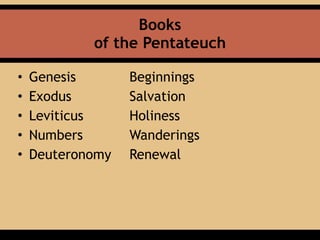
Books

of the Pentateuch
• Genesis Beginnings
• Exodus Salvation
• Leviticus Holiness
• Numbers Wanderings
• Deuteronomy Renewal
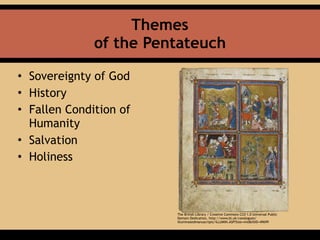
• Sovereignty of God
• History
• Fallen Condition of
Humanity
• Salvation
• Holiness
Themes

of the Pentateuch
The British Library / Creative Commons CC0 1.0 Universal Public
Domain Dedication, http://www.bl.uk/catalogues/
illuminatedmanuscripts/ILLUMIN.ASP?Size=mid&IllID=49699
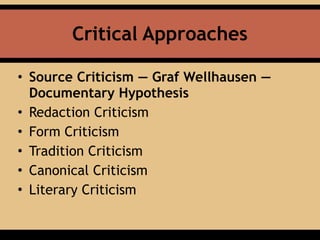
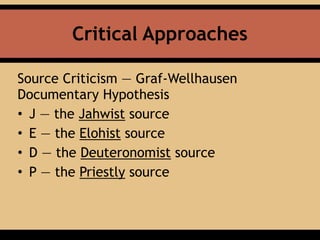
Critical Approaches
• Source Criticism — Graf Wellhausen —
Documentary Hypothesis
• Redaction Criticism
• Form Criticism
• Tradition Criticism
• Canonical Criticism
• Literary Criticism
Critical Approaches
Source Criticism — Graf-Wellhausen
Documentary Hypothesis
• J — the Jahwist source
• E — the Elohist source
• D — the Deuteronomist source
• P — the Priestly source
When R & D gets in the way of saving
lives
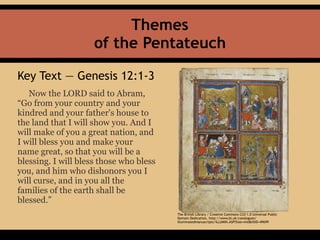
Key Text — Genesis 12:1-3
Now the LORD said to Abram,
“Go from your country and your
kindred and your father's house to
the land that I will show you. And I
will make of you a great nation, and
I will bless you and make your
name great, so that you will be a
blessing. I will bless those who bless
you, and him who dishonors you I
will curse, and in you all the
families of the earth shall be
blessed.”
Themes

of the Pentateuch
The British Library / Creative Commons CC0 1.0 Universal Public
Domain Dedication, http://www.bl.uk/catalogues/
illuminatedmanuscripts/ILLUMIN.ASP?Size=mid&IllID=49699
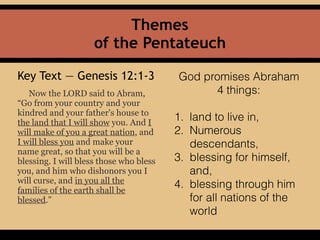
Key Text — Genesis 12:1-3
Now the LORD said to Abram,
“Go from your country and your
kindred and your father's house to
the land that I will show you. And I
will make of you a great nation, and
I will bless you and make your
name great, so that you will be a
blessing. I will bless those who bless
you, and him who dishonors you I
will curse, and in you all the
families of the earth shall be
blessed.”
Themes

of the Pentateuch
God promises Abraham
4 things:
1. land to live in,
2. Numerous
descendants,
3. blessing for himself,
and,
4. blessing through him
for all nations of the
world
Key Text — Genesis
12:1-3
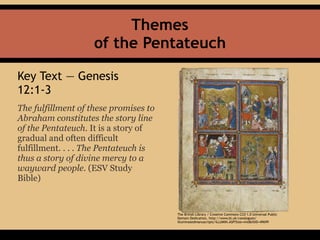
The fulfillment of these promises to
Abraham constitutes the story line
of the Pentateuch. It is a story of
gradual and often difficult
fulfillment. . . . The Pentateuch is
thus a story of divine mercy to a
wayward people. (ESV Study
Bible)
Themes

of the Pentateuch
The British Library / Creative Commons CC0 1.0 Universal Public
Domain Dedication, http://www.bl.uk/catalogues/
illuminatedmanuscripts/ILLUMIN.ASP?Size=mid&IllID=49699
Genesis 1–11: 

The Prelude to Israel
• Primeval History and Its Nature
• Contents of Genesis 1–11
– Creation and Its Nature (chapters 1–2)
– Sin and Its Nature (chapters 3–11)
Contents of Genesis 1–11
I. The Creation of the World (1:1–2:3)
II. Adam and Eve (2:4–25)
III. The Fall (3:1–24)
IV. Cain and Abel (4:1–26)
V. From Adam to Noah (5:1–32)
VI. The Flood (6:1–8:22)
VII. Noah after the Flood (9:1–29)
VIII. The Table of Nations (10:1–32)
IX. The Tower of Babel (11:1–9)
X. The Shemites (11:10–32)
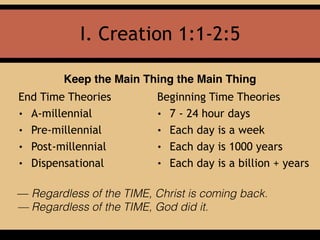
I. Creation 1:1-2:5
End Time Theories
• A-millennial
• Pre-millennial
• Post-millennial
• Dispensational
Keep the Main Thing the Main Thing
Beginning Time Theories
• 7 - 24 hour days
• Each day is a week
• Each day is 1000 years
• Each day is a billion + years
— Regardless of the TIME, Christ is coming back.
— Regardless of the TIME, God did it.
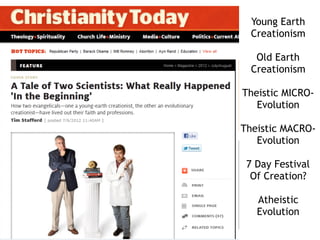
Young Earth
Creationism


Old Earth
Creationism


Theistic MICRO-
Evolution


Theistic MACRO-
Evolution


7 Day Festival
Of Creation?


Atheistic
Evolution

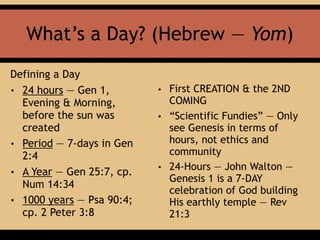
What’s a Day? (Hebrew — Yom)
Defining a Day
• 24 hours — Gen 1,
Evening & Morning,
before the sun was
created
• Period — 7-days in Gen
2:4
• A Year — Gen 25:7, cp.
Num 14:34
• 1000 years — Psa 90:4;
cp. 2 Peter 3:8
• First CREATION & the 2ND
COMING
• “Scientific Fundies” — Only
see Genesis in terms of
hours, not ethics and
community
• 24-Hours — John Walton —
Genesis 1 is a 7-DAY
celebration of God building
His earthly temple — Rev
21:3
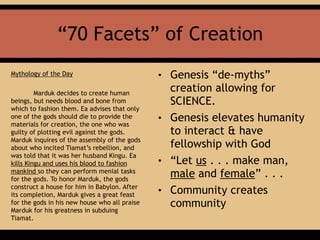
“70 Facets” of Creation
Mythology of the Day
Marduk decides to create human
beings, but needs blood and bone from
which to fashion them. Ea advises that only
one of the gods should die to provide the
materials for creation, the one who was
guilty of plotting evil against the gods.
Marduk inquires of the assembly of the gods
about who incited Tiamat’s rebellion, and
was told that it was her husband Kingu. Ea
kills Kingu and uses his blood to fashion
mankind so they can perform menial tasks
for the gods. To honor Marduk, the gods
construct a house for him in Babylon. After
its completion, Marduk gives a great feast
for the gods in his new house who all praise
Marduk for his greatness in subduing
Tiamat.
• Genesis “de-myths”
creation allowing for
SCIENCE.
• Genesis elevates humanity
to interact & have
fellowship with God
• “Let us . . . make man,
male and female” . . .
• Community creates
community
“70 Facets” of Creation
Mythology of the Day
Marduk decides to create human
beings, but needs blood and bone from
which to fashion them. Ea advises that only
one of the gods should die to provide the
materials for creation, the one who was
guilty of plotting evil against the gods.
Marduk inquires of the assembly of the gods
about who incited Tiamat’s rebellion, and
was told that it was her husband Kingu. Ea
kills Kingu and uses his blood to fashion
mankind so they can perform menial tasks
for the gods. To honor Marduk, the gods
construct a house for him in Babylon. After
its completion, Marduk gives a great feast
for the gods in his new house who all praise
Marduk for his greatness in subduing
Tiamat.
• Genesis establishes our
worth — for ALL of
humanity
• Humanity was not created
to be a slave force, but to
serve in a sacred play as
priests.
• Every Sabbath was to
remember creation
Atheistic Evolution vs. Creation
Atheistic Evolution
• Humanity is no different
than any other creature.
• Man’s origin is random,
accidental
• DNA is common to all living
things — therefore there is
no god
• Our origins derive from the
simple, single-celled
organism
• Animals and people are of
the same value.
Creation
• Humanity is the highest — of
the lowest
• Man was pre-planned (Eph 1:4)
• DNA is common because we
have a common Creator.
• Our origins go UP to a Creator
in whose image we are made.
• Animals are important, But,
not as important as those in
God’s image. (see Deut 22:6-7)
Choose Your Worldview Carefully
Non-Biblical
• Made in the image
of an evil god
• You are a lowly
slave — get over it
and get busy.
• You are an
afterthought.
Biblical
• Made in the image
of a Good God who
does good.
• You are a Royal
Priesthood serving in
the King’s paradise.
• You planned and
purposed.
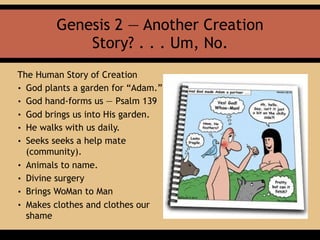
Genesis 2 — Another Creation
Story? . . . Um, No.
The Human Story of Creation
• God plants a garden for “Adam.”
• God hand-forms us — Psalm 139
• God brings us into His garden.
• He walks with us daily.
• Seeks seeks a help mate
(community).
• Animals to name.
• Divine surgery
• Brings WoMan to Man
• Makes clothes and clothes our
shame
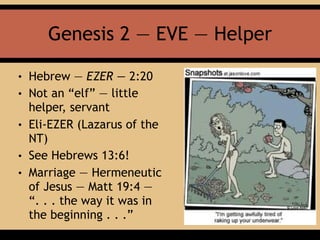
Genesis 2 — EVE — Helper
• Hebrew — EZER — 2:20
• Not an “elf” — little
helper, servant
• Eli-EZER (Lazarus of the
NT)
• See Hebrews 13:6!
• Marriage — Hermeneutic
of Jesus — Matt 19:4 —
“. . . the way it was in
the beginning . . .”
Genesis 3 — And so it begins . . .
Myth-busters of Genesis 3
True or False
• The Tree of the Knowledge of Good and Evil had
apples.
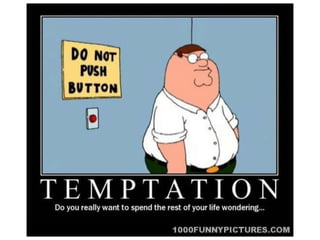
• Eve was ALONE when first tempted.
• If Adam was doing his job as leader of the home,
this would not have happened.
• Eve added to the Word of God (see 2:17 & 3:3).
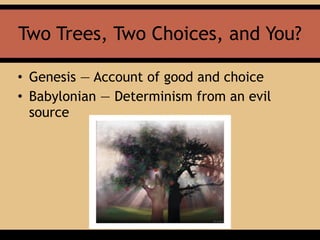
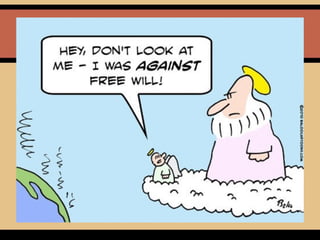
Two Trees, Two Choices, and You?
• Genesis — Account of good and choice
• Babylonian — Determinism from an evil
source
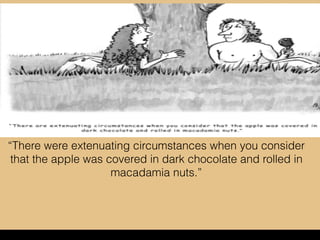
“There were extenuating circumstances when you consider
that the apple was covered in dark chocolate and rolled in
macadamia nuts.”
Freedom and Its Consequences —
Genesis 3
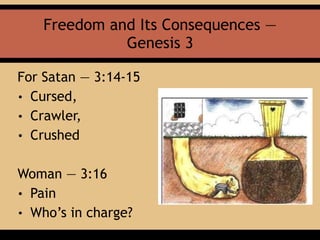
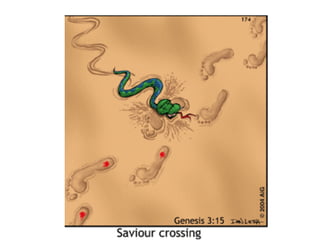
For Satan — 3:14-15
• Cursed,
• Crawler,
• Crushed
Woman — 3:16
• Pain
• Who’s in charge?
Freedom and Its Consequences —
Genesis 3
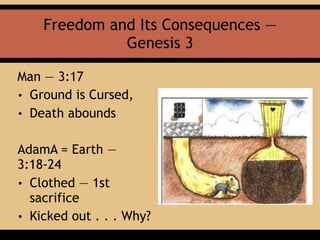
Man — 3:17
• Ground is Cursed,
• Death abounds
AdamA = Earth —
3:18-24
• Clothed — 1st
sacrifice
• Kicked out . . . Why?
Freedom and Its Consequences —
Genesis 3
• Adam alienated from
Eve
• Alienated from God
• Alienated from
creation
• Alienated from self
• Alienated from
community
• Cain and Abel
• Lamech the murderer
• Noah getting drunk
• Abe “pimp’s” his wife —
TWICE!
• Etc., Etc., and so on,
and so forth . . .
• The rest of the Bible is
about rescuing/saving us
(often from ourselves!)
Mirror Images — Genesis and Revelation
• 1:1-ff — Creation of
heaven and earth
• 2:22 — Eve given to
Adam
• 3:8 — God walked daily
— God’s sanctuary
• 3:19 — Curse with
death
• 2:10 — A river runs
through it
• 2:9 — Tree of Life
• 21:1 — New heaven and
new earth
• 21:2 — Bride given to
Husband
• 21:3 — God walks again
among us — God’s
sanctuary
• 21:4 — Curse removed —
including death
• 22:1 — the River of the
Water of Life
• Tree of Life
The First Family — Genesis 4
• 4:1 — “Now Adam yada with his wife” — This term
is never used of animals.
• 4:1 — “I have gotten a man wth the help of the
LORD.” First person to use God’s name in Scripture
was Eve.
• 4:2 — “Abel” — “Nothing” — What a name!
• Abel — flocks; Cain — gardener (like his parents).
• First Murder was within family!
• East . . . East . . . East = BAD (3:24; 4:16).
• WORSHIP — 4:26!!!
Long Live the Sons of God! — Genesis 5
The Generations of Adam
Where did Cain get his wife? . . .
What does the Bible say? . . . Genesis 5:4
Long Live the Sons of God! — Genesis 5
The Generations of Adam
Literary structure —
When A had lived X years, he fathered B. A
lived Y years after he fathered B and had
other sons and daughters. Thus all the days
of A were Z (= X + Y) years, after which he
died.
Long Live the Sons of God! — Genesis 5
The Generations of Adam
Compressed genealogies?
• “Fathered” also means “ancestor of”
• cp. to Moses’ genealogy — Exodus 6:16-20
and Joshua 1 Chronicles 7:23-27 . . .
Long Live the Sons of God! — Genesis 5
The Generations of Adam
How old were these guys? . . .
• Literal — did something in the cosmology change to shorten
lifespans?
• Figure of speech — Sumerian King List (recorded before a
“great flood”) lists kinds living 28,800; 36,000, & 43,200 years.
• Symbolic — related to astronomical figures
• Encoded — with some unknown honorary significance
• Calculated — by a different numeric method
One thing is clear: These people actually lived (regardless of how
long), and they actually died.
Contemplative Question
How would you view yourself if, 1) You
were the product of blind chance/
Atheistic Evolution. How would you
view yourself if, 2) You know you are
created in the image of a loving and
good God? Due Monday (Jan 18).

Engaging the ot 3a

  • 1.
  • 4.
    Introduction to thePentateuch • What Is the Pentateuch? • What Is the Pentateuch About? • What Are the Overarching Themes of the Pentateuch? – Sovereignty of God – History – Corrupted Condition of Humanity – Salvation – Holiness • Who Wrote the Pentateuch?
  • 5.
    Introduction to thePentateuch What Is the Pentateuch? ESV Study Bible The Pentateuch (Gk. “five-volumed”) consists of the first five books of the Bible, i.e., Genesis through Deuteronomy. The Hebrew term for it is torah (“law” or “instruction”) • The beginning and foundation of the Bible.
  • 6.
    Introduction to thePentateuch What Is the Pentateuch? ESV Study Bible • Orientation — The world is created and controlled by One God • Divine Purposes — Showing God’s intentions for His creation • Theology and Ethics — Insight into God’s character and His ethical standards
  • 7.
    Introduction to thePentateuch What Is the Pentateuch? ESV Study Bible — Content • It’s “Center” — Exodus 19 — Numbers 10 — Law giving at Sinai • The Life of Moses — Exodus — Deuteronomy
  • 8.
    Introduction to thePentateuch What Is the Pentateuch? ESV Study Bible — Composition • Moses (and his helpers) — • Exodus 20-23; see Exodus 24:4, 7 (cp. Exod 34:27; 17:14; Num 33:2; Deut 31:9, 19, 22, 24). • But this does not mean he wrote every single word (for obvious reasons, i.e., recording his own death in Deut 34). • “The evidence suggests that Moses was the inspiration for these books. He is its source, it originator, its authorizer. However, terms such as ‘author’ and ‘authorship’ are inappropriate when referring to ancient Near Easter literary products, since they carry modern implications that were absent in antiquity” (Arnold & Beyer, Encountering the Old Testament, 49, emphasis mine).
  • 9.
    Books
 of the Pentateuch •Genesis Beginnings • Exodus Salvation • Leviticus Holiness • Numbers Wanderings • Deuteronomy Renewal
  • 10.
    • Sovereignty ofGod • History • Fallen Condition of Humanity • Salvation • Holiness Themes
 of the Pentateuch The British Library / Creative Commons CC0 1.0 Universal Public Domain Dedication, http://www.bl.uk/catalogues/ illuminatedmanuscripts/ILLUMIN.ASP?Size=mid&IllID=49699
  • 11.
    Critical Approaches • SourceCriticism — Graf Wellhausen — Documentary Hypothesis • Redaction Criticism • Form Criticism • Tradition Criticism • Canonical Criticism • Literary Criticism
  • 12.
    Critical Approaches Source Criticism— Graf-Wellhausen Documentary Hypothesis • J — the Jahwist source • E — the Elohist source • D — the Deuteronomist source • P — the Priestly source
  • 13.
    When R &D gets in the way of saving lives
  • 14.
    Key Text —Genesis 12:1-3 Now the LORD said to Abram, “Go from your country and your kindred and your father's house to the land that I will show you. And I will make of you a great nation, and I will bless you and make your name great, so that you will be a blessing. I will bless those who bless you, and him who dishonors you I will curse, and in you all the families of the earth shall be blessed.” Themes
 of the Pentateuch The British Library / Creative Commons CC0 1.0 Universal Public Domain Dedication, http://www.bl.uk/catalogues/ illuminatedmanuscripts/ILLUMIN.ASP?Size=mid&IllID=49699
  • 15.
    Key Text —Genesis 12:1-3 Now the LORD said to Abram, “Go from your country and your kindred and your father's house to the land that I will show you. And I will make of you a great nation, and I will bless you and make your name great, so that you will be a blessing. I will bless those who bless you, and him who dishonors you I will curse, and in you all the families of the earth shall be blessed.” Themes
 of the Pentateuch God promises Abraham 4 things: 1. land to live in, 2. Numerous descendants, 3. blessing for himself, and, 4. blessing through him for all nations of the world
  • 16.
    Key Text —Genesis 12:1-3 The fulfillment of these promises to Abraham constitutes the story line of the Pentateuch. It is a story of gradual and often difficult fulfillment. . . . The Pentateuch is thus a story of divine mercy to a wayward people. (ESV Study Bible) Themes
 of the Pentateuch The British Library / Creative Commons CC0 1.0 Universal Public Domain Dedication, http://www.bl.uk/catalogues/ illuminatedmanuscripts/ILLUMIN.ASP?Size=mid&IllID=49699
  • 18.
    Genesis 1–11: 
 ThePrelude to Israel • Primeval History and Its Nature • Contents of Genesis 1–11 – Creation and Its Nature (chapters 1–2) – Sin and Its Nature (chapters 3–11)
  • 19.
    Contents of Genesis1–11 I. The Creation of the World (1:1–2:3) II. Adam and Eve (2:4–25) III. The Fall (3:1–24) IV. Cain and Abel (4:1–26) V. From Adam to Noah (5:1–32) VI. The Flood (6:1–8:22) VII. Noah after the Flood (9:1–29) VIII. The Table of Nations (10:1–32) IX. The Tower of Babel (11:1–9) X. The Shemites (11:10–32)
  • 20.
    I. Creation 1:1-2:5 EndTime Theories • A-millennial • Pre-millennial • Post-millennial • Dispensational Keep the Main Thing the Main Thing Beginning Time Theories • 7 - 24 hour days • Each day is a week • Each day is 1000 years • Each day is a billion + years — Regardless of the TIME, Christ is coming back. — Regardless of the TIME, God did it.
  • 21.
    Young Earth Creationism
 
 Old Earth Creationism
 
 TheisticMICRO- Evolution
 
 Theistic MACRO- Evolution
 
 7 Day Festival Of Creation?
 
 Atheistic Evolution

  • 22.
    What’s a Day?(Hebrew — Yom) Defining a Day • 24 hours — Gen 1, Evening & Morning, before the sun was created • Period — 7-days in Gen 2:4 • A Year — Gen 25:7, cp. Num 14:34 • 1000 years — Psa 90:4; cp. 2 Peter 3:8 • First CREATION & the 2ND COMING • “Scientific Fundies” — Only see Genesis in terms of hours, not ethics and community • 24-Hours — John Walton — Genesis 1 is a 7-DAY celebration of God building His earthly temple — Rev 21:3
  • 23.
    “70 Facets” ofCreation Mythology of the Day Marduk decides to create human beings, but needs blood and bone from which to fashion them. Ea advises that only one of the gods should die to provide the materials for creation, the one who was guilty of plotting evil against the gods. Marduk inquires of the assembly of the gods about who incited Tiamat’s rebellion, and was told that it was her husband Kingu. Ea kills Kingu and uses his blood to fashion mankind so they can perform menial tasks for the gods. To honor Marduk, the gods construct a house for him in Babylon. After its completion, Marduk gives a great feast for the gods in his new house who all praise Marduk for his greatness in subduing Tiamat. • Genesis “de-myths” creation allowing for SCIENCE. • Genesis elevates humanity to interact & have fellowship with God • “Let us . . . make man, male and female” . . . • Community creates community
  • 24.
    “70 Facets” ofCreation Mythology of the Day Marduk decides to create human beings, but needs blood and bone from which to fashion them. Ea advises that only one of the gods should die to provide the materials for creation, the one who was guilty of plotting evil against the gods. Marduk inquires of the assembly of the gods about who incited Tiamat’s rebellion, and was told that it was her husband Kingu. Ea kills Kingu and uses his blood to fashion mankind so they can perform menial tasks for the gods. To honor Marduk, the gods construct a house for him in Babylon. After its completion, Marduk gives a great feast for the gods in his new house who all praise Marduk for his greatness in subduing Tiamat. • Genesis establishes our worth — for ALL of humanity • Humanity was not created to be a slave force, but to serve in a sacred play as priests. • Every Sabbath was to remember creation
  • 25.
    Atheistic Evolution vs.Creation Atheistic Evolution • Humanity is no different than any other creature. • Man’s origin is random, accidental • DNA is common to all living things — therefore there is no god • Our origins derive from the simple, single-celled organism • Animals and people are of the same value. Creation • Humanity is the highest — of the lowest • Man was pre-planned (Eph 1:4) • DNA is common because we have a common Creator. • Our origins go UP to a Creator in whose image we are made. • Animals are important, But, not as important as those in God’s image. (see Deut 22:6-7)
  • 26.
    Choose Your WorldviewCarefully Non-Biblical • Made in the image of an evil god • You are a lowly slave — get over it and get busy. • You are an afterthought. Biblical • Made in the image of a Good God who does good. • You are a Royal Priesthood serving in the King’s paradise. • You planned and purposed.
  • 27.
    Genesis 2 —Another Creation Story? . . . Um, No. The Human Story of Creation • God plants a garden for “Adam.” • God hand-forms us — Psalm 139 • God brings us into His garden. • He walks with us daily. • Seeks seeks a help mate (community). • Animals to name. • Divine surgery • Brings WoMan to Man • Makes clothes and clothes our shame
  • 28.
    Genesis 2 —EVE — Helper • Hebrew — EZER — 2:20 • Not an “elf” — little helper, servant • Eli-EZER (Lazarus of the NT) • See Hebrews 13:6! • Marriage — Hermeneutic of Jesus — Matt 19:4 — “. . . the way it was in the beginning . . .”
  • 29.
    Genesis 3 —And so it begins . . . Myth-busters of Genesis 3 True or False • The Tree of the Knowledge of Good and Evil had apples. • Eve was ALONE when first tempted. • If Adam was doing his job as leader of the home, this would not have happened. • Eve added to the Word of God (see 2:17 & 3:3).
  • 30.
    Two Trees, TwoChoices, and You? • Genesis — Account of good and choice • Babylonian — Determinism from an evil source
  • 32.
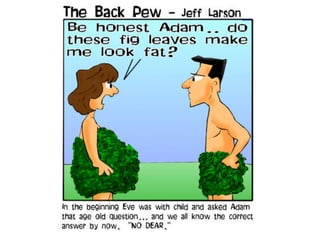
    “There were extenuatingcircumstances when you consider that the apple was covered in dark chocolate and rolled in macadamia nuts.”
  • 33.
    Freedom and ItsConsequences — Genesis 3 For Satan — 3:14-15 • Cursed, • Crawler, • Crushed Woman — 3:16 • Pain • Who’s in charge?
  • 34.
    Freedom and ItsConsequences — Genesis 3 Man — 3:17 • Ground is Cursed, • Death abounds AdamA = Earth — 3:18-24 • Clothed — 1st sacrifice • Kicked out . . . Why?
  • 36.
    Freedom and ItsConsequences — Genesis 3 • Adam alienated from Eve • Alienated from God • Alienated from creation • Alienated from self • Alienated from community • Cain and Abel • Lamech the murderer • Noah getting drunk • Abe “pimp’s” his wife — TWICE! • Etc., Etc., and so on, and so forth . . . • The rest of the Bible is about rescuing/saving us (often from ourselves!)
  • 40.
    Mirror Images —Genesis and Revelation • 1:1-ff — Creation of heaven and earth • 2:22 — Eve given to Adam • 3:8 — God walked daily — God’s sanctuary • 3:19 — Curse with death • 2:10 — A river runs through it • 2:9 — Tree of Life • 21:1 — New heaven and new earth • 21:2 — Bride given to Husband • 21:3 — God walks again among us — God’s sanctuary • 21:4 — Curse removed — including death • 22:1 — the River of the Water of Life • Tree of Life
  • 41.
    The First Family— Genesis 4 • 4:1 — “Now Adam yada with his wife” — This term is never used of animals. • 4:1 — “I have gotten a man wth the help of the LORD.” First person to use God’s name in Scripture was Eve. • 4:2 — “Abel” — “Nothing” — What a name! • Abel — flocks; Cain — gardener (like his parents). • First Murder was within family! • East . . . East . . . East = BAD (3:24; 4:16). • WORSHIP — 4:26!!!
  • 42.
    Long Live theSons of God! — Genesis 5 The Generations of Adam Where did Cain get his wife? . . . What does the Bible say? . . . Genesis 5:4
  • 43.
    Long Live theSons of God! — Genesis 5 The Generations of Adam Literary structure — When A had lived X years, he fathered B. A lived Y years after he fathered B and had other sons and daughters. Thus all the days of A were Z (= X + Y) years, after which he died.
  • 44.
    Long Live theSons of God! — Genesis 5 The Generations of Adam Compressed genealogies? • “Fathered” also means “ancestor of” • cp. to Moses’ genealogy — Exodus 6:16-20 and Joshua 1 Chronicles 7:23-27 . . .
  • 45.
    Long Live theSons of God! — Genesis 5 The Generations of Adam How old were these guys? . . . • Literal — did something in the cosmology change to shorten lifespans? • Figure of speech — Sumerian King List (recorded before a “great flood”) lists kinds living 28,800; 36,000, & 43,200 years. • Symbolic — related to astronomical figures • Encoded — with some unknown honorary significance • Calculated — by a different numeric method One thing is clear: These people actually lived (regardless of how long), and they actually died.
  • 46.
    Contemplative Question How wouldyou view yourself if, 1) You were the product of blind chance/ Atheistic Evolution. How would you view yourself if, 2) You know you are created in the image of a loving and good God? Due Monday (Jan 18).