The Book of Genesis
Introduction
Genesis is the first book of the
Bible
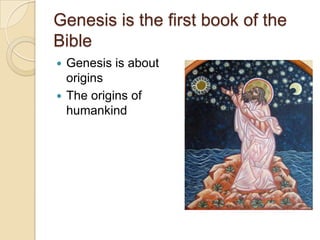
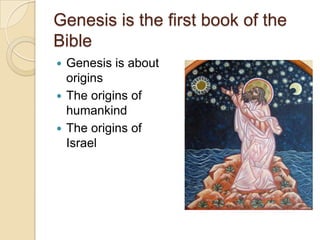
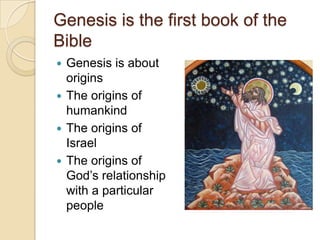
   ―Genesis is a book
    about origins: the
    origins of
    humankind, the
    origins of Israel,
    and the origins of
    the unique
    relationship
    between God and
    a particular
    people.‖ (The JPS Torah
    Commentary: Genesis; Commentary by
    Nahum M. Sarna; The Jewish Publications
    Society, Philadelphia, PA 1989 p.xii)
Genesis is the first book of the
Bible
   Genesis is about
    origins
Genesis is the first book of the
Bible
 Genesis is about
  origins
 The origins of
  humankind
Genesis is the first book of the
Bible
 Genesis is about
  origins
 The origins of
  humankind
 The origins of
  Israel
Genesis is the first book of the
Bible
 Genesis is about
  origins
 The origins of
  humankind
 The origins of
  Israel
 The origins of
  God‘s relationship
  with a particular
  people
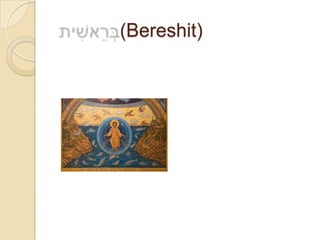
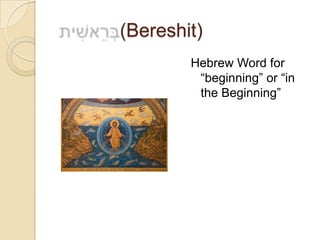
(Bereshit)
(Bereshit)
        Hebrew Word for
         ―beginning‖ or ―in
         the Beginning‖
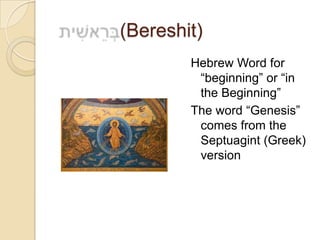
(Bereshit)
        Hebrew Word for
         ―beginning‖ or ―in
         the Beginning‖
        The word ―Genesis‖
         comes from the
         Septuagint (Greek)
         version
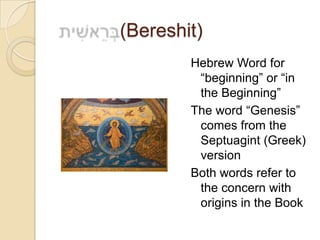
(Bereshit)
        Hebrew Word for
         ―beginning‖ or ―in
         the Beginning‖
        The word ―Genesis‖
         comes from the
         Septuagint (Greek)
         version
        Both words refer to
         the concern with
         origins in the Book
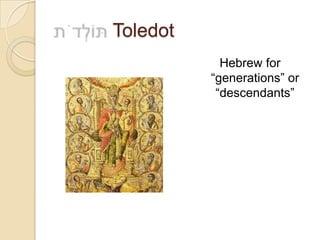
Toledot
            Hebrew for
          ―generations‖ or
           ―descendants‖
Creation

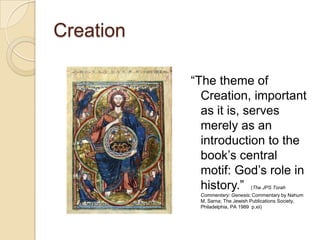
           ―The theme of
             Creation, important
             as it is, serves
             merely as an
             introduction to the
             book‘s central
             motif: God‘s role in
             history.‖          (The JPS Torah
            Commentary: Genesis; Commentary by Nahum
            M. Sarna; The Jewish Publications Society,
            Philadelphia, PA 1989 p.xii)
Creation
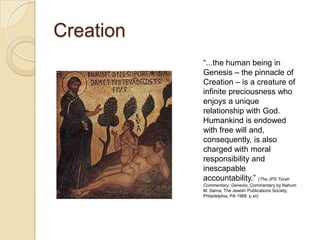
           ―...the human being in
           Genesis – the pinnacle of
           Creation – is a creature of
           infinite preciousness who
           enjoys a unique
           relationship with God.
           Humankind is endowed
           with free will and,
           consequently, is also
           charged with moral
           responsibility and
           inescapable
           accountability.‖ (The JPS Torah
           Commentary: Genesis; Commentary by Nahum
           M. Sarna; The Jewish Publications Society,
           Philadelphia, PA 1989 p.xii)
Dignity of the Human Person
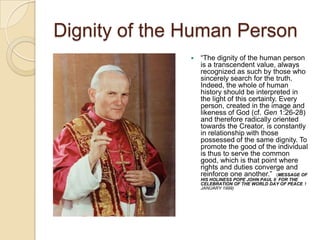
                  ―The dignity of the human person
                   is a transcendent value, always
                   recognized as such by those who
                   sincerely search for the truth.
                   Indeed, the whole of human
                   history should be interpreted in
                   the light of this certainty. Every
                   person, created in the image and
                   likeness of God (cf. Gen 1:26-28)
                   and therefore radically oriented
                   towards the Creator, is constantly
                   in relationship with those
                   possessed of the same dignity. To
                   promote the good of the individual
                   is thus to serve the common
                   good, which is that point where
                   rights and duties converge and
                   reinforce one another.‖ (MESSAGE OF
                   HIS HOLINESS POPE JOHN PAUL II FOR THE
                   CELEBRATION OF THE WORLD DAY OF PEACE 1
                   JANUARY 1999)
The Number 10

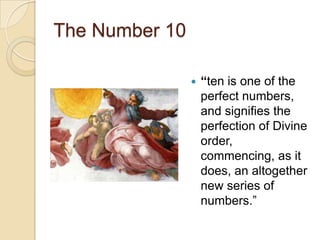
                   “ten is one of the
                    perfect numbers,
                    and signifies the
                    perfection of Divine
                    order,
                    commencing, as it
                    does, an altogether
                    new series of
                    numbers.‖
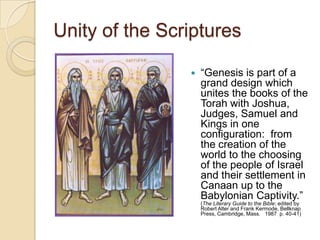
Unity of the Scriptures

                   ―Genesis is part of a
                    grand design which
                    unites the books of the
                    Torah with Joshua,
                    Judges, Samuel and
                    Kings in one
                    configuration: from
                    the creation of the
                    world to the choosing
                    of the people of Israel
                    and their settlement in
                    Canaan up to the
                    Babylonian Captivity.‖
                    (The Literary Guide to the Bible; edited by
                    Robert Alter and Frank Kermode, Bellknap
                    Press, Cambridge, Mass. 1987 p. 40-41)
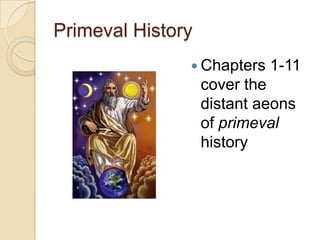
Primeval History
                Chapters   1-11
                   cover the
                   distant aeons
                   of primeval
                   history
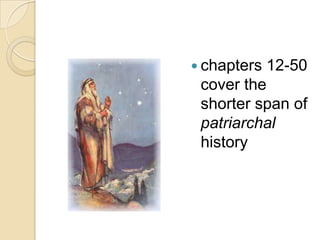
 chapters12-50
 cover the
 shorter span of
 patriarchal
 history
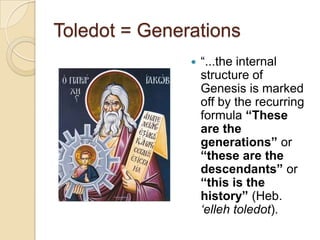
Toledot = Generations
                  ―...the internal
                   structure of
                   Genesis is marked
                   off by the recurring
                   formula “These
                   are the
                   generations” or
                   “these are the
                   descendants” or
                   “this is the
                   history” (Heb.
                   ‘elleh toledot).
Toledot = Generations
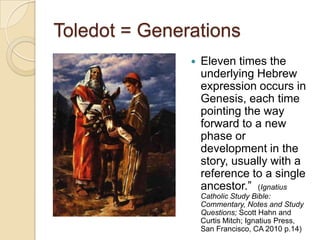
                  Eleven times the
                   underlying Hebrew
                   expression occurs in
                   Genesis, each time
                   pointing the way
                   forward to a new
                   phase or
                   development in the
                   story, usually with a
                   reference to a single
                   ancestor.‖ (Ignatius
                   Catholic Study Bible:
                   Commentary, Notes and Study
                   Questions; Scott Hahn and
                   Curtis Mitch; Ignatius Press,
                   San Francisco, CA 2010 p.14)
Toledot = Generations
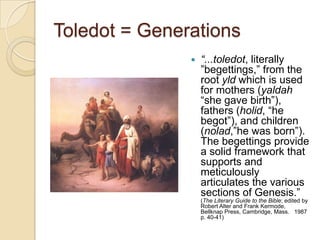
                  “...toledot, literally
                   ‖begettings,‖ from the
                   root yld which is used
                   for mothers (yaldah
                   ―she gave birth‖),
                   fathers (holid, ―he
                   begot‖), and children
                   (nolad,‖he was born‖).
                   The begettings provide
                   a solid framework that
                   supports and
                   meticulously
                   articulates the various
                   sections of Genesis.‖
                   (The Literary Guide to the Bible; edited by
                   Robert Alter and Frank Kermode,
                   Bellknap Press, Cambridge, Mass. 1987
                   p. 40-41)
Documentary Hypothesis
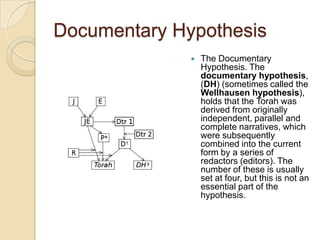
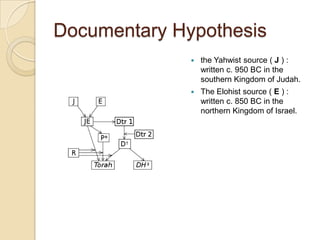
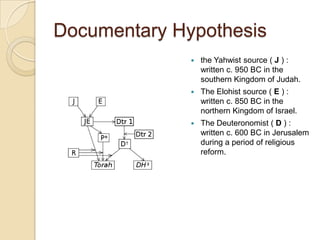
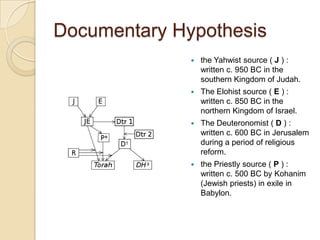
                 The Documentary
                  Hypothesis. The
                  documentary hypothesis,
                  (DH) (sometimes called the
                  Wellhausen hypothesis),
                  holds that the Torah was
                  derived from originally
                  independent, parallel and
                  complete narratives, which
                  were subsequently
                  combined into the current
                  form by a series of
                  redactors (editors). The
                  number of these is usually
                  set at four, but this is not an
                  essential part of the
                  hypothesis.
Documentary Hypothesis
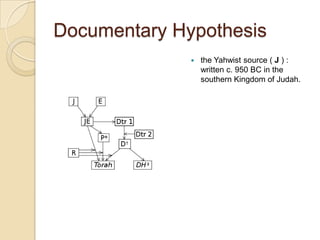
                 the Yahwist source ( J ) :
                  written c. 950 BC in the
                  southern Kingdom of Judah.
Documentary Hypothesis
                 the Yahwist source ( J ) :
                  written c. 950 BC in the
                  southern Kingdom of Judah.
                 The Elohist source ( E ) :
                  written c. 850 BC in the
                  northern Kingdom of Israel.
Documentary Hypothesis
                 the Yahwist source ( J ) :
                  written c. 950 BC in the
                  southern Kingdom of Judah.
                 The Elohist source ( E ) :
                  written c. 850 BC in the
                  northern Kingdom of Israel.
                 The Deuteronomist ( D ) :
                  written c. 600 BC in Jerusalem
                  during a period of religious
                  reform.
Documentary Hypothesis
                 the Yahwist source ( J ) :
                  written c. 950 BC in the
                  southern Kingdom of Judah.
                 The Elohist source ( E ) :
                  written c. 850 BC in the
                  northern Kingdom of Israel.
                 The Deuteronomist ( D ) :
                  written c. 600 BC in Jerusalem
                  during a period of religious
                  reform.
                 the Priestly source ( P ) :
                  written c. 500 BC by Kohanim
                  (Jewish priests) in exile in
                  Babylon.
Creation in the Bible
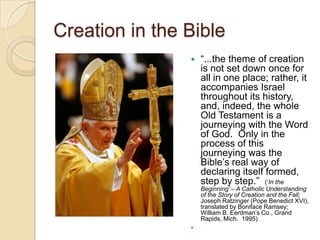
                   ―...the theme of creation
                    is not set down once for
                    all in one place; rather, it
                    accompanies Israel
                    throughout its history,
                    and, indeed, the whole
                    Old Testament is a
                    journeying with the Word
                    of God. Only in the
                    process of this
                    journeying was the
                    Bible‘s real way of
                    declaring itself formed,
                    step by step.‖ (‗In the
                    Beginning’ – A Catholic Understanding
                    of the Story of Creation and the Fall;
                    Joseph Ratzinger (Pope Benedict XVI),
                    translated by Boniface Ramsey;
                    William B. Eerdman‘s Co., Grand
                    Rapids, Mich. 1995)
                
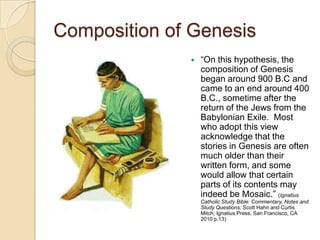
Composition of Genesis
                 ―On this hypothesis, the
                  composition of Genesis
                  began around 900 B.C and
                  came to an end around 400
                  B.C., sometime after the
                  return of the Jews from the
                  Babylonian Exile. Most
                  who adopt this view
                  acknowledge that the
                  stories in Genesis are often
                  much older than their
                  written form, and some
                  would allow that certain
                  parts of its contents may
                  indeed be Mosaic.‖ (Ignatius
                  Catholic Study Bible: Commentary, Notes and
                  Study Questions; Scott Hahn and Curtis
                  Mitch; Ignatius Press, San Francisco, CA
                  2010 p.13)
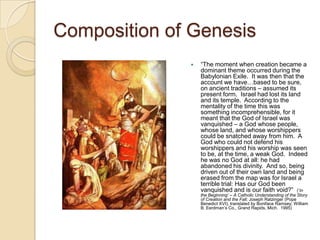
Composition of Genesis
                 ―The moment when creation became a
                  dominant theme occurred during the
                  Babylonian Exile. It was then that the
                  account we have…based to be sure,
                  on ancient traditions – assumed its
                  present form. Israel had lost its land
                  and its temple. According to the
                  mentality of the time this was
                  something incomprehensible, for it
                  meant that the God of Israel was
                  vanquished – a God whose people,
                  whose land, and whose worshippers
                  could be snatched away from him. A
                  God who could not defend his
                  worshippers and his worship was seen
                  to be, at the time, a weak God. Indeed
                  he was no God at all: he had
                  abandoned his divinity. And so, being
                  driven out of their own land and being
                  erased from the map was for Israel a
                  terrible trial: Has our God been
                  vanquished and is our faith void?‖ (‗In
                  the Beginning’ – A Catholic Understanding of the Story
                  of Creation and the Fall; Joseph Ratzinger (Pope
                  Benedict XVI), translated by Boniface Ramsey; William
                  B. Eerdman‘s Co., Grand Rapids, Mich. 1995)
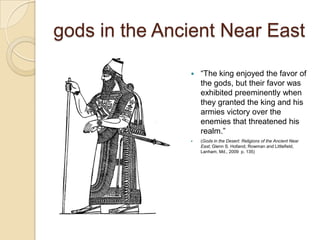
gods in the Ancient Near East

                  ―The king enjoyed the favor of
                   the gods, but their favor was
                   exhibited preeminently when
                   they granted the king and his
                   armies victory over the
                   enemies that threatened his
                   realm.‖
                  (Gods in the Desert: Religions of the Ancient Near
                   East; Glenn S. Holland; Rowman and Littlefield,
                   Lanham, Md., 2009 p. 135)
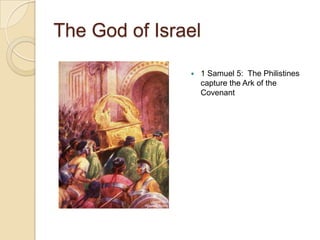
The God of Israel

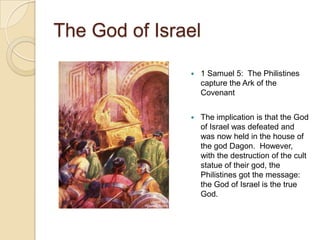
                  1 Samuel 5: The Philistines
                   capture the Ark of the
                   Covenant
The God of Israel

                  1 Samuel 5: The Philistines
                   capture the Ark of the
                   Covenant


                  The implication is that the God
                   of Israel was defeated and
                   was now held in the house of
                   the god Dagon. However,
                   with the destruction of the cult
                   statue of their god, the
                   Philistines got the message:
                   the God of Israel is the true
                   God.
The God of Israel

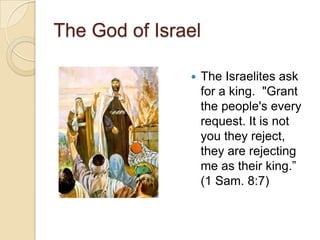
                  The Israelites ask
                   for a king. "Grant
                   the people's every
                   request. It is not
                   you they reject,
                   they are rejecting
                   me as their king.‖
                   (1 Sam. 8:7)
The God of Israel
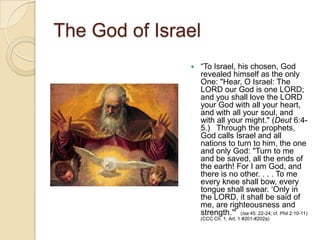
                  ―To Israel, his chosen, God
                   revealed himself as the only
                   One: "Hear, O Israel: The
                   LORD our God is one LORD;
                   and you shall love the LORD
                   your God with all your heart,
                   and with all your soul, and
                   with all your might." (Deut 6:4-
                   5.) Through the prophets,
                   God calls Israel and all
                   nations to turn to him, the one
                   and only God: "Turn to me
                   and be saved, all the ends of
                   the earth! For I am God, and
                   there is no other. . . . To me
                   every knee shall bow, every
                   tongue shall swear. ‗Only in
                   the LORD, it shall be said of
                   me, are righteousness and
                   strength.'" (Isa 45: 22-24; cf. Phil 2:10-11)
                   (CCC Ch. 1, Art. 1 #201-#202a)
I believe in one God
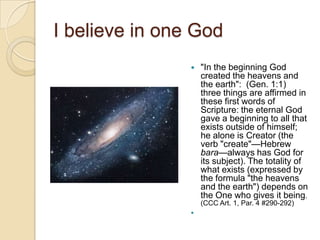
                   "In the beginning God
                    created the heavens and
                    the earth": (Gen. 1:1)
                    three things are affirmed in
                    these first words of
                    Scripture: the eternal God
                    gave a beginning to all that
                    exists outside of himself;
                    he alone is Creator (the
                    verb "create"—Hebrew
                    bara—always has God for
                    its subject). The totality of
                    what exists (expressed by
                    the formula "the heavens
                    and the earth") depends on
                    the One who gives it being.
                    (CCC Art. 1, Par. 4 #290-292)
                
I believe in one God

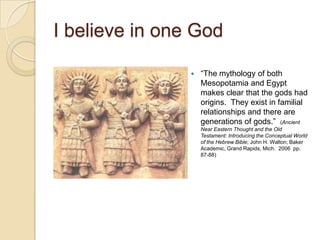
                   ―The mythology of both
                    Mesopotamia and Egypt
                    makes clear that the gods had
                    origins. They exist in familial
                    relationships and there are
                    generations of gods.‖ (Ancient
                    Near Eastern Thought and the Old
                    Testament: Introducing the Conceptual World
                    of the Hebrew Bible; John H. Walton; Baker
                    Academic, Grand Rapids, Mich. 2006 pp.
                    87-88)
I believe in one God

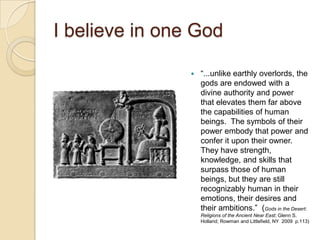
                   ―...unlike earthly overlords, the
                    gods are endowed with a
                    divine authority and power
                    that elevates them far above
                    the capabilities of human
                    beings. The symbols of their
                    power embody that power and
                    confer it upon their owner.
                    They have strength,
                    knowledge, and skills that
                    surpass those of human
                    beings, but they are still
                    recognizably human in their
                    emotions, their desires and
                    their ambitions.‖ (Gods in the Desert:
                    Religions of the Ancient Near East; Glenn S.
                    Holland; Rowman and Littlefield, NY 2009 p.113)

The book of genesis

  • 1.
    The Book ofGenesis Introduction
  • 2.
    Genesis is thefirst book of the Bible  ―Genesis is a book about origins: the origins of humankind, the origins of Israel, and the origins of the unique relationship between God and a particular people.‖ (The JPS Torah Commentary: Genesis; Commentary by Nahum M. Sarna; The Jewish Publications Society, Philadelphia, PA 1989 p.xii)
  • 3.
    Genesis is thefirst book of the Bible  Genesis is about origins
  • 4.
    Genesis is thefirst book of the Bible  Genesis is about origins  The origins of humankind
  • 5.
    Genesis is thefirst book of the Bible  Genesis is about origins  The origins of humankind  The origins of Israel
  • 6.
    Genesis is thefirst book of the Bible  Genesis is about origins  The origins of humankind  The origins of Israel  The origins of God‘s relationship with a particular people
  • 7.
  • 8.
    (Bereshit) Hebrew Word for ―beginning‖ or ―in the Beginning‖
  • 9.
    (Bereshit) Hebrew Word for ―beginning‖ or ―in the Beginning‖ The word ―Genesis‖ comes from the Septuagint (Greek) version
  • 10.
    (Bereshit) Hebrew Word for ―beginning‖ or ―in the Beginning‖ The word ―Genesis‖ comes from the Septuagint (Greek) version Both words refer to the concern with origins in the Book
  • 11.
    Toledot Hebrew for ―generations‖ or ―descendants‖
  • 12.
    Creation ―The theme of Creation, important as it is, serves merely as an introduction to the book‘s central motif: God‘s role in history.‖ (The JPS Torah Commentary: Genesis; Commentary by Nahum M. Sarna; The Jewish Publications Society, Philadelphia, PA 1989 p.xii)
  • 13.
    Creation ―...the human being in Genesis – the pinnacle of Creation – is a creature of infinite preciousness who enjoys a unique relationship with God. Humankind is endowed with free will and, consequently, is also charged with moral responsibility and inescapable accountability.‖ (The JPS Torah Commentary: Genesis; Commentary by Nahum M. Sarna; The Jewish Publications Society, Philadelphia, PA 1989 p.xii)
  • 14.
    Dignity of theHuman Person  ―The dignity of the human person is a transcendent value, always recognized as such by those who sincerely search for the truth. Indeed, the whole of human history should be interpreted in the light of this certainty. Every person, created in the image and likeness of God (cf. Gen 1:26-28) and therefore radically oriented towards the Creator, is constantly in relationship with those possessed of the same dignity. To promote the good of the individual is thus to serve the common good, which is that point where rights and duties converge and reinforce one another.‖ (MESSAGE OF HIS HOLINESS POPE JOHN PAUL II FOR THE CELEBRATION OF THE WORLD DAY OF PEACE 1 JANUARY 1999)
  • 15.
    The Number 10  “ten is one of the perfect numbers, and signifies the perfection of Divine order, commencing, as it does, an altogether new series of numbers.‖
  • 16.
    Unity of theScriptures  ―Genesis is part of a grand design which unites the books of the Torah with Joshua, Judges, Samuel and Kings in one configuration: from the creation of the world to the choosing of the people of Israel and their settlement in Canaan up to the Babylonian Captivity.‖ (The Literary Guide to the Bible; edited by Robert Alter and Frank Kermode, Bellknap Press, Cambridge, Mass. 1987 p. 40-41)
  • 17.
    Primeval History  Chapters 1-11 cover the distant aeons of primeval history
  • 18.
     chapters12-50 coverthe shorter span of patriarchal history
  • 19.
    Toledot = Generations  ―...the internal structure of Genesis is marked off by the recurring formula “These are the generations” or “these are the descendants” or “this is the history” (Heb. ‘elleh toledot).
  • 20.
    Toledot = Generations  Eleven times the underlying Hebrew expression occurs in Genesis, each time pointing the way forward to a new phase or development in the story, usually with a reference to a single ancestor.‖ (Ignatius Catholic Study Bible: Commentary, Notes and Study Questions; Scott Hahn and Curtis Mitch; Ignatius Press, San Francisco, CA 2010 p.14)
  • 21.
    Toledot = Generations  “...toledot, literally ‖begettings,‖ from the root yld which is used for mothers (yaldah ―she gave birth‖), fathers (holid, ―he begot‖), and children (nolad,‖he was born‖). The begettings provide a solid framework that supports and meticulously articulates the various sections of Genesis.‖ (The Literary Guide to the Bible; edited by Robert Alter and Frank Kermode, Bellknap Press, Cambridge, Mass. 1987 p. 40-41)
  • 22.
    Documentary Hypothesis  The Documentary Hypothesis. The documentary hypothesis, (DH) (sometimes called the Wellhausen hypothesis), holds that the Torah was derived from originally independent, parallel and complete narratives, which were subsequently combined into the current form by a series of redactors (editors). The number of these is usually set at four, but this is not an essential part of the hypothesis.
  • 23.
    Documentary Hypothesis  the Yahwist source ( J ) : written c. 950 BC in the southern Kingdom of Judah.
  • 24.
    Documentary Hypothesis  the Yahwist source ( J ) : written c. 950 BC in the southern Kingdom of Judah.  The Elohist source ( E ) : written c. 850 BC in the northern Kingdom of Israel.
  • 25.
    Documentary Hypothesis  the Yahwist source ( J ) : written c. 950 BC in the southern Kingdom of Judah.  The Elohist source ( E ) : written c. 850 BC in the northern Kingdom of Israel.  The Deuteronomist ( D ) : written c. 600 BC in Jerusalem during a period of religious reform.
  • 26.
    Documentary Hypothesis  the Yahwist source ( J ) : written c. 950 BC in the southern Kingdom of Judah.  The Elohist source ( E ) : written c. 850 BC in the northern Kingdom of Israel.  The Deuteronomist ( D ) : written c. 600 BC in Jerusalem during a period of religious reform.  the Priestly source ( P ) : written c. 500 BC by Kohanim (Jewish priests) in exile in Babylon.
  • 27.
    Creation in theBible  ―...the theme of creation is not set down once for all in one place; rather, it accompanies Israel throughout its history, and, indeed, the whole Old Testament is a journeying with the Word of God. Only in the process of this journeying was the Bible‘s real way of declaring itself formed, step by step.‖ (‗In the Beginning’ – A Catholic Understanding of the Story of Creation and the Fall; Joseph Ratzinger (Pope Benedict XVI), translated by Boniface Ramsey; William B. Eerdman‘s Co., Grand Rapids, Mich. 1995) 
  • 28.
    Composition of Genesis  ―On this hypothesis, the composition of Genesis began around 900 B.C and came to an end around 400 B.C., sometime after the return of the Jews from the Babylonian Exile. Most who adopt this view acknowledge that the stories in Genesis are often much older than their written form, and some would allow that certain parts of its contents may indeed be Mosaic.‖ (Ignatius Catholic Study Bible: Commentary, Notes and Study Questions; Scott Hahn and Curtis Mitch; Ignatius Press, San Francisco, CA 2010 p.13)
  • 29.
    Composition of Genesis  ―The moment when creation became a dominant theme occurred during the Babylonian Exile. It was then that the account we have…based to be sure, on ancient traditions – assumed its present form. Israel had lost its land and its temple. According to the mentality of the time this was something incomprehensible, for it meant that the God of Israel was vanquished – a God whose people, whose land, and whose worshippers could be snatched away from him. A God who could not defend his worshippers and his worship was seen to be, at the time, a weak God. Indeed he was no God at all: he had abandoned his divinity. And so, being driven out of their own land and being erased from the map was for Israel a terrible trial: Has our God been vanquished and is our faith void?‖ (‗In the Beginning’ – A Catholic Understanding of the Story of Creation and the Fall; Joseph Ratzinger (Pope Benedict XVI), translated by Boniface Ramsey; William B. Eerdman‘s Co., Grand Rapids, Mich. 1995)
  • 30.
    gods in theAncient Near East  ―The king enjoyed the favor of the gods, but their favor was exhibited preeminently when they granted the king and his armies victory over the enemies that threatened his realm.‖  (Gods in the Desert: Religions of the Ancient Near East; Glenn S. Holland; Rowman and Littlefield, Lanham, Md., 2009 p. 135)
  • 31.
    The God ofIsrael  1 Samuel 5: The Philistines capture the Ark of the Covenant
  • 32.
    The God ofIsrael  1 Samuel 5: The Philistines capture the Ark of the Covenant  The implication is that the God of Israel was defeated and was now held in the house of the god Dagon. However, with the destruction of the cult statue of their god, the Philistines got the message: the God of Israel is the true God.
  • 33.
    The God ofIsrael  The Israelites ask for a king. "Grant the people's every request. It is not you they reject, they are rejecting me as their king.‖ (1 Sam. 8:7)
  • 34.
    The God ofIsrael  ―To Israel, his chosen, God revealed himself as the only One: "Hear, O Israel: The LORD our God is one LORD; and you shall love the LORD your God with all your heart, and with all your soul, and with all your might." (Deut 6:4- 5.) Through the prophets, God calls Israel and all nations to turn to him, the one and only God: "Turn to me and be saved, all the ends of the earth! For I am God, and there is no other. . . . To me every knee shall bow, every tongue shall swear. ‗Only in the LORD, it shall be said of me, are righteousness and strength.'" (Isa 45: 22-24; cf. Phil 2:10-11) (CCC Ch. 1, Art. 1 #201-#202a)
  • 35.
    I believe inone God  "In the beginning God created the heavens and the earth": (Gen. 1:1) three things are affirmed in these first words of Scripture: the eternal God gave a beginning to all that exists outside of himself; he alone is Creator (the verb "create"—Hebrew bara—always has God for its subject). The totality of what exists (expressed by the formula "the heavens and the earth") depends on the One who gives it being. (CCC Art. 1, Par. 4 #290-292) 
  • 36.
    I believe inone God  ―The mythology of both Mesopotamia and Egypt makes clear that the gods had origins. They exist in familial relationships and there are generations of gods.‖ (Ancient Near Eastern Thought and the Old Testament: Introducing the Conceptual World of the Hebrew Bible; John H. Walton; Baker Academic, Grand Rapids, Mich. 2006 pp. 87-88)
  • 37.
    I believe inone God  ―...unlike earthly overlords, the gods are endowed with a divine authority and power that elevates them far above the capabilities of human beings. The symbols of their power embody that power and confer it upon their owner. They have strength, knowledge, and skills that surpass those of human beings, but they are still recognizably human in their emotions, their desires and their ambitions.‖ (Gods in the Desert: Religions of the Ancient Near East; Glenn S. Holland; Rowman and Littlefield, NY 2009 p.113)