AC Generator
Class 12Physics
Project
Understanding AC Generator Concepts and
Applications
Write your Name
2.
Introduction
This presentation delvesinto the fundamental concepts of alternating current
(AC) generators. It covers their definition, functionality, and various types,
providing a comprehensive overview suitable for Class 12 Physics students. The
objective is to enhance understanding of AC generation principles and their
significance in real-world applications.
Definition and Functionality
ACgenerators, also known as alternators, convert mechanical energy into
electrical energy through electromagnetic induction. They operate by rotating a
coil within a magnetic field. This conversion process is fundamental in power
generation, allowing for electricity to be transmitted over long distances
efficiently.
5.
Basic Principles ofAC Generation
The principle of electromagnetic induction, discovered by Faraday, underlies the
functioning of AC generators. As the coil rotates, it cuts through magnetic field
lines, inducing an electromotive force (EMF). The generated AC voltage varies
sinusoidally, which forms the basis for most electrical systems used today,
facilitating the use of AC for homes and industries.
6.
Key Components ofAC
Generators
AC generators consist of several essential components
that work together to produce electricity. The primary
parts include the rotor, which rotates within the
magnetic field, and the stator, which houses the coils
where the voltage is induced. Additionally, excitation
systems ensure the rotor maintains the necessary
magnetic field strength, while voltage regulators
manage the output voltage to ensure consistent
electrical supply.
Synchronous
Generators
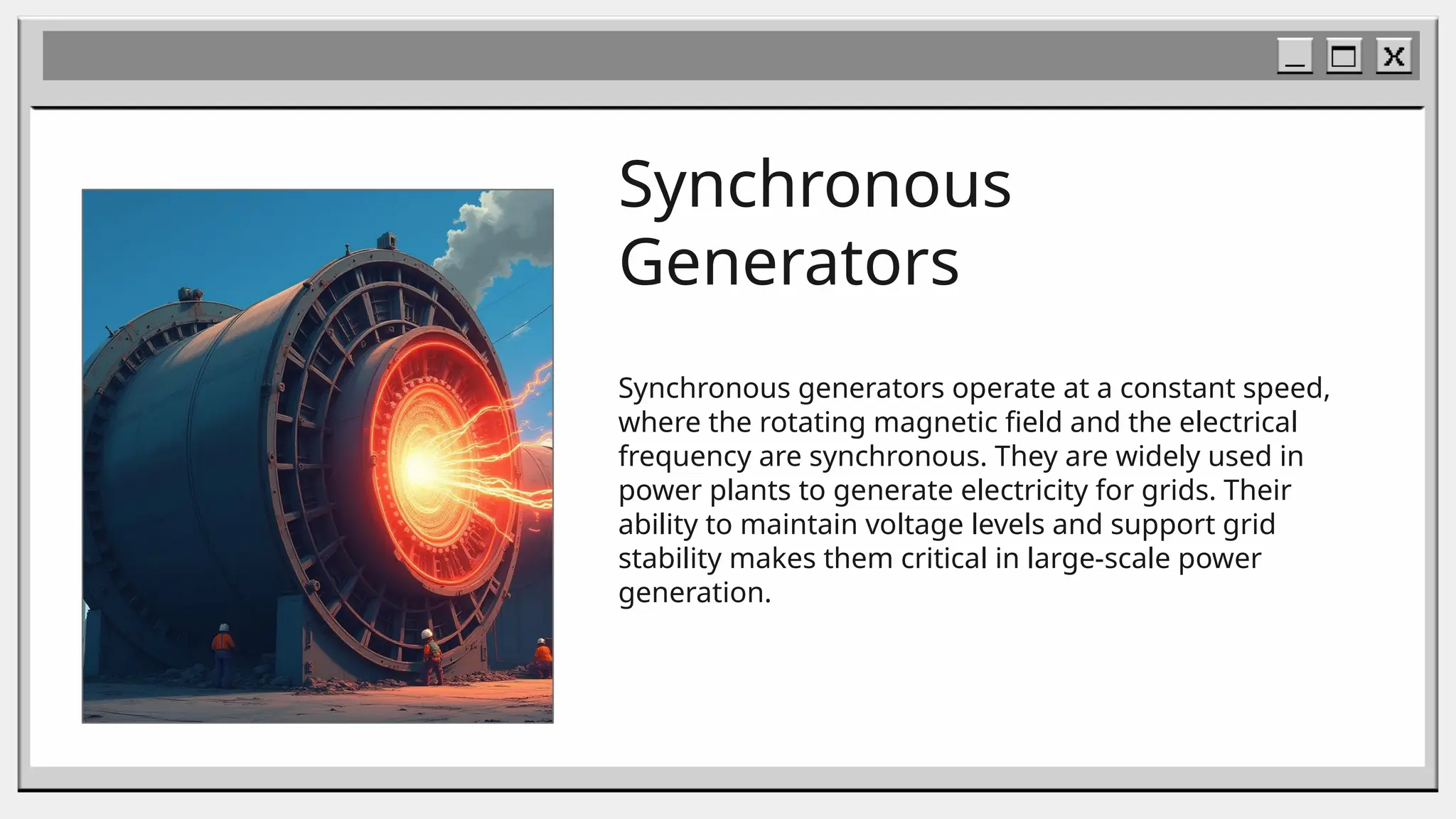
Synchronous generators operateat a constant speed,
where the rotating magnetic field and the electrical
frequency are synchronous. They are widely used in
power plants to generate electricity for grids. Their
ability to maintain voltage levels and support grid
stability makes them critical in large-scale power
generation.
9.
Induction Generators
Induction generatorsdiffer from synchronous generators as they do not require
a separate excitation system. They convert mechanical energy into electrical
energy when driven above synchronous speed. Commonly used in wind
turbines, they are known for their simplicity and reliability, making them a
popular choice in renewable energy applications.
10.
Applications in VariousFields
AC generators are pivotal in various sectors, including electricity generation,
industrial manufacturing, and transportation. They power homes, businesses,
and infrastructure, making them essential for modern society. With the shift
towards sustainable energy, their role in renewable sources like wind and
hydroelectric power is increasingly significant.
11.
Conclusions
In conclusion, ACgenerators play a vital role in the conversion of mechanical
energy to electrical energy. Understanding their components, types, and
applications highlights their importance in power generation and modern
technology. As the demand for energy continues to grow, the relevance of AC
generators in sustainable and efficient energy solutions cannot be overstated.
12.
CREDITS: This presentationtemplate was created by
Slidesgo, and includes icons, infographics & images
by Freepik
Thank you!
Do you have any questions?
+00 000 000 000