KENDRIYA VIDYALAYA
IIT KANPUR
PHYSICS INVESTIGATORY
PROJECT
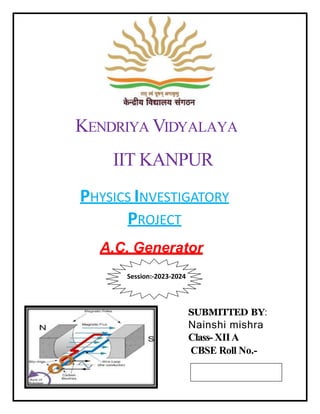
A.C. Generator
SUBMITTED BY:
Nainshi mishra
Class- XIIA
CBSE Roll No.-
Session:-2023-2024
CONTENTS
 Certificate
 Acknowledgment
 Introduction
 Principle of A.C. Generator
 Construction of A.C. Generator
 Theory
 Circuit Diagram
 Working of A.C. Generator
 Expression for Instaneous e.m.f.
produced
 Result
 Applications of A.C. Generator
 Bibliography
This is to certify that Nainshi Mishra, a
student of Class XII A has successfully
completed the project under the guidance
of Mr. Awadh Narayan (PGT PHY),During
the academic year 2023-2024 in partial
fulfillment of physics practical examination
conducted by CBSE.
Sub.Teacher Principal Examiner
ACKNOWLEDGMENT
It would my utmost pleasure to
express my sincere thanks to my physics
teacher Mr. Awadh Narayan in
providing a helping hand in this project.
His valuable guidance and support and
supervision all through this project are
responsible for attaining its present
form.
Introduction
A.C. Generator means Alternating
current generator. It is a device which is
used to convert mechanical energy
into electrical energy.
A.C. generator forces electric current
to flow through an external circuit. The
source of mechanical energy may be a
reciprocating or turbine steam engine,
water falling through a turbine or
waterwheel, an internal combustion
engine, a wind turbine, a hand crank,
compressed air, or any other source of
mechanical energy.
Principle of A.C. Generator
It is based on the principle of
electro-magnetic induction,
i.e., whenever amount of magnetic flux
linked with a coil changes, an e.m.f. is
induced in the coil.
The direction of current induced is given
by Fleming’s right-hand rule.
Construction of A.C. Generator
The A.C. Generator is consist of four main parts :
(1) THE COIL (ARMATURE) :
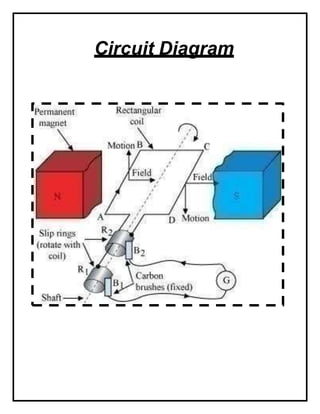
A rectangular coil ABCD consist of a large number
of turns of copper bound over a soft iron core is called
armature. The soft iron core is used to increase the
magnetic flux.
(2) MAGNETIC FIELD :
It is usually a permanent sponge magnet having
concave poles. The armature is rotated of a magnet so
that axis of the armature is perpendicular to magnetic
field lines.
(3) SLIP RINGS :
Slip rings are the magnetic rings, which are connected
to the terminal of the armature. These rings are
rotated with the coil and these are used to draw the
current from the generator.
(4) BRUSHES :
The brushes B1 & B2 just touches the slip rings. They
are not rotating with the coil and these brushes lead
to the output of load resistance.
Theory
1.The strong magnetic field is produced by a current flow
through the field coil of the rotor.
2.The field coil in the rotor receives excitation through the
use of slip rings and brushes.
3.Two brushes are spring-held in contact with the slip rings
to provide the continuous connection between the field coil
and external circuit.
4.The armature is contained within the windings of the
stator and is connected to the output.
5.Each time the rotor makes one complete revolution, one
complete cycle of AC is developed.
6.A generator has many turns of wire wound into the slots
of the rotor.
7.The magnitude of AC voltage generated by an AC
generator is dependent on the field strength and speed of
the rotor.
8.Most generators are operated at a constant speed;
therefore, the generated voltage depends on field excitation
or strength.
Circuit Diagram
Working of an A.C. Generator
The coil is rotated in the anti-clockwise
direction. In the first half rotation the arm AB is
moving outward and CD is moving inward. So
the e.m.f. is induced in the arm AB from A to B.
And in the arm CD from C to D. After half
rotation (in the second half). The arm CD is
moving outward and AB is moving inward. In
this time current is induced in arm CD from D to
C. And in arm AB from B to A. In the second-half
rotation, the current direction is changing so in
this generator AC is produced.
Expression for Instaneous
e.m.f. produced
Let position of the coil at any time t.
It's making angle θ with vertical. If w is
uniform angular speed of the coil.
Then, θ =ωt
B be the strength of magnetic field n
be the number of turns in the coil and A
area of the coil then magnetic flux with
the coil in this position is given by :
Φ = nBA Cosθ = nBA Cos ωt.
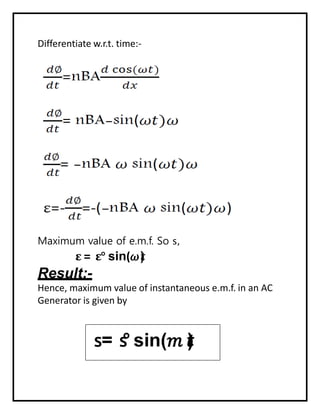
Differentiate w.r.t. time:-
Maximum value of e.m.f. So 𝗌,
ε = ε° sin(𝜔𝑡
)
Result:-
Hence, maximum value of instantaneous e.m.f. in an AC
Generator is given by
𝗌= 𝗌
° sin(𝑚 𝒕
)
Applications of A.C. Generator
1.Aircraft auxiliary power generation, wind
generators, high-speed gas turbine generators.
2.Hybrid electric vehicle (HEV) drive systems,
automotive starter generators.
3.An ac generator, or 'alternator', is used to
produce ac voltages for transmission via the grid
system or, locally, as portable generators.
4.All of our household appliances run on ac
current.
Ex: Refrigerator, washing machines, oven, lights,
fan, etc.
5.The main advantage of AC is ease of power
distribution.
It is more efficient to use high voltage to distribute
power, but it is not safe to have high voltage at
home. It is easy to step up (and step down) AC
voltage using a transformer.
Bibliography
• CBSE Lab manual
• Help of Physics Teacher
• NCERT Textbook
• Websites:-
www.google.com
www.wikipedia.com

nidhi mishraAC-Generator.pptx

  • 1.
    KENDRIYA VIDYALAYA IIT KANPUR PHYSICSINVESTIGATORY PROJECT A.C. Generator SUBMITTED BY: Nainshi mishra Class- XIIA CBSE Roll No.- Session:-2023-2024
  • 2.
    CONTENTS  Certificate  Acknowledgment Introduction  Principle of A.C. Generator  Construction of A.C. Generator  Theory  Circuit Diagram  Working of A.C. Generator  Expression for Instaneous e.m.f. produced  Result  Applications of A.C. Generator  Bibliography
  • 3.
    This is tocertify that Nainshi Mishra, a student of Class XII A has successfully completed the project under the guidance of Mr. Awadh Narayan (PGT PHY),During the academic year 2023-2024 in partial fulfillment of physics practical examination conducted by CBSE. Sub.Teacher Principal Examiner
  • 4.
    ACKNOWLEDGMENT It would myutmost pleasure to express my sincere thanks to my physics teacher Mr. Awadh Narayan in providing a helping hand in this project. His valuable guidance and support and supervision all through this project are responsible for attaining its present form.
  • 5.
    Introduction A.C. Generator meansAlternating current generator. It is a device which is used to convert mechanical energy into electrical energy. A.C. generator forces electric current to flow through an external circuit. The source of mechanical energy may be a reciprocating or turbine steam engine, water falling through a turbine or waterwheel, an internal combustion engine, a wind turbine, a hand crank, compressed air, or any other source of mechanical energy.
  • 6.
    Principle of A.C.Generator It is based on the principle of electro-magnetic induction, i.e., whenever amount of magnetic flux linked with a coil changes, an e.m.f. is induced in the coil. The direction of current induced is given by Fleming’s right-hand rule.
  • 7.
    Construction of A.C.Generator The A.C. Generator is consist of four main parts : (1) THE COIL (ARMATURE) : A rectangular coil ABCD consist of a large number of turns of copper bound over a soft iron core is called armature. The soft iron core is used to increase the magnetic flux. (2) MAGNETIC FIELD : It is usually a permanent sponge magnet having concave poles. The armature is rotated of a magnet so that axis of the armature is perpendicular to magnetic field lines. (3) SLIP RINGS : Slip rings are the magnetic rings, which are connected to the terminal of the armature. These rings are rotated with the coil and these are used to draw the current from the generator. (4) BRUSHES : The brushes B1 & B2 just touches the slip rings. They are not rotating with the coil and these brushes lead to the output of load resistance.
  • 8.
    Theory 1.The strong magneticfield is produced by a current flow through the field coil of the rotor. 2.The field coil in the rotor receives excitation through the use of slip rings and brushes. 3.Two brushes are spring-held in contact with the slip rings to provide the continuous connection between the field coil and external circuit. 4.The armature is contained within the windings of the stator and is connected to the output. 5.Each time the rotor makes one complete revolution, one complete cycle of AC is developed. 6.A generator has many turns of wire wound into the slots of the rotor. 7.The magnitude of AC voltage generated by an AC generator is dependent on the field strength and speed of the rotor. 8.Most generators are operated at a constant speed; therefore, the generated voltage depends on field excitation or strength.
  • 9.
  • 10.
    Working of anA.C. Generator The coil is rotated in the anti-clockwise direction. In the first half rotation the arm AB is moving outward and CD is moving inward. So the e.m.f. is induced in the arm AB from A to B. And in the arm CD from C to D. After half rotation (in the second half). The arm CD is moving outward and AB is moving inward. In this time current is induced in arm CD from D to C. And in arm AB from B to A. In the second-half rotation, the current direction is changing so in this generator AC is produced.
  • 11.
    Expression for Instaneous e.m.f.produced Let position of the coil at any time t. It's making angle θ with vertical. If w is uniform angular speed of the coil. Then, θ =ωt B be the strength of magnetic field n be the number of turns in the coil and A area of the coil then magnetic flux with the coil in this position is given by : Φ = nBA Cosθ = nBA Cos ωt.
  • 12.
    Differentiate w.r.t. time:- Maximumvalue of e.m.f. So 𝗌, ε = ε° sin(𝜔𝑡 ) Result:- Hence, maximum value of instantaneous e.m.f. in an AC Generator is given by 𝗌= 𝗌 ° sin(𝑚 𝒕 )
  • 13.
    Applications of A.C.Generator 1.Aircraft auxiliary power generation, wind generators, high-speed gas turbine generators. 2.Hybrid electric vehicle (HEV) drive systems, automotive starter generators. 3.An ac generator, or 'alternator', is used to produce ac voltages for transmission via the grid system or, locally, as portable generators. 4.All of our household appliances run on ac current. Ex: Refrigerator, washing machines, oven, lights, fan, etc. 5.The main advantage of AC is ease of power distribution. It is more efficient to use high voltage to distribute power, but it is not safe to have high voltage at home. It is easy to step up (and step down) AC voltage using a transformer.
  • 14.
    Bibliography • CBSE Labmanual • Help of Physics Teacher • NCERT Textbook • Websites:- www.google.com www.wikipedia.com