GENERATING
PATTERNS
MATHEMATICS 10 – MODULE 1
Prepared By: Chriza D. Suarez
OBJECTIVES
describes and
generates
patterns
find the next
term of a
sequence.
finds the
general term
or nth term of
a sequence
M1: GENERATING PATTERNS
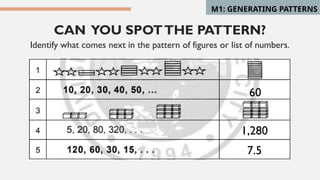
CAN YOU SPOTTHE PATTERN?
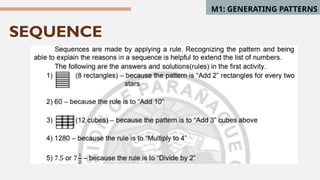
Identify what comes next in the pattern of figures or list of numbers.
60
1,280
7.5
LESSON 2
M1: GENERATING PATTERNS
SEQUENCE
PATTERN is also known as a SEQUENCE.
is an arrangement of elements or numbers
that usually follow a particular rule. It can be
finite (elements can be counted) or infinite
(the pattern goes on).
M1: GENERATING PATTERNS
 FINITE SEQUENCE (can be counted)
example: 0, 3, 6, 9, 12, 15
This sequence has exactly 6
elements
 INFINITE SEQUENCE (cannot be
counted)
example: 10, 20, 30, 40 …
Three dots mean it keeps going
M1: GENERATING PATTERNS
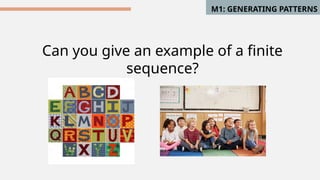
Can you give an example of a finite
sequence?
M1: GENERATING PATTERNS
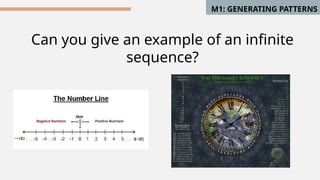
Can you give an example of an infinite
sequence?
M1: GENERATING PATTERNS
SEQUENCE
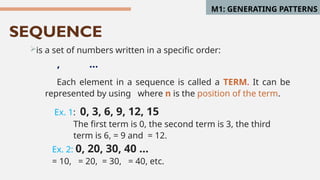
is a set of numbers written in a specific order:
, …
Each element in a sequence is called a TERM. It can be
represented by using where n is the position of the term.
Ex. 1: 0, 3, 6, 9, 12, 15
The first term is 0, the second term is 3, the third
term is 6, = 9 and = 12.
Ex. 2: 0, 20, 30, 40 …
= 10, = 20, = 30, = 40, etc.
M1: GENERATING PATTERNS
SEQUENCE
M1: GENERATING PATTERNS
LET’S APPLY
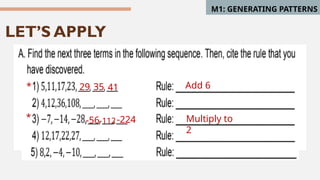
29 35 41 Add 6
-56-112-224 Multiply to
2
*
*
M1: GENERATING PATTERNS
FINDINGTHE NEXTTERM OF A
SEQUENCE GIVEN ITS GENERALTERM
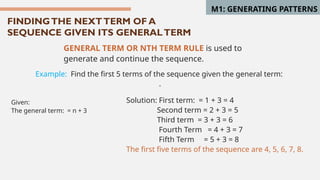
GENERAL TERM OR NTH TERM RULE is used to
generate and continue the sequence.
Example: Find the first 5 terms of the sequence given the general term:
.
Given:
The general term: = n + 3
Solution: First term: = 1 + 3 = 4
Second term = 2 + 3 = 5
Third term = 3 + 3 = 6
Fourth Term = 4 + 3 = 7
Fifth Term = 5 + 3 = 8
The first five terms of the sequence are 4, 5, 6, 7, 8.
M1: GENERATING PATTERNS
FINDINGTHE NEXTTERM OF A
SEQUENCE GIVEN ITS GENERALTERM
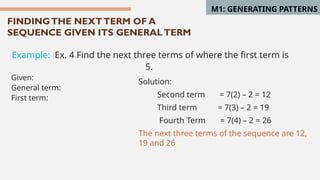
Example: Ex. 4 Find the next three terms of where the first term is
5.
Given:
General term:
First term:
Solution:
Second term = 7(2) – 2 = 12
Third term = 7(3) – 2 = 19
Fourth Term = 7(4) – 2 = 26
The next three terms of the sequence are 12,
19 and 26.
M1: GENERATING PATTERNS
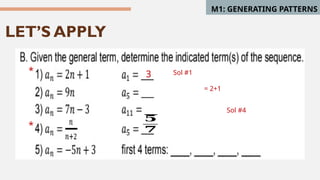
LET’S APPLY
Sol #1
= 2+1
*
* 3
Sol #4
𝟓
𝟕
M1: GENERATING PATTERNS
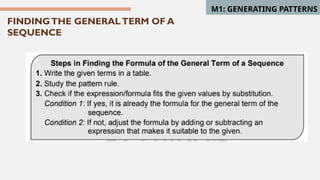
FINDINGTHE GENERALTERM OF A
SEQUENCE
M1: GENERATING PATTERNS
FINDINGTHE GENERALTERM OF A
SEQUENCE
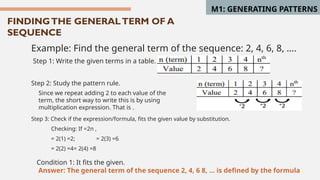
Example: Find the general term of the sequence: 2, 4, 6, 8, ….
Step 1: Write the given terms in a table.
Condition 1: It fits the given.
Answer: The general term of the sequence 2, 4, 6 8, ... is defined by the formula .
Step 2: Study the pattern rule.
Step 3: Check if the expression/formula, fits the given value by substitution.
Checking: If =2n ,
= 2(1) =2; = 2(3) =6
= 2(2) =4= 2(4) =8
Since we repeat adding 2 to each value of the
term, the short way to write this is by using
multiplication expression. That is .
M1: GENERATING PATTERNS
FINDINGTHE GENERALTERM OF A SEQUENCE
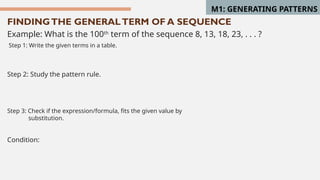
Example: What is the 100th
term of the sequence 8, 13, 18, 23, . . . ?
Step 1: Write the given terms in a table.
Condition:
Step 2: Study the pattern rule.
Step 3: Check if the expression/formula, fits the given value by
substitution.
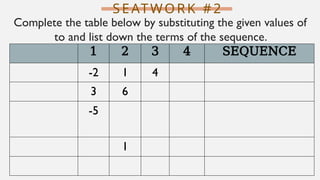
SEATWORK #2
Complete the table below by substituting the given values of
to and list down the terms of the sequence.
1 2 3 4 SEQUENCE
-2 1 4
3 6
-5
1
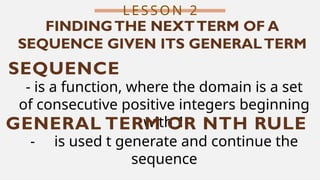
LESSON 2
SEQUENCE
FINDINGTHE NEXTTERM OF A
SEQUENCE GIVEN ITS GENERALTERM
- is a function, where the domain is a set
of consecutive positive integers beginning
with 1
GENERAL TERM OR NTH RULE
- is used t generate and continue the
sequence
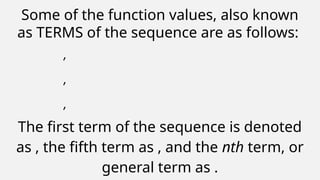
Some of the function values, also known
as TERMS of the sequence are as follows:
,
,
,
The first term of the sequence is denoted
as , the fifth term as , and the nth term, or
general term as .

M1W1 Generating Patterns (sequence and patterns)

  • 1.
    GENERATING PATTERNS MATHEMATICS 10 –MODULE 1 Prepared By: Chriza D. Suarez
  • 2.
    OBJECTIVES describes and generates patterns find thenext term of a sequence. finds the general term or nth term of a sequence M1: GENERATING PATTERNS
  • 3.
    M1: GENERATING PATTERNS CANYOU SPOTTHE PATTERN? Identify what comes next in the pattern of figures or list of numbers. 60 1,280 7.5
  • 4.
    LESSON 2 M1: GENERATINGPATTERNS SEQUENCE PATTERN is also known as a SEQUENCE. is an arrangement of elements or numbers that usually follow a particular rule. It can be finite (elements can be counted) or infinite (the pattern goes on).
  • 5.
    M1: GENERATING PATTERNS FINITE SEQUENCE (can be counted) example: 0, 3, 6, 9, 12, 15 This sequence has exactly 6 elements  INFINITE SEQUENCE (cannot be counted) example: 10, 20, 30, 40 … Three dots mean it keeps going
  • 6.
    M1: GENERATING PATTERNS Canyou give an example of a finite sequence?
  • 7.
    M1: GENERATING PATTERNS Canyou give an example of an infinite sequence?
  • 8.
    M1: GENERATING PATTERNS SEQUENCE isa set of numbers written in a specific order: , … Each element in a sequence is called a TERM. It can be represented by using where n is the position of the term. Ex. 1: 0, 3, 6, 9, 12, 15 The first term is 0, the second term is 3, the third term is 6, = 9 and = 12. Ex. 2: 0, 20, 30, 40 … = 10, = 20, = 30, = 40, etc.
  • 9.
  • 10.
    M1: GENERATING PATTERNS LET’SAPPLY 29 35 41 Add 6 -56-112-224 Multiply to 2 * *
  • 11.
    M1: GENERATING PATTERNS FINDINGTHENEXTTERM OF A SEQUENCE GIVEN ITS GENERALTERM GENERAL TERM OR NTH TERM RULE is used to generate and continue the sequence. Example: Find the first 5 terms of the sequence given the general term: . Given: The general term: = n + 3 Solution: First term: = 1 + 3 = 4 Second term = 2 + 3 = 5 Third term = 3 + 3 = 6 Fourth Term = 4 + 3 = 7 Fifth Term = 5 + 3 = 8 The first five terms of the sequence are 4, 5, 6, 7, 8.
  • 12.
    M1: GENERATING PATTERNS FINDINGTHENEXTTERM OF A SEQUENCE GIVEN ITS GENERALTERM Example: Ex. 4 Find the next three terms of where the first term is 5. Given: General term: First term: Solution: Second term = 7(2) – 2 = 12 Third term = 7(3) – 2 = 19 Fourth Term = 7(4) – 2 = 26 The next three terms of the sequence are 12, 19 and 26.
  • 13.
    M1: GENERATING PATTERNS LET’SAPPLY Sol #1 = 2+1 * * 3 Sol #4 𝟓 𝟕
  • 14.
    M1: GENERATING PATTERNS FINDINGTHEGENERALTERM OF A SEQUENCE
  • 15.
    M1: GENERATING PATTERNS FINDINGTHEGENERALTERM OF A SEQUENCE Example: Find the general term of the sequence: 2, 4, 6, 8, …. Step 1: Write the given terms in a table. Condition 1: It fits the given. Answer: The general term of the sequence 2, 4, 6 8, ... is defined by the formula . Step 2: Study the pattern rule. Step 3: Check if the expression/formula, fits the given value by substitution. Checking: If =2n , = 2(1) =2; = 2(3) =6 = 2(2) =4= 2(4) =8 Since we repeat adding 2 to each value of the term, the short way to write this is by using multiplication expression. That is .
  • 16.
    M1: GENERATING PATTERNS FINDINGTHEGENERALTERM OF A SEQUENCE Example: What is the 100th term of the sequence 8, 13, 18, 23, . . . ? Step 1: Write the given terms in a table. Condition: Step 2: Study the pattern rule. Step 3: Check if the expression/formula, fits the given value by substitution.
  • 17.
    SEATWORK #2 Complete thetable below by substituting the given values of to and list down the terms of the sequence. 1 2 3 4 SEQUENCE -2 1 4 3 6 -5 1
  • 18.
    LESSON 2 SEQUENCE FINDINGTHE NEXTTERMOF A SEQUENCE GIVEN ITS GENERALTERM - is a function, where the domain is a set of consecutive positive integers beginning with 1 GENERAL TERM OR NTH RULE - is used t generate and continue the sequence
  • 19.
    Some of thefunction values, also known as TERMS of the sequence are as follows: , , , The first term of the sequence is denoted as , the fifth term as , and the nth term, or general term as .