What’s new!
Suppose you participate in a
bikeathon for charity. That charity
starts with Php 50.00 in donations.
Each participant must raise Php
200.00 in pledges. What is the
minumum amount of money to be
increased if there are 75 participants?
What’s the plan! Number
of
Participa
nts (n)
Total
Amount
Raised
1 50
2 250
3 450
… …
75 14,850
an = a1 + ( n-1) d
a75 = 50 + (75-1) 200
= 50 + (74) 200
= 50 + 14,800
= 14, 850
To solve this problem, we'll calculate the
total amount of money raised by the 75
participants, plus the initial donation. This
forms an arithmetic sequence:
1.Initial donation: Php 50.00
2.Each participant raises: Php 200.00
3.Number of participants: 75
a1 = 50 n= 75 d= 200
Therefore, the minimum
amount of money raised
with 75 participants is Php
14, 850.00.
"Where Else
Do We See
Arithmetic
Sequences in
Daily Life?"
Solving Real-Life
Problems Involving
Arithmetic
Sequences
solve real-
life
problems
involving
arithmetic
sequences
by applying
the formula
2
OBJECTIVES
1
accurately
and
effectively
write and
solve
arithmetic
sequence
problems;
3
appreciate the
importance of
arithmetic
sequences in real-
life contexts and
demonstrate a
positive attitude
toward
mathematical
problem-solving.
Given
a1
n
d
"GAS Up Your Problem-Solving!"
Asked
an=?
Solution
an = a1 + ( n-1) d
Example Problem:
Bacterial Growth
In a scientific observation, a
researcher notes a bacterial
population growth pattern. Starting
with 100 bacteria, the population
increases by 50 every hour. This
scenario serves as an effective
illustration of an arithmetic sequence
A scientist is observing
the growth of bacteria
in a petri dish. The
initial population is
100 bacteria, and it
increases by 50
bacteria every hour.
How many bacteria
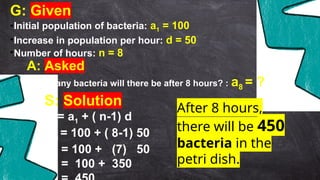
G: Given
•Initial population of bacteria: a1 = 100
•Increase in population per hour: d = 50
•Number of hours: n = 8
A: Asked
How many bacteria will there be after 8 hours? : a8 = ?
S: Solution
an = a1 + ( n-1) d
a8 = 100 + ( 8-1) 50
= 100 + (7) 50
= 100 + 350
After 8 hours,
there will be 450
bacteria in the
petri dish.
“Mastering the
Basics: Your
Guided
Practice”
Example Problem 1: Salary Increase
A recent graduate starts
a new job with starting
salary of
Php20,000.00. Each year,
they receive a raise of
Php 2,000.00. How much
will their salary be in the
5th
year?
G: Given
•Starting salary: a1 = 20,000
•Increase in salary per year: d = 2,000
•Number of years: n = 5
A: Asked
How much will their salary be in the 5th year? : a5 = ?
S: Solution
an = a1 + ( n-1) d
a5 = 20,000 + ( 5-1) 50
= 20,000+(4) 2,000
= 20,000 + 8,000
The salary in the 5th
year is Php
28,000.00
The first step of a
staircase is 10 cm
high, and each step
is 2 cm higher. What
is the height of the
15th
step?
“Generalize and Apply!"
• What are the key learning points you
took away from today's lesson?
• How can arithmetic sequences be
used to solve real-life problems? Can
you give an example?
A plant grows 4 cm each
week. If it starts at 10 cm,
how tall will it be after 8
weeks?
G: Given
A: Asked
S: Solution
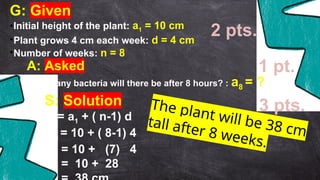
G: Given
•Initial height of the plant: a1 = 10 cm
•Plant grows 4 cm each week: d = 4 cm
•Number of weeks: n = 8
A: Asked
How many bacteria will there be after 8 hours? : a8 = ?
S: Solution
an = a1 + ( n-1) d
a8 = 10 + ( 8-1) 4
= 10 + (7) 4
= 10 + 28
The plant will be 38 cm
tall after 8 weeks.
2 pts.
1 pt.
3 pts.
"Exit Tickets:
Quick Insights
for Deeper
Understanding
"
Exit Tickets
• One Thing I Learned Today:
•One Question I Still Have:
ASSIGNMENT
. Solve the following problems:
. 1.Runner increases distance by 0.2 km each day,
starting at 2 km. Find distance on day 10.
. 2.Glenn bought a car Php600,000. The yearly
depreciation of his car is 10% of its value at the start of
the year. What is its value after 4 years?

Problem Solving in Arithmetic sequence.pptx

  • 1.
    What’s new! Suppose youparticipate in a bikeathon for charity. That charity starts with Php 50.00 in donations. Each participant must raise Php 200.00 in pledges. What is the minumum amount of money to be increased if there are 75 participants?
  • 2.
    What’s the plan!Number of Participa nts (n) Total Amount Raised 1 50 2 250 3 450 … … 75 14,850 an = a1 + ( n-1) d a75 = 50 + (75-1) 200 = 50 + (74) 200 = 50 + 14,800 = 14, 850 To solve this problem, we'll calculate the total amount of money raised by the 75 participants, plus the initial donation. This forms an arithmetic sequence: 1.Initial donation: Php 50.00 2.Each participant raises: Php 200.00 3.Number of participants: 75 a1 = 50 n= 75 d= 200 Therefore, the minimum amount of money raised with 75 participants is Php 14, 850.00.
  • 3.
    "Where Else Do WeSee Arithmetic Sequences in Daily Life?"
  • 5.
  • 6.
    solve real- life problems involving arithmetic sequences by applying theformula 2 OBJECTIVES 1 accurately and effectively write and solve arithmetic sequence problems; 3 appreciate the importance of arithmetic sequences in real- life contexts and demonstrate a positive attitude toward mathematical problem-solving.
  • 7.
    Given a1 n d "GAS Up YourProblem-Solving!" Asked an=? Solution an = a1 + ( n-1) d
  • 8.
    Example Problem: Bacterial Growth Ina scientific observation, a researcher notes a bacterial population growth pattern. Starting with 100 bacteria, the population increases by 50 every hour. This scenario serves as an effective illustration of an arithmetic sequence
  • 9.
    A scientist isobserving the growth of bacteria in a petri dish. The initial population is 100 bacteria, and it increases by 50 bacteria every hour. How many bacteria
  • 10.
    G: Given •Initial populationof bacteria: a1 = 100 •Increase in population per hour: d = 50 •Number of hours: n = 8 A: Asked How many bacteria will there be after 8 hours? : a8 = ? S: Solution an = a1 + ( n-1) d a8 = 100 + ( 8-1) 50 = 100 + (7) 50 = 100 + 350 After 8 hours, there will be 450 bacteria in the petri dish.
  • 11.
  • 12.
    Example Problem 1:Salary Increase
  • 13.
    A recent graduatestarts a new job with starting salary of Php20,000.00. Each year, they receive a raise of Php 2,000.00. How much will their salary be in the 5th year?
  • 14.
    G: Given •Starting salary:a1 = 20,000 •Increase in salary per year: d = 2,000 •Number of years: n = 5 A: Asked How much will their salary be in the 5th year? : a5 = ? S: Solution an = a1 + ( n-1) d a5 = 20,000 + ( 5-1) 50 = 20,000+(4) 2,000 = 20,000 + 8,000 The salary in the 5th year is Php 28,000.00
  • 15.
    The first stepof a staircase is 10 cm high, and each step is 2 cm higher. What is the height of the 15th step?
  • 16.
    “Generalize and Apply!" •What are the key learning points you took away from today's lesson? • How can arithmetic sequences be used to solve real-life problems? Can you give an example?
  • 18.
    A plant grows4 cm each week. If it starts at 10 cm, how tall will it be after 8 weeks? G: Given A: Asked S: Solution
  • 19.
    G: Given •Initial heightof the plant: a1 = 10 cm •Plant grows 4 cm each week: d = 4 cm •Number of weeks: n = 8 A: Asked How many bacteria will there be after 8 hours? : a8 = ? S: Solution an = a1 + ( n-1) d a8 = 10 + ( 8-1) 4 = 10 + (7) 4 = 10 + 28 The plant will be 38 cm tall after 8 weeks. 2 pts. 1 pt. 3 pts.
  • 20.
    "Exit Tickets: Quick Insights forDeeper Understanding "
  • 21.
    Exit Tickets • OneThing I Learned Today: •One Question I Still Have:
  • 22.
    ASSIGNMENT . Solve thefollowing problems: . 1.Runner increases distance by 0.2 km each day, starting at 2 km. Find distance on day 10. . 2.Glenn bought a car Php600,000. The yearly depreciation of his car is 10% of its value at the start of the year. What is its value after 4 years?