Knowledge And JustificationJohn L Pollock
download
https://ebookbell.com/product/knowledge-and-justification-john-l-
pollock-51946862
Explore and download more ebooks at ebookbell.com
2.
Here are somerecommended products that we believe you will be
interested in. You can click the link to download.
Essays On A Priori Knowledge And Justification 1st Edition Albert
Casullo
https://ebookbell.com/product/essays-on-a-priori-knowledge-and-
justification-1st-edition-albert-casullo-6638586
A Historical And Systematic Perspective On A Priori Knowledge And
Justification Ivette Fredrivera
https://ebookbell.com/product/a-historical-and-systematic-perspective-
on-a-priori-knowledge-and-justification-ivette-fredrivera-48040660
Antiindividualism Mind And Language Knowledge And Justification 1st
Edition Sanford C Goldberg
https://ebookbell.com/product/antiindividualism-mind-and-language-
knowledge-and-justification-1st-edition-sanford-c-goldberg-1874608
Themes From Klein Knowledge Scepticism And Justification 1st Ed
Branden Fitelson
https://ebookbell.com/product/themes-from-klein-knowledge-scepticism-
and-justification-1st-ed-branden-fitelson-9962328
3.
Knowledge Truth AndDuty Essays On Epistemic Justification
Responsibility And Virtue Matthias Steup
https://ebookbell.com/product/knowledge-truth-and-duty-essays-on-
epistemic-justification-responsibility-and-virtue-matthias-
steup-1673538
Knowledge And Reality In Nine Questions A First Book In Philosophy
Matthew Davidson
https://ebookbell.com/product/knowledge-and-reality-in-nine-questions-
a-first-book-in-philosophy-matthew-davidson-46748430
Knowledge And Power The Information Theory Of Capitalism And How It Is
Revolutionizing Our World 2013 George Gilder
https://ebookbell.com/product/knowledge-and-power-the-information-
theory-of-capitalism-and-how-it-is-revolutionizing-our-
world-2013-george-gilder-48506930
Knowledge And Power Science In World History 1st Edition William E
Burns
https://ebookbell.com/product/knowledge-and-power-science-in-world-
history-1st-edition-william-e-burns-48692560
Knowledge And Power Science In World History 2nd Edition William E
Burns
https://ebookbell.com/product/knowledge-and-power-science-in-world-
history-2nd-edition-william-e-burns-48693338
Preface
ONE of themost firmly entrenched beliefs of contemporary
philosophy is that the only way to analyze a concept is to state its
truth conditions. In epistemology this has led to the search for
reductive analyses. These are analyses that state the truth condi-
tions of concepts in terms of the grounds we employ in ascribing
the concepts to things. Thus we are led to phenomenalism and
behaviorism, and their analogues in other areas of knowledge. But
these attempts at reductive analysis have invariably failed, leaving
epistemology shipwrecked on the shoals of a barren theory of
conceptual analysis. The purpose of this book is to defend an alter-
native theory of conceptual analysis according to which concepts
can be analyzed in terms of their justification conditions rather
than their truth conditions. The first two chapters provide a theo-
retical justification for this alternative scheme of analysis, but the
strongest possible argument in its favor must consist of actually
carrying out the proposed analyses. Accordingly, the remaining
chapters attempt to provide the analyses for a number of episte-
mologically problematic concepts, and in so doing solve a number
of traditional epistemological problems. Only the reader can judge
how successful this attempt has been.
The epistemological theory I am concerned to defend has
historical antecedents, although they are surprisingly meager. The
one area in which it has been pursued vigorously is the philosophy
of mind. In that area it is represented by the "criteriological
theory" apparently stemming from Wittgenstein and further de-
veloped by Malcolm, Strawson, Shoemaker, and others. My
position is also suggested by some of Carnap's remarks on the
logical concept of probability, although the connection is rather
12.
Preface
tenuous. The onlyphilosopher who has seriously defended this
sort of view across a wide spectrum of philosophical problems is
Roderick Chisholm, and I am probably closer to him than to any
other philosopher.
A terminological matter should be raised here. Being an un-
repentant Platonist, I make free use of the terms "concept" and
"proposition". I also tend to use the term "statement" interchange-
ably with "proposition". Some philosophers may be put off by this
Platonistic terminology. However, in the first nine chapters of the
book, that is all it is—terminology. A philosopher who prefers
words and sentences to concepts and propositions can translate
my proclamations into his terminology without loss. It is only in
the final chapter that the Platonistic terminology gains substance.
In that chapter I argue explicitly for a Platonistic view of concepts
and propositions and argue that, contrary to popular opinion,
conceptual analysis is not about language. The contemporary view
that all we are doing in philosophy is analyzing language is a myth.
Many parts of this book have grown out of journal articles. The
entire book can be regarded as growing out of my article "Criteria
and Our Knowledge of the Material World". Chapter 1 is a minor
revision of "What Is an Epistemological Problem?". Chapter 2
contains material from "Perceptual Knowledge" and greatly re-
vised material from "The Structure of Epistemic Justification".
Chapters 3 and 4 are taken, with minor revision, from "Perceptual
Knowledge". Some of the material in chapter 8 comes from "The
Logic of Projectibility". Part of chapter 10 grows out of "Mathe-
matical Proof".
I am indebted to The Research Foundation of the State of New
York for three summer fellowships which helped considerably in
the early stages of writing this book, and to The American Council
of Learned Societies for a fellowship for the spring and summer of
1972 which allowed me to bring the book to completion. I am also
indebted more than I can say to my colleagues, friends, and stu-
dents for helpful comments and criticism along the way. I am
particularly indebted to Rolf Eberle, Keith Lehrer, and John
Turk Saunders.
JOHN L. POLLOCK
Rochester, New York
November 1972
13.
Contents
Preface vii
One WhatIs an Epistemological Problem?
1. The Fundamental Problem of Epistemology 3
2. Reductive Analyses 6
3. A Theory of Meaning 11
3.1 The Analysis of Concepts 12
3.2 The Analysis of Statements 17
4. TheDemiseofTraditionalEpistemology 20
Two The Structure of Epistemic Justification
1. The Pyramidal Theoryof Knowledge 23
2. Epistemologically Basic Propositions 25
2.1 The Existence of Epistemologically Basic
Propositions 25
2.2 The Logical Status of Epistemologically Basic
Propositions 29
2.3 Conclusions 32
3. Reasons 33
3.1 SomeElementaryObservations 33
3.2 LogicalandContingentReasons 34
3.3 ConclusiveandNonconclusiveLogicalReasons 36
3.4 Logically Good Reasons and Prima Facie
Reasons 39
3.5 Logical Reasons Again 46
3.6 Conclusions 48
Three Theories of Perceptual Knowledge
1. Introduction 50
2. NaiveRealism 51
3. Phenomenalism 53
4. Scientific Realism 54
5. Descriptivism 56
14.
Coatents
6. Direct Realism
7.The Principle of Implicit Reasons
8. Reconsideration of Direct Realism
9. Reconsideration of Naive Realism
10. Conclusions
Four Incorrigibility
1. Preliminaries
2. A Demonstration of Incorrigibility
3. The Electroencephalograph Argument
4. Conclusions
Five Perceptual Attributes
1. Introduction
2. "There is something red before me"
2.1 A Perceptual Criterion
2.2 Other Reasons
2.3 Defeaters
3. "χ has a red surface facing me"
3.1 A Perceptual Criterion
3.2 OtherReasons
3.3 Defeaters
3.4 Objective Appearance
4. Nonspatial Perceptual Attributes
5. Spatial Attributes
5.1 Length
5.2 Volume and Area
5.3 Shape
5.4 Location
5.5 Phenomenal Attributes
6. Perception
7. Perceptual Attributes
8. The Concept of a Physical Thing
Six The Reidentification of Physical Things
1. Introduction
2. Spatio-Temporal Continuity
3. Reidentification
3.1 ContinualObservation
3.2 Discrete Observation
3.3 ASingleCriterion
3.4 Defeaters
4. Sortals and Composition
4.1 Fission and Fusion
4.2 Composition
58
60
64
66
70
71
75
77
78
80
8 1
81
82
84
85
85
86
86
95
97
98
98
108
1 1 1
113
116
119
128
129
134
140
142
143
149
153
155
157
157
158
15.
Contents
4.2.1 Composition andidentity 158
4.2.2 The analysis of composition 161
4.2.3 Examples of composition 164
4.3 Reidentification 166
4.4 Emergence and Inheritance 171
4.5 Conclusions 174
Seven Memory and Historical Knowledge
1. Introduction 175
2. Theories of Historical Knowledge 177
2.1 Naive Realism 177
2.2 Reductionism 179
2.3 Scientific Realism 179
2.4 Descriptivism 180
3. Two Kinds of Memory 181
3.1 Propositional Memory 182
3.2 Personal Memory 183
3.3 Reconsideration of Propositional Memory 188
4. An Analysis of Propositional Memory 196
Eight Induction
1. The Problem of Induction 204
2. The Confirmation Relation 205
3. Classical Attempts to State the Principles of
Induction 208
3.1 The Nicod Principle 208
3.2 Explanatory Induction 213
4. Enumerative Induction 218
5. A Theory of Projectibility 226
5.1 Nonprojectible Conditionals 226
5.2 The Definition of Projectibility 229
5.3 The Logic of Projectibility 231
5.3.1 Closure conditions for projectibility 231
5.3.2 Some conjectures on projectibility 234
5.3.3 Indirect confirmation 237
5.4 Basic Projectibility 239
6. Projectibility and Induction 241
7. Theories and the Hypothetico-Deductive Method 241
Nine The Concept of a Person
1. Theories Regarding Our Knowledge of Other Minds 249
1.1 The Argument from Analogy 250
1.2 Scientific Realism 253
1.3 Behaviorism 254
1.4 The Criteriological Theory 255
xi
16.
Contents
2. Our Knowledgeof the P-States of Others 264
2.1 The Equivalence of the Argument from Analogy
and the Criteriological Theory 264
2.2 Persons and Bodies 265
2.3 The Problem of Copersonality 267
2.4 How P-Concepts Are Possible 272
3. The Analysis of P-Concepts 274
3.1 Projectibility 274
3.2 Phenomenological States 276
3.2.1 Identifying phenomenological states
with one another 276
3.2.2 Reidentifyingphenomenologicalstates 281
3.3 The Projectibility of Phenomenological
Sameness 282
4. Personal Identity 283
4.1 First-Person Reidentification 283
4.2 Third-Person Reidentification 288
4.3 Exchange of Bodies 292
4.4 Borderline Cases of Personal Identity 293
5. The Concept of a Person 296
Ten TruthsofReason
1. Introduction 300
2. Logical Skepticism 302
3. Two Theories of A Priori Knowledge 304
3.1 LogicalIntuitionism 304
3.2 Reductionism 305
3.3 Conventionalism 308
4. Logical Intuitionism 317
4.1 Platonism 317
4.2 Logical Intuitions 318
4.3 The Phenomenology of Our Logical Intuitions 321
5. A Priori Truth and Implication 327
5.1 Implication 328
5.1.1 Immediateimplication 328
5.1.2 Implication 329
5.2 LogicalPossibility 331
5.3 APrioriTruth 332
5.4 Some Formal Results 333
6. Logical Necessity and Entailment 336
7. Conclusions 339
References 341
Index 347
Chapter One
What Isan Epistemological
Problem?
1. The Fundamental Problem of Epistemology
LET US begin by looking at an example of a classical epistemo-
logical problem:
There is a book sitting on my desk in front of me. But, now,
suppose I ask myself how I know that there is, or more generally,
how I know that there is anything there at all (regardless of
whether it is a book). A sensible answer to this question would
be, "Because I see it." We know that there are material objects
around us because we see them, feel them, hear them, etc. And the
statement that we see something, or feel it, or hear it, logically
entails that it is there to be seen, or felt, or heard. But now, I say
that I see something (a book) there before me on my desk, but
how do I know that I do? Mightn't I be hallucinating, or seeing an
after-image, or witnessing some sort of cleverly constructed optical
illusion? My experience might be exactly the same as when I
really am seeing a book, and yet there might not be any book
there, because I am hallucinating. Generalizing this, how do we
know we ever perceive the things we think we do? Mightn't we
always be hallucinating?
As it has sometimes been denied that it is even meaningful to
suppose we might always be hallucinating, let us make this pos-
sibility more concrete. Suppose that a group of psychologists, bio-
physicists, and neurologists have constructed an adequate
explanation of the neurophysiology of perception, and to test
their explanation they take a subject from birth and wire him into a
computer which directly stimulates his brain in such a way as to
give a coherent, but completely false, sequence of sensations. In the
subject's own mind he would seem to live out a completely normal
life, growing up, making friends, going to school, getting a job,
20.
What Is anEpistemological Problem?
marrying and raising a family, etc. And yet all those years he was
really sealed into an experimental apparatus in which he was fed
intravenously and never had any contact with the outside world.
It is true that in the present state of neurophysiology this could not
be done, but it is certainly a meaningful hypothesis and a logical
possibility.
Now, how do I know that I am not in the position of the subject
of the above experiment? Perhaps a group of scientists have me
hooked into such a computer, and all of the experiences that I think
I havehad since birth are really figments of the computer. How can
I possibly know that this is not the case? It seems that any reason
I can have for thinking that I am not hooked into such a computer
must be either a reason for thinking that such a hypothesis is
logically impossible, or else an empirical reason, arrived at in
ductively, for thinking that it is false as a matter of fact. But it is
hard to see how this skeptical hypothesis can be logically im
possible (it seems to make perfectly good sense—we know what it
would be like for someone to be wired into a computer), and it
seems that in order to have inductive evidence for an empirical
reason I would already have to be able to rely upon some of my
perceptions—which I cannot do without simply begging the
question against the skeptical hypothesis. How then can I know
that the skeptical hypothesis is false?
Faced with this sort of argument, one might be tempted to
conclude that the skeptic is right—we really don't know the things
we think we know. But such a conclusion flics in the face of com
mon sense. There are many things that I know: I know that there
is a desk before me, that I am holding a pen and writing on a
piece of paper. I know that the walls of my study are lined with
books, and that it is raining outside. All of these things I am certain
about. It would be ridiculous to conclude that it is in principle
impossible for me to know them.
That an argument"Pu . . . ,Pn ) therefore Q" is valid does not
establish that its conclusion is true. It merely establishes that if
the premises are true then the conclusion is true. Or better, it
establishes that at least one of the propositions Pu . . . , Pn, Q is
false. The argument does not by itself determine which is false.
A skeptical argument proceeds from prima facie reasonable prem
ises to the conclusion that we do not know things that we are
quite certain we do know. But all that such an argument establishes
21.
1. The FundamentalProblem of Epistemology
is that either one of the premises P1, . . . , Pn is false or that
proposition Q (that we do have the sort of knowledge we think we
do) is false. In deciding which of these propositions to reject, all
we can do is seize upon the one we are least certain about. But
we will never be as certain about the premises of a skeptical argu-
ment as we are that we do have knowledge. So it will always be
more reasonable to reject one of the premises than to accept the
skeptical conclusion. A skeptical argument can only be construed
as a reductio ad absurdum of its premises. There must be some-
thing wrong with any skeptical argument. Presented with such an
argument, what we must decide is which premise to reject.
Skeptical arguments generate epistemological problems. Ap-
parently reasonable assumptions lead to the conclusion that knowl-
edge of a certain sort (e.g., knowledge of the physical world, or
knowledge of other minds) is impossible. Faced with such an
argument, our task is to explain how knowledge is possible. The
problem is not to show that knowledge is possible; that much we
can take for granted. What we must do is find the hole in the
skeptical argument that makes it possible for us to have the knowl-
edge we do. The problems of epistemology are problems of how
we can possibly know certain kinds of things that we claim to know
or customarily think we know. In general, given a statement P, we
can ask, "How do you know that PT' This is the general form of
an epistemological problem. The question "How do you know
that P?" is a challenge—a demand for justification. The task of
the epistemologist is to explain how it is possible for us to know
that P, i.e., to explain what justifies us in believing the things
we do.1
Returning for a moment to the skeptical argument with which
this chapter began, we can be confident that it proceeds from a
false premise. Its conclusion, which is that knowledge of the
physical world is impossible, is certainly mistaken. The task of
the epistemologist is to find the false premise. This is not a task
that can be undertaken at this point. Preliminary groundwork is
1 To forestall misunderstanding, let me hasten to say that the task I am
undertaking is not that of investigating knowledge per se but merely that
of investigating epistemic justification. Gettier [1963] has made it painfully
obvious that knowledge requires more than justified true belief, but in
this book I will not try to say what more is required. The task I have set
myself is not to determine when we have knowledge but is the more funda
mental one of determining when our beliefs are justified.
22.
What Is anEpistemological Problem?
necessary. We will return to this skeptical argument in Chapter
Two, at which time it will be possible to pinpoint the error.
2. ReductiveAnalyses
Now let us turn to a second skeptical argument, around which the
contents of this book will be organized. The development of this
argument is rather involved, occupying this entire section. At the
end of the section, the argument will be summarized.
Our knowledge can be separated into areas according to subject
matter. These areas will include knowledge of the physical world,
knowledge of the past, knowledge of contingent general truths,
knowledge of other minds, a priori knowledge, and possibly knowl-
edge of moral truths. The significance of these areas is that each
has associated with it a characteristic source of knowledge. For
example, the source of our knowledge of the physical world is per-
ception. This is not to say that the only way to know that a physical
object has a certain property is by perceiving the object. There
are other ways, e.g., we may remember that it does, or we may be
told that it does. But these other ways are all parasitic on percep-
tion. If we could not acquire knowledge of the physical world
through perception, we could not acquire it in any of these other
ways either. Analogously, the source of our knowledge of the past
is memory; the source of our knowledge of contingent general
truths is induction; the source of our knowledge of other minds
is the behavior of other bodies. It is not clear just what are sources
of knowledge either of a priori truths or of moral truths.
Given a statement P, let us call the conditions under which one
would be justified in believing-that-P the justification conditions of
the statment P. We can distinguish between two problems. The
first is to state the justification conditions for the propositions in
each of our areas of knowledge, and the second is to prove that
those are the justification conditions. These two problems are not
unrelated, but they are distinct problems. The second has gen-
erally interested epistemologists more than the first. Epistemologists
have usually been content to give only a very rough description
of the justification conditions of statements, and then have
gone ahead to try to prove that those are the justification condi-
tions. For example, the classical Problem of Induction is one of
justifying induction as a way of learning the truth of universal
23.
2. Reductive Analyses
generalizations.Although they've never been very clear about just
what those grounds are, few philosophers doubt that we do base
knowledge claims on inductive grounds. But what is demanded is
a proof that we are justified in doing so. And similarly, the Prob-
lem of Perception is the problem of explaining how we can justify
basing knowledge claims about physical objects on sense percep-
tion. It is not doubted that we do in fact base them somehow on
sense perception, but what is wanted is a proof that we are justi-
fied in doing so.
The fundamental problem of epistemology is to explain what it
is that justifies us in making the kinds of knowledge claims that we
do customarily make. This problem has traditionally been con-
strued as requiring a justification for our basing knowledge claims
on the grounds on which we do in fact base them (a proof that
what we suppose to be the justification conditions really are the
justification conditions). In other words, it has been identified with
the second of the above two problems. On the face of it, there
seems to be a very good reason why we should, in principle, be
able to give a proof of the sort desired. If we cannot establish
any connection between one state of affairs and another, then we
cannot be justified in making claims about the one state of affairs
on the basis of the other. Thus if we cannot justify our customary
grounds for knowledge claims, then we cannot take them as justi-
fying our claims to knowledge. But if we cannot take them as
justifying those claims, then they do not justify those claims, and
so they are not really good grounds at all. Therefore, unless we
can, in principle, give a proof of the sort desired, we are led to
skepticism.
How might we set about justifying our basing knowledge claims
on some particular source (such as perception)? It seems that
there can be only two ways in which this might be done. We could
either justify it inductively, showing that it does in. fact tend to lead
to true knowledge claims, or else we could justify it logically, show-
ing that there is some sort of logical connection between the source
and the knowledge of which it is a source. But an inductive justi-
fication is impossible. We could only inductively justify a source
of knowledge if we had independent access to both the source and
the knowledge of which it is a source, and then could compare
them and see that there is a correlation. But we do not have in-
dependent access to the knowledge that these sources are supposed
24.
What Is anEpistemological Problem?
to provide. They constitute the sources of this knowledge. For
example, we do not have access to the physical world except
through perception, and so there is no way to compare the physical
world with perception to see that perception is a reliable guide un
less we beg the question and assume in the beginning that it is.
It seems then that the only way to justify a source of knowledge
is by establishing some sortof logical connection between the source
and the knowledge it is supposed to give us. A logical connection
must arise from the meanings of the concepts or statements in
volved in the knowledge claims. And (and here is the step which
I shall deny) it has traditionally been supposed that the only way
to analyze the meaning of a statement or concept is to give its truth
conditions—to say what conditions must be satisfied in order for
the statement to be true or for the concept to be correctly ascrib-
able to an object.2 Furthermore, not just any statement of truth
conditions will suffice. Starting from the truth conditions of a
statement, we could never establish a logical connection between
that statement and the source of knowledge which is supposed to
yield the statement unless those truth conditions were stated in
terms of the same concepts as are used in describing the source.
Thus, for example, we could never establish a logical connection
between perception and statements about the material world unless
we could state the truth conditions of the latter in terms of the
concepts used in describing perception.
An analysis of the truth conditions of a statement in terms of
the concepts used in describing the source of our knowledge of that
kind of statement is what philosophers have called a reductive
analysis. Since Descartes, epistemologists have been concerned
almost exclusively with giving reductive analyses of statements,
and we now see why. Given assumptions that philosophers have
traditionally accepted, it follows that the only way to prove that
the purported justification conditions of a statement really are the
justification conditions is by giving a reductive analysis of the
statement in which the truth conditions are stated in terms of
the same concepts as the justification conditions.
Philosophers have commonly supposed that they know more or
less how we are justified in making the kinds of knowledge claims
2We have inherited this assumption most recently from logical atomism
and logical positivism, but it is not new. It is really the same sort of thing
that Locke, Berkeley, and Hume, and' for that matter Socrates, were doing.
25.
2. Reductive Analyses
wedo. Although they have not generally been able to state the
justification conditions precisely, they felt that they could at least
pick out the general sources of our knowledge in different areas.
For example, our knowledge of the physical world comes from
sense perception. And our knowledge of other minds comes from
people's behavior. And our knowledge of right and wrong (if we
can properly speak of "knowledge" here) comes from nonmoral
states of affairs in the world. Thus if we are to justify these sources
of knowledge, it seems we must seek reductive analyses of these
statements in terms of these sources. Working within this tradi
tional framework, phenomenalism becomes the only possible
theory of our knowledge of the material world, behaviorism be
comes the only possible theory of our knowledge of other minds,3
and some form of naturalistic ethics becomes the only possible
theory of our knowledge of moral truth.
It seems that in order to justify sources of knowledge we are
driven inexorably to reductive analyses. This appears to be the
only way to derive the justification conditions of statements from
the meanings of those statements. And it seems that if the justifica
tion conditions are not derivable from the meanings of the state
ments—if there really is no logical connection between them—
then they cannot be the justification conditions, because if we
cannot justify our sources of knowledge, then they do not justify
our claims to knowledge and so are not really sources of knowledge
at all. We seem forced to conclude that we must have either
reductive analyses or skepticism. They are the only two pos
sibilities.
Let us ask then whether reductive analyses are always possible.
Unfortunately, the answer seems to be "No". For example, con
sider our knowledge of the physical world. A reductive analysis
there would take the form of phenomenalism. I think the strongest
argument against phenomenalism is that from "perceptual rela
tivity". According to phenomenalism a statement about physical
objects is to be analyzed as a (perhaps infinite) conjunction of
s This is oversimplifying a bit in the case of behaviorism, because the
possibility of an inductive justification of our source of knowledge has
been maintained by the supporters of the argument from analogy. But if we
can agree with those who maintain that the argument from analogy will not
work, and thus that an inductive justification is impossible, then it seems to
follow that behaviorism is the only possible theory.
26.
What Is anEpistemological Problem?
statements about experience. Then the physical object statement
must entail each of those statements about experience. But a
physical object statement cannot entail any statement about ex-
perience: given any physical object statement and any statement
about experience, we can imagine circumstances in which the
physical object statement is true, and yet due to malfunction of
certain organs, or hallucination, the statement about experience is
false. For example, we can recall the example of the man who is
wired into a computer that directly stimulates his brain. This is
done in such a way that his experience is entirely independent of
what is actually going on around him, so that his experience is
always delusive. Given any proposed entailment between a ma-
terial object statement and a statement about his experience, we
can always program the computer in such a way as to make the
latter statement false even when the former is true. Consequently
there is no entailment.
Thus it seems that the search for reductive analyses that will
solve the problem of our knowledge of the physical world is
stymied. Nor is this the only place in which the attempt to find
reductive analyses seems to have failed. Consider our knowledge of
other minds. Here the reductive analysts are the behaviorists who
try to reduce statements about persons to statements about material
objects. But behaviorism does not seem to work,' and so reductive
analyses do not offer a solution to the problem. Consider the phi-
losophy of logic. Quine and his followers have argued, in effect,
that no reductive analyses can be given of such logical concepts as
analyticity, implication, and logical necessity, and on this basis
they have actually been led to embrace a kind of logical skepticism
wherein they deny the very existence of these concepts. We have a
corresponding problem in ethics. Reductive analyses in ethics take
the form of naturalistic ethical theories in which the meaning of an
ethical statement is analyzed in terms of statements about the
physical world. But the apparent existence of the Naturalistic
Fallacy vitiates such analyses. In all of these areas the search for
reductive analyses has been fruitless.
Thus the traditional epistemologist finds himself forced to the
conclusion that either reductive analyses can be given in the various
areas of knowledge or else skepticism is true. And he cannot find
any reductive analyses.
4 See Chapter Nine.
27.
3. ATheory ofMeaning
The above skeptical argument has been rather long and in-
volved, so let me lay it out explicitly step by step:
1. If we cannot establish a connection between one state of
affairs and another, then we cannot be justified in making claims
about the one state of affairs on the basis of the other.
2. Thus if we cannot establish a connection between our cus-
tomary sources of knowledge and the states of affairs of which
they are supposed to yield knowledge, then they are not sources
of knowledge after all.
3. It is impossible to establish such a connection inductively
without begging the question.
4. Thus the only way to justify a source of knowledge is to
establish a logical connection between it and the states of affairs
of which it is supposed to yield knowledge.
5. A logical connection must arise out of the meanings of the
knowledge claims.
6. The only way to analyze the meaning of a statement is to
give its truth conditions.
7. Thus the only way to justify a source of knowledge is to
analyze the truth conditions of the knowledge claim in terms of
the concepts used in describing the source of knowledge, i.e., to
give a reductive analysis.
8. It is impossible to give reductive analyses.
9. Therefore our sources of knowledge cannot be justified and
hence are not sources of knowledge at all.
The conclusion of this argument is certainly false, so one of the
steps of the argument must fail. The philosopher's problem is to
discover which.
3. ATheoryofMeaning
The solution to our skeptical dilemma is to deny that the meaning
of a statement must always be given by stating its truth conditions,
i.e., to deny step 6 of the above argument. It will be argued that
often the meaning of a statement can be given in another way—by
stating its justification conditions. Or more precisely, often the
meaning of a statement is uniquely determined by the justification
conditions of it and its denial. The more I think about this, the
more obvious it seems to me and the less in need of argument.
28.
What Is anEpistemological Problem?
Despite the exhaustive search for truth condition analyses which
has occupied philosophy for many years, such analyses are distin-
guished by their rarity. It is the truly exceptional statement or
concept for which truth condition analyses have actually been
found. Stop and think how many even simple concepts can literally
be "defined". To learn the meaning of a concept is certainly not to
learn its "definition". It is to learn how to use it, which is to learn
how to make justifiable assertions involving it. Thus it seems to me
inescapable that the meaning of a concept is determined by its
justification conditions. This seems to me obvious, but I realize it
does not seem obvious to those steeped in the tradition of analytic
philosophy, so I will now endeavor to give a detailed argument to
establish what I think is really obvious.
My initial thesis is that often, as a matter of logic, the meaning
of a statement is uniquely determined by the justification conditions
of it and its denial. This thesis will be defended in two steps. First
it will be shown that it holds for statements of the simple form
"x is a φ", and then it will be concluded from this that the thesis
holds in general.
3.1 The Analysis of Concepts
Rather than talk directly about the statement "Λ: is a 9", it
proves convenient to talk about "the concept of a p". By "the
justification conditions of the concept of a 95" will be meant the
justification conditions of the statement "x is a <p' i.e., the condi -
tions under which one could justifiably ascribe the concept of a 9 to
something. It will be argued that, at least for many concepts, what
it means to say that something is an instance of that concept is
uniquely determined by the justification conditions of that concept.
Let us say that a person has the concept of a 9 if he knows what
it means to say of something that it is a Ψ. Given any concept,
there is a set of conditions C which must be satisfied before a
person can be said to have acquired that concept. As different
things are required in order for a person to have acquired different
concepts, the conditions C will differ for each concept. Thus a
concept is uniquely determined by the set C of conditions which
must be satisfied in order for a person to be said to have acquired
that concept. It will now be argued that, for many concepts, the
conditions C are in turn uniquely determined by the justification
29.
3. A Theoryof Meaning
conditions of the concept, and thus those latter conditions also
uniquely determine the concept.
Just what is necessary before we can truly say of a person that
he has learned the concept of a certain kind of thing, such as "red
thing" or "bird"? We frequently talk about a person "knowing
what a bird is" rather than about his having the concept of a bird.
But we must be careful with the locution "S knows what a bird
is", because it can be used to mean two quite different things.
There is a clear sense in which an ornithologist knows more about
what a bird is than does a layman, e.g., he knows that birds are
warm blooded, that they have livers, etc. But this sort of knowledge
about birds cannot be part of having the concept of a bird. All that
we can require of a person in order for him to have a concept is
"conceptual knowledge"—knowledge of things that are in some
sense constitutive of the concept itself—and not knowledge of
contingent facts. Someone must already have had the concept of a
bird before these contingent facts could have been discovered. For
example, if the naturalist who first discovered that birds are warm
blooded had not already known what a bird was, he could not
have told that it was a bird that he was examining.
It is the sense of "S knows what a bird is" in which the naturalist
had to already know what a bird was that is equivalent to "S has
the concept of a bird". This just means "5 knows a bird when he
sees one".5 If 5 does not know a bird when he sees one, then he
does not know what a bird is, regardless of the amount of theoreti-
cal knowledge he may have about birds. On the other hand, if S
does know a bird when he sees one, even though he may not be
able to tell us much about birds, then he knows what a bird is—he
has the concept of a bird.
To say that S knows a bird when he sees one is just to say that
he can pick birds out from among other things—he can identify
birds. Thus to acquire the concept of a bird is to learn how to
identify birds. But this is still not as clear as we might desire. What
is necessary in order for a person to know how to identify birds?
There is perhaps a temptation to say that one must know what
would count as making "JC is a bird" true—one must know the
truth conditions for"x is a bird". But it does not take much reflec-
tion to see that this is not the case. Although a philosopher or a
5 This is not a literal use of "sees".
30.
What Is anEpistemological Problem?
lexicographer might (although I doubt it) be able to construct a
definition of "bird" that would give us such a set of truth condi -
tions, very few ordinary speakers of English would be able to do
that, and we could not by any stretch of the imagination maintain
that those ordinary speakers do not have the concept of a bird.
A person may very well have the concept of a bird without being
able to give a definition or state truth conditions for "χ is a bird".
But one might suppose instead that in order for a person to know
how to identify birds, although he need not be able to say what
makes something a bird, he must nevertheless "do the identify-
ing"—ascribe the concept "bird" to things—just when the truth
conditions are satisfied.
But if this is understood as requiring that the person never make
a mistake, then clearly it is too stringent a requirement. Suppose
we are teaching a child what a bird is. The simple fact that the
child makes a mistake, thinking perhaps that a very cleverly con-
structed duck hunter's decoy is a bird, is not sufficient to show
that the child has not learned what a bird is or learned how to
identify birds. The reason this would not count as showing that
the child has not learned what a bird is is that he might have been
perfectly justified in thinking that the decoy was a bird, because it
looked so much like one that anyone would have been justified in
taking it to be one. If his ascription of the concept were thus
justified, even though false, this would excuse his mistake from
showing that he had not learned what a bird is.
Suppose then that the child ascribed the concept "bird" to things
in cases where his ascription could not possibly be justified on
grounds like the above. Would this count as showing that he has
not acquired the concept? No, because the child might know better
than to ascribe the concept on such flimsy grounds but do it any-
way. He might not have been paying attention. Perhaps he was just
careless. The simple fact that the child occasionally ascribes the
concept "bird" to things unjustifiably would not in itself show
that he has not acquired the concept.
But if in fact the child did not know how to ascribe the concept
and its complement justifiably (i.e., he did not know how to justi-
fiably determine whether something was a bird),6 this would show
6 By "the complement of the concept of a ψη
I mean the concept of a
ηοη-φ.
31.
3. ATheory ofMeaning
that he had not learned how to identify birds and so does not have
the concept.
Conversely, when the child has learned to judge justifiably
whether a thing is a bird (i.e., he has learned to ascribe the concept
and its complement to things justifiably), we are satisfied that he
knows how to identify birds and so has got the concept right—he
knows what a bird is.
Of course, when we say that the child must "know how" to
ascribe the concept to things justifiably, this is knowledge in the
sense of practical knowledge, rather than theoretical knowledge.
The child must know how to ascribe the concept to things justi-
fiably, but he need not know what is required for his ascription of
it to be justifiable. Few people would be able to articulate the
grounds on which they justifiably judge that something is a bird.
Thus far I have concerned myself only with the concept "bird",
and I have concluded that to learn the concept "bird" is to learn
how to justifiably ascribe that concept and its complement to
things. The question that arises now concerns the extent to which
this conclusion can be generalized to apply to other concepts. It
seems clear that the conclusion can be generalized immediately to
cover many concepts of kinds of things, such as the concept of a
red thing, the concept of a four-legged thing, the concept of a cat,
etc. It can also be generalized to cover the concepts of many
relations between things, such as "brother of" or "taller than",
because those can be thought of as concepts of kinds of ordered
pairs (or more generally, ordered «-tuples). Frequently, when we
have a concept that can be thought of as the concept of a kind of
thing, then we can say that the meaning or identity of that concept
is uniquely determined by the conditions under which we would
be justified in ascribing it or its complement to something.
It would be nice if the above result held for all concepts of
kinds of things, but it is doubtful that it does. There are essentially
two ways of explaining a new concept to a person. You can give a
verbal definition or an ostensive definition. When you use an
ostensive definition to teach a person a concept, what you are
teaching him is how to judge whether something is an instance of
that concept. Thus the above account applies immediately to all
concepts that can be introduced by ostensive definitions. Let us
call such concepts ostensive concepts. On the other hand, when you
32.
What Is anEpistemological Problem?
use a verbal definition to teach a person a concept, you character -
ize the concept in terms of other concepts the person already has.
At first it may seem that this is simply another way of specifying
the justification conditions of the concept. For example, if a O is
defined to be anything that is both a <p and a φ, then we have in
effect said that one is justified in taking something to be a O iff he
is justified in taking it to be both a φ and a ψ. Unfortunately, some
definitions are more complex than this. For example, suppose we
define a θ to be anything that is a φ but which nobody knows to be
a <p. Then to know that something is a θ one would have to know
both that it is a ψ and that nobody knows that it is a c, which is
impossible. Consequently, there are no conditions under which
one would be justified in thinking of something that it is a Θ. The
justification conditions of the concept of a O constitute the null
class. Under these circumstances, it would not be true that to know
what a θ is is to know how to determine whether something is a Θ.
It seems that in this case, to know what a O is would be something
like knowing the definition of a θ and having the concepts involved
in the definition. Thus we cannot conclude that the concept of a θ
is uniquely determined by the justification conditions of it and its
complement.
One concept may be defined verbally in terms of some other
concepts, and those concepts in turn defined in terms of some
further concepts, and so on, but this cannot go on indefinitely. We
cannot define all concepts verbally without going around in a
circle. Our sequence of verbal definitions must eventually terminate
with some concepts that can be defined ostensively. Furthermore,
if the concept of a ψ is defined verbally in terms of some concepts
Ip1, . . . , ψ„, which are in turn defined verbally in terms of some
ostensive concepts γι,..., ym, then by putting all of the definitions
together we can obtain a definition of ψ in terms of γι, . . . , ym .
Consequently, if a concept ψ can be defined by means of a sequence
of verbal definitions which terminate ultimately with ostensive
concepts, then φ can be defined directly in terms of ostensive
concepts. This means that there are in general only two kinds of
concepts —those that can be defined ostensively, and those that can
be defined verbally in terms of others than can be defined osten-
sively.7 This in turn implies:
7 These are not exclusive. A concept might be definable in both ways.
33.
3. A Theoryof Meaning
(3.1) Given any concept, either it is characterized by the justi-
fication conditions of it and its complement, or it can be
defined verbally in terms of other concepts that are so
characterized.
This is a very important principle. It will be because of this prin-
ciple that the skeptical argument fails.
3.2 The Analysis of Statements
Having discussed the meaning of concepts, and hence the
meaning of statements of the simple form "x is a we can now
turn to the meaning of other statements. In analogy to the above
principle concerning concepts, it will be shown that, given any
statement, either its meaning can be characterized by the justifica-
tion conditions of it and its denial, or it can be analyzed in terms of
other statements whose meanings can be so characterized.
A statement states that something is the case. For example, the
statement that Smith is a bachelor states that Smith is a bachelor.
This is a truism. Statements are differentiated by what they state
to be the case, or by the kind of state of affairs in which they would
be true. For example, the statement that Smith is a bachelor would
be true in any state of affairs that included Smith's being a bache-
lor, and so by picking out this particular kind of state of affairs we
can uniquely specify the statement that Smith is a bachelor by
saying that it is that statement which means that a state of affairs
of this kind obtains. Thus the identity of a statement is uniquely
determined by the kind of state of affairs which it states to obtain.
Kinds of things are correlative with concepts of kinds of things.
That is, two different concepts of kinds of things (e.g., the concept
of a blue thing and the concept of a red thing) determine two
different kinds of things. There cannot be two different concepts
which are both the concept of the same kind of thing. And con-
versely, given any two different kinds of things, the concepts of
those two different kinds of things are distinct (e.g., the concept of
a blue thing is distinct from the concept of a red thing). Therefore,
as the identity of a statement is uniquely determined by the kind
of state of affairs which it states to obtain, it is also uniquely
determined by the concept of the kind of state of affairs which it
states to obtain.
34.
What Is anEpistemological Problem?
We have seen that a concept is either definable or characterized
by the justification conditions of it and its complement. Thus in
particular, the concept of a kind of state of affairs is either defin
able or characterized by the conditions under which we would be
justified in judging that the present state of affairs is or is not of
that kind. Therefore the concept of the kind of state of affairs
which the statement P asserts to obtain is either definable or
characterized by the conditions under which we would be justified
in judging that the present state of affairs is or is not of that kind.
The latter conditions are just the justification conditions for P and
its denial. Furthermore, a definition of the kind of state of affairs
which P states to obtain will be a statement of the truth conditions
of P. Thus we find that there are just two kinds of statements:
those that are characterized by the justification conditions of them
and their denial (ostensive statements), and those for which truth
condition analyses can be given. In general:
(3.2) Given any statement P, either the meaning of P is charac
terized by the justification conditions of P and ^ P, or
else the truth conditions of P can be stated in terms of
statements whose meanings are so characterized.
Given a statement whose meaning is characterized by its justifi
cation conditions, we can say that the justification conditions are
constitutive of the meaning of the statement. By this is meant two
things. First, the justification conditions logically determine the
meaning of the statement. Second, when one has learned to use
the justification conditions, one has thereby learned the meaning.
There is nothing over and above the justification conditions that
one must learn in order to learn the meaning. In this sense, the
justification conditions are all there is to the meaning of the state
ment. Does this mean that the meaning can be identified with the
justification conditions? I do not believe so, but only because of a
quirk in the grammar of the word "meaning". In "The meaning of
the statement that P is . . .", the blank can only (meaningfully) be
filled with a that-clause—a paraphrase of the statement that P.
It is not false to say that the meaning of the statement is the same
thing as its justification conditions—it is meaningless to say that.
The problem is that "The meaning of the statement that P" is not a
substantive term. There is nothing which is the meaning of the
statement. One might say that the word "meaning" is syncategore-
35.
3. ATheory ofMeaning
matical. It can only function in certain narrowly restricted con-
texts including "has the same meaning as", "is part of the mean-
ing of", "is meaningless", and a few others. I do not regard this as
a terribly important philosophical fact. I think it is little more than
an accident of language. I can see no obstacle to philosophers
extending the use of the word "meaning" artificially so as to make
it a substantive term, and then it would be quite reasonable to
identify meaning with justification conditions. However, without
extending the use of the word "meaning", I can still express my
main point by saying that for ostensive statements, although we
may not be able to identify the meaning with the justification
conditions, the meaning is not something over and above the justi-
fication conditions either. Once we have given the justification
conditons, we have thereby given the meaning. There is nothing
more we have to do to give the meaning.
Principle 3.2 is reminiscent of a verification theory of meaning.
It amounts to saying that the verification theory of meaning holds
for some statements (insofar as "means of verification" is under-
stood as "justification conditions"). But this principle also allows
for there to be statements for which the verification theory fails.
These will be statements that are meaningful because their truth
conditions can be stated in terms of other meaningful statements,
even though their meaning cannot be explained by giving their
justification conditions. A simple example would be "It is raining
but nobody knows that it is raining". Both "it is raining" and
"nobody knows that it is raining" are statements whose meanings
can be explained by giving justification conditions, but there are
no conditions under which one could be justified in believing the
conjunction of the two statements. Consequently the meaning of the
conjunction is not characterized by its justification conditions.
Notice also that principle 3.2 is only a conditional—not a bi-
conditional. It leaves open the possibility that there may be truth
condition analyses that do not determine (meaningful) statements.
An example might be "There is a gremlin in the corner whose
properties are such as to logically preclude anyone's ever knowing
that he exists". These are the sorts of cases against which the
logical positivists hoped to use their verification theory of meaning.
As principle 3.2 has nothing to say about such cases, it is con-
siderably weaker than any of the historical versions of the verifica-
tion principle.
36.
What Is anEpistemological Problem?
4. The Demise of Traditional Epistemology
Now let us return to our skeptical problem. In order for our
customary sources of knowledge to actually be sources of knowl
edge, there must be a logical connection between the sources and
the resulting knowledge claims. The skeptical argument seemed to
show that this in turn required the existence of reductive analyses,
and yet reductive analyses do not seem to be possible. However, in
attempting to establish the necessity of reductive analyses, it was
assumed that the only way to analyze the meaning of a statement
is to give its truth conditions (step 6). Principle 3.2 shows that that
assumption is incorrect. By virtue of principle 3.2 there is often a
second way to analyze the meaning of a statement—by giving its
justification conditions. Although in analyzing the meaning of a
statement we may have to begin by stating its truth conditions in
terms of simpler statements, the constituents of this truth condition
analysis will be statements whose meanings can only be given
(noncircularly) in terms of justification conditions.
Epistemologically problematic statements may be complex state
ments whose meanings are given by truth conditions. For example,
"He is in pain, but happy to see his mother" is analyzable as "He
is in pain, and he is happy to see his mother"; and "That is a red
sphere" is analyzable as "That is red, and that is a sphere". But in
this way, within any particular area of knowledge we quickly
arrive at "simple" statements ("That is red", "He is in pain") that
cannot be further analyzed in terms of truth conditions. The only
noncircular way to give the meaning of such a simple statement is
in terms of its justification conditions.
Given such a simple statement, our task is to show that there is
a logical connection between it and the source of knowledge from
which it arises. A logical connection must result from the meaning
of the statement, which means for these particular statements that
a connection must arise out of their justification conditions. But
this is now trivial. Stating the justification conditions just is stating
what is a source of knowledge for these statements. There is
automatically a logical connection between the statement and the
source of our knowledge of that statement because the source of
knowledge is the sole determinant of the meaning of the statement.
The problem dissolves.
37.
4. The Demiseof Traditional Epistemology
This reply to the skeptical argument does more than just answer
that argument. It changes our whole conception of the task of
epistemology. The basic task of epistemology is to explain how it
is possible to have knowledge in each of the various areas of knowl-
edge. This was traditionally interpreted as involving two things—
spelling out the justification conditions for statements in each area,
and establishing that they are the justification conditions. The
second half of this task is that of justifying sources of knowledge.
But it only makes sense to talk about justifying a source of knowl-
edge if it is possible to establish a nontrivial connection between
the source and the knowledge, and there is no nontrivial connec-
tion. It was assumed that, having once spelled out the justification
conditions for a statement, we would have to go on to prove that
those are the justification conditions by deriving them from the
meaning of the statement (which was identified with the truth
conditions). To prove that the purported justification conditions
are the justification conditions would be to derive them from some-
thing deeper. But in fact there is generally nothing deeper. The
justification conditions are themselves constitutive of the meaning
of the statement. We can no more prove that the justification con-
ditions of "That is red" are the justification conditions than we can
prove on the basis of something deeper about the meaning of
"bachelor" that all bachelors are unmarried. Being unmarried
constitutes part of the meaning of "bachelor" and as such cannot
be derived from anything deeper about the meaning of "bachelor";
and analogously the justification conditions of "That is red" or "He
is in pain" are constitutive of the meanings of those statements and
hence cannot be derived from any deeper features of their mean-
ings. There are no deeper features.
This means that our basic epistemological task cannot be split
into two parts—spelling out the justification conditions, and estab-
lishing that we have got the right ones. These merge into a single
task—spelling out the justification conditions and getting them
right. This remains as the sole task of epistemology. Explaining
how knowledge is possible amounts to nothing more than de-
scribing the justification conditions for statements in the different
areas of knowledge. For example, we want to know exactly what
the relationship is between perception and justified belief about
physical objects. And we would like to be able to state what the
38.
What Is anEpistemologicaI Problem?
connection is between a person's behavior and our right to make
judgments about his mental states. Analogously we want to state
exactly what counts as good inductive grounds for a contingent
generalization.8 These and similar questions make up the only
proper problems for epistemology. In answering such questions we
can still think of ourselves as mapping the "logical geography" of
concepts, but this must be done as much in terms of justification
conditions as in terms of truth conditions. The remainder of this
book will be concerned with seeking such analyses.
8This is just what Goodman [1955] has called "The New Riddle of In
duction".
39.
Chapter Two
The Structureof Epistemic
Justification
1. The Pyramidal Theory of Knowledge
THE fundamental problem of epistemology is one of answering
questions of the form "How do you know that P?" and these are
questions concerning what justifies one in believing that P. In
order to answer these questions for each of the various areas of
knowledge, it will be necessary to get clearer on the structure of
epistemic justification.
Our knowledge of the world comes to us through what, for lack
of a better term, we might call "modes of intuition", such as our
senses of sight, touch, smell, taste, our interoceptive sense, our
memory, etc. This much is at least a psychological fact. But
philosophers have generally wanted to go further and say that these
modes of intuition provide not only the psychological causes of our
beliefs (or at least one link in the causal chain) but also the
logical grounds for our beliefs. Associated with each of these
modes of intuition there are supposed to be beliefs about the
content of one's intuitions, about what one seems to intuit (i.e.,
seems to see, hear, feel, etc.), and it has often been supposed that
one cannot be wrong when he holds such a belief—these beliefs
are "incorrigible".1 Then all other beliefs are supposed to be
grounded on these incorrigible beliefs.
1 More precisely, a proposition P is incorrigible for a person S iff S's
believing P logically entails that P is true. This definition has the unexpected
result that if P is necessarily true then it is automatically incorrigible. For
this reason it seems best also to build into the definition of incorrigibility
that an incorrigible proposition be incorrigibly justified in the sense of
section 2.2.
40.
The Structure ofEpistemic Justification
This generates a sort of pyramidal theory of knowledge. Accord
ing to this theory, the propositions that a particular person knows
to be true can be arranged into a pyramidal structure such that:
(1) the propositions in the lowest tier are justifiably believed
without requiring an independent reason for believing them, and
hence constitute a foundation for knowledge; and (2) each propo
sition in the higher tiers of the pyramid is justified on the basis of
propositions lower in the pyramid than it is. The propositions in the
lowest tier are said to be epistemologically basic. They are those
propositions that one can know to be true without appealing to
anything else that one knows.
A number of questions must be asked regarding the pyramidal
theory of knowledge. In connection with epistemologicany basic
propositions: Are there actually any epistemologically basic propo
sitions? If so, must they be incorrigible? If they are not incorrigible,
what other logical status might they have? How do they come to
have that status? These questions will be examined in section 2 of
this chapter. In connection with the upper tiers of the pyramid, we
must ask what the relationship is between each proposition and
those propositions below it which support it. This relationship is
that of one proposition being a reason for believing another propo
sition, so we must investigate the concept of a reason for believing
something. Philosophers have generally worked with a grossly
oversimplified conception of reasons. They have commonly ac
cepted a deductive model in which a reason can only be a reason
by virtue of logically entailing what it is a reason for. This deduc
tive model has been largely responsible for generating a number of
traditional philosophical problems and making them appear in
soluble. For example, there is no deductive connection between
perception and the physical world, or behavior and mental states,
or inductive grounds and the inductive conclusion. Consequently,
accepting the deductive model makes it impossible to explain how
we can have knowledge of the material world, other minds, or
contingent generalizations. In section 3 the attempt will be made
to clarify the way in which reasons actually work, showing that
this is much more complicated than the deductive model would
have us believe, and showing that once the true structure of epis-
temic justification is understood, many traditional problems appear
relatively unproblematic.
41.
2. Epistemologically BasicPropositions
2. Epistemologically Basic Propositions
2.1 The Existence of Epistemologically Basic Propositions
An epistemologically basic proposition is one that a person
can justifiably believe without having a reason for believing it. Such
a proposition is in some sense "self-justifying". Are there any
propositions of this sort? The simplest way to answer this question
is to examine the alternative to there being epistemologically basic
propositions.
What is it that justifies a belief? Suppose someone justifiably
believes some fact about the world on the basis of some other fact.
Philosophers have often wanted to say that it is the second fact
that justifies one's belief in the first fact. For example, consider the
case of a person who believes there is a sheep in the field because
he sees a dog that looks very much like a sheep—so much like a
sheep that anyone would be justified in taking it to be a sheep
until he examined it quite closely. One is apt to say that it is the
fact that the dog looks like a sheep that justifies the person in
thinking that there is a sheep in the field. But this is misleading.
What is important in deciding whether the person is justified in
his belief is not the fact itself but rather the person's belief that it
is a fact. After all, if the person did not believe that the dog looked
like a sheep, then his belief that there was a sheep in the field
would not be justified, although it would of course still be a fact
that the dog looked like a sheep. Thus we must say that what justi
fies a belief is always another belief.2 It is a person's "doxastic
state" which determines which of his beliefs are justified. Of course,
we can still talk about facts, states of affairs, etc., justifying beliefs,
but this must be understood in terms of beliefs justifying beliefs.
In order to justify a belief one must appeal to another belief,
but the simple fact that a person believes one thing does not auto
matically mean that he is justified in believing something else which
can be supported by the first belief. He must not only have the first
belief—he must also be justified in having it. If a person believed,
for no good reason, that the moon was shaped like half of an egg
shell, so that it had no back side, this belief would not justify his
believing further that the pictures that have been taken of the back
2 This is a bit too narrow, as we will see in Chapter Three, but for the time
being we will only consider reasons that are beliefs.
42.
The Structure ofEpistemic Justification
side of the moon are fraudulent. To justify a belief one must appeal
to a further justified belief.
Now let us suppose that there are no epistemologically basic
beliefs. This alternative is for knowledge to be, not a tree having
its roots in epistemologically basic beliefs, but a vast nebula within
which no beliefs are in any way more basic than any others and in
which the process of justification just goes around and around with-
out terminating anywhere. This is the view that knowledge does not
have a foundation.® Let us examine this position more closely.
In order to justify a belief one must appeal to a further justified
belief. This means that one of two things must be the case. Either
there are some (epistemologically basic) beliefs that we can be
justified in holding without being able to justify them on the basis
of any other beliefs, or else for each justified belief there is an
infinite regress of (potential) justification.4 Let us call the latter the
nebula theory. On this theory there is no rock bottom of justifica-
tion. Justification just meanders in and out through our network of
beliefs stopping nowhere.
Philosophers have a great fear of infinite regresses, and so when
there are only two alternatives, and one of them involves an infinite
regress, they generally opt for the other alternative. In this case this
has led some epistemologists to conclude that the nebula theory
is wrong and that there are epistemologically basic beliefs. But this
is a very weak argument. If a person were to maintain that in order
for a belief to be justified one must have explicitly carried out the
justification—that is, consciously appealed to the further beliefs in
terms of which the given belief is justified and seen that those fur-
ther beliefs are themselves justified—then the infinite regress of
justification would require a person to carry out infinitely many
steps of reasoning before he could be justified in believing any-
thing. And as this is impossible, it would follow that no belief
3 I am uncertain whether anyone has ever held this view, although many
philosophers have skirted dangerously close to it. Blanshard [1939], chap.
25, seems to take a position of this sort but later makes statements incom
patible with it. Austin [1962] seems to be supporting such a view, but then
on p. 110, in discussing Carnap, he says that such a view is "perfectly
wild". Quine [1951] makes remarks that suggest this view but never actually
commits himself to it. Popper is another possible candidate for the attribu
tion of this view.
4 I am calling either an infinite linear chain or a circular chain of justifica
tion an "infinite regress o£ justification".
43.
2. Epistemologically BasicPropositions
could ever be justified. This conclusion is false, so it would follow
that the nebula theory is incorrect. But instead it might be main-
tained that all that is required for a belief to be justified is for one
to be able to justify it—he need not have done so antecedently. In
other words, if a belief is justified one must hold some further
justified belief which constitutes a good reason for holding the
belief in question, but one need not have explicitly thought about
the connection between the two beliefs. If this is correct, then
the infinite regress would seem to cause no particular difficulty.
Let us ask then which of these two alternatives is the correct
one. Can a person be justified in holding a belief when he has not
consciously thought about the justification? It seems clear that he
can. For example, suppose a person looks in the next room, sees
what looks to him like a table, and thinks, "There's a table in the
next room." If the circumstances are in no way unusual then it
seems clear that his belief that it is a table is justified. But did
he actually go through any process of justification? Did he con-
sciously appeal to any other belief? It is unlikely that he did. He
might have thought to himself, "That looks to me like a table, so
it probably is", but most likely he simply formed the belief that
it was a table without relating that belief to any other beliefs about
what it looked like.
This suggests that an infinite regress of justification would not
be as troublesome as it might first appear, and thus that the con-
clusion that there must exist epistemologically basic beliefs that
are justified without being independently justifiable cannot be sup-
ported by the fact that the only alternative involves an infinite
regress. But perhaps there is a better argument against the nebula
theory. The nebula theory commits us to what is essentially a
coherence theory of justification. According to the nebula theory,
a person is justified in holding a belief P whenever he holds an
infinite (possibly circular) sequence of beliefs Qu Q2, . . . such
that P is supported by some of the beliefs in the sequence and
each belief in turn is supported by later beliefs in the sequence.5
5 One might wish to put some further restrictions on this. For example, it
might be reasonable to require that the sequence be noncircular. Also, some
restrictions might be placed on the nature of the reasons involved. But no
plausible restrictions will have any effect on the following argument. What
ever restrictions are employed, it must be admitted that modus ponens
provides us with a good reason for its conclusion, and that is all that is
needed for the argument.
44.
The Structure ofEpistemic Justification
The basic difficulty with this is that it cuts justification oil from the
world. A person could be justified in believing anything. All that
would be required would be a sufficiently outlandish but coherent
set of beliefs. For example, given an arbitrary belief P, S would
be justified in holding it if he also happened to believe each of
Qu Qi =3 P; Ga, Q2 D QU Q2 O (Q1 D P); Q3 t Qi O Q2 ,
Qz => (Qz d Qi), Q3 => [Q2 => (Qi => P)]; Qi, Qi ? Qm
Q4 =3 (Q3 O Q2 ), Qi D [Q3 => (Q2 D Q1 )], Qi => [Q3 =>
[ 0 2 ^ C(2i 3 f ) ] } ; Q s , . . . .
In this sequence of beliefs, each belief is supported by beliefs later
in the sequence, but the beliefs are nowhere tied down in any
way to the evidence of S's senses. As long as a person's beliefs
form such a coherent set, he could hold any beliefs at all regard-
ing the colors, shapes, sizes, etc., of things, regardless of how
they look or feel to him. That such an infinite regress could not
provide justification seems to me to be immediately apparent. This
can be underscored in the following way. Given such a coherence
theory of justification, we could well imagine a person whose
beliefs were such as to justify him in rejecting all of the evidence
of his senses. For example, he might justifiably believe that what-
ever looks tall is really short, whatever looks red is really blue,
whatever looks green is really yellow, whatever feels hot is really
cold, etc. As long as his beliefs form a coherent set, there would
be nothing wrong with this. The person would be justified in be-
lieving that all of his senses mislead him in a systematic way.
Notice that this is not simply a matter of his rejecting all of the
evidence of his senses and adopting a skeptical stance. He has
positive beliefs concerning precisely how his senses mislead him.
But I submit that it is impossible for him to be justified in holding
such a set of beliefs. A person may well be justified in believing
that some particular sense misleads him in some systematic way.
For example, a color-blind person can know that he is color-blind;
but he can only know that by relying upon other evidence of his
senses. It is impossible for a person to be justified in believing
that all of his senses systematically mislead him all of the time.
And yet this sort of thing would be possible if the nebula theory
were correct. Therefore, the nebula theory cannot be correct. An
infinite regress of justification is at least not always possible. In
45.
2. Epistemologically BasicPropositions
at least some cases an infinite chain of reasons leads to absurdity.
And if such an infinite regress of justification is not always possible,
then it seems clear that it is never possible. An infinite regress of
reasons would provide no stronger warrant for belief in one case
than it does in any other case. All justification must eventually
terminate with some epistemologically basic beliefs that do not
require independent justification. And some of these beliefs must
have something to do with the evidence of our senses.
2.2 The Logical Status of Epistemologically Basic Propositions
The nebula theory, according to which there are no epistemo-
logically basic beliefs, is incorrect. It has generally been supposed
that this forces us back to the traditional incorrigibility theory
which maintains that there are epistemologically basic beliefs and
that they are incorrigible. But this is a mistake. There is a broad but
largely uncharted middle ground between the nebula theory and
the incorrigibility theory.
In rejecting the nebula theory our conclusion is only that there
can be no infinite chain of justification—justification must always
terminate after finitely many steps. If it is agreed that justification
must always proceed in terms of beliefs, and hence that it must
terminate with beliefs, then we can conclude that there must
exist epistemologically basic beliefs that one can be justified in
holding without being able to supply independent justification.
However, it may not be agreed that justification must always
proceed in terms of beliefs. SeIlarse has urged repeatedly that, for
example, what justifies me in thinking that something is red is not
my belief that it looks red to me but simply its looking red to me.
If this is correct, there need be no epistemologically basic beliefs.
Justification will not terminate with beliefs at all, but with mental
states of some other sort. For now, I will simply reject this posi-
tion, returning to it in the next chapter, at which point it will be
evaluated more carefully.
Supposing then that there are epistemologically basic beliefs,
must these beliefs be incorrigible? Our conclusion so far is only
that these must be beliefs for which we do not need reasons. These
beliefs somehow carry their justification with them—they are "self-
6 See, for example, "Empiricism and the philosophy of mind" in Sellars
[19631.
46.
The Structure ofEpistemic Justification
justifying". This does not require that these beliefs be incorrigible.
It requires only that our simply having these beliefs is, at least in
some cases, sufficient to make them justified (even though they
might fail to be true).
We might suppose this to mean that our having such a belief
logically entails that we are justified in having it. Let us say that
the belief P is incorrigibly justified for a person S if, and only if,
the mere fact that S believes P is logically sufficient to guarantee
that his belief is justified. That is,
(2.1) "The belief-that-P is incorrigibly justified for S" means
"It is necessarily true that if S believes (or were to be-
lieve) that P then S is (or would be) justified in believing
that P."7
As a false belief may still be justified, an incorrigibly justified
belief need not be incorrigibly true.8 It might be supposed that
what the argument used against the nebula theory shows is that
justification must always terminate with incorrigibly justified
beliefs.9
That argument does not prove, however, that there must be
incorrigibly justified beliefs. It shows only that there are beliefs
for which we do not have to have reasons. Our not having to have
reasons for believing them does not mean that it may not be pos-
sible to have good reasons for disbelieving them. In other words,
our epistemologically basic beliefs may be only prima facie justified
in the sense that, necessarily, if we have such a belief, then in
the absence of any other belief that constitutes a reason for re-
jecting it, the belief is justified. More precisely, let us define:
(2.2) "P is prima facie justified for 5" means "It is necessarily
true that if S believes (or were to believe) that P, and S
has no reason for thinking that it is false that P, then S
is (or would be) justified in believing that P."
7 The hyphenation in phrases like "belief-that-P" and "stafemcnt-that-/1"
is merely intended to make the sentence easier to read and has no philo
sophical significance.
8 This concept of an incorrigibly justified belief seems to be the same as
Chisholm's concept of a directly evident statement (in Chisholm [1966]),
although in places his discussion suggests that a directly evident statement
must be true.
9 This was my position in Pollock [1967].
47.
2. Epistemologically BasicPropositions
The basic idea behind the concept of a prima facie justified belief
is that there is a "logical presumption" in favor of the belief's
being justified. If a belief is prima facie justified, one does not need
a reason for believing it, but it may be possible to have a reason
for disbelieving it. For example, one might urge that my belief that
something looks green to me is prima facie justified (for me)
because (1) in the absence of any reasons for thinking that it does
not look green to me it would be justified, but (2) it might be pos-
sible for me to have reasons for thinking that it does not look
green to me, which would make the belief unjustified. It will be-
come clearer in a moment just what such reasons might look like.
The argument used against the nebula theory shows that we must
at least have prima facie justified epistemologically basic beliefs.
But it might be urged that, although that argument does not prove
it, these beliefs are actually incorrigibly justified rather than
merely prima facie justified. Unless we are prepared to go even
further, however, and maintain that these beliefs are actually
incorrigible, then we cannot reasonably maintain that they are
incorrigibly justified. The reason for this turns around an argu-
ment that has frequently been employed against the incorrigibility
theory. Consider some particular candidate for an epistemolog-
ically basic belief, e.g., a person's belief about what color some-
thing looks to him. Armstrong and others have argued as follows.10
In the not too distant future it is possible that neurophysiologists
will have an adequate theory of the neurophysiology of percep-
tion. We can suppose this theory to be very highly confirmed. Let
us suppose that on the basis of this theory they are able to con-
struct a "super electroencephalograph" (SEEG) with the help
of which they can tell exactly what perceptual states a person is in.
In particular, they can tell what color something looks to him.
Suppose then that on some occasion a person thinks that something
looks red to him, but the SEEG reports that it really looks green to
him. Armstrong and the others have urged that if the neurophysio-
logical theory were sufficiently well confirmed we would have a
good reason for thinking that the person is wrong about how
things look to him, and consequently his belief cannot be incor-
rigible.
As an argument against the incorrigibility theory this begs the
question. If epistemologically basic beliefs are incorrigible, then
10 See particularly Armstrong [1963] and Meehl [1966].
48.
The Structureof EpistemicJustification
the use of a neurological theory to rebut such a belief is impos-
sible; if the theory came in conflict with a person's judgment
about how things appear to him this would simply refute the
theory. But on the assumption that epistemologically basic beliefs
are not incorrigible, this argument is telling against the thesis that
they are incorrigibly justified. If a person can be wrong about how
things appear to him, we could ascertain with the help of the
SEEG that he is wrong on particular occasions. But then it would
be quite possible for a person to believe that things appear a cer-
tain way to him but not be justified in that belief. For example,
he might make a hasty judgment that something looks red to him,
but at the same time have (but not pay attention to) sufficient
neurological data to know that it really looks green to him. Thus
epistemologically basic beliefs being incorrigibly justified is not a
viable alternative to their being either incorrigible or prima facie
justified.
2.3 Conclusions
We have concluded that there must be epistemologically basic
beliefs and that at least some of them must have something to do
with perception. Contrary to what has generally been supposed,
epistemologically basic beliefs need not be incorrigible; they may
be only prima facie justified. These, however, are the only two
possibilities that have come to light regarding the logical status of
epistemologically basic beliefs. The possibility of a belief being
prima facie justified would be very puzzling on the traditional
theory of meaning according to which the only way to give the
meaning of a statement is to give its truth conditions. But we have
seen that another way to give the meaning of a statement is in
terms of its justification conditions, and to say that a statement is
prima facie justified is merely to say something about its justifica-
tion conditions. So there is really no problem about how a belief
might come to be prima facie justified. That it is prima facie justi-
fied would simply be part of the meaning of the statement.
As yet we have said nothing about what particular propositions
are epistemologically basic, or about which logical status they
have—incorrigibility or prima facie justification. There is no par-
ticular reason to think that all epistemologically basic propositions
are going to have the same logical status. Some may be incorrigible
and others prima facie justified. In subsequent chapters, as we
49.
3. Reasons
investigate differentareas of knowledge, we will isolate different
classes of epistemologically basic propositions, and at each point
the attempt will be made to determine whether the propositions in
that class are incorrigible or prima facie justified.
3. Reasons
3.1 Some Elementary Observations
The observation that our knowledge is based upon epistemo
logically basic beliefs indicates that our knowledge does constitute
a pyramidal structure whose lowest tier consists of epistemolog
ically basic beliefs. Now let us turn to the upper tiers. How do we
get from a lower tier to a higher tier? Beliefs in each tier are
justified on the basis of beliefs in the tiers below it. Justification
proceeds in terms of reasons. When one belief justifies another,
then the former is said to be a reason for the latter.11 Sometimes,
rather than talk about S's belief-that-P being a reason for S to
believe that Q, we say that S's reason is the fact that P. But, for
the reasons given in section 2.1, it_is clearer to talk about reasons
as being beliefs.
Reasons differ in what we might call "quality". One belief may
be a better reason for believing something than another belief. For
example, if one has tested a hypothesis in ten different cases this
might be sufficient to justify him in believing the hypothesis to be
true, and so would provide him with a reason, but if he had tested
the hypothesis in a hundred different cases, this would surely
provide him with a better reason for believing the hypothesis to be
true. It seems that all reasons are susceptible to these differences
in quality. Even in the case of perceptual beliefs there are differ
ences. For example, if an object seen in broad daylight looks
plainly red to me, this may justify me in being certain that it is
red. But if the object is seen in a dark room where I can just
barely discern colors, and it looks only vaguely red to me, this may
only justify me in thinking that it is probably red.
11 This is not intended to be a definition of "reason" but only a rather
loose characterization. As will become apparent, the concept of a reason is
really a family of concepts which share many family resemblances but about
which little can be said in general. No attempt will be made to give a general
definition of "reason", although definitions will be offered for certain im
portant classes of reasons.
50.
The Structureof EpistemicJustification
Let us say that a good reason is one that is sufficient to justify
the belief for which it is a reason. We often have reasons both for
believing something and for disbelieving it. These are all reasons,
both pro and con, but they do not all justify what they are reasons
for. Each one by itself, in the absence of any competing reasons
to the contrary, would be a good reason for believing that for
which it is a reason, but taken together with the other reasons it
may no longer be a good reason. Thus reasons need not always be
good reasons.
3.2 Logical and Contingent Reasons
There are two fundamentally different kinds of good reasons
for believing things. Some beliefs are good reasons for holding
other beliefs simply by virtue of their logical nature. For example,
the justified belief that that is a sheep in the field is a good reason
for one to believe that there is a sheep in the field, and this results
simply from the meanings of the statement that that is a sheep
in the field and the statement that there is a sheep in the field.
Whenever the justified belief-that-P is a good reason for one to
believe that Q, simply by virtue of the meanings of the statements
that P and that Q, we will say that the statement-that-P is a logical
reason for believing the statement-that-<2· The simplest examples
of logical reasons are of course simply entailments, but it will
be seen later that there are other logical reasons that are not en-
tailments.
It is desirable to have a precise definition of the notion of a
logical reason. The basic idea is that if P is a logical reason for a
person S to believe that Q, then in order for the belief-that-P to
be a good reason for S to believe that Q he does not have to have
an independent reason for believing that (P D Q). This suggests
the following:
(3.1) The statement-that-P is a logical reason for 5 to believe
the statement-that-g iff it is possible for the belief-that-P
to be a good reason for S to believe-that-(P without his
having an independent reason for believing that (P ID (?).
Notice that this does not require that if P is a logical reason for
S to believe that Q then P is always a good reason for S to believe
that Q. For example, that two times two is four is a logical reason
for one to think that two is the positive square root of four, but it
51.
3. Reasons
may notbe a good reason for Jones to think that, because Jones
may not know what a square root is. In order for a logical reason
for S to believe-that-<2 to be a good reason for S to believe-that-g,
at the very least it is required that S understand the statement-that-
Q. In section 3.5 it will be seen that for some kinds of logical
reasons, other conditions must also be satisfied.
In order for a person to have a reason for believing something, it
must be a good reason, and he must be justified in believing that
it is true. So let us define "S has the logical reason P for believing
that Q" to mean "(1) S justifiably believes that P, (2) P is a logical
reason for S to believe that Q, and (3) P is a good reason for S
to believe that Q."
Philosophers have always recognized the category of logical
reasons. But they have often overlooked the fact that there are
good reasons that are not logical reasons. For example, the belief
that Smith said there is a woman in the next room may be a good
reason for me to think there is a woman in the next room. But it
is certainly not a logical reason. Let us say that a good reason
that is not a logical reason is a contingent reason.
Although there are these two categories of good reasons—
logical reasons and contingent reasons—they are closely related.
At least often a belief is only a contingent reason for a person to
believe something if the person also has a related logical reason
for believing it. For example, the belief that Smith said there is a
woman in the next room is only a good reason for me to think
that there is a woman in the next room because I justifiably believe
that Smith is telling the truth. And the conjunctive belief that
Smith said there is a woman in the next room and he is telling
the truth is a logical reason for me to think that there is a woman
there. Thus in many cases, the belief P is only a contingent reason
for S to believe-that-g if S also justifiably believes some further
statement R such that the statement-that-(P & R) is a logical rea-
son for believing the statement-that-<2. Such a contingent reason
only becomes a contingent reason when one acquires such a further
justified belief.
The question arises whether all contingent reasons can be re-
duced to logical reasons in this way. It seems that they can. By
definition, if P is a contingent reason for S to believe that Q, then
S m u s t h a v e a n i n d e p e n d e n t r e a s o n f o r believing t h a t ( P D Q ) .
This is not yet to say that he must believe that (P D Q) but only
52.
The Structure ofEpistemic Justification
that he must have a reason which would justify him in believing it
were he to do so. However, it seems clear that in fact he must
believe it. A contingent reason for believing-that-Q is a proposi
tion that is discovered to be a reason, and discovering it to be a
reason is simply to discover that if it is true then Q is true. For
example, if Smith's having told me that there is a woman in the
next room is a good reason for me to believe that there is a woman
in the next room, then I must justifiably believe that if Smith told
me there is a woman in the next room then there is a woman in
the next room. (Of course, I need not justifiably believe that
whenever Smith tells me there is a woman in the next room then
there is a woman in the next room.) Thus, if P is a contingent rea
son for S to believe that Q, then S must justifiably believe that
( P Z> Q ) . T h e conjunctive belief-that-(P a n d ( P Z ) Q ) ) i s a
logical reason for S to believe that Q. Consequently, although
there are these two distinct classes of good reasons—logical and
contingent—contingent reasons can always be reduced to logical
reasons. Therefore, justification can be thought of as proceeding
exclusively in terms of logical reasons.
3.3 Conclusive and Nonconclusive Logical Reasons
Simple entailments are logical reasons. It is tempting to sup
pose that all entailments are logical reasons. But this will not do.
If we consider any fairly complex entailment, one might be justi
fied in believing the antecedent but, not knowing that the anteced
ent does entail the consequent, not be justified in believing the
consequent. For example, the Axiom of Choice entails Zorn's
Lemma, but this is not an entailment that one could be expccted
to see without proof. Thus one might justifiably believe that the
Axiom of Choice is true but not see that it entails Zorn's Lemma,
and so not be justified in believing that Zorn's Lemma is true.
In order for an entailment to provide a good reason, one must be
justified in believing that there is such an entailment. In the case
of simple entailments, we can see just by considering the meanings
of the statements that the one entails the other, and so such en
tailments are always good reasons for anyone who understands
the statements involved. But there are more complex entailments
that can only be known as the result of giving a demonstration,
and these entailments do not provide us with good reasons until
we have given the requisite demonstrations. To give such a dem-
53.
3. Reasons
onstration isto acquire an independent reason for believing that
if the antecedent is true then the consequent is true. Hence, al-
though after the demonstrations have been given the entailments
provide good reasons, they are not logical reasons. They are only
contingent reasons.
We have isolated one class of logical reasons, which we can
call "conclusive" reasons. Let us say that:
(3.2) The statement-that-P is a conclusive reason for S to be-
lieve that Q, iff the statement-that-P entails and is a
logical reason for S to believe that Q.
Conclusive reasons are logical reasons. Do conclusive reasons
exhaust the class of logical reasons? It is astonishing how often
philosophers have thought that they do. For example, Judith Jarvis
Thompson [1965], p. 292, writes, "One thing that seems plain is
that if 'This is S' does not imply 'This is P' it will always be at best
a matter of fact, to be established by investigation, that the first
is a reason for the second."12 But there seem to be clear counter-
examples to the supposition that all logical reasons are conclusive.
Consider, for example, induction. A class of singular statements
P1, . . . , Pn can provide inductive grounds for an unrestricted
generalization Q, and thus the conjunction (P1 & . . . & Pn) of
those singular statements is a good reason for the general state-
ment Q. The conjunction of the singular statements clearly does
not entail the generalization, and yet it constitutes a logical reason
for believing it. This can be shown as follows. If (P1 & . . . & Pn)
constituted merely a contingent reason for believing that Q, then
a person would have to have an independent reason for believing
that [(Pi & . . . & Pn) Z> Q] before the conjunction could be a rea-
son for believing that Q. There are only two plausible alternatives
for what such an independent reason might be. First, it might be
an inductive reason. But then we could ask the same question with
regard to that inductive reason. This appeal to further inductive
reasons can only go on for finitely many steps (recall that an in-
finite regress of justification is impossible); eventually there has
to be a stopping point which must be justified on some other basis
in order to get the whole sequence of inductive justifications started
in the first place. This stopping point will be a conditional of this
same form which is justified in some other way. This brings us to
12 See also Russell [1948].
54.
The Structure ofEpistemic Justification
the second alternative: this conditional might be entailed by some
general principle which we might call a principle of the Uniformity
of Nature. Philosophers have often looked for some such principle
to justify induction. But even if such a principle could be found,
which seems exceedingly unlikely, we could still ask what justifies
us in believing it. Again, there are two possibilities. First, the
principle might be a truth of logic. But in that case the conditional
[(P1 & . . . & Pn) Z> Q], being entailed by the general principle,
would also be a truth of logic. And this would require that the
conjunction of singular statements (P1 & . . . & Pn) entail the gen
eral statement Q, which is impossible. Suppose instead that the
general principle is not a truth of logic. Then we can ask what
logical reasons there are for believing it. And on the supposition
that all logical reasons are conclusive, this amounts to asking what
justified beliefs entail it. These beliefs constitute a set Γ. The beliefs
in Γ must be justified without appeal to the general principle, so
they cannot include any beliefs justified inductively. Consequently,
any general beliefs in Γ must be truths of logic. But if a set of
statements some of which are truths of logic entails another state
ment, then the set of statements that results from deleting the
truths of logic also entails the other statement. Consequently, any
general beliefs in Γ can be omitted with the result that the remain
ing beliefs still entail the principle of the Uniformity of Nature.
The remaining beliefs in Γ must constitute a class of singular
statements Ru . . . , Rm . But then if the inductive grounds Pu . . . ,
Pn together with the principle of the Uniformity of Nature entailed
Q, the inductive grounds Pi, . . . , Pn together with the additional
singular statements Ru . . . , Rm would also have to entail Q
(because the latter entail the principle of the Uniformity of
Nature). And then again we would have a general statement being
entailed by a finite conjunction of singular statements, which is
impossible. Thus induction cannot be accounted for in terms of
conclusive reasons, and so cannot itself be a contingent reason.
But it cannot be denied that induction provides us with good rea
sons. It must be concluded that induction constitutes one example
of a nonconclusive logical reason. And it will be argued throughout
this book that there are many other important examples of such
reasons.18
13This of course should not be taken as implying that induction and
other nonconclusive logical reasons cannot be "reduced" to conclusive rea-
880
885
890
895
Chorus [attached toOctavia]: Oh, dire and deadly has the people's
love
To many proved, which fills their swelling sails
With favoring breeze, and bears them out to sea;
But soon its vigor languishes and dies,
And leaves them to the mercy of the deep.
The wretched mother of the Gracchi wept
Her murdered sons, who, though of noble blood,
Far famed for eloquence and piety,
Stout-hearted, learnéd in defense of law,
Were brought to ruin by the people's love
And popular renown. And Livius, thee
To equal fate did fickle fortune give,
Who found no safety in thy lictors' rods,
No refuge in thy home. But grief forbids
To tell more instances. This hapless girl,
To whom but now the citizens decreed
The restoration of her fatherland,
Her home, her brother's couch, is dragged away
In tears and misery to punishment,
With citizens consenting to her death!
Oh, blesséd poverty, content to hide
Beneath the refuge of a lowly roof!
For lofty homes, to fame and fortune known,
By storms are blasted and by fate o'erthrown!
[Enter Octavia in the custody of the palace guards, who are
dragging her roughly out into the street.]
57.
900
905
910
915
920
925
930
935
Octavia: Oh, whitherdo ye hurry me? What fate
Has that vile tyrant or his queen ordained?
Does she, subdued and softened by my woes,
Grant me to live in exile? Or, if not,
If she intends to crown my sufferings
With death, why does her savage heart begrudge
That I should die at home? But now, alas,
I can no longer hope for life; behold,
My brother's bark, within whose treacherous hold
His mother once was borne; and now for me,
Poor wretch, his slighted sister-wife, it waits.
No more has right a place upon the earth,
Nor heavenly gods. Grim Fury reigns supreme.
Oh, who can fitly weep my evil plight?
What nightingale has tongue to sing my woes?
Would that the fates would grant her wings to me!
Then would I speed away on pinions swift,
And leave my grievous troubles far behind,
Leave these unholy haunts of savage men.
There, all alone, within some forest wide,
Among the swaying branches would I sit,
And let my grieving spirit weep its fill.
Chorus: The race of men is by the fates controlled,
And none may hope to make his own secure;
And o'er the ever-shifting ways of life
The day which most we fear shall come to us.
But comfort now thy heart with thought of those
Of thine own house who suffered ill, and ask:
In what has fortune been more harsh to thee?
Thee first I name, Agrippa's noble child,
The famous mother of so many sons,
Great Caesar's wife, whose name throughout the world
In flaming glory shone, whose teeming womb
Brought forth so many hostages of peace:
E'en thee did exile wait, and cruel chains,
58.
940
945
950
955
960
965
970
975
Blows, bitter anguish,and at last a death
Of lingering agony. And Livia, thou,
Though fortunate in husband and in sons,
Didst walk the way of sin—and punishment.
And Julia, too, endured her mother's fate;
For, though no evil deed was charged to her,
She fell a victim to the sword at last.
What could not once thy mighty mother do
Who ruled supreme the house of Claudius,
By him beloved, and in her son secure?
Yet she at last was subject to a slave,
And fell beneath a brutal soldier's sword.
For what exalted heights of royalty
Might not our Nero's mother once have hoped?
Mishandled first by vulgar sailors' hands,
Then slain and mangled by the bungling sword,
She lay the victim of her cruel son.
Octavia: Me, too, the tyrant to the world of shades
Is sending. Why delay? Then speed my death,
For fate hath made me subject to your power.
I pray the heavenly gods—what wouldst thou, fool?
Pray not to gods who show their scorn of thee.
But, O ye gods of hell, ye furies dire,
Who work your vengeance on the crimes of men,
And thou, my father's restless spirit, come
And bring this tyrant fitting punishment.
[To her guards.]
The death you threaten has no terrors now
For me. Go, set your ship in readiness,
Unfurl your sails, and let your pilot seek
The barren shores of Pandataria.
[Exit Octavia with guards.]
Chorus: Ye gentle breezes and ye zephyrs mild,
Which once from savage Dian's altar bore
Atrides' daughter in a cloud concealed,
59.
980
g ,
This childof ours, Octavia too, we pray,
Bear far away from these too cruel woes,
And set her in the fane of Trivia.
For Aulis is more merciful than Rome,
The savage Taurian land more mild than this:
There hapless strangers to their gods they feed,
But Rome delights to see her children bleed.
FOOTNOTES:
[58] Reading, quam temperet non ira, etc.
Prologue.—Dialogue between
Oedipus andthe priest of
Zeus, who discloses the
present plague-smitten
condition of the people, and
prays the king for aid since he
is so wise. The fatherly regard
Prologue.—In the early
morning Oedipus is seen
lamenting the plague-smitten
condition of his people. He
narrates how he had fled from
Corinth to avoid the fulfilment
of a dreadful oracle, that he
COMPARATIVE ANALYSES OF SENECA'S TRAGEDIES AND THE
CORRESPONDING GREEK DRAMAS
The Phoenissae, if, indeed, these fragments are to be considered as
belonging to one play, has no direct correspondent in Greek drama;
although, in the general situations and in some details, it is similar to
parts of three plays: The Seven Against Thebes of Aeschylus, the
Oedipus at Colonus of Sophocles, and the Phoenician Damsels of
Euripides. The Thyestes is without a parallel in extant Greek drama;
and the Octavia, of course, stands alone.
The other seven tragedies attributed by tradition to Seneca, together
with their Greek correspondents, are here presented in comparative
analyses in order that the reader may be enabled easily to compare,
at least so far as subject-matter and dramatic structure are
concerned, the Roman tragedies and their Greek originals.
Although the traditional division into acts is followed in the English
version of the several plays, it seems wise in these comparisons to
give the more minute division into prologue, episodes, and choral
interludes.
THE OEDIPUS OF SOPHOCLES, AND THE
OEDIPUS OF SENECA
63.
of Oedipus forhis people, in
that he has already sent a
messenger to ask the aid of
the oracle, is portrayed.
The answer of the oracle: first
reference to an unexpiated
sin. Short question and answer
between Oedipus and Creon,
the messenger, bringing out
the facts of Laïus' death.
The irony of fate: Oedipus
proposes, partly in his own
interest, to seek out the
murderer. As yet there is no
foreshadowing of evil in the
king's mind. At the end of the
prologue Oedipus remains
alone upon the stage.
should kill his father and wed
his mother. Even here he
cannot feel safe, but still fears
some dreadful fate that seems
threatening. He describes with
minute detail the terrors of the
pestilence which has smitten
man and beast and even the
vegetable world. He prays for
death that he may not survive
his stricken people. Jocasta
remonstrates with him for his
despair and reminds him that
it is a king's duty to bear
reverses with cheerfulness.
Parode, or chorus entry.—The
chorus enlarges upon the
distresses of the city, and
appeals to the gods for aid.
Parode, or chorus entry.—The
chorus appeals to Bacchus,
relating how the descendants
of his old Theban comrades
are perishing. It enlarges upon
the distresses of the city, and
deplores the violence of the
plague. The sufferings of the
people are described in minute
detail.
First episode.—The curse of
Oedipus upon the unknown
murderer is pronounced, and
First episode.—Creon,
returned from the consultation
of the oracle at Delphi,
64.
the charge ismade by Tiresias
(who long refuses to speak but
is forced to do so by Oedipus),
"Thou art the man." Oedipus'
explanation of Tiresias'
charge; it is a plot between
the latter and Creon. The facts
of Oedipus' birth are hinted at.
Tiresias prophesies the after-
life of the king, with the name
but thinly veiled.
announces that the plague is
caused by the unatoned
murder of Laïus, former king
of Thebes. Oedipus anxiously
inquires who the murderer is,
but is told that this is still a
mystery. Creon describes the
scene at Delphi in the giving of
the oracle. Oedipus declares
himself eager to hunt out the
murderer and inquires why the
matter has been left so long
uninvestigated. He is told that
the terrors of the Sphinx had
driven all other thoughts out
of the people's mind.
The irony of fate: Oedipus
pronounces a dreadful curse
upon the murderer of Laïus
and vows not to rest until he
finds him. He inquires where
the murder took place and
how. At this moment the blind
old Tiresias enters, led by his
daughter, Manto. Tiresias tries
by the arts of divination
(which are described with the
greatest elaboration) to
ascertain the name of the
murderer, but without avail;
and says that recourse must
be had to necromancy, or the
raising of the dead.
65.
First choral interlude.—The
chorusreflects upon the oracle
and the certain discovery of
the guilty one. Ideal picture of
the flight of the murderer.
While troubled by the charge
of Tiresias, the chorus still
refuses to give it credence.
After all, the seer is only a
man and liable to be mistaken.
Oedipus has shown himself a
wiser man by solving the
riddle of the Sphinx.
First choral interlude.—The
chorus sings a dithyrambic
strain in praise of the
wonderful works of Bacchus.
No reference is made to the
tragedy which is in progress.
Second episode.—Quarrel of
Oedipus and Creon based
upon the charges of the
former. Oedipus' argument:
The deed was done long ago,
and Tiresias, though then also
a seer, made no charge. Now,
when forced by the recent
oracle, the seer comes forward
with Creon. This looks like a
conspiracy. Creon pleads for a
fair and complete
investigation. Jocasta tries to
reconcile the two, but in vain,
and Creon is driven out.
Jocasta relates the
circumstances of Laïus' death,
which tally in all details but
one with the death of one
slain by Oedipus. A terrible
Second episode.—Creon
returns from the rites of
necromancy in which he had
accompanied Tiresias, and
strives to avoid telling the
result of the investigation to
the king. Being at last forced
to reveal all that he knows, he
describes with great vividness
of detail how Tiresias has
summoned up the spirits of
the dead, and among them
Laïus. The latter declares that
Oedipus himself is the
murderer, having slain his
father and married his mother.
Oedipus, strong in the belief
that Polybus and Merope of
Corinth are his parents, denies
the charge, and after a hot
66.
conclusion begins todawn
upon the king. He tells his
queen the story of his life and
the dreadful oracle, the fear of
the fulfilment of which drove
him from Corinth. At the end
of this episode the death of
Laïus at the hands of Oedipus
is all but proved, but the
relation between the two is
not yet hinted at.
dispute orders Creon to be
cast into prison, on suspicion
of a conspiracy with Tiresias to
deprive Oedipus of the scepter.
Second choral interlude.—
Prayer for a life in accordance
with the will of heaven. Under
the shadow of impending ill,
the chorus seeks the aid of
God, meditates upon the doom
of the unrighteous, and
considers the seeming
fallibility of the oracle.
Second choral interlude.—The
chorus refuses to believe the
charge against Oedipus, but
lays the blame of all these ills
upon the evil fate of Thebes
which has pursued the
Thebans from the first.
Third episode.—A messenger
from Corinth brings the news
of Polybus' death, the
supposed father of Oedipus.
The irony of fate: the king is
lifted up with joy that now the
oracle cannot be fulfilled that
he should kill his own father.
Step by step the details of the
king's infancy come out, which
reveal the awful truth to
Jocasta. To Oedipus the only
Third episode.—Oedipus,
remembering that he had slain
a man on his way to Thebes,
questions Jocasta more closely
as to the circumstances of
Laïus' death, and finding these
circumstances to tally with his
own experience, is convinced
that he was indeed the slayer
of Laïus.
67.
result of thepresent revelation
is that he is probably base-
born. Jocasta tries to deter
Oedipus from further
investigation.
At this point a messenger from
Corinth, an old man,
announces to Oedipus the
death of Polybus, the king of
Corinth, and the supposed
father of Oedipus. The latter is
summoned to the empty
throne of Corinth. A quick
succession of questions and
answers brings to light the fact
that Oedipus is not the child of
Polybus and Merope, but that
the messenger himself had
given him when an infant to
the Corinthian pair. This
announcement removes the
chief support of Oedipus
against the charges of
Tiresias, and now he rushes
blindly on to know the rest of
the fatal truth. The shepherd
is summoned who had given
the baby to the old Corinthian.
He strives to avoid answering,
but, driven on by the threats
of Oedipus, he at last states
that he had received the child
from the royal household of
Thebes, and that it was in fact
the son of Jocasta. At this last
and awful disclosure, Oedipus
goes off the stage in a fit of
raving madness.
68.
Strophe and antistrophe.—A
partialinterlude, while they
wait for the shepherd who is
to furnish the last link in the
chain of evidence. The chorus
conjectures as to the
wonderful birth of Oedipus;
possibly his father is Pan, or
Apollo, or Mercury, or Bacchus.
The shepherd, arriving, also
seeks to keep the dreadful
truth from the king, but a
second time the passion of
Oedipus forces the truth from
an unwilling witness. At last
the whole story comes out,
and Oedipus realizes that he
has slain his father and wed
his mother.
Third choral interlude.—The
utter nothingness of human
life, judged by the fate of
Oedipus, who above all men
was successful, wise, and
good. It is inscrutable; why
should such a fate come to
him? The chorus laments the
doom of the king as its own.
Third choral interlude.—The
chorus reflects upon the
dangerous position of the man
who is unduly exalted, and
illustrates this principle by the
case of Icarus.
Exode.—The catastrophe in its
final manifestations. A
messenger describes the
Exode.—Although there is a
short chorus interjected here
(lines 980-97) on the
69.
lamentations and suicideof
Jocasta, the despair of
Oedipus, and the wild mood in
which he inflicts blindness
upon himself. He comes upon
the stage piteously wailing and
groping his way. He prays for
death or banishment at the
hands of Creon, who is now
king. He takes a tender
farewell of his daughters and
consigns them to Creon's care.
The play ends with the solemn
warning of the chorus "to
reckon no man happy till ye
witness the closing day; until
he pass the border which
severs life from death,
unscathed by sorrow."
inevitableness of fate, all the
remainder of the play is really
the exode, showing the
catastrophe in its final
manifestation. A messenger
describes with horrible
minuteness how Oedipus in his
ravings has dug out his eyes.
At this point Oedipus himself
comes upon the stage,
rejoicing in his blindness, since
now he can never look upon
his shame. And now Jocasta
appears, having heard strange
rumors. On learning the whole
truth, she slays herself on the
stage with Oedipus' sword.
The play ends as the blind old
king goes groping his way out
into darkness and exile.
Prologue.—The old nurse of
Medea, alone upon the stage,
laments that the Argo was
ever framed and that Medea
had ever fled from Colchis.
Then had she never been here
in Corinth an exile and now
Prologue.—Medea, finding
herself deserted by Jason,
calls upon gods and furies to
grant her vengeance. She
prays for destruction to light
upon her rival, and imprecates
curses upon Jason. She thinks
THE MEDEA OF EURIPIDES, AND THE MEDEA
OF SENECA
70.
deserted even byher husband,
Jason. In describing Medea's
distracted condition, the nurse
first voices the fear of that
violence which forms the
catastrophe of the play. Enter
an old attendant with the two
sons of Medea, who
announces a new woe—that
Creon, the king, has decreed
the banishment of Medea and
her children. The nurse
repeats her warning note, and
urges the attendant to keep
the children out of the sight of
their mother, who even now
can be heard raving within,
and vowing the destruction of
her children and her husband.
The attendant retires with the
children.
it monstrous that the sun can
still hold on his way, and prays
for power to subvert the whole
course of nature. She finally
realizes that she is impotent
save as she has recourse to
her old sorceries which she
has long since laid aside, and
resolves upon them as a
means of revenge.
Parode, or chorus entry.—The
chorus of Corinthian women
comes to the front of the
palace to inquire the cause of
Medea's cries, which they have
heard, and to profess their
attachment to her. From time
to time Medea's voice can be
heard from within as she prays
for death and imprecates
curses upon Jason. The nurse
at the suggestion of the
chorus undertakes to induce
Parode, or chorus entry.—A
chorus of Corinthians chants
an epithalamium for the
nuptials of Jason and Creüsa.
First, in Asclepiadean strains,
they invoke the gods to be
present and bless the nuptials.
The strain then changes to
quick, joyful Glyconics in
praise of the surpassing
beauty of the married pair.
Changing back to Asclepiads,
the chorus continues in
71.
her mistress tocome forth,
that converse with her friends
may soothe her grief. The
nurse goes within, leaving the
chorus alone upon the stage.
extravagant praise of Jason
and his bride, congratulates
him on his exchange from
Medea to Creüsa, and finally,
in six lines of hexameter,
exults in the license of the
hour.
First episode.—Medea comes
forth from the palace to
explain to the chorus her
position and unhappy
condition. She deplores the lot
of women in general, and
especially in relation to
marriage, and enlists the
sympathy of the chorus in her
attempt to secure some
revenge for her wrongs. They
confess the justice of her
cause and promise to keep her
secret.
Creon announces to Medea
that she must leave his realm
at once, for much he fears
that she will take her revenge
upon him and upon his house.
She pleads for grace, and
bewails her reputation for
magic power; she assures the
king that he has nothing to
fear from her, and affects
compliance with all that has
taken place. Creon, while still
First episode.—Hearing the
epithalamium, Medea goes
into a passion of rage. She
recounts all that she has done
for Jason, and exclaims
against his ingratitude. Again,
with shifting feelings she
pleads Jason's cause to herself
and strives to excuse him,
blaming all upon Creon. Upon
him she vows the direst
vengeance. Meanwhile the
nurse in vain urges prudence.
Creon now enters, manifesting
in his words a fear of Medea,
and bent upon her immediate
banishment. Medea pleads her
innocence, and begs to know
the reason for her exile. She
reviews at length her former
regal estate and contrasts with
this her present forlorn
condition. She claims the
credit for the preservation of
all the Argonautic heroes.
Upon this ground she claims
72.
protesting that shecannot be
trusted, yields in so far that he
grants her a single day's delay.
Medea tells the chorus that
her recent compliance was
only feigned, and openly
announces her intention
before the day is done of
slaying Creon, his daughter,
and Jason. She debates the
various methods by which this
may be accomplished, and
decides, for her own greater
safety, upon the help of magic.
that Jason is hers. She begs of
Creon some small corner in his
kingdom for her dwelling, but
the king remains obdurate.
She then prays for a single
day's delay in which to say
farewell to her children, who
are to remain, the wards of
the king. This prayer Creon
reluctantly grants.
First choral interlude.—The
course of nature is subverted.
No longer let woman alone
have the reputation for
falsehood; man's insincerity
equals hers. In poetry the
fickleness of both should be
sung, just as in history it is
seen. Though Medea, for her
love of Jason, left her native
land and braved all the terrors
of the deep, she is now left all
forsaken and alone. Verily
truth and honor have departed
from the earth.
First choral interlude.—
Apropos of Medea's reference
to the Argonautic heroes the
chorus sings of the dangers
which those first voyagers
upon the sea endured; how
the natural bounds which the
gods set to separate the lands
have now been removed—and
all this for gold and this
barbarian woman. (The chorus
is nowhere friendly to Medea,
as in Euripides.) The ode ends
with a prophecy of the time
when all the earth shall be
revealed, and there shall be no
"Ultima Thule."
73.
Second episode.—Jason
reproaches Medeafor her
intemperate speech against
the king, which has resulted in
her banishment, and shows
her that he is still concerned
for her interests. She retorts
with reproaches because of his
ingratitude, and proceeds to
recount all that she had done
for him and given up in his
behalf. Jason replies that it
was not through her help but
that of Venus that he had
escaped all the perils of the
past, and reminds her of the
advantages which she herself
had gained by leaving her
barbarous land for Greece. He
even holds that his marriage
into the royal family of Corinth
is in her interest and that of
her children, since by this
means their common fortunes
will be mended. He offers her
from his new resources
assistance for her exile, which
she indignantly refuses, and
Jason retires from her bitter
taunts.
Second episode.—Medea is
rushing out to seek
vengeance, while the nurse
tries in vain to restrain her.
The nurse soliloquizes,
describing the wild frenzy of
her mistress, and expressing
grave fears for the result.
Medea, not noticing the
nurse's presence, reflects upon
the day that has been granted
her by Creon, and vows that
her terrible vengeance shall be
commensurate with her
sufferings. She rushes off the
stage, while the nurse calls
after her a last warning.
Jason now enters, lamenting
the difficult position in which
he finds himself. He asserts
that it is for his children's sake
that he has done all, and
hopes to be able to persuade
Medea herself to take this
view. Medea comes back, and
at sight of Jason her fury is
still further inflamed. She
announces her intended flight.
But whither shall she flee? For
his sake she has closed all
lands against herself. In bitter
sarcasm she accepts all these
sufferings as her just
punishment. Then in a flash of
fury she recalls all her services
74.
to him andcontrasts his
ingratitude. She shifts
suddenly to passionate
entreaty, and prays him to pity
her, to give back all that she
gave up for him, if she must
needs flee; she begs him to
brave the wrath of Creon and
flee with her, and promises
him her protection as of old.
In a long series of quick, short
passages they shift from phase
to phase of feeling, and finally
Medea prays that in her flight
she may have her children as
her comrades. Jason's refusal
shows how deeply he loves his
sons, and here is suggested to
Medea for the first time the
method of her direst revenge.
Jason now yields to her
assumed penitence and grants
her the custody of the children
for this day alone. When Jason
has withdrawn, she bids the
nurse prepare the fatal robe
which she proposes to send to
her rival by the hands of her
children.
Second choral interlude.—The
chorus prays to be delivered
from the pangs of immoderate
love and jealousy, from exile,
and the ingratitude of friends.
Second choral interlude.—The
chorus opens on the text, "Hell
hath no fury like a woman
scorned," and continues with a
prayer for Jason's safety. It
75.
then recounts thesubsequent
history of the individual
Argonauts, showing how
almost all came to some
untimely end. They might
indeed be said to deserve this
fate, for they volunteered to
assist in that first impious
voyage in quest of the golden
fleece; but Jason should be
spared the general doom, for
the task had been imposed
upon him by his usurping
uncle, Pelias.
Third, episode.—Aegeus, in
Corinth by accident,
recognizes Medea, and learns
from her her present grievous
condition and imminent exile.
She begs that he receive her
into his kingdom as a friend
under his protection. This he
promises with a mighty oath to
do.
Medea, left alone with the
chorus, explains to it still more
in detail her plans. She will
send her sons with gifts to the
new bride, which, by their
magic power, will destroy her
and all who touch her. She
adds that she will also slay her
two sons, the more to injure
Third episode.—The nurse in a
long monologue recites
Medea's magic wonders of the
past, and all her present
preparations. Then Medea's
voice is heard, and presently
she comes upon the stage
chanting her incantations. She
summons up the gods of
Tartara to aid her task;
recounts all the wonders which
her charms can work;
describes her store of magic
fires and other potent objects.
Then breaking into quicker
measure, as if filled with a
fuller frenzy, she continues her
incantations accompanied by
wild cries and gestures. She
finally dispatches her sons to
76.
Jason. The chorus,while
protesting against this last
proposal, offers no resistance.
Jason's bride with the robe she
has anointed with her magic
drugs and charged with her
curses. She hastens out in the
opposite direction.
Third choral interlude.—The
chorus, dwelling upon Medea's
proposed place of refuge,
sings the praises of Athens,
sacred to the Muses. It
contrasts with this holy city
the dreadful deed which
Medea intends, and again
vainly strives to dissuade her.
Third choral interlude.—The
chorus notes and describes
Medea's wild bearing, and
prays for her speedy departure
from their city.
Fourth episode.—Medea,
sending for Jason, with
feigned humility reproaches
herself for her former
intemperate words to him, and
begs only that he use his
influence for the reprieve of
their children from exile. To
assist him in this, she
proposes to send the children
themselves, bearing a
gorgeous robe of golden tissue
(which she has anointed with
magic poison) as a wedding
present to the bride. Upon this
errand Jason retires attended
by his little sons.
77.
Fourth choral interlude.—The
chorus,with full knowledge of
the fatal robe, pictures the
delight of the bride at its
reception, and laments her
fearful doom.
Fifth episode.—This episode is
in four parts.
The attendant returns with the
children and announces to
Medea that her gifts have
prevailed for their reprieve.
(The attendant retires.)
Medea contrasts the assured
career of her children with her
own hapless condition; then
remembers her resolve and
with softening heart laments
their dreadful fate. She hastily
sends them within the palace.
Left alone, she again struggles
between her mother-love and
her resolve not to leave her
children subject to the scorn of
her foes. (She here leaves the
stage to wait for tidings from
the royal house.)
Then follows a monologue by
the chorus leader discussing
the advantages of
childlessness. No reference is
made to the passing events.
78.
Medea returns justin time to
meet a messenger who
breathlessly announces the
death of Creon and his
daughter. At the request of
Medea he gives a detailed
account of the reception of the
magic robe and crown, the
bride's delight, and her sudden
and awful death, in which her
father also was involved. He
urges Medea to fly at once.
She announces her intention
to do so as soon as she has
slain her children; and then
rushes into the house.
Fifth choral interlude.—This
consists of a single strophe
and antistrophe in which the
chorus calls upon the gods to
restrain Medea's mad act.
Then are heard within the
house the shrieks first of the
two children, then of one, then
silence, the chorus meanwhile
wildly shouting to Medea to
desist from her deadly work.
The exode.—Jason appears in
search of Medea that he may
avenge on her the death of
the royal pair; but most he
fears for his children. The
chorus informs him that they
The exode.—A messenger
comes running in from the
direction of the palace, and
announces that the king and
his daughter are dead. The
eager questions of the chorus
79.
are already slainwithin the
palace by their mother's hand.
He prepares to force an
entrance into the house.
But now Medea appears in a
chariot drawn by dragons. She
defies Jason's power to harm
her. Jason replies by
reproaching her with all the
murderous deeds of her life,
which have culminated in this
crowning deed of blood. She in
turn reproaches him and his
ingratitude as the cause of all.
A storm of mutual
imprecations follows, and
Medea disappears with the
bodies of her two sons,
denying to Jason even the
comfort of weeping over their
remains.
bring out the strange
circumstances attending this
catastrophe. Medea enters in
time to hear that her magic
has been successful, and
ignoring the nurse's entreaties
to flee at once, she becomes
absorbed in her own
reflections. And now in her
words may be seen the inward
struggle between maternal
love and jealous hate as she
nerves herself for the final act
of vengeance. The purpose to
kill her children grows upon
her, resist it as she may, until
in an ecstasy of madness,
urged on by a vision of her
murdered brother, she slays
her first son; and then,
bearing the corpse of one and
leading the other by the hand,
she mounts to the turret of
her house. Here with a
refinement of cruelty she slays
the second son in Jason's
sight, disregarding his abject
prayers for the boy's life. Now
a chariot drawn by dragons
appears in the air. This Medea
mounts and is borne away,
while Jason shouts his
impotent curses after her.
80.
Prologue.—The old
Amphitryon, beforethe altar of
Jupiter, at the entrance of the
house of Hercules in Thebes,
relates how Hercules has gone
to the lower world to bring
thence to the realms of day
the triple-headed Cerberus.
Meanwhile, Lycus, taking
advantage of the hero's
absence, has slain king Creon
and usurped his throne. The
father, wife, and children of
Hercules he has reduced to
poverty, and holds them in
durance here in Thebes,
threatening to slay the sons,
Lest, when the boys attain
maturer age,
They should avenge their
grandsire, Creon's,
death.
Amphitryon condoles with
Megara, and counsels with her
how they may escape the
dangers of their present lot.
Prologue.—Juno complains
that she is fairly driven out of
heaven by her numerous
rivals, mortal women who
have been deified and set in
the sky, either they or their
offspring, by Jupiter. Especially
is her wrath hot against
Hercules, against whom she
has waged fruitless war from
his infancy until now. But he
thrives on hardship, and
scorns her opposition. She
passes in review the hard
tasks which she has set him,
and all of which he has
triumphantly performed.
Already is he claiming a place
in heaven. He can be
conquered only by his own
hand. Yes, this shall be turned
against him, for a fury shall be
summoned up from hell who
shall fill his heart with
madness; and in this madness
shall he do deeds which shall
make him long for death.
THE HERCULES FURENS OF EURIPIDES, AND
THE HERCULES FURENS OF SENECA
81.
Parode, or chorusentry.—The
chorus of Theban elders,
feeble, tottering old men,
enters and bemoans the
wretched fate that has befallen
their city and the household of
their prince.
Parode, or chorus entry.—A
vivid picture of the dawning
day, when the stars and
waning moon fade out before
the rising sun; when Toil
wakes up and resumes its
daily cares; when through the
fields the animals and birds
are all astir with glad, new life.
But in the cities men awaken
to repeat the sordid round of
toil, the greedy quest for gold
and power. But, whether
happily or unhappily, all are
speeding down to the world of
shades. Even before his time
has Hercules gone down to
Pluto's realm, and has not yet
returned.
First episode.—Now enters
Lycus, the usurper. He
insolently taunts his victims on
their helplessness, tells them
that Hercules will never return,
belittles and scorns the hero's
mighty deeds, and announces
his intention of killing the
sons.
Amphitryon answers the
slanders of Lycus against
Hercules, and protests against
the proposed barbarous
First episode.—Megara enters
and bewails the fresh woes
that are ever ready to meet
her husband's home-coming.
She recounts the incidents of
his long and difficult career, his
heroic suffering at Juno's
bidding.
And now base Lycus has taken
advantage of her husband's
absence in the lower world to
kill her father, Creon, king of
82.
treatment of thechildren, who
are innocent of any harm. He
reproaches Thebes and all the
land of Greece, because they
have so ill repaid the services
of their deliverer in not coming
to the rescue of his wife and
children. Lycus gives orders to
burn the hated race of
Hercules, even where they
kneel for refuge at the altar-
side; and threatens the elders
who would thwart his will,
bidding them remember that
they are but as slaves in his
sight. Yet the old men valiantly
defy him, and warn him that
they will withstand his attacks
upon the children.
But Megara shows them how
foolish it is to contend against
the king's unbounded power.
Let them rather entreat his
mercy. Could not exile be
substituted for death? But no,
for this is worse than death.
Rather, let them all die
together. Perhaps Lycus will
allow her to go into the palace
and deck her children in
funeral garments? This prayer
is granted, though Lycus
warns them that they are to
die at once. Left alone,
Amphitryon chides Jupiter
Thebes, and all his sons, and
to usurp the throne—
And Lycus rules the Thebes of
Hercules!
She prays her husband soon to
come and right these wrongs,
though in her heart she fears
that he will never come again.
Old Amphitryon tries to
reassure her by recalling the
superhuman valor and
strength of Hercules, but
without success.
Now Lycus appears, boasting
of the power which he has
gained, not by long descent
from a noble line, but by his
own valor. But his house
cannot stand by valor alone.
He must strengthen his power
by union with some princely
house—he will marry Megara!
Should she refuse, he will give
to utter ruin all the house of
Hercules.
Meeting her at the moment,
he attempts with specious
arguments to persuade her to
his plan. But Megara repulses
his monstrous proposition with
indignant scorn. Lycus
attempts to defend his
slaughter of her father and
83.
because he doesnot care for
the children of his son:
Thou know'st not
how
To save thy friends. Thou
surely art a god,
Either devoid of wisdom, or
unjust.
brother as done through the
exigency of war, and pleads
with her to put away her
wrath; but all in vain, and in
the end he bids his attendants
heap high a funeral pyre on
which to burn the woman and
all her brood.
When Lycus has retired,
Amphitryon in his extremity
prays to heaven for aid; but
suddenly checks himself with
incredulous joy, for he hears
approaching the well-known
step of Hercules!
First choral interlude.—The
chorus sings in praise of the
mighty works of Hercules,
describing these in picturesque
detail, from the destruction of
the Nemean lion to his last
adventure which has taken
him to the world of shades,
whence, alas, he will never
more return. And meanwhile,
lacking his protection, his
friends and family are plunged
in hopeless misery.
First choral interlude.—Verily
fortune is unjust, for while
Eurystheus sits at ease, the
nobler Hercules must suffer
unending hardships. His labors
are briefly recapitulated. Now
has he gone to hell to bring
back Cerberus. Oh, that he
may conquer death as all
things else, and come back
again, as did Orpheus by the
charm of his lyre.
Second episode.—Forth from
the palace, all dressed in the
garb of death, come Megara
Second episode.—Hercules
enters, fresh from the lower
world, rejoicing that he again
84.
and her children.She is ready
for the doom which has been
pronounced upon them. She
sadly recalls the fond hopes
that she and her husband had
cherished for these sons. But
these bright prospects have
vanished now, for death is
waiting to claim them all,
herself as well. She will fold
them in a last motherly
embrace, and pour out her
grief:
How, like the bee with
variegated wings,
Shall I collect the sorrows of
you all,
And blend the whole together
in a flood
Of tears
exhaustless!
But perhaps even yet her
absent lord has power to
intervene in her behalf, though
he be but a ghost. She prays
despairingly that he will come
to aid. Amphitryon would try
the favor of Jove once more in
this extremity:
beholds the light of day, and
exulting in the accomplishment
of his latest and most difficult
task; when suddenly he
notices soldiers on guard, and
his wife and children dressed
in mourning garments. He
asks what these things mean.
Amphitryon answers briefly
that Lycus has killed Creon and
his sons, usurped the throne,
and now has doomed Megara
and her children to death.
Hercules leaves his home at
once to find, and take
vengeance on, his enemy,
though Theseus, whom he has
rescued from the world of
shades, begs for the privilege
himself of slaying Lycus. Left
with Amphitryon, in reply to
the latter's questions, Theseus
gives in great detail an
account of the lower world, its
way of approach, its
topography, and the various
creatures who dwell within its
bounds. After describing in
particular the operations of
justice and the punishment of
the condemned, he tells how
Hercules overcame Cerberus
and brought him to the upper
world.
85.
I call onthee, O Jove, that, if
thou mean
To be a friend to these
deserted children,
Thou interpose without delay
and save them;
For soon 'twill be no longer in
thy power.
But at this juncture, when no
help seems possible from
heaven or hell, to their
amazed joy, Hercules himself
appears, and in the flesh. He
perceives the mourning
garments of his family, and the
grief-stricken faces of the
chorus, and quickly learns the
cause of all this woe. He at
once plans vengeance upon
the wretch who has wrought it
all. He has, himself,
forewarned by a "bird of evil
omen perched aloft," entered
Thebes in secret; and now he
will hide within his own palace
and wait until Lycus comes to
fetch the victims whom he has
doomed to death. But first he
briefly replies to Amphitryon's
questions as to the success of
his errand to the lower world.
86.
Second choral interlude.—The
oldmen sing in envy of youth
and complaint of old age:
But now a burden on
my head
Heavier than Aetna's rock, old
age, I bear.
They hold that had the gods
been wiser they would have
given renewed youth as a
reward to the virtuous, leaving
the degenerate to fall asleep
and wake no more. And yet,
though oppressed by age, they
still may "breathe the strain
Mnemosyne inspires," and sing
unceasingly the deeds of
Hercules:
Alcides, the resistless son of
Jove;
Those trophies which to noble
birth belong
By him are all surpassed; his
forceful hand,
Restoring peace, hath
cleansed this monster-
teeming land.
Second choral interlude.—The
chorus, with Theseus' words in
mind, dwell in fancy still upon
the lower world. They follow
Hercules along "that dark way,
which to the distant manes
leads," and picture the
thronging shades, the
"repulsive glooms," and the
"weary inactivity of that still,
empty universe." They pray
that it may be long ere they
must go to that dread world,
to which all the wandering
tribes of earth must surely
come. But away with gloomy
thoughts! Now is the time for
joy, for Hercules is come
again. Let animals and men
make holiday, and fitly
celebrate their prince's world-
wide victories, and their own
deliverance from their recent
woes.
Third episode.—Lycus enters
and encounters Amphitryon
without the palace. Him he
bids to go within and bring out
Third episode.—Hercules
returns to his house, fresh
from the slaying of Lycus, and
proceeds to offer sacrifices of
87.
the victims totheir death. To
this Amphitryon objects on the
ground that it would make him
an accomplice in their murder.
Whereupon Lycus enters the
palace to do his own errand.
The old man, looking after
him, exclaims:
Depart; for to that place the
fates ordain
You now are on the road;
while the chorus rejoices that
now the oppressor is so soon
to meet his just punishment.
Now the despairing cries of
Lycus are heard within and
then—silence.
thanksgiving to Jupiter. But in
the midst of the sacrifice the
madness planned by Juno
begins to come upon him. His
sight is darkened, and his
reason changed to delirium.
Now he catches sight of his
children, cowering in fright; he
thinks they are the children of
Lycus, immediately lets fly an
arrow at one of them, and
seizes a second, whom he
drags from the scene.
Amphitryon, standing where
he can see all that takes place,
describes the wretched death
of the second, and then the
third, though Megara tries to
save her last remaining child.
She also falls before the blow
of her husband, who thinks in
his madness that she is his
cruel stepmother, Juno.
Hercules, re-entering, exults in
his supposed victory over his
enemies, and then sinks down
in a deep faint.
Third choral interlude.—All is
now joy and exultation. Fear
has departed, hope has come
back again, and faith in the
protecting care of the gods is
restored. Therefore, let all
Thebes give herself up to the
Third choral interlude.—The
chorus calls upon heaven,
earth, and sea to mourn for
Hercules in this new disaster
that has befallen him. They
pray that he may be restored
to sanity. In a long apostrophe
88.
rapture and triumphof this
hour.
But now two specters are seen
hovering over the palace, one
of whom introduces herself to
the chorus as Iris, the
ambassadress of Juno, and
announces that her companion
is a fiend, daughter of the
night. Their mission hither is,
at the command of Juno, to
drive Hercules into a madness
in which he shall slay his
children. The fiend, indeed,
makes a weak protest against
such a mission, but speedily
yields and goes darting into
the palace, where we know
that she begins at once her
deadly work within the breast
of Hercules.
The chorus bemoans the city's
short-lived joy, and the new
and terrible disaster that has
fallen upon their hero's house.
Soon they hear the mad
shouts of Hercules, and know
by these that the fiend has
already done her fatal work.
to Sleep they pray that the
soothing influences of this god
may hold and subdue him until
his former mind returns to its
accustomed course. They
watch his feverish tossings,
and suffer with him in the grief
which he so soon must realize.
They close with a pathetic
lament over the dead children.
Exode.—A messenger hurries
out of the palace, and
describes the dreadful scenes
that have just been enacted
Exode.—Hercules wakes up in
his right mind, bewildered and
uncertain where he is. His
eyes fall on the murdered
89.
there. Hercules wasoffering
sacrifices of purification before
Jove's altar, with his three sons
and Megara beside him. All
was propitious, when suddenly
a madness seized on Hercules.
He ceased his present
sacrifice, declaring that he
must first go to Mycenae and
kill Eurystheus and his sons,
and so make an end of all his
enemies at once. In fancy he
mounted a chariot and
speedily arrived at Mycenae.
His own sons seemed to his
disordered vision to be
Eurystheus' sons; and, rushing
savagely upon them, he soon
had slain them all, and Megara
herself. Then did he fall into a
deep, swoonlike slumber,
prostrate beside a mighty
column, to which the
attendants tied him securely
with cords, lest he awake and
do further mischief.
The palace doors are now
thrown open, and the
prostrate, sleeping Hercules is
seen. Amphitryon warns the
chorus not to wake him lest
they restore him to his
miseries. Soon Hercules
awakes, and in his right mind.
He seems to himself to have
children, though he does not
as yet recognize them as his
own. He misses his familiar
club and bow, and wonders
who has been bold enough to
remove these and not to fear
even a sleeping Hercules. Now
he recognizes in the corpses
his own wife and children:
Oh, what sight is this?
My sons lie murdered,
weltering in their blood;
My wife is slain. What Lycus
rules the land?
Who could have dared to do
such things in Thebes,
And Hercules returned?
He notices that Theseus and
Amphitryon turn away and will
not meet his gaze. He asks
them who has slain his family.
At last, partly through their
half-admissions, and partly
through his own surmise, it
comes to him that this
dreadful deed is his own. His
soul reels with the shock, and
he prays wildly for death. No
attempts of his two friends to
palliate his deed can soothe
his grief and shame. At last
the threat of old Amphitryon
instantly to anticipate the
death of Hercules by his own
90.
had a dreadfuldream. He
looks in wonder at the cords
which bind his arms, at the
fresh-slain corpses lying near,
at his own arrows scattered on
the floor. He calls aloud for
someone to explain these
things to him. Amphitryon
advances and informs him that
in his madness, sent by Juno's
hate, he has destroyed his
wife and all his sons.
And now Theseus, having
heard that Lycus has usurped
the throne of Thebes, and
grateful for his own
deliverance from the world of
shades by Hercules, has come
with an army of Athenian
youth to aid his friend. He is
shocked to find the hero
sitting in deepest dejection,
with head bowed low, and
covered with a mourning-veil.
Quickly he inquires and learns
the truth from Amphitryon.
With noble and unselfish
friendship, he offers his
sympathy and help to
Hercules, although the latter
warns him to avoid the
contagion which his own guilty
presence engenders. He bids
Hercules be a man, and give
leads the hero to give over his
deadly purpose.
He consents to live—but
where? What land will receive
a polluted wretch like him? He
appeals to Theseus:
O Theseus, faithful friend,
seek out a place,
Far off from here where I may
hide myself.
Theseus offers his own Athens
as a place of refuge, where his
friend may find at once asylum
and cleansing from his sin:
My land awaits thy coming;
there will Mars
Wash clean thy hands and give
thee back thy arms.
That land, O Hercules, now
calls to thee,
Which even gods from sin is
wont to free.
91.
Welcome to ourwebsite – the perfect destination for book lovers and
knowledge seekers. We believe that every book holds a new world,
offering opportunities for learning, discovery, and personal growth.
That’s why we are dedicated to bringing you a diverse collection of
books, ranging from classic literature and specialized publications to
self-development guides and children's books.
More than just a book-buying platform, we strive to be a bridge
connecting you with timeless cultural and intellectual values. With an
elegant, user-friendly interface and a smart search system, you can
quickly find the books that best suit your interests. Additionally,
our special promotions and home delivery services help you save time
and fully enjoy the joy of reading.
Join us on a journey of knowledge exploration, passion nurturing, and
personal growth every day!
ebookbell.com



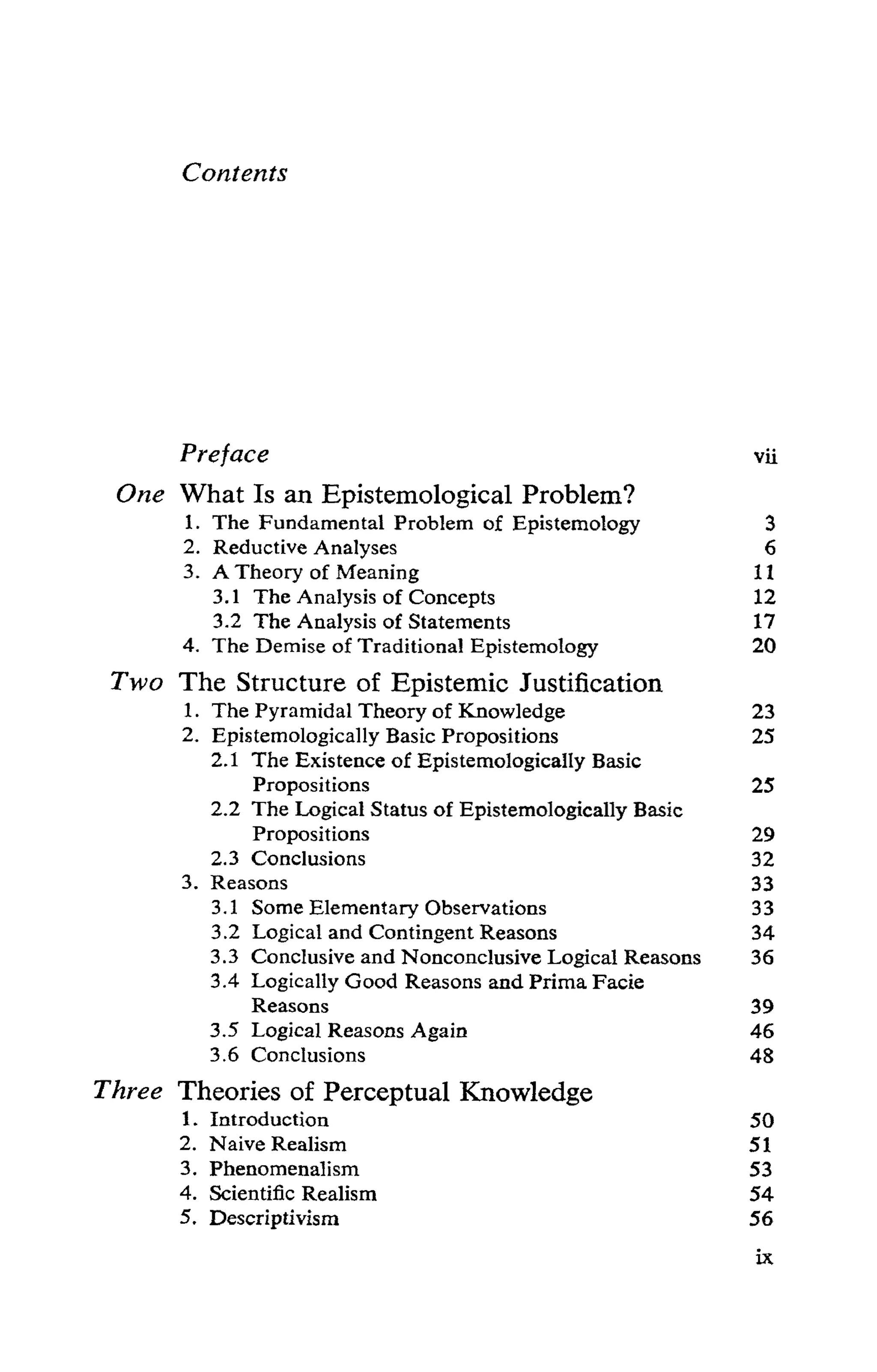
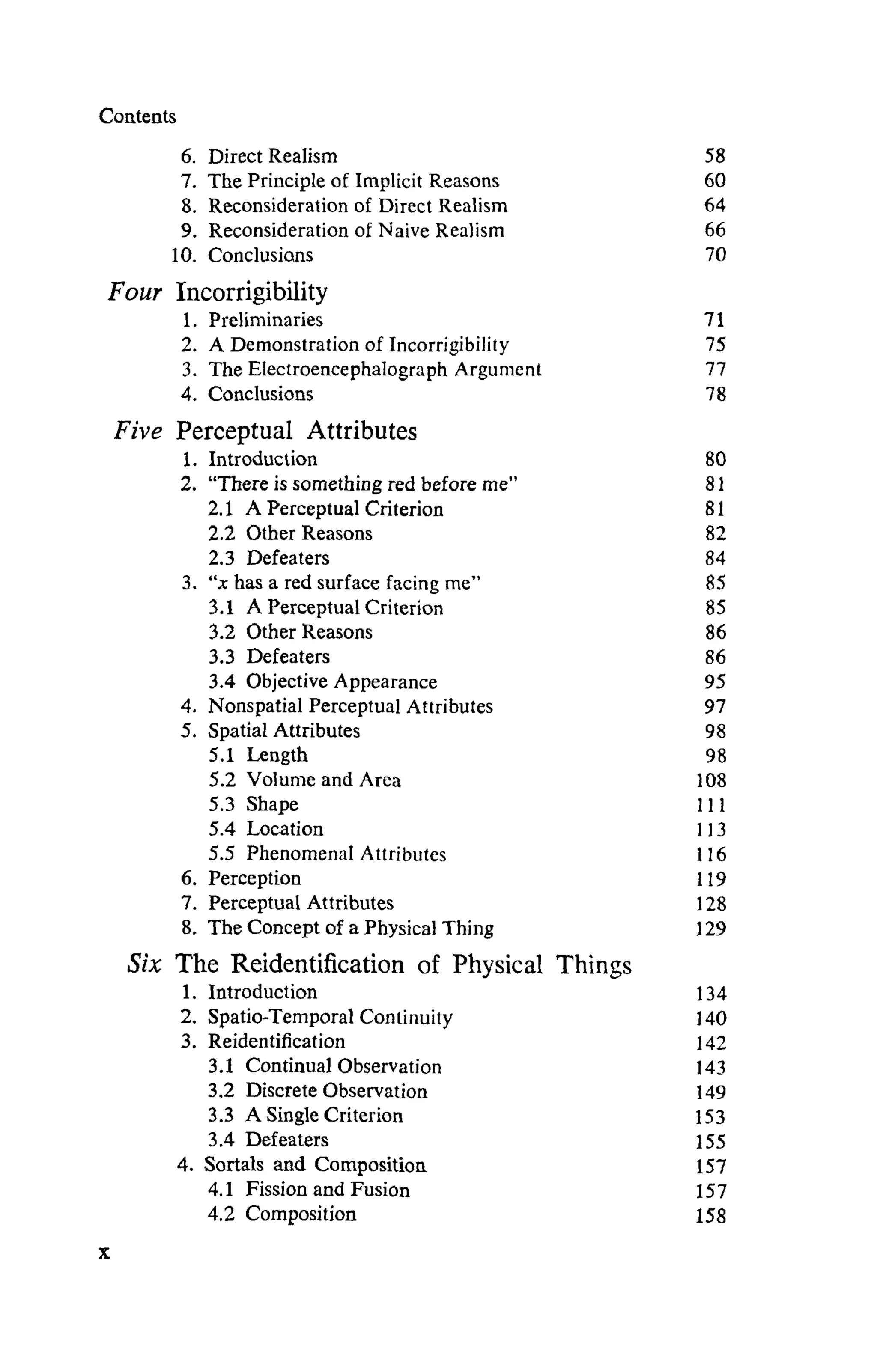

![1. The Fundamental Problem of Epistemology
is that either one of the premises P1, . . . , Pn is false or that
proposition Q (that we do have the sort of knowledge we think we
do) is false. In deciding which of these propositions to reject, all
we can do is seize upon the one we are least certain about. But
we will never be as certain about the premises of a skeptical argu-
ment as we are that we do have knowledge. So it will always be
more reasonable to reject one of the premises than to accept the
skeptical conclusion. A skeptical argument can only be construed
as a reductio ad absurdum of its premises. There must be some-
thing wrong with any skeptical argument. Presented with such an
argument, what we must decide is which premise to reject.
Skeptical arguments generate epistemological problems. Ap-
parently reasonable assumptions lead to the conclusion that knowl-
edge of a certain sort (e.g., knowledge of the physical world, or
knowledge of other minds) is impossible. Faced with such an
argument, our task is to explain how knowledge is possible. The
problem is not to show that knowledge is possible; that much we
can take for granted. What we must do is find the hole in the
skeptical argument that makes it possible for us to have the knowl-
edge we do. The problems of epistemology are problems of how
we can possibly know certain kinds of things that we claim to know
or customarily think we know. In general, given a statement P, we
can ask, "How do you know that PT' This is the general form of
an epistemological problem. The question "How do you know
that P?" is a challenge—a demand for justification. The task of
the epistemologist is to explain how it is possible for us to know
that P, i.e., to explain what justifies us in believing the things
we do.1
Returning for a moment to the skeptical argument with which
this chapter began, we can be confident that it proceeds from a
false premise. Its conclusion, which is that knowledge of the
physical world is impossible, is certainly mistaken. The task of
the epistemologist is to find the false premise. This is not a task
that can be undertaken at this point. Preliminary groundwork is
1 To forestall misunderstanding, let me hasten to say that the task I am
undertaking is not that of investigating knowledge per se but merely that
of investigating epistemic justification. Gettier [1963] has made it painfully
obvious that knowledge requires more than justified true belief, but in
this book I will not try to say what more is required. The task I have set
myself is not to determine when we have knowledge but is the more funda
mental one of determining when our beliefs are justified.](https://image.slidesharecdn.com/25973431-250521175425-73d7a88f/75/Knowledge-And-Justification-John-L-Pollock-21-2048.jpg)






![What Is an EpistemologicaI Problem?
connection is between a person's behavior and our right to make
judgments about his mental states. Analogously we want to state
exactly what counts as good inductive grounds for a contingent
generalization.8 These and similar questions make up the only
proper problems for epistemology. In answering such questions we
can still think of ourselves as mapping the "logical geography" of
concepts, but this must be done as much in terms of justification
conditions as in terms of truth conditions. The remainder of this
book will be concerned with seeking such analyses.
8This is just what Goodman [1955] has called "The New Riddle of In
duction".](https://image.slidesharecdn.com/25973431-250521175425-73d7a88f/75/Knowledge-And-Justification-John-L-Pollock-38-2048.jpg)
![The Structure of Epistemic Justification
side of the moon are fraudulent. To justify a belief one must appeal
to a further justified belief.
Now let us suppose that there are no epistemologically basic
beliefs. This alternative is for knowledge to be, not a tree having
its roots in epistemologically basic beliefs, but a vast nebula within
which no beliefs are in any way more basic than any others and in
which the process of justification just goes around and around with-
out terminating anywhere. This is the view that knowledge does not
have a foundation.® Let us examine this position more closely.
In order to justify a belief one must appeal to a further justified
belief. This means that one of two things must be the case. Either
there are some (epistemologically basic) beliefs that we can be
justified in holding without being able to justify them on the basis
of any other beliefs, or else for each justified belief there is an
infinite regress of (potential) justification.4 Let us call the latter the
nebula theory. On this theory there is no rock bottom of justifica-
tion. Justification just meanders in and out through our network of
beliefs stopping nowhere.
Philosophers have a great fear of infinite regresses, and so when
there are only two alternatives, and one of them involves an infinite
regress, they generally opt for the other alternative. In this case this
has led some epistemologists to conclude that the nebula theory
is wrong and that there are epistemologically basic beliefs. But this
is a very weak argument. If a person were to maintain that in order
for a belief to be justified one must have explicitly carried out the
justification—that is, consciously appealed to the further beliefs in
terms of which the given belief is justified and seen that those fur-
ther beliefs are themselves justified—then the infinite regress of
justification would require a person to carry out infinitely many
steps of reasoning before he could be justified in believing any-
thing. And as this is impossible, it would follow that no belief
3 I am uncertain whether anyone has ever held this view, although many
philosophers have skirted dangerously close to it. Blanshard [1939], chap.
25, seems to take a position of this sort but later makes statements incom
patible with it. Austin [1962] seems to be supporting such a view, but then
on p. 110, in discussing Carnap, he says that such a view is "perfectly
wild". Quine [1951] makes remarks that suggest this view but never actually
commits himself to it. Popper is another possible candidate for the attribu
tion of this view.
4 I am calling either an infinite linear chain or a circular chain of justifica
tion an "infinite regress o£ justification".](https://image.slidesharecdn.com/25973431-250521175425-73d7a88f/75/Knowledge-And-Justification-John-L-Pollock-42-2048.jpg)

![The Structure of Epistemic Justification
The basic difficulty with this is that it cuts justification oil from the
world. A person could be justified in believing anything. All that
would be required would be a sufficiently outlandish but coherent
set of beliefs. For example, given an arbitrary belief P, S would
be justified in holding it if he also happened to believe each of
Qu Qi =3 P; Ga, Q2 D QU Q2 O (Q1 D P); Q3 t Qi O Q2 ,
Qz => (Qz d Qi), Q3 => [Q2 => (Qi => P)]; Qi, Qi ? Qm
Q4 =3 (Q3 O Q2 ), Qi D [Q3 => (Q2 D Q1 )], Qi => [Q3 =>
[ 0 2 ^ C(2i 3 f ) ] } ; Q s , . . . .
In this sequence of beliefs, each belief is supported by beliefs later
in the sequence, but the beliefs are nowhere tied down in any
way to the evidence of S's senses. As long as a person's beliefs
form such a coherent set, he could hold any beliefs at all regard-
ing the colors, shapes, sizes, etc., of things, regardless of how
they look or feel to him. That such an infinite regress could not
provide justification seems to me to be immediately apparent. This
can be underscored in the following way. Given such a coherence
theory of justification, we could well imagine a person whose
beliefs were such as to justify him in rejecting all of the evidence
of his senses. For example, he might justifiably believe that what-
ever looks tall is really short, whatever looks red is really blue,
whatever looks green is really yellow, whatever feels hot is really
cold, etc. As long as his beliefs form a coherent set, there would
be nothing wrong with this. The person would be justified in be-
lieving that all of his senses mislead him in a systematic way.
Notice that this is not simply a matter of his rejecting all of the
evidence of his senses and adopting a skeptical stance. He has
positive beliefs concerning precisely how his senses mislead him.
But I submit that it is impossible for him to be justified in holding
such a set of beliefs. A person may well be justified in believing
that some particular sense misleads him in some systematic way.
For example, a color-blind person can know that he is color-blind;
but he can only know that by relying upon other evidence of his
senses. It is impossible for a person to be justified in believing
that all of his senses systematically mislead him all of the time.
And yet this sort of thing would be possible if the nebula theory
were correct. Therefore, the nebula theory cannot be correct. An
infinite regress of justification is at least not always possible. In](https://image.slidesharecdn.com/25973431-250521175425-73d7a88f/75/Knowledge-And-Justification-John-L-Pollock-44-2048.jpg)

![The Structure of Epistemic Justification
justifying". This does not require that these beliefs be incorrigible.
It requires only that our simply having these beliefs is, at least in
some cases, sufficient to make them justified (even though they
might fail to be true).
We might suppose this to mean that our having such a belief
logically entails that we are justified in having it. Let us say that
the belief P is incorrigibly justified for a person S if, and only if,
the mere fact that S believes P is logically sufficient to guarantee
that his belief is justified. That is,
(2.1) "The belief-that-P is incorrigibly justified for S" means
"It is necessarily true that if S believes (or were to be-
lieve) that P then S is (or would be) justified in believing
that P."7
As a false belief may still be justified, an incorrigibly justified
belief need not be incorrigibly true.8 It might be supposed that
what the argument used against the nebula theory shows is that
justification must always terminate with incorrigibly justified
beliefs.9
That argument does not prove, however, that there must be
incorrigibly justified beliefs. It shows only that there are beliefs
for which we do not have to have reasons. Our not having to have
reasons for believing them does not mean that it may not be pos-
sible to have good reasons for disbelieving them. In other words,
our epistemologically basic beliefs may be only prima facie justified
in the sense that, necessarily, if we have such a belief, then in
the absence of any other belief that constitutes a reason for re-
jecting it, the belief is justified. More precisely, let us define:
(2.2) "P is prima facie justified for 5" means "It is necessarily
true that if S believes (or were to believe) that P, and S
has no reason for thinking that it is false that P, then S
is (or would be) justified in believing that P."
7 The hyphenation in phrases like "belief-that-P" and "stafemcnt-that-/1"
is merely intended to make the sentence easier to read and has no philo
sophical significance.
8 This concept of an incorrigibly justified belief seems to be the same as
Chisholm's concept of a directly evident statement (in Chisholm [1966]),
although in places his discussion suggests that a directly evident statement
must be true.
9 This was my position in Pollock [1967].](https://image.slidesharecdn.com/25973431-250521175425-73d7a88f/75/Knowledge-And-Justification-John-L-Pollock-46-2048.jpg)
![2. Epistemologically Basic Propositions
The basic idea behind the concept of a prima facie justified belief
is that there is a "logical presumption" in favor of the belief's
being justified. If a belief is prima facie justified, one does not need
a reason for believing it, but it may be possible to have a reason
for disbelieving it. For example, one might urge that my belief that
something looks green to me is prima facie justified (for me)
because (1) in the absence of any reasons for thinking that it does
not look green to me it would be justified, but (2) it might be pos-
sible for me to have reasons for thinking that it does not look
green to me, which would make the belief unjustified. It will be-
come clearer in a moment just what such reasons might look like.
The argument used against the nebula theory shows that we must
at least have prima facie justified epistemologically basic beliefs.
But it might be urged that, although that argument does not prove
it, these beliefs are actually incorrigibly justified rather than
merely prima facie justified. Unless we are prepared to go even
further, however, and maintain that these beliefs are actually
incorrigible, then we cannot reasonably maintain that they are
incorrigibly justified. The reason for this turns around an argu-
ment that has frequently been employed against the incorrigibility
theory. Consider some particular candidate for an epistemolog-
ically basic belief, e.g., a person's belief about what color some-
thing looks to him. Armstrong and others have argued as follows.10
In the not too distant future it is possible that neurophysiologists
will have an adequate theory of the neurophysiology of percep-
tion. We can suppose this theory to be very highly confirmed. Let
us suppose that on the basis of this theory they are able to con-
struct a "super electroencephalograph" (SEEG) with the help
of which they can tell exactly what perceptual states a person is in.
In particular, they can tell what color something looks to him.
Suppose then that on some occasion a person thinks that something
looks red to him, but the SEEG reports that it really looks green to
him. Armstrong and the others have urged that if the neurophysio-
logical theory were sufficiently well confirmed we would have a
good reason for thinking that the person is wrong about how
things look to him, and consequently his belief cannot be incor-
rigible.
As an argument against the incorrigibility theory this begs the
question. If epistemologically basic beliefs are incorrigible, then
10 See particularly Armstrong [1963] and Meehl [1966].](https://image.slidesharecdn.com/25973431-250521175425-73d7a88f/75/Knowledge-And-Justification-John-L-Pollock-47-2048.jpg)

![3. Reasons
onstration is to acquire an independent reason for believing that
if the antecedent is true then the consequent is true. Hence, al-
though after the demonstrations have been given the entailments
provide good reasons, they are not logical reasons. They are only
contingent reasons.
We have isolated one class of logical reasons, which we can
call "conclusive" reasons. Let us say that:
(3.2) The statement-that-P is a conclusive reason for S to be-
lieve that Q, iff the statement-that-P entails and is a
logical reason for S to believe that Q.
Conclusive reasons are logical reasons. Do conclusive reasons
exhaust the class of logical reasons? It is astonishing how often
philosophers have thought that they do. For example, Judith Jarvis
Thompson [1965], p. 292, writes, "One thing that seems plain is
that if 'This is S' does not imply 'This is P' it will always be at best
a matter of fact, to be established by investigation, that the first
is a reason for the second."12 But there seem to be clear counter-
examples to the supposition that all logical reasons are conclusive.
Consider, for example, induction. A class of singular statements
P1, . . . , Pn can provide inductive grounds for an unrestricted
generalization Q, and thus the conjunction (P1 & . . . & Pn) of
those singular statements is a good reason for the general state-
ment Q. The conjunction of the singular statements clearly does
not entail the generalization, and yet it constitutes a logical reason
for believing it. This can be shown as follows. If (P1 & . . . & Pn)
constituted merely a contingent reason for believing that Q, then
a person would have to have an independent reason for believing
that [(Pi & . . . & Pn) Z> Q] before the conjunction could be a rea-
son for believing that Q. There are only two plausible alternatives
for what such an independent reason might be. First, it might be
an inductive reason. But then we could ask the same question with
regard to that inductive reason. This appeal to further inductive
reasons can only go on for finitely many steps (recall that an in-
finite regress of justification is impossible); eventually there has
to be a stopping point which must be justified on some other basis
in order to get the whole sequence of inductive justifications started
in the first place. This stopping point will be a conditional of this
same form which is justified in some other way. This brings us to
12 See also Russell [1948].](https://image.slidesharecdn.com/25973431-250521175425-73d7a88f/75/Knowledge-And-Justification-John-L-Pollock-53-2048.jpg)
![The Structure of Epistemic Justification
the second alternative: this conditional might be entailed by some
general principle which we might call a principle of the Uniformity
of Nature. Philosophers have often looked for some such principle
to justify induction. But even if such a principle could be found,
which seems exceedingly unlikely, we could still ask what justifies
us in believing it. Again, there are two possibilities. First, the
principle might be a truth of logic. But in that case the conditional
[(P1 & . . . & Pn) Z> Q], being entailed by the general principle,
would also be a truth of logic. And this would require that the
conjunction of singular statements (P1 & . . . & Pn) entail the gen
eral statement Q, which is impossible. Suppose instead that the
general principle is not a truth of logic. Then we can ask what
logical reasons there are for believing it. And on the supposition
that all logical reasons are conclusive, this amounts to asking what
justified beliefs entail it. These beliefs constitute a set Γ. The beliefs
in Γ must be justified without appeal to the general principle, so
they cannot include any beliefs justified inductively. Consequently,
any general beliefs in Γ must be truths of logic. But if a set of
statements some of which are truths of logic entails another state
ment, then the set of statements that results from deleting the
truths of logic also entails the other statement. Consequently, any
general beliefs in Γ can be omitted with the result that the remain
ing beliefs still entail the principle of the Uniformity of Nature.
The remaining beliefs in Γ must constitute a class of singular
statements Ru . . . , Rm . But then if the inductive grounds Pu . . . ,
Pn together with the principle of the Uniformity of Nature entailed
Q, the inductive grounds Pi, . . . , Pn together with the additional
singular statements Ru . . . , Rm would also have to entail Q
(because the latter entail the principle of the Uniformity of
Nature). And then again we would have a general statement being
entailed by a finite conjunction of singular statements, which is
impossible. Thus induction cannot be accounted for in terms of
conclusive reasons, and so cannot itself be a contingent reason.
But it cannot be denied that induction provides us with good rea
sons. It must be concluded that induction constitutes one example
of a nonconclusive logical reason. And it will be argued throughout
this book that there are many other important examples of such
reasons.18
13This of course should not be taken as implying that induction and
other nonconclusive logical reasons cannot be "reduced" to conclusive rea-](https://image.slidesharecdn.com/25973431-250521175425-73d7a88f/75/Knowledge-And-Justification-John-L-Pollock-54-2048.jpg)

![880
885
890
895
Chorus [attached to Octavia]: Oh, dire and deadly has the people's
love
To many proved, which fills their swelling sails
With favoring breeze, and bears them out to sea;
But soon its vigor languishes and dies,
And leaves them to the mercy of the deep.
The wretched mother of the Gracchi wept
Her murdered sons, who, though of noble blood,
Far famed for eloquence and piety,
Stout-hearted, learnéd in defense of law,
Were brought to ruin by the people's love
And popular renown. And Livius, thee
To equal fate did fickle fortune give,
Who found no safety in thy lictors' rods,
No refuge in thy home. But grief forbids
To tell more instances. This hapless girl,
To whom but now the citizens decreed
The restoration of her fatherland,
Her home, her brother's couch, is dragged away
In tears and misery to punishment,
With citizens consenting to her death!
Oh, blesséd poverty, content to hide
Beneath the refuge of a lowly roof!
For lofty homes, to fame and fortune known,
By storms are blasted and by fate o'erthrown!
[Enter Octavia in the custody of the palace guards, who are
dragging her roughly out into the street.]](https://image.slidesharecdn.com/25973431-250521175425-73d7a88f/75/Knowledge-And-Justification-John-L-Pollock-56-2048.jpg)
![940
945
950
955
960
965
970
975
Blows, bitter anguish, and at last a death
Of lingering agony. And Livia, thou,
Though fortunate in husband and in sons,
Didst walk the way of sin—and punishment.
And Julia, too, endured her mother's fate;
For, though no evil deed was charged to her,
She fell a victim to the sword at last.
What could not once thy mighty mother do
Who ruled supreme the house of Claudius,
By him beloved, and in her son secure?
Yet she at last was subject to a slave,
And fell beneath a brutal soldier's sword.
For what exalted heights of royalty
Might not our Nero's mother once have hoped?
Mishandled first by vulgar sailors' hands,
Then slain and mangled by the bungling sword,
She lay the victim of her cruel son.
Octavia: Me, too, the tyrant to the world of shades
Is sending. Why delay? Then speed my death,
For fate hath made me subject to your power.
I pray the heavenly gods—what wouldst thou, fool?
Pray not to gods who show their scorn of thee.
But, O ye gods of hell, ye furies dire,
Who work your vengeance on the crimes of men,
And thou, my father's restless spirit, come
And bring this tyrant fitting punishment.
[To her guards.]
The death you threaten has no terrors now
For me. Go, set your ship in readiness,
Unfurl your sails, and let your pilot seek
The barren shores of Pandataria.
[Exit Octavia with guards.]
Chorus: Ye gentle breezes and ye zephyrs mild,
Which once from savage Dian's altar bore
Atrides' daughter in a cloud concealed,](https://image.slidesharecdn.com/25973431-250521175425-73d7a88f/75/Knowledge-And-Justification-John-L-Pollock-58-2048.jpg)
![980
g ,
This child of ours, Octavia too, we pray,
Bear far away from these too cruel woes,
And set her in the fane of Trivia.
For Aulis is more merciful than Rome,
The savage Taurian land more mild than this:
There hapless strangers to their gods they feed,
But Rome delights to see her children bleed.
FOOTNOTES:
[58] Reading, quam temperet non ira, etc.](https://image.slidesharecdn.com/25973431-250521175425-73d7a88f/75/Knowledge-And-Justification-John-L-Pollock-59-2048.jpg)