Psychoanalysis (continued) Freud believed that abnormal behavior and all personality could be explained by the motives and drives of the unconcious DARWINIAN Influence Believed that the unconscious served a function To keep unacceptable thoughts or desires repressed or hidden from the conscious mind Freud used HYPNOSIS  and FREE ASSOCIATION
Criticisms Against Psychoanalysis Lack of scientific control and careful experimentation Psychoanalysis relies on techniques that have never been validated. EXAMPLE: Dream Interpretation
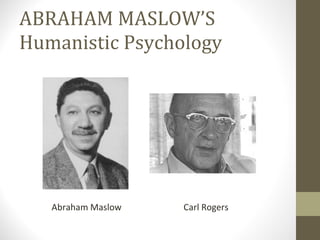
ABRAHAM MASLOW’S Humanistic Psychology Abraham Maslow   Carl Rogers
Humanistic Psychology Called the THIRD FORCE in Psychology The Psychoanalytic and Behavioral viewpoints constitute the first two forces. Humanist psychologists don’t believe that behavior is governed either by the inconscious or by external stimuli in the environment PEOPLE ARE FREE AGENTS Having free will, conscious and creative and born with an inner motivation to fulfil their potential.  MASLOW called this Self-Actualization
MODERN PSYCH PERSPECTIVES
BIOLOGICAL PERSPECTIVE Attributes human  and animal behavior to biological events occurring in the body Such as genetic influences, hormones, and the activity of the nervous  system.  It investigates at the level of nerves, neurotransmitters, brain circuitry and  the basic biological processes that underlie normal and abnormal behavior
Psychodynamic Perspective (Psychoanalytic – Freudian) More focused on the development of a sense of self and the discovery of  other motivations behind a person’s behavior than sexual motivations.  Are driven by dark forces of the unconsciousness  Unconscious needs, conflicts, repressed memories, and childhood  experiences determine behavior
Humanistic Perspective People have free will, the freedom to choose their own destiny.  Emphasized the human potential, the ability of each person to become the  best person he or she could be.  S elf-actualization - achieving one’s full potential or actual self.  The influence of self-concept, perceptions, and interpersonal relationships,  and on need for personal growth determine behavior
Cognitive Perspective People are information-processing systems  Focuses on memory, intelligence, perception, problem solving, and learning.  Mental interpretation of our experience determines behavior
Social Perspective how to explain a variety of demographic, social, and cultural facts in terms of  human social interaction  People are social animals, so human behavior must be interpreted in social  context  Cultures, social norms and expectations, social learning determines this  behavior
Behavioral Perspective focuses on learned behaviors.  While  behaviorism  dominated psychology early in the twentieth century, it began to lose its hold during the 1950s. Today, the behavioral perspective is still concerned with how behaviors are learned and reinforced.  Behavioral principles are often applied in mental health settings, where therapists and counselors use these techniques to explain and treat a variety of illnesses.
Developmental Perspective We undergo predictable patterns of change throughout our lives  Interaction between heredity and environment determines behavior
End of Chapter 1

General psych intropart2

  • 1.
  • 2.
    Psychoanalysis (continued) Freudbelieved that abnormal behavior and all personality could be explained by the motives and drives of the unconcious DARWINIAN Influence Believed that the unconscious served a function To keep unacceptable thoughts or desires repressed or hidden from the conscious mind Freud used HYPNOSIS and FREE ASSOCIATION
  • 3.
    Criticisms Against PsychoanalysisLack of scientific control and careful experimentation Psychoanalysis relies on techniques that have never been validated. EXAMPLE: Dream Interpretation
  • 4.
    ABRAHAM MASLOW’S HumanisticPsychology Abraham Maslow Carl Rogers
  • 5.
    Humanistic Psychology Calledthe THIRD FORCE in Psychology The Psychoanalytic and Behavioral viewpoints constitute the first two forces. Humanist psychologists don’t believe that behavior is governed either by the inconscious or by external stimuli in the environment PEOPLE ARE FREE AGENTS Having free will, conscious and creative and born with an inner motivation to fulfil their potential. MASLOW called this Self-Actualization
  • 6.
  • 7.
    BIOLOGICAL PERSPECTIVE Attributeshuman and animal behavior to biological events occurring in the body Such as genetic influences, hormones, and the activity of the nervous system. It investigates at the level of nerves, neurotransmitters, brain circuitry and the basic biological processes that underlie normal and abnormal behavior
  • 8.
    Psychodynamic Perspective (Psychoanalytic– Freudian) More focused on the development of a sense of self and the discovery of other motivations behind a person’s behavior than sexual motivations. Are driven by dark forces of the unconsciousness Unconscious needs, conflicts, repressed memories, and childhood experiences determine behavior
  • 9.
    Humanistic Perspective Peoplehave free will, the freedom to choose their own destiny. Emphasized the human potential, the ability of each person to become the best person he or she could be. S elf-actualization - achieving one’s full potential or actual self. The influence of self-concept, perceptions, and interpersonal relationships, and on need for personal growth determine behavior
  • 10.
    Cognitive Perspective Peopleare information-processing systems Focuses on memory, intelligence, perception, problem solving, and learning. Mental interpretation of our experience determines behavior
  • 11.
    Social Perspective howto explain a variety of demographic, social, and cultural facts in terms of human social interaction People are social animals, so human behavior must be interpreted in social context Cultures, social norms and expectations, social learning determines this behavior
  • 12.
    Behavioral Perspective focuseson learned behaviors. While behaviorism dominated psychology early in the twentieth century, it began to lose its hold during the 1950s. Today, the behavioral perspective is still concerned with how behaviors are learned and reinforced. Behavioral principles are often applied in mental health settings, where therapists and counselors use these techniques to explain and treat a variety of illnesses.
  • 13.
    Developmental Perspective Weundergo predictable patterns of change throughout our lives Interaction between heredity and environment determines behavior
  • 14.