General Principles to Make
Handouts
BY
MANSHI
RESEARCH SCHOLAR
M.PHIL (ENGLISH)
BANASTHALI VIDHYAPITH, RAJASTHAN
Content
 Points to remember
 Content of Handouts
 Do & Don’t
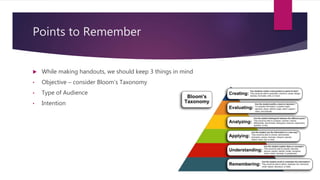
Points to Remember
 While making handouts, we should keep 3 things in mind
• Objective – consider Bloom’s Taxonomy
• Type of Audience
• Intention
Objectives
Intention
( Content we cover )
Type of audience
(PG Students or Literature
students)
Content of Handouts
 Introductory information
 an outline
 summary of main points
 visual aids (if needed)
 conclusions
 questions posed by the material
 questions frequently asked by students (FAQs)
 links to other lectures.
Do & Don’t
 Don’t
 Avoid used excessive jargons
 Avoid clutter
 Don’t include excessive content on a
single page that your handout begins to
look like a textbook.
 Try to avoid writing down vocabulary in
the target language on your handouts.
 Avoid including copyrighted material
 Use company letterhead or company
name, logo, etc.
 Submit journal articles without receiving
written permission.
 Do
 Organized the information in a logical
order for learning
 Use simple, clear language throughout
 Subdivide long handouts with headings
 Left plenty of white space where students
are to write on the handout
 Chosen graphics that illustrate the topic
clearly
 Used graphics to explain difficult or
complicated procedural steps
 Placed graphics close to the written
material they illustrate
 Keep a master copy with yourself
Thank You

General Principles to Make Handouts

  • 1.
    General Principles toMake Handouts BY MANSHI RESEARCH SCHOLAR M.PHIL (ENGLISH) BANASTHALI VIDHYAPITH, RAJASTHAN
  • 2.
    Content  Points toremember  Content of Handouts  Do & Don’t
  • 3.
    Points to Remember While making handouts, we should keep 3 things in mind • Objective – consider Bloom’s Taxonomy • Type of Audience • Intention
  • 4.
    Objectives Intention ( Content wecover ) Type of audience (PG Students or Literature students)
  • 5.
    Content of Handouts Introductory information  an outline  summary of main points  visual aids (if needed)  conclusions  questions posed by the material  questions frequently asked by students (FAQs)  links to other lectures.
  • 6.
    Do & Don’t Don’t  Avoid used excessive jargons  Avoid clutter  Don’t include excessive content on a single page that your handout begins to look like a textbook.  Try to avoid writing down vocabulary in the target language on your handouts.  Avoid including copyrighted material  Use company letterhead or company name, logo, etc.  Submit journal articles without receiving written permission.  Do  Organized the information in a logical order for learning  Use simple, clear language throughout  Subdivide long handouts with headings  Left plenty of white space where students are to write on the handout  Chosen graphics that illustrate the topic clearly  Used graphics to explain difficult or complicated procedural steps  Placed graphics close to the written material they illustrate  Keep a master copy with yourself
  • 7.