z
General Intelligence
(Spearman)
z
CHARLES SPEARMAN
Born:
September 10, 1863
London, United Kingdom
Died:
September 17, 1945
London, United Kingdom
Fields:
British Psychologist who theorized
that a general factor of intelligence
Known for:
Work in Statistic as a pioneer of
factor analysis, and for spearman rank
correlation coefficient.
z
What is General Intelligence?
 General intelligence, also known as g factor, refers to a
general mental ability that, according to Spearman,
underlies multiple specific skills, including verbal, spatial,
numerical, and mechanical.
 General intelligence is a term that consists of a variety of
cognitive talents. These skills enable people to learn new
things and solve issues. This broad mental capacity
underpins specialised mental talents in spatial,
mathematical, mechanical, and linguistic skills.
z
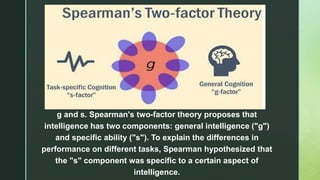
g and s. Spearman's two-factor theory proposes that
intelligence has two components: general intelligence ("g")
and specific ability ("s"). To explain the differences in
performance on different tasks, Spearman hypothesized that
the "s" component was specific to a certain aspect of
intelligence.
z
z
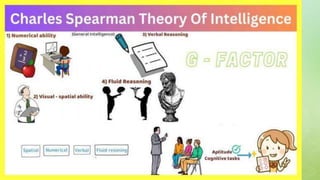
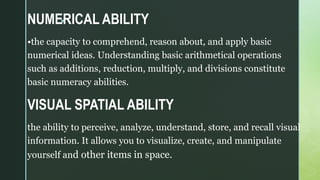
NUMERICAL ABILITY
•the capacity to comprehend, reason about, and apply basic
numerical ideas. Understanding basic arithmetical operations
such as additions, reduction, multiply, and divisions constitute
basic numeracy abilities.
VISUAL SPATIAL ABILITY
the ability to perceive, analyze, understand, store, and recall visual
information. It allows you to visualize, create, and manipulate
yourself and other items in space.
z
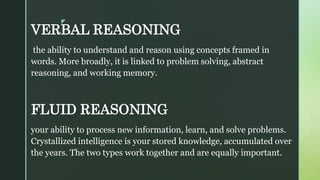
VERBAL REASONING
the ability to understand and reason using concepts framed in
words. More broadly, it is linked to problem solving, abstract
reasoning, and working memory.
FLUID REASONING
your ability to process new information, learn, and solve problems.
Crystallized intelligence is your stored knowledge, accumulated over
the years. The two types work together and are equally important.
z References
 Explorablehttps://explorable.com ›
spearmanSpearman and the Theory of
General Intelligence
 StudiousGuyhttps://studiousguy.com ›
spearman...Spearman's Two-factor Theory
of Intelligence Explained
 Britannicahttps://www.britannica.com ›
Charl...Charles E. Spearman | Statistical
analysis, Intelligence testing, Factor ...
z
THANK YOU SO
MUCH
EVERYONE !!

General-Intelligences by Charles Spearman-

  • 1.
  • 2.
    z CHARLES SPEARMAN Born: September 10,1863 London, United Kingdom Died: September 17, 1945 London, United Kingdom Fields: British Psychologist who theorized that a general factor of intelligence Known for: Work in Statistic as a pioneer of factor analysis, and for spearman rank correlation coefficient.
  • 3.
    z What is GeneralIntelligence?  General intelligence, also known as g factor, refers to a general mental ability that, according to Spearman, underlies multiple specific skills, including verbal, spatial, numerical, and mechanical.  General intelligence is a term that consists of a variety of cognitive talents. These skills enable people to learn new things and solve issues. This broad mental capacity underpins specialised mental talents in spatial, mathematical, mechanical, and linguistic skills.
  • 4.
    z g and s.Spearman's two-factor theory proposes that intelligence has two components: general intelligence ("g") and specific ability ("s"). To explain the differences in performance on different tasks, Spearman hypothesized that the "s" component was specific to a certain aspect of intelligence.
  • 5.
  • 6.
    z NUMERICAL ABILITY •the capacityto comprehend, reason about, and apply basic numerical ideas. Understanding basic arithmetical operations such as additions, reduction, multiply, and divisions constitute basic numeracy abilities. VISUAL SPATIAL ABILITY the ability to perceive, analyze, understand, store, and recall visual information. It allows you to visualize, create, and manipulate yourself and other items in space.
  • 7.
    z VERBAL REASONING the abilityto understand and reason using concepts framed in words. More broadly, it is linked to problem solving, abstract reasoning, and working memory. FLUID REASONING your ability to process new information, learn, and solve problems. Crystallized intelligence is your stored knowledge, accumulated over the years. The two types work together and are equally important.
  • 8.
    z References  Explorablehttps://explorable.com› spearmanSpearman and the Theory of General Intelligence  StudiousGuyhttps://studiousguy.com › spearman...Spearman's Two-factor Theory of Intelligence Explained  Britannicahttps://www.britannica.com › Charl...Charles E. Spearman | Statistical analysis, Intelligence testing, Factor ...
  • 9.