CRITICAL STATE
MODEL
By- Pankaj Drolia
Central Idea
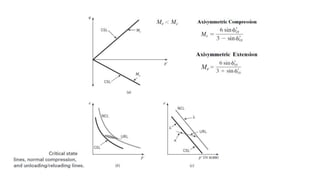
The central idea in the CSM is that all soils will fail on a unique failure surface in (p’, q, e)
space
The framework of CSM ties the concept of one dimensional consolidation behaviour and
shear stress vs normal stress behaviour
Why CSM?
Basics
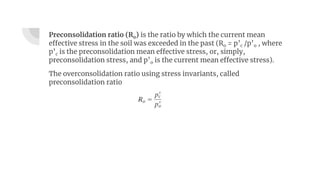
Preconsolidation ratio (Ro) is the ratio by which the current mean
effective stress in the soil was exceeded in the past (Ro = p’c /p’o , where
p’c is the preconsolidation mean effective stress, or, simply,
preconsolidation stress, and p’o is the current mean effective stress).
The overconsolidation ratio using stress invariants, called
preconsolidation ratio
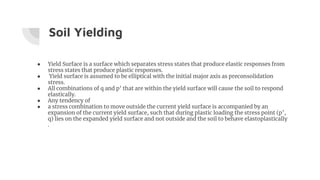
Soil Yielding
● Yield Surface is a surface which separates stress states that produce elastic responses from
stress states that produce plastic responses.
● Yield surface is assumed to be elliptical with the initial major axis as preconsolidation
stress.
● All combinations of q and p’ that are within the yield surface will cause the soil to respond
elastically.

● Any tendency of
● a stress combination to move outside the current yield surface is accompanied by an
expansion of the current yield surface, such that during plastic loading the stress point (p’,
q) lies on the expanded yield surface and not outside and the soil to behave elastoplastically
.
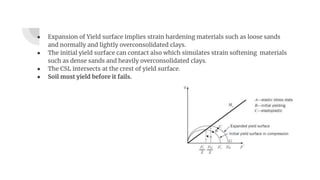
● Expansion of Yield surface implies strain hardening materials such as loose sands
and normally and lightly overconsolidated clays.
● The initial yield surface can contact also which simulates strain softening materials
such as dense sands and heavily overconsolidated clays.
● The CSL intersects at the crest of yield surface.
● Soil must yield before it fails.
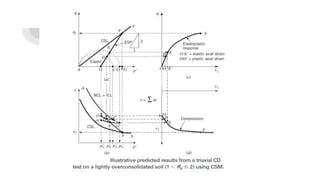
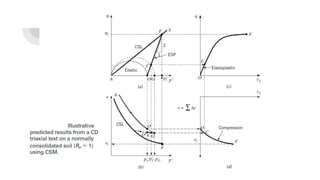
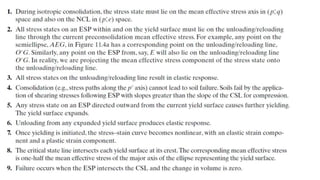
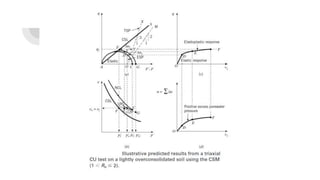
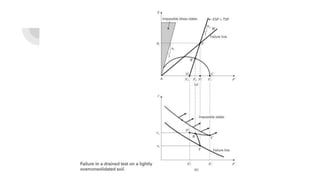
Behaviour of normally consolidated
and lightly overconsolidated soil under
drained condition
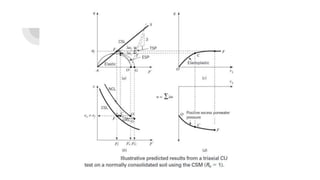
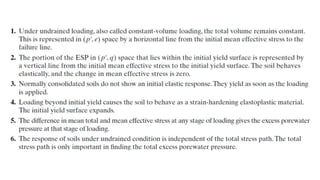
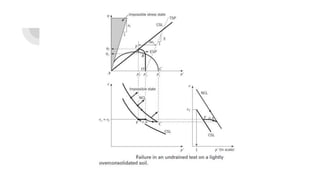
Behavior of Normally Consolidated and
Lightly Overconsolidated Soils Under
Undrained Condition
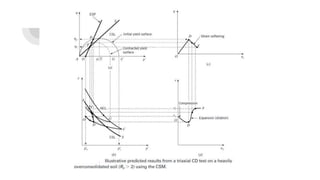
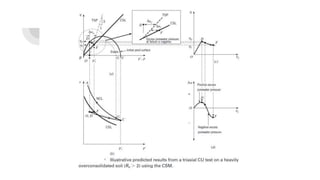
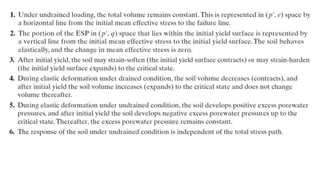
Behavior of Heavily Overconsolidated
Soils Under Drained and Undrained
Condition
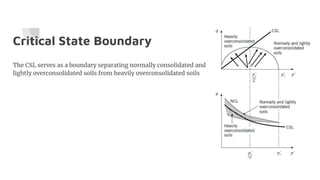
Critical State Boundary
The CSL serves as a boundary separating normally consolidated and
lightly overconsolidated soils from heavily overconsolidated soils
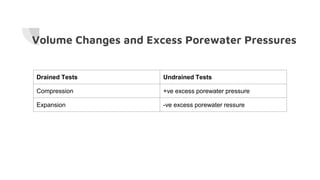
Volume Changes and Excess Porewater Pressures
Drained Tests Undrained Tests
Compression +ve excess porewater pressure
Expansion -ve excess porewater ressure
Elements of Critical State
Model
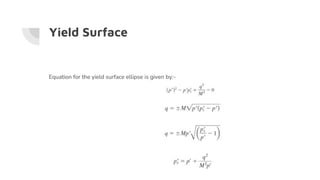
Yield Surface
Equation for the yield surface ellipse is given by:-
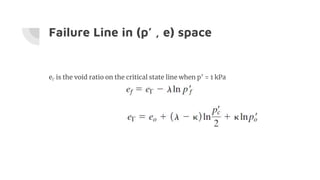
Failure Line in (p’ , e) space
eΓ is the void ratio on the critical state line when p’ = 1 kPa
Failure Stress from CSM
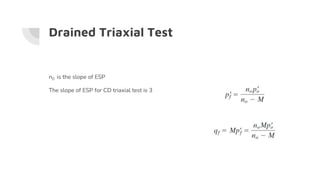
Drained Triaxial Test
n0 is the slope of ESP
The slope of ESP for CD triaxial test is 3
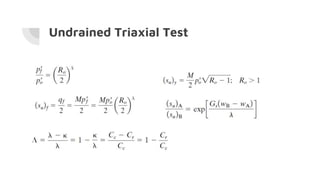
Undrained Triaxial Test
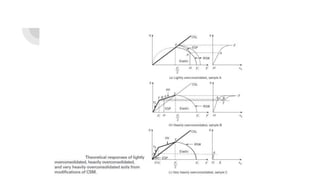
Modified CSM
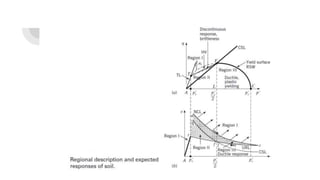
● Experimental data from shear box tests on heavily overconsolidated clays presented
by Hvorslev (1937) reveal that the locus of peak shear strength is approximately a
straight line. In considering heavily overconsolidated fine-grained soils, we will
replace that portion of the initial elliptical yield surface on the left side of the critical
state line by the straight line found by Hvorslev. This line defines limiting stress states
● Then there is a yield surface labeled as RSW (after Roscoe, Schofield, and Wroth,
1958).
● There is also a line which delineate limiting tensile stress states.
Region 1 :- Impossible state as uncemented soil cannot sustain tension
Region 2 :- Soil will behave elastically but as it approaches HV surface discontinuity starts
occurring and shear band started to form and especially within shear bands the permeability
increases and may cause the structure to fail because of seepage
Region 3 :- Desirable behaviour as soil will behave in a ductile manner
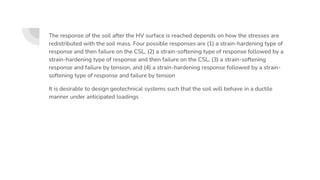
The response of the soil after the HV surface is reached depends on how the stresses are
redistributed with the soil mass. Four possible responses are (1) a strain-hardening type of
response and then failure on the CSL, (2) a strain-softening type of response followed by a
strain-hardening type of response and then failure on the CSL, (3) a strain-softening
response and failure by tension, and (4) a strain-hardening response followed by a strain-
softening type of response and failure by tension
It is desirable to design geotechnical systems such that the soil will behave in a ductile
manner under anticipated loadings
Some Important
Relationships
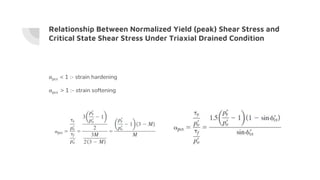
Relationship Between Normalized Yield (peak) Shear Stress and
Critical State Shear Stress Under Triaxial Drained Condition
αpcs < 1 :- strain hardening
αpcs > 1 :- strain softening
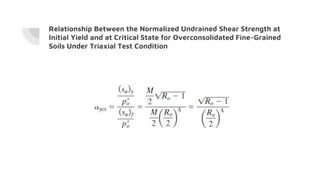
Relationship Between the Normalized Undrained Shear Strength at
Initial Yield and at Critical State for Overconsolidated Fine-Grained
Soils Under Triaxial Test Condition
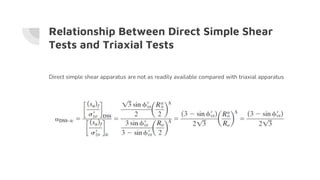
Relationship Between Direct Simple Shear
Tests and Triaxial Tests
Direct simple shear apparatus are not as readily available compared with triaxial apparatus
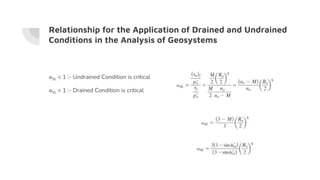
Relationship for the Application of Drained and Undrained
Conditions in the Analysis of Geosystems
αSL < 1 :- Undrained Condition is critical
αSL > 1 :- Drained Condition is critical
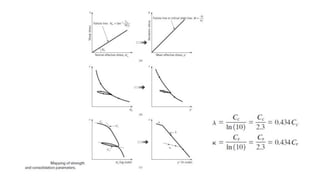
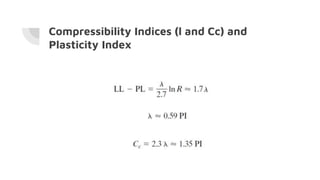
Compressibility Indices (l and Cc) and
Plasticity Index
Thank You !

Critical State Model (Advance Soil Mechanics)

  • 1.
  • 2.
    Central Idea The centralidea in the CSM is that all soils will fail on a unique failure surface in (p’, q, e) space The framework of CSM ties the concept of one dimensional consolidation behaviour and shear stress vs normal stress behaviour
  • 3.
  • 4.
  • 7.
    Preconsolidation ratio (Ro)is the ratio by which the current mean effective stress in the soil was exceeded in the past (Ro = p’c /p’o , where p’c is the preconsolidation mean effective stress, or, simply, preconsolidation stress, and p’o is the current mean effective stress). The overconsolidation ratio using stress invariants, called preconsolidation ratio
  • 8.
    Soil Yielding ● YieldSurface is a surface which separates stress states that produce elastic responses from stress states that produce plastic responses. ● Yield surface is assumed to be elliptical with the initial major axis as preconsolidation stress. ● All combinations of q and p’ that are within the yield surface will cause the soil to respond elastically. ● Any tendency of ● a stress combination to move outside the current yield surface is accompanied by an expansion of the current yield surface, such that during plastic loading the stress point (p’, q) lies on the expanded yield surface and not outside and the soil to behave elastoplastically .
  • 9.
    ● Expansion ofYield surface implies strain hardening materials such as loose sands and normally and lightly overconsolidated clays. ● The initial yield surface can contact also which simulates strain softening materials such as dense sands and heavily overconsolidated clays. ● The CSL intersects at the crest of yield surface. ● Soil must yield before it fails.
  • 10.
    Behaviour of normallyconsolidated and lightly overconsolidated soil under drained condition
  • 14.
    Behavior of NormallyConsolidated and Lightly Overconsolidated Soils Under Undrained Condition
  • 18.
    Behavior of HeavilyOverconsolidated Soils Under Drained and Undrained Condition
  • 22.
    Critical State Boundary TheCSL serves as a boundary separating normally consolidated and lightly overconsolidated soils from heavily overconsolidated soils
  • 23.
    Volume Changes andExcess Porewater Pressures Drained Tests Undrained Tests Compression +ve excess porewater pressure Expansion -ve excess porewater ressure
  • 24.
  • 25.
    Yield Surface Equation forthe yield surface ellipse is given by:-
  • 26.
    Failure Line in(p’ , e) space eΓ is the void ratio on the critical state line when p’ = 1 kPa
  • 27.
  • 28.
    Drained Triaxial Test n0is the slope of ESP The slope of ESP for CD triaxial test is 3
  • 30.
  • 32.
  • 33.
    ● Experimental datafrom shear box tests on heavily overconsolidated clays presented by Hvorslev (1937) reveal that the locus of peak shear strength is approximately a straight line. In considering heavily overconsolidated fine-grained soils, we will replace that portion of the initial elliptical yield surface on the left side of the critical state line by the straight line found by Hvorslev. This line defines limiting stress states ● Then there is a yield surface labeled as RSW (after Roscoe, Schofield, and Wroth, 1958). ● There is also a line which delineate limiting tensile stress states.
  • 35.
    Region 1 :-Impossible state as uncemented soil cannot sustain tension Region 2 :- Soil will behave elastically but as it approaches HV surface discontinuity starts occurring and shear band started to form and especially within shear bands the permeability increases and may cause the structure to fail because of seepage Region 3 :- Desirable behaviour as soil will behave in a ductile manner
  • 37.
    The response ofthe soil after the HV surface is reached depends on how the stresses are redistributed with the soil mass. Four possible responses are (1) a strain-hardening type of response and then failure on the CSL, (2) a strain-softening type of response followed by a strain-hardening type of response and then failure on the CSL, (3) a strain-softening response and failure by tension, and (4) a strain-hardening response followed by a strain- softening type of response and failure by tension It is desirable to design geotechnical systems such that the soil will behave in a ductile manner under anticipated loadings
  • 38.
  • 39.
    Relationship Between NormalizedYield (peak) Shear Stress and Critical State Shear Stress Under Triaxial Drained Condition αpcs < 1 :- strain hardening αpcs > 1 :- strain softening
  • 40.
    Relationship Between theNormalized Undrained Shear Strength at Initial Yield and at Critical State for Overconsolidated Fine-Grained Soils Under Triaxial Test Condition
  • 41.
    Relationship Between DirectSimple Shear Tests and Triaxial Tests Direct simple shear apparatus are not as readily available compared with triaxial apparatus
  • 42.
    Relationship for theApplication of Drained and Undrained Conditions in the Analysis of Geosystems αSL < 1 :- Undrained Condition is critical αSL > 1 :- Drained Condition is critical
  • 43.
    Compressibility Indices (land Cc) and Plasticity Index
  • 44.