GENERAL
CHEMISTRY 1
2
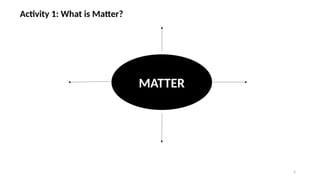
MATTER
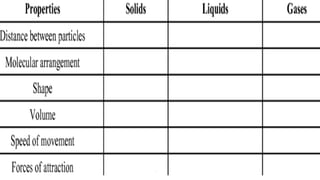
Activity 1: What is Matter?
3
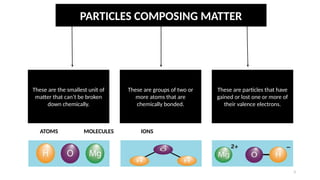
PARTICLES COMPOSING MATTER
These are the smallest unit of
matter that can’t be broken
down chemically.
These are groups of two or
more atoms that are
chemically bonded.
These are particles that have
gained or lost one or more of
their valence electrons.
ATOMS MOLECULES IONS
4
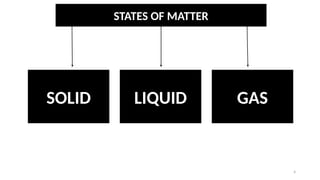
STATES OF MATTER
SOLID LIQUID GAS
5
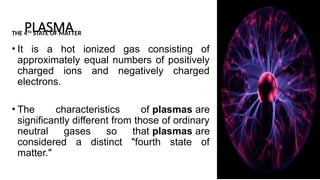
PLASMA
THE 4TH
STATE OF MATTER
• It is a hot ionized gas consisting of
approximately equal numbers of positively
charged ions and negatively charged
electrons.
• The characteristics of plasmas are
significantly different from those of ordinary
neutral gases so that plasmas are
considered a distinct "fourth state of
matter."
6
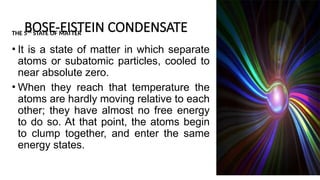
BOSE-EISTEIN CONDENSATE
THE 5TH
STATE OF MATTER
• It is a state of matter in which separate
atoms or subatomic particles, cooled to
near absolute zero.
• When they reach that temperature the
atoms are hardly moving relative to each
other; they have almost no free energy
to do so. At that point, the atoms begin
to clump together, and enter the same
energy states.
7
8
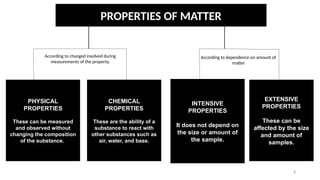
PROPERTIES OF MATTER
PHYSICAL
PROPERTIES
These can be measured
and observed without
changing the composition
of the substance.
CHEMICAL
PROPERTIES
These are the ability of a
substance to react with
other substances such as
air, water, and base.
INTENSIVE
PROPERTIES
It does not depend on
the size or amount of
the sample.
EXTENSIVE
PROPERTIES
These can be
affected by the size
and amount of
samples.
According to changed involved during
measurements of the property.
According to dependence on amount of
matter
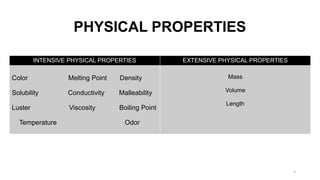
PHYSICAL PROPERTIES
INTENSIVE PHYSICAL PROPERTIES EXTENSIVE PHYSICAL PROPERTIES
Color Melting Point Density
Solubility Conductivity Malleability
Luster Viscosity Boiling Point
Temperature Odor
Mass
Volume
Length
9
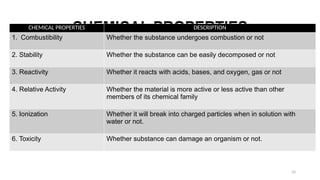
CHEMICAL PROPERTIES

10
CHEMICAL PROPERTIES DESCRIPTION
1. Combustibility Whether the substance undergoes combustion or not
2. Stability Whether the substance can be easily decomposed or not
3. Reactivity Whether it reacts with acids, bases, and oxygen, gas or not
4. Relative Activity Whether the material is more active or less active than other
members of its chemical family
5. Ionization Whether it will break into charged particles when in solution with
water or not.
6. Toxicity Whether substance can damage an organism or not.
11
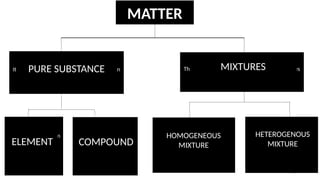
MATTER
It is a matter that has a definite composition
and distinct properties
These are composed of two or more substances
combined physically in various composition
It is the simplest form
of matter since it
composed of only
one kind of atom.
It contains two or more
kinds of atom
chemically combined in
definite proportion by
mass
It is a solid, liquid, or
gaseous mixture that has the
same proportions of its
components throughout any
given sample.
It is a mixture whose
composition varies from
one position to another
within the sample.
PURE SUBSTANCE MIXTURES
ELEMENT COMPOUND
HOMOGENEOUS
MIXTURE
HETEROGENOUS
MIXTURE
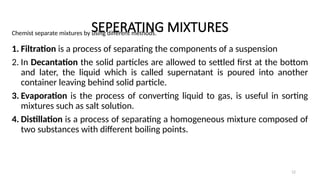
SEPERATING MIXTURES
Chemist separate mixtures by using different methods.
1. Filtration is a process of separating the components of a suspension
2. In Decantation the solid particles are allowed to settled first at the bottom
and later, the liquid which is called supernatant is poured into another
container leaving behind solid particle.
3. Evaporation is the process of converting liquid to gas, is useful in sorting
mixtures such as salt solution.
4. Distillation is a process of separating a homogeneous mixture composed of
two substances with different boiling points.
12
SEPERATING MIXTURES
Chemist separate mixtures by using different methods.
5. Magnetic Separation is the process of separating elemental metals from
other particles in a mixture.
6. Melting is a process that can be used in extricating mixture that contain
two substances with different melting points.
7. Sublimation is a process of changing solid to gas without passing through
the liquid state.
8. In Centrifugation, the mixture is poured into a special tube in the centrifuge
apparatus, and is allowed to spin using centrifugal force. The spinning motion
forces the sediments to settle at the bottom. The liquid can be poured off
from the solid particles.
13
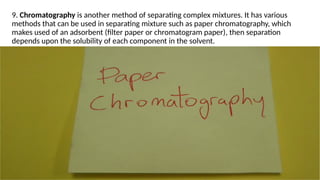
9. Chromatography is another method of separating complex mixtures. It has various
methods that can be used in separating mixture such as paper chromatography, which
makes used of an adsorbent (filter paper or chromatogram paper), then separation
depends upon the solubility of each component in the solvent.
14
PURE SUBSTANCES & MIXTURES IN
CONSUMER PRODUCTS
CONSUMER PRODUCT
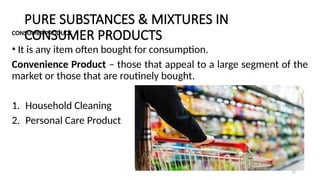
• It is any item often bought for consumption.
Convenience Product – those that appeal to a large segment of the
market or those that are routinely bought.
1. Household Cleaning
2. Personal Care Product
15
PURE SUBSTANCES & MIXTURES IN
CONSUMER PRODUCTS
HOUSEHOLD CLEANING MATERIAL
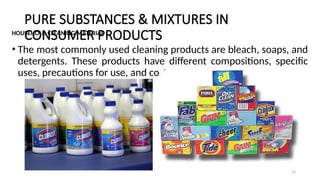
• The most commonly used cleaning products are bleach, soaps, and
detergents. These products have different compositions, specific
uses, precautions for use, and costs.
16
PURE SUBSTANCES & MIXTURES IN
CONSUMER PRODUCTS
HOUSEHOLD CLEANING MATERIAL
• Bleach helps clean and whiten surfaces by generally lowering the
stability of the chemical bonds in stain molecules.
• It can convert dirt into particles that can be easily washed away in
conjunction with use of detergents.
• NaOCl (Sodium Hypochlorite) and H2O2 (Hydrogen Peroxide) are
most common bleaching agents that are strong oxidizers; they can
burn then skin and eyes especially if used in concentrated form.
17
PURE SUBSTANCES & MIXTURES IN
CONSUMER PRODUCTS
HOUSEHOLD CLEANING MATERIAL
• Soap and Detergent are mixture of surfactants, water softeners, stain
removers, enzymes and perfumes, among others.
• Surfactants render soaps and detergents capable of lowering the surface
tension of water, which allows them to wet the surface to be cleaned. They
also loosen and disperse water-insoluble solids making them washable with
water.
• Soap and Detergents are generally not toxic and severely dangerous, but
may cause irritation to the skin and eyes.
18
PURE SUBSTANCES & MIXTURES IN
CONSUMER PRODUCTS
PERSONAL CARE PRODUCTS
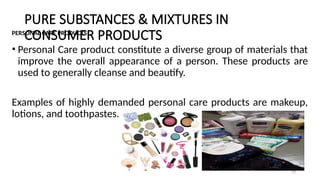
• Personal Care product constitute a diverse group of materials that
improve the overall appearance of a person. These products are
used to generally cleanse and beautify.
Examples of highly demanded personal care products are makeup,
lotions, and toothpastes.
19

GENERAL CHEMISTRY 1.pptx....................

  • 1.
  • 2.
  • 3.
    3 PARTICLES COMPOSING MATTER Theseare the smallest unit of matter that can’t be broken down chemically. These are groups of two or more atoms that are chemically bonded. These are particles that have gained or lost one or more of their valence electrons. ATOMS MOLECULES IONS
  • 4.
  • 5.
  • 6.
    PLASMA THE 4TH STATE OFMATTER • It is a hot ionized gas consisting of approximately equal numbers of positively charged ions and negatively charged electrons. • The characteristics of plasmas are significantly different from those of ordinary neutral gases so that plasmas are considered a distinct "fourth state of matter." 6
  • 7.
    BOSE-EISTEIN CONDENSATE THE 5TH STATEOF MATTER • It is a state of matter in which separate atoms or subatomic particles, cooled to near absolute zero. • When they reach that temperature the atoms are hardly moving relative to each other; they have almost no free energy to do so. At that point, the atoms begin to clump together, and enter the same energy states. 7
  • 8.
    8 PROPERTIES OF MATTER PHYSICAL PROPERTIES Thesecan be measured and observed without changing the composition of the substance. CHEMICAL PROPERTIES These are the ability of a substance to react with other substances such as air, water, and base. INTENSIVE PROPERTIES It does not depend on the size or amount of the sample. EXTENSIVE PROPERTIES These can be affected by the size and amount of samples. According to changed involved during measurements of the property. According to dependence on amount of matter
  • 9.
    PHYSICAL PROPERTIES INTENSIVE PHYSICALPROPERTIES EXTENSIVE PHYSICAL PROPERTIES Color Melting Point Density Solubility Conductivity Malleability Luster Viscosity Boiling Point Temperature Odor Mass Volume Length 9
  • 10.
    CHEMICAL PROPERTIES 10 CHEMICAL PROPERTIESDESCRIPTION 1. Combustibility Whether the substance undergoes combustion or not 2. Stability Whether the substance can be easily decomposed or not 3. Reactivity Whether it reacts with acids, bases, and oxygen, gas or not 4. Relative Activity Whether the material is more active or less active than other members of its chemical family 5. Ionization Whether it will break into charged particles when in solution with water or not. 6. Toxicity Whether substance can damage an organism or not.
  • 11.
    11 MATTER It is amatter that has a definite composition and distinct properties These are composed of two or more substances combined physically in various composition It is the simplest form of matter since it composed of only one kind of atom. It contains two or more kinds of atom chemically combined in definite proportion by mass It is a solid, liquid, or gaseous mixture that has the same proportions of its components throughout any given sample. It is a mixture whose composition varies from one position to another within the sample. PURE SUBSTANCE MIXTURES ELEMENT COMPOUND HOMOGENEOUS MIXTURE HETEROGENOUS MIXTURE
  • 12.
    SEPERATING MIXTURES Chemist separatemixtures by using different methods. 1. Filtration is a process of separating the components of a suspension 2. In Decantation the solid particles are allowed to settled first at the bottom and later, the liquid which is called supernatant is poured into another container leaving behind solid particle. 3. Evaporation is the process of converting liquid to gas, is useful in sorting mixtures such as salt solution. 4. Distillation is a process of separating a homogeneous mixture composed of two substances with different boiling points. 12
  • 13.
    SEPERATING MIXTURES Chemist separatemixtures by using different methods. 5. Magnetic Separation is the process of separating elemental metals from other particles in a mixture. 6. Melting is a process that can be used in extricating mixture that contain two substances with different melting points. 7. Sublimation is a process of changing solid to gas without passing through the liquid state. 8. In Centrifugation, the mixture is poured into a special tube in the centrifuge apparatus, and is allowed to spin using centrifugal force. The spinning motion forces the sediments to settle at the bottom. The liquid can be poured off from the solid particles. 13
  • 14.
    9. Chromatography isanother method of separating complex mixtures. It has various methods that can be used in separating mixture such as paper chromatography, which makes used of an adsorbent (filter paper or chromatogram paper), then separation depends upon the solubility of each component in the solvent. 14
  • 15.
    PURE SUBSTANCES &MIXTURES IN CONSUMER PRODUCTS CONSUMER PRODUCT • It is any item often bought for consumption. Convenience Product – those that appeal to a large segment of the market or those that are routinely bought. 1. Household Cleaning 2. Personal Care Product 15
  • 16.
    PURE SUBSTANCES &MIXTURES IN CONSUMER PRODUCTS HOUSEHOLD CLEANING MATERIAL • The most commonly used cleaning products are bleach, soaps, and detergents. These products have different compositions, specific uses, precautions for use, and costs. 16
  • 17.
    PURE SUBSTANCES &MIXTURES IN CONSUMER PRODUCTS HOUSEHOLD CLEANING MATERIAL • Bleach helps clean and whiten surfaces by generally lowering the stability of the chemical bonds in stain molecules. • It can convert dirt into particles that can be easily washed away in conjunction with use of detergents. • NaOCl (Sodium Hypochlorite) and H2O2 (Hydrogen Peroxide) are most common bleaching agents that are strong oxidizers; they can burn then skin and eyes especially if used in concentrated form. 17
  • 18.
    PURE SUBSTANCES &MIXTURES IN CONSUMER PRODUCTS HOUSEHOLD CLEANING MATERIAL • Soap and Detergent are mixture of surfactants, water softeners, stain removers, enzymes and perfumes, among others. • Surfactants render soaps and detergents capable of lowering the surface tension of water, which allows them to wet the surface to be cleaned. They also loosen and disperse water-insoluble solids making them washable with water. • Soap and Detergents are generally not toxic and severely dangerous, but may cause irritation to the skin and eyes. 18
  • 19.
    PURE SUBSTANCES &MIXTURES IN CONSUMER PRODUCTS PERSONAL CARE PRODUCTS • Personal Care product constitute a diverse group of materials that improve the overall appearance of a person. These products are used to generally cleanse and beautify. Examples of highly demanded personal care products are makeup, lotions, and toothpastes. 19