



By: Dr. Aaradhana Bandhani
Assistant Professor Sociology
Gender sensitization concentrate over Gender
Sensitivity which refers to the modification of behavior
by raising awareness of gender equality concerns.
Gender sensitization theories claim that modification
of the behavior of teachers and parents (etc.) towards
children which can have a causal effect on gender
equality.
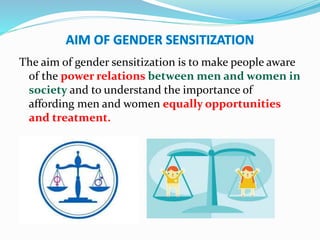
The aim of gender sensitization is to make people aware
of the power relations between men and women in
society and to understand the importance of
affording men and women equally opportunities
and treatment.
SEX AND GENDER
Sex refers to physical or physiological differences between
males and females, including both primary sex
characteristics (the reproductive system) and secondary
characteristics such as height and muscularity.
Gender is a person’s deeply held internal perception of his or
her identity, which is based on social factors such as values,
perceptions, beliefs, and attitudes.
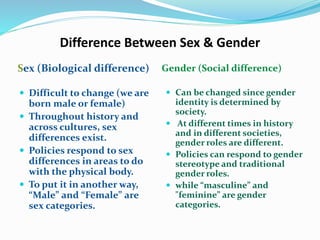
Difference Between Sex & Gender
Sex (Biological difference) Gender (Social difference)
 Difficult to change (we are
born male or female)
 Throughout history and
across cultures, sex
differences exist.
 Policies respond to sex
differences in areas to do
with the physical body.
 To put it in another way,
“Male” and “Female” are
sex categories.
 Can be changed since gender
identity is determined by
society.
 At different times in history
and in different societies,
gender roles are different.
 Policies can respond to gender
stereotype and traditional
gender roles.
 while “masculine” and
"feminine” are gender
categories.
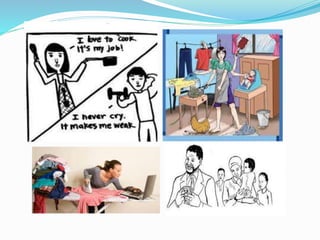
EXPECTED ROLE
WOMAN MAN
 Home & Hearth
 Caring & subservient
 Patient
 Obedient
 Loving
 Giving
 Selfless
 Dedicated to satisfy Family
needs
 Not to express desires & Sexual
Satisfaction
 Women Witches are BOSSEY
 Working Mothers a CURSE
 Bread Winner
 Masters
 Dominating
 Demanding
 Strong
 Controlled Emotions
 Centrifugal
 Procure
 Commanding & free to seek
away from home
 Real Men Bosses
 Household Cures UNMANLY
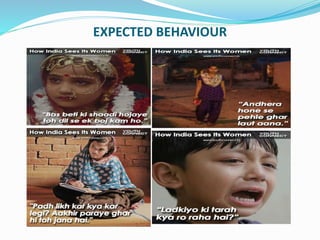
EXPECTED BEHAVIOUR
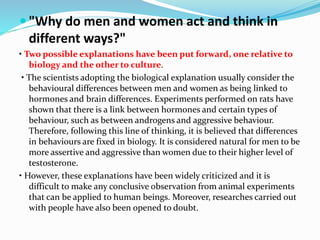
 "Why do men and women act and think in
different ways?"
• Two possible explanations have been put forward, one relative to
biology and the other to culture.
• The scientists adopting the biological explanation usually consider the
behavioural differences between men and women as being linked to
hormones and brain differences. Experiments performed on rats have
shown that there is a link between hormones and certain types of
behaviour, such as between androgens and aggressive behaviour.
Therefore, following this line of thinking, it is believed that differences
in behaviours are fixed in biology. It is considered natural for men to be
more assertive and aggressive than women due to their higher level of
testosterone.
• However, these explanations have been widely criticized and it is
difficult to make any conclusive observation from animal experiments
that can be applied to human beings. Moreover, researches carried out
with people have also been opened to doubt.
• The most popular explanation among sociologists
remains the cultural one. Gender roles are viewed as
being learnt through socialization.
Culture is thus put forward as the key to understanding why men
and women hold different attitudes and behaviours and why
society actually expects them to behave in different ways and
accept these differences as ‘natural'. This is why the term ‘gender'
has been coined. It is asserted that men and women are not born
with behavioural differences, despite their anatomical
differences. They rather learn, as from an early age, that because
they belong to a particular sex, they must behave in a specific
way. Their gender identities and gender roles are assigned to
them, not by biology, but by society's norms and values
regarding the different sexes.
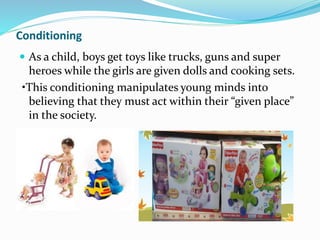
Conditioning
 As a child, boys get toys like trucks, guns and super
heroes while the girls are given dolls and cooking sets.
•This conditioning manipulates young minds into
believing that they must act within their “given place”
in the society.
Challenges
• Girls who do not conform to stereotypical expectations
can experience criticism, ostracism and even violence.
• This also puts unwarranted pressure on boys who love
to read, dislike fighting, or dislike sports or mechanics.
IMPORTANCE OF GENDER SENSITIZATION
 Gender Sensitization is one basic requirement for the
normal development of an individual. Without being
sensitive to the needs of a particular gender, an individual
may refrain from understanding the opposite gender and in
some acute cases even him or herself. The need for this
sensitivity has been felt and realized through times
immemorial and in almost all kinds of human existence,
across the globe.
continue
 Particularly in a country like India, with the vast
diversity existing in terms of its customs, traditions,
rituals, social values, family beliefs and individual
perception, the need for a More Systematic, Well
Planned and More Professional Approach is desired to
inculcate this sensitivity and primarily highlight the
contribution of both the genders in creation and
development of a well balanced society.
continue
To overcome the various disparities existing in lieu of gender
equality the following aspects have to be developed:
 Individuals need to be more open-minded, rational and
unbiased in their thoughts and actions.
 There is an urgent need to shatter the load of our Orthodox
Beliefs and Biased Values to accentuate the Progressive
Existence of both the genders.
 Better reconciliation of work and private life for both
women and men is essential to gender equality.
A country that does not value gender sensitization, will never be
safe. If we have to make our society safer for women, it’s time to
demand gender sensitization.
 Schools and homes are the basic sources of development of the
understanding of gender and gender relations. The influence of
teachers and educators as change agents in this area cannot be
underestimated. The broader goal of gender equality is a societal
goal to which educational institutions must contribute to.
 Our education system needs to be gender sensitive and gender
friendly. Schools can play an important role in inculcating
gender sensitivity in etiquettes and manners of the students.
 A detailed action plan with a definite road map is required in the
school curriculum to achieve gender equality. One of the best
possible strategies to minimize gender discrimination in society
is to promote gender awareness in parents and teachers.
continue
 Teachers play a very important part in the early upbringing
of the child and their ideas and beliefs can change the
thought processes of young students. Children in the
formative years easily nurture values and virtues which are
taught at school. Gender sensitization will change the
perception that men and women have of each other. It will
create a mindset in which men will no longer see women in
stereotypical image. They will no longer consider women as
weak and unequal entity. Men will see their female
counterparts as responsible and equal partners in socio-
economic development.
continue
 Teachers are important agents of change because of the key
role they play in the processes of education as major
executors of the teaching and learning processes. A teacher
must therefore constantly be aware of the fact that his or
her action / attitude / behavior / mindset / outlook will
help to shape a child's gender role. He/she may use
multiple strategies and interventions to ensure that
students have equal opportunities to both create and
obtain their goals . For the teachers to bring about a change
in the society they should be given a pre hand knowledge of
the issues . Teachers not only need gender sensitive
curriculum and textbooks but also gender equality
education . Academic contents with lessons on gender
sensitivity and moral traditions will unconsciously mould
the character of the tender minds. It is time to transform
India's patriarchal norms.
Recommendations/Suggestions:
Stressing on zero tolerance on indecent behavior towards
women, Hon'ble MHRD Mr. Pallam Raju while addressing
media said that gender sensitization will be made an
integral part of the school curriculum.
 1. It is necessary that the school curriculum should be free
of gender inequality .
 2. Pictures in the textbooks should be gender sensitive to
promote gender equality .
 3. Education system should be gender friendly and gender
sensitive .
continue
 4. Gender neutral language should be promoted in the schools at
all levels.
 5. Gender sensitivity training programmes to be made
mandatory for all teachers.
 6. School parents partnership should be strengthened to address
gender issues at homes.
 7. Gender sensitive counseling by gender experts for teachers and
students.
 8. Gender sensitive , empowered women can serve as role models
for girls and pass on new values to all their students.
 9. All policies , programmes, interventions need to be gender
sensitive.
 10.Classroom interaction , academic delivery and teaching
methodologies should be gender responsive.
 Gender Sensitization

Gender Sensitization

  • 1.
    By: Dr. AaradhanaBandhani Assistant Professor Sociology
  • 2.
    Gender sensitization concentrateover Gender Sensitivity which refers to the modification of behavior by raising awareness of gender equality concerns. Gender sensitization theories claim that modification of the behavior of teachers and parents (etc.) towards children which can have a causal effect on gender equality.
  • 3.
    The aim ofgender sensitization is to make people aware of the power relations between men and women in society and to understand the importance of affording men and women equally opportunities and treatment.
  • 4.
    SEX AND GENDER Sexrefers to physical or physiological differences between males and females, including both primary sex characteristics (the reproductive system) and secondary characteristics such as height and muscularity. Gender is a person’s deeply held internal perception of his or her identity, which is based on social factors such as values, perceptions, beliefs, and attitudes.
  • 5.
    Difference Between Sex& Gender Sex (Biological difference) Gender (Social difference)  Difficult to change (we are born male or female)  Throughout history and across cultures, sex differences exist.  Policies respond to sex differences in areas to do with the physical body.  To put it in another way, “Male” and “Female” are sex categories.  Can be changed since gender identity is determined by society.  At different times in history and in different societies, gender roles are different.  Policies can respond to gender stereotype and traditional gender roles.  while “masculine” and "feminine” are gender categories.
  • 6.
    EXPECTED ROLE WOMAN MAN Home & Hearth  Caring & subservient  Patient  Obedient  Loving  Giving  Selfless  Dedicated to satisfy Family needs  Not to express desires & Sexual Satisfaction  Women Witches are BOSSEY  Working Mothers a CURSE  Bread Winner  Masters  Dominating  Demanding  Strong  Controlled Emotions  Centrifugal  Procure  Commanding & free to seek away from home  Real Men Bosses  Household Cures UNMANLY
  • 8.
  • 10.
     "Why domen and women act and think in different ways?" • Two possible explanations have been put forward, one relative to biology and the other to culture. • The scientists adopting the biological explanation usually consider the behavioural differences between men and women as being linked to hormones and brain differences. Experiments performed on rats have shown that there is a link between hormones and certain types of behaviour, such as between androgens and aggressive behaviour. Therefore, following this line of thinking, it is believed that differences in behaviours are fixed in biology. It is considered natural for men to be more assertive and aggressive than women due to their higher level of testosterone. • However, these explanations have been widely criticized and it is difficult to make any conclusive observation from animal experiments that can be applied to human beings. Moreover, researches carried out with people have also been opened to doubt.
  • 11.
    • The mostpopular explanation among sociologists remains the cultural one. Gender roles are viewed as being learnt through socialization. Culture is thus put forward as the key to understanding why men and women hold different attitudes and behaviours and why society actually expects them to behave in different ways and accept these differences as ‘natural'. This is why the term ‘gender' has been coined. It is asserted that men and women are not born with behavioural differences, despite their anatomical differences. They rather learn, as from an early age, that because they belong to a particular sex, they must behave in a specific way. Their gender identities and gender roles are assigned to them, not by biology, but by society's norms and values regarding the different sexes.
  • 12.
    Conditioning  As achild, boys get toys like trucks, guns and super heroes while the girls are given dolls and cooking sets. •This conditioning manipulates young minds into believing that they must act within their “given place” in the society.
  • 13.
    Challenges • Girls whodo not conform to stereotypical expectations can experience criticism, ostracism and even violence. • This also puts unwarranted pressure on boys who love to read, dislike fighting, or dislike sports or mechanics.
  • 14.
    IMPORTANCE OF GENDERSENSITIZATION  Gender Sensitization is one basic requirement for the normal development of an individual. Without being sensitive to the needs of a particular gender, an individual may refrain from understanding the opposite gender and in some acute cases even him or herself. The need for this sensitivity has been felt and realized through times immemorial and in almost all kinds of human existence, across the globe.
  • 15.
    continue  Particularly ina country like India, with the vast diversity existing in terms of its customs, traditions, rituals, social values, family beliefs and individual perception, the need for a More Systematic, Well Planned and More Professional Approach is desired to inculcate this sensitivity and primarily highlight the contribution of both the genders in creation and development of a well balanced society.
  • 16.
    continue To overcome thevarious disparities existing in lieu of gender equality the following aspects have to be developed:  Individuals need to be more open-minded, rational and unbiased in their thoughts and actions.  There is an urgent need to shatter the load of our Orthodox Beliefs and Biased Values to accentuate the Progressive Existence of both the genders.  Better reconciliation of work and private life for both women and men is essential to gender equality.
  • 17.
    A country thatdoes not value gender sensitization, will never be safe. If we have to make our society safer for women, it’s time to demand gender sensitization.
  • 18.
     Schools andhomes are the basic sources of development of the understanding of gender and gender relations. The influence of teachers and educators as change agents in this area cannot be underestimated. The broader goal of gender equality is a societal goal to which educational institutions must contribute to.  Our education system needs to be gender sensitive and gender friendly. Schools can play an important role in inculcating gender sensitivity in etiquettes and manners of the students.  A detailed action plan with a definite road map is required in the school curriculum to achieve gender equality. One of the best possible strategies to minimize gender discrimination in society is to promote gender awareness in parents and teachers.
  • 19.
    continue  Teachers playa very important part in the early upbringing of the child and their ideas and beliefs can change the thought processes of young students. Children in the formative years easily nurture values and virtues which are taught at school. Gender sensitization will change the perception that men and women have of each other. It will create a mindset in which men will no longer see women in stereotypical image. They will no longer consider women as weak and unequal entity. Men will see their female counterparts as responsible and equal partners in socio- economic development.
  • 20.
    continue  Teachers areimportant agents of change because of the key role they play in the processes of education as major executors of the teaching and learning processes. A teacher must therefore constantly be aware of the fact that his or her action / attitude / behavior / mindset / outlook will help to shape a child's gender role. He/she may use multiple strategies and interventions to ensure that students have equal opportunities to both create and obtain their goals . For the teachers to bring about a change in the society they should be given a pre hand knowledge of the issues . Teachers not only need gender sensitive curriculum and textbooks but also gender equality education . Academic contents with lessons on gender sensitivity and moral traditions will unconsciously mould the character of the tender minds. It is time to transform India's patriarchal norms.
  • 21.
    Recommendations/Suggestions: Stressing on zerotolerance on indecent behavior towards women, Hon'ble MHRD Mr. Pallam Raju while addressing media said that gender sensitization will be made an integral part of the school curriculum.  1. It is necessary that the school curriculum should be free of gender inequality .  2. Pictures in the textbooks should be gender sensitive to promote gender equality .  3. Education system should be gender friendly and gender sensitive .
  • 22.
    continue  4. Genderneutral language should be promoted in the schools at all levels.  5. Gender sensitivity training programmes to be made mandatory for all teachers.  6. School parents partnership should be strengthened to address gender issues at homes.  7. Gender sensitive counseling by gender experts for teachers and students.  8. Gender sensitive , empowered women can serve as role models for girls and pass on new values to all their students.  9. All policies , programmes, interventions need to be gender sensitive.  10.Classroom interaction , academic delivery and teaching methodologies should be gender responsive.