
RAJKUMAR POREL
M.SC GEOGRAPHY, 1ST SEMESTER
ROLL= 91
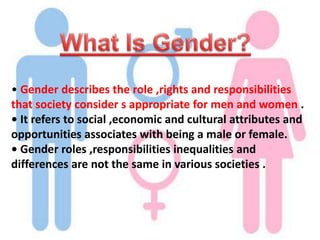
• Gender describes the role ,rights and responsibilities
that society consider s appropriate for men and women .
• It refers to social ,economic and cultural attributes and
opportunities associates with being a male or female.
• Gender roles ,responsibilities inequalities and
differences are not the same in various societies .
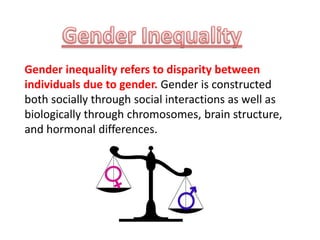
Gender inequality refers to disparity between
individuals due to gender. Gender is constructed
both socially through social interactions as well as
biologically through chromosomes, brain structure,
and hormonal differences.
There are many kinds of gender inequality or gender disparity
which are as follows:
• Inequality in Family
• Natality inequality
• Professional or Employment inequality or inequality at work place.
• Ownership inequality
• Household inequality
• Special opportunity inequality
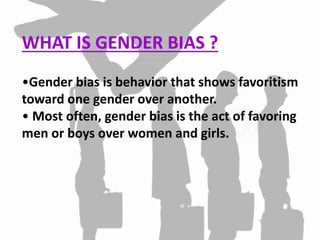
WHAT IS GENDER BIAS ?
•Gender bias is behavior that shows favoritism
toward one gender over another.
• Most often, gender bias is the act of favoring
men or boys over women and girls.
CAUSES:
Sociocultural
Biological
Economic
Prejudice
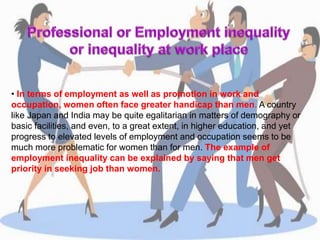
• In terms of employment as well as promotion in work and
occupation, women often face greater handicap than men. A country
like Japan and India may be quite egalitarian in matters of demography or
basic facilities, and even, to a great extent, in higher education, and yet
progress to elevated levels of employment and occupation seems to be
much more problematic for women than for men. The example of
employment inequality can be explained by saying that men get
priority in seeking job than women.
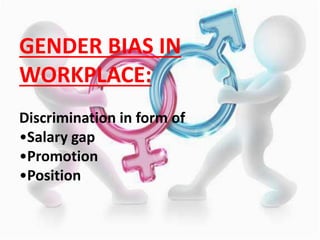
GENDER BIAS IN
WORKPLACE:
Discrimination in form of
•Salary gap
•Promotion
•Position
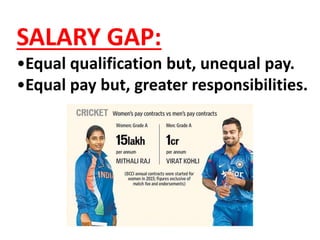
SALARY GAP:
•Equal qualification but, unequal pay.
•Equal pay but, greater responsibilities.
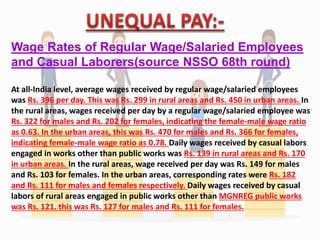
Wage Rates of Regular Wage/Salaried Employees
and Casual Laborers(source NSSO 68th round)
At all-India level, average wages received by regular wage/salaried employees
was Rs. 396 per day. This was Rs. 299 in rural areas and Rs. 450 in urban areas. In
the rural areas, wages received per day by a regular wage/salaried employee was
Rs. 322 for males and Rs. 202 for females, indicating the female-male wage ratio
as 0.63. In the urban areas, this was Rs. 470 for males and Rs. 366 for females,
indicating female-male wage ratio as 0.78. Daily wages received by casual labors
engaged in works other than public works was Rs. 139 in rural areas and Rs. 170
in urban areas. In the rural areas, wage received per day was Rs. 149 for males
and Rs. 103 for females. In the urban areas, corresponding rates were Rs. 182
and Rs. 111 for males and females respectively. Daily wages received by casual
labors of rural areas engaged in public works other than MGNREG public works
was Rs. 121. this was Rs. 127 for males and Rs. 111 for females.
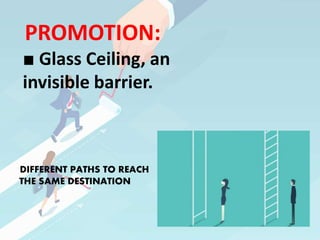
PROMOTION:
■ Glass Ceiling, an
invisible barrier.
DIFFERENT PATHS TO REACH
THE SAME DESTINATION
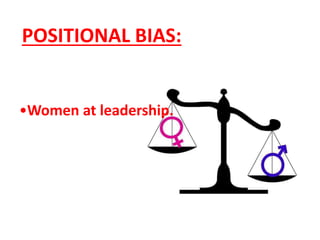
POSITIONAL BIAS:
•Women at leadership.
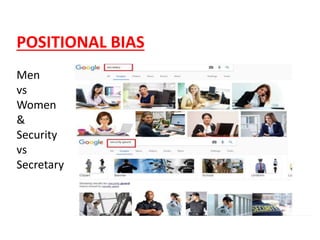
POSITIONAL BIAS
Men
vs
Women
&
Security
vs
Secretary
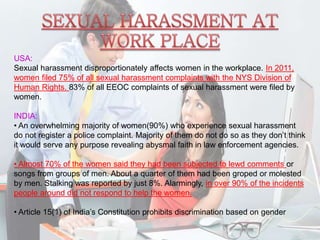
USA:
Sexual harassment disproportionately affects women in the workplace. In 2011,
women filed 75% of all sexual harassment complaints with the NYS Division of
Human Rights. 83% of all EEOC complaints of sexual harassment were filed by
women.
INDIA:
• An overwhelming majority of women(90%) who experience sexual harassment
do not register a police complaint. Majority of them do not do so as they don’t think
it would serve any purpose revealing abysmal faith in law enforcement agencies.
• Almost 70% of the women said they had been subjected to lewd comments or
songs from groups of men. About a quarter of them had been groped or molested
by men. Stalking was reported by just 8%. Alarmingly, in over 90% of the incidents
people around did not respond to help the women.
• Article 15(1) of India’s Constitution prohibits discrimination based on gender
• In 2013, India passed the Anti-Sexual Harassment of Women at
Workplace Act. The act defines sexual harassment in the workplace
and intends to minimize any bias or influence by people in positions of
authority to intervene in cases of sexual harassment.
• In a recent ICRW an UN Women Survey, 95% of women and girls
feel unsafe from unwanted sexual harassment in public spaces in the
city of Delhi.
• 63% of women in Delhi survey were afraid to go out after dark
alone and 21% stated they do not go out at all.
• 17% of working women in India have experienced some form of sexual
harassment at work.
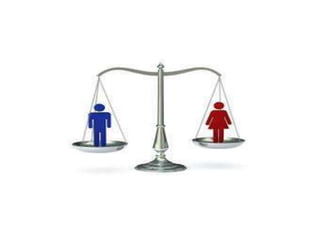
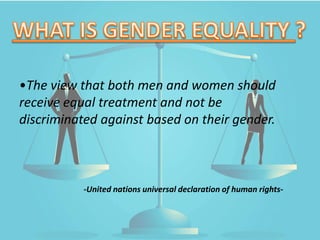
•The view that both men and women should
receive equal treatment and not be
discriminated against based on their gender.
-United nations universal declaration of human rights-
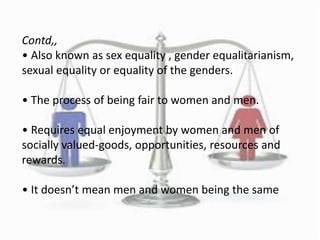
Contd,,
• Also known as sex equality , gender equalitarianism,
sexual equality or equality of the genders.
• The process of being fair to women and men.
• Requires equal enjoyment by women and men of
socially valued-goods, opportunities, resources and
rewards.
• It doesn’t mean men and women being the same
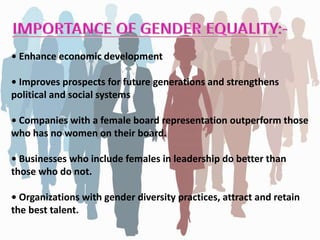
• Enhance economic development
• Improves prospects for future generations and strengthens
political and social systems
• Companies with a female board representation outperform those
who has no women on their board.
• Businesses who include females in leadership do better than
those who do not.
• Organizations with gender diversity practices, attract and retain
the best talent.
HOW TO REDUCE GENDER BIASNESS
•Interaction with in two genders
•Grooming the new Generation
•Changing the Old-Traditions & Norms
•Gender Diversity
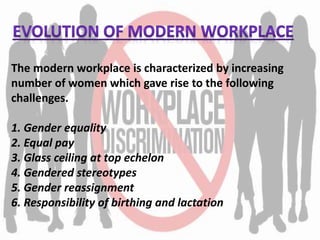
The modern workplace is characterized by increasing
number of women which gave rise to the following
challenges.
1. Gender equality
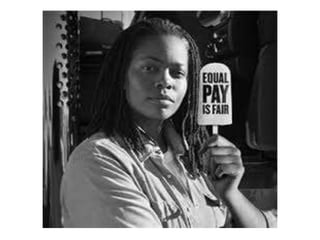
2. Equal pay
3. Glass ceiling at top echelon
4. Gendered stereotypes
5. Gender reassignment
6. Responsibility of birthing and lactation
• Lack of cooperation between men and women
• Prevalent mindset about lower capability of women
• Misinterpretation of religion
• Low awareness of women rights
• Non-availability of breastfeeding facility
• Gender equality attracts top talent
• Gender equality can reduce expenses
• Companies with gender equality perform better
• Gender equality improves national productivity and
Competitiveness
• Gender inequality wastes resources
• Gender equality must become a lived reality.
• It will come from determination, guts and heart.
• It will come from the men and women who believe they
can make a difference.
• We must close the gender gap.
Gender inequality at work place

Gender inequality at work place

  • 1.
    RAJKUMAR POREL M.SC GEOGRAPHY,1ST SEMESTER ROLL= 91
  • 4.
    • Gender describesthe role ,rights and responsibilities that society consider s appropriate for men and women . • It refers to social ,economic and cultural attributes and opportunities associates with being a male or female. • Gender roles ,responsibilities inequalities and differences are not the same in various societies .
  • 5.
    Gender inequality refersto disparity between individuals due to gender. Gender is constructed both socially through social interactions as well as biologically through chromosomes, brain structure, and hormonal differences.
  • 6.
    There are manykinds of gender inequality or gender disparity which are as follows: • Inequality in Family • Natality inequality • Professional or Employment inequality or inequality at work place. • Ownership inequality • Household inequality • Special opportunity inequality
  • 7.
    WHAT IS GENDERBIAS ? •Gender bias is behavior that shows favoritism toward one gender over another. • Most often, gender bias is the act of favoring men or boys over women and girls.
  • 8.
  • 9.
    • In termsof employment as well as promotion in work and occupation, women often face greater handicap than men. A country like Japan and India may be quite egalitarian in matters of demography or basic facilities, and even, to a great extent, in higher education, and yet progress to elevated levels of employment and occupation seems to be much more problematic for women than for men. The example of employment inequality can be explained by saying that men get priority in seeking job than women.
  • 10.
    GENDER BIAS IN WORKPLACE: Discriminationin form of •Salary gap •Promotion •Position
  • 11.
    SALARY GAP: •Equal qualificationbut, unequal pay. •Equal pay but, greater responsibilities.
  • 12.
    Wage Rates ofRegular Wage/Salaried Employees and Casual Laborers(source NSSO 68th round) At all-India level, average wages received by regular wage/salaried employees was Rs. 396 per day. This was Rs. 299 in rural areas and Rs. 450 in urban areas. In the rural areas, wages received per day by a regular wage/salaried employee was Rs. 322 for males and Rs. 202 for females, indicating the female-male wage ratio as 0.63. In the urban areas, this was Rs. 470 for males and Rs. 366 for females, indicating female-male wage ratio as 0.78. Daily wages received by casual labors engaged in works other than public works was Rs. 139 in rural areas and Rs. 170 in urban areas. In the rural areas, wage received per day was Rs. 149 for males and Rs. 103 for females. In the urban areas, corresponding rates were Rs. 182 and Rs. 111 for males and females respectively. Daily wages received by casual labors of rural areas engaged in public works other than MGNREG public works was Rs. 121. this was Rs. 127 for males and Rs. 111 for females.
  • 14.
    PROMOTION: ■ Glass Ceiling,an invisible barrier. DIFFERENT PATHS TO REACH THE SAME DESTINATION
  • 15.
  • 16.
  • 17.
    USA: Sexual harassment disproportionatelyaffects women in the workplace. In 2011, women filed 75% of all sexual harassment complaints with the NYS Division of Human Rights. 83% of all EEOC complaints of sexual harassment were filed by women. INDIA: • An overwhelming majority of women(90%) who experience sexual harassment do not register a police complaint. Majority of them do not do so as they don’t think it would serve any purpose revealing abysmal faith in law enforcement agencies. • Almost 70% of the women said they had been subjected to lewd comments or songs from groups of men. About a quarter of them had been groped or molested by men. Stalking was reported by just 8%. Alarmingly, in over 90% of the incidents people around did not respond to help the women. • Article 15(1) of India’s Constitution prohibits discrimination based on gender
  • 18.
    • In 2013,India passed the Anti-Sexual Harassment of Women at Workplace Act. The act defines sexual harassment in the workplace and intends to minimize any bias or influence by people in positions of authority to intervene in cases of sexual harassment. • In a recent ICRW an UN Women Survey, 95% of women and girls feel unsafe from unwanted sexual harassment in public spaces in the city of Delhi. • 63% of women in Delhi survey were afraid to go out after dark alone and 21% stated they do not go out at all. • 17% of working women in India have experienced some form of sexual harassment at work.
  • 21.
    •The view thatboth men and women should receive equal treatment and not be discriminated against based on their gender. -United nations universal declaration of human rights-
  • 22.
    Contd,, • Also knownas sex equality , gender equalitarianism, sexual equality or equality of the genders. • The process of being fair to women and men. • Requires equal enjoyment by women and men of socially valued-goods, opportunities, resources and rewards. • It doesn’t mean men and women being the same
  • 23.
    • Enhance economicdevelopment • Improves prospects for future generations and strengthens political and social systems • Companies with a female board representation outperform those who has no women on their board. • Businesses who include females in leadership do better than those who do not. • Organizations with gender diversity practices, attract and retain the best talent.
  • 25.
    HOW TO REDUCEGENDER BIASNESS •Interaction with in two genders •Grooming the new Generation •Changing the Old-Traditions & Norms •Gender Diversity
  • 26.
    The modern workplaceis characterized by increasing number of women which gave rise to the following challenges. 1. Gender equality 2. Equal pay 3. Glass ceiling at top echelon 4. Gendered stereotypes 5. Gender reassignment 6. Responsibility of birthing and lactation
  • 27.
    • Lack ofcooperation between men and women • Prevalent mindset about lower capability of women • Misinterpretation of religion • Low awareness of women rights • Non-availability of breastfeeding facility
  • 28.
    • Gender equalityattracts top talent • Gender equality can reduce expenses • Companies with gender equality perform better • Gender equality improves national productivity and Competitiveness • Gender inequality wastes resources
  • 29.
    • Gender equalitymust become a lived reality. • It will come from determination, guts and heart. • It will come from the men and women who believe they can make a difference. • We must close the gender gap.