THE SIMPLE TRUTH
ABOUT THE GENDER PAY GAP
• The pay gap is a comparison between men’s and
women’s typical earnings.
• Weekly earnings or annual earnings
• [Insert your state pay gap here.]
What Is the Pay Gap?
The earnings ratio and the pay gap for 2013 are calculated using
these formulas:
What Is the Pay Gap?
Earnings ratio =
women’s median earnings
men’s median earnings
Pay gap =
[men’s median earnings – women’s median earnings]
men’s median earnings
= 78%
= 22%
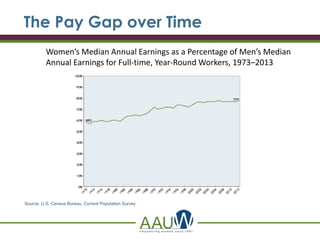
The Pay Gap over Time
Women’s Median Annual Earnings as a Percentage of Men’s Median
Annual Earnings for Full-time, Year-Round Workers, 1973–2013
Source: U.S. Census Bureau, Current Population Survey
• Men and women tend to choose different majors in college
and to work in different occupations after college.
• Women tend to work fewer hours, even when they work
full time.
• Women are more likely to leave the workforce or to work
part time when they have young children.
• Choices can account for some of the differences in salaries,
but they aren’t the whole story.
What about Choices?
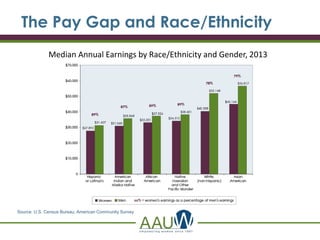
The Pay Gap and Race/Ethnicity
Median Annual Earnings by Race/Ethnicity and Gender, 2013
Source: U.S. Census Bureau, American Community Survey
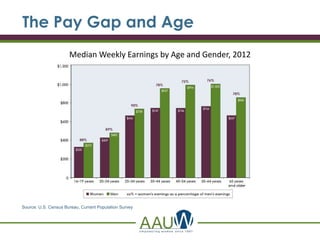
The Pay Gap and Age
Median Weekly Earnings by Age and Gender, 2012
Source: U.S. Census Bureau, Current Population Survey
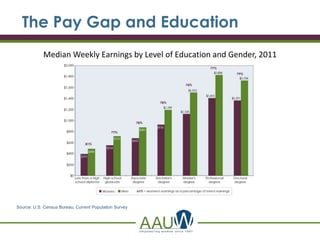
The Pay Gap and Education
Median Weekly Earnings by Level of Education and Gender, 2011
Source: U.S. Census Bureau, Current Population Survey
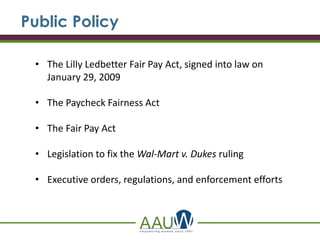
Public Policy
• The Lilly Ledbetter Fair Pay Act, signed into law on
January 29, 2009
• The Paycheck Fairness Act
• The Fair Pay Act
• Legislation to fix the Wal-Mart v. Dukes ruling
• Executive orders, regulations, and enforcement efforts
Conclusion
• The pay gap is real and pervasive, and it affects all women.
• Individuals, employers, and communities need to take
action.
• For more information and resources, including our one-
stop guide on this topic, The Simple Truth about the
Gender Pay Gap, visit us online at www.aauw.org.
The Simple Truth about the Gender Pay Gap -- AAUW

The Simple Truth about the Gender Pay Gap -- AAUW

  • 1.
    THE SIMPLE TRUTH ABOUTTHE GENDER PAY GAP
  • 2.
    • The paygap is a comparison between men’s and women’s typical earnings. • Weekly earnings or annual earnings • [Insert your state pay gap here.] What Is the Pay Gap?
  • 3.
    The earnings ratioand the pay gap for 2013 are calculated using these formulas: What Is the Pay Gap? Earnings ratio = women’s median earnings men’s median earnings Pay gap = [men’s median earnings – women’s median earnings] men’s median earnings = 78% = 22%
  • 4.
    The Pay Gapover Time Women’s Median Annual Earnings as a Percentage of Men’s Median Annual Earnings for Full-time, Year-Round Workers, 1973–2013 Source: U.S. Census Bureau, Current Population Survey
  • 5.
    • Men andwomen tend to choose different majors in college and to work in different occupations after college. • Women tend to work fewer hours, even when they work full time. • Women are more likely to leave the workforce or to work part time when they have young children. • Choices can account for some of the differences in salaries, but they aren’t the whole story. What about Choices?
  • 6.
    The Pay Gapand Race/Ethnicity Median Annual Earnings by Race/Ethnicity and Gender, 2013 Source: U.S. Census Bureau, American Community Survey
  • 7.
    The Pay Gapand Age Median Weekly Earnings by Age and Gender, 2012 Source: U.S. Census Bureau, Current Population Survey
  • 8.
    The Pay Gapand Education Median Weekly Earnings by Level of Education and Gender, 2011 Source: U.S. Census Bureau, Current Population Survey
  • 9.
    Public Policy • TheLilly Ledbetter Fair Pay Act, signed into law on January 29, 2009 • The Paycheck Fairness Act • The Fair Pay Act • Legislation to fix the Wal-Mart v. Dukes ruling • Executive orders, regulations, and enforcement efforts
  • 10.
    Conclusion • The paygap is real and pervasive, and it affects all women. • Individuals, employers, and communities need to take action. • For more information and resources, including our one- stop guide on this topic, The Simple Truth about the Gender Pay Gap, visit us online at www.aauw.org.

Editor's Notes

  • #2 [Introduce yourself.] The American Association of University Women (AAUW) is a nationwide network of more than 170,000 members and supporters, 1,000 branches, and 800 college/university partner members. [www.aauw.org/join] For more than 130 years, AAUW members have examined and taken positions on the fundamental issues of the day—educational, social, economic, and political. Our commitment to our mission of advancing equity for women and girls is reflected in all aspects of our work.
  • #3 The pay gap is one of the most pressing issues for women today. This presentation provides an overview of this important topic, which we hope will help you explain it to others. The gender pay gap is a comparison of men’s and women’s median earnings. Median earnings are typical, not average, earnings. Looking at the salaries of all men and women working full time, the median is the number in the middle of the group. We often say “typical” to refer to median because it is the person “right in the middle.” Half of the people earn more, and half earn less. [Why not use averages? Because very high earnings can pull up the average, but they don’t pull up the middle point in the same way. Average wages tend to be higher than median wages.] Earnings are usually measured on a weekly or annual basis. Both are valid ways of comparing earnings. [State pay gap data can be found on page 7 of The Simple Truth about the Gender Pay Gap.]
  • #4 The calculation of the earnings ratio and the pay gap is simple [read chart]. The earnings ratio for 2013 was 78 percent, and the pay gap was 22 percent. The numbers displayed here represent the pay gap on a national level. However, using this same formula and current data from the U.S. Census Bureau, we can calculate the pay gap for individual states. Our state’s pay gap can be found on page 7 of The Simple Truth about the Gender Pay Gap.
  • #5 While the pay gap has steadily narrowed over time, it is nowhere near being eliminated, and in recent years progress has actually stalled. In the 10 years between 2003 and 2013, the pay gap hasn’t budged. At this rate, the pay gap will never close.
  • #6 Sometimes, men and women makes choices that affect their salaries, and in turn, this affects the pay gap. Men and women still tend to choose different majors in college and to work in different occupations after college. Women also tend to work fewer hours, even when they work full time (full-time work is defined by the Bureau of Labor Statistics as 35 hours a week or more). Women are more likely to leave the workforce or work part time when they have young children. Choices account for some of the differences in salaries, but they aren’t the whole story. The 2012 AAUW report Graduating to a Pay Gap examines this question. After accounting for the issues raised above as well as others, our study found that there was a 7 percent difference in the earnings of men and women one year after college graduation that was still unexplained.
  • #7 The pay gap affects women from all backgrounds, but its effects vary among different demographics. The chart shown here lays out the pay gap by race and ethnicity among full-time workers in 2013. You can see that Hispanics, American Indians, African Americans, and Native Hawaiians, both men and women, had lower median earnings than non-Hispanic whites and Asian Americans. Women were paid less than men within each racial and ethnic group, and the pay gap between men and women was smaller among African Americans, Hispanics, American Indians, and Native Hawaiians compared with whites and Asian Americans. It is clear from the chart, however, that this smaller gender pay gap among these groups is due solely to the fact that American Indian, Native Hawaiian, African American, and Hispanic men were paid substantially less than non-Hispanic white and Asian American men were paid in 2013. Asian American and white women were paid more than other women, and Asian American men were paid the highest wages.
  • #8 The pay gap is narrow among younger women and men, but it increases among middle-age workers and older groups. For example, in this chart, you can see that among young people ages 16 to 34, women are paid around 90 percent of what men are paid. In the peak earning years of 35–64, in contrast, women are paid between 75 percent and 78 percent of what men are paid.
  • #9 While earnings tend to increase with education level, education does not eliminate the pay gap. The pay gap exists at all levels of education and, in some cases, is larger at higher levels of education. For example, this chart shows that women with less than a high school diploma were paid 81 percent as much as their male peers were paid in 2011, whereas women with master’s degrees were paid only 74 percent of what men with master’s degrees were paid.
  • #10 Thanks in part to the hard work of AAUW Action Network members and our coalition partners, President Obama signed the Lilly Ledbetter Fair Pay Act into law on January 29, 2009. This law allows for a longer time period in which employees can bring legal action for pay discrimination lawsuits. Other legislative measures that have been pending in Congress for several years would address longstanding discriminatory practices that contribute to the gender-based wage gap. Key among them is the Paycheck Fairness Act (S. 84/H.R. 377), which would expand the Equal Pay Act by requiring employers to prove that wage gaps between men and women doing the same work have a business justification and are truly a result of factors other than sex. It would allow for wage comparisons between employees to determine fair wages and prohibit employer retaliation against workers who inquire about wage practices or disclose their own wages. (This nonretaliation provision would have been particularly helpful to Lilly Ledbetter, because Goodyear prohibited employees from discussing or sharing their wages. This policy delayed her discovery of the discrimination against her by more than a decade.) The Fair Pay Act (S. 168/H.R. 438) would prohibit wage discrimination based on sex, race, and national origin by requiring employers to provide equal pay for work of equal value, whether or not the jobs are the same. This bill is particularly helpful for women working in female-dominated jobs equivalent in skills, effort, responsibility, and working conditions to jobs dominated by men—for example, a social worker (traditionally female) and a parole officer (traditionally male). Wal-Mart v. Dukes, a 2011 U.S. Supreme Court decision, severely restricted the ability of workers to fight discrimination together in a class action. Champions in the House and Senate vowed to fix the flawed court decision legislatively. Because partisan gridlock stalled this legislation, President Obama pledged to issue executive orders and additional regulatory guidance and reform, which although limited in scope, would provide additional pay protections for federal contractors and employees. It was no coincidence that the president signed two AAUW-supported executive orders addressing pay discrimination on Equal Pay Day 2014—the day when women’s earnings finally catch up to what men earned in the previous year. The first executive order bans federal contractors from retaliating against workers who talk about their salaries or inquire about wage practices. The second executive order requires the U.S. Department of Labor to collect wage data from federal contractors, including the race, sex, and national origin of employees. These two orders send a clear message to companies awarded government contracts that they cannot discriminate with taxpayer money. The Small Business Administration also issued regulations raising the loan caps for women business owners seeking loans through the Women’s Procurement Program, leveling the field for women and men who own competing businesses and are seeking federal contracts. Federal budgets need to ensure adequate enforcement of all civil rights laws through sufficient funding and staffing of the Equal Employment Opportunity Commission, the Office of Federal Contract Compliance Programs, and the various civil rights divisions. The Department of Labor’s Women’s Bureau, the only federal agency devoted to the concerns of women in the workplace, should be fully funded to continue its important work on fair pay issues.
  • #11 The pay gap is real and pervasive, and it affects all women. There is no one silver bullet. Rather, individuals, employers, and communities need to take action. For more information and resources, including AAUW’s The Simple Truth about the Gender Pay Gap, visit us online at www.aauw.org. The online version will always have up-to-date information on the pay gap. Thank you for coming to our presentation. To get informed and involved on pay equity and other issues affecting women and girls, you can join AAUW.