JointWorld Conference on SocialWork, Education & Social Development:
PromotingThe Dignity andWorth of People
27 – 30 June 2016, Seoul, Korea
Cherry Hau-linTAM, Ph.D. Assistant Professor
Department of Applied Social Sciences
City University of Hong Kong
and
Wai Cheuk CHOI
Outreach SocialWorker, Hong Kong Children andYouth Services
and
Eugene CHAU
Supervisor, Hong Kong Children andYouth Services
Gender Differences of Internet Use AmongYoung People
in Hong Kong: Implications for Social Work Practice
Research Objectives & Design
Research Objectives:
 To reveal internet use of young people in Hong Kong.
 Internet use includes both smart-technologies and
computers at home or at internet bar
Research Design:
 Commissioned by the Fight Crime Committee of Tai Po
District in Hong Kong and collaborated with Outreach
SocialWork Teams in the District.
 This is a self-administered questionnaire survey conducted
randomly among 20 secondary schools and 2 Outreach
SocialWork Teams in the District between December
2014 to June 2015.
Characteristics of the Respondents
 Totally, 2,142 questionnaires were collected from 20
schools and 2 Outreach SocialWork Team
 2,102 were valid questionnaires. 208 were outreach
clients and 1894 were secondary school students.
Male Female
All respondents 1149 916
School Youth 1032 835
Outreach Clients 117 81
0
200
400
600
800
1000
1200
1400
Sex of the Respondents
No. of
Respondents
55.6%
55.3%
59.1%
44.4%
44.7%
40.9%
Male
1,149
56%
Female
916
44%
Characteristics of the Respondents
Under 11 12 to 14 15 to 17 18 to 20 21 to 24
All Respondents 25 694 1065 297 0
School Youth 25 675 945 230 0
Outreach Clients 0 19 120 42 25
1.2%
33.3%
51.2%
14.3%
0%
1.3%
36%
50.4%
12.3%
0%0%
9.2%
58.3%
20.4%
12.1%
0
200
400
600
800
1000
1200
Age of the Repondents
No. of
Respondents
 86.4% school youth are under 17 (age of majority in
Hong Kong is 18), among outreach clients is 67.5%
 32.5% outreach clients are 18 to 24.
Characteristics of the Respondents
Grade 7 Grade 8 Grade 9 Grade 10 Grade 11 Grade 12
All Respondents 303 285 329 489 325 345
School Youth 300 270 288 450 274 290
Outreach Clients 3 15 41 39 51 55
14.6%
13.7%
15.8%
23.6%
15.7%
16.6%
16%
14.4% 15.4%
24%
14.6%
15.5%
1.5%
7.4%
20.1% 19.1% 25% 27%
0
100
200
300
400
500
600
Education Level of the Respondents
No. of
Respondents
Characteristics of the Respondents
Studying in
Schools
Working Unemployed Other Study
Status of the Outreach Clients 171 24 7 1
0
20
40
60
80
100
120
140
160
180
Status of the Outreach Clients
84.3%
11.8%
3.4%
0.5%
No. of
Respondents
 Most of the outreach clients are still studying in schools.
Key Findings
 92.8% of the respondents had internet connection at home.
 84.7% had smart phones, while percentage among outreach
clients was even higher at 97.1%.
 Internet & smart phone uses are very common among
young people in Hong Kong regardless of their SES.
Desktop /
Notebook
ipad / tablet Internet at Home Smart Phone
All Respondents 1618 976 1914 1751
School Youth 1455 822 1722 1550
Outreach Clients 163 94 192 201
78%
47.7%
92.8%
84.7%
78%
48%
92.9%
83.3%
78.4% 45.4%
92.3% 97.1%
0
500
1000
1500
2000
2500
Online Facilities / EquipmentsYoung People Have
No. of
Respondents
 When smart technologies are so common & convenient
nowadays, smart phone (73.6% of all respondents) was
also the most frequent means that young people used to
log onto internet.
 When internet connection becomes more mobile and
moveable, only 5.1% went to internet bar for connection.
Key Findings
Smart
Phone
Internet
Bar
ipad
Desktop /
Notebook
Others
All Respondents 1543 106 225 812 46
73.6%
5.1%
10.7%
38.7%
2.2%
0
200
400
600
800
1000
1200
1400
1600
1800
Most Frequently Used Facilities Logging Onto Internet
No. of
Respondents
 As a whole, 58.9% of the respondents connected online 3
or less than 3 hours daily and 29.4% for 4 to 6 hours.
Only 11.7% connected more than 7 hours a day.
 This reflects that many young people could control their
time spent online in a normal & acceptable manner.
Key Findings
0 hours 1 - 3 hours 4 - 6 hours 7 - 12 hours
13 - 23
hours
24 hours
All Respondents 57 1153 604 195 19 26
School Youth 54 1075 516 161 18 25
Outreach Clients 3 78 88 34 1 1
2.8%
56.1%
29.4%
9.5%
0.9% 1.3%
2.9%
58.1%
27.9%
8.7%
1% 1.4%1.5%
38% 42.9% 16.6% 0.5% 0.5%
0
200
400
600
800
1000
1200
1400
Average Daily Online Hours
No. of
Respondents
Key Findings
 93.9% of the respondents indicated that their monthly
expenses online were less that USD25. 4.3% spent USD25
to USD65 and only 1.7% spent more than USD65.
 As a whole, their expenses online were at a modest level.
0 Dollar
1 - 50
Dollars
51 - 100
Dollars
101 - 200
Dollars
201 - 500
Dollars
501 - 1000
Dollars
1001 or
above
All Respondents 1243 165 206 190 83 16 18
School Youth 1185 151 189 101 68 14 15
Outreach Clients 58 14 17 89 15 2 3
64.7%
8.6% 10.7% 9.9% 4.3% 0.8% 0.9%
68.8%
8.8% 11% 5.9%
3.9% 0.8% 0.9%29.3% 7.1% 8.6% 44.9%
7.6% 1.5% 1.5%
0
200
400
600
800
1000
1200
1400 Monthly Expenses on Internet
No. of
Respondents
Key Findings
Average Daily Online Hours & Monthly Expenses Online
 From the tables, as a whole, young people’s average daily
online hours were found to be normal & acceptable.
Only 11.7% of the respondents connected more than 7
hours a day.
 Their monthly online expenses were also found to be
modest with 93.9% spent less than USD25 per month.
 Apart from the findings above, through the correlation
analyses, daily online and monthly online expenses among
outreach clients and the male respondents were found to
be significantly longer and higher than school youth and
the female respondents.
Key Findings
 Most Common Online Activities of theYoung People
Online
Games
Online
Gambling
Movie /
Comic
Books
Sex
Websites
Online
Shopping
Discussion
Blogs
Personal
Blog
Online
News
Academic
Entertain
ment
Instant
Messaging
Online
Phones
Email /
Download
Files
Upload
Photos /
Movies
All Respondents 1373 116 1410 215 554 680 1586 815 719 785 947 306 639 1006
School Youth 1226 90 1302 189 477 587 1404 753 660 716 804 273 604 914
Outreach Clients 147 26 108 26 77 93 182 62 59 69 143 33 35 92
65.5%
5.5%
67.2%
10.2%
26.4%
32.4%
75.6%
38.8%
34.3%
37.4%
45.1%
14.6%
30.5%
48%
64.9%
4.8%
68.9%
10%
25.2%
31%
74.2%
39.8%
34.9%
37.9%
42.5%
14.4%
32%
48.3%
71%
12.6
52.2%
12.6%
37.2%
44.9%
87.9%
30% 28.5% 33.3%
69.1%
15.9% 16.9%
44.4%
0
200
400
600
800
1000
1200
1400
1600
1800
Most Common Online ActivitiesNo. of
Respondents
Key Findings
Gender Difference in Online Activities of the Respondents
 The most usual online activities of the males were:
◦ Those relatively individual-oriented
◦ Online games,
◦ online gambling,
◦ Online comic books, and
◦ browsing sex related materials.
 The most usual online activities of the females were:
◦ Those relatively social and interactive oriented
◦ Online shopping,
◦ uploading photos,
◦ communication through instant messages, and
◦ social networking sites.
Key Findings
20 - 49 points Average User
50 - 79 points Occasional
Problem User
80 - 100 points Problem User
All Respondents 1033 909 46
School Youth 961 784 41
Outreach Clients 72 125 5
52%
45.7%
2.3%
53.8%
43.9%
2.3%35.6%
61.9%
2.5%
0
200
400
600
800
1000
1200
Internet AddictionTest (IAT Score)
No. of
Respondents
 As a whole, half of the respondents (52%) were average
users, 45.7% were occasional problem users, and only
2.3% were found to be problem users.
 It seems to reflect that their degree of internet
addiction is not obvious in this study.
 It is worth to note that more outreach clients (61.9%)
were found to be occasional problem users.
Key Findings
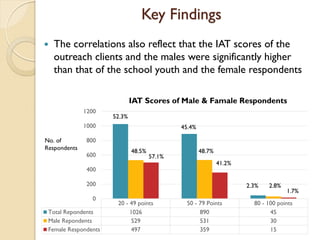
 The correlations also reflect that the IAT scores of the
outreach clients and the males were significantly higher
than that of the school youth and the female respondents
20 - 49 points 50 - 79 Points 80 - 100 points
Total Repondents 1026 890 45
Male Repondents 529 531 30
Female Respondents 497 359 15
0
200
400
600
800
1000
1200
IAT Scores of Male & Famale Respondents
No. of
Respondents
52.3%
45.4%
2.3%
48.5%
57.1%
48.7%
41.2%
2.8%
1.7%
Key Findings
6 - 12 No Significant
Influence
13 - 18 Moderate
Influence
19 - 30 Signficant
Influence
All Respondents 1301 528 193
School Youth 1192 504 174
Outreach Clients 109 78 19
62.7%
28%
9.3%
63.7%
27%
9.3%52.9% 37.9% 9.2%
0
200
400
600
800
1000
1200
1400
Impairment in Family Relationship
No. of
Respondents
6 - 12 No Significant
Influence
13 - 18 Moderate
Influence
19 - 30 Signficant
Influence
All Respondents 1347 552 164
School Youth 1228 484 143
Outreach Clients 119 68 21
65.3%
26.8%
7.9%
66.28%
26.1%
7.7%57.2% 32.7% 10.1%
0
200
400
600
800
1000
1200
1400
1600
Impairment in Relationship with Friends
No. of
Respondents
Key Findings
6 - 12 No Significant
Influence
13 - 18 Moderate
Influence
19 - 30 Signficant
Influence
All Respondents 1280 575 216
School Youth 1133 535 199
Outreach Clients 147 40 17
61.8%
27.8%
10.4%
60.7%
28.7%
10.7%%72.1%
19.6% 8.3%
0
200
400
600
800
1000
1200
1400
Impairment in Physical Health
No. of
Respondents
6 - 12 No Significant
Influence
13 - 18 Moderate
Influence
19 - 30 Signficant
Influence
All Respondents 1032 778 249
School Youth 944 684 226
Outreach Clients 88 94 23
50.1%
37.8%
12.1%
50.9%
36.9%
12.2%
42.9% 45.9% 11.2%
0
200
400
600
800
1000
1200
Impairment in School/Work Performance
No. of
Respondents
 From the tables before, around 10% of the respondents
revealed that online activities had significant influences to
their family relationships, relationships with friends, their
physical health, and their performance in school/work.
 Around 30% found that online activities had moderate
influence to their relationships with family, (28%) friends
(26.8%), and to their physical health (27.8%), while
moderate influence to their school/work performance
was 37.8%.
 It seems to reflect that the respondents perceived
greater influences to their performance in school/work
than other relationships.
Key Findings
 Moreover, apart from having higher IAT scores than those
school youth, outreach clients perceived significantly
higher influence to their relationships with family and
friends than those of the school youth.
 However, special attention should be drawn to their
responses to the influence of their physical health.
 72.1% of outreach clients indicated that online activities
did not have significant influence to their physical health,
which was more than 10% higher than the school youth.
 This may reflect that outreach clients may have lower
awareness to the influence of online activities on their
physical health.
Key Findings
Key Findings
Average Daily
Online Hours
Monthly Expenses
on Internet
IAT Scores Influence to
Physical Health
Male > Female Male > Female Male > Female Not significant
Outreach
Clients >
SchoolYouth
Outreach Clients
> SchoolYouth
Outreach
Clients >
SchoolYouth
Outreach Clients
< SchoolYouth
Most Common Online Activities –
Male Respondents
Most Common Online Activities –
Female Respondents
Relatively individual-oriented
 Online games
 Online gambling
 Online comic books
 Browsing sex related materials
Relatively social and interactive
 Online shopping
 Uploading photos
 Communication through instant
messages
 Social networking sites
Discussions
 Internet use has become very common & indispensable
not only among young people, but also among adults.
 Prohibition or controlled use can no longer be possible,
particularly when online activities become even more
smart in nature (more mobile & moveable).
 In Hong Kong, schools and families still think of possible
means to stop & control young people browsing
different “unhealthy” materials online.
 Education & open discussion on the influences or
possible risks of sex related materials, cyberbullying or
online communication to young people have seldom
been included in school curriculum or extra-curricular
activities.
Discussions
 In recent years, in Hong Kong, we found different
cheating behaviours occurred over the internet (from
the virtual community), but carried real damages to
people’s actual daily living.
 For instances, some ladies lose money through online
shopping, are cheated through compensated dating over
the internet or cheated through dating websites etc.
 For some gentlemen, they are tempted to have online
chatting but without wearing clothes.They are then
threatened to pay for the videos of the chatting
scenarios where they haven’t wore clothes.
 Online activities become indispensable in this smart
generation or even we cannot live without internet.
Online activities may not necessarily be dangerous.
Recommendations
 When we can’t live without internet, we do need to live
with it wisely. Knowledge and awareness are always
better than avoidance and ignorance.
 Acceptance, education and open discussion on the wise
use of internet may be possible ways out to raise the
consciousness of our young people on how to use
internet healthily and safely.
 Moreover, based on the length and different natures of
the males’ & females’ online activities, the focuses of
education can then be different and tailor-made in
accordance with their patterns of activities.
 Males – online sex education
 Females – about online shopping or dating activities
~~ ThankYou ~~

Gender differences of internet use among young people in Hong Kong: Implications for social work practice

  • 1.
    JointWorld Conference onSocialWork, Education & Social Development: PromotingThe Dignity andWorth of People 27 – 30 June 2016, Seoul, Korea Cherry Hau-linTAM, Ph.D. Assistant Professor Department of Applied Social Sciences City University of Hong Kong and Wai Cheuk CHOI Outreach SocialWorker, Hong Kong Children andYouth Services and Eugene CHAU Supervisor, Hong Kong Children andYouth Services Gender Differences of Internet Use AmongYoung People in Hong Kong: Implications for Social Work Practice
  • 2.
    Research Objectives &Design Research Objectives:  To reveal internet use of young people in Hong Kong.  Internet use includes both smart-technologies and computers at home or at internet bar Research Design:  Commissioned by the Fight Crime Committee of Tai Po District in Hong Kong and collaborated with Outreach SocialWork Teams in the District.  This is a self-administered questionnaire survey conducted randomly among 20 secondary schools and 2 Outreach SocialWork Teams in the District between December 2014 to June 2015.
  • 3.
    Characteristics of theRespondents  Totally, 2,142 questionnaires were collected from 20 schools and 2 Outreach SocialWork Team  2,102 were valid questionnaires. 208 were outreach clients and 1894 were secondary school students. Male Female All respondents 1149 916 School Youth 1032 835 Outreach Clients 117 81 0 200 400 600 800 1000 1200 1400 Sex of the Respondents No. of Respondents 55.6% 55.3% 59.1% 44.4% 44.7% 40.9% Male 1,149 56% Female 916 44%
  • 4.
    Characteristics of theRespondents Under 11 12 to 14 15 to 17 18 to 20 21 to 24 All Respondents 25 694 1065 297 0 School Youth 25 675 945 230 0 Outreach Clients 0 19 120 42 25 1.2% 33.3% 51.2% 14.3% 0% 1.3% 36% 50.4% 12.3% 0%0% 9.2% 58.3% 20.4% 12.1% 0 200 400 600 800 1000 1200 Age of the Repondents No. of Respondents  86.4% school youth are under 17 (age of majority in Hong Kong is 18), among outreach clients is 67.5%  32.5% outreach clients are 18 to 24.
  • 5.
    Characteristics of theRespondents Grade 7 Grade 8 Grade 9 Grade 10 Grade 11 Grade 12 All Respondents 303 285 329 489 325 345 School Youth 300 270 288 450 274 290 Outreach Clients 3 15 41 39 51 55 14.6% 13.7% 15.8% 23.6% 15.7% 16.6% 16% 14.4% 15.4% 24% 14.6% 15.5% 1.5% 7.4% 20.1% 19.1% 25% 27% 0 100 200 300 400 500 600 Education Level of the Respondents No. of Respondents
  • 6.
    Characteristics of theRespondents Studying in Schools Working Unemployed Other Study Status of the Outreach Clients 171 24 7 1 0 20 40 60 80 100 120 140 160 180 Status of the Outreach Clients 84.3% 11.8% 3.4% 0.5% No. of Respondents  Most of the outreach clients are still studying in schools.
  • 7.
    Key Findings  92.8%of the respondents had internet connection at home.  84.7% had smart phones, while percentage among outreach clients was even higher at 97.1%.  Internet & smart phone uses are very common among young people in Hong Kong regardless of their SES. Desktop / Notebook ipad / tablet Internet at Home Smart Phone All Respondents 1618 976 1914 1751 School Youth 1455 822 1722 1550 Outreach Clients 163 94 192 201 78% 47.7% 92.8% 84.7% 78% 48% 92.9% 83.3% 78.4% 45.4% 92.3% 97.1% 0 500 1000 1500 2000 2500 Online Facilities / EquipmentsYoung People Have No. of Respondents
  • 8.
     When smarttechnologies are so common & convenient nowadays, smart phone (73.6% of all respondents) was also the most frequent means that young people used to log onto internet.  When internet connection becomes more mobile and moveable, only 5.1% went to internet bar for connection. Key Findings Smart Phone Internet Bar ipad Desktop / Notebook Others All Respondents 1543 106 225 812 46 73.6% 5.1% 10.7% 38.7% 2.2% 0 200 400 600 800 1000 1200 1400 1600 1800 Most Frequently Used Facilities Logging Onto Internet No. of Respondents
  • 9.
     As awhole, 58.9% of the respondents connected online 3 or less than 3 hours daily and 29.4% for 4 to 6 hours. Only 11.7% connected more than 7 hours a day.  This reflects that many young people could control their time spent online in a normal & acceptable manner. Key Findings 0 hours 1 - 3 hours 4 - 6 hours 7 - 12 hours 13 - 23 hours 24 hours All Respondents 57 1153 604 195 19 26 School Youth 54 1075 516 161 18 25 Outreach Clients 3 78 88 34 1 1 2.8% 56.1% 29.4% 9.5% 0.9% 1.3% 2.9% 58.1% 27.9% 8.7% 1% 1.4%1.5% 38% 42.9% 16.6% 0.5% 0.5% 0 200 400 600 800 1000 1200 1400 Average Daily Online Hours No. of Respondents
  • 10.
    Key Findings  93.9%of the respondents indicated that their monthly expenses online were less that USD25. 4.3% spent USD25 to USD65 and only 1.7% spent more than USD65.  As a whole, their expenses online were at a modest level. 0 Dollar 1 - 50 Dollars 51 - 100 Dollars 101 - 200 Dollars 201 - 500 Dollars 501 - 1000 Dollars 1001 or above All Respondents 1243 165 206 190 83 16 18 School Youth 1185 151 189 101 68 14 15 Outreach Clients 58 14 17 89 15 2 3 64.7% 8.6% 10.7% 9.9% 4.3% 0.8% 0.9% 68.8% 8.8% 11% 5.9% 3.9% 0.8% 0.9%29.3% 7.1% 8.6% 44.9% 7.6% 1.5% 1.5% 0 200 400 600 800 1000 1200 1400 Monthly Expenses on Internet No. of Respondents
  • 11.
    Key Findings Average DailyOnline Hours & Monthly Expenses Online  From the tables, as a whole, young people’s average daily online hours were found to be normal & acceptable. Only 11.7% of the respondents connected more than 7 hours a day.  Their monthly online expenses were also found to be modest with 93.9% spent less than USD25 per month.  Apart from the findings above, through the correlation analyses, daily online and monthly online expenses among outreach clients and the male respondents were found to be significantly longer and higher than school youth and the female respondents.
  • 12.
    Key Findings  MostCommon Online Activities of theYoung People Online Games Online Gambling Movie / Comic Books Sex Websites Online Shopping Discussion Blogs Personal Blog Online News Academic Entertain ment Instant Messaging Online Phones Email / Download Files Upload Photos / Movies All Respondents 1373 116 1410 215 554 680 1586 815 719 785 947 306 639 1006 School Youth 1226 90 1302 189 477 587 1404 753 660 716 804 273 604 914 Outreach Clients 147 26 108 26 77 93 182 62 59 69 143 33 35 92 65.5% 5.5% 67.2% 10.2% 26.4% 32.4% 75.6% 38.8% 34.3% 37.4% 45.1% 14.6% 30.5% 48% 64.9% 4.8% 68.9% 10% 25.2% 31% 74.2% 39.8% 34.9% 37.9% 42.5% 14.4% 32% 48.3% 71% 12.6 52.2% 12.6% 37.2% 44.9% 87.9% 30% 28.5% 33.3% 69.1% 15.9% 16.9% 44.4% 0 200 400 600 800 1000 1200 1400 1600 1800 Most Common Online ActivitiesNo. of Respondents
  • 13.
    Key Findings Gender Differencein Online Activities of the Respondents  The most usual online activities of the males were: ◦ Those relatively individual-oriented ◦ Online games, ◦ online gambling, ◦ Online comic books, and ◦ browsing sex related materials.  The most usual online activities of the females were: ◦ Those relatively social and interactive oriented ◦ Online shopping, ◦ uploading photos, ◦ communication through instant messages, and ◦ social networking sites.
  • 14.
    Key Findings 20 -49 points Average User 50 - 79 points Occasional Problem User 80 - 100 points Problem User All Respondents 1033 909 46 School Youth 961 784 41 Outreach Clients 72 125 5 52% 45.7% 2.3% 53.8% 43.9% 2.3%35.6% 61.9% 2.5% 0 200 400 600 800 1000 1200 Internet AddictionTest (IAT Score) No. of Respondents  As a whole, half of the respondents (52%) were average users, 45.7% were occasional problem users, and only 2.3% were found to be problem users.  It seems to reflect that their degree of internet addiction is not obvious in this study.  It is worth to note that more outreach clients (61.9%) were found to be occasional problem users.
  • 15.
    Key Findings  Thecorrelations also reflect that the IAT scores of the outreach clients and the males were significantly higher than that of the school youth and the female respondents 20 - 49 points 50 - 79 Points 80 - 100 points Total Repondents 1026 890 45 Male Repondents 529 531 30 Female Respondents 497 359 15 0 200 400 600 800 1000 1200 IAT Scores of Male & Famale Respondents No. of Respondents 52.3% 45.4% 2.3% 48.5% 57.1% 48.7% 41.2% 2.8% 1.7%
  • 16.
    Key Findings 6 -12 No Significant Influence 13 - 18 Moderate Influence 19 - 30 Signficant Influence All Respondents 1301 528 193 School Youth 1192 504 174 Outreach Clients 109 78 19 62.7% 28% 9.3% 63.7% 27% 9.3%52.9% 37.9% 9.2% 0 200 400 600 800 1000 1200 1400 Impairment in Family Relationship No. of Respondents 6 - 12 No Significant Influence 13 - 18 Moderate Influence 19 - 30 Signficant Influence All Respondents 1347 552 164 School Youth 1228 484 143 Outreach Clients 119 68 21 65.3% 26.8% 7.9% 66.28% 26.1% 7.7%57.2% 32.7% 10.1% 0 200 400 600 800 1000 1200 1400 1600 Impairment in Relationship with Friends No. of Respondents
  • 17.
    Key Findings 6 -12 No Significant Influence 13 - 18 Moderate Influence 19 - 30 Signficant Influence All Respondents 1280 575 216 School Youth 1133 535 199 Outreach Clients 147 40 17 61.8% 27.8% 10.4% 60.7% 28.7% 10.7%%72.1% 19.6% 8.3% 0 200 400 600 800 1000 1200 1400 Impairment in Physical Health No. of Respondents 6 - 12 No Significant Influence 13 - 18 Moderate Influence 19 - 30 Signficant Influence All Respondents 1032 778 249 School Youth 944 684 226 Outreach Clients 88 94 23 50.1% 37.8% 12.1% 50.9% 36.9% 12.2% 42.9% 45.9% 11.2% 0 200 400 600 800 1000 1200 Impairment in School/Work Performance No. of Respondents
  • 18.
     From thetables before, around 10% of the respondents revealed that online activities had significant influences to their family relationships, relationships with friends, their physical health, and their performance in school/work.  Around 30% found that online activities had moderate influence to their relationships with family, (28%) friends (26.8%), and to their physical health (27.8%), while moderate influence to their school/work performance was 37.8%.  It seems to reflect that the respondents perceived greater influences to their performance in school/work than other relationships. Key Findings
  • 19.
     Moreover, apartfrom having higher IAT scores than those school youth, outreach clients perceived significantly higher influence to their relationships with family and friends than those of the school youth.  However, special attention should be drawn to their responses to the influence of their physical health.  72.1% of outreach clients indicated that online activities did not have significant influence to their physical health, which was more than 10% higher than the school youth.  This may reflect that outreach clients may have lower awareness to the influence of online activities on their physical health. Key Findings
  • 20.
    Key Findings Average Daily OnlineHours Monthly Expenses on Internet IAT Scores Influence to Physical Health Male > Female Male > Female Male > Female Not significant Outreach Clients > SchoolYouth Outreach Clients > SchoolYouth Outreach Clients > SchoolYouth Outreach Clients < SchoolYouth Most Common Online Activities – Male Respondents Most Common Online Activities – Female Respondents Relatively individual-oriented  Online games  Online gambling  Online comic books  Browsing sex related materials Relatively social and interactive  Online shopping  Uploading photos  Communication through instant messages  Social networking sites
  • 21.
    Discussions  Internet usehas become very common & indispensable not only among young people, but also among adults.  Prohibition or controlled use can no longer be possible, particularly when online activities become even more smart in nature (more mobile & moveable).  In Hong Kong, schools and families still think of possible means to stop & control young people browsing different “unhealthy” materials online.  Education & open discussion on the influences or possible risks of sex related materials, cyberbullying or online communication to young people have seldom been included in school curriculum or extra-curricular activities.
  • 23.
    Discussions  In recentyears, in Hong Kong, we found different cheating behaviours occurred over the internet (from the virtual community), but carried real damages to people’s actual daily living.  For instances, some ladies lose money through online shopping, are cheated through compensated dating over the internet or cheated through dating websites etc.  For some gentlemen, they are tempted to have online chatting but without wearing clothes.They are then threatened to pay for the videos of the chatting scenarios where they haven’t wore clothes.  Online activities become indispensable in this smart generation or even we cannot live without internet. Online activities may not necessarily be dangerous.
  • 24.
    Recommendations  When wecan’t live without internet, we do need to live with it wisely. Knowledge and awareness are always better than avoidance and ignorance.  Acceptance, education and open discussion on the wise use of internet may be possible ways out to raise the consciousness of our young people on how to use internet healthily and safely.  Moreover, based on the length and different natures of the males’ & females’ online activities, the focuses of education can then be different and tailor-made in accordance with their patterns of activities.  Males – online sex education  Females – about online shopping or dating activities
  • 25.