Running head: GENDER ASSIGNMENT AND PLAY BEHAVIOR 1
Effects of Interviewer’s Gender on Children’s Assignment of Gender to Games
Tonjaletha Howard
(Faculty Sponsor: Dr. Kim Ernst)
Loyola University New Orleans
GENDER ASSIGNMENT AND PLAY BEHAVIOR 2
Abstract
Children learn to assign gender to people, objects, and activities at an early age. Past research
supports the idea that children and adolescents are capable of identifying gender roles in
everyday life, however, less is known about this ability in younger children. Additionally, past
research has overlooked the manner in which young children learn to assign gender to
gender-neutral games. Thus, the present study investigated the influence an interviewer’s gender
has on children’s assignment of gender to toys, games, and activities. Eleven children, aged 3 to
5, were assigned to one of two groups, wherein each child established his/her ability to identify
current gender stereotypes attached to certain toys and games. Each child was then introduced to
gender-neutral and ambiguous games, verbally described by either a male or female interviewer
and asked whether it is a game for girls, for boys, or for both. Children were also asked to select
one undergraduate from an array of pictures with whom they would like to play. One hypothesis
was that children will identify gender-neutral games as belonging to the gender of the researcher.
It was also hypothesized that children will choose a member of their same gender with whom to
play the game.
Keywords: children, gender, play behavior
GENDER ASSIGNMENT AND PLAY BEHAVIOR 3
Effects of Interviewer’s Gender on Children’s Assignment of Gender to Games
Over the past century, psychologists have studied children’s ability to identify and assign
gender. Past researchers have focused on how and when this acquisition is attained. Many studies
have concentrated on gender differences in adults and children and on how these differences are
exemplified in daily life. These studies, however, have neglected to examine the role that adults
other than parents influence children’s assignment of gender to items and activities, including
toys and games.
Cherney and Dempsey (2010) investigated of the role of neutral and ambiguous toys in
children’s play behavior and understanding of gender. Participants were 31 three- to
five-year-old (19 males, 12 females) Caucasian children from two Midwestern US daycare
centers. Eleven age-appropriate toys were selected and gender classified by adults on a
Likert-type scale with anchors ranging from 1 (very masculine) through 4 (neutral) to 7 (very
feminine). Adults classified one toy as masculine, four as neutral, five as ambiguous, and one as
feminine. The toys were strategically arranged on a blanket in a room separate from other
children at the daycare center. Each participant was allowed to engage in free play and was
videotaped by a trained researcher, who did not engage in play with the child. After free play,
each child was asked to categorize each toy as either a “girl toy” or a “boy toy.” Results showed
that boys tended to avoid other-gendered stereotyped toys and were more likely than girls to
categorize ambiguous and neutral toys as masculine. One limitation to the study was a small
sample size with an unequal number of boys and girls in each age group. Another was the
selection and rating of toys by adults who have strong senses of gender stereotypes present in
society. Researchers suggest that future research validate the scales and investigate alternate
scales that may produce similar results with more highly gender-stereotyped toys.
GENDER ASSIGNMENT AND PLAY BEHAVIOR 4
In an evaluation of children’s awareness of sex differences, Conn (1951) asked 193
children (124 males, 69 females) to name and re-enact their favorite games and activities. Results
showed that dolls and doll furniture were the most popular among girls, while airplanes, autos,
and tools were the most popular among boys. Half of the children were then asked to discuss
their beliefs about the opposite sex. Thirty children (23 males, 7 females) agreed that “girls do
not play as strenuously or work as hard as boys.” Several children also agreed with the statement
“girls are timid, fearful and afraid of being hurt,” and others used words like “sissy,” “tomboy,”
and “boy-girl” to describe members of the opposite sex. Conn concluded that at an early age
children learn which games are reserved for each gender and display this knowledge during play.
He determined that many of these attitudes are the result of parental influence as well as parents’
encouragement of socially normative behavior.
Rakoczy, Hamann, Warneken, and Tomasello (2010) investigated how preschoolers learn
the rules of games from adults and peers. Participants were twenty-four 3-year-old (10 males, 14
females) and twenty-four 4-year-old (13 males, 11 females) native German children. Each child
was interviewed separately by two researchers in a quiet room on each daycare center’s
premises. Each child played with one experimenter until he or she “warmed-up” and felt more
comfortable; thereafter, each child was introduced to the second experimenter, who used a hand
puppet named “Max” to demonstrate games to the child. Each child was then presented with a
laptop that showed a video of two actors (one adult male and one 4-year-old boy). A short film
was shown wherein the actors introduced themselves and demonstrated various novel items and
games, and sometimes the child model gave the items incorrect names or performed tasks
inappropriately and was corrected by the adult. Children’s play behaviors were coded as either
“like adult model,” “partly like adult model,” like child model,” “partly like child model,” and
GENDER ASSIGNMENT AND PLAY BEHAVIOR 5
“other.” Results showed that more children were likely to follow the adult model than their peer.
Also, when playing with others, children corrected their peers’ behaviors to reflect that of the
adult model. Rakozcy et al. found their results to be consistent with past research that suggests
that children are more inclined to be willing to learn from adults rather than their peers.
Raag (1999) investigated the influences of social expectations of gender, gender
stereotypes, and structural constraints on children’s toy choices. Participants were 107 (57 males,
50 females) 4- to 5-year-old children. Children were assigned to one of three groups: “No Prep”
(control group), “Gender-typed Clothes,” or “Gender-typed Toys” (dish set and tool set). Each
child was evaluated in a lab play room individually and without parental presence. Children were
introduced to toys and some were told gender stereotypes about the toys. Each child was then
videotaped for three minutes playing alone with the toys of their liking. Thereafter, parents and
children were interviewed separately. Results showed that when children were given explicit
gender-typed information about toys, there was a greater difference in play behavior. Also,
although many children seemed to agree that cross-gendered play was “bad,” many of the male
participants played with the toy dish set despite its stereotype as being feminine. Results also
showed that boys are more likely to reject cross-gendered typed play to avoid negative social
consequences. Raag suggested that future researchers focus on the interactive effects of the
situational and cognitive factors, including perception of appropriate behavior, the presence of
adolescent influence, and the effects of physical appearance, on children’s toy choices.
Raag and Rackliff (1998) used preschoolers’ toy choices to assess their awareness of
social expectations of gender. Participants were 61 (28 females, 33 males) preschool children
between 4 and 5 years old (M = 4.67 years). Of the 61 participants, 60 were categorized as
White. Each child was tested in a room separate from parents and shown how a toy dish set and
GENDER ASSIGNMENT AND PLAY BEHAVIOR 6
a toy tool set worked, and some children were told gender stereotypes about the toy sets.
Children and parents were also asked whether gender-typed play was “bad,” good,” or “doesn’t
matter.” Most answers by parents and children alike reflected the belief that gender-typed play
was either neutral or positive, but viewed as negative. However, it was found that boys who
believed their fathers viewed cross-gendered play as “bad” were less likely to play with the dish
set, showing that fathers greatly influence their sons’ gender-typed play behaviors. Results also
showed that boys are more likely to base their toys choices on learned social expectations than
on their actual toy preference. Raag and Rackliff urge further research to explore the possible
reasons that fathers’ expectations so heavily on their sons’ gender-typed play and how this works
to make boys avoid toys that are perceived as for girls only.
In an assessment of preschoolers’ perceptions of gender appropriate toys, Freeman (2007)
evaluated children and their parents’ beliefs about gendered play behavior. Participants were 26
(14 females, 12 males) 3- and 5-year-old children. Children were interviewed following the
interview style of Raag and Rackliff (1998). Children were then given toys and asked to make
one pile for “girl toys” and one pile for “boy toys.” All children were interviewed again (one
week to one month later) and asked again to make separate piles for girl toys and boy toys.
Parents were given Burge’s (1981) Child-Rearing Sex-Role Attitude Scale to evaluate their
beliefs and attitudes about gender-typed toys, activities, and behaviors. Results showed that 98%
of 5-year-olds separated the toys in a gender-stereotypical way, while only 92% of 3-year-olds
used the same categorization method, showing that gender-typing becomes refined with age.
Also, most children believed that their parents would view cross-gendered play negatively.
Although parents’ results on the Sex-Role Attitude Scale (Burge, 1981) showed that they would
support their child’s cross-gendered behavior, parents expressed being more accepting of having
GENDER ASSIGNMENT AND PLAY BEHAVIOR 7
girls engage in cross-gendered play. Freeman suggests that parents and professionals be clear in
their gendered behaviors and avoid miscommunications so that children are able to make specific
distinctions between gender roles.
Reis and Wright (1982) assessed 3- to 5-year old children’s knowledge of sex-role
stereotypes. Participants were 86 children assigned to groups by age: under 3.5 years, 3.5-4.0
years, 4.0-4.5 years, and over 4.5 years. Each child was tested individually by trained
undergraduate students. Each child was evaluated via The Peabody Picture Vocabulary Test
(Dunn & Dunn, 1959) as well as a modified The Sex Stereotype Measure (Williams et al., 1975),
and each child’s verbal response was recorded. Results supported the hypothesis that knowledge
of adult sex-role stereotypes increase with age.
Taken together, past studies have examined the emergence of children’s gender identity
as it becomes more apparent with age. Researchers have evaluated the role parental influence has
on gender-typed speech and play-behavior. Past research has failed, however, to access how
non-parental adults influence gender-typed play. Thus, the present study investigated the role
that an interviewer’s gender plays in children’s assignment of gender to games. One hypothesis
is that children will assign the gender of the interviewer to unknown gender-neutral and
ambiguous games. It is also hypothesized that children will choose a member of their same
gender to play the game with as children identify themselves as a member of a certain gender
and model behavior of older members of that gender. It is important to understand when and how
children learn to assign gender, so that parents, caregivers, and teachers learn the most effective
methods of teaching children about gender differences and sexual identity.
Method
Participants
GENDER ASSIGNMENT AND PLAY BEHAVIOR 8
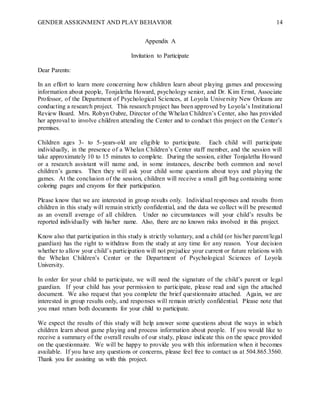
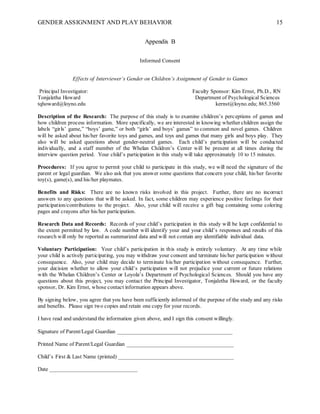
Program Director Robyn Oubre distributed 35 letters of invitation (See Appendix A)
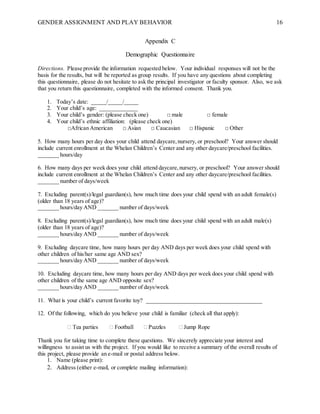
along with informed consent (See Appendix B) and demographic questionnaire (See Appendix
C) packets to parents/legal guardians to recruit children for participation. Of the 17 returned
packets for approve participation, five children did not assent and one child withdrew assent
during the structured interview (Appendix E), leaving the sample at 11 (N = 11). Participants
were four female and seven male 3- to 5-year old (M = 3.86, SD = 0.71) children from the
Whelan Children’s Center. Ninety percent of children were classified as White. Each child
enrolled to participate received a gift bag containing pages from a coloring book and crayons.
Design
The two-group experimental design was employed. The independent variables (IVs) are
the gender of the interviewer as well as the amount of time the child spends with both older and
younger members of the opposite sex as reported by parents/legal guardians in a demographic
questionnaire (See Appendix C). The dependent variables (DVs) are the gender each child
assigned to the gender-neutral games and activities as well as the gender of the undergraduate
with whom to play that each child selected from an array of pictures (See Appendix F).
Materials
A PI-designed 12-item demographic questionnaire (See Appendix C) was distributed to
parents/legal guardians. This questionnaire assessed information including the child’s age, the
amount of time the child spends at Whelan’s Center, the amount of time the child spends with
same-aged children of the same and opposite gender, as well as the amount of time the child
spends with adults of the same and opposite gender.
A22-item structured interview (See Appendix E), following the interview style of Ragg
and Rackliff (1998), was administered to each child by the PI or RA. The items concern
GENDER ASSIGNMENT AND PLAY BEHAVIOR 9
questions about children’s toys and games, and whether the toys/games are for girls, boys, or
both girls and boys.
An array of 2-in x 3-in color pictures (See Appendix F) of four female and four male
Loyola undergraduates of diverse ethnicities was shown to each child. Each picture was cropped
to show only the students’ body from the shoulders up.
Procedure
After consent documents and demographic questionnaires were collected, each child was
assigned to one of two groups: female interviewer (PI) or male interviewer (RA). The Principal
Investigator (PI) or Research Assistant (RA) were introduced to children individually by the
program director or a Whelan’s Center staff member. Verbal child assent to participate (See
Appendix D) was obtained. The PI/RA then administered the structured interview (See Appendix
E). Thereafter, each child was asked in which category he/she would place the unknown,
gender-neutral games as well as other known gender-neutral and ambiguous toys, games, and
activities. Each child was then shown the array of pictures (See Appendix G) and asked to select
an undergraduate with whom he/she would like to play and why. To conclude each structured
interview, the PI/RA told the child that he/she did a really good job, and then thanked the child
for his/her help. Children were then rewarded for their time and dismissed to a Whelan’s Center
staff member. Each interview lasted 5 to 10 mins.
Results
Because there was such a small sample size (N = 11), only descriptive statistical analyses
were performed, and findings are reported in frequencies and percentages. Results from the
parent/guardian-completed demographic questionnaire show that each child spent between 7 and
9 hrs (M = 8.14, SD = 0.81 ) five days a week at the Whelan Center, which has majority female
GENDER ASSIGNMENT AND PLAY BEHAVIOR 10
employees (only two male work-study students work for the Center). Outside of daycare,
children spend more time with adult females (M = 9.05 hrs, 4.45 days a week) than with adult
males (M = 3.86 hrs, 1.27 days a week). When not in daycare, children also spend more time
with same-sex peers (M = 2.55 hrs, 1.81 days a week) than with opposite-sex peers (M = 1.59
hrs, 1.45 days a week).
Though there was differences in the amounts of time children spent with members of the
same and opposite sex, children’s responses during interviews reflected many of the same beliefs
about gender-typed play. When asked to place the known gender-neutral games in activities into
gender categories, 90% of the children said puzzles are for both girls and boys, 78% said that tea
parties are for both girls and boys, and 80% said that jump rope is for both girls and boys.
However, 80% said that football was only for boys.
When placing the unknown gender-neutral games into gender categories, 78% considered
“Splooge” as for both girls and boys, while the other 22% attributed the game as belonging to the
interviewer’s gender. Likewise, 78% thought “Jimbleweeves” was for both girls and boys;
however, the other 22% attributed the game to being for the interviewer’s opposite sex. The
game “Wugs” was thought by 56% to be for both genders, and the other 44% percent attributed
the game as belonging to the interviewer’s gender. When asked with whom they would like to
play, 100% of female participants chose a female undergraduate. Fifty-seven percent of male
participants chose male undergraduates, 14% chose a female, and the remaining 29% did not
respond.
Discussion
Although results were not statistically significant, trends in the data supported the
hypothesis that children would select a member of their own gender with whom to play.
GENDER ASSIGNMENT AND PLAY BEHAVIOR 11
However, the hypothesis that children would assign the gender of the interviewer to unknown
gender-neutral and ambiguous games and activities was not supported. Also, while children
spent more time with adult females even when not in daycare, results still showed that children
were able to identify and express knowledge of male-gendered association with some activities.
Yet most toys, games, and activities were attributed as being for both males and females,
showing an inconsistency with past research. Another inconsistency with past research is the idea
that parents have the most influence on children’s gender-typed play behavior as it was shown
that children’s time in daycare and play with peers more heavily influenced their play behavior.
Because the Whelan Center employees encourage all children to play together, many of the
children’s play experiences are with members of both genders, which may cause the children to
believe that most games, toys, and activities are for both genders. One deviation from this trend
was the belief that football is for “boys only” was reported by almost all children interviewed.
This may be because only males play professional football, which is televised.
Some limitations to the present study include the small sample size, which rendered none
of the data applicable to all children. Future research should also utilize a larger, more diverse
sample to ensure results will be statistically significant and generalizable. Another limitation was
that both the PI and RA were African-American, omitting the influence that race and ethnicity of
the interviewer has on children’s decisions. Future research should include interviewers from
diverse ethnic backgrounds. Also, further research is needed to draw conclusions regarding the
influences children’s assignment of gender to unknown gender-neutral and ambiguous games.
GENDER ASSIGNMENT AND PLAY BEHAVIOR 12
References
Burge, P. L. (1981). Parental child-rearing sex-role attitudes related to social issue sex-role
attitudes and selected demographic variables. Home Economics Research Journal, 9(3),
193-199. doi: 10.1177/1077727X8100900302
Cherney, I. D., & Dempsey, J. (2010). Young children’s classification, stereotyping and play
behavior for gender neutral and ambiguous toys. Educational Psychology, 30(6),
651-669. doi: 10.1080/01443410.2010.498419
Conn, J. H. (1951). Children’s awareness of sex differences. Journal of Child Psychiatry, 2,
82-99. Retrieved from http://www.ncbi.nlm.nih.gov/pubmed/20252619
Dunn, L. M., & Dunn, L. M. (1959). Peabody Picture Vocabulary Test, First Edition. Cited in
Reis & Wright, 1982.
Freeman, N. K. (2007). Preschoolers’ perceptions of gender appropriate toys and their parents’
beliefs about genderized behaviors: Miscommunications, mixed messages, or hidden
truths? Early Childhood Education Journal, 34(5), 357-366.
doi: 10.1007/s10643-006-0123-x
Rakoczy, H., Hamann, K., Warneken, F., & Tomasello, M. (2010). Bigger knows best: Young
children selectively learn rule games from adults rather than from peers. British Journal
of Developmental Psychology, 28, 785-798. doi:10.1348/026151009X479178
Raag, T. (1999). Influences of social expectations of gender, gender stereotypes, and situational
constraints on children’s toy choices. Sex Roles, 41(11/12), 809-831.
doi: 10.1023/A:1018828328713
GENDER ASSIGNMENT AND PLAY BEHAVIOR 13
Raag, T., & Rackliff, C. L. (1998). Preschoolers’ awareness of social expectations of gender:
Relationship to toy choices. Sex Roles, 38(9/10), 685-700.
doi: 10.1023/A:1018890728636
Reis, H. T., & Wright, S. (1982). Knowledge of sex-role stereotypes in children aged 3 to 5.
Sex Roles, 8(10), 1049-1056. doi: 10.1007/BF00290999
Williams, J. E., Bennett, S. M., & Best, D. L. (1975). The Sex Stereotype Measure. Cited in Reis
& Wright, 1982.
GENDER ASSIGNMENT AND PLAY BEHAVIOR 14
Appendix A
Invitation to Participate
Dear Parents:
In an effort to learn more concerning how children learn about playing games and processing
information about people, Tonjaletha Howard, psychology senior, and Dr. Kim Ernst, Associate
Professor, of the Department of Psychological Sciences, at Loyola University New Orleans are
conducting a research project. This research project has been approved by Loyola’s Institutional
Review Board. Mrs. Robyn Oubre, Director of the Whelan Children’s Center, also has provided
her approval to involve children attending the Center and to conduct this project on the Center’s
premises.
Children ages 3- to 5-years-old are eligible to participate. Each child will participate
individually, in the presence of a Whelan Children’s Center staff member, and the session will
take approximately 10 to 15 minutes to complete. During the session, either Tonjaletha Howard
or a research assistant will name and, in some instances, describe both common and novel
children’s games. Then they will ask your child some questions about toys and playing the
games. At the conclusion of the session, children will receive a small gift bag containing some
coloring pages and crayons for their participation.
Please know that we are interested in group results only. Individual responses and results from
children in this study will remain strictly confidential, and the data we collect will be presented
as an overall average of all children. Under no circumstances will your child’s results be
reported individually with his/her name. Also, there are no known risks involved in this project.
Know also that participation in this study is strictly voluntary, and a child (or his/her parent/legal
guardian) has the right to withdraw from the study at any time for any reason. Your decision
whether to allow your child’s participation will not prejudice your current or future relations with
the Whelan Children’s Center or the Department of Psychological Sciences of Loyola
University.
In order for your child to participate, we will need the signature of the child’s parent or legal
guardian. If your child has your permission to participate, please read and sign the attached
document. We also request that you complete the brief questionnaire attached. Again, we are
interested in group results only, and responses will remain strictly confidential. Please note that
you must return both documents for your child to participate.
We expect the results of this study will help answer some questions about the ways in which
children learn about game playing and process information about people. If you would like to
receive a summary of the overall results of our study, please indicate this on the space provided
on the questionnaire. We will be happy to provide you with this information when it becomes
available. If you have any questions or concerns, please feel free to contact us at 504.865.3560.
Thank you for assisting us with this project.
GENDER ASSIGNMENT AND PLAY BEHAVIOR 15
Appendix B
Informed Consent
Effects of Interviewer’s Gender on Children’s Assignment of Gender to Games
Principal Investigator: Faculty Sponsor: Kim Ernst, Ph.D., RN
Tonjaletha Howard Department of Psychological Sciences
tqhoward@loyno.edu kernst@loyno.edu; 865.3560
Description of the Research: The purpose of this study is to examine children’s perceptions of games and
how children process information. More specifically, we are interested in knowing whether children assign the
labels “girls’ game,” “boys’ game,” or both “girls’ and boys’ games” to common and novel games. Children
will be asked about his/her favorite toys and games, and toys and games that many girls and boys play. They
also will be asked questions about gender-neutral games. Each child’s participation will be conducted
individually, and a staff member of the Whelan Children’s Center will be present at all times during the
interview question period. Your child’s participation in this study will take approximately 10 to 15 minutes.
Procedures: If you agree to permit your child to participate in this study, we will need the signature of the
parent or legal guardian. We also ask that you answer some questions that concern your child, his/her favorite
toy(s), game(s), and his/her playmates.
Benefits and Risks: There are no known risks involved in this project. Further, there are no incorrect
answers to any questions that will be asked. In fact, some children may experience positive feelings for their
participation/contributions to the project. Also, your child will receive a gift bag containing some coloring
pages and crayons after his/her participation.
Research Data and Records: Records of your child’s participation in this study will be kept confidential to
the extent permitted by law. A code number will identify your and your child’s responses and results of this
research will only be reported as summarized data and will not contain any identifiable individual data.
Voluntary Participation: Your child’s participation in this study is entirely voluntary. At any time while
your child is actively participating, you may withdraw your consent and terminate his/her participation without
consequence. Also, your child may decide to terminate his/her participation without consequence. Further,
your decision whether to allow your child’s participation will not prejudice your current or future relations
with the Whelan Children’s Center or Loyola’s Department of Psychological Sciences. Should you have any
questions about this project, you may contact the Principal Investigator, Tonjaletha Howard, or the faculty
sponsor, Dr. Kim Ernst, whose contact information appears above.
By signing below, you agree that you have been sufficiently informed of the purpose of the study and any risks
and benefits. Please sign two copies and retain one copy for your records.
I have read and understand the information given above, and I sign this consent willingly.
Signature of Parent/Legal Guardian __________________________________________
Printed Name of Parent/Legal Guardian _______________________________________
Child’s First & Last Name (printed) __________________________________________
Date ________________________________
GENDER ASSIGNMENT AND PLAY BEHAVIOR 16
Appendix C
Demographic Questionnaire
Directions. Please provide the information requested below. Your individual responses will not be the
basis for the results, but will be reported as group results. If you have any questions about completing
this questionnaire, please do not hesitate to ask the principal investigator or faculty sponsor. Also, we ask
that you return this questionnaire, completed with the informed consent. Thank you.
1. Today’s date: _____/_____/_____
2. Your child’s age: _____________
3. Your child’s gender: (please check one) □ male □ female
4. Your child’s ethnic affiliation: (please check one)
□African American □ Asian □ Caucasian □ Hispanic □ Other
5. How many hours per day does your child attend daycare,nursery, or preschool? Your answer should
include current enrollment at the Whelan Children’s Center and any other daycare/preschool facilities.
_______ hours/day
6. How many days per week does your child attend daycare,nursery, or preschool? Your answer should
include current enrollment at the Whelan Children’s Center and any other daycare/preschool facilities.
_______ number of days/week
7. Excluding parent(s)/legal guardian(s), how much time does your child spend with an adult female(s)
(older than 18 years of age)?
_______ hours/day AND _______ number of days/week
8. Excluding parent(s)/legal guardian(s), how much time does your child spend with an adult male(s)
(older than 18 years of age)?
_______ hours/day AND _______ number of days/week
9. Excluding daycare time, how many hours per day AND days per week does your child spend with
other children of his/her same age AND sex?
_______ hours/day AND _______ number of days/week
10. Excluding daycare time, how many hours per day AND days per week does your child spend with
other children of the same age AND opposite sex?
_______ hours/day AND _______ number of days/week
11. What is your child’s current favorite toy? ________________________________________
12. Of the following, which do you believe your child is familiar (check all that apply):
 Tea parties  Football  Puzzles  Jump Rope
Thank you for taking time to complete these questions. We sincerely appreciate your interest and
willingness to assist us with the project. If you would like to receive a summary of the overall results of
this project, please provide an e-mail or postal address below.
1. Name (please print):
2. Address (either e-mail, or complete mailing information):
GENDER ASSIGNMENT AND PLAY BEHAVIOR 17
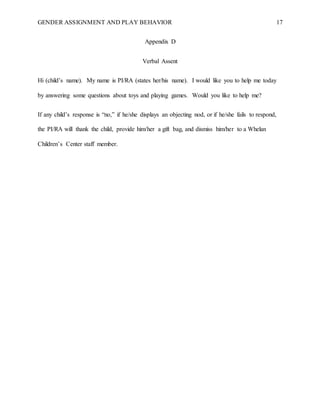
Appendix D
Verbal Assent
Hi (child’s name). My name is PI/RA (states her/his name). I would like you to help me today
by answering some questions about toys and playing games. Would you like to help me?
If any child’s response is “no,” if he/she displays an objecting nod, or if he/she fails to respond,
the PI/RA will thank the child, provide him/her a gift bag, and dismiss him/her to a Whelan
Children’s Center staff member.
GENDER ASSIGNMENT AND PLAY BEHAVIOR 18
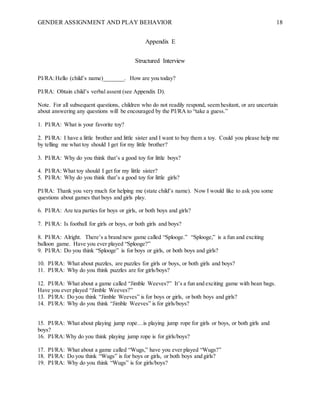
Appendix E
Structured Interview
PI/RA:Hello (child’s name)_______. How are you today?
PI/RA: Obtain child’s verbal assent (see Appendix D).
Note. For all subsequent questions, children who do not readily respond, seem hesitant, or are uncertain
about answering any questions will be encouraged by the PI/RA to “take a guess.”
1. PI/RA: What is your favorite toy?
2. PI/RA: I have a little brother and little sister and I want to buy them a toy. Could you please help me
by telling me what toy should I get for my little brother?
3. PI/RA: Why do you think that’s a good toy for little boys?
4. PI/RA: What toy should I get for my little sister?
5. PI/RA: Why do you think that’s a good toy for little girls?
PI/RA: Thank you very much for helping me (state child’s name). Now I would like to ask you some
questions about games that boys and girls play.
6. PI/RA: Are tea parties for boys or girls, or both boys and girls?
7. PI/RA: Is football for girls or boys, or both girls and boys?
8. PI/RA: Alright. There’s a brand new game called “Splooge.” “Splooge,” is a fun and exciting
balloon game. Have you ever played “Splooge?”
9. PI/RA: Do you think “Splooge” is for boys or girls, or both boys and girls?
10. PI/RA: What about puzzles, are puzzles for girls or boys, or both girls and boys?
11. PI/RA: Why do you think puzzles are for girls/boys?
12. PI/RA: What about a game called “Jimble Weeves?” It’s a fun and exciting game with bean bags.
Have you ever played “Jimble Weeves?”
13. PI/RA: Do you think “Jimble Weeves” is for boys or girls, or both boys and girls?
14. PI/RA: Why do you think “Jimble Weeves” is for girls/boys?
15. PI/RA: What about playing jump rope…is playing jump rope for girls or boys, or both girls and
boys?
16. PI/RA:Why do you think playing jump rope is for girls/boys?
17. PI/RA: What about a game called “Wugs,” have you ever played “Wugs?”
18. PI/RA: Do you think “Wugs” is for boys or girls, or both boys and girls?
19. PI/RA: Why do you think “Wugs” is for girls/boys?
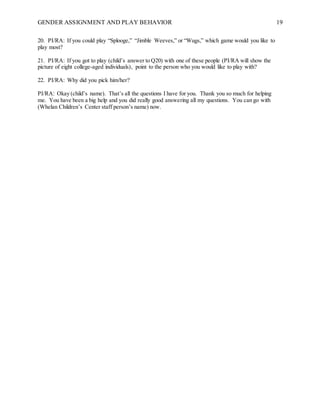
GENDER ASSIGNMENT AND PLAY BEHAVIOR 19
20. PI/RA: If you could play “Splooge,” “Jimble Weeves,” or “Wugs,” which game would you like to
play most?
21. PI/RA: If you got to play (child’s answer to Q20) with one of these people (PI/RA will show the
picture of eight college-aged individuals), point to the person who you would like to play with?
22. PI/RA: Why did you pick him/her?
PI/RA: Okay (child’s name). That’s all the questions I have for you. Thank you so much for helping
me. You have been a big help and you did really good answering all my questions. You can go with
(Whelan Children’s Center staff person’s name) now.
GENDER ASSIGNMENT AND PLAY BEHAVIOR 20
Appendix F

Final Thesis Manuscipt. December 2011

  • 1.
    Running head: GENDERASSIGNMENT AND PLAY BEHAVIOR 1 Effects of Interviewer’s Gender on Children’s Assignment of Gender to Games Tonjaletha Howard (Faculty Sponsor: Dr. Kim Ernst) Loyola University New Orleans
  • 2.
    GENDER ASSIGNMENT ANDPLAY BEHAVIOR 2 Abstract Children learn to assign gender to people, objects, and activities at an early age. Past research supports the idea that children and adolescents are capable of identifying gender roles in everyday life, however, less is known about this ability in younger children. Additionally, past research has overlooked the manner in which young children learn to assign gender to gender-neutral games. Thus, the present study investigated the influence an interviewer’s gender has on children’s assignment of gender to toys, games, and activities. Eleven children, aged 3 to 5, were assigned to one of two groups, wherein each child established his/her ability to identify current gender stereotypes attached to certain toys and games. Each child was then introduced to gender-neutral and ambiguous games, verbally described by either a male or female interviewer and asked whether it is a game for girls, for boys, or for both. Children were also asked to select one undergraduate from an array of pictures with whom they would like to play. One hypothesis was that children will identify gender-neutral games as belonging to the gender of the researcher. It was also hypothesized that children will choose a member of their same gender with whom to play the game. Keywords: children, gender, play behavior
  • 3.
    GENDER ASSIGNMENT ANDPLAY BEHAVIOR 3 Effects of Interviewer’s Gender on Children’s Assignment of Gender to Games Over the past century, psychologists have studied children’s ability to identify and assign gender. Past researchers have focused on how and when this acquisition is attained. Many studies have concentrated on gender differences in adults and children and on how these differences are exemplified in daily life. These studies, however, have neglected to examine the role that adults other than parents influence children’s assignment of gender to items and activities, including toys and games. Cherney and Dempsey (2010) investigated of the role of neutral and ambiguous toys in children’s play behavior and understanding of gender. Participants were 31 three- to five-year-old (19 males, 12 females) Caucasian children from two Midwestern US daycare centers. Eleven age-appropriate toys were selected and gender classified by adults on a Likert-type scale with anchors ranging from 1 (very masculine) through 4 (neutral) to 7 (very feminine). Adults classified one toy as masculine, four as neutral, five as ambiguous, and one as feminine. The toys were strategically arranged on a blanket in a room separate from other children at the daycare center. Each participant was allowed to engage in free play and was videotaped by a trained researcher, who did not engage in play with the child. After free play, each child was asked to categorize each toy as either a “girl toy” or a “boy toy.” Results showed that boys tended to avoid other-gendered stereotyped toys and were more likely than girls to categorize ambiguous and neutral toys as masculine. One limitation to the study was a small sample size with an unequal number of boys and girls in each age group. Another was the selection and rating of toys by adults who have strong senses of gender stereotypes present in society. Researchers suggest that future research validate the scales and investigate alternate scales that may produce similar results with more highly gender-stereotyped toys.
  • 4.
    GENDER ASSIGNMENT ANDPLAY BEHAVIOR 4 In an evaluation of children’s awareness of sex differences, Conn (1951) asked 193 children (124 males, 69 females) to name and re-enact their favorite games and activities. Results showed that dolls and doll furniture were the most popular among girls, while airplanes, autos, and tools were the most popular among boys. Half of the children were then asked to discuss their beliefs about the opposite sex. Thirty children (23 males, 7 females) agreed that “girls do not play as strenuously or work as hard as boys.” Several children also agreed with the statement “girls are timid, fearful and afraid of being hurt,” and others used words like “sissy,” “tomboy,” and “boy-girl” to describe members of the opposite sex. Conn concluded that at an early age children learn which games are reserved for each gender and display this knowledge during play. He determined that many of these attitudes are the result of parental influence as well as parents’ encouragement of socially normative behavior. Rakoczy, Hamann, Warneken, and Tomasello (2010) investigated how preschoolers learn the rules of games from adults and peers. Participants were twenty-four 3-year-old (10 males, 14 females) and twenty-four 4-year-old (13 males, 11 females) native German children. Each child was interviewed separately by two researchers in a quiet room on each daycare center’s premises. Each child played with one experimenter until he or she “warmed-up” and felt more comfortable; thereafter, each child was introduced to the second experimenter, who used a hand puppet named “Max” to demonstrate games to the child. Each child was then presented with a laptop that showed a video of two actors (one adult male and one 4-year-old boy). A short film was shown wherein the actors introduced themselves and demonstrated various novel items and games, and sometimes the child model gave the items incorrect names or performed tasks inappropriately and was corrected by the adult. Children’s play behaviors were coded as either “like adult model,” “partly like adult model,” like child model,” “partly like child model,” and
  • 5.
    GENDER ASSIGNMENT ANDPLAY BEHAVIOR 5 “other.” Results showed that more children were likely to follow the adult model than their peer. Also, when playing with others, children corrected their peers’ behaviors to reflect that of the adult model. Rakozcy et al. found their results to be consistent with past research that suggests that children are more inclined to be willing to learn from adults rather than their peers. Raag (1999) investigated the influences of social expectations of gender, gender stereotypes, and structural constraints on children’s toy choices. Participants were 107 (57 males, 50 females) 4- to 5-year-old children. Children were assigned to one of three groups: “No Prep” (control group), “Gender-typed Clothes,” or “Gender-typed Toys” (dish set and tool set). Each child was evaluated in a lab play room individually and without parental presence. Children were introduced to toys and some were told gender stereotypes about the toys. Each child was then videotaped for three minutes playing alone with the toys of their liking. Thereafter, parents and children were interviewed separately. Results showed that when children were given explicit gender-typed information about toys, there was a greater difference in play behavior. Also, although many children seemed to agree that cross-gendered play was “bad,” many of the male participants played with the toy dish set despite its stereotype as being feminine. Results also showed that boys are more likely to reject cross-gendered typed play to avoid negative social consequences. Raag suggested that future researchers focus on the interactive effects of the situational and cognitive factors, including perception of appropriate behavior, the presence of adolescent influence, and the effects of physical appearance, on children’s toy choices. Raag and Rackliff (1998) used preschoolers’ toy choices to assess their awareness of social expectations of gender. Participants were 61 (28 females, 33 males) preschool children between 4 and 5 years old (M = 4.67 years). Of the 61 participants, 60 were categorized as White. Each child was tested in a room separate from parents and shown how a toy dish set and
  • 6.
    GENDER ASSIGNMENT ANDPLAY BEHAVIOR 6 a toy tool set worked, and some children were told gender stereotypes about the toy sets. Children and parents were also asked whether gender-typed play was “bad,” good,” or “doesn’t matter.” Most answers by parents and children alike reflected the belief that gender-typed play was either neutral or positive, but viewed as negative. However, it was found that boys who believed their fathers viewed cross-gendered play as “bad” were less likely to play with the dish set, showing that fathers greatly influence their sons’ gender-typed play behaviors. Results also showed that boys are more likely to base their toys choices on learned social expectations than on their actual toy preference. Raag and Rackliff urge further research to explore the possible reasons that fathers’ expectations so heavily on their sons’ gender-typed play and how this works to make boys avoid toys that are perceived as for girls only. In an assessment of preschoolers’ perceptions of gender appropriate toys, Freeman (2007) evaluated children and their parents’ beliefs about gendered play behavior. Participants were 26 (14 females, 12 males) 3- and 5-year-old children. Children were interviewed following the interview style of Raag and Rackliff (1998). Children were then given toys and asked to make one pile for “girl toys” and one pile for “boy toys.” All children were interviewed again (one week to one month later) and asked again to make separate piles for girl toys and boy toys. Parents were given Burge’s (1981) Child-Rearing Sex-Role Attitude Scale to evaluate their beliefs and attitudes about gender-typed toys, activities, and behaviors. Results showed that 98% of 5-year-olds separated the toys in a gender-stereotypical way, while only 92% of 3-year-olds used the same categorization method, showing that gender-typing becomes refined with age. Also, most children believed that their parents would view cross-gendered play negatively. Although parents’ results on the Sex-Role Attitude Scale (Burge, 1981) showed that they would support their child’s cross-gendered behavior, parents expressed being more accepting of having
  • 7.
    GENDER ASSIGNMENT ANDPLAY BEHAVIOR 7 girls engage in cross-gendered play. Freeman suggests that parents and professionals be clear in their gendered behaviors and avoid miscommunications so that children are able to make specific distinctions between gender roles. Reis and Wright (1982) assessed 3- to 5-year old children’s knowledge of sex-role stereotypes. Participants were 86 children assigned to groups by age: under 3.5 years, 3.5-4.0 years, 4.0-4.5 years, and over 4.5 years. Each child was tested individually by trained undergraduate students. Each child was evaluated via The Peabody Picture Vocabulary Test (Dunn & Dunn, 1959) as well as a modified The Sex Stereotype Measure (Williams et al., 1975), and each child’s verbal response was recorded. Results supported the hypothesis that knowledge of adult sex-role stereotypes increase with age. Taken together, past studies have examined the emergence of children’s gender identity as it becomes more apparent with age. Researchers have evaluated the role parental influence has on gender-typed speech and play-behavior. Past research has failed, however, to access how non-parental adults influence gender-typed play. Thus, the present study investigated the role that an interviewer’s gender plays in children’s assignment of gender to games. One hypothesis is that children will assign the gender of the interviewer to unknown gender-neutral and ambiguous games. It is also hypothesized that children will choose a member of their same gender to play the game with as children identify themselves as a member of a certain gender and model behavior of older members of that gender. It is important to understand when and how children learn to assign gender, so that parents, caregivers, and teachers learn the most effective methods of teaching children about gender differences and sexual identity. Method Participants
  • 8.
    GENDER ASSIGNMENT ANDPLAY BEHAVIOR 8 Program Director Robyn Oubre distributed 35 letters of invitation (See Appendix A) along with informed consent (See Appendix B) and demographic questionnaire (See Appendix C) packets to parents/legal guardians to recruit children for participation. Of the 17 returned packets for approve participation, five children did not assent and one child withdrew assent during the structured interview (Appendix E), leaving the sample at 11 (N = 11). Participants were four female and seven male 3- to 5-year old (M = 3.86, SD = 0.71) children from the Whelan Children’s Center. Ninety percent of children were classified as White. Each child enrolled to participate received a gift bag containing pages from a coloring book and crayons. Design The two-group experimental design was employed. The independent variables (IVs) are the gender of the interviewer as well as the amount of time the child spends with both older and younger members of the opposite sex as reported by parents/legal guardians in a demographic questionnaire (See Appendix C). The dependent variables (DVs) are the gender each child assigned to the gender-neutral games and activities as well as the gender of the undergraduate with whom to play that each child selected from an array of pictures (See Appendix F). Materials A PI-designed 12-item demographic questionnaire (See Appendix C) was distributed to parents/legal guardians. This questionnaire assessed information including the child’s age, the amount of time the child spends at Whelan’s Center, the amount of time the child spends with same-aged children of the same and opposite gender, as well as the amount of time the child spends with adults of the same and opposite gender. A22-item structured interview (See Appendix E), following the interview style of Ragg and Rackliff (1998), was administered to each child by the PI or RA. The items concern
  • 9.
    GENDER ASSIGNMENT ANDPLAY BEHAVIOR 9 questions about children’s toys and games, and whether the toys/games are for girls, boys, or both girls and boys. An array of 2-in x 3-in color pictures (See Appendix F) of four female and four male Loyola undergraduates of diverse ethnicities was shown to each child. Each picture was cropped to show only the students’ body from the shoulders up. Procedure After consent documents and demographic questionnaires were collected, each child was assigned to one of two groups: female interviewer (PI) or male interviewer (RA). The Principal Investigator (PI) or Research Assistant (RA) were introduced to children individually by the program director or a Whelan’s Center staff member. Verbal child assent to participate (See Appendix D) was obtained. The PI/RA then administered the structured interview (See Appendix E). Thereafter, each child was asked in which category he/she would place the unknown, gender-neutral games as well as other known gender-neutral and ambiguous toys, games, and activities. Each child was then shown the array of pictures (See Appendix G) and asked to select an undergraduate with whom he/she would like to play and why. To conclude each structured interview, the PI/RA told the child that he/she did a really good job, and then thanked the child for his/her help. Children were then rewarded for their time and dismissed to a Whelan’s Center staff member. Each interview lasted 5 to 10 mins. Results Because there was such a small sample size (N = 11), only descriptive statistical analyses were performed, and findings are reported in frequencies and percentages. Results from the parent/guardian-completed demographic questionnaire show that each child spent between 7 and 9 hrs (M = 8.14, SD = 0.81 ) five days a week at the Whelan Center, which has majority female
  • 10.
    GENDER ASSIGNMENT ANDPLAY BEHAVIOR 10 employees (only two male work-study students work for the Center). Outside of daycare, children spend more time with adult females (M = 9.05 hrs, 4.45 days a week) than with adult males (M = 3.86 hrs, 1.27 days a week). When not in daycare, children also spend more time with same-sex peers (M = 2.55 hrs, 1.81 days a week) than with opposite-sex peers (M = 1.59 hrs, 1.45 days a week). Though there was differences in the amounts of time children spent with members of the same and opposite sex, children’s responses during interviews reflected many of the same beliefs about gender-typed play. When asked to place the known gender-neutral games in activities into gender categories, 90% of the children said puzzles are for both girls and boys, 78% said that tea parties are for both girls and boys, and 80% said that jump rope is for both girls and boys. However, 80% said that football was only for boys. When placing the unknown gender-neutral games into gender categories, 78% considered “Splooge” as for both girls and boys, while the other 22% attributed the game as belonging to the interviewer’s gender. Likewise, 78% thought “Jimbleweeves” was for both girls and boys; however, the other 22% attributed the game to being for the interviewer’s opposite sex. The game “Wugs” was thought by 56% to be for both genders, and the other 44% percent attributed the game as belonging to the interviewer’s gender. When asked with whom they would like to play, 100% of female participants chose a female undergraduate. Fifty-seven percent of male participants chose male undergraduates, 14% chose a female, and the remaining 29% did not respond. Discussion Although results were not statistically significant, trends in the data supported the hypothesis that children would select a member of their own gender with whom to play.
  • 11.
    GENDER ASSIGNMENT ANDPLAY BEHAVIOR 11 However, the hypothesis that children would assign the gender of the interviewer to unknown gender-neutral and ambiguous games and activities was not supported. Also, while children spent more time with adult females even when not in daycare, results still showed that children were able to identify and express knowledge of male-gendered association with some activities. Yet most toys, games, and activities were attributed as being for both males and females, showing an inconsistency with past research. Another inconsistency with past research is the idea that parents have the most influence on children’s gender-typed play behavior as it was shown that children’s time in daycare and play with peers more heavily influenced their play behavior. Because the Whelan Center employees encourage all children to play together, many of the children’s play experiences are with members of both genders, which may cause the children to believe that most games, toys, and activities are for both genders. One deviation from this trend was the belief that football is for “boys only” was reported by almost all children interviewed. This may be because only males play professional football, which is televised. Some limitations to the present study include the small sample size, which rendered none of the data applicable to all children. Future research should also utilize a larger, more diverse sample to ensure results will be statistically significant and generalizable. Another limitation was that both the PI and RA were African-American, omitting the influence that race and ethnicity of the interviewer has on children’s decisions. Future research should include interviewers from diverse ethnic backgrounds. Also, further research is needed to draw conclusions regarding the influences children’s assignment of gender to unknown gender-neutral and ambiguous games.
  • 12.
    GENDER ASSIGNMENT ANDPLAY BEHAVIOR 12 References Burge, P. L. (1981). Parental child-rearing sex-role attitudes related to social issue sex-role attitudes and selected demographic variables. Home Economics Research Journal, 9(3), 193-199. doi: 10.1177/1077727X8100900302 Cherney, I. D., & Dempsey, J. (2010). Young children’s classification, stereotyping and play behavior for gender neutral and ambiguous toys. Educational Psychology, 30(6), 651-669. doi: 10.1080/01443410.2010.498419 Conn, J. H. (1951). Children’s awareness of sex differences. Journal of Child Psychiatry, 2, 82-99. Retrieved from http://www.ncbi.nlm.nih.gov/pubmed/20252619 Dunn, L. M., & Dunn, L. M. (1959). Peabody Picture Vocabulary Test, First Edition. Cited in Reis & Wright, 1982. Freeman, N. K. (2007). Preschoolers’ perceptions of gender appropriate toys and their parents’ beliefs about genderized behaviors: Miscommunications, mixed messages, or hidden truths? Early Childhood Education Journal, 34(5), 357-366. doi: 10.1007/s10643-006-0123-x Rakoczy, H., Hamann, K., Warneken, F., & Tomasello, M. (2010). Bigger knows best: Young children selectively learn rule games from adults rather than from peers. British Journal of Developmental Psychology, 28, 785-798. doi:10.1348/026151009X479178 Raag, T. (1999). Influences of social expectations of gender, gender stereotypes, and situational constraints on children’s toy choices. Sex Roles, 41(11/12), 809-831. doi: 10.1023/A:1018828328713
  • 13.
    GENDER ASSIGNMENT ANDPLAY BEHAVIOR 13 Raag, T., & Rackliff, C. L. (1998). Preschoolers’ awareness of social expectations of gender: Relationship to toy choices. Sex Roles, 38(9/10), 685-700. doi: 10.1023/A:1018890728636 Reis, H. T., & Wright, S. (1982). Knowledge of sex-role stereotypes in children aged 3 to 5. Sex Roles, 8(10), 1049-1056. doi: 10.1007/BF00290999 Williams, J. E., Bennett, S. M., & Best, D. L. (1975). The Sex Stereotype Measure. Cited in Reis & Wright, 1982.
  • 14.
    GENDER ASSIGNMENT ANDPLAY BEHAVIOR 14 Appendix A Invitation to Participate Dear Parents: In an effort to learn more concerning how children learn about playing games and processing information about people, Tonjaletha Howard, psychology senior, and Dr. Kim Ernst, Associate Professor, of the Department of Psychological Sciences, at Loyola University New Orleans are conducting a research project. This research project has been approved by Loyola’s Institutional Review Board. Mrs. Robyn Oubre, Director of the Whelan Children’s Center, also has provided her approval to involve children attending the Center and to conduct this project on the Center’s premises. Children ages 3- to 5-years-old are eligible to participate. Each child will participate individually, in the presence of a Whelan Children’s Center staff member, and the session will take approximately 10 to 15 minutes to complete. During the session, either Tonjaletha Howard or a research assistant will name and, in some instances, describe both common and novel children’s games. Then they will ask your child some questions about toys and playing the games. At the conclusion of the session, children will receive a small gift bag containing some coloring pages and crayons for their participation. Please know that we are interested in group results only. Individual responses and results from children in this study will remain strictly confidential, and the data we collect will be presented as an overall average of all children. Under no circumstances will your child’s results be reported individually with his/her name. Also, there are no known risks involved in this project. Know also that participation in this study is strictly voluntary, and a child (or his/her parent/legal guardian) has the right to withdraw from the study at any time for any reason. Your decision whether to allow your child’s participation will not prejudice your current or future relations with the Whelan Children’s Center or the Department of Psychological Sciences of Loyola University. In order for your child to participate, we will need the signature of the child’s parent or legal guardian. If your child has your permission to participate, please read and sign the attached document. We also request that you complete the brief questionnaire attached. Again, we are interested in group results only, and responses will remain strictly confidential. Please note that you must return both documents for your child to participate. We expect the results of this study will help answer some questions about the ways in which children learn about game playing and process information about people. If you would like to receive a summary of the overall results of our study, please indicate this on the space provided on the questionnaire. We will be happy to provide you with this information when it becomes available. If you have any questions or concerns, please feel free to contact us at 504.865.3560. Thank you for assisting us with this project.
  • 15.
    GENDER ASSIGNMENT ANDPLAY BEHAVIOR 15 Appendix B Informed Consent Effects of Interviewer’s Gender on Children’s Assignment of Gender to Games Principal Investigator: Faculty Sponsor: Kim Ernst, Ph.D., RN Tonjaletha Howard Department of Psychological Sciences tqhoward@loyno.edu kernst@loyno.edu; 865.3560 Description of the Research: The purpose of this study is to examine children’s perceptions of games and how children process information. More specifically, we are interested in knowing whether children assign the labels “girls’ game,” “boys’ game,” or both “girls’ and boys’ games” to common and novel games. Children will be asked about his/her favorite toys and games, and toys and games that many girls and boys play. They also will be asked questions about gender-neutral games. Each child’s participation will be conducted individually, and a staff member of the Whelan Children’s Center will be present at all times during the interview question period. Your child’s participation in this study will take approximately 10 to 15 minutes. Procedures: If you agree to permit your child to participate in this study, we will need the signature of the parent or legal guardian. We also ask that you answer some questions that concern your child, his/her favorite toy(s), game(s), and his/her playmates. Benefits and Risks: There are no known risks involved in this project. Further, there are no incorrect answers to any questions that will be asked. In fact, some children may experience positive feelings for their participation/contributions to the project. Also, your child will receive a gift bag containing some coloring pages and crayons after his/her participation. Research Data and Records: Records of your child’s participation in this study will be kept confidential to the extent permitted by law. A code number will identify your and your child’s responses and results of this research will only be reported as summarized data and will not contain any identifiable individual data. Voluntary Participation: Your child’s participation in this study is entirely voluntary. At any time while your child is actively participating, you may withdraw your consent and terminate his/her participation without consequence. Also, your child may decide to terminate his/her participation without consequence. Further, your decision whether to allow your child’s participation will not prejudice your current or future relations with the Whelan Children’s Center or Loyola’s Department of Psychological Sciences. Should you have any questions about this project, you may contact the Principal Investigator, Tonjaletha Howard, or the faculty sponsor, Dr. Kim Ernst, whose contact information appears above. By signing below, you agree that you have been sufficiently informed of the purpose of the study and any risks and benefits. Please sign two copies and retain one copy for your records. I have read and understand the information given above, and I sign this consent willingly. Signature of Parent/Legal Guardian __________________________________________ Printed Name of Parent/Legal Guardian _______________________________________ Child’s First & Last Name (printed) __________________________________________ Date ________________________________
  • 16.
    GENDER ASSIGNMENT ANDPLAY BEHAVIOR 16 Appendix C Demographic Questionnaire Directions. Please provide the information requested below. Your individual responses will not be the basis for the results, but will be reported as group results. If you have any questions about completing this questionnaire, please do not hesitate to ask the principal investigator or faculty sponsor. Also, we ask that you return this questionnaire, completed with the informed consent. Thank you. 1. Today’s date: _____/_____/_____ 2. Your child’s age: _____________ 3. Your child’s gender: (please check one) □ male □ female 4. Your child’s ethnic affiliation: (please check one) □African American □ Asian □ Caucasian □ Hispanic □ Other 5. How many hours per day does your child attend daycare,nursery, or preschool? Your answer should include current enrollment at the Whelan Children’s Center and any other daycare/preschool facilities. _______ hours/day 6. How many days per week does your child attend daycare,nursery, or preschool? Your answer should include current enrollment at the Whelan Children’s Center and any other daycare/preschool facilities. _______ number of days/week 7. Excluding parent(s)/legal guardian(s), how much time does your child spend with an adult female(s) (older than 18 years of age)? _______ hours/day AND _______ number of days/week 8. Excluding parent(s)/legal guardian(s), how much time does your child spend with an adult male(s) (older than 18 years of age)? _______ hours/day AND _______ number of days/week 9. Excluding daycare time, how many hours per day AND days per week does your child spend with other children of his/her same age AND sex? _______ hours/day AND _______ number of days/week 10. Excluding daycare time, how many hours per day AND days per week does your child spend with other children of the same age AND opposite sex? _______ hours/day AND _______ number of days/week 11. What is your child’s current favorite toy? ________________________________________ 12. Of the following, which do you believe your child is familiar (check all that apply):  Tea parties  Football  Puzzles  Jump Rope Thank you for taking time to complete these questions. We sincerely appreciate your interest and willingness to assist us with the project. If you would like to receive a summary of the overall results of this project, please provide an e-mail or postal address below. 1. Name (please print): 2. Address (either e-mail, or complete mailing information):
  • 17.
    GENDER ASSIGNMENT ANDPLAY BEHAVIOR 17 Appendix D Verbal Assent Hi (child’s name). My name is PI/RA (states her/his name). I would like you to help me today by answering some questions about toys and playing games. Would you like to help me? If any child’s response is “no,” if he/she displays an objecting nod, or if he/she fails to respond, the PI/RA will thank the child, provide him/her a gift bag, and dismiss him/her to a Whelan Children’s Center staff member.
  • 18.
    GENDER ASSIGNMENT ANDPLAY BEHAVIOR 18 Appendix E Structured Interview PI/RA:Hello (child’s name)_______. How are you today? PI/RA: Obtain child’s verbal assent (see Appendix D). Note. For all subsequent questions, children who do not readily respond, seem hesitant, or are uncertain about answering any questions will be encouraged by the PI/RA to “take a guess.” 1. PI/RA: What is your favorite toy? 2. PI/RA: I have a little brother and little sister and I want to buy them a toy. Could you please help me by telling me what toy should I get for my little brother? 3. PI/RA: Why do you think that’s a good toy for little boys? 4. PI/RA: What toy should I get for my little sister? 5. PI/RA: Why do you think that’s a good toy for little girls? PI/RA: Thank you very much for helping me (state child’s name). Now I would like to ask you some questions about games that boys and girls play. 6. PI/RA: Are tea parties for boys or girls, or both boys and girls? 7. PI/RA: Is football for girls or boys, or both girls and boys? 8. PI/RA: Alright. There’s a brand new game called “Splooge.” “Splooge,” is a fun and exciting balloon game. Have you ever played “Splooge?” 9. PI/RA: Do you think “Splooge” is for boys or girls, or both boys and girls? 10. PI/RA: What about puzzles, are puzzles for girls or boys, or both girls and boys? 11. PI/RA: Why do you think puzzles are for girls/boys? 12. PI/RA: What about a game called “Jimble Weeves?” It’s a fun and exciting game with bean bags. Have you ever played “Jimble Weeves?” 13. PI/RA: Do you think “Jimble Weeves” is for boys or girls, or both boys and girls? 14. PI/RA: Why do you think “Jimble Weeves” is for girls/boys? 15. PI/RA: What about playing jump rope…is playing jump rope for girls or boys, or both girls and boys? 16. PI/RA:Why do you think playing jump rope is for girls/boys? 17. PI/RA: What about a game called “Wugs,” have you ever played “Wugs?” 18. PI/RA: Do you think “Wugs” is for boys or girls, or both boys and girls? 19. PI/RA: Why do you think “Wugs” is for girls/boys?
  • 19.
    GENDER ASSIGNMENT ANDPLAY BEHAVIOR 19 20. PI/RA: If you could play “Splooge,” “Jimble Weeves,” or “Wugs,” which game would you like to play most? 21. PI/RA: If you got to play (child’s answer to Q20) with one of these people (PI/RA will show the picture of eight college-aged individuals), point to the person who you would like to play with? 22. PI/RA: Why did you pick him/her? PI/RA: Okay (child’s name). That’s all the questions I have for you. Thank you so much for helping me. You have been a big help and you did really good answering all my questions. You can go with (Whelan Children’s Center staff person’s name) now.
  • 20.
    GENDER ASSIGNMENT ANDPLAY BEHAVIOR 20 Appendix F