Preventing Child
Sexual Abuse
Community Prevention Program
Amy C. Hughes
Some things parents need to know …
 Child Sexual Abuse can occur within every race, every socioeconomic group,
every culture and every religion.
 Although there is no way to provide absolute protection for your child, there
are several steps that parents can take to promote their child’s safety (RAINN,
2009)
 If your child’s school does not have an abuse prevention program in place,
ask the school district leaders and school administrators to start one.
Parents are primarily responsible for a child’s safety, schools and community
programs are an important support system in promoting children’s safety
(Ana/Yorba Medical Group, 2015).
 If sexual abuse of a child is suspected, or a child says that they have been
abused in any way, REPORT the suspected abuse IMMEDIATELY!!
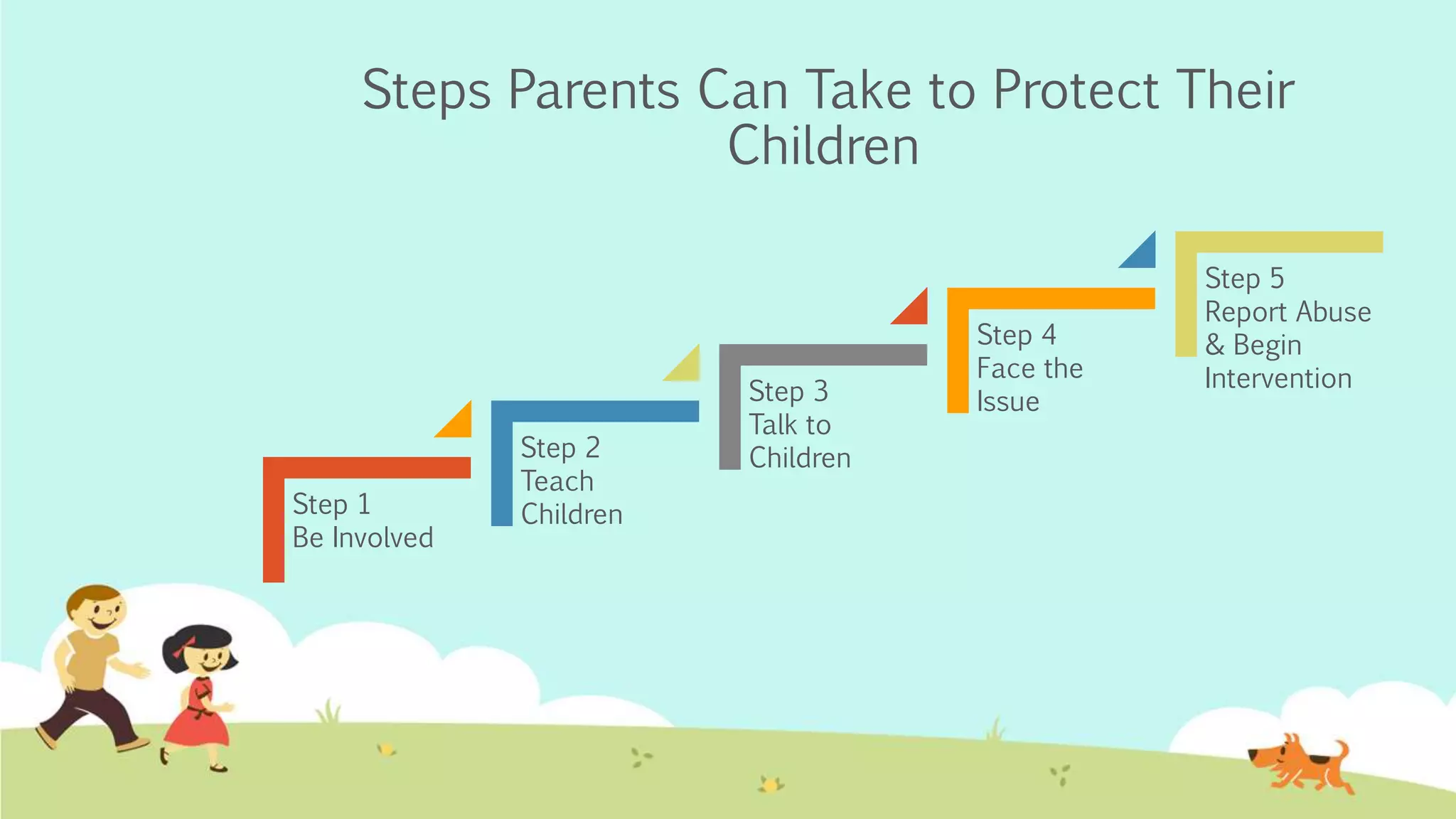
Steps Parents Can Take to Protect Their
Children
Step 1
Be Involved
Step 2
Teach
Children
Step 3
Talk to
Children
Step 4
Face the
Issue
Step 5
Report Abuse
& Begin
Intervention
Step 1: Be Involved!
• It is important to understand that children are usually
victimized by someone who is known to them, someone
they should be able to trust. Often the abuser is a
relative (Smith & Segal, 2015).
• Know who your child is spending time with.
• Never allow a child to go to a strangers house without a
parent or highly trusted adult.
• Be very careful about letting your child spend time alone
or in remote areas with adults or older children
(Ana/Yorba Medical Group, 2015).
• Be wary of adults or older children who offer or give your
child “special” gifts or pay an inappropriate amount of
attention to your child (AAP, 2011).
Steps 2 & 3: Teach and Talk to Your Child
 Teach your child how to talk about their body. Teach them the proper names for
each part of their body, including genitalia. This enables children to become
comfortable talking about their body, and will allow them to effectively explain if
any type of abuse occurs (RAINN, 2009).
 It is very important to recognize that physical contact is not present in every
case of sexual abuse (Smith & Segal,2015). This type of abuse can include
coercing the child to participate in pornographic photography, forcing a child to
watch the abuser fondle themselves or masturbate, or participate in watching
others engage in sexual acts.
 Create a safety plan (Tabachnick & Polland, 2007).
 Talk to your child. Ask open-ended questions and assure them that they will not
be in trouble if they need to tell you about something that has happened. If your
child does make the effort to talk to you, listen to them and follow through on
your assurances. If you are angry, assure your child that you are not angry with
them, you are angry with the person that hurt them. Be appropriate with your
anger and resulting behaviors (RAINN, 2009).
Step 4: Face the Issue
 Fear that a child will not be believed, feeling that the abuse is their fault, that
others will be angry, threats made by the abuser, and fear of hurting their
family are issues that make false allegations of child sexual abuse very rare.
 Boys are less likely to report abuse due to feelings of guilt, shame and fear
of stigmatization. Shame and a developing feeling of self-loathing make it
extremely difficult for children to volunteer information regarding sexual
abuse (Smith & Segal, 2015).
 If your child talks to you and mentions anything about being touched or
abused, do not take this lightly. Do not blow it off or tell your child that they
may have misunderstood the situation. Take the revelation seriously and
assure your child that this is not their fault and they have nothing to be
ashamed of (Ana/Yorba Medical Group, 2015).
Step 5: Report Abuse and Begin
Intervention & Therapy
• If you suspect, or your child reports, that any type of
sexual abuse has occurred, REPORT abuse IMMEDIATELY!
• Bring your child to their pediatrician to be examined to
confirm abuse and have their physical health checked.
• Enroll your child in a community, mental health or school
anti-abuse or intervention and support program. Begin
therapy as soon as possible to promote the beginning of
the healing process (AAP, 2011).
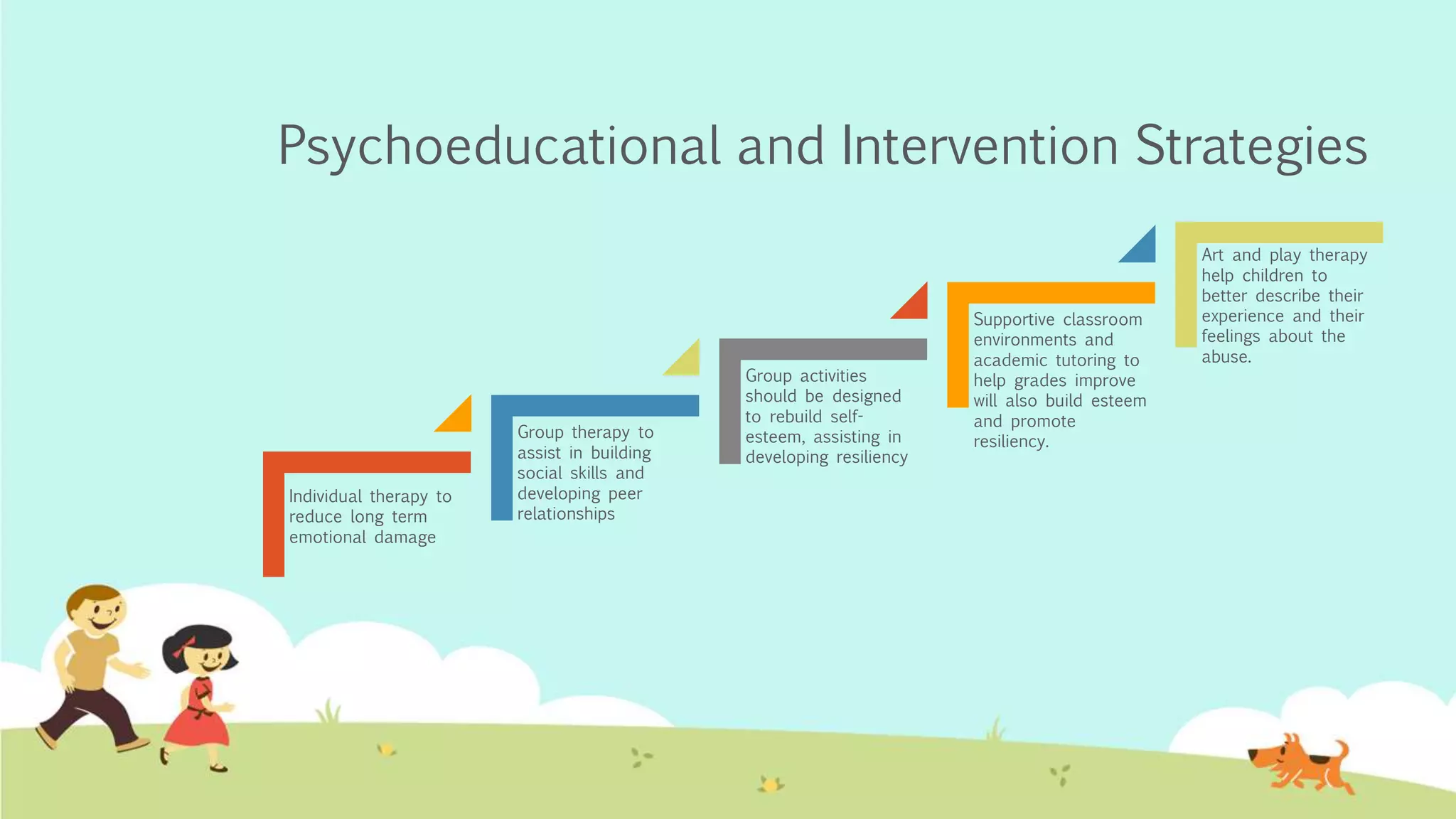
Psychoeducational and Intervention Strategies
Individual therapy to
reduce long term
emotional damage
Group therapy to
assist in building
social skills and
developing peer
relationships
Group activities
should be designed
to rebuild self-
esteem, assisting in
developing resiliency
Supportive classroom
environments and
academic tutoring to
help grades improve
will also build esteem
and promote
resiliency.
Art and play therapy
help children to
better describe their
experience and their
feelings about the
abuse.
References
American Academy of Pediatrics. (2011). Parenting Tips for Preventing and Identifying
Child Sexual Abuse. Retrieved from https://www.aap.org/en-us/about-the-aap/aap-
press-room/news-features-and-safety-tips/Pages/Parent-Tips-for-Preventing-and-
Identifying-Child-Sexual-Abuse.aspx
Ana/Yorba Medical Group. (2015). Child Sexual Abuse: What it is and How to Prevent It.
Retrieved from http://www.drsvyas.com/child_sexual_abuse.html
Rape, Abuse & Incest National Network. (2009). How Can I Protect My Child From Sexual
Assault? Retrieved from https://www.rainn.org/get-information/sexual-assault-
prevention/protecting-a-child-from-sexual-assault
Smith, Melinda MA. & Segal, Jeanne Ph. D. (2015). Recognizing, Preventing and Reporting
Child Abuse. Child Sexual Abuse: A hidden type of abuse. Retrieved from
http://www.helpguide.org/articles/abuse/child-abuse-and-neglect.htm#child
Tobachnick, Joan & Polland, Peter. (2003, edited 2007). Prevent Child Sexual Abuse: Facts
about sexual abuse and how to prevent it. Retrieved from http://www.stopitnow.org

HughesA_M2A2CV

  • 1.
    Preventing Child Sexual Abuse CommunityPrevention Program Amy C. Hughes
  • 2.
    Some things parentsneed to know …  Child Sexual Abuse can occur within every race, every socioeconomic group, every culture and every religion.  Although there is no way to provide absolute protection for your child, there are several steps that parents can take to promote their child’s safety (RAINN, 2009)  If your child’s school does not have an abuse prevention program in place, ask the school district leaders and school administrators to start one. Parents are primarily responsible for a child’s safety, schools and community programs are an important support system in promoting children’s safety (Ana/Yorba Medical Group, 2015).  If sexual abuse of a child is suspected, or a child says that they have been abused in any way, REPORT the suspected abuse IMMEDIATELY!!
  • 3.
    Steps Parents CanTake to Protect Their Children Step 1 Be Involved Step 2 Teach Children Step 3 Talk to Children Step 4 Face the Issue Step 5 Report Abuse & Begin Intervention
  • 4.
    Step 1: BeInvolved! • It is important to understand that children are usually victimized by someone who is known to them, someone they should be able to trust. Often the abuser is a relative (Smith & Segal, 2015). • Know who your child is spending time with. • Never allow a child to go to a strangers house without a parent or highly trusted adult. • Be very careful about letting your child spend time alone or in remote areas with adults or older children (Ana/Yorba Medical Group, 2015). • Be wary of adults or older children who offer or give your child “special” gifts or pay an inappropriate amount of attention to your child (AAP, 2011).
  • 5.
    Steps 2 &3: Teach and Talk to Your Child  Teach your child how to talk about their body. Teach them the proper names for each part of their body, including genitalia. This enables children to become comfortable talking about their body, and will allow them to effectively explain if any type of abuse occurs (RAINN, 2009).  It is very important to recognize that physical contact is not present in every case of sexual abuse (Smith & Segal,2015). This type of abuse can include coercing the child to participate in pornographic photography, forcing a child to watch the abuser fondle themselves or masturbate, or participate in watching others engage in sexual acts.  Create a safety plan (Tabachnick & Polland, 2007).  Talk to your child. Ask open-ended questions and assure them that they will not be in trouble if they need to tell you about something that has happened. If your child does make the effort to talk to you, listen to them and follow through on your assurances. If you are angry, assure your child that you are not angry with them, you are angry with the person that hurt them. Be appropriate with your anger and resulting behaviors (RAINN, 2009).
  • 6.
    Step 4: Facethe Issue  Fear that a child will not be believed, feeling that the abuse is their fault, that others will be angry, threats made by the abuser, and fear of hurting their family are issues that make false allegations of child sexual abuse very rare.  Boys are less likely to report abuse due to feelings of guilt, shame and fear of stigmatization. Shame and a developing feeling of self-loathing make it extremely difficult for children to volunteer information regarding sexual abuse (Smith & Segal, 2015).  If your child talks to you and mentions anything about being touched or abused, do not take this lightly. Do not blow it off or tell your child that they may have misunderstood the situation. Take the revelation seriously and assure your child that this is not their fault and they have nothing to be ashamed of (Ana/Yorba Medical Group, 2015).
  • 7.
    Step 5: ReportAbuse and Begin Intervention & Therapy • If you suspect, or your child reports, that any type of sexual abuse has occurred, REPORT abuse IMMEDIATELY! • Bring your child to their pediatrician to be examined to confirm abuse and have their physical health checked. • Enroll your child in a community, mental health or school anti-abuse or intervention and support program. Begin therapy as soon as possible to promote the beginning of the healing process (AAP, 2011).
  • 8.
    Psychoeducational and InterventionStrategies Individual therapy to reduce long term emotional damage Group therapy to assist in building social skills and developing peer relationships Group activities should be designed to rebuild self- esteem, assisting in developing resiliency Supportive classroom environments and academic tutoring to help grades improve will also build esteem and promote resiliency. Art and play therapy help children to better describe their experience and their feelings about the abuse.
  • 9.
    References American Academy ofPediatrics. (2011). Parenting Tips for Preventing and Identifying Child Sexual Abuse. Retrieved from https://www.aap.org/en-us/about-the-aap/aap- press-room/news-features-and-safety-tips/Pages/Parent-Tips-for-Preventing-and- Identifying-Child-Sexual-Abuse.aspx Ana/Yorba Medical Group. (2015). Child Sexual Abuse: What it is and How to Prevent It. Retrieved from http://www.drsvyas.com/child_sexual_abuse.html Rape, Abuse & Incest National Network. (2009). How Can I Protect My Child From Sexual Assault? Retrieved from https://www.rainn.org/get-information/sexual-assault- prevention/protecting-a-child-from-sexual-assault Smith, Melinda MA. & Segal, Jeanne Ph. D. (2015). Recognizing, Preventing and Reporting Child Abuse. Child Sexual Abuse: A hidden type of abuse. Retrieved from http://www.helpguide.org/articles/abuse/child-abuse-and-neglect.htm#child Tobachnick, Joan & Polland, Peter. (2003, edited 2007). Prevent Child Sexual Abuse: Facts about sexual abuse and how to prevent it. Retrieved from http://www.stopitnow.org