in
Gender inequality in India
refers to socially constructed
differences between men and
women in India that
systematically empower one
group to the detriment of the
other.
Gender in equalities include
: unequal rights
responsibilities and
opportunities for Indian
t
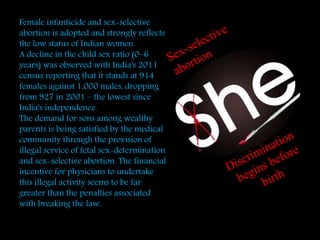
Female infanticide and sex-selective
abortion is adopted and strongly reflects
the low status of Indian women.
A decline in the child sex ratio (0–6
years) was observed with India's 2011
census reporting that it stands at 914
females against 1,000 males, dropping
from 927 in 2001 – the lowest since
India's independence.
The demand for sons among wealthy
parents is being satisfied by the medical
community through the provision of
illegal service of fetal sex-determination
and sex-selective abortion. The financial
incentive for physicians to undertake
this illegal activity seems to be far
greater than the penalties associated
with breaking the law.
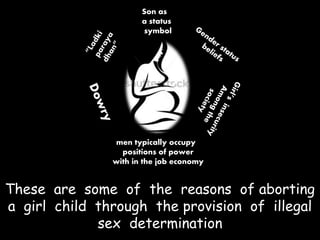
Son as
a status
symbol
men typically occupy
positions of power
with in the job economy
These are some of the reasons of aborting
a girl child through the provision of illegal
sex determination
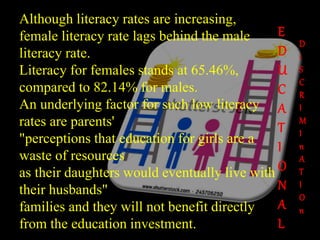
Although literacy rates are increasing,
female literacy rate lags behind the male
literacy rate.
Literacy for females stands at 65.46%,
compared to 82.14% for males.
An underlying factor for such low literacy
rates are parents'
"perceptions that education for girls are a
waste of resources
as their daughters would eventually live with
their husbands"
families and they will not benefit directly
from the education investment.
E
D
U
C
A
T
I
O
N
A
L
D
i
S
C
R
I
M
I
n
A
T
I
O
n
Domestic discrimination (at home)
Inequalities in decision making:
Girl child doesn’t have enough freedom
to choose the course that she want to
study. women have little influence
over important household decisions.
Lack of control over health-care needs:
women have little influence in health-related
matters. The exclusion of women from these
decisions about their health can compromise
the health and well-being of all family
members, particularly children.
Restricted mobility and freedom:
Girls are restricted to roam out after
getting dark.
men often exert a high degree of control
over women’s mobility.
Control of income and assets:
The consequences of exclusion from
owning property or assets can be even more
direct, particularly when a marriage breaks
down or the husband dies.
Property Inheritance
Many countries have laws that give less inheritance of
ancestral property for women compared to men.
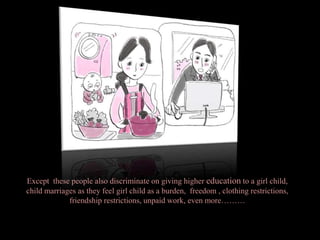
Except these people also discriminate on giving higher education to a girl child,
child marriages as they feel girl child as a burden, freedom , clothing restrictions,
friendship restrictions, unpaid work, even more………
Gender discrimination at work place
Women still face a gender bias – especially in the
workforce.
The rights of women are neglected in workplace,
while recruitment they are treated as they cannot
do the job perfectly , underestimating their
abilities and skills while recruitment.
This is often because women are physically weaker
than men, and they are more easily abused and
discriminated against men. Despite the best efforts
of companies to promote diversity and equality,
women still dominate the lower paying
administrative ranks while men continue to
dominate at the executive level. This inequality is
hurting corporate performance.
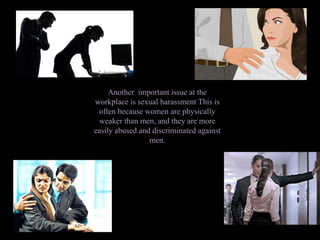
Another important issue at the
workplace is sexual harassment This is
often because women are physically
weaker than men, and they are more
easily abused and discriminated against
men.
In creative fields like movies
Girls /woman have less superior roles in movies as
compared to that of boys/man
Woman usually also portrayed a certain way, with an
idealized physique, giving girls insecurity at a very
young age
A psychology today survey showed of 3452 women
surveyed, 23% said that movie or television
celebrities influenced their body image when they
were young and 22% were influenced by fashion
magazine models.
Negative views of society on woman
•Woman is not capable
of decision making
•Woman shouldn’t vote
•Woman should stay in
kitchen
•Woman cannot be
trusted
Gender stereotype
Masculine traits
• Dominant
• Independent
• Intelligent
• Rational
• Assertive
• Analytical
• Strong
• Brave
• Ambitious
• Active
• Competitive
• Insensitive
• Sexually aggressive
• Attractive due to
achievements
Feminine traits
• Submissive
• Dependent
• Unintelligent
• Emotional
• Receptive
• Intuitive
• Weak
• Timid
• Content
• Passive
• Cooperative
• Sensitive
• Sex object
• Attractive due to physical
appearance
Towards gender equality
• Social awareness for the female.
• Not only female society must be educated to
provide females their rights.
• Equal job opportunities.
• Say no to child marriage, dowry, and other
female harassing practices .
• Say no to sex determination etc.
Break silence
to
break violence
Brought to you by
S.Nagasudha T.Pratyusha
N.Pravalika Z.Mounika
G.Pushyami D. Navya

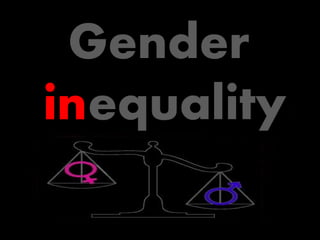
Gender inequality

  • 1.
  • 2.
    Gender inequality inIndia refers to socially constructed differences between men and women in India that systematically empower one group to the detriment of the other. Gender in equalities include : unequal rights responsibilities and opportunities for Indian
  • 3.
    t Female infanticide andsex-selective abortion is adopted and strongly reflects the low status of Indian women. A decline in the child sex ratio (0–6 years) was observed with India's 2011 census reporting that it stands at 914 females against 1,000 males, dropping from 927 in 2001 – the lowest since India's independence. The demand for sons among wealthy parents is being satisfied by the medical community through the provision of illegal service of fetal sex-determination and sex-selective abortion. The financial incentive for physicians to undertake this illegal activity seems to be far greater than the penalties associated with breaking the law.
  • 4.
    Son as a status symbol mentypically occupy positions of power with in the job economy These are some of the reasons of aborting a girl child through the provision of illegal sex determination
  • 5.
    Although literacy ratesare increasing, female literacy rate lags behind the male literacy rate. Literacy for females stands at 65.46%, compared to 82.14% for males. An underlying factor for such low literacy rates are parents' "perceptions that education for girls are a waste of resources as their daughters would eventually live with their husbands" families and they will not benefit directly from the education investment. E D U C A T I O N A L D i S C R I M I n A T I O n
  • 6.
    Domestic discrimination (athome) Inequalities in decision making: Girl child doesn’t have enough freedom to choose the course that she want to study. women have little influence over important household decisions. Lack of control over health-care needs: women have little influence in health-related matters. The exclusion of women from these decisions about their health can compromise the health and well-being of all family members, particularly children. Restricted mobility and freedom: Girls are restricted to roam out after getting dark. men often exert a high degree of control over women’s mobility. Control of income and assets: The consequences of exclusion from owning property or assets can be even more direct, particularly when a marriage breaks down or the husband dies. Property Inheritance Many countries have laws that give less inheritance of ancestral property for women compared to men.
  • 7.
    Except these peoplealso discriminate on giving higher education to a girl child, child marriages as they feel girl child as a burden, freedom , clothing restrictions, friendship restrictions, unpaid work, even more………
  • 8.
    Gender discrimination atwork place Women still face a gender bias – especially in the workforce. The rights of women are neglected in workplace, while recruitment they are treated as they cannot do the job perfectly , underestimating their abilities and skills while recruitment. This is often because women are physically weaker than men, and they are more easily abused and discriminated against men. Despite the best efforts of companies to promote diversity and equality, women still dominate the lower paying administrative ranks while men continue to dominate at the executive level. This inequality is hurting corporate performance.
  • 9.
    Another important issueat the workplace is sexual harassment This is often because women are physically weaker than men, and they are more easily abused and discriminated against men.
  • 10.
    In creative fieldslike movies Girls /woman have less superior roles in movies as compared to that of boys/man Woman usually also portrayed a certain way, with an idealized physique, giving girls insecurity at a very young age A psychology today survey showed of 3452 women surveyed, 23% said that movie or television celebrities influenced their body image when they were young and 22% were influenced by fashion magazine models.
  • 11.
    Negative views ofsociety on woman •Woman is not capable of decision making •Woman shouldn’t vote •Woman should stay in kitchen •Woman cannot be trusted
  • 12.
    Gender stereotype Masculine traits •Dominant • Independent • Intelligent • Rational • Assertive • Analytical • Strong • Brave • Ambitious • Active • Competitive • Insensitive • Sexually aggressive • Attractive due to achievements Feminine traits • Submissive • Dependent • Unintelligent • Emotional • Receptive • Intuitive • Weak • Timid • Content • Passive • Cooperative • Sensitive • Sex object • Attractive due to physical appearance
  • 13.
    Towards gender equality •Social awareness for the female. • Not only female society must be educated to provide females their rights. • Equal job opportunities. • Say no to child marriage, dowry, and other female harassing practices . • Say no to sex determination etc.
  • 14.
  • 15.
    Brought to youby S.Nagasudha T.Pratyusha N.Pravalika Z.Mounika G.Pushyami D. Navya