PPT-22
Green Earth Movement
An E-Newsletter for the cause of Environment, Peace, Harmony and Justice
Remember - “you and I can decide the future”
SAVE
LAKES
AND
PONDS
Water is a scarce and precious
natural resource to be planned,
developed, conserved and
managed as such, and on an
integrated and environmentally
sound basis, keeping in mind the
socio-economic aspects of a
country. The limited water
availability and increasing demand has prompted the
need for water conservation and in particular ponds
and lakes as – ‘any resource saved is resource
created’.
Several technical definitions of ‘Pond’ and ‘Lakes’
have met with resistance or disapproval, as the
defining characteristics are each difficult to measure
or verify. However for simplicity sake we can define
ponds and lakes as follows:
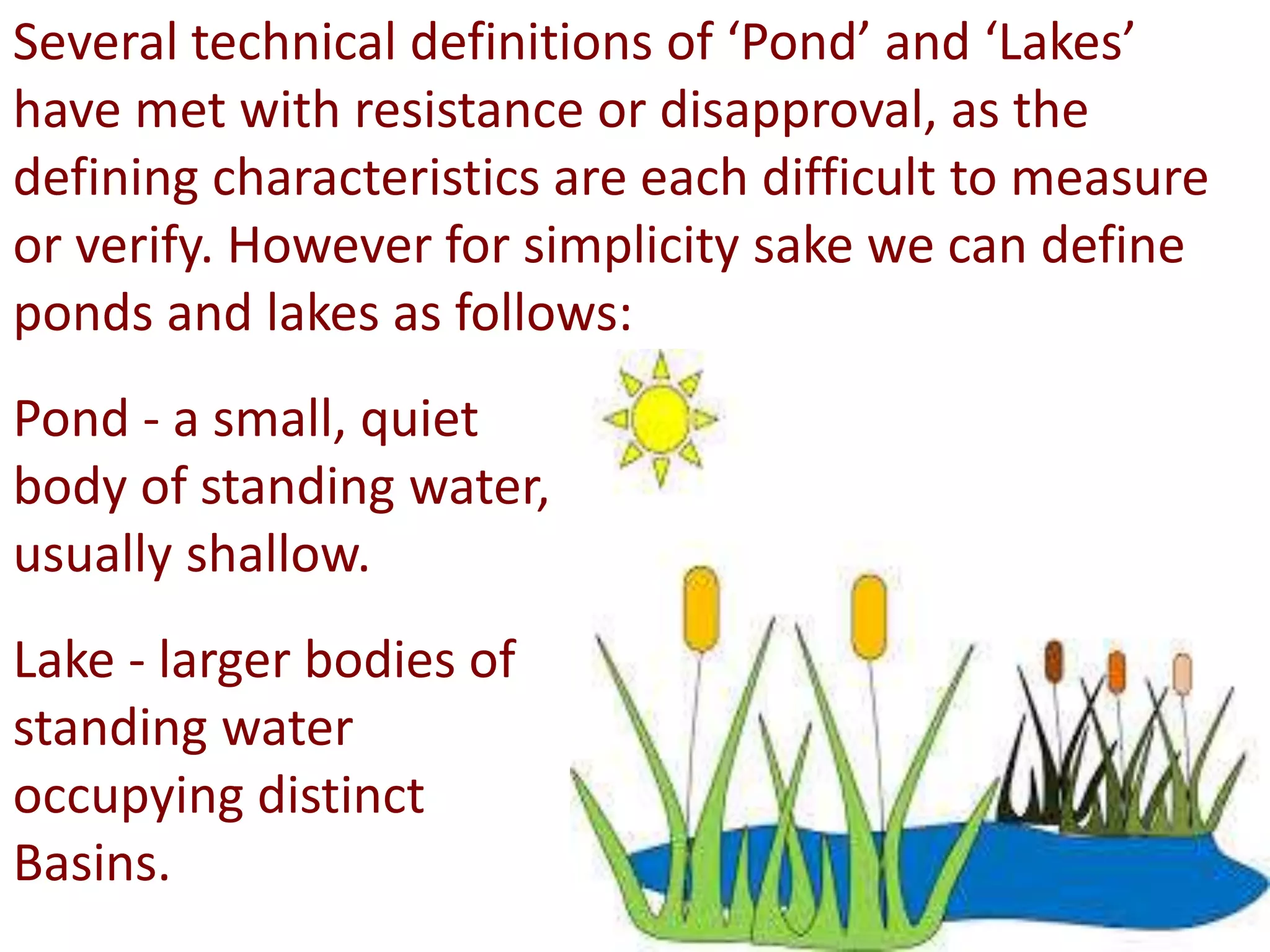
Pond - a small, quiet
body of standing water,
usually shallow.
Lake - larger bodies of
standing water
occupying distinct
Basins.
Lakes and ponds are important part of
ecosystem. Though relatively small in size,
ponds and lakes perform significant
environmental, social and economic functions,
ranging from being a source of drinking water,
recharging ground water, control flooding,
supporting biodiversity and providing
livelihoods.
Water in lakes and ponds is an easily available
source of water for the needs of many sectors
of economy such as agriculture, domestic and
industrial. These water bodies, whether man-
made or natural, fresh water or brackish play a
very vital role in
maintaining environmental
sustainability especially in
today’s context when the
cities are facing the
challenges of unplanned
rapid urbanization.
In brief
Although, there is a
Plethora of policies and
acts for the protection
and restoration of lakes
and wetlands, urban
water bodies are in extremely poor condition. Their
numbers are declining rapidly. For example at the
beginning of 1960s Bangalore had 262 lakes, now only
10 hold water.
Similarly, in 2001, 137 lakes were listed in Ahmadabad
city, and over 65 were reported being already built
over (Excreta Matters, 2012).
In Delhi in 2010-11 to check
the changes in 3 waterbodies
in last 10 years the status of
44 lakes was ascertained and
it was found that 21 out 44
Lakes were gone dry due to
rapid urbanization and falling
water tables (Singh & Bhatnagar, 2012).
Another example exhibiting this increasing loss of urban
water bodies is Hyderabad, within last 12 years, Hyderabad
has lost 3245 ha. area of its water in the form of lakes and
ponds (Times of India, 2012). There are endless examples in
India that shows such devastating state of urban water
bodies.
Threats to Urban Water Bodies
For the last two decades, urban water bodies
have been a victim to unplanned urbanization in
India, because of which they face several
threats. These are
pollution,
encroachment,
eutrophication,
illegal mining
activities,
ungoverned
tourist activities and cultural misuse.
1] Pollution: For the last two decades, there has been
an explosive increase in the urban population without
corresponding expansion of civic facilities such as
adequate infrastructure for the disposal of waste.
Hence, as more and more people are migrating to
cities the urban civic services
are becoming less adequate.
As a result, almost all urban
water bodies in India are
suffering because of pollution
and are used for disposing
untreated local sewage and solid waste, and in many
cases the water bodies have been ultimately turned
into landfills.
2] Encroachment:
Encroachment is another
major threat to water
bodies particularly in
urban areas. As more
people are migrating to
cities the availability of
land is getting scarce.
Today, even a small piece
of land in urban areas has a high economic value. Hence,
these urban water bodies are no more acknowledged for
their ecosystem services but as real estate. Both for the
government and the private builders these lakes are
extremely valuable opportunities.
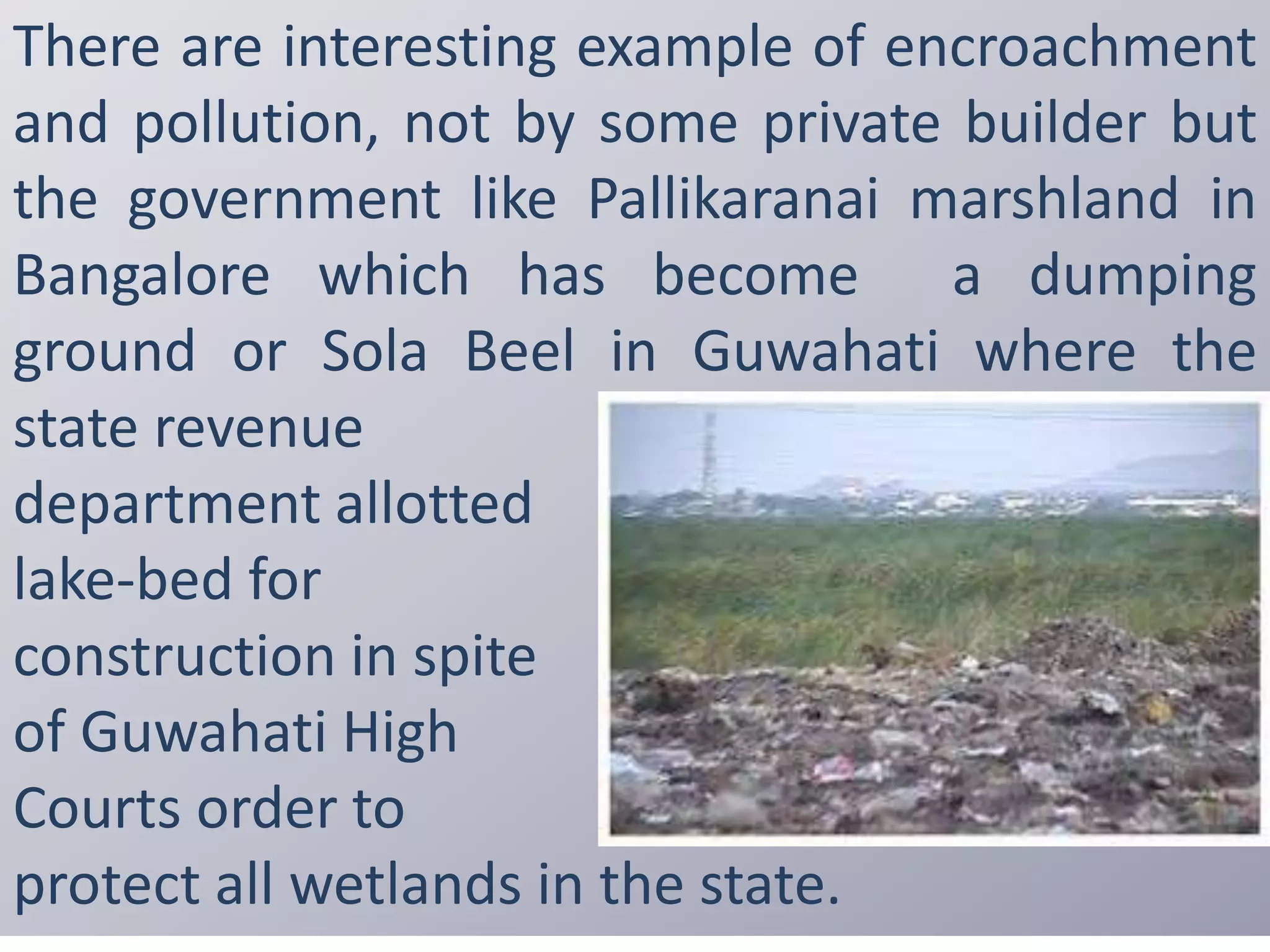
There are interesting example of encroachment
and pollution, not by some private builder but
the government like Pallikaranai marshland in
Bangalore which has become a dumping
ground or Sola Beel in Guwahati where the
state revenue
department allotted
lake-bed for
construction in spite
of Guwahati High
Courts order to
protect all wetlands in the state.
3] Eutrofication: Primarily being lentic water systems, lakes
are almost closed ecosystems. Hence, a large part of the
substances that enter in the lakes become a permanent part
of the system as only a part of that can be removed
depending on the water exchange system. As a result, the
entry of nutrients through raw sewage become the part of
lake system and cause various
destructive changes in the
water body such as prolific
growth of aquatic weeds in
lakes and ponds that ultimately
disturb and kill the ecology of the
waterbody. Bheels of Assam is a
well known example of high
growth of hyacinth due to
pollution.
4] Illegal Mining Activities:
Illegal mining for building
material such as sand and
stones both on the catchment
and on the bed of the lake
also have extremely damaging
impact on the water body and
one of the reasons behind
the destruction of many water bodies in India. For example,
the Basamand lake in Jodhpur, once the only source of
drinking water for the city of Jodhpur, has been suffering from
illegal mining for the last 20 years despite the court’s order to
stop mining in 1999. Surajkund lake in Haryana is another
example of illegal mining activities that have destroyed the
lake.
5] Unplanned Tourism Activities: Unplanned tourism activities without
systematic planning and regulation proved to be another major threat
to urban water bodies. Disturbance of wildlife, pollution, changes in
local lifestyles and loss of cultural heritage are some of the impacts of
tourism on the local environment. In the absence of garbage disposal
facilities, the practice of dumping garbage into nearby water bodies has
become quite common in recent years and has contributed to the
degradation of many water bodies especially at the high altitude lakes,
for examples, Dal Lake in Srinagar, Tso Morari and Pongsho Lakes in
Ladakh where the unplanned and unregulated tourism has posed long-
term negative impacts both on biodiversity of the area and as well as on
the local environment
6] Cultural Misuse: Adding to the sorry
state of urban water
bodies is also the
misuse of these
water bodies by
local communities
for their cultural
or religious festivals
such the immersion of idols . These
activities are particularly a source of
serious pollution in lakes.
Protection of Ponds - How can you help?
We can all help ponds and their wildlife in some way. Here are a few
practical ideas:
Have a look around your neighbourhood and see if you can
find any ‘wild’ ponds. If you think a pond needs improvement
e.g. rubbish or plants removing, perhaps you and some
friends or family
could try to renovate it.
It is best to ask for
advice and help on
Pond management
from professional
organisations. Your
local environmental NGOs may be able to help you too.
If you see a neglected pond
or lake, you may take up
the issue with the local
Panchayat or city corporation
with the help of NGOs
like (ALMs in Mumbai).
Citizens’ pressure on local
government authorities
may lead to the clean
up operation and the maintenance of your
neighbourhood pond or lake.
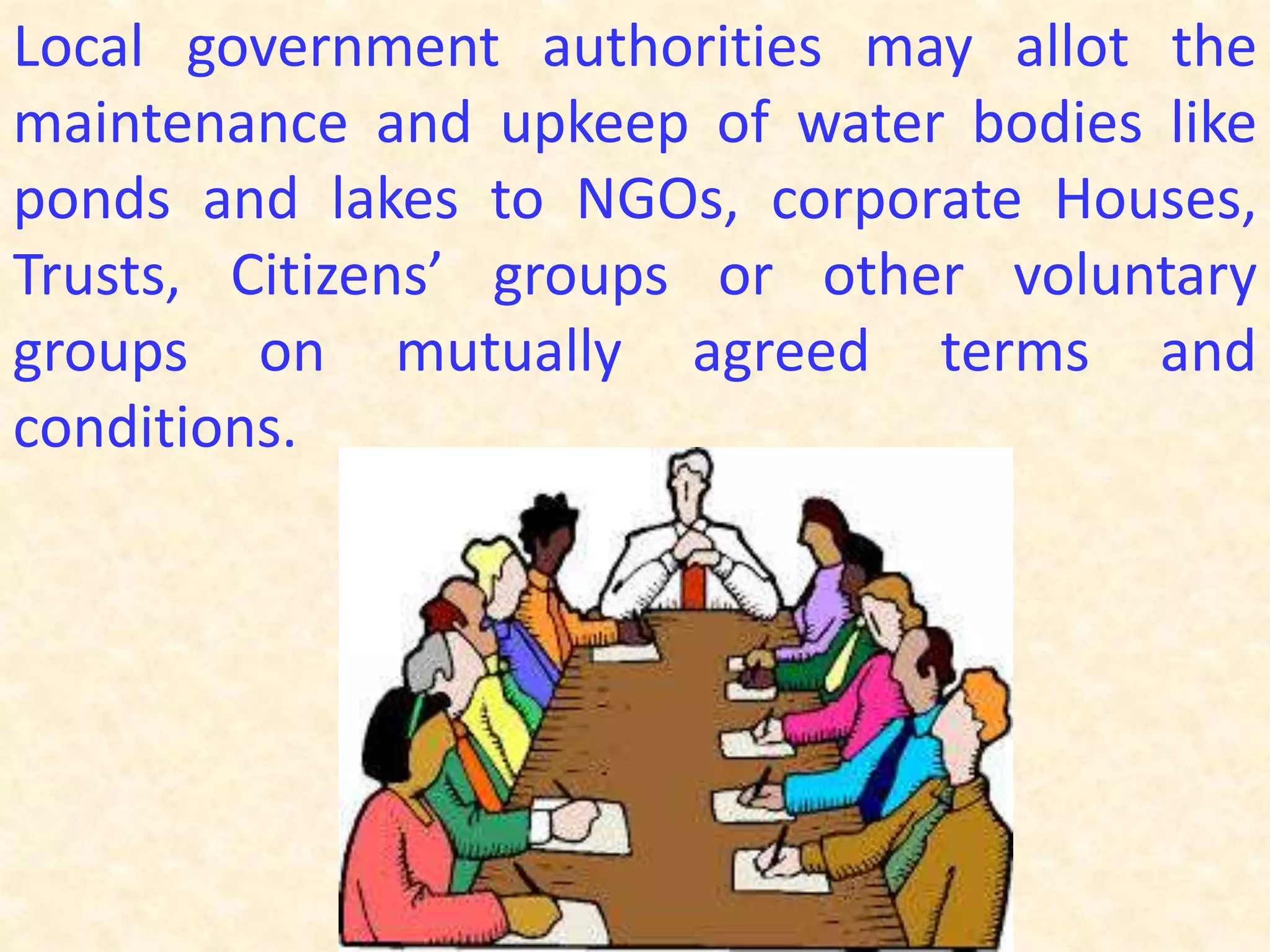
Local government authorities may allot the
maintenance and upkeep of water bodies like
ponds and lakes to NGOs, corporate Houses,
Trusts, Citizens’ groups or other voluntary
groups on mutually agreed terms and
conditions.
THE STAND OF COURTS ON PROTECTION OF LAKES
AND PONDS
“We would like to make it clear
that no one should be allowed
to fill up or destroy natural
lakes or ponds, as it will have
serious negative environmental
impact,” said Majmudar. He
added, “Natural lakes and ponds should not be made
a casualty or it will lead to larger environmental
hazards in future.” The judges asked Mhada to
consider restoring a natural lake at Borivli (West),
which was to be developed as a garden.
The Supreme Court of India has said that protection
of natural lakes and ponds honours the most basic
fundamental right -- the right to life that is
guaranteed to all Indian citizens under Article 21 of
the Constitution. As such, the government is duty-
bound to preserve these natural water bodies, to
ensure its citizens the right to water and to a decent
standard of living.
This educational PowerPoint Presentation (editable) is
prepared by GEM Team (courtesy: internet).
For other similar GEM PowerPoint Presentations on
various environmental issues see next slide.
These PPTs may be downloaded from our website
www.infantjesusjogeshwari.in
The GEM PPTs can be creatively used for various
groups like school/college students, NGOs,
government officials, Church groups, SCC groups,
housing society members and so on.
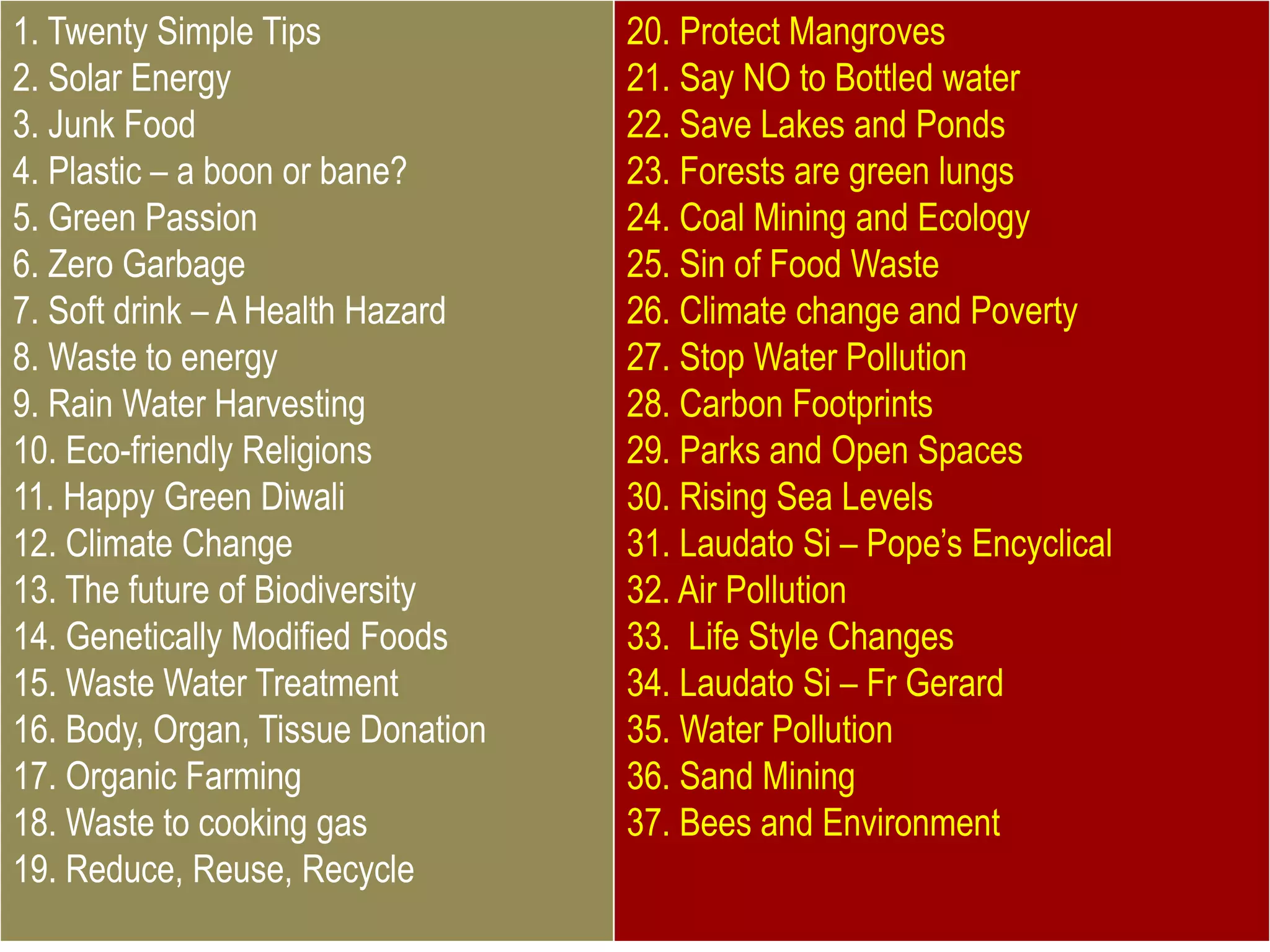
1. Twenty Simple Tips
2. Solar Energy
3. Junk Food
4. Plastic – a boon or bane?
5. Green Passion
6. Zero Garbage
7. Soft drink – A Health Hazard
8. Waste to energy
9. Rain Water Harvesting
10. Eco-friendly Religions
11. Happy Green Diwali
12. Climate Change
13. The future of Biodiversity
14. Genetically Modified Foods
15. Waste Water Treatment
16. Body, Organ, Tissue Donation
17. Organic Farming
18. Waste to cooking gas
19. Reduce, Reuse, Recycle
20. Protect Mangroves
21. Say NO to Bottled water
22. Save Lakes and Ponds
23. Forests are green lungs
24. Coal Mining and Ecology
25. Sin of Food Waste
26. Climate change and Poverty
27. Stop Water Pollution
28. Carbon Footprints
29. Parks and Open Spaces
30. Rising Sea Levels
31. Laudato Si – Pope’s Encyclical
32. Air Pollution
33. Life Style Changes
34. Laudato Si – Fr Gerard
35. Water Pollution
36. Sand Mining
37. Bees and Environment
For Free Weekly GEM E-Newsletters visit –
www.infantjesusjogeshwari.in. Go to GEM
section,
click GEM E-NEWSLETTERS

Gem ppt-22-save ponds and lakes

  • 1.
    PPT-22 Green Earth Movement AnE-Newsletter for the cause of Environment, Peace, Harmony and Justice Remember - “you and I can decide the future” SAVE LAKES AND PONDS
  • 2.
    Water is ascarce and precious natural resource to be planned, developed, conserved and managed as such, and on an integrated and environmentally sound basis, keeping in mind the socio-economic aspects of a country. The limited water availability and increasing demand has prompted the need for water conservation and in particular ponds and lakes as – ‘any resource saved is resource created’.
  • 3.
    Several technical definitionsof ‘Pond’ and ‘Lakes’ have met with resistance or disapproval, as the defining characteristics are each difficult to measure or verify. However for simplicity sake we can define ponds and lakes as follows: Pond - a small, quiet body of standing water, usually shallow. Lake - larger bodies of standing water occupying distinct Basins.
  • 4.
    Lakes and pondsare important part of ecosystem. Though relatively small in size, ponds and lakes perform significant environmental, social and economic functions, ranging from being a source of drinking water, recharging ground water, control flooding, supporting biodiversity and providing livelihoods.
  • 5.
    Water in lakesand ponds is an easily available source of water for the needs of many sectors of economy such as agriculture, domestic and industrial. These water bodies, whether man- made or natural, fresh water or brackish play a very vital role in maintaining environmental sustainability especially in today’s context when the cities are facing the challenges of unplanned rapid urbanization.
  • 6.
  • 7.
    Although, there isa Plethora of policies and acts for the protection and restoration of lakes and wetlands, urban water bodies are in extremely poor condition. Their numbers are declining rapidly. For example at the beginning of 1960s Bangalore had 262 lakes, now only 10 hold water. Similarly, in 2001, 137 lakes were listed in Ahmadabad city, and over 65 were reported being already built over (Excreta Matters, 2012).
  • 8.
    In Delhi in2010-11 to check the changes in 3 waterbodies in last 10 years the status of 44 lakes was ascertained and it was found that 21 out 44 Lakes were gone dry due to rapid urbanization and falling water tables (Singh & Bhatnagar, 2012). Another example exhibiting this increasing loss of urban water bodies is Hyderabad, within last 12 years, Hyderabad has lost 3245 ha. area of its water in the form of lakes and ponds (Times of India, 2012). There are endless examples in India that shows such devastating state of urban water bodies.
  • 9.
    Threats to UrbanWater Bodies For the last two decades, urban water bodies have been a victim to unplanned urbanization in India, because of which they face several threats. These are pollution, encroachment, eutrophication, illegal mining activities, ungoverned tourist activities and cultural misuse.
  • 10.
    1] Pollution: Forthe last two decades, there has been an explosive increase in the urban population without corresponding expansion of civic facilities such as adequate infrastructure for the disposal of waste. Hence, as more and more people are migrating to cities the urban civic services are becoming less adequate. As a result, almost all urban water bodies in India are suffering because of pollution and are used for disposing untreated local sewage and solid waste, and in many cases the water bodies have been ultimately turned into landfills.
  • 11.
    2] Encroachment: Encroachment isanother major threat to water bodies particularly in urban areas. As more people are migrating to cities the availability of land is getting scarce. Today, even a small piece of land in urban areas has a high economic value. Hence, these urban water bodies are no more acknowledged for their ecosystem services but as real estate. Both for the government and the private builders these lakes are extremely valuable opportunities.
  • 12.
    There are interestingexample of encroachment and pollution, not by some private builder but the government like Pallikaranai marshland in Bangalore which has become a dumping ground or Sola Beel in Guwahati where the state revenue department allotted lake-bed for construction in spite of Guwahati High Courts order to protect all wetlands in the state.
  • 13.
    3] Eutrofication: Primarilybeing lentic water systems, lakes are almost closed ecosystems. Hence, a large part of the substances that enter in the lakes become a permanent part of the system as only a part of that can be removed depending on the water exchange system. As a result, the entry of nutrients through raw sewage become the part of lake system and cause various destructive changes in the water body such as prolific growth of aquatic weeds in lakes and ponds that ultimately disturb and kill the ecology of the waterbody. Bheels of Assam is a well known example of high growth of hyacinth due to pollution.
  • 14.
    4] Illegal MiningActivities: Illegal mining for building material such as sand and stones both on the catchment and on the bed of the lake also have extremely damaging impact on the water body and one of the reasons behind the destruction of many water bodies in India. For example, the Basamand lake in Jodhpur, once the only source of drinking water for the city of Jodhpur, has been suffering from illegal mining for the last 20 years despite the court’s order to stop mining in 1999. Surajkund lake in Haryana is another example of illegal mining activities that have destroyed the lake.
  • 15.
    5] Unplanned TourismActivities: Unplanned tourism activities without systematic planning and regulation proved to be another major threat to urban water bodies. Disturbance of wildlife, pollution, changes in local lifestyles and loss of cultural heritage are some of the impacts of tourism on the local environment. In the absence of garbage disposal facilities, the practice of dumping garbage into nearby water bodies has become quite common in recent years and has contributed to the degradation of many water bodies especially at the high altitude lakes, for examples, Dal Lake in Srinagar, Tso Morari and Pongsho Lakes in Ladakh where the unplanned and unregulated tourism has posed long- term negative impacts both on biodiversity of the area and as well as on the local environment
  • 16.
    6] Cultural Misuse:Adding to the sorry state of urban water bodies is also the misuse of these water bodies by local communities for their cultural or religious festivals such the immersion of idols . These activities are particularly a source of serious pollution in lakes.
  • 17.
    Protection of Ponds- How can you help? We can all help ponds and their wildlife in some way. Here are a few practical ideas: Have a look around your neighbourhood and see if you can find any ‘wild’ ponds. If you think a pond needs improvement e.g. rubbish or plants removing, perhaps you and some friends or family could try to renovate it. It is best to ask for advice and help on Pond management from professional organisations. Your local environmental NGOs may be able to help you too.
  • 18.
    If you seea neglected pond or lake, you may take up the issue with the local Panchayat or city corporation with the help of NGOs like (ALMs in Mumbai). Citizens’ pressure on local government authorities may lead to the clean up operation and the maintenance of your neighbourhood pond or lake.
  • 19.
    Local government authoritiesmay allot the maintenance and upkeep of water bodies like ponds and lakes to NGOs, corporate Houses, Trusts, Citizens’ groups or other voluntary groups on mutually agreed terms and conditions.
  • 20.
    THE STAND OFCOURTS ON PROTECTION OF LAKES AND PONDS “We would like to make it clear that no one should be allowed to fill up or destroy natural lakes or ponds, as it will have serious negative environmental impact,” said Majmudar. He added, “Natural lakes and ponds should not be made a casualty or it will lead to larger environmental hazards in future.” The judges asked Mhada to consider restoring a natural lake at Borivli (West), which was to be developed as a garden.
  • 21.
    The Supreme Courtof India has said that protection of natural lakes and ponds honours the most basic fundamental right -- the right to life that is guaranteed to all Indian citizens under Article 21 of the Constitution. As such, the government is duty- bound to preserve these natural water bodies, to ensure its citizens the right to water and to a decent standard of living.
  • 22.
    This educational PowerPointPresentation (editable) is prepared by GEM Team (courtesy: internet). For other similar GEM PowerPoint Presentations on various environmental issues see next slide. These PPTs may be downloaded from our website www.infantjesusjogeshwari.in The GEM PPTs can be creatively used for various groups like school/college students, NGOs, government officials, Church groups, SCC groups, housing society members and so on.
  • 23.
    1. Twenty SimpleTips 2. Solar Energy 3. Junk Food 4. Plastic – a boon or bane? 5. Green Passion 6. Zero Garbage 7. Soft drink – A Health Hazard 8. Waste to energy 9. Rain Water Harvesting 10. Eco-friendly Religions 11. Happy Green Diwali 12. Climate Change 13. The future of Biodiversity 14. Genetically Modified Foods 15. Waste Water Treatment 16. Body, Organ, Tissue Donation 17. Organic Farming 18. Waste to cooking gas 19. Reduce, Reuse, Recycle 20. Protect Mangroves 21. Say NO to Bottled water 22. Save Lakes and Ponds 23. Forests are green lungs 24. Coal Mining and Ecology 25. Sin of Food Waste 26. Climate change and Poverty 27. Stop Water Pollution 28. Carbon Footprints 29. Parks and Open Spaces 30. Rising Sea Levels 31. Laudato Si – Pope’s Encyclical 32. Air Pollution 33. Life Style Changes 34. Laudato Si – Fr Gerard 35. Water Pollution 36. Sand Mining 37. Bees and Environment
  • 24.
    For Free WeeklyGEM E-Newsletters visit – www.infantjesusjogeshwari.in. Go to GEM section, click GEM E-NEWSLETTERS