Oslo
Oslo
Demographics:
Longitude: 59.5500 degree N
Latitude: 10.7500 degree E
Country: Norway
District: Østlandet
Population : ( Jan 2015)
City: 647,676
Density: 1,400/km2 (3,700/sq mi)
Urban: 951,581
Urban density: 3,300/km2 (8,500/sq mi)
Metro: 1,502,604
Metro density: 170/km2 (440/sq mi)
Literacy : 100%
Government: Parliamentary system
Climate: Humidity: 81%
Wind speed per Hour: 16 km/hr
Average max temp: -5 degree C
Average min temp: 20 degree C
Geography:
Area :
City: 454.03 km2 (175.30 sq mi)
Urban: 289.84 km2 (111.91 sq mi)
Metro: 8,900 km2 (3,400 sq mi)
Sea boundary
•Since the Middle Ages Oslo has gone though great changes, even the name of the town has been
changed a few times, before it became the city it is today.
•The town was originally called Oslo. In the Middle Ages it was located on the east side of the
Bjørvika inlet.
•In the end of the 12th century, Hanseatic traders from Rostock moved into the city and gained major
influence in the city.
•In 1350 Around 3/4 of the population dies under the Black Death. The city suffered greatly. The
churches' earnings from their land also dropped so much that the Hanseatic traders dominated the
city's foreign trade in the 15th century.
•After a dramatic fire in 1624, king Christian IV decided that the town be rebuilt in the area below
the Akershus Fortress, and he changed its name to Christiania.
•In the 18th century, after the Great Northern War, the city's economy boomed with shipbuilding and
trade. The strong economy transformed Christiania into a trading port. Christiania expanded its
industry from 1840.
•From 1877 the name was spelled Kristiania and in 1925 it was changed back to the original name,
Oslo.
History
1050
Marked as
a City
[King
Harald
Hardrade]
1299
Constructi
on of
the Akers
hus Castle
[King
Haakon]
1350
Black
Death
1624
Major fire
[King
Christian
IV]
1686
Fire
Timeline
Medieval Map of Oslo
Map of Kristiania [1877]
The Political System
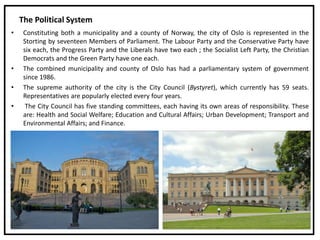
• Constituting both a municipality and a county of Norway, the city of Oslo is represented in the
Storting by seventeen Members of Parliament. The Labour Party and the Conservative Party have
six each, the Progress Party and the Liberals have two each ; the Socialist Left Party, the Christian
Democrats and the Green Party have one each.
• The combined municipality and county of Oslo has had a parliamentary system of government
since 1986.
• The supreme authority of the city is the City Council (Bystyret), which currently has 59 seats.
Representatives are popularly elected every four years.
• The City Council has five standing committees, each having its own areas of responsibility. These
are: Health and Social Welfare; Education and Cultural Affairs; Urban Development; Transport and
Environmental Affairs; and Finance.
Economy
• Oslo has a varied and strong economy and was ranked number one among European large cities.
• Oslo is an important centre of maritime knowledge in Europe and is home to approximately 1980
companies and 8,500 employees within the maritime sector. Some of which are the world's largest
shipping companies, shipbrokers, and insurance brokers.
• The city's port is the largest general cargo port in the country and its leading passenger gateway.
Close to 6,000 ships dock at the Port of Oslo annually with a total of 6 million tonnes of cargo and
over five million passengers.
• Oslo is one of the most expensive cities in the world. As of 2006, it is ranked tenth according to the
Worldwide Cost of Living Survey provided by Mercer Human Resource Consulting] and first
according to the Economist Intelligence Unit.
• The key industries in Oslo are Maritime, Oil and gas, Energy and environment, Information and
communications technology (ICT), Life Sciences.
• In a labor force more than two million workers, approximately 72 percent are in services, 23
percent work in industry, and 5 percent engage in agriculture, forestry, and fishing.
Culture
• Religions in the city include Christianity, Islam, Buddhism.
• The suburbs with the highest proportions of people of immigrant origin were Søndre Nordstrand,
Stovner og Alna, where they formed around 50 percent of the population. Pakistanis make up the
single largest ethnic minority, followed by Swedes, Somalis, and Poles. Other large immigrant
groups are people from Sri Lanka, Vietnam, Turkey, Morocco, Iraq and Iran.
• Languages are Norwegian, Bokmal, Nynorsk. Bokmal is more widely spoken than Nynorsk which is
limited to just 20% of the people in Oslo. English, German, Spanish and French also have a
presence in the city.
• Oslo's festivals include rock, opera, dance, literature, Medieval culture, world music, films.
• Oslo Jazz festival, a six-day jazz festival which has been held annually in August for the past 25
years. Oslo's biggest rock festival is Øyafestivalen or simply "Øya".
69.83%
3.59%
0.51%
26.07%
Religions
Christianity Islam
Buddhism other
Products Exported by Oslo
•Crude Petroleum, Petroleum gas, Refined petroleum, non-fillet fresh fish, Raw Aluminium, Frozen
fishes, Raw Nickle.
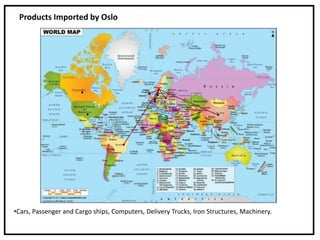
Products Imported by Oslo
•Cars, Passenger and Cargo ships, Computers, Delivery Trucks, Iron Structures, Machinery.
Migration of People in Oslo
Transportation
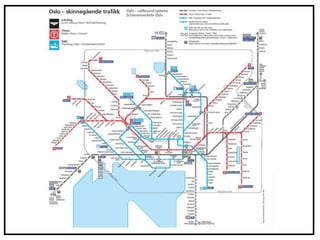
• Oslo has Norway's most extensive public transport system, managed by Ruter. This includes the six-
line Oslo Metro, the world's most extensive metro per resident, the six-line Oslo Tramway and the
eight-line Oslo Commuter Rail.
• The tramway operates within the areas close to the city centre, while the metro, which runs
underground through the city centre, operates to suburbs further away; this includes two lines
that operate to Bærum, and the Ring Line which loops to areas north of the centre.
• Oslo is also covered by a bus network consisting of 32 city lines, as well as regional buses to the
neighboring county of Akershus.
• Oslo Central Station acts as the central hub, and offers rail services to most major cities in
southern Norway as well as Stockholm and Gothenburg in Sweden.
• Some of the city islands and the neighbouring municipality of Nesodden are connected by ferry.
Daily cruiseferry services operate to Copenhagen and Frederikshavn in Denmark, and to Kiel in
Germany.
• The major motorways through Oslo are European Route E6 and E18. There are three beltways, the
innermost which are streets and the outermost, Ring 3 which is an expressway.
• The main airport serving the city is Gardermoen Airport, located in Ullensaker, 47 kilometers
(29 mi) from the city centre of Oslo. It acts as the main international gateway to Norway, and is the
sixth-largest domestic airport in Europe.
Oslo Central Station Airport Express Train
Airport Express Train Rental Bicycle
Levels
Infrastructure
Parks and recreation areas:
•Frogner Park is a large park located a few minutes walk away
from the city centre. This is the biggest and most reputed park in
Norway with a large collection of sculptures of Gustav Vigeland
Bygdøy is a large green area, commonly called the Museum
Peninsula of Oslo.
• The area is surrounded by the sea and is one of the most
expensive districts in Norway.
•St. Hanshaugen Park is an old public park on a high hill in central
Oslo. 'St. Hanshaugen' is also the name of the surrounding
neighborhood as well as the larger administrative district
(borough) that includes major parts of central Oslo.
•Tøyen Park stretches out behind the Munch Museum, and is a
vast, grassy expanse. In the north, there is a viewing point known
as Ola Narr. The Tøyen area also includes the Botanical
Garden and Museum belonging to the University of Oslo.
Performing arts
•Oslo houses over 20 theatres, such as the Norwegian Theatre
and the National Theatre located at Karl Johan Street.
•The National Theatre is the largest theatre in Norway and is
situated between the royal palace and the parliament
building, Stortinget.
Infrastructure
Sports:
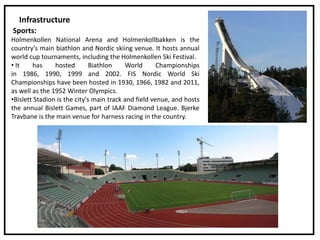
Holmenkollen National Arena and Holmenkollbakken is the
country's main biathlon and Nordic skiing venue. It hosts annual
world cup tournaments, including the Holmenkollen Ski Festival.
• It has hosted Biathlon World Championships
in 1986, 1990, 1999 and 2002. FIS Nordic World Ski
Championships have been hosted in 1930, 1966, 1982 and 2011,
as well as the 1952 Winter Olympics.
•Bislett Stadion is the city's main track and field venue, and hosts
the annual Bislett Games, part of IAAF Diamond League. Bjerke
Travbane is the main venue for harness racing in the country.
Gas/Oil: Gas is not used as much as oil in Norway. The country is rich in oil exports.
Electricity
• As per the rules of the Norwegian Water and Energy Directorate (NVE), consumers must read their
meters every alternate month starting lst January and report the same to their power company.
The monthly bill includes a fixed fee of NOK 75 and power at the rate of NOK 0.5763 per KWh. The
most common payment method for utilities services is through the bank either in person, online,
at the post office or by mail.
• Electricity is the main form of energy used for heating in Norwegian homes.
• Oslo gets its power supply from Hafslund ASA. To create an account, call Hafslund Stram at 815 44
660 between 8AM to 8 PM from Monday to Friday. In case there is an interruption in power
supply, call the Hafslund Netts Operations centre any hour of the day at 815 30 400-9.
Sustainability of Oslo
•Over the past 5 years the most advanced intelligent street lighting in the world has been built and
tested in oslo.
•Each lamp can be stepless and individually dimmed according to traffic, climatic conditions etc.
•Intelligent lightening reduces CO2 emissions and saves money.
•Eighty percent of Oslo’s heating system is powered by renewable energy – mainly bio-methane from
waste.
•Energy supply and heating are Oslo's second largest source of CO2 emissions at around 30% of total
emissions. The city promotes energy and eco-friendly in buildings and built environment.
•Around 1700 electric cars in the Oslo urban area. Electric cars are given free passage through Oslo's
toll road system and are allowed to use lanes otherwise reserved for public transport. through the
climate and energy fund the city supports the establishment of charging stations.
• In Oslo solid waste management has been defined scientifically at three levels; generation;
collection; treatment. Waste management has been practised in Oslo since a decade and has
created a benchmark for other cities to follow. The methodology for research is premised on
qualitative tools.
• , whereas Oslo solid waste management collection rate is almost 100%.
• . In Oslo people feel confident to pay for waste facilities because of awareness and
knowledge and also due to higher socio-economic norms.
Solid Waste Management
Skyline
Submitted by:
Hiren Bhingradiya
Divyesh Babariya
Nirav Avaiya
Aska Desai
Ravina Jain
Miral Hadakia

Oslo

  • 1.
  • 2.
    Oslo Demographics: Longitude: 59.5500 degreeN Latitude: 10.7500 degree E Country: Norway District: Østlandet Population : ( Jan 2015) City: 647,676 Density: 1,400/km2 (3,700/sq mi) Urban: 951,581 Urban density: 3,300/km2 (8,500/sq mi) Metro: 1,502,604 Metro density: 170/km2 (440/sq mi) Literacy : 100% Government: Parliamentary system Climate: Humidity: 81% Wind speed per Hour: 16 km/hr Average max temp: -5 degree C Average min temp: 20 degree C Geography: Area : City: 454.03 km2 (175.30 sq mi) Urban: 289.84 km2 (111.91 sq mi) Metro: 8,900 km2 (3,400 sq mi)
  • 4.
  • 5.
    •Since the MiddleAges Oslo has gone though great changes, even the name of the town has been changed a few times, before it became the city it is today. •The town was originally called Oslo. In the Middle Ages it was located on the east side of the Bjørvika inlet. •In the end of the 12th century, Hanseatic traders from Rostock moved into the city and gained major influence in the city. •In 1350 Around 3/4 of the population dies under the Black Death. The city suffered greatly. The churches' earnings from their land also dropped so much that the Hanseatic traders dominated the city's foreign trade in the 15th century. •After a dramatic fire in 1624, king Christian IV decided that the town be rebuilt in the area below the Akershus Fortress, and he changed its name to Christiania. •In the 18th century, after the Great Northern War, the city's economy boomed with shipbuilding and trade. The strong economy transformed Christiania into a trading port. Christiania expanded its industry from 1840. •From 1877 the name was spelled Kristiania and in 1925 it was changed back to the original name, Oslo. History
  • 6.
    1050 Marked as a City [King Harald Hardrade] 1299 Constructi onof the Akers hus Castle [King Haakon] 1350 Black Death 1624 Major fire [King Christian IV] 1686 Fire Timeline
  • 7.
  • 8.
  • 9.
    The Political System •Constituting both a municipality and a county of Norway, the city of Oslo is represented in the Storting by seventeen Members of Parliament. The Labour Party and the Conservative Party have six each, the Progress Party and the Liberals have two each ; the Socialist Left Party, the Christian Democrats and the Green Party have one each. • The combined municipality and county of Oslo has had a parliamentary system of government since 1986. • The supreme authority of the city is the City Council (Bystyret), which currently has 59 seats. Representatives are popularly elected every four years. • The City Council has five standing committees, each having its own areas of responsibility. These are: Health and Social Welfare; Education and Cultural Affairs; Urban Development; Transport and Environmental Affairs; and Finance.
  • 10.
    Economy • Oslo hasa varied and strong economy and was ranked number one among European large cities. • Oslo is an important centre of maritime knowledge in Europe and is home to approximately 1980 companies and 8,500 employees within the maritime sector. Some of which are the world's largest shipping companies, shipbrokers, and insurance brokers. • The city's port is the largest general cargo port in the country and its leading passenger gateway. Close to 6,000 ships dock at the Port of Oslo annually with a total of 6 million tonnes of cargo and over five million passengers. • Oslo is one of the most expensive cities in the world. As of 2006, it is ranked tenth according to the Worldwide Cost of Living Survey provided by Mercer Human Resource Consulting] and first according to the Economist Intelligence Unit. • The key industries in Oslo are Maritime, Oil and gas, Energy and environment, Information and communications technology (ICT), Life Sciences. • In a labor force more than two million workers, approximately 72 percent are in services, 23 percent work in industry, and 5 percent engage in agriculture, forestry, and fishing.
  • 12.
    Culture • Religions inthe city include Christianity, Islam, Buddhism. • The suburbs with the highest proportions of people of immigrant origin were Søndre Nordstrand, Stovner og Alna, where they formed around 50 percent of the population. Pakistanis make up the single largest ethnic minority, followed by Swedes, Somalis, and Poles. Other large immigrant groups are people from Sri Lanka, Vietnam, Turkey, Morocco, Iraq and Iran. • Languages are Norwegian, Bokmal, Nynorsk. Bokmal is more widely spoken than Nynorsk which is limited to just 20% of the people in Oslo. English, German, Spanish and French also have a presence in the city. • Oslo's festivals include rock, opera, dance, literature, Medieval culture, world music, films. • Oslo Jazz festival, a six-day jazz festival which has been held annually in August for the past 25 years. Oslo's biggest rock festival is Øyafestivalen or simply "Øya". 69.83% 3.59% 0.51% 26.07% Religions Christianity Islam Buddhism other
  • 13.
    Products Exported byOslo •Crude Petroleum, Petroleum gas, Refined petroleum, non-fillet fresh fish, Raw Aluminium, Frozen fishes, Raw Nickle.
  • 14.
    Products Imported byOslo •Cars, Passenger and Cargo ships, Computers, Delivery Trucks, Iron Structures, Machinery.
  • 15.
  • 16.
    Transportation • Oslo hasNorway's most extensive public transport system, managed by Ruter. This includes the six- line Oslo Metro, the world's most extensive metro per resident, the six-line Oslo Tramway and the eight-line Oslo Commuter Rail. • The tramway operates within the areas close to the city centre, while the metro, which runs underground through the city centre, operates to suburbs further away; this includes two lines that operate to Bærum, and the Ring Line which loops to areas north of the centre. • Oslo is also covered by a bus network consisting of 32 city lines, as well as regional buses to the neighboring county of Akershus. • Oslo Central Station acts as the central hub, and offers rail services to most major cities in southern Norway as well as Stockholm and Gothenburg in Sweden. • Some of the city islands and the neighbouring municipality of Nesodden are connected by ferry. Daily cruiseferry services operate to Copenhagen and Frederikshavn in Denmark, and to Kiel in Germany. • The major motorways through Oslo are European Route E6 and E18. There are three beltways, the innermost which are streets and the outermost, Ring 3 which is an expressway. • The main airport serving the city is Gardermoen Airport, located in Ullensaker, 47 kilometers (29 mi) from the city centre of Oslo. It acts as the main international gateway to Norway, and is the sixth-largest domestic airport in Europe.
  • 17.
    Oslo Central StationAirport Express Train Airport Express Train Rental Bicycle
  • 19.
  • 20.
    Infrastructure Parks and recreationareas: •Frogner Park is a large park located a few minutes walk away from the city centre. This is the biggest and most reputed park in Norway with a large collection of sculptures of Gustav Vigeland Bygdøy is a large green area, commonly called the Museum Peninsula of Oslo. • The area is surrounded by the sea and is one of the most expensive districts in Norway. •St. Hanshaugen Park is an old public park on a high hill in central Oslo. 'St. Hanshaugen' is also the name of the surrounding neighborhood as well as the larger administrative district (borough) that includes major parts of central Oslo. •Tøyen Park stretches out behind the Munch Museum, and is a vast, grassy expanse. In the north, there is a viewing point known as Ola Narr. The Tøyen area also includes the Botanical Garden and Museum belonging to the University of Oslo. Performing arts •Oslo houses over 20 theatres, such as the Norwegian Theatre and the National Theatre located at Karl Johan Street. •The National Theatre is the largest theatre in Norway and is situated between the royal palace and the parliament building, Stortinget.
  • 21.
    Infrastructure Sports: Holmenkollen National Arenaand Holmenkollbakken is the country's main biathlon and Nordic skiing venue. It hosts annual world cup tournaments, including the Holmenkollen Ski Festival. • It has hosted Biathlon World Championships in 1986, 1990, 1999 and 2002. FIS Nordic World Ski Championships have been hosted in 1930, 1966, 1982 and 2011, as well as the 1952 Winter Olympics. •Bislett Stadion is the city's main track and field venue, and hosts the annual Bislett Games, part of IAAF Diamond League. Bjerke Travbane is the main venue for harness racing in the country.
  • 22.
    Gas/Oil: Gas isnot used as much as oil in Norway. The country is rich in oil exports. Electricity • As per the rules of the Norwegian Water and Energy Directorate (NVE), consumers must read their meters every alternate month starting lst January and report the same to their power company. The monthly bill includes a fixed fee of NOK 75 and power at the rate of NOK 0.5763 per KWh. The most common payment method for utilities services is through the bank either in person, online, at the post office or by mail. • Electricity is the main form of energy used for heating in Norwegian homes. • Oslo gets its power supply from Hafslund ASA. To create an account, call Hafslund Stram at 815 44 660 between 8AM to 8 PM from Monday to Friday. In case there is an interruption in power supply, call the Hafslund Netts Operations centre any hour of the day at 815 30 400-9. Sustainability of Oslo •Over the past 5 years the most advanced intelligent street lighting in the world has been built and tested in oslo. •Each lamp can be stepless and individually dimmed according to traffic, climatic conditions etc. •Intelligent lightening reduces CO2 emissions and saves money. •Eighty percent of Oslo’s heating system is powered by renewable energy – mainly bio-methane from waste. •Energy supply and heating are Oslo's second largest source of CO2 emissions at around 30% of total emissions. The city promotes energy and eco-friendly in buildings and built environment. •Around 1700 electric cars in the Oslo urban area. Electric cars are given free passage through Oslo's toll road system and are allowed to use lanes otherwise reserved for public transport. through the climate and energy fund the city supports the establishment of charging stations.
  • 23.
    • In Oslosolid waste management has been defined scientifically at three levels; generation; collection; treatment. Waste management has been practised in Oslo since a decade and has created a benchmark for other cities to follow. The methodology for research is premised on qualitative tools. • , whereas Oslo solid waste management collection rate is almost 100%. • . In Oslo people feel confident to pay for waste facilities because of awareness and knowledge and also due to higher socio-economic norms. Solid Waste Management
  • 24.
  • 25.
    Submitted by: Hiren Bhingradiya DivyeshBabariya Nirav Avaiya Aska Desai Ravina Jain Miral Hadakia