FOUR BASIC
COMPUTER PERIODS
GEE-LIE
LIVING IN THE IT ERA
•PRE-MECHANICAL AGE
•MECHANICAL AGE
•ELECTROMECHANICAL AGE
•ELECTRONIC AGE
PRE-MECHANICAL AGE
(3000 BC- 1450 AD)
The Pre-mechanical age is the earliest age of information
technology. When humans first started communicating, they
would try to use language or simple picture drawings known as
petroglyphs which were usually carved in rock. Early alphabets
were developed such as the Phoenician alphabet.
THE PRE-MECHANICAL AGE
(3000 BC- 1450 AD)
• Writing and Alphabets
• Paper and Pen
• Books and Libraries
• The First Numbering System
• The First Calculators
A petroglyph is an image
created by removing part of
a rock surface by incising,
picking, carving, or abrading
,as a form of rock art.
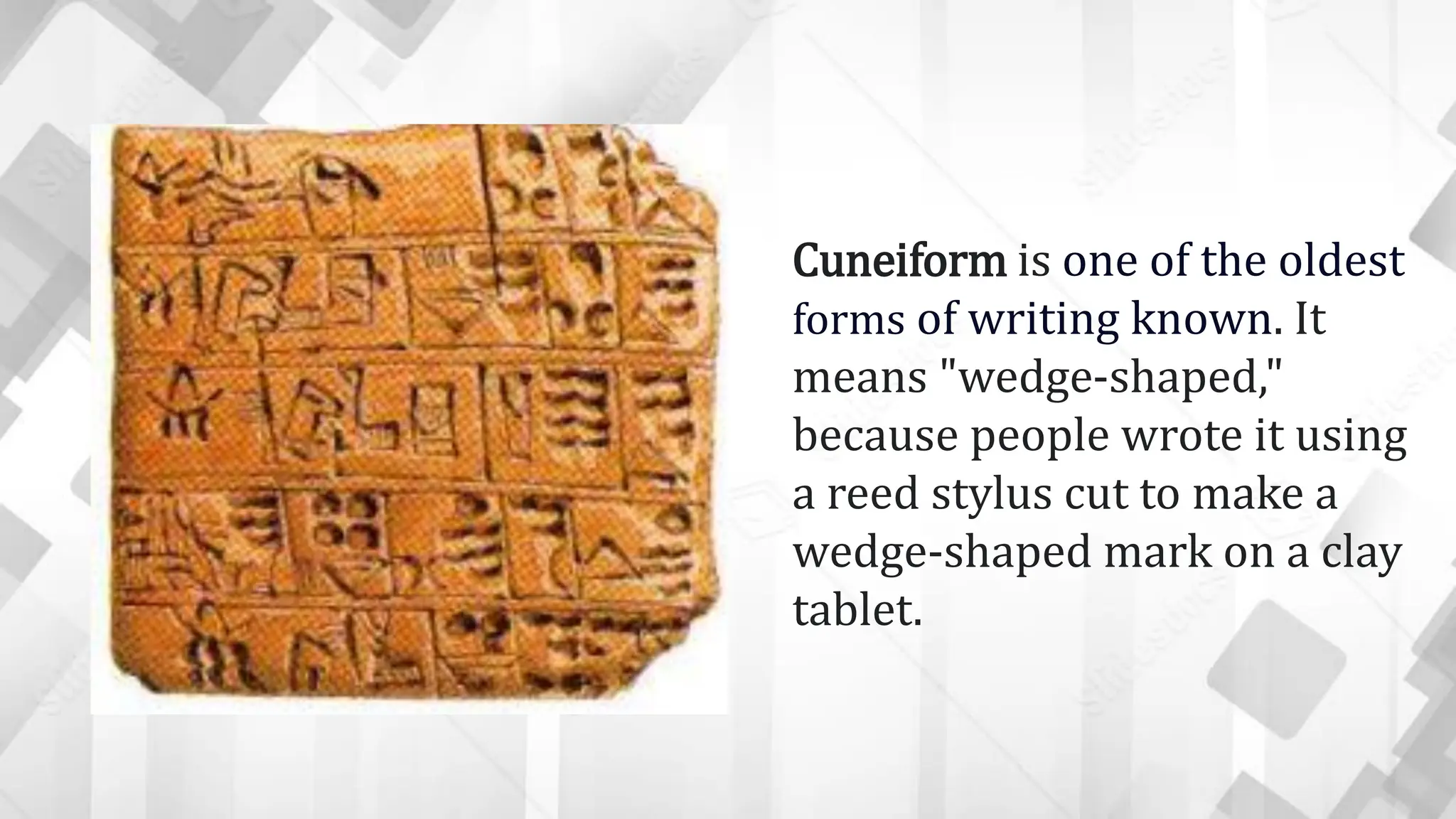
Cuneiform is one of the oldest
forms of writing known. It
means "wedge-shaped,"
because people wrote it using
a reed stylus cut to make a
wedge-shaped mark on a clay
tablet.
Abacus is used to show how
numbers, letters, and signs can be
stored in a binary system on a
Computer, or using an ASCII
number. The device consists of a
series of beads on parallel wires
that are arranged in three separate
rows.
MECHANICAL AGE
(1450-1840)
This is the age that we observe the first connections
between the technology of today and its ancestors. Slide rule
is invented (early example of analog computers). The first
general purpose computers are developed.
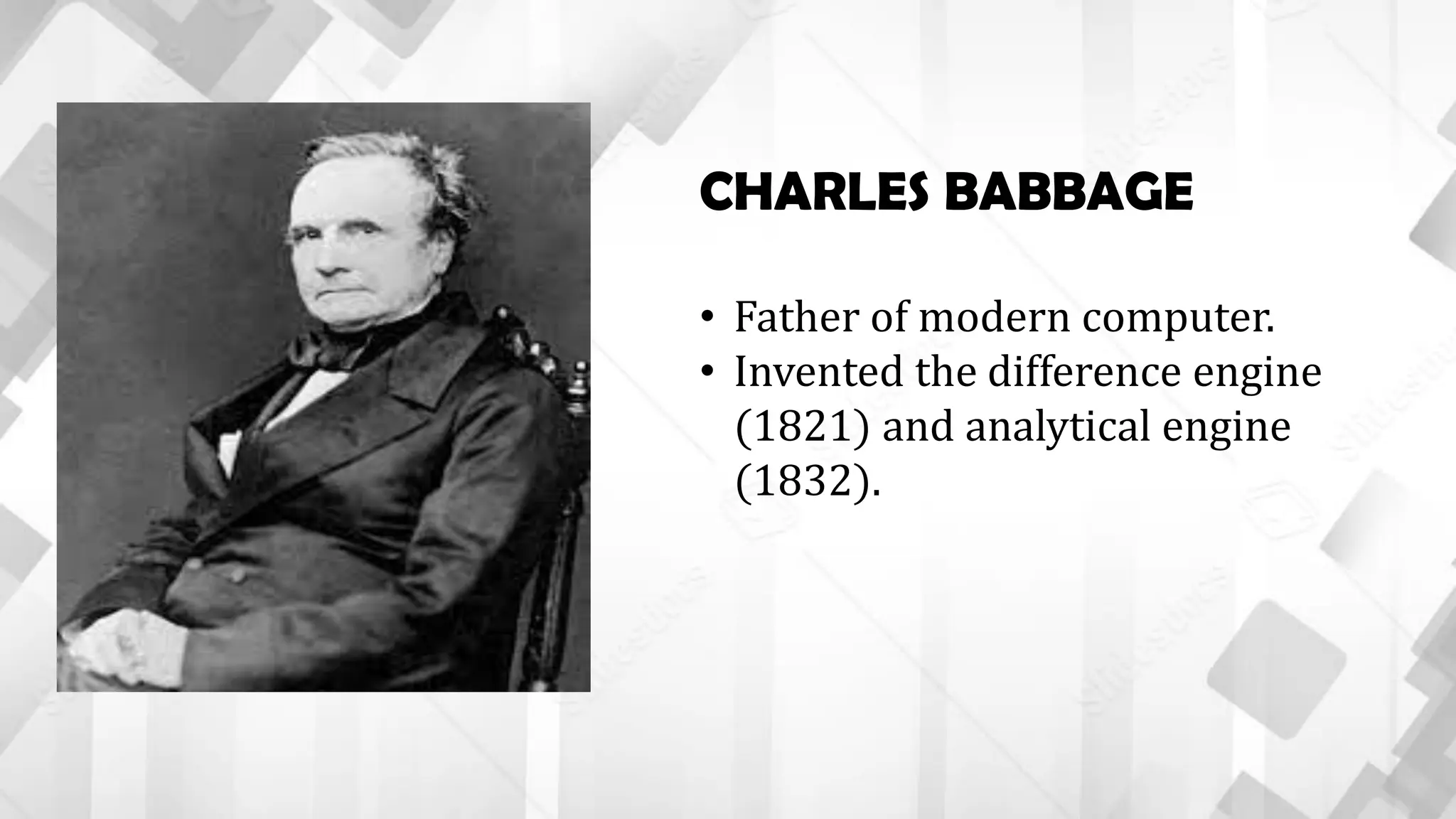
CHARLES BABBAGE
• Father of modern computer.
• Invented the difference engine
(1821) and analytical engine
(1832).
A difference engine is
automatic mechanical
calculator designed to
tabulate polynomial functions.
It was designed in the 1820s
and was first created by Charles
Babbage. The name difference
engine is derived from the
method of divided differences, a
way to interpolate or tabulate
functions by using a small set of
polynomial co-efficient.
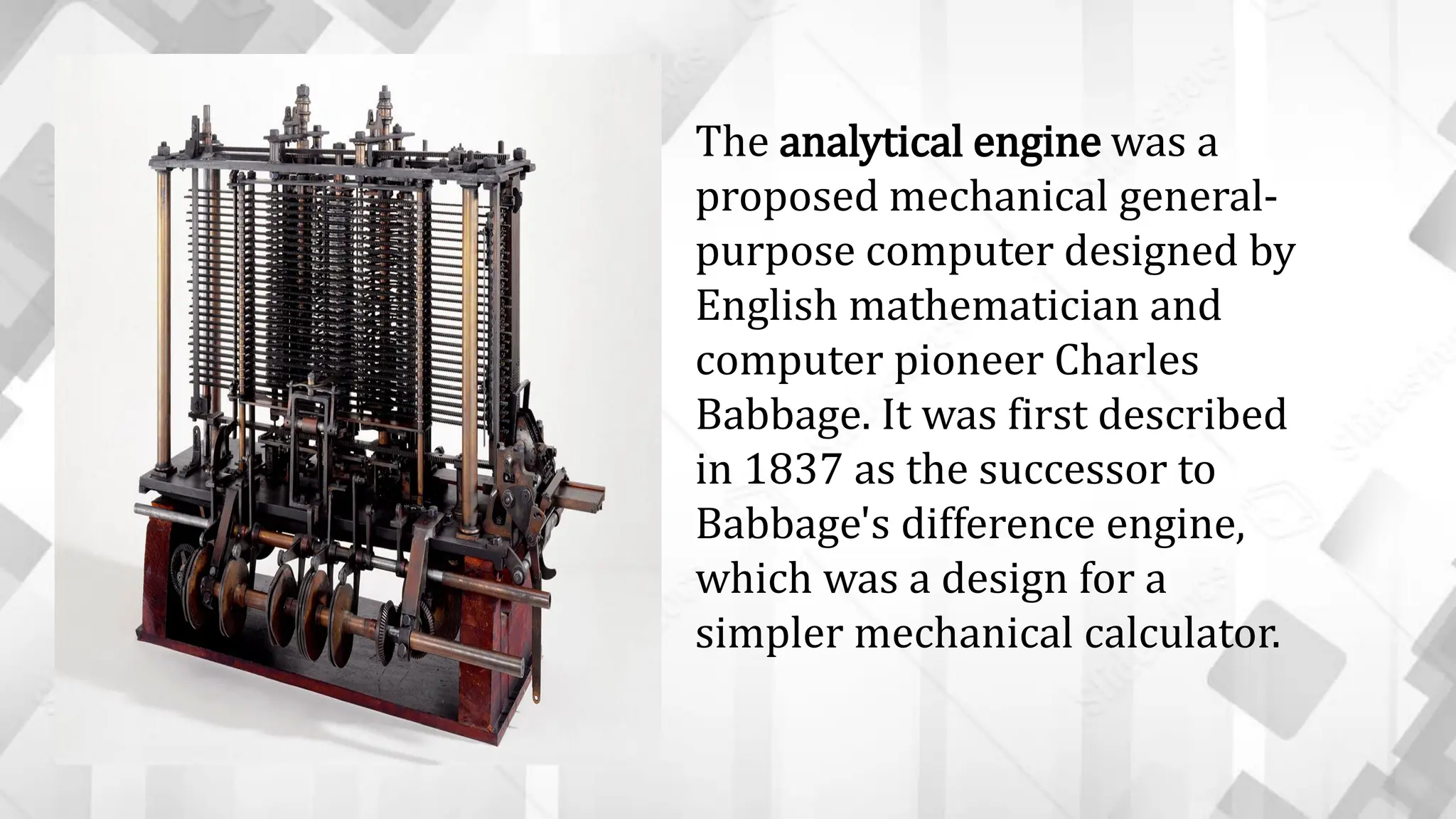
The analytical engine was a
proposed mechanical general-
purpose computer designed by
English mathematician and
computer pioneer Charles
Babbage. It was first described
in 1837 as the successor to
Babbage's difference engine,
which was a design for a
simpler mechanical calculator.
Charles Xavier Thomas de Colmar
He was a French inventor and
entrepreneur best known for designing,
patenting and manufacturing the first
commercially successful mechanical
calculator, the Arithmometer.
Arithmometer, early calculating machine,
built in 1820 by Charles Xavier Thomas
de Colmar of France. Whereas earlier
calculating machines, such as Blaise
Pascal’s Pascaline in France and Gottfried
Wilhelm von Leibniz’s Step Reckoner in
Germany, were mere curiosities, with the
Industrial Revolution came a widespread
need to perform repetitive operations
efficiently.
Lady Ada Augusta Lovelace Byron
She was an English mathematician
who has been called the first computer
programmer for writing an algorithm, or
a set of operating instructions, for the
early computing machine built by Charles
Babbage in 1821.
Computer Programming
Ada Lovelace became an expert in its
design and operation. And in 1843, she
translated a French description of the
machine into English. In the translation,
Lovelace added her copious notes and
annotations, which included a method of
calculating Bernoulli numbers using the
Analytical Engine. This became known as
the world’s first complete computer
program.
ELECTROMECHANICAL AGE
(1840-1940)
The electromechanical age heralded the beginnings of
telecommunications as we know it today. This age can be defined
roughly as the time between 1840 and 1940. Several revolutionary
technologies were invented in this period such as the Morse code,
telephone, radio, etc. All of these technologies were crucial
stepping stones towards modern information technology systems.
The Beginning of Telecommunications
• Voltaic Battery
• Telegraph
• Morse Code
• Telephone and Radio
Voltaic Battery - the discovery of a
reliable method of creating and
storing electricity (with a voltaic
battery) at the end of the 18th
century made possible a whole new
method of communicating
information.
Telegraph- the first major invention
to use electricity for communication
purposes, made it possible to
transmit information over great
distances with great speed.
Morse Code - the usefulness of the
telegraph was further enhanced by
the development of Morse Code in
1835 by Samuel Morse, an
American from New York. Morse
devised a system that broke down
information into bits that could then
be transformed into electrical
impulses and transmitted over a
wire (just as today's digital
technologies break down
information into zeros and ones).
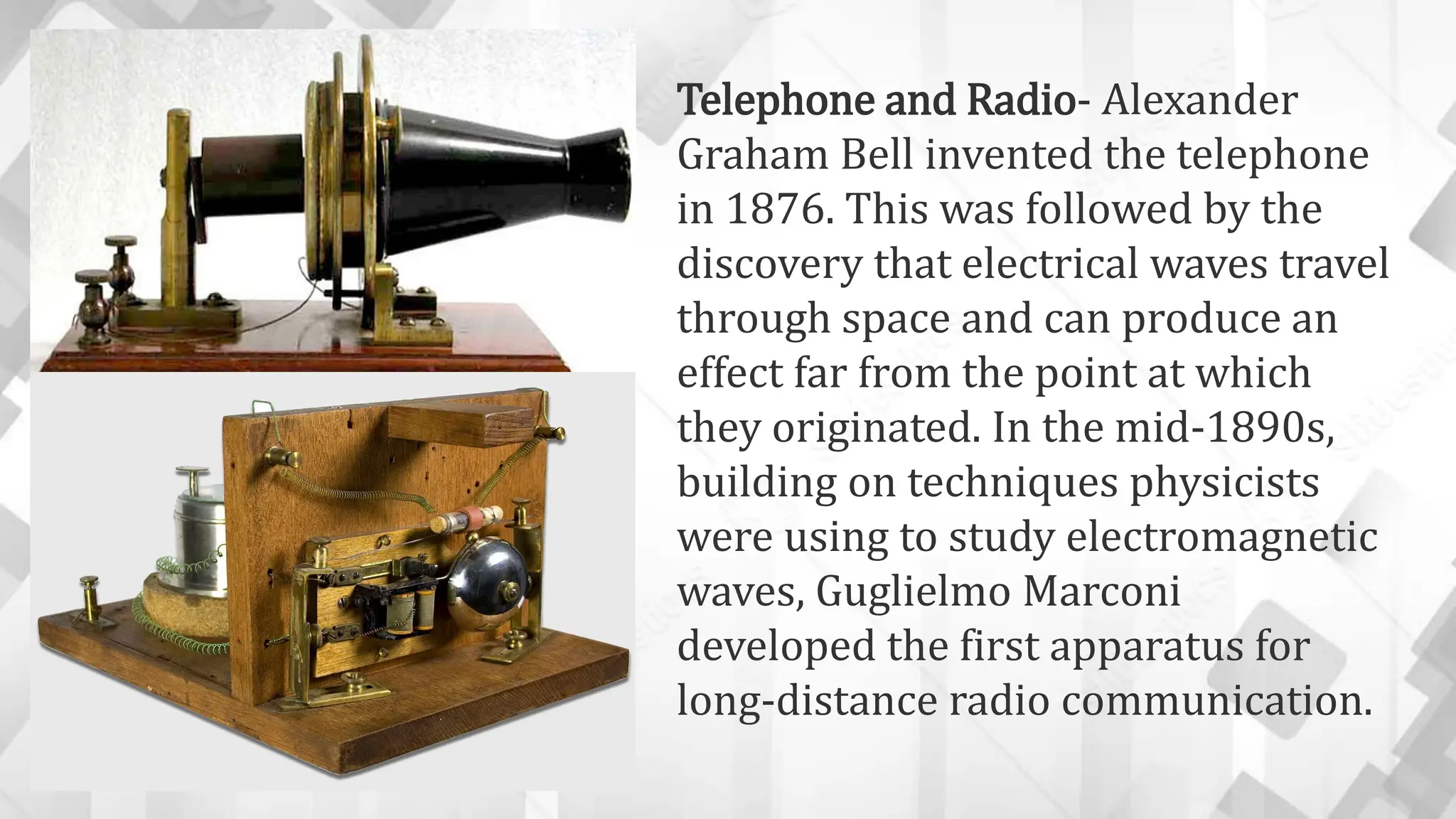
Telephone and Radio- Alexander
Graham Bell invented the telephone
in 1876. This was followed by the
discovery that electrical waves travel
through space and can produce an
effect far from the point at which
they originated. In the mid-1890s,
building on techniques physicists
were using to study electromagnetic
waves, Guglielmo Marconi
developed the first apparatus for
long-distance radio communication.
ELECTRONIC AGE
(1941-Present)
The Electronic Age is also known as the information age or
the digital age. It is a period in human history characterized by the
shift from traditional industry that the industrial revolution
brought through industrialization, to an economy based on
information computerization. The onset of the Electronic Age is
associated with the Digital Revolution, just as the Industrial
Revolution marked the onset of the Industrial Age.
Konrad Ernst Otto Zuse
He was a German civil engineer,
pioneering computer scientist, inventor
and businessman. His greatest
achievement was the world's first
programmable computer; the functional
program-controlled Turing-complete Z3
became operational in May 1941. Zuse
is regarded by some as the inventor and
father of the modern computer.
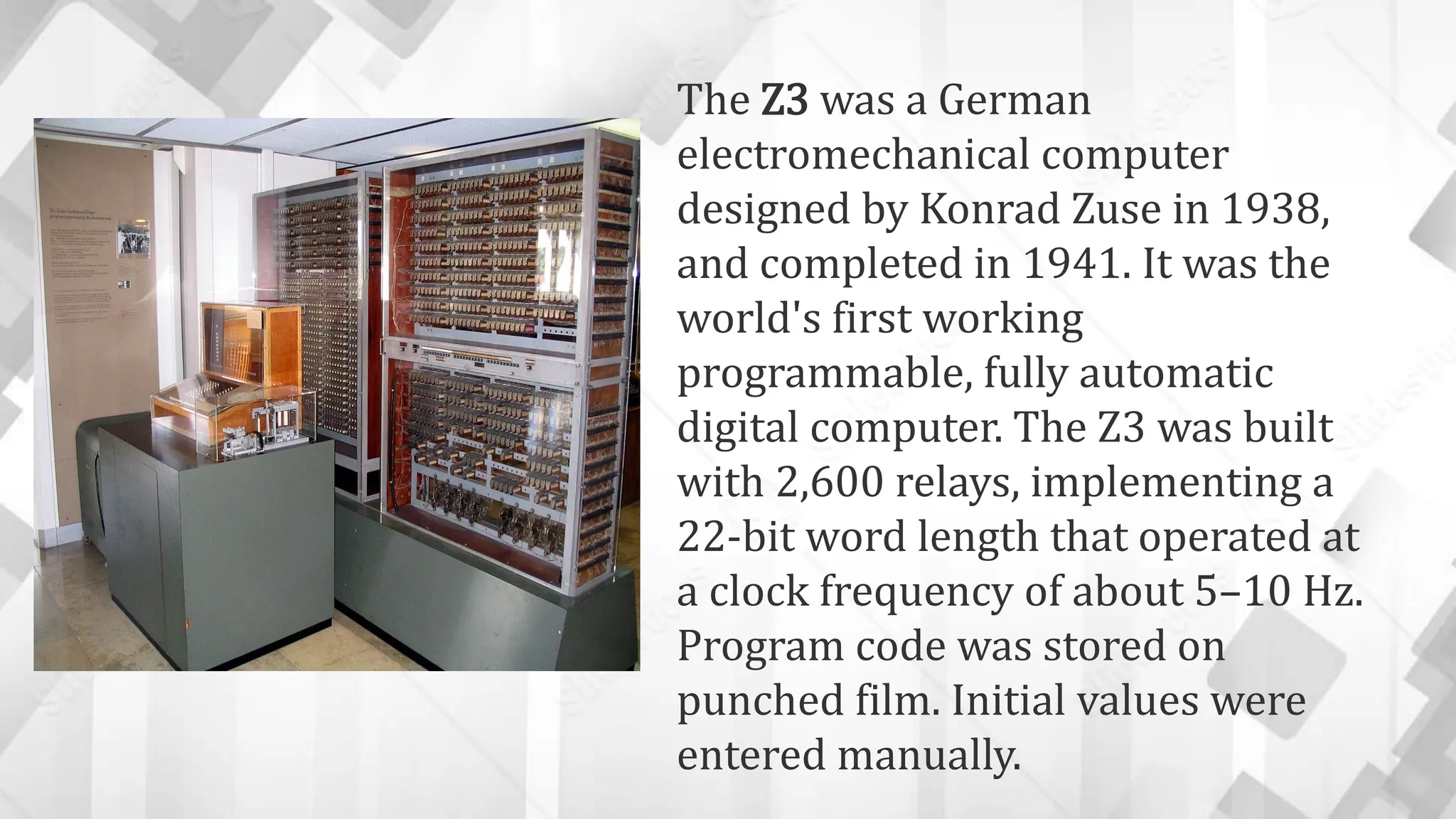
The Z3 was a German
electromechanical computer
designed by Konrad Zuse in 1938,
and completed in 1941. It was the
world's first working
programmable, fully automatic
digital computer. The Z3 was built
with 2,600 relays, implementing a
22-bit word length that operated at
a clock frequency of about 5–10 Hz.
Program code was stored on
punched film. Initial values were
entered manually.
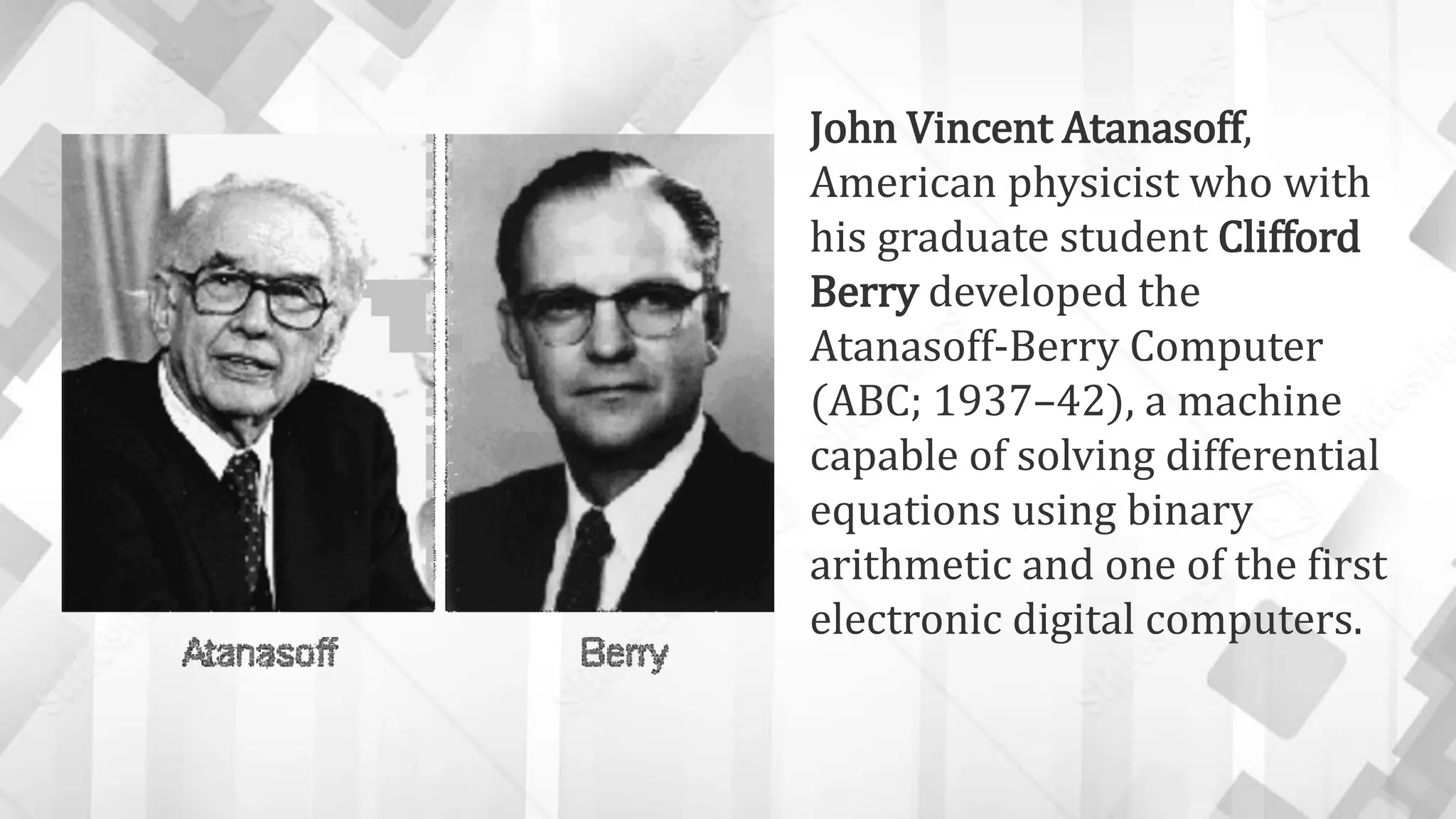
John Vincent Atanasoff,
American physicist who with
his graduate student Clifford
Berry developed the
Atanasoff-Berry Computer
(ABC; 1937–42), a machine
capable of solving differential
equations using binary
arithmetic and one of the first
electronic digital computers.
The Atanasoff–Berry Computer
(ABC) was the first automatic
electronic digital computer. Limited
by the technology of the day, and
execution, the device has remained
somewhat obscure. The ABC's
priority is debated among historians
of computer technology, because it
was neither programmable, nor
Turing-complete.
John von Neumann was a Hungarian-
American mathematician, physicist,
computer scientist, engineer and
polymath. He was regarded as having
perhaps the widest coverage of any
mathematician of his time and was
said to have been "the last
representative of the great
mathematicians who were equally at
home in both pure and applied
mathematics".
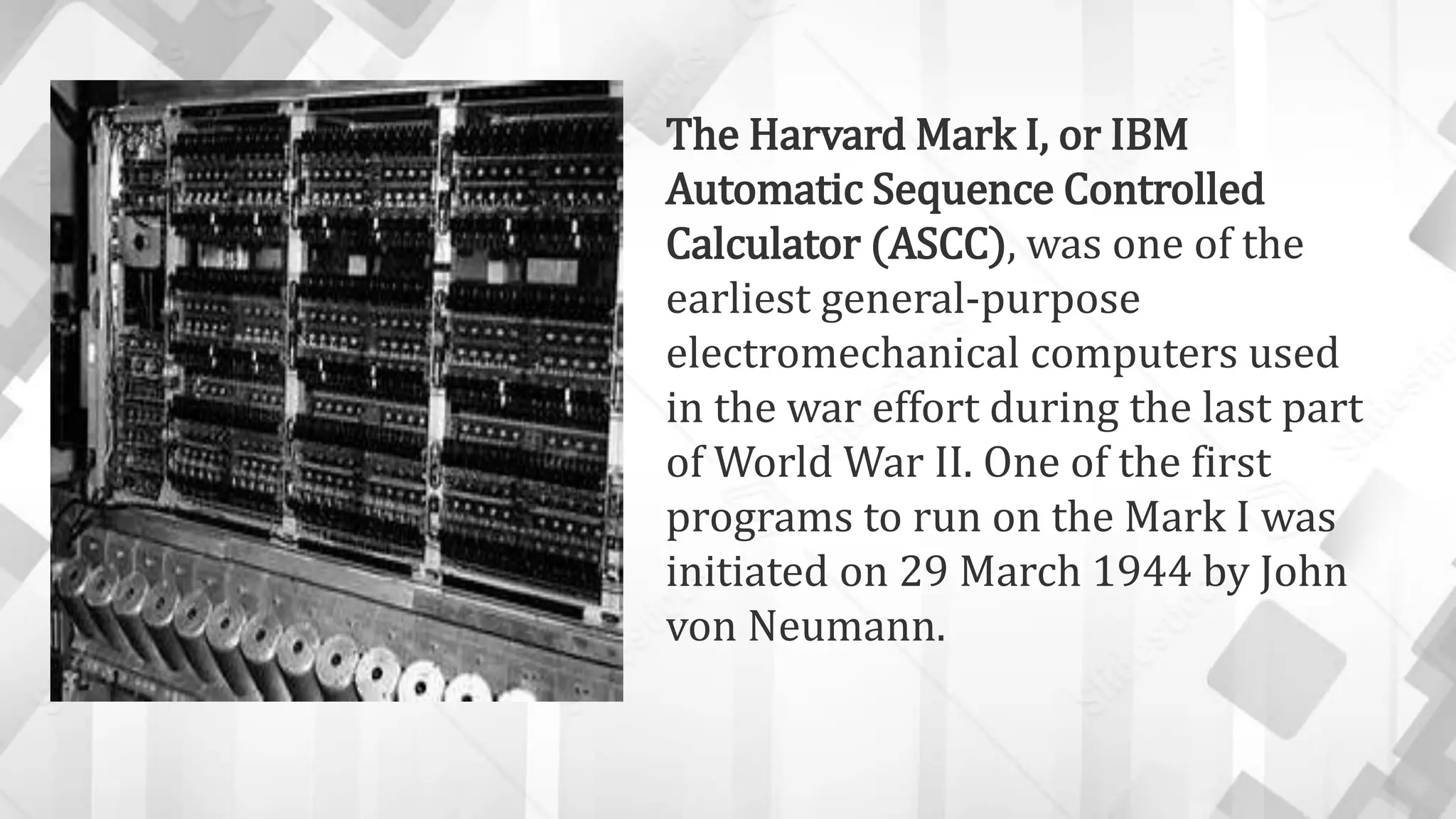
The Harvard Mark I, or IBM
Automatic Sequence Controlled
Calculator (ASCC), was one of the
earliest general-purpose
electromechanical computers used
in the war effort during the last part
of World War II. One of the first
programs to run on the Mark I was
initiated on 29 March 1944 by John
von Neumann.
THANK YOU...

GEE-LIE LIVING IN THE IT ERA (FOUR BASIC COMPUTER PERIODS).pdf

  • 1.
  • 2.
  • 3.
    PRE-MECHANICAL AGE (3000 BC-1450 AD) The Pre-mechanical age is the earliest age of information technology. When humans first started communicating, they would try to use language or simple picture drawings known as petroglyphs which were usually carved in rock. Early alphabets were developed such as the Phoenician alphabet.
  • 4.
    THE PRE-MECHANICAL AGE (3000BC- 1450 AD) • Writing and Alphabets • Paper and Pen • Books and Libraries • The First Numbering System • The First Calculators
  • 5.
    A petroglyph isan image created by removing part of a rock surface by incising, picking, carving, or abrading ,as a form of rock art.
  • 6.
    Cuneiform is oneof the oldest forms of writing known. It means "wedge-shaped," because people wrote it using a reed stylus cut to make a wedge-shaped mark on a clay tablet.
  • 7.
    Abacus is usedto show how numbers, letters, and signs can be stored in a binary system on a Computer, or using an ASCII number. The device consists of a series of beads on parallel wires that are arranged in three separate rows.
  • 8.
    MECHANICAL AGE (1450-1840) This isthe age that we observe the first connections between the technology of today and its ancestors. Slide rule is invented (early example of analog computers). The first general purpose computers are developed.
  • 9.
    CHARLES BABBAGE • Fatherof modern computer. • Invented the difference engine (1821) and analytical engine (1832).
  • 10.
    A difference engineis automatic mechanical calculator designed to tabulate polynomial functions. It was designed in the 1820s and was first created by Charles Babbage. The name difference engine is derived from the method of divided differences, a way to interpolate or tabulate functions by using a small set of polynomial co-efficient.
  • 11.
    The analytical enginewas a proposed mechanical general- purpose computer designed by English mathematician and computer pioneer Charles Babbage. It was first described in 1837 as the successor to Babbage's difference engine, which was a design for a simpler mechanical calculator.
  • 12.
    Charles Xavier Thomasde Colmar He was a French inventor and entrepreneur best known for designing, patenting and manufacturing the first commercially successful mechanical calculator, the Arithmometer.
  • 13.
    Arithmometer, early calculatingmachine, built in 1820 by Charles Xavier Thomas de Colmar of France. Whereas earlier calculating machines, such as Blaise Pascal’s Pascaline in France and Gottfried Wilhelm von Leibniz’s Step Reckoner in Germany, were mere curiosities, with the Industrial Revolution came a widespread need to perform repetitive operations efficiently.
  • 14.
    Lady Ada AugustaLovelace Byron She was an English mathematician who has been called the first computer programmer for writing an algorithm, or a set of operating instructions, for the early computing machine built by Charles Babbage in 1821.
  • 15.
    Computer Programming Ada Lovelacebecame an expert in its design and operation. And in 1843, she translated a French description of the machine into English. In the translation, Lovelace added her copious notes and annotations, which included a method of calculating Bernoulli numbers using the Analytical Engine. This became known as the world’s first complete computer program.
  • 16.
    ELECTROMECHANICAL AGE (1840-1940) The electromechanicalage heralded the beginnings of telecommunications as we know it today. This age can be defined roughly as the time between 1840 and 1940. Several revolutionary technologies were invented in this period such as the Morse code, telephone, radio, etc. All of these technologies were crucial stepping stones towards modern information technology systems.
  • 17.
    The Beginning ofTelecommunications • Voltaic Battery • Telegraph • Morse Code • Telephone and Radio
  • 18.
    Voltaic Battery -the discovery of a reliable method of creating and storing electricity (with a voltaic battery) at the end of the 18th century made possible a whole new method of communicating information.
  • 19.
    Telegraph- the firstmajor invention to use electricity for communication purposes, made it possible to transmit information over great distances with great speed.
  • 20.
    Morse Code -the usefulness of the telegraph was further enhanced by the development of Morse Code in 1835 by Samuel Morse, an American from New York. Morse devised a system that broke down information into bits that could then be transformed into electrical impulses and transmitted over a wire (just as today's digital technologies break down information into zeros and ones).
  • 21.
    Telephone and Radio-Alexander Graham Bell invented the telephone in 1876. This was followed by the discovery that electrical waves travel through space and can produce an effect far from the point at which they originated. In the mid-1890s, building on techniques physicists were using to study electromagnetic waves, Guglielmo Marconi developed the first apparatus for long-distance radio communication.
  • 22.
    ELECTRONIC AGE (1941-Present) The ElectronicAge is also known as the information age or the digital age. It is a period in human history characterized by the shift from traditional industry that the industrial revolution brought through industrialization, to an economy based on information computerization. The onset of the Electronic Age is associated with the Digital Revolution, just as the Industrial Revolution marked the onset of the Industrial Age.
  • 23.
    Konrad Ernst OttoZuse He was a German civil engineer, pioneering computer scientist, inventor and businessman. His greatest achievement was the world's first programmable computer; the functional program-controlled Turing-complete Z3 became operational in May 1941. Zuse is regarded by some as the inventor and father of the modern computer.
  • 24.
    The Z3 wasa German electromechanical computer designed by Konrad Zuse in 1938, and completed in 1941. It was the world's first working programmable, fully automatic digital computer. The Z3 was built with 2,600 relays, implementing a 22-bit word length that operated at a clock frequency of about 5–10 Hz. Program code was stored on punched film. Initial values were entered manually.
  • 25.
    John Vincent Atanasoff, Americanphysicist who with his graduate student Clifford Berry developed the Atanasoff-Berry Computer (ABC; 1937–42), a machine capable of solving differential equations using binary arithmetic and one of the first electronic digital computers.
  • 26.
    The Atanasoff–Berry Computer (ABC)was the first automatic electronic digital computer. Limited by the technology of the day, and execution, the device has remained somewhat obscure. The ABC's priority is debated among historians of computer technology, because it was neither programmable, nor Turing-complete.
  • 27.
    John von Neumannwas a Hungarian- American mathematician, physicist, computer scientist, engineer and polymath. He was regarded as having perhaps the widest coverage of any mathematician of his time and was said to have been "the last representative of the great mathematicians who were equally at home in both pure and applied mathematics".
  • 28.
    The Harvard MarkI, or IBM Automatic Sequence Controlled Calculator (ASCC), was one of the earliest general-purpose electromechanical computers used in the war effort during the last part of World War II. One of the first programs to run on the Mark I was initiated on 29 March 1944 by John von Neumann.
  • 29.