VISUAL ART
DEFINITION & MEANING
Module 1
Visual Arts
Is a modern but imprecise umbrella term for
a broad category of art which includes a
number of artistic disciplines from various
sub-categories.
Arts
The meaning of beauty and art is explored in the
branch of philosophy called aesthetics. Visual
Arts is one of the Arts Education Key Learning
Area.
The Visual Arts assist students in their
acquisition of artistic and aesthetic
experiences, knowledge, skills, values and
attitudes, all of which contribute to students’
whole-person development.
Arts
It also provides a curriculum framework for
students who take Visual Arts as a subject, and
go through the public assessment process that
will replace the existing Visual Arts
Examination and the Advanced Level Art
Examination.
Visual Arts
The Visual Arts course is
different from the existing Art
and Design courses, that it
emphasizes both art appreciation
and criticism and art making.
Visual Arts, as a subject, is
designed to stretch students’
aesthetic and artistic potential
and develop their values and
attitudes, thus empowering them
to be better prepared for their
own future.
Being a place of diverse
cultures at the crossroads of
change, our country Philippines
is influenced by a mix of
local, Asian and Western art.
It has become more and more
important to rediscover links
to other countries’ artistic
heritage and connections to the
art of Asia and other cultural
contexts.
Visual Arts
There is also a greater emphasis on
studying the contextual character
of the visual arts. This course
emphasizes the further development
of the mind to which the visual
arts can contribute. . Human beings
are always making marks and looking
at/reading others’ marks, and
western theorists have discussed
these marks, and also used the idea
of visual as a metaphor for
understanding and perception, for
as long as they’ve been writing.
Being a place of diverse
cultures at the crossroads of
change, our country Philippines
is influenced by a mix of
local, Asian and Western art.
It has become more and more
important to rediscover links
to other countries’ artistic
heritage and connections to the
art of Asia and other cultural
contexts.
01
OVERVIEW
The ancient Greek philosophers
insisted on the importance of
visual for truth and knowledge:
Heraclitus in 500 BC wrote: Those
things of which there is sight,
hearing, knowledge.
02
OVERVIEW
Plato, writing over a century
later, argued that truth is
embodied in what he called the
Idea, which he understood as an
actual form visible to the mind (or
‘the mind’s eye’).
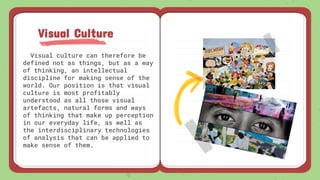
Visual culture can therefore be
defined not as things, but as a way
of thinking, an intellectual
discipline for making sense of the
world. Our position is that visual
culture is most profitably
understood as all those visual
artefacts, natural forms and ways
of thinking that make up perception
in our everyday life, as well as
the interdisciplinary technologies
of analysis that can be applied to
make sense of them.
Visual Culture
Capital-A Art is one discipline that provides many
useful techniques for anyone studying visual culture,
and is one of the important fields of social
understanding, history and culture; we therefore
include it as a particular instance of the field, as
something we can use to see and understand the world
through seeing. Other approaches focus on the processes
of spectatorship; the production of visual media,
especially digital media; anthropology; how objects are
designed; why some visual matter is considered
beautiful or appealing; and the social and economic
importance of media convergence in making sense of the
world.
visual studies, this is an interdisciplinary
field that has close links with the humanities
and social sciences—philosophy, sociology and
literary studies in particular. It is, as the
editorial statement of the journal Cultural
Studies notes, committed to the theorizing of
politics and the politicizing of theory, and
hence is a discipline which is concerned with how
to understand human and institutional relations
and practices.
Cultural theorists are always concerned to break
with everyday notions about how the world works,
and to understand the extent to which society is
built on arbitrary divisions that serve
particular interests. Cultural theory asks
questions like:
Why are things as they are?
How could they be different?
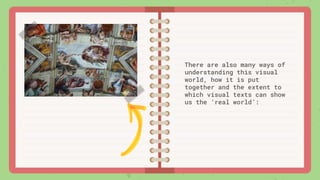
There are also many ways of
understanding this visual
world, how it is put
together and the extent to
which visual texts can show
us the ‘real world’:
Writers on visual culture
debate the extent to which visual
texts, especially those that
comprise a single frame, can tell
a story in and of themselves. We
outline what is meant by
narrative, and examine how
narratives emerge in visual
texts. Some of the most important
stories of our time are those
told through visual art, social
institutions that determine what
can be seen and the economic
market.
Some of these ideas, particularly
those concerned with the social
function of visual texts, and
their role as pieces of
communication; we also examine
the degree to which linguistic
models of communication can be
applied to the analysis of visual
texts. One of the important ways
of making sense of visual texts
is through narrative, or stories
that are organized visually.
Thank you!
Module 1

Week 1 definition and meaning

  • 1.
    VISUAL ART DEFINITION &MEANING Module 1
  • 2.
    Visual Arts Is amodern but imprecise umbrella term for a broad category of art which includes a number of artistic disciplines from various sub-categories.
  • 3.
    Arts The meaning ofbeauty and art is explored in the branch of philosophy called aesthetics. Visual Arts is one of the Arts Education Key Learning Area. The Visual Arts assist students in their acquisition of artistic and aesthetic experiences, knowledge, skills, values and attitudes, all of which contribute to students’ whole-person development.
  • 4.
    Arts It also providesa curriculum framework for students who take Visual Arts as a subject, and go through the public assessment process that will replace the existing Visual Arts Examination and the Advanced Level Art Examination.
  • 5.
    Visual Arts The VisualArts course is different from the existing Art and Design courses, that it emphasizes both art appreciation and criticism and art making. Visual Arts, as a subject, is designed to stretch students’ aesthetic and artistic potential and develop their values and attitudes, thus empowering them to be better prepared for their own future. Being a place of diverse cultures at the crossroads of change, our country Philippines is influenced by a mix of local, Asian and Western art. It has become more and more important to rediscover links to other countries’ artistic heritage and connections to the art of Asia and other cultural contexts.
  • 6.
    Visual Arts There isalso a greater emphasis on studying the contextual character of the visual arts. This course emphasizes the further development of the mind to which the visual arts can contribute. . Human beings are always making marks and looking at/reading others’ marks, and western theorists have discussed these marks, and also used the idea of visual as a metaphor for understanding and perception, for as long as they’ve been writing. Being a place of diverse cultures at the crossroads of change, our country Philippines is influenced by a mix of local, Asian and Western art. It has become more and more important to rediscover links to other countries’ artistic heritage and connections to the art of Asia and other cultural contexts.
  • 7.
    01 OVERVIEW The ancient Greekphilosophers insisted on the importance of visual for truth and knowledge: Heraclitus in 500 BC wrote: Those things of which there is sight, hearing, knowledge.
  • 8.
    02 OVERVIEW Plato, writing overa century later, argued that truth is embodied in what he called the Idea, which he understood as an actual form visible to the mind (or ‘the mind’s eye’).
  • 9.
    Visual culture cantherefore be defined not as things, but as a way of thinking, an intellectual discipline for making sense of the world. Our position is that visual culture is most profitably understood as all those visual artefacts, natural forms and ways of thinking that make up perception in our everyday life, as well as the interdisciplinary technologies of analysis that can be applied to make sense of them. Visual Culture
  • 10.
    Capital-A Art isone discipline that provides many useful techniques for anyone studying visual culture, and is one of the important fields of social understanding, history and culture; we therefore include it as a particular instance of the field, as something we can use to see and understand the world through seeing. Other approaches focus on the processes of spectatorship; the production of visual media, especially digital media; anthropology; how objects are designed; why some visual matter is considered beautiful or appealing; and the social and economic importance of media convergence in making sense of the world.
  • 11.
    visual studies, thisis an interdisciplinary field that has close links with the humanities and social sciences—philosophy, sociology and literary studies in particular. It is, as the editorial statement of the journal Cultural Studies notes, committed to the theorizing of politics and the politicizing of theory, and hence is a discipline which is concerned with how to understand human and institutional relations and practices.
  • 12.
    Cultural theorists arealways concerned to break with everyday notions about how the world works, and to understand the extent to which society is built on arbitrary divisions that serve particular interests. Cultural theory asks questions like: Why are things as they are? How could they be different?
  • 13.
    There are alsomany ways of understanding this visual world, how it is put together and the extent to which visual texts can show us the ‘real world’:
  • 14.
    Writers on visualculture debate the extent to which visual texts, especially those that comprise a single frame, can tell a story in and of themselves. We outline what is meant by narrative, and examine how narratives emerge in visual texts. Some of the most important stories of our time are those told through visual art, social institutions that determine what can be seen and the economic market. Some of these ideas, particularly those concerned with the social function of visual texts, and their role as pieces of communication; we also examine the degree to which linguistic models of communication can be applied to the analysis of visual texts. One of the important ways of making sense of visual texts is through narrative, or stories that are organized visually.
  • 15.