Labour principles
Pooran C. Pandey
Global Compact Network
India
Global Compact Network India
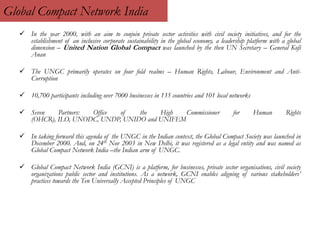
 In the year 2000, with an aim to conjoin private sector activities with civil society initiatives, and for the
establishment of an inclusive corporate sustainability in the global economy, a leadership platform with a global
dimension – United Nation Global Compact was launched by the then UN Secretary – General Kofi
Anan
 The UNGC primarily operates on four fold realms – Human Rights, Labour, Environment and Anti-
Corruption
 10,700 participants including over 7000 businesses in 135 countries and 101 local networks
 Seven Partners: Office of the High Commissioner for Human Rights
(OHCR), ILO, UNODC, UNDP, UNIDO and UNIFEM
 In taking forward this agenda of the UNGC in the Indian context, the Global Compact Society was launched in
December 2000. And, on 24th Nov 2003 in New Delhi, it was registered as a legal entity and was named as
Global Compact Network India –the Indian arm of UNGC.
 Global Compact Network India (GCNI) is a platform, for businesses, private sector organisations, civil society
organizations public sector and institutions. As a network, GCNI enables aligning of various stakeholders’
practices towards the Ten Universally Accepted Principles of UNGC
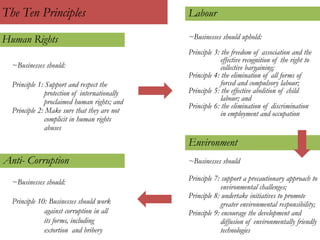
The Ten Principles
~Businesses should:
Principle 1: Support and respect the
protection of internationally
proclaimed human rights; and
Principle 2: Make sure that they are not
complicit in human rights
abuses
Human Rights
Labour
~Businesses should uphold:
Principle 3: the freedom of association and the
effective recognition of the right to
collective bargaining;
Principle 4: the elimination of all forms of
forced and compulsory labour;
Principle 5: the effective abolition of child
labour; and
Principle 6: the elimination of discrimination
in employment and occupation
Environment
~Businesses should
Principle 7: support a precautionary approach to
environmental challenges;
Principle 8: undertake initiatives to promote
greater environmental responsibility;
Principle 9: encourage the development and
diffusion of environmentally friendly
technologies
Anti- Corruption
~Businesses should:
Principle 10: Businesses should work
against corruption in all
its forms, including
extortion and bribery
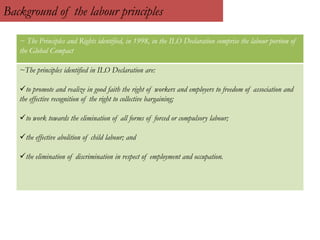
Background of the labour principles
~ The Principles and Rights identified, in 1998, in the ILO Declaration comprise the labour portion of
the Global Compact
~The principles identified in ILO Declaration are:
to promote and realize in good faith the right of workers and employers to freedom of association and
the effective recognition of the right to collective bargaining;
to work towards the elimination of all forms of forced or compulsory labour;
the effective abolition of child labour; and
the elimination of discrimination in respect of employment and occupation.
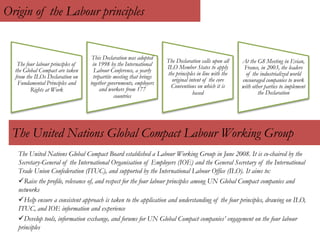
Origin of the Labour principles
The four labour principles of
the Global Compact are taken
from the ILOs Declaration on
Fundamental Principles and
Rights at Work
This Declaration was adopted
in 1998 by the International
Labour Conference, a yearly
tripartite meeting that brings
together governments, employers
and workers from 177
countries
The Declaration calls upon all
ILO Member States to apply
the principles in line with the
original intent of the core
Conventions on which it is
based
At the G8 Meeting in Evian,
France, in 2003, the leaders
of the industrialized world
encouraged companies to work
with other parties to implement
the Declaration
The United Nations Global Compact Labour Working Group
The United Nations Global Compact Board established a Labour Working Group in June 2008. It is co-chaired by the
Secretary-General of the International Organisation of Employers (IOE) and the General Secretary of the International
Trade Union Confederation (ITUC), and supported by the International Labour Office (ILO). It aims to:
Raise the profile, relevance of, and respect for the four labour principles among UN Global Compact companies and
networks
Help ensure a consistent approach is taken to the application and understanding of the four principles, drawing on ILO,
ITUC, and IOE information and experience
Develop tools, information exchange, and forums for UN Global Compact companies’ engagement on the four labour
principles
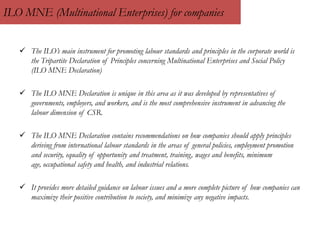
ILO MNE (Multinational Enterprises) for companies
 The ILO’s main instrument for promoting labour standards and principles in the corporate world is
the Tripartite Declaration of Principles concerning Multinational Enterprises and Social Policy
(ILO MNE Declaration)
 The ILO MNE Declaration is unique in this area as it was developed by representatives of
governments, employers, and workers, and is the most comprehensive instrument in advancing the
labour dimension of CSR.
 The ILO MNE Declaration contains recommendations on how companies should apply principles
deriving from international labour standards in the areas of general policies, employment promotion
and security, equality of opportunity and treatment, training, wages and benefits, minimum
age, occupational safety and health, and industrial relations.
 It provides more detailed guidance on labour issues and a more complete picture of how companies can
maximize their positive contribution to society, and minimize any negative impacts.
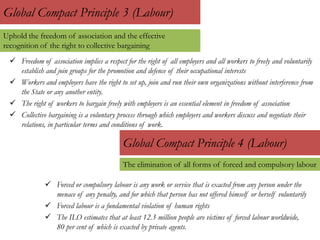
Global Compact Principle 3 (Labour)
 Freedom of association implies a respect for the right of all employers and all workers to freely and voluntarily
establish and join groups for the promotion and defence of their occupational interests
 Workers and employers have the right to set up, join and run their own organizations without interference from
the State or any another entity.
 The right of workers to bargain freely with employers is an essential element in freedom of association
 Collective bargaining is a voluntary process through which employers and workers discuss and negotiate their
relations, in particular terms and conditions of work.
Global Compact Principle 4 (Labour)
 Forced or compulsory labour is any work or service that is exacted from any person under the
menace of any penalty, and for which that person has not offered himself or herself voluntarily
 Forced labour is a fundamental violation of human rights
 The ILO estimates that at least 12.3 million people are victims of forced labour worldwide,
80 per cent of which is exacted by private agents.
Uphold the freedom of association and the effective
recognition of the right to collective bargaining
The elimination of all forms of forced and compulsory labour
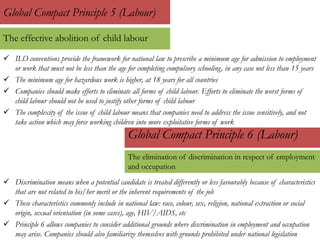
 ILO conventions provide the framework for national law to prescribe a minimum age for admission to employment
or work that must not be less than the age for completing compulsory schooling, in any case not less than 15 years
 The minimum age for hazardous work is higher, at 18 years for all countries
 Companies should make efforts to eliminate all forms of child labour. Efforts to eliminate the worst forms of
child labour should not be used to justify other forms of child labour
 The complexity of the issue of child labour means that companies need to address the issue sensitively, and not
take action which may force working children into more exploitative forms of work
Global Compact Principle 5 (Labour)
Global Compact Principle 6 (Labour)
 Discrimination means when a potential candidate is treated differently or less favourably because of characteristics
that are not related to his/her merit or the inherent requirements of the job
 These characteristics commonly include in national law: race, colour, sex, religion, national extraction or social
origin, sexual orientation (in some cases), age, HIV/AIDS, etc
 Principle 6 allows companies to consider additional grounds where discrimination in employment and occupation
may arise. Companies should also familiarize themselves with grounds prohibited under national legislation
The effective abolition of child labour
The elimination of discrimination in respect of employment
and occupation
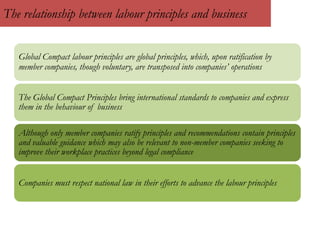
The relationship between labour principles and business
Global Compact labour principles are global principles, which, upon ratification by
member companies, though voluntary, are transposed into companies’ operations
The Global Compact Principles bring international standards to companies and express
them in the behaviour of business
Although only member companies ratify principles and recommendations contain principles
and valuable guidance which may also be relevant to non-member companies seeking to
improve their workplace practices beyond legal compliance
Companies must respect national law in their efforts to advance the labour principles
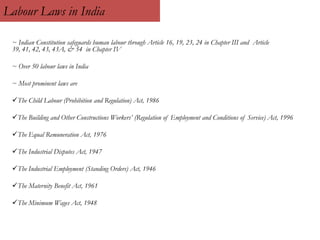
Labour Laws in India
~ Indian Constitution safeguards human labour through Article 16, 19, 23, 24 in Chapter III and Article
39, 41, 42, 43, 43A, & 54 in Chapter IV
~ Over 50 labour laws in India
~ Most prominent laws are
The Child Labour (Prohibition and Regulation) Act, 1986
The Building and Other Constructions Workers’ (Regulation of Employment and Conditions of Service) Act, 1996
The Equal Remuneration Act, 1976
The Industrial Disputes Act, 1947
The Industrial Employment (Standing Orders) Act, 1946
The Maternity Benefit Act, 1961
The Minimum Wages Act, 1948
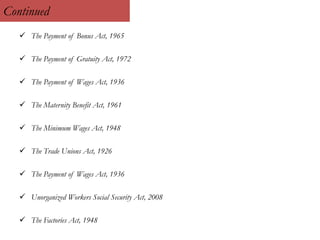
Continued
 The Payment of Bonus Act, 1965
 The Payment of Gratuity Act, 1972
 The Payment of Wages Act, 1936
 The Maternity Benefit Act, 1961
 The Minimum Wages Act, 1948
 The Trade Unions Act, 1926
 The Payment of Wages Act, 1936
 Unorganized Workers Social Security Act, 2008
 The Factories Act, 1948
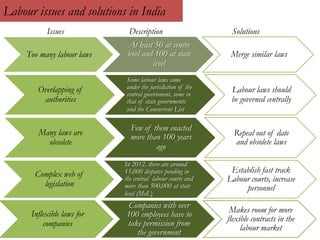
Labour issues and solutions in India
Too many labour laws
At least 50 at centre
level and 100 at state
level
Merge similar laws
Overlapping of
authorities
Some labour laws come
under the jurisdiction of the
central government, some in
that of state governments
and the Concurrent List
Labour laws should
be governed centrally
Many laws are
obsolete
Few of them enacted
more than 100 years
ago
Repeal out of date
and obsolete laws
Complex web of
legislation
In 2012, there are around
15,000 disputes pending in
the central labour courts and
more than 500,000 at state
level (MoL)
Establish fast track
Labour courts, increase
personnel
Inflexible laws for
companies
Companies with over
100 employees have to
take permission from
the government
Makes room for more
flexible contracts in the
labour market
Issues Description Solutions
Thank you

UN Global Compact Network India : Labour Principles by Pooran C. Pandey

  • 1.
    Labour principles Pooran C.Pandey Global Compact Network India
  • 2.
    Global Compact NetworkIndia  In the year 2000, with an aim to conjoin private sector activities with civil society initiatives, and for the establishment of an inclusive corporate sustainability in the global economy, a leadership platform with a global dimension – United Nation Global Compact was launched by the then UN Secretary – General Kofi Anan  The UNGC primarily operates on four fold realms – Human Rights, Labour, Environment and Anti- Corruption  10,700 participants including over 7000 businesses in 135 countries and 101 local networks  Seven Partners: Office of the High Commissioner for Human Rights (OHCR), ILO, UNODC, UNDP, UNIDO and UNIFEM  In taking forward this agenda of the UNGC in the Indian context, the Global Compact Society was launched in December 2000. And, on 24th Nov 2003 in New Delhi, it was registered as a legal entity and was named as Global Compact Network India –the Indian arm of UNGC.  Global Compact Network India (GCNI) is a platform, for businesses, private sector organisations, civil society organizations public sector and institutions. As a network, GCNI enables aligning of various stakeholders’ practices towards the Ten Universally Accepted Principles of UNGC
  • 3.
    The Ten Principles ~Businessesshould: Principle 1: Support and respect the protection of internationally proclaimed human rights; and Principle 2: Make sure that they are not complicit in human rights abuses Human Rights Labour ~Businesses should uphold: Principle 3: the freedom of association and the effective recognition of the right to collective bargaining; Principle 4: the elimination of all forms of forced and compulsory labour; Principle 5: the effective abolition of child labour; and Principle 6: the elimination of discrimination in employment and occupation Environment ~Businesses should Principle 7: support a precautionary approach to environmental challenges; Principle 8: undertake initiatives to promote greater environmental responsibility; Principle 9: encourage the development and diffusion of environmentally friendly technologies Anti- Corruption ~Businesses should: Principle 10: Businesses should work against corruption in all its forms, including extortion and bribery
  • 4.
    Background of thelabour principles ~ The Principles and Rights identified, in 1998, in the ILO Declaration comprise the labour portion of the Global Compact ~The principles identified in ILO Declaration are: to promote and realize in good faith the right of workers and employers to freedom of association and the effective recognition of the right to collective bargaining; to work towards the elimination of all forms of forced or compulsory labour; the effective abolition of child labour; and the elimination of discrimination in respect of employment and occupation.
  • 5.
    Origin of theLabour principles The four labour principles of the Global Compact are taken from the ILOs Declaration on Fundamental Principles and Rights at Work This Declaration was adopted in 1998 by the International Labour Conference, a yearly tripartite meeting that brings together governments, employers and workers from 177 countries The Declaration calls upon all ILO Member States to apply the principles in line with the original intent of the core Conventions on which it is based At the G8 Meeting in Evian, France, in 2003, the leaders of the industrialized world encouraged companies to work with other parties to implement the Declaration The United Nations Global Compact Labour Working Group The United Nations Global Compact Board established a Labour Working Group in June 2008. It is co-chaired by the Secretary-General of the International Organisation of Employers (IOE) and the General Secretary of the International Trade Union Confederation (ITUC), and supported by the International Labour Office (ILO). It aims to: Raise the profile, relevance of, and respect for the four labour principles among UN Global Compact companies and networks Help ensure a consistent approach is taken to the application and understanding of the four principles, drawing on ILO, ITUC, and IOE information and experience Develop tools, information exchange, and forums for UN Global Compact companies’ engagement on the four labour principles
  • 6.
    ILO MNE (MultinationalEnterprises) for companies  The ILO’s main instrument for promoting labour standards and principles in the corporate world is the Tripartite Declaration of Principles concerning Multinational Enterprises and Social Policy (ILO MNE Declaration)  The ILO MNE Declaration is unique in this area as it was developed by representatives of governments, employers, and workers, and is the most comprehensive instrument in advancing the labour dimension of CSR.  The ILO MNE Declaration contains recommendations on how companies should apply principles deriving from international labour standards in the areas of general policies, employment promotion and security, equality of opportunity and treatment, training, wages and benefits, minimum age, occupational safety and health, and industrial relations.  It provides more detailed guidance on labour issues and a more complete picture of how companies can maximize their positive contribution to society, and minimize any negative impacts.
  • 7.
    Global Compact Principle3 (Labour)  Freedom of association implies a respect for the right of all employers and all workers to freely and voluntarily establish and join groups for the promotion and defence of their occupational interests  Workers and employers have the right to set up, join and run their own organizations without interference from the State or any another entity.  The right of workers to bargain freely with employers is an essential element in freedom of association  Collective bargaining is a voluntary process through which employers and workers discuss and negotiate their relations, in particular terms and conditions of work. Global Compact Principle 4 (Labour)  Forced or compulsory labour is any work or service that is exacted from any person under the menace of any penalty, and for which that person has not offered himself or herself voluntarily  Forced labour is a fundamental violation of human rights  The ILO estimates that at least 12.3 million people are victims of forced labour worldwide, 80 per cent of which is exacted by private agents. Uphold the freedom of association and the effective recognition of the right to collective bargaining The elimination of all forms of forced and compulsory labour
  • 8.
     ILO conventionsprovide the framework for national law to prescribe a minimum age for admission to employment or work that must not be less than the age for completing compulsory schooling, in any case not less than 15 years  The minimum age for hazardous work is higher, at 18 years for all countries  Companies should make efforts to eliminate all forms of child labour. Efforts to eliminate the worst forms of child labour should not be used to justify other forms of child labour  The complexity of the issue of child labour means that companies need to address the issue sensitively, and not take action which may force working children into more exploitative forms of work Global Compact Principle 5 (Labour) Global Compact Principle 6 (Labour)  Discrimination means when a potential candidate is treated differently or less favourably because of characteristics that are not related to his/her merit or the inherent requirements of the job  These characteristics commonly include in national law: race, colour, sex, religion, national extraction or social origin, sexual orientation (in some cases), age, HIV/AIDS, etc  Principle 6 allows companies to consider additional grounds where discrimination in employment and occupation may arise. Companies should also familiarize themselves with grounds prohibited under national legislation The effective abolition of child labour The elimination of discrimination in respect of employment and occupation
  • 9.
    The relationship betweenlabour principles and business Global Compact labour principles are global principles, which, upon ratification by member companies, though voluntary, are transposed into companies’ operations The Global Compact Principles bring international standards to companies and express them in the behaviour of business Although only member companies ratify principles and recommendations contain principles and valuable guidance which may also be relevant to non-member companies seeking to improve their workplace practices beyond legal compliance Companies must respect national law in their efforts to advance the labour principles
  • 10.
    Labour Laws inIndia ~ Indian Constitution safeguards human labour through Article 16, 19, 23, 24 in Chapter III and Article 39, 41, 42, 43, 43A, & 54 in Chapter IV ~ Over 50 labour laws in India ~ Most prominent laws are The Child Labour (Prohibition and Regulation) Act, 1986 The Building and Other Constructions Workers’ (Regulation of Employment and Conditions of Service) Act, 1996 The Equal Remuneration Act, 1976 The Industrial Disputes Act, 1947 The Industrial Employment (Standing Orders) Act, 1946 The Maternity Benefit Act, 1961 The Minimum Wages Act, 1948
  • 11.
    Continued  The Paymentof Bonus Act, 1965  The Payment of Gratuity Act, 1972  The Payment of Wages Act, 1936  The Maternity Benefit Act, 1961  The Minimum Wages Act, 1948  The Trade Unions Act, 1926  The Payment of Wages Act, 1936  Unorganized Workers Social Security Act, 2008  The Factories Act, 1948
  • 12.
    Labour issues andsolutions in India Too many labour laws At least 50 at centre level and 100 at state level Merge similar laws Overlapping of authorities Some labour laws come under the jurisdiction of the central government, some in that of state governments and the Concurrent List Labour laws should be governed centrally Many laws are obsolete Few of them enacted more than 100 years ago Repeal out of date and obsolete laws Complex web of legislation In 2012, there are around 15,000 disputes pending in the central labour courts and more than 500,000 at state level (MoL) Establish fast track Labour courts, increase personnel Inflexible laws for companies Companies with over 100 employees have to take permission from the government Makes room for more flexible contracts in the labour market Issues Description Solutions
  • 13.