


Treatment of Giant Cell
Arteritis
DR. MAZEN AL ZO’UBI, MD
FELLOW OF RHEUMATOLOGY, DRMS, JORDAN
TREATMENT APPROACH
Glucocorticoid treatment should be instituted promptly once the diagnosis of GCA is suspected
strongly, especially those with recent or threatened vascular complications.
A temporal artery biopsy should be obtained as soon as possible, but treatment should not be
withheld while awaiting the performance or the results of the biopsy.
If the temporal or other artery biopsies reveal no evidence of arteritis but if clinical suspicion of
GCA remains strong, glucocorticoid treatment should be continued.
TREATMENT APPROACH
Even with optimal bilateral temporal artery biopsy performance, false-negative results occur in
at least 9% of GCA cases.
The therapeutic regimen for GCA is somewhat different than that for patients who are believed
to have only polymyalgia rheumatica (PMR, the treatment of PMR requires lower doses of
glucocorticoids.
INITIAL TREATMENT
Glucocorticoids
Efficacy
Glucocorticoids effectiveness in GCA is so well-established.
Evidence for efficacy is based upon several series in which the use of glucocorticoids improved
or resolved symptoms and decreased the risk of vascular complications.
Daily dosing is more effective than alternate day dosing.
Split dosing (i.e. the use of multiple doses during a single day) is no more effective than a single
daily dose.
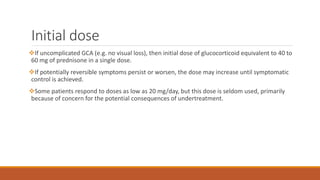
Initial dose
If uncomplicated GCA (e.g. no visual loss), then initial dose of glucocorticoid equivalent to 40 to
60 mg of prednisone in a single dose.
If potentially reversible symptoms persist or worsen, the dose may increase until symptomatic
control is achieved.
Some patients respond to doses as low as 20 mg/day, but this dose is seldom used, primarily
because of concern for the potential consequences of undertreatment.
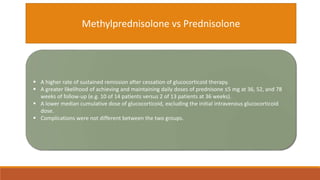
Methylprednisolone vs Prednisolone
 A higher rate of sustained remission after cessation of glucocorticoid therapy.
 A greater likelihood of achieving and maintaining daily doses of prednisone ≤5 mg at 36, 52, and 78
weeks of follow-up (e.g. 10 of 14 patients versus 2 of 13 patients at 36 weeks).
 A lower median cumulative dose of glucocorticoid, excluding the initial intravenous glucocorticoid
dose.
 Complications were not different between the two groups.
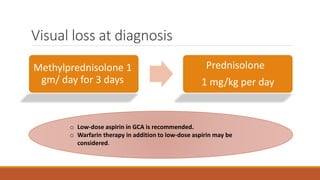
Visual loss at diagnosis
Methylprednisolone 1
gm/ day for 3 days
Prednisolone
1 mg/kg per day
o Low-dose aspirin in GCA is recommended.
o Warfarin therapy in addition to low-dose aspirin may be
considered.
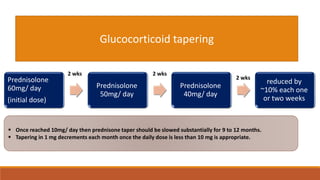
Prednisolone
60mg/ day
(initial dose)
Prednisolone
50mg/ day
Prednisolone
40mg/ day
reduced by
~10% each one
or two weeks
2 wks 2 wks
Glucocorticoid tapering
2 wks
 Once reached 10mg/ day then prednisone taper should be slowed substantially for 9 to 12 months.
 Tapering in 1 mg decrements each month once the daily dose is less than 10 mg is appropriate.
Monitoring disease activity
Acute phase reactants such as ESR and CRP are often useful adjuncts to clinical decision-
making.
Abnormalities of serum proteins unrelated to GCA may elevate the ESR falsely; e.g. monoclonal
gammopathies. For such patients, the CRP may be a more useful marker of disease activity.
Monitoring of serum levels of IL-6 and of soluble intercellular adhesion molecule (sICAM)-1
holds promise as additional potential assays to assess active disease.
Clinician must remember:
• that the ESR normally rises
somewhat with age (a value of 40
mm/hour may not be abnormal for
an 80-year-old).
• to treat the patient and not to treat
the laboratory test result.
Relapse
Recurrence of GCA should be suspected when:
patients have a return of symptoms that recall their original presentations.
new symptoms compatible with the diagnosis of GCA .
 when there is a striking elevation of ESR or CRP should trigger close clinical follow-up and
questioning of patients about symptoms of possible disease recurrences.
 Patients should be counseled to be watchful for symptoms of PMR or GCA and should be encouraged to
seek medical attention immediately if any symptoms are noted.
Aortic aneurysms between 3 and 5 cm in diameter with markers of inflammation
Reinitiation or an increase in the dose of glucocorticoids is warranted
Use of immunosuppressive agents not supported by any clinical studies.
Yearly CXR up to 10 years to identify patients with aortic aneurysms is recomended
RESISTANT DISEASE
AND
GLUCOCORTICOID-
SPARING AGENTS
Methotrexate
oMTX resulted in a significant reduction in the cumulative dose of glucocorticoid .
oMTX treatment was associated with a higher probability of achieving sustained discontinuation
of glucocorticoids during follow-up and with fewer relapses.
oMTX is moderately effective as a glucocorticoid-sparing agent , so routine addition of MTX to
glucocorticoid therapy for GCA is not recommended.
oMTX may be considered as a possible glucocorticoid-sparing strategy among patients who have
developed or who are at high risk for adverse effects of prednisone.
Methotrexate
oPatients receiving MTX were less likely to relapse.
oPatients receiving MTX had a shorter time to complete withdrawal of prednisolone
oand had a lower mean cumulative dose of prednisone
Tocilizumab
It is a humanized monoclonal antibody against the IL-6 receptor.
TCZ may be effective in patients with GCA in whom:
it has been difficult to taper glucocorticoids to an acceptable level
disease has been refractory or relapsing, even despite therapy with additional agents
The use of TCZ in GCA is also supported by the evidence that IL-6 may be important in disease
pathogenesis.
Cyclophosphamide
Cyclophosphamide has been widely used in the treatment of systemic vasculitis.
Useful in GCA in patients at high risk of glucocorticoid-related adverse effects.
Useful in GCA in patients who have not responded adequately to other immunosuppressive or
immunomodulatory treatments.
Adverse effects are common but usually reversible with dose reduction or with drug
discontinuation.
Infliximab
•Because GCA is characterized by granulomatous inflammation, tumor necrosis factor (TNF)
inhibition would appear to be an appropriate treatment approach.
•The addition of infliximab to glucocorticoids did not improve the durability of remissions, nor did
it reduce cumulative glucocorticoid requirements in GCA.
REVASCULARIZATION
Revascularization of arteries to the extremities is seldom required because of the abundant
collateral circulation that occurs in this disease.
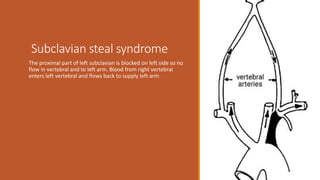
Only in exceptional circumstances (e.g., the development of a subclavian steal syndrome)
should thoughts of revascularization be entertained.
Through inhibition of the inflammatory process and allowance of collateral blood vessel
growth, most symptoms of large vessel narrowing improve with medical therapy alone.
Subclavian steal syndrome
The proximal part of left subclavian is blocked on left side so no
flow in vertebral and to left arm. Blood from right vertebral
enters left vertebral and flows back to supply left arm
PROGNOSIS
GCA tends to run a self-limited course over several months to several years.
The glucocorticoid dose can eventually be reduced and discontinued in the majority of patients.
A minority have more chronic disease and require low doses of prednisone for a number of
years to control symptoms.
GCA may not adversely affect overall survival.
SUMMARY
1) In uncomplicated GCA; an initial dose of glucocorticoid equivalent to 40 to 60 mg of
prednisone in a single dose is sufficient unless symptoms persist or worsen.
2) Treatment must be directed toward the patient’s signs and symptoms and not toward the
laboratory value.
3) A low-dose aspirin therapy in patients with GCA with or without visual loss to reduce the risk
of visual loss, transient ischemic attacks, or stroke is recommended.
4) If there is a strong suspicion of GCA as the cause of visual loss, we suggest use of intravenous
pulse methylprednisolone.
SUMMARY
5) The addition of MTX can be considered together with glucocorticoids in patients at highest risk
of experiencing glucocorticoid-related side effects.
6) Other agents that may be of benefit include tocilizumab and cyclophosphamide .
7) A yearly CXR should be performed for up to 10 years to identify patients with thoracic aortic
aneurysms.
8) GCA tends to run a self-limited course over several months to several years.
GCA treatment

GCA treatment

  • 1.
    Treatment of GiantCell Arteritis DR. MAZEN AL ZO’UBI, MD FELLOW OF RHEUMATOLOGY, DRMS, JORDAN
  • 2.
    TREATMENT APPROACH Glucocorticoid treatmentshould be instituted promptly once the diagnosis of GCA is suspected strongly, especially those with recent or threatened vascular complications. A temporal artery biopsy should be obtained as soon as possible, but treatment should not be withheld while awaiting the performance or the results of the biopsy. If the temporal or other artery biopsies reveal no evidence of arteritis but if clinical suspicion of GCA remains strong, glucocorticoid treatment should be continued.
  • 3.
    TREATMENT APPROACH Even withoptimal bilateral temporal artery biopsy performance, false-negative results occur in at least 9% of GCA cases. The therapeutic regimen for GCA is somewhat different than that for patients who are believed to have only polymyalgia rheumatica (PMR, the treatment of PMR requires lower doses of glucocorticoids.
  • 4.
  • 5.
    Efficacy Glucocorticoids effectiveness inGCA is so well-established. Evidence for efficacy is based upon several series in which the use of glucocorticoids improved or resolved symptoms and decreased the risk of vascular complications. Daily dosing is more effective than alternate day dosing. Split dosing (i.e. the use of multiple doses during a single day) is no more effective than a single daily dose.
  • 6.
    Initial dose If uncomplicatedGCA (e.g. no visual loss), then initial dose of glucocorticoid equivalent to 40 to 60 mg of prednisone in a single dose. If potentially reversible symptoms persist or worsen, the dose may increase until symptomatic control is achieved. Some patients respond to doses as low as 20 mg/day, but this dose is seldom used, primarily because of concern for the potential consequences of undertreatment.
  • 7.
    Methylprednisolone vs Prednisolone A higher rate of sustained remission after cessation of glucocorticoid therapy.  A greater likelihood of achieving and maintaining daily doses of prednisone ≤5 mg at 36, 52, and 78 weeks of follow-up (e.g. 10 of 14 patients versus 2 of 13 patients at 36 weeks).  A lower median cumulative dose of glucocorticoid, excluding the initial intravenous glucocorticoid dose.  Complications were not different between the two groups.
  • 8.
    Visual loss atdiagnosis Methylprednisolone 1 gm/ day for 3 days Prednisolone 1 mg/kg per day o Low-dose aspirin in GCA is recommended. o Warfarin therapy in addition to low-dose aspirin may be considered.
  • 9.
    Prednisolone 60mg/ day (initial dose) Prednisolone 50mg/day Prednisolone 40mg/ day reduced by ~10% each one or two weeks 2 wks 2 wks Glucocorticoid tapering 2 wks  Once reached 10mg/ day then prednisone taper should be slowed substantially for 9 to 12 months.  Tapering in 1 mg decrements each month once the daily dose is less than 10 mg is appropriate.
  • 10.
    Monitoring disease activity Acutephase reactants such as ESR and CRP are often useful adjuncts to clinical decision- making. Abnormalities of serum proteins unrelated to GCA may elevate the ESR falsely; e.g. monoclonal gammopathies. For such patients, the CRP may be a more useful marker of disease activity. Monitoring of serum levels of IL-6 and of soluble intercellular adhesion molecule (sICAM)-1 holds promise as additional potential assays to assess active disease. Clinician must remember: • that the ESR normally rises somewhat with age (a value of 40 mm/hour may not be abnormal for an 80-year-old). • to treat the patient and not to treat the laboratory test result.
  • 11.
    Relapse Recurrence of GCAshould be suspected when: patients have a return of symptoms that recall their original presentations. new symptoms compatible with the diagnosis of GCA .  when there is a striking elevation of ESR or CRP should trigger close clinical follow-up and questioning of patients about symptoms of possible disease recurrences.  Patients should be counseled to be watchful for symptoms of PMR or GCA and should be encouraged to seek medical attention immediately if any symptoms are noted. Aortic aneurysms between 3 and 5 cm in diameter with markers of inflammation Reinitiation or an increase in the dose of glucocorticoids is warranted Use of immunosuppressive agents not supported by any clinical studies. Yearly CXR up to 10 years to identify patients with aortic aneurysms is recomended
  • 12.
  • 13.
    Methotrexate oMTX resulted ina significant reduction in the cumulative dose of glucocorticoid . oMTX treatment was associated with a higher probability of achieving sustained discontinuation of glucocorticoids during follow-up and with fewer relapses. oMTX is moderately effective as a glucocorticoid-sparing agent , so routine addition of MTX to glucocorticoid therapy for GCA is not recommended. oMTX may be considered as a possible glucocorticoid-sparing strategy among patients who have developed or who are at high risk for adverse effects of prednisone.
  • 14.
    Methotrexate oPatients receiving MTXwere less likely to relapse. oPatients receiving MTX had a shorter time to complete withdrawal of prednisolone oand had a lower mean cumulative dose of prednisone
  • 15.
    Tocilizumab It is ahumanized monoclonal antibody against the IL-6 receptor. TCZ may be effective in patients with GCA in whom: it has been difficult to taper glucocorticoids to an acceptable level disease has been refractory or relapsing, even despite therapy with additional agents The use of TCZ in GCA is also supported by the evidence that IL-6 may be important in disease pathogenesis.
  • 16.
    Cyclophosphamide Cyclophosphamide has beenwidely used in the treatment of systemic vasculitis. Useful in GCA in patients at high risk of glucocorticoid-related adverse effects. Useful in GCA in patients who have not responded adequately to other immunosuppressive or immunomodulatory treatments. Adverse effects are common but usually reversible with dose reduction or with drug discontinuation.
  • 17.
    Infliximab •Because GCA ischaracterized by granulomatous inflammation, tumor necrosis factor (TNF) inhibition would appear to be an appropriate treatment approach. •The addition of infliximab to glucocorticoids did not improve the durability of remissions, nor did it reduce cumulative glucocorticoid requirements in GCA.
  • 18.
    REVASCULARIZATION Revascularization of arteriesto the extremities is seldom required because of the abundant collateral circulation that occurs in this disease. Only in exceptional circumstances (e.g., the development of a subclavian steal syndrome) should thoughts of revascularization be entertained. Through inhibition of the inflammatory process and allowance of collateral blood vessel growth, most symptoms of large vessel narrowing improve with medical therapy alone.
  • 19.
    Subclavian steal syndrome Theproximal part of left subclavian is blocked on left side so no flow in vertebral and to left arm. Blood from right vertebral enters left vertebral and flows back to supply left arm
  • 20.
    PROGNOSIS GCA tends torun a self-limited course over several months to several years. The glucocorticoid dose can eventually be reduced and discontinued in the majority of patients. A minority have more chronic disease and require low doses of prednisone for a number of years to control symptoms. GCA may not adversely affect overall survival.
  • 21.
    SUMMARY 1) In uncomplicatedGCA; an initial dose of glucocorticoid equivalent to 40 to 60 mg of prednisone in a single dose is sufficient unless symptoms persist or worsen. 2) Treatment must be directed toward the patient’s signs and symptoms and not toward the laboratory value. 3) A low-dose aspirin therapy in patients with GCA with or without visual loss to reduce the risk of visual loss, transient ischemic attacks, or stroke is recommended. 4) If there is a strong suspicion of GCA as the cause of visual loss, we suggest use of intravenous pulse methylprednisolone.
  • 22.
    SUMMARY 5) The additionof MTX can be considered together with glucocorticoids in patients at highest risk of experiencing glucocorticoid-related side effects. 6) Other agents that may be of benefit include tocilizumab and cyclophosphamide . 7) A yearly CXR should be performed for up to 10 years to identify patients with thoracic aortic aneurysms. 8) GCA tends to run a self-limited course over several months to several years.