
Chronic Obstructive Pulmonary Disease
Dr. Mazen Al Zo’ubi
Rheumatology and Internal Medicine Senior
Specialist
Definition
COPD is an irreversible lung disease characterized by limited airflow
It is progressive and accompanied by an abnormally inflammatory
response of the lungs to toxic substances or gases
Emphysema, small airways disease, and chronic bronchitis are grouped
under the umbrella diagnosis of COPD
Lung hyperinflation, ventilation/perfusion mismatch, increased work of
breathing, and dyspnea follow as a result
The presence of several comorbidities, including cancer, ischemic heart
disease, hypertension, diabetes, and heart failure, suggests that the
condition could be a result of a broad systemic inflammatory response.
Epidemiology and Aetiology
Long-term exposure to
harmful chemicals and
particles results in COPD
Over 90% of cases in
developed nations involve
smoking cigarettes
Biomass heating fuels and
cooking smoke in poorly
ventilated locations, play a
role in developing nations
Only 10–20% of smokers
experience the development
of COPD, indicating a
possible underlying
individual predisposition
Pathophysiology
Structurally, there may be
evidence of emphysema and
small airways disease, with
increased mucus-producing
goblet cells in the bronchial
mucosa, which may lead to
chronic bronchitis
Pathologically, there is
evidence of both acute and
chronic inflammation
This chronic inflammation
results in scarring and fibrosis
of the small airways. In
addition, there is destruction
of the alveolar walls, which
results in emphysema.
Emphysema
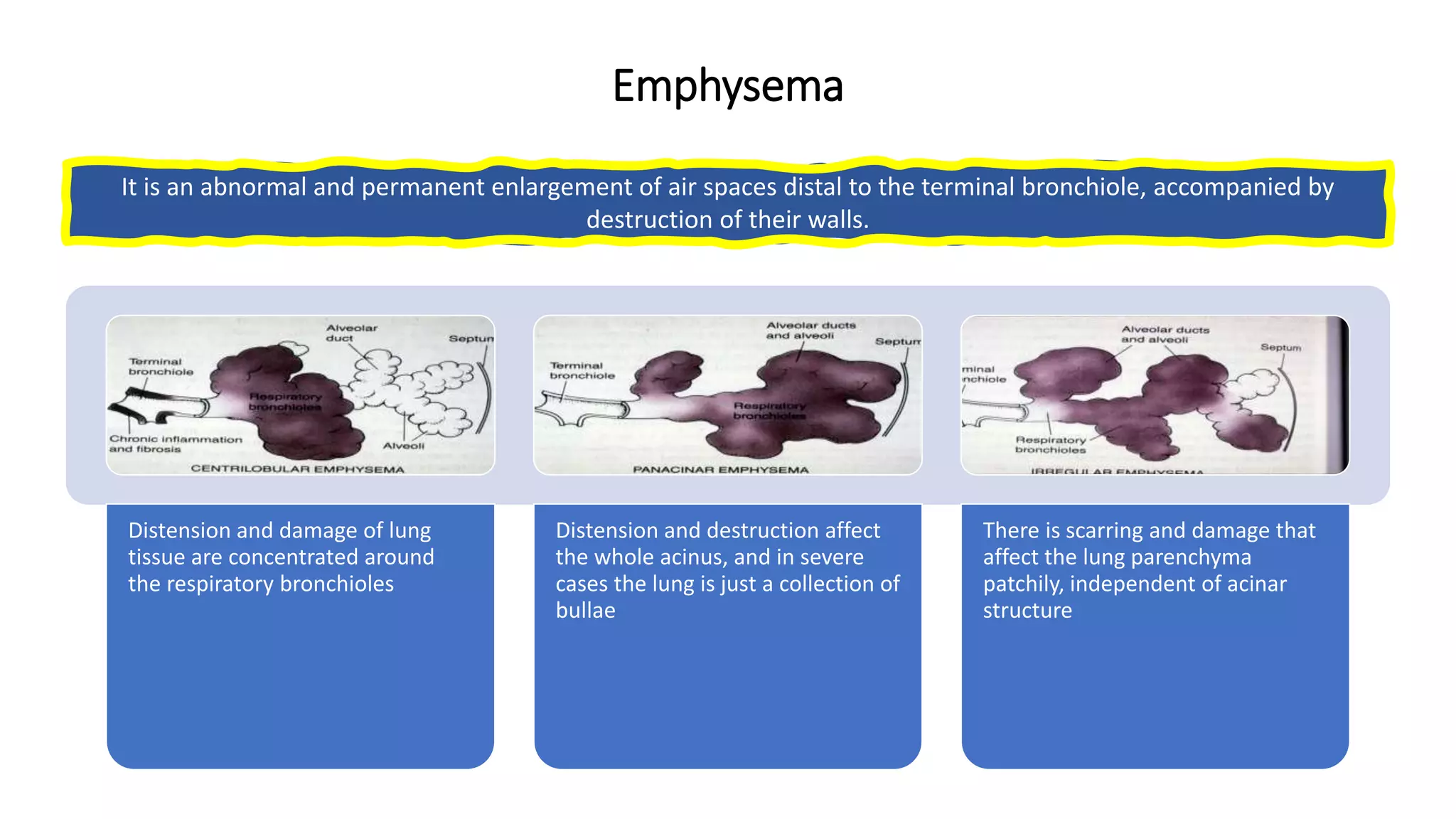
It is an abnormal and permanent enlargement of air spaces distal to the terminal bronchiole, accompanied by
destruction of their walls.
Distension and damage of lung
tissue are concentrated around
the respiratory bronchioles
Distension and destruction affect
the whole acinus, and in severe
cases the lung is just a collection of
bullae
There is scarring and damage that
affect the lung parenchyma
patchily, independent of acinar
structure
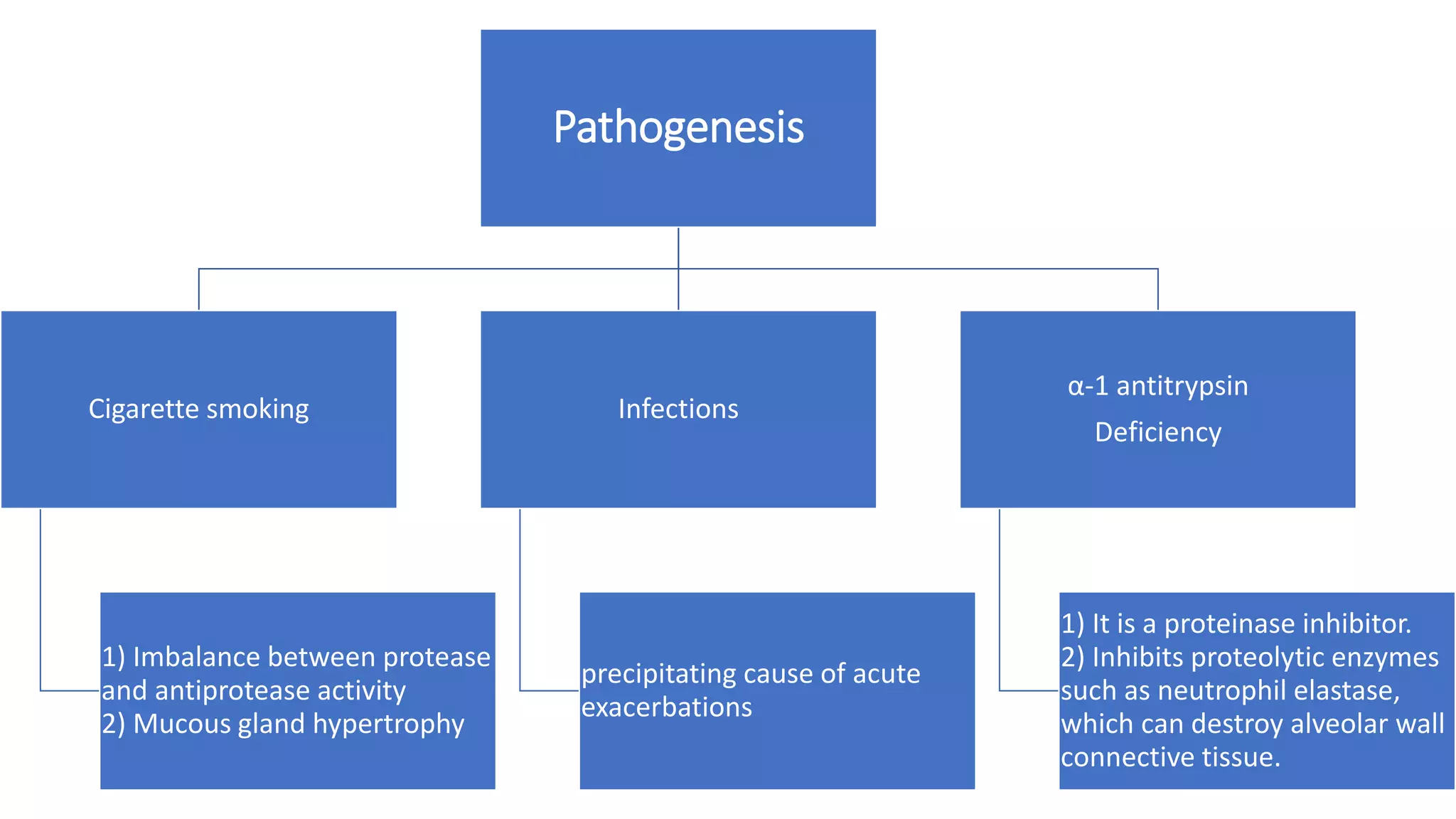
Pathogenesis
Cigarette smoking
1) Imbalance between protease
and antiprotease activity
2) Mucous gland hypertrophy
Infections
precipitating cause of acute
exacerbations
α-1 antitrypsin
Deficiency
1) It is a proteinase inhibitor.
2) Inhibits proteolytic enzymes
such as neutrophil elastase,
which can destroy alveolar wall
connective tissue.
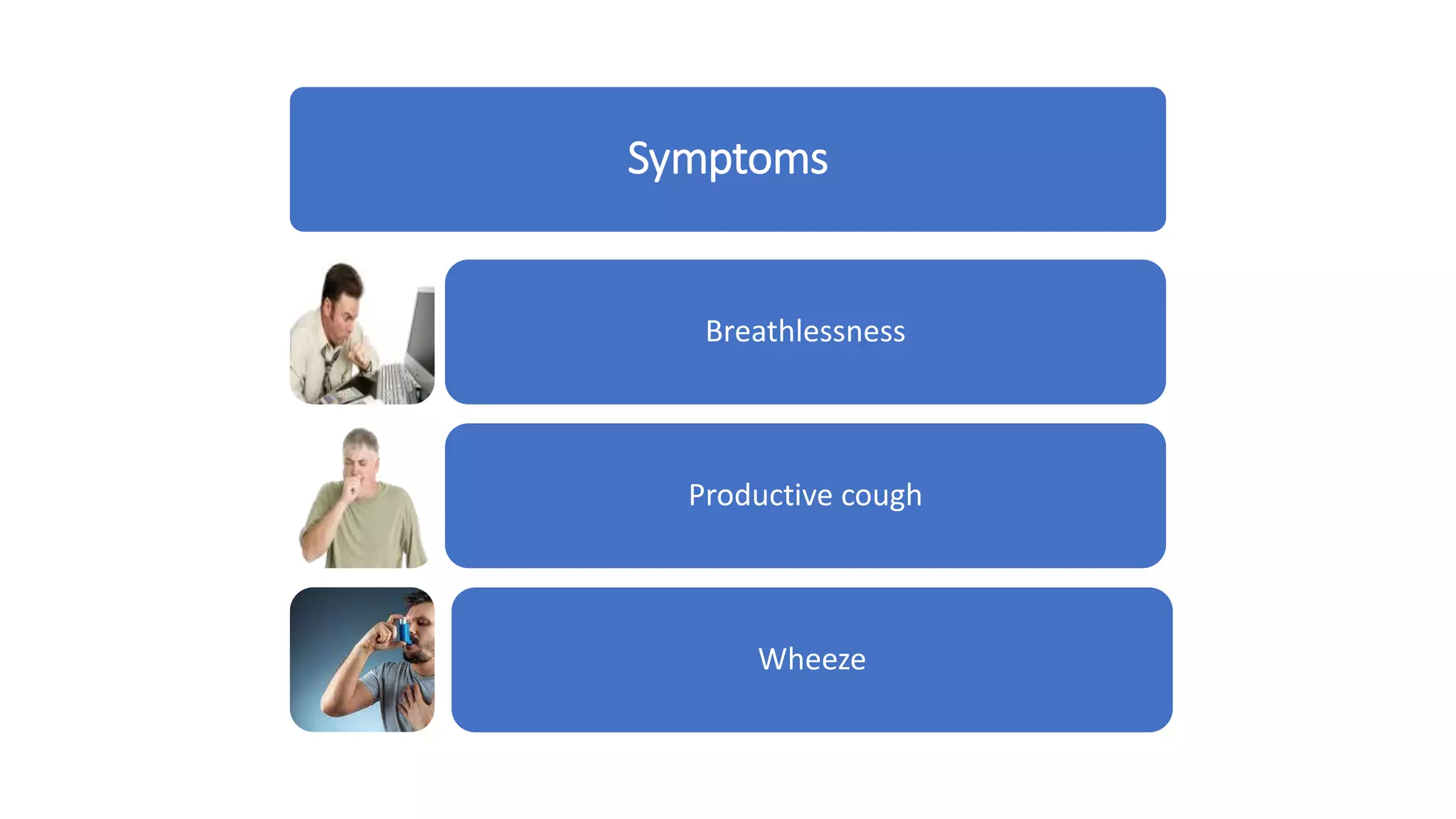
Symptoms
Breathlessness
Productive cough
Wheeze
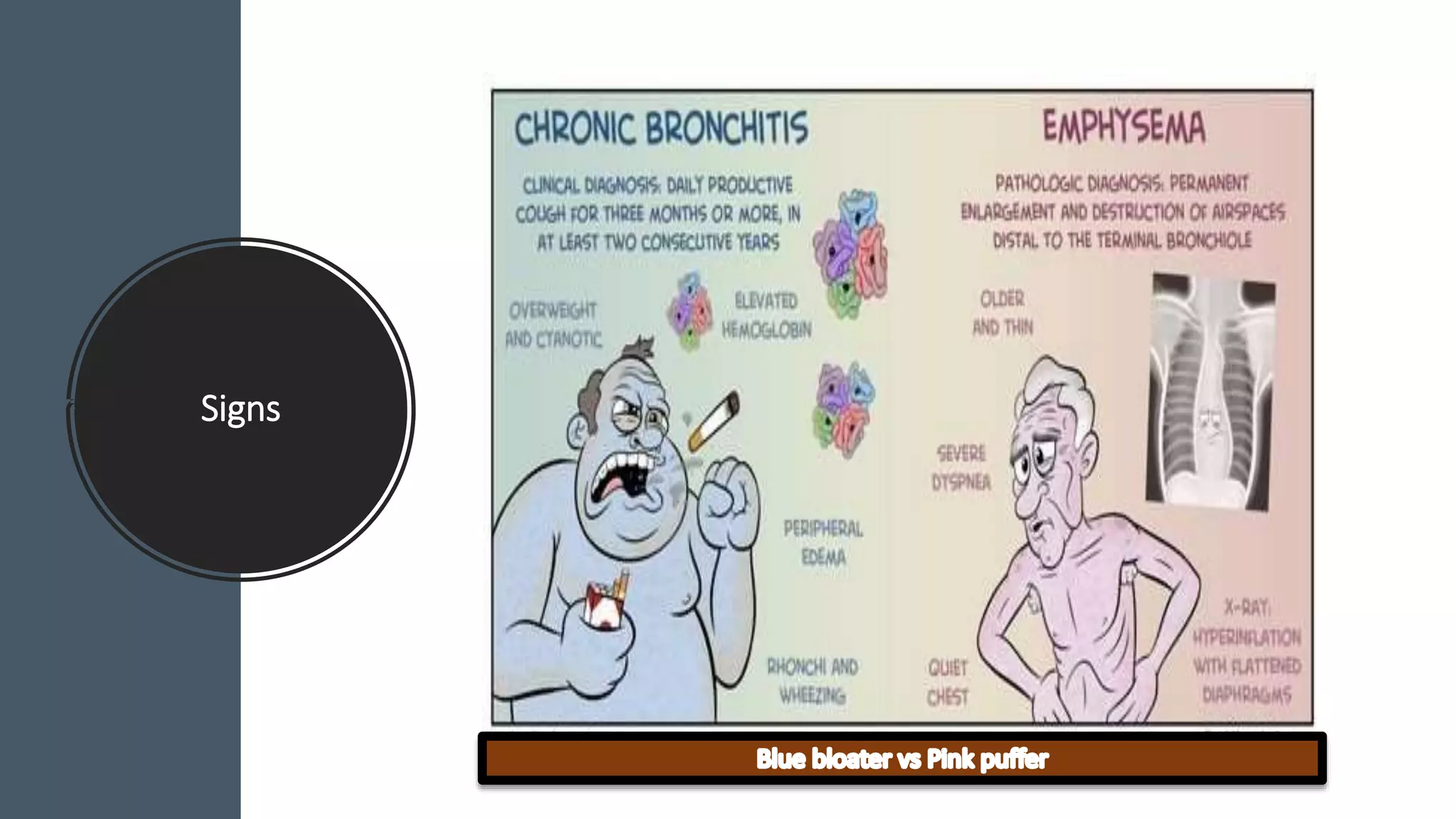
Signs
Early disease
• Asymptomatic
• Quit wheeze
Severe disease
• Tachypnoea
• Prolonged expiration
• Accessory muscle use
• Lips purse
• Reduced cricosternal
distance
• Poor chest expansion
Advanced disease
• Signs of right heart
failure
Signs
Diagnosis
This is usually clinical
and based on a history
of breathlessness and
sputum production in
a chronic smoker.
In the absence of a
history of cigarette
smoking, asthma is a
more likely
explanation, unless
there is a family
history suggesting α1-
antitrypsin deficiency.
Investigations
Show evidence of airflow limitation (FEV1:FVC ratio is reduced)
Often normal
Over-inflation
Flattened diaphragms
Sometimes the presence of large bullae
Useful, particularly when the CXR is normal
helpful to determine if there is any evidence of respiratory failure
worth measuring in premature disease or lifelong non-smokers
Classification of airflow limitation severity in
COPD (based on post-bronchodilator FEV1)
Global Initiative for Chronic Obstructive Lung Disease
(GOLD)
Management
Healthcare
• The single most useful measure
• Smoke from burning biomass fuels in poorly
ventilated homes should also be reduced
Smoking cessation
• single dose of the polyvalent pneumococcal
polysaccharide vaccine
• Yearly influenza vaccinations
Vaccines
Management
Drug therapy
• Mild COPD: short-acting β2 agonist
• Moderate and severe COPD: long-acting β2 agonist
β-Adrenoceptor agonists
• Regular use of a LAMA (such as inhaled tiotropium) improves lung function, symptoms of
dyspnea and quality of life
• Use of a LAMA does not prevent the decline in FEV1
Antimuscarinic drugs
• It is used as an adjunct to bronchodilators for maintenance treatment in those patients with
an FEV1 of less than 50% and chronic bronchitis
Phosphodiesterase type 4
inhibitors
• Inhaled corticosteroids are recommended in patients with frequent exacerbations or a FEV1
of less than 50% predicted
• Demonstration of a blood eosinophilia may identify patients who are more likely to have a
beneficial response to inhaled corticosteroid therapy
Corticosteroids
• Long-acting preparations of theophylline are of little benefit
Theophyllines
Management
Oxygen therapy
PaO2 of <7.3 kPa (55 mmHg) when breathing air; measurements should be taken
on two occasions at least 3 weeks apart after appropriate bronchodilator therapy
PaO2 of <8 kPa with secondary polycythemia, nocturnal hypoxemia, peripheral
oedema or evidence of pulmonary hypertension
Carboxyhemoglobin of <3% (i.e., patients who have stopped smoking).
Domiciliary oxygen is best provided via an oxygen concentrator
Algorithm for
the treatment
of chronic
obstructive
pulmonary
disease
COPD.pptx

COPD.pptx

  • 1.
    Chronic Obstructive PulmonaryDisease Dr. Mazen Al Zo’ubi Rheumatology and Internal Medicine Senior Specialist
  • 2.
    Definition COPD is anirreversible lung disease characterized by limited airflow It is progressive and accompanied by an abnormally inflammatory response of the lungs to toxic substances or gases Emphysema, small airways disease, and chronic bronchitis are grouped under the umbrella diagnosis of COPD Lung hyperinflation, ventilation/perfusion mismatch, increased work of breathing, and dyspnea follow as a result The presence of several comorbidities, including cancer, ischemic heart disease, hypertension, diabetes, and heart failure, suggests that the condition could be a result of a broad systemic inflammatory response.
  • 3.
    Epidemiology and Aetiology Long-termexposure to harmful chemicals and particles results in COPD Over 90% of cases in developed nations involve smoking cigarettes Biomass heating fuels and cooking smoke in poorly ventilated locations, play a role in developing nations Only 10–20% of smokers experience the development of COPD, indicating a possible underlying individual predisposition
  • 4.
    Pathophysiology Structurally, there maybe evidence of emphysema and small airways disease, with increased mucus-producing goblet cells in the bronchial mucosa, which may lead to chronic bronchitis Pathologically, there is evidence of both acute and chronic inflammation This chronic inflammation results in scarring and fibrosis of the small airways. In addition, there is destruction of the alveolar walls, which results in emphysema.
  • 5.
    Emphysema It is anabnormal and permanent enlargement of air spaces distal to the terminal bronchiole, accompanied by destruction of their walls. Distension and damage of lung tissue are concentrated around the respiratory bronchioles Distension and destruction affect the whole acinus, and in severe cases the lung is just a collection of bullae There is scarring and damage that affect the lung parenchyma patchily, independent of acinar structure
  • 6.
    Pathogenesis Cigarette smoking 1) Imbalancebetween protease and antiprotease activity 2) Mucous gland hypertrophy Infections precipitating cause of acute exacerbations α-1 antitrypsin Deficiency 1) It is a proteinase inhibitor. 2) Inhibits proteolytic enzymes such as neutrophil elastase, which can destroy alveolar wall connective tissue.
  • 7.
  • 8.
    Signs Early disease • Asymptomatic •Quit wheeze Severe disease • Tachypnoea • Prolonged expiration • Accessory muscle use • Lips purse • Reduced cricosternal distance • Poor chest expansion Advanced disease • Signs of right heart failure
  • 9.
  • 10.
    Diagnosis This is usuallyclinical and based on a history of breathlessness and sputum production in a chronic smoker. In the absence of a history of cigarette smoking, asthma is a more likely explanation, unless there is a family history suggesting α1- antitrypsin deficiency.
  • 11.
    Investigations Show evidence ofairflow limitation (FEV1:FVC ratio is reduced) Often normal Over-inflation Flattened diaphragms Sometimes the presence of large bullae Useful, particularly when the CXR is normal helpful to determine if there is any evidence of respiratory failure worth measuring in premature disease or lifelong non-smokers
  • 12.
    Classification of airflowlimitation severity in COPD (based on post-bronchodilator FEV1) Global Initiative for Chronic Obstructive Lung Disease (GOLD)
  • 13.
    Management Healthcare • The singlemost useful measure • Smoke from burning biomass fuels in poorly ventilated homes should also be reduced Smoking cessation • single dose of the polyvalent pneumococcal polysaccharide vaccine • Yearly influenza vaccinations Vaccines
  • 14.
    Management Drug therapy • MildCOPD: short-acting β2 agonist • Moderate and severe COPD: long-acting β2 agonist β-Adrenoceptor agonists • Regular use of a LAMA (such as inhaled tiotropium) improves lung function, symptoms of dyspnea and quality of life • Use of a LAMA does not prevent the decline in FEV1 Antimuscarinic drugs • It is used as an adjunct to bronchodilators for maintenance treatment in those patients with an FEV1 of less than 50% and chronic bronchitis Phosphodiesterase type 4 inhibitors • Inhaled corticosteroids are recommended in patients with frequent exacerbations or a FEV1 of less than 50% predicted • Demonstration of a blood eosinophilia may identify patients who are more likely to have a beneficial response to inhaled corticosteroid therapy Corticosteroids • Long-acting preparations of theophylline are of little benefit Theophyllines
  • 15.
    Management Oxygen therapy PaO2 of<7.3 kPa (55 mmHg) when breathing air; measurements should be taken on two occasions at least 3 weeks apart after appropriate bronchodilator therapy PaO2 of <8 kPa with secondary polycythemia, nocturnal hypoxemia, peripheral oedema or evidence of pulmonary hypertension Carboxyhemoglobin of <3% (i.e., patients who have stopped smoking). Domiciliary oxygen is best provided via an oxygen concentrator
  • 16.
    Algorithm for the treatment ofchronic obstructive pulmonary disease