Analytical Mathematics
Lecture 2
ANJULA WEERASINGHE
BENG. EE (SHU.UK), MSC. CS (UOP)
Applications of matrices & determinants
Solution of simultaneous equations by
matrices – ( 2 unknowns )
 The procedure for solving linear simultaneous equations in two unknowns using
matrices is:
i. write the equations in the form
ii. Write the matrix equation corresponding to these equations,
iii. Determine the inverse matrix of
iv. multiply each side of (ii) by the inverse matrix , and
v. Solve for x and y by equating corresponding elements.
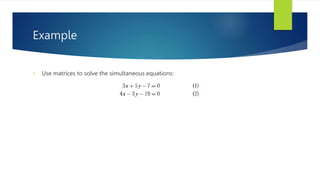
Example
1. Use matrices to solve the simultaneous equations:
Solution of simultaneous equations by
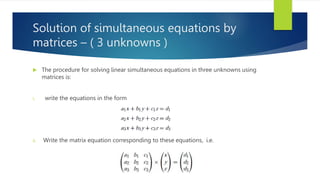
matrices – ( 3 unknowns )
 The procedure for solving linear simultaneous equations in three unknowns using
matrices is:
i. write the equations in the form
ii. Write the matrix equation corresponding to these equations, i.e.
iii. Determine the inverse matrix of
iv. multiply each side of (ii) by the inverse matrix , and
v. Solve for x , y and z by equating corresponding elements.
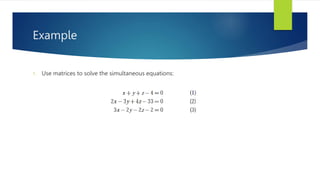
Example
1. Use matrices to solve the simultaneous equations:
Solution of simultaneous equations by
determinants
 When solving linear simultaneous equations in two unknowns using
determinants:
i. Write the equations in the form
ii. The solution is given by
Where
i.e. the determinant of the coefficients left when the x-column is covered up,
i.e. the determinant of the coefficients left when the y-column is covered up,
And
i.e. the determinant of the coefficients left when the constants -column is covered
up,
Example
1. Solve the following simultaneous equations using determinants:
Example
1. The velocity of a car, accelerating at uniform acceleration a between two points, is
given by v=u+at, where u is its velocity when passing the first point and t is the
time taken to pass between the two points.
If v=21m/s when t =3.5s and v=33m/s when t =6.1s, use determinants to
find the values of u and a, each correct to 4 significant figures.
Solution of simultaneous 3 equations by
determinants
 When solving simultaneous equations in three unknowns using determinants:
i. Write the equations in the form
ii. The solution is given by
Where
i.e. the determinant of the coefficients left when the x-column is covered up,
i.e. the determinant of the coefficients left when the y-column is covered up,
And
i.e. the determinant of the coefficients left when the constants -column is covered
up,
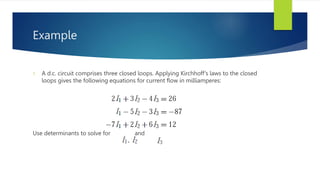
Example
1. A d.c. circuit comprises three closed loops. Applying Kirchhoff’s laws to the closed
loops gives the following equations for current flow in milliamperes:
Use determinants to solve for and
Solution of simultaneous equations using
Cramer’s rule
 Cramer’s∗ rule states that if
Where
i.e. the x-column has been replaced by the RHS b column ,
i.e. the y-column has been replaced by the RHS b column ,
i.e. the z-column has been replaced by the RHS b column ,
,
Example
1. Solve the following simultaneous equations using Cramer’s rule.
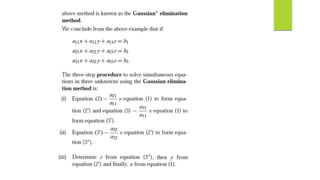
Solution of simultaneous equations using the
Gaussian elimination method
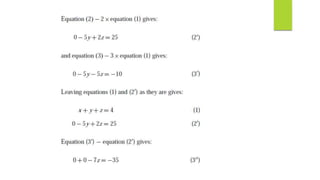
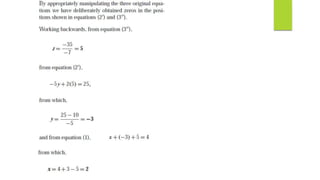
 Consider the following simultaneous equations:
Example
 A d.c. circuit comprises three closed loops. Applying Kirchhoff’s laws to the closed
loops gives the following equations for current flow in milliamperes:
Use the Gaussian elimination method to solve for I1, I2 and I3
Eigenvalues and Eigenvectors
 In practical applications, such as coupled oscillations and vibrations, equations of the form:
 occur, where A is a square matrix and λ is a number. Whenever x ≠ 0, the values of λ are called
the eigenvalues of the matrix A; the corresponding solutions of the equation Ax = λx are
called the eigenvectors of A.
 Sometimes, instead of the term eigenvalues, characteristic values or latent
roots are used. Also, instead of the term eigenvectors, characteristic vectors is
used. From above, if Ax = λx then Ax −λx = 0 i.e.
(A −λI) = 0 where I is the unit matrix.
If x ≠ 0 then |A−λI| = 0
 |A−λI| is called the characteristic determinant of A and |A−λI| = 0 is called the
characteristic equation.
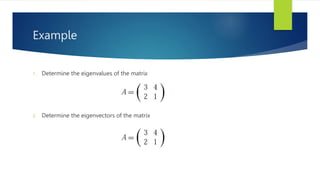
Example
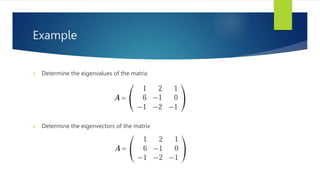
1. Determine the eigenvalues of the matrix
2. Determine the eigenvectors of the matrix
Example
3. Determine the eigenvalues of the matrix
4. Determine the eigenvectors of the matrix
Example
3. Determine the eigenvalues of the matrix
4. Determine the eigenvectors of the matrix

Analytical Mathematics lec 2.pptx

  • 1.
    Analytical Mathematics Lecture 2 ANJULAWEERASINGHE BENG. EE (SHU.UK), MSC. CS (UOP)
  • 2.
  • 3.
    Solution of simultaneousequations by matrices – ( 2 unknowns )  The procedure for solving linear simultaneous equations in two unknowns using matrices is: i. write the equations in the form ii. Write the matrix equation corresponding to these equations,
  • 4.
    iii. Determine theinverse matrix of iv. multiply each side of (ii) by the inverse matrix , and v. Solve for x and y by equating corresponding elements.
  • 5.
    Example 1. Use matricesto solve the simultaneous equations:
  • 6.
    Solution of simultaneousequations by matrices – ( 3 unknowns )  The procedure for solving linear simultaneous equations in three unknowns using matrices is: i. write the equations in the form ii. Write the matrix equation corresponding to these equations, i.e.
  • 7.
    iii. Determine theinverse matrix of iv. multiply each side of (ii) by the inverse matrix , and v. Solve for x , y and z by equating corresponding elements.
  • 8.
    Example 1. Use matricesto solve the simultaneous equations:
  • 9.
    Solution of simultaneousequations by determinants  When solving linear simultaneous equations in two unknowns using determinants: i. Write the equations in the form ii. The solution is given by
  • 10.
    Where i.e. the determinantof the coefficients left when the x-column is covered up, i.e. the determinant of the coefficients left when the y-column is covered up, And i.e. the determinant of the coefficients left when the constants -column is covered up,
  • 11.
    Example 1. Solve thefollowing simultaneous equations using determinants:
  • 12.
    Example 1. The velocityof a car, accelerating at uniform acceleration a between two points, is given by v=u+at, where u is its velocity when passing the first point and t is the time taken to pass between the two points. If v=21m/s when t =3.5s and v=33m/s when t =6.1s, use determinants to find the values of u and a, each correct to 4 significant figures.
  • 13.
    Solution of simultaneous3 equations by determinants  When solving simultaneous equations in three unknowns using determinants: i. Write the equations in the form ii. The solution is given by
  • 14.
    Where i.e. the determinantof the coefficients left when the x-column is covered up, i.e. the determinant of the coefficients left when the y-column is covered up, And i.e. the determinant of the coefficients left when the constants -column is covered up,
  • 15.
    Example 1. A d.c.circuit comprises three closed loops. Applying Kirchhoff’s laws to the closed loops gives the following equations for current flow in milliamperes: Use determinants to solve for and
  • 16.
    Solution of simultaneousequations using Cramer’s rule  Cramer’s∗ rule states that if
  • 17.
    Where i.e. the x-columnhas been replaced by the RHS b column , i.e. the y-column has been replaced by the RHS b column , i.e. the z-column has been replaced by the RHS b column , ,
  • 18.
    Example 1. Solve thefollowing simultaneous equations using Cramer’s rule.
  • 19.
    Solution of simultaneousequations using the Gaussian elimination method  Consider the following simultaneous equations:
  • 23.
    Example  A d.c.circuit comprises three closed loops. Applying Kirchhoff’s laws to the closed loops gives the following equations for current flow in milliamperes: Use the Gaussian elimination method to solve for I1, I2 and I3
  • 24.
    Eigenvalues and Eigenvectors In practical applications, such as coupled oscillations and vibrations, equations of the form:  occur, where A is a square matrix and λ is a number. Whenever x ≠ 0, the values of λ are called the eigenvalues of the matrix A; the corresponding solutions of the equation Ax = λx are called the eigenvectors of A.
  • 25.
     Sometimes, insteadof the term eigenvalues, characteristic values or latent roots are used. Also, instead of the term eigenvectors, characteristic vectors is used. From above, if Ax = λx then Ax −λx = 0 i.e. (A −λI) = 0 where I is the unit matrix. If x ≠ 0 then |A−λI| = 0  |A−λI| is called the characteristic determinant of A and |A−λI| = 0 is called the characteristic equation.
  • 26.
    Example 1. Determine theeigenvalues of the matrix 2. Determine the eigenvectors of the matrix
  • 27.
    Example 3. Determine theeigenvalues of the matrix 4. Determine the eigenvectors of the matrix
  • 28.
    Example 3. Determine theeigenvalues of the matrix 4. Determine the eigenvectors of the matrix