Simultaneous Linear Equations
Topic: Gaussian Elimination
Dr. Nasir M Mirza
Numerical Methods
Numerical Methods
Email: nasirmm@yahoo.com
Gaussian Elimination
Basic Principles
• The general description of a set of linear equations in the matrix
form: [A][X] = [B]
• Where, [A] is ( m x n ) matrix, the [X] is a ( n x 1 ) vector, and
the [B] is a (m x 1 ) vector.
• Where m in no. of rows and n is no. of columns.
• How we solve such a system:
• Write the equations in natural form
• Identify unknowns and order them
• Isolate unknowns
• Write equations in matrix form
Types of Matrix Formulation
If m = n The solution of [A]{x} ={b} with n unknowns and m(n) equations
If m > n The system is overdetermined system (Least Square Problems)
If m < n The system is underdetermined system (Optimization Problems)
m
n
mn
m
m
m
n
n
n
n
n
n
b
x
a
x
a
x
a
x
a
b
x
a
x
a
x
a
x
a
b
x
a
x
a
x
a
x
a
b
x
a
x
a
x
a
x
a




























3
3
2
2
1
1
3
3
3
33
2
32
1
31
2
2
3
23
2
22
1
21
1
1
3
13
2
12
1
11
Suppose we have an ( m x n ) Array
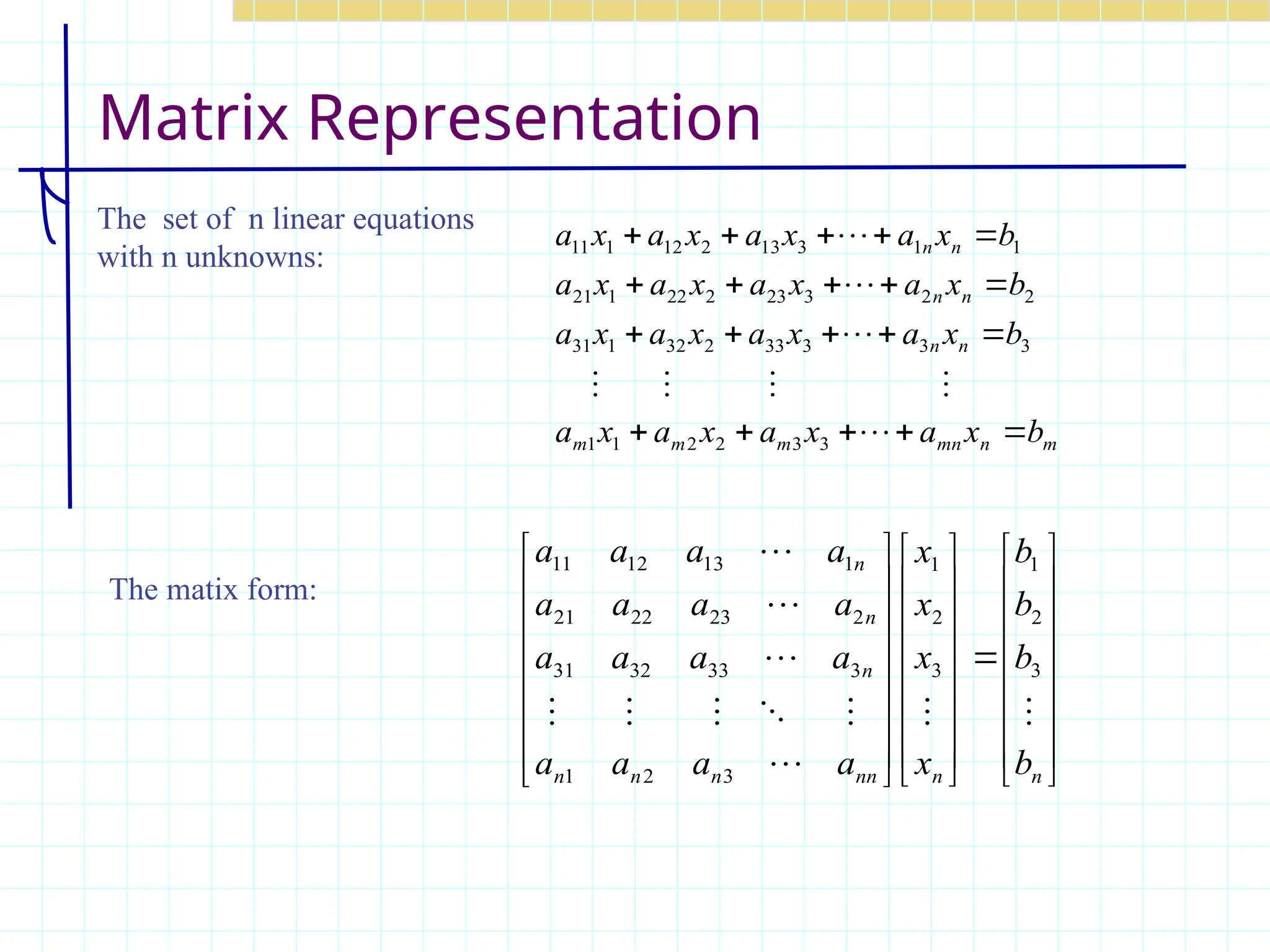
Matrix Representation

















































n
n
nn
n
n
n
n
n
n
b
b
b
b
x
x
x
x
a
a
a
a
a
a
a
a
a
a
a
a
a
a
a
a











3
2
1
3
2
1
3
2
1
3
33
32
31
2
23
22
21
1
13
12
11
m
n
mn
m
m
m
n
n
n
n
n
n
b
x
a
x
a
x
a
x
a
b
x
a
x
a
x
a
x
a
b
x
a
x
a
x
a
x
a
b
x
a
x
a
x
a
x
a




























3
3
2
2
1
1
3
3
3
33
2
32
1
31
2
2
3
23
2
22
1
21
1
1
3
13
2
12
1
11
The set of n linear equations
with n unknowns:
The matix form:
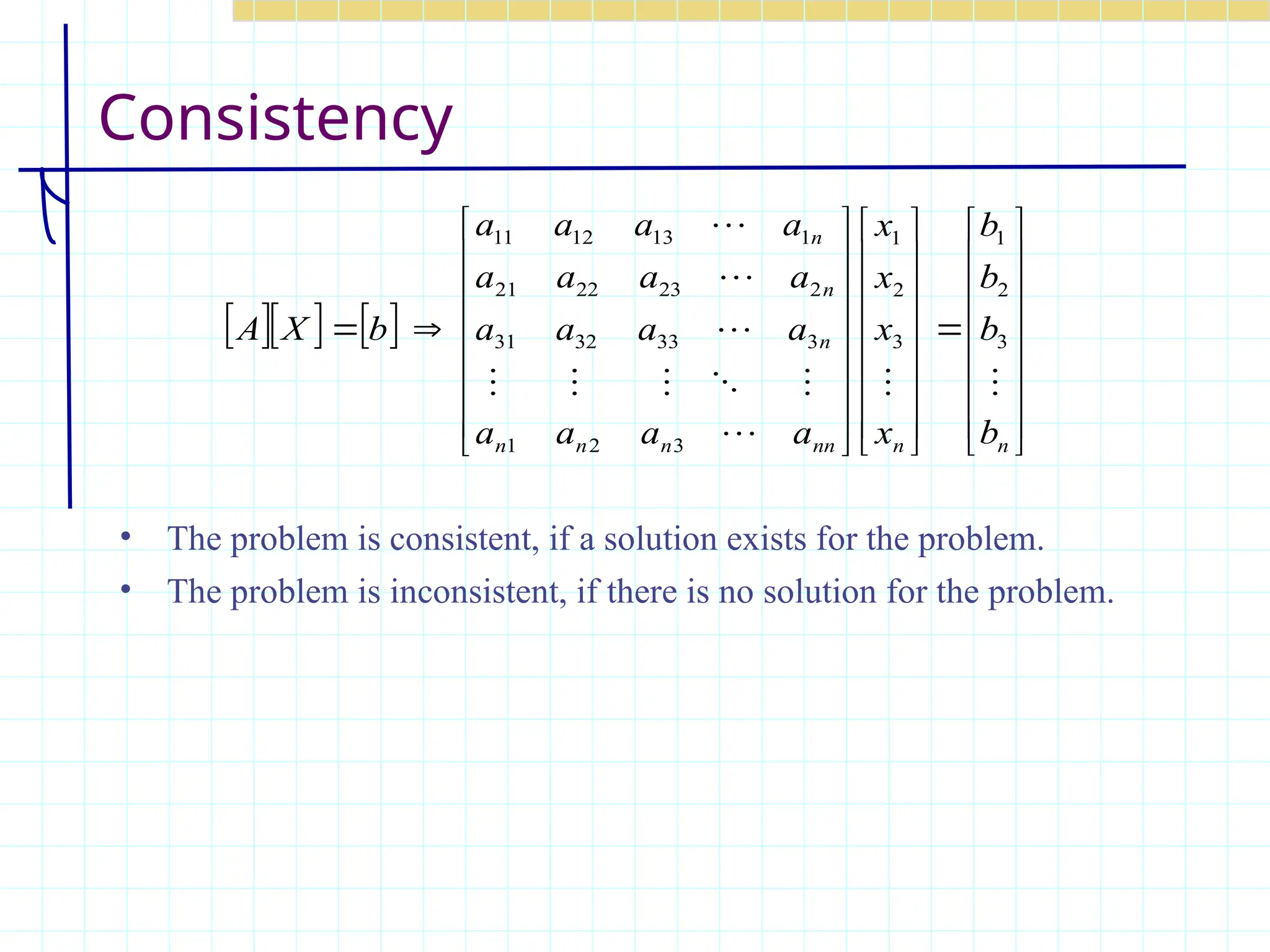
Consistency
    



















































n
n
nn
n
n
n
n
n
n
b
b
b
b
x
x
x
x
a
a
a
a
a
a
a
a
a
a
a
a
a
a
a
a
b
X
A











3
2
1
3
2
1
3
2
1
3
33
32
31
2
23
22
21
1
13
12
11
• The problem is consistent, if a solution exists for the problem.
• The problem is inconsistent, if there is no solution for the problem.
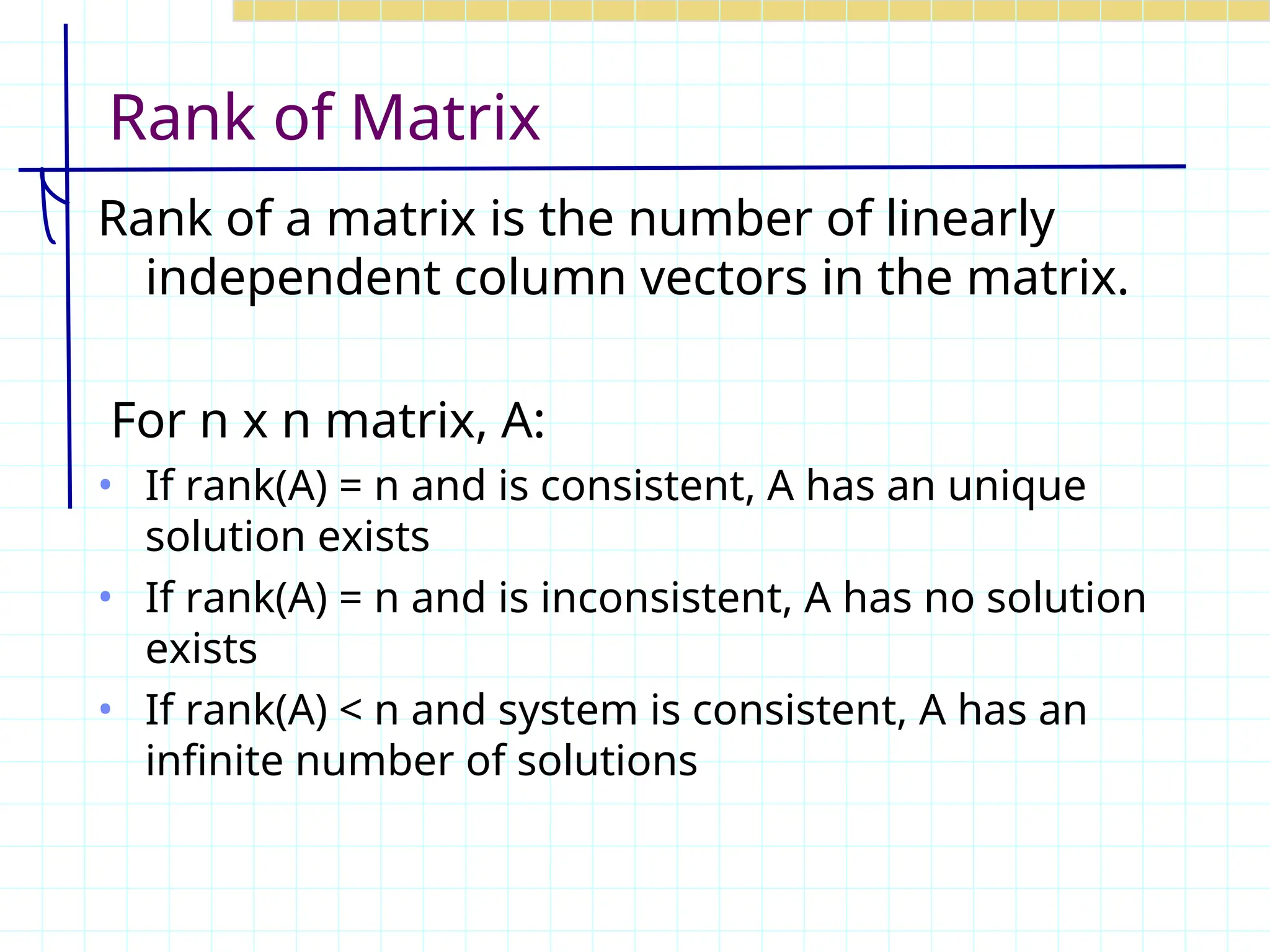
Rank of Matrix
Rank of a matrix is the number of linearly
independent column vectors in the matrix.
For n x n matrix, A:
• If rank(A) = n and is consistent, A has an unique
solution exists
• If rank(A) = n and is inconsistent, A has no solution
exists
• If rank(A) < n and system is consistent, A has an
infinite number of solutions
Matrix
For an n x n system, rank(A) = n automatically
guarantees
that the system is consistent.
• The columns of A are linearly independent
• The rows of A are linearly independent
• rank(A) = n
• det(A) != 0
• A-1
exists;
• The solution to [A]{x} ={b} exist and is unique.
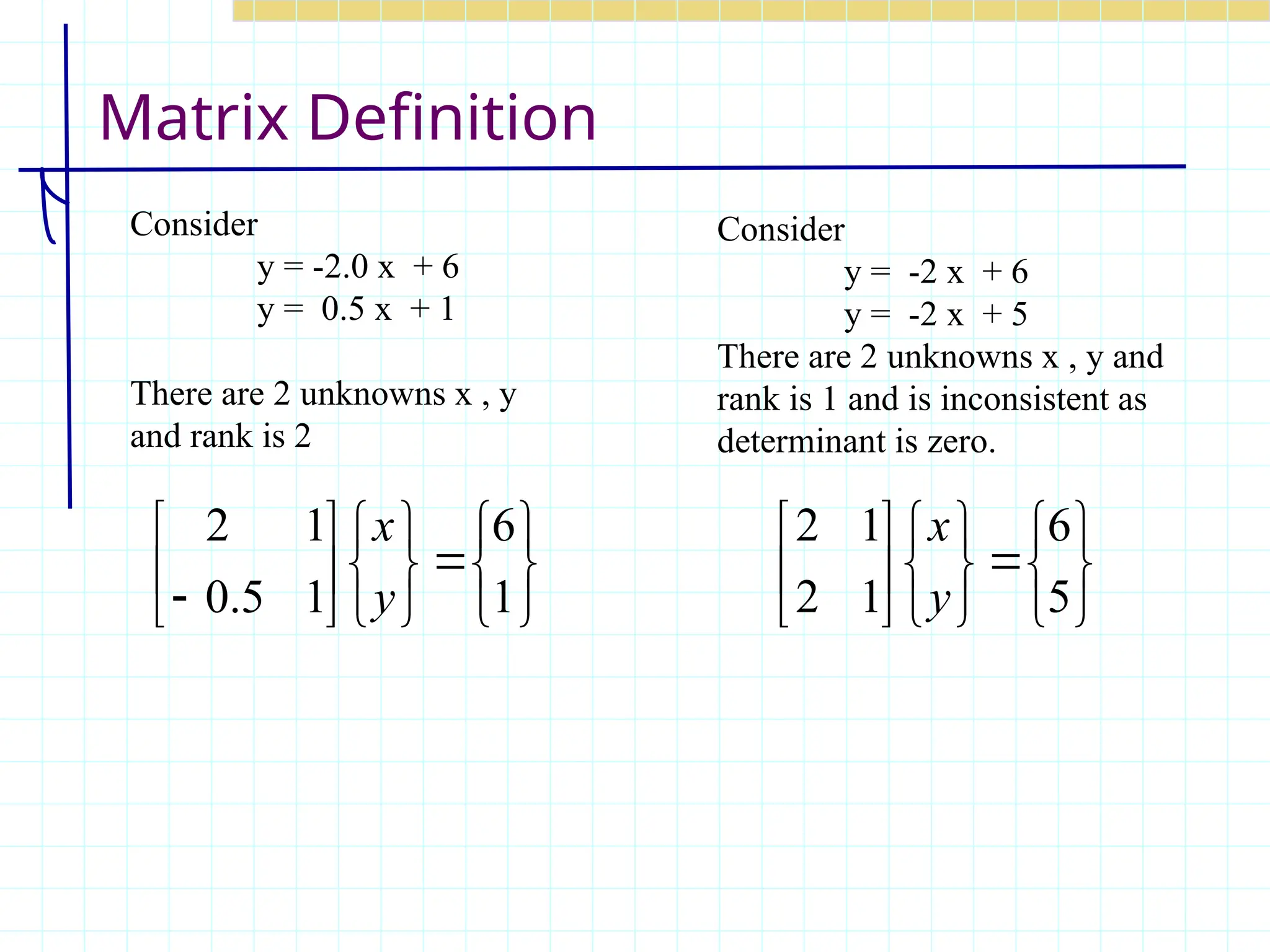
Matrix Definition



















 1
6
1
5
.
0
1
2
y
x



















5
6
1
2
1
2
y
x
Consider
y = -2.0 x + 6
y = 0.5 x + 1
There are 2 unknowns x , y
and rank is 2
Consider
y = -2 x + 6
y = -2 x + 5
There are 2 unknowns x , y and
rank is 1 and is inconsistent as
determinant is zero.
Gaussian Elimination
Gaussian Elimination is one of the most popular techniques for
solving simultaneous linear equations of the form: [A][X] =[b]
The method consists of 2 steps
1. Forward Elimination of Unknowns.
2. Back Substitution
Let us learn the method first by examples:
m
n
mn
m
m
m
n
n
n
n
n
n
b
x
a
x
a
x
a
x
a
b
x
a
x
a
x
a
x
a
b
x
a
x
a
x
a
x
a
b
x
a
x
a
x
a
x
a




























3
3
2
2
1
1
3
3
3
33
2
32
1
31
2
2
3
23
2
22
1
21
1
1
3
13
2
12
1
11
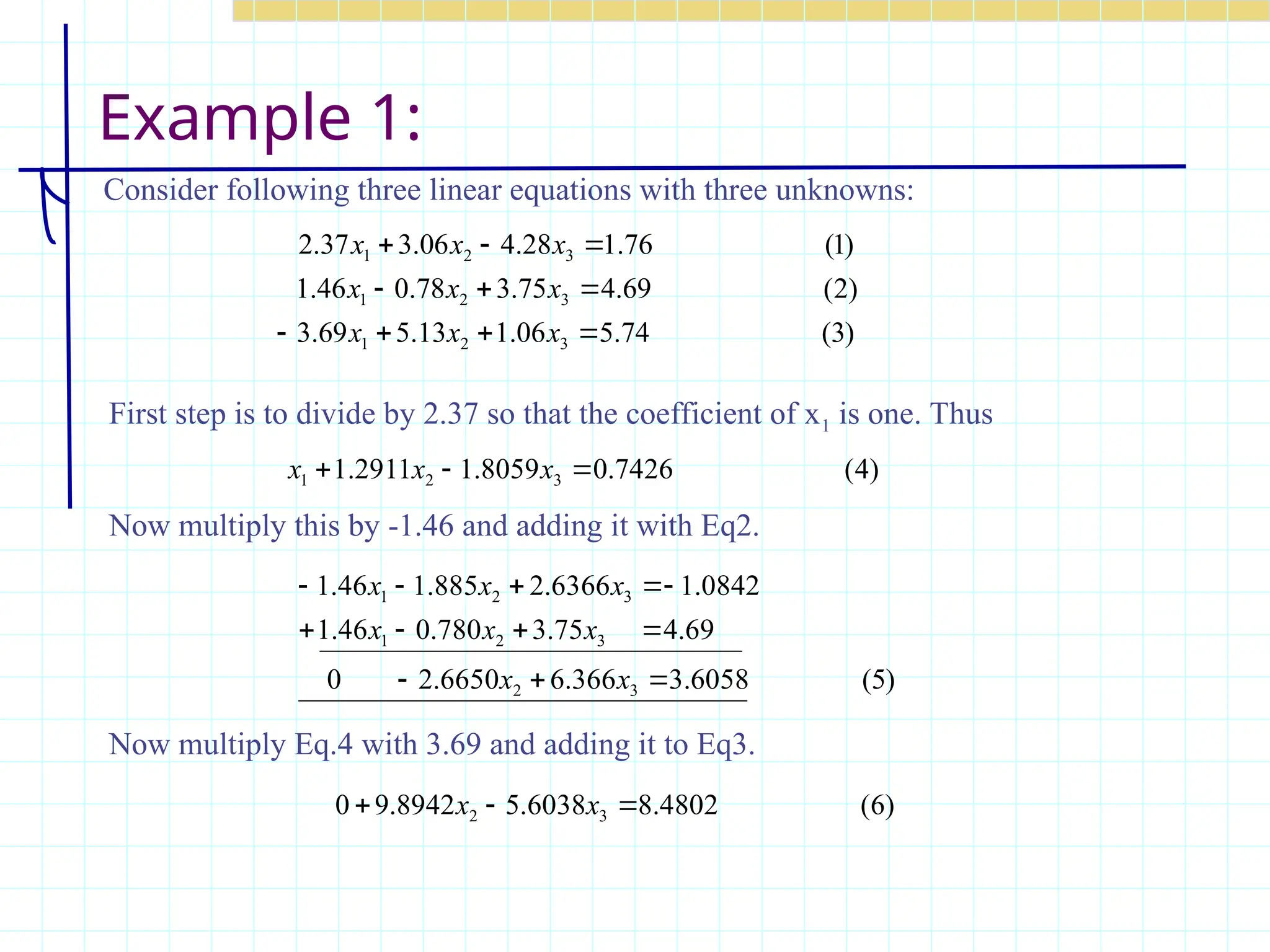
Example 1:
Consider following three linear equations with three unknowns:
)
3
(
74
.
5
06
.
1
13
.
5
69
.
3
)
2
(
69
.
4
75
.
3
78
.
0
46
.
1
)
1
(
76
.
1
28
.
4
06
.
3
37
.
2
3
2
1
3
2
1
3
2
1










x
x
x
x
x
x
x
x
x
)
4
(
7426
.
0
8059
.
1
2911
.
1 3
2
1 

 x
x
x
)
5
(
6058
.
3
366
.
6
6650
.
2
0
69
.
4
75
.
3
780
.
0
46
.
1
0842
.
1
6366
.
2
885
.
1
46
.
1
3
2
3
2
1
3
2
1












x
x
x
x
x
x
x
x
First step is to divide by 2.37 so that the coefficient of x1 is one. Thus
Now multiply this by -1.46 and adding it with Eq2.
)
6
(
4802
.
8
6038
.
5
8942
.
9
0 3
2 

 x
x
Now multiply Eq.4 with 3.69 and adding it to Eq3.
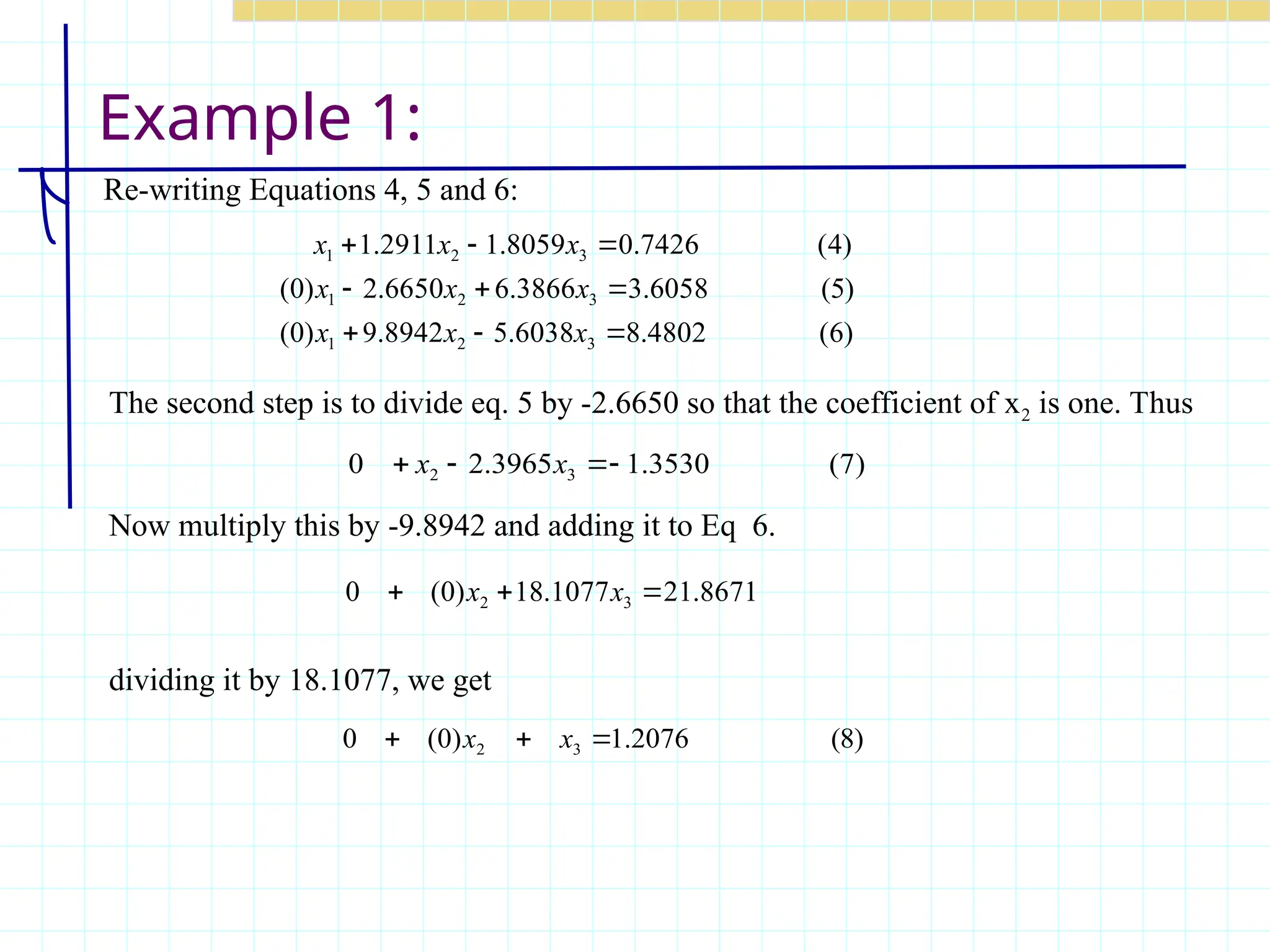
Example 1:
Re-writing Equations 4, 5 and 6:
)
6
(
4802
.
8
6038
.
5
8942
.
9
)
0
(
)
5
(
6058
.
3
3866
.
6
6650
.
2
)
0
(
)
4
(
7426
.
0
8059
.
1
2911
.
1
3
2
1
3
2
1
3
2
1









x
x
x
x
x
x
x
x
x
)
7
(
3530
.
1
3965
.
2
0 3
2 


 x
x
8671
.
21
1077
.
18
)
0
(
0 3
2 

 x
x
The second step is to divide eq. 5 by -2.6650 so that the coefficient of x2 is one. Thus
Now multiply this by -9.8942 and adding it to Eq 6.
dividing it by 18.1077, we get
)
8
(
2076
.
1
)
0
(
0 3
2 

 x
x
Example 1:
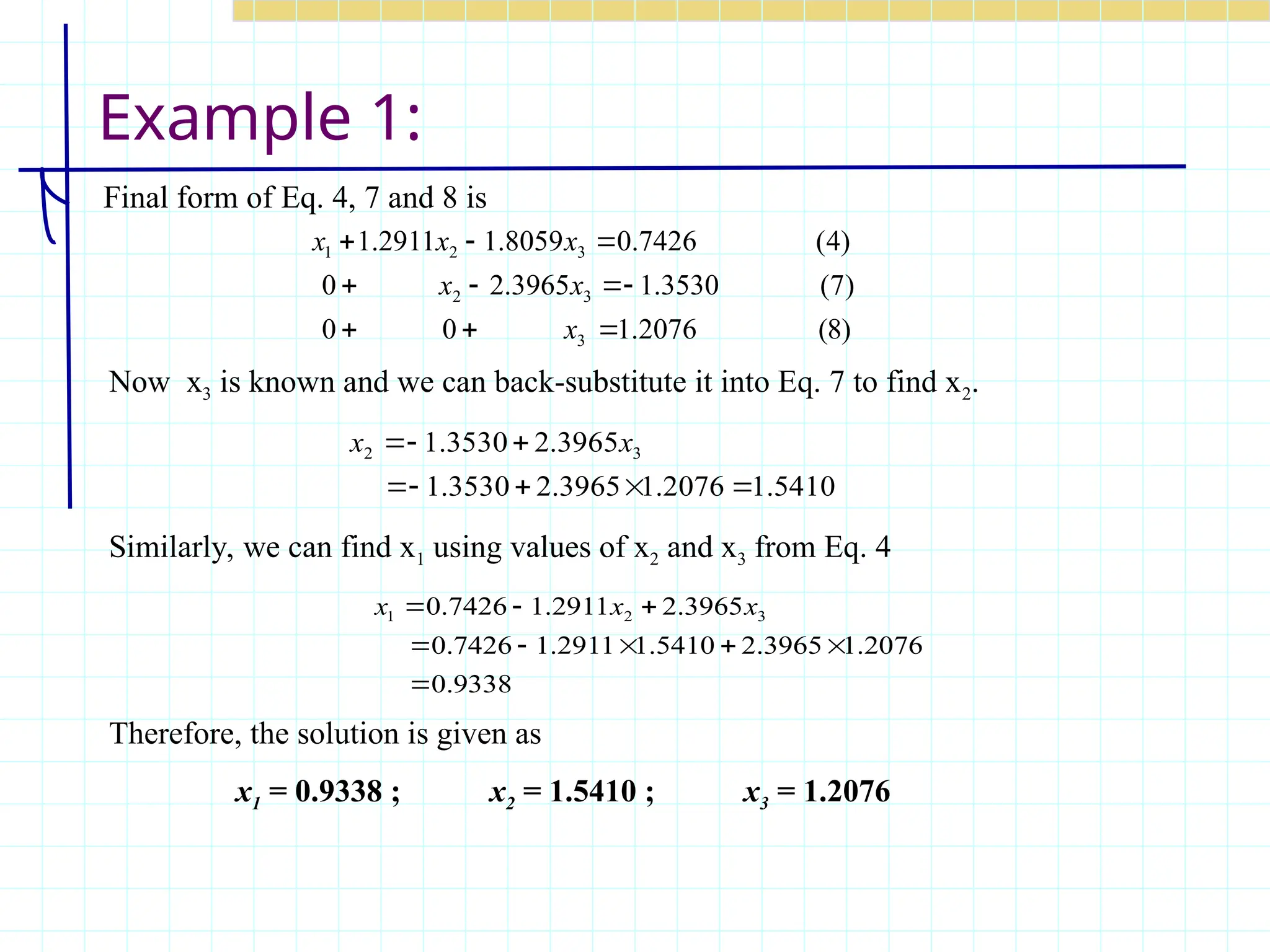
Final form of Eq. 4, 7 and 8 is
)
8
(
2076
.
1
0
0
)
7
(
3530
.
1
3965
.
2
0
)
4
(
7426
.
0
8059
.
1
2911
.
1
3
3
2
3
2
1










x
x
x
x
x
x
5410
.
1
2076
.
1
3965
.
2
3530
.
1
3965
.
2
3530
.
1 3
2







 x
x
Now x3 is known and we can back-substitute it into Eq. 7 to find x2.
Similarly, we can find x1 using values of x2 and x3 from Eq. 4
Therefore, the solution is given as
x1 = 0.9338 ; x2 = 1.5410 ; x3 = 1.2076
9338
.
0
2076
.
1
3965
.
2
5410
.
1
2911
.
1
7426
.
0
3965
.
2
2911
.
1
7426
.
0 3
2
1








 x
x
x
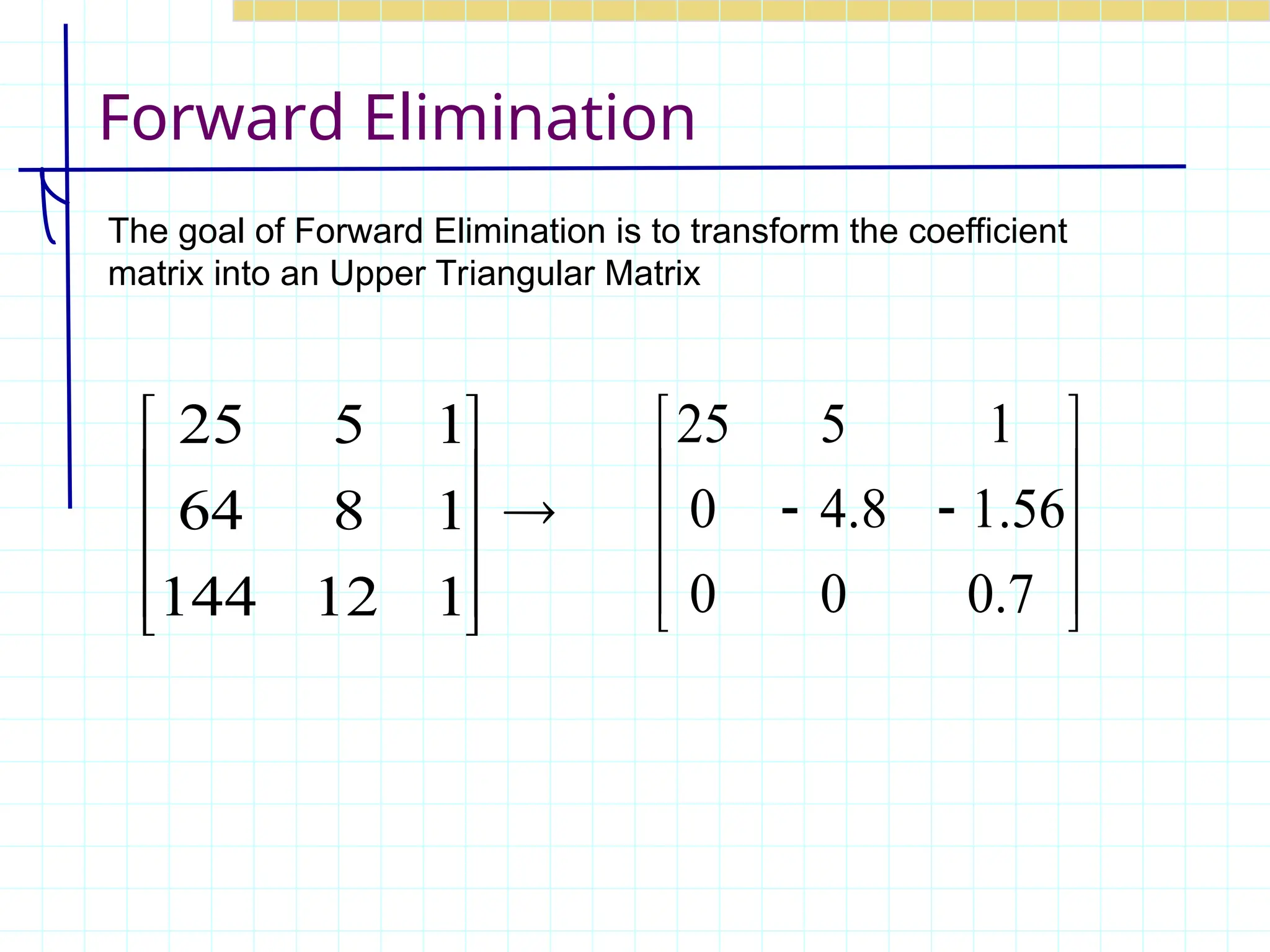
Forward Elimination
The goal of Forward Elimination is to transform the coefficient
matrix into an Upper Triangular Matrix
7
.
0
0
0
56
.
1
8
.
4
0
1
5
25























1
12
144
1
8
64
1
5
25
Forward Elimination
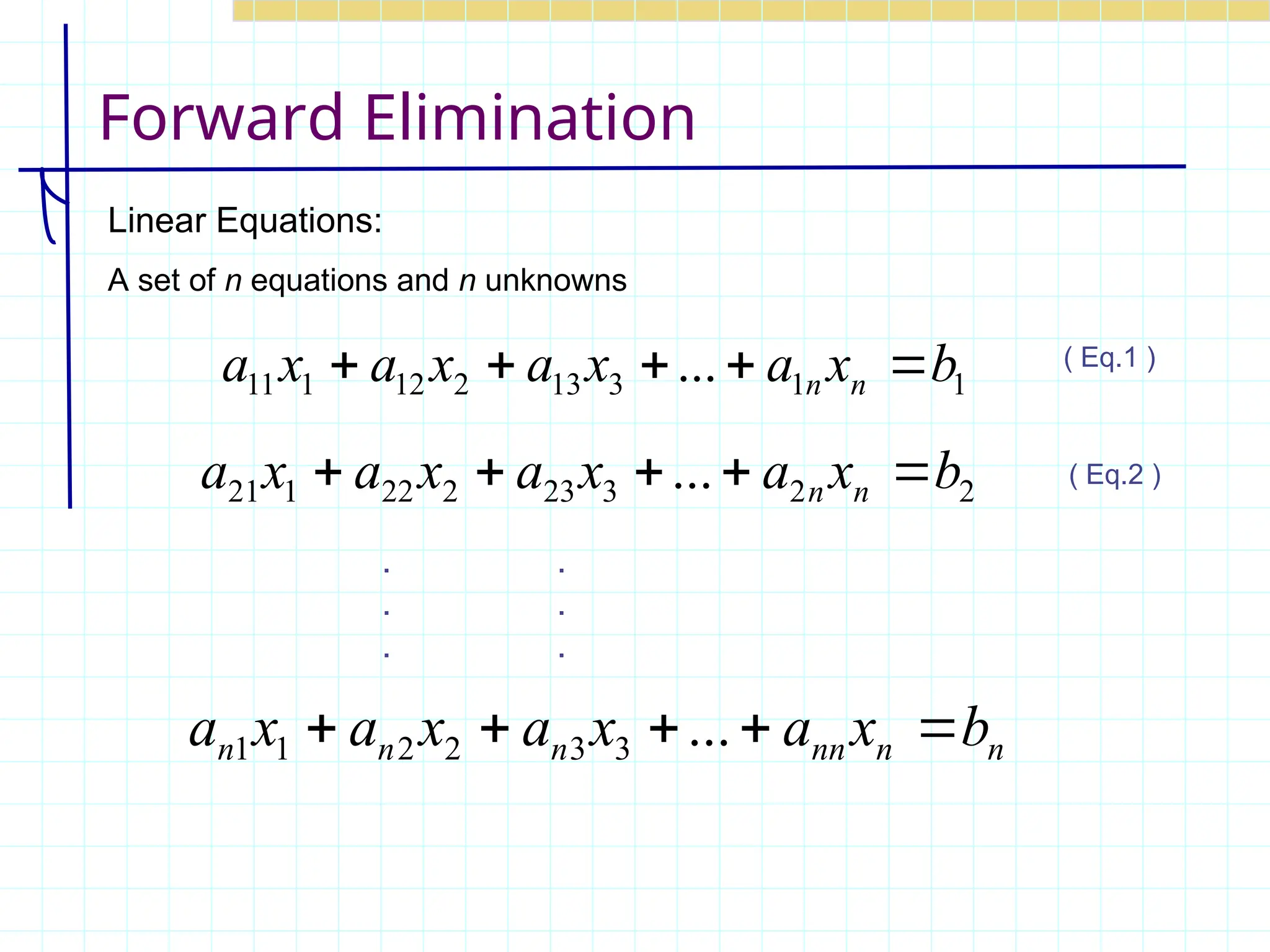
Linear Equations:
A set of n equations and n unknowns
1
1
3
13
2
12
1
11 ... b
x
a
x
a
x
a
x
a n
n 




2
2
3
23
2
22
1
21 ... b
x
a
x
a
x
a
x
a n
n 




n
n
nn
n
n
n b
x
a
x
a
x
a
x
a 



 ...
3
3
2
2
1
1
. .
. .
. .
( Eq.1 )
( Eq.2 )
Forward Elimination
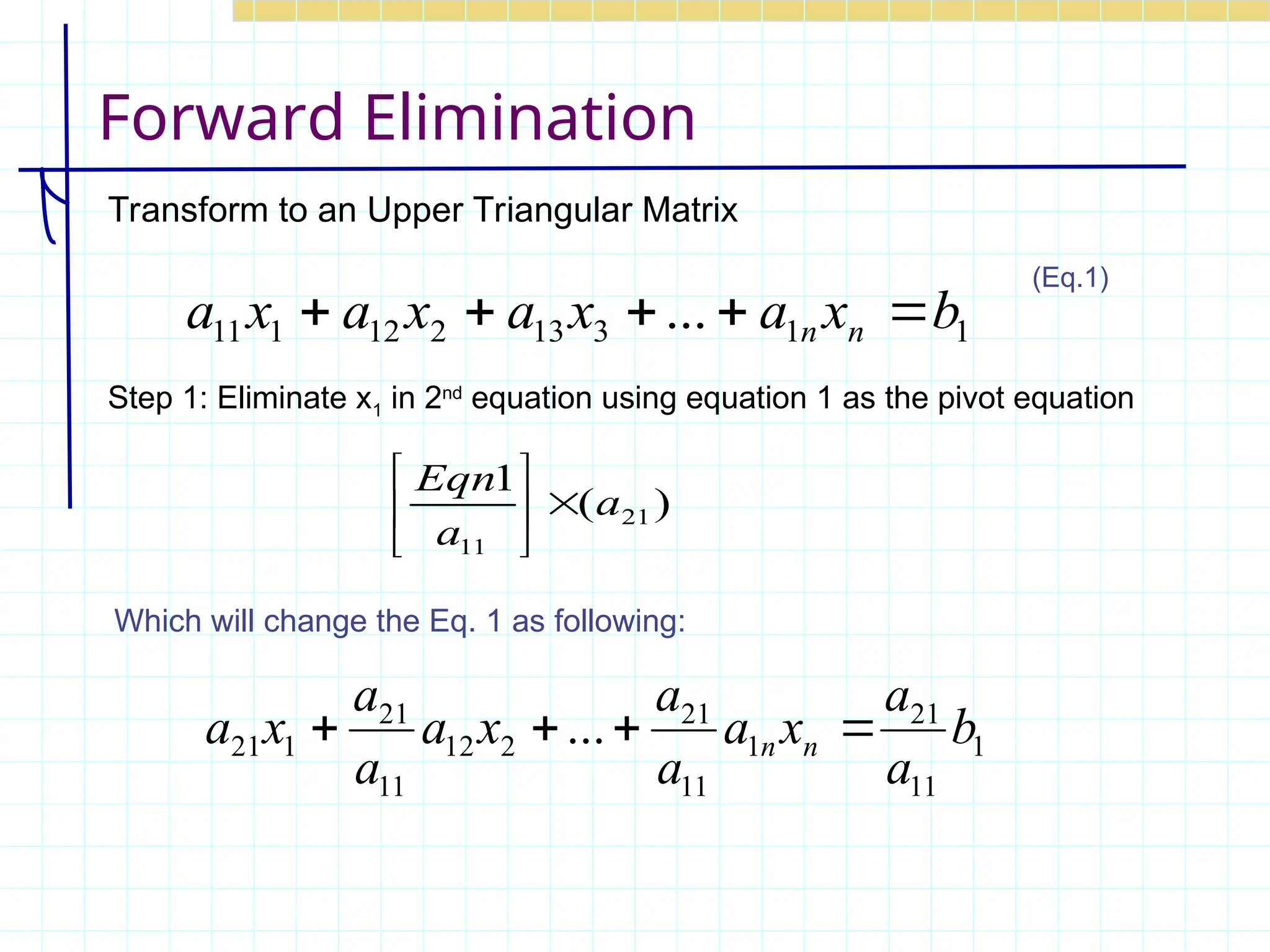
Transform to an Upper Triangular Matrix
Step 1: Eliminate x1 in 2nd
equation using equation 1 as the pivot equation
)
(
1
21
11
a
a
Eqn







Which will change the Eq. 1 as following:
1
11
21
1
11
21
2
12
11
21
1
21 ... b
a
a
x
a
a
a
x
a
a
a
x
a n
n 



1
1
3
13
2
12
1
11 ... b
x
a
x
a
x
a
x
a n
n 




(Eq.1)
Forward Elimination
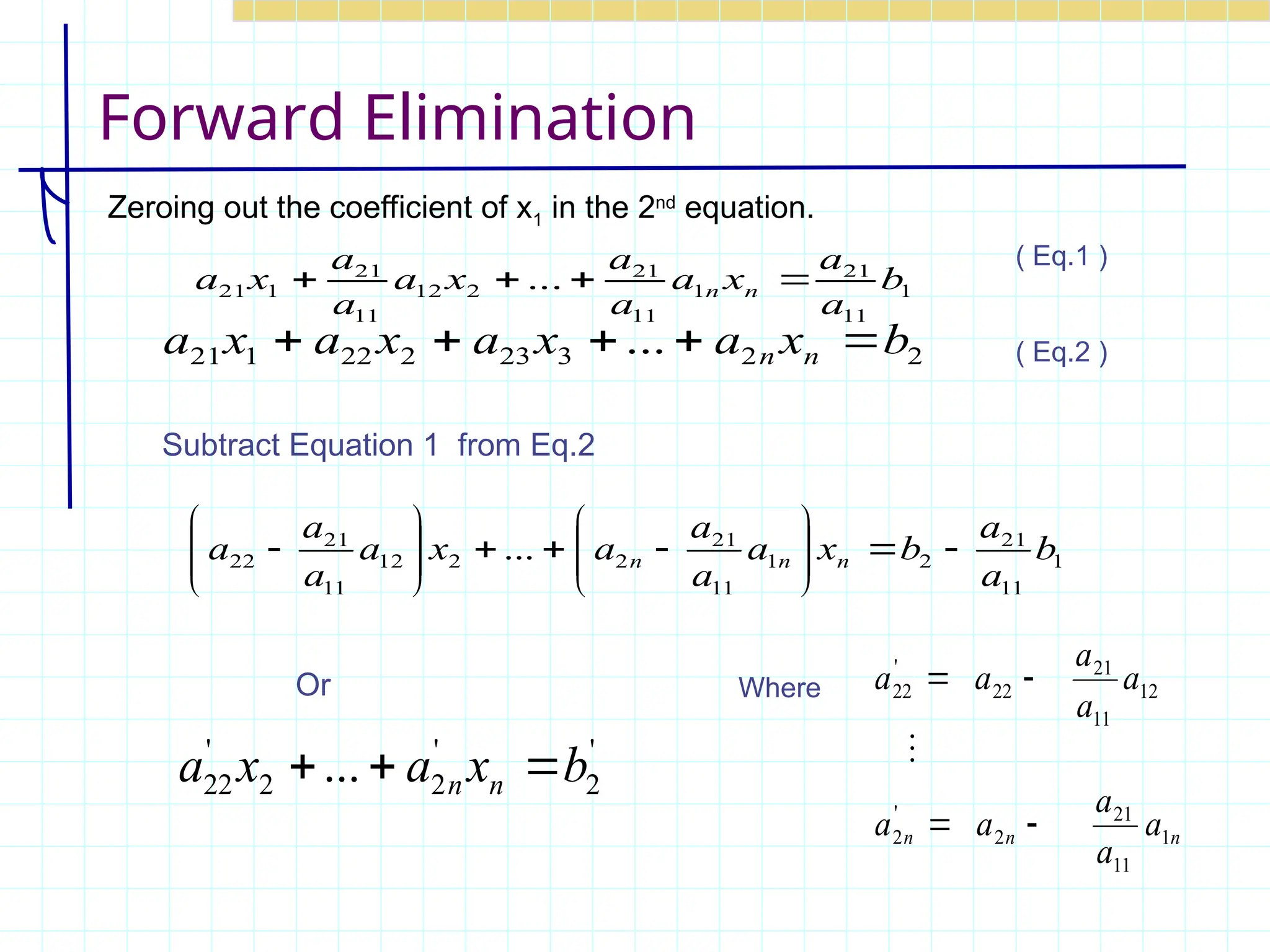
Zeroing out the coefficient of x1 in the 2nd
equation.
Subtract Equation 1 from Eq.2
1
11
21
2
1
11
21
2
2
12
11
21
22 ... b
a
a
b
x
a
a
a
a
x
a
a
a
a n
n
n 





















'
2
'
2
2
'
22 ... b
x
a
x
a n
n 


n
n
n a
a
a
a
a
a
a
a
a
a
1
11
21
2
'
2
12
11
21
22
'
22





Or
1
11
21
1
11
21
2
12
11
21
1
21 ... b
a
a
x
a
a
a
x
a
a
a
x
a n
n 



Where
2
2
3
23
2
22
1
21 ... b
x
a
x
a
x
a
x
a n
n 



 ( Eq.2 )
( Eq.1 )
Forward Elimination
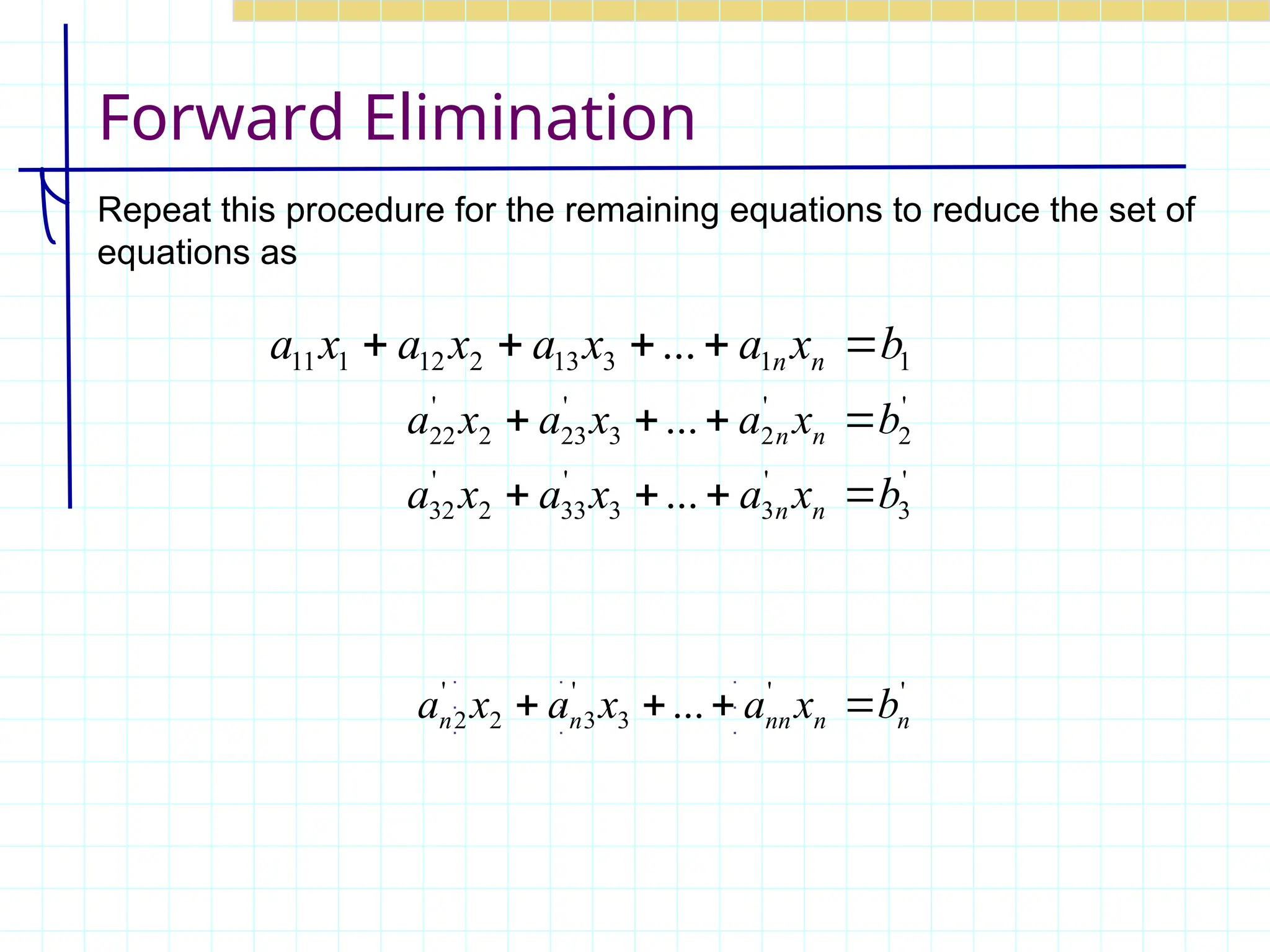
Repeat this procedure for the remaining equations to reduce the set of
equations as
1
1
3
13
2
12
1
11 ... b
x
a
x
a
x
a
x
a n
n 




'
2
'
2
3
'
23
2
'
22 ... b
x
a
x
a
x
a n
n 



'
3
'
3
3
'
33
2
'
32 ... b
x
a
x
a
x
a n
n 



'
'
3
'
3
2
'
2 ... n
n
nn
n
n b
x
a
x
a
x
a 



. . .
. . .
. . .
Forward Elimination
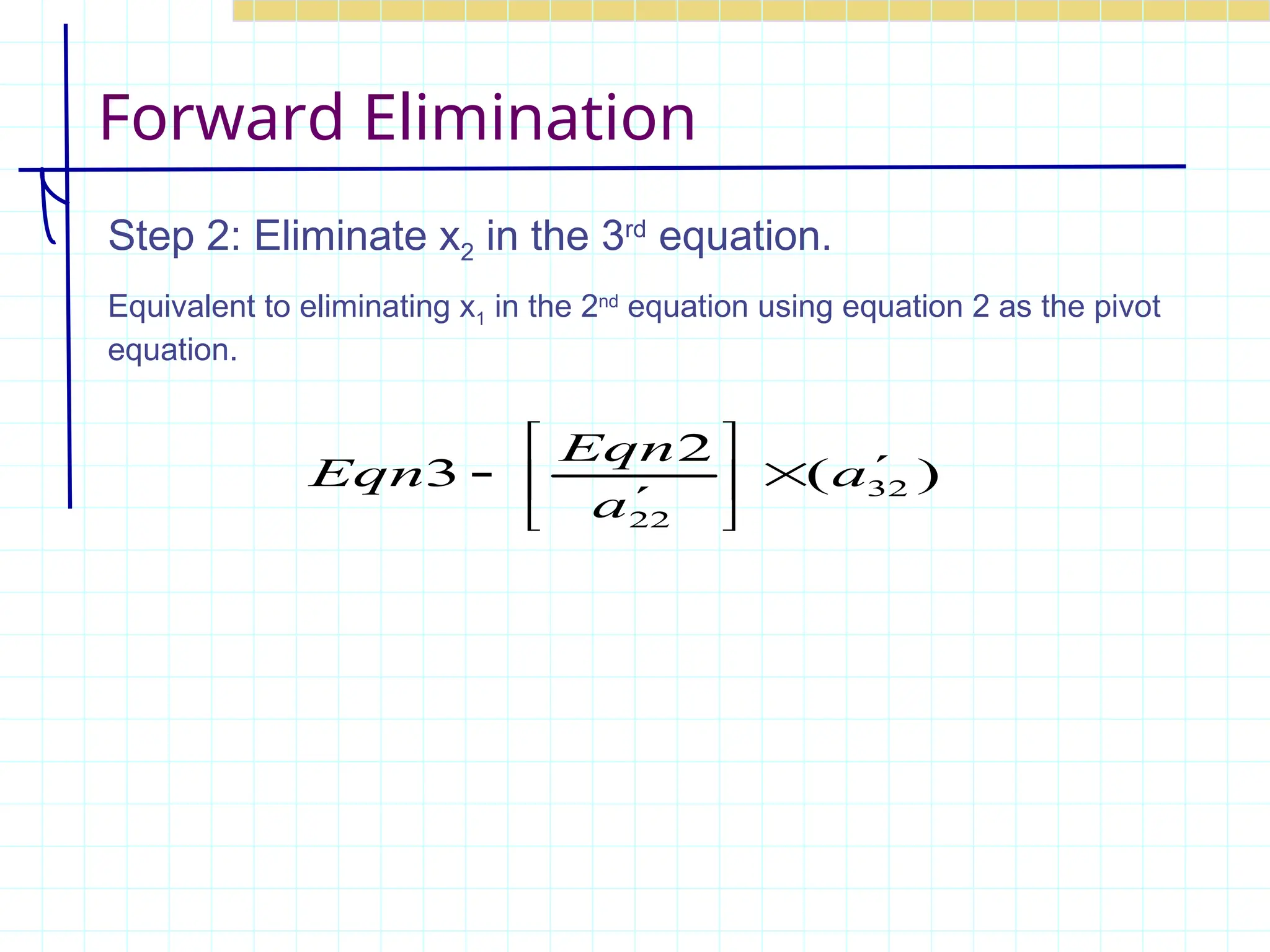
Step 2: Eliminate x2 in the 3rd
equation.
Equivalent to eliminating x1 in the 2nd
equation using equation 2 as the pivot
equation.
)
(
2
3 32
22
a
a
Eqn
Eqn 









Forward Elimination
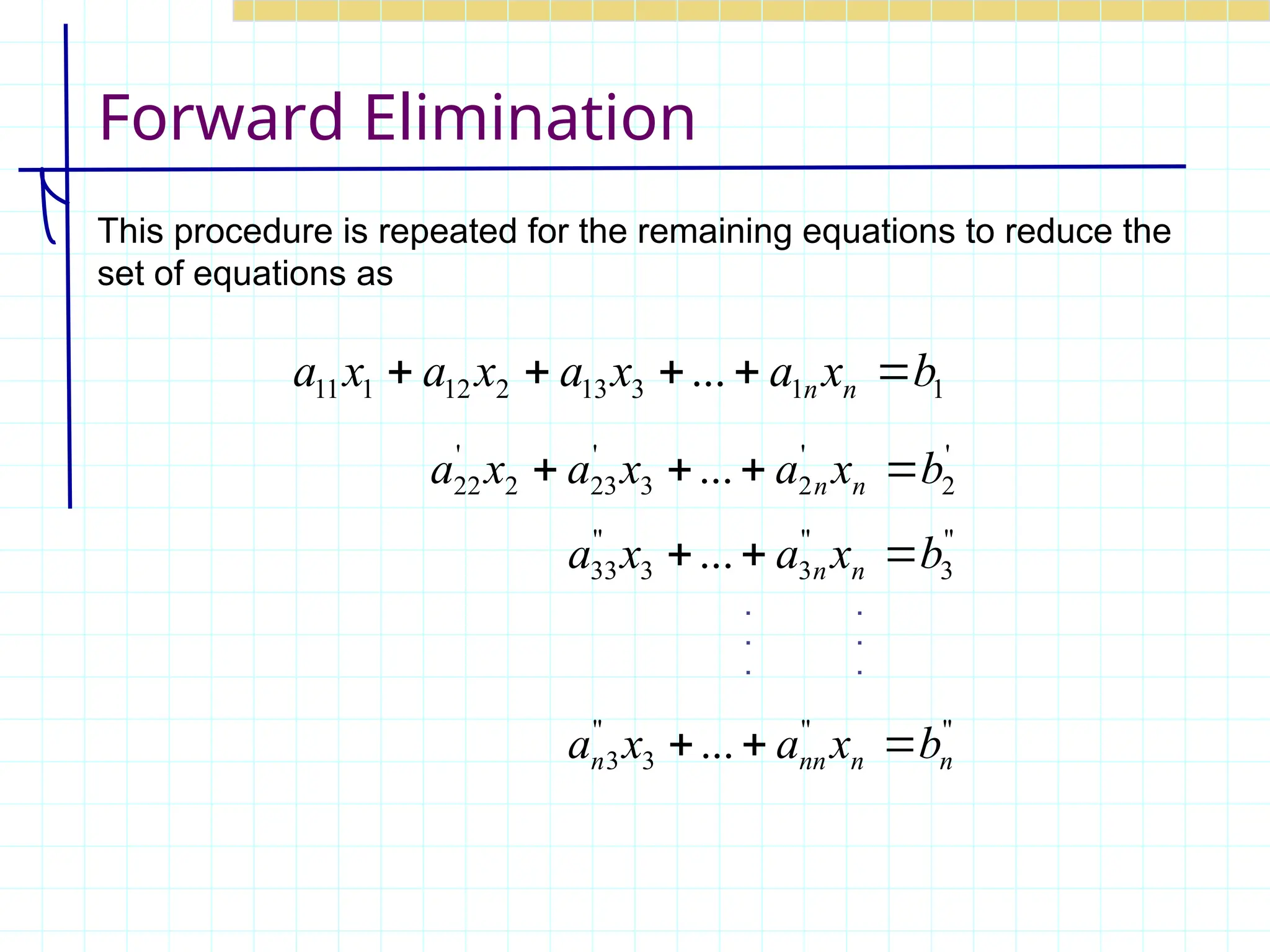
This procedure is repeated for the remaining equations to reduce the
set of equations as
1
1
3
13
2
12
1
11 ... b
x
a
x
a
x
a
x
a n
n 




'
2
'
2
3
'
23
2
'
22 ... b
x
a
x
a
x
a n
n 



"
3
"
3
3
"
33 ... b
x
a
x
a n
n 


"
"
3
"
3 ... n
n
nn
n b
x
a
x
a 


. .
. .
. .
Forward Elimination
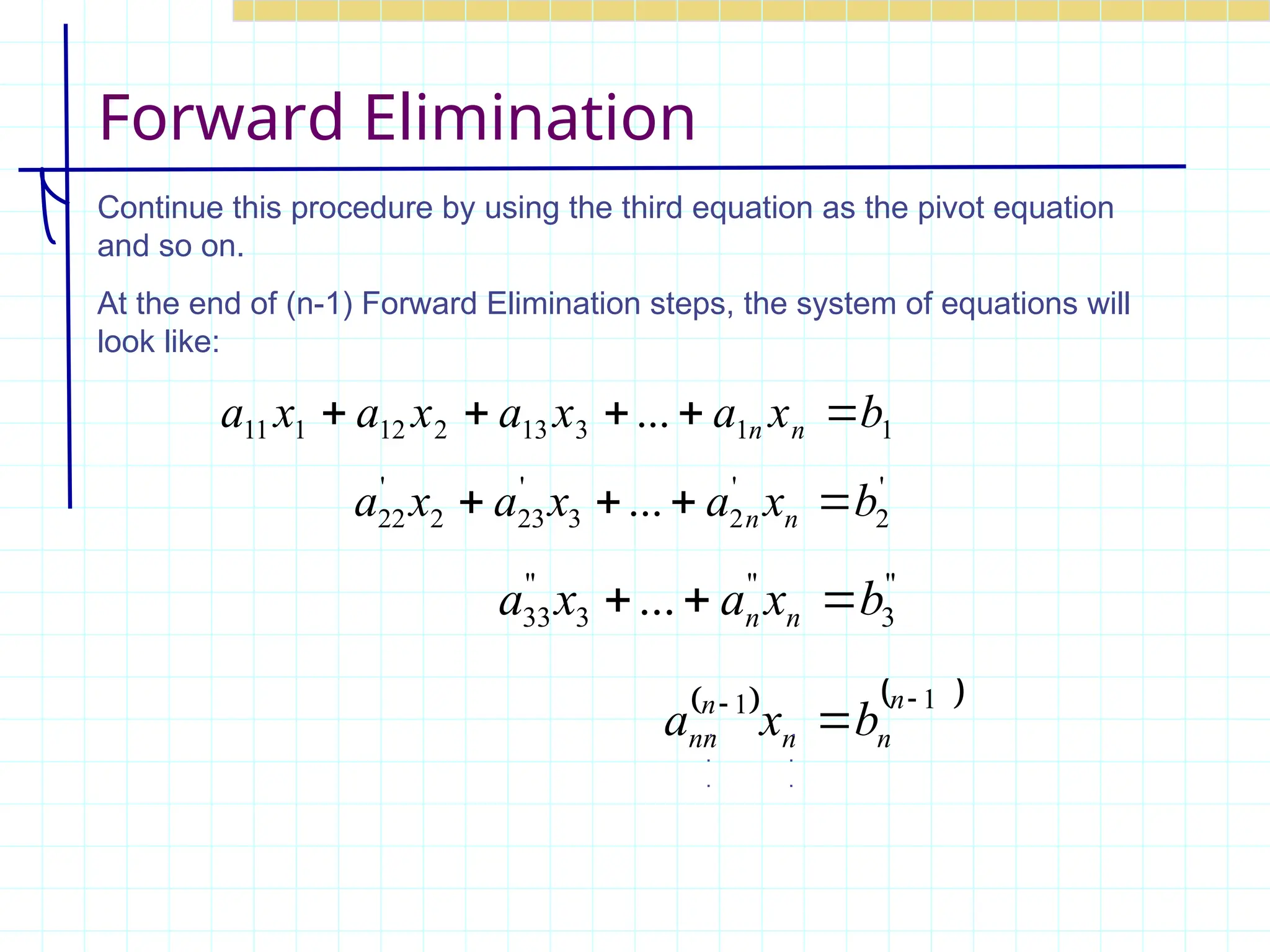
Continue this procedure by using the third equation as the pivot equation
and so on.
At the end of (n-1) Forward Elimination steps, the system of equations will
look like:
'
2
'
2
3
'
23
2
'
22 ... b
x
a
x
a
x
a n
n 



"
3
"
3
"
33 ... b
x
a
x
a n
n 


   
1
1 


n
n
n
n
nn b
x
a . .
. .
. .
1
1
3
13
2
12
1
11 ... b
x
a
x
a
x
a
x
a n
n 




Forward Elimination
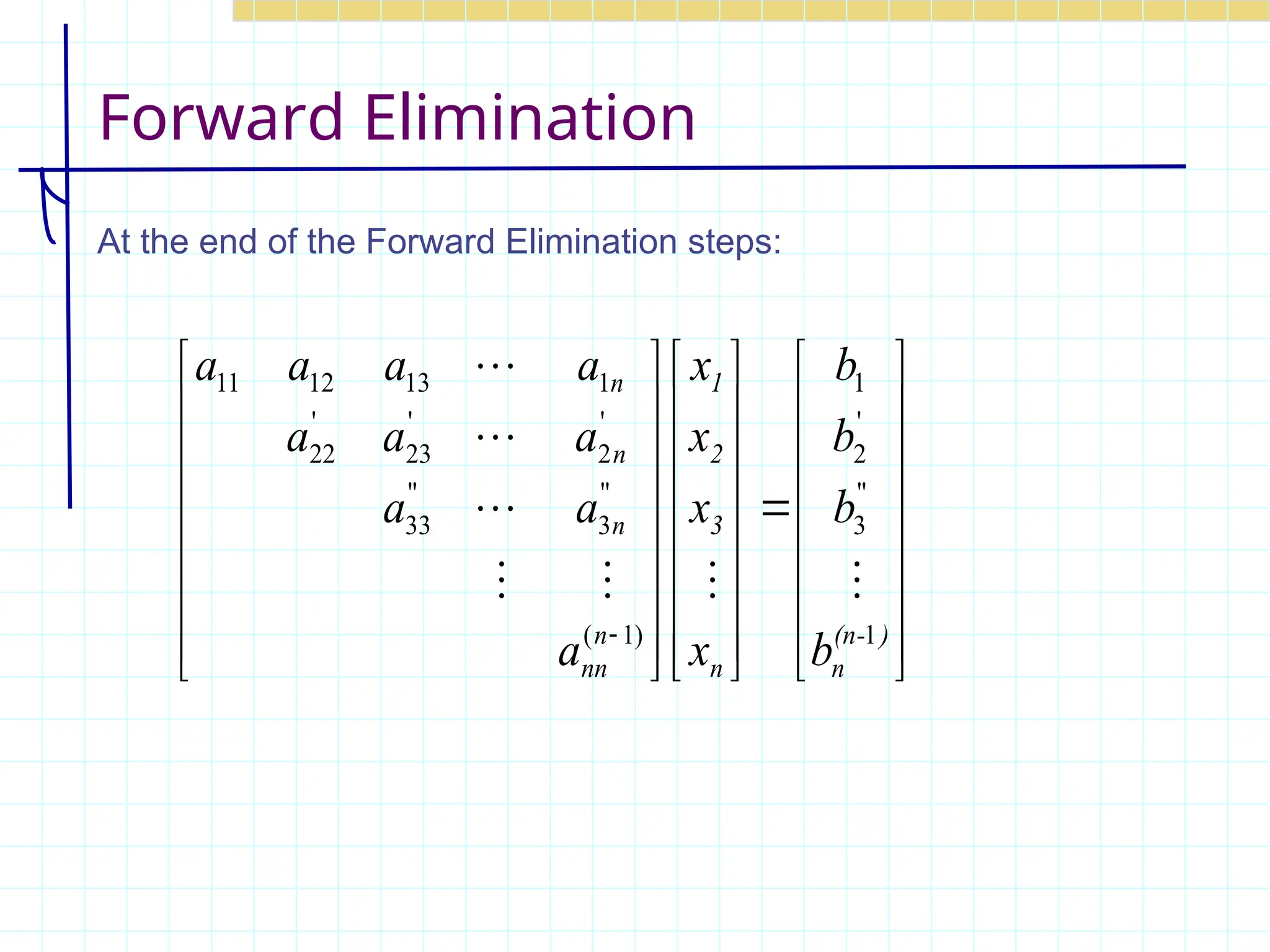
At the end of the Forward Elimination steps:

















































 )
-
(n
n
n
3
2
1
n
nn
n
n
n
b
b
b
b
x
x
x
x
a
a
a
a
a
a
a
a
a
a
1
"
3
'
2
1
)
1
(
"
3
"
33
'
2
'
23
'
22
1
13
12
11







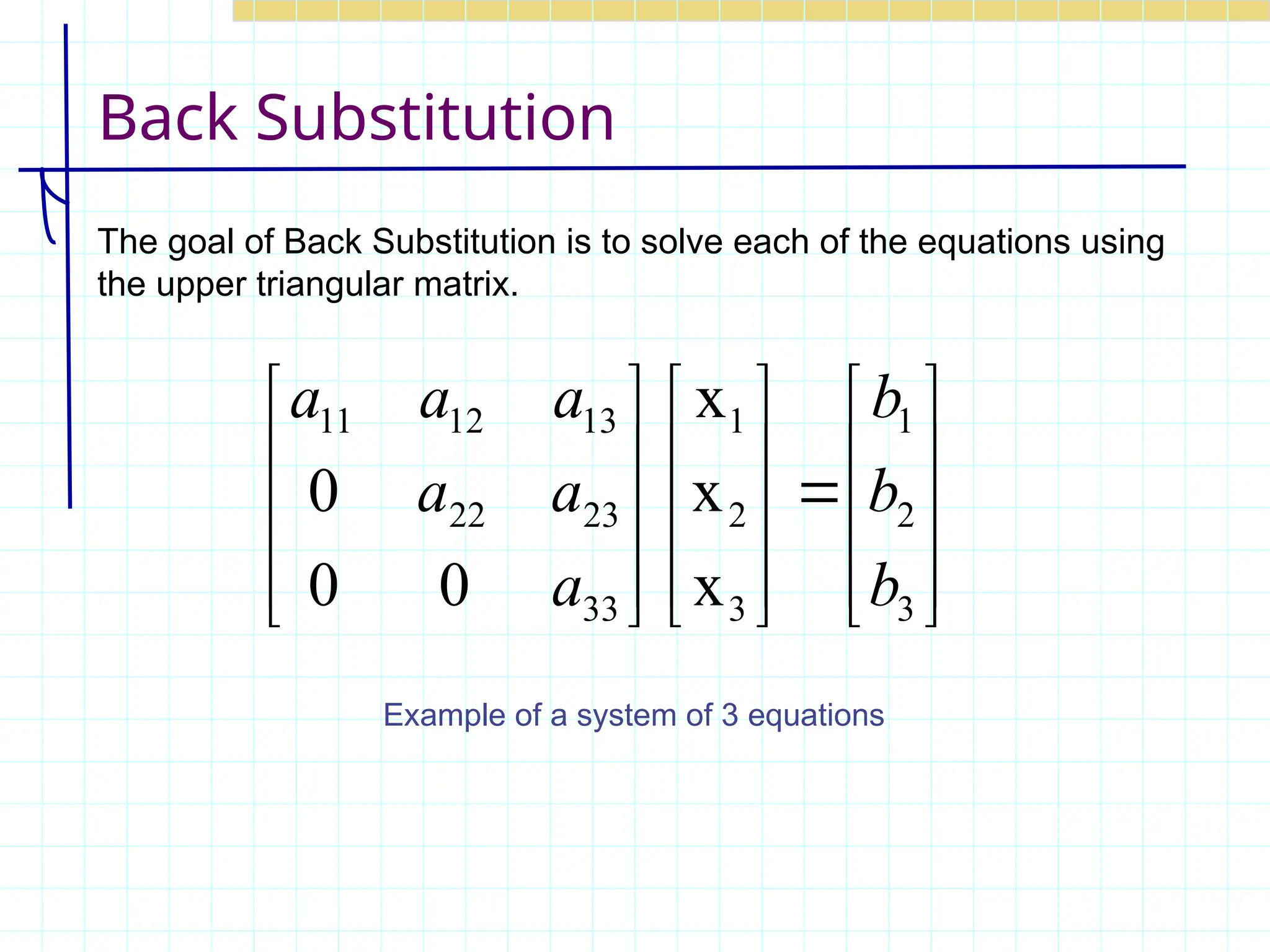
Back Substitution
The goal of Back Substitution is to solve each of the equations using
the upper triangular matrix.































3
2
1
3
2
1
33
23
22
13
12
11
x
x
x
0
0
0
b
b
b
a
a
a
a
a
a
Example of a system of 3 equations
Back Substitution
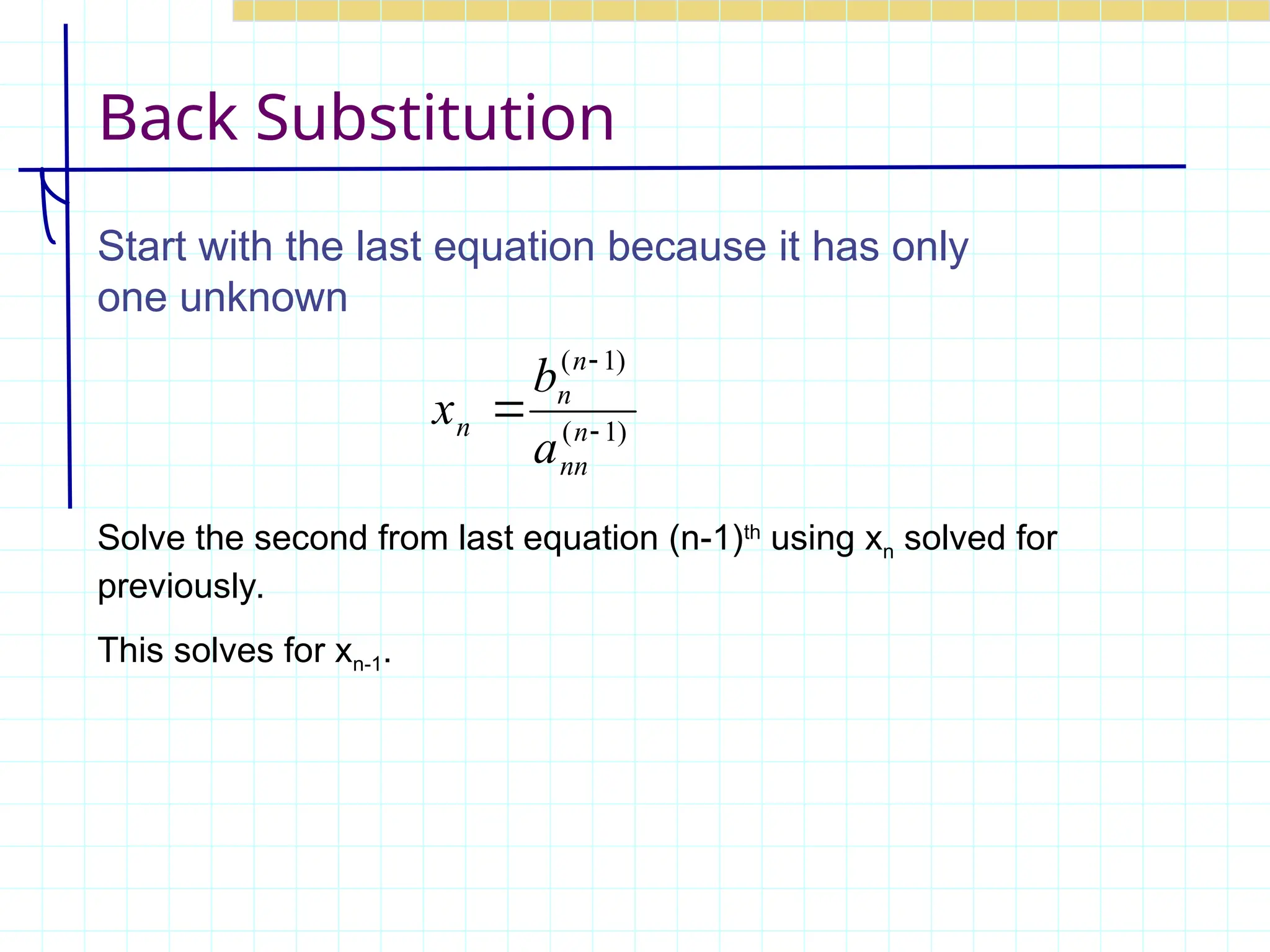
Start with the last equation because it has only
one unknown
)
1
(
)
1
(


 n
nn
n
n
n
a
b
x
Solve the second from last equation (n-1)th
using xn solved for
previously.
This solves for xn-1.
Back Substitution
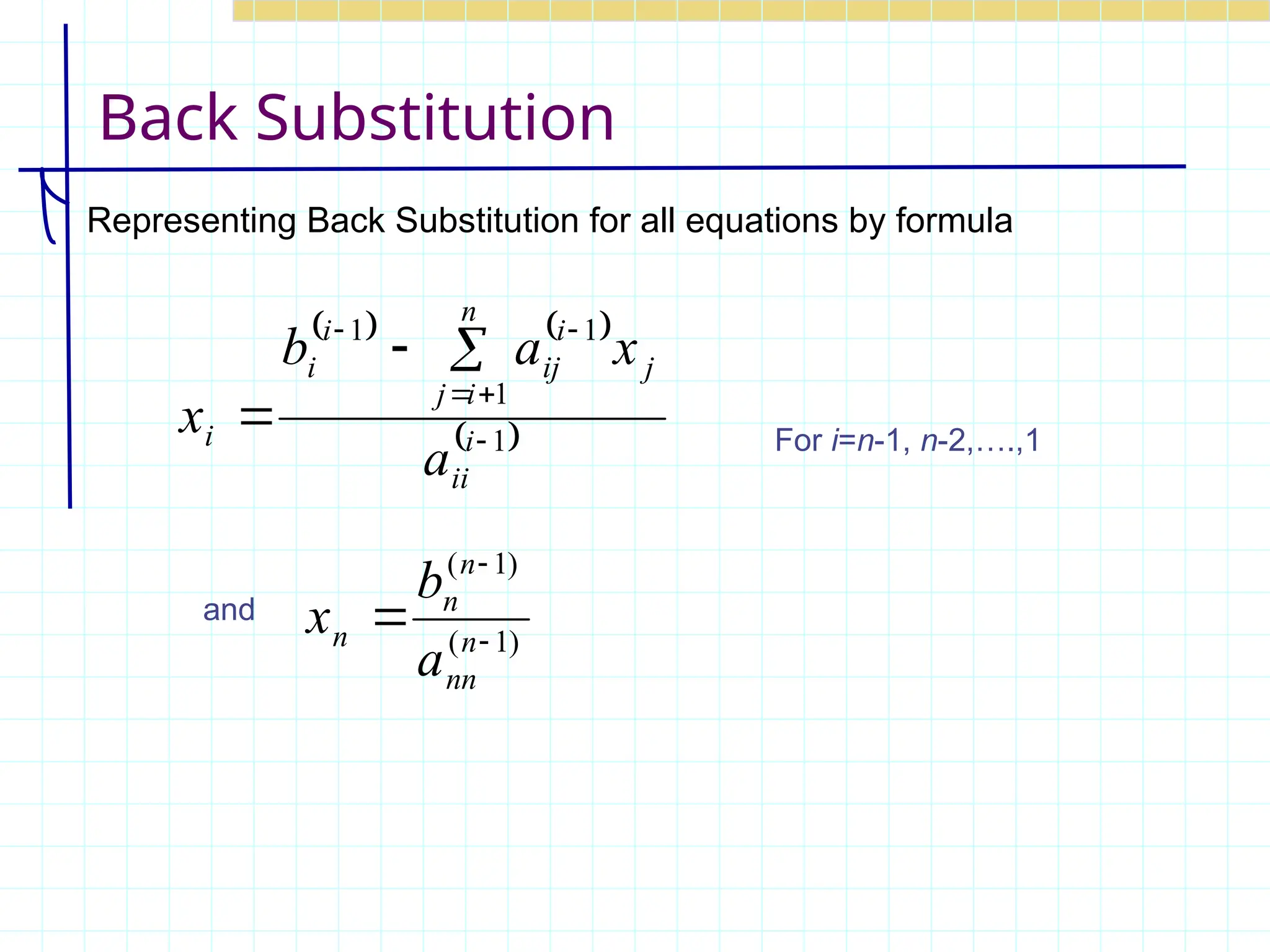
Representing Back Substitution for all equations by formula
   
 
1
1
1
1







 i
ii
n
i
j
j
i
ij
i
i
i
a
x
a
b
x For i=n-1, n-2,….,1
and
)
1
(
)
1
(


 n
nn
n
n
n
a
b
x
Computer Program
function x = gaussE(A,b,ptol)
% GEdemo Show steps in Gauss elimination and back substitution
% No pivoting is used.
%
% Synopsis: x = GEdemo(A,b)
% x = GEdemo(A,b,ptol)
%
% Input: A,b = coefficient matrix and right hand side vector
% ptol = (optional) tolerance for detection of zero pivot
% Default: ptol = 50 * eps
%
% Output: x = solution vector, if solution exists
A=[25 5 1; 64 8 1; 144 12 1]
b=[106.8; 177.2; 279.2]
if nargin<3, ptol = 50*eps; end
[m,n] = size(A);
if m~=n, error('A matrix needs to be square'); end
nb = n+1; Ab = [A b]; % Augmented system
fprintf('n Begin forward elimination with Augmented system;n'); disp(Ab);
% --- Elimination
Computer Program (continued)
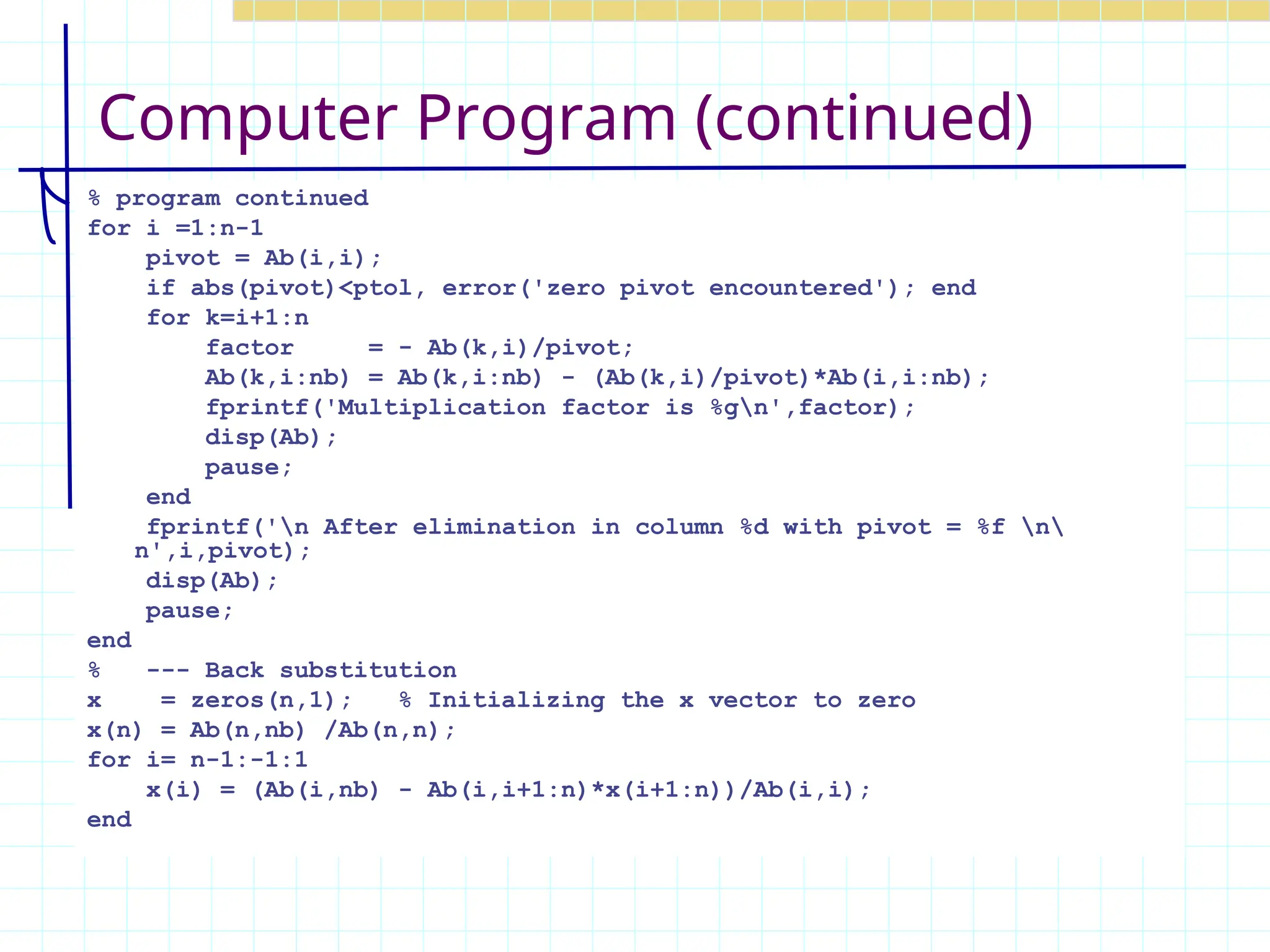
% program continued
for i =1:n-1
pivot = Ab(i,i);
if abs(pivot)<ptol, error('zero pivot encountered'); end
for k=i+1:n
factor = - Ab(k,i)/pivot;
Ab(k,i:nb) = Ab(k,i:nb) - (Ab(k,i)/pivot)*Ab(i,i:nb);
fprintf('Multiplication factor is %gn',factor);
disp(Ab);
pause;
end
fprintf('n After elimination in column %d with pivot = %f n
n',i,pivot);
disp(Ab);
pause;
end
% --- Back substitution
x = zeros(n,1); % Initializing the x vector to zero
x(n) = Ab(n,nb) /Ab(n,n);
for i= n-1:-1:1
x(i) = (Ab(i,nb) - Ab(i,i+1:n)*x(i+1:n))/Ab(i,i);
end

lec 10 gauss elimination mathematics note for engineering subject

  • 1.
    Simultaneous Linear Equations Topic:Gaussian Elimination Dr. Nasir M Mirza Numerical Methods Numerical Methods Email: nasirmm@yahoo.com
  • 2.
  • 3.
    Basic Principles • Thegeneral description of a set of linear equations in the matrix form: [A][X] = [B] • Where, [A] is ( m x n ) matrix, the [X] is a ( n x 1 ) vector, and the [B] is a (m x 1 ) vector. • Where m in no. of rows and n is no. of columns. • How we solve such a system: • Write the equations in natural form • Identify unknowns and order them • Isolate unknowns • Write equations in matrix form
  • 4.
    Types of MatrixFormulation If m = n The solution of [A]{x} ={b} with n unknowns and m(n) equations If m > n The system is overdetermined system (Least Square Problems) If m < n The system is underdetermined system (Optimization Problems) m n mn m m m n n n n n n b x a x a x a x a b x a x a x a x a b x a x a x a x a b x a x a x a x a                             3 3 2 2 1 1 3 3 3 33 2 32 1 31 2 2 3 23 2 22 1 21 1 1 3 13 2 12 1 11 Suppose we have an ( m x n ) Array
  • 5.
  • 6.
    Consistency                                                        n n nn n n n n n n b b b b x x x x a a a a a a a a a a a a a a a a b X A            3 2 1 3 2 1 3 2 1 3 33 32 31 2 23 22 21 1 13 12 11 • The problem is consistent, if a solution exists for the problem. • The problem is inconsistent, if there is no solution for the problem.
  • 7.
    Rank of Matrix Rankof a matrix is the number of linearly independent column vectors in the matrix. For n x n matrix, A: • If rank(A) = n and is consistent, A has an unique solution exists • If rank(A) = n and is inconsistent, A has no solution exists • If rank(A) < n and system is consistent, A has an infinite number of solutions
  • 8.
    Matrix For an nx n system, rank(A) = n automatically guarantees that the system is consistent. • The columns of A are linearly independent • The rows of A are linearly independent • rank(A) = n • det(A) != 0 • A-1 exists; • The solution to [A]{x} ={b} exist and is unique.
  • 9.
    Matrix Definition                     1 6 1 5 . 0 1 2 y x                    5 6 1 2 1 2 y x Consider y= -2.0 x + 6 y = 0.5 x + 1 There are 2 unknowns x , y and rank is 2 Consider y = -2 x + 6 y = -2 x + 5 There are 2 unknowns x , y and rank is 1 and is inconsistent as determinant is zero.
  • 10.
    Gaussian Elimination Gaussian Eliminationis one of the most popular techniques for solving simultaneous linear equations of the form: [A][X] =[b] The method consists of 2 steps 1. Forward Elimination of Unknowns. 2. Back Substitution Let us learn the method first by examples: m n mn m m m n n n n n n b x a x a x a x a b x a x a x a x a b x a x a x a x a b x a x a x a x a                             3 3 2 2 1 1 3 3 3 33 2 32 1 31 2 2 3 23 2 22 1 21 1 1 3 13 2 12 1 11
  • 11.
    Example 1: Consider followingthree linear equations with three unknowns: ) 3 ( 74 . 5 06 . 1 13 . 5 69 . 3 ) 2 ( 69 . 4 75 . 3 78 . 0 46 . 1 ) 1 ( 76 . 1 28 . 4 06 . 3 37 . 2 3 2 1 3 2 1 3 2 1           x x x x x x x x x ) 4 ( 7426 . 0 8059 . 1 2911 . 1 3 2 1    x x x ) 5 ( 6058 . 3 366 . 6 6650 . 2 0 69 . 4 75 . 3 780 . 0 46 . 1 0842 . 1 6366 . 2 885 . 1 46 . 1 3 2 3 2 1 3 2 1             x x x x x x x x First step is to divide by 2.37 so that the coefficient of x1 is one. Thus Now multiply this by -1.46 and adding it with Eq2. ) 6 ( 4802 . 8 6038 . 5 8942 . 9 0 3 2    x x Now multiply Eq.4 with 3.69 and adding it to Eq3.
  • 12.
    Example 1: Re-writing Equations4, 5 and 6: ) 6 ( 4802 . 8 6038 . 5 8942 . 9 ) 0 ( ) 5 ( 6058 . 3 3866 . 6 6650 . 2 ) 0 ( ) 4 ( 7426 . 0 8059 . 1 2911 . 1 3 2 1 3 2 1 3 2 1          x x x x x x x x x ) 7 ( 3530 . 1 3965 . 2 0 3 2     x x 8671 . 21 1077 . 18 ) 0 ( 0 3 2    x x The second step is to divide eq. 5 by -2.6650 so that the coefficient of x2 is one. Thus Now multiply this by -9.8942 and adding it to Eq 6. dividing it by 18.1077, we get ) 8 ( 2076 . 1 ) 0 ( 0 3 2    x x
  • 13.
    Example 1: Final formof Eq. 4, 7 and 8 is ) 8 ( 2076 . 1 0 0 ) 7 ( 3530 . 1 3965 . 2 0 ) 4 ( 7426 . 0 8059 . 1 2911 . 1 3 3 2 3 2 1           x x x x x x 5410 . 1 2076 . 1 3965 . 2 3530 . 1 3965 . 2 3530 . 1 3 2         x x Now x3 is known and we can back-substitute it into Eq. 7 to find x2. Similarly, we can find x1 using values of x2 and x3 from Eq. 4 Therefore, the solution is given as x1 = 0.9338 ; x2 = 1.5410 ; x3 = 1.2076 9338 . 0 2076 . 1 3965 . 2 5410 . 1 2911 . 1 7426 . 0 3965 . 2 2911 . 1 7426 . 0 3 2 1          x x x
  • 14.
    Forward Elimination The goalof Forward Elimination is to transform the coefficient matrix into an Upper Triangular Matrix 7 . 0 0 0 56 . 1 8 . 4 0 1 5 25                        1 12 144 1 8 64 1 5 25
  • 15.
    Forward Elimination Linear Equations: Aset of n equations and n unknowns 1 1 3 13 2 12 1 11 ... b x a x a x a x a n n      2 2 3 23 2 22 1 21 ... b x a x a x a x a n n      n n nn n n n b x a x a x a x a      ... 3 3 2 2 1 1 . . . . . . ( Eq.1 ) ( Eq.2 )
  • 16.
    Forward Elimination Transform toan Upper Triangular Matrix Step 1: Eliminate x1 in 2nd equation using equation 1 as the pivot equation ) ( 1 21 11 a a Eqn        Which will change the Eq. 1 as following: 1 11 21 1 11 21 2 12 11 21 1 21 ... b a a x a a a x a a a x a n n     1 1 3 13 2 12 1 11 ... b x a x a x a x a n n      (Eq.1)
  • 17.
    Forward Elimination Zeroing outthe coefficient of x1 in the 2nd equation. Subtract Equation 1 from Eq.2 1 11 21 2 1 11 21 2 2 12 11 21 22 ... b a a b x a a a a x a a a a n n n                       ' 2 ' 2 2 ' 22 ... b x a x a n n    n n n a a a a a a a a a a 1 11 21 2 ' 2 12 11 21 22 ' 22      Or 1 11 21 1 11 21 2 12 11 21 1 21 ... b a a x a a a x a a a x a n n     Where 2 2 3 23 2 22 1 21 ... b x a x a x a x a n n      ( Eq.2 ) ( Eq.1 )
  • 18.
    Forward Elimination Repeat thisprocedure for the remaining equations to reduce the set of equations as 1 1 3 13 2 12 1 11 ... b x a x a x a x a n n      ' 2 ' 2 3 ' 23 2 ' 22 ... b x a x a x a n n     ' 3 ' 3 3 ' 33 2 ' 32 ... b x a x a x a n n     ' ' 3 ' 3 2 ' 2 ... n n nn n n b x a x a x a     . . . . . . . . .
  • 19.
    Forward Elimination Step 2:Eliminate x2 in the 3rd equation. Equivalent to eliminating x1 in the 2nd equation using equation 2 as the pivot equation. ) ( 2 3 32 22 a a Eqn Eqn          
  • 20.
    Forward Elimination This procedureis repeated for the remaining equations to reduce the set of equations as 1 1 3 13 2 12 1 11 ... b x a x a x a x a n n      ' 2 ' 2 3 ' 23 2 ' 22 ... b x a x a x a n n     " 3 " 3 3 " 33 ... b x a x a n n    " " 3 " 3 ... n n nn n b x a x a    . . . . . .
  • 21.
    Forward Elimination Continue thisprocedure by using the third equation as the pivot equation and so on. At the end of (n-1) Forward Elimination steps, the system of equations will look like: ' 2 ' 2 3 ' 23 2 ' 22 ... b x a x a x a n n     " 3 " 3 " 33 ... b x a x a n n        1 1    n n n n nn b x a . . . . . . 1 1 3 13 2 12 1 11 ... b x a x a x a x a n n     
  • 22.
    Forward Elimination At theend of the Forward Elimination steps:                                                   ) - (n n n 3 2 1 n nn n n n b b b b x x x x a a a a a a a a a a 1 " 3 ' 2 1 ) 1 ( " 3 " 33 ' 2 ' 23 ' 22 1 13 12 11       
  • 23.
    Back Substitution The goalof Back Substitution is to solve each of the equations using the upper triangular matrix.                                3 2 1 3 2 1 33 23 22 13 12 11 x x x 0 0 0 b b b a a a a a a Example of a system of 3 equations
  • 24.
    Back Substitution Start withthe last equation because it has only one unknown ) 1 ( ) 1 (    n nn n n n a b x Solve the second from last equation (n-1)th using xn solved for previously. This solves for xn-1.
  • 25.
    Back Substitution Representing BackSubstitution for all equations by formula       1 1 1 1         i ii n i j j i ij i i i a x a b x For i=n-1, n-2,….,1 and ) 1 ( ) 1 (    n nn n n n a b x
  • 26.
    Computer Program function x= gaussE(A,b,ptol) % GEdemo Show steps in Gauss elimination and back substitution % No pivoting is used. % % Synopsis: x = GEdemo(A,b) % x = GEdemo(A,b,ptol) % % Input: A,b = coefficient matrix and right hand side vector % ptol = (optional) tolerance for detection of zero pivot % Default: ptol = 50 * eps % % Output: x = solution vector, if solution exists A=[25 5 1; 64 8 1; 144 12 1] b=[106.8; 177.2; 279.2] if nargin<3, ptol = 50*eps; end [m,n] = size(A); if m~=n, error('A matrix needs to be square'); end nb = n+1; Ab = [A b]; % Augmented system fprintf('n Begin forward elimination with Augmented system;n'); disp(Ab); % --- Elimination
  • 27.
    Computer Program (continued) %program continued for i =1:n-1 pivot = Ab(i,i); if abs(pivot)<ptol, error('zero pivot encountered'); end for k=i+1:n factor = - Ab(k,i)/pivot; Ab(k,i:nb) = Ab(k,i:nb) - (Ab(k,i)/pivot)*Ab(i,i:nb); fprintf('Multiplication factor is %gn',factor); disp(Ab); pause; end fprintf('n After elimination in column %d with pivot = %f n n',i,pivot); disp(Ab); pause; end % --- Back substitution x = zeros(n,1); % Initializing the x vector to zero x(n) = Ab(n,nb) /Ab(n,n); for i= n-1:-1:1 x(i) = (Ab(i,nb) - Ab(i,i+1:n)*x(i+1:n))/Ab(i,i); end