Lecture 6: Gaussian
Elimination
1
Introduction
• One of the most popular techniques for solving
simultaneous linear equations is the Gaussian
elimination method.
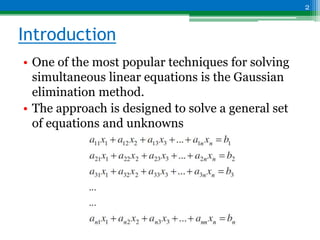
• The approach is designed to solve a general set
of equations and unknowns
2
Two steps of Gaussian Elimination
• Forward Elimination of Unknowns:
 In this step, the unknown is eliminated in each
equation starting with the first equation. This way, the
equations are reduced to one equation and one
unknown in each equation.
• Back Substitution:
 In this step, starting from the last equation, each of the
unknowns is found.
3
Forward Elimination of Unknowns:
• In the first step of forward elimination, the first
unknown, x1 is eliminated from all rows below the first
row.
• The first equation is selected as the pivot equation to
eliminate x1.
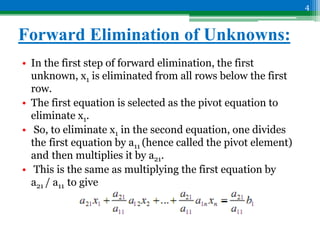
• So, to eliminate x1 in the second equation, one divides
the first equation by a11 (hence called the pivot element)
and then multiplies it by a21.
• This is the same as multiplying the first equation by
a21 / a11 to give
4
Forward Elimination of
Unknowns(cont.):
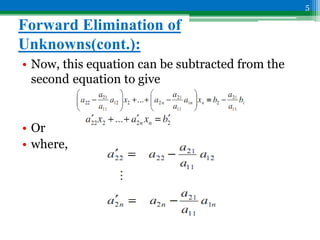
• Now, this equation can be subtracted from the
second equation to give
• Or
• where,
5
Forward Elimination of
Unknowns(cont.):
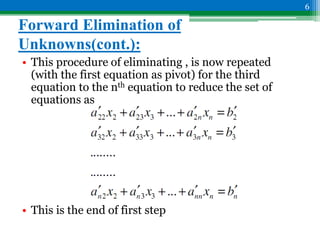
• This procedure of eliminating , is now repeated
(with the first equation as pivot) for the third
equation to the nth equation to reduce the set of
equations as
• This is the end of first step
6
Forward Elimination of
Unknowns(cont.):
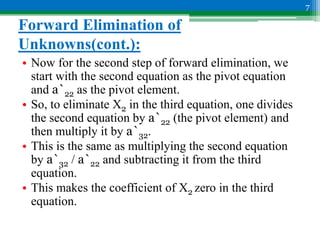
• Now for the second step of forward elimination, we
start with the second equation as the pivot equation
and a`22 as the pivot element.
• So, to eliminate X2 in the third equation, one divides
the second equation by a`22 (the pivot element) and
then multiply it by a`32.
• This is the same as multiplying the second equation
by a`32 / a`22 and subtracting it from the third
equation.
• This makes the coefficient of X2 zero in the third
equation.
7
Forward Elimination of
Unknowns(cont.):
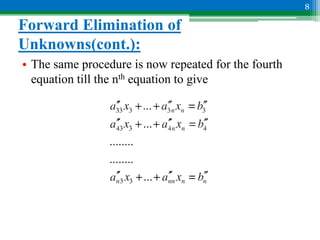
• The same procedure is now repeated for the fourth
equation till the nth equation to give
8
Forward Elimination of
Unknowns(cont.):
• The next steps of forward elimination are conducted
by using the third equation as a pivot equation and so
on.
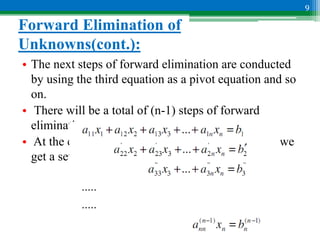
• There will be a total of (n-1) steps of forward
elimination.
• At the end of (n-1) steps of forward elimination, we
get a set of equations that look like
9
Back Substitution
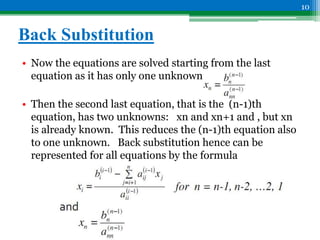
• Now the equations are solved starting from the last
equation as it has only one unknown.
• Then the second last equation, that is the (n-1)th
equation, has two unknowns: xn and xn+1 and , but xn
is already known. This reduces the (n-1)th equation also
to one unknown. Back substitution hence can be
represented for all equations by the formula
10
Example
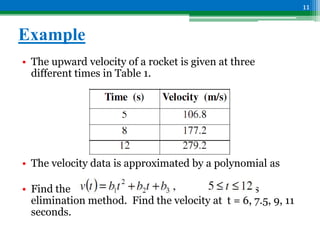
• The upward velocity of a rocket is given at three
different times in Table 1.
• The velocity data is approximated by a polynomial as
• Find the values of b1, b2 and b3 using the Gauss
elimination method. Find the velocity at t = 6, 7.5, 9, 11
seconds.
11
Example
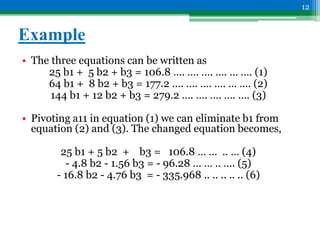
• The three equations can be written as
25 b1 + 5 b2 + b3 = 106.8 …. …. …. …. … …. (1)
64 b1 + 8 b2 + b3 = 177.2 …. …. …. …. … …. (2)
144 b1 + 12 b2 + b3 = 279.2 …. …. …. …. …. (3)
• Pivoting a11 in equation (1) we can eliminate b1 from
equation (2) and (3). The changed equation becomes,
25 b1 + 5 b2 + b3 = 106.8 … … .. … (4)
- 4.8 b2 - 1.56 b3 = - 96.28 … … .. …. (5)
- 16.8 b2 - 4.76 b3 = - 335.968 .. .. .. .. .. (6)
12
Example
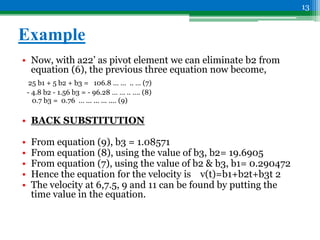
• Now, with a22’ as pivot element we can eliminate b2 from
equation (6), the previous three equation now become,
25 b1 + 5 b2 + b3 = 106.8 … … .. … (7)
- 4.8 b2 - 1.56 b3 = - 96.28 … … .. …. (8)
0.7 b3 = 0.76 … ... ... ... .... (9)
• BACK SUBSTITUTION
• From equation (9), b3 = 1.08571
• From equation (8), using the value of b3, b2= 19.6905
• From equation (7), using the value of b2 & b3, b1= 0.290472
• Hence the equation for the velocity is v(t)=b1+b2t+b3t 2
• The velocity at 6,7.5, 9 and 11 can be found by putting the
time value in the equation.
13
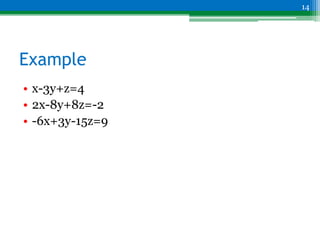
Example
• x-3y+z=4
• 2x-8y+8z=-2
• -6x+3y-15z=9
14
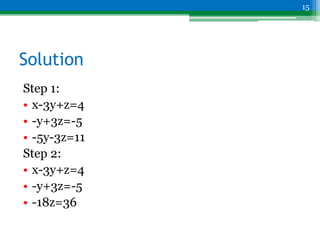
Solution
Step 1:
• x-3y+z=4
• -y+3z=-5
• -5y-3z=11
Step 2:
• x-3y+z=4
• -y+3z=-5
• -18z=36
15
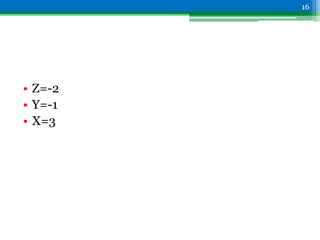
• Z=-2
• Y=-1
• X=3
16
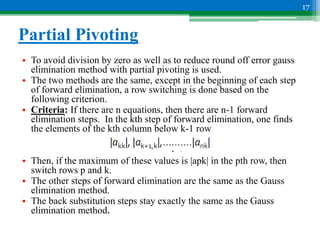
Partial Pivoting
• To avoid division by zero as well as to reduce round off error gauss
elimination method with partial pivoting is used.
• The two methods are the same, except in the beginning of each step
of forward elimination, a row switching is done based on the
following criterion.
• Criteria: If there are n equations, then there are n-1 forward
elimination steps. In the kth step of forward elimination, one finds
the elements of the kth column below k-1 row
• Then, if the maximum of these values is |apk| in the pth row, then
switch rows p and k.
• The other steps of forward elimination are the same as the Gauss
elimination method.
• The back substitution steps stay exactly the same as the Gauss
elimination method.
17
Example: Partial pivoting
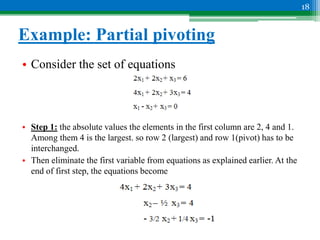
• Consider the set of equations
• Step 1: the absolute values the elements in the first column are 2, 4 and 1.
Among them 4 is the largest. so row 2 (largest) and row 1(pivot) has to be
interchanged.
• Then eliminate the first variable from equations as explained earlier. At the
end of first step, the equations become
18
Example: Partial pivoting
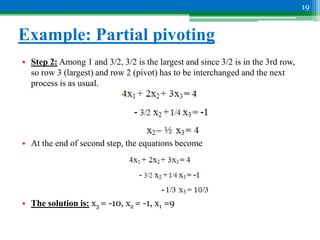
• Step 2: Among 1 and 3/2, 3/2 is the largest and since 3/2 is in the 3rd row,
so row 3 (largest) and row 2 (pivot) has to be interchanged and the next
process is as usual.
• At the end of second step, the equations become
• The solution is: x3 = -10, x2 = -1, x1 =9
19
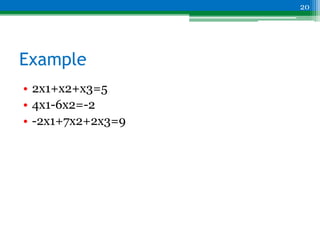
Example
• 2x1+x2+x3=5
• 4x1-6x2=-2
• -2x1+7x2+2x3=9
20
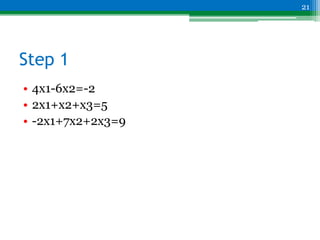
Step 1
• 4x1-6x2=-2
• 2x1+x2+x3=5
• -2x1+7x2+2x3=9
21
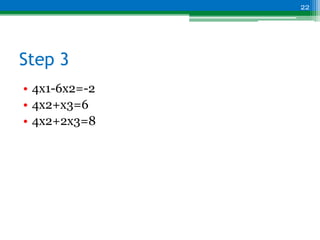
Step 3
• 4x1-6x2=-2
• 4x2+x3=6
• 4x2+2x3=8
22
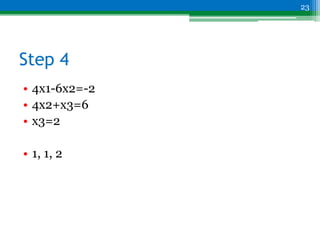
Step 4
• 4x1-6x2=-2
• 4x2+x3=6
• x3=2
• 1, 1, 2
23
Exercises
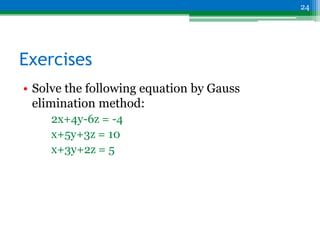
• Solve the following equation by Gauss
elimination method:
2x+4y-6z = -4
x+5y+3z = 10
x+3y+2z = 5
24
Thank you!!!
25

06. Gaussian Elimination.pptx

  • 1.
  • 2.
    Introduction • One ofthe most popular techniques for solving simultaneous linear equations is the Gaussian elimination method. • The approach is designed to solve a general set of equations and unknowns 2
  • 3.
    Two steps ofGaussian Elimination • Forward Elimination of Unknowns:  In this step, the unknown is eliminated in each equation starting with the first equation. This way, the equations are reduced to one equation and one unknown in each equation. • Back Substitution:  In this step, starting from the last equation, each of the unknowns is found. 3
  • 4.
    Forward Elimination ofUnknowns: • In the first step of forward elimination, the first unknown, x1 is eliminated from all rows below the first row. • The first equation is selected as the pivot equation to eliminate x1. • So, to eliminate x1 in the second equation, one divides the first equation by a11 (hence called the pivot element) and then multiplies it by a21. • This is the same as multiplying the first equation by a21 / a11 to give 4
  • 5.
    Forward Elimination of Unknowns(cont.): •Now, this equation can be subtracted from the second equation to give • Or • where, 5
  • 6.
    Forward Elimination of Unknowns(cont.): •This procedure of eliminating , is now repeated (with the first equation as pivot) for the third equation to the nth equation to reduce the set of equations as • This is the end of first step 6
  • 7.
    Forward Elimination of Unknowns(cont.): •Now for the second step of forward elimination, we start with the second equation as the pivot equation and a`22 as the pivot element. • So, to eliminate X2 in the third equation, one divides the second equation by a`22 (the pivot element) and then multiply it by a`32. • This is the same as multiplying the second equation by a`32 / a`22 and subtracting it from the third equation. • This makes the coefficient of X2 zero in the third equation. 7
  • 8.
    Forward Elimination of Unknowns(cont.): •The same procedure is now repeated for the fourth equation till the nth equation to give 8
  • 9.
    Forward Elimination of Unknowns(cont.): •The next steps of forward elimination are conducted by using the third equation as a pivot equation and so on. • There will be a total of (n-1) steps of forward elimination. • At the end of (n-1) steps of forward elimination, we get a set of equations that look like 9
  • 10.
    Back Substitution • Nowthe equations are solved starting from the last equation as it has only one unknown. • Then the second last equation, that is the (n-1)th equation, has two unknowns: xn and xn+1 and , but xn is already known. This reduces the (n-1)th equation also to one unknown. Back substitution hence can be represented for all equations by the formula 10
  • 11.
    Example • The upwardvelocity of a rocket is given at three different times in Table 1. • The velocity data is approximated by a polynomial as • Find the values of b1, b2 and b3 using the Gauss elimination method. Find the velocity at t = 6, 7.5, 9, 11 seconds. 11
  • 12.
    Example • The threeequations can be written as 25 b1 + 5 b2 + b3 = 106.8 …. …. …. …. … …. (1) 64 b1 + 8 b2 + b3 = 177.2 …. …. …. …. … …. (2) 144 b1 + 12 b2 + b3 = 279.2 …. …. …. …. …. (3) • Pivoting a11 in equation (1) we can eliminate b1 from equation (2) and (3). The changed equation becomes, 25 b1 + 5 b2 + b3 = 106.8 … … .. … (4) - 4.8 b2 - 1.56 b3 = - 96.28 … … .. …. (5) - 16.8 b2 - 4.76 b3 = - 335.968 .. .. .. .. .. (6) 12
  • 13.
    Example • Now, witha22’ as pivot element we can eliminate b2 from equation (6), the previous three equation now become, 25 b1 + 5 b2 + b3 = 106.8 … … .. … (7) - 4.8 b2 - 1.56 b3 = - 96.28 … … .. …. (8) 0.7 b3 = 0.76 … ... ... ... .... (9) • BACK SUBSTITUTION • From equation (9), b3 = 1.08571 • From equation (8), using the value of b3, b2= 19.6905 • From equation (7), using the value of b2 & b3, b1= 0.290472 • Hence the equation for the velocity is v(t)=b1+b2t+b3t 2 • The velocity at 6,7.5, 9 and 11 can be found by putting the time value in the equation. 13
  • 14.
  • 15.
    Solution Step 1: • x-3y+z=4 •-y+3z=-5 • -5y-3z=11 Step 2: • x-3y+z=4 • -y+3z=-5 • -18z=36 15
  • 16.
  • 17.
    Partial Pivoting • Toavoid division by zero as well as to reduce round off error gauss elimination method with partial pivoting is used. • The two methods are the same, except in the beginning of each step of forward elimination, a row switching is done based on the following criterion. • Criteria: If there are n equations, then there are n-1 forward elimination steps. In the kth step of forward elimination, one finds the elements of the kth column below k-1 row • Then, if the maximum of these values is |apk| in the pth row, then switch rows p and k. • The other steps of forward elimination are the same as the Gauss elimination method. • The back substitution steps stay exactly the same as the Gauss elimination method. 17
  • 18.
    Example: Partial pivoting •Consider the set of equations • Step 1: the absolute values the elements in the first column are 2, 4 and 1. Among them 4 is the largest. so row 2 (largest) and row 1(pivot) has to be interchanged. • Then eliminate the first variable from equations as explained earlier. At the end of first step, the equations become 18
  • 19.
    Example: Partial pivoting •Step 2: Among 1 and 3/2, 3/2 is the largest and since 3/2 is in the 3rd row, so row 3 (largest) and row 2 (pivot) has to be interchanged and the next process is as usual. • At the end of second step, the equations become • The solution is: x3 = -10, x2 = -1, x1 =9 19
  • 20.
  • 21.
    Step 1 • 4x1-6x2=-2 •2x1+x2+x3=5 • -2x1+7x2+2x3=9 21
  • 22.
    Step 3 • 4x1-6x2=-2 •4x2+x3=6 • 4x2+2x3=8 22
  • 23.
    Step 4 • 4x1-6x2=-2 •4x2+x3=6 • x3=2 • 1, 1, 2 23
  • 24.
    Exercises • Solve thefollowing equation by Gauss elimination method: 2x+4y-6z = -4 x+5y+3z = 10 x+3y+2z = 5 24
  • 25.