Agroforestry in the Era of the
Sustainable Development
Goals…and Beyond
Dennis Garrity
Sustainable Development Goals
• Food security
• Poverty eradication
• Health
• Gender equity
• Universal Education
• Reversing land degradation
• Climate change resilience
• Biodiversity conservation
• Energy for all
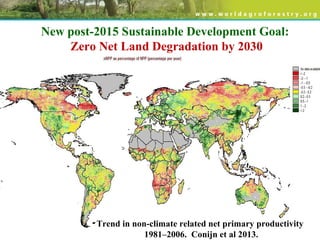
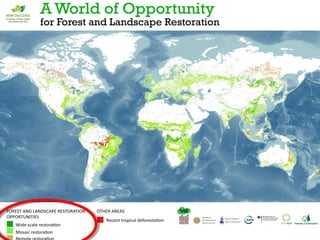
Trend in non-climate related net primary productivity
1981–2006. Conijn et al 2013.
New post-2015 Sustainable Development Goal:
Zero Net Land Degradation by 2030
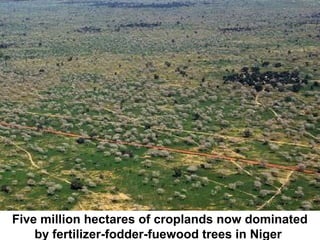
Five million hectares of croplands now dominated
by fertilizer-fodder-fuewood trees in Niger
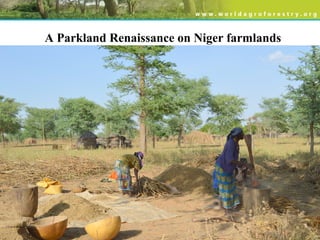
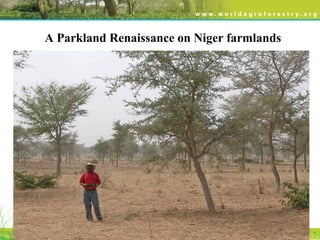
A Parkland Renaissance on Niger farmlands
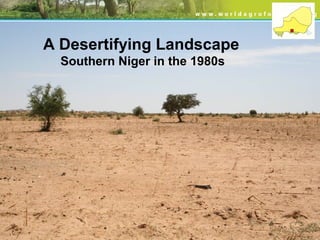
A Desertifying Landscape
Southern Niger in the 1980s
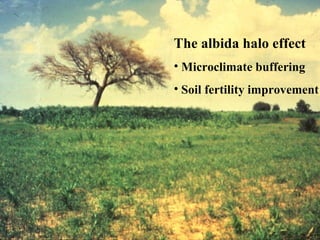
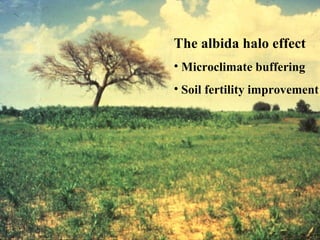
The albida halo effect
• Microclimate buffering
• Soil fertility improvement
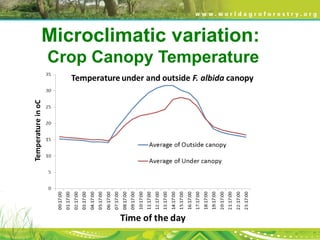
Microclimatic variation:
Crop Canopy Temperature
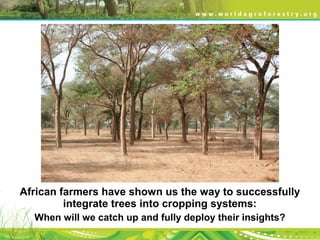
African farmers have shown us the way to successfully
integrate trees into cropping systems:
When will we catch up and fully deploy their insights?
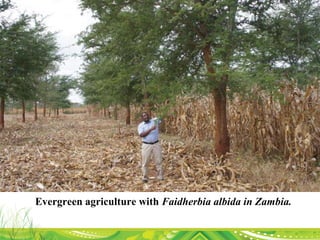
Evergreen agriculture with Faidherbia albida in Zambia.
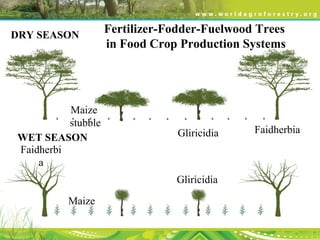
FaidherbiaGliricidia
Maize
stubble
Faidherbi
a
Gliricidia
Maize
DRY SEASON
WET SEASON
Fertilizer-Fodder-Fuelwood Trees
in Food Crop Production Systems
EverGreen Agriculture
Connecting with the
Hard-Core Aggies to
Transform Food Crop Production Systems
Guess who said this:
“Some people say ‘Give the customers what they
want.’ But that’s not my approach. Our job is to
figure out what they’re going to want before they
do.
“Henry Ford once said ‘If I’d asked customers
what they wanted they would have said ‘A faster
horse.’
“People don’t know what they want until you
show it to them.
“That’s why I never rely on market research. Our
task is to read things thatn are not yet on the
page.”
“People don’t know what they want until you
show it to them.
“That’s why I never rely on market research. Our
task is to read things thatn are not yet on the
page.”
-- Steve Jobs
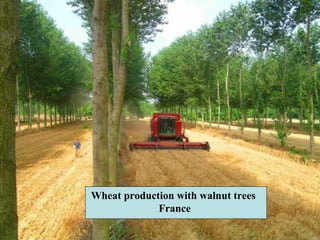
Wheat production with walnut trees
France
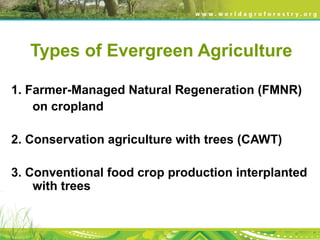
Types of Evergreen Agriculture
1. Farmer-Managed Natural Regeneration (FMNR)
on cropland
2. Conservation agriculture with trees (CAWT)
3. Conventional food crop production interplanted
with trees
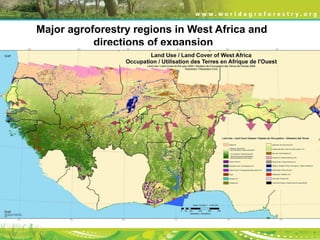
Major agroforestry regions in West Africa and
directions of expansion
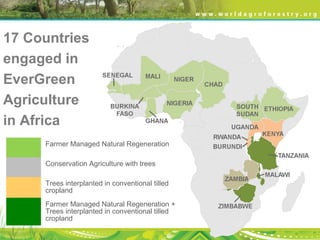
17 Countries
engaged in
EverGreen
Agriculture
in Africa
Farmer Managed Natural Regeneration
Conservation Agriculture with trees
Trees interplanted in conventional tilled
cropland
Farmer Managed Natural Regeneration +
Trees interplanted in conventional tilled
cropland
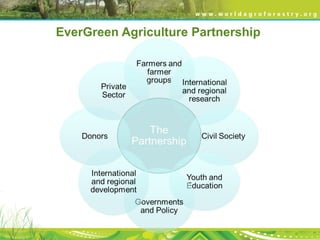
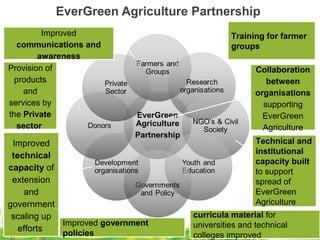
EverGreen Agriculture Partnership
What do we need to do to fully mobilize
for the upcoming global revolution in
agroforestry upscaling?
• Urgent need to map agroforestry across
the world at global, regional, and national
scales
• Create a Global Agroforestry Assessment
based on national assessments
• Develop a global plan to upscale
agroforestry
• Staff up in linking agroforestry science to
The Perennialization of
Agriculture
… at the heart of a truly sustainable
planet.
The Holy Grail of
Agroforestry Genomics:
Identifying and Manipulating the
Genes for Reverse Phenology
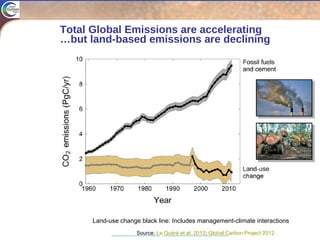
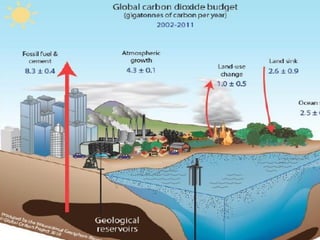
Total Global Emissions are accelerating
…but land-based emissions are declining
Land-use change black line: Includes management-climate interactions
Source: Le Quéré et al. 2012; Global Carbon Project 2012
The Perennialization of
Agriculture
… at the heart of a truly sustainable
planet.
The Perennialization of
Agriculture
… at the heart of a truly sustainable
planet.
For More Information
World Agroforestry Centre
www.worldagroforestry.org
Evergreen Agriculture web site
www.evergreenagriculture.net
Email contacts:
d.garrity@cgiar.org
Channels for Reducing Vulnerability
1. Buffer crop production from drought stress
-- Sustain higher and more stable yields
by more favorable microclimate
-- Conserve and enhance soil organic matter,
infiltration and water holding capacity
2. Tree crops generally less severely affected by
drought, heat, excess water
3. Greater diversity of income sources
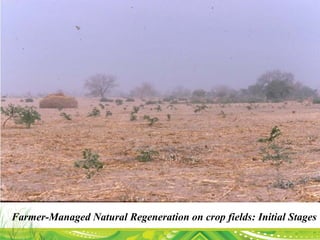
Farmer-Managed Natural Regeneration on crop fields: Initial Stages
A Parkland Renaissance on Niger farmlands
The albida halo effect
• Microclimate buffering
• Soil fertility improvement
Zero Net Land Degradation
Classify all land into three categories:
– Degrading
– Regenerating
– Stable
Monitor land degradation and regeneration in terms
of biomass production.
Calculate the ratio: Regenerating/Degrading
The target is a ratio exceeding 1.0
What is Evergreen Agriculture?
A form of more intensive farming that
integrates trees into crop and livestock
production systems.
Evergreen farming systems are ‘double- story’
systems that feature both perennial and
annual species (food crops and trees),
maintaining a green cover on the land
throughout the year.
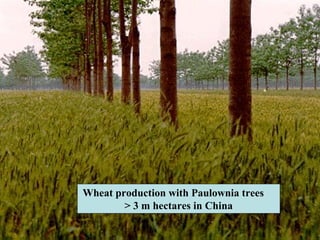
Wheat production with Paulownia trees
> 3 m hectares in China
Training for farmer
groups
curricula material for
universities and technical
colleges improved
Improved government
policies
Improved
technical
capacity of
extension
and
government
scaling up
efforts
Improved
communications and
awareness
Provision of
products
and
services by
the Private
sector
Technical and
institutional
capacity built
to support
spread of
EverGreen
Agriculture
Collaboration
between
organisations
supporting
EverGreen
Agriculture
EverGreen Agriculture PartnershipEverGreen Agriculture Partnership
Af & sd gs wca3 address feb 2014

Af & sd gs wca3 address feb 2014

  • 1.
    Agroforestry in theEra of the Sustainable Development Goals…and Beyond Dennis Garrity
  • 2.
    Sustainable Development Goals •Food security • Poverty eradication • Health • Gender equity • Universal Education • Reversing land degradation • Climate change resilience • Biodiversity conservation • Energy for all
  • 3.
    Trend in non-climaterelated net primary productivity 1981–2006. Conijn et al 2013. New post-2015 Sustainable Development Goal: Zero Net Land Degradation by 2030
  • 4.
    Five million hectaresof croplands now dominated by fertilizer-fodder-fuewood trees in Niger
  • 5.
    A Parkland Renaissanceon Niger farmlands
  • 6.
  • 8.
    The albida haloeffect • Microclimate buffering • Soil fertility improvement
  • 9.
  • 10.
    African farmers haveshown us the way to successfully integrate trees into cropping systems: When will we catch up and fully deploy their insights?
  • 11.
    Evergreen agriculture withFaidherbia albida in Zambia.
  • 13.
  • 14.
    EverGreen Agriculture Connecting withthe Hard-Core Aggies to Transform Food Crop Production Systems
  • 15.
    Guess who saidthis: “Some people say ‘Give the customers what they want.’ But that’s not my approach. Our job is to figure out what they’re going to want before they do. “Henry Ford once said ‘If I’d asked customers what they wanted they would have said ‘A faster horse.’
  • 16.
    “People don’t knowwhat they want until you show it to them. “That’s why I never rely on market research. Our task is to read things thatn are not yet on the page.”
  • 17.
    “People don’t knowwhat they want until you show it to them. “That’s why I never rely on market research. Our task is to read things thatn are not yet on the page.” -- Steve Jobs
  • 18.
    Wheat production withwalnut trees France
  • 19.
    Types of EvergreenAgriculture 1. Farmer-Managed Natural Regeneration (FMNR) on cropland 2. Conservation agriculture with trees (CAWT) 3. Conventional food crop production interplanted with trees
  • 20.
    Major agroforestry regionsin West Africa and directions of expansion
  • 21.
    17 Countries engaged in EverGreen Agriculture inAfrica Farmer Managed Natural Regeneration Conservation Agriculture with trees Trees interplanted in conventional tilled cropland Farmer Managed Natural Regeneration + Trees interplanted in conventional tilled cropland
  • 22.
  • 23.
    What do weneed to do to fully mobilize for the upcoming global revolution in agroforestry upscaling? • Urgent need to map agroforestry across the world at global, regional, and national scales • Create a Global Agroforestry Assessment based on national assessments • Develop a global plan to upscale agroforestry • Staff up in linking agroforestry science to
  • 24.
    The Perennialization of Agriculture …at the heart of a truly sustainable planet.
  • 25.
    The Holy Grailof Agroforestry Genomics: Identifying and Manipulating the Genes for Reverse Phenology
  • 27.
    Total Global Emissionsare accelerating …but land-based emissions are declining Land-use change black line: Includes management-climate interactions Source: Le Quéré et al. 2012; Global Carbon Project 2012
  • 29.
    The Perennialization of Agriculture …at the heart of a truly sustainable planet.
  • 30.
    The Perennialization of Agriculture …at the heart of a truly sustainable planet.
  • 31.
    For More Information WorldAgroforestry Centre www.worldagroforestry.org Evergreen Agriculture web site www.evergreenagriculture.net Email contacts: d.garrity@cgiar.org
  • 32.
    Channels for ReducingVulnerability 1. Buffer crop production from drought stress -- Sustain higher and more stable yields by more favorable microclimate -- Conserve and enhance soil organic matter, infiltration and water holding capacity 2. Tree crops generally less severely affected by drought, heat, excess water 3. Greater diversity of income sources
  • 33.
    Farmer-Managed Natural Regenerationon crop fields: Initial Stages
  • 34.
    A Parkland Renaissanceon Niger farmlands
  • 35.
    The albida haloeffect • Microclimate buffering • Soil fertility improvement
  • 36.
    Zero Net LandDegradation Classify all land into three categories: – Degrading – Regenerating – Stable Monitor land degradation and regeneration in terms of biomass production. Calculate the ratio: Regenerating/Degrading The target is a ratio exceeding 1.0
  • 37.
    What is EvergreenAgriculture? A form of more intensive farming that integrates trees into crop and livestock production systems. Evergreen farming systems are ‘double- story’ systems that feature both perennial and annual species (food crops and trees), maintaining a green cover on the land throughout the year.
  • 38.
    Wheat production withPaulownia trees > 3 m hectares in China
  • 39.
    Training for farmer groups curriculamaterial for universities and technical colleges improved Improved government policies Improved technical capacity of extension and government scaling up efforts Improved communications and awareness Provision of products and services by the Private sector Technical and institutional capacity built to support spread of EverGreen Agriculture Collaboration between organisations supporting EverGreen Agriculture EverGreen Agriculture PartnershipEverGreen Agriculture Partnership

Editor's Notes

  • #22 Over 17 countries across the African content, and many more around the world as you can hear about this week, have some form of EverGreen Agriculture present, be it from FMNR, planting or a mixture of both. Most of these countries also have the presence and collaboration of NGO’s and development organisations such as GIZ present.   Accelerate the ongoing national scaling-up programmes in Malawi, Zambia, Burkina Faso and Niger National Agroforestry Food Security Programmes being developed for India, Senegal, Ethiopia, Rwanda, and Kenya Preparatory work for new programmes under way in Tanzania, Mali, and 12 other countries National policy commitments in Kenya - >10% tree cover on agricultural land Ethiopia – 100 mill Faidherbia trees in Ag land - National Faidherbia albida programme.
  • #23 International and regional development organisations - While Worldvision is one of our most important partners, we are also speaking to the Catholic relief service amoung other organisations Donors Governments and Policy International and Regional Research organisations Farmers and agricultural groups Private Sector Education Youth Civil Society
  • #40 Our approach to try to facilitate the removal of such barriers, and in so doing to allow the science to reach development outcomes, is through the EverGreen Agriclture Partnership. The Partnership involves working with a range of stakeholders from various different communities, from policy makers and national governments to farmer groups to the private sector. Each of these partners has their own contributions to make in supporting the scaling up of EverGreen Agriculture. As you can see the research community is also there, both as a partner to share technical advice and input with other development partners, but also to learn of the needs and questions that still exist. But what does this partnership actually do? Well, as part of the ITAACC pilot project, we have a range of activities underway, such as: the development of awareness raising and extension and training materials The development of models for youth based agribusinesses supporting EverGreen Agriculture (both at inputs and outputs) Providing training opportunities to government and non government extensionists working with farmers Liason with national governments on policies and strategies related to the use of trees on farms. Review of curriculum and development of teaching materials on EGA for use in university courses. Raising awareness and