GATE
Numerical
NUMERICAL
ESTIMATION & VALUATION
HOUSING (FAR – DENSITY CALC)
ACOUSTICS
ILLUMINATION
RUN OFF CALCULATIONS
SCALE
STURCTURES
CPM & PERT
IMPORATANT TOPICS
Rainfall
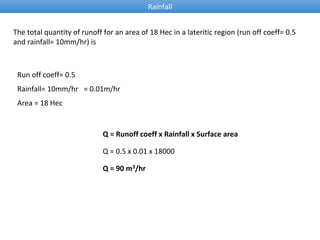
The total quantity of runoff for an area of 18 Hec in a lateritic region (run off coeff= 0.5
and rainfall= 10mm/hr) is
Run off coeff= 0.5
Rainfall= 10mm/hr = 0.01m/hr
Q = Runoff coeff x Rainfall x Surface area
Area = 18 Hec
Q = 0.5 x 0.01 x 18000
Q = 90 m3/hr
Rainfall
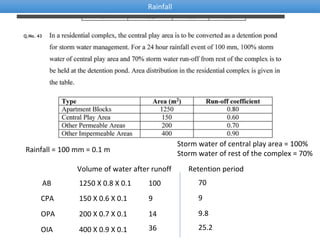
Rainfall = 100 mm = 0.1 m
Storm water of central play area = 100%
Storm water of rest of the complex = 70%
Volume of water after runoff
AB
CPA
OPA
OIA
100
9
14
36
Retention period
1250 X 0.8 X 0.1
150 X 0.6 X 0.1
200 X 0.7 X 0.1
400 X 0.9 X 0.1
70
9
9.8
25.2
Rainfall
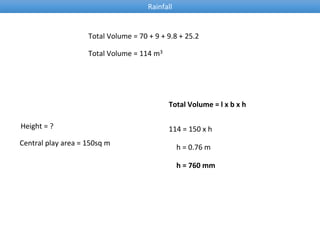
Total Volume = 70 + 9 + 9.8 + 25.2
Total Volume = 114 m3
Total Volume = l x b x h
Height = ? 114 = 150 x h
Central play area = 150sq m
h = 0.76 m
h = 760 mm
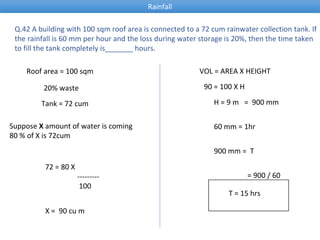
Q.42 A building with 100 sqm roof area is connected to a 72 cum rainwater collection tank. If
the rainfall is 60 mm per hour and the loss during water storage is 20%, then the time taken
to fill the tank completely is_______ hours.
Roof area = 100 sqm
20% waste
Tank = 72 cum
Suppose X amount of water is coming
80 % of X is 72cum
72 = 80 X
---------
100
X = 90 cu m
VOL = AREA X HEIGHT
90 = 100 X H
H = 9 m = 900 mm
60 mm = 1hr
900 mm = T
= 900 / 60
T = 15 hrs
Rainfall
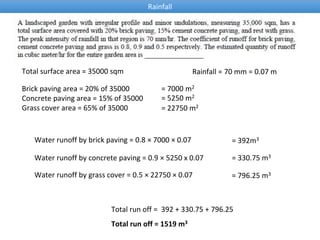
Brick paving area = 20% of 35000
Concrete paving area = 15% of 35000
Grass cover area = 65% of 35000
= 7000 m2
= 5250 m2
= 22750 m2
Total surface area = 35000 sqm
Water runoff by brick paving = 0.8 × 7000 × 0.07
Water runoff by concrete paving = 0.9 × 5250 x 0.07
Water runoff by grass cover = 0.5 × 22750 × 0.07
= 392m3
= 330.75 m3
= 796.25 m3
Rainfall = 70 mm = 0.07 m
Total run off = 392 + 330.75 + 796.25
Total run off = 1519 m3
Rainfall
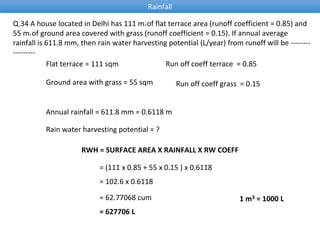
Q.34 A house located in Delhi has 111 m2 of flat terrace area (runoff coefficient = 0.85) and
55 m2 of ground area covered with grass (runoff coefficient = 0.15). If annual average
rainfall is 611.8 mm, then rain water harvesting potential (L/year) from runoff will be --------
---------
Flat terrace = 111 sqm Run off coeff terrace = 0.85
Ground area with grass = 55 sqm
Annual rainfall = 611.8 mm = 0.6118 m
Rain water harvesting potential = ?
RWH = SURFACE AREA X RAINFALL X RW COEFF
= (111 x 0.85 + 55 x 0.15 ) x 0.6118
Run off coeff grass = 0.15
= 102.6 x 0.6118
= 62.77068 cum 1 m3 = 1000 L
= 627706 L
Rainfall
Construction
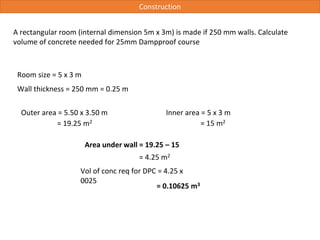
A rectangular room (internal dimension 5m x 3m) is made if 250 mm walls. Calculate
volume of concrete needed for 25mm Dampproof course
Room size = 5 x 3 m
Wall thickness = 250 mm = 0.25 m
Area under wall = 19.25 – 15
Outer area = 5.50 x 3.50 m
= 4.25 m2
Vol of conc req for DPC = 4.25 x
0025
Inner area = 5 x 3 m
= 19.25 m2 = 15 m2
= 0.10625 m3
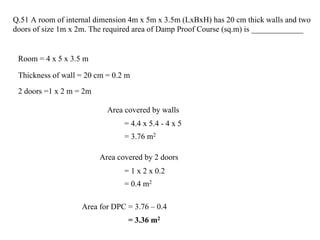
Q.51 A room of internal dimension 4m x 5m x 3.5m (LxBxH) has 20 cm thick walls and two
doors of size 1m x 2m. The required area of Damp Proof Course (sq.m) is _____________
Room = 4 x 5 x 3.5 m
Thickness of wall = 20 cm = 0.2 m
2 doors =1 x 2 m = 2m
Area covered by walls
= 4.4 x 5.4 - 4 x 5
= 3.76 m2
Area covered by 2 doors
= 1 x 2 x 0.2
= 0.4 m2
Area for DPC = 3.76 – 0.4
= 3.36 m2
Construction
A rectangular room (internal dimension 5m x 3m) is made if 250 mm walls. Calculate
volume of concrete needed for 25mm Dampproof course
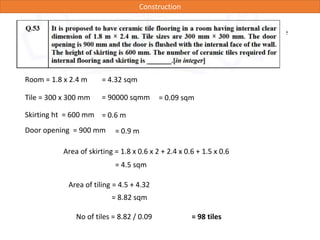
Room = 1.8 x 2.4 m = 4.32 sqm
Tile = 300 x 300 mm = 90000 sqmm = 0.09 sqm
Area of skirting = 1.8 x 0.6 x 2 + 2.4 x 0.6 + 1.5 x 0.6
Skirting ht = 600 mm
Door opening = 900 mm
= 0.6 m
= 0.9 m
= 4.5 sqm
Area of tiling = 4.5 + 4.32
= 8.82 sqm
No of tiles = 8.82 / 0.09 = 98 tiles
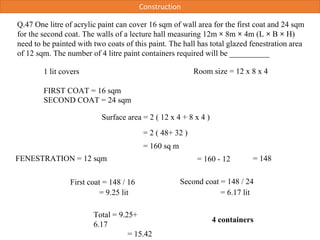
Q.47 One litre of acrylic paint can cover 16 sqm of wall area for the first coat and 24 sqm
for the second coat. The walls of a lecture hall measuring 12m × 8m × 4m (L × B × H)
need to be painted with two coats of this paint. The hall has total glazed fenestration area
of 12 sqm. The number of 4 litre paint containers required will be __________
1 lit covers
FIRST COAT = 16 sqm
SECOND COAT = 24 sqm
Room size = 12 x 8 x 4
FENESTRATION = 12 sqm
Surface area = 2 ( 12 x 4 + 8 x 4 )
= 2 ( 48+ 32 )
= 160 sq m
= 160 - 12 = 148
First coat = 148 / 16 Second coat = 148 / 24
= 9.25 lit = 6.17 lit
Total = 9.25+
6.17
= 15.42
4 containers
Construction
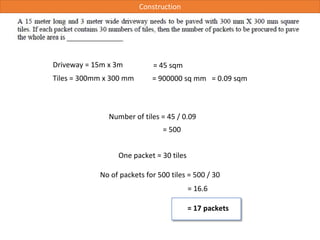
Number of tiles = 45 / 0.09
Driveway = 15m x 3m
Tiles = 300mm x 300 mm
= 45 sqm
= 900000 sq mm = 0.09 sqm
= 500
One packet = 30 tiles
No of packets for 500 tiles = 500 / 30
= 16.6
= 17 packets
Construction
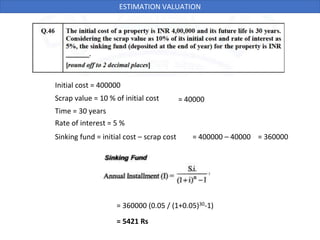
Initial cost = 400000
Scrap value = 10 % of initial cost
Time = 30 years
Rate of interest = 5 %
= 40000
Sinking fund = initial cost – scrap cost = 400000 – 40000 = 360000
= 360000 (0.05 / (1+0.05)30-1)
= 5421 Rs
ESTIMATION VALUATION
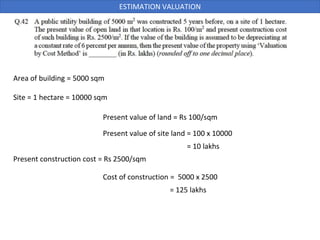
Area of building = 5000 sqm
Site = 1 hectare = 10000 sqm
Present value of land = Rs 100/sqm
Present value of site land = 100 x 10000
= 10 lakhs
Cost of construction = 5000 x 2500
Present construction cost = Rs 2500/sqm
= 125 lakhs
ESTIMATION VALUATION
Depreciation rate = 6% Value of the building after depreciation in 5 years
= 125 (1 – r)n
= 91.7 lakhs
= 125 × (1 – 0.06)5
Present Value of Property = Land Value + Building Value
= 10+ 91.7
= 101.7 lakhs
ESTIMATION VALUATION
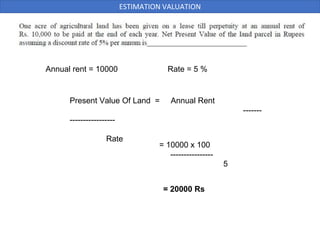
Annual rent = 10000
Present Value Of Land = Annual Rent
-------
-----------------
Rate
= 10000 x 100
----------------
5
= 20000 Rs
Rate = 5 %
ESTIMATION VALUATION
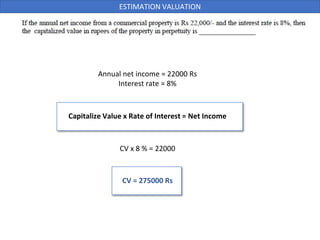
Annual net income = 22000 Rs
Interest rate = 8%
Capitalize Value x Rate of Interest = Net Income
CV x 8 % = 22000
CV = 275000 Rs
ESTIMATION VALUATION
FAR
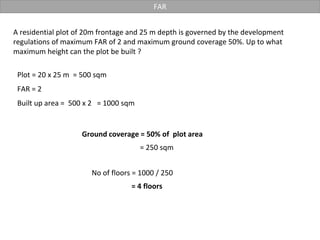
A residential plot of 20m frontage and 25 m depth is governed by the development
regulations of maximum FAR of 2 and maximum ground coverage 50%. Up to what
maximum height can the plot be built ?
Plot = 20 x 25 m = 500 sqm
FAR = 2
Ground coverage = 50% of plot area
Built up area = 500 x 2 = 1000 sqm
= 250 sqm
No of floors = 1000 / 250
= 4 floors
FAR
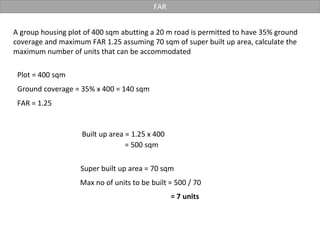
A group housing plot of 400 sqm abutting a 20 m road is permitted to have 35% ground
coverage and maximum FAR 1.25 assuming 70 sqm of super built up area, calculate the
maximum number of units that can be accommodated
Plot = 400 sqm
Ground coverage = 35% x 400 = 140 sqm
Built up area = 1.25 x 400
FAR = 1.25
= 500 sqm
Super built up area = 70 sqm
= 7 units
Max no of units to be built = 500 / 70
FAR
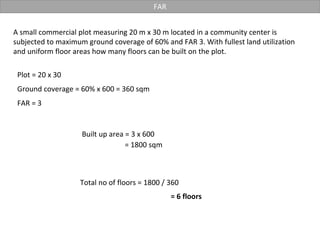
A small commercial plot measuring 20 m x 30 m located in a community center is
subjected to maximum ground coverage of 60% and FAR 3. With fullest land utilization
and uniform floor areas how many floors can be built on the plot.
Plot = 20 x 30
Ground coverage = 60% x 600 = 360 sqm
Built up area = 3 x 600
FAR = 3
= 1800 sqm
= 6 floors
Total no of floors = 1800 / 360
FAR
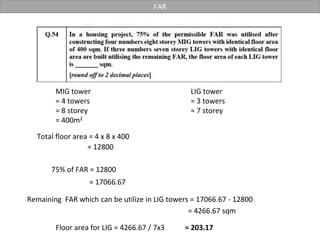
MIG tower
= 4 towers
= 8 storey
= 400m2
LIG tower
= 3 towers
= 7 storey
75% of FAR = 12800
Remaining FAR which can be utilize in LIG towers = 17066.67 - 12800
Total floor area = 4 x 8 x 400
= 12800
= 17066.67
= 4266.67 sqm
Floor area for LIG = 4266.67 / 7x3 = 203.17
Plot = 3000 sqm
Total b/up
area
4500
6000
6000
9000
9000 + 15 % of EWS (9000)
10350
FAR
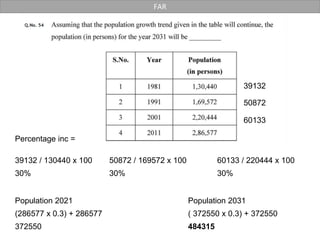
39132
50872
60133
39132 / 130440 x 100
Percentage inc =
30%
50872 / 169572 x 100
30%
60133 / 220444 x 100
30%
Population 2021 Population 2031
(286577 x 0.3) + 286577
372550
( 372550 x 0.3) + 372550
484315
FAR
Housing
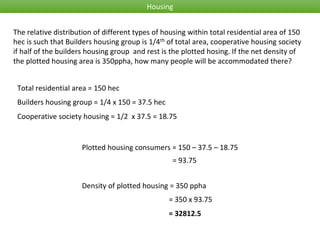
The relative distribution of different types of housing within total residential area of 150
hec is such that Builders housing group is 1/4th of total area, cooperative housing society
if half of the builders housing group and rest is the plotted hosing. If the net density of
the plotted housing area is 350ppha, how many people will be accommodated there?
Total residential area = 150 hec
Builders housing group = 1/4 x 150 = 37.5 hec
Plotted housing consumers = 150 – 37.5 – 18.75
Cooperative society housing = 1/2 x 37.5 = 18.75
= 93.75
Density of plotted housing = 350 ppha
= 350 x 93.75
= 32812.5
Housing
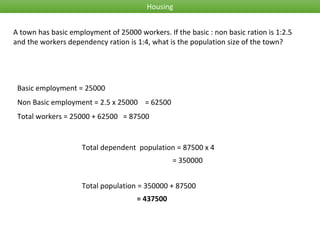
A town has basic employment of 25000 workers. If the basic : non basic ration is 1:2.5
and the workers dependency ration is 1:4, what is the population size of the town?
Basic employment = 25000
Non Basic employment = 2.5 x 25000 = 62500
Total dependent population = 87500 x 4
Total workers = 25000 + 62500 = 87500
= 350000
Total population = 350000 + 87500
= 437500
Housing
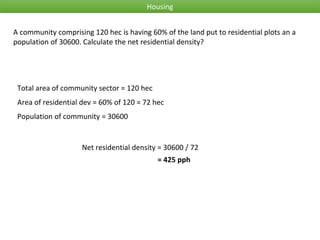
A community comprising 120 hec is having 60% of the land put to residential plots an a
population of 30600. Calculate the net residential density?
Total area of community sector = 120 hec
Area of residential dev = 60% of 120 = 72 hec
Net residential density = 30600 / 72
Population of community = 30600
= 425 pph
Housing
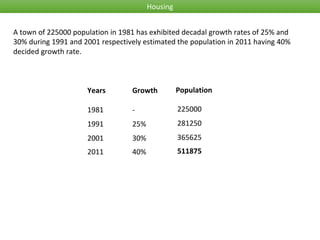
A town of 225000 population in 1981 has exhibited decadal growth rates of 25% and
30% during 1991 and 2001 respectively estimated the population in 2011 having 40%
decided growth rate.
1981
1991
2001
2011
-
25%
30%
40%
225000
281250
365625
511875
Years Growth Population
Housing
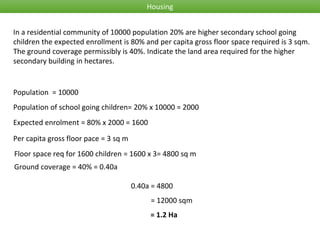
In a residential community of 10000 population 20% are higher secondary school going
children the expected enrollment is 80% and per capita gross floor space required is 3 sqm.
The ground coverage permissibly is 40%. Indicate the land area required for the higher
secondary building in hectares.
Expected enrolment = 80% x 2000 = 1600
Population = 10000
Population of school going children= 20% x 10000 = 2000
Per capita gross floor pace = 3 sq m
= 1.2 Ha
0.40a = 4800
= 12000 sqm
Floor space req for 1600 children = 1600 x 3= 4800 sq m
Ground coverage = 40% = 0.40a
Housing
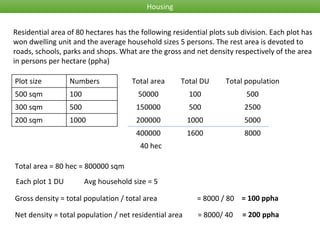
Residential area of 80 hectares has the following residential plots sub division. Each plot has
won dwelling unit and the average household sizes 5 persons. The rest area is devoted to
roads, schools, parks and shops. What are the gross and net density respectively of the area
in persons per hectare (ppha)
Total area = 80 hec = 800000 sqm
= 8000 / 80
Gross density = total population / total area
Each plot 1 DU Avg household size = 5
Plot size Numbers
500 sqm 100
300 sqm 500
200 sqm 1000
Total area Total DU Total population
50000 100 500
150000 500 2500
200000 1000 5000
400000 1600 8000
Net density = total population / net residential area = 8000/ 40
40 hec
= 100 ppha
= 200 ppha
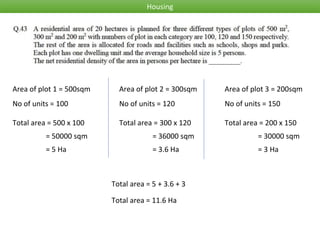
Area of plot 1 = 500sqm
No of units = 100
Total area = 500 x 100
= 50000 sqm
= 5 Ha
Area of plot 2 = 300sqm
No of units = 120
Total area = 300 x 120
= 36000 sqm
= 3.6 Ha
Area of plot 3 = 200sqm
No of units = 150
Total area = 200 x 150
= 30000 sqm
= 3 Ha
Total area = 5 + 3.6 + 3
Total area = 11.6 Ha
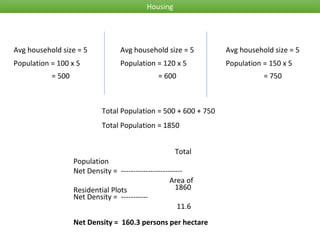
Housing
Population = 100 x 5
Avg household size = 5
= 500
Population = 120 x 5
Avg household size = 5
= 600
Population = 150 x 5
Avg household size = 5
= 750
Total Population = 500 + 600 + 750
Total Population = 1850
Total
Population
Net Density = -------------------------
Area of
Residential Plots 1860
Net Density = -----------
11.6
Net Density = 160.3 persons per hectare
Housing
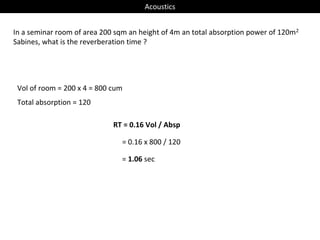
Acoustics
In a seminar room of area 200 sqm an height of 4m an total absorption power of 120m2
Sabines, what is the reverberation time ?
Vol of room = 200 x 4 = 800 cum
Total absorption = 120
RT = 0.16 Vol / Absp
= 0.16 x 800 / 120
= 1.06 sec
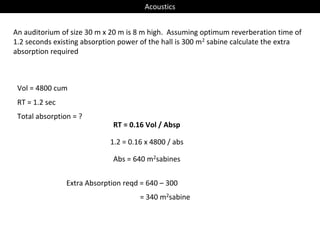
Acoustics
An auditorium of size 30 m x 20 m is 8 m high. Assuming optimum reverberation time of
1.2 seconds existing absorption power of the hall is 300 m2 sabine calculate the extra
absorption required
Vol = 4800 cum
RT = 1.2 sec
RT = 0.16 Vol / Absp
1.2 = 0.16 x 4800 / abs
Abs = 640 m2sabines
Total absorption = ?
Extra Absorption reqd = 640 – 300
= 340 m2sabine
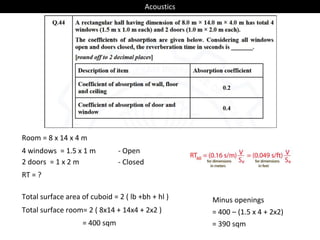
Room = 8 x 14 x 4 m
4 windows = 1.5 x 1 m
2 doors = 1 x 2 m - Closed
- Open
RT = ?
Total surface area of cuboid = 2 ( lb +bh + hl )
Total surface room= 2 ( 8x14 + 14x4 + 2x2 )
= 400 sqm
Minus openings
= 400 – (1.5 x 4 + 2x2)
= 390 sqm
Acoustics
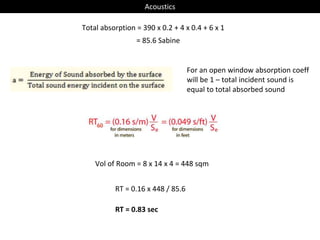
Vol of Room = 8 x 14 x 4 = 448 sqm
Total absorption = 390 x 0.2 + 4 x 0.4 + 6 x 1
= 85.6 Sabine
For an open window absorption coeff
will be 1 – total incident sound is
equal to total absorbed sound
RT = 0.16 x 448 / 85.6
RT = 0.83 sec
Acoustics
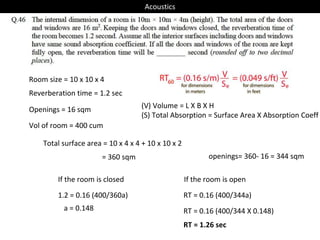
Room size = 10 x 10 x 4
Vol of room = 400 cum
Reverberation time = 1.2 sec
1.2 = 0.16 (400/360a)
Total surface area = 10 x 4 x 4 + 10 x 10 x 2
= 360 sqm
(V) Volume = L X B X H
(S) Total Absorption = Surface Area X Absorption Coeff
a = 0.148
Openings = 16 sqm
If the room is closed
RT = 0.16 (400/344a)
If the room is open
openings= 360- 16 = 344 sqm
RT = 0.16 (400/344 X 0.148)
RT = 1.26 sec
Acoustics
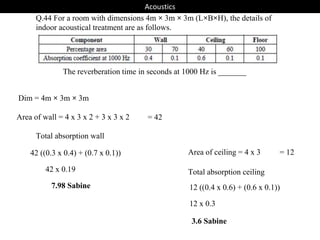
Q.44 For a room with dimensions 4m × 3m × 3m (L×B×H), the details of
indoor acoustical treatment are as follows.
The reverberation time in seconds at 1000 Hz is _______
Dim = 4m × 3m × 3m
Area of wall = 4 x 3 x 2 + 3 x 3 x 2 = 42
42 ((0.3 x 0.4) + (0.7 x 0.1))
42 x 0.19
7.98 Sabine
Area of ceiling = 4 x 3 = 12
12 ((0.4 x 0.6) + (0.6 x 0.1))
12 x 0.3
3.6 Sabine
Total absorption wall
Total absorption ceiling
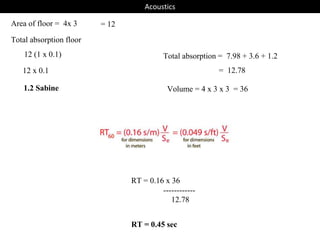
Acoustics
Area of floor = 4x 3 = 12
12 (1 x 0.1)
12 x 0.1
1.2 Sabine
Total absorption floor
RT = 0.16 x 36
------------
12.78
Total absorption = 7.98 + 3.6 + 1.2
RT = 0.45 sec
= 12.78
Volume = 4 x 3 x 3 = 36
Acoustics
Scale
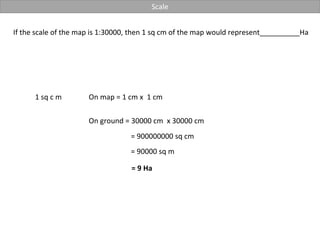
If the scale of the map is 1:30000, then 1 sq cm of the map would represent__________Ha
1 sq c m On map = 1 cm x 1 cm
On ground = 30000 cm x 30000 cm
= 900000000 sq cm
= 90000 sq m
= 9 Ha
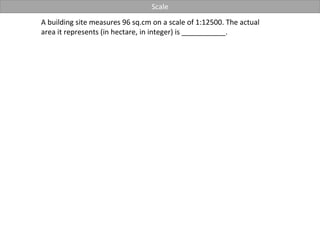
A building site measures 96 sq.cm on a scale of 1:12500. The actual
area it represents (in hectare, in integer) is ___________.
Scale
Scale
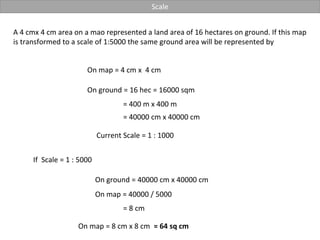
A 4 cmx 4 cm area on a mao represented a land area of 16 hectares on ground. If this map
is transformed to a scale of 1:5000 the same ground area will be represented by
On map = 4 cm x 4 cm
On ground = 16 hec = 16000 sqm
= 400 m x 400 m
Current Scale = 1 : 1000
= 8 cm
On ground = 40000 cm x 40000 cm
= 40000 cm x 40000 cm
If Scale = 1 : 5000
On map = 40000 / 5000
On map = 8 cm x 8 cm = 64 sq cm
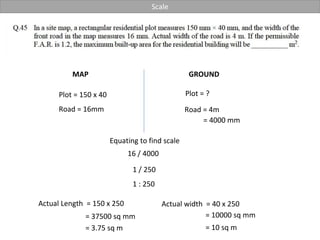
MAP GROUND
Plot = 150 x 40
Road = 16mm Road = 4m
= 4000 mm
16 / 4000
Equating to find scale
1 / 250
1 : 250
Actual Length = 150 x 250 Actual width = 40 x 250
= 37500 sq mm
= 3.75 sq m
= 10000 sq mm
= 10 sq m
Plot = ?
Scale
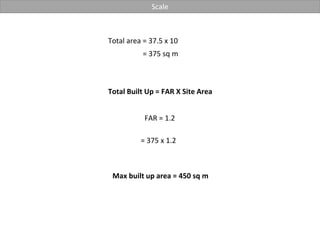
Total area = 37.5 x 10
= 375 sq m
Total Built Up = FAR X Site Area
= 375 x 1.2
FAR = 1.2
Max built up area = 450 sq m
Scale
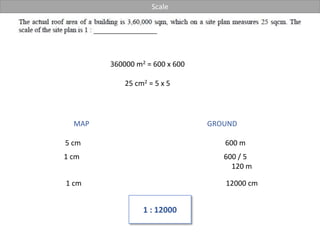
360000 m2 = 600 x 600
25 cm2 = 5 x 5
MAP GROUND
5 cm 600 m
1 cm 600 / 5
120 m
1 : 12000
1 cm 12000 cm
Scale
Lighting
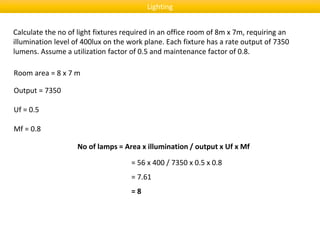
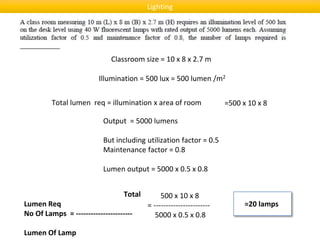
Calculate the no of light fixtures required in an office room of 8m x 7m, requiring an
illumination level of 400lux on the work plane. Each fixture has a rate output of 7350
lumens. Assume a utilization factor of 0.5 and maintenance factor of 0.8.
Room area = 8 x 7 m
No of lamps = Area x illumination / output x Uf x Mf
= 56 x 400 / 7350 x 0.5 x 0.8
= 7.61
= 8
Output = 7350
Uf = 0.5
Mf = 0.8
Classroom size = 10 x 8 x 2.7 m
Output = 5000 lumens
But including utilization factor = 0.5
Maintenance factor = 0.8
Lumen output = 5000 x 0.5 x 0.8
Illumination = 500 lux = 500 lumen /m2
Total
Lumen Req
No Of Lamps = -----------------------
Lumen Of Lamp
Total lumen req = illumination x area of room =500 x 10 x 8
500 x 10 x 8
= -----------------------
5000 x 0.5 x 0.8
=20 lamps
Lighting
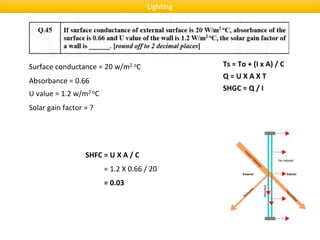
Surface conductance = 20 w/m2 oC
Q = U X A X T
Absorbance = 0.66
U value = 1.2 w/m2 oC
Solar gain factor = ?
SHFC = U X A / C
Ts = To + (I x A) / C
SHGC = Q / I
= 1.2 X 0.66 / 20
= 0.03
Lighting
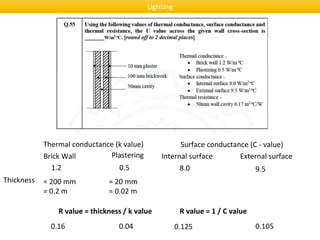
Thermal conductance (k value) Surface conductance (C - value)
Brick Wall Plastering Internal surface External surface
1.2 0.5 8.0 9.5
Thickness = 200 mm
= 0.2 m
= 20 mm
= 0.02 m
R value = thickness / k value
0.16 0.04 0.125 0.105
R value = 1 / C value
Lighting
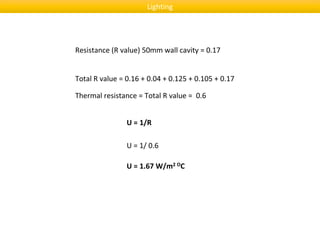
Total R value = 0.16 + 0.04 + 0.125 + 0.105 + 0.17
U = 1/R
U = 1/ 0.6
U = 1.67 W/m2 OC
Thermal resistance = Total R value = 0.6
Resistance (R value) 50mm wall cavity = 0.17
Lighting
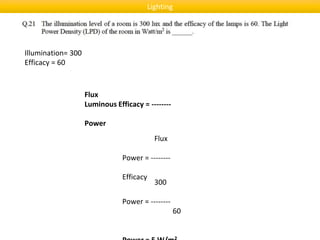
Flux
Luminous Efficacy = --------
Power
Flux
Power = --------
Efficacy
Illumination= 300
Efficacy = 60
300
Power = --------
60
Lighting
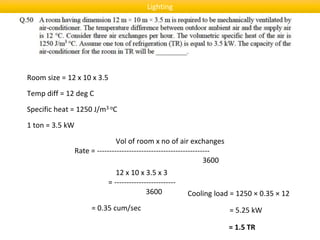
Room size = 12 x 10 x 3.5
Temp diff = 12 deg C
Specific heat = 1250 J/m3 oC
1 ton = 3.5 kW
Vol of room x no of air exchanges
Rate = ----------------------------------------------
3600
12 x 10 x 3.5 x 3
= -------------------------
3600
= 0.35 cum/sec
Cooling load = 1250 × 0.35 × 12
= 5.25 kW
= 1.5 TR
Lighting
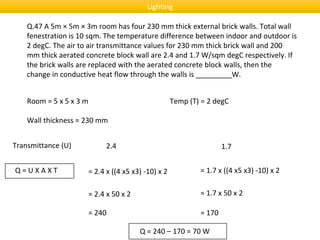
Q.47 A 5m × 5m × 3m room has four 230 mm thick external brick walls. Total wall
fenestration is 10 sqm. The temperature difference between indoor and outdoor is
2 degC. The air to air transmittance values for 230 mm thick brick wall and 200
mm thick aerated concrete block wall are 2.4 and 1.7 W/sqm degC respectively. If
the brick walls are replaced with the aerated concrete block walls, then the
change in conductive heat flow through the walls is _________W.
Room = 5 x 5 x 3 m
Wall thickness = 230 mm
Transmittance (U) 2.4 1.7
Q = U X A X T
Temp (T) = 2 degC
= 2.4 x ((4 x5 x3) -10) x 2 = 1.7 x ((4 x5 x3) -10) x 2
= 2.4 x 50 x 2 = 1.7 x 50 x 2
= 240 = 170
Q = 240 – 170 = 70 W
Lighting
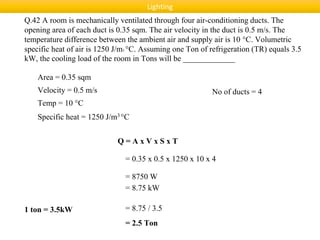
Q.42 A room is mechanically ventilated through four air-conditioning ducts. The
opening area of each duct is 0.35 sqm. The air velocity in the duct is 0.5 m/s. The
temperature difference between the ambient air and supply air is 10 °C. Volumetric
specific heat of air is 1250 J/m3 °C. Assuming one Ton of refrigeration (TR) equals 3.5
kW, the cooling load of the room in Tons will be _____________
Area = 0.35 sqm
Velocity = 0.5 m/s
Temp = 10 °C
Specific heat = 1250 J/m3 °C
Q = A x V x S x T
= 0.35 x 0.5 x 1250 x 10 x 4
= 8750 W
No of ducts = 4
= 8.75 kW
1 ton = 3.5kW = 8.75 / 3.5
= 2.5 Ton
Lighting
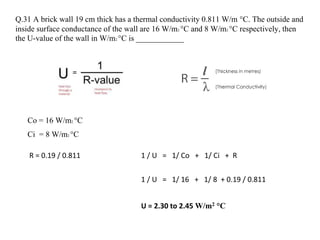
Q.31 A brick wall 19 cm thick has a thermal conductivity 0.811 W/m °C. The outside and
inside surface conductance of the wall are 16 W/m2 °C and 8 W/m2 °C respectively, then
the U-value of the wall in W/m2 °C is ____________
R = 0.19 / 0.811 1 / U = 1/ Co + 1/ Ci + R
Co = 16 W/m2 °C
Ci = 8 W/m2 °C
1 / U = 1/ 16 + 1/ 8 + 0.19 / 0.811
U = 2.30 to 2.45 W/m2 °C
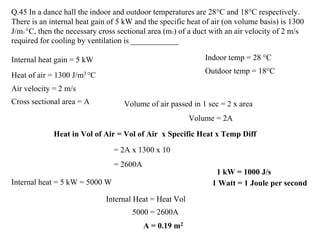
Q.45 In a dance hall the indoor and outdoor temperatures are 28°C and 18°C respectively.
There is an internal heat gain of 5 kW and the specific heat of air (on volume basis) is 1300
J/m3 °C, then the necessary cross sectional area (m2) of a duct with an air velocity of 2 m/s
required for cooling by ventilation is ____________
Indoor temp = 28 °C
Outdoor temp = 18°C
Internal heat gain = 5 kW
Heat of air = 1300 J/m3 °C
Air velocity = 2 m/s
Volume of air passed in 1 sec = 2 x area
Volume = 2A
Heat in Vol of Air = Vol of Air x Specific Heat x Temp Diff
Cross sectional area = A
= 2A x 1300 x 10
= 2600A
Internal heat = 5 kW = 5000 W 1 Watt = 1 Joule per second
Internal Heat = Heat Vol
5000 = 2600A
A = 0.19 m2
1 kW = 1000 J/s
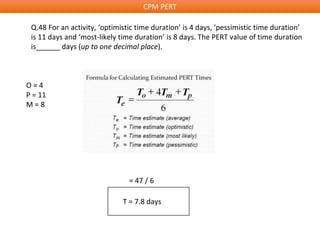
Q.48 For an activity, ‘optimistic time duration’ is 4 days, ‘pessimistic time duration’
is 11 days and ‘most-likely time duration’ is 8 days. The PERT value of time duration
is______ days (up to one decimal place).
O = 4
P = 11
M = 8
= 47 / 6
T = 7.8 days
CPM PERT
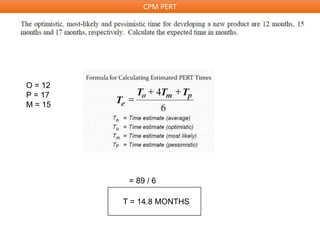
O = 12
P = 17
M = 15
= 89 / 6
T = 14.8 MONTHS
CPM PERT
CPM PERT
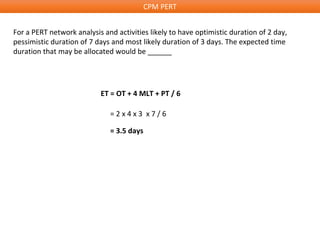
For a PERT network analysis and activities likely to have optimistic duration of 2 day,
pessimistic duration of 7 days and most likely duration of 3 days. The expected time
duration that may be allocated would be ______
ET = OT + 4 MLT + PT / 6
= 2 x 4 x 3 x 7 / 6
= 3.5 days
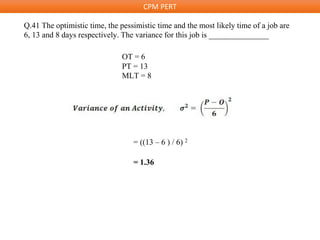
Q.41 The optimistic time, the pessimistic time and the most likely time of a job are
6, 13 and 8 days respectively. The variance for this job is _______________
OT = 6
PT = 13
MLT = 8
= ((13 – 6 ) / 6) 2
= 1.36
CPM PERT

GATE Numericals.post graduation ,march ,architecture

  • 1.
  • 2.
    NUMERICAL ESTIMATION & VALUATION HOUSING(FAR – DENSITY CALC) ACOUSTICS ILLUMINATION RUN OFF CALCULATIONS SCALE STURCTURES CPM & PERT IMPORATANT TOPICS
  • 3.
    Rainfall The total quantityof runoff for an area of 18 Hec in a lateritic region (run off coeff= 0.5 and rainfall= 10mm/hr) is Run off coeff= 0.5 Rainfall= 10mm/hr = 0.01m/hr Q = Runoff coeff x Rainfall x Surface area Area = 18 Hec Q = 0.5 x 0.01 x 18000 Q = 90 m3/hr
  • 4.
    Rainfall Rainfall = 100mm = 0.1 m Storm water of central play area = 100% Storm water of rest of the complex = 70% Volume of water after runoff AB CPA OPA OIA 100 9 14 36 Retention period 1250 X 0.8 X 0.1 150 X 0.6 X 0.1 200 X 0.7 X 0.1 400 X 0.9 X 0.1 70 9 9.8 25.2
  • 5.
    Rainfall Total Volume =70 + 9 + 9.8 + 25.2 Total Volume = 114 m3 Total Volume = l x b x h Height = ? 114 = 150 x h Central play area = 150sq m h = 0.76 m h = 760 mm
  • 6.
    Q.42 A buildingwith 100 sqm roof area is connected to a 72 cum rainwater collection tank. If the rainfall is 60 mm per hour and the loss during water storage is 20%, then the time taken to fill the tank completely is_______ hours. Roof area = 100 sqm 20% waste Tank = 72 cum Suppose X amount of water is coming 80 % of X is 72cum 72 = 80 X --------- 100 X = 90 cu m VOL = AREA X HEIGHT 90 = 100 X H H = 9 m = 900 mm 60 mm = 1hr 900 mm = T = 900 / 60 T = 15 hrs Rainfall
  • 7.
    Brick paving area= 20% of 35000 Concrete paving area = 15% of 35000 Grass cover area = 65% of 35000 = 7000 m2 = 5250 m2 = 22750 m2 Total surface area = 35000 sqm Water runoff by brick paving = 0.8 × 7000 × 0.07 Water runoff by concrete paving = 0.9 × 5250 x 0.07 Water runoff by grass cover = 0.5 × 22750 × 0.07 = 392m3 = 330.75 m3 = 796.25 m3 Rainfall = 70 mm = 0.07 m Total run off = 392 + 330.75 + 796.25 Total run off = 1519 m3 Rainfall
  • 8.
    Q.34 A houselocated in Delhi has 111 m2 of flat terrace area (runoff coefficient = 0.85) and 55 m2 of ground area covered with grass (runoff coefficient = 0.15). If annual average rainfall is 611.8 mm, then rain water harvesting potential (L/year) from runoff will be -------- --------- Flat terrace = 111 sqm Run off coeff terrace = 0.85 Ground area with grass = 55 sqm Annual rainfall = 611.8 mm = 0.6118 m Rain water harvesting potential = ? RWH = SURFACE AREA X RAINFALL X RW COEFF = (111 x 0.85 + 55 x 0.15 ) x 0.6118 Run off coeff grass = 0.15 = 102.6 x 0.6118 = 62.77068 cum 1 m3 = 1000 L = 627706 L Rainfall
  • 9.
    Construction A rectangular room(internal dimension 5m x 3m) is made if 250 mm walls. Calculate volume of concrete needed for 25mm Dampproof course Room size = 5 x 3 m Wall thickness = 250 mm = 0.25 m Area under wall = 19.25 – 15 Outer area = 5.50 x 3.50 m = 4.25 m2 Vol of conc req for DPC = 4.25 x 0025 Inner area = 5 x 3 m = 19.25 m2 = 15 m2 = 0.10625 m3
  • 10.
    Q.51 A roomof internal dimension 4m x 5m x 3.5m (LxBxH) has 20 cm thick walls and two doors of size 1m x 2m. The required area of Damp Proof Course (sq.m) is _____________ Room = 4 x 5 x 3.5 m Thickness of wall = 20 cm = 0.2 m 2 doors =1 x 2 m = 2m Area covered by walls = 4.4 x 5.4 - 4 x 5 = 3.76 m2 Area covered by 2 doors = 1 x 2 x 0.2 = 0.4 m2 Area for DPC = 3.76 – 0.4 = 3.36 m2
  • 11.
    Construction A rectangular room(internal dimension 5m x 3m) is made if 250 mm walls. Calculate volume of concrete needed for 25mm Dampproof course Room = 1.8 x 2.4 m = 4.32 sqm Tile = 300 x 300 mm = 90000 sqmm = 0.09 sqm Area of skirting = 1.8 x 0.6 x 2 + 2.4 x 0.6 + 1.5 x 0.6 Skirting ht = 600 mm Door opening = 900 mm = 0.6 m = 0.9 m = 4.5 sqm Area of tiling = 4.5 + 4.32 = 8.82 sqm No of tiles = 8.82 / 0.09 = 98 tiles
  • 12.
    Q.47 One litreof acrylic paint can cover 16 sqm of wall area for the first coat and 24 sqm for the second coat. The walls of a lecture hall measuring 12m × 8m × 4m (L × B × H) need to be painted with two coats of this paint. The hall has total glazed fenestration area of 12 sqm. The number of 4 litre paint containers required will be __________ 1 lit covers FIRST COAT = 16 sqm SECOND COAT = 24 sqm Room size = 12 x 8 x 4 FENESTRATION = 12 sqm Surface area = 2 ( 12 x 4 + 8 x 4 ) = 2 ( 48+ 32 ) = 160 sq m = 160 - 12 = 148 First coat = 148 / 16 Second coat = 148 / 24 = 9.25 lit = 6.17 lit Total = 9.25+ 6.17 = 15.42 4 containers Construction
  • 13.
    Number of tiles= 45 / 0.09 Driveway = 15m x 3m Tiles = 300mm x 300 mm = 45 sqm = 900000 sq mm = 0.09 sqm = 500 One packet = 30 tiles No of packets for 500 tiles = 500 / 30 = 16.6 = 17 packets Construction
  • 14.
    Initial cost =400000 Scrap value = 10 % of initial cost Time = 30 years Rate of interest = 5 % = 40000 Sinking fund = initial cost – scrap cost = 400000 – 40000 = 360000 = 360000 (0.05 / (1+0.05)30-1) = 5421 Rs ESTIMATION VALUATION
  • 15.
    Area of building= 5000 sqm Site = 1 hectare = 10000 sqm Present value of land = Rs 100/sqm Present value of site land = 100 x 10000 = 10 lakhs Cost of construction = 5000 x 2500 Present construction cost = Rs 2500/sqm = 125 lakhs ESTIMATION VALUATION
  • 16.
    Depreciation rate =6% Value of the building after depreciation in 5 years = 125 (1 – r)n = 91.7 lakhs = 125 × (1 – 0.06)5 Present Value of Property = Land Value + Building Value = 10+ 91.7 = 101.7 lakhs ESTIMATION VALUATION
  • 17.
    Annual rent =10000 Present Value Of Land = Annual Rent ------- ----------------- Rate = 10000 x 100 ---------------- 5 = 20000 Rs Rate = 5 % ESTIMATION VALUATION
  • 18.
    Annual net income= 22000 Rs Interest rate = 8% Capitalize Value x Rate of Interest = Net Income CV x 8 % = 22000 CV = 275000 Rs ESTIMATION VALUATION
  • 19.
    FAR A residential plotof 20m frontage and 25 m depth is governed by the development regulations of maximum FAR of 2 and maximum ground coverage 50%. Up to what maximum height can the plot be built ? Plot = 20 x 25 m = 500 sqm FAR = 2 Ground coverage = 50% of plot area Built up area = 500 x 2 = 1000 sqm = 250 sqm No of floors = 1000 / 250 = 4 floors
  • 20.
    FAR A group housingplot of 400 sqm abutting a 20 m road is permitted to have 35% ground coverage and maximum FAR 1.25 assuming 70 sqm of super built up area, calculate the maximum number of units that can be accommodated Plot = 400 sqm Ground coverage = 35% x 400 = 140 sqm Built up area = 1.25 x 400 FAR = 1.25 = 500 sqm Super built up area = 70 sqm = 7 units Max no of units to be built = 500 / 70
  • 21.
    FAR A small commercialplot measuring 20 m x 30 m located in a community center is subjected to maximum ground coverage of 60% and FAR 3. With fullest land utilization and uniform floor areas how many floors can be built on the plot. Plot = 20 x 30 Ground coverage = 60% x 600 = 360 sqm Built up area = 3 x 600 FAR = 3 = 1800 sqm = 6 floors Total no of floors = 1800 / 360
  • 22.
    FAR MIG tower = 4towers = 8 storey = 400m2 LIG tower = 3 towers = 7 storey 75% of FAR = 12800 Remaining FAR which can be utilize in LIG towers = 17066.67 - 12800 Total floor area = 4 x 8 x 400 = 12800 = 17066.67 = 4266.67 sqm Floor area for LIG = 4266.67 / 7x3 = 203.17
  • 23.
    Plot = 3000sqm Total b/up area 4500 6000 6000 9000 9000 + 15 % of EWS (9000) 10350 FAR
  • 24.
    39132 50872 60133 39132 / 130440x 100 Percentage inc = 30% 50872 / 169572 x 100 30% 60133 / 220444 x 100 30% Population 2021 Population 2031 (286577 x 0.3) + 286577 372550 ( 372550 x 0.3) + 372550 484315 FAR
  • 25.
    Housing The relative distributionof different types of housing within total residential area of 150 hec is such that Builders housing group is 1/4th of total area, cooperative housing society if half of the builders housing group and rest is the plotted hosing. If the net density of the plotted housing area is 350ppha, how many people will be accommodated there? Total residential area = 150 hec Builders housing group = 1/4 x 150 = 37.5 hec Plotted housing consumers = 150 – 37.5 – 18.75 Cooperative society housing = 1/2 x 37.5 = 18.75 = 93.75 Density of plotted housing = 350 ppha = 350 x 93.75 = 32812.5
  • 26.
    Housing A town hasbasic employment of 25000 workers. If the basic : non basic ration is 1:2.5 and the workers dependency ration is 1:4, what is the population size of the town? Basic employment = 25000 Non Basic employment = 2.5 x 25000 = 62500 Total dependent population = 87500 x 4 Total workers = 25000 + 62500 = 87500 = 350000 Total population = 350000 + 87500 = 437500
  • 27.
    Housing A community comprising120 hec is having 60% of the land put to residential plots an a population of 30600. Calculate the net residential density? Total area of community sector = 120 hec Area of residential dev = 60% of 120 = 72 hec Net residential density = 30600 / 72 Population of community = 30600 = 425 pph
  • 28.
    Housing A town of225000 population in 1981 has exhibited decadal growth rates of 25% and 30% during 1991 and 2001 respectively estimated the population in 2011 having 40% decided growth rate. 1981 1991 2001 2011 - 25% 30% 40% 225000 281250 365625 511875 Years Growth Population
  • 29.
    Housing In a residentialcommunity of 10000 population 20% are higher secondary school going children the expected enrollment is 80% and per capita gross floor space required is 3 sqm. The ground coverage permissibly is 40%. Indicate the land area required for the higher secondary building in hectares. Expected enrolment = 80% x 2000 = 1600 Population = 10000 Population of school going children= 20% x 10000 = 2000 Per capita gross floor pace = 3 sq m = 1.2 Ha 0.40a = 4800 = 12000 sqm Floor space req for 1600 children = 1600 x 3= 4800 sq m Ground coverage = 40% = 0.40a
  • 30.
    Housing Residential area of80 hectares has the following residential plots sub division. Each plot has won dwelling unit and the average household sizes 5 persons. The rest area is devoted to roads, schools, parks and shops. What are the gross and net density respectively of the area in persons per hectare (ppha) Total area = 80 hec = 800000 sqm = 8000 / 80 Gross density = total population / total area Each plot 1 DU Avg household size = 5 Plot size Numbers 500 sqm 100 300 sqm 500 200 sqm 1000 Total area Total DU Total population 50000 100 500 150000 500 2500 200000 1000 5000 400000 1600 8000 Net density = total population / net residential area = 8000/ 40 40 hec = 100 ppha = 200 ppha
  • 31.
    Area of plot1 = 500sqm No of units = 100 Total area = 500 x 100 = 50000 sqm = 5 Ha Area of plot 2 = 300sqm No of units = 120 Total area = 300 x 120 = 36000 sqm = 3.6 Ha Area of plot 3 = 200sqm No of units = 150 Total area = 200 x 150 = 30000 sqm = 3 Ha Total area = 5 + 3.6 + 3 Total area = 11.6 Ha Housing
  • 32.
    Population = 100x 5 Avg household size = 5 = 500 Population = 120 x 5 Avg household size = 5 = 600 Population = 150 x 5 Avg household size = 5 = 750 Total Population = 500 + 600 + 750 Total Population = 1850 Total Population Net Density = ------------------------- Area of Residential Plots 1860 Net Density = ----------- 11.6 Net Density = 160.3 persons per hectare Housing
  • 33.
    Acoustics In a seminarroom of area 200 sqm an height of 4m an total absorption power of 120m2 Sabines, what is the reverberation time ? Vol of room = 200 x 4 = 800 cum Total absorption = 120 RT = 0.16 Vol / Absp = 0.16 x 800 / 120 = 1.06 sec
  • 34.
    Acoustics An auditorium ofsize 30 m x 20 m is 8 m high. Assuming optimum reverberation time of 1.2 seconds existing absorption power of the hall is 300 m2 sabine calculate the extra absorption required Vol = 4800 cum RT = 1.2 sec RT = 0.16 Vol / Absp 1.2 = 0.16 x 4800 / abs Abs = 640 m2sabines Total absorption = ? Extra Absorption reqd = 640 – 300 = 340 m2sabine
  • 35.
    Room = 8x 14 x 4 m 4 windows = 1.5 x 1 m 2 doors = 1 x 2 m - Closed - Open RT = ? Total surface area of cuboid = 2 ( lb +bh + hl ) Total surface room= 2 ( 8x14 + 14x4 + 2x2 ) = 400 sqm Minus openings = 400 – (1.5 x 4 + 2x2) = 390 sqm Acoustics
  • 36.
    Vol of Room= 8 x 14 x 4 = 448 sqm Total absorption = 390 x 0.2 + 4 x 0.4 + 6 x 1 = 85.6 Sabine For an open window absorption coeff will be 1 – total incident sound is equal to total absorbed sound RT = 0.16 x 448 / 85.6 RT = 0.83 sec Acoustics
  • 37.
    Room size =10 x 10 x 4 Vol of room = 400 cum Reverberation time = 1.2 sec 1.2 = 0.16 (400/360a) Total surface area = 10 x 4 x 4 + 10 x 10 x 2 = 360 sqm (V) Volume = L X B X H (S) Total Absorption = Surface Area X Absorption Coeff a = 0.148 Openings = 16 sqm If the room is closed RT = 0.16 (400/344a) If the room is open openings= 360- 16 = 344 sqm RT = 0.16 (400/344 X 0.148) RT = 1.26 sec Acoustics
  • 38.
    Q.44 For aroom with dimensions 4m × 3m × 3m (L×B×H), the details of indoor acoustical treatment are as follows. The reverberation time in seconds at 1000 Hz is _______ Dim = 4m × 3m × 3m Area of wall = 4 x 3 x 2 + 3 x 3 x 2 = 42 42 ((0.3 x 0.4) + (0.7 x 0.1)) 42 x 0.19 7.98 Sabine Area of ceiling = 4 x 3 = 12 12 ((0.4 x 0.6) + (0.6 x 0.1)) 12 x 0.3 3.6 Sabine Total absorption wall Total absorption ceiling Acoustics
  • 39.
    Area of floor= 4x 3 = 12 12 (1 x 0.1) 12 x 0.1 1.2 Sabine Total absorption floor RT = 0.16 x 36 ------------ 12.78 Total absorption = 7.98 + 3.6 + 1.2 RT = 0.45 sec = 12.78 Volume = 4 x 3 x 3 = 36 Acoustics
  • 40.
    Scale If the scaleof the map is 1:30000, then 1 sq cm of the map would represent__________Ha 1 sq c m On map = 1 cm x 1 cm On ground = 30000 cm x 30000 cm = 900000000 sq cm = 90000 sq m = 9 Ha
  • 41.
    A building sitemeasures 96 sq.cm on a scale of 1:12500. The actual area it represents (in hectare, in integer) is ___________. Scale
  • 42.
    Scale A 4 cmx4 cm area on a mao represented a land area of 16 hectares on ground. If this map is transformed to a scale of 1:5000 the same ground area will be represented by On map = 4 cm x 4 cm On ground = 16 hec = 16000 sqm = 400 m x 400 m Current Scale = 1 : 1000 = 8 cm On ground = 40000 cm x 40000 cm = 40000 cm x 40000 cm If Scale = 1 : 5000 On map = 40000 / 5000 On map = 8 cm x 8 cm = 64 sq cm
  • 43.
    MAP GROUND Plot =150 x 40 Road = 16mm Road = 4m = 4000 mm 16 / 4000 Equating to find scale 1 / 250 1 : 250 Actual Length = 150 x 250 Actual width = 40 x 250 = 37500 sq mm = 3.75 sq m = 10000 sq mm = 10 sq m Plot = ? Scale
  • 44.
    Total area =37.5 x 10 = 375 sq m Total Built Up = FAR X Site Area = 375 x 1.2 FAR = 1.2 Max built up area = 450 sq m Scale
  • 45.
    360000 m2 =600 x 600 25 cm2 = 5 x 5 MAP GROUND 5 cm 600 m 1 cm 600 / 5 120 m 1 : 12000 1 cm 12000 cm Scale
  • 46.
    Lighting Calculate the noof light fixtures required in an office room of 8m x 7m, requiring an illumination level of 400lux on the work plane. Each fixture has a rate output of 7350 lumens. Assume a utilization factor of 0.5 and maintenance factor of 0.8. Room area = 8 x 7 m No of lamps = Area x illumination / output x Uf x Mf = 56 x 400 / 7350 x 0.5 x 0.8 = 7.61 = 8 Output = 7350 Uf = 0.5 Mf = 0.8
  • 47.
    Classroom size =10 x 8 x 2.7 m Output = 5000 lumens But including utilization factor = 0.5 Maintenance factor = 0.8 Lumen output = 5000 x 0.5 x 0.8 Illumination = 500 lux = 500 lumen /m2 Total Lumen Req No Of Lamps = ----------------------- Lumen Of Lamp Total lumen req = illumination x area of room =500 x 10 x 8 500 x 10 x 8 = ----------------------- 5000 x 0.5 x 0.8 =20 lamps Lighting
  • 48.
    Surface conductance =20 w/m2 oC Q = U X A X T Absorbance = 0.66 U value = 1.2 w/m2 oC Solar gain factor = ? SHFC = U X A / C Ts = To + (I x A) / C SHGC = Q / I = 1.2 X 0.66 / 20 = 0.03 Lighting
  • 49.
    Thermal conductance (kvalue) Surface conductance (C - value) Brick Wall Plastering Internal surface External surface 1.2 0.5 8.0 9.5 Thickness = 200 mm = 0.2 m = 20 mm = 0.02 m R value = thickness / k value 0.16 0.04 0.125 0.105 R value = 1 / C value Lighting
  • 50.
    Total R value= 0.16 + 0.04 + 0.125 + 0.105 + 0.17 U = 1/R U = 1/ 0.6 U = 1.67 W/m2 OC Thermal resistance = Total R value = 0.6 Resistance (R value) 50mm wall cavity = 0.17 Lighting
  • 51.
    Flux Luminous Efficacy =-------- Power Flux Power = -------- Efficacy Illumination= 300 Efficacy = 60 300 Power = -------- 60 Lighting
  • 52.
    Room size =12 x 10 x 3.5 Temp diff = 12 deg C Specific heat = 1250 J/m3 oC 1 ton = 3.5 kW Vol of room x no of air exchanges Rate = ---------------------------------------------- 3600 12 x 10 x 3.5 x 3 = ------------------------- 3600 = 0.35 cum/sec Cooling load = 1250 × 0.35 × 12 = 5.25 kW = 1.5 TR Lighting
  • 53.
    Q.47 A 5m× 5m × 3m room has four 230 mm thick external brick walls. Total wall fenestration is 10 sqm. The temperature difference between indoor and outdoor is 2 degC. The air to air transmittance values for 230 mm thick brick wall and 200 mm thick aerated concrete block wall are 2.4 and 1.7 W/sqm degC respectively. If the brick walls are replaced with the aerated concrete block walls, then the change in conductive heat flow through the walls is _________W. Room = 5 x 5 x 3 m Wall thickness = 230 mm Transmittance (U) 2.4 1.7 Q = U X A X T Temp (T) = 2 degC = 2.4 x ((4 x5 x3) -10) x 2 = 1.7 x ((4 x5 x3) -10) x 2 = 2.4 x 50 x 2 = 1.7 x 50 x 2 = 240 = 170 Q = 240 – 170 = 70 W Lighting
  • 54.
    Q.42 A roomis mechanically ventilated through four air-conditioning ducts. The opening area of each duct is 0.35 sqm. The air velocity in the duct is 0.5 m/s. The temperature difference between the ambient air and supply air is 10 °C. Volumetric specific heat of air is 1250 J/m3 °C. Assuming one Ton of refrigeration (TR) equals 3.5 kW, the cooling load of the room in Tons will be _____________ Area = 0.35 sqm Velocity = 0.5 m/s Temp = 10 °C Specific heat = 1250 J/m3 °C Q = A x V x S x T = 0.35 x 0.5 x 1250 x 10 x 4 = 8750 W No of ducts = 4 = 8.75 kW 1 ton = 3.5kW = 8.75 / 3.5 = 2.5 Ton Lighting
  • 55.
    Q.31 A brickwall 19 cm thick has a thermal conductivity 0.811 W/m °C. The outside and inside surface conductance of the wall are 16 W/m2 °C and 8 W/m2 °C respectively, then the U-value of the wall in W/m2 °C is ____________ R = 0.19 / 0.811 1 / U = 1/ Co + 1/ Ci + R Co = 16 W/m2 °C Ci = 8 W/m2 °C 1 / U = 1/ 16 + 1/ 8 + 0.19 / 0.811 U = 2.30 to 2.45 W/m2 °C
  • 56.
    Q.45 In adance hall the indoor and outdoor temperatures are 28°C and 18°C respectively. There is an internal heat gain of 5 kW and the specific heat of air (on volume basis) is 1300 J/m3 °C, then the necessary cross sectional area (m2) of a duct with an air velocity of 2 m/s required for cooling by ventilation is ____________ Indoor temp = 28 °C Outdoor temp = 18°C Internal heat gain = 5 kW Heat of air = 1300 J/m3 °C Air velocity = 2 m/s Volume of air passed in 1 sec = 2 x area Volume = 2A Heat in Vol of Air = Vol of Air x Specific Heat x Temp Diff Cross sectional area = A = 2A x 1300 x 10 = 2600A Internal heat = 5 kW = 5000 W 1 Watt = 1 Joule per second Internal Heat = Heat Vol 5000 = 2600A A = 0.19 m2 1 kW = 1000 J/s
  • 57.
    Q.48 For anactivity, ‘optimistic time duration’ is 4 days, ‘pessimistic time duration’ is 11 days and ‘most-likely time duration’ is 8 days. The PERT value of time duration is______ days (up to one decimal place). O = 4 P = 11 M = 8 = 47 / 6 T = 7.8 days CPM PERT
  • 58.
    O = 12 P= 17 M = 15 = 89 / 6 T = 14.8 MONTHS CPM PERT
  • 59.
    CPM PERT For aPERT network analysis and activities likely to have optimistic duration of 2 day, pessimistic duration of 7 days and most likely duration of 3 days. The expected time duration that may be allocated would be ______ ET = OT + 4 MLT + PT / 6 = 2 x 4 x 3 x 7 / 6 = 3.5 days
  • 60.
    Q.41 The optimistictime, the pessimistic time and the most likely time of a job are 6, 13 and 8 days respectively. The variance for this job is _______________ OT = 6 PT = 13 MLT = 8 = ((13 – 6 ) / 6) 2 = 1.36 CPM PERT