Chapter 2
Part 1
Modeling Basis
1
MicroGuide to Process and Decision
Modeling
2
OUTLINE
• BPMN And DMN Concepts
• BPMN And DMN Subset
• Basic BPMN Elements
• Basic DMN Elements
• Process Flow
• Phases of Activity
• Process Flow with Gateways
BPMN and DMN concepts
3
In the early 1900s, Process Modeling using flow charts was developed
to represent Manufacturing Processes.
Graphical Approaches
 Business Process Modeling: BPMN 2.0
 Stateless Diagramming Techniques /Commercial: BPEL, XPDL and
Petri net.
DMN (Decision Model and Notation)
 is an organizing structure for Business Rules
 focused on “verbalizing”.
 can be utilized across multiple processes.
 Decision model using DMN 1.0
4
BPMN and DMN concepts
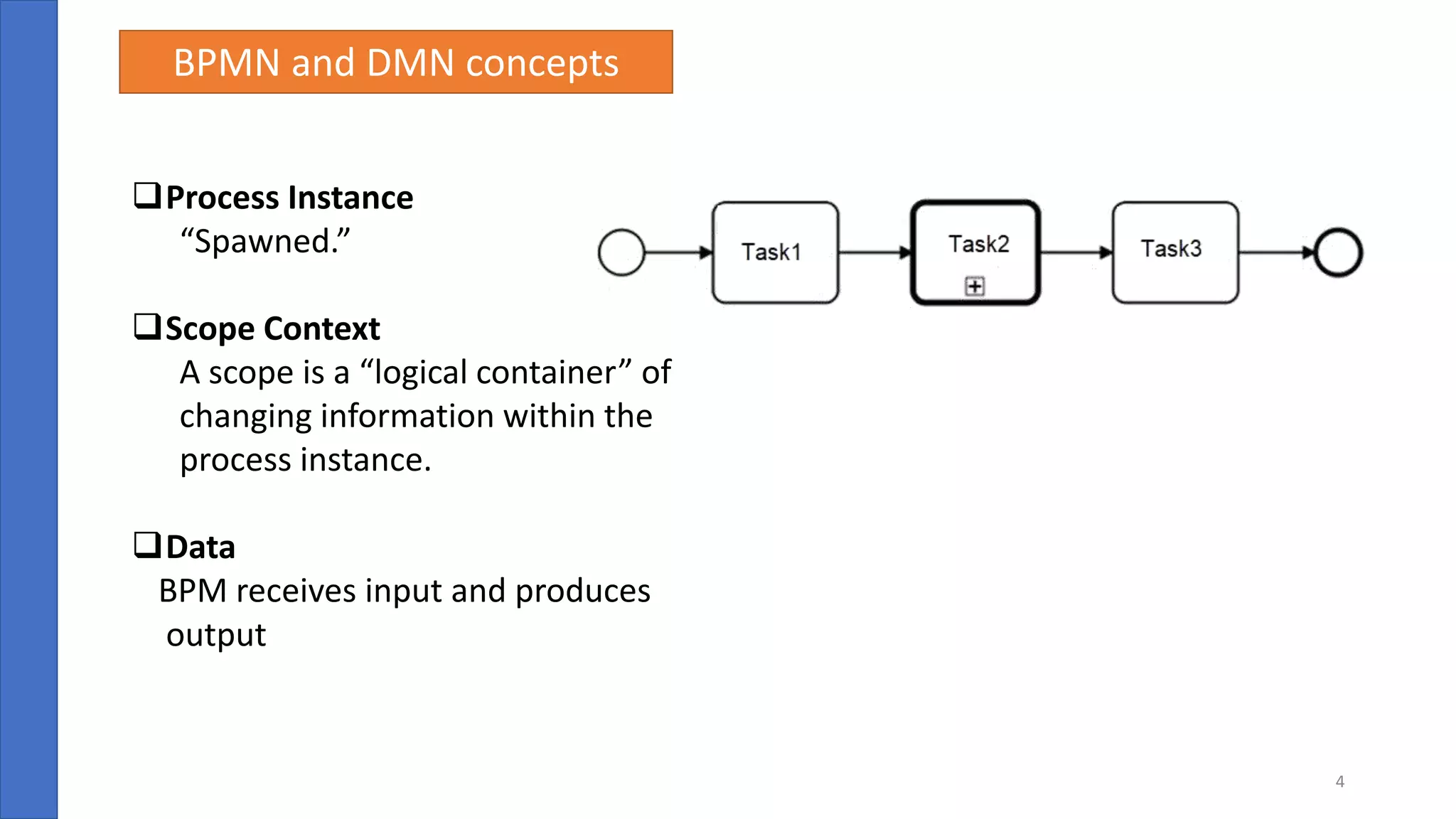
Process Instance
“Spawned.”
Scope Context
A scope is a “logical container” of
changing information within the
process instance.
Data
BPM receives input and produces
output
5
Process
hierarchy
Level 1
Process
Landscape
Level 2
Main
Processes
(e.g. BPMN)
Level 3+
Subprocesses, Tasks
(e.g. BPMN)
BPMN and DMN concepts
Process Instance
“Spawned.”
Scope Context
A scope is a “logical container” of
changing information within the
process instance.
Data
BPM receives input and produces
output
6
Building Models by modeling Decisions and Processes
Business Decision is Stateless and Time-invariant
DMN is adept at documenting and implementing decisions,
(logic steps or business rules).
BPMN is adept at managing process instances and is designed
to model and document interactions among participants.
BPMN and DMN Subset
7
Basic BPMN Elements
8
Basic DMN Elements
9
Task
A rounded rectangle showing the finest, or atomic, process step.
Subprocess (collapsed)
A rounded rectangle that can contain a series of other steps. The other
steps are hidden from view; the plus sign indicates additional
information.
Subprocess (expanded)
A rounded rectangle showing all the subprocess activities (from the
collapsed subprocess).
Rule Task
The business rule task shape denotes the place within the process
model that calls up a DMN model and obtains the decision output..
Task
Subprocess
(collapsed)
Subprocess
(expanded)
Rule Task
Activities
Basic DMN Elements
10
There are two types of flows in a BPMN diagram:
Sequence—Defines the order in which activities are performed for
any given process.
 Sequence flow never occurs between participants.
Message—Defines the flow of information and messages between
participants within a process.
 Messages never occur within the same participant.
Process Flow
The sequence that is activated can also be
considered the traversalof a single token
11
Ready: Pre-execution, an
activity is ready for execution if
the required number of tokens
has arrived—if multiple tasks
might need to be completed.
Phases of Activity
Active: During execution, the
required input data is available
and the activity is performing
work or waiting for completion.
Completed: All the
prerequisites are done,
and a token is generated
for the next sequence.
12
Inventory Process.
Implicit state
explicit state
Process Flow with Gateways
Thank you
13

ch02-part1.pptx

  • 1.
    Chapter 2 Part 1 ModelingBasis 1 MicroGuide to Process and Decision Modeling
  • 2.
    2 OUTLINE • BPMN AndDMN Concepts • BPMN And DMN Subset • Basic BPMN Elements • Basic DMN Elements • Process Flow • Phases of Activity • Process Flow with Gateways
  • 3.
    BPMN and DMNconcepts 3 In the early 1900s, Process Modeling using flow charts was developed to represent Manufacturing Processes. Graphical Approaches  Business Process Modeling: BPMN 2.0  Stateless Diagramming Techniques /Commercial: BPEL, XPDL and Petri net. DMN (Decision Model and Notation)  is an organizing structure for Business Rules  focused on “verbalizing”.  can be utilized across multiple processes.  Decision model using DMN 1.0
  • 4.
    4 BPMN and DMNconcepts Process Instance “Spawned.” Scope Context A scope is a “logical container” of changing information within the process instance. Data BPM receives input and produces output
  • 5.
    5 Process hierarchy Level 1 Process Landscape Level 2 Main Processes (e.g.BPMN) Level 3+ Subprocesses, Tasks (e.g. BPMN) BPMN and DMN concepts Process Instance “Spawned.” Scope Context A scope is a “logical container” of changing information within the process instance. Data BPM receives input and produces output
  • 6.
    6 Building Models bymodeling Decisions and Processes Business Decision is Stateless and Time-invariant DMN is adept at documenting and implementing decisions, (logic steps or business rules). BPMN is adept at managing process instances and is designed to model and document interactions among participants. BPMN and DMN Subset
  • 7.
  • 8.
  • 9.
    9 Task A rounded rectangleshowing the finest, or atomic, process step. Subprocess (collapsed) A rounded rectangle that can contain a series of other steps. The other steps are hidden from view; the plus sign indicates additional information. Subprocess (expanded) A rounded rectangle showing all the subprocess activities (from the collapsed subprocess). Rule Task The business rule task shape denotes the place within the process model that calls up a DMN model and obtains the decision output.. Task Subprocess (collapsed) Subprocess (expanded) Rule Task Activities Basic DMN Elements
  • 10.
    10 There are twotypes of flows in a BPMN diagram: Sequence—Defines the order in which activities are performed for any given process.  Sequence flow never occurs between participants. Message—Defines the flow of information and messages between participants within a process.  Messages never occur within the same participant. Process Flow The sequence that is activated can also be considered the traversalof a single token
  • 11.
    11 Ready: Pre-execution, an activityis ready for execution if the required number of tokens has arrived—if multiple tasks might need to be completed. Phases of Activity Active: During execution, the required input data is available and the activity is performing work or waiting for completion. Completed: All the prerequisites are done, and a token is generated for the next sequence.
  • 12.
    12 Inventory Process. Implicit state explicitstate Process Flow with Gateways
  • 13.

Editor's Notes

  • #3 I will talk about BPMN And DMN Concepts and their subset and basic elements of each of them, and go through process flow and phases of activity and last explain process flow with gateways by inventory example.
  • #4 Before 1st point: Over the years, there have been many evolutions of process modeling before BPMN. ------------------------------------------------------------------------------------------------------------------------------------------------------------------------------------------ After 2nd point: BPMN incorporates a few concepts of flow charts and other process modeling techniques. BPMN is the settled notation; other commercial approaches include graphical editors for Business Process Execution Language (BPEL) and XML Process Definition Language (XPDL). ------------------------------------------------ Continue: BPMN concepts were defined as the key elements of a business process model. The DMN concepts that were introduced represent the key elements for defining the decision making required by a process., so the decision is as important as the process steps, the BPM industry has created DMN. With DMN, the structure of the decision and the logic can be modeled. Decisions can be connected to a business process. ----------------------------------------------------------------------------------------------------------------------------------------------------------------------------------------- Verbalizing express (ideas or feelings) in words
  • #5 Instance: Each time a process starts, an instance of the process is created or “spawned.”/ instance is linked for all types of processes (subprocess)/since
  • #6 A scope is a logical container of changing information within the process instance. By default, all process instances have a hierarchy of scope con text. At the top is business process scope, which is the high-level objective of the process. In the scope of the entire (top) process, a business objective, with well-defined start and end points, exists for the entire process. A logical division of activities and data arises as details are added to the diagram.
  • #7 Point 1: Knowing the basic BPMN and DMN shapes and some key concepts such as decisions, tokens, activity states, and process data is critical for effective process modeling. ---------------------------------------------------------------------------------------------------------------------------------------------------------------------------------- Point 2: A business decision is stateless and time-invariant; when it is executable, it simply applies logic to input data.
  • #8 In BPMN, the symbols are classified by one of four shape types: rectangle, circle, line, or diamond. The shapes define classes of behaviors that include activities, gateways, events, sequences, and flows. Markers within a shape define its behavior.
  • #9 using only four shapes and three links. Shapes wide variety of decision models
  • #11 Inverted triangle