Mixing Rules and Process Sandy Kemsley Kemsley Design Ltd. www.column2.com Business Rules Forum, October 28 th , 2008
Agenda Business process management (BPM) defined Business rules management (BRM) defined BPM + BRM = greater than the sum of the parts Techniques for mixing rules and process
Business Processes Chain of activities producing a business result Usually spans functional silos Requirement to “manage the white space” between functional groups
BPM Defined A management discipline for improving cross-functional business processes. The methods and technology tools used to manage and optimize business processes.
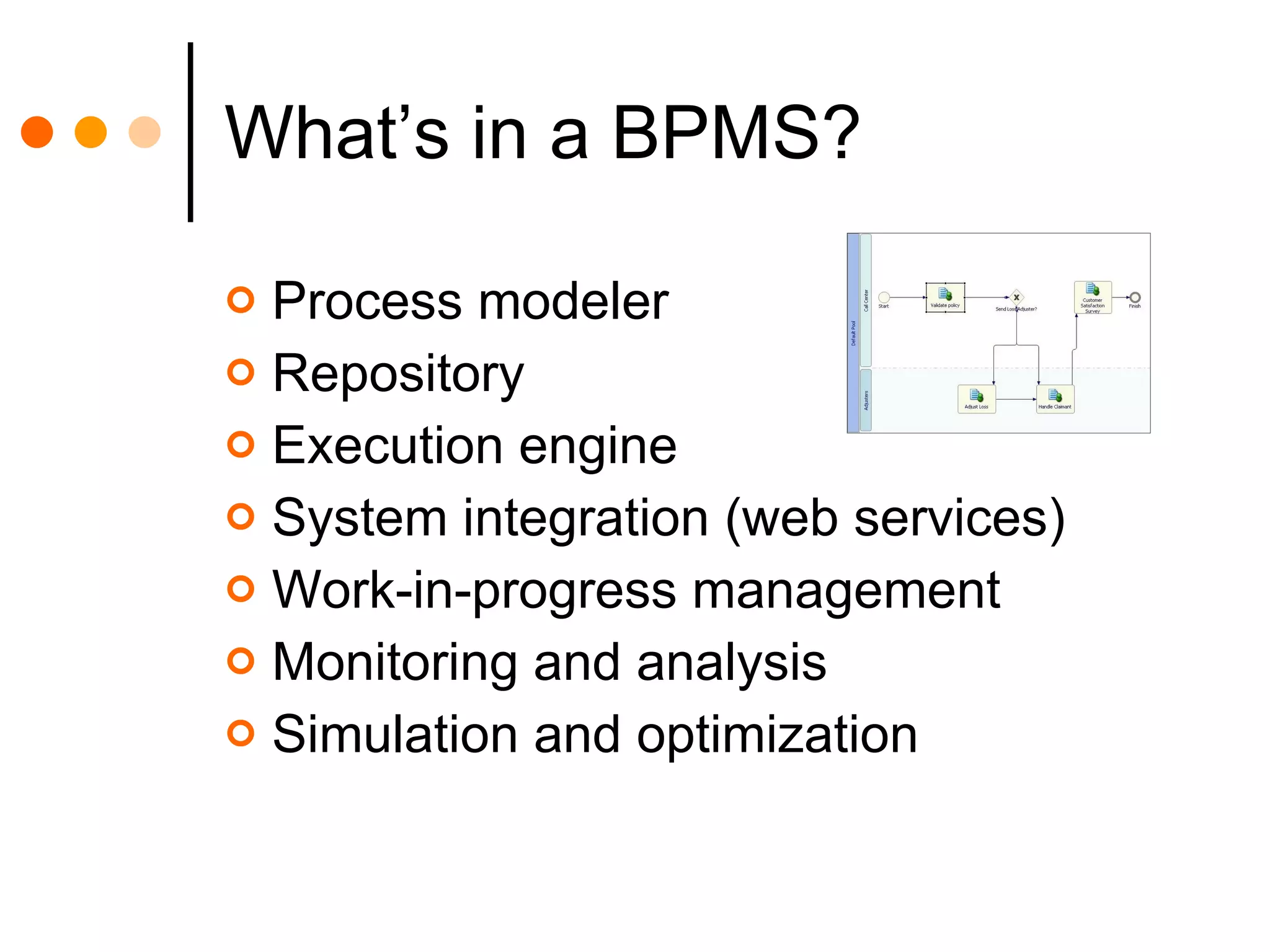
What’s in a BPMS? Process modeler Repository Execution engine System integration (web services) Work-in-progress management Monitoring and analysis Simulation and optimization
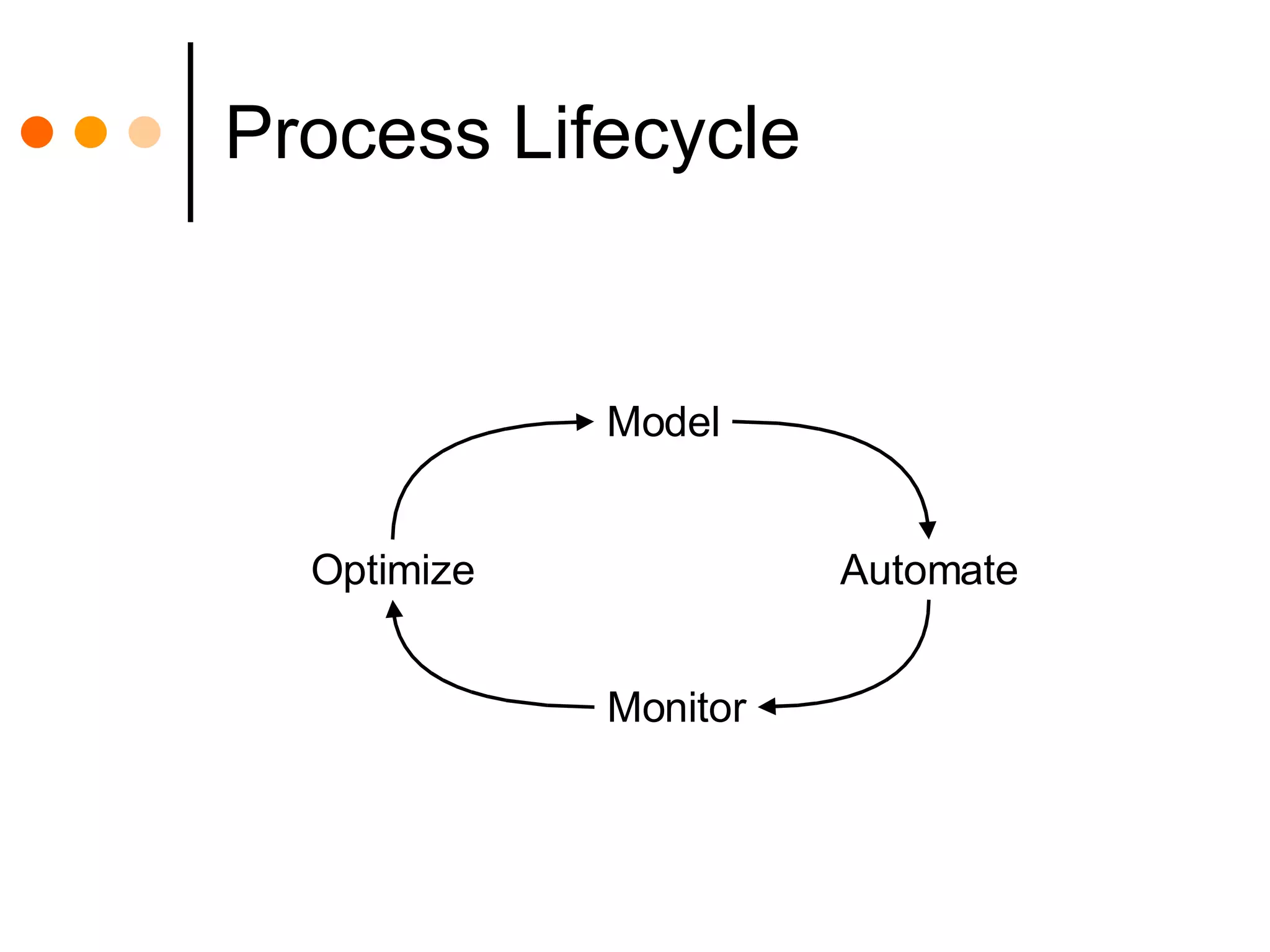
Process Lifecycle Model Automate Monitor Optimize
BPM Goals Efficiency Automating steps and handoffs Integrating systems and data sources Compliance Achieving and proving standardization Agility Changing processes quickly and easily Visibility See what’s happening in a process
Business Rules Business policies that define an action Decision Constraint Implicit in systems and procedures Explicit in BRMS
BRM Defined Discipline for discovery and management of business rules Methodologies and tools used to manage rules
What’s in a BRMS? Rules modeler Rules repository Execution engine Monitoring and analysis Simulation
Doesn’t BPM Have Rules? Typically not full-featured BR: Simple Boolean rules for routing decisions Rules defined for a specific process step Rule changes may require redeploying processes with IT involvement Rule changes may not affect in-flight processes Many process models don’t automate decisions
Separating rules from process Externalize decisions from process Routing decisions Work assignment Set parameters Call BRMS from BPMS for decision Standard web services call Tight integration by vendors
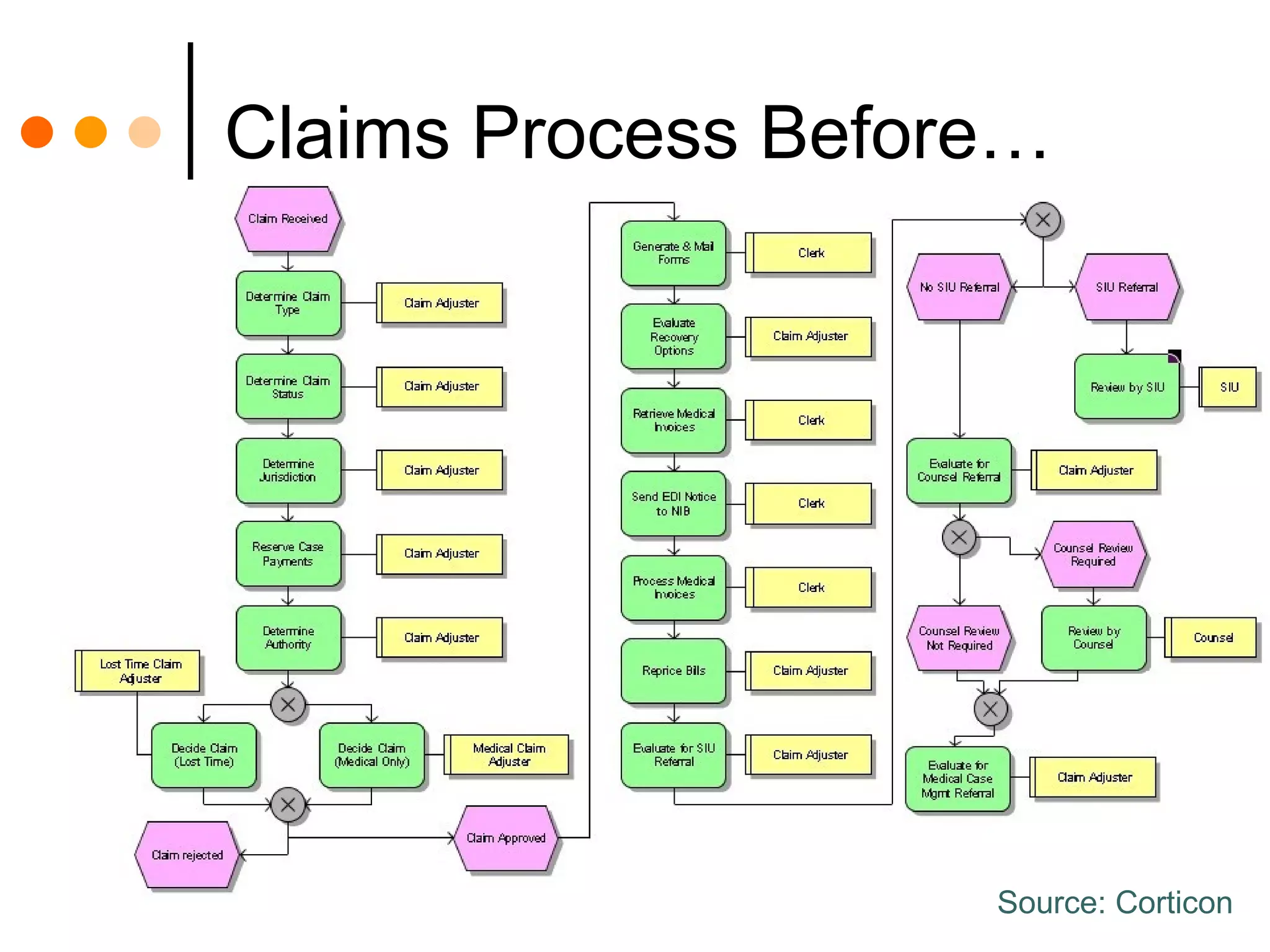
Claims Process Before… Source: Corticon
Claims Process After… Source: Corticon
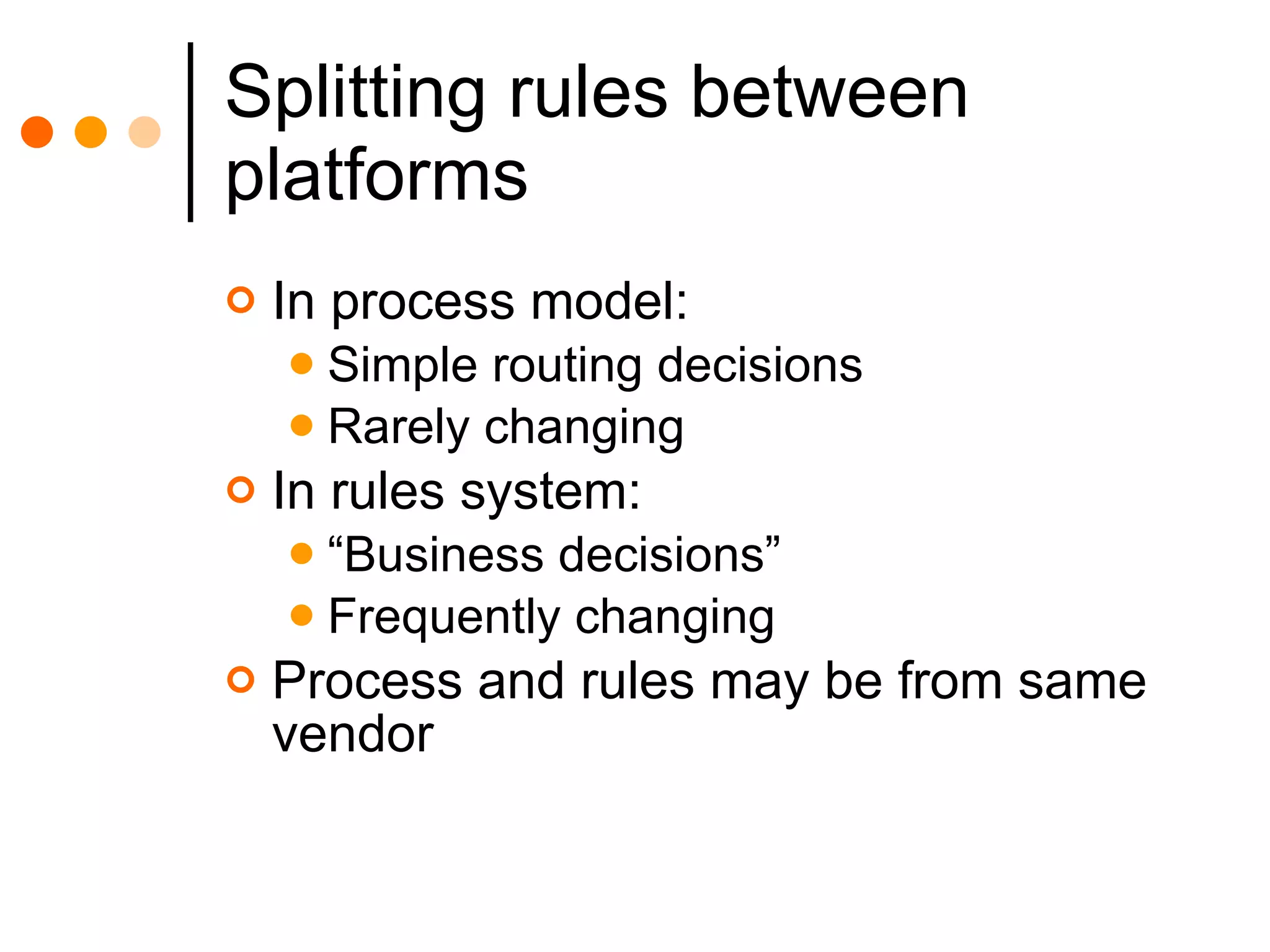
Splitting rules between platforms In process model: Simple routing decisions Rarely changing In rules system: “Business decisions” Frequently changing Process and rules may be from same vendor
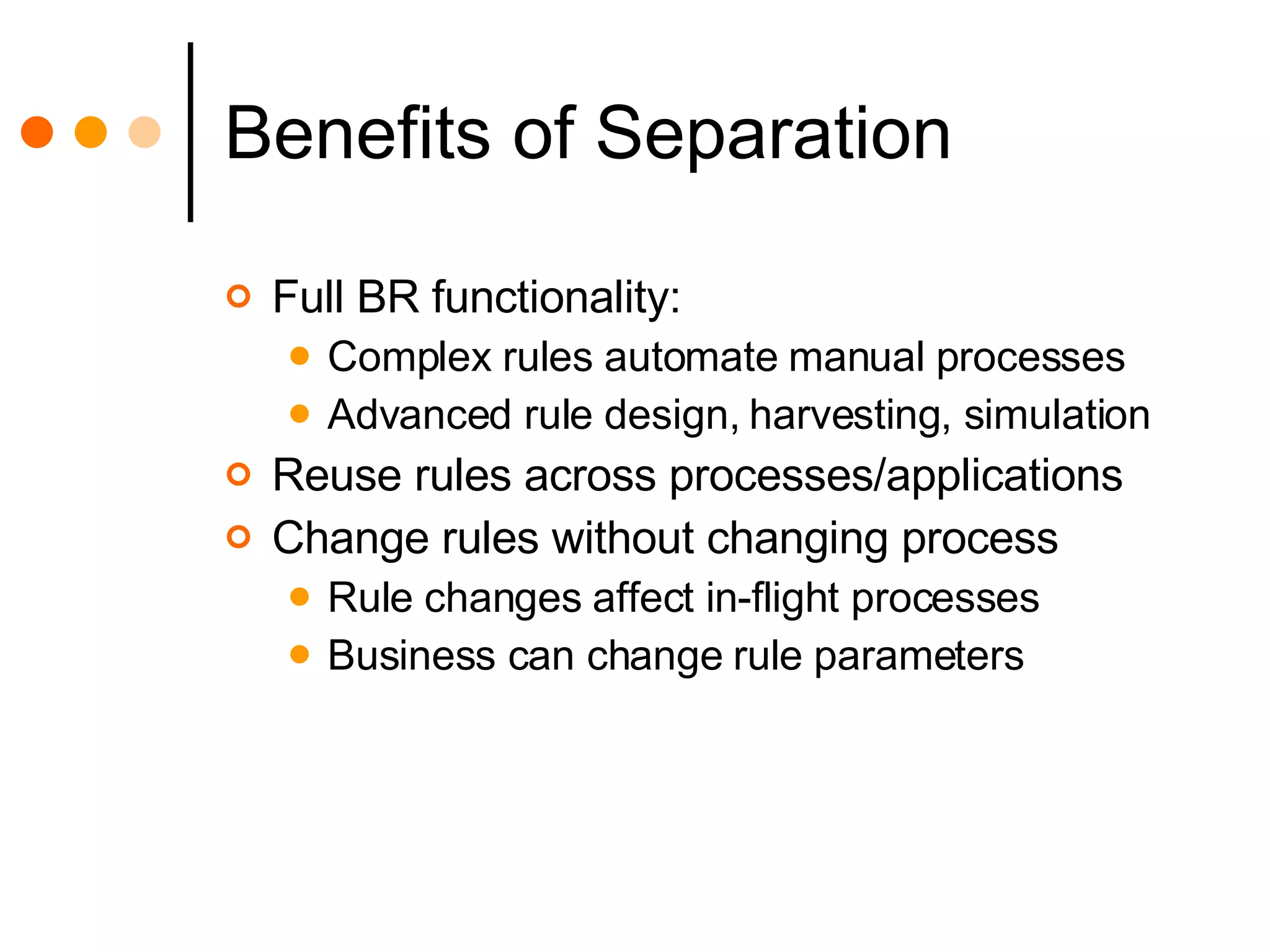
Benefits of Separation Full BR functionality: Complex rules automate manual processes Advanced rule design, harvesting, simulation Reuse rules across processes/applications Change rules without changing process Rule changes affect in-flight processes Business can change rule parameters
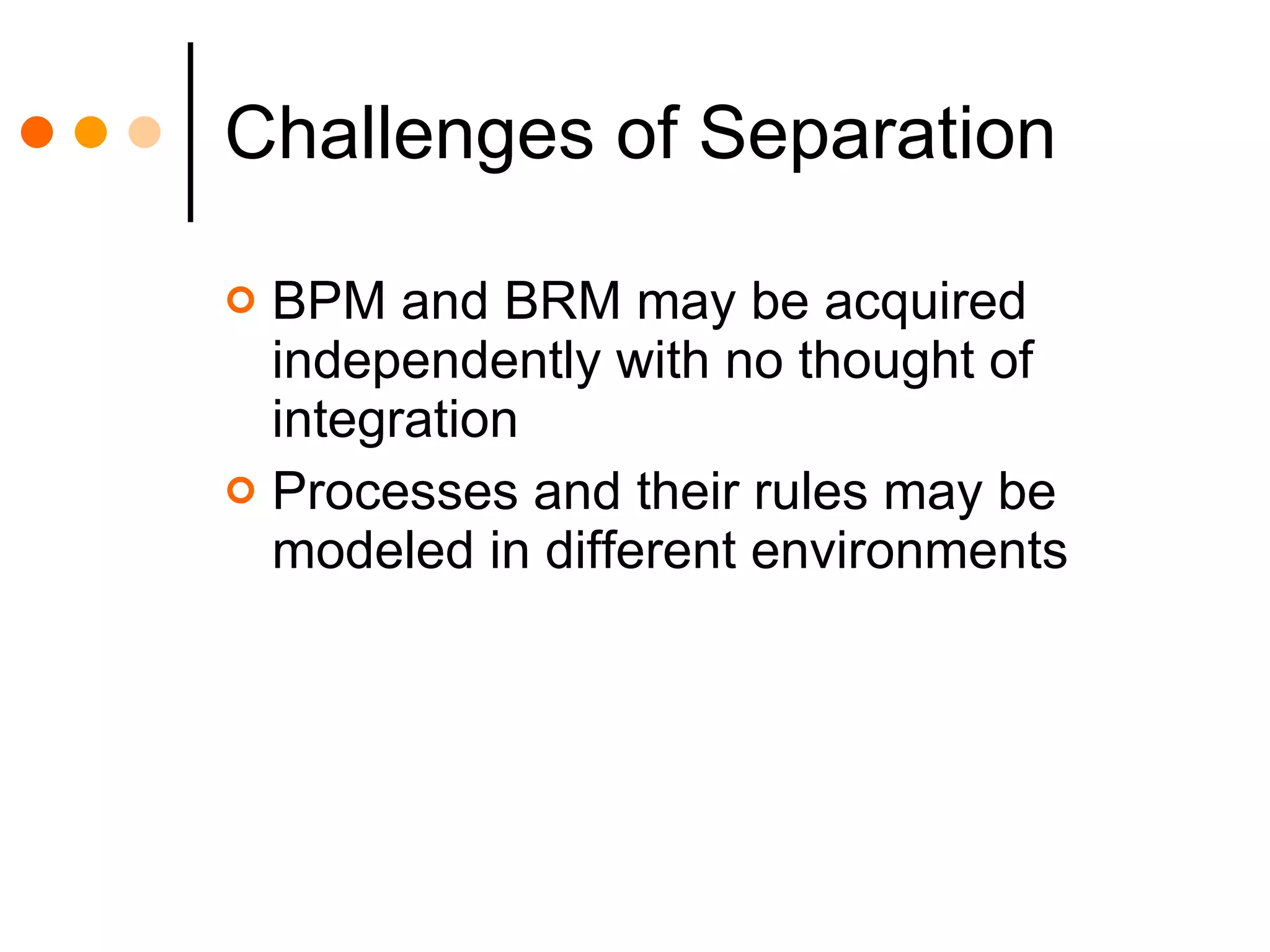
Challenges of Separation BPM and BRM may be acquired independently with no thought of integration Processes and their rules may be modeled in different environments
Summary Externalizing and automating decisions is the key to process agility More sophisticated capabilities of BRM allow more process automation BPM + BRM turns policies into action and builds for change
Questions? Sandy Kemsley Kemsley Design Ltd. www.column2.com

Mixing Rules and Process

  • 1.
    Mixing Rules andProcess Sandy Kemsley Kemsley Design Ltd. www.column2.com Business Rules Forum, October 28 th , 2008
  • 2.
    Agenda Business processmanagement (BPM) defined Business rules management (BRM) defined BPM + BRM = greater than the sum of the parts Techniques for mixing rules and process
  • 3.
    Business Processes Chainof activities producing a business result Usually spans functional silos Requirement to “manage the white space” between functional groups
  • 4.
    BPM Defined Amanagement discipline for improving cross-functional business processes. The methods and technology tools used to manage and optimize business processes.
  • 5.
    What’s in aBPMS? Process modeler Repository Execution engine System integration (web services) Work-in-progress management Monitoring and analysis Simulation and optimization
  • 6.
    Process Lifecycle ModelAutomate Monitor Optimize
  • 7.
    BPM Goals EfficiencyAutomating steps and handoffs Integrating systems and data sources Compliance Achieving and proving standardization Agility Changing processes quickly and easily Visibility See what’s happening in a process
  • 8.
    Business Rules Businesspolicies that define an action Decision Constraint Implicit in systems and procedures Explicit in BRMS
  • 9.
    BRM Defined Disciplinefor discovery and management of business rules Methodologies and tools used to manage rules
  • 10.
    What’s in aBRMS? Rules modeler Rules repository Execution engine Monitoring and analysis Simulation
  • 11.
    Doesn’t BPM HaveRules? Typically not full-featured BR: Simple Boolean rules for routing decisions Rules defined for a specific process step Rule changes may require redeploying processes with IT involvement Rule changes may not affect in-flight processes Many process models don’t automate decisions
  • 12.
    Separating rules fromprocess Externalize decisions from process Routing decisions Work assignment Set parameters Call BRMS from BPMS for decision Standard web services call Tight integration by vendors
  • 13.
    Claims Process Before…Source: Corticon
  • 14.
    Claims Process After…Source: Corticon
  • 15.
    Splitting rules betweenplatforms In process model: Simple routing decisions Rarely changing In rules system: “Business decisions” Frequently changing Process and rules may be from same vendor
  • 16.
    Benefits of SeparationFull BR functionality: Complex rules automate manual processes Advanced rule design, harvesting, simulation Reuse rules across processes/applications Change rules without changing process Rule changes affect in-flight processes Business can change rule parameters
  • 17.
    Challenges of SeparationBPM and BRM may be acquired independently with no thought of integration Processes and their rules may be modeled in different environments
  • 18.
    Summary Externalizing andautomating decisions is the key to process agility More sophisticated capabilities of BRM allow more process automation BPM + BRM turns policies into action and builds for change
  • 19.
    Questions? Sandy KemsleyKemsley Design Ltd. www.column2.com

Editor's Notes

  • #2 Abstract: There are many techniques for combining rules or decisioning capability with business process management (BPM), ranging from using simple expression engines embedded within a BPM system to a full integration between separate BRM and BPM systems. This session takes a close look at what rules functionality that the BPM systems offer, and the key characteristics that identify which rules and decisions should remain in the domain of the BPM system, and which should be entrusted to a full-strength business rules management system. Attendees will learn: The current state of BPM and BRM How BPM and BRM interact Where your rules belong