Team E
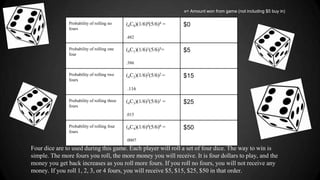
x= Amount won from game (not including $5 buy in)
Probability of rolling no
fours

(4C0)(1/6)0(5/6)4 =

$0

.482
Probability of rolling one
four

(4C1)(1/6)1(5/6)3=

$5

.386
Probability of rolling two
fours

(4C2)(1/6)2(5/6)2 =

$15

.116
Probability of rolling three
fours

(4C3)(1/6)3(5/6)1 =

$25

.015

Probability of rolling four
fours

(4C4)(1/6)4(5/6)0 =

$50

.0007

Four dice are to used during this game. Each player will roll a set of four dice. The way to win is
simple. The more fours you roll, the more money you will receive. It is four dollars to play, and the
money you get back increases as you roll more fours. If you roll no fours, you will not receive any
money. If you roll 1, 2, 3, or 4 fours, you will receive $5, $15, $25, $50 in that order.
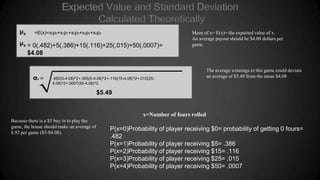
μx

=E(x)=x0p0+x1p1+x2p2+x3p3+x4p4

μx = 0(.482)+5(.386)+15(.116)+25(.015)+50(.0007)=

Mean of x= E(x)= the expected value of x.
An average payout should be $4.08 dollars per
game.

$4.08

σx =

.482(0-4.08)^2+.385(5-4.08)^2+.116(15-4.08)^2+.015(254.08)^2+.0007(50-4.08)^2

The average winnings in this game could deviate
an average of $5.49 from the mean $4.08

$5.49

x=Number of fours rolled
Because there is a $5 buy in to play the
game, the house should make an average of
$.92 per game ($5-$4.08).

P(x=0)Probability of player receiving $0= probability of getting 0 fours=
.482
P(x=1)Probability of player receiving $5= .386
P(x=2)Probability of player receiving $15= .116
P(x=3)Probability of player receiving $25= .015
P(x=4)Probability of player receiving $50= .0007
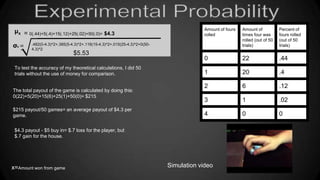
μx = 0(.44)+5(.4)+15(.12)+25(.02)+50(.0)= $4.3
σx =

Amount of fours
rolled

Amount of
times four was
rolled (out of 50
trials)

Percent of
fours rolled
(out of 50
trials)

0

22

.44

1

20

.4

2

6

.12

3

1

.02

4

0

0

.482(0-4.3)^2+.385(5-4.3)^2+.116(15-4.3)^2+.015(25-4.3)^2+0(504.3)^2

$5.53

To test the accuracy of my theoretical calculations, I did 50
trials without the use of money for comparison.

The total payout of the game is calculated by doing this:
0(22)+5(20)+15(6)+25(1)+50(0)= $215
$215 payout/50 games= an average payout of $4.3 per
game.

$4.3 payout - $5 buy in= $.7 loss for the player, but
$.7 gain for the house.

x=Amount won from game

Simulation video
Overall, Two is Company, Four is Money is a Casino’s dream! It has a wonderful house
advantage, and seemed to be true for the trials. I was very surprised that the simulation stayed
somewhat true to the theoretical probability. The closest probabilities were rolling either two fours or
three fours, two just .005 of a percent off, and three being only .006 of a percent off. The biggest
change(s) would be the payout and standard deviation, which were only .22 and .04 off (in that
order).
The biggest fault that the game has would be its attractiveness to casino fanatics. Those who
understand odds would most likely be skeptical to play a game where they had to roll four 4’s on
dice to only receive $50. This game would be better if there was a possible way to increase the cash
out without ruining the house advantage. Realistically, people are going to want to play games that
are not too expensive, but have a high “jackpot” and $50 is very little compared to other games.

Game e

  • 1.
  • 2.
    x= Amount wonfrom game (not including $5 buy in) Probability of rolling no fours (4C0)(1/6)0(5/6)4 = $0 .482 Probability of rolling one four (4C1)(1/6)1(5/6)3= $5 .386 Probability of rolling two fours (4C2)(1/6)2(5/6)2 = $15 .116 Probability of rolling three fours (4C3)(1/6)3(5/6)1 = $25 .015 Probability of rolling four fours (4C4)(1/6)4(5/6)0 = $50 .0007 Four dice are to used during this game. Each player will roll a set of four dice. The way to win is simple. The more fours you roll, the more money you will receive. It is four dollars to play, and the money you get back increases as you roll more fours. If you roll no fours, you will not receive any money. If you roll 1, 2, 3, or 4 fours, you will receive $5, $15, $25, $50 in that order.
  • 3.
    μx =E(x)=x0p0+x1p1+x2p2+x3p3+x4p4 μx = 0(.482)+5(.386)+15(.116)+25(.015)+50(.0007)= Meanof x= E(x)= the expected value of x. An average payout should be $4.08 dollars per game. $4.08 σx = .482(0-4.08)^2+.385(5-4.08)^2+.116(15-4.08)^2+.015(254.08)^2+.0007(50-4.08)^2 The average winnings in this game could deviate an average of $5.49 from the mean $4.08 $5.49 x=Number of fours rolled Because there is a $5 buy in to play the game, the house should make an average of $.92 per game ($5-$4.08). P(x=0)Probability of player receiving $0= probability of getting 0 fours= .482 P(x=1)Probability of player receiving $5= .386 P(x=2)Probability of player receiving $15= .116 P(x=3)Probability of player receiving $25= .015 P(x=4)Probability of player receiving $50= .0007
  • 4.
    μx = 0(.44)+5(.4)+15(.12)+25(.02)+50(.0)=$4.3 σx = Amount of fours rolled Amount of times four was rolled (out of 50 trials) Percent of fours rolled (out of 50 trials) 0 22 .44 1 20 .4 2 6 .12 3 1 .02 4 0 0 .482(0-4.3)^2+.385(5-4.3)^2+.116(15-4.3)^2+.015(25-4.3)^2+0(504.3)^2 $5.53 To test the accuracy of my theoretical calculations, I did 50 trials without the use of money for comparison. The total payout of the game is calculated by doing this: 0(22)+5(20)+15(6)+25(1)+50(0)= $215 $215 payout/50 games= an average payout of $4.3 per game. $4.3 payout - $5 buy in= $.7 loss for the player, but $.7 gain for the house. x=Amount won from game Simulation video
  • 5.
    Overall, Two isCompany, Four is Money is a Casino’s dream! It has a wonderful house advantage, and seemed to be true for the trials. I was very surprised that the simulation stayed somewhat true to the theoretical probability. The closest probabilities were rolling either two fours or three fours, two just .005 of a percent off, and three being only .006 of a percent off. The biggest change(s) would be the payout and standard deviation, which were only .22 and .04 off (in that order). The biggest fault that the game has would be its attractiveness to casino fanatics. Those who understand odds would most likely be skeptical to play a game where they had to roll four 4’s on dice to only receive $50. This game would be better if there was a possible way to increase the cash out without ruining the house advantage. Realistically, people are going to want to play games that are not too expensive, but have a high “jackpot” and $50 is very little compared to other games.