Gambling	
  Awareness	
  101	


In	
  order	
  to	
  become	
  a	
  profitable	
  gambler	
  it	
  is	
  important	
  to	
  be	
  aware	
  of	
  risk,	
  
reward	
  and	
  probabilities	
  involved	
  in	
  the	
  game.	
  	
  There	
  are	
  statistical	
  techniques	
  that	
  
can	
  help	
  you	
  make	
  a	
  decision	
  when	
  gambling.	
  	
  The	
  people	
  who	
  risk	
  their	
  money	
  in	
  
order	
  to	
  make	
  a	
  substantial	
  profit	
  need	
  to	
  be	
  three	
  things:	
  logical,	
  strategic	
  and	
  
unemotional.	
  	
  They	
  need	
  to	
  understand	
  the	
  inherent	
  risk	
  involved	
  in	
  any	
  game.	
  
Advantage	
  Play	
  
Advantage	
  play	
  is	
  ubiquitous	
  in	
  the	
  lives	
  of	
  successful	
  gamblers.	
  It	
  is	
  
essentially	
  the	
  legal	
  way	
  to	
  gain	
  a	
  mathematical	
  edge	
  within	
  a	
  game.	
  	
  This	
  is	
  
commonly	
  seen	
  in	
  the	
  game	
  of	
  black	
  jack	
  or	
  poker.	
  For	
  example,	
  let’s	
  imagine	
  that	
  
you	
  are	
  playing	
  a	
  game	
  of	
  black	
  jack	
  against	
  five	
  people	
  including	
  the	
  dealer.	
  	
  Each	
  
player	
  is	
  dealt	
  two	
  cards	
  with	
  one	
  card	
  facing	
  up	
  and	
  another	
  facing	
  down.	
  	
  If	
  you	
  
see	
  that	
  you	
  are	
  dealt	
  a	
  two	
  face	
  up	
  and	
  a	
  jack	
  face	
  down,	
  and	
  that	
  there	
  are	
  five	
  
cards	
  showing	
  a	
  value	
  of	
  ten,	
  then	
  you	
  know	
  that	
  there	
  are	
  roughly	
  fourteen	
  cards	
  
that	
  can	
  make	
  you	
  go	
  over	
  21	
  out	
  of	
  the	
  remaining	
  forty	
  cards	
  or	
  35%	
  you	
  lose.	
  	
  You	
  
do	
  not	
  know	
  what	
  the	
  values	
  of	
  the	
  face	
  down	
  cards	
  are.	
  This	
  is	
  why	
  it	
  is	
  just	
  an	
  
approximation.	
  Then,	
  suppose	
  everybody	
  calls	
  for	
  a	
  third	
  card—they	
  come	
  out	
  to	
  be	
  
a	
  queen,	
  king,	
  king,	
  ten,	
  and	
  a	
  jack.	
  The	
  card	
  you	
  receive	
  is	
  a	
  two.	
  	
  You	
  would	
  then	
  
have	
  roughly	
  26%	
  chance	
  that	
  you	
  will	
  go	
  over	
  on	
  your	
  next	
  card.	
  	
  As	
  you	
  can	
  see,	
  
the	
  more	
  cards	
  that	
  come	
  out…	
  you	
  can	
  learn	
  how	
  its	
  affects	
  your	
  future	
  chances.	
  If	
  
you	
  are	
  aware	
  of	
  these	
  probability	
  enhancers,	
  then	
  you	
  can	
  make	
  smarter	
  gambling	
  
decisions	
  on	
  the	
  floor.	
  	
  Most	
  gamblers	
  have	
  tried	
  to	
  count	
  cards,	
  especially	
  in	
  black	
  
jack.	
  They	
  are	
  essentially	
  using	
  a	
  similar	
  idea	
  to	
  make	
  educated	
  guesses	
  on	
  their	
  
next	
  cards.	
  Thus,	
  this	
  would	
  give	
  them	
  an	
  edge	
  over	
  the	
  house	
  and	
  come	
  out	
  on	
  top	
  
with	
  profits.	
  Nowadays,	
  however,	
  it	
  is	
  not	
  as	
  simple	
  as	
  this.	
  Most	
  casinos	
  use	
  roughly	
  
four	
  to	
  six	
  decks	
  a	
  game.	
  This	
  makes	
  it	
  much	
  more	
  difficult	
  to	
  count	
  since	
  you	
  are	
  
now	
  dealing	
  with	
  many	
  more	
  cards.	
  	
  
Nevertheless,	
  there	
  are	
  also	
  many	
  illegal	
  ways	
  of	
  gaining	
  an	
  unfair	
  advantage.	
  
There	
  are	
  scenarios	
  in	
  craps	
  when	
  gamblers	
  can	
  attempt	
  to	
  throw	
  the	
  die	
  a	
  certain	
  
way.	
  Still,	
  given	
  the	
  cameras,	
  heightened	
  security	
  and	
  strict	
  rules	
  when	
  throwing	
  the	
  
die,	
  it	
  is	
  much	
  harder	
  to	
  achieve	
  this	
  feat.	
  	
  Be	
  mindful	
  of	
  the	
  loaded	
  dice	
  scam.	
  	
  A	
  
“loaded”,	
  or	
  weighted	
  die	
  is	
  one	
  that	
  has	
  been	
  fixed	
  to	
  land	
  with	
  a	
  specific	
  side	
  facing	
  
up	
  more	
  often	
  than	
  it	
  normally	
  would.	
  	
  A	
  type	
  of	
  loaded	
  die	
  is	
  hollow	
  with	
  a	
  small	
  
weight	
  and	
  a	
  semi-­‐solid	
  substance	
  inside	
  whose	
  melting	
  point	
  is	
  just	
  lower	
  than	
  the	
  
temperature	
  of	
  the	
  human	
  body,	
  allowing	
  the	
  cheater	
  to	
  change	
  the	
  loading	
  of	
  the	
  
die	
  by	
  applying	
  body	
  heat,	
  causing	
  the	
  semi-­‐solid	
  to	
  melt	
  and	
  the	
  weight	
  to	
  drift	
  
down,	
  making	
  the	
  chosen	
  opposite	
  face	
  more	
  likely	
  to	
  land	
  up.	
  A	
  less	
  common	
  type	
  
of	
  loaded	
  die	
  can	
  be	
  made	
  by	
  inserting	
  a	
  magnet	
  into	
  the	
  die	
  and	
  then	
  embed	
  a	
  coil	
  
of	
  wire	
  in	
  the	
  game	
  table	
  which	
  in	
  turn	
  would	
  create	
  an	
  electro-­‐magnet.	
  After	
  
running	
  current	
  through	
  the	
  coil,	
  it	
  increases	
  the	
  likelihood	
  of	
  a	
  certain	
  side	
  landing	
  
on	
  the	
  bottom.	
  	
  These	
  are	
  obviously	
  the	
  illegal	
  way	
  of	
  gaining	
  an	
  edge	
  when	
  
gambling.	


Expected	
  Value	
  
Expected	
  value	
  is	
  the	
  average	
  gains	
  or	
  losses	
  to	
  be	
  “expected”	
  from	
  a	
  game.	
  For	
  
example,	
  suppose	
  you	
  play	
  a	
  game	
  in	
  which	
  you	
  pay	
  five	
  dollars	
  to	
  roll	
  a	
  dice.	
  If	
  you	
  
get	
  an	
  even	
  number,	
  you	
  are	
  rewarded	
  the	
  corresponding	
  number.	
  If	
  you	
  get	
  on	
  odd	
  
number	
  you	
  are	
  rewarded	
  nothing.	
  Your	
  expected	
  value	
  per	
  game	
  would	
  be	
  	
  $-­‐0.5.	
  
You	
  obtain	
  this	
  by	
  multiplying	
  probabilities	
  of	
  each	
  outcome	
  by	
  their	
  corresponding	
  
gain	
  or	
  loss	
  and	
  summing	
  them	
  together.	
  This	
  is	
  shown	
  mathematically	
  as:	
  	
  
E=1/6	
  x	
  2	
  +	
  1/6	
  x	
  4	
  +	
  1/6	
  x	
  6	
  -­‐	
  3/6	
  x	
  5	
  =-­‐0.5	
  
Essentially	
  this	
  means	
  when	
  you	
  risk	
  five	
  dollars	
  to	
  potentially	
  make	
  two,	
  four	
  or	
  six	
  
dollars	
  your	
  average	
  over	
  time	
  would	
  be	
  negative.	
  You	
  can	
  expect	
  to	
  lose	
  roughly	
  fifty	
  
cents	
  per	
  game.	
  	
  If	
  you	
  play	
  this	
  100	
  times,	
  you	
  can	
  expect	
  to	
  lose	
  fifty	
  dollars.	
  Casinos	
  
use	
  this	
  idea	
  in	
  order	
  to	
  stack	
  the	
  probabilities	
  in	
  their	
  favor	
  in	
  order	
  to	
  be	
  constantly	
  
profitable.	
  This	
  edge	
  is	
  why	
  and	
  how	
  the	
  house	
  always	
  wins	
  on	
  average.	
  This	
  is	
  called	
  
Advantage	
  Play.	


Another	
  simple	
  example	
  is	
  shown	
  through	
  a	
  game	
  of	
  roulette.	
  On	
  a	
  European	
  
roulette	
  table,	
  a	
  croupier	
  spins	
  the	
  wheel	
  and	
  releases	
  a	
  ball	
  to	
  fall	
  into	
  one	
  of	
  37	
  slots.	
  	
  
There	
  are	
  18	
  red	
  and	
  18	
  black	
  slots	
  and	
  one	
  green	
  0	
  slot.	
  If	
  you	
  were	
  to	
  constantly	
  bet	
  
$1	
  on	
  black,	
  since	
  the	
  payout	
  is	
  1	
  to	
  1,	
  the	
  expected	
  value	
  per	
  game	
  would	
  come	
  out	
  to	
  
$-­‐0.027	
  per	
  game.	
  This	
  is	
  shown	
  mathematically	
  as:	


  18/37	
  x	
  $1	
  –	
  19/37	
  x	
  $1	
  =	
  -­‐$0.027	


That	
  extra	
  green	
  slot	
  is	
  enough	
  to	
  stack	
  the	
  probability	
  in	
  favor	
  of	
  the	
  house.	
  For	
  an	
  
American	
  Roulette	
  table,	
  your	
  expected	
  loss	
  would	
  be	
  roughly	
  $-­‐0.0526	
  per	
  game	
  on	
  
account	
  of	
  the	
  two	
  green	
  slots	
  for	
  0	
  and	
  00.	
  It	
  is	
  a	
  small	
  edge	
  the	
  house	
  gets,	
  and	
  it	
  
quickly	
  adds	
  up	
  over	
  the	
  hundreds	
  of	
  thousands	
  of	
  game	
  that	
  are	
  played.	
  This	
  edge	
  
holds	
  true	
  for	
  any	
  way	
  you	
  choose	
  to	
  bet	
  and	
  no	
  matter	
  what	
  the	
  payout	
  odds	
  are	
  for	
  
each	
  type	
  of	
  bet.	
  	
  You	
  could	
  have	
  bet	
  on	
  6	
  numbers	
  on	
  an	
  American	
  Roulette	
  table.	
  The	
  
pay	
  out	
  would	
  be	
  6	
  to	
  1.	
  This	
  is	
  shown	
  mathematically	
  as:	


6/38	
  x	
  $5	
  –	
  $1	
  x	
  32/38	
  =	
  	
  -­‐$0.0526	


If	
  you	
  played	
  the	
  American	
  roulette	
  game	
  1,000	
  times	
  the	
  house	
  would	
  be	
  expected	
  to	
  
gain	
  $52.60	
  from	
  you	
  alone.	
  It	
  would	
  be	
  wise	
  to	
  consider	
  playing	
  on	
  the	
  European	
  
table	
  as	
  opposed	
  to	
  the	
  American.	


It	
  is	
  interesting	
  when	
  you	
  think	
  about	
  the	
  influence	
  that	
  adding	
  just	
  one	
  or	
  
two	
  more	
  slots	
  has	
  on	
  a	
  game,	
  its	
  outcome	
  and	
  profit	
  potential.	
  It	
  is	
  enough	
  for	
  the	
  
casino	
  to	
  almost	
  always	
  come	
  out	
  on	
  top	
  on	
  average.	
  	
  For	
  every	
  winner	
  there	
  will	
  be	
  
more	
  losers.	
  It	
  makes	
  you	
  wonder	
  why	
  playing	
  at	
  all	
  makes	
  any	
  sense?	
  	
  Most	
  people	
  
don’t	
  understand	
  this	
  simple	
  concept.	
  Casinos	
  are	
  a	
  business,	
  and	
  like	
  any	
  other	
  
business,	
  it	
  is	
  there	
  to	
  make	
  money.	
  It	
  is	
  important	
  to	
  understand	
  that	
  more	
  than	
  
half	
  of	
  the	
  gamblers	
  walking	
  around	
  any	
  casino	
  floor	
  are	
  losers.	


Variance	
  
Variance	
  is	
  an	
  important	
  concept	
  to	
  understand	
  when	
  gambling.	
  It	
  is	
  the	
  
measure	
  of	
  how	
  far	
  the	
  numbers	
  lie	
  from	
  the	
  mean.	
  Although	
  there	
  are	
  various	
  
formulas	
  used	
  to	
  describe	
  the	
  variance	
  of	
  a	
  certain	
  data	
  set,	
  the	
  concept	
  remains	
  the	
  
same.	
  	
  The	
  simplest	
  mathematical	
  version	
  of	
  variance	
  is	
  basically	
  the	
  probability	
  of	
  
the	
  outcome	
  times	
  the	
  square	
  of	
  the	
  difference	
  between	
  the	
  shown	
  value	
  and	
  the	
  
expected	
  value	
  and	
  taking	
  their	
  sum.	
  For	
  example,	
  if	
  you	
  were	
  to	
  roll	
  a	
  dice,	
  then	
  the	
  
variance	
  would	
  be	
  roughly	
  2.92.	
  	
  This	
  is	
  shown	
  mathematically	
  as:	


1/6x(1-­‐3.5)	
  2+	
  1/6	
  x(2-­‐3.5)	
  2	
  +	
  1/6	
  x(3-­‐3.5)	
  2	
  +	
  1/6	
  x(4-­‐3.5)	
  2	
  +	
  1/6	
  x	
  (5-­‐3.5)	
  2	
  +	
  1/6	
  x	
  (6-­‐3.5)	
  2	
  =	
  2.92.	


Statistical	
  variance	
  gives	
  a	
  measure	
  of	
  how	
  the	
  data	
  distributes	
  itself	
  about	
  the	
  mean	
  
or	
  expected	
  value.	
  Unlike	
  range	
  that	
  only	
  looks	
  at	
  the	
  extremes,	
  the	
  variance	
  looks	
  at	
  
all	
  the	
  data	
  points	
  and	
  then	
  determines	
  their	
  distribution.	
  If	
  there	
  were	
  a	
  relatively	
  
high	
  variance,	
  you	
  should	
  expect	
  a	
  wide	
  spread	
  of	
  values,	
  and	
  it	
  would	
  be	
  wise	
  to	
  
reconsider	
  your	
  bet	
  on	
  a	
  given	
  outcome.	
  It	
  is	
  a	
  good	
  indication	
  of	
  what	
  kind	
  of	
  
challenge	
  you	
  will	
  be	
  facing	
  when	
  placing	
  a	
  bet.	
  	
  From	
  the	
  variance	
  you	
  can	
  always	
  
obtain	
  the	
  standard	
  deviation,	
  by	
  taking	
  its	
  square	
  root.	
  	
  The	
  standard	
  deviation	
  
typically	
  corresponds	
  to	
  the	
  deviation	
  from	
  the	
  expected	
  value.	
  In	
  the	
  case	
  shown	
  
above,	
  the	
  standard	
  deviation	
  would	
  be	
  the	
  square	
  root	
  of	
  2.92,	
  which	
  would	
  be	
  
roughly	
  1.71.	
  Knowing	
  these	
  values	
  you	
  can	
  make	
  more	
  educated	
  guesses	
  about	
  
where	
  the	
  bet	
  is	
  going	
  and	
  how	
  likely	
  you	
  are	
  to	
  succeed.	
  These	
  ideas	
  can,	
  perhaps,	
  
save	
  you	
  a	
  lot	
  of	
  money	
  down	
  the	
  line.	
  If	
  you	
  are	
  aware	
  of	
  these	
  concepts	
  and	
  their	
  
applications,	
  you	
  can	
  make	
  more	
  thoughtful	
  decisions	
  throughout	
  your	
  gambling	
  
career.	
  
Bankroll	
  Management	
  
Bankroll	
  management	
  is	
  just	
  as	
  important	
  as	
  the	
  gambling	
  strategy	
  itself.	
  A	
  
successful	
  gambler	
  needs	
  to	
  be	
  aware	
  of	
  his	
  capital	
  and	
  his	
  ability	
  to	
  absorb	
  losses.	
  
It	
  is	
  very	
  important	
  to	
  understand	
  that	
  it	
  takes	
  money	
  to	
  make	
  money	
  in	
  the	
  long	
  
run.	
  	
  	
  Many	
  people	
  see	
  the	
  stock	
  market	
  as	
  gambling	
  because	
  there	
  is	
  a	
  chance	
  the	
  
stock	
  price	
  can	
  go	
  up	
  or	
  down	
  and	
  there	
  is	
  a	
  50%	
  chance	
  of	
  each.	
  	
  However,	
  there	
  
are	
  probability	
  enhancers	
  that	
  indicate	
  which	
  way	
  a	
  price	
  is	
  likely	
  to	
  go.	
  Traders	
  and	
  
financial	
  advisors	
  undertake	
  this	
  endeavor	
  everyday.	
  The	
  big	
  hedge	
  funds	
  and	
  
investment	
  banks	
  such	
  as	
  J.P.	
  Morgan	
  and	
  Goldman	
  Sachs	
  are	
  able	
  to	
  make	
  loads	
  of	
  
money	
  on	
  small	
  price	
  movements	
  because	
  of	
  their	
  huge	
  bank	
  account.	
  They	
  can	
  also	
  
absorb	
  losses	
  if	
  the	
  market	
  goes	
  against	
  them	
  if	
  they	
  are	
  wrong.	
  This	
  is	
  because	
  they	
  
manage	
  their	
  bankroll	
  in	
  such	
  as	
  way	
  as	
  to	
  only	
  risk	
  roughly	
  2%	
  of	
  their	
  financial	
  
assets	
  on	
  any	
  one	
  trade.	
  However,	
  a	
  typical	
  retail	
  trader’s	
  2%	
  will	
  be	
  much	
  less	
  than	
  
J.P.	
  Morgan’s	
  and	
  Goldman	
  Sachs’.	
  Thus,	
  most	
  retail	
  traders	
  will	
  risk	
  much	
  more	
  
than	
  2%	
  of	
  what	
  they’re	
  willing	
  to	
  spend	
  on	
  gambling	
  for	
  the	
  night.	
  	
  This	
  goes	
  the	
  
same	
  for	
  gamblers	
  in	
  a	
  casino.	
  A	
  good	
  example	
  is	
  found	
  in	
  professional	
  bull	
  riding.	
  It	
  
takes	
  a	
  very	
  strong	
  guy	
  to	
  be	
  able	
  to	
  handle	
  all	
  the	
  highs,	
  lows,	
  twists	
  and	
  thrusts	
  in	
  
any	
  event.	
  	
  A	
  weaker	
  person	
  would	
  not	
  be	
  able	
  to	
  hang	
  on	
  as	
  long.	
  This	
  is	
  because	
  
the	
  stronger	
  guy	
  was	
  able	
  to	
  absorb	
  the	
  shocks	
  from	
  the	
  bull	
  without	
  getting	
  
knocked	
  out	
  of	
  the	
  game.	
  	
  
With	
  knowledge	
  of	
  the	
  expected	
  value	
  of	
  any	
  game,	
  odds	
  and	
  your	
  bankroll	
  
account	
  you	
  can	
  absorb	
  losses	
  that	
  will	
  be	
  inevitable	
  given	
  the	
  presence	
  of	
  variance.	
  
It	
  allows	
  you	
  to	
  stay	
  in	
  the	
  same	
  longer,	
  and	
  hopefully,	
  when	
  you	
  win,	
  it	
  is	
  much	
  
greater	
  than	
  your	
  accumulated	
  losses.	
  When	
  I	
  say	
  losses	
  I	
  mean	
  long	
  run	
  losses	
  
given	
  since	
  you	
  started.	
  Winning	
  $1,000	
  one	
  day	
  after	
  losing	
  $15,000	
  since	
  you	
  
started	
  a	
  month	
  ago	
  does	
  not	
  make	
  you	
  a	
  winner.	
  	
  
Bankroll	
  management	
  is	
  what	
  will	
  allow	
  you	
  to	
  hopefully	
  make	
  more	
  
educated	
  guesses	
  and	
  allow	
  you	
  to	
  come	
  out	
  on	
  top	
  with	
  a	
  profit.	
  	
  	
  Most	
  people	
  
when	
  gambling,	
  after	
  losing	
  a	
  significant	
  amount	
  on	
  any	
  given	
  bet,	
  will	
  feel	
  hopeless	
  
and	
  let	
  their	
  emotions	
  take	
  over.	
  They	
  will	
  then	
  make	
  a	
  rash	
  decision	
  and	
  decide	
  to	
  
go	
  all	
  in.	
  This	
  is	
  not	
  proper	
  bankroll	
  management,	
  and	
  it	
  is	
  what	
  also	
  gives	
  the	
  
casino	
  another	
  edge.	
  In	
  Vegas,	
  where	
  the	
  casinos	
  are	
  open	
  24	
  hours	
  a	
  day	
  serving	
  
alcohol,	
  it	
  greatly	
  enhances	
  the	
  probability	
  that	
  the	
  gambler	
  will	
  make	
  a	
  rash	
  
decision	
  and	
  lose	
  money.	
  	
  From	
  either	
  mental	
  fatigue	
  or	
  inebriation,	
  this	
  will	
  work	
  
against	
  them.	
  Casinos	
  are	
  a	
  lucrative	
  business,	
  which	
  uses	
  logic	
  to	
  stack	
  the	
  odds	
  in	
  
their	
  favor	
  even	
  before	
  any	
  gambler	
  chooses	
  to	
  bet	
  in	
  any	
  given	
  game.	
  	
  
Risk	
  of	
  Ruin	
  
The	
  formal	
  definition	
  of	
  ‘Risk	
  of	
  Ruin’	
  (ROR)	
  is	
  the	
  amount	
  of	
  money	
  that	
  you	
  are	
  
willing	
  to	
  risk	
  before	
  you	
  stop	
  gambling.	
  	
  The	
  formula	
  that	
  determines	
  this	
  
probability	
  calculates	
  the	
  percentage	
  of	
  your	
  bank	
  account	
  you	
  are	
  playing	
  with.	
  
Mathematically	
  this	
  can	
  be	
  shown	
  to	
  be:	
  	
  
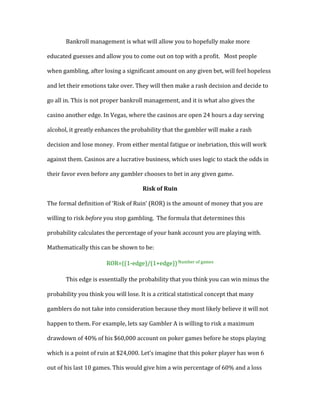
ROR=((1-­‐edge)/(1+edge))	
  Number	
  of	
  games	
  
This	
  edge	
  is	
  essentially	
  the	
  probability	
  that	
  you	
  think	
  you	
  can	
  win	
  minus	
  the	
  
probability	
  you	
  think	
  you	
  will	
  lose.	
  It	
  is	
  a	
  critical	
  statistical	
  concept	
  that	
  many	
  
gamblers	
  do	
  not	
  take	
  into	
  consideration	
  because	
  they	
  most	
  likely	
  believe	
  it	
  will	
  not	
  
happen	
  to	
  them.	
  For	
  example,	
  lets	
  say	
  Gambler	
  A	
  is	
  willing	
  to	
  risk	
  a	
  maximum	
  
drawdown	
  of	
  40%	
  of	
  his	
  $60,000	
  account	
  on	
  poker	
  games	
  before	
  he	
  stops	
  playing	
  
which	
  is	
  a	
  point	
  of	
  ruin	
  at	
  $24,000.	
  Let’s	
  imagine	
  that	
  this	
  poker	
  player	
  has	
  won	
  6	
  
out	
  of	
  his	
  last	
  10	
  games.	
  This	
  would	
  give	
  him	
  a	
  win	
  percentage	
  of	
  60%	
  and	
  a	
  loss	
  
percentage	
  of	
  40%.	
  His	
  edge	
  would	
  be	
  equal	
  to	
  20%.	
  	
  Let’s	
  say	
  the	
  buy	
  in	
  for	
  his	
  
poker	
  games	
  are	
  $500	
  each.	
  This	
  would	
  give	
  him	
  access	
  to	
  48	
  games.	
  	
  The	
  ROR	
  in	
  
this	
  particular	
  case	
  for	
  Gambler	
  A	
  would	
  be	
  .00000000353	
  or	
  .000000353%.	
  	
  I	
  
encourage	
  you	
  to	
  carry	
  out	
  the	
  calculation	
  on	
  your	
  own.	
  This	
  is	
  a	
  very	
  low	
  
probability.	
  	
  Now,	
  let’s	
  imagine	
  that	
  Gambler	
  B	
  enters	
  into	
  the	
  same	
  poker	
  
tournament	
  with	
  $12,000	
  in	
  his	
  account	
  and	
  is	
  willing	
  to	
  risk	
  the	
  same	
  percentage	
  of	
  
his	
  bank	
  account	
  as	
  Gambler	
  A	
  at	
  40%.	
  The	
  ROR	
  at	
  this	
  point	
  would	
  be	
  $4,800.	
  	
  
Let’s	
  say	
  Gambler	
  B	
  also	
  has	
  a	
  60%	
  win	
  percentage.	
  Gambler	
  B	
  would	
  have	
  access	
  to	
  
about	
  11	
  poker	
  games	
  for	
  this	
  tournament.	
  The	
  ROR	
  of	
  Gambler	
  B	
  would	
  come	
  out	
  
to	
  .026	
  or	
  2.6%.	
  This	
  is	
  interesting	
  because	
  as	
  you	
  see	
  here,	
  the	
  risk	
  of	
  ruin	
  is	
  much	
  
higher	
  even	
  though	
  they	
  have	
  the	
  same	
  win	
  percentage	
  and	
  same	
  max	
  drawdown	
  
percentage.	
  The	
  only	
  difference	
  is	
  the	
  amount	
  of	
  capital.	
  Please	
  note,	
  however,	
  this	
  
only	
  holds	
  true	
  if	
  the	
  gamblers	
  maintain	
  the	
  60%	
  win	
  rate.	
  	
  Once	
  you	
  start	
  losing	
  
more	
  than	
  you	
  win—	
  the	
  ROR	
  quickly	
  rises	
  and	
  you	
  will	
  have	
  a	
  greater	
  chance	
  of	
  
reaching	
  your	
  limit.	


Casino paper 2

  • 1.
      Gambling  Awareness  101       In  order  to  become  a  profitable  gambler  it  is  important  to  be  aware  of  risk,   reward  and  probabilities  involved  in  the  game.    There  are  statistical  techniques  that   can  help  you  make  a  decision  when  gambling.    The  people  who  risk  their  money  in   order  to  make  a  substantial  profit  need  to  be  three  things:  logical,  strategic  and   unemotional.    They  need  to  understand  the  inherent  risk  involved  in  any  game.   Advantage  Play   Advantage  play  is  ubiquitous  in  the  lives  of  successful  gamblers.  It  is   essentially  the  legal  way  to  gain  a  mathematical  edge  within  a  game.    This  is   commonly  seen  in  the  game  of  black  jack  or  poker.  For  example,  let’s  imagine  that   you  are  playing  a  game  of  black  jack  against  five  people  including  the  dealer.    Each   player  is  dealt  two  cards  with  one  card  facing  up  and  another  facing  down.    If  you   see  that  you  are  dealt  a  two  face  up  and  a  jack  face  down,  and  that  there  are  five   cards  showing  a  value  of  ten,  then  you  know  that  there  are  roughly  fourteen  cards   that  can  make  you  go  over  21  out  of  the  remaining  forty  cards  or  35%  you  lose.    You   do  not  know  what  the  values  of  the  face  down  cards  are.  This  is  why  it  is  just  an   approximation.  Then,  suppose  everybody  calls  for  a  third  card—they  come  out  to  be   a  queen,  king,  king,  ten,  and  a  jack.  The  card  you  receive  is  a  two.    You  would  then   have  roughly  26%  chance  that  you  will  go  over  on  your  next  card.    As  you  can  see,   the  more  cards  that  come  out…  you  can  learn  how  its  affects  your  future  chances.  If   you  are  aware  of  these  probability  enhancers,  then  you  can  make  smarter  gambling  
  • 2.
    decisions  on  the  floor.    Most  gamblers  have  tried  to  count  cards,  especially  in  black   jack.  They  are  essentially  using  a  similar  idea  to  make  educated  guesses  on  their   next  cards.  Thus,  this  would  give  them  an  edge  over  the  house  and  come  out  on  top   with  profits.  Nowadays,  however,  it  is  not  as  simple  as  this.  Most  casinos  use  roughly   four  to  six  decks  a  game.  This  makes  it  much  more  difficult  to  count  since  you  are   now  dealing  with  many  more  cards.     Nevertheless,  there  are  also  many  illegal  ways  of  gaining  an  unfair  advantage.   There  are  scenarios  in  craps  when  gamblers  can  attempt  to  throw  the  die  a  certain   way.  Still,  given  the  cameras,  heightened  security  and  strict  rules  when  throwing  the   die,  it  is  much  harder  to  achieve  this  feat.    Be  mindful  of  the  loaded  dice  scam.    A   “loaded”,  or  weighted  die  is  one  that  has  been  fixed  to  land  with  a  specific  side  facing   up  more  often  than  it  normally  would.    A  type  of  loaded  die  is  hollow  with  a  small   weight  and  a  semi-­‐solid  substance  inside  whose  melting  point  is  just  lower  than  the   temperature  of  the  human  body,  allowing  the  cheater  to  change  the  loading  of  the   die  by  applying  body  heat,  causing  the  semi-­‐solid  to  melt  and  the  weight  to  drift   down,  making  the  chosen  opposite  face  more  likely  to  land  up.  A  less  common  type   of  loaded  die  can  be  made  by  inserting  a  magnet  into  the  die  and  then  embed  a  coil   of  wire  in  the  game  table  which  in  turn  would  create  an  electro-­‐magnet.  After   running  current  through  the  coil,  it  increases  the  likelihood  of  a  certain  side  landing   on  the  bottom.    These  are  obviously  the  illegal  way  of  gaining  an  edge  when   gambling.        
  • 3.
    Expected  Value   Expected  value  is  the  average  gains  or  losses  to  be  “expected”  from  a  game.  For   example,  suppose  you  play  a  game  in  which  you  pay  five  dollars  to  roll  a  dice.  If  you   get  an  even  number,  you  are  rewarded  the  corresponding  number.  If  you  get  on  odd   number  you  are  rewarded  nothing.  Your  expected  value  per  game  would  be    $-­‐0.5.   You  obtain  this  by  multiplying  probabilities  of  each  outcome  by  their  corresponding   gain  or  loss  and  summing  them  together.  This  is  shown  mathematically  as:     E=1/6  x  2  +  1/6  x  4  +  1/6  x  6  -­‐  3/6  x  5  =-­‐0.5   Essentially  this  means  when  you  risk  five  dollars  to  potentially  make  two,  four  or  six   dollars  your  average  over  time  would  be  negative.  You  can  expect  to  lose  roughly  fifty   cents  per  game.    If  you  play  this  100  times,  you  can  expect  to  lose  fifty  dollars.  Casinos   use  this  idea  in  order  to  stack  the  probabilities  in  their  favor  in  order  to  be  constantly   profitable.  This  edge  is  why  and  how  the  house  always  wins  on  average.  This  is  called   Advantage  Play.                 Another  simple  example  is  shown  through  a  game  of  roulette.  On  a  European   roulette  table,  a  croupier  spins  the  wheel  and  releases  a  ball  to  fall  into  one  of  37  slots.     There  are  18  red  and  18  black  slots  and  one  green  0  slot.  If  you  were  to  constantly  bet   $1  on  black,  since  the  payout  is  1  to  1,  the  expected  value  per  game  would  come  out  to   $-­‐0.027  per  game.  This  is  shown  mathematically  as:            18/37  x  $1  –  19/37  x  $1  =  -­‐$0.027       That  extra  green  slot  is  enough  to  stack  the  probability  in  favor  of  the  house.  For  an   American  Roulette  table,  your  expected  loss  would  be  roughly  $-­‐0.0526  per  game  on   account  of  the  two  green  slots  for  0  and  00.  It  is  a  small  edge  the  house  gets,  and  it  
  • 4.
    quickly  adds  up  over  the  hundreds  of  thousands  of  game  that  are  played.  This  edge   holds  true  for  any  way  you  choose  to  bet  and  no  matter  what  the  payout  odds  are  for   each  type  of  bet.    You  could  have  bet  on  6  numbers  on  an  American  Roulette  table.  The   pay  out  would  be  6  to  1.  This  is  shown  mathematically  as:     6/38  x  $5  –  $1  x  32/38  =    -­‐$0.0526     If  you  played  the  American  roulette  game  1,000  times  the  house  would  be  expected  to   gain  $52.60  from  you  alone.  It  would  be  wise  to  consider  playing  on  the  European   table  as  opposed  to  the  American.       It  is  interesting  when  you  think  about  the  influence  that  adding  just  one  or   two  more  slots  has  on  a  game,  its  outcome  and  profit  potential.  It  is  enough  for  the   casino  to  almost  always  come  out  on  top  on  average.    For  every  winner  there  will  be   more  losers.  It  makes  you  wonder  why  playing  at  all  makes  any  sense?    Most  people   don’t  understand  this  simple  concept.  Casinos  are  a  business,  and  like  any  other   business,  it  is  there  to  make  money.  It  is  important  to  understand  that  more  than   half  of  the  gamblers  walking  around  any  casino  floor  are  losers.       Variance   Variance  is  an  important  concept  to  understand  when  gambling.  It  is  the   measure  of  how  far  the  numbers  lie  from  the  mean.  Although  there  are  various   formulas  used  to  describe  the  variance  of  a  certain  data  set,  the  concept  remains  the   same.    The  simplest  mathematical  version  of  variance  is  basically  the  probability  of   the  outcome  times  the  square  of  the  difference  between  the  shown  value  and  the  
  • 5.
    expected  value  and  taking  their  sum.  For  example,  if  you  were  to  roll  a  dice,  then  the   variance  would  be  roughly  2.92.    This  is  shown  mathematically  as:     1/6x(1-­‐3.5)  2+  1/6  x(2-­‐3.5)  2  +  1/6  x(3-­‐3.5)  2  +  1/6  x(4-­‐3.5)  2  +  1/6  x  (5-­‐3.5)  2  +  1/6  x  (6-­‐3.5)  2  =  2.92.     Statistical  variance  gives  a  measure  of  how  the  data  distributes  itself  about  the  mean   or  expected  value.  Unlike  range  that  only  looks  at  the  extremes,  the  variance  looks  at   all  the  data  points  and  then  determines  their  distribution.  If  there  were  a  relatively   high  variance,  you  should  expect  a  wide  spread  of  values,  and  it  would  be  wise  to   reconsider  your  bet  on  a  given  outcome.  It  is  a  good  indication  of  what  kind  of   challenge  you  will  be  facing  when  placing  a  bet.    From  the  variance  you  can  always   obtain  the  standard  deviation,  by  taking  its  square  root.    The  standard  deviation   typically  corresponds  to  the  deviation  from  the  expected  value.  In  the  case  shown   above,  the  standard  deviation  would  be  the  square  root  of  2.92,  which  would  be   roughly  1.71.  Knowing  these  values  you  can  make  more  educated  guesses  about   where  the  bet  is  going  and  how  likely  you  are  to  succeed.  These  ideas  can,  perhaps,   save  you  a  lot  of  money  down  the  line.  If  you  are  aware  of  these  concepts  and  their   applications,  you  can  make  more  thoughtful  decisions  throughout  your  gambling   career.   Bankroll  Management   Bankroll  management  is  just  as  important  as  the  gambling  strategy  itself.  A   successful  gambler  needs  to  be  aware  of  his  capital  and  his  ability  to  absorb  losses.   It  is  very  important  to  understand  that  it  takes  money  to  make  money  in  the  long  
  • 6.
    run.      Many  people  see  the  stock  market  as  gambling  because  there  is  a  chance  the   stock  price  can  go  up  or  down  and  there  is  a  50%  chance  of  each.    However,  there   are  probability  enhancers  that  indicate  which  way  a  price  is  likely  to  go.  Traders  and   financial  advisors  undertake  this  endeavor  everyday.  The  big  hedge  funds  and   investment  banks  such  as  J.P.  Morgan  and  Goldman  Sachs  are  able  to  make  loads  of   money  on  small  price  movements  because  of  their  huge  bank  account.  They  can  also   absorb  losses  if  the  market  goes  against  them  if  they  are  wrong.  This  is  because  they   manage  their  bankroll  in  such  as  way  as  to  only  risk  roughly  2%  of  their  financial   assets  on  any  one  trade.  However,  a  typical  retail  trader’s  2%  will  be  much  less  than   J.P.  Morgan’s  and  Goldman  Sachs’.  Thus,  most  retail  traders  will  risk  much  more   than  2%  of  what  they’re  willing  to  spend  on  gambling  for  the  night.    This  goes  the   same  for  gamblers  in  a  casino.  A  good  example  is  found  in  professional  bull  riding.  It   takes  a  very  strong  guy  to  be  able  to  handle  all  the  highs,  lows,  twists  and  thrusts  in   any  event.    A  weaker  person  would  not  be  able  to  hang  on  as  long.  This  is  because   the  stronger  guy  was  able  to  absorb  the  shocks  from  the  bull  without  getting   knocked  out  of  the  game.     With  knowledge  of  the  expected  value  of  any  game,  odds  and  your  bankroll   account  you  can  absorb  losses  that  will  be  inevitable  given  the  presence  of  variance.   It  allows  you  to  stay  in  the  same  longer,  and  hopefully,  when  you  win,  it  is  much   greater  than  your  accumulated  losses.  When  I  say  losses  I  mean  long  run  losses   given  since  you  started.  Winning  $1,000  one  day  after  losing  $15,000  since  you   started  a  month  ago  does  not  make  you  a  winner.    
  • 7.
    Bankroll  management  is  what  will  allow  you  to  hopefully  make  more   educated  guesses  and  allow  you  to  come  out  on  top  with  a  profit.      Most  people   when  gambling,  after  losing  a  significant  amount  on  any  given  bet,  will  feel  hopeless   and  let  their  emotions  take  over.  They  will  then  make  a  rash  decision  and  decide  to   go  all  in.  This  is  not  proper  bankroll  management,  and  it  is  what  also  gives  the   casino  another  edge.  In  Vegas,  where  the  casinos  are  open  24  hours  a  day  serving   alcohol,  it  greatly  enhances  the  probability  that  the  gambler  will  make  a  rash   decision  and  lose  money.    From  either  mental  fatigue  or  inebriation,  this  will  work   against  them.  Casinos  are  a  lucrative  business,  which  uses  logic  to  stack  the  odds  in   their  favor  even  before  any  gambler  chooses  to  bet  in  any  given  game.     Risk  of  Ruin   The  formal  definition  of  ‘Risk  of  Ruin’  (ROR)  is  the  amount  of  money  that  you  are   willing  to  risk  before  you  stop  gambling.    The  formula  that  determines  this   probability  calculates  the  percentage  of  your  bank  account  you  are  playing  with.   Mathematically  this  can  be  shown  to  be:     ROR=((1-­‐edge)/(1+edge))  Number  of  games   This  edge  is  essentially  the  probability  that  you  think  you  can  win  minus  the   probability  you  think  you  will  lose.  It  is  a  critical  statistical  concept  that  many   gamblers  do  not  take  into  consideration  because  they  most  likely  believe  it  will  not   happen  to  them.  For  example,  lets  say  Gambler  A  is  willing  to  risk  a  maximum   drawdown  of  40%  of  his  $60,000  account  on  poker  games  before  he  stops  playing   which  is  a  point  of  ruin  at  $24,000.  Let’s  imagine  that  this  poker  player  has  won  6   out  of  his  last  10  games.  This  would  give  him  a  win  percentage  of  60%  and  a  loss  
  • 8.
    percentage  of  40%.  His  edge  would  be  equal  to  20%.    Let’s  say  the  buy  in  for  his   poker  games  are  $500  each.  This  would  give  him  access  to  48  games.    The  ROR  in   this  particular  case  for  Gambler  A  would  be  .00000000353  or  .000000353%.    I   encourage  you  to  carry  out  the  calculation  on  your  own.  This  is  a  very  low   probability.    Now,  let’s  imagine  that  Gambler  B  enters  into  the  same  poker   tournament  with  $12,000  in  his  account  and  is  willing  to  risk  the  same  percentage  of   his  bank  account  as  Gambler  A  at  40%.  The  ROR  at  this  point  would  be  $4,800.     Let’s  say  Gambler  B  also  has  a  60%  win  percentage.  Gambler  B  would  have  access  to   about  11  poker  games  for  this  tournament.  The  ROR  of  Gambler  B  would  come  out   to  .026  or  2.6%.  This  is  interesting  because  as  you  see  here,  the  risk  of  ruin  is  much   higher  even  though  they  have  the  same  win  percentage  and  same  max  drawdown   percentage.  The  only  difference  is  the  amount  of  capital.  Please  note,  however,  this   only  holds  true  if  the  gamblers  maintain  the  60%  win  rate.    Once  you  start  losing   more  than  you  win—  the  ROR  quickly  rises  and  you  will  have  a  greater  chance  of   reaching  your  limit.