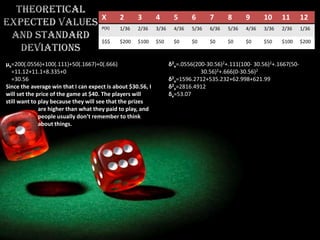
This is a very simple game. The
player pays $100 to play, and
they then roll two dice. The
sum of the rolled dice is
calculated, and the player is
given the amount of money
that corresponds to the
number that they have rolled.
(See table)
The game looks attractive to a
potential player because they
can win more than they paid
for six of the possible
outcomes, but the game
actually has a house
advantage.
X

2

3

4

5

6

7

8

9

10

11

12

P(X)

1/36

2/36

3/36

4/36

5/36

6/36

5/36

4/36

3/36

2/36

1/36

$$$

$200

$100

$50

$0

$0

$0

$0

$0

$50

$100

$200

μx=200(.0556)+100(.111)+50(.1667)+0(.666)
=11.12+11.1+8.335+0
=30.56
Since the average win that I can expect is about $30.56, I
will set the price of the game at $40. The players will
still want to play because they will see that the prizes
are higher than what they paid to play, and
people usually don’t remember to think
about things.

δ2x=.0556(200-30.56)2+.111(100- 30.56)2+.1667(5030.56)2+.666(0-30.56)2
δ2x=1596.2712+535.232+62.998+621.99
δ2x=2816.4912
δx=53.07
Sum Rolled

2

3

4

5

6

7

8

9

10

11

12

Money won

$200

$100

$50

$0

$0

$0

$0

$0

$50

$100

$200

Frequency

0/50 3/50 5/50 6/50

8/50

8/50

9/50

7/50

2/50

2/50

0/50

Total Amount Won

$850

Mean of Experimental

$17.00

Standard Deviation

$32.57

μx= (200)(0)+(100)(5/50)+(50)(7/50)+(0)(38/50)
=0+10+7+0
=17

δ2x=0(200-17)2+5/50(100-17)2+7/50(50-17)2+38/50(0-17)2
=688.9+152.46+219.64
=1061
δx=32.57
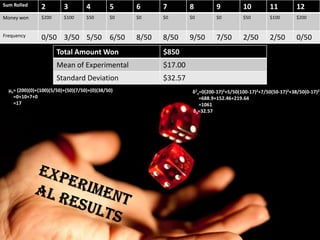
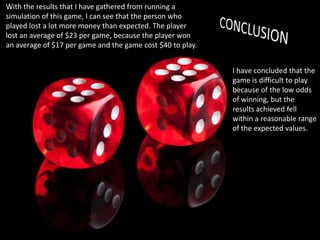
With the results that I have gathered from running a
simulation of this game, I can see that the person who
played lost a lot more money than expected. The player
lost an average of $23 per game, because the player won
an average of $17 per game and the game cost $40 to play.
I have concluded that the
game is difficult to play
because of the low odds
of winning, but the
results achieved fell
within a reasonable range
of the expected values.

Game cc

  • 2.
    This is avery simple game. The player pays $100 to play, and they then roll two dice. The sum of the rolled dice is calculated, and the player is given the amount of money that corresponds to the number that they have rolled. (See table) The game looks attractive to a potential player because they can win more than they paid for six of the possible outcomes, but the game actually has a house advantage.
  • 3.
    X 2 3 4 5 6 7 8 9 10 11 12 P(X) 1/36 2/36 3/36 4/36 5/36 6/36 5/36 4/36 3/36 2/36 1/36 $$$ $200 $100 $50 $0 $0 $0 $0 $0 $50 $100 $200 μx=200(.0556)+100(.111)+50(.1667)+0(.666) =11.12+11.1+8.335+0 =30.56 Since the averagewin that I can expect is about $30.56, I will set the price of the game at $40. The players will still want to play because they will see that the prizes are higher than what they paid to play, and people usually don’t remember to think about things. δ2x=.0556(200-30.56)2+.111(100- 30.56)2+.1667(5030.56)2+.666(0-30.56)2 δ2x=1596.2712+535.232+62.998+621.99 δ2x=2816.4912 δx=53.07
  • 4.
    Sum Rolled 2 3 4 5 6 7 8 9 10 11 12 Money won $200 $100 $50 $0 $0 $0 $0 $0 $50 $100 $200 Frequency 0/503/50 5/50 6/50 8/50 8/50 9/50 7/50 2/50 2/50 0/50 Total Amount Won $850 Mean of Experimental $17.00 Standard Deviation $32.57 μx= (200)(0)+(100)(5/50)+(50)(7/50)+(0)(38/50) =0+10+7+0 =17 δ2x=0(200-17)2+5/50(100-17)2+7/50(50-17)2+38/50(0-17)2 =688.9+152.46+219.64 =1061 δx=32.57
  • 5.
    With the resultsthat I have gathered from running a simulation of this game, I can see that the person who played lost a lot more money than expected. The player lost an average of $23 per game, because the player won an average of $17 per game and the game cost $40 to play. I have concluded that the game is difficult to play because of the low odds of winning, but the results achieved fell within a reasonable range of the expected values.