Team DD
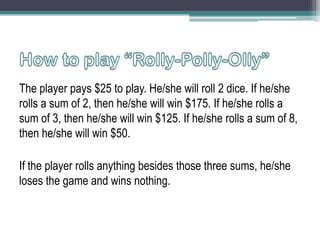
The player pays $25 to play. He/she will roll 2 dice. If he/she
rolls a sum of 2, then he/she will win $175. If he/she rolls a
sum of 3, then he/she will win $125. If he/she rolls a sum of 8,
then he/she will win $50.
If the player rolls anything besides those three sums, he/she
loses the game and wins nothing.
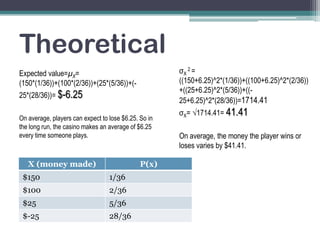
Theoretical
σX 2 =
((150+6.25)^2*(1/36))+((100+6.25)^2*(2/36))
+((25+6.25)^2*(5/36))+((25+6.25)^2*(28/36))=1714.41

Expected value=μX=
(150*(1/36))+(100*(2/36))+(25*(5/36))+(25*(28/36))= $-6.25
On average, players can expect to lose $6.25. So in
the long run, the casino makes an average of $6.25
every time someone plays.

X (money made)

P(x)

$150

1/36

$100

2/36

$25

5/36

$-25

28/36

σX= √1714.41= 41.41

On average, the money the player wins or
loses varies by $41.41.
Simulation Video

To simulate this game, we will be using the randINT function on our calculator to generate 50 random
numbers between 1 and 6. These 50 numbers will represent what we get when we roll the first die 50
times. Next, we will generate another set of 50 random numbers between 1 and 6 which will represent
what we get when we roll the second die 50 times. Then we will find the sum of the first roll and the
second roll for each of the 50 trials to find out how much money we would win. This will help us figure
out the expected value and the standard deviation of our simulation data.
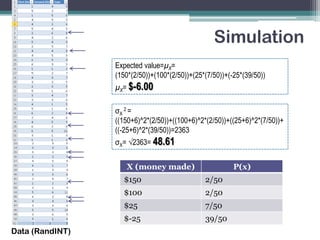
Simulation
Expected value=μX=
(150*(2/50))+(100*(2/50))+(25*(7/50))+(-25*(39/50))

μX= $-6.00
σX 2 =
((150+6)^2*(2/50))+((100+6)^2*(2/50))+((25+6)^2*(7/50))+
((-25+6)^2*(39/50))=2363
σX= √2363= 48.61
X (money made)

P(x)

$150
$100

2/50

$25

7/50

$-25

Data (RandINT)

2/50

39/50
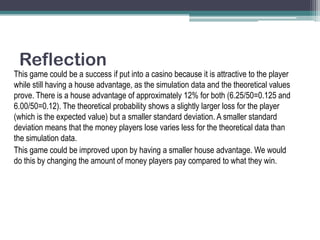
Reflection

This game could be a success if put into a casino because it is attractive to the player
while still having a house advantage, as the simulation data and the theoretical values
prove. There is a house advantage of approximately 12% for both (6.25/50=0.125 and
6.00/50=0.12). The theoretical probability shows a slightly larger loss for the player
(which is the expected value) but a smaller standard deviation. A smaller standard
deviation means that the money players lose varies less for the theoretical data than
the simulation data.
This game could be improved upon by having a smaller house advantage. We would
do this by changing the amount of money players pay compared to what they win.

Game dd

  • 1.
  • 2.
    The player pays$25 to play. He/she will roll 2 dice. If he/she rolls a sum of 2, then he/she will win $175. If he/she rolls a sum of 3, then he/she will win $125. If he/she rolls a sum of 8, then he/she will win $50. If the player rolls anything besides those three sums, he/she loses the game and wins nothing.
  • 3.
    Theoretical σX 2 = ((150+6.25)^2*(1/36))+((100+6.25)^2*(2/36)) +((25+6.25)^2*(5/36))+((25+6.25)^2*(28/36))=1714.41 Expectedvalue=μX= (150*(1/36))+(100*(2/36))+(25*(5/36))+(25*(28/36))= $-6.25 On average, players can expect to lose $6.25. So in the long run, the casino makes an average of $6.25 every time someone plays. X (money made) P(x) $150 1/36 $100 2/36 $25 5/36 $-25 28/36 σX= √1714.41= 41.41 On average, the money the player wins or loses varies by $41.41.
  • 4.
    Simulation Video To simulatethis game, we will be using the randINT function on our calculator to generate 50 random numbers between 1 and 6. These 50 numbers will represent what we get when we roll the first die 50 times. Next, we will generate another set of 50 random numbers between 1 and 6 which will represent what we get when we roll the second die 50 times. Then we will find the sum of the first roll and the second roll for each of the 50 trials to find out how much money we would win. This will help us figure out the expected value and the standard deviation of our simulation data.
  • 5.
    Simulation Expected value=μX= (150*(2/50))+(100*(2/50))+(25*(7/50))+(-25*(39/50)) μX= $-6.00 σX2 = ((150+6)^2*(2/50))+((100+6)^2*(2/50))+((25+6)^2*(7/50))+ ((-25+6)^2*(39/50))=2363 σX= √2363= 48.61 X (money made) P(x) $150 $100 2/50 $25 7/50 $-25 Data (RandINT) 2/50 39/50
  • 6.
    Reflection This game couldbe a success if put into a casino because it is attractive to the player while still having a house advantage, as the simulation data and the theoretical values prove. There is a house advantage of approximately 12% for both (6.25/50=0.125 and 6.00/50=0.12). The theoretical probability shows a slightly larger loss for the player (which is the expected value) but a smaller standard deviation. A smaller standard deviation means that the money players lose varies less for the theoretical data than the simulation data. This game could be improved upon by having a smaller house advantage. We would do this by changing the amount of money players pay compared to what they win.