Surgical Aspects of the
Multidisciplinary Treatment
of Gallbladder Cancer
Eduardo A Guzman MD
“In malignancy of the gallbladder, when a diagnosis
can be made without exploration, no operation
should be performed, inasmuch as it only shortens
the patient’s life”
Alfred Blalock, 1924
Introduction
•Aggressive malignancy
•Elderly patients
•Poor prognosis
•Many tumors are unresectable
•Distant metastasis
•Selected patients will benefit from an aggressive surgical
approach
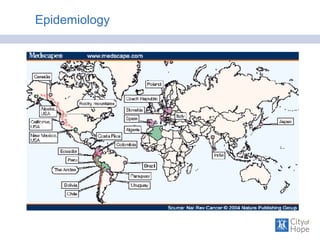
Epidemiology
• Rare tumor
• Incidence 2.5 cases per 100,000 residents
• Most common malignancy of the biliary tract
• 5th most common gastrointestinal malignancy
• 2 times more common in women
• More than 75 % are older than 65
Epidemiology
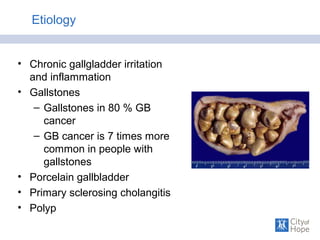
Etiology
• Chronic gallgladder irritation
and inflammation
• Gallstones
– Gallstones in 80 % GB
cancer
– GB cancer is 7 times more
common in people with
gallstones
• Porcelain gallbladder
• Primary sclerosing cholangitis
• Polyp
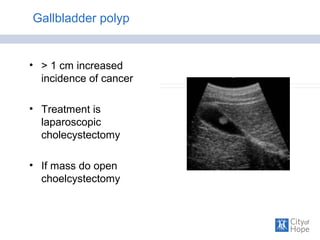
Gallbladder polyp
• > 1 cm increased
incidence of cancer
• Treatment is
laparoscopic
cholecystectomy
• If mass do open
choelcystectomy
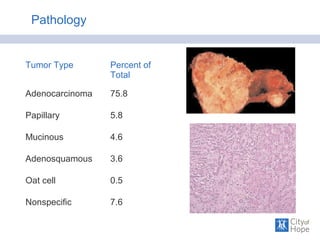
Pathology
Tumor Type Percent of
Total
Adenocarcinoma 75.8
Papillary 5.8
Mucinous 4.6
Adenosquamous 3.6
Oat cell 0.5
Nonspecific 7.6
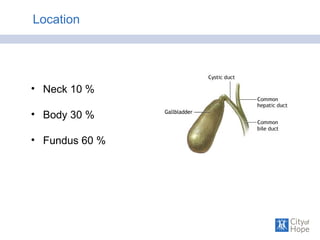
Location
• Neck 10 %
• Body 30 %
• Fundus 60 %
Lymphatic drainage of the gallbladder
• Cystic
• Pericholedocal
• Posterior pancreaticoduodenal
• Periportal
• Common hepatic artery nodes
• Celiac, interaortocaval, SMA
Staging
• Multiple classifications
– Nevin
– Japanese
– AJCC / TNM
• Recent modification of AJCC / TNM
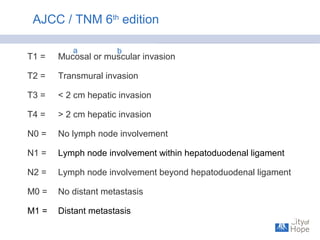
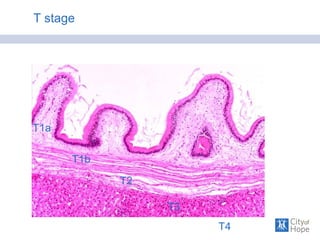
T1 = Mucosal or muscular invasion
T2 = Transmural invasion
T3 = < 2 cm hepatic invasion
T4 = > 2 cm hepatic invasion
N0 = No lymph node involvement
N1 = Lymph node involvement within hepatoduodenal ligament
N2 = Lymph node involvement beyond hepatoduodenal ligament
M0 = No distant metastasis
M1 = Distant metastasis
AJCC / TNM 6th
edition
a b
T1a
T1b
T2
T3
T4
T stage
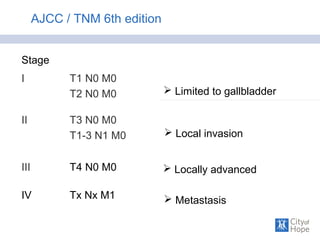
Stage
I T1 N0 M0
T2 N0 M0
II T3 N0 M0
T1-3 N1 M0
III T4 N0 M0
IV Tx Nx M1
AJCC / TNM 6th edition
 Limited to gallbladder
 Local invasion
 Locally advanced
 Metastasis
Other points
• Stage I includes 2
different surgical
therapies
• T4 tumors can be
resectable
• N2 nodes are
considered metastatic
disease
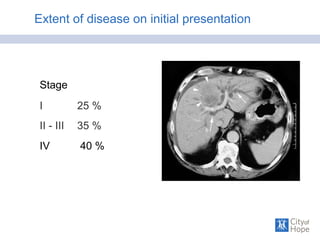
Extent of disease on initial presentation
Stage
I 25 %
II - III 35 %
IV 40 %
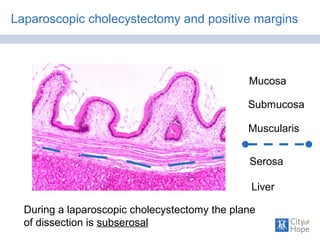
Laparoscopic cholecystectomy and positive margins
Mucosa
Submucosa
Muscularis
Serosa
Liver
During a laparoscopic cholecystectomy the plane
of dissection is subserosal
Clinical presentation
• Undistinguishable from benign
gallstone disease
– Right upper quadrant pain
– Weight loss
– Anorexia
– Abdominal mass
• Yet, one should suspect
gallbladder cancer in an elderly
person with weight loss and
constant pain
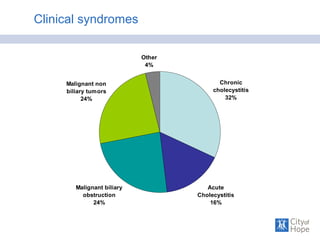
Clinical syndromes
Chronic
cholecystitis
32%
Acute
Cholecystitis
16%
Malignant biliary
obstruction
24%
Malignant non
biliary tumors
24%
Other
4%
Diagnosis
• Usually diagnosed late in the disease course
• Ultrasound
– Heterogeneous mass
– Irregular GB wall
– Sensitivity 70 – 100 %
• CT scan
– Mass replacing the gallbladder or with direct extension
• MRI
– Identifies plane between gallbladder mass and adjacent liver
• Cholagiography
– Stricture of the common hepatic duct
Incidental diagnosis
• It is the most common
presentation
• Intraoperative
• Postoperative
– Pathology
• 1 % of all elective
cholecystectomies for
cholelithiasis harbor an occult
GB cancer
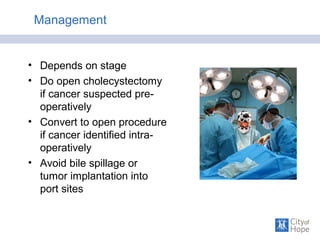
Management
• Depends on stage
• Do open cholecystectomy
if cancer suspected pre-
operatively
• Convert to open procedure
if cancer identified intra-
operatively
• Avoid bile spillage or
tumor implantation into
port sites
Biopsy
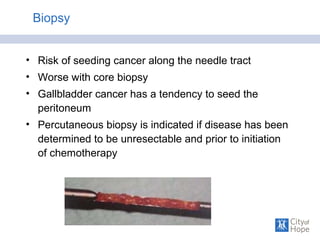
• Risk of seeding cancer along the needle tract
• Worse with core biopsy
• Gallbladder cancer has a tendency to seed the
peritoneum
• Percutaneous biopsy is indicated if disease has been
determined to be unresectable and prior to initiation
of chemotherapy
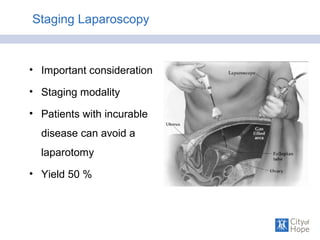
Staging Laparoscopy
• Important consideration
• Staging modality
• Patients with incurable
disease can avoid a
laparotomy
• Yield 50 %
Stage I
• T1a
– Disease limited to mucosa
– Almost always diagnosed following
cholecystectomy
– Negligible probability of lymph node metastasis
– Excellent survival 95 %
– No further intervention required
– Make sure cystic duct margin is negative for
tumor
Stage I
• T1b
– Disease limited to muscularis
– Higher locoregional recurrence
– 5 year survival = 85 %
– Treatment remains controversial
– Selected patients (young and healthy) may benefit
from liver resection of segment IVb and V along
with local lymphadenectomy
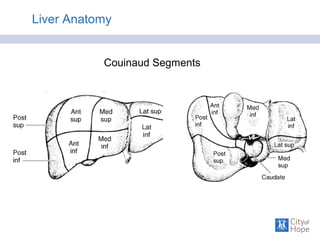
Couinaud Segments
Liver Anatomy
Stage I
• T2
– Transmural invasion
– Positive margin after cholecystectomy
– Good probability for lymph node positivity
– Optimal patient for aggressive surgical
intervention. 5 yr survival 18 % Vs 61 %
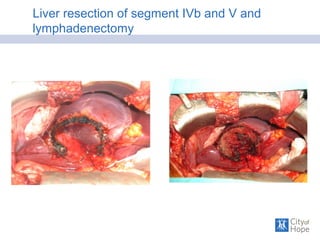
– Liver resection of segment IVb and V and
lymphadenectomy
• Cystic
• Pericholedochal
• Portal
• Right celiac
• Hepatic
• Posterior pancreaticoduodenal
Liver resection of segment IVb and V and
lymphadenectomy
Stage II
• T3N0 / N1 disease
– Cancer invades into contiguous liver for less than
2 cm and/or has positive hepatoduodenal lymph
nodes
– Tumor is still resectable
– High increased incidence of lymph node
metastasis
– Ideal patient for staging laparoscopy
– Liver resection of segment IVb and V and
lymphadenectomy
Stage III
• T4N0MO
– Cancer invades into contiguous liver for more than
2 cm and negative lymph nodes
– Anecdotal evidence of resectability
– Extended liver resection
• Trisegmentectomy
Some other important surgical considerations
• Resect port sites
• Avoid spillage of bile
• En bloc resection
• Do not hesitate to do
CBD resection
• Do anatomic liver
resections
• Tumors in the
infundibulum may require
a trisegmentectomy
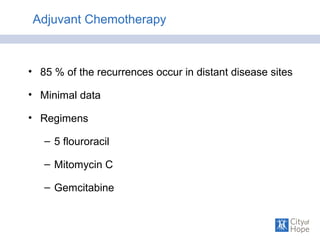
Adjuvant Chemotherapy
• 85 % of the recurrences occur in distant disease sites
• Minimal data
• Regimens
– 5 flouroracil
– Mitomycin C
– Gemcitabine
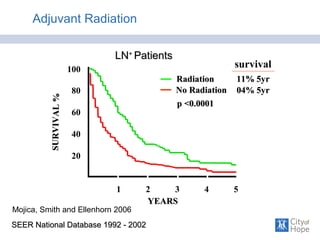
LNLN++
PatientsPatients
SEER National Database 1992 - 2002SEER National Database 1992 - 2002
YEARSYEARS
100
20
40
60
80
1 2 3 4 5
SURVIVAL%SURVIVAL%
RadiationRadiation
No RadiationNo Radiation
p <0.0001p <0.0001
11% 5yr11% 5yr
04% 5yr04% 5yr
survival
Mojica, Smith and Ellenhorn 2006
Adjuvant Radiation
Stage IV
• M1
– N2 lymph nodes
– Extrahepatic metastasis
– Chemotherapy
– Palliation
• Obstructive jaundice
• Pain
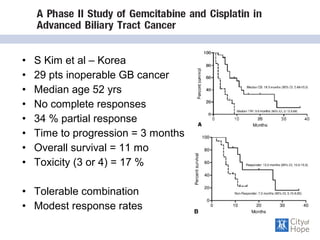
• S Kim et al – Korea
• 29 pts inoperable GB cancer
• Median age 52 yrs
• No complete responses
• 34 % partial response
• Time to progression = 3 months
• Overall survival = 11 mo
• Toxicity (3 or 4) = 17 %
• Tolerable combination
• Modest response rates
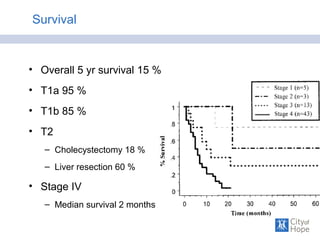
Survival
• Overall 5 yr survival 15 %
• T1a 95 %
• T1b 85 %
• T2
– Cholecystectomy 18 %
– Liver resection 60 %
• Stage IV
– Median survival 2 months
Summary
• Gallbladder cancer is a bad disease
• Accurate staging is critical
• Cholecystectomy is an inadequate operation in most
of the cases
• T1a tumors have excellent prognosis
• Selected patients would obtain significant benefit
from aggressive surgical interventions
• Nearly all patients without metastatic disease require
surgical evaluation to determine resectability
“In malignancy of the gallbladder, after careful
patient selection, an aggressive surgical approach
can have a significant impact in the patient’s life”
Eduardo Guzman, 2007

Gallbladder cancer

  • 1.
    Surgical Aspects ofthe Multidisciplinary Treatment of Gallbladder Cancer Eduardo A Guzman MD
  • 2.
    “In malignancy ofthe gallbladder, when a diagnosis can be made without exploration, no operation should be performed, inasmuch as it only shortens the patient’s life” Alfred Blalock, 1924
  • 3.
    Introduction •Aggressive malignancy •Elderly patients •Poorprognosis •Many tumors are unresectable •Distant metastasis •Selected patients will benefit from an aggressive surgical approach
  • 4.
    Epidemiology • Rare tumor •Incidence 2.5 cases per 100,000 residents • Most common malignancy of the biliary tract • 5th most common gastrointestinal malignancy • 2 times more common in women • More than 75 % are older than 65
  • 5.
  • 6.
    Etiology • Chronic gallgladderirritation and inflammation • Gallstones – Gallstones in 80 % GB cancer – GB cancer is 7 times more common in people with gallstones • Porcelain gallbladder • Primary sclerosing cholangitis • Polyp
  • 7.
    Gallbladder polyp • >1 cm increased incidence of cancer • Treatment is laparoscopic cholecystectomy • If mass do open choelcystectomy
  • 8.
    Pathology Tumor Type Percentof Total Adenocarcinoma 75.8 Papillary 5.8 Mucinous 4.6 Adenosquamous 3.6 Oat cell 0.5 Nonspecific 7.6
  • 9.
    Location • Neck 10% • Body 30 % • Fundus 60 %
  • 10.
    Lymphatic drainage ofthe gallbladder • Cystic • Pericholedocal • Posterior pancreaticoduodenal • Periportal • Common hepatic artery nodes • Celiac, interaortocaval, SMA
  • 11.
    Staging • Multiple classifications –Nevin – Japanese – AJCC / TNM • Recent modification of AJCC / TNM
  • 12.
    T1 = Mucosalor muscular invasion T2 = Transmural invasion T3 = < 2 cm hepatic invasion T4 = > 2 cm hepatic invasion N0 = No lymph node involvement N1 = Lymph node involvement within hepatoduodenal ligament N2 = Lymph node involvement beyond hepatoduodenal ligament M0 = No distant metastasis M1 = Distant metastasis AJCC / TNM 6th edition a b
  • 13.
  • 14.
    Stage I T1 N0M0 T2 N0 M0 II T3 N0 M0 T1-3 N1 M0 III T4 N0 M0 IV Tx Nx M1 AJCC / TNM 6th edition  Limited to gallbladder  Local invasion  Locally advanced  Metastasis
  • 15.
    Other points • StageI includes 2 different surgical therapies • T4 tumors can be resectable • N2 nodes are considered metastatic disease
  • 16.
    Extent of diseaseon initial presentation Stage I 25 % II - III 35 % IV 40 %
  • 17.
    Laparoscopic cholecystectomy andpositive margins Mucosa Submucosa Muscularis Serosa Liver During a laparoscopic cholecystectomy the plane of dissection is subserosal
  • 18.
    Clinical presentation • Undistinguishablefrom benign gallstone disease – Right upper quadrant pain – Weight loss – Anorexia – Abdominal mass • Yet, one should suspect gallbladder cancer in an elderly person with weight loss and constant pain
  • 19.
  • 20.
    Diagnosis • Usually diagnosedlate in the disease course • Ultrasound – Heterogeneous mass – Irregular GB wall – Sensitivity 70 – 100 % • CT scan – Mass replacing the gallbladder or with direct extension • MRI – Identifies plane between gallbladder mass and adjacent liver • Cholagiography – Stricture of the common hepatic duct
  • 21.
    Incidental diagnosis • Itis the most common presentation • Intraoperative • Postoperative – Pathology • 1 % of all elective cholecystectomies for cholelithiasis harbor an occult GB cancer
  • 22.
    Management • Depends onstage • Do open cholecystectomy if cancer suspected pre- operatively • Convert to open procedure if cancer identified intra- operatively • Avoid bile spillage or tumor implantation into port sites
  • 23.
    Biopsy • Risk ofseeding cancer along the needle tract • Worse with core biopsy • Gallbladder cancer has a tendency to seed the peritoneum • Percutaneous biopsy is indicated if disease has been determined to be unresectable and prior to initiation of chemotherapy
  • 24.
    Staging Laparoscopy • Importantconsideration • Staging modality • Patients with incurable disease can avoid a laparotomy • Yield 50 %
  • 25.
    Stage I • T1a –Disease limited to mucosa – Almost always diagnosed following cholecystectomy – Negligible probability of lymph node metastasis – Excellent survival 95 % – No further intervention required – Make sure cystic duct margin is negative for tumor
  • 26.
    Stage I • T1b –Disease limited to muscularis – Higher locoregional recurrence – 5 year survival = 85 % – Treatment remains controversial – Selected patients (young and healthy) may benefit from liver resection of segment IVb and V along with local lymphadenectomy
  • 27.
  • 28.
    Stage I • T2 –Transmural invasion – Positive margin after cholecystectomy – Good probability for lymph node positivity – Optimal patient for aggressive surgical intervention. 5 yr survival 18 % Vs 61 % – Liver resection of segment IVb and V and lymphadenectomy • Cystic • Pericholedochal • Portal • Right celiac • Hepatic • Posterior pancreaticoduodenal
  • 29.
    Liver resection ofsegment IVb and V and lymphadenectomy
  • 30.
    Stage II • T3N0/ N1 disease – Cancer invades into contiguous liver for less than 2 cm and/or has positive hepatoduodenal lymph nodes – Tumor is still resectable – High increased incidence of lymph node metastasis – Ideal patient for staging laparoscopy – Liver resection of segment IVb and V and lymphadenectomy
  • 31.
    Stage III • T4N0MO –Cancer invades into contiguous liver for more than 2 cm and negative lymph nodes – Anecdotal evidence of resectability – Extended liver resection • Trisegmentectomy
  • 32.
    Some other importantsurgical considerations • Resect port sites • Avoid spillage of bile • En bloc resection • Do not hesitate to do CBD resection • Do anatomic liver resections • Tumors in the infundibulum may require a trisegmentectomy
  • 33.
    Adjuvant Chemotherapy • 85% of the recurrences occur in distant disease sites • Minimal data • Regimens – 5 flouroracil – Mitomycin C – Gemcitabine
  • 34.
    LNLN++ PatientsPatients SEER National Database1992 - 2002SEER National Database 1992 - 2002 YEARSYEARS 100 20 40 60 80 1 2 3 4 5 SURVIVAL%SURVIVAL% RadiationRadiation No RadiationNo Radiation p <0.0001p <0.0001 11% 5yr11% 5yr 04% 5yr04% 5yr survival Mojica, Smith and Ellenhorn 2006 Adjuvant Radiation
  • 35.
    Stage IV • M1 –N2 lymph nodes – Extrahepatic metastasis – Chemotherapy – Palliation • Obstructive jaundice • Pain
  • 36.
    • S Kimet al – Korea • 29 pts inoperable GB cancer • Median age 52 yrs • No complete responses • 34 % partial response • Time to progression = 3 months • Overall survival = 11 mo • Toxicity (3 or 4) = 17 % • Tolerable combination • Modest response rates
  • 37.
    Survival • Overall 5yr survival 15 % • T1a 95 % • T1b 85 % • T2 – Cholecystectomy 18 % – Liver resection 60 % • Stage IV – Median survival 2 months
  • 38.
    Summary • Gallbladder canceris a bad disease • Accurate staging is critical • Cholecystectomy is an inadequate operation in most of the cases • T1a tumors have excellent prognosis • Selected patients would obtain significant benefit from aggressive surgical interventions • Nearly all patients without metastatic disease require surgical evaluation to determine resectability
  • 39.
    “In malignancy ofthe gallbladder, after careful patient selection, an aggressive surgical approach can have a significant impact in the patient’s life” Eduardo Guzman, 2007

Editor's Notes

  • #20 Chronic cholecystitis 40 % Biliary colic Acute cholecystitis 20 % Pain, fever, leukocytosis Malignant biliary obstruction 30 % Jaundice, Wt loss, anorexia, pain Malignant non biliary tract tumor 30 % Wt loss, anorexia, pain Other GI complaint 5 % Bleeding, obstruction