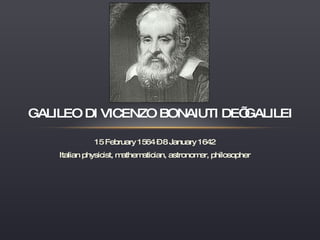
15 February 1564 – 8 January 1642 Italian physicist, mathematician, astronomer, philosopher GALILEO DI VICENZO BONAIUTI DE’ GALILEI
AND SO IT BEGINS Galileo was born in the Duchy of Florence (Pisa), Italy, February 15, 1564. He was the eldest of six children, only four of which lived past infancy. At eight years old, Galileo moved with his family to Florence. Two years later he began his education at Camaldolese Monastery at Vallombrosa. Galileo considered entering the priesthood, but instead enrolled in the University of Pisa for a medical degree. He would not complete this degree. Alternately he studied mathematics. In 1588, Galileo obtained a teaching post at the Accademia delle Arti del Disegno in Florence. In 1589, he became chair of mathematics in Pisa. In 1592, he moved to the University of Padua, where he taught geometry, mechanics, and astronomy. In later years, Galileo would father three children, two girls, Virginia and Livia, and one boy, Vincenzo, out of wedlock with Marina Gamba.  His daughters were considered unmarriageable because of their illegitimate status and were sent to Arceti to the convent of San Matteo. Later in life, his son was legitimized and married Sestilia Bocchineri
ALL THE SCIENCE It begins with the tides. Galileo fought for the Copernican system, the belief that the sun circles the Earth. He claimed that were it not so, there would be no tides which he considered to occur due to the water moving as a point on Earth sped up or slowed down. He refused to give credit to the idea that the moon caused the tides and that planets moved in an elliptical orbit. Then came the comets. Due to a disagreement regarding the nature of comets, Galileo, under a pseudonym, published several articles contradictiong Father Orazio Grassi’s concepts regarding comets. Although one of his articles entranced Pope Urban VIII, his work permanently estranged him from the Jesuits.
HELIOCENTRISM: THE BIG ARGUMENT Galileo was a supporter of heliocentrism, the idea that the earth and all planets move about the sun, which sun is the center of the universe. Although Galileo considered that it was not in conflict with biblical passages regarding the nature of the earth, many disagreed. In 1616, Galileo went to Rome to attempt to convince the Catholic Church not to ban the ideas of Copernicus. Under order, Galileo was made to neither hold nor defend heliocentrism. For several years, he managed to stay out of trouble with the Church, until he began writing a book. Dialogue Concerning the Two Chief World Systems  was published, with formal permission from the Inquisition and the Pope, in 1632. Unfortunately, Urban VIII began to suffer strains of the Inquisition. He asked Galileo to give arguments for and against heliocentrism in is book, being careful not to favor heliocentrism. Galileo gave the argument against heliocentrism to a character which was often made to look a fool. Some of this characters words were the words of Urban VIII.
IN THE END Galileo was suspected of heresy. He was submitted to formal imprisonment. One day later, this was overturned for house arrest, in which he lived for the remainder of his life. The  Dialogue Concerning the Two Chief World Systems  was banned, as well as the publication of any other works, including those which might have been written during his imprisonment. While under house arrest, Galileo began  Two New Sciences,  which is considered to be his finest work. By 1638, Galileo had gone blind. January 8, 1642, at the age of 77, Galileo died. Because of the protests of Urban VIII, permission was denied the Grand Duke of Tuscany to bury Galileo in the main body of the Basilica of Santa Croce. However, in 1737, he was reburied there with a monument erected in his honor.

Galileo

  • 1.
    15 February 1564– 8 January 1642 Italian physicist, mathematician, astronomer, philosopher GALILEO DI VICENZO BONAIUTI DE’ GALILEI
  • 2.
    AND SO ITBEGINS Galileo was born in the Duchy of Florence (Pisa), Italy, February 15, 1564. He was the eldest of six children, only four of which lived past infancy. At eight years old, Galileo moved with his family to Florence. Two years later he began his education at Camaldolese Monastery at Vallombrosa. Galileo considered entering the priesthood, but instead enrolled in the University of Pisa for a medical degree. He would not complete this degree. Alternately he studied mathematics. In 1588, Galileo obtained a teaching post at the Accademia delle Arti del Disegno in Florence. In 1589, he became chair of mathematics in Pisa. In 1592, he moved to the University of Padua, where he taught geometry, mechanics, and astronomy. In later years, Galileo would father three children, two girls, Virginia and Livia, and one boy, Vincenzo, out of wedlock with Marina Gamba. His daughters were considered unmarriageable because of their illegitimate status and were sent to Arceti to the convent of San Matteo. Later in life, his son was legitimized and married Sestilia Bocchineri
  • 3.
    ALL THE SCIENCEIt begins with the tides. Galileo fought for the Copernican system, the belief that the sun circles the Earth. He claimed that were it not so, there would be no tides which he considered to occur due to the water moving as a point on Earth sped up or slowed down. He refused to give credit to the idea that the moon caused the tides and that planets moved in an elliptical orbit. Then came the comets. Due to a disagreement regarding the nature of comets, Galileo, under a pseudonym, published several articles contradictiong Father Orazio Grassi’s concepts regarding comets. Although one of his articles entranced Pope Urban VIII, his work permanently estranged him from the Jesuits.
  • 4.
    HELIOCENTRISM: THE BIGARGUMENT Galileo was a supporter of heliocentrism, the idea that the earth and all planets move about the sun, which sun is the center of the universe. Although Galileo considered that it was not in conflict with biblical passages regarding the nature of the earth, many disagreed. In 1616, Galileo went to Rome to attempt to convince the Catholic Church not to ban the ideas of Copernicus. Under order, Galileo was made to neither hold nor defend heliocentrism. For several years, he managed to stay out of trouble with the Church, until he began writing a book. Dialogue Concerning the Two Chief World Systems was published, with formal permission from the Inquisition and the Pope, in 1632. Unfortunately, Urban VIII began to suffer strains of the Inquisition. He asked Galileo to give arguments for and against heliocentrism in is book, being careful not to favor heliocentrism. Galileo gave the argument against heliocentrism to a character which was often made to look a fool. Some of this characters words were the words of Urban VIII.
  • 5.
    IN THE ENDGalileo was suspected of heresy. He was submitted to formal imprisonment. One day later, this was overturned for house arrest, in which he lived for the remainder of his life. The Dialogue Concerning the Two Chief World Systems was banned, as well as the publication of any other works, including those which might have been written during his imprisonment. While under house arrest, Galileo began Two New Sciences, which is considered to be his finest work. By 1638, Galileo had gone blind. January 8, 1642, at the age of 77, Galileo died. Because of the protests of Urban VIII, permission was denied the Grand Duke of Tuscany to bury Galileo in the main body of the Basilica of Santa Croce. However, in 1737, he was reburied there with a monument erected in his honor.