Ga li l eo’s Ba tt le for the He aven s                                                                         AIRING OCTOBER 29, 2002


 1564 Born in Pisa,Italy, on
        February 15.
 1579 Studies at a Benedictine
                                             Who Was Galileo Galilei?
        monastery and considers              Galileo was a man of many interests. Unlike
        becoming a monk.                     today’s scientists who become experts in very
 1581   Begins studies at the
        University of Pisa,Italy.
                                             specialized areas, Galileo studied a wide range
 1585   Leaves Pisa without a degree.        of topics from mathematics to astronomy to             Unfortunately, one of the books Galileo pub-
 1589   Takes a teaching position at         physics. He was also a teacher, inventor, and          lished included a strong argument that the Sun
        Pisa.Three years later, begins       writer.                                                and not Earth was at the center of the solar sys-
        teaching at the University of             Galileo may be best known for opposing the        tem.This went against church teachings, and
        Padua.                               Catholic Church’s view that Earth was the center       Galileo was brought before a church organiza-
 1597   Develops a geometric and
                                             of the universe, but he was in fact a religious per-   tion known as the Inquisition.
        military compass.
 1599   Enters a relationship with           son. As a teenager, he attended school in a                 In 1633, the Inquisition placed Galileo
        Marina Gamba,who bears his           monastery and dreamed of becoming a monk.              under house arrest,where he stayed until he
        three children.                           In 1581, Galileo’s father sent him to the         died in 1642. Although Galileo was old and
 1600   Daughter, Virginia                   University of Pisa, Italy, to study medicine. He       sick at this point, he continued scientific experi-
        (1600–1634),is born.                 wanted Galileo to become a doctor so he could          mentation. Going blind, he could no longer
 1601   Daughter, Livia (1601–1659),
                                             make a good living and eventually support his          study astronomy. Instead, he returned to his
        is born.
 1602   Conducts experiments with a          younger siblings. Galileo had other ideas. While       studies on motion. Galileo’s studies of inclined
        pendulum.                            at the University, he became fascinated with           planes, falling bodies, projectiles, and other laws
 1604   Begins experimenting with            mathematics. He left the University to become          of motion became the foundation of modern
        accelerated motion on an             a tutor of mathematics and then a professor.           physics.Throughout his life, Galileo was
        inclined plane.                           Galileo next became interested in falling         strongly supported by his eldest daughter,
 1606   Son, Vincenzio (1606–1649),          bodies. Whether or not he dropped cannonballs          Virginia (Sister Maria Celeste), who entered
        is born.
 1609   Improves the telescope and
                                             from the Leaning Tower of Pisa is not known,           into a convent in 1613 and corresponded with
        becomes first to use it for ser i-   but he did discover that the speed at which            him regularly.
        ous astronomical observation.        objects fall depends on air resistance, not on              By following his many interests and
 1610   Discovers the moons of               how much they weigh.                                   pursuing questions that intrigued him,
        Jupiter; appointed chief math-            At around this time, Galileo’s love for tin-      Galileo contributed greatly to science. He
        ematician and philosopher to         kering with mechanical things led to his inven-        made many discoveries in astronomy and laid
        the Grand Duke of Tuscany,
                                             tion of a simple thermometer, a geometric and          the foundation for modern physics.
        Cosimo II.
 1632   Publishes Dialogue on the            military compass, and an improved telescope.
        Two Chief World Systems:                  He observed the surface of the Moon and           Galileo Resources
        Ptolemaic and Copernican.            found it to be surprisingly similar to Earth; he
 1633   Submits to trial for heresy by       witnessed four objects circling around Jupiter         Galileo’s Battle for the Heavens.
        The Holy Office of the               (four of its moons); and then he sketched              WGBH Boston Video, 2002.
        Inquisition and abjures his                                                                 Find out more about Galileo’s discoveries, his
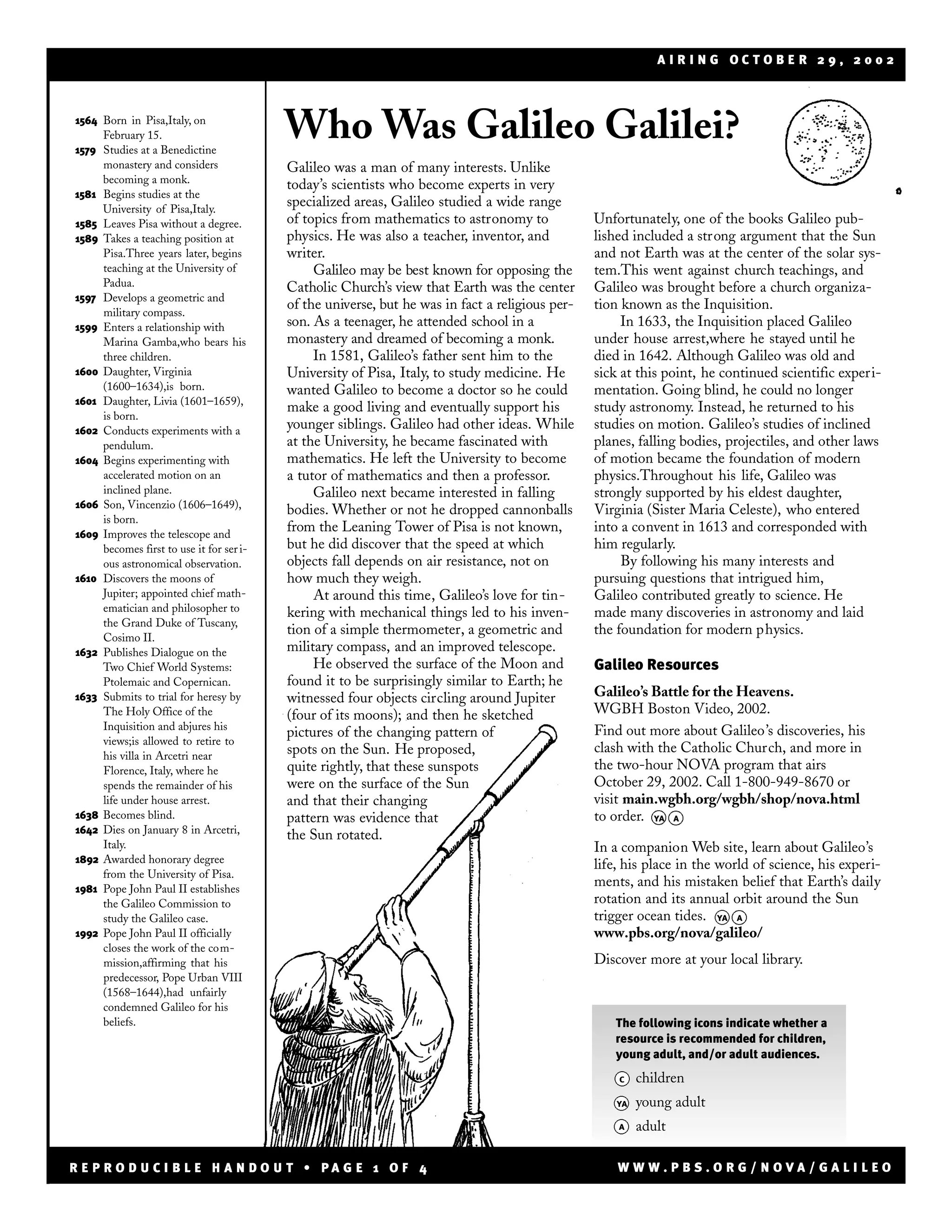
                                             pictures of the changing pattern of
        views;is allowed to retire to
                                             spots on the Sun. He proposed,                         clash with the Catholic Church, and more in
        his villa in Arcetri near
        Florence, Italy, where he            quite rightly, that these sunspots                     the two-hour NOVA program that airs
        spends the remainder of his          were on the surface of the Sun                         October 29, 2002. Call 1-800-949-8670 or
        life under house arrest.             and that their changing                                visit main.wgbh.org/wgbh/shop/nova.html
 1638   Becomes blind.                       pattern was evidence that                              to order. ya a
 1642   Dies on January 8 in Arcetri,        the Sun rotated.
        Italy.                                                                                      In a companion Web site, learn about Galileo’s
 1892   Awarded honorary degree                                                                     life, his place in the world of science, his experi-
        from the University of Pisa.
 1981   Pope John Paul II establishes
                                                                                                    ments, and his mistaken belief that Earth’s daily
        the Galileo Commission to                                                                   rotation and its annual orbit around the Sun
        study the Galileo case.                                                                     trigger ocean tides. ya a
 1992   Pope John Paul II officially                                                                www.pbs.org/nova/galileo/
        closes the work of the com-
        mission,affirming that his                                                                  Discover more at your local library.
        predecessor, Pope Urban VIII
        (1568–1644),had unfairly
        condemned Galileo for his
        beliefs.                                                                                       The following icons indicate whether a
                                                                                                       resource is recommended for children,
                                                                                                       young adult, and/or adult audiences.
                                                                                                        c    children
                                                                                                        ya   young adult
                                                                                                        a    adult

R E P R O D U C I B L E H A NDO U T • PA G E 1 OF 4                                                     WWW.PBS.ORG/NOVA/GALILEO
G a li l eo’s Ba ttle f or t he He av en s                                                        AIRING OCTOBER 29, 2002


Learning More                       Scientists Today
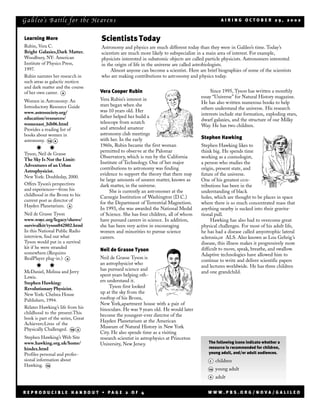
Rubin, Vera C.                      Astronomy and physics are much different today than they were in Galileo’s time. Today’s
Bright Galaxies,Dark Matter.        scientists are much more likely to subspecialize in a main area of interest. For example,
Woodbury, NY: American              physicists interested in subatomic objects are called particle physicists. Astronomers interested
Institute of Physics Press,         in the origin of life in the universe are called astrobiologists.
1997.                                    Almost anyone can become a scientist. Here are brief biographies of some of the scientists
Rubin narrates her resear ch in     who are making contributions to astronomy and physics today.
such areas as galactic motion
and dark matter and the course
of her own career. a                Vera Cooper Rubin                                       Since 1995, Tyson has written a monthly
                                                                                       essay “Universe” for Natural History magazine.
Women in Astronomy: An              Vera Rubin’s interest in
                                                                                       He has also written numerous books to help
Introductory Resource Guide         stars began when she
                                                                                       others understand the universe. His research
www.astrosociety.org/               was 10 years old. Her
                                                                                       interests include star formation, exploding stars,
education/resources/                father helped her build a
                                                                                       dwarf galaxies, and the structure of our Milky
womenast_bib06.html                 telescope from scratch
                                                                                       Way. He has two children.
Provides a reading list of          and attended amateur
books about women in                astronomy club meetings
                                    with her. In the early                             Stephen Hawking
astronomy. ya a
                                    1960s, Rubin became the first woman                Stephen Hawking likes to
      P      P                      permitted to observe at the Palomar                think big. He spends time
Tyson, Neil de Grasse
                                    Observatory, which is run by the California        working as a cosmologist,
The Sky Is Not the Limit:
                                    Institute of Technology. One of her major          a person who studies the
Adventures of an Urban
                                    contributions to astronomy was finding             origin, present state, and
Astrophysicist.
                                    evidence to support the theory that there may      future of the universe.
New York: Doubleday, 2000.
                                    be large amounts of unseen matter, known as        One of his greatest con-
Offers Tyson’s perspectives         dark matter, in the universe.                      tributions has been in the
and experiences—from his                 She is currently an astronomer at the         understanding of black
childhood in the Bronx to his       Carnegie Institution of Washington (D.C.)          holes, which are thought to be places in space
current post as director of
                                    for the Department of Terrestrial Magnetism.       where there is so much concentrated mass that
Hayden Planetarium. a
                                    In 1993, she was awarded the National Medal        anything nearby is sucked into their gravita-
Neil de Grasse Tyson                of Science. She has four children, all of whom     tional pull.
www.wnyc.org/legacy/shows/          have pursued careers in science. In addition,           Hawking has also had to overcome great
survivalkit/tyson042802.html        she has been very active in encouraging            physical challenges. For most of his adult life,
In this National Public Radio       women and minorities to pursue science             he has had a disease called amyotrophic lateral
interview, find out what            careers.                                           sclerosis,or ALS. Also known as Lou Gehrig ’s
Tyson would put in a survival                                                          disease, this illness makes it progressively more
kit if he were stranded                                                                difficult to move, speak, breathe, and swallow.
                                    Neil de Grasse Tyson
somewhere.(Requires                                                                    Adaptive technologies have allowed him to
RealPlayer plug-in.) a              Neil de Grasse Tyson is
                                                                                       continue to write and deliver scientific papers
                                    an astrophysicist who
      P      P                      has pursued science and
                                                                                       and lectures worldwide. He has three children
McDaniel, Melissa and Jerry                                                            and one grandchild.
Lewis.                              spent years helping oth-
Stephen Hawking:                    ers understand it.
Revolutionary Physicist.                 Tyson first looked
New York: Chelsea House             up at the sky from the
Publishers, 1994.                   rooftop of his Bronx,
                                    New York,apartment house with a pair of
Relates Hawking’s life from his     binoculars. He was 9 years old. He would later
childhood to the present.This
                                    become the youngest-ever director of the
book is part of the series, Great
                                    Hayden Planetarium at the American
Achievers:Lives of the
                                    Museum of Natural History in New York
Physically Challenged. ya a
                                    City. He also spends time as a visiting
Stephen Hawking’s Web Site          research scientist in astrophysics at Princeton
www.hawking.org.uk/home/            University, New Jersey.                               The following icons indicate whether a
hindex.html                                                                               resource is recommended for children,
Profiles personal and profes-                                                             young adult, and/or adult audiences.
sional information about                                                                   c    children
Hawking. ya
                                                                                           ya   young adult
                                                                                           a    adult


REPRODUCIBLE HANDOUT • PAGE 2 OF 4                                                        WWW.PBS.ORG/NOVA/GALILEO
Ga li l eo’s Ba tt le for the He aven s                                                       AIRING OCTOBER 29, 2002


In the Swing of Things                                                                    Learning More
                                                                                          Bonnet , Robert L. and Dan Keen.
                                                                                          Science Fair Projects: Physics.
For ages 10 and older.                       What to do                                   New York: Sterling Publishing, 1999.
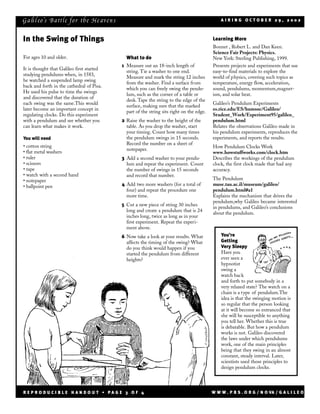
                                           1 Measure out an 18-inch length of             Presents projects and experiments that use
It is thought that Galileo first started
                                             string. Tie a washer to one end.             easy-to-find materials to explore the
studying pendulums when, in 1583,
                                             Measure and mark the string 12 inches        world of physics, covering such topics as
he watched a suspended lamp swing
                                             from the washer. Find a surface from         temperature, energy flow, acceleration,
back and forth in the cathedral of Pisa.
                                             which you can freely swing the pendu-        sound, pendulums, momentum,magnet-
He used his pulse to time the swings
                                             lum, such as the corner of a table or        ism, and solar heat.
and discovered that the duration of
                                             desk. Tape the string to the edge of the
each swing was the same.This would                                                        Galileo’s Pendulum Experiments
                                             surface, making sure that the marked
later become an important concept in                                                      es.rice.edu/ES/humsoc/Galileo/
                                             part of the string sits right on the edge.
regulating clocks. Do this experiment                                                     Student_Work/Experiment95/galileo_
with a pendulum and see whether you        2 Raise the washer to the height of the        pendulum.html
can learn what makes it work.                table. As you drop the washer, start         Relates the observations Galileo made in
                                             your timing. Count how many times            his pendulum experiments, reproduces the
You will need                                the pendulum swings in 15 seconds.           experiments, and reports the results.
                                             Record the number on a sheet of
• cotton string                                                                           How Pendulum Clocks Work
                                             notepaper.
• flat metal washers                                                                      www.howstuffworks.com/clock.htm
• ruler                                    3 Add a second washer to your pendu-           Describes the workings of the pendulum
• scissors                                   lum and repeat the experiment. Count         clock, the first clock made that had any
• tape                                       the number of swings in 15 seconds           accuracy.
• watch with a second hand                   and record that number.
• notepaper                                                                               The Pendulum
• ballpoint pen                            4 Add two more washers (for a total of         muse.tau.ac.il/museum/galileo/
                                             four) and repeat the procedure one           pendulum.html#a1
                                             more time.                                   Explains the mechanism that drives the
                                                                                          pendulum,why Galileo became interested
                                           5 Cut a new piece of string 30 inches
                                                                                          in pendulums, and Galileo’s conclusions
                                             long and create a pendulum that is 24
                                                                                          about the pendulum.
                                             inches long, twice as long as in your
                                             first experiment. Repeat the experi-
                                             ment above.
                                           6 Now take a look at your results. What            You’re
                                             affects the timing of the swing? What            Getting
                                             do you think would happen if you                 Very Sleepy
                                             started the pendulum from different              Have you
                                             heights?                                         ever seen a
                                                                                              hypnotist
                                                                                              swing a
                                                                                              watch back
                                                                                              and forth to put somebody in a
                                                                                              very relaxed state? The watch on a
                                                                                              chain is a type of pendulum.The
                                                                                              idea is that the swinging motion is
                                                                                              so regular that the person looking
                                                                                              at it will become so entranced that
                                                                                              she will be susceptible to anything
                                                                                              you tell her. Whether this is true
                                                                                              is debatable. But how a pendulum
                                                                                              works is not. Galileo discovered
                                                                                              the laws under which pendulums
                                                                                              work, one of the main principles
                                                                                              being that they swing in an almost
                                                                                              constant, steady interval. Later,
                                                                                              scientists used those principles to
                                                                                              design pendulum clocks.


REPRODUCIBLE HANDOUT • PAGE 3 OF 4                                                        W W W . P B S . O R G / N O VA / G A L I L E O
G a li l eo’s Ba ttle f or t he He ave n s                                                        AIRING OCTOBER 29, 2002


The Tick Tock of a Water Clock                                                                Learning More
                                                                                              Llewellyn, Claire.
For ages 10 and older.                           What to do                                   My First Book of Time.
                                                                                              New York: DK Publishing, 1992.
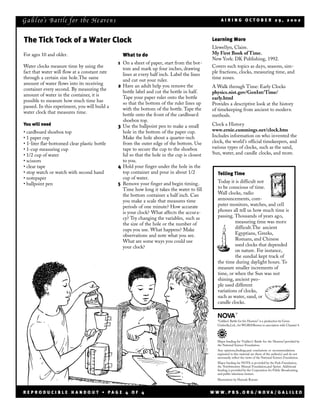
                                               1 On a sheet of paper, start from the bot-
Water clocks measure time by using the                                                        Covers such topics as days, seasons, sim-
                                                 tom and mark up four inches, drawing
fact that water will flow at a constant rate                                                  ple fractions, clocks, measuring time, and
                                                 lines at every half inch. Label the lines
through a certain size hole.The same                                                          time zones.
                                                 and cut out your ruler.
amount of water flows into its receiving       2 Have an adult help you remove the            A Walk through Time: Early Clocks
container every second. By measuring the         bottle label and cut the bottle in half.     physics.nist.gov/GenInt/Time/
amount of water in the container, it is          Tape your paper ruler onto the bottle        early.html
possible to measure how much time has            so that the bottom of the ruler lines up     Provides a descriptive look at the history
passed. In this experiment, you will build a     with the bottom of the bottle. Tape the      of timekeeping from ancient to modern
water clock that measures time.                  bottle onto the front of the cardboard       methods.
                                                 shoebox top.
You will need                                  3 Use the ballpoint pen to make a small        Clock a History
• cardboard shoebox top                          hole in the bottom of the paper cup.         www.ernie.cummings.net/clock.htm
• 1 paper cup                                    Make the hole about a quarter-inch           Includes information on who invented the
• 1-liter flat-bottomed clear plastic bottle     from the outer edge of the bottom. Use       clock, the world’s official timekeepers, and
• 1-cup measuring cup                            tape to secure the cup to the shoebox        various types of clocks, such as the sand,
• 1/2 cup of water                               lid so that the hole in the cup is closest   Sun, water, and candle clocks, and more.
• scissors                                       to you.
• clear tape                                   4 Hold your finger under the hole in the
• stop watch or watch with second hand           top container and pour in about 1/2            Telling Time
• notepaper                                      cup of water.
• ballpoint pen                                5 Remove your finger and begin timing.           Today it is difficult not
                                                 Time how long it takes the water to fill       to be conscious of time.
                                                 the bottom container a half inch. Can          Wall clocks, radio
                                                 you make a scale that measures time            announcements, com-
                                                 periods of one minute? How accurate            puter monitors, watches, and cell
                                                 is your clock? What affects the accura-        phones all tell us how much time is
                                                 cy? Try changing the variables, such as        passing. Thousands of years ago,
                                                 the size of the hole or the number of                   measuring time was more
                                                 cups you use. What happens? Make                        difficult.The ancient
                                                 observations and note what you see.                     Egyptians, Greeks,
                                                 What are some ways you could use                        Romans, and Chinese
                                                 your clock?                                             used clocks that depended
                                                                                                         on nature. For instance,
                                                                                                         the sundial kept track of
                                                                                                the time during daylight hours. To
                                                                                                measure smaller increments of
                                                                                                time, or when the Sun was not
                                                                                                shining, ancient peo-
                                                                                                ple used different
                                                                                                variations of clocks,
                                                                                                such as water, sand, or
                                                                                                candle clocks.

                                                                                                              ®

                                                                                                “Galileo’s Battle for the Heavens” is a production by Green
                                                                                                Umbrella,Ltd., for WGBH/Boston in association with Channel 4.


                                                                                                Major funding for “Galileo’s Battle for the Heavens”provided by
                                                                                                the National Science Foundation.
                                                                                                Any opinions,findings,and conclusions or recommendations
                                                                                                expressed in this material are those of the author(s) and do not
                                                                                                necessarily reflect the views of the National Science Foundation.
                                                                                                Major funding for NOVA is provided by the Park Foundation,
                                                                                                the Northwestern Mutual Foundation,and Sprint. Additional
                                                                                                funding is provided by the Corporation for Public Broadcasting
                                                                                                and public television viewers.
                                                                                                Illustrations by Hannah Bonner


REPRODUCIBLE HANDOUT • PAGE 4 OF 4                                                            WWW.PBS.ORG/NOVA/GALILEO

Galileu Galilei

  • 1.
    Ga li leo’s Ba tt le for the He aven s AIRING OCTOBER 29, 2002 1564 Born in Pisa,Italy, on February 15. 1579 Studies at a Benedictine Who Was Galileo Galilei? monastery and considers Galileo was a man of many interests. Unlike becoming a monk. today’s scientists who become experts in very 1581 Begins studies at the University of Pisa,Italy. specialized areas, Galileo studied a wide range 1585 Leaves Pisa without a degree. of topics from mathematics to astronomy to Unfortunately, one of the books Galileo pub- 1589 Takes a teaching position at physics. He was also a teacher, inventor, and lished included a strong argument that the Sun Pisa.Three years later, begins writer. and not Earth was at the center of the solar sys- teaching at the University of Galileo may be best known for opposing the tem.This went against church teachings, and Padua. Catholic Church’s view that Earth was the center Galileo was brought before a church organiza- 1597 Develops a geometric and of the universe, but he was in fact a religious per- tion known as the Inquisition. military compass. 1599 Enters a relationship with son. As a teenager, he attended school in a In 1633, the Inquisition placed Galileo Marina Gamba,who bears his monastery and dreamed of becoming a monk. under house arrest,where he stayed until he three children. In 1581, Galileo’s father sent him to the died in 1642. Although Galileo was old and 1600 Daughter, Virginia University of Pisa, Italy, to study medicine. He sick at this point, he continued scientific experi- (1600–1634),is born. wanted Galileo to become a doctor so he could mentation. Going blind, he could no longer 1601 Daughter, Livia (1601–1659), make a good living and eventually support his study astronomy. Instead, he returned to his is born. 1602 Conducts experiments with a younger siblings. Galileo had other ideas. While studies on motion. Galileo’s studies of inclined pendulum. at the University, he became fascinated with planes, falling bodies, projectiles, and other laws 1604 Begins experimenting with mathematics. He left the University to become of motion became the foundation of modern accelerated motion on an a tutor of mathematics and then a professor. physics.Throughout his life, Galileo was inclined plane. Galileo next became interested in falling strongly supported by his eldest daughter, 1606 Son, Vincenzio (1606–1649), bodies. Whether or not he dropped cannonballs Virginia (Sister Maria Celeste), who entered is born. 1609 Improves the telescope and from the Leaning Tower of Pisa is not known, into a convent in 1613 and corresponded with becomes first to use it for ser i- but he did discover that the speed at which him regularly. ous astronomical observation. objects fall depends on air resistance, not on By following his many interests and 1610 Discovers the moons of how much they weigh. pursuing questions that intrigued him, Jupiter; appointed chief math- At around this time, Galileo’s love for tin- Galileo contributed greatly to science. He ematician and philosopher to kering with mechanical things led to his inven- made many discoveries in astronomy and laid the Grand Duke of Tuscany, tion of a simple thermometer, a geometric and the foundation for modern physics. Cosimo II. 1632 Publishes Dialogue on the military compass, and an improved telescope. Two Chief World Systems: He observed the surface of the Moon and Galileo Resources Ptolemaic and Copernican. found it to be surprisingly similar to Earth; he 1633 Submits to trial for heresy by witnessed four objects circling around Jupiter Galileo’s Battle for the Heavens. The Holy Office of the (four of its moons); and then he sketched WGBH Boston Video, 2002. Inquisition and abjures his Find out more about Galileo’s discoveries, his pictures of the changing pattern of views;is allowed to retire to spots on the Sun. He proposed, clash with the Catholic Church, and more in his villa in Arcetri near Florence, Italy, where he quite rightly, that these sunspots the two-hour NOVA program that airs spends the remainder of his were on the surface of the Sun October 29, 2002. Call 1-800-949-8670 or life under house arrest. and that their changing visit main.wgbh.org/wgbh/shop/nova.html 1638 Becomes blind. pattern was evidence that to order. ya a 1642 Dies on January 8 in Arcetri, the Sun rotated. Italy. In a companion Web site, learn about Galileo’s 1892 Awarded honorary degree life, his place in the world of science, his experi- from the University of Pisa. 1981 Pope John Paul II establishes ments, and his mistaken belief that Earth’s daily the Galileo Commission to rotation and its annual orbit around the Sun study the Galileo case. trigger ocean tides. ya a 1992 Pope John Paul II officially www.pbs.org/nova/galileo/ closes the work of the com- mission,affirming that his Discover more at your local library. predecessor, Pope Urban VIII (1568–1644),had unfairly condemned Galileo for his beliefs. The following icons indicate whether a resource is recommended for children, young adult, and/or adult audiences. c children ya young adult a adult R E P R O D U C I B L E H A NDO U T • PA G E 1 OF 4 WWW.PBS.ORG/NOVA/GALILEO
  • 2.
    G a lil eo’s Ba ttle f or t he He av en s AIRING OCTOBER 29, 2002 Learning More Scientists Today Rubin, Vera C. Astronomy and physics are much different today than they were in Galileo’s time. Today’s Bright Galaxies,Dark Matter. scientists are much more likely to subspecialize in a main area of interest. For example, Woodbury, NY: American physicists interested in subatomic objects are called particle physicists. Astronomers interested Institute of Physics Press, in the origin of life in the universe are called astrobiologists. 1997. Almost anyone can become a scientist. Here are brief biographies of some of the scientists Rubin narrates her resear ch in who are making contributions to astronomy and physics today. such areas as galactic motion and dark matter and the course of her own career. a Vera Cooper Rubin Since 1995, Tyson has written a monthly essay “Universe” for Natural History magazine. Women in Astronomy: An Vera Rubin’s interest in He has also written numerous books to help Introductory Resource Guide stars began when she others understand the universe. His research www.astrosociety.org/ was 10 years old. Her interests include star formation, exploding stars, education/resources/ father helped her build a dwarf galaxies, and the structure of our Milky womenast_bib06.html telescope from scratch Way. He has two children. Provides a reading list of and attended amateur books about women in astronomy club meetings with her. In the early Stephen Hawking astronomy. ya a 1960s, Rubin became the first woman Stephen Hawking likes to P P permitted to observe at the Palomar think big. He spends time Tyson, Neil de Grasse Observatory, which is run by the California working as a cosmologist, The Sky Is Not the Limit: Institute of Technology. One of her major a person who studies the Adventures of an Urban contributions to astronomy was finding origin, present state, and Astrophysicist. evidence to support the theory that there may future of the universe. New York: Doubleday, 2000. be large amounts of unseen matter, known as One of his greatest con- Offers Tyson’s perspectives dark matter, in the universe. tributions has been in the and experiences—from his She is currently an astronomer at the understanding of black childhood in the Bronx to his Carnegie Institution of Washington (D.C.) holes, which are thought to be places in space current post as director of for the Department of Terrestrial Magnetism. where there is so much concentrated mass that Hayden Planetarium. a In 1993, she was awarded the National Medal anything nearby is sucked into their gravita- Neil de Grasse Tyson of Science. She has four children, all of whom tional pull. www.wnyc.org/legacy/shows/ have pursued careers in science. In addition, Hawking has also had to overcome great survivalkit/tyson042802.html she has been very active in encouraging physical challenges. For most of his adult life, In this National Public Radio women and minorities to pursue science he has had a disease called amyotrophic lateral interview, find out what careers. sclerosis,or ALS. Also known as Lou Gehrig ’s Tyson would put in a survival disease, this illness makes it progressively more kit if he were stranded difficult to move, speak, breathe, and swallow. Neil de Grasse Tyson somewhere.(Requires Adaptive technologies have allowed him to RealPlayer plug-in.) a Neil de Grasse Tyson is continue to write and deliver scientific papers an astrophysicist who P P has pursued science and and lectures worldwide. He has three children McDaniel, Melissa and Jerry and one grandchild. Lewis. spent years helping oth- Stephen Hawking: ers understand it. Revolutionary Physicist. Tyson first looked New York: Chelsea House up at the sky from the Publishers, 1994. rooftop of his Bronx, New York,apartment house with a pair of Relates Hawking’s life from his binoculars. He was 9 years old. He would later childhood to the present.This become the youngest-ever director of the book is part of the series, Great Hayden Planetarium at the American Achievers:Lives of the Museum of Natural History in New York Physically Challenged. ya a City. He also spends time as a visiting Stephen Hawking’s Web Site research scientist in astrophysics at Princeton www.hawking.org.uk/home/ University, New Jersey. The following icons indicate whether a hindex.html resource is recommended for children, Profiles personal and profes- young adult, and/or adult audiences. sional information about c children Hawking. ya ya young adult a adult REPRODUCIBLE HANDOUT • PAGE 2 OF 4 WWW.PBS.ORG/NOVA/GALILEO
  • 3.
    Ga li leo’s Ba tt le for the He aven s AIRING OCTOBER 29, 2002 In the Swing of Things Learning More Bonnet , Robert L. and Dan Keen. Science Fair Projects: Physics. For ages 10 and older. What to do New York: Sterling Publishing, 1999. 1 Measure out an 18-inch length of Presents projects and experiments that use It is thought that Galileo first started string. Tie a washer to one end. easy-to-find materials to explore the studying pendulums when, in 1583, Measure and mark the string 12 inches world of physics, covering such topics as he watched a suspended lamp swing from the washer. Find a surface from temperature, energy flow, acceleration, back and forth in the cathedral of Pisa. which you can freely swing the pendu- sound, pendulums, momentum,magnet- He used his pulse to time the swings lum, such as the corner of a table or ism, and solar heat. and discovered that the duration of desk. Tape the string to the edge of the each swing was the same.This would Galileo’s Pendulum Experiments surface, making sure that the marked later become an important concept in es.rice.edu/ES/humsoc/Galileo/ part of the string sits right on the edge. regulating clocks. Do this experiment Student_Work/Experiment95/galileo_ with a pendulum and see whether you 2 Raise the washer to the height of the pendulum.html can learn what makes it work. table. As you drop the washer, start Relates the observations Galileo made in your timing. Count how many times his pendulum experiments, reproduces the You will need the pendulum swings in 15 seconds. experiments, and reports the results. Record the number on a sheet of • cotton string How Pendulum Clocks Work notepaper. • flat metal washers www.howstuffworks.com/clock.htm • ruler 3 Add a second washer to your pendu- Describes the workings of the pendulum • scissors lum and repeat the experiment. Count clock, the first clock made that had any • tape the number of swings in 15 seconds accuracy. • watch with a second hand and record that number. • notepaper The Pendulum • ballpoint pen 4 Add two more washers (for a total of muse.tau.ac.il/museum/galileo/ four) and repeat the procedure one pendulum.html#a1 more time. Explains the mechanism that drives the pendulum,why Galileo became interested 5 Cut a new piece of string 30 inches in pendulums, and Galileo’s conclusions long and create a pendulum that is 24 about the pendulum. inches long, twice as long as in your first experiment. Repeat the experi- ment above. 6 Now take a look at your results. What You’re affects the timing of the swing? What Getting do you think would happen if you Very Sleepy started the pendulum from different Have you heights? ever seen a hypnotist swing a watch back and forth to put somebody in a very relaxed state? The watch on a chain is a type of pendulum.The idea is that the swinging motion is so regular that the person looking at it will become so entranced that she will be susceptible to anything you tell her. Whether this is true is debatable. But how a pendulum works is not. Galileo discovered the laws under which pendulums work, one of the main principles being that they swing in an almost constant, steady interval. Later, scientists used those principles to design pendulum clocks. REPRODUCIBLE HANDOUT • PAGE 3 OF 4 W W W . P B S . O R G / N O VA / G A L I L E O
  • 4.
    G a lil eo’s Ba ttle f or t he He ave n s AIRING OCTOBER 29, 2002 The Tick Tock of a Water Clock Learning More Llewellyn, Claire. For ages 10 and older. What to do My First Book of Time. New York: DK Publishing, 1992. 1 On a sheet of paper, start from the bot- Water clocks measure time by using the Covers such topics as days, seasons, sim- tom and mark up four inches, drawing fact that water will flow at a constant rate ple fractions, clocks, measuring time, and lines at every half inch. Label the lines through a certain size hole.The same time zones. and cut out your ruler. amount of water flows into its receiving 2 Have an adult help you remove the A Walk through Time: Early Clocks container every second. By measuring the bottle label and cut the bottle in half. physics.nist.gov/GenInt/Time/ amount of water in the container, it is Tape your paper ruler onto the bottle early.html possible to measure how much time has so that the bottom of the ruler lines up Provides a descriptive look at the history passed. In this experiment, you will build a with the bottom of the bottle. Tape the of timekeeping from ancient to modern water clock that measures time. bottle onto the front of the cardboard methods. shoebox top. You will need 3 Use the ballpoint pen to make a small Clock a History • cardboard shoebox top hole in the bottom of the paper cup. www.ernie.cummings.net/clock.htm • 1 paper cup Make the hole about a quarter-inch Includes information on who invented the • 1-liter flat-bottomed clear plastic bottle from the outer edge of the bottom. Use clock, the world’s official timekeepers, and • 1-cup measuring cup tape to secure the cup to the shoebox various types of clocks, such as the sand, • 1/2 cup of water lid so that the hole in the cup is closest Sun, water, and candle clocks, and more. • scissors to you. • clear tape 4 Hold your finger under the hole in the • stop watch or watch with second hand top container and pour in about 1/2 Telling Time • notepaper cup of water. • ballpoint pen 5 Remove your finger and begin timing. Today it is difficult not Time how long it takes the water to fill to be conscious of time. the bottom container a half inch. Can Wall clocks, radio you make a scale that measures time announcements, com- periods of one minute? How accurate puter monitors, watches, and cell is your clock? What affects the accura- phones all tell us how much time is cy? Try changing the variables, such as passing. Thousands of years ago, the size of the hole or the number of measuring time was more cups you use. What happens? Make difficult.The ancient observations and note what you see. Egyptians, Greeks, What are some ways you could use Romans, and Chinese your clock? used clocks that depended on nature. For instance, the sundial kept track of the time during daylight hours. To measure smaller increments of time, or when the Sun was not shining, ancient peo- ple used different variations of clocks, such as water, sand, or candle clocks. ® “Galileo’s Battle for the Heavens” is a production by Green Umbrella,Ltd., for WGBH/Boston in association with Channel 4. Major funding for “Galileo’s Battle for the Heavens”provided by the National Science Foundation. Any opinions,findings,and conclusions or recommendations expressed in this material are those of the author(s) and do not necessarily reflect the views of the National Science Foundation. Major funding for NOVA is provided by the Park Foundation, the Northwestern Mutual Foundation,and Sprint. Additional funding is provided by the Corporation for Public Broadcasting and public television viewers. Illustrations by Hannah Bonner REPRODUCIBLE HANDOUT • PAGE 4 OF 4 WWW.PBS.ORG/NOVA/GALILEO