Gait disorders
Gait disorders
• can be caused by abnormal function of almost
any part of the nervous system, as well as by
some orthopedic conditions
• Careful examination of gait is therefore one of
the most sensitive tests of subtle neurologic
dysfunction
• However, gait disorders alone often do not
provide enough information for localization, and
they must be analyzed in the context of a
complete history and neurologic exam
SPASTIC GAIT
LOCALIZATION
• Unilateral or bilateral corticospinal tracts
DESCRIPTION OF GAIT
ABNORMALITIES
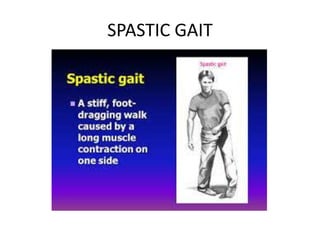
• Unilateral or bilateral. Stiff-legged,
circumduction, sometimes with scissoring of
the legs and toe-walking (from increased tone
in calf muscles),decreased arm swing,
unsteady, falling toward side of greater
spasticity
COMMON CAUSES
• Cortical, subcortical, or brain stem infarcts
affecting upper motor neuron pathways
• cerebral palsy;
• Degenerative conditions;
• Multiple sclerosis;
• spinal cord lesions
ATAXIC GAIT
LOCALIZATION:
• Cerebellar vermis or other midline cerebellar
structures
ATAXIC GAIT
DESCRIPTION OF GAIT
ABNORMALITIES
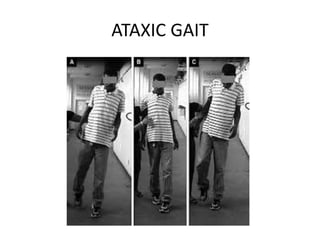
• Wide based, unsteady, staggering side to side,
and falling toward side of worse pathology.
Subtle deficit can be detected with tandem
(heel-to-toe, or “drunk walk”) gait testing
COMMON CAUSES
• Toxins such as alcohol; medications;
• tumors of cerebellar vermis;
• infarcts or ischemia of cerebellar pathways
• cerebellar degeneration
PARKINSONIAN GAIT
LOCALIZATION
• Substantia nigra or other regions of basal
ganglia
PARKINSONIAN GAIT
DESCRIPTION OF GAIT
ABNORMALITIES
• Slow, shuffling, narrow based. Difficulty
initiating walking. Often stooped forward,
with decreased arm swing, and “en bloc
turning.”Unsteady, with “retropulsion,” taking
several rapid steps to regain balance when
pushed backward.
COMMON CAUSES
• Parkinson’s disease; other parkinsonian
syndromes, such as progressive palsy, or use
of neuroleptic drugs
DYSKINETIC GAIT
LOCALIZATION
• Subthalamic nucleus, or other regions of basal
ganglia
DYSKINETIC GAIT
DESCRIPTION OF GAIT
ABNORMALITIES
• Unilateral or bilateral dancelike (choreic),
flinging (ballistic), or writhing (athetoid)
movements occur during walking and may be
accompanied by some unsteadiness
COMMON CAUSES
• Huntington’s disease;
• infarct of subthalamic nucleus or striatum;
• side effect of levodopa;
• other familial or drug-induced dyskinesias
TABETIC GAIT
LOCALIZATION
• Posterior columns or sensory nerve fibers
TABETIC GAIT
DESCRIPTION OF GAIT
ABNORMALITIES
• High-stepping, foot-flapping gait with
particular difficulty walking in the dark or on
uneven surfaces
• Patients sway and fall in attempts to stand
with feet together and eyes closed (Romberg
sign).
COMMON CAUSES
• Posterior cord syndrome;
• Severe sensory neuropathy
PARETIC GAIT
LOCALISATION
• Nerve roots
• peripheral nerves
• Neuromuscular junction, or muscles
PARETIC GAIT
DESCRIPTION OF GAIT
ABNORMALITIES
• Exact appearance depends on location of
lesion. With proximal hip weakness there may
be a waddling, Trendelenburg gait. Severe
thigh weakness may cause sudden knee
buckling. Foot drop can cause a high-stepping,
slapping gait, with frequent tripping
CAUSES
• Numerous peripheral nerve and muscle
disorders
PAINFUL (ANTALGIC) GAIT
LOCALIZATION
• Peripheral nerve or orthopedic injury
PAINFUL (ANTALGIC) GAIT
DESCRIPTION OF GAIT
ABNORMALITIES
• Pain may be obvious based on patient’s report
or facial expression
• Patients tend to avoid putting pressure on
affected limb.
CAUSES
• Herniated disc;
• Peripheral neuropathy;
• muscle strain contusions;
• fractures

Gait disorders.pptx