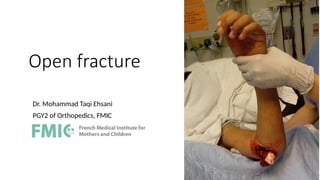
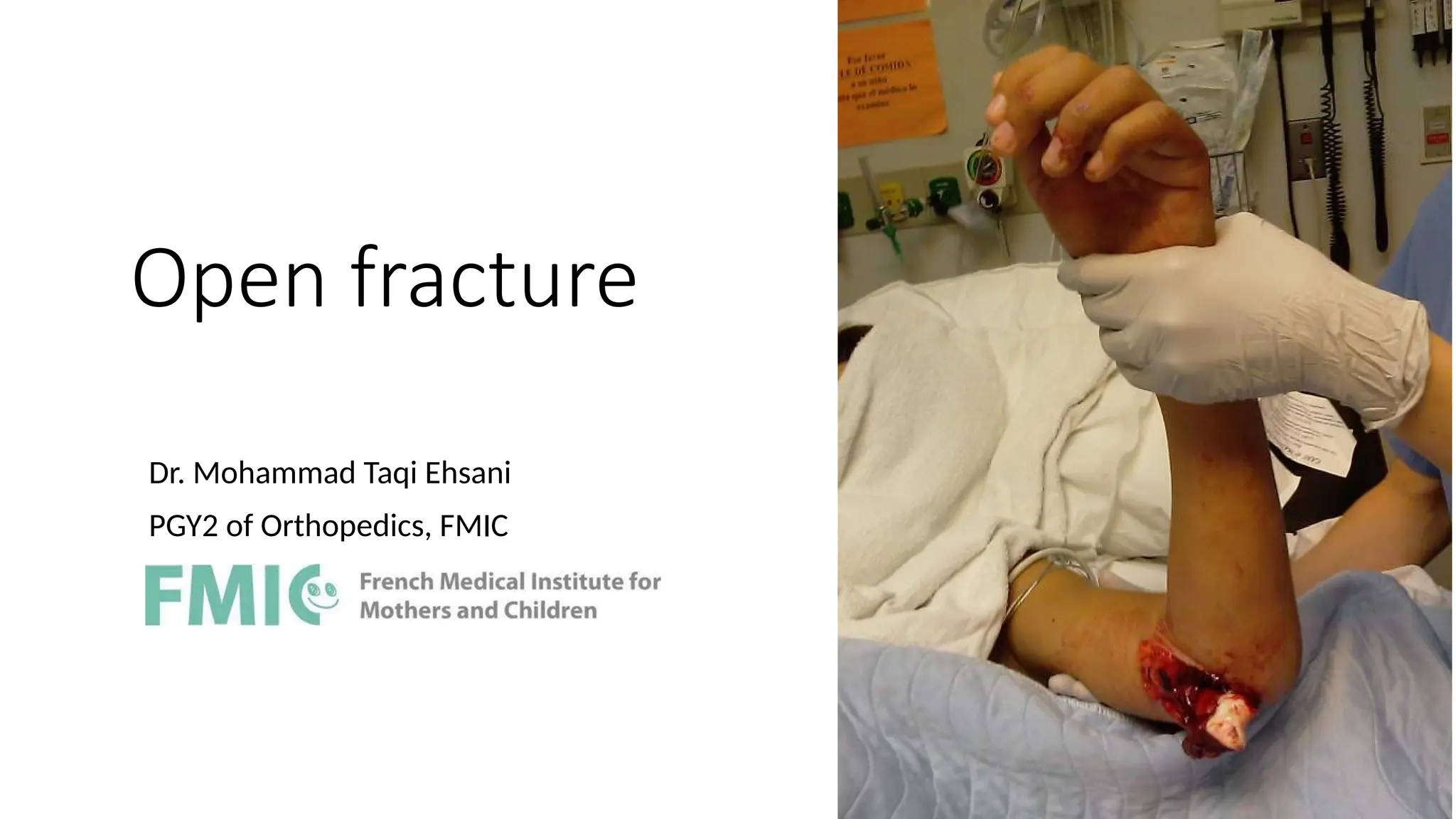
Open fracture
Dr. Mohammad Taqi Ehsani
PGY2 of Orthopedics, FMIC
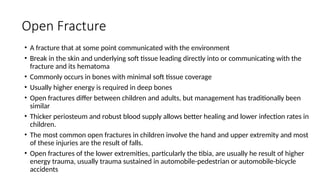
Open Fracture
• A fracture that at some point communicated with the environment
• Break in the skin and underlying soft tissue leading directly into or communicating with the
fracture and its hematoma
• Commonly occurs in bones with minimal soft tissue coverage
• Usually higher energy is required in deep bones
• Open fractures differ between children and adults, but management has traditionally been
similar
• Thicker periosteum and robust blood supply allows better healing and lower infection rates in
children.
• The most common open fractures in children involve the hand and upper extremity and most
of these injuries are the result of falls.
• Open fractures of the lower extremities, particularly the tibia, are usually he result of higher
energy trauma, usually trauma sustained in automobile-pedestrian or automobile-bicycle
accidents
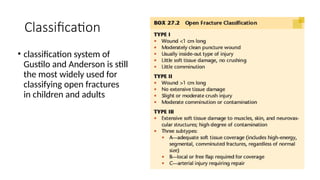
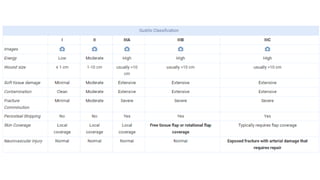
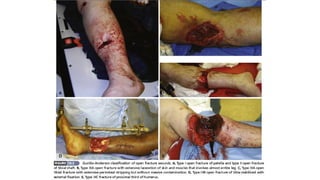
Classification
• classification system of
Gustilo and Anderson is still
the most widely used for
classifying open fractures
in children and adults
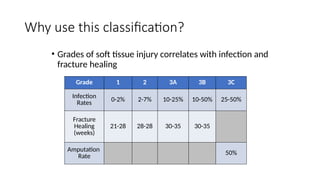
Why use this classification?
• Grades of soft tissue injury correlates with infection and
fracture healing
Grade 1 2 3A 3B 3C
Infection
Rates 0-2% 2-7% 10-25% 10-50% 25-50%
Fracture
Healing
(weeks)
21-28 28-28 30-35 30-35
Amputation
Rate 50%
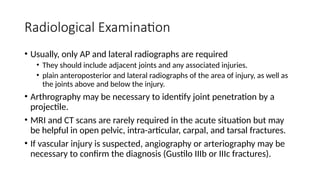
Radiological Examination
• Usually, only AP and lateral radiographs are required
• They should include adjacent joints and any associated injuries.
• plain anteroposterior and lateral radiographs of the area of injury, as well as
the joints above and below the injury.
• Arthrography may be necessary to identify joint penetration by a
projectile.
• MRI and CT scans are rarely required in the acute situation but may
be helpful in open pelvic, intra-articular, carpal, and tarsal fractures.
• If vascular injury is suspected, angiography or arteriography may be
necessary to confirm the diagnosis (Gustilo IIIb or IIIc fractures).
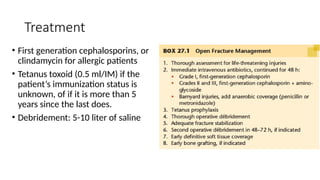
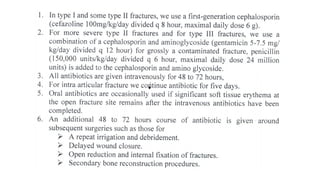
Treatment
• First generation cephalosporins, or
clindamycin for allergic patients
• Tetanus toxoid (0.5 ml/IM) if the
patient’s immunization status is
unknown, of if it is more than 5
years since the last does.
• Debridement: 5-10 liter of saline
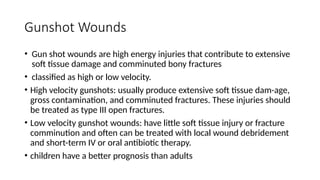
Gunshot Wounds
• Gun shot wounds are high energy injuries that contribute to extensive
soft tissue damage and comminuted bony fractures
• classified as high or low velocity.
• High velocity gunshots: usually produce extensive soft tissue dam-age,
gross contamination, and comminuted fractures. These injuries should
be treated as type III open fractures.
• Low velocity gunshot wounds: have little soft tissue injury or fracture
comminution and often can be treated with local wound debridement
and short-term IV or oral antibiotic therapy.
• children have a better prognosis than adults
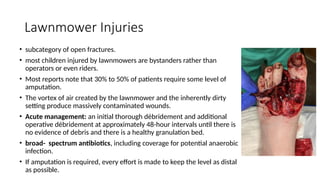
Lawnmower Injuries
• subcategory of open fractures.
• most children injured by lawnmowers are bystanders rather than
operators or even riders.
• Most reports note that 30% to 50% of patients require some level of
amputation.
• The vortex of air created by the lawnmower and the inherently dirty
setting produce massively contaminated wounds.
• Acute management: an initial thorough débridement and additional
operative débridement at approximately 48-hour intervals until there is
no evidence of debris and there is a healthy granulation bed.
• broad- spectrum antibiotics, including coverage for potential anaerobic
infection.
• If amputation is required, every effort is made to keep the level as distal
as possible.

Open fracture types and management .pptx

  • 1.
    Open fracture Dr. MohammadTaqi Ehsani PGY2 of Orthopedics, FMIC
  • 2.
    Open Fracture • Afracture that at some point communicated with the environment • Break in the skin and underlying soft tissue leading directly into or communicating with the fracture and its hematoma • Commonly occurs in bones with minimal soft tissue coverage • Usually higher energy is required in deep bones • Open fractures differ between children and adults, but management has traditionally been similar • Thicker periosteum and robust blood supply allows better healing and lower infection rates in children. • The most common open fractures in children involve the hand and upper extremity and most of these injuries are the result of falls. • Open fractures of the lower extremities, particularly the tibia, are usually he result of higher energy trauma, usually trauma sustained in automobile-pedestrian or automobile-bicycle accidents
  • 3.
    Classification • classification systemof Gustilo and Anderson is still the most widely used for classifying open fractures in children and adults
  • 6.
    Why use thisclassification? • Grades of soft tissue injury correlates with infection and fracture healing Grade 1 2 3A 3B 3C Infection Rates 0-2% 2-7% 10-25% 10-50% 25-50% Fracture Healing (weeks) 21-28 28-28 30-35 30-35 Amputation Rate 50%
  • 7.
    Radiological Examination • Usually,only AP and lateral radiographs are required • They should include adjacent joints and any associated injuries. • plain anteroposterior and lateral radiographs of the area of injury, as well as the joints above and below the injury. • Arthrography may be necessary to identify joint penetration by a projectile. • MRI and CT scans are rarely required in the acute situation but may be helpful in open pelvic, intra-articular, carpal, and tarsal fractures. • If vascular injury is suspected, angiography or arteriography may be necessary to confirm the diagnosis (Gustilo IIIb or IIIc fractures).
  • 8.
    Treatment • First generationcephalosporins, or clindamycin for allergic patients • Tetanus toxoid (0.5 ml/IM) if the patient’s immunization status is unknown, of if it is more than 5 years since the last does. • Debridement: 5-10 liter of saline
  • 10.
    Gunshot Wounds • Gunshot wounds are high energy injuries that contribute to extensive soft tissue damage and comminuted bony fractures • classified as high or low velocity. • High velocity gunshots: usually produce extensive soft tissue dam-age, gross contamination, and comminuted fractures. These injuries should be treated as type III open fractures. • Low velocity gunshot wounds: have little soft tissue injury or fracture comminution and often can be treated with local wound debridement and short-term IV or oral antibiotic therapy. • children have a better prognosis than adults
  • 11.
    Lawnmower Injuries • subcategoryof open fractures. • most children injured by lawnmowers are bystanders rather than operators or even riders. • Most reports note that 30% to 50% of patients require some level of amputation. • The vortex of air created by the lawnmower and the inherently dirty setting produce massively contaminated wounds. • Acute management: an initial thorough débridement and additional operative débridement at approximately 48-hour intervals until there is no evidence of debris and there is a healthy granulation bed. • broad- spectrum antibiotics, including coverage for potential anaerobic infection. • If amputation is required, every effort is made to keep the level as distal as possible.