Astronomy Unit Presentation

By: Jaida Glanton
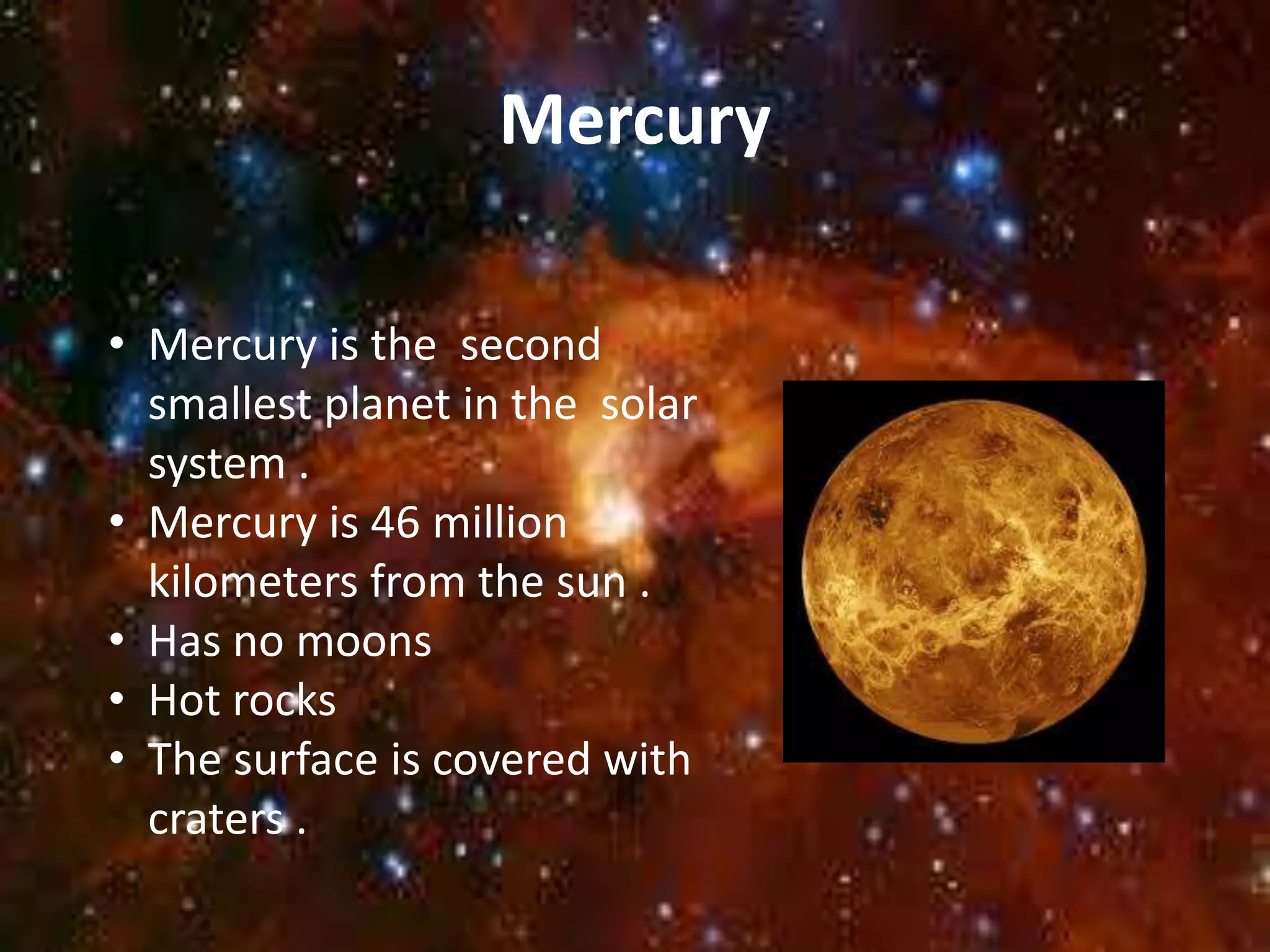
Mercury
• Mercury is the second
smallest planet in the solar
system .
• Mercury is 46 million
kilometers from the sun .
• Has no moons
• Hot rocks
• The surface is covered with
craters .
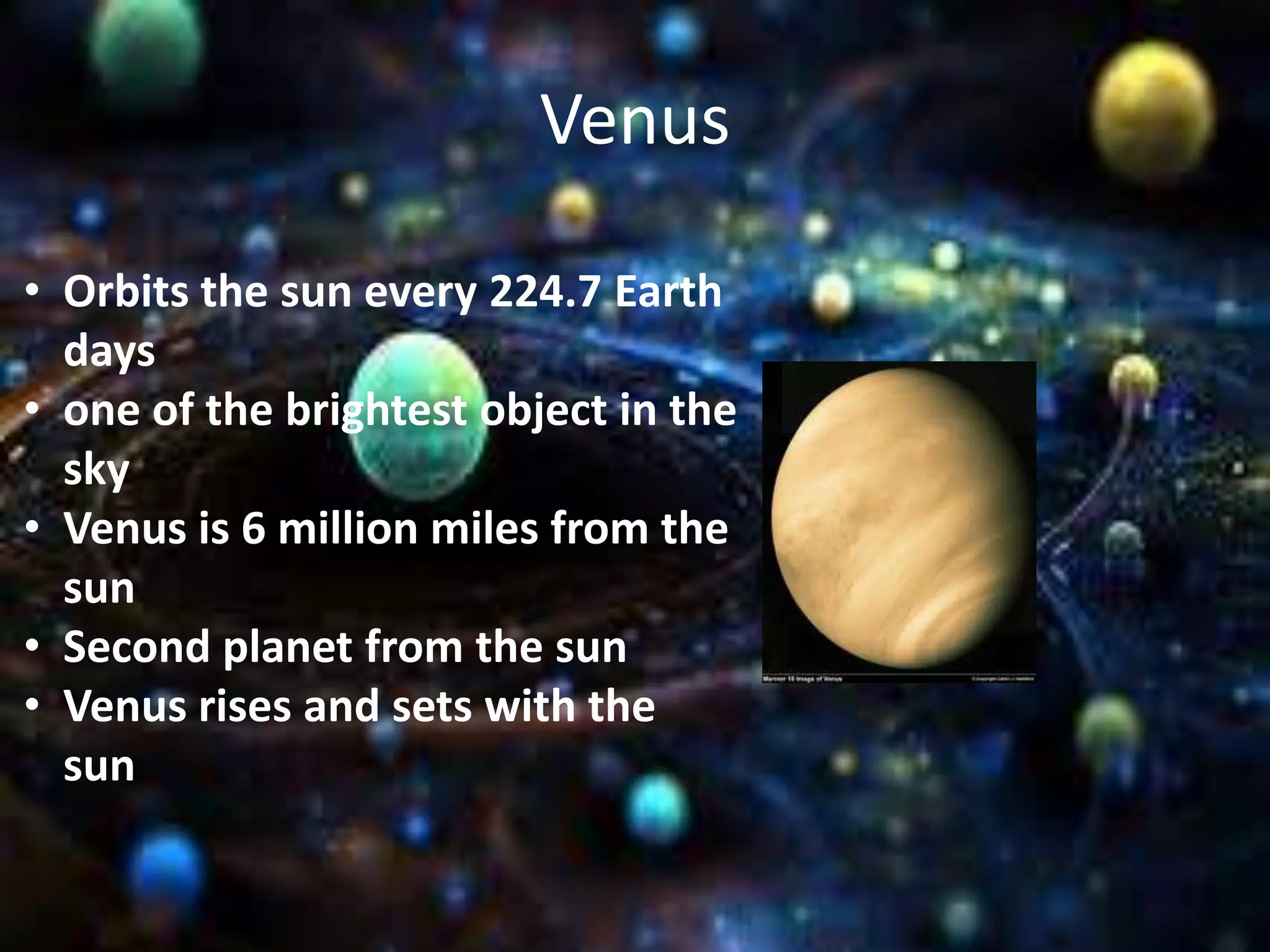
Venus
• Orbits the sun every 224.7 Earth
days
• one of the brightest object in the
sky
• Venus is 6 million miles from the
sun
• Second planet from the sun
• Venus rises and sets with the
sun
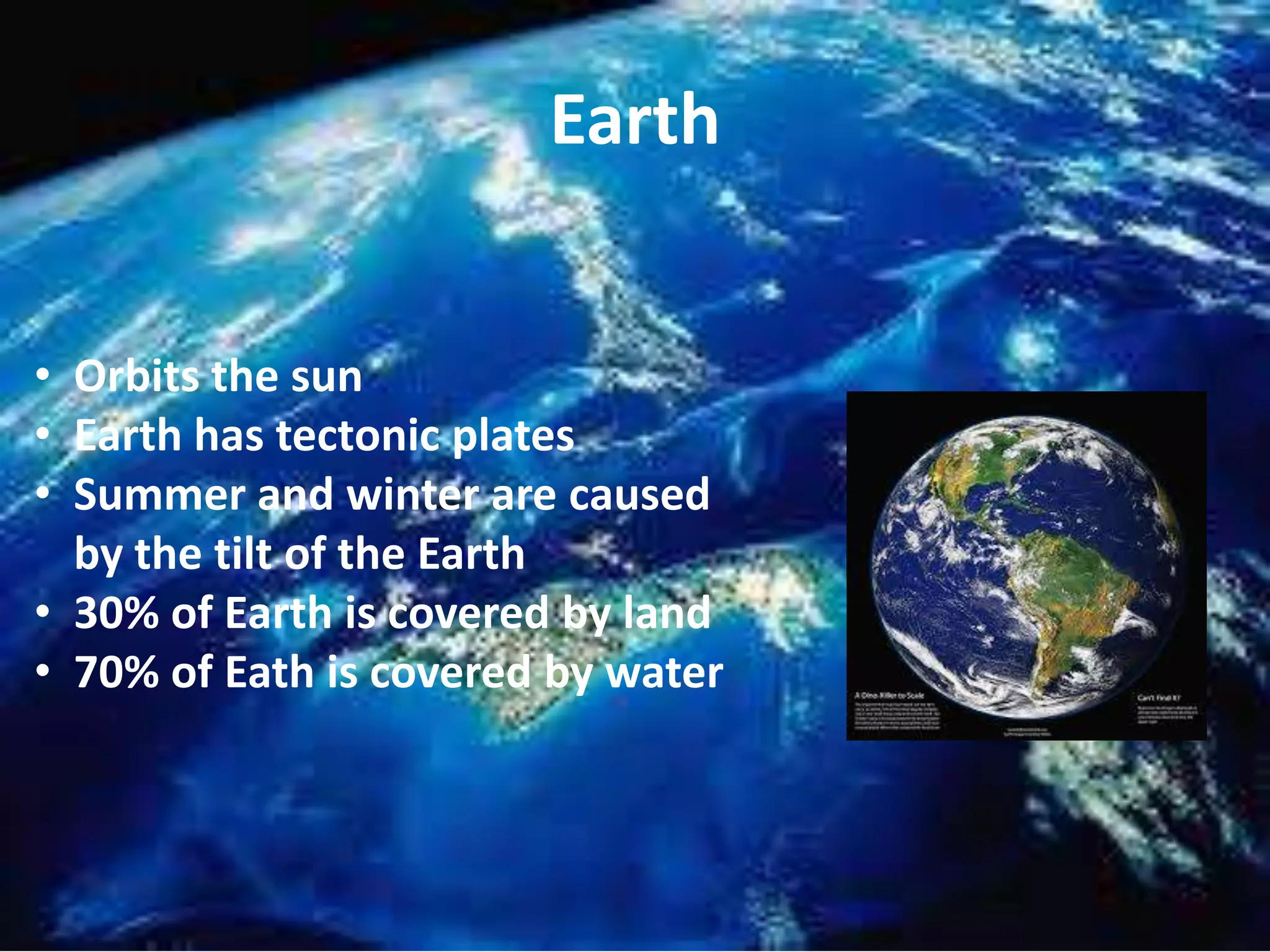
Earth
• Orbits the sun
• Earth has tectonic plates
• Summer and winter are caused
by the tilt of the Earth
• 30% of Earth is covered by land
• 70% of Eath is covered by water
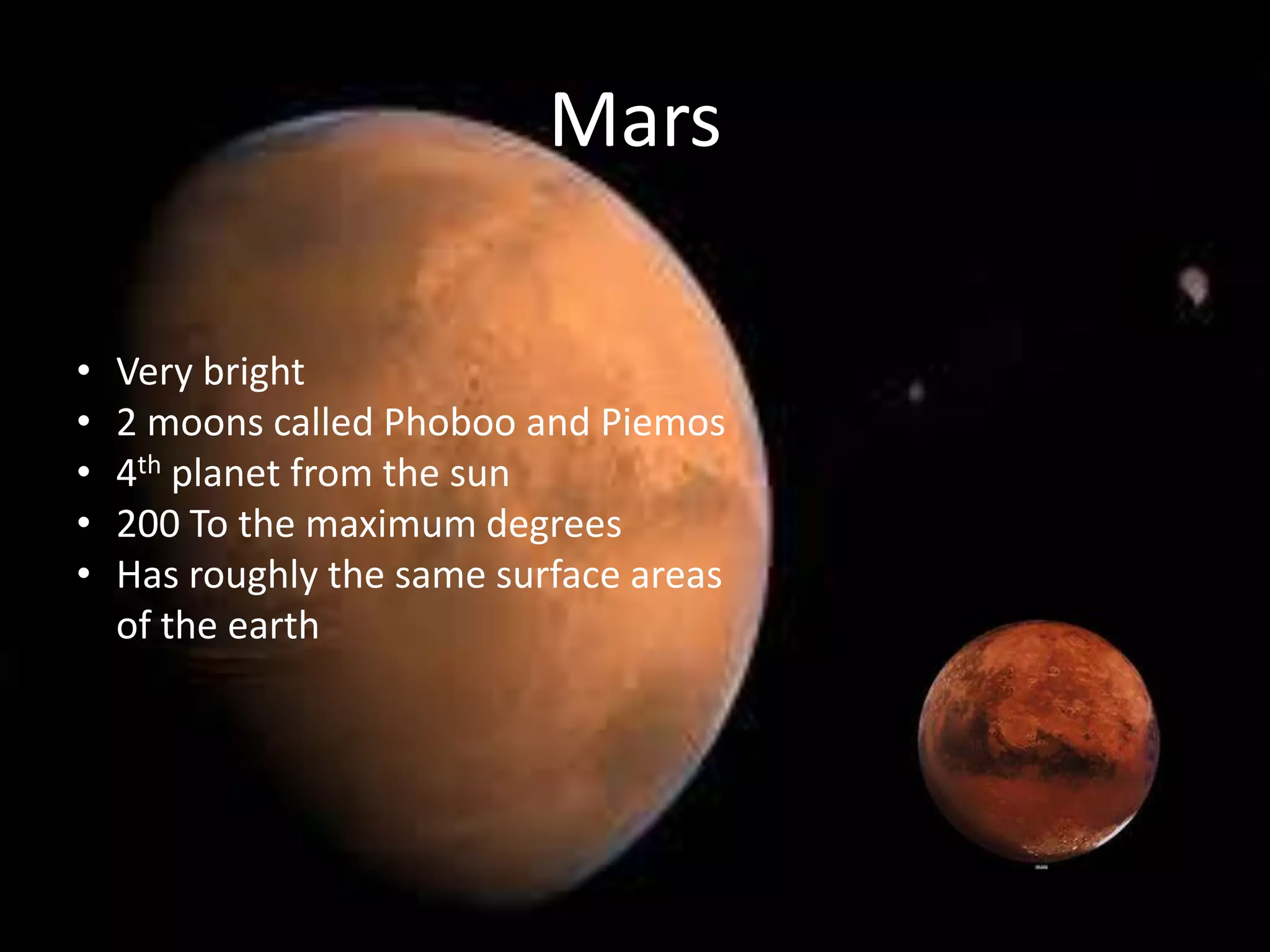
Mars
•
•
•
•
•

Very bright
2 moons called Phoboo and Piemos
4th planet from the sun
200 To the maximum degrees
Has roughly the same surface areas
of the earth
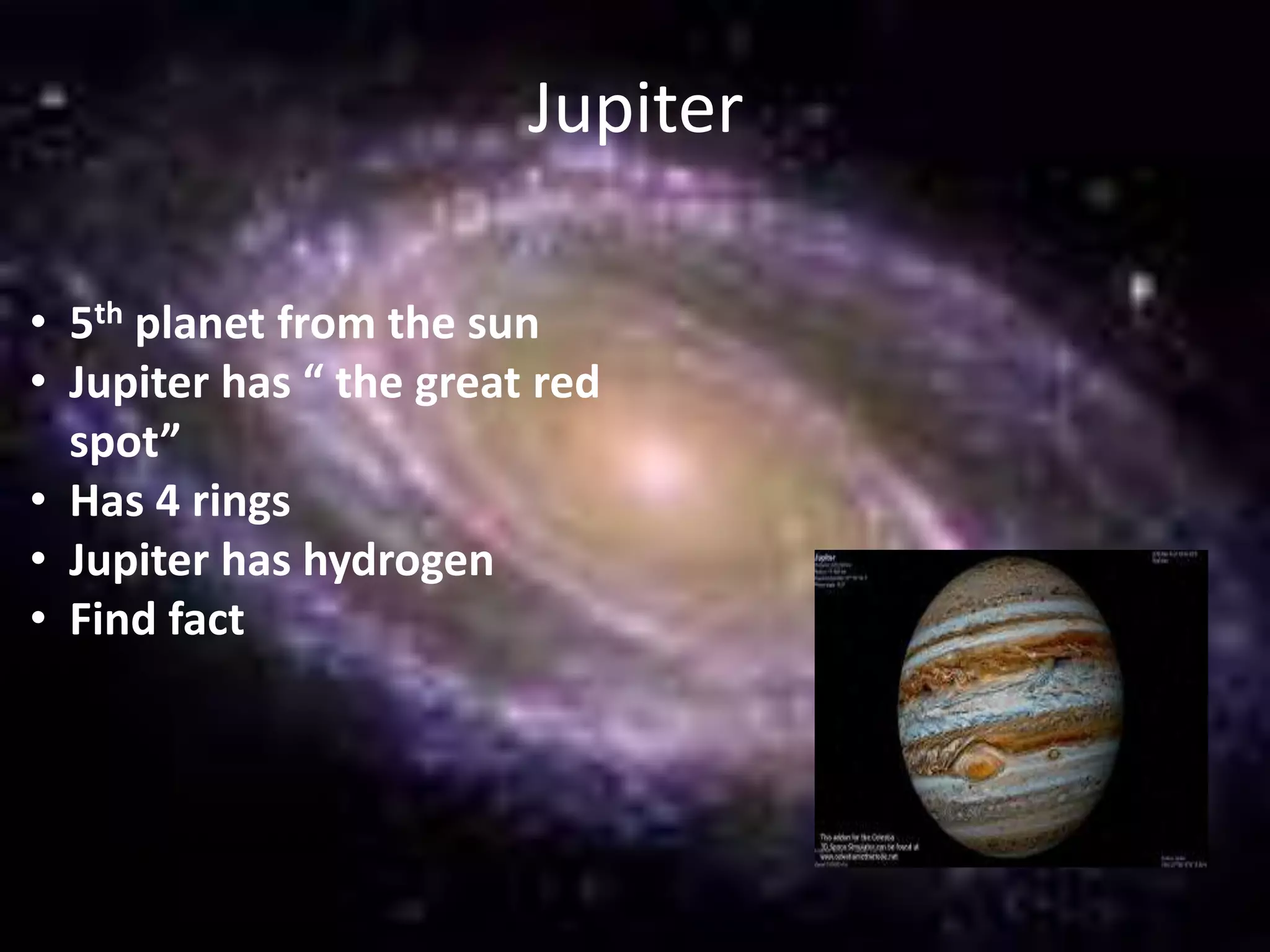
Jupiter
• 5th planet from the sun
• Jupiter has “ the great red
spot”
• Has 4 rings
• Jupiter has hydrogen
• Find fact
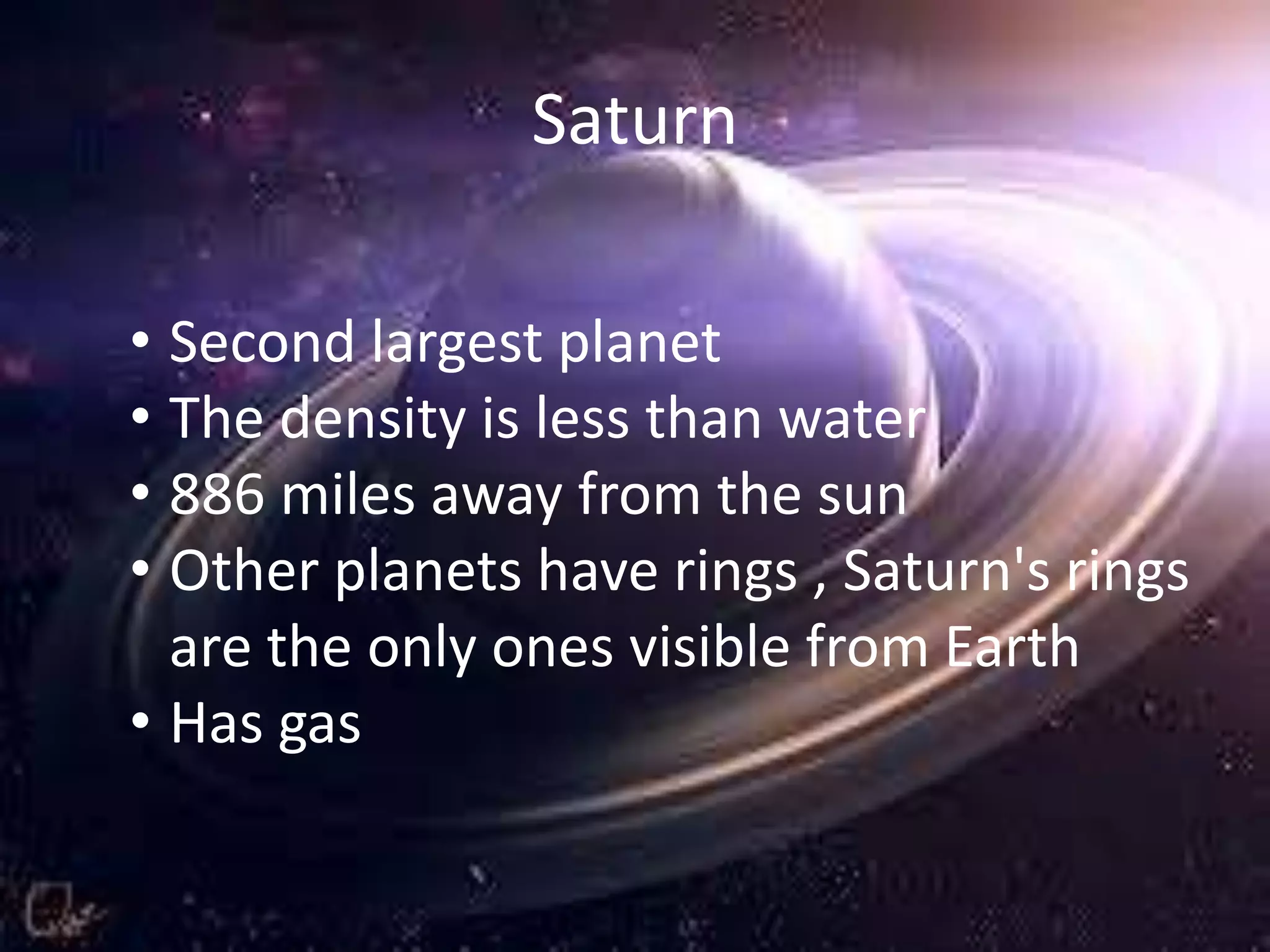
Saturn
• Second largest planet
• The density is less than water
• 886 miles away from the sun
• Other planets have rings , Saturn's rings
are the only ones visible from Earth
• Has gas
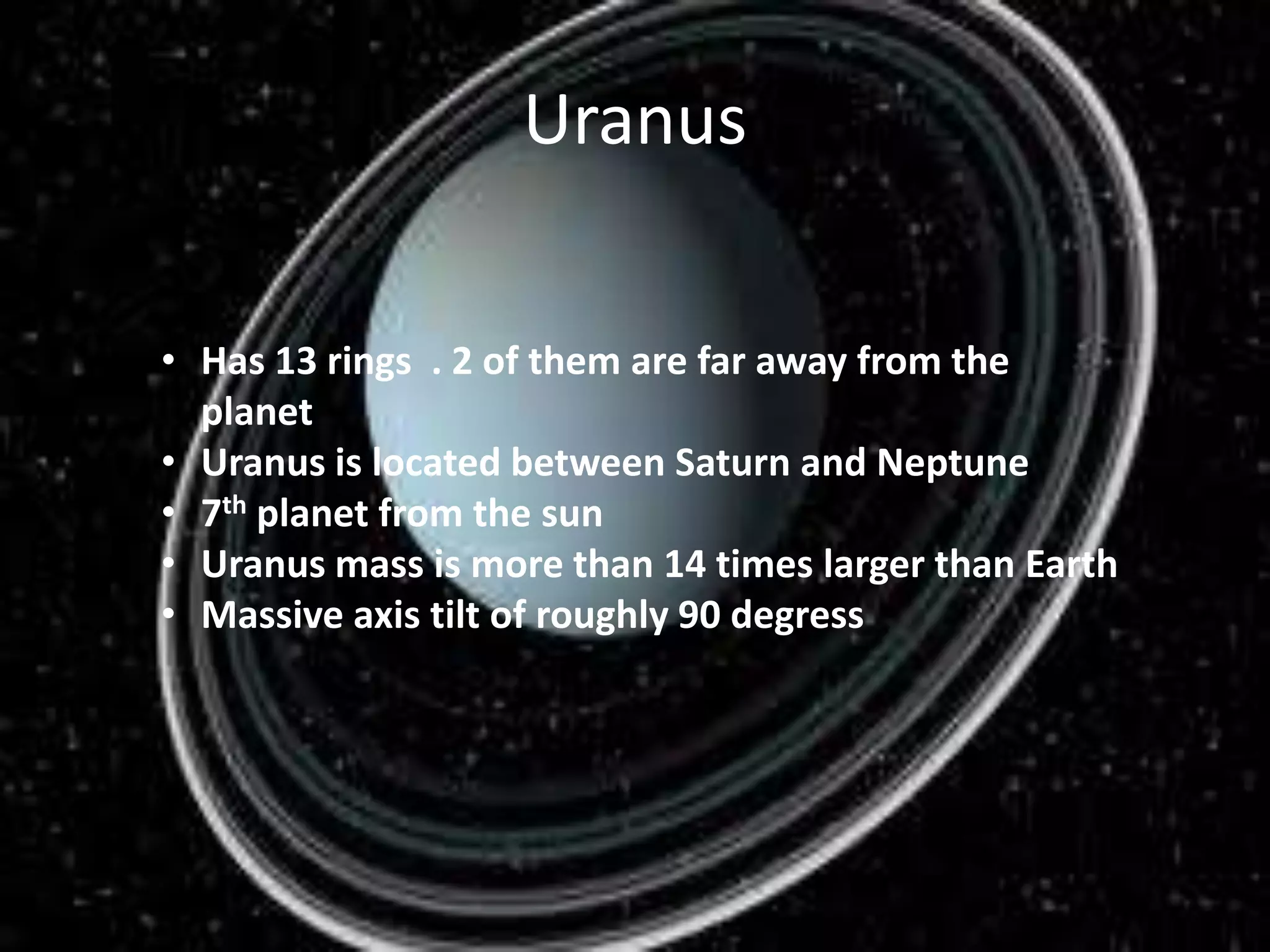
Uranus
• Has 13 rings . 2 of them are far away from the
planet
• Uranus is located between Saturn and Neptune
• 7th planet from the sun
• Uranus mass is more than 14 times larger than Earth
• Massive axis tilt of roughly 90 degress
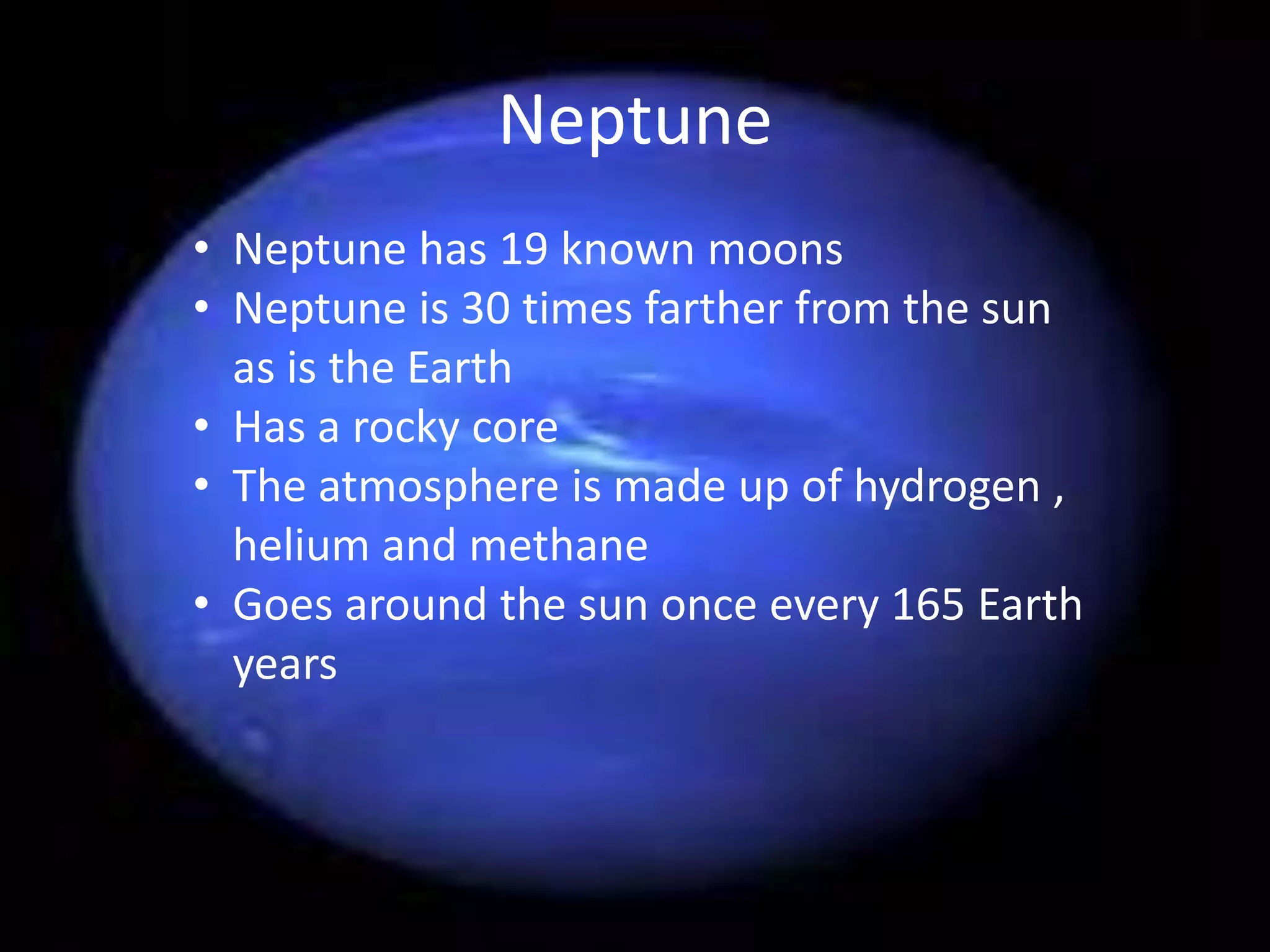
Neptune
• Neptune has 19 known moons
• Neptune is 30 times farther from the sun
as is the Earth
• Has a rocky core
• The atmosphere is made up of hydrogen ,
helium and methane
• Goes around the sun once every 165 Earth
years
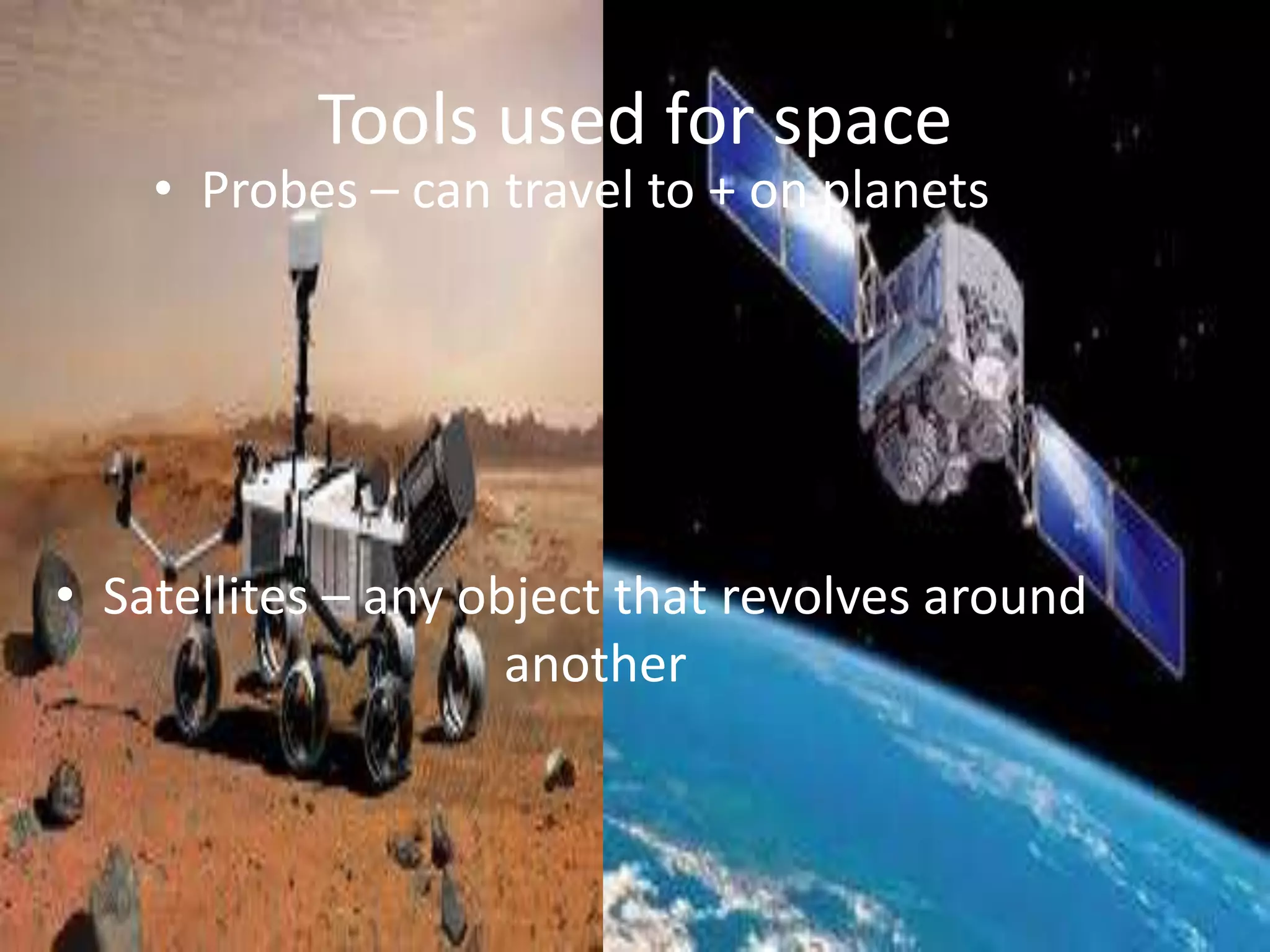
Tools used for space

• Probes – can travel to + on planets

• Satellites – any object that revolves around
another
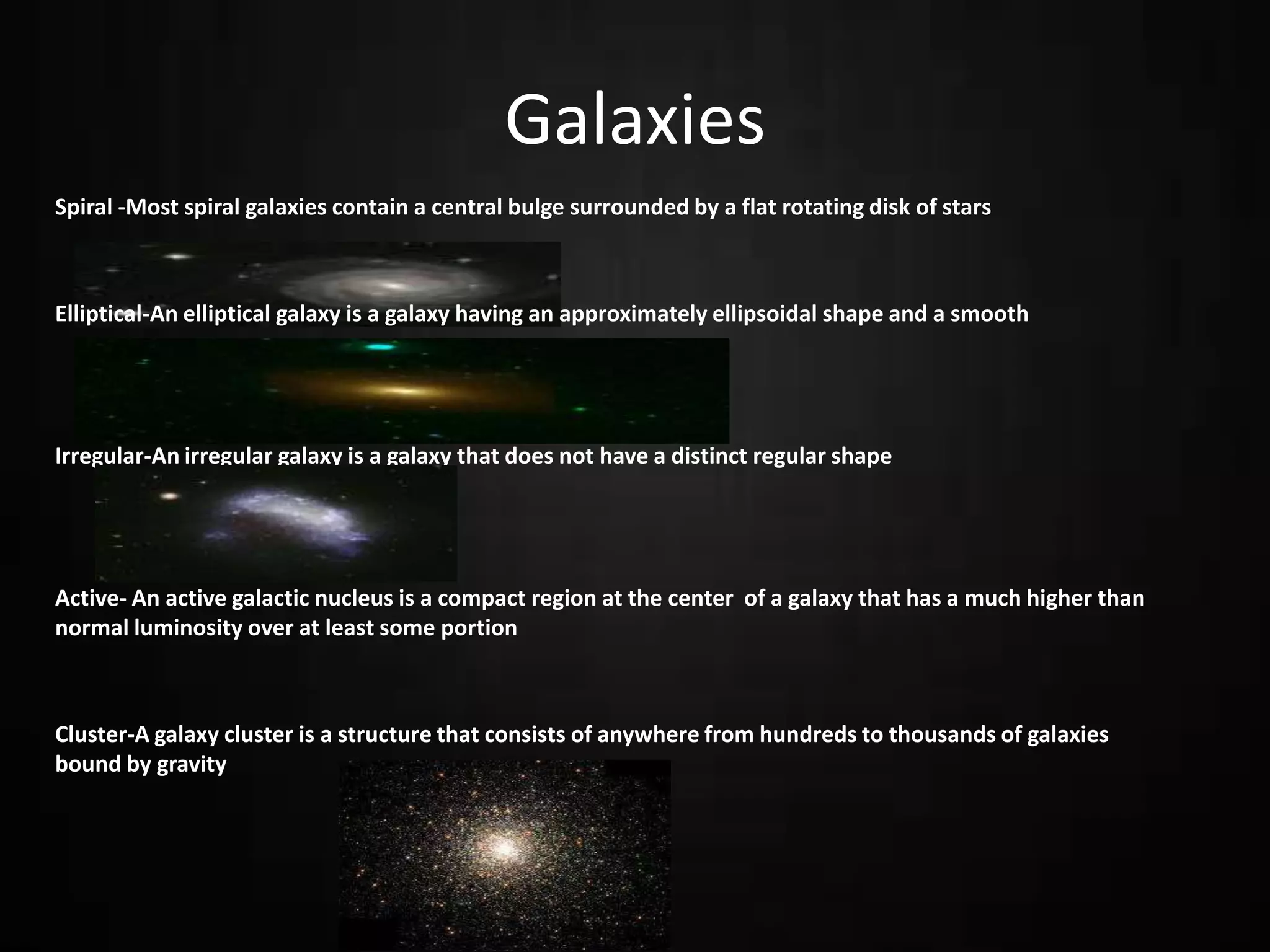
Galaxies
Spiral -Most spiral galaxies contain a central bulge surrounded by a flat rotating disk of stars

Elliptical-An elliptical galaxy is a galaxy having an approximately ellipsoidal shape and a smooth

Irregular-An irregular galaxy is a galaxy that does not have a distinct regular shape

Active- An active galactic nucleus is a compact region at the center of a galaxy that has a much higher than
normal luminosity over at least some portion

Cluster-A galaxy cluster is a structure that consists of anywhere from hundreds to thousands of galaxies
bound by gravity
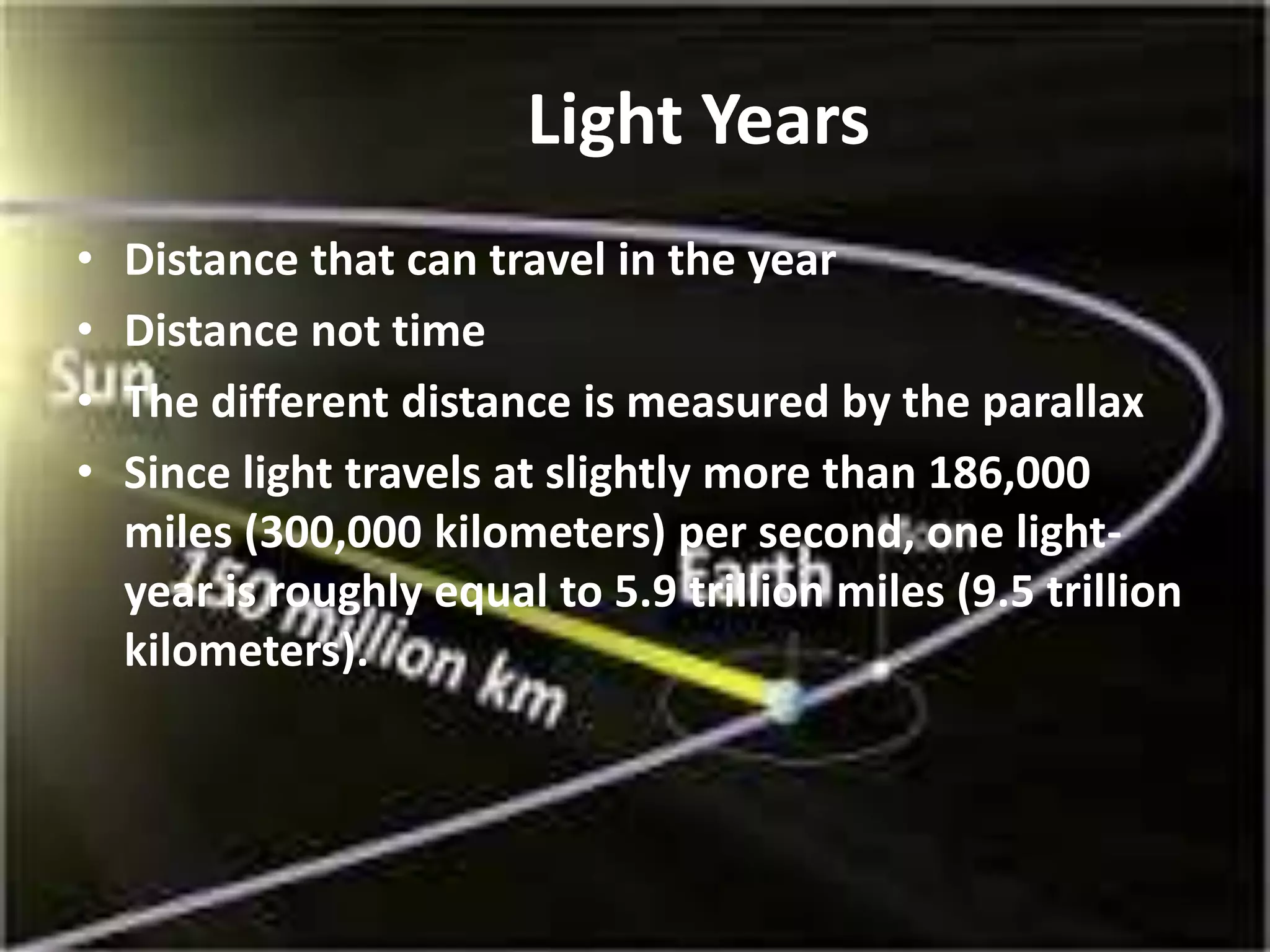
Light Years
•
•
•
•

Distance that can travel in the year
Distance not time
The different distance is measured by the parallax
Since light travels at slightly more than 186,000
miles (300,000 kilometers) per second, one lightyear is roughly equal to 5.9 trillion miles (9.5 trillion
kilometers).
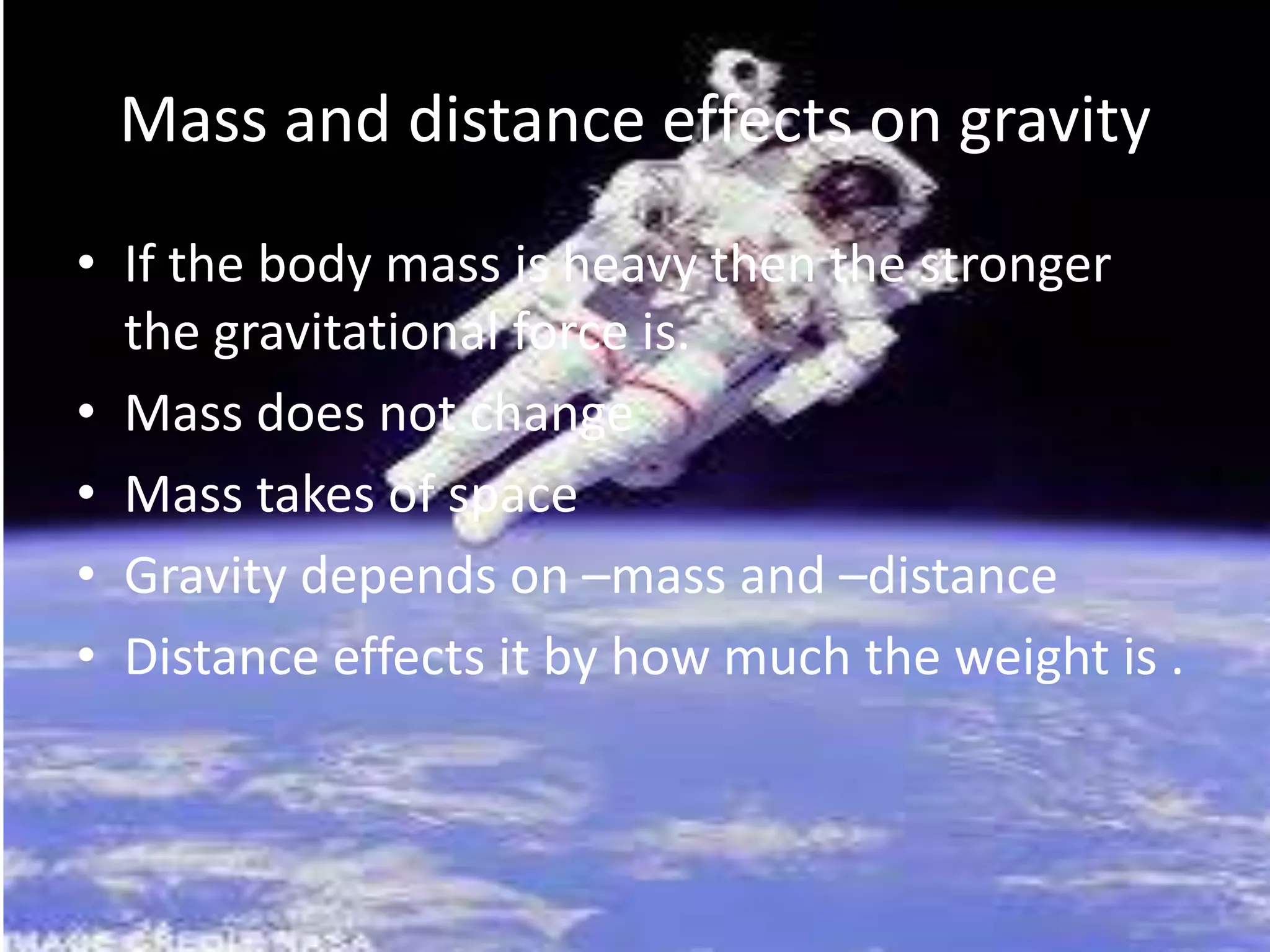
Mass and distance effects on gravity
• If the body mass is heavy then the stronger
the gravitational force is.
• Mass does not change
• Mass takes of space
• Gravity depends on –mass and –distance
• Distance effects it by how much the weight is .
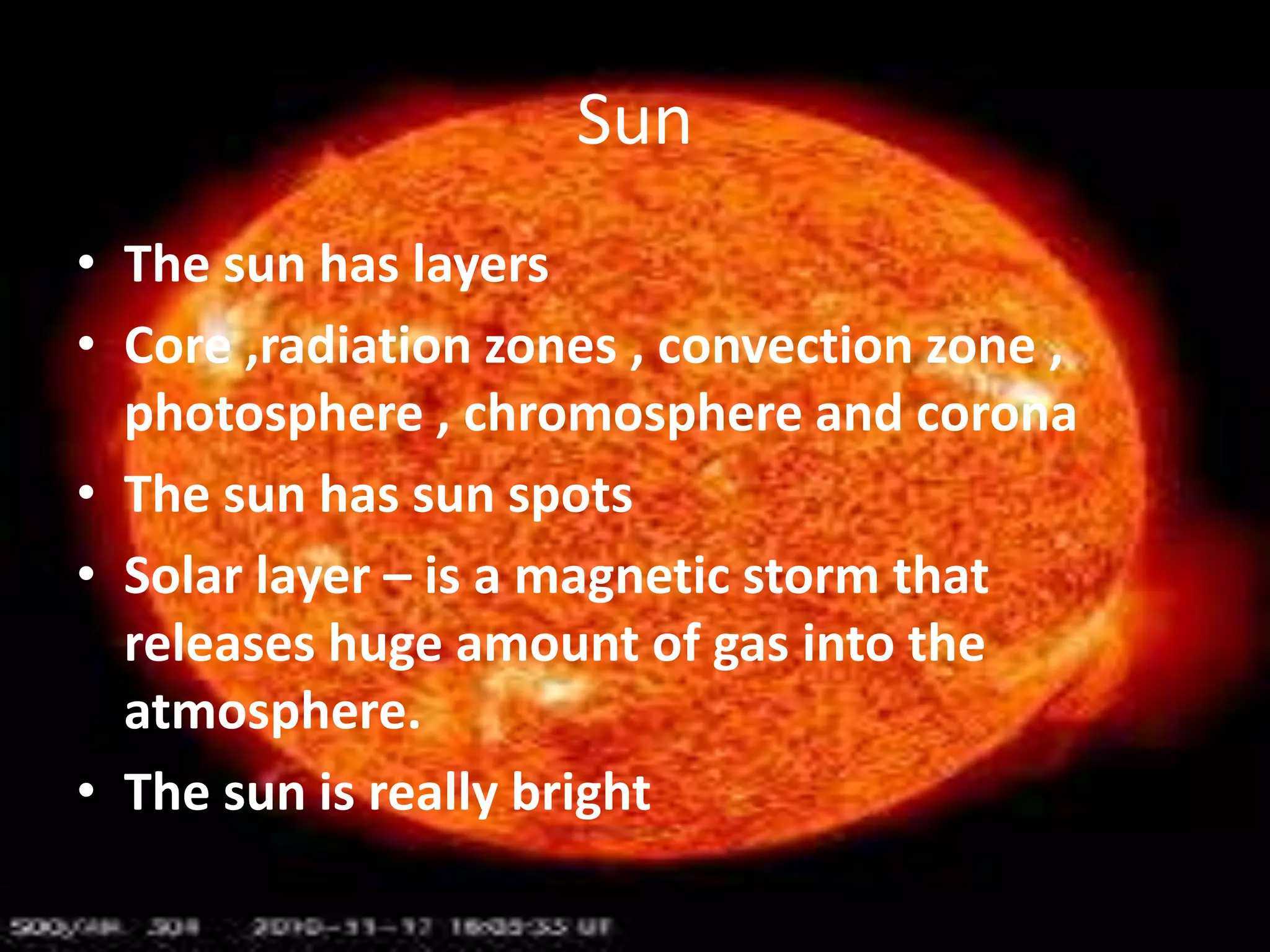
Sun
• The sun has layers
• Core ,radiation zones , convection zone ,
photosphere , chromosphere and corona
• The sun has sun spots
• Solar layer – is a magnetic storm that
releases huge amount of gas into the
atmosphere.
• The sun is really bright
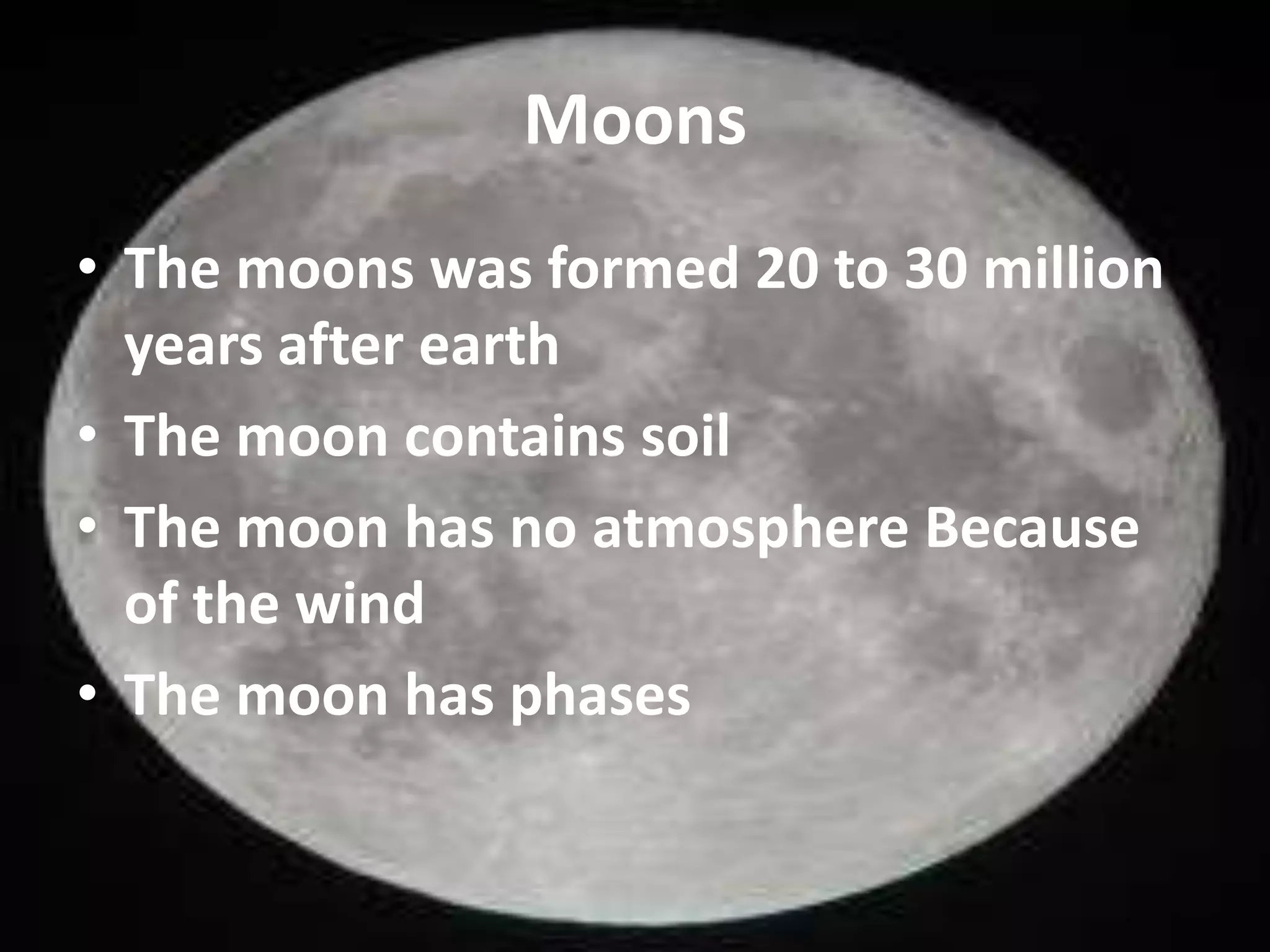
Moons
• The moons was formed 20 to 30 million
years after earth
• The moon contains soil
• The moon has no atmosphere Because
of the wind
• The moon has phases
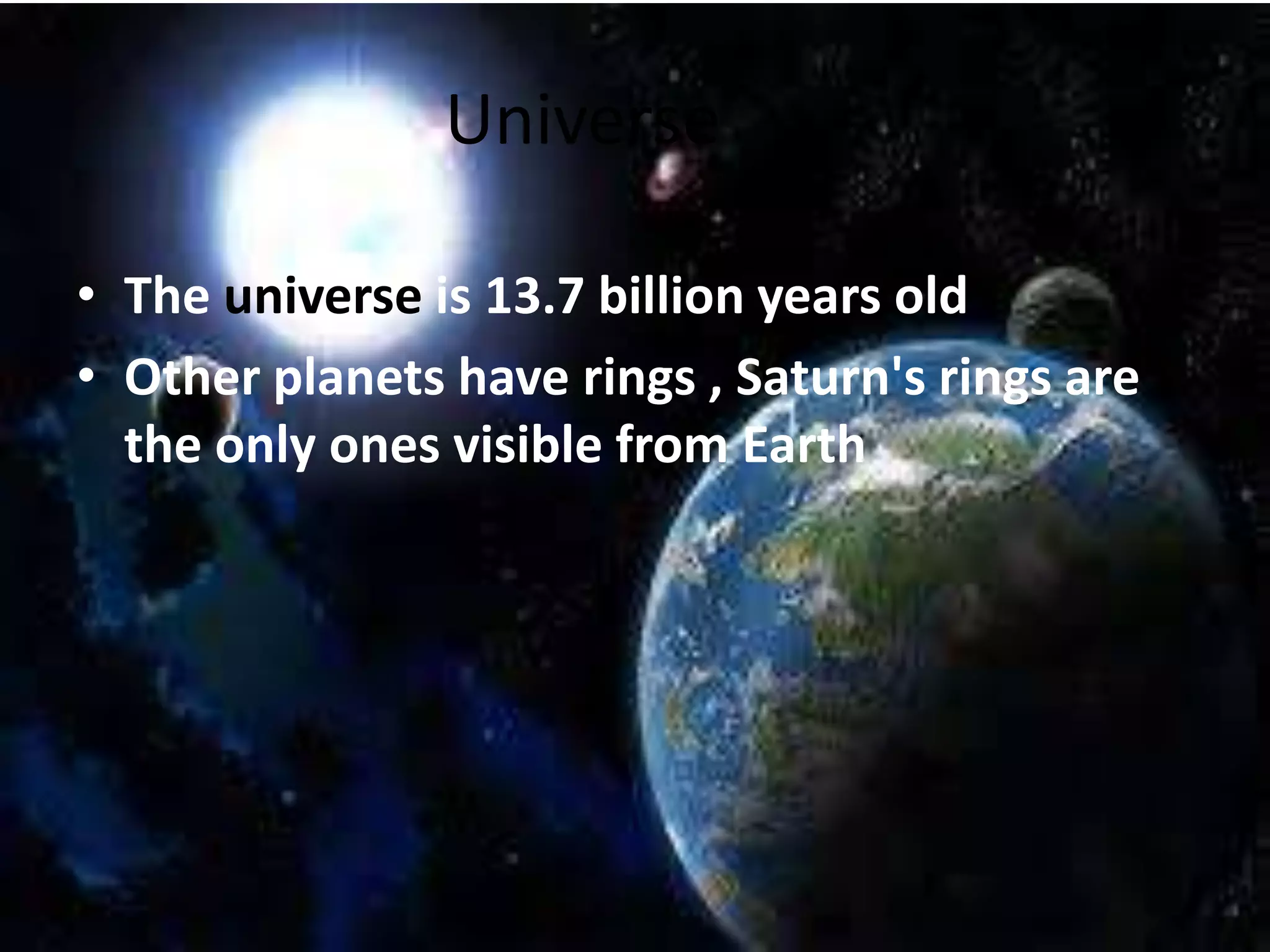
Universe
• The universe is 13.7 billion years old
• Other planets have rings , Saturn's rings are
the only ones visible from Earth
FUN FACTS!

• Even though Mercury is the closest planet to the Sun, temperatures can reach 280 degrees F. Why? Since Mercury has almost no atmosphere, there is nothing to
trap heat near the surface. So, the dark side of Mercury (the side facing away
from the Sun) is very cold.
• Venus is considerably hotter than Mercury, even though it is further away from
the Sun. The thickness of Venus’ atmosphere traps heat near the surface of the
planet.
• Every year the moon is moving away from the Earth by 3 cm.
• Some of the stars in the sky are so far that the light from them takes million of
years to reach us.
• The Sun is only an average size for a star but still accounts for 98% of the total
matter in our solar system.

Astronmy project

  • 1.
  • 2.
    Mercury • Mercury isthe second smallest planet in the solar system . • Mercury is 46 million kilometers from the sun . • Has no moons • Hot rocks • The surface is covered with craters .
  • 3.
    Venus • Orbits thesun every 224.7 Earth days • one of the brightest object in the sky • Venus is 6 million miles from the sun • Second planet from the sun • Venus rises and sets with the sun
  • 4.
    Earth • Orbits thesun • Earth has tectonic plates • Summer and winter are caused by the tilt of the Earth • 30% of Earth is covered by land • 70% of Eath is covered by water
  • 5.
    Mars • • • • • Very bright 2 moonscalled Phoboo and Piemos 4th planet from the sun 200 To the maximum degrees Has roughly the same surface areas of the earth
  • 6.
    Jupiter • 5th planetfrom the sun • Jupiter has “ the great red spot” • Has 4 rings • Jupiter has hydrogen • Find fact
  • 7.
    Saturn • Second largestplanet • The density is less than water • 886 miles away from the sun • Other planets have rings , Saturn's rings are the only ones visible from Earth • Has gas
  • 8.
    Uranus • Has 13rings . 2 of them are far away from the planet • Uranus is located between Saturn and Neptune • 7th planet from the sun • Uranus mass is more than 14 times larger than Earth • Massive axis tilt of roughly 90 degress
  • 9.
    Neptune • Neptune has19 known moons • Neptune is 30 times farther from the sun as is the Earth • Has a rocky core • The atmosphere is made up of hydrogen , helium and methane • Goes around the sun once every 165 Earth years
  • 10.
    Tools used forspace • Probes – can travel to + on planets • Satellites – any object that revolves around another
  • 11.
    Galaxies Spiral -Most spiralgalaxies contain a central bulge surrounded by a flat rotating disk of stars Elliptical-An elliptical galaxy is a galaxy having an approximately ellipsoidal shape and a smooth Irregular-An irregular galaxy is a galaxy that does not have a distinct regular shape Active- An active galactic nucleus is a compact region at the center of a galaxy that has a much higher than normal luminosity over at least some portion Cluster-A galaxy cluster is a structure that consists of anywhere from hundreds to thousands of galaxies bound by gravity
  • 12.
    Light Years • • • • Distance thatcan travel in the year Distance not time The different distance is measured by the parallax Since light travels at slightly more than 186,000 miles (300,000 kilometers) per second, one lightyear is roughly equal to 5.9 trillion miles (9.5 trillion kilometers).
  • 13.
    Mass and distanceeffects on gravity • If the body mass is heavy then the stronger the gravitational force is. • Mass does not change • Mass takes of space • Gravity depends on –mass and –distance • Distance effects it by how much the weight is .
  • 14.
    Sun • The sunhas layers • Core ,radiation zones , convection zone , photosphere , chromosphere and corona • The sun has sun spots • Solar layer – is a magnetic storm that releases huge amount of gas into the atmosphere. • The sun is really bright
  • 15.
    Moons • The moonswas formed 20 to 30 million years after earth • The moon contains soil • The moon has no atmosphere Because of the wind • The moon has phases
  • 16.
    Universe • The universeis 13.7 billion years old • Other planets have rings , Saturn's rings are the only ones visible from Earth
  • 17.
    FUN FACTS! • Eventhough Mercury is the closest planet to the Sun, temperatures can reach 280 degrees F. Why? Since Mercury has almost no atmosphere, there is nothing to trap heat near the surface. So, the dark side of Mercury (the side facing away from the Sun) is very cold. • Venus is considerably hotter than Mercury, even though it is further away from the Sun. The thickness of Venus’ atmosphere traps heat near the surface of the planet. • Every year the moon is moving away from the Earth by 3 cm. • Some of the stars in the sky are so far that the light from them takes million of years to reach us. • The Sun is only an average size for a star but still accounts for 98% of the total matter in our solar system.