PPACA Update:
How The Affordable Care Act Will
Affect Employers
Seth Perretta
Principal, Co-Chair of the Health Practice Group
Groom Law Group
April 24, 2014
We	
  will	
  cover...	
  
•  Status	
  of	
  the	
  individual	
  mandate	
  
•  Employer	
  mandate	
  or	
  “pay	
  or	
  play”	
  
•  Brief	
  refresher	
  on	
  “pay”	
  or	
  “play”	
  choice	
  
•  How	
  to	
  determine	
  whether	
  you	
  are	
  subject	
  to	
  the	
  employer	
  mandate	
  	
  
•  Overview	
  of	
  the	
  recently	
  issued	
  final	
  regula@ons	
  	
  
•  Treatment	
  of	
  various	
  types	
  of	
  workers	
  
•  Seasonal	
  employees	
  
•  Short-­‐term,	
  non-­‐seasonal	
  hires	
  
•  State	
  of	
  public	
  and	
  private	
  exchanges	


2	
  
•  Originally	
  scheduled	
  to	
  take	
  effect	
  on	
  January	
  1,	
  2014	
  
•  Now	
  scheduled	
  to	
  take	
  effect	
  on	
  January	
  1,	
  2015	
  
•  Generally	
  requires	
  that	
  all	
  nonexempt	
  individuals	
  be	
  
enrolled	
  in	
  “minimum	
  essen@al	
  coverage”	
  or	
  pay	
  a	
  tax	
  
penalty	


Individual	
  Mandate	
  
•  Originally	
  effec@ve	
  for	
  2014,	
  but	
  delayed	
  for	
  one	
  year	
  
•  Now	
  scheduled	
  to	
  take	
  effect	
  on	
  January	
  1,	
  2015	
  
•  Addi@onal	
  delay	
  for:	
  
•  Qualifying	
  sponsors	
  of	
  non-­‐calendar	
  year	
  plans	
  
•  Qualifying	
  employers	
  with	
  50-­‐99	
  full-­‐@me	
  (FTs)	
  and	


  full-­‐@me	
  equivalent	
  (FTE)	
  employees	
  
•  Limited	
  transi@on	
  relief	
  for	
  the	
  “A-­‐Penalty”	


“Pay	
  or	
  Play”	
  
•  Two	
  separate	
  penal@es:	
  
•  4980H(a)	
  or	
  “A-­‐Penalty”	
  
•  4980H(b)	
  or	
  “B-­‐Penalty”	


“Pay	
  or	
  Play”	
  
•  A-­‐Penalty	
  (4980H(a))	
  
•  Some@mes	
  referred	
  to	
  as	
  the	
  “offering	
  requirement”	
  
•  General	
  rule	
  =	
  An	
  employer	
  must	
  offer	
  “minimum	
  essen@al	
  
coverage”	
  (MEC)	
  to	
  95%	
  of	
  its	
  4980H-­‐defined	
  full-­‐@me	
  
employees	
  “(and	
  their	
  dependents)”	
  or	
  risk	
  a	
  penalty	
  equal	
  to	
  (i)	
  
$2,000,	
  mul@plied	
  by	
  (ii)	
  the	
  number	
  of	
  full-­‐@me	
  employees	
  
minus	
  30	
  
•  **	
  Certain	
  transi@on	
  relief	
  through	
  close	
  of	
  2015	
  plan	
  year	
  was	
  
provided	
  **	


“Pay	
  or	
  Play”	
  
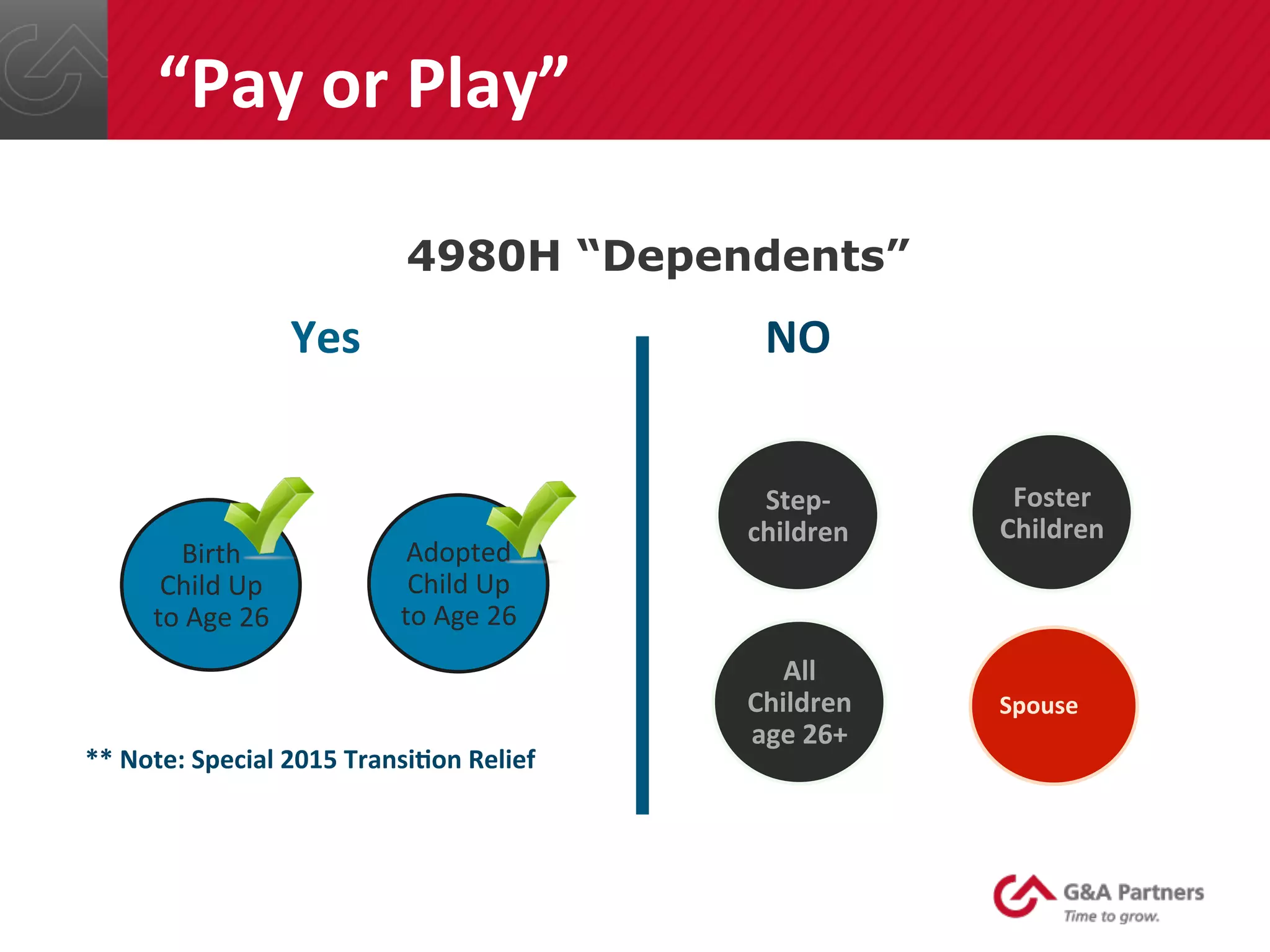
Birth	
  
Child	
  Up	
  
to	
  Age	
  26	
  
Adopted	
  
Child	
  Up	
  
to	
  Age	
  26	
  
Step-­‐
children	
  
Foster	
  
Children	
  
All	
  
Children	
  
age	
  26+	
  
4980H “Dependents”


  Yes	


  NO	


  Spouse	
  
**	
  Note:	
  Special	
  2015	
  TransiUon	
  Relief	
  
“Pay	
  or	
  Play”	
  
•  B-­‐Penalty	
  (4980H(b))	
  
•  General	
  rule	
  =	
  Even	
  if	
  an	
  employer	
  sa@sfies	
  the	
  offering	
  requirement	
  (i.e.,	
  
avoids	
  the	
  A-­‐Penalty),	
  if	
  the	
  employer	
  fails	
  to	
  offer	
  affordable	
  and	
  minimum	
  
value	
  coverage	
  to	
  a	
  full-­‐@me	
  employee,	
  it	
  can	
  risk	
  a	
  B-­‐Penalty	
  generally	
  equal	
  
to	
  $3,000	
  per	
  year	
  for	
  that	
  employee	


“Pay	
  or	
  Play”	
  
•  4980H	
  Applies	
  to	
  “applicable	
  large	
  employers”	
  or	
  ALEs	
  
•  Who	
  is	
  an	
  ALE?	
  
•  An	
  employer	
  that	
  employed	
  on	
  average	
  at	
  least	
  50	
  full-­‐@me	
  employees	
  (FTs)	
  or	
  full-­‐
@me	
  equivalents	
  (FTEs)	
  during	
  the	
  preceding	
  calendar	
  year	
  
•  Note:	
  	
  Special	
  seasonal	
  worker	
  excep@on	
  
•  ALSO,	
  special	
  transi@on	
  rule	
  for	
  2015	
  
•  Things	
  to	
  keep	
  in	
  mind:	
  
•  ALE	
  status	
  is	
  determined	
  using	
  IRS	
  80%	
  controlled	
  group	
  rules	
  
•  But	
  once	
  ALE	
  status	
  is	
  determined,	
  each	
  ALE	
  member	
  gets	
  its	
  own	
  “pay	
  or	
  play”	
  
decision	


Subject	
  Employers:	
  ALEs	
  
•  To	
  determine	
  ALE	
  status,	
  you	
  need	
  to	
  take	
  the	
  following	
  
steps:	
  
1.  For	
  each	
  calendar	
  month	
  last	
  year:	
  
•  Determine	
  the	
  client	
  employer’s	
  number	
  of	


  full-­‐@me	
  employees	
  across	
  its	
  controlled	
  group	
  	
  
•  Determine	
  the	
  client	
  employer’s	
  number	
  of	


  full-­‐@me	
  equivalent	
  employees	
  	
  
2.  Add	
  up	
  the	
  number	
  of	
  	
  FTs	
  and	
  FTEs	
  for	
  all	
  12	
  months	
  of	
  last	
  
year	
  and	
  divide	
  by	
  12	
  
Subject	
  Employers:	
  ALEs	
  
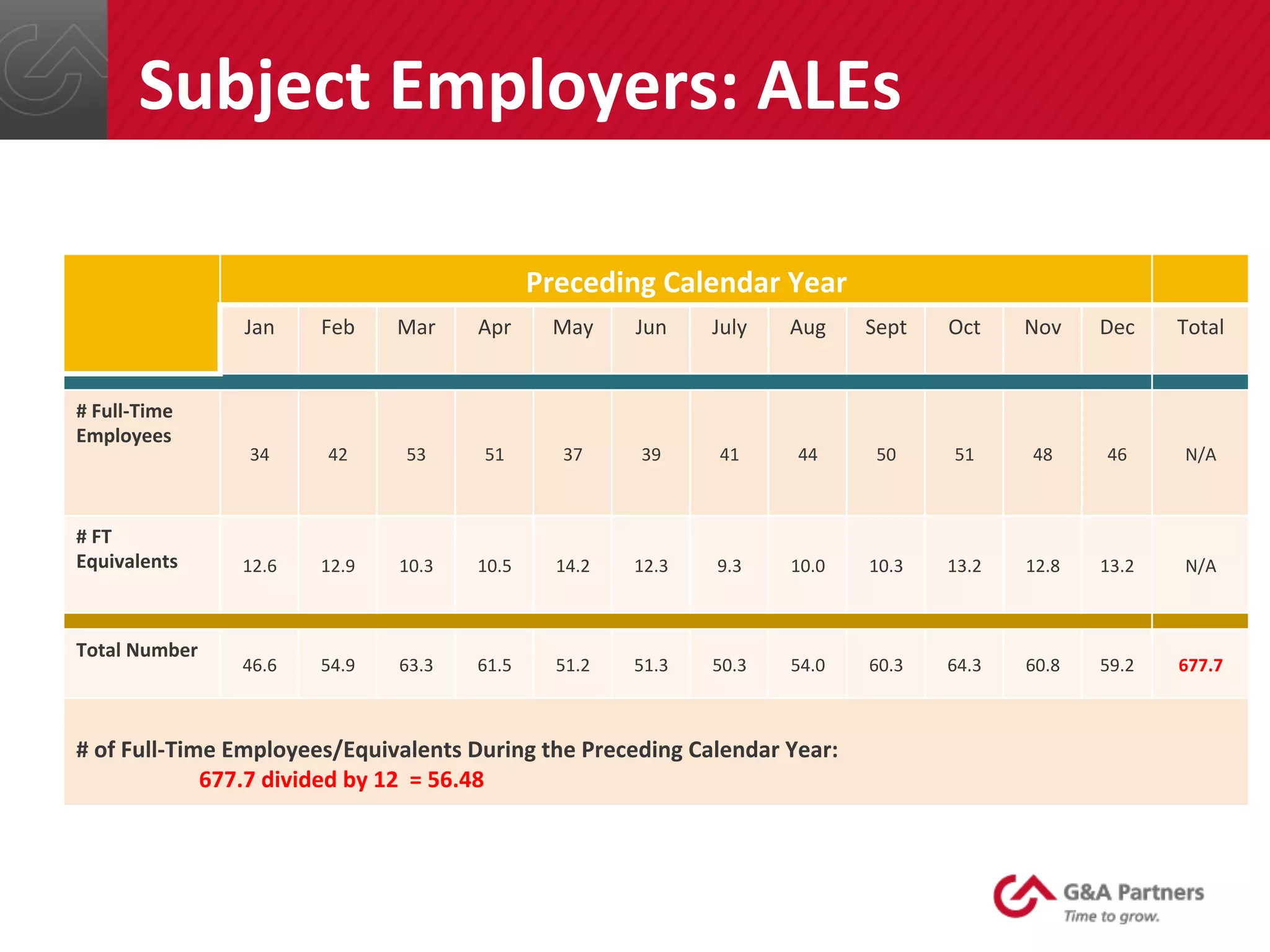
Preceding	
  Calendar	
  Year	
  
Jan	
   Feb	
   Mar	
   Apr	
   May	
   Jun	
   July	
   Aug	
   Sept	
   Oct	
   Nov	
   Dec	
   Total	
  
#	
  Full-­‐Time	
  
Employees	
  
34	
   42	
   53	
   51	
   37	
   39	
   41	
   44	
   50	
   51	
   48	
   46	
   N/A	
  
#	
  FT	
  
Equivalents	
   12.6	
   12.9	
   10.3	
   10.5	
   14.2	
   12.3	
   9.3	
   10.0	
   10.3	
   13.2	
   12.8	
   13.2	
   N/A	
  
Total	
  Number	
  
46.6	
   54.9	
   63.3	
   61.5	
   51.2	
   51.3	
   50.3	
   54.0	
   60.3	
   64.3	
   60.8	
   59.2	
   677.7	


#	
  of	
  Full-­‐Time	
  Employees/Equivalents	
  During	
  the	
  Preceding	
  Calendar	
  Year:	


  677.7	
  divided	
  by	
  12	
  	
  =	
  56.48	
  
Subject	
  Employers:	
  ALEs	
  
•  Full-­‐Time	
  Employee	
  (FT)	
  
•  Defini@on:	
  Worked	
  on	
  average	
  120	
  hours	
  during	
  the	
  
calendar	
  month	
  at	
  issue	
  
•  NOTE:	
  	
  This	
  is	
  NOT	
  the	
  same	
  defini@on	
  of	
  FT	
  that	
  applies	
  in	
  second	
  step	
  of	
  
analysis,	
  i.e.,	
  when	
  determining	
  TO	
  WHOM	
  qualifying	
  coverage	
  must	
  be	
  
provided.	
  	
  (That	
  defini@on	
  uses	
  30	
  hours/wk	
  or	
  130	
  hours/month).	


Subject	
  Employers:	
  ALEs	
  
•  Full-­‐Time	
  Equivalent	
  Employee	
  (FTE)	
  
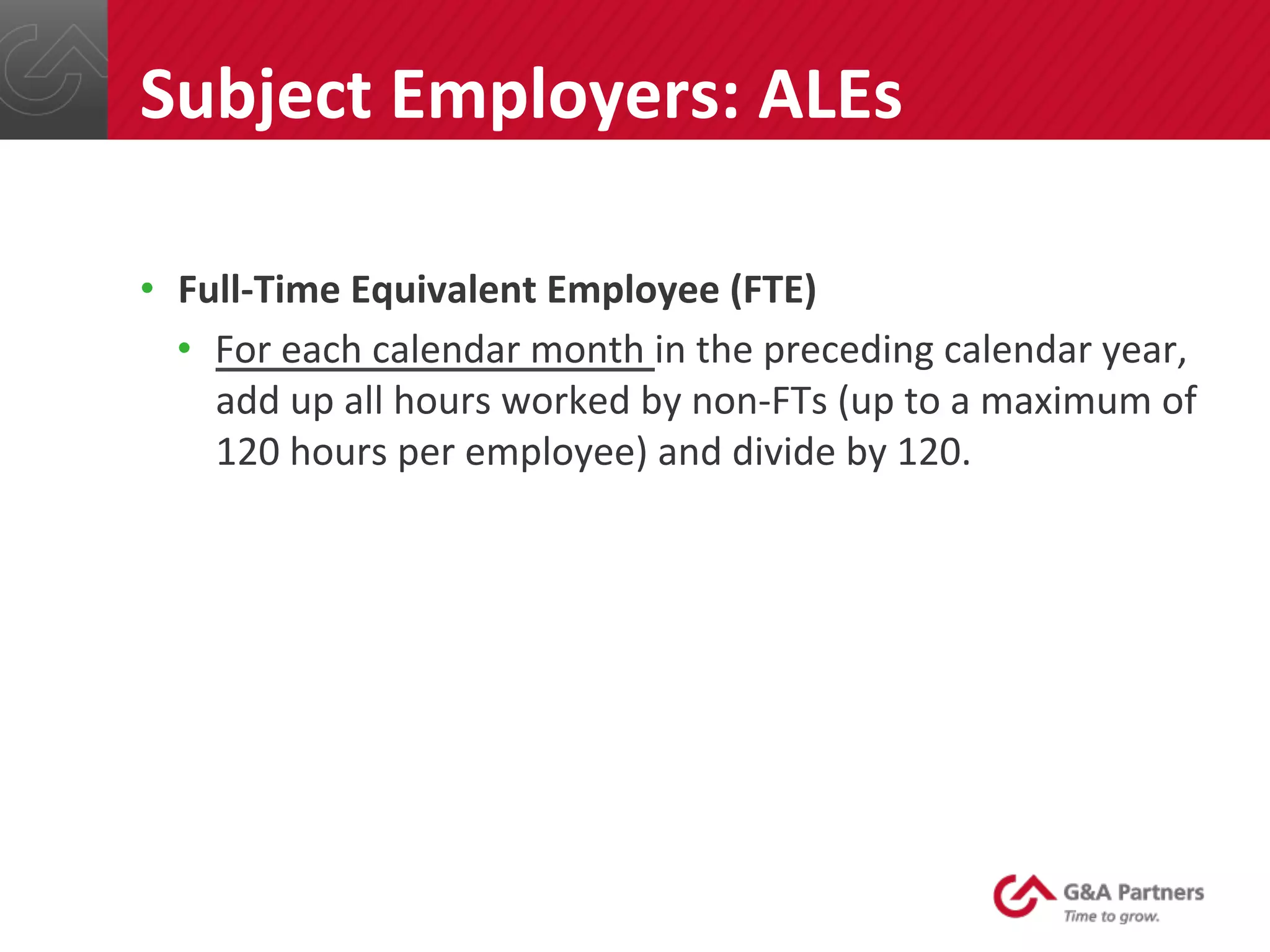
•  For	
  each	
  calendar	
  month	
  in	
  the	
  preceding	
  calendar	
  year,	
  
add	
  up	
  all	
  hours	
  worked	
  by	
  non-­‐FTs	
  (up	
  to	
  a	
  maximum	
  of	
  
120	
  hours	
  per	
  employee)	
  and	
  divide	
  by	
  120.	


Subject	
  Employers:	
  ALEs	
  
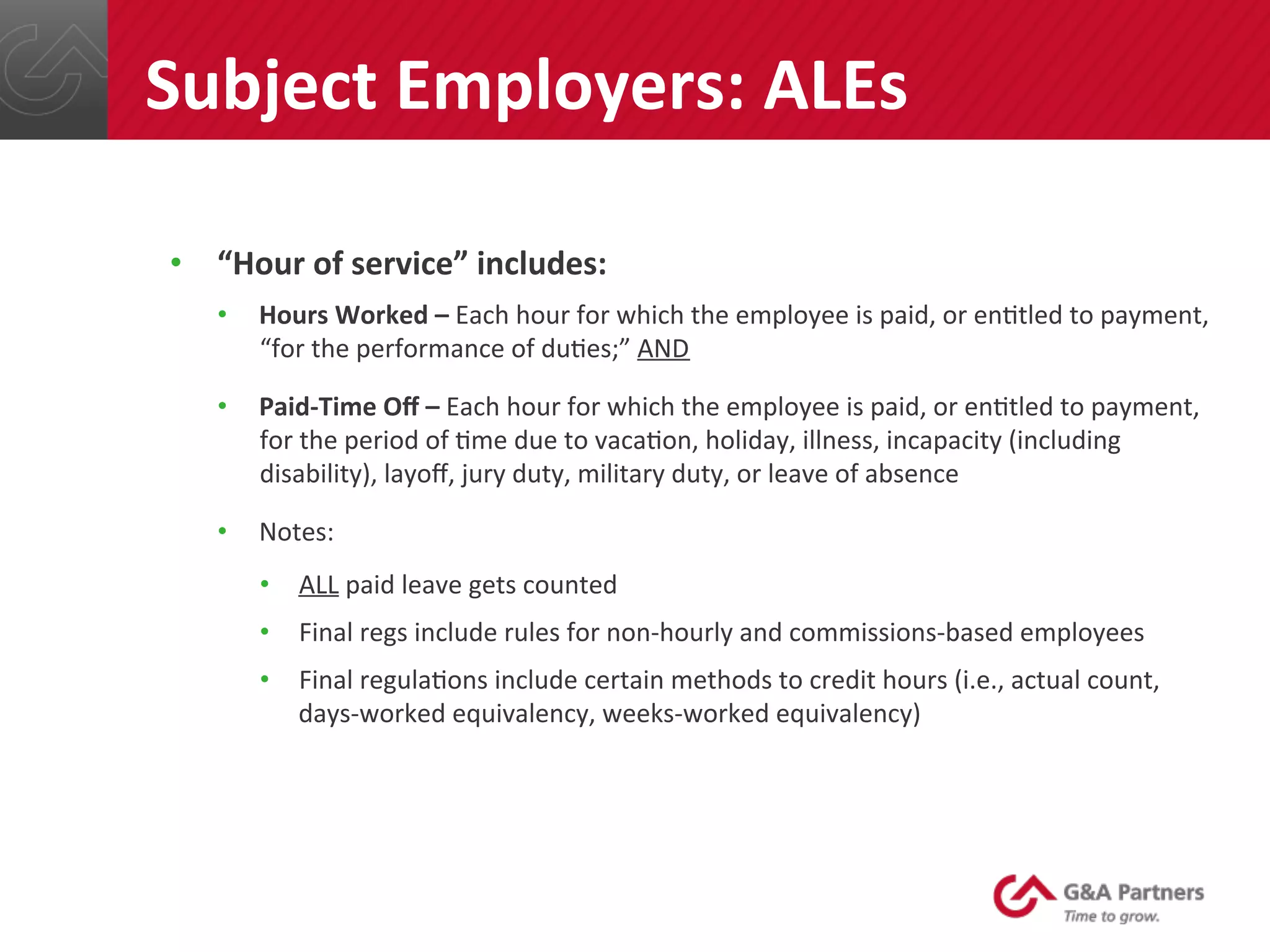
•  “Hour	
  of	
  service”	
  includes:	
  
•  Hours	
  Worked	
  –	
  Each	
  hour	
  for	
  which	
  the	
  employee	
  is	
  paid,	
  or	
  en@tled	
  to	
  payment,	
  
“for	
  the	
  performance	
  of	
  du@es;”	
  AND	
  
•  Paid-­‐Time	
  Off	
  –	
  Each	
  hour	
  for	
  which	
  the	
  employee	
  is	
  paid,	
  or	
  en@tled	
  to	
  payment,	
  
for	
  the	
  period	
  of	
  @me	
  due	
  to	
  vaca@on,	
  holiday,	
  illness,	
  incapacity	
  (including	
  
disability),	
  layoff,	
  jury	
  duty,	
  military	
  duty,	
  or	
  leave	
  of	
  absence	
  
•  Notes:	
  
•  ALL	
  paid	
  leave	
  gets	
  counted	
  
•  Final	
  regs	
  include	
  rules	
  for	
  non-­‐hourly	
  and	
  commissions-­‐based	
  employees	
  
•  Final	
  regula@ons	
  include	
  certain	
  methods	
  to	
  credit	
  hours	
  (i.e.,	
  actual	
  count,	
  
days-­‐worked	
  equivalency,	
  weeks-­‐worked	
  equivalency)	


Subject	
  Employers:	
  ALEs	
  
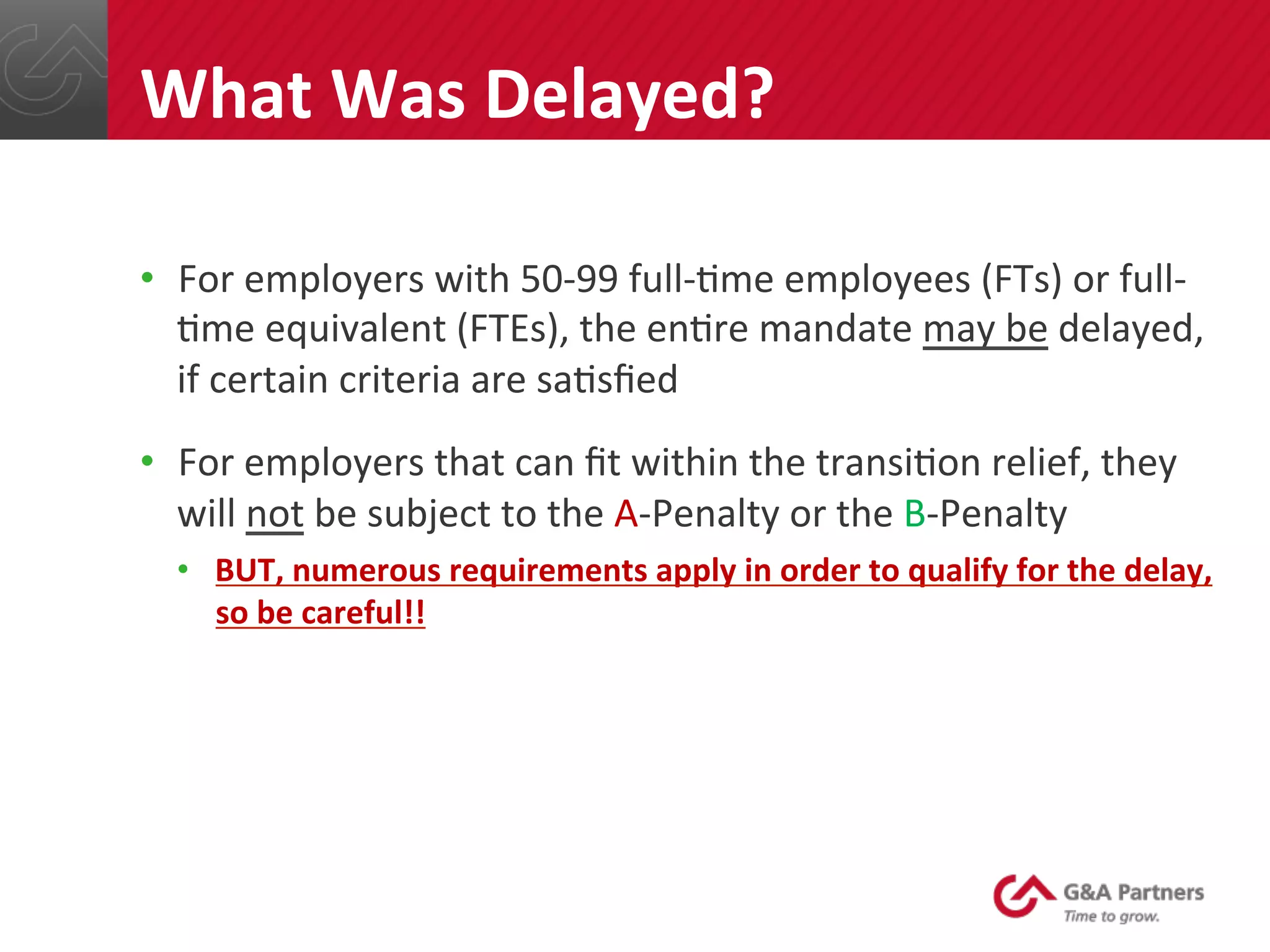
•  For	
  employers	
  with	
  50-­‐99	
  full-­‐@me	
  employees	
  (FTs)	
  or	
  full-­‐
@me	
  equivalent	
  (FTEs),	
  the	
  en@re	
  mandate	
  may	
  be	
  delayed,	
  
if	
  certain	
  criteria	
  are	
  sa@sfied	
  
•  For	
  employers	
  that	
  can	
  fit	
  within	
  the	
  transi@on	
  relief,	
  they	
  
will	
  not	
  be	
  subject	
  to	
  the	
  A-­‐Penalty	
  or	
  the	
  B-­‐Penalty	
  
•  BUT,	
  numerous	
  requirements	
  apply	
  in	
  order	
  to	
  qualify	
  for	
  the	
  delay,	
  
so	
  be	
  careful!!	


What	
  Was	
  Delayed?	
  
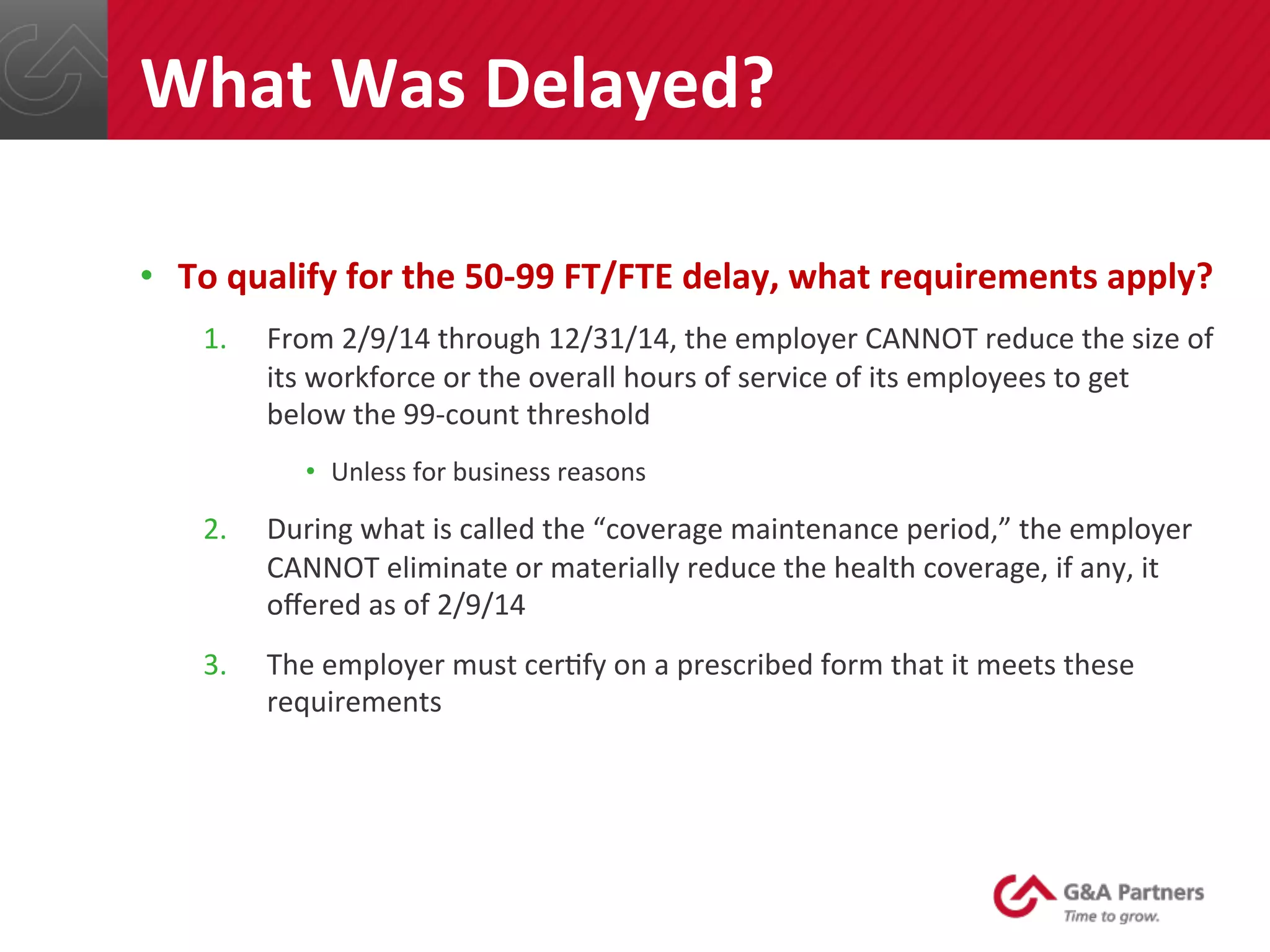
•  To	
  qualify	
  for	
  the	
  50-­‐99	
  FT/FTE	
  delay,	
  what	
  requirements	
  apply?	
  
1.  From	
  2/9/14	
  through	
  12/31/14,	
  the	
  employer	
  CANNOT	
  reduce	
  the	
  size	
  of	
  
its	
  workforce	
  or	
  the	
  overall	
  hours	
  of	
  service	
  of	
  its	
  employees	
  to	
  get	
  
below	
  the	
  99-­‐count	
  threshold	
  
•  Unless	
  for	
  business	
  reasons	
  
2.  During	
  what	
  is	
  called	
  the	
  “coverage	
  maintenance	
  period,”	
  the	
  employer	
  
CANNOT	
  eliminate	
  or	
  materially	
  reduce	
  the	
  health	
  coverage,	
  if	
  any,	
  it	
  
offered	
  as	
  of	
  2/9/14	
  
3.  The	
  employer	
  must	
  cer@fy	
  on	
  a	
  prescribed	
  form	
  that	
  it	
  meets	
  these	
  
requirements	


What	
  Was	
  Delayed?	
  
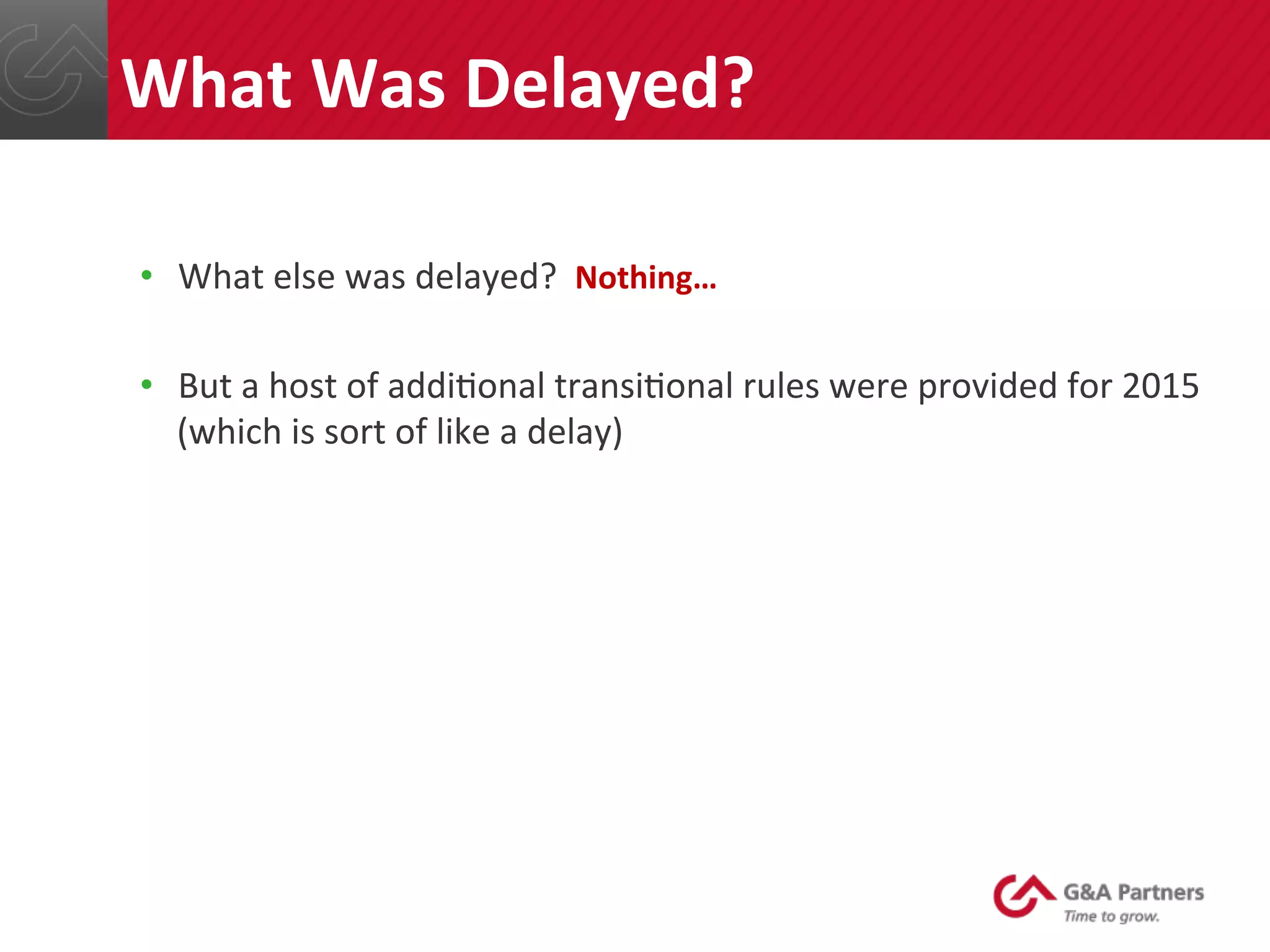
•  What	
  else	
  was	
  delayed?	
  	
  Nothing…	


•  But	
  a	
  host	
  of	
  addi@onal	
  transi@onal	
  rules	
  were	
  provided	
  for	
  2015	
  
(which	
  is	
  sort	
  of	
  like	
  a	
  delay)	


What	
  Was	
  Delayed?	
  
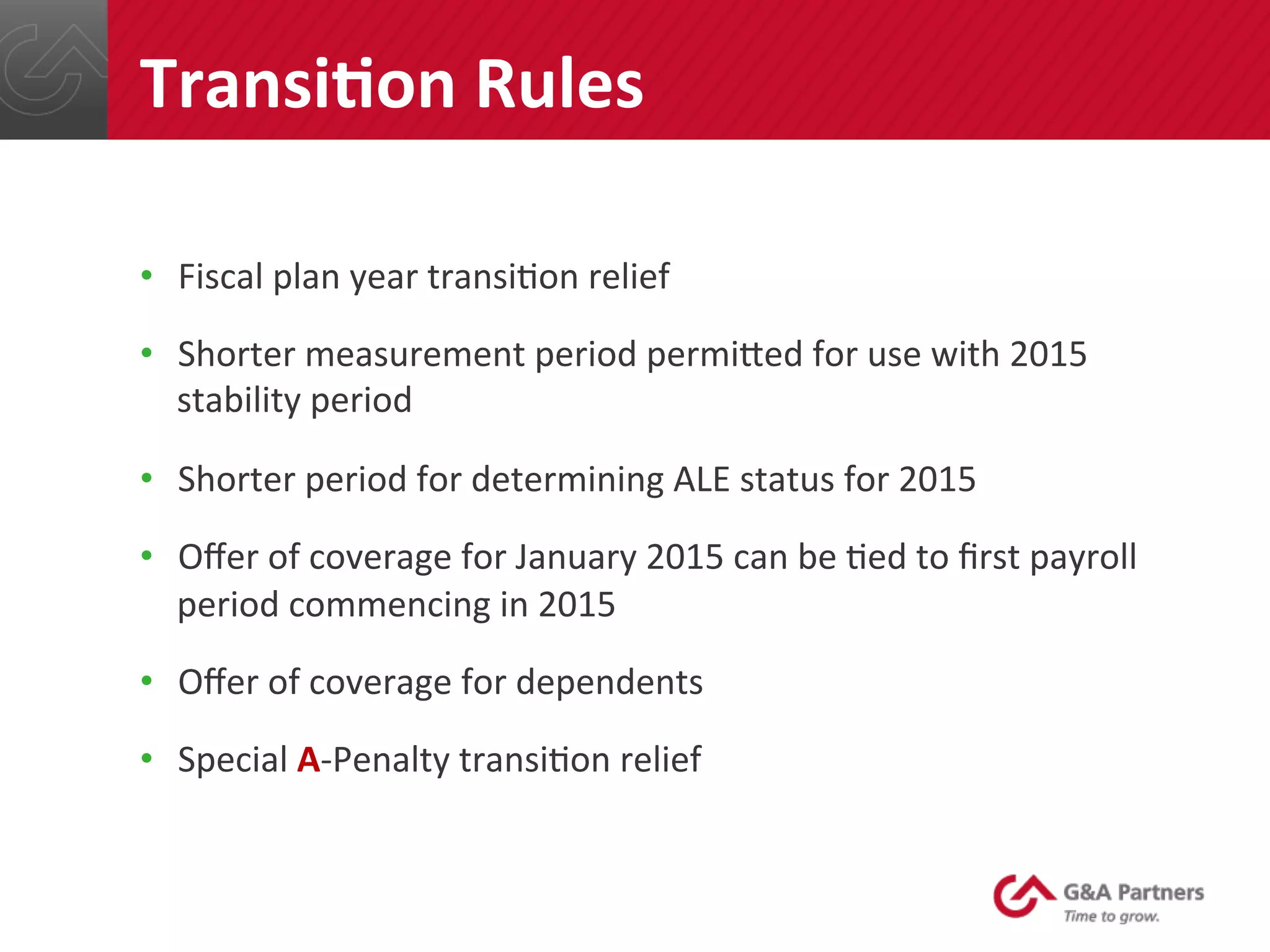
•  Fiscal	
  plan	
  year	
  transi@on	
  relief	
  
•  Shorter	
  measurement	
  period	
  permined	
  for	
  use	
  with	
  2015	
  
stability	
  period	
  
•  Shorter	
  period	
  for	
  determining	
  ALE	
  status	
  for	
  2015	
  
•  Offer	
  of	
  coverage	
  for	
  January	
  2015	
  can	
  be	
  @ed	
  to	
  first	
  payroll	
  
period	
  commencing	
  in	
  2015	
  
•  Offer	
  of	
  coverage	
  for	
  dependents	
  
•  Special	
  A-­‐Penalty	
  transi@on	
  relief	


TransiUon	
  Rules	
  
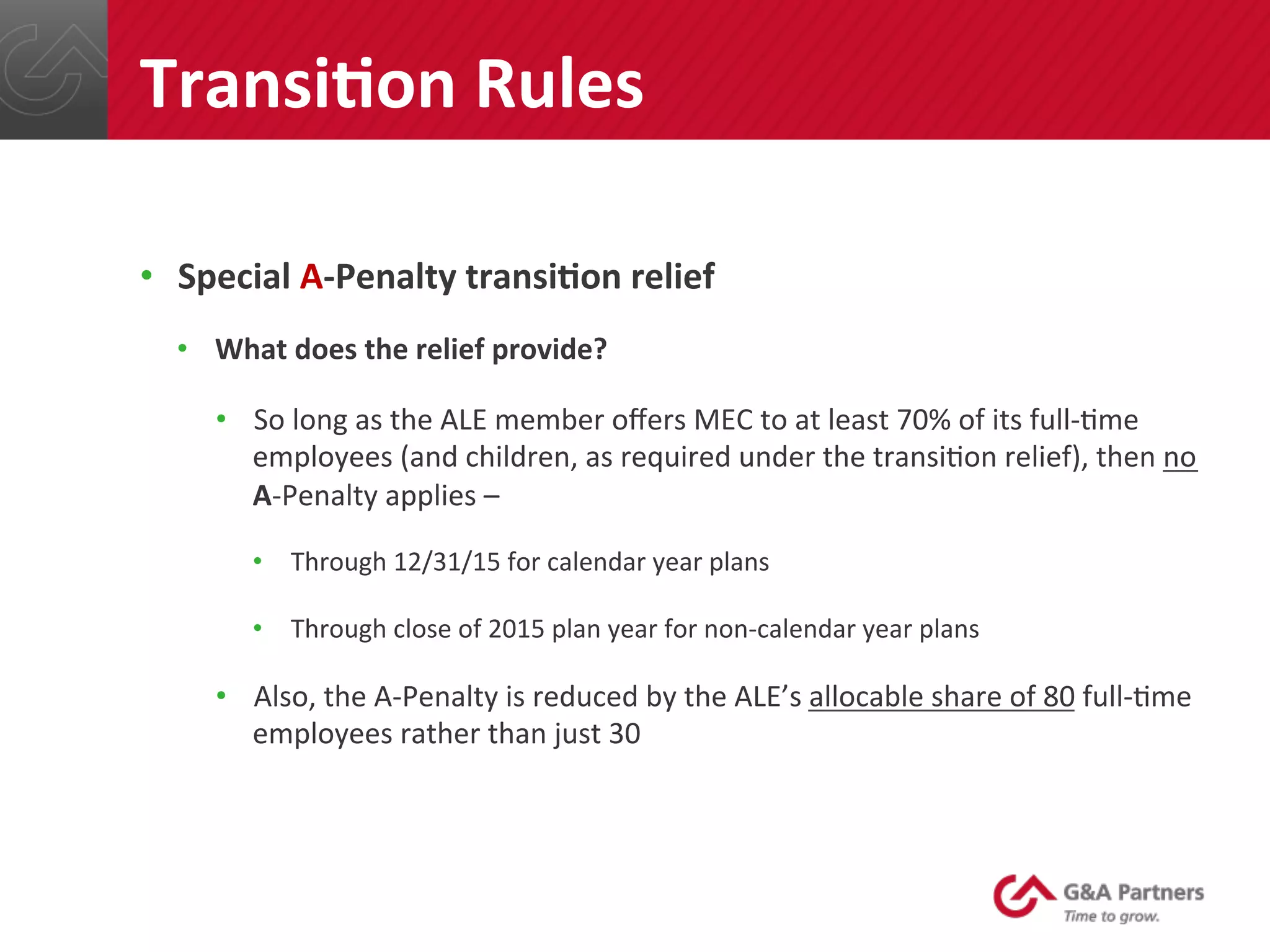
•  Special	
  A-­‐Penalty	
  transiUon	
  relief	
  
•  What	
  does	
  the	
  relief	
  provide?	
  
•  So	
  long	
  as	
  the	
  ALE	
  member	
  offers	
  MEC	
  to	
  at	
  least	
  70%	
  of	
  its	
  full-­‐@me	
  
employees	
  (and	
  children,	
  as	
  required	
  under	
  the	
  transi@on	
  relief),	
  then	
  no	
  
A-­‐Penalty	
  applies	
  –	
  
•  Through	
  12/31/15	
  for	
  calendar	
  year	
  plans	
  
•  Through	
  close	
  of	
  2015	
  plan	
  year	
  for	
  non-­‐calendar	
  year	
  plans	
  
•  Also,	
  the	
  A-­‐Penalty	
  is	
  reduced	
  by	
  the	
  ALE’s	
  allocable	
  share	
  of	
  80	
  full-­‐@me	
  
employees	
  rather	
  than	
  just	
  30	


TransiUon	
  Rules	
  
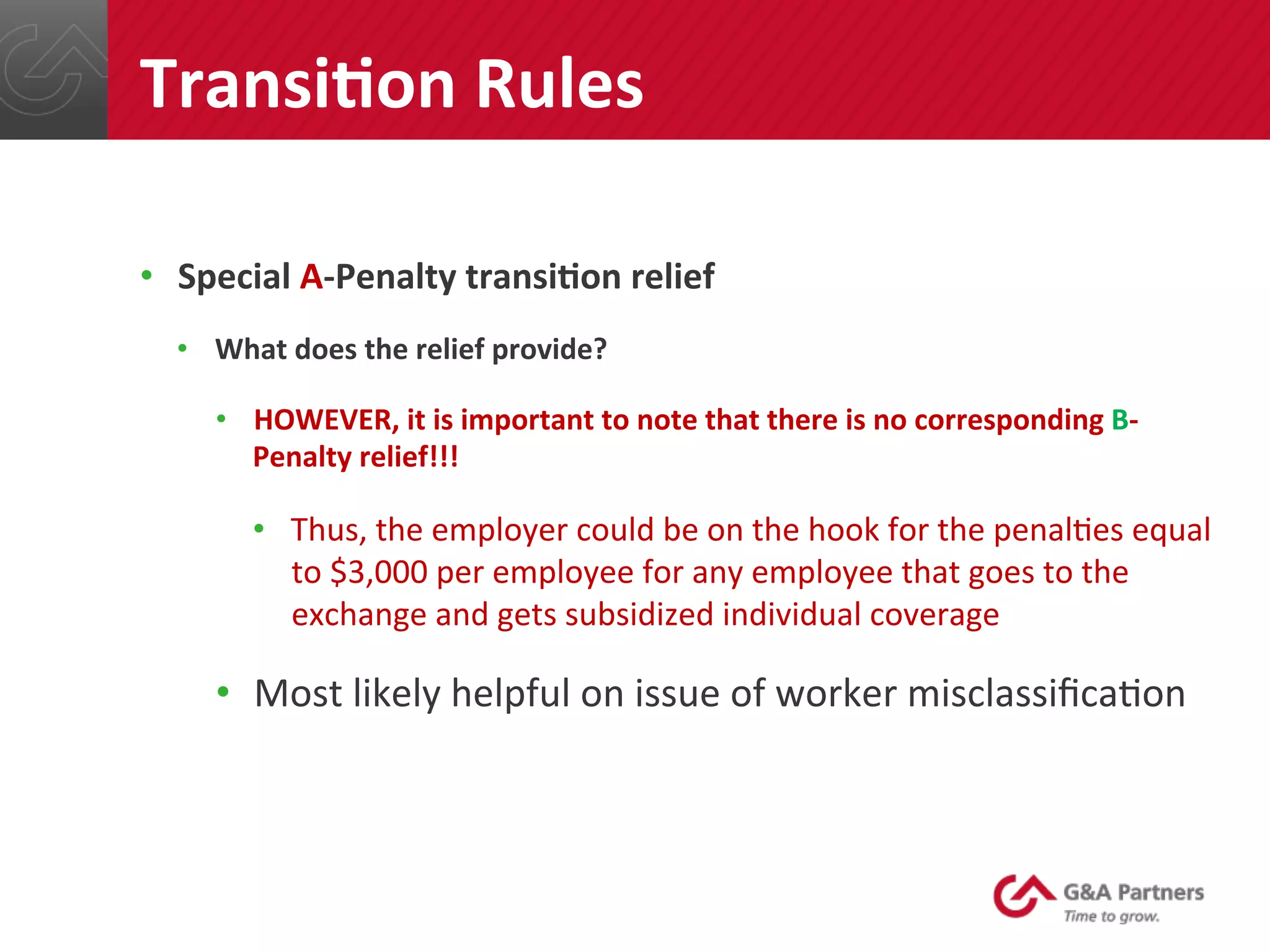
•  Special	
  A-­‐Penalty	
  transiUon	
  relief	
  
•  What	
  does	
  the	
  relief	
  provide?	
  
•  HOWEVER,	
  it	
  is	
  important	
  to	
  note	
  that	
  there	
  is	
  no	
  corresponding	
  B-­‐
Penalty	
  relief!!!	
  
•  Thus,	
  the	
  employer	
  could	
  be	
  on	
  the	
  hook	
  for	
  the	
  penal@es	
  equal	
  
to	
  $3,000	
  per	
  employee	
  for	
  any	
  employee	
  that	
  goes	
  to	
  the	
  
exchange	
  and	
  gets	
  subsidized	
  individual	
  coverage	
  
•  Most	
  likely	
  helpful	
  on	
  issue	
  of	
  worker	
  misclassifica@on	


TransiUon	
  Rules	
  
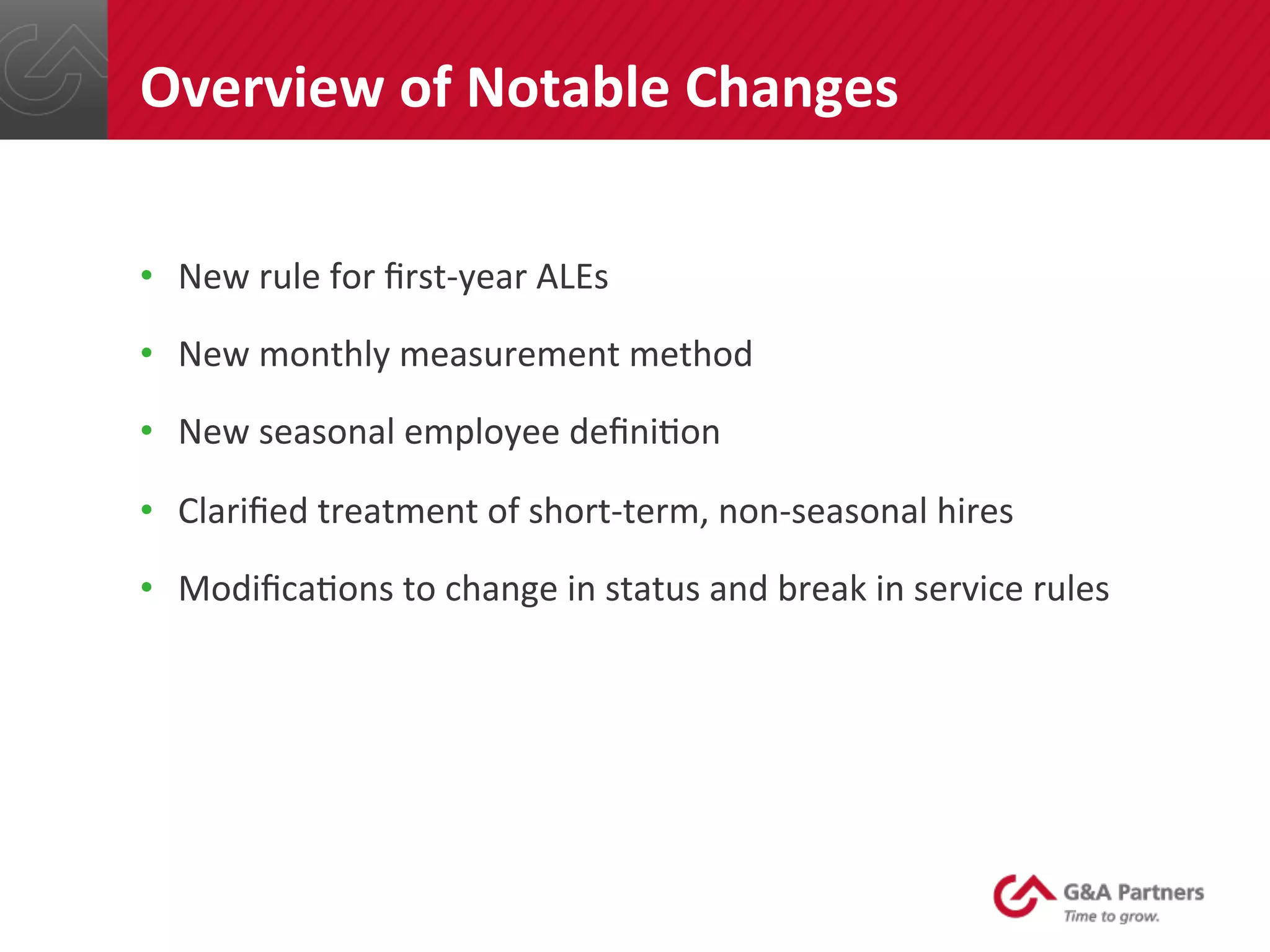
•  New	
  rule	
  for	
  first-­‐year	
  ALEs	
  
•  New	
  monthly	
  measurement	
  method	
  
•  New	
  seasonal	
  employee	
  defini@on	
  
•  Clarified	
  treatment	
  of	
  short-­‐term,	
  non-­‐seasonal	
  hires	
  
•  Modifica@ons	
  to	
  change	
  in	
  status	
  and	
  break	
  in	
  service	
  rules	


Overview	
  of	
  Notable	
  Changes	
  
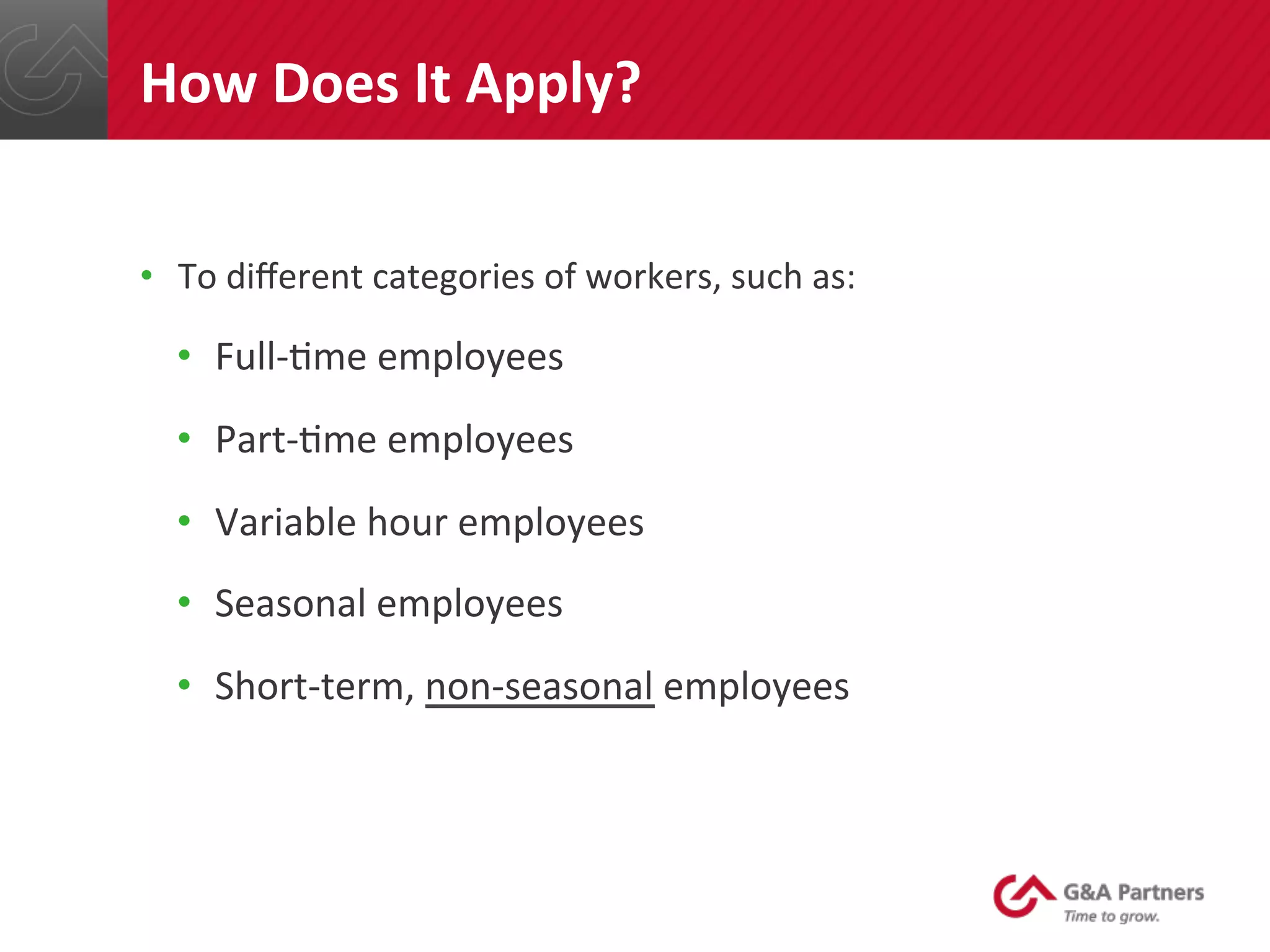
•  To	
  different	
  categories	
  of	
  workers,	
  such	
  as:	
  
•  Full-­‐@me	
  employees	
  
•  Part-­‐@me	
  employees	
  
•  Variable	
  hour	
  employees	
  
•  Seasonal	
  employees	
  
•  Short-­‐term,	
  non-­‐seasonal	
  employees	


How	
  Does	
  It	
  Apply?	
  
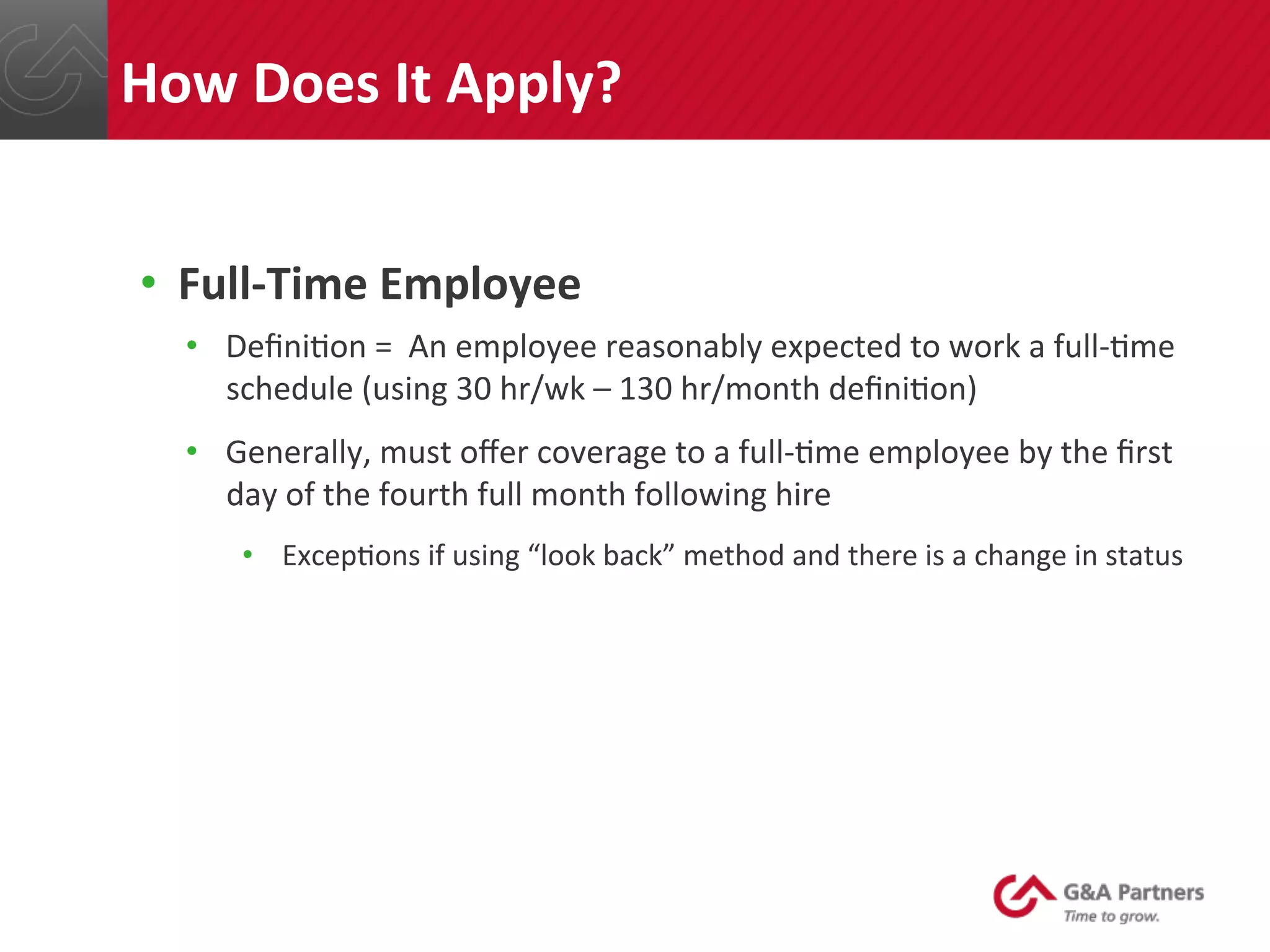
•  Full-­‐Time	
  Employee	
  
•  Defini@on	
  =	
  	
  An	
  employee	
  reasonably	
  expected	
  to	
  work	
  a	
  full-­‐@me	
  
schedule	
  (using	
  30	
  hr/wk	
  –	
  130	
  hr/month	
  defini@on)	
  
•  Generally,	
  must	
  offer	
  coverage	
  to	
  a	
  full-­‐@me	
  employee	
  by	
  the	
  first	
  
day	
  of	
  the	
  fourth	
  full	
  month	
  following	
  hire	
  
•  Excep@ons	
  if	
  using	
  “look	
  back”	
  method	
  and	
  there	
  is	
  a	
  change	
  in	
  status	


How	
  Does	
  It	
  Apply?	
  
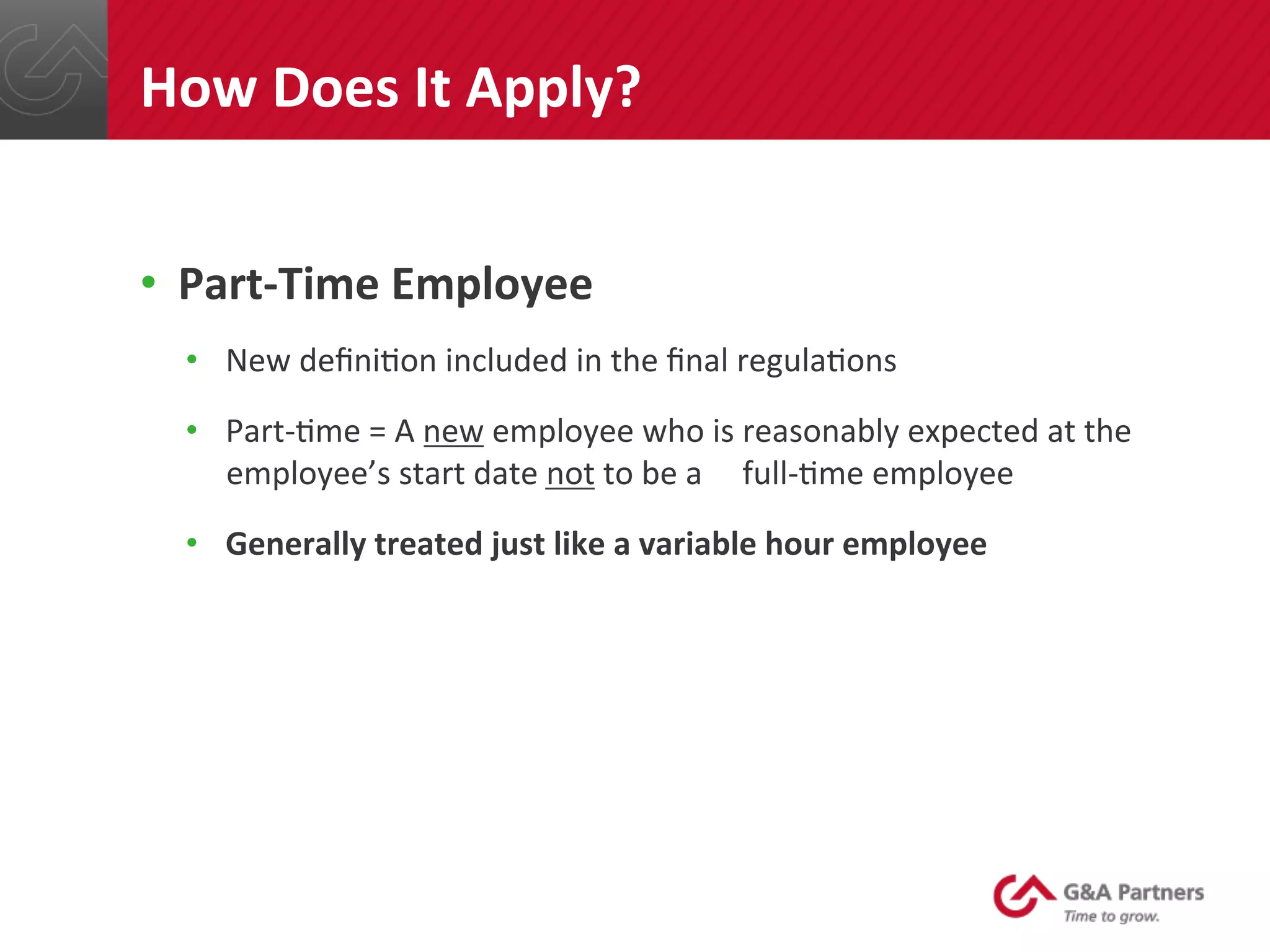
•  Part-­‐Time	
  Employee	
  
•  New	
  defini@on	
  included	
  in	
  the	
  final	
  regula@ons	
  
•  Part-­‐@me	
  =	
  A	
  new	
  employee	
  who	
  is	
  reasonably	
  expected	
  at	
  the	
  
employee’s	
  start	
  date	
  not	
  to	
  be	
  a	


  full-­‐@me	
  employee	
  
•  Generally	
  treated	
  just	
  like	
  a	
  variable	
  hour	
  employee	


How	
  Does	
  It	
  Apply?	
  
•  Variable	
  Hour	
  Employee	
  
•  Defini@on	
  =	
  	
  An	
  employee	
  not	
  reasonably	
  expected	
  to	
  work	
  a	
  full-­‐@me	
  
schedule	
  (using	
  30	
  hr/wk–130	
  hr/month	
  defini@on)	
  
•  Final	
  regs:	
  	
  Facts	
  and	
  circumstances	
  test,	
  but	
  factors	
  to	
  consider	
  include:	
  
•  Whether	
  the	
  employee	
  is	
  replacing	
  an	
  employee	
  who	
  was	
  or	
  was	
  not	
  a	
  full-­‐@me	
  
employee	
  
•  The	
  extent	
  to	
  which	
  employees	
  in	
  the	
  same	
  or	
  comparable	
  posi@ons	
  are	
  or	
  are	
  not	
  full-­‐
@me	
  employees	
  
•  Whether	
  job	
  was	
  adver@sed,	
  or	
  otherwise	
  communicated	
  to	
  the	
  new	
  hire	
  or	
  otherwise	
  
documented	
  as	
  full-­‐@me	
  
•  Consider	
  crea@ng	
  wrinen	
  job	
  descrip@ons	
  for	
  variable	
  hour	
  employees	
  that	
  
explicitly	
  set	
  out	
  the	
  hours	
  expecta@on	


How	
  Does	
  It	
  Apply?	
  
•  Variable	
  Hour	
  Employee	
  
•  How	
  4980H	
  applies	
  to	
  these	
  employees	
  depends	
  on	
  whether	
  the	
  employer	
  plans	
  to	
  
use	
  the	
  “look-­‐back”	
  measurement	
  method	
  or	
  the	
  new	
  monthly	
  measurement	
  method	
  
•  If	
  using	
  the	
  “look-­‐back”	
  measurement	
  method:	
  	
  Can	
  apply-­‐up	
  to	
  a	
  12	
  month	
  measurement	
  
period	
  for	
  determining	
  full-­‐@me	
  status	
  
•  If	
  using	
  new	
  monthly	
  measurement	
  method:	
  	
  Must	
  have	
  offered	
  coverage	
  in	
  advance	
  for	
  any	
  
calendar	
  month	
  in	
  which	
  the	
  variable	
  hour	
  employee	
  works	
  a	
  full-­‐@me	
  schedule	
  (subject	
  to	
  
once	
  per-­‐employment-­‐term	
  3-­‐month	
  non-­‐assessment	
  period)	


How	
  Does	
  It	
  Apply?	
  
•  Seasonal	
  Employee	
  
•  Proposed	
  regula@ons	
  permined	
  employers	
  to	
  use	
  a	
  good	
  faith	
  
interpreta@on	
  for	
  determining	
  who	
  is	
  a	
  “seasonal	
  employee”	
  
•  An	
  employee	
  is	
  permined	
  under	
  the	
  final	
  regula@ons	
  to	
  apply	
  a	
  
measurement	
  period	
  of	
  up	
  to	
  12	
  months	
  with	
  respect	
  to	
  seasonal	
  
employees	
  (subject	
  to	
  “slice	
  and	
  dice”	
  rules)	
  
•  The	
  prac@cal	
  effect	
  of	
  this	
  is	
  that	
  no	
  4980H	
  penal@es	
  are	
  likely	
  to	
  apply	
  (since	
  a	
  seasonal	
  
employee	
  should	
  not	
  be	
  employed	
  at	
  the	
  close	
  of	
  the	
  12-­‐month	
  period	
  at	
  which	
  @me	
  the	
  
coverage	
  requirement	
  could	
  take	
  effect)	
  
•  The	
  final	
  regula@ons	
  provide	
  an	
  express	
  defini@on:	
  
•  Seasonal	
  employee	
  =	
  an	
  employee	
  in	
  a	
  posi@on	
  that	
  is	
  performed	
  at	
  a	
  recurring	
  @me	
  each	
  
year	
  and	
  customarily	
  lasts	
  no	
  longer	
  than	
  6	
  months	
  
•  Note:	
  	
  In	
  limited	
  instances,	
  actual	
  employment	
  could	
  in	
  theory	
  extend	
  beyond	
  without	
  
jeopardizing	
  status	
  as	
  a	
  seasonal	
  worker	


How	
  Does	
  It	
  Apply?	
  
•  Short-­‐Term,	
  Non-­‐Seasonal	
  Employee	
  
•  Short-­‐term	
  hires	
  are	
  NOT	
  necessarily	
  seasonal	
  employees	
  
•  In	
  fact,	
  many	
  short-­‐term	
  hires	
  will	
  NOT	
  qualify	
  as	
  seasonal	
  employees	
  
•  Why?	
  	
  Because	
  the	
  posi@on	
  (i)	
  customarily	
  lasts	
  in	
  excess	
  of	
  6	
  months,	
  or	
  (ii)	
  is	
  not	
  recurring	
  based	
  
on	
  a	
  specific	
  @me	
  of	
  the	
  year	
  
•  The	
  proposed	
  regula@ons	
  included	
  a	
  limited	
  transi@on	
  rule	
  for	
  2014	
  that	
  permined	
  
employers	
  in	
  certain	
  instances	
  to	
  treat	
  short-­‐term	
  hires	
  like	
  seasonal	
  employees	
  and	
  apply	
  
a	
  measurement	
  period	
  of	
  up	
  to	
  12	
  months	
  
•  The	
  final	
  regula@ons	
  do	
  NOT	
  include	
  a	
  similar	
  transi@on	
  rule	
  
•  And	
  specifically	
  state	
  that	
  an	
  employer	
  CANNOT	
  take	
  turnover	
  or	
  expected	
  short-­‐term	
  nature	
  of	
  
employment	
  into	
  considera@on	
  in	
  determining	
  whether	
  “full-­‐@me”	
  
•  THEREFORE,	
  an	
  employer	
  that	
  employs	
  a	
  short-­‐term	
  hire	
  that	
  is	
  expected	
  to	
  work	
  a	
  “full-­‐
@me”	
  schedule	
  and	
  is	
  not	
  a	
  seasonal	
  employee	
  generally	
  must	
  be	
  offered	
  4980H-­‐compliant	
  
coverage	
  by	
  the	
  first	
  day	
  of	
  the	
  fourth	
  month	
  aqer	
  hire	
  (or	
  else	
  the	
  employer	
  could	
  be	
  
subject	
  to	
  penal@es)	


How	
  Does	
  It	
  Apply?	
  
•  Troubled	
  rollout	
  of	
  federal	
  and	
  many	
  state	
  exchanges	
  
•  Extended	
  enrollment	
  window	
  through	
  3/31/14	
  
•  By	
  end	
  of	
  March:	
  Total	
  of	
  6	
  million	
  enrolled	
  
•  Percola@ng:	
  
•  Errors	
  in	
  enrollment	
  and	
  “adver@sing”	
  of	
  plans	
  
•  Issues	
  with	
  processing	
  premium	
  tax	
  credits	
  and/or	
  cost-­‐sharing	
  
subsidies	


State	
  of	
  Exchanges	
  –	
  Public	
  
•  Troubled	
  rollout	
  of	
  federal	
  and	
  many	
  state	
  exchanges	
  
•  Extended	
  enrollment	
  window	
  through	
  3/31/14	
  
•  By	
  end	
  of	
  March:	
  Total	
  of	
  6	
  million	
  enrolled	
  
•  Percola@ng:	
  
•  Errors	
  in	
  enrollment	
  and	
  “adver@sing”	
  of	
  plans	
  
•  Issues	
  with	
  processing	
  premium	
  tax	
  credits	
  and/or	
  cost-­‐sharing	
  
subsidies	


State	
  of	
  Exchanges	
  –	
  Public	
  
•  Growing	
  number	
  of	
  providers	
  offering	
  private	
  exchanges	
  –	
  insured	
  or	
  
self-­‐funded	
  coverage	
  
•  Agency	
  guidance	
  makes	
  it	
  very	
  difficult	
  for	
  employers	
  to	
  par@cipate	
  in	
  
public	
  exchanges	
  u@lizing	
  individual	
  insurance	
  if	
  the	
  employer	
  wants	
  to	
  
provide	
  a	
  tax-­‐preferred	
  premium	
  subsidy	
  to	
  the	
  employee	
  
•  Generally,	
  the	
  employer	
  will	
  need	
  to	
  sponsor	
  insured	
  or	
  self-­‐funded	
  
group	
  health	
  plans	
  
•  Many	
  employers	
  are	
  considering	
  use	
  of	
  self-­‐funded	
  coverage	
  with	
  the	
  
private	
  exchange	
  because	
  economics	
  (e.g.,	
  the	
  “COI”	
  with	
  insured	
  
coverage	
  is	
  too	
  great)	
  
•  Be	
  careful!	
  –	
  Arrangements	
  can	
  raise	
  ERISA	
  concerns	


State	
  of	
  Exchanges	
  –	
  Private	
  
Questions
info@gnapartners.com
1-800-253-8562
** This webinar will be posted to the G&A website by Friday
32	
  

PPACA Update: How The Affordable Care Act Will Affect Employers

  • 1.
    PPACA Update: How TheAffordable Care Act Will Affect Employers Seth Perretta Principal, Co-Chair of the Health Practice Group Groom Law Group April 24, 2014
  • 2.
    We  will  cover...   •  Status  of  the  individual  mandate   •  Employer  mandate  or  “pay  or  play”   •  Brief  refresher  on  “pay”  or  “play”  choice   •  How  to  determine  whether  you  are  subject  to  the  employer  mandate     •  Overview  of  the  recently  issued  final  regula@ons     •  Treatment  of  various  types  of  workers   •  Seasonal  employees   •  Short-­‐term,  non-­‐seasonal  hires   •  State  of  public  and  private  exchanges     2  
  • 3.
    •  Originally  scheduled  to  take  effect  on  January  1,  2014   •  Now  scheduled  to  take  effect  on  January  1,  2015   •  Generally  requires  that  all  nonexempt  individuals  be   enrolled  in  “minimum  essen@al  coverage”  or  pay  a  tax   penalty             Individual  Mandate  
  • 4.
    •  Originally  effec@ve  for  2014,  but  delayed  for  one  year   •  Now  scheduled  to  take  effect  on  January  1,  2015   •  Addi@onal  delay  for:   •  Qualifying  sponsors  of  non-­‐calendar  year  plans   •  Qualifying  employers  with  50-­‐99  full-­‐@me  (FTs)  and            full-­‐@me  equivalent  (FTE)  employees   •  Limited  transi@on  relief  for  the  “A-­‐Penalty”         “Pay  or  Play”  
  • 5.
    •  Two  separate  penal@es:   •  4980H(a)  or  “A-­‐Penalty”   •  4980H(b)  or  “B-­‐Penalty”                 “Pay  or  Play”  
  • 6.
    •  A-­‐Penalty  (4980H(a))   •  Some@mes  referred  to  as  the  “offering  requirement”   •  General  rule  =  An  employer  must  offer  “minimum  essen@al   coverage”  (MEC)  to  95%  of  its  4980H-­‐defined  full-­‐@me   employees  “(and  their  dependents)”  or  risk  a  penalty  equal  to  (i)   $2,000,  mul@plied  by  (ii)  the  number  of  full-­‐@me  employees   minus  30   •  **  Certain  transi@on  relief  through  close  of  2015  plan  year  was   provided  **     “Pay  or  Play”  
  • 7.
    Birth   Child  Up   to  Age  26   Adopted   Child  Up   to  Age  26   Step-­‐ children   Foster   Children   All   Children   age  26+   4980H “Dependents”          Yes            NO      Spouse   **  Note:  Special  2015  TransiUon  Relief   “Pay  or  Play”  
  • 8.
    •  B-­‐Penalty  (4980H(b))   •  General  rule  =  Even  if  an  employer  sa@sfies  the  offering  requirement  (i.e.,   avoids  the  A-­‐Penalty),  if  the  employer  fails  to  offer  affordable  and  minimum   value  coverage  to  a  full-­‐@me  employee,  it  can  risk  a  B-­‐Penalty  generally  equal   to  $3,000  per  year  for  that  employee               “Pay  or  Play”  
  • 9.
    •  4980H  Applies  to  “applicable  large  employers”  or  ALEs   •  Who  is  an  ALE?   •  An  employer  that  employed  on  average  at  least  50  full-­‐@me  employees  (FTs)  or  full-­‐ @me  equivalents  (FTEs)  during  the  preceding  calendar  year   •  Note:    Special  seasonal  worker  excep@on   •  ALSO,  special  transi@on  rule  for  2015   •  Things  to  keep  in  mind:   •  ALE  status  is  determined  using  IRS  80%  controlled  group  rules   •  But  once  ALE  status  is  determined,  each  ALE  member  gets  its  own  “pay  or  play”   decision       Subject  Employers:  ALEs  
  • 10.
    •  To  determine  ALE  status,  you  need  to  take  the  following   steps:   1.  For  each  calendar  month  last  year:   •  Determine  the  client  employer’s  number  of          full-­‐@me  employees  across  its  controlled  group     •  Determine  the  client  employer’s  number  of          full-­‐@me  equivalent  employees     2.  Add  up  the  number  of    FTs  and  FTEs  for  all  12  months  of  last   year  and  divide  by  12   Subject  Employers:  ALEs  
  • 11.
    Preceding  Calendar  Year   Jan   Feb   Mar   Apr   May   Jun   July   Aug   Sept   Oct   Nov   Dec   Total   #  Full-­‐Time   Employees   34   42   53   51   37   39   41   44   50   51   48   46   N/A   #  FT   Equivalents   12.6   12.9   10.3   10.5   14.2   12.3   9.3   10.0   10.3   13.2   12.8   13.2   N/A   Total  Number   46.6   54.9   63.3   61.5   51.2   51.3   50.3   54.0   60.3   64.3   60.8   59.2   677.7     #  of  Full-­‐Time  Employees/Equivalents  During  the  Preceding  Calendar  Year:                                              677.7  divided  by  12    =  56.48   Subject  Employers:  ALEs  
  • 12.
    •  Full-­‐Time  Employee  (FT)   •  Defini@on:  Worked  on  average  120  hours  during  the   calendar  month  at  issue   •  NOTE:    This  is  NOT  the  same  defini@on  of  FT  that  applies  in  second  step  of   analysis,  i.e.,  when  determining  TO  WHOM  qualifying  coverage  must  be   provided.    (That  defini@on  uses  30  hours/wk  or  130  hours/month).       Subject  Employers:  ALEs  
  • 13.
    •  Full-­‐Time  Equivalent  Employee  (FTE)   •  For  each  calendar  month  in  the  preceding  calendar  year,   add  up  all  hours  worked  by  non-­‐FTs  (up  to  a  maximum  of   120  hours  per  employee)  and  divide  by  120.         Subject  Employers:  ALEs  
  • 14.
    •  “Hour  of  service”  includes:   •  Hours  Worked  –  Each  hour  for  which  the  employee  is  paid,  or  en@tled  to  payment,   “for  the  performance  of  du@es;”  AND   •  Paid-­‐Time  Off  –  Each  hour  for  which  the  employee  is  paid,  or  en@tled  to  payment,   for  the  period  of  @me  due  to  vaca@on,  holiday,  illness,  incapacity  (including   disability),  layoff,  jury  duty,  military  duty,  or  leave  of  absence   •  Notes:   •  ALL  paid  leave  gets  counted   •  Final  regs  include  rules  for  non-­‐hourly  and  commissions-­‐based  employees   •  Final  regula@ons  include  certain  methods  to  credit  hours  (i.e.,  actual  count,   days-­‐worked  equivalency,  weeks-­‐worked  equivalency)       Subject  Employers:  ALEs  
  • 15.
    •  For  employers  with  50-­‐99  full-­‐@me  employees  (FTs)  or  full-­‐ @me  equivalent  (FTEs),  the  en@re  mandate  may  be  delayed,   if  certain  criteria  are  sa@sfied   •  For  employers  that  can  fit  within  the  transi@on  relief,  they   will  not  be  subject  to  the  A-­‐Penalty  or  the  B-­‐Penalty   •  BUT,  numerous  requirements  apply  in  order  to  qualify  for  the  delay,   so  be  careful!!             What  Was  Delayed?  
  • 16.
    •  To  qualify  for  the  50-­‐99  FT/FTE  delay,  what  requirements  apply?   1.  From  2/9/14  through  12/31/14,  the  employer  CANNOT  reduce  the  size  of   its  workforce  or  the  overall  hours  of  service  of  its  employees  to  get   below  the  99-­‐count  threshold   •  Unless  for  business  reasons   2.  During  what  is  called  the  “coverage  maintenance  period,”  the  employer   CANNOT  eliminate  or  materially  reduce  the  health  coverage,  if  any,  it   offered  as  of  2/9/14   3.  The  employer  must  cer@fy  on  a  prescribed  form  that  it  meets  these   requirements         What  Was  Delayed?  
  • 17.
    •  What  else  was  delayed?    Nothing…     •  But  a  host  of  addi@onal  transi@onal  rules  were  provided  for  2015   (which  is  sort  of  like  a  delay)               What  Was  Delayed?  
  • 18.
    •  Fiscal  plan  year  transi@on  relief   •  Shorter  measurement  period  permined  for  use  with  2015   stability  period   •  Shorter  period  for  determining  ALE  status  for  2015   •  Offer  of  coverage  for  January  2015  can  be  @ed  to  first  payroll   period  commencing  in  2015   •  Offer  of  coverage  for  dependents   •  Special  A-­‐Penalty  transi@on  relief     TransiUon  Rules  
  • 19.
    •  Special  A-­‐Penalty  transiUon  relief   •  What  does  the  relief  provide?   •  So  long  as  the  ALE  member  offers  MEC  to  at  least  70%  of  its  full-­‐@me   employees  (and  children,  as  required  under  the  transi@on  relief),  then  no   A-­‐Penalty  applies  –   •  Through  12/31/15  for  calendar  year  plans   •  Through  close  of  2015  plan  year  for  non-­‐calendar  year  plans   •  Also,  the  A-­‐Penalty  is  reduced  by  the  ALE’s  allocable  share  of  80  full-­‐@me   employees  rather  than  just  30     TransiUon  Rules  
  • 20.
    •  Special  A-­‐Penalty  transiUon  relief   •  What  does  the  relief  provide?   •  HOWEVER,  it  is  important  to  note  that  there  is  no  corresponding  B-­‐ Penalty  relief!!!   •  Thus,  the  employer  could  be  on  the  hook  for  the  penal@es  equal   to  $3,000  per  employee  for  any  employee  that  goes  to  the   exchange  and  gets  subsidized  individual  coverage   •  Most  likely  helpful  on  issue  of  worker  misclassifica@on         TransiUon  Rules  
  • 21.
    •  New  rule  for  first-­‐year  ALEs   •  New  monthly  measurement  method   •  New  seasonal  employee  defini@on   •  Clarified  treatment  of  short-­‐term,  non-­‐seasonal  hires   •  Modifica@ons  to  change  in  status  and  break  in  service  rules           Overview  of  Notable  Changes  
  • 22.
    •  To  different  categories  of  workers,  such  as:   •  Full-­‐@me  employees   •  Part-­‐@me  employees   •  Variable  hour  employees   •  Seasonal  employees   •  Short-­‐term,  non-­‐seasonal  employees         How  Does  It  Apply?  
  • 23.
    •  Full-­‐Time  Employee   •  Defini@on  =    An  employee  reasonably  expected  to  work  a  full-­‐@me   schedule  (using  30  hr/wk  –  130  hr/month  defini@on)   •  Generally,  must  offer  coverage  to  a  full-­‐@me  employee  by  the  first   day  of  the  fourth  full  month  following  hire   •  Excep@ons  if  using  “look  back”  method  and  there  is  a  change  in  status             How  Does  It  Apply?  
  • 24.
    •  Part-­‐Time  Employee   •  New  defini@on  included  in  the  final  regula@ons   •  Part-­‐@me  =  A  new  employee  who  is  reasonably  expected  at  the   employee’s  start  date  not  to  be  a          full-­‐@me  employee   •  Generally  treated  just  like  a  variable  hour  employee               How  Does  It  Apply?  
  • 25.
    •  Variable  Hour  Employee   •  Defini@on  =    An  employee  not  reasonably  expected  to  work  a  full-­‐@me   schedule  (using  30  hr/wk–130  hr/month  defini@on)   •  Final  regs:    Facts  and  circumstances  test,  but  factors  to  consider  include:   •  Whether  the  employee  is  replacing  an  employee  who  was  or  was  not  a  full-­‐@me   employee   •  The  extent  to  which  employees  in  the  same  or  comparable  posi@ons  are  or  are  not  full-­‐ @me  employees   •  Whether  job  was  adver@sed,  or  otherwise  communicated  to  the  new  hire  or  otherwise   documented  as  full-­‐@me   •  Consider  crea@ng  wrinen  job  descrip@ons  for  variable  hour  employees  that   explicitly  set  out  the  hours  expecta@on         How  Does  It  Apply?  
  • 26.
    •  Variable  Hour  Employee   •  How  4980H  applies  to  these  employees  depends  on  whether  the  employer  plans  to   use  the  “look-­‐back”  measurement  method  or  the  new  monthly  measurement  method   •  If  using  the  “look-­‐back”  measurement  method:    Can  apply-­‐up  to  a  12  month  measurement   period  for  determining  full-­‐@me  status   •  If  using  new  monthly  measurement  method:    Must  have  offered  coverage  in  advance  for  any   calendar  month  in  which  the  variable  hour  employee  works  a  full-­‐@me  schedule  (subject  to   once  per-­‐employment-­‐term  3-­‐month  non-­‐assessment  period)             How  Does  It  Apply?  
  • 27.
    •  Seasonal  Employee   •  Proposed  regula@ons  permined  employers  to  use  a  good  faith   interpreta@on  for  determining  who  is  a  “seasonal  employee”   •  An  employee  is  permined  under  the  final  regula@ons  to  apply  a   measurement  period  of  up  to  12  months  with  respect  to  seasonal   employees  (subject  to  “slice  and  dice”  rules)   •  The  prac@cal  effect  of  this  is  that  no  4980H  penal@es  are  likely  to  apply  (since  a  seasonal   employee  should  not  be  employed  at  the  close  of  the  12-­‐month  period  at  which  @me  the   coverage  requirement  could  take  effect)   •  The  final  regula@ons  provide  an  express  defini@on:   •  Seasonal  employee  =  an  employee  in  a  posi@on  that  is  performed  at  a  recurring  @me  each   year  and  customarily  lasts  no  longer  than  6  months   •  Note:    In  limited  instances,  actual  employment  could  in  theory  extend  beyond  without   jeopardizing  status  as  a  seasonal  worker       How  Does  It  Apply?  
  • 28.
    •  Short-­‐Term,  Non-­‐Seasonal  Employee   •  Short-­‐term  hires  are  NOT  necessarily  seasonal  employees   •  In  fact,  many  short-­‐term  hires  will  NOT  qualify  as  seasonal  employees   •  Why?    Because  the  posi@on  (i)  customarily  lasts  in  excess  of  6  months,  or  (ii)  is  not  recurring  based   on  a  specific  @me  of  the  year   •  The  proposed  regula@ons  included  a  limited  transi@on  rule  for  2014  that  permined   employers  in  certain  instances  to  treat  short-­‐term  hires  like  seasonal  employees  and  apply   a  measurement  period  of  up  to  12  months   •  The  final  regula@ons  do  NOT  include  a  similar  transi@on  rule   •  And  specifically  state  that  an  employer  CANNOT  take  turnover  or  expected  short-­‐term  nature  of   employment  into  considera@on  in  determining  whether  “full-­‐@me”   •  THEREFORE,  an  employer  that  employs  a  short-­‐term  hire  that  is  expected  to  work  a  “full-­‐ @me”  schedule  and  is  not  a  seasonal  employee  generally  must  be  offered  4980H-­‐compliant   coverage  by  the  first  day  of  the  fourth  month  aqer  hire  (or  else  the  employer  could  be   subject  to  penal@es)         How  Does  It  Apply?  
  • 29.
    •  Troubled  rollout  of  federal  and  many  state  exchanges   •  Extended  enrollment  window  through  3/31/14   •  By  end  of  March:  Total  of  6  million  enrolled   •  Percola@ng:   •  Errors  in  enrollment  and  “adver@sing”  of  plans   •  Issues  with  processing  premium  tax  credits  and/or  cost-­‐sharing   subsidies       State  of  Exchanges  –  Public  
  • 30.
    •  Troubled  rollout  of  federal  and  many  state  exchanges   •  Extended  enrollment  window  through  3/31/14   •  By  end  of  March:  Total  of  6  million  enrolled   •  Percola@ng:   •  Errors  in  enrollment  and  “adver@sing”  of  plans   •  Issues  with  processing  premium  tax  credits  and/or  cost-­‐sharing   subsidies       State  of  Exchanges  –  Public  
  • 31.
    •  Growing  number  of  providers  offering  private  exchanges  –  insured  or   self-­‐funded  coverage   •  Agency  guidance  makes  it  very  difficult  for  employers  to  par@cipate  in   public  exchanges  u@lizing  individual  insurance  if  the  employer  wants  to   provide  a  tax-­‐preferred  premium  subsidy  to  the  employee   •  Generally,  the  employer  will  need  to  sponsor  insured  or  self-­‐funded   group  health  plans   •  Many  employers  are  considering  use  of  self-­‐funded  coverage  with  the   private  exchange  because  economics  (e.g.,  the  “COI”  with  insured   coverage  is  too  great)   •  Be  careful!  –  Arrangements  can  raise  ERISA  concerns       State  of  Exchanges  –  Private  
  • 32.
    Questions info@gnapartners.com 1-800-253-8562 ** This webinarwill be posted to the G&A website by Friday 32