









z
The New Overtime Rules
How Will You Comply?
z
z
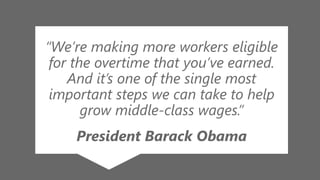
“We’re making more workers eligible
for the overtime that you’ve earned.
And it’s one of the single most
important steps we can take to help
grow middle-class wages.”
President Barack Obama
z
z
“Overtime is not a
problem as long as
I pay the employee
a salary.”
z
All of your employees have access to
company email + instant messaging
on their mobile devices.
Since you are concerned that employees may be
reading and answering messages “off the clock,”
you decide to pay everyone a salary that exceeds
the current minimum wage of $455/week
That solves the problem, right?
z
“If an employee’s title is
‘Manager’ or ‘Supervisor,’ and
I pay the correct salary, they
don’t get overtime.”
z
“I have a policy written in my
handbook that clearly says that all
overtime must be approved by a
supervisor in advance – or the
time will not be paid.
Good solution, right?”
z
“Once an employee
is exempt, they are
always exempt.”
z
“One of your hourly
employees needs Friday
of next week off to have
her wisdom tooth pulled,
but she has no vacation
or paid time left. In order
to avoid losing pay, she
offers to work an extra 8
hours this week.
That’s OK, right?”
z
WHITE COLLAR
EXEMPTIONS
Section 13(a)(1) of the FLSA provides an
exemption from both minimum wage
and overtime pay for employees who
are employed in a bona fide:
Executive
Administrative
Professional
Outside Sales
Capacity
Certain computer employees
may be exempt professionals
under Section 13(a)(1) or
exempt under Section
13(a)(17) of the FLSA
z
3 Testsfor Exemption
1 Salary Basis
2 Job Duties
3 Salary Level
z
Salary Basis
Test
Regularly receives a
predetermined compensation
amount each pay period
Compensation cannot be reduced
due to variations in quality or
quantity of work performed
Must be paid full salary for
any week in which employee
performs any work
Need not be paid for any
workweek when no work is
performed
z
DUTIES
TEST
z
Executive
Duties
Primary duty is management of
the enterprise or of a customarily
recognized dept/subdivision
Customarily and regularly directs
work of 2 or more employees
Authority to hire or fire other
employees or whose suggestions
and recommendations as to hiring,
firing, advancement, promotion or
other change of status of other
employees are given particular
weight
z
Administrative
Duties
Primary duty is performance of
office or non-manual work
directly related to management
or general business operations
of employer or employer’s
customers
Primary duty includes the
exercise of discretion and
independent judgment with
respect to matters of significance
z
Salary Level
$455/wkcurrently[ ]
z
z
New Minimum
Salary Level
$913/wk
$47,476/yr
z
Periodic
Increase of
Minimum
SALARIES
z
Inclusion of
Bonuses +
Incentive
Payments
z
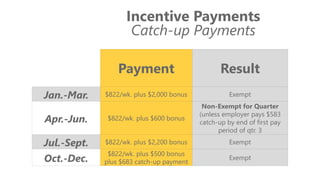
Payment Result
Jan.-Mar. $822/wk. plus $2,000 bonus Exempt
Apr.-Jun. $822/wk. plus $600 bonus
Non-Exempt for Quarter
(unless employer pays $583
catch-up by end of first pay
period of qtr. 3
Jul.-Sept. $822/wk. plus $2,200 bonus Exempt
Oct.-Dec.
$822/wk. plus $500 bonus
plus $683 catch-up payment
Exempt
Incentive Payments
Catch-up Payments
z
Highly
Compensated
EMPLOYEES
(“HCEs”)
z
Highly Compensated
Test
Total annual compensation of
at least $134,004
At least $913 per week paid on
a salary or fee basis
Performs office or non-
manual work
Customarily + regularly performs
any 1 or more of the exempt duties
identified in the standard tests for
the executive, administrative, or
professional exemptions
z
Effective
Dec. 1
2016
z
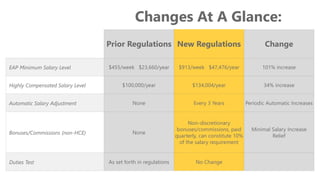
Prior Regulations New Regulations Change
EAP Minimum Salary Level $455/week $23,660/year $913/week $47,476/year 101% increase
Highly Compensated Salary Level $100,000/year $134,004/year 34% increase
Automatic Salary Adjustment None Every 3 Years Periodic Automatic Increases
Bonuses/Commissions (non-HCE) None
Non-discretionary
bonuses/commissions, paid
quarterly, can constitute 10%
of the salary requirement
Minimal Salary Increase
Relief
Duties Test As set forth in regulations No Change
Changes At A Glance:
z
www.dol.gov/whd/
overtime/final2016
z
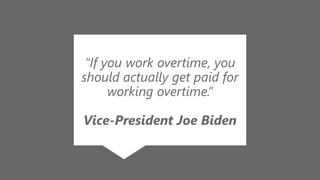
“If you work overtime, you
should actually get paid for
working overtime.”
Vice-President Joe Biden
z
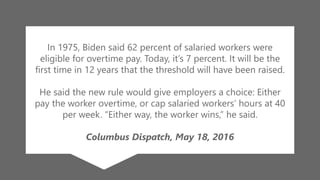
In 1975, Biden said 62 percent of salaried workers were
eligible for overtime pay. Today, it’s 7 percent. It will be the
first time in 12 years that the threshold will have been raised.
He said the new rule would give employers a choice: Either
pay the worker overtime, or cap salaried workers’ hours at 40
per week. “Either way, the worker wins,” he said.
Columbus Dispatch, May 18, 2016
z
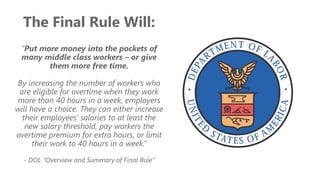
The Final Rule Will:
“Put more money into the pockets of
many middle class workers – or give
them more free time.
By increasing the number of workers who
are eligible for overtime when they work
more than 40 hours in a week, employers
will have a choice. They can either increase
their employees’ salaries to at least the
new salary threshold, pay workers the
overtime premium for extra hours, or limit
their work to 40 hours in a week.”
- DOL “Overview and Summary of Final Rule”
z
Information +
ANALYSIS
z
Internal
z
The Employee Mix: Over + Under $47,476
z
Possible Proxy Data
Key/badge swipe records
Alarm login/logout records
Records of login/logout on
computer network
Cash register log records
Email records
GPS data
z
For Compliance
z
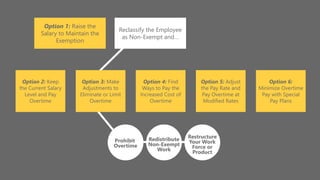
Option 1: Raise the
Salary to Maintain the
Exemption
Option 2: Keep
the Current Salary
Level and Pay
Overtime
Option 3: Make
Adjustments to
Eliminate or Limit
Overtime
Option 4: Find
Ways to Pay the
Increased Cost of
Overtime
Option 5: Adjust
the Pay Rate and
Pay Overtime at
Modified Rates
Option 6:
Minimize Overtime
Pay with Special
Pay Plans
Reclassify the Employee
as Non-Exempt and…
Prohibit
Overtime
Redistribute
Non-Exempt
Work
Restructure
Your Work
Force or
Product
z
Bridge the Pay Gap
1 Raise the salary to maintain the exemption
z
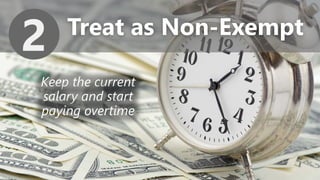
Treat as Non-Exempt
2
Keep the current
salary and start
paying overtime
z
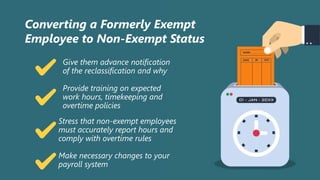
Converting a Formerly Exempt
Employee to Non-Exempt Status
Give them advance notification
of the reclassification and why
Provide training on expected
work hours, timekeeping and
overtime policies
Stress that non-exempt employees
must accurately report hours and
comply with overtime rules
Make necessary changes to your
payroll system
z
Treat as Non-Exempt
3
And make
adjustments to
eliminate or
limit overtime
z
Prohibit
Overtime
Redistribute
Non-Exempt
Work
Restructure
Your Work
Force or
Product
z
Treat as Non-Exempt
4
And find ways to
pay the
increased costs
of overtime
z
Treat as Non-Exempt
5
Adjust the pay
rate and pay
overtime at
modified rates
z
Hourly Rate Conversion
FORMULA
Hourly Rate = Salary ÷
[40+(OT hours x 1.5)]
z
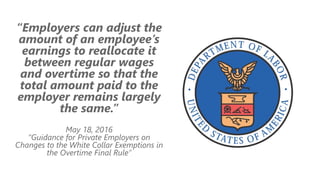
“Employers can adjust the
amount of an employee’s
earnings to reallocate it
between regular wages
and overtime so that the
total amount paid to the
employer remains largely
the same.”
May 18, 2016
“Guidance for Private Employers on
Changes to the White Collar Exemptions in
the Overtime Final Rule”
z
PAY
Adjustment
z
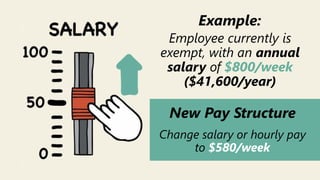
Employee currently is
exempt, with an annual
salary of $800/week
($41,600/year)
New Pay Structure
Change salary or hourly pay
to $580/week
Example:
z
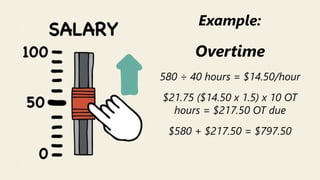
Overtime
580 ÷ 40 hours = $14.50/hour
$21.75 ($14.50 x 1.5) x 10 OT
hours = $217.50 OT due
$580 + $217.50 = $797.50
Example:
z
Treat as Non-Exempt
6
But minimize
overtime pay with
special pay plans
z
Fluctuating Workweek
Employee’s hours fluctuate
from week to week
Employee is paid a fixed salary
– that doesn’t vary with hours
worked (except overtime)
Employee and employer have
a “common understanding”
that the employee will receive
the fixed salary regardless of
the number of hours worked
Employee is paid ½ time
overtime, in addition to the
fixed salary, for all hours in
excess of 40 in a week
z
Fluctuating Workweek
Method: Assumptions
1
Employee is paid a weekly
salary of $800
2
Employee’s hours are
customarily irregular and
vary over and under 40
hours per week
3
Employee understands that
the salary is compensation
for all hours worked in a
given week, which hours
will fluctuate
z
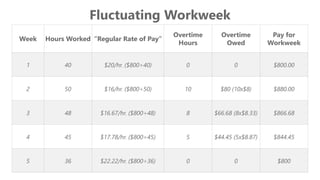
Week Hours Worked “Regular Rate of Pay”
Overtime
Hours
Overtime
Owed
Pay for
Workweek
1 40 $20/hr. ($800÷40) 0 0 $800.00
2 50 $16/hr. ($800÷50) 10 $80 (10x$8) $880.00
3 48 $16.67/hr. ($800÷48) 8 $66.68 (8x$8.33) $866.68
4 45 $17.78/hr. ($800÷45) 5 $44.45 (5x$8.87) $844.45
5 36 $22.22/hr. ($800÷36) 0 0 $800
Fluctuating Workweek
z
Fluctuating Workweek
Pay Plan
A
A Fixed Salary Means a
Fixed Salary
B
Fluctuating Means
Fluctuating
C
There Must Be a Provable
Agreement
D
The DOL (and Some States)
Doesn’t Like It
z
Got Any Other BRIGHT Ideas?
z
Reassess Your Workforce
z
Plan for Periodic
Escalation in
Costs
z
Independent
Contractors?
Don’t Even
Think About It!
z
Think Carefully
About Adjustments
for Newly Non-
Exempt Personnel
z
Timekeeping + Working Hours
z
Common Compensable
Time Issues
1 Off-the-Clock work
2 On-Call Time
3 Training
4 Social Events
5 Meal Time and Breaks
6 Travel
z
Off-Premises Work
z
Cost Forecasts
z
Miscellaneous
Reclassification
ISSUES
Benefit Plans
Handbooks +
Personnel Policies
z
To New
Employee
Morale Issues
z
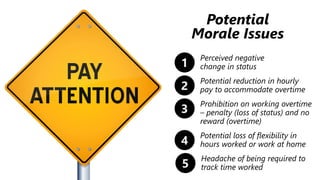
Potential
Morale Issues
1
Perceived negative
change in status
2
Potential reduction in hourly
pay to accommodate overtime
3
Prohibition on working overtime
– penalty (loss of status) and no
reward (overtime)
4
Potential loss of flexibility in
hours worked or work at home
5
Headache of being required to
track time worked
z
Plan Your
Communications
Carefully

The New Overtime Rules: How Will You Comply

  • 1.
    z The New OvertimeRules How Will You Comply?
  • 2.
  • 3.
    z “We’re making moreworkers eligible for the overtime that you’ve earned. And it’s one of the single most important steps we can take to help grow middle-class wages.” President Barack Obama
  • 4.
  • 5.
    z “Overtime is nota problem as long as I pay the employee a salary.”
  • 6.
    z All of youremployees have access to company email + instant messaging on their mobile devices. Since you are concerned that employees may be reading and answering messages “off the clock,” you decide to pay everyone a salary that exceeds the current minimum wage of $455/week That solves the problem, right?
  • 7.
    z “If an employee’stitle is ‘Manager’ or ‘Supervisor,’ and I pay the correct salary, they don’t get overtime.”
  • 8.
    z “I have apolicy written in my handbook that clearly says that all overtime must be approved by a supervisor in advance – or the time will not be paid. Good solution, right?”
  • 9.
    z “Once an employee isexempt, they are always exempt.”
  • 10.
    z “One of yourhourly employees needs Friday of next week off to have her wisdom tooth pulled, but she has no vacation or paid time left. In order to avoid losing pay, she offers to work an extra 8 hours this week. That’s OK, right?”
  • 11.
    z WHITE COLLAR EXEMPTIONS Section 13(a)(1)of the FLSA provides an exemption from both minimum wage and overtime pay for employees who are employed in a bona fide: Executive Administrative Professional Outside Sales Capacity Certain computer employees may be exempt professionals under Section 13(a)(1) or exempt under Section 13(a)(17) of the FLSA
  • 12.
    z 3 Testsfor Exemption 1Salary Basis 2 Job Duties 3 Salary Level
  • 13.
    z Salary Basis Test Regularly receivesa predetermined compensation amount each pay period Compensation cannot be reduced due to variations in quality or quantity of work performed Must be paid full salary for any week in which employee performs any work Need not be paid for any workweek when no work is performed
  • 14.
  • 15.
    z Executive Duties Primary duty ismanagement of the enterprise or of a customarily recognized dept/subdivision Customarily and regularly directs work of 2 or more employees Authority to hire or fire other employees or whose suggestions and recommendations as to hiring, firing, advancement, promotion or other change of status of other employees are given particular weight
  • 16.
    z Administrative Duties Primary duty isperformance of office or non-manual work directly related to management or general business operations of employer or employer’s customers Primary duty includes the exercise of discretion and independent judgment with respect to matters of significance
  • 17.
  • 18.
  • 19.
  • 20.
  • 21.
  • 22.
    z Payment Result Jan.-Mar. $822/wk.plus $2,000 bonus Exempt Apr.-Jun. $822/wk. plus $600 bonus Non-Exempt for Quarter (unless employer pays $583 catch-up by end of first pay period of qtr. 3 Jul.-Sept. $822/wk. plus $2,200 bonus Exempt Oct.-Dec. $822/wk. plus $500 bonus plus $683 catch-up payment Exempt Incentive Payments Catch-up Payments
  • 23.
  • 24.
    z Highly Compensated Test Total annualcompensation of at least $134,004 At least $913 per week paid on a salary or fee basis Performs office or non- manual work Customarily + regularly performs any 1 or more of the exempt duties identified in the standard tests for the executive, administrative, or professional exemptions
  • 25.
  • 26.
    z Prior Regulations NewRegulations Change EAP Minimum Salary Level $455/week $23,660/year $913/week $47,476/year 101% increase Highly Compensated Salary Level $100,000/year $134,004/year 34% increase Automatic Salary Adjustment None Every 3 Years Periodic Automatic Increases Bonuses/Commissions (non-HCE) None Non-discretionary bonuses/commissions, paid quarterly, can constitute 10% of the salary requirement Minimal Salary Increase Relief Duties Test As set forth in regulations No Change Changes At A Glance:
  • 27.
  • 28.
    z “If you workovertime, you should actually get paid for working overtime.” Vice-President Joe Biden
  • 29.
    z In 1975, Bidensaid 62 percent of salaried workers were eligible for overtime pay. Today, it’s 7 percent. It will be the first time in 12 years that the threshold will have been raised. He said the new rule would give employers a choice: Either pay the worker overtime, or cap salaried workers’ hours at 40 per week. “Either way, the worker wins,” he said. Columbus Dispatch, May 18, 2016
  • 30.
    z The Final RuleWill: “Put more money into the pockets of many middle class workers – or give them more free time. By increasing the number of workers who are eligible for overtime when they work more than 40 hours in a week, employers will have a choice. They can either increase their employees’ salaries to at least the new salary threshold, pay workers the overtime premium for extra hours, or limit their work to 40 hours in a week.” - DOL “Overview and Summary of Final Rule”
  • 31.
  • 32.
  • 33.
    z The Employee Mix:Over + Under $47,476
  • 34.
    z Possible Proxy Data Key/badgeswipe records Alarm login/logout records Records of login/logout on computer network Cash register log records Email records GPS data
  • 35.
  • 36.
    z Option 1: Raisethe Salary to Maintain the Exemption Option 2: Keep the Current Salary Level and Pay Overtime Option 3: Make Adjustments to Eliminate or Limit Overtime Option 4: Find Ways to Pay the Increased Cost of Overtime Option 5: Adjust the Pay Rate and Pay Overtime at Modified Rates Option 6: Minimize Overtime Pay with Special Pay Plans Reclassify the Employee as Non-Exempt and… Prohibit Overtime Redistribute Non-Exempt Work Restructure Your Work Force or Product
  • 37.
    z Bridge the PayGap 1 Raise the salary to maintain the exemption
  • 38.
    z Treat as Non-Exempt 2 Keepthe current salary and start paying overtime
  • 39.
    z Converting a FormerlyExempt Employee to Non-Exempt Status Give them advance notification of the reclassification and why Provide training on expected work hours, timekeeping and overtime policies Stress that non-exempt employees must accurately report hours and comply with overtime rules Make necessary changes to your payroll system
  • 40.
    z Treat as Non-Exempt 3 Andmake adjustments to eliminate or limit overtime
  • 41.
  • 42.
    z Treat as Non-Exempt 4 Andfind ways to pay the increased costs of overtime
  • 43.
    z Treat as Non-Exempt 5 Adjustthe pay rate and pay overtime at modified rates
  • 44.
    z Hourly Rate Conversion FORMULA HourlyRate = Salary ÷ [40+(OT hours x 1.5)]
  • 45.
    z “Employers can adjustthe amount of an employee’s earnings to reallocate it between regular wages and overtime so that the total amount paid to the employer remains largely the same.” May 18, 2016 “Guidance for Private Employers on Changes to the White Collar Exemptions in the Overtime Final Rule”
  • 46.
  • 47.
    z Employee currently is exempt,with an annual salary of $800/week ($41,600/year) New Pay Structure Change salary or hourly pay to $580/week Example:
  • 48.
    z Overtime 580 ÷ 40hours = $14.50/hour $21.75 ($14.50 x 1.5) x 10 OT hours = $217.50 OT due $580 + $217.50 = $797.50 Example:
  • 49.
    z Treat as Non-Exempt 6 Butminimize overtime pay with special pay plans
  • 50.
    z Fluctuating Workweek Employee’s hoursfluctuate from week to week Employee is paid a fixed salary – that doesn’t vary with hours worked (except overtime) Employee and employer have a “common understanding” that the employee will receive the fixed salary regardless of the number of hours worked Employee is paid ½ time overtime, in addition to the fixed salary, for all hours in excess of 40 in a week
  • 51.
    z Fluctuating Workweek Method: Assumptions 1 Employeeis paid a weekly salary of $800 2 Employee’s hours are customarily irregular and vary over and under 40 hours per week 3 Employee understands that the salary is compensation for all hours worked in a given week, which hours will fluctuate
  • 52.
    z Week Hours Worked“Regular Rate of Pay” Overtime Hours Overtime Owed Pay for Workweek 1 40 $20/hr. ($800÷40) 0 0 $800.00 2 50 $16/hr. ($800÷50) 10 $80 (10x$8) $880.00 3 48 $16.67/hr. ($800÷48) 8 $66.68 (8x$8.33) $866.68 4 45 $17.78/hr. ($800÷45) 5 $44.45 (5x$8.87) $844.45 5 36 $22.22/hr. ($800÷36) 0 0 $800 Fluctuating Workweek
  • 53.
    z Fluctuating Workweek Pay Plan A AFixed Salary Means a Fixed Salary B Fluctuating Means Fluctuating C There Must Be a Provable Agreement D The DOL (and Some States) Doesn’t Like It
  • 54.
    z Got Any OtherBRIGHT Ideas?
  • 55.
  • 56.
  • 57.
  • 58.
    z Think Carefully About Adjustments forNewly Non- Exempt Personnel
  • 59.
  • 60.
    z Common Compensable Time Issues 1Off-the-Clock work 2 On-Call Time 3 Training 4 Social Events 5 Meal Time and Breaks 6 Travel
  • 61.
  • 62.
  • 63.
  • 64.
  • 65.
    z Potential Morale Issues 1 Perceived negative changein status 2 Potential reduction in hourly pay to accommodate overtime 3 Prohibition on working overtime – penalty (loss of status) and no reward (overtime) 4 Potential loss of flexibility in hours worked or work at home 5 Headache of being required to track time worked
  • 66.