J o i n t
P r o b a b i l i t y
D i s t r i b u t i o n
Prepared by: Marjorie M. Estuita
MAT-Math
Objectiv
es
At the end of the session, the
learners should be able to:
1. Define joint probability
distribution.
2. Learn what the joint
probability of two independent
events is.
3. Understand how to calculate
joint probability through using
the joint probability formula.
4. Solve simple exercises
involving joint probability
distribution.
D e fi n i t i o n
Probability is the likelihood that something will happen. One
common probability that many people experience every day is
given in the weather report. The chance of rain is a probability,
or likelihood, that it will rain on a given day. The probability is
given in percentage points, such as '20% chance of rain, where
the percentage indicates the probability of the event, rain.
What is Joint Probability?
The word joint implies multiple things joined together and
that is just what joint probability is, the likelihood of two
independent events happening at the same time. There are
two important keys to joint probability:
1.The events must happen at the same time.
2.The events must be independent of each other.
Events are independent when they are not conditional on each other. For
example, when rolling two dice, the result for the second has nothing to do with the
result on the first. The two dice are not connected in any way, thus the result for each is
independent. Dice are thrown at the same time, tumble to a stop simultaneously, and
one cube in no way impacts the other; this is a perfect example of joint probability. The
probability of rolling a 6 on either die is 16 regardless of what comes up on the other
die.
Drawing colored marbles out of a bag leads to two scenarios: one a joint
probability problem and one that does not comply with the joint probability definition.
Joint Probability Formula
Knowing what joint probability is does not help to figure out how to
calculate joint probability. The joint probability formula is very simple and
straight forward:
P(A∩B) = P(A)×P(B)
Where:
 P(A∩B) is the joint probability of two events (A, B) (note the
mathematical symbol for the union of the two variables in the formula),
 P(A) is the probability of the first event on its own, and
 P(B)is the probability of the second event on its own.
Example2:
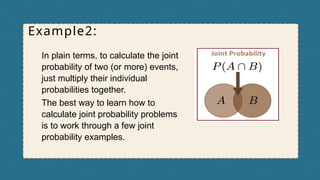
In plain terms, to calculate the joint
probability of two (or more) events,
just multiply their individual
probabilities together.
The best way to learn how to
calculate joint probability problems
is to work through a few joint
probability examples.
Joint Probability Examples
Many joint probability examples come in the
form of dice-throwing scenarios. The first joint
probability examples will focus on the rolling of
dice.
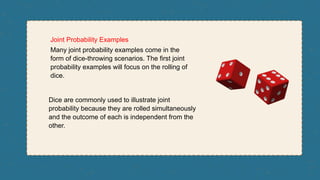
Dice are commonly used to illustrate joint
probability because they are rolled simultaneously
and the outcome of each is independent from the
other.
Joint Probability with Dice: Example 1
Two fair dice are thrown. What is the probability that each will land on a 6?
Step 1
Determine the probability of each event. Since there is only one 6 on each dice
and there are six sides to each, then the probability of each is
Step 2
Multiply the probability of the events together.
Step 3 (optional)
Convert the resulting product into a percentage by dividing out the fraction and
then multiplying the result by 100. = 0.027777 = 2.8%.
There is a 2.8% chance that both cubes will land on 6.
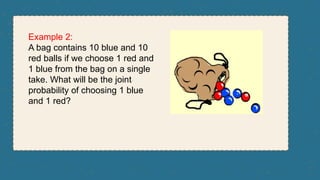
Example 2:
A bag contains 10 blue and 10
red balls if we choose 1 red and
1 blue from the bag on a single
take. What will be the joint
probability of choosing 1 blue
and 1 red?
Solution:
 Possible outcomes = (red, blue),(blue, red),(red, red),
(blue, blue)=4
 Favorable outcomes = (red, blue) or (blue, red) = 1
 Probability of choosing red ball = P(A)
 Probability of choosing blue ball = P(B)
 P(A∩B) = P(A)×P(B) =
Joint Probability Distribution
A joint probability distribution shows a
probability distribution for two (or more)
random variables. Instead of events
being labeled A and B, the norm is to
use X and Y. The formal definition is:
f(x, y) = P(X = x, Y = y)
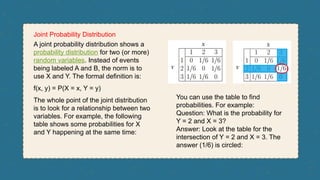
The whole point of the joint distribution
is to look for a relationship between two
variables. For example, the following
table shows some probabilities for X
and Y happening at the same time:
You can use the table to find
probabilities. For example:
Question: What is the probability for
Y = 2 and X = 3?
Answer: Look at the table for the
intersection of Y = 2 and X = 3. The
answer (1/6) is circled:
Exercises
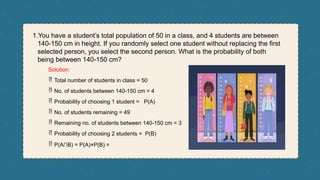
1.You have a student’s total population of 50 in a class, and 4 students are between
140-150 cm in height. If you randomly select one student without replacing the first
selected person, you select the second person. What is the probability of both
being between 140-150 cm?
Solution:
 Total number of students in class = 50
 No. of students between 140-150 cm = 4
 Probability of choosing 1 student = P(A)
 No. of students remaining = 49
 Remaining no. of students between 140-150 cm = 3
 Probability of choosing 2 students = P(B)
 P(A∩B) = P(A)×P(B) =
2. Consider the roll of a die and let A = 1 if the number is even (2, 4, or 6)
and A = 0 otherwise. Furthermore, let B = 1 if the number is prime (2, 3 or
5) and B = 0 otherwise. Find the Joint Distribution of A and B?
Solution:
• P(A = 0, B = 0) = {1} =
• P(A = 0, B = 1) = {3, 5} =
• P(A = 1, B = 0) = {4, 6} =
• P(A = 1, B = 1) = {2} =
Thank you

Join-Probability-Distribution-Estuita-Marjorie-M.pptx

  • 1.
    J o in t P r o b a b i l i t y D i s t r i b u t i o n Prepared by: Marjorie M. Estuita MAT-Math
  • 2.
    Objectiv es At the endof the session, the learners should be able to: 1. Define joint probability distribution. 2. Learn what the joint probability of two independent events is. 3. Understand how to calculate joint probability through using the joint probability formula. 4. Solve simple exercises involving joint probability distribution.
  • 3.
    D e fin i t i o n Probability is the likelihood that something will happen. One common probability that many people experience every day is given in the weather report. The chance of rain is a probability, or likelihood, that it will rain on a given day. The probability is given in percentage points, such as '20% chance of rain, where the percentage indicates the probability of the event, rain.
  • 4.
    What is JointProbability? The word joint implies multiple things joined together and that is just what joint probability is, the likelihood of two independent events happening at the same time. There are two important keys to joint probability: 1.The events must happen at the same time. 2.The events must be independent of each other.
  • 5.
    Events are independentwhen they are not conditional on each other. For example, when rolling two dice, the result for the second has nothing to do with the result on the first. The two dice are not connected in any way, thus the result for each is independent. Dice are thrown at the same time, tumble to a stop simultaneously, and one cube in no way impacts the other; this is a perfect example of joint probability. The probability of rolling a 6 on either die is 16 regardless of what comes up on the other die. Drawing colored marbles out of a bag leads to two scenarios: one a joint probability problem and one that does not comply with the joint probability definition.
  • 6.
    Joint Probability Formula Knowingwhat joint probability is does not help to figure out how to calculate joint probability. The joint probability formula is very simple and straight forward: P(A∩B) = P(A)×P(B) Where:  P(A∩B) is the joint probability of two events (A, B) (note the mathematical symbol for the union of the two variables in the formula),  P(A) is the probability of the first event on its own, and  P(B)is the probability of the second event on its own.
  • 7.
    Example2: In plain terms,to calculate the joint probability of two (or more) events, just multiply their individual probabilities together. The best way to learn how to calculate joint probability problems is to work through a few joint probability examples.
  • 8.
    Joint Probability Examples Manyjoint probability examples come in the form of dice-throwing scenarios. The first joint probability examples will focus on the rolling of dice. Dice are commonly used to illustrate joint probability because they are rolled simultaneously and the outcome of each is independent from the other.
  • 9.
    Joint Probability withDice: Example 1 Two fair dice are thrown. What is the probability that each will land on a 6? Step 1 Determine the probability of each event. Since there is only one 6 on each dice and there are six sides to each, then the probability of each is Step 2 Multiply the probability of the events together. Step 3 (optional) Convert the resulting product into a percentage by dividing out the fraction and then multiplying the result by 100. = 0.027777 = 2.8%. There is a 2.8% chance that both cubes will land on 6.
  • 10.
    Example 2: A bagcontains 10 blue and 10 red balls if we choose 1 red and 1 blue from the bag on a single take. What will be the joint probability of choosing 1 blue and 1 red?
  • 11.
    Solution:  Possible outcomes= (red, blue),(blue, red),(red, red), (blue, blue)=4  Favorable outcomes = (red, blue) or (blue, red) = 1  Probability of choosing red ball = P(A)  Probability of choosing blue ball = P(B)  P(A∩B) = P(A)×P(B) =
  • 12.
    Joint Probability Distribution Ajoint probability distribution shows a probability distribution for two (or more) random variables. Instead of events being labeled A and B, the norm is to use X and Y. The formal definition is: f(x, y) = P(X = x, Y = y) The whole point of the joint distribution is to look for a relationship between two variables. For example, the following table shows some probabilities for X and Y happening at the same time: You can use the table to find probabilities. For example: Question: What is the probability for Y = 2 and X = 3? Answer: Look at the table for the intersection of Y = 2 and X = 3. The answer (1/6) is circled:
  • 13.
  • 14.
    1.You have astudent’s total population of 50 in a class, and 4 students are between 140-150 cm in height. If you randomly select one student without replacing the first selected person, you select the second person. What is the probability of both being between 140-150 cm? Solution:  Total number of students in class = 50  No. of students between 140-150 cm = 4  Probability of choosing 1 student = P(A)  No. of students remaining = 49  Remaining no. of students between 140-150 cm = 3  Probability of choosing 2 students = P(B)  P(A∩B) = P(A)×P(B) =
  • 15.
    2. Consider theroll of a die and let A = 1 if the number is even (2, 4, or 6) and A = 0 otherwise. Furthermore, let B = 1 if the number is prime (2, 3 or 5) and B = 0 otherwise. Find the Joint Distribution of A and B? Solution: • P(A = 0, B = 0) = {1} = • P(A = 0, B = 1) = {3, 5} = • P(A = 1, B = 0) = {4, 6} = • P(A = 1, B = 1) = {2} =
  • 17.