Popular Indian 
Literature Figures 
PRESENTED BY-MAYUR 
(029) 
DEEP(030) 
KHYATI(031) 
BHUMI(032) 
DEVANSHI(033) 
KHADIJA(034) 
PARTH(035)
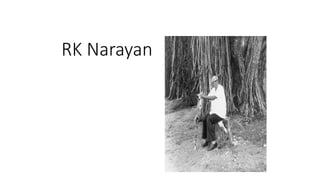
RK Narayan
Writing Struggle 
• Even though Narayan is a well respected writer now, his early years 
were not that easy. In his autobiography, he mentions how he wrote 
several stories revolving around matrimony, for his uncle’s friend who 
was starting a magazine on it. Later, the editor said, that he would 
publish the stories one by one, over a period of time, and the 
payment too was delayed. Or not made at all. I am not sure. 
The whole concept of him becoming a writer, was in itself a very 
uncomfortable pill to swallow for his family. 
“Unwisdom! Unwisdom!” one gentleman cried. “You could write as 
a hobby, how can you make a living as a writer? The notion is very 
unpractical.”
Success At Last! 
• His novel did ultimately get published, and in quite a dramatic 
fashion. 
After being rejected by half-a-dozen publishers in England, he asked 
his friend Purna, to weigh it with a stone and drop it into the Thames 
river. 
Better sense prevailed, and Purna sent the novel to Graham Greene. 
He said that the book was one in ten thousand and found a publisher 
for Swami and Friends. 
The novel despite being well received did not do well as far as sales 
are concerned. 
The publisher, Hamish Hamilton, refused to publish his second novel,
RK Narayan 
• Besides his fictional work he has written, the two great Indian epics- 
Ramayana and Mahabharata, a healthy amount of essays, an 
autobiography, a travelogue, and also a Guide Book of Karnataka, 
which he republished as ‘The Emerald Route’ under his own 
publication. 
“It may sound hyperbolic, but I am prepared to state that almost 
every individual among the five hundred millions living in India is 
aware of the story of the Ramayana in some measure or the other. 
Everyone of whatever age, outlook, education, or station in life knows 
the essential part of the epic.” 
“As a fiction writer, I have enjoyed reading Kamban, felt the 
stimulation of his poetry and the felicity of his language, admired the
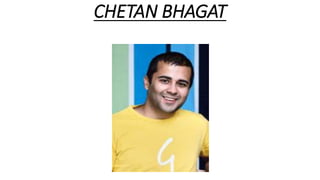
CHETAN BHAGAT
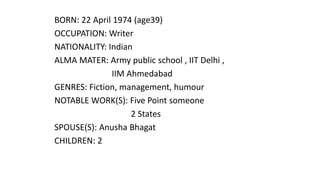
BORN: 22 April 1974 (age39) 
OCCUPATION: Writer 
NATIONALITY: Indian 
ALMA MATER: Army public school , IIT Delhi , 
IIM Ahmedabad 
GENRES: Fiction, management, humour 
NOTABLE WORK(S): Five Point someone 
2 States 
SPOUSE(S): Anusha Bhagat 
CHILDREN: 2
• Chetan Bhagat is an indian author 
,columnist(Journalist) and speaker. 
• He is the author of bestselling novels like 
five point someone, 
one night@ call center ,etc. 
• All the books have remained bestsellers since their 
release and the three have inspired bollywood films 
like 3 Idiots and Kai Po Che! 
• He writes op-ed columns for popular english and 
hindi newspapers, including “The Times Of India” and 
“Dainik Bhaskar”, focusing on youth, career and issues 
based on national development. 
• He quits his investment banking career in 2009, to 
focus on writing.
His Books 
• The 3 mistake of my life 
• 2 states(the story about my marriage) 
• 5 point someone 
• One night @ call center 
• Revolution 2020 
• What Young India Wants 
• Half GirlFriend
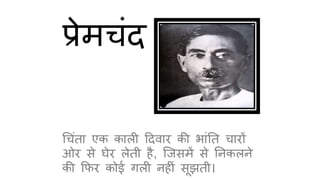
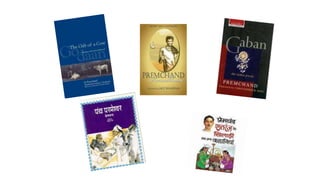
प्रेमचंद 
चचतंा एक काली ददवार की भांतत चारों 
ओर से घेर लेती है, जिसमें से तिकलिे 
की फिर कोई गली िहीं सूझती।
• Premchand was born on 31 July 1880 in Lamahi, a 
village located near Varanasi. 
• His mother died when he was 7 and his father 
remarried. 
• He got married when he was 15 to a girl more older 
than him. 
• Being poor in arithmetic skills, he couldn’t sought 
admission in Central Hindu College. 
• Remarried to Shivrani Devi.
• He wrote over three hundred short stories and 
fourteen novels, many essays and letters, plays and 
translations 
• Also he is considered the first Hindi author whose 
writings prominently featured realism and rational 
thoughts. 
• Died on 8 October 1936 due to poor health
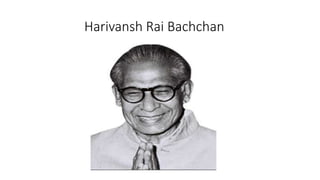
Harivansh Rai Bachchan
Life of Harivansh Rai Bachchan 
He was born as Harivanshrai Srivastava into a Kayasth 
family on November 27, 1907 at a small town (of Patti, 
in district of Pratapgarh,U.P.) near Allahabad in the 
United Provinces (modern Uttar Pradesh). 
He was called “bachchan” (meaning ‘child’) at home. 
He received his formal schooling in a municipal school 
and followed the family tradition of attending Kayasth 
Paathshaalas to learn Urdu as the first step to a career in 
law. 
He later studied at the Allahabad University and Banaras 
Hindu University.
WORKS 
He is best known for his early lyric poem Madhushala 
(The House of Wine), which has been translated into 
English and many regional Indian languages including 
Bengali, Marathi and Malayalam. 
There are some poem of harivanshrai bachchan 
Tera har (1932) 
Madhushala(1935) 
Madhubala(1936) 
Madhukalash(1937) 
Ekaant sangit(1939) 
Milan yamini(1950) 
Bahut din bite(1967)
A Brief History 
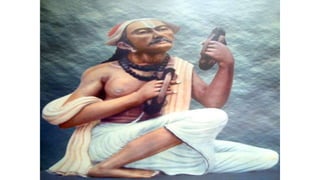
• Narsinh Mehta was born in Vadnagar Nagar community at Talaja and later shifted 
to Junagadh (then Jirndurg) in Saurashtra, Gujarat. He lost his parents when he 
was 5 years old. He could not speak until the age of 8. He was raised by his grand 
mother Jaygauri.[1] 
• He married Manekbai probably in the year 1429. Mehta and his wife stayed at his 
brother Bansidhar’s place in Junagadh. 
• However, his cousin's wife (Sister-in-law or bhabhi) did not welcome Narsinh very 
well. She was an ill-tempered woman, always taunting and insulting Narsinh 
mehta for his worship (Bhakti). One day, when Narasinh mehta had enough of 
these taunts and insults, he left the house and went to a nearby forest in search 
of some peace.
Famous Works 
• Mehta is a pioneer poet of Gujarati literature. He is known for his 
literary forms called " pada (verse) ", " Aakhyan ", & " Prabhatiya ". 
One of the most important features of Mehta’s works is that they are 
not available in the language in which Narsinh had composed them. 
• They have been largely preserved orally. The oldest available 
manuscript of his work is dated around 1612, and was found by the 
noted scholar K.K.Shastri from Gujarat Vidhya Sabha. 
• Because of the immense popularity of his works, their language has 
undergone modifications with changing times.
RABINDRANATH TAGORE
Brief Introduction Of 
Tagore: 
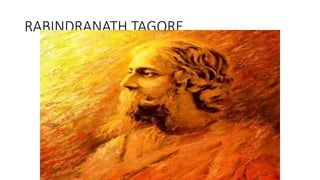
• Born: Rabindranath Thakur ,7 May 1861 Calcutta, Bengal Presidency, British India. 
• Died: 7 August 1941 (aged 80). 
• Occupation: Poet, short story writer, song composer, novelist, playwright, essayist, painter. 
• Language: Bengali, English. 
• Nationality: British India. 
• Ethnicity : Bengali. 
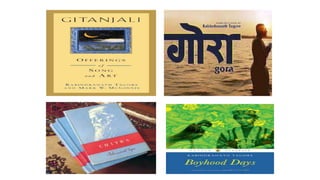
• Notable works : Gitanjali, Gora, Ghare-Baire, Jana Gana Mana, Rabindra Sangeet, Amar 
Shonar Bangla (other works) 
• Notable awards: Nobel Prize in Literature 1913 
• Spouse : Mrinalini Devi (m. 1883–1902) 
• Children: five children, two of whom died in childhood
Early life of Rabindranath 
Tagore:- 
• Family background 
• Dwarkanath Tagore Lane,Jorasanko — the address of his family 
mansion. 
• Jorasanko was located in the Bengali section of north Kolkata located 
near Chitpur Road. 
• He was the son of Debendranath Tagore and Sarada Devi 
Debendranath Tagore had formulated the Brahmo faith.
His Childhood : 
• Tagore, nicknamed "Rabi," was born the youngest of fifteen children . 
• Tagore was also tutored at home by Hemendranath, his brother. 
• Also physical tasks for example, swimming in the Ganges River, taking 
long treks through hilly areas, and practicing judo and wrestling he 
was also given Bengali-language lessons in anatomy, drawing, English 
language geography, gymnastics, history, literature, mathematics, and 
Sanskrit imparted before and after school.
Schooling in England (1874–1900):- 
• In early October 1878, Tagore travelled to England with the intent of 
becoming a barrister. 
• He enrolled at University College London. However, he never 
completed his degree, leaving England after staying just over a year. 
• This exposure to English culture and language would later percolate 
into his earlier acquaintance with Bengali musical tradition, allowing 
him to create new modes of music, poetry, and drama.
Last Days Of Tagore: 
• Rabindranath Tagore has undergone an operation called 'Supra pubic 
Cystostomy ' after the operation the severe infective process took 
place. 
• Penicillin or other Antibiotics were not invented till then. 
• After a span of painful 7 days Rabindranath left the world. 
• A lecturer, a dreamer of universal brotherhood, which he was never 
able to bring about between Hindus and Muslims. 
• His purpose was to harmonize the mystical mind of the East with the 
Western rationalism.
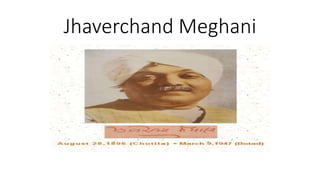
Jhaverchand Meghani
Works and tributes 
• Jhaverchand Meghani was a noted poet, litterateur, social reformer 
and freedom fighter from Gujarat. 
• He is a well-known name in the field of Gujarati literature. 
• Born in Chotila. 
• He received many awards like ”Ranjitram Suvarna 
Chandrak” and ”Mahida Paaritoshik” in literature. 
• He authored more than 100 books. 
• His first book was a translation work of Rabindranath Tagore's 
ballad Kathaa-u-Kaahinee titled Kurbani Ni Katha (Stories of 
martyrdom) which was first published in 1922.
Continue… 
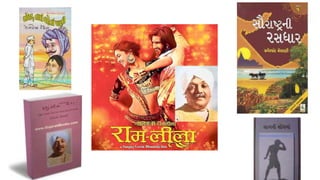
• He contributed widely to Gujarati folk literature. 
• He went from village to village in search of folk-lores and published 
them in various volumes of Saurashtra Ni Rasdhar. 
• He was also the Editor of Phoolchhab Newspaper of Janmabhoomi 
group.
Conclusion 
• Studying world literature is a great thing. 
• You can gain so much from it 
• You have to do critical thinking on stories to see if you understand 
them. It will help prepare you for college so you learn how to read 
faster and interpreted a reading from another culture. 
• Some advice for a student that will be taking world literature in the 
future or is taking right now is to read.

G5-pre

  • 1.
    Popular Indian LiteratureFigures PRESENTED BY-MAYUR (029) DEEP(030) KHYATI(031) BHUMI(032) DEVANSHI(033) KHADIJA(034) PARTH(035)
  • 2.
  • 3.
    Writing Struggle •Even though Narayan is a well respected writer now, his early years were not that easy. In his autobiography, he mentions how he wrote several stories revolving around matrimony, for his uncle’s friend who was starting a magazine on it. Later, the editor said, that he would publish the stories one by one, over a period of time, and the payment too was delayed. Or not made at all. I am not sure. The whole concept of him becoming a writer, was in itself a very uncomfortable pill to swallow for his family. “Unwisdom! Unwisdom!” one gentleman cried. “You could write as a hobby, how can you make a living as a writer? The notion is very unpractical.”
  • 4.
    Success At Last! • His novel did ultimately get published, and in quite a dramatic fashion. After being rejected by half-a-dozen publishers in England, he asked his friend Purna, to weigh it with a stone and drop it into the Thames river. Better sense prevailed, and Purna sent the novel to Graham Greene. He said that the book was one in ten thousand and found a publisher for Swami and Friends. The novel despite being well received did not do well as far as sales are concerned. The publisher, Hamish Hamilton, refused to publish his second novel,
  • 5.
    RK Narayan •Besides his fictional work he has written, the two great Indian epics- Ramayana and Mahabharata, a healthy amount of essays, an autobiography, a travelogue, and also a Guide Book of Karnataka, which he republished as ‘The Emerald Route’ under his own publication. “It may sound hyperbolic, but I am prepared to state that almost every individual among the five hundred millions living in India is aware of the story of the Ramayana in some measure or the other. Everyone of whatever age, outlook, education, or station in life knows the essential part of the epic.” “As a fiction writer, I have enjoyed reading Kamban, felt the stimulation of his poetry and the felicity of his language, admired the
  • 6.
  • 7.
    BORN: 22 April1974 (age39) OCCUPATION: Writer NATIONALITY: Indian ALMA MATER: Army public school , IIT Delhi , IIM Ahmedabad GENRES: Fiction, management, humour NOTABLE WORK(S): Five Point someone 2 States SPOUSE(S): Anusha Bhagat CHILDREN: 2
  • 8.
    • Chetan Bhagatis an indian author ,columnist(Journalist) and speaker. • He is the author of bestselling novels like five point someone, one night@ call center ,etc. • All the books have remained bestsellers since their release and the three have inspired bollywood films like 3 Idiots and Kai Po Che! • He writes op-ed columns for popular english and hindi newspapers, including “The Times Of India” and “Dainik Bhaskar”, focusing on youth, career and issues based on national development. • He quits his investment banking career in 2009, to focus on writing.
  • 9.
    His Books •The 3 mistake of my life • 2 states(the story about my marriage) • 5 point someone • One night @ call center • Revolution 2020 • What Young India Wants • Half GirlFriend
  • 10.
    प्रेमचंद चचतंा एककाली ददवार की भांतत चारों ओर से घेर लेती है, जिसमें से तिकलिे की फिर कोई गली िहीं सूझती।
  • 11.
    • Premchand wasborn on 31 July 1880 in Lamahi, a village located near Varanasi. • His mother died when he was 7 and his father remarried. • He got married when he was 15 to a girl more older than him. • Being poor in arithmetic skills, he couldn’t sought admission in Central Hindu College. • Remarried to Shivrani Devi.
  • 12.
    • He wroteover three hundred short stories and fourteen novels, many essays and letters, plays and translations • Also he is considered the first Hindi author whose writings prominently featured realism and rational thoughts. • Died on 8 October 1936 due to poor health
  • 14.
  • 15.
    Life of HarivanshRai Bachchan He was born as Harivanshrai Srivastava into a Kayasth family on November 27, 1907 at a small town (of Patti, in district of Pratapgarh,U.P.) near Allahabad in the United Provinces (modern Uttar Pradesh). He was called “bachchan” (meaning ‘child’) at home. He received his formal schooling in a municipal school and followed the family tradition of attending Kayasth Paathshaalas to learn Urdu as the first step to a career in law. He later studied at the Allahabad University and Banaras Hindu University.
  • 16.
    WORKS He isbest known for his early lyric poem Madhushala (The House of Wine), which has been translated into English and many regional Indian languages including Bengali, Marathi and Malayalam. There are some poem of harivanshrai bachchan Tera har (1932) Madhushala(1935) Madhubala(1936) Madhukalash(1937) Ekaant sangit(1939) Milan yamini(1950) Bahut din bite(1967)
  • 18.
    A Brief History • Narsinh Mehta was born in Vadnagar Nagar community at Talaja and later shifted to Junagadh (then Jirndurg) in Saurashtra, Gujarat. He lost his parents when he was 5 years old. He could not speak until the age of 8. He was raised by his grand mother Jaygauri.[1] • He married Manekbai probably in the year 1429. Mehta and his wife stayed at his brother Bansidhar’s place in Junagadh. • However, his cousin's wife (Sister-in-law or bhabhi) did not welcome Narsinh very well. She was an ill-tempered woman, always taunting and insulting Narsinh mehta for his worship (Bhakti). One day, when Narasinh mehta had enough of these taunts and insults, he left the house and went to a nearby forest in search of some peace.
  • 19.
    Famous Works •Mehta is a pioneer poet of Gujarati literature. He is known for his literary forms called " pada (verse) ", " Aakhyan ", & " Prabhatiya ". One of the most important features of Mehta’s works is that they are not available in the language in which Narsinh had composed them. • They have been largely preserved orally. The oldest available manuscript of his work is dated around 1612, and was found by the noted scholar K.K.Shastri from Gujarat Vidhya Sabha. • Because of the immense popularity of his works, their language has undergone modifications with changing times.
  • 20.
  • 21.
    Brief Introduction Of Tagore: • Born: Rabindranath Thakur ,7 May 1861 Calcutta, Bengal Presidency, British India. • Died: 7 August 1941 (aged 80). • Occupation: Poet, short story writer, song composer, novelist, playwright, essayist, painter. • Language: Bengali, English. • Nationality: British India. • Ethnicity : Bengali. • Notable works : Gitanjali, Gora, Ghare-Baire, Jana Gana Mana, Rabindra Sangeet, Amar Shonar Bangla (other works) • Notable awards: Nobel Prize in Literature 1913 • Spouse : Mrinalini Devi (m. 1883–1902) • Children: five children, two of whom died in childhood
  • 22.
    Early life ofRabindranath Tagore:- • Family background • Dwarkanath Tagore Lane,Jorasanko — the address of his family mansion. • Jorasanko was located in the Bengali section of north Kolkata located near Chitpur Road. • He was the son of Debendranath Tagore and Sarada Devi Debendranath Tagore had formulated the Brahmo faith.
  • 23.
    His Childhood : • Tagore, nicknamed "Rabi," was born the youngest of fifteen children . • Tagore was also tutored at home by Hemendranath, his brother. • Also physical tasks for example, swimming in the Ganges River, taking long treks through hilly areas, and practicing judo and wrestling he was also given Bengali-language lessons in anatomy, drawing, English language geography, gymnastics, history, literature, mathematics, and Sanskrit imparted before and after school.
  • 24.
    Schooling in England(1874–1900):- • In early October 1878, Tagore travelled to England with the intent of becoming a barrister. • He enrolled at University College London. However, he never completed his degree, leaving England after staying just over a year. • This exposure to English culture and language would later percolate into his earlier acquaintance with Bengali musical tradition, allowing him to create new modes of music, poetry, and drama.
  • 25.
    Last Days OfTagore: • Rabindranath Tagore has undergone an operation called 'Supra pubic Cystostomy ' after the operation the severe infective process took place. • Penicillin or other Antibiotics were not invented till then. • After a span of painful 7 days Rabindranath left the world. • A lecturer, a dreamer of universal brotherhood, which he was never able to bring about between Hindus and Muslims. • His purpose was to harmonize the mystical mind of the East with the Western rationalism.
  • 27.
  • 28.
    Works and tributes • Jhaverchand Meghani was a noted poet, litterateur, social reformer and freedom fighter from Gujarat. • He is a well-known name in the field of Gujarati literature. • Born in Chotila. • He received many awards like ”Ranjitram Suvarna Chandrak” and ”Mahida Paaritoshik” in literature. • He authored more than 100 books. • His first book was a translation work of Rabindranath Tagore's ballad Kathaa-u-Kaahinee titled Kurbani Ni Katha (Stories of martyrdom) which was first published in 1922.
  • 29.
    Continue… • Hecontributed widely to Gujarati folk literature. • He went from village to village in search of folk-lores and published them in various volumes of Saurashtra Ni Rasdhar. • He was also the Editor of Phoolchhab Newspaper of Janmabhoomi group.
  • 31.
    Conclusion • Studyingworld literature is a great thing. • You can gain so much from it • You have to do critical thinking on stories to see if you understand them. It will help prepare you for college so you learn how to read faster and interpreted a reading from another culture. • Some advice for a student that will be taking world literature in the future or is taking right now is to read.